Blog Archives
The Conjuring (2013)
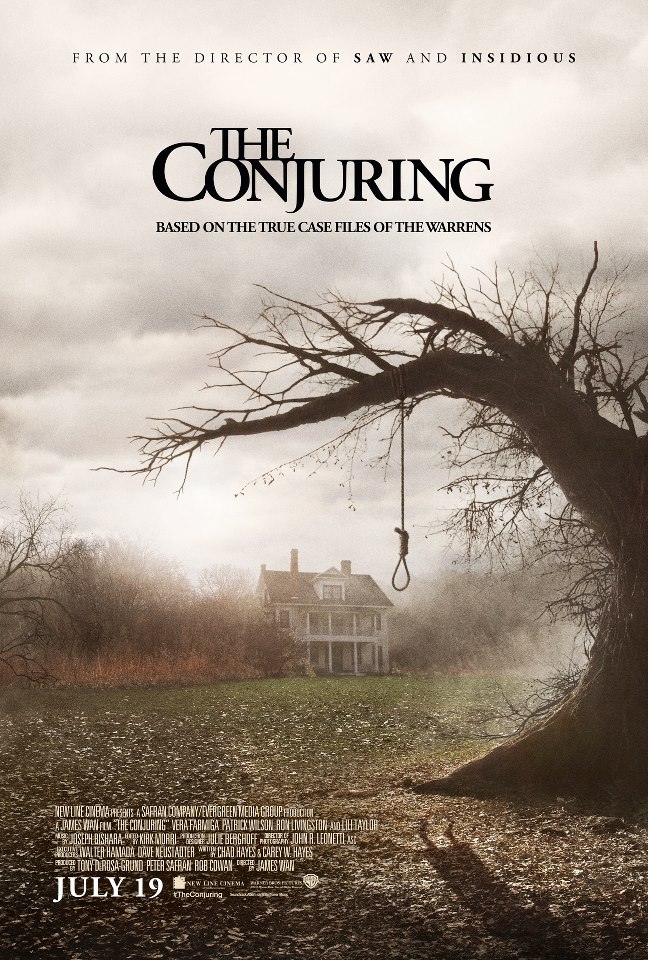 Does it seem like it’s getting harder and harder to scare people? Perhaps audiences have grown jaded by a real world kept at a fever pitch of post-9/11 anxiety and economic uncertainty. It seems that one solution is to just up the gore/gross factor, or overdose on grisly nihilism, but there has to be a law of diminishing returns to pointless shock value. The core elements of a good scary movie will usually be the same: make us care about the people onscreen and make us dread what happens next. What The Conjuring does so well, almost effortlessly, is what all provocative horror movies should accomplish, and that’s the formation of a truly effective spooky atmosphere. There may not even be any gore whatsoever in this film and very minimal jump scares, two overused tools in modern horror filmmaking. This is old school horror played to spine-tingling satisfaction.
Ed and Lorraine Warren (Patrick Wilson and Vera Farmiga) are the top paranormal investigators in the nation. In 1971, they’re asked to determine what is tormenting the Perron family in rural Rhode Island. Carolyn (Lily Taylor) and Roger Perron (Ron Livingston) and their five daughters cannot rest as a vengeful spirit is wrecking havoc with their lives. The spirit wants a body count and won’t go away before it has blood.
 Director James Wan (Saw) and his team take their time to build a direct sense of unease, a chilling mood that leaves you dreading what may happen next. The success of a horror film isn’t necessarily the fear of what you see but more so what you fail to see. The buildup, in essence, is more pivotal than the boo part. Credit also needs to go to twin screenwriters Chad and Carey Hayes (Whiteout, House of Wax) who show off their skill at setting up scares and delivering (I credit their work on Baywatch Nights because, well, someone has to remember that spin-off). The child game of Hide and Clap, where one person wanders blindfolded trying to find their compatriots, requesting three claps to locate them, is just a flat-out terrific idea to parlay into a horror movie. There’s the staple of dramatic irony, realizing what the onscreen character does not, and the increasingly suspenseful dredge into unknown danger. Another example is a wind-up toy that, when its jingle is complete, should reveal something ghostly in its mirror. This is a great device that delivers tension in budding anticipation. Then there’s one daughter’s habit of sleepwalking, which again leads to some effective unease. The Hayes find smart ways to introduce elements to their ghost story and then integrate them again and again in satisfying and spooky ways. Plus there’s all those groping in the dark moments and a super effective sound design. The film does an excellent job of developing old school scares, taking its time to get under your skin.
It also helps when you actually care about the character being tormented. The Conjuring does a good job of making its characters relatable given the outlandish circumstances. At no point does any character really violate the Law of Stupidity, where our allegiance reverses. They even present plausible reasons why the family can’t simply move out of its haunted abode (financially under water, no one to buy the estate, the ghost will just follow them). The Perron clan is a loving family that feels real. The Warrens themselves are given their own vulnerability, which is important since they are the experts. Having a know-it-all character without a weakness doesn’t make for an interesting battle against the paranormal. Lorraine can sense things, yes, but she also loses part of herself every time, thus endangering herself with every new case, making herself more susceptible to the forces she feels she’s been chosen to defend others from. When Lorraine accidentally leaves behind a family locket, with a picture of her daughter, it brings an escalated threat level that hits home for the Warrens. The acting form top to bottom is also exceptional. They don’t oversell the scares. You feel their fear in a palpable way.
Another aspect of a haunting story is the mystery surrounding the angry spirit. If it’s a compelling investigation, you’re intrigued by every new clue or revelation and enjoy how the pieces come together. While there isn’t a complex backstory to the haunting of the Perron home, The Conjuring has enough creepy historical details to add to the overall atmosphere. I enjoyed that the evil spirit cursed anyone who lived on her property, eventually divided up into different owners. I liked that the spirit had a mother-child fixation, turning mothers against their children. And I liked that these peripheral ghosts, many of whom killed themselves in ghastly fashions, also pop up to terrorize the Perrons. It adds further depth to the world of the film while upping the spooky factor.
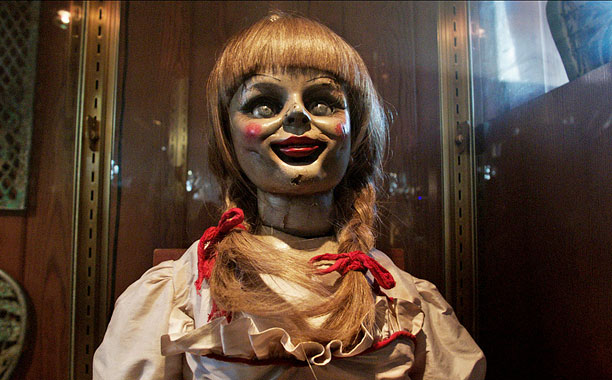 I need to single out one section of the plot that was eerie but also a bit confounding. The opening case doesn’t have anything to do with the Perron family but it does set a nice mood. It’s about a cracked, fraying, and altogether creepy porcelain doll that appears to be possessed and leaving notes for its roommates (“Miss me?”). We later see this creepy doll again because the Warrens have an entire garage filled with creepy artifacts from previous investigations. They argue destroying the possessed items because it would unleash all those demonic forces, so instead the garage serves as a sort of prison (a priest comes by every so often to re-bless the premises, which sounds like a nice side gig for the Vatican). I’ll accept the Warrens reasoning that locking away these dangerous items, each with its own troubling story, is safer for mankind. It’s also just a great set that begs for further analysis to pick apart every artifact. What I do not understand at all is that it looks like the Warrens have no protective lock with this door. Their young daughter stumbles in at one point. I don’t want to give anybody parenting tips, but if you have a room stocked with demonically possessed items that can escape, perhaps, I don’t know, you get a padlock for that door to safeguard against unwanted intrusions.
While entertaining to the end, the third act doesn’t have the same effect because it transitions wholly from a haunted house story into an overt exorcism film. For my tastes, it’s less interesting and exorcism films have always come across as fairly lazy for me. Once you bring a demonic possession and a set of familiar rules, it sort of goes on autopilot and rarely strays from the same template as the most famous of exorcism movies (Naturally I’m talking about Repossessed). For fans of that horror subgenre, they’ll be tickled, but I found it a lesser way to steer the movie to its conclusion. I realize that we’re dealing with the parameters of a personal account (I’m hesitant to say “true story” when it comes to paranormal events, but that’s my own bias), so I understand that this is the direction the story must conclude. I just thought it was a slight downgrade.
If you’re looking for a scary movie this summer, then The Conjuring will do the trick. It’s an old school horror movie that’s more concerned with properly established atmosphere, a mood of dread, and paying off well-developed plot elements that pack a punch. The best compliment I can give Wan, the Hayes, and everyone else involved is that I was squirming throughout much of the movie, uneasily shifting and dreading what was next. There’s a maturity to the film and Wan’s direction, as if he’s patterned his style after the films of the 1970s themselves. After Insidious, Wan definitely knows a thing or two about keeping an audience afraid. There are several moments of unsettling imagery that should find a way to creep out just about everyone. Just remember: don’t invite dolls to live with you, do investigate those strange bruises, and always lock up your demonic possessions, people. In short, The Conjuring doesn’t reinvent the wheel when it comes to ghost stories but it doesn’t have to, because this movie is scary good.
Nate’s Grade: B+
Share this:

The Kings of Summer (2013)
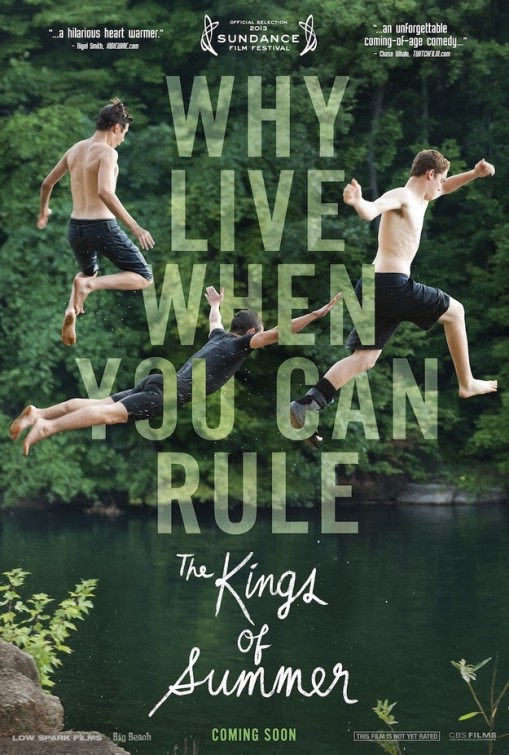 Working part-time at a movie theater in the summers, I come across, let’s say, an interesting selection of customers with… interesting opinions. One middle-aged woman openly opined, while looking at the poster for the coming-of-age comedy The Kings of Summer, that she’s had enough with movies told from a teenage male perspective. While this same woman had very specific and narrow demands for an acceptable movie, she got me thinking. Why do we get so many coming-of-age movies from a male perspective? Let’s forget the easy answer that Hollywood has a lot more male filmmakers than female. There’s always that sense of romance with coming-of-age films, a nostalgic look back at a supposedly simpler time that now seems better appreciated. Maybe men are just more prone to romanticizing the past while women look forward to the future. Or maybe there are really just more men calling the shots about films get made. Whatever the reason, the woman didn’t go see The Kings of Summer, and judging by her attitude, I don’t think she missed out.
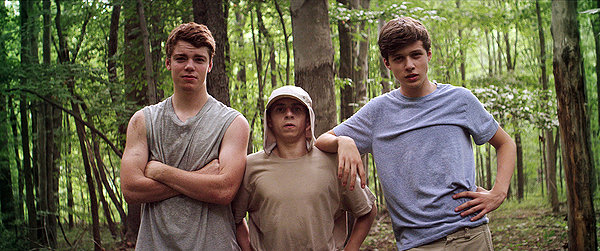 Joe (Nick Robinson) has just finished his freshman year in high school. He has a long summer ahead butting heads with his no-nonsense father (Nick Offerman). Then Joe gets the brilliant idea. He and his pal Patrick (Gabriel Basso), who is also sick of his annoying parents, will build their own home in the woods, a sanctuary where they can set the rules. Joe and Patrick pack up their belongings, find a quiet spot in the woods, and build that dream home. Biaggio (Moises Arias), a weird and gangly kid, takes an interest in the youthful declaration of independence and joins in. The guys invite girls over, explore the wilderness, grow patchy wisps of facial hair, and live out their fantasies of roughing it like real men. Of course it helps when a Boston Market is just down the road.
From start to finish, The Kings of Summer kept me laughing. I did not expect the comedy to be as consistent and thorough as it was, but writer Chris Galletta has a sure handed way of making the comedy derive from the situations and characters. Even with some outsized elements, notably Biaggio and the fact that the boys home-away-from-home is way too advanced for a kid who blundered through shop class, the humor never feels forced. That is an accomplishment, though the script also overly relies on Biaggio to say outlandish or weird lines. I especially enjoyed his one-scene pep talk with his father late in the movie. That confidant sense of humor goes a long way to relax an audience, allowing us to attune to the mellow waves of the film. It’s fun to watch the guys try to forage a life out in the woods, slowly learning how hard this whole survivalist lifestyle may actually be. The adults are viewed as blithe buffoons or hardasses, though they don’t come across as caricatures. Credit the attention paid to Offerman’s (TV’s Parks and Recreation) character as Joe’s father and credit Offerman’s uncanny ability to make gruff parenting endearing. This is an easy film to like, to go along with the flow, and to enjoy. It never really falters in entertainment and routinely has another joke at the ready to make you smile. It’s a sweet movie that does enough to keep you charmed.
While pleasant, I had to stop and reflect that there was absolutely very little to these characters. The boys all kind of blend together in their youthful romanticism of freedom and rebellion of lame parents, but you’d be hard-pressed to describe them beyond core physical descriptions. The moments that do supply character development are mostly broadly comedic or somewhat generic in their coming-of-age tropes, notably the broken heart administered by a guy’s crush. Example: Biaggio is essentially little more than a walking punchline machine. While quite funny and well acted, every line of his dialogue feels like a punchline. He comes from nowhere. At one point, Joe advises Biaggio that a girl may be interested in him, but Biaggio demurs and says that won’t work out. All right, here we go. Here’s where the movie sheds some light on him. Biaggio admits to being gay. The very next line involves him confusing gay with cystic fibrosis. It’s a funny joke but it turns a moment where a character was getting added dimension and just manufactures another punchline. Again, The Kings of Summer is a very pleasant film going experience, and one that made me laugh consistently, but objectively, the impact is too limited because of the lack of proper characterization.
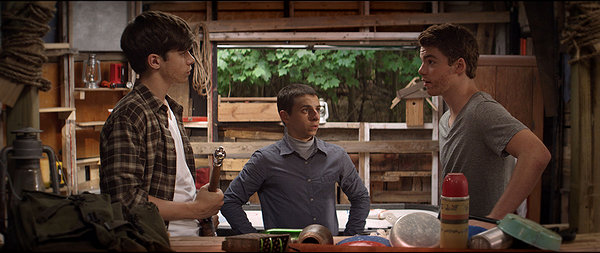 And I suppose this leads into a bigger question of whether this lack of substantial characterization even matters. Coming-of-age movies, like any subgenre in film, have their own expectations and conventions. We all have our different tolerance levels for narrative familiarity, and depending upon the genre, familiarity may be a necessity. Fans of coming-of-age films want to see those familiar elements. They want to see the bonds of friendship, the neglectful parents, the first crushes that lead to first heartaches. It’s just like fans of romantic comedies finding comfort in the two leads hating one another until, inevitably, they love each other, or the public sing-alongs. I think many coming-of-age films at some level tend to be somewhat broad or generic to make them more relatable. Perhaps I’m just being too generous to formulaic pictures. If you’re a fan of coming-of-age movies then you’ll probably be quite forgiving of the shortcomings in The Kings of Summer. Me, I prefer Jeff Nichols’ Mud and its more textured, empathetic look at adolescence in a working poor Missouri riverbed community.
Director Jordan Vogt-Roberts (TV’s Mash Up, Funny or Die Presents…) makes the film look beautiful. The romanticism of the youth running away to live in nature is improved with some spectacular looking natural settings and compositions. The film was primarily filmed in Cleveland and northern Ohio, and as a native Ohioan, I have to puff my chest. Vogt-Roberts is also skilled at handling his actors and balancing tone; while I criticize the over reliance on comedy at the expense of fleshing out characters, the tone is not divergent. It plays within the same cohesive wavelength throughout. If there is a breakout actor from this movie, it would have to be Arias (TV’s Hannah Montana, The Middle). The kid has a tremendous ability to tap into an oddball character, making him quirky rather than insufferable. He also has a unique look to him, and that’s got to be a plus for a working actor. Just ask Steve Buscemi.
Genial and undemanding, The Kings of Summer isn’t anything close to royalty in the coming-of-age genre but it’s consistently funny and enjoyable. The acting is good, the jokes work, and the movie’s out after 90 minutes. It’s a nice summer diversion but doesn’t contain the resonance to be considered more than that. The weak characterization and broad humor, while opening its wide appeal, also makes the film less substantial. It’s sweet and funny but little to distinguish it from other sweet and funny coming-of-age entries. If you’re a fan of the genre or looking for a mellow and pleasant evening at the movies, think of The Kings of Summer. Just don’t think it’s going to be anything more.
Nate’s Grade: B
Share this:

V/H/S/2 (2013)
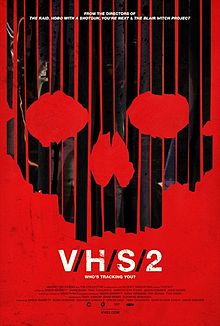 The second entry in the found footage horror anthology (and less than a year after the first to boot) is not as clever as V/H/S but more polished, better paced, and full of enough ingenuity to recommend, especially for horror fans. In my review of the first film I championed a shorter format, giving an audience the thrills they crave faster rather than slogging through an hour of slow buildup. The results are still fairly hit or miss, though none of the four segments is a misfire per se. The weakest is probably the last, “”Slumber Party Alien Abduction,” where the poor camera quality makes it hard to tell what is actually going on. The best, by far, is The Raid director Gareth Evans’ “Safe Haven” about a team of journalists picking perhaps the worst day to tour a creepy cult’s compound, notably during the apocalypse the cult predicted. This one takes a bit to wind up but when all hell breaks loose it goes nuts with glory. The wraparound segment tying everything together is more palatable and points to a promising mythology around the collection of these haunted VHS tapes that people keep watching and then dying over. All together, this is a concept that just works for horror and I’ll welcome presumed sequels as they come off the assembly line. This is found footage done right, with faster payoffs, more variety, and greater focus and ingenuity. If you enjoyed the first film, or are a fan of horror anthologies in general, then pop in V/H/S/2.
Nate’s Grade: B
Share this:

Before Midnight (2013)
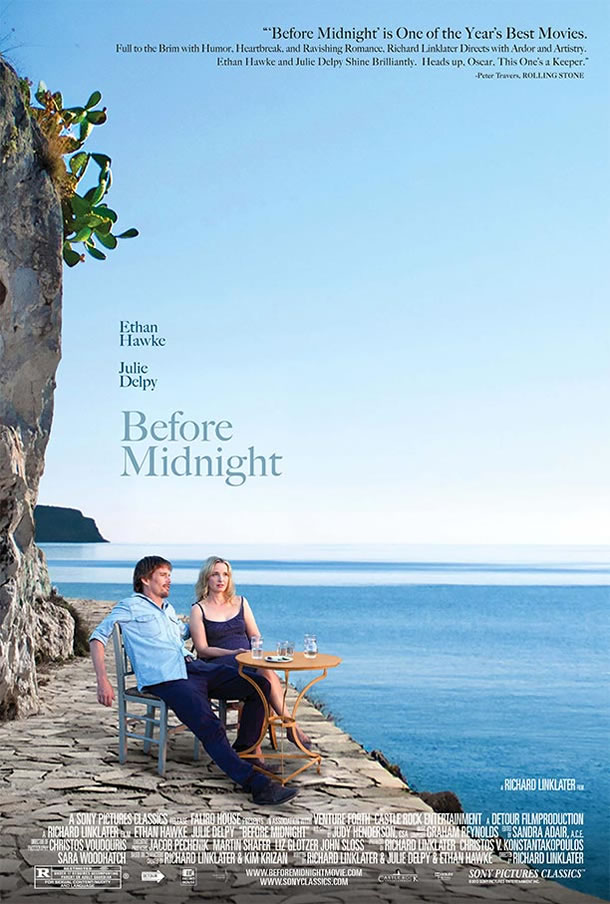 If you’re a fan of writer/director Richard Linklater’s previous movies (Before Sunrise and Before Sunset), as I am, then a new Before movie is a cause of celebration. It feels like we’re checking in with old friends. It’s fascinating to take stock of these characters and their new points in their lives, now approaching middle age. This series is becoming the dramatic equivalent to the 7 Up documentary series that periodically checks up on its subjects every seven years in their lives (56 Up came out this year). Individually, the films are wonderful, but when taken as a whole, the series becomes something truly special, something indelible and sweeping and transporting. Before Midnight is a wonderful movie, brimming with heart as well as ache. It’s also one of the best movies you’ll see this year and another touchstone to the impressive legacy of the series.
In 1995, 23-year-olds Jessie (Ethan Hawke) and Celine (Julie Delpy) met on a train and spent a magical day strolling through Vienna and essentially falling in love. In 2004, Jessie was touring Paris on his book tour, having turned the events of that Vienna night into a successful novel. Celine meets him and the two pal around, reconnecting, with Celine revealing how much that night meant to her as well. Now, in 2013, Jessie and Celine are together, though unmarried, and have twin seven-year-old daughters, Ella and Nina. They’ve been vacationing in Greece for a month while Jessie works on a new novel. Over the course of one long day, the couple will try and stir old passions and question whether they still share the same commitments.
 We’re watching the evolution of two human beings, and your response will vary depending upon your own life’s stopping point at the time of viewing. I must say, as a man now in his early thirties, that I enjoyed Sunrise and Sunset even more, finding greater thematic resonance to the characters, their anxieties, and the concern about faking your way through the “adult world.” I imagine I will find these movies even more emotionally engaging as I continue to age and cross similar hurdles as the characters do. For fans of the series, we’ve already invested 20 years and four hours of screen time with these characters. There’s more at stake when they fight. Watching the other movies beforehand, which I heartily recommend for multiple reasons, also provides stirring points of contrast, the romanticism of youth, the exuberance of promise. What Before Midnight does, and does so exceptionally, is take the romance of the earlier films and put it to the test. There’s a lovely dinner scene with several couples, and you realize that each one is an analogue for Jessie and Celine: the teenagers, the middle-aged couple starting out, the older couple discussing the demise of their previous spouses. It’s hard not to contrast the different stops and the different realities of love by the age.
Fair warning, Before Midnight is the least romantic of all three movies (I want a new movie every 9 years or so until the last one is essentially Amour). The first movie was them connecting. The second movie was about them reconnecting. The third movie establishes that they’ve been together for nine years and have a pair of twin daughters. The focus of Midnight is the struggle of maintaining a long-term relationship, something rarely given such thoughtful, perceptive, and compassionate depth on screen. We’d all rather watch lovebirds make goo-goo eyes at one another while we swoon appropriately, but Midnight’s many battles, small and large, new and ongoing, explore a relationship reality that many should find alarmingly relatable. While the particulars may be different, you may be surprised at how similar these conflicts can be. Exclude stuff like vacationing in Greece, the cushy jobs, and look to the mounting difficulty to retain that spark, a reminder of why you fell in love long ago, with the responsibilities of parenting and work stretching you in different directions. Routine can quickly transform into malaise. Jessie has a teenage son from a previous relationship, and this pushes him into great remorse when the kid departs, making him feel inadequate as a parent, which leads him to suggest unlikely relocation scenarios. Celine, being something of a worst-case scenario creature, notes the moment, saying this is when couples start falling apart. She’s worried he’ll resent her for choosing against a cross-country move. However, as the movie progresses, you realize there are already enough long-simmering resentments between the couple. This is a hard movie to watch at times because Jessie and Celine both go for broke when they argue, and it can get ugly (he dismisses her feelings as “crazy”; she vents about his lack of virility). Ending on a moment of ambiguity, like the other films, it’s perfectly reasonable to assume you just watched a two-hour breakup movie. Their problems don’t really seem resolved but I guess we’ll see in nine years, won’t we? Hopefully the next one isn’t called Before Divorce.
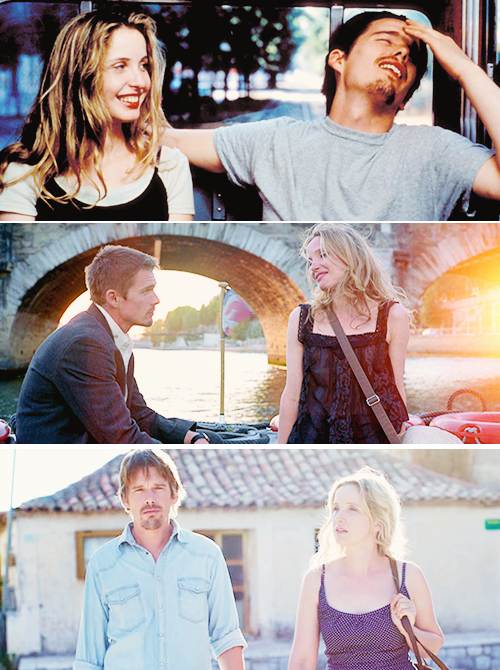 The hallmark of the series, its sparkling conversation, is alive and well, with added maturity and reflection. When you get dialogue this good, this fluidly natural, this engaging, I could listen to them talk for days. In my mini-review for Before Sunset I compared it to listening to birds sing. The shots can last upwards of ten minutes as the camera just slowly walks ahead of Hawke and Delpy as they converse. In the first film we got a foot-tour of Vienna, the second Paris, and now Greece. The sights, while nice, are incidental because I was consumed with the dialogue, which spills so effortlessly from Hawke and Delpy, relishing playing these characters once more. Their give-and-take is often breathless, with nary a pause between them, and it can become overpowering for the uninitiated (lots of old ladies, I have found, dislike this movie, though when asked, none have seen the previous two). But there’s such added dramatic subtext now that we’ve jumped ahead in time. Rather than yearn for the characters to get together, now we’re assembling what we can of their history together and the durable conflicts. The exposition never feels forced, and each new bit provides another prism to view the character actions. You’re studying the characters, parsing their words, sizing up their honesty, and analyzing the various tests and dodges they dole out to one another. It’s a more active experience than you might expect for watching people talk a lot.
Hawke (The Purge) and Delpy (2 Days in New York) are so exquisitely natural with these characters and together and never better. They know these people inside out, and they should because both are credited yet again as co-screenwriters with Linklater. I’d expect another Oscar nomination in their future, much like Before Sunset. Delpy has a wonderful faux youthful voice she uses for hilarious disdain to narrate Jessie’s female fans. Both actors go a long way to flesh out their characters, provide degrees of new wisdom and worry while making us care about their problems. One character does not have the moral high ground, which makes their arguments all the more challenging to process. I don’t want to make it sound like Before Midnight is some twenty-first century Whose Afraid of Virginia Woolfe? There are innumerous moments of humor and grace and compassion, but the louder ringing of the raging conflicts can swallow them up. I also found it intriguing that this is the first movie in the series with nudity from our couple. Granted, it would seem somewhat forward if it happened in Sunrise and Sunset considering the narrow timeframes. As presented in Midnight, it loses erotic context and becomes another indicator of the struggles of maintaining passion.
I want to reiterate that I really hope that Linklater and his stars continue to bless us with a new film every decade, checking back on the lives of Jessie and Celine. The next one, if we continue the nine-year tradition, will deal with them turning fifty, which seems like a grand opportunity for some existential ennui. Also, Jessie son from a previous marriage will be roughly the same age Jessie was in 1995’s Before Sunrise. That could provide another interesting perspective for dad. I’m just not ready to say goodbye to these characters yet. Much like the 7 Up documentary series, the movies provide a point to reflect on our own lives, how we’ve changed and grown, the setbacks and triumphs, surprises and sadness. Catching up with the series, I viewed the movies very differently than I did when I first watched them. The art remains the same but the frame changes; we change. The glorious aspect of Linklater’s series is that we get to chart that change, checking back with old friends we’ve grown with. The movie’s attention to character and the relatable problems of middle age and long-term relationships is rich, nuanced, and just about everything This is 40 should have been and wasn’t. Before Midnight may lack the idealistic romanticism of previous entries but it substitutes a soulfulness to a series that has always been mature beyond its years. Approaching half a life lived, the characters still have plenty of life in them, plenty of dreams worth pursuing, and plenty more hurdles to go. It has been an ongoing privilege to get to spend time with these two. I pray this is not the end but just another stop on what ends up being one of cinema’s definitive statements on love through the ages.
Nate’s Grade: A
Share this:

Frances Ha (2013)
 Noah Baumbach is a filmmaker I generally don’t care for. I quite enjoyed his first feature, the college comedy Kicking and Screaming, and his co-authorship of Wes Anderson’s Fantastic Mr. Fox was a worthy venture. But I normally associate such unrepentant misery with this guy’s movies, chiefly because they’re generally about miserable people being miserable (The Squid and the Whale, Margot at the Wedding, Greenberg). I was surprised then when his new movie Frances Ha got ringing endorsements from several of my trusted female friends, the kind who would not cotton to Baumbach’s usual pedigree of filmmaking. I took the plunge and was captivated by the shrewd, funny, and surprisingly affectionate portrayal of a twenty-something woman finding herself late (ish) in life.
Frances (Greta Gerwig) is an apprentice for a dance company in New York City waiting her turn at much in life. She’s waiting for her post-college life to fall into place; however, her world gets shaken up when her roommate and best friend since college, Sophie (Mickey Sumner), moves out. The distance grows beyond physical proximity and Frances feels like she’s drifting away from her closest friend. In the meantime, she sputters trying to become an adult herself, swapping roommates and living conditions, and getting into trouble with guys, money, and Sophie.
 While a bit freeform in its plot momentum, Frances Ha is a perceptive and ultimately poignant film exploring female friendship dynamics and the perils of growing up. Frances is something of an adorable mess but she’s been treading water for some time, bouncing around, but her window for avoiding the adult world is coming to a close and she knows it, which is why she feels the anxiety that she does. There’s something completely relatable about the anxiety of entering into the “adult world,” and yet it’s a transition we must all endure. Frances, now 27, has put it off as long as she could but even her “other half,” Sophie, is making the transition, and with it growing apart from her BFF. Frances may be living in New York City but she hasn’t had a charmed existence, the kind of hipster nouveau rich experience we see detailed in Lena Dunham’s Girls (a show I genuinely enjoy, though the second season was a bit iffy). When Frances is out on a date, an event she engineered because she just got her tax return, she discovers she has to pay in cash. She then runs several blocks looking for an ATM. When she finds one she stands in great deliberation at the screen. She’ll incur a $3 fee for withdrawing. When she returns, she apologizes to her date, saying, “I’m sorry. I’m not a real person yet.” Despite these economic bearings, she makes impulsive decisions but pays for them. A spontaneous weekend getaway to Paris, which she spends most of it sleeping or moping, results in Frances working back at her alma mater in a menial fashion.
There’s also Baumbach’s signature dark humor that follows Frances like a dark cloud, her life regularly a series of more downs than ups. However, Baumbach’s caustic sensibilities have been sanded down, perhaps thanks to co-writer/girlfriend Gerwig’s involvement, and the movie adopts a tone less scabrous and more knowing. It doesn’t position us to laugh at Frances as a self-involved moron who makes poor decisions; we’re laughing from the standpoint of perspective. I noticed little judgment (when she says “my friends make fun of me because I can’t explain where my bruises come from,” I thought of a few female friends in my life who could relate). Not much goes right for Frances through the duration of the movie, but by the end she appears to have come out the stronger. She’s got the beginnings of her entrance into the adult world and the movie leaves the impression that she’s going to be okay. I appreciated that she didn’t abandon her passion with dance as if becoming a grown-up meant stepping away from what you care about. That concluding uplift provides a reward for the audience and Frances after so many missteps and struggles. There’s a tenderness here that’s refreshing for Baumbach.
I also thought Frances Ha was a very insightful and interesting look at female dynamics, something that rarely gets such a thoughtful and high profile examination. Friendships, especially those between women, can function like romantic relationships when it comes to intimacy, minus the sex. Frances and Sophie comment that their relationship is like an old lesbian couple that has stopped having sex. They are each other’s other half, attuned perfectly to one another’s peculiar sensibilities. When Frances tries to recreate these sensibilities with another woman, she responds in annoyance. At the very beginning, Frances gets into a fight and breaks up with her boyfriend all because he wanted her to move in with him and thus away from Sophie. We feel her grief then when this important person, this long-standing friend that Frances has defined her own sense of identity with, is moving on and moving out. We’ve all had those people in our lives whose personal successes force us to reflect upon our own life trajectories, and we may grimace. It’s an unavoidable part of growing up but our relationships will alter and the people important in our lives will fluctuate, many times through no fault to either party. Frances and Sophie are at that crossroads as Sophie settles down with a career and an emerging and serious relationship, while Frances is sputtering and trying to hold onto the past. The end even borrows a literal nod from 2011 Bridesmaids, one of my favorite films of that year. Frances yearns for a love that is so powerful so transcendent, that all it needs is a look, a silent nod of communication that both parties share, invisible to all others. It doesn’t take a genius to infer that this look will be between Frances and Sophie by film’s end.
 Gerwig (Arthur, To Rome with Love) has been an up-and-coming It Girl for some time in Hollywood, rising in the ranks of mumblecore cinema and becoming a muse for Baumbach. Frances Ha is tailor-made to her amiable strengths; the woman is easy to fall in love with. Watch her skip and dance through the streets of New York, set to David Bowie’s “Modern Love,” and try not to smile. Gerwig has a natural, easy-going charisma and a screen presence that grabs you. Her cheerful, unmannered dorkiness grounds Frances’ vanity, making her far more relatable and worthy of our rooting. France sis no mere Manic Pixie Dream Girl sketch of a woman; here is a three-dimensional figure for the taking. Gerwig also has fantastic chemistry with Sumner (TV’s The Borgias), daughter of Sting. You instantly get a feel for the history these two have shared with their relaxed interactions. And speaking of HBO’s Girls, Adam Driver, a.k.a. Adam, has a substantial supporting role and another Frances Ha actor, Michael Zegen (TV’s Boardwalk Empire), will appear in season 3. Small world.
Frances Ha owes as much to the French New Wave as it does to the observational mumblecore movies of Gerwig’s early roots. Here is a film that’s perceptive, dryly funny, poignant, and relatively lovely in its quieter moments of everyday life and relationships, rich with feeling. It’s angst and ennui without overpowering self-absorption. Your ultimate judgment is going to rest on your opinion of Gerwig and the Frances character, but I found both to be charming and easy to relate with. We want this woman to land on her feet, find her place in the world so to speak, but the movie refrains from casting condescension. Frances isn’t stupid; she’s a bit naïve and a bit impulsive and oblivious, but this woman is also hopeful, passionate, persistent, and a good person at heart. Losing her closest female friend is akin to the worst breakup of her life. She’s sputtering to redefine herself, to find traction with the adult world she knows she cannot hold off any longer. In that sense, Frances Ha is also a winning look at late-bloomers. It’s Baumbach’s best film since Kicking and Screaming and one of the best films of 2013 thus far.
Nate’s Grade: A-
Share this:

What Maisie Knew (2013)
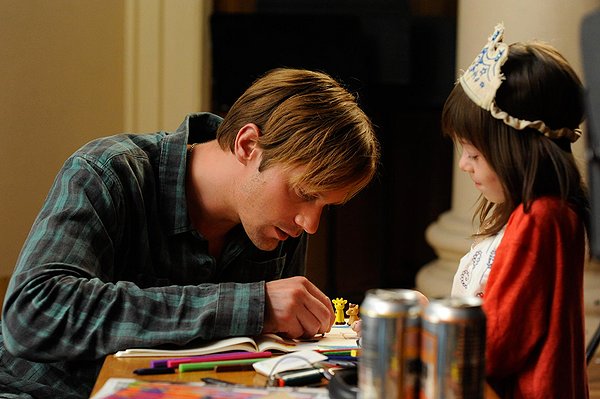
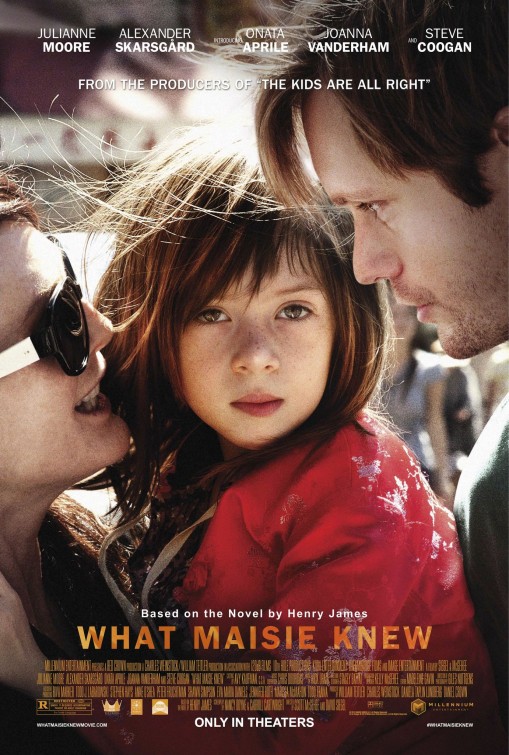 Did you know that What Maisie Knew is based on a novel by Henry James that was published in 1897? I sure didn’t, but then again my knowledge of Mr. James is somewhat limited. James’ tale of negligent parents passing off their daughter back and forth was controversial when the novel was first published. Updated to modern-day New York City, seven-year-old Maisie (Onata Aprile) is the pawn in her parents’ contentious divorce. Her father, Beale (Steve Coogan) is an art dealer who is constantly on his phone and making out-of-country trips. Her mother, Susanna (Julianne Moore), is an aging lead singer for a 90s alt rock band who also likes to party. Beale remarries Margo (Joanna Vanderham), a young woman who previously served as Maisie’s nanny. Not to be outdone, Susanna remarries Lincoln (Alexander Skarsgard), an affable bartender who’s somewhat clueless around kids. Everyone is trying to navigate the tricky new relationships and what they think is best for Maisie, though Lincoln and Margo seem to be the only ones who actually care.
 When it comes to divorce dramas, the easy way is to go big, to ramp up the emotions of such an emotionally distraught experience, and to tip into the overwrought territory of melodrama. I can already imagine the animated shouting fests and crying fests. Then there’s the impulse to go the bitterness route, like 2005’s The Squid and the Whale, where the movie takes a cue from its feuding parents and infuses the film with a dark, overpowering sense of acrimony. I credit directors Scott McGehee and David Siegel (The Deep End, Bee Season) for making arguably one of the most subdued movies about divorce I’ve ever seen. It’s certainly not flippant in the slightest, treating the subject, and mainly the toxic effect on Maisie, with sincerity and good taste. But as far as overblown shouting matches, they’re kept to a minimum and mostly comprise the first fifteen minutes of the movie, establishing the inevitable divorce of Susanna and Beale. The movie ignores the sensational and focuses on the ordinary, little moments of complete believability that serve to build, like brick by brick, the overall reality of the story. You’ll watch the film and think to yourself that, even with parents with completely outlandishly rich professions, that everything in this movie could realistically happen. Weird to think that James wrote his tale over 100 years ago and yet how relatable his conflicts still are to this day. However, because of this subdued, naturalistic approach, What Maisie Knew can’t quite find a proper ending. The one presented seems a tad too pat and tidy for this movie. It almost approaches a“happy ending,” though not quite. Still, knowing how thick-skulled both Susanna and Beale are, it’s hard to think that they will ever come to their senses and do what’s in the best interest of Maisie.
This can be an uncomfortable movie to watch because Maisie’s mom and dad are so destructively neglectful and self-involved. There’s a perverse rubbernecking draw to seeing the antics of truly awful parenting. You’ll find yourself getting very mad at how terrible these people are at being human beings. Susanna and Beale interrogate their daughter for ammo they can use against the other, twisting and manipulating the kid that we wonder if either truly cares about. Dad’s always full of excuses and mom’s looking to flee from responsibility at a moment’s notice, dumping her daughter on her latest boyfriend. You’ll find yourself easily sympathizing with Lincoln and Margo, the two people who love Maisie most and would make the best parents for her. I began rooting that they just abduct Maisie and start a new life as a family in a different country. The unchecked narcissism of both Susanna and Beale could serve as a clinical study. It’s a wonder that Maisie seems like a bright, playful, and relatively normal kid. For now.
Another aspect of McGehee and Siegel’s joint direction that I really enjoyed was how the movie takes on the perspective of little Maisie; she is our eyes and ears, and often the camera framing will instinctively mirror her own point of view, cutting off adults. It’s an interesting visual approach but it also further tethers us to this girl, forcing us to think even deeper about Maisie’s perspective, and how she’s interpreting the angry words. I suppose there is a valid argument to be had that a seven-year-old child is going to be a rather limited perspective on such a contentious conflict. There’s also the nature of Maisie. She’s a relatively quiet child, given to poking her head around corners and staring with those big glassy eyes of hers. Given the fact that she’s a child, and processing a painful life experience, don’t expect her to divulge too much about her thoughts and feelings. She’s an opaque presence and I realize that that can get frustrating for some. She’s not the kind of kid that’s going to burst into tantrums. This girl is internalizing all the pain and confusion. Having a passive prism for your movie might be akin to telling a love story from the point of view of a potted fern. Literally anchoring the camerawork to Maisie (I don’t want to oversell this as if it’s a stylistic gimmick) forces us to constantly think of every action through its impact upon Maisie. It’s not exactly a coming of age or loss of innocence tale but more a combination of the two.
 If you’re going to have a child be the star of your movie, you better choose wisely. I’ve found that as I grow older I have less tolerance for poor child actors. Perhaps it’s my inner Scrooge. Good thing that little Aprile (Yellow) is so effortlessly heartbreaking as she tries to find her way amidst her changing home life. One day she has a mom and dad, then she’s splitting time, then her daddy has a new mommy, who happens to be her old nanny, and then mommy has a new husband as well (Susanna admits she got remarried simply to improve her court standing). Aprile nicely underplays her character’s innate vulnerability while still reminding you of her youth. She’ll get scared and ask to go home, crying alone in her bed, and your heart will ache. I cannot say whether the strength of Aprile’s performance lies more with her legitimate skills as an actress, good direction, or the general reticence of the character, and thus the lesser demands for a child.
Moore (The Kids Are All Right) and Coogan (The Trip) give surprisingly textured performances, at least more so than the opening fifteen minutes would have you believe. They can both be monstrous and callously indifferent to their daughter’s well being, but as the movie concludes, each one of them has a small moment where they realize the damage they are inflicting upon their child, how poor a parent they have been (Susanna even lashes out at Lincoln’s encouragement to Maisie as “undermining her as a parent”). It’s much more than I was anticipating and both actors do good work at being unlikable without going overboard. Fans of TV’s True Blood might just swoon a little harder thanks to Skarsgard’s good-natured, humble, and mildly affecting performance as a man who becomes profoundly attached to Maisie. He may not know what he’s doing but isn’t that parenting as a whole? Skarsgard and the charming Vanderham make a great onscreen pair and their genuine affection for Maisie provide the most uplifting moments.
When it comes to parenting, there are no magic instructions to insure a responsible, loving, thoughtful, and independent human being. It’s a leap of blind faith. However, it’s much easier to predict the events that can screw up an impressionable child (do not misconstrue this as my declaration that children of divorce are, at heart, broken somehow). The thought of collateral damage is fresh in our minds as we track little Maisie trying to survive the reach of her terrible parents. The terse arguments can be painful but even more painful is the overall negligence of her rich and mostly absent, self-involved parents. What Maisie Knew isn’t a downer of a movie and its subject matter is given proper seriousness and reflection. You’ll likely cringe at points, may even grumble under your breath, but in the end it ends on a hopeful note, the possibility that Maisie, under the right guidance, could turn out to be the bright kid we see glimpses of at her school. There’s something quite moving about the resiliency of a child. This is, of course, just one interpretation of the movie, but What Maisie Knew is an emotionally engaging, subdued, sincere, and poignant film that trades on naturalistic waves of human interaction rather than cartoonish bluster, all the while forgoing cheap sentimentality or unpleasant bitterness. For the performances, the deft handling of sensitive material, and the quality direction, give What Maisie Knew a chance when able.
Nate’s Grade: B+
Share this:

The Iceman (2013)
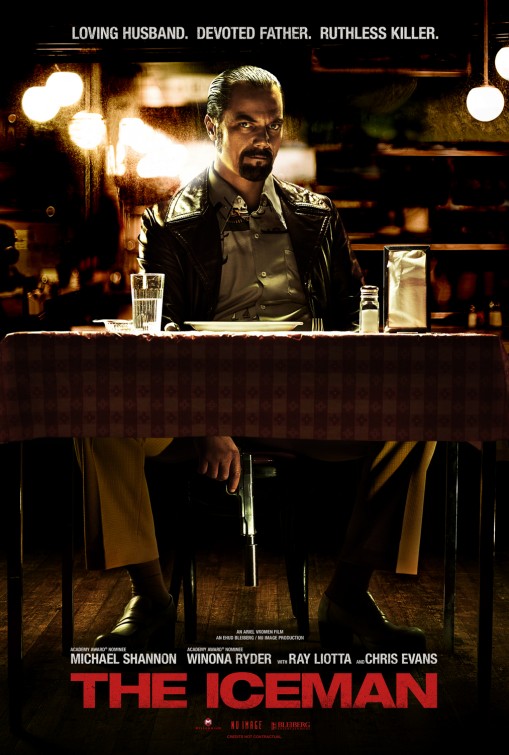 We’re fascinated by hired killers. Chalk it up to morbid curiosity or perhaps perverse, secret wish fulfillment, but we’re all titillated a tad by the murderous for hire. The Iceman is all about Richard Kuklinski (Michael Shannon), who worked as a contract killer for the mob from 1966 to 1988. He’s estimated to have killed over 100 people. A mob middleman (Ray Liotta) is impressed that Kuklinski shows no fear with a gun in his face, and so the guy gets hired to rack up the bodies. At the same time, Kuklinski has a wife (Winona Ryder) and two daughters, all of whom have no clue what daddy does for a living until he’s finally brought to justice.
The main issue at play with The Iceman is that it’s trying to draw out a character study for a rather impenetrable person. It’s hard to get a solid read on the character of Richard Kuklinski. The compartmentalizing of these two very distinct lives is a fascinating psychology to explore, one I wish the filmmakers had spent a majority of the screen time upon. The internal justifications, struggles and compromises would make for an excellent and insightful look into the psychology of killer rationalization. However, I don’t know if this movie would even be possible from this subject. Kuklinski is by all accounts a pretty detached guy. There just doesn’t seem like there’s a lot to him. His circumstances are interesting, beaten into an emotionless cipher by his father, brother to a fellow sociopath, and trying to make a reasonable life for himself while keeping his inner urges at bay. The sociopath-tries-to-make-good storyline is reminiscent to fans of TV’s Dexter, and there’s plenty of room to work there. It’s an intriguing contradiction, the man who cares for so little protecting his family. In the end, we don’t really get a sense of why beyond the illusion of the American Family that Kuklinski wants to hold onto, to make himself seem normal, to prove to his family he could break free from their influence. Even typing this I feel like I’m giving the film more depth than it actually illustrates. Even though he tries to play the part of devoted family man, we rarely see any evidence of devotion. He provides, yes, puts his kids in private school, but he puts his family at risk and doesn’t seem to have affection for them as much as propriety. They are his things and nobody will mess with them. Your guess is as good as mine if he genuinely loves any of them.
 Too much of the film gets mired in standard mob clichés. This guy upsets that guy; this guy wants the other guy dead. It all becomes the focal point of the movie, Kuklinski getting caught up in, essentially, office politics. Even the true-life details of the grisly methods of death feel like wasted potential for a better story. He goes on a job, he botches a job, he gets let go, so to speak, he strikes up a new partnership with another contract killer, Mr. Freezy (Chris Evans in a bad wig). That last part could have been a movie unto itself, watching an odd couple of hitmen plan, execute, and then dispose of their targets. The Iceman nickname comes from their process, freezing the dismembered corpses for months so that coroners cannot get a read on when the bodies were slain. While Evans is entertaining, this entire portion of the movie could have been eliminated, its bearing on the plot minimal. Likewise, the movie has several small roles populated by recognizable actors, which become a series of one-scene distractions. Kuklinski goes out on a hit and it’s… James Franco. Then there’s Friends actor David Schwimmer as a sleazy, ponytailed, nebbish mob screw-up. Stephen Dorff has one moment as Kuklinski’s angry, desperate, murderous brother in prison. The actors are all fine, with the exception of Franco, but many of them are just another reminder of the film’s disjointed attention.
I mentioned in Pain and Gain the notion of portraying true-life criminals as sympathetic figures, and the queasy nature of this complicit interpretation. The Iceman never really tries to make Kuklinski sympathetic or some form of an antihero, and I think the movie is better for it. One of the earliest moments in the film is Kuklinski slitting the throat of a guy who harassed him and defamed his lady. This is BEFORE the guy is even hired as a contract killer too. It seems like when the guy can’t murder he becomes a worse family man. Even in the end, he’s testing a new batch of cyanide on the neighborhood cat. The movie presents Kuklinski as he is, though you’ll be forgiven for feeling some initial pings of sympathy when you seem him try and protect his family. Granted his family could also very well use protection from him.
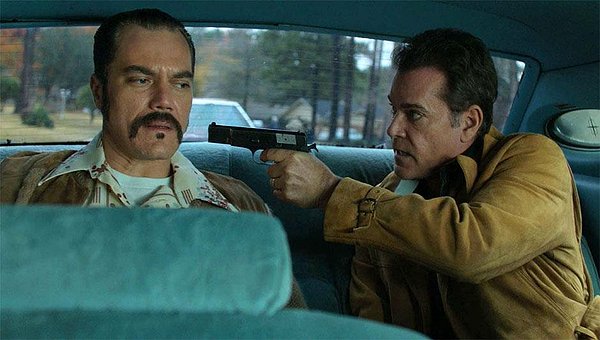 Shannon’s (Premium Rush) performance is what keeps you watching. There are few actors who are as intense as this guy, though I’m used to seeing him play unhinged psychos bouncing off the walls. Kuklinski is just as troubled as his other roles but he’s all reserve, steely nerves, and anger that eventually bubbles over into violent rage. Shannon is still such a good actor that even with a thin character, or at least thin characterization, he can be completely compelling to watch onscreen. One of the more peculiar, inconsistent elements of the film is Shannon’s constantly-changing facial hair. I think I lost count at about nine or ten different facial topiary variations. There were times where it will be different in consecutive scenes. I guess that’s a tipoff of a time jump, but his morphing, period-appropriate facial hair also became a point of amusement.
What makes The Iceman so disappointing in retrospect is how much potential it seems to squander. There’s a great story to be had with a contract killer by night and a family man by day. That contradiction, the struggle, the psychology is all rich material to work with. It’s just that Kuklinski is not necessarily that guy; he’s not too deep, at least not in this version, and his killer work problems are just not that compelling. If this is what the filmmakers were going to do with their real-life subject, then they might as well have just used Kuklinski as inspiration. Take the best parts and then compose a different lead character, someone more emotionally transparent or relatable or just plain old interesting. Just because it’s a real story doesn’t mean you’re indebted to telling every true facet of it, especially when a better story is within sight. Shannon is a terrific actor and does his best to make the film worth watching, but from distracted plotting to unmet analysis and emotional exploration, it’s hard to walk away from The Iceman and not feel a bit chilly.
Nate’s Grade: C+
Share this:

House at the End of the Street (2012)
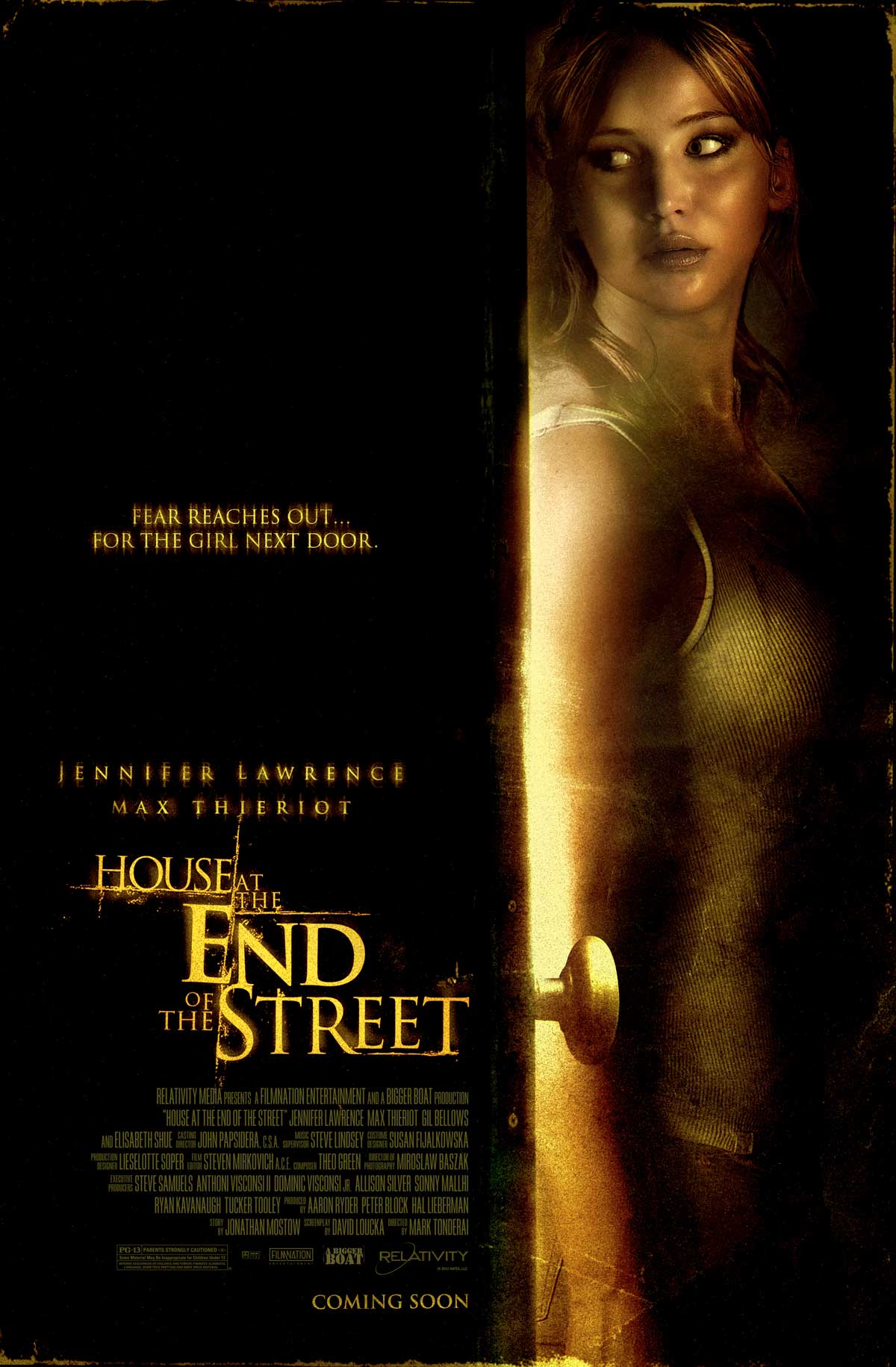 As readers will attest, I am a fan of actress Jennifer Lawrence. Some of my pals might say limiting the word to “fan” is being too modest on my part, but I don’t want to alarm anyone. I think she’s a terrifically talented actress and her Best Actress Oscar was well deserved for a film I unabashedly adore. With all of this being said, good actors can still make really bad movies, and that’s what we have with the stillborn horror flick, House at the End of the Street, referred to by marketing by the Twitter-friendly acronym HATES. That seemed like a tip-off, didn’t it? The problem is that for a good hour this movie is more of a drama than a horror movie, and everyone in town seems to be jerks to this guy in town whose sister murdered his family. Apparently him still residing in town lowers their property values… for some reason. I think it wants to be a psychological thriller, but even giving it that much credit assumes there’s some degree of competent execution. It’s not scary, the twists should be easily telegraphed to anyone with a modicum of sense, and Lawrence’s presence is just downright questionable. Why did she agree to do this? What about this clunky script, with its obvious padding to its “shocking” revelation, appealed to this woman? I suppose with her fast ascent to the top of Hollywood, Lawrence now has the clout to never again star in something as drecky as this would-be thriller. Then again, if she does, it’ll be by choice. Or a fat paycheck.
Nate’s Grade: C-
Share this:

The Great Gatsby (2013)
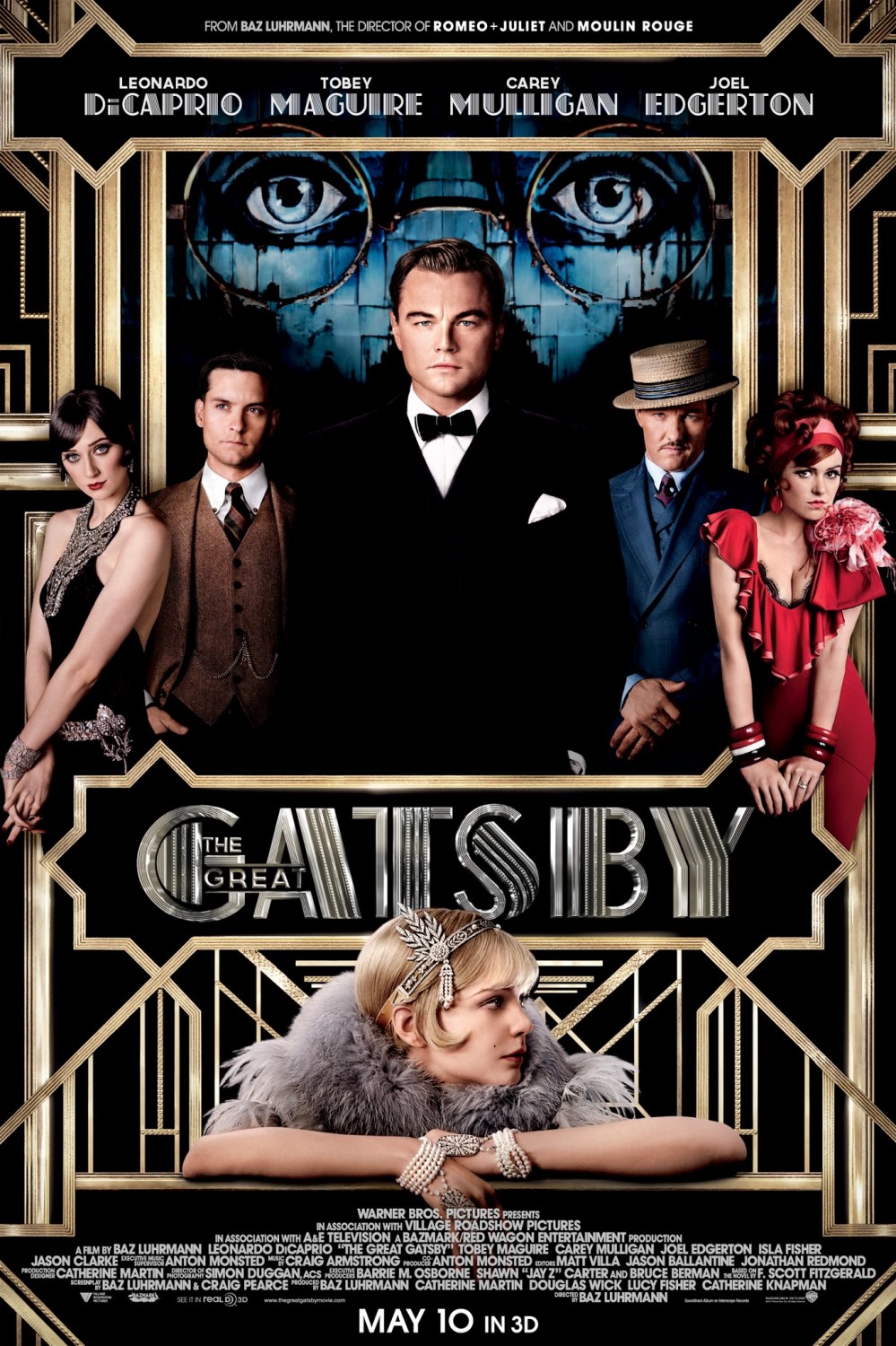 It seemed like some sort of educational mandate that every child in the United States was forced to read F. Scott Fitzgerald’s novel, The Great Gatsby, when they were in high school. In my highly unscientific number crunching, it appears that those who actually enjoyed the book are in the minority. I recall loathing it, but then again, when you’re fifteen, you sort of loath everything. Enter Australian director Baz Luhrmann, the showman who exploded the screen in razzle-dazzle run amok with Romeo and Juliet and Moulin Rouge!. Not exactly the kind of filmmaker one would fathom helming an adaptation of a classic of American literature, but the man’s style of excess seems like a suitable match for Fitzgerald’s tale of high-class overindulgence.
In 1922, young Nick Carraway (Tobey Maguire) moves to the hustle and bustle of New York City, living close to his cousin Daisy (Carey Mulligan) and her rich husband Tom Buchanan (Joel Edgerton). He’s also the neighbor to the mysterious and newly rich Jay Gatsby (Leonardo DiCaprio), a reclusive man who opens his mansion up to prolific bacchanals. Rumors persist in who he is and how he accrued his enormous fortune. He’s an old flame of Daisy’s and is secretly hoping she’ll attend one of his raucous soirees. He enlists Nick to help arrange a reunion for them, and soon enough Gatsby is already planning their happy future together again. Trouble is, Tom isn’t willing to lose his wife without a fight.
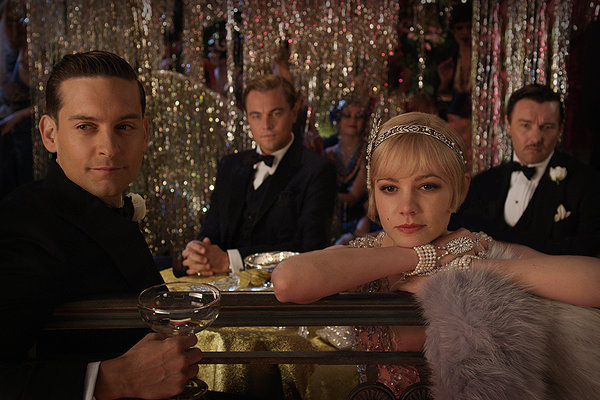 Luhrmann’s helming of The Great Gatsby gave me exactly what I desired and expected. The movie is convulsing with energy and the first hour just moves; be it the camerawork or people onscreen, for long stretches there always seems to be some degree of onscreen movement. Luhrmann’s signature theatrical visual atmosphere is vibrant, joyous, and a perfect translator of the lavish lifestyles of the noveau rich in the Roaring ‘20s. The man brings to startling life the sensations of being young, privileged, and carefree, and the use of anachronistic music, while not nearly as textured and thematically relevant as Moulin Rouge!, adds to the fun. I quite enjoyed a low-key, jazzy rendition of Beyonce’s “Crazy in Love.” Luhrmann’s style treks in excess but it’s a much more pleasant, dreamy, and altogether beguiling form of artistic indulgence than, say, Michael Bay or Tony Scott and their respective macho visual fetishes. Luhrmann’s campy sense of style doesn’t come across as overly suffocating or distracting, at least to my eyes, and instead the man injects his movies with tremendous energy, immersing you into a new world of old and modern. This is what Luhrmann was meant for. While other canonical classics of American literature may not survive a glitzy Lurhmann treatment, it’s a good match for the extravagant excess of Fitzgerald’s setting. Lurhmann’s visuals are glorious, and the 1920s era is brought to glamorous life. You get the sense it was one giant party without any lasting consequences (if you were rich enough).
The second half of the movie slows down considerably after the amped-up introduction. We’re caught up in the characters at this point, as we should be, and the Gatsby/Daisy reunion dominates the plot. I suppose there are only so many Busby Berkeley numbers and confetti explosions one can encounter before the plot has to set in. Lurhmann and company stick pretty faithfully to Fitzgerald’s plot (rest easy, lazy high school students of today and tomorrow). Interestingly, they are far more explicit about Gatsby’s securities fraud, knowingly making a fortune off junk bonds, all in the name to impress Daisy. There’s a genuine sense of respect for the source material even with Luhrmann’s visual flourishes; at several points, Fitzgerald’s text floats onscreen. The problem is that Luhrmann’s Gatsby is almost entirely focused on the romantic coupling of its title figure and Daisy. Gone is the class criticism, the indictment of the follies of the rich, the examination of the dark side of the American Dream, and the subtext. You’ll get plenty of shots of that famous green light, 20th century literature’s most famous and unsophisticated symbol (pay attention kids: green means go), but there’s little time for complexity. It’s not a screen romance worth this much attention, which is kind of the point, but when the movie clocks at over 2 hours and 20 minutes, drawing out a lackluster romance can become rather grating.
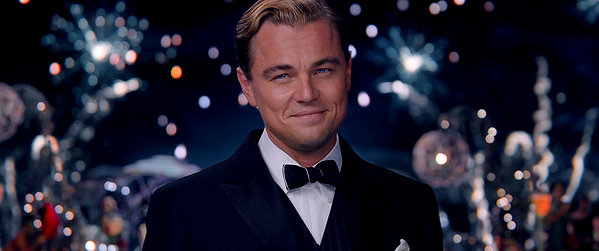 If I were top cite one major fault in Luhrmann’s incarnation, it’s that it adopts Nick’s fawning perspective and treats Gatsby as this tragic romantic figure. I acknowledge with every adaption there is a degree of interpretation, and romantic hero is certainly one facet of Gatsby, certainly how he sees himself, but by the end of Fitzgerald’s novel, Gatsby is really more a naïve man who really only sees Daisy as trophy, a prize for his reinvention and jumping up to the storied moneyed class. Daisy herself is certainly weak-willed but her emptiness (she says there’s nothing better than for a girl to be a “beautiful, young fool”) is part of the appeal to Gatsby because he can remake her however he wants. He’s not interested insomuch as her as a person. I don’t think that the Gatsby/Daisy escapades fall into the ranks of Great Tragic Couples of Literature, but that’s how Luhrmann interprets the novel, transforming Gatsby into a revered, honorable, and heartbreaking romantic we’re meant to shed a tear for. I suppose since we’re reliving the story through Nick’s perspective that events could be colored differently. Beyond just a simplistic analysis, it also misses the greater and more futile tragedy of a man trying to escape his past by obsessively recreating it.
The acting is fairly good all around, though the standout is certainly not whom you’d expect. DiCaprio (Django Unchained) is a good fit for the handsome social-climber, but the movie only asks him to play a limited range of emotions, rarely breaking free to show glimpses of the darker, less polished side of Gatsby’s carefully crafted image. He doesn’t exactly exude the charisma you would think necessary for the man, plus his use of “old sport” is so overly abundant it approaches farce. Maguire (Brothers) is a bit too earnest even for his role. It becomes readily clear within minutes that Maguire does not possess a voice for narration. The man is also a bit too old, at 37, to play the naïve, stars-in-his-eyes Nick Carraway. Mulligan (Shame) is given the least to work with since Daisy is meant to be rather opaque but she brings an extra amount of sympathy for a character trapped by her indecision and the demands of men. Easily the best actor in the bunch is Edgerton (Warrior). It would be easy for the guy to simply be the brutish heavy, the angry husband and easy to hate antagonist. Edgerton showcases a surprising depth, and you may find yourself feeling some smidge of sympathy for the lout.
Much like Luhrmann’s Moulin Rouge!, it’s an easy prediction that his Great Gatsby will be equally divisive. There will probably be as many critics decrying Luhrmann’s blitzkrieg of confetti and style as a campy cannibalization of an American classic as there will be celebrating the mad energy and obsequious reverence exhibited in a handsomely mounted, big-budget adaptation. The movie is even being presented in 3D, and did you ever think you’d hear the phrase “The Great Gatsby in 3D” in your life? I enjoyed Luhrmann’s gaudiness and indulgences, painting the screen with his vivid imagination. The impressive production design, costumes, visual effects, and overall visual aesthetic of the movie are a feast for the eyes. Now there are plenty of indulgences and excesses in the movie, particularly the emphasis on grand romance, but Gatsby entertains with few lags. Having read the book once and disliked it heartily in my youth, I can readily say that here is an example of where the movie is better than the book. Now if someone could go about making an improved version of The Lord of the Flies and A Tale of Two Cities, whatever you have to do, my teenage self will thank you kindly.
Nate’s Grade: B
Share this:

Iron Man 3 (2013)
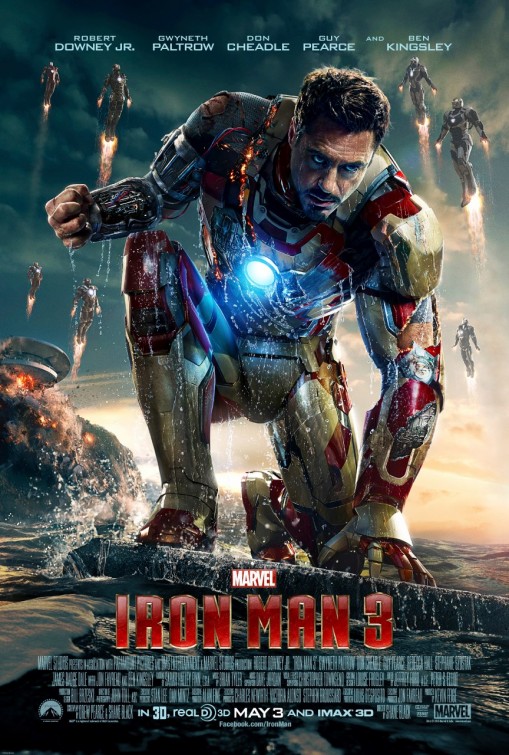 Third movies in superhero franchises always seem to be a precarious proposition; X-Men 3, Spider-Man 3, Superman 3, all graveyards of rushed productions, artistic compromises, and general complacency. Usually the third movie is when the hero has what he or she (but mostly he) has built up stripped down. It’s the same case with Iron Man 3, which short of a noisy finale has a surprisingly small amount of actual Iron Man, much like the scant amount of Batman in last year’s The Dark Knight Rises. That’s fine with me because the appeal of this franchise has been Tony Stark the character, not the mechanical heroics. Iron Man 3 is co-written and directed by super Hollywood scribe Shane Black, the man who gave us Lethal Weapon, The Last Boy Scout, The Long Kiss Goodnight, and the 2005 gem that resuscitated Robert Downey Jr.’s career, Kiss Kiss Bang Bang. It was this fact alone, especially after how disappointing Iron Man 2 was, that got me jazzed about a third outing. Black’s characteristic sense of humor, genre blending, and mass appeal thrills helps to make Iron Man 3 an enjoyable if flawed movie-going experience and a suitable kickoff to the summer movie season.
Tony Stark (Downey Jr.) is having trouble sleeping, haunted by the near world-ending events in New York City from his time with the Avengers. Pepper Potts (Gwyneth Paltrow), head of Stark Industries and Tony’s main squeeze, wants her man to take a mental health break. He’s spending as much time as possible in his lab, concocting a whole army of different Iron Man suits. His latest invention allows him to control a suit prototype with his body, compelling pieces of his amour to his person with a wave of his arms. He’ll need the help because the Mandarin (Ben Kingsley), a fearful terrorist leader, is staging a series of bombings around the United States, leaving behind videos taunting his foes. After an attack that hits close to home, Stark challenges the Mandarin and the bad guy brings the fight to the man of iron, decimating his home and forcing Stark to flee. In Tennessee, Stark unravels the mystery behind the Mandarin, which involves a brilliant scientist (Rebecca Hall), a nefarious biotechnology businessman (Guy Pearce), and even the president of the United States himself.
 The best part of the first film was watching a brilliant guy become Iron Man; sure the superhero stuff was fun but it wasn’t what made the movie special. Downey Jr. as a charismatic, egotistical, self-involved but ultimately redeemable middle-aged playboy is what made the movie special. With Iron Man 3, he has to rely on his wits for large portions, which are still considerable. It’s a clever way to make a billionaire playboy with out-of-this-world technology empathetic. He’s never going to be an everyman but that doesn’t mean we can’t empathize. With that said, I still find his whole PTSD ordeal after events from The Avengers to be shaky. He’s already had near death experiences before so unless we get a bigger explanation (proof of alien existence and superiority? Knowing a return is inevitable?) I find it hard to fathom that a guy as outwardly unflappable as Tony Stark would be hobbled by his super team-up activities. Also, now that we exist in a post-Avengers universe, wouldn’t the ongoing attacks by the Mandarin warrant some sort of S.H.I.E.L.D. response or monitoring?
Likewise, I really appreciated how Black developed his action sequences, routinely giving Stark limitations. The concept of a suit that can assemble by itself and fly hundreds of miles is silly, sure, but it also opens up fun possibilities and questions of identity. At one point, Stark has one arm and one leg of his suit, allowing him to fight back but having to get creative with his moves. A fight while he’s handcuffed also provides enjoyable thrills. During the home attack, Stark’s suit is a prototype and will not allow him to fly, so he has to get inventive, literally shooting a grand piano at a helicopter. The best action scene is when Iron Man has to save a dozen people from plummeting to their deaths after being sucked out of Air Force One in midair. I wish the solution hadn’t been so quick but it’s a thrilling sequence with terrific aerial photography.
Until the finale, which is all-robot action, you could accuse the film of being too shrift in its action sequences, rarely lasting longer than a few brief minutes. They’re still quite entertaining, and well directed, with Black nicely drawing out organic complications and making good use of geography. We know that Black can write a glorious action sequence, but unless you were one of the lucky souls who saw Kiss Kiss Bang Bang, it’s a surprise that the man can direct one so well. There’s a nice sense of style on display but it never becomes overpowering, and thankfully it’s presented in a manner that you can, shocker, tell what is happening onscreen. Black definitely has a good eye for visuals and scene compositions but he also knows how to deliver great crowd-pleasing moments that we want in our summer movies. The climax is pretty busy with lots of keen Iron Man suits that you just know are there to be purchasable toys first and foremost. The sustained action is pretty involving, and Black is an expert at establishing mini-goals and developing naturally. Even as it starts to devolve into a hectic video game-like frenzy, there are enough changing goals and reversals to keep you satisfied for the long haul.
The movie’s villains are somewhat nebulous and employ an Evil Plot that is too convoluted by half. The Mandarin is an intriguing figure but undergoes some changes that will surely leave fans of the comic steaming mad. I accept that movies are an adaptation from the source material, and have no real personal affinity for Iron Man or his rogues’ gallery, so I wasn’t bothered by the notable change. It fits the tone of the movie as well as becomes another plot point in a convoluted Evil Plot. I will agree with detractors on this point: after the invasion in The Avengers, alien technology, the source of the Mandarin’s powers in the comic, is credible. I don’t really understand the political commentary at play with the Mandarin either. More so, and I’m trying to be delicate with spoilers, Iron Man 3 is really a movie about Tony Stark versus… lava people. Sure they have superhuman brains that provide regeneration and superior human ability. It just seems that all these super humans decide to do is… heat things up. They glow red, melt through walls, and are essentially lava creatures. Apparently Tony Stark needs to take some cues from that old U.S. Marines ad where the guy fights a giant lava monster (“Have you been attacked by a lava monster recently? No? You’re welcome – signed, the Marines”). The villains, while weak, are still probably the best in the series. It’s been a fairly weak franchise for antagonists.
 Coming from Black, you’d expect an increase in the implementation of comedy, though Iron Man 3 probably walks just up to the line. It almost gets too jokey but pulls back enough. Adam Pally’s (TV’s criminally underseen Happy Endings) small bit as an obsessed fan of Stark is probably the testing point. Tony Stark has issues sure, especially if Disney will ever let the movies explore his history with alcoholism, but the man is never going to challenge Bruce Wayne for the brooding loner throne. Stark is a quipper, a loudmouth who uses humor as a weapon and a shield, and brought to vivid life by Downey Jr., the man will always be a comedian. That’s not to say that the drama lacks proper seriousness. However, Black pushes a lot more comedy into the film than we’ve seen in the earlier installments. Most of it is welcome and even when the movie goes into mass appeal mode, especially in Act Two when a plucky kid aids Stark, Black covers the familiar without losing his edge. You’ll likely recognize the buddy cop patter from Black’s other movies but it still works. There are several setups that look like we’re getting Big Hero Moments, and then Black decides to undercut them for a good laugh. Iron Man 3’s consistent sense of humor makes the movie feel even faster paced.
Downey Jr. (The Avengers) is still the MVP of the modern Marvel-verse in my eyes, and even two years removed from 50, he’s still got enough energy to power a small army. He’s still pulling the same schtick so to speak, which may wear thin for others after four starring appearances as Tony Stark, but I still find him naturally appealing. Paltrow (Contagion) gets a chance to do more than the standard damsel in distress that the women function in these movies. I regret that after being given a tantalizing new direction the movie reverts her back to standard damsel sidekick so speedily. Ho hum. Kingsley (Hugo) just seemed wrong for the part from the start, never mind the nebulous ethnicity issues. His vocal fluctuations and strange emphasis proved too distracting for me. However, he proves to be a better match after the Mandarin’s twist. Pearce (Lawless) is a pretty solid, smarmy bad guy and man has he got an impressive physique going on. It’s just nice to see great character actors from Hall (The Town) to Miguel Ferrer (Traffic) to Dale Dickey (Winter’s Bone) in a high-profile mega blockbuster. Even little Ty Simpkins (Insidious) is pretty good as the kid who helps out Stark. My tolerance for child acting has gone downhill as I have gotten older, but the kid is genuinely good without falling into the common trappings of being cloying or overly precocious.
Iron Man 3 is a definite improvement over the overstuffed, undernourished 2010 sequel. It ends on a moment that feels like something close to closure, but you know, as the credits helpfully indicate, that Tony Stark will appear again, at least in 2015’s Avengers 2. The bigger question is can this franchise exist without the participation of Downey Jr.? I’m sure we’ll all find out eventually considering the character is too profitable to simply retire once Downey Jr. decides he’s had enough. We’ve had five Batmans after all, not counting Adam West. However, never has a character seemed so intrinsically linked with an actor before. Downey Jr. just is Tony Stark, and while some capable young male lead out there in Hollywood will put up a valiant effort, it will never be the same. Iron Man 3 is further proof that the appeal of the franchise is not the explosions and action set pieces, which it does a fine job with; it’s the man inside the suit and the formidable actor that gives this franchise its juice. Spending more time with Stark is a bonus, and Black’s zippy sense of comedy and acute knowledge of the architecture of popcorn thrills allows the movie to fly by with ease. While the first film reigns supreme, Iron Man 3 is a fitting and pleasurable enough blockbuster that reminds you why we still love this guy.
Nate’s Grade: B


You must be logged in to post a comment.