Blog Archives
Halloween Ends (2022)
 If you’re a fan of the hallowed Halloween horror series, I can understand why Halloween Ends can be a disappointment, since it dramatically steers away from the formula that has carried this franchise since its beginning. However, if you are like me and find Michael Myers to be one of the most boring slasher killers, and too much of the slasher genre to be rote and repetitive, then this movie might actually be something of a welcomed surprise. Ends might be the least Halloween movie since the third film, the failed 1982 sequel that tried to establish life outside of the hulking menace that is Myers, and then the series shortly retreated back to its familiar bloody formula. Ends might be the least amount of screen time Myers has ever had in any film in the franchise, excluding the third movie; he doesn’t even get his first kill until almost an hour in.
The 2018 reboot was a mixed bag of a horror movie but it ended on the strongest note, with three generations of Strode women fighting together to end their torment. Unfortunately, the series had to continue because the 2018 movie made so much money for the studio, so we’ve been given two rather perfunctory sequels. It’s clear director David Gordon Green and his co-screenwriters, including actor Danny McBride, didn’t really have a desire to continue, and so they spent the sequels exploring other avenues of Haddonfield. I wasn’t a fan of 2021’s Halloween Kills, but the subplot about the mob of scared citizens becoming vigilantes was at least something new and added to a larger understanding of the trauma of this terrorized community. I can say the same with Halloween Ends, namely that the things that were most unexpected and tertiarily related to Myers were what I enjoyed the most. Halloween Ends is messy and disjointed but at least it’s interesting even as it strains to justify its existence and even seems slightly disdainful as well.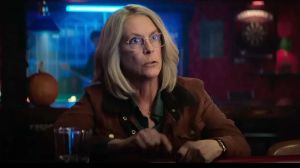
It’s Halloween time again in Haddonfield and the citizens are still psychologically recovering from the events of the prior year, as featured in Halloween Kills. Nobody has seen Myers since he killed Laurie’s (Jamie Lee Curtis) adult daughter. In fact the Myers’ estate has been demolished, at long last, and the town is trying to move on from yet another massacre. Laurie is trying to transition into domestic territory, watching over her granddaughter Allyson (Andi Matichak) as she works at an urgent care center. The real star of the movie isn’t Laurie but Corey (Rohan Campbell), a teenager who accidentally killed a child he was babysitting years ago. Corey is a pariah in town as he tries to get his life back on track, with the meager options that Haddonfield offers for someone with his baggage. He is befriended by Laurie, who introduces the lad to Allyson, and the two instantly connect as outsiders unfairly maligned by their town. These star-crossed lovers get more complicated when Corey begins to tap into his darker impulses and discovers the location of a recuperating Michael Myers. How far will he go?
Because Myers is such a colossal bore as a character, so readily deemed pure evil as to remove anything remotely interesting, I was grateful that Halloween Ends chooses to be something else for most of its running time, precisely the evolution of a killer. Characters that are just born as soulless evil don’t require much in the way of understanding or back-story. This movie decides to spend the majority of its time setting up a protégé figure for the big bad boogeyman, so much so that you could cut the scant Myers appearances in his subterranean lair and make the first half of this a completely different movie. It’s proof that Green and his screenwriters weren’t just coasting from creative inertia of delivering the same-old same-old. There is an actual story here that wants to explore elements of the franchise that have been dormant and chronicle how a young man can fall onto a dark path and lose himself. It’s the appeal of the dark side, and it’s personified in one young man’s journey. It’s the serial killer origin structure, and it mostly works. I was far more interested in Corey than anything else happening in Ends. The prologue establishes him as misunderstood and an outcast, blamed for an accident that nobody seems to think was actually an accident. It’s about how the ailing town treats this young man and how he tries to reform after tragedy, only to be met with suspicion and resentment. Getting to know Corey’s limited world and watching him succumb to his darker impulses, it’s like a little side story that you never would have known existed in the larger Halloween universe so often dominated by the endlessly wheel-spinning Laurie vs. Michael drama. I’m not going to say that the screenplay was nuanced and populated with three-dimensional characters, and the pacing of Corey’s descent is indeed rushed, but I appreciated the efforts to try something different.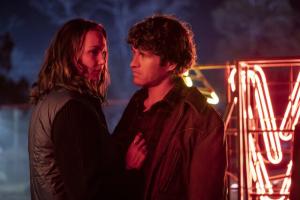
Another issue I have is that first-half Laurie and second-half Laurie feel like two totally different characters. This version of Laurie Strode feels like a completely different character from the prior two Halloween movies that shaped her as a grizzled, obsessive, survivalist loner. This version is making awkward meet-cute small talk in grocery stores and burning pies she’s determined that her granddaughter will eat because of nascent Strode family traditions. Who is this woman? I know some time has passed from the previous movie, but where is the response or lingering grief over the loss of her daughter, the same person she spent years preparing to defend herself against the return of Myers and then was killed by him anyway. For all the weight given to this passing, it feels like an afterthought and that is bizarre. It’s as if Laurie’s daughter never existed for all the impact that her murder has on this story. Once Corey and Allyson become a romantic pair, that’s when something clicks over with Laurie and she recognizes the danger this boy represents, and then she becomes the overly protective mother (granted, her instincts are correct, but the characterization is blah). There was potential to explore the continued strained relationship between the different generations, but Allyson mostly comes across as the naïve child who just wants to run away with her dreamy new broody boy. Had the characterization for Laurie and Allyson been more coherent, and meaningfully tied to the past events in the new trilogy, I think it would have better aided the aims of the Corey examination.
Say what you will about the Halloween series stretching things out over its two lesser sequels, but Green and company add a definitive end note to their title. The degree to which the movie seeks definitive closure is almost comical. It feels like Green is saying to the studio, “Okay, this time it’s really, really over. There is absolutely no coming back from this. That’s it.” This sequence of finality goes so many steps beyond confirming its ending that I began to chuckle to myself at the absurdity of the movie telling its audience that this is the serious end. We go beyond beating-a-dead-horse territory into making the dead horse into a vase that is then shattered, and then the pieces thrown into a fire, and then the ashes launched into space. Of course, all of this will depend on the box-office viability of the movie and whether or not its parent company wants to squeeze even more money from the 40-year franchise (maybe an H50 in 2028?). After all, picking and choosing specific sequels to eliminate from franchise canon has become more popular, as evidenced by the 2018 movie blinking every sequel out of existence for its timeline, so all of these would-be definitive events can just be erased as easily by another sequel. That’s the nature of popular horror: everybody dies but nobody ever stays dead for long. 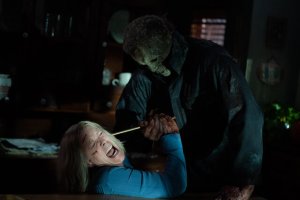
As slasher thrillers go, there’s probably not enough going on here to appeal to your baser desires, as there is no real memorable or gruesome kill. As a character study, there’s not enough careful development and plotting to reward exploring an offshoot to this universe. It’s fascinating to me, at best a middling fan of the Halloween series, how this sequel seems to simply not care about being a Halloween sequel, hence the shelving of Myers for so long, as well as the inconsistent characterization of Laurie and lack of follow-through, and the shirking of extensive gore and terror. I loved the strange detail that the friend group that bullies Corey aren’t a group of roided-out jocks but… marching band geeks (granted, with unchecked privilege). I loved how the movie goes above and beyond to persuade its conclusive ending, even closing out on the “Ends” of the title. You can almost feel certain degrees of disdain that Green and company have to create this added content, a misshapen denouement to the better climax in 2018. I guess there’s nothing stopping anyone from pretending these sequels are non-canonical, and it’s likely only a matter of years before the studio does the exact same thing to reignite the series. Halloween Ends is a strange, frustrating sequel that struggles to be a Halloween movie, for better or worse.
Nate’s Grade: C
Share this:

Catherine Called Birdy (2022)/ Sharp Stick (2022)
Lena Dunham is a controversial creator, even more so since the conclusion of her hit HBO comedy Girls back in 2017. I’ve been a fan of her creative voice from the very first episode of Girls, and I appreciated how well she could write self-involved, self-destructive, myopic characters and her directing instincts as well, all at the age of 25. From her zeitgeist-tapping TV success came Lena Dunham the brand, the industry, and with that her feminist newsletter, book deals, personal appearances, and a perennial case of foot-in-mouth syndrome. It makes it more difficult to carry that fandom when the figure says cringey things like she wished she had had an abortion to better understand the plight of those who have. Some of the early criticisms against Dunham were simply mean-spirited, like gross insults regarding her body and her penchant for nudity on her own TV series, as if women don’t exist who resemble Dunham’s shape. However, with each new public example of bourgeois entitlement, I began to wonder whether Dunham’s satirical skills at sizing up self-involved characters was maybe a little less satirical. I’ve been curious what creative projects Dunham would gravitate to next. Her first was Camping, a short-lived 2018 remake of a British comedy that was cancelled after one season. But aside from producing some more HBO shows, and occasional acting appearances like in Once Upon a Time in Hollywood, Dunham has been relatively silent. And then in 2022, she had two new movies as writer and director. I thought it would be telling to review them both together, as they share many similarities, and as further insight into Dunham as an artist still exploring her voice.
 Sharp Stick was released first, though only a couple months before Catherine Called Birdy. Both movies are coming-of-age comedies about young women finding their place in a world that is all too ready to package them into tidy offerings for male desire. Both movies are about their plucky heroines pushing social boundaries and being exploited by lustful men, but one of these films is far better developed, more charming, and with clear ideas and consistent commentary. In short, watch the delightful Catherine Called Birdy and skip the rather dulled Sharp Stick.
Catherine Called Birdy is based on the 1994 children’s book by Karen Cushman and modeled as a young girl’s diary from thirteenth century England. Catherine (Bella Ramsey) is the only child of the lord of a small village. Her mother (Billie Piper) has suffered five miscarriages or stillborn births, and her spendthrift father (Andrew Scott) is bewildered at what to do with his headstrong daughter. She’s 14 and rejecting her father’s assembly of suitors, as he tries to marry her off and recoup some money to stabilize the family’s looming debt. Catherine narrates her very important year where she starts her period, hides it, and learns about love and life and finding her place.
Right away, I was taken with the sprightly energy and strong personality of our narrator, who would prefer to go by Birdy, thank you very much. We open with her literally slinging mud with the neighborhood kids and laughing and wilding out, enjoying the thrills of being young. The contrast of the movie will hinge upon the distinction of what is childish and what is mature, as these youngin’s are thrust into adult roles because society says that as soon as they can menstruate, they are ready to be married off and become baby factories. Birdy is angry with her mother for continuing to try and have children, especially after the painful recuperation of burying sibling after sibling. She resents the idea of being a mother, and especially so early into a life that still feels bound by the stirrings of being a child. Girls should be allowed to be girls, she demands, and by that she means running around, talking with her friends, and absent the pressures and limitations of adulthood. She’s defiant against the larger Medieval system of valuing women for their fertility. Dunham is smart enough to frame the movie in credible terms. It’s not like Birdy, through her tenacity, is going to overthrow an entire centuries-old system of gender norms, but the story is positioned in more personal terms, in breaking through to her father to see her on her own terms rather than as a convenient investment portfolio. That’s more achievable and will be more gratifying for us because of what winning him over will mean.
 The movie is also fast-paced and funny, with Birdy’s casual and catty observations delivered in quick succession. In some ways this reminded me of a Medieval version of 2011’s Submarine, another charming indie coming-of-age movie with an eccentric pop-culture obsessed teenage weirdo. There’s Medieval covers of contemporary pop songs strewn throughout for a youthful energy, and lots of onscreen titles and graphics that have their own jokes. The disconnect between Birdy’s viewpoints of the world and the common ways of thinking provide snarky commentary and plenty of progressive attitude. It’s a constant entertainment to watch this precocious little lady tweak the gender and social norms, riling up buffoonish and fragile male psyches. She’s an upstart, and there’s joy in watching her upset those in power and privilege, though she too is reminded of her own privilege considering she is the daughter of the lord and not merely some dirt-poor peasant. If it wasn’t for the sharp character-focused writing, Ramsey’s performance wouldn’t achieve the same comic and emotional heights.
Ramsey was a supreme scene-stealer on Game of Thrones, so much so that producers turned a one-scene part into a multi-season role, even giving her a badass death scene. Ramsey is the anchor of Catherine Called Birdy and perfectly in tune with her character’s feisty yet limited worldview. She’s such a winning character and represents our more modern worldview chaffing up against the very real reality of Medieval life. In some ways, she’s a case study in having to grow up too soon, and surely not the only woman to have done so. Ramsey is heartfelt and hilarious and headed for stardom (she’ll be co-headlining the HBO Last of Us series along with Pedro Pascal).
 Attaching the audience to this character is a rewarding experience, and Dunham as screenwriter has balanced the adaptation of going from a first-person diary-based narrator into a film world where we can get outside viewpoints that complicate and challenge our perceptions. I appreciated the widened scope of the narrative. It’s not just the women who are expected to perform their social duties. Birdy’s beloved older uncle, George (Joe Alwyn), is definitely in love with Birdy’s best friend, but that marriage will not do. He’s expected to marry from an established pecking order to better protect his family. There’s a village boy who is also clearly gay but will never be allowed to marry whom he loves, again emblematic of plenty of people who would be left behind in this system. Sophie Ookonedo (Hotel Rwanda) appears as a widowed noble lady who speaks about the freedoms she enjoys having “played the game” and waiting her turn, speaking to a possibility for Birdy working within a broken system. She’s savvy but graceful, with the hint of sadness just on the outer edges of her words. Birdy’s mother, Lady Aislinn (Piper), is similar, hoping to make the best of limited options, and trying to ready her daughter for a life she knows she will be ill-prepared for. It’s what any parent feels, trying to ease your child for the reality to come while still holding onto their innocence as long as possible. She has some heart-rending moments especially during a difficult childbirth scene, and it’s that moment that really showcases Birdy’s father, Lord Rollo (Scott). Until this point, her father has been frustrated by his impetuous daughter, but it’s this moment where she, and by extension us, see the depth of his caring for his family. It’s wonderfully played by Scott, and it reminds us that even the stooges and fools of this world have their own hidden depth.
Catherine Called Birdy is also something of a Game of Thrones reunion, pairing Ramsey with David Bradley, Dean-Charles Chapman, Paul Kaye, and Ralph Ineson. It’s like Dunham used the HBO series as a quick casting cheat sheet since she’s already seen them in a Medieval setting. Special mention to Russell Brand (Death on the Nile) who also just kills it in one scene as a confused and easily swayed suitor. I would have loved more appearances from this man but having him continually foiled by Birdy and never learning from his gullibility.
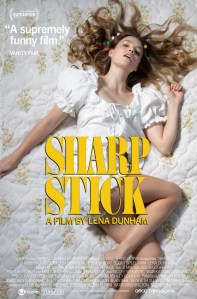 Moving onto Sharp Stick, an original story from Dunham, you can see points of similarity immediately, framing the narrative around the self-discovery of Sarah Jo (Kristine Forseth). She’s 26 years old and still a virgin, a point she feels more uncomfortable about because of how open her half-sister Treina (Zola’s Taylour Paige) and mother (Jennifer Jason-Leigh) are about their own sexuality and their many paramours. Sarah Jo has her sights set on Josh (Jon Bernthal), a seemingly kind stay-at-home dad taking care of his special needs son that Sarah Jo babysits. If she’s going to lose her virginity to someone, she wants it to be him, but with this comes consequences as well as a steep learning curve for Sarah Jo on the realities of intimacy.
My issue with Sharp Stick is that it feels far more dawdling and confused about what it wants to say and explore with its brief 86-minute running time. This feels more like a handful of ideas or short story beginnings that Dunham inartly smashed together, and the proceeding movie has moments of levity and insight but is overall too messy and shambling and underdeveloped. Let’s start off with the main character who I would have assumed was a teenager by the way that she was acting. When the script tells me she is 26 years old, I was flabbergasted. She was behaving like a much less mature adult, not to say 26 is the height of maturity or that everyone matures at the same speed. Still, Sarah Jo comes across as very naïve and infantilized about adult relationships and human sexuality, which is confusing considering how open her family is about sex and pleasure. It’s not like she’s growing up in a conservative or repressive environment. She’s literally helping her sister record twerking videos for her social media account. The chief reason I think Dunham made an explicit reason for aging our protagonist 26 was to remove some of the ickier consent issues from coming-of-age stories about inappropriate relationships between underage teens and adults (American Beauty, Towelhead, The Diary of a Teenage Girl). She wanted to preemptively remove those criticisms, and so she made Sarah Jo 26, and she also had her uterus removed, something meant to make her seem more adult, at least on paper. Except this is the most childish 26-year-old I may have ever seen. The problem is that Sarah Jo’s naivete has shackled her character, so her sexual awakening feels more akin to a teenager’s than a mid-twenties adult.
Update: I did some research and discovered that Sarah Jo was originally written to be autistic, which would explain more of her social awkwardness. Dunham reached out to an expert on compassionate representations of autism and physical intimacy but then reportedly cancelled on her. I guess she just decided to make Sarah Jo neurotypical but didn’t change anything else. Needless to say, this was not the best decision and its impact is all over the oblivious sense of naivete that pervades the character and her choices.
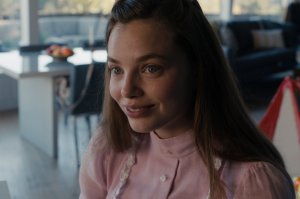 I found it hard to take Sarah Jo that seriously as a character, as her education seemed to be obvious and a little too arch and twee in delivery for the rest of the movie. Once she has her sights set on Josh, Sarah Jo looks to Internet pornography to learn about what she may do to better please her partner. She is titillated by watching porn but less from the simple carnal activity and more from her fixation on one very commanding actor, played with nonchalant exuberance by Scott Speedman. Sarah Jo studies the annals of porn and creates a colorful construction-paper-heavy checklist of sexual acts she would like to experiment with, and she even alphabetizes it. It’s stuff like this that paints Sarah Jo as being infantilized. It’s not like we were shown her penchant for arts and crafts or taking larger tasks and breaking them down into cutesy checklists before. She even starts soliciting men online to better help her check things off her list, although this doesn’t come to any danger beyond a few lackluster men not living up to her expectations. And that’s the big takeaway here, that what porn promotes is more fantasy than reality, that actual intimacy between consenting adults is its own very different thing. This is too simple a revelation to rest the entire movie upon wuthout a more in-depth character, which Sarah Jo is not. Again, it’s confusing because this character will seem like she is ignorant to the world of sexuality and yet her family is so direct. The Sarah Jo character feels like she’s been ported from another story about a sheltered wallflower learning about her body and her pleasure versus how she’s been told to act to better turn on men.
I don’t fully understand what the entire storyline with Josh was meant to add up to. He’s her first sexual experience, and while he’s awkward and hesitant, he eventually gives in to this young woman’s ego-stroking infatuation, and then they embark on an affair behind the back of his pregnant wife (played by Dunham). I’m going to go into spoilers to better assess this storyline, so be warned dear reader. He eventually confesses to his wife about the affair and breaks down into tears, apologizing and saying he couldn’t help himself, and the moment is squarely to make us see Josh as a pathetic loser. His tears are performative, and he’s throwing around shifty excuses like that he did it for them. He admonishes himself but it’s not contrition we see but manipulation, meant to provoke forgiveness or at least mitigation of his actions by his wife. That’s when she shakes her head and talks about the many, many other women that Josh had had affairs with, proving that this tryst was not out of character. In fact, this seemingly “good guy” dad is actually a creep. Okay, but then Dunham’s character stays with him and they continue living their lives, obviously with the absence of Sarah Jo now. She even returns to them to yell to Josh that she’s getting much better at sex, like she will win him back as a lover. I suppose Dunham was setting up Sarah Jo’s object of desire being less than her expectations and instead as another scuzzy and coddled man-child. That’s fine. But then why does Sarah Jo still seem so determined to win him back? It’s like she hasn’t learned from this.
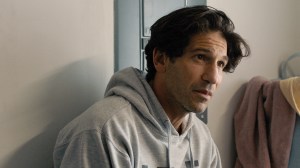 There are moments that work in Sharp Stick, little pieces that click together with insight or well-honed character writing. I enjoyed Sarah Jo’s mom going into full monologue mode to describe how she met and fell in love with Treina’s father. When Sarah Jo asks about her own father and her story about meeting him, her mom just shrugs and says her dad was just some guy. The disappointment is palpably felt. I also appreciated that children with special needs are presented in a straightforward and un-stigmatized fashion as just being kids. I thought the conclusion with life advice from Speedman was a great scene-stealing deluge of wisdom from the most unexpected place. I just wish it felt more earned for Sarah Jo and her awkward personal odyssey.
Dunham hasn’t directed a movie since her indie breakout in 2010, Tiny Furniture, and now she has two movies within weeks of one another. Catherine Called Birdy is the much stronger outing, allowing Dunham to adapt her voice and talents into a PG-13-firendly universe while still keeping her sharp wit and attention to character detail. Sharp Stick, in contrast, feels like several ideas that never fully coalesce, and the messy decisions with the main character makes the entire enterprise feel strange and lacking better-earned wisdom from her journey. After six seasons of Girls, I’ll always be intrigued about a new Dunham creative project, but they are not all equal. Catherine Called Birdy is Dunham flying far above the routine criticisms about her writing and her perspective, as well as showing her adaptability in an unfamiliar setting. Sharp Stick, sadly, is a reconfirmation of those criticisms and the sloppy execution of bigger ideas.
Nate’s Grades:
Catherine Called Birdy: B+
Sharp Stick: C
Share this:

Blonde (2022)
 After receiving such blistering and excoriating responses, I went into writer/director Andrew Dominik’s Blonde with great trepidation. The near-three-hour biopic on the iconic Marilyn Monroe, played by Ana de Armas, is the first movie to earn an NC-17 rating since 2011’s Killer Joe, and as such, there’s a natural curiosity factor to any movie receiving such hostile reactions. Fans and critics have called the movie exploitative, navel-gazing, misogynistic, and redundant misery porn. One critic even said Blonde was “the worst movie Netflix has ever made.” I was a major fan of Dominik’s verbosely titled 2007 film, The Assassination of Jesse James by the Coward Robert Ford, and less so 2012’s Killing Them Softly, though I recognized sparing artistic merit. It’s been ten years since Dominik has directed a movie, so surely Blonde, based upon the novel by Joyce Carol Oates, had to have some merit beyond all its hype and criticism, right? Well, no. I processed my general disgust for Dominik’s three-hour slow-mo car crash. This movie is so stupendously misguided and cruel and filled with bizarre, outlandish, and maddening artistic decisions. For my movie review, I felt I needed to break my standard formula, so I decided to give voice to my analysis and criticisms by writing a pretend conversation between Dominik and a stand-in for the Netflix production. Enjoy, dear reader, and beware.
Andrew Dominick sits in front of the desk of a very concerned Netflix Producer, who fidgets uncomfortably in his seat and shuffles papers in his hands.
Netflix Producer: So, thanks, Andrew for making time for this meeting. We’ve seen your full movie and we have some… well, concerns.
Andrew Dominik: That’s life, man. You can’t tell stories without risk. Break a few eggs.
Netflix Producer: Yes, sure, but, well, I guess one of our biggest questions is why did you need almost three hours to devote entirely to the lengthy suffering of Marilyn Monroe? This is supposed to be a biopic, but all we get, scene after scene, to a fault, is a moment of Marilyn being abused, or crying, or being generally exploited. It’s… a lot to take in, Andrew.
 Andrew Dominik: Hey man, that was her life. She was this glamorous star, but behind the glamor is a lot more dirt and grime. Everyone wanted to be her, and I wanted to show the world how wrong that would be. This is a woman who was desired by the world and she was still a victim in the Old Hollywood system, which was a rape factory. I was just being honest, man.
Netflix Producer: I get that principle, but it really feels like the only version of Marilyn we get in this movie is the role of a long-suffering victim. It’s practically a passion play: The Passion of Marilyn Monroe. You’re cheapening her real-life suffering by making it so redundant to the point of self-parody, and also, if you were so concerned about creating an honest portrayal of what this woman went through, then why are you also making things up to add to her legitimate suffering?
Andrew Dominik: What d’ya mean? I adapted the book.
Netflix Producer: Yes, but you do know that Oates’ book is explicitly fictitious, right? It’s made up. Marilyn never had a throuple relationship with Charlie Chaplain Jr. and Edward G Robinson Jr. Marilyn had a positive relationship with her mother. Even worse, you’re adding fictitious suffering, like her relationship with her mother, or Marilyn being raped during an audition.
Andrew Dominik: Yeah, that might never have happened, but the rape represents the-
Netflix Producer: I’m gonna stop you there. You should refrain from sentences that include the phrase, “The rape represents [blank].” We don’t need literal sexual violence, of which we return to time and again, to stand in for a larger thematic message. Also, it’s quite disingenuous to add extra traumatic experiences when you’re purporting to tell this woman’s real trauma and conflict.
Andrew Dominik: Agree to disagree, then.
Netflix Producer: No, not really, but, okay, Andrew, can you tell me any personable impression you get of Marilyn from this movie? And-and you cannot say “victim.”
 Andrew Dominik: She was…….
Netflix Producer: …Yes?
Andrew Dominik: Sexy?
Netflix Producer: Okay, sex symbol for nearly 60 years after her death, sure. What else?
Andrew Dominik: She was…. Um…. Uh… Can I look this up on my phone?
Netflix Producer: See, Andrew, this is our problem-
Andrew Dominik: Oh, she has daddy issues! There. That.
Netflix Producer: And for an hour you have her referring to all the men in her life as “daddy,” which is very uncomfortable especially when those men are literally abusing her.
Andrew Dominik: But, y’see, she calls ‘em all “daddy” because she has-
Netflix Producer: Oh, we get it. Thank you. You have 160 minutes and you keep hitting the same point over and over, bludgeoning the viewer into submission. It’s more than a bit gratuitous, especially when you factor that you’re adding even more trauma.
Andrew Dominik: What d’ya mean by “gratuitous?”
Netflix Producer: I have prepared several examples. For starters, it might be a bit much within the first twenty minutes of your movie to subject your audience to a mother trying to drown her child in the bathtub and Marilyn being sexually assaulted at one of her first auditions.
Andrew Dominik: Okay. Okay. I get that.
Netflix Producer: Then there’s the ghastly POV shot from inside Marilyn’s vagina, which by God happens twice, and both times it’s during forced abortions. Did we really need that queasy angle that is literally invading her body against her will to accomplish what exactly?
Andrew Dominik: The purpose of any true artist is to go deeper-
 Netflix Producer: I’m gonna stop you there again. It’s just bad taste, Andrew. Also, speaking of bad taste, maybe we don’t need the entire sequence where JFK rapes her and then hires government goons to abduct her and force Marilyn into an abortion. And then, on top of all that, she hears the pleas of her first aborted fetus calling back to her. Yikes. Can you at any point step outside of your position, Andrew, and realize how shockingly gratuitous all of that can be?
Andrew Dominik: It’s all designed to separate the person from the icon. Marilyn Monroe never really existed beyond the fantasies of the public, man. It’s about bringing back her humanity.
Netflix Producer: Separating the legend from the person would be a natural artistic angle, but that means spending time establishing the person, building her up through multiple dimensions, multiple opportunities to flesh her out. You only spend time seeing her as a victim, that is when we’re not meant to partake in the same sexualization of her that you seem to be criticizing. I mean the 1996 HBO TV movie managed by having two different actresses portray her, with Naomi Judd as Norma Jean and Mira Sorvino as Marilyn. That literalized the differences and even had Marilyn converse with her former persona as a plot device. You have none of that.
Andrew Dominik: I might not have that, but my movie has a cross dissolve that goes from Marilyn getting banged to the literal crest line of Niagara Falls.
Netflix Producer: I don’t think that really makes up for a lack of character substance.
Andrew Dominik: Agree to disagree, man.
Netflix Producer: You really can’t keep using that as a defense.
Andrew Dominik: Agree to disagree, man.
Netflix Producer: Your horror show of relentless trauma and bad taste might undercut your stated goal of humanizing this woman. She’s not a character but a symbol of abject suffering, a martyr, and you increase her suffering, and sometimes in grating, absurdly grotesque ways. Do you even care about this woman? You’ve devoted three hours to reanimating her as a powerless punching bag.
Andrew Dominik: Well, I did say Gentlemen Prefer Blondes is about “well-dressed whores” and that Blonde is “just another movie about Marilyn Monroe. And there will be others.” I also said that the most important part of her life was that she killed herself.
 Netflix Producer: Exactly. That makes us question whether you have the passion and sensitivity for this project. Why does this movie even have to be NC-17? Will your three hour torture chamber be bereft of meaning if the audience doesn’t see two inner vaginal camera angles?
Andrew Dominik: How dare you even question my artistic integrity. If you remove those shots, you might as well be removing the soul of this movie. Why even tell this story?
Netflix Producer: Yes, why indeed?
Andrew Dominik: It’s meant to be disorienting.
Netflix Producer: Congrats.
The Netflix producer leans back in his chair and releases an extended, wearying sigh.
Andrew Dominik: So… after everything…. Are you going to make me cut anything?
Netflix Producer: Please. We’re so hungry for Oscar recognition, we don’t care. Go for it.
I want to cite de Armas’ (The Gray Man) performance as one of the few attributes to the movie. It’s hard to watch this woman suffer and cry in literally every scene, but I also just felt so sad for not just her character but for de Armas as an actress herself. She shouldn’t have to endure everything that she does to play this character. She is undercut by Dominik’s artistic antics and avarice at every turn, like the story jumping around incoherently so every scene fails to build upon one another. There is no genuine character exploration to be found here. It’s a cycle of suffering, and the movie wants to rub your nose in the exploitation of Monroe while simultaneously exploiting her. De Armas deserves better. Marilyn Monroe deserves better. Every viewer deserves better. Spare yourself three awful hours of pointless suffering in the name of misapplied art.
Nate’s Grade: F
Share this:

Fall (2022)
 It’s no more, no less than its bald premise, but with the benefit of some nifty aerial photography to heighten viewer veritgo, some seamless special effects, and a streamlined story structure, Fall is serviceable survivor escapsism. The motivation is pretty inconsequential as to why these two young women (Grace Caroline Currey, Virginia Gardner) are climbing an old radio tower, but they do, they reach the top, and then the ladder crumbles below them, trapping them way up high. From there, it becomes a survival thriller that isn’t as dumb as its straightforward title and premise might have you believe. I recall 2010’s Frozen, not the popular Disney musical, but the small indie thriller about a group of characters stranded on an abandoned ski lift. It’s a similar scenario and becomes less of a question over whether they will get down and more how they will endure the elements and simply survive long enough to draw attention to their plight. If you have a fear of heights, there are several deft moments that draw out that anxiety-ridden tension; I even gasped a few times at the movement from teetering positions and leaps. There’s a late twist I wasn’t expecting that I think is handled well, and there’s just enough character introspection to keep things interesting without de-escalating the urgency and tension of the premise. Also, Fall originally had a lot more swearing and 30-some F-bombs and these were eliminated from the use of a Deep Fake A.I. software that swapped the actors’ mouths into contorting new PG-13-approved syllables. I didn’t even notice it, which is a sign of how remarkable the technology has become and how cost-effective (the budget for Fall was only $3 million). There’s little else to this than being a well-developed, well-executed 100-minute thrill ride (you get Jeffrey Dean Morgan for exactly two whole scenes) and when you’re looking for fleeting fun, that’s certainly agreeable disposable entertainment.
Nate’s Grade: B
Share this:

Clerks III (2022)
 I’m at a crossroads with writer/director Kevin Smith. Well, I might actually have already switched sides but don’t want to fully admit it yet even if it’s self-evident. I’ve written about this before but Smith was one of those major cinematic voices that helped shape my sense of indie film and even comedy during my formative teenage years. I became a diehard fan, watched every movie several times and had all their interconnected Easter eggs memorized, and I’ve seen the man in person three times, one time recorded for a college Q&A DVD release. In short, I was most definitely a Kevin Smith super fan. Then over the last five years or so, things began to change, or more accurately my perception of Smith’s movies began to change. The attempts at humor were strained, obvious, and gassed, and it felt like his biting wit and raunch had transformed into mawkish nostalgia. The man in his twenties who made comedies I identified with and loved became a man in his forties with different priorities and a different perspective. He evolved. However, I am no static creature, and I too was evolving, and my fanfare for Smith’s comedy sensibility has transformed into more of a pained grimace. I re-watched Dogma in 2019 and Jay and Silent Bob Strike Back in 2021, as well as its second-banana imitation Jay and Silent Bob Reboot in 2019, and my assessment was only reaffirmed with each movie: I’ve outgrown my old influence. As a big screen storyteller, Smith has become more and more insular, inaccessible, and beholden to eroding fan-service, almost like he too is trying to bid goodbye to his own universe of characters. Maybe that will be the big reveal, Smith putting all his toys back away while he still can.
Clerks III is a return to the old QuickStop convenience store in Red Bank, New Jersey, last seen in 2006 with friends and malcontents Dante Hicks (Brian O’Halloran) and Randall (Jeff Anderson) as the new owners. Clerks II seemingly ended on a moment of triumph, of the guys returning to their roots but also stepping up, assuming ownership responsibilities. However, many can also view the ending as a darker indictment on what the future held for these men. Sixteen years later, what have these men accomplished? That’s the thrust of this third film, following Randal’s brush with death from a heart attack (based upon Smith’s own life-threatening experience). He re-evaluates his life at 50 and yearns to make a movie about his life and his personal experiences, which just happens to be life in service at the QuickStop. He bands together with Dante as producer and they put together a ragtag crew, including old buddies now selling their own state-approved brand of bud, Jay (Jason Mewes) and Silent Bob (Smith), to make their movie.
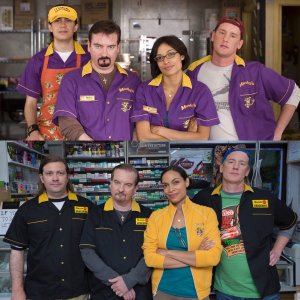 In many ways, Clerks III is like a remake of Clerks with the characters of Clerks making their own version of Clerks only thirty years removed from the actual scenes of Clerks. There’s a bit of a snake eating its own tail feeling; many scenes are re-creations of moments from the original Clerks and with the same actors. It’s slightly fun to see even the smaller non-actors come back to recreate these moments, but it also makes the movie feel like an extended high school reunion (“Oh look, that guy lost his hair.”). If you were not a fan of Clerks, well you shouldn’t really be watching the third film in the series, but if you didn’t have an attachment to these characters and this odd world, seeing older versions of former fleeting characters, from the Chewlie’s Gum rep to the angry ruse-baiting video store customer or the woman who manually masturbates caged animals, would feel like flipping through someone else’s photo album, devoid of whatever nostalgic or emotion was intended.
As a lifelong fan of Smith’s filmography, or at least a former lifelong fan now transitioning to accepting a parting of ways, it’s neat to see this reunion of sorts, but it’s also ultimately pointless from a narrative standpoint. Smith is treading the same ground now with irony and distance. Actually, the irony gives way more to sentimentality. It’s not an insult to say that Smith has gotten increasingly softer as he’s gotten older, blunting much of his comedy edge. He comes across as a sincere man who really cares for the people in his life, including these very people that contributed their time and efforts in 1992 to help make a young man’s dream come true. I understand his desire to pay back all the little people, to check back with them one more time, and to have Clerks III serve as a love letter to those who were there from the very beginning. If you’re plugged into this universe, you might smile and you might also feel some of the love.
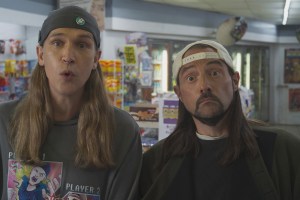 There are famous cameos to balance out the lesser known faces from the original Clerks. You’ll see Ben Affleck hamming it up, Justin Long doing a funny voice, Fred Armisen grasping for something to do, and Sarah Michelle Gellar’s first film role since 2012 and first live-action film role since 2009’s Possession (Gellar was a voice on Smith’s Masters of the Universe animated series on Netflix). The two big additions from Clerks II also return. Trevor Fehrman, returning as the socially awkward coworker Elias, is the funniest part of the movie as his character goes through a spiritual crisis. He feels let down by Jesus and commits himself to Satan, and his runway show’s worth of crazy outfits and cosplays throughout the movie is the funniest joke that never even bears mentioning, which only makes it funnier (he too has his own Silent Bob-esque quiet sidekick played with good spirits by Austin Zajur). Elias was the voice of a younger generation of Internet fandom in Clerks II, allowing Smith his opportunity to criticize modern geek pop-culture, like the Star Wars prequels and Lord of the Rings. That doesn’t really happen in Clerks III despite 16 years of Dante and Randal’s cinematic absence. Smith doesn’t even nibble or good-naturedly rib any pop-culture landscape. Even the jokes about NFTs feel hesitant and wishy-washy and lazy. Smith was defined by his ribald wit and hyper-literate dialogue, and now his comedy has become inane slapstick and pandering nods meant to serve as a replacement for an absent punchline. It’s disappointing how little the comedy registers now.
The biggest addition to the Clerks trilogy was Rosario Dawson, now even more popular as she’s firmly solidified in the Star Wars TV empire. I figured she would have been written out of the franchise as her availability was going to be far more limited. It’s not a spoiler considering it’s revealed within the first minute or so, but Dawson’s character, Becky, who was pregnant with Dante’s child and this presented a new route for his future, is dead. Not only is Becky gone but she died in 2006 from a drunk driver, which means that her unborn child with Dante also died, though this is never touched upon and that seems truly bizarre because much of Dante’s characterization in this movie will be his prison of grief he’s been unable to break from. It’s been 16 years and Dante has not moved on, and I wish more of this was explored thoughtfully. He views himself as a man stuck, now in his 50s, and having missed his off-ramp to another and better life. Without more careful attention, it can come across like a schlub holding onto his grief as a mistaken form of identity. Even that description could be interesting, but you’re not going to get that level of drama in something like Clerks III. Dawson does have a few appearances as a ghostly memory trying to help Dante move on, though if this is the case, I feel like she should be reaching some kind of breaking point after 16 years of effort.
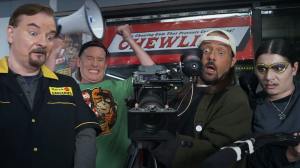 By the end of Clerks III, it’s clear that Smith intends for this to be the concluding chapter, sending off these characters as reflections of his own film history. The focus of the final act is far more dramatic, as the act of retelling one’s life story as a movie becomes its own way of sharing the love and admiration of a decades-long friendship. I don’t quite think Smith gets to the dramatic heights he’s reaching for, even when some pretty significant and surprising events play out. Too much of the movie is like watching a low-budget remake of Clerks thirty years late, and while I’m a sucker for movies about the making of movies, and those fun found families of creatives banding together, the structural vehicle and conceit for Clerks III left much to be desired. If you remember the scenes of 1994’s Clerks, watching Clerks III is like reliving them as a strange Lynchian dream where the edges are smudged and everything isn’t quite as it should be. At this point, a new Kevin Smith movie is made strictly for the most diehard of fans. I can see that ever-shrinking pool of fans warmly smiling and chuckling from the movie but more in nostalgic recognition of time gone by. It’s nice to revisit these characters, as I’ve been eager to see what life has dealt them since Clerks II. You can feel Smith’s affection for these people, the ones who catapulted him into fame, but the movie is too backward-looking and uninterested in its own comedy as Smith winds down.
Nate’s Grade: C
Share this:

Secretary (2002) [Review Re-View]

Originally released September 20, 2002:
Secretary is a new romantic comedy with a few kinks to it. It’s actually the most romantic S&M movie ever. It’s the first S&M romantic comedy since maybe Garry Marshall’s disastrous 1994 Exit to Eden. I’m still trying to get the image of Rosie O’Donnell in a bondage mask out of my ongoing nightmares.
Lee Halloway (Maggie Gyllenhaal) is fresh from a stop at a mental institution for her hazardous habit of cutting herself to feel relief. Her overbearing mother stashes the entire kitchen cutlery in a locked cabinet. The sheltered Lee resorts back to a kiddy make-up box stashed under her home bed. Instead of colorful brushes and arrays of lipstick, she has a selection of sharp objects. Lee goes job hunting to step back from her habit, and is hired as a secretary to E. Edward Gray (James Spader). He is a rigid taskmaster who delights in pointing out typographical errors with his red marker, his weapon of choice. Gray enjoys his dominance and Lee complies, even if it’s routing through garbage. He ticks away Lee’s flaws like a checklist of annoyance but also appears to have genuine concern for her. When he notices her wounds Gray confronts her and convinces Lee to stop cutting herself.
The turning point arrives when Gray orders Lee into his office one afternoon. He commands her to bend over his desk and then delivers a sound spanking. Lee stares at her purple rump with fascination, like something has been awakened inside her. Soon enough Lee purposely makes typos so she can re-assume her spanking position.
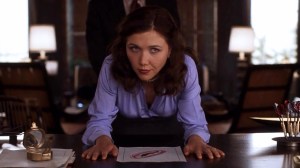 Maggie Gyllenhaal is a cinematic find with a fearless and breathtaking performance that is at once delicate, nervous, self-controlled, seductive and delightful. Gyllenhaal, with her heart-like face and pert lips, radiates star quality. She allows the audience into Lee”s head and we quickly fall in love with this peculiar yet charming heroine. If there is any justice in this world Gyllenhaal should at least get an Oscar nomination (she didn’t). Spader can do this left-of-center creepy character stuff in his sleep.
Secretary on the surface may seem like a fetish flick but it’s no different than boy (sadist) meets girl (masochist) and falls in love. Director Steven Shainberg treads carefully around serious subject matter, like Lee’s self-mutilation, to focus on these two very special characters. Secretary isn’t making any loud statements on sadomasochism or post-feminism, it’s just showing us that S&M is the route these two people take to find true love. It doesn’t judge them for their unconventional tastes and neither should we. This is one of the finest romances in recent memory and it seems to come from one of the most unlikely places.
Sadomasochism has been predominantly shown involving pain or some leather-masked madman evoking torture. Secretary may be the film that shows there can be pleasures with pain. Some people regard what Lee and Edward do as sick, perverted, or downright wrong. Secretary is a foot in the door to get people to understand what willing sadomasochism really is about. We all have fetishes and interests, and S&M is the number one fetish truth be told. This isn’t your everyday romance.
Obviously, this is a movie that will not appeal to everyone. The relationship between our leads is surprisingly complex but gentle and even sweet (if that’s the proper word for an S&M romantic comedy). Secretary shows that it truly takes different strokes and, despite an overly silly ending, is the most pleasing romance of the year. You’ll never look at red felt pens the same.
Nate’s Grade: A
——————————————————
WRITER REFLECTIONS 20 YEARS LATER

I’ll be honest with you, dear reader, because I think you deserve that. I didn’t recently re-watch Secretary. I did re-watch it a year or two ago, and the return experience was so jarring that I didn’t feel that I would greatly benefit from watching it so soon again, but I knew I would have to include it on my 2002 re-watch list when it was time. When I first watched it in 2002, I was smitten with its offbeat charms about an unconventional romance through the BDSM community and a young woman’s self-actualization through accepting her kinks. It was a star-making performance from Maggie Gyllenhaal (originally was going to be Gwyneth Paltrow) and as a sucker for quirky romances, it was one of my favorite films of the year. Nearly two decades later, I took out my DVD copy to share with my now fiancé, who is also a fan of quirky romances and who had never watched Secretary. Surely, I thought, she would be entertained. Dear reader, she was very not entertained. She was horrified. She was shaking with disgust. She was having a literal violent reaction to the movie and its onscreen display of what constituted romance, and I will say it struck me differently too. I understand that not every film will age well, as our sense of what is funny or acceptable or what is even compelling will change over time as our culture inevitably shifts. That’s art. But hoo boy has Secretary aged about as well as milk in the ensuing twenty years.
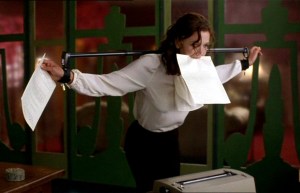 The very nature of the S&M relationship between boss and secretary was already problematic when it was released in 2002, but in a post-Me Too universe it is inexcusable and taints any charms the movie may have had. Mr. Grey (James Spader), the dominant boss and rigid stickler for rules, is the villain of the movie and not its Byronic hero, the brooding and damaged man that a pure-hearted woman just needs to find a magical way to reach and reform. He is not romantic. He is appalling, and the early critical praise, myself included, excused far too much of his behavior. While not condoning his excesses, critics may have given more leeway because the end result was framed as a happy ending, with Lee (Gyllenhaal) being cared for by Mr. Grey. However, he completely uses his position of authority in many inappropriate manners, and while they do develop a mutual relationship, eventually, the power dynamic is not equal at all. This takes away the agency of Lee and makes the romance feel like a false choice. Much of her relationship can be summarized by the awful moment he ejaculates on her back: she just has to take whatever he dishes and like it. That’s not romantic. That’s not cute. That’s toxic. It also hurts the overall movie that the way Lee proves her devotion as the film’s climax is to stay fixed at her boss’ desk for many days, to the detriment of her physical health. Yes, Mr. Grey gets Lee to kick her habit of self-harming but she replaces one need with another. He resembles a predator by most every definition, and to try and say, “Well, he’s just complicated,” is bad man excuse-making.
I tried imagining tweaks and alterations that could make this all work, but anything where he is her boss muddies the issue of consent. Maybe if he was a visiting businessman, but that would also offer a questionable dynamic. The core of Secretary is built upon the secretary/boss interplay and imagery. The tagline is, “Assume the position,” and depending upon the poster, you might only get a woman’s rear in fishnets as the sole imagery. Director Steven Shainberg (Fur) and screenwriter Erin Cressida Wilson (Chloe, The Girl on the Train) are clearly veering into the obvious office power dynamics for provocation. They are very intentional about subverting romantic clichés and looking for something different for our heroine. We have a nice guy, played with squirmy energy by Jeremy Davies, who just won’t cut it. He’s too vanilla for her and afraid to be too forceful in his spanking. It’s like the filmmakers are declaring that Lee demands more, and her specific combination of qualities just so happens to align with this gross man. The movie wants us to hold our judgment, and I could in 2002 in a “love is love” declaration, but what I see on-screen in 2022 is not indicative of love. It’s obsession. It’s codependency. It’s sad.
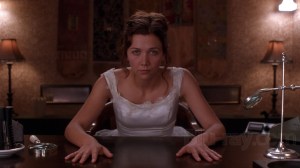 The other problem, sadly, is Maggie Gyllenhaal’s fragile performance. The choices she makes collapse Lee, greatly infantilizing her and magnifying all the icky feelings I had. She’s playing Lee less like an adult woman who is struggling to figure out her confusing life, and impulses, and more like a teenager who woke up in the body of an adult woman. Part of this is the screenplay but it’s not helped by the acting choices that Gyllenhaal engages with. I do really enjoy her as an actress, and it’s easy to see why she could captivate so many circa 2002 with this performance, but it plays so differently now. Today, she comes across as another young woman trying to remodel herself to please a man. Her little girl acting choices only make the courtship feel even more abhorrent. I wonder if they were trying to aim for the movie to be its own kinky fable, wherein the infantilization would harken back to older fairy tale tropes and Mr. Grey as the unorthodox knight in shining armor.
This is one of the biggest critical swings I’ve had since re-watching twenty-year-old movies and my initial reviews, and I’d say even one of my biggest changes on any movie I’ve watched. I do think you can make a funny and sexy S&M rom-com; for years I thought Secretary was it. Not so. I wouldn’t even recommend this movie and it used to be in my top of 2002. I suppose people who are curious could give it a chance, but I think the objections outweigh whatever positives can be gained from viewing. Oh well. That’s the nature of art. Not every movie or book or song will have the same power over time. They stay the same but we, the prism upon which art is judged and related, are constantly in flux. That’s just the way it is. This won’t be the last movie where my opinion changes dramatically. I just won’t watch Secretary again, and that’s okay.
And you’ll never be able to convince me that E.L. James didn’t take her BDSM character’s name from this film.
Re-View Grade: D
Share this:

Nope (2022)
 Within two movies, and most likely just with his first in 2017, Jordan Peele catapulted himself as a brand name in the world of horror. At this point, you’ll see a Peele horror movie sight unseen because you know what you’re getting is going to be a unique experience. There are plenty of modern horror directors that have built a rabid fandom, like Ari Aster or James Wan, but nobody seems to be given the same platform as Peele has earned at this juncture. The writer/director has become what M. Night Shyamalan used to exhibit, the director whose creative visions were each highly anticipated event movies. Nope is Peele’s first foray into science fiction territory and the results are messy, disturbing, and, at points, astounding.
The Haywood family ranch has been involved in the motion picture industry since its very beginning. One of the first film images, a black man astride a horse, was the great-great-great grandfather of Emerald (Keke Palmer) and Otis Jr. (Daniel Kaluuya). The brother and sister are trying to save the family ranch after the untimely and strange passing of their father (Keith David) who was felled by debris falling from the sky. Their neighbor, Ricky “Jupe” Park (Steven Yeun), is spinning his notoriety as a child actor into a Western theme park attraction. Ricky’s claim to fame was being one of two survivors of a 1990s sitcom where the trained chimpanzee, who in the context of the show was his adopted sibling, snapped and went on a killing spree. Emerald and Otis Jr. begin to suspect that there is a real unidentified flying object hanging over their land, so they set out to capture living proof and become rich and famous. The alien, hiding in an unmoving cloud over the course of six months, has other plans and intends to assert its claim on the Haywood territory.
 Peele is proving himself more and more as a major director of genre spectacle and vision. Each of his three directorial efforts will hit people differently; I think they’ve incrementally gotten a little sloppier in the writing department, but Peele is only growing stronger as a visual stylist and orchestrator of big screen spookery. There is a grandeur to the visual arrangements, owing as much to the expansive language of Westerns and the awe of early Steven Spielberg. I wish I had seen the movie in IMAX as Peele intended, since he went to all the trouble of planning specific sequences for the grand IMAX cameras. There are several moments that are jaw-dropping and stirring in horror and wonder. A literal rain of blood and viscera and expelled non-organic items is a striking image. Even the unnatural way that helpless people are thrown off the ground can be jolting and primal. There’s a claustrophobic interior sequence of desperate people that really conveys the terror of the doomed. A big addition to the eerie atmosphere is the brilliant sound design. The otherworldly-ness of the alien encounters is heightened by a really in-depth sound design that can make the hairs on the back of your neck stand at attention. Even the sound of rain, and its distance, can be an indicator of the proximity of danger. There are also the distant sounds of horrible screams circling through the clouds high above, and it’s a deeply unsettling design trick that works every time. Even when the movie wasn’t quite as engaging from a narrative or thematic standpoint, Nope is always engaging on a simple delivery system of spectacle. The way Peele distributes his visual clues and keys, sometimes literally, always provides something for an audience to anticipate.
I was also starting to grow impatient from Peele’s coy narrative games. The plot moves in frustrating starts and stops, teasing an intriguing development or proffering a question and then skipping backwards, denying the viewer a sense of gathering momentum. There’s a toying sense of teasing out how far he can go before an audience gets too impatient and quits. Much of the first half also takes place during night or sequences of sustained darkness, which can definitely play into the the fear of what could be in those shadows, but it makes for a fitfully frustrating experience when you’re trying to unravel a science fiction mystery. I kept wondering how all these pieces were going to come together, especially the ongoing subplot about this killer chimpanzee, but I had faith in Peele (mostly). That faith was rewarded but I’ll admit for the first hour I was wondering if Peele was too evasive for his own good.
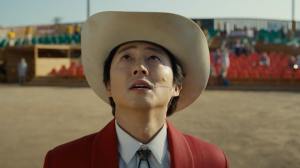 Nope begins as Close Encounters of the Third Kind and then transitions into Jaws and stays there, and it was during the second half that my interest magnified exponentially. It’s around the hour mark that the movie finally puts all its cards on the table and declares what it is and what the remaining movie is going to be about. All the stutter steps and vagaries are cast aside, and the movie finally shifts into its grand entertainment of a group of humans learning about an overwhelming and unusual threat and plotting their unorthodox plan of attack. I’ll still try and play around spoilers without getting too deep into specifics. It’s a great relief when Peele no longer has to tease his threads and mysteries and can at last be open and let the conflicting components come together. The annoyances I felt in the first half melted away, and I was satisfied as the movie picked up a genuine momentum and smartly tied in many prior plot elements for the bigger picture, like the inflatable tube men, old timey picture-taking souvenir machines, and even the very vague almost carwash-esque imagery from the opening credits. The second half of the movie is more fun because it’s a big hunt and it allows our characters to make use of what they have learned to form conclusions and strategic moves and adjustments. It’s characters making smart decisions. It’s a scenario that finally allows Peele to finally play with all the setups he’s spent an hour cheekily hiding around.
While the climax is great, and the movie gets consistently better, I don’t feel like all of its many thematic ties come together. Being a Jordan Peele horror movie, we’re now expecting there to be extra layers of social-political commentary and allegories. The back-story for Ricky as a child actor is given a lot of attention and screen time for a two-hour movie, and I don’t know if what it adds up to is equal to the time it was given. Thematically, you can make some speculative reaching about the exploitation of animals for spectacle, about underestimating and not respecting nature, and even setting up for later tragedy, but it all seems less meaningfully integrated than any other Peele movies’ elevated subplots. With the Ricky back-story, there is even a literal anticipation of a literal shoe to drop, which seems so obvious as a visual metaphor but I cannot link it directly with what follows. I can keep digging and find connections but it requires far more effort than Peele’s other works of horror. The family history of working for Hollywood as horse wranglers feels underdeveloped. There are also rules that it establishes that Peele isn’t fully consistent (just don’t look?) that left me questioning. I figured that colonialism would be an obvious parallel with invading aliens (H.G. Welles even made use of the analogy 120 years ago), but maybe that was too obvious territory for someone like Peele. My friend Ben had a crazy early theory that the aliens themselves would resemble horses and thus they were returning to free their equine brothers and sisters from human exploitation. I guess I’ll go ahead and spoil you, dear reader, that this does not happen in any shape with Nope.
 I’d rank Nope the third best Jordan Peele horror venture, and while it clearly makes use of science fiction concepts and its rich iconography, it’s still very firmly a movie rooted in horror, the horror of the unknown, the horror of being small and helpless, the horror of being left behind. Not all of Nope’s many ambitions quite land, and the themes feel a bit more jumbled or underdeveloped, but I want Jordan Peele to continue making the movies he wants on his terms. Not every one is going to hit exactly the same for me, or for any viewer, but we’re all better when unique artists like Peele are given the latitude and support to bring their personal visions to the big screen. As long as he’s still achieving a baseline of quality, something that befell the middle Shyamalan period, then I say swing away and let’s see where you’ll take us all next, Jordan Peele.
Nate’s Grade: B
Share this:

Licorice Pizza (2021)
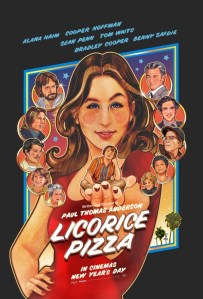
It took me many months but I’ve finally watched the last of the 2021 Best Picture nominees, and now I can safely say, I just don’t understand all the love for Licorice Pizza. It’s writer/director Paul Thomas Anderson’s (Phantom Thread, Boogie Nights) nostalgic L.A. hangout movie, but the axiom of hangout movies is that they only really work if you actually want to hang out with the participants. I’m not certain I needed or wanted to watch either of our lead characters navigate the curious bounds of their possible romantic entanglement. Alana Haim plays Alana, an under-achieving 25-year-old looking to better define herself, and Cooper Hoffman, son of the late Phillip Seymour Hoffman, who appeared in five prior PTA movies, plays an over-achieving 15-year-old that is in a hurry to grow up and conquer the adult world. He’s crushing on her, she’s flattered but says it’s not appropriate, and over two hours we watch a series of meandering episodic adventures that test their will-they-won’t-they determination. I found Haim’s character to be generally unlikable and, worse, uninteresting. She’s petulant, needling, prone to jealousy but also clearly likes the attention but doesn’t know how far to test it. Hoffman’s character, based in part on Tom Hanks’ childhood friend and producing partner Gary Goetzman, is like a human puppy dog, so overwhelming and sunny and anxious to be liked, but I can’t see any more depth to him or her. They’re just kind of annoying and maybe that’s the point about looking back. I don’t see the larger thesis or theme in many of Anderson’s small and unfunny asides. He’s trying so delicately to recreate a feeling of time and place of early 1970s Los Angeles, but the movie doesn’t succeed in answering why anyone else should really care about this personal PTA slice of nostalgia. The best part of the movie, by far, is the segment where Bradley Cooper plays the lascivious and self-absorbed hairdresser-turned-producer John Peters. Too many of the other misadventures feel like table anecdotes brought to overextended life with technical pizazz and minimal emotional accessibility. Licorice Pizza left me cold and unfulfilled.
Nate’s Grade: C+
Share this:

River Road (2022)
 I was asked to review River Road by an Ohio producer, although he is the lone Ohio connection and it was filmed in British Columbia, so it doesn’t exactly count as an official Ohio indie. It’s written and directed by Rob Willey, a Canadian commercial and music video director with one previous feature credit, 2016’s Dark Cove, a horror thriller with a budget of only $25,000. Willey is definitely a talented visual stylist, that much is apparent from watching clips of his shorts or the trailers for his movies. He sure makes a pretty picture. My issue with River Road as a drama is that the plot, characterization, and structure felt not nearly on par with the alluring visuals.
Travis (Cody Kearsley, Daybreak) is a Vancouver guitarist living a wild life of drugs, sex, and rock and roll. He meets Zoe (Lexi Redman) at his journaling spot while he’s luxuriating at a friend’s home on the eponymous River Road. She’s an American visiting a friend and over the course of a party they hook up in more ways than one. Zoe’s cocaine ends up being heroin and now both become inexorably tied together, two addicts sinking lower and relying upon one another for support. Travis empties his bank account, sells his belongings, including his prized guitar, and then considers increasingly risky crime to be able to afford more drugs. This brings him and Zoe to their most dangerous option: robbing local drug lord, Fresno (Steven Roberts), and making a very bad man a very clear enemy who will want very real and violent vengeance.
 In short, I found these characters to be insufferable. This is billed as a crime movie but it’s really more of an addiction narrative following the descent of two people into more desperate and self-destructive behavior. As an addiction narrative, it’s best to start with some tangible semblance of what the “before times” are like so we have a baseline to contrast with the damaging effects of drug abuse. If we followed a story about a deranged homeless man with alcoholism who suddenly started using crack, that’s not enough of a dramatic contrast to effect much added drama and tension. This is the first error of River Road. Our introduction to Travis is that he’s a traveling hedonist, playing in a rock band and going through women like water. He has a montage about “getting clean” after the band’s last tour but this literally lasts minutes before he’s right back to snorting cocaine at the local parties (maybe we have different definitions of “clean”). With Zoe, we have one meet-cute first encounter, and then she’s already at the same party snorting cocaine and introducing Travis to heroin. This all happens fifteen minutes into the movie, so not enough time to effectively establish a “before” phase, but Willey errs by failing to give us more to either Travis or Zoe as characters. They were vague before and now, for the next hour, they will be defined by the depths of their addiction. However, I was never emotionally engaged with either of them so I found much of their rather redundant wallowing to be tedious and, shocking, failing to provide further needed characterization.
My engagement was also hampered by much of the clunky and inauthentic dialogue. When people speak, you don’t really feel like you’re learning much about them; it’s like empty air unless they’re directly expositing what is, by all other means, unclear. Travis says, via helpful future narration, that he never met someone “so alive” like Zoe and he was won over by her sense of humor. I shook my head and wondered where the evidence for this was, because the previous twenty minutes did not establish either of these aspects. The dialogue often falls into being redundant or exceedingly expository. We’re told Zoe has a great sense of humor, but where did we see it? We’re told this romance was electric, but where did we see it? The conclusions are being dictated to us rather than shared and earned. And then paradoxically we’re given scenes where characters will talk in circles but just hit the same note into oblivion. I found every scene with music producer Cash Dirty (Sunee Dhaliwal) to be excruciatingly long and unnecessary. I think he’s supposed to be “comic relief” but he’s just a more verbose version of most of the men, trading in the same levels of hedonism and casual misogyny. The big villain likes to keep taking but it’s the same improv note with too much time to fill. I’ve seen this kind of haphazard writing before in other indies that confuse “authenticity” with uninteresting and bland dialogue.
 If you’re making an addiction movie you chiefly go one of two tonal routes: tragedy or immersion. Naturally, you can combine the two like Requiem for a Dream, but usually a filmmaker wants you to feel an emotional connection or a vicarious immersion with an overload of style. So, if you’re falling short from a characterization standpoint you can at least provide a satisfying array of style to bring to haunting visual and auditory life what the addiction process is like. I suppose one could argue that depictions of addiction without even the attempted integrity of characters and drama is simply cheap exploitation, and that can be true. With River Road, the characters don’t cut it to supply the tragedy. It’s just not there. I think it was another screenwriting error to provide not one but two framing devices, Travis and Zoe each narrating from the future when they’ve both gotten some form of treatment or help. I understand why this would be appealing to Willey because you can immediately plug into a scene of the past and cut to the character literally explaining, via voice over, what they were thinking at any moment. The problem with this is that the insight of these future narrators is pretty deficient. We don’t need future Zoe to tell us such obvious statements like “once you’re high there is no pain, there are no worries.” I think we understood that through the serene expressions on their faces, plus the general nature of drugs. They’re appealing for a reason. The other problem is that having both of our participants in this doomed love story as future storytellers means they won’t die. It eases some of the tension of its more fraught Act Three when they begin their dangerous decisions.
There’s also a misplaced twist at the one-hour mark that I find absolutely self-defeating, but to explain further will require some spoilers, so if you want to remain pure dear reader, skip to the next paragraph. From the fifteen-minute mark until the one-hour mark, we’re beset with redundant scenes of Zoe and Travis getting high, wandering around, being happy, and then being mopey during their withdrawal times, which shockingly don’t take up more time. It’s awkward to watch Travis mess up recording his guitar part for a song, and this is one of the few instances where we at least get a semblance of personal before/after contrast, but how many stagnant scenes do we need of people getting high, then begging people for money, then getting high again? This descent into debauchery doesn’t feel like we’ve regressed too far. Then at the one-hour mark the twist detonates that Zoe… actually knew about Travis when she saw his band perform in New York City. She stalked him online and followed him and planned her “chance meeting,” and my response was to merely shrug. So what? What does this twist do for the narrative? They were addicted to heroin before the first act was finished, so what does her being a stalker change with their current addiction crisis? After he demands she leave, Zoe comes back, and it’s as if this weird twist never happened for all its minimal impact. Travis does get to scream that Zoe hooked him on heroin on purpose, to try and control him, but, again, this is not evident with what we’ve seen onscreen. Also again, what does it matter? They’re stuck now. The manipulative woman trope, added onto the crazy groupie trope, is tacky, though I don’t know if we’re supposed to adopt Travis’ assessment when he learns the real truth. If this twist were going to be effective, we needed a lot more work done with Zoe’s characterization, with more time spent establishing a clear persona before the drugs became the dominant force. As it’s written, the twist plays like, “Hey, that vague girl who got addicted to drugs really quickly had maybe some other motives while she was vague.” You can’t earn that Gone Girl-style twist without putting in the proper time and effort for the rug pulling to genuinely upend the viewer.
 From a technical standpoint, River Road is a slick-looking movie with moody, neon-drenched cinematography and an atmospheric and evocative film score, both done by Willey (he also edited and produced too). There are some fantastic visual compositions here and that’s where I think Willey has his true passion. The movie makes extensive use of montage where you can tell the shot composition and arrangement and editing are just much more ambitious. It almost feels like the drug montages and time lapse montages were what Willey enjoyed making the most. In contrast, the scenes of characters talking have less appealing composition, often relying upon a stifling shot-reverse shot rhythm where each person is left in a single shot. After a while, the discerning viewer can start to categorize the scenes that Willey prioritized more. Every filmmaker invariably does this to some degree; it’s just more apparent with River Road. The drug use sequences are entrancing, like the first taste of heroin leading to Zoe and Travis losing one another in the cosmos with snow falling on them being overlapped. I’m surprised we don’t have more visual sequences trying to convey the highs. Much of the scenes after this initial jolt are watching people close their eyes and nod in contentment. The editing in the montages is also smooth and seamlessly melting from shot to shot with ease. There are other scenes where the editing gets less prioritized as well. A scene where Zoe is laying perpendicular across Travis’ stomach kept cutting at sharp forty-five-degree angles that it ruined the flow of the scene. Likewise, a climactic foot chase is hampered from edits where the proximity is hard to judge. We needed more shots of Person A being seen with Person B. Without, or without clear markers to denote progression of the chase, it’s a jumble of frantic images without forming an important visual continuity.
River Road is a production where I would recommend just about every element with one big exception, the storytelling. I don’t blame the technicians nor the actors. It’s the screenplay that doesn’t know what to do with its 85 minutes, the wasted and redundant characterization, and the shrug-worthy climax (why do I care about an ultimate showdown between the big bad dealer and the guy who Travis works with at the gym?) that mitigate the other shining qualities. I think Willey is a filmmaker with some serious chops but maybe defer on the screenwriting next time.
Nate’s Grade: C
Share this:

Not Okay (2022)
 I don’t really know what writer/director Quinn Shepherd (Blame) was trying to say with Not Okay. It’s supposedly a jet black comedy about social media celebrity and FOMO, and the lead character Danni Sanders (Zoey Deutch) is definitely a callous hanger-on wanting to taste fame by gloming onto real-life tragedy, but the tonal inconsistency hamstrings the cohesion of the message and the overall entertainment value. The film begins well, establishing Danni as selfish and clueless, with some sharp lines like her feeling she missed out on a big millennial formative experience of 9/11 and asking, “Can tone deaf be a brand?’ She fakes being in Paris to impress a douchey vaping influencer (Dylan O’Brien) and during this time terrorists bomb the French capital. Sensing an opportunity, Danni pretends to be a victim and she is given a voice, a platform, and sympathy from strangers. Halfway through, however, the movie transitions into something more earnest by introducing a real survivor of trauma, Rowan (Mia Isaac), a school shooting survivor who advocates for political reforms. Until this character, everyone is the movie has been a stereotype, pastiche, or easy send-up, and now the movie wants us to take it seriously, and the satire just atrophies. You can either go one of two ways with a concept like this: satirize some aspect of our shallow society in go-for-broke style like World’s Greatest Dad, or turn it into a personal thriller of how far will she go to maintain the lie and will she be caught like Shattered Glass. Not Okay tries to do both and in doing so the accrued tonal dissonance causes both approaches to suffer. I don’t care whether she’ll get caught because she’s not interesting as a person because she’s made to be an avatar of attention-seeking validation, and also it’s easy to disprove her illusion. I am not laughing because the movie drops being a comedy for much of the second half and its satirical points are fairly broad and already been done in better movies. The problem is that Shepherd doesn’t own the unlikability of her protagonist. She wants her to learn a lesson and be affected by her harmful actions. The end has a blunt message about white saviors co-opting the voice and spotlight from genuine suffering of people of color, and in a smarter movie it would resonate more. However, with Not Okay, it’s just another example that all human suffering can be co-opted to make obvious insights appear more meaningful to the right audience.
Nate’s Grade: C+


 nathanzoebl
You must be logged in to post a comment.