Blog Archives
Evening (2007)
 A chick flick crammed with lots of bona fide stars and A-list talent that manages to squander all talent. It slogs on and on, the back and forth nature of the plot does little to keep an audience alert, and the story it tells in the past is so pedestrian, so minuscule, and ultimately so mundane that you can’t help but wonder why an old woman on her deathbed would be flashing back and remembering it. This high profile weepy never finds the right tone and often settles for maudlin and predictable plot turns. Evening is the kind of movie that kills the chances for a large, female-driven film to get made in Hollywood.
Nate’s Grade: C-
Share this:

The Namesake (2007)

Extremely heartfelt, this cross-generational family drama runs aground on some familiar territory but is boasted by strong acting. Whenever the film’s focus falls to the arranged married couple settling into a new country and a new relationship, that is when The Namesake is the most affecting and interesting. Too much time is spent on Gogol (Kal Penn) as their son who has completely embraced American culture and throws off his Indian roots. Of course he comes around in his opinion but his character never feels fully formed or completely believable, more like a composite of a prodigal son. Director Mira Nair has an obvious personal attachment to this tale of an Indian family trying to make their way in the U.S. of A, and she never misses her mark when dealing with the intensely decent and selfless father and his love for his wife. It’s a shame then that the movie shifts too much focus at the halfway point onto Gogol. The Namesake is touching and entertaining that’s a cut above thanks to sensitive performances.
Nate’s Grade: B+
Share this:

The Invisible (2007)
 Forget whatever the advertising and the trailers had you believe this film was about. Instead of watching a ghost solve the mystery of his own death, almost all of The Invisible consists of following an obnoxious kid mope about. There is no mystery from the start because the audience witnesses exactly what happens, knows exactly who the murderer is, so much of the film is just waiting for other characters to piece things together. It’s the cinematic equivalent of sitting on your hands. The plot holes are massive and people have the irritating habit of acting out of character or being moronic (why does the best friend, who inadvertently got his friend killed but was not an accomplice, say nothing to the police?). When the film tries to shoehorn in a laughably contrived romance between murderer and murderee, I was about ready to kill someone myself. Whole sections and characters could be wiped out and nothing would be too altered. The ending is a cop-out and makes little sense given the facts of the case (it’s never really a murder, which makes the advertising even more wrong). Watching The Invisible feels like you’re chained to an annoying emo kid who won’t shut the hell up. This is one lame, snooze-worthy supernatural After School Special.
Nate’s Grade: D+
Share this:

The Golden Compass (2007)
 Beloved by many and condemned by others, Philip Pullman’s fantasy series, His Dark Materials, is widely popular. New Line Cinema placed an expensive wager in adapting the first book of the series, The Golden Compass, with the express desire of having their own Narnia-style franchise. Chris Weitz (American Pie, About a Boy) was hired to adapt and direct the enterprise. The final tally had the budget somewhere around $180 million, add in an extra $60 million for marketing, and New Line was pretty much banking their studio’s fortunes on this would-be fantasy blockbuster. Trouble is, there is not built in audience for a Golden Compass movie. The books are more popular overseas and less than ten years old, so there hasn’t been enough time to build a sense of lore or greater anticipation, like with Narnia. As of this writing, it looks like The Golden Compass is going to tap out at about $70 million domestic haul, and while I have no doubt that figure will be much higher overseas, I do not think it is a coincidence that soon after The Golden Compass fizzled New Line buried the hatchet with Peter Jackson and started the process on engineering two Hobbit movies. You see, that’s guaranteed money in the bank unlike The Golden Compass.
On a parallel Earth, people walk around with their souls in the form of animals known as daemons. These creatures serve as conscience, servant, and protector. Until a child reaches adulthood the daemon will often change form until it settles on one creature, be it a cat or a hawk or a toad. Lord Asriel (Daniel Craig) has discovered an inter-dimensional hole around the Arctic Circle, and a magical substance known as Dust is seeping through. The all-powerful Magisterium feels that they know best for others and that people need to be told what to do, and they most certainly do not appreciate Lord Asriel’s scientific discovery. They have decided to silence him permanently as he travels to the Arctic.
 Meanwhile, Lord Asriel’s niece Lyra (Dakota Blue Richards) is investigating poor orphans that seem to be vanishing around her school. The Magisterium has taken an interest in Lyra and “asked” that she accompany Mrs. Coulter (Nicole Kidman), an icy woman with a wicked monkey as a daemon. She has great hopes for Lyra, but soon the child realizes she is a prisoner in the care of Mrs.. Coulter and that the Magisterium is responsible for abducting children and conducting experiments to remove their daemons from them forever.
She escapes and heads to the North, and finds help amongst nomadic people known as Gyptians, an air cowboy (Sam Elliott), a group of flying witches led by Serafina (Eva Green, as lovely as ever), and a scarred and grumpy polar bear named Lorek (voiced by Ian McKellen) who has been exiled from the Ice Bear kingdom after losing in one-on-one combat with the cruel current king, Ragnar (voiced by Ian McShane). Lyra leads this motley crew to the Arctic where the Magisterium is keeping the absconded children for experiments.
Most noticeably absent is a sense of wonder. The Golden Compass kind of plods along, and when new magical creatures are introduced they’re done so with such matter-of-fact complacency. If they can’t pretend to be impressed then why should I? There’s a difference between playing the fantastic straight and just shrugging it off. The structure of the screenplay doesn’t help things much. Many subplots feel rushed or grafted on to a lumbering plot that collects minor characters like static cling; it isn’t until the climax that the whole slew of people combines forces. As a result, some subplots are far more interesting than others, like the world of armored polar bears. This imaginative diversion, like much of Golden Compass, reveals itself as simply a side step in a plot littered with nothing but side steps. Just as soon as the storyline has started it’s pretty much over and the movie has moved on to new ground.
The movie fluctuates between the silly and the confusing. The hardest part of any fantasy film is establishing the rules and laws of this new realm, and The Golden Compass seems a tad overburdened in trying to explain its world. Weitz’s adaptation is heavy in lugubrious exposition without the benefit of drawn-out explanation. Often some character will explain something briefly and then the audience is left to orient themselves with this new morsel of information. Cosmic dust, alternate dimensions, Magesteriums, daemons, Gyptians, polar bears, witches, prophecies, it’s a bit much to decipher for an adult let alone a child (I’m convinced that the sluggish pace and confusing jumble of a story will totally bore kids). The golden compass itself is a very awkward creation and really has little purpose or connection to the events of the film. First off, in order to pose a question a person must align three hands to varying pictures to best describe what they will ask (how many pictures do you need to ask where you left your keys?).
The book’s anti-ideology stance has been severely watered down and replaced with half-hearted euphemisms. Gone are any overt references to the church or Christianity, instead the movie couches its ire in vague authoritarian terms, a giant entity that wants to separate children from their daemons (souls) to purify them from Dust (sin). I do find it amusing that the villainess is a tall, thin blonde woman named Mrs. Coulter, though this seems more coincidence than indignation. There is a brief scene in the film where a bunch of frowning, older white men (one of them Christopher Lee) sit around a table clucking their tongues and talking up their evil scheme; that’s about as provocative as the movie gets. But by sanitizing the book’s provocative nature, Weitz has produced a movie adaptation that feels too silly to be taken at face value and too bland to be taken as anything but.
 From an effects-driven perspective, The Golden Compass is admirable even if few of the CGI works manage to truly dazzle. The special effects are sturdy for a tale with such demands as talking animals and winter icescapes. The bear battle is the film’s highlight but a climax involving a sprawling brawl, which visually indicates a person’s death by a daemon vanishing into a cloud of gold smoke, is fun to watch. Sadly, an ongoing sense of fun or enjoyment is missing from most of The Golden Compass. It feels more dutiful when it should be wondrous and timid when it should be exciting.
The Golden Compass is a less spirited fantasy adventure that skimps on what makes the genre special. It has no sense of awe and wonder, and even worse the movie is structured in a rush with little time for clarification and growing characters. The film is crammed with cheerless exposition and the bulk of the plot is built around a lame rescue attempt. Weitz has sanitized the intellectual and religious provocations of the book to appeal to greater mass audiences, but by doing so he’s robbed the audience of substantial subtext. The Golden Compass even ends on kind of an unresolved, Fellowship of the Ring, “Oh, it’s over” kind of way, finishing before even reaching the climax of the first book it’s based upon. I have read that the studio shot these scenes, and you can even see them in the original trailer and access them via the video game tie-in. They wanted to save them for the start of a second movie. It may be painfully obvious to most, but allow me to say it: there is not going to be a second movie. The Golden Compass is a slightly entertaining but mostly charmless fantasy film. Someone figure out the right three pictures to ask, “How could we have made this movie better?”
Nate’s Grade: C+
Share this:

National Treasure: Book of Secrets (2007)
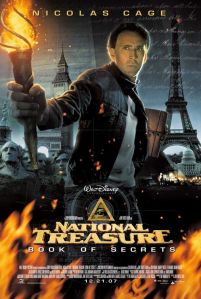 National Treasure: Book of Secrets is like a big dumb puppy that just wants love. It does a trick and thinks it deserves some form of recognition, and me with my cold heart just wants to shrug and move on with my day. How can I be so unmoved when there’s even a cartoon before the movie? For any prospective moviegoers, if you enjoyed the 2004 National Treasure, where I remind all that the U.S. Declaration of Independence had a secret treasure map on its other side, then chances are good you’ll enjoy Book of Secrets. That’s because they’re pretty much the same movie.
Ben Gates (Nicolas Cage) and his father (Jon Voight) are basking in their newfound respect from proving that their crackpot treasure schemes were in fact real. Their respectability is turned upside down, however, when Mitch Wilkinson (Ed Harris, with a dollop of a Southern drawl) has evidence that great-great-grandaddy Gates was responsible for planning President Lincoln’s assassination. He has a piece of John Wilkes Booth’s diary and a list of conspirators is jotted down, with great-great granddaddy Gates listed right there. The diary is authenticated and the Gates are devastated but ultimately unconvinced. They know their Civil War era ancestor would never betray his country and was unknowingly decoding a secret that could lead the Confederacy to an ancient golden temple, something that could help turn the tide of the war. This ancestor ripped pages out of the diary and threw them in a fire to protect the welfare of his country and was then shot by a secret Confederate soldier. In order to clear his ancestor’s good name, Ben Gates will have to find this hidden treasure, which is precisely what Mitch has wanted from the start.
 Gates re-teams with his pals from their first successful adventure, computer whiz Riley (Justin Bartha) and Abigail (Diane Kruger), who has thrown Gates out of their home due to his single-minded focus. Dating a treasure hunter is a certain path to a rocky relationship, ladies. Riley, who even wrote a book about his treasure exploits but still can’t get recognized, is game but Abigail has to be tricked into help. The group finally figures out that the only way to verify the temple’s hidden location is by getting their eyes on the mysterious President’s Book of Secrets, which only presidents can read. This means that Ben has no choice but to get the president (Bruce Greenwood) alone and beg to see a book not meant for outside eyes.
Book of Secrets is a little less dopey than the first preposterous National Treasure adventure, but that doesn’t mean it isn’t chock full of stupidity. According to these movies, apparently damn near everything in this country is built over an Indian burial ground or a giant cavern of treasure. I advise all readers to try digging in their backyards because it appears that the odds are in their favor (also: beware of your real estate company moving the tombstones but not the bodies). The clues are a little less mind-boggling, so instead of a single brick that’s been undisturbed for 200 years we get matching furniture for the Queen of England and the President of the United States. One doozey of stupidity is that one clue requires people to douse a large rock formation with water in hopes that they hit exactly the right spot and have an invisible eagle make its appearance. The plot is still structured on the clue-leads-to-other-clue template, which can be exhausting after a while because there’s never any indication of progress until the end arrives.
The subplot about kidnapping the president is ridiculous in the fact that, while already being dumb, it adds needless conflict. When Gates “”kidnaps” Mr. President he does so through a secret tunnel under George Washington’s Mt. Vernon estate. The passage closes behind them and cuts off the frantic Secret Servicemen. It is here where Gates makes his plea for the titular Book of Secrets, which the president confirms but cannot confirm publicly (well, it is a secret book of secrets). Instead of sensibly saying to his men, “Sorry guys, you know how old these places are, we got trapped, but Mr. Gates here helped get me out,” the movie tries to claim that the next course of action is that Gates will be on the run for kidnapping the leader of the free world. Huh? What makes this sequence stand out is how easily explainable it could all pass, and yet Book of Secrets figures the movie is better served by a contrived complication to add more outside pressure on Gates and his treasure hunting crew.
Of course all of the silliness and off-the-wall shenanigans would be acceptable if the film delivered some exciting action sequences that pinned you to your chair, but just like the first National Treasure, this movie is pretty much devoid of a well-thought out action sequence. Returning director Jon Turtletaub has no real visual flair and lets the material simply lay there on screen without much effort to jazz it up. Many action sequences are brief and never really flirt with complications. Usually, the script will propose a simple sequence of events like, say, “Good Guys on Run from Bad Guys” and then Turtletaub will show us exactly that, no better no worse. There’s nary a scene that actually utilizes its globetrotting destination to its advantage; most of the action is not geographic based, which means that it could happen anywhere because it doesn’t take advantage of the specifics of exotic locales. That is inexcusable to me, a big fan of good action sequences. A lengthy trip to an underground golden temple tries the patience as it rambles on and unabashedly apes the Indiana Jones series. Book of Secrets has a halfway decent car chase through the streets of London and that ends up being the highlight of the film. The trouble is that there’s more than an hour left at that point.
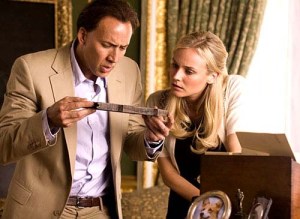 Book of Secrets is a slightly better film than the original. It jumps around in time through the lineage of the Gates clan and gives a better sense of the personal stakes for Ben and his father. Having their long-dead heroic family members linked to a dastardly assassination is good motivation for action, even if that action is ultimately finding an underground temple of gold (how A+B = C I will never know). The production design is skillful and the various European locations bring some sense of grander excitement that, sadly, will never be fully capitalized upon. The characters are still pretty shallow and one-note, but it seems like it’s less annoying this time because there’s less setup on who these characters are, which is, in short, shallow and one-note.
Cage is on autopilot and plays up his goofy mannerisms and William Shatner-esque line readings. This is a paycheck job for Cage and nothing more. Just because the first flick made tons of money is a lark to him and not an indication that he should try something different. He’s giving the people what they seemingly want, which is a wacky Nicolas Cage hamming it up with his patented version of kooky acting. Kruger is the exact copy of her character from the previous National Treasure, meaning she’s the bickering blonde counterweight to the conspiracy theorists on the journey. I suppose she plays a damsel in distress adequately. Voight gets more screen time this go-around thanks to a plump subplot involving the team seeking out the assistance of his ex-wife, played by Oscar-winning actress Helen Mirren. Yes, that Helen Mirren. Harris is given a do-nothing part as the villain and then the movie can’t even follow through on that. Everyone seems to have fun with all the nuttiness and goofy stunts, so I can’t fault them too much for faking it in a big Hollywood blockbuster.
I understand the appeal of these movies, which have found a sizeable audience willing to lap up a Cliff Notes of History along with their popcorn thrills. I imagine the fans of the original will show up in droves and make sure that National Treasure 3: The Mystery of Franklin’s Syphilis is fast-tracked for a future holiday release. I don’t mean to be a killjoy (my mother really enjoys these films) but I cannot get behind the National Treasure movement when the movies are riddled with rampant stupidity, contrived situations, convoluted conspiracies, one-note characters, and inept action sequences that never amount to much of anything beyond teetering homage to better adventure films. Book of Secrets is essentially the exact same movie reheated to take the chill off. Replace Sean Bean for Ed Harris as rival treasure hunter, add another female character, and there you have it, a mostly undisturbed formula that proved profitable in 2004.
Nate’s Grade: C
Share this:

Southland Tales (2007)
 Richard Kelly is a talented writer/director who scored big with his first film, modern cult classic Donnie Darko. I was in love with the ominous yet inspired Darko from the moment I saw it, which, not to toot my own horn, was February 2002, way before the cult got started. I have been eagerly anticipating Southland Tales, Kelly’s writing/directing follow-up, even after its notorious 2006 Cannes Film Festival reception where critics readily cited terms like “indulgent,” “bloated,” “messy,” and, “disaster.” My love of Darko shielded me from such negative affronts, and so I watched Southland Tales undaunted and with as open a mind as possible. The regrettable truth is that even after Kelly shaved off a half-hour from the Cannes version, Southland Tales is every bit a mess as had been advertised; however, it is occasionally worthwhile and subversively ambitious.
Kelly begins his massive yarn with a nuclear attack on Abilene, Texas in 2005. America is plunged into World War III and fights, simultaneously, Iran, Syria, Afghanistan, and North Korea, while the conflict with Iraq continues. The Internet is now in control of the government, who passes sweeping security measures, chief among them IdentiCorp. This government arm uses thousands of trained cameras to keep watch over the lives of ordinary citizens, including when they duck into public bathroom stalls. Violent neo-Marxist groups have placed cells around the country, ready and willing to strike to destroy the last vestiges of American capitalism.
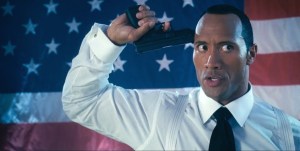 Fuel resources have almost run dry and the world looks to scientist Baron Von Westphalen (Wallace Shawn, hamming it up and having a good time) for a solution. The Baron has devised a substance known as Fluid Karma, which works under the properties of the churning oceans and will produce a radius of power. Fluid Karma also works as a powerful hallucinogenic drug and the Baron tested it on wounded Iraqi vets like Pilot Abilene (Justin Timberlake). Coldly narrating the film, Abilene stands guard outside the Baron’s laboratory and also peddles the drug on the side.
It is the summer of 2008 and the presidential election is months away. The Republican candidate, Senator Bobby Frost (Holmes Osborne), is in crisis mode. His spoiled daughter (Mandy Moore) is frantic because her husband, actor Boxer Santaros (Dwayne “The Rock” Johnson), has vanished. He’s awakened in the California desert with amnesia and shacked up with porn star Krysta Now (Sarah Michelle Gellar); the duo has written a prophetic screenplay called “The Power.” Krysta and a pair of tattoo babes (Nora Dunn) plan to blackmail the Frost campaign with video of Boxer frolicking with the adult movie star. They want the campaign to endorse Proposition 69, which would rescind the encroachments on civil liberties by the U.S. government.
A group of neo-Marxists, led by pint-sized Zora Carmichaels (Cheri Oteri), have kidnapped a police officer, Roland Taverner, and are using his twin brother Ronald (both played by Seann William Scott) to frame the police and Boxer. And I haven’t even begun to talk about Senator Frost’s wife (Miranda Richardson), the president of Japan having his hand lopped off in a loony sequence, the frequent inverting of T.S. Elitot’s quote about the way the world ends, a commercial where two cars literally have sex, and a rip in the space-time continuum that people are putting monkeys inside.
Extraordinarily messy and scattershot, Southland Tales has 1000 ideas rolling around inside without much traction. It’s as if Kelly thought he was never going to get the chance to make another movie again so he crammed every thought and topic he ever had into one 144-minute cross-pollinated jumble. The movie veers wildly and chaotically from political satire, to crude comedy, to sci-fi head-trip, all the way to Busby Berkley musical. There’s a little of everything here but few of the dispirited elements mesh and the film runs a good two hours before any sort of overall context becomes remotely approachable. One second the movie is satirizing a Big Brother control state and the loss of American civil liberties, and in the next second a character is threatening to kill herself unless Boxer allows her to orally pleasure him. You got, among other things, zeppelins, global deceleration, perpetual motion machines, Zelda Rubenstein, drugs, holes in time, twins, a murderous Jon Lovitz, ice cream trucks that house military-grade weapons, blackmail, Kevin Smith in a ZZ Top beard and no legs, reality TV, the American national anthem cut together with an ATM robbery, Biblical Revelation quotes courtesy of Timberlake, and, why not, the end of the world. What does it all mean? I have no idea but I credit Kelly for his ambition.
 Plenty of stuff happens for a solid two hours but little to nothing feels like it amounts to anything, and several subplots just get dropped. There are long stretches where I cannot explain even “what’s happening” from a literal description. This sprawling, magnificently self-indulgent meditative opus consists too much of side characters running into each other and having vague, pseudo-intellectual conversations that go nowhere. There are a lot of nonsensical speed bumps in this narrative. Sometimes the screen is just nothing but a series of newscasts overloading the audience with details on the reality of this alternative America; it’s filler. The conclusion is rather frustratingly abrupt; after slogging through two-plus hours of oblique questions it finally seems like we may reach some tentative answers, and then Kelly pulls the pin on his grenade and collapses his tale. Krysta tells Boxer in a moment of clarity, “It had to end this way.” Really? It did? This way?
The movie feels like a giant garage sale with scattered treasures hard to find but buried beneath loads of kitsch. Kelly clearly has bitten off more than he can chew and yet there is a bizarre undeniable power to some moments here. Roland (or is it Ronald) Taverner watches his mirror reflection a step behind; it’s unsettling and eerie and very cool. Timberlake has a drug-induced dance number where his scarred (both physically and mentally) Iraq veteran character is covered in blood, drinks beer, and lip synchs to the Killers’ song “All the Things I’ve Done,” which has the pertinent lyrics, “I’ve got soul but I’m not a solider,” and “You gotta help me out.” All the while, leggy dancing girls in blonde bobs strut and coo around him. It’s weird and tangential to the plot but it has a certain draw to it. The conclusion featuring the Taverner twins seeking forgiveness even generates some redemptive quality. Religious questioning and the philosophy of souls occupying the same realm plays a heavy part and gives the film an approachable reflection that tickles the brain, even if Timecop, sort of, visited the same ground, albeit secular, first (you’ll kind of understand when you see the movie). Southland Tales is grasping at profound and relevant messages, and yet some images achieve this easily, like a toy soldier crawling on the L.A. streets or a tank with Hustler stamped across its side for product placement. These simple images are able to transcend Kelly’s pop manifesto.
 None of the actors really equip themselves well with the outrageousness. Scott comes off the best but that’s because his character(s) is/are the only figure(s) the audience is given a chance to emotionally connect with. The Rock, listed for the first time simply as Dwayne Johnson, is an actor that I genuinely like and think has tremendous comic ability, as evidenced by 2003’s The Rundown. With this film, however, he comes across too constantly bewildered and shifty, like he really needs to pee and cannot find a bathroom. Gellar is woefully miscast and I think she knows it given her leaden performance. Southland Tales is the kind of film where every role, even the two-bit nothing parts, is played by a known face, be it Christopher Lambert, John Larroquette, Curtis “Booger” Armstrong, Will Sasso, and a horde of Saturday Night Live alums.
Kelly’s previous film succeeded partially because an audience was able to relate and care about the central characters, which is not the case with the comically broad Southland Tales. Kelly seems to work best when he has some restraint, be it financially or artistically; the director’s cut of Donnie Darko explained far too much and took some of the magic out of interpreting the movie on your own terms. Southland Tales runs wildly in the opposite direction and is a giant mess unseen in Hollywood for some time, though for the doomsayers comparing Southland Tales to studio-killing, self-indulgent, era-defining Heaven’s Gate, may I argue that Oliver Stone’s Alexander was far more self-indulgent, longer, wackier, and duller. Due to its unpredictable nature, you can never say Southland Tales is boring.
Southland Tales the movie begins as Chapter Four of Kelly’s saga, the first three chapters being made into comic books, and really, when I think about it, a comic book is the right medium for this material. The confines of narrative film are too daunting for Kelly’s overloaded imagination. Southland Tales is oblique, incoherent, strange, and unfocused but not without merit. I doubt Kelly will ever be given the same artistic legroom to create another picture like this, so perhaps Southland Tales has helped to reign in Kelly’s filmmaking. A reigned-in Kelly is where he does his best work, and I look forward to Kelly’s remake of Richard Matheson’s story, “The Box,” presumably with no dance numbers and sexually active motor vehicles.
Nate’s Grade: C
Share this:

Blood and Chocolate (2007)
 A werewolf tale set in Europe where the remaining handful of werewolves hunt men for sport by night and swish around being Eurotrash by day. The film plays closely to the teens-as-super creatures formula that seems to be chiseled by the likes of The Craft, Underworld, and The Covenant. What’s kind of hilariously goofy is that these werewolves actually just turn into normal, White Fang-looking wolves; no hulking man-beasts. They tend to run, and in a feat of cheesy special effects, blur into a wolf thanks to a magical glow. But there are instances when they would be much better off staying as people than transforming into wolves, like for ridiculous wolf-on-wolf fight scenes. The whole concept seems rather uninspiring; would you feel a sense of power simply because you could transform into a medium sized canine at will? I can’t see many practical instances where this would benefit someone. What’s the appeal? Regardless, the peculiarly titled film is rather dim with plot and character and whimpers to a hasty yet predictable conclusion. Agnes Bruckner, that’s a talented and beautiful young actress. Someone out there find here something worthy.
Nate’s Grade: D+
Share this:

The Lives of Others (2006)
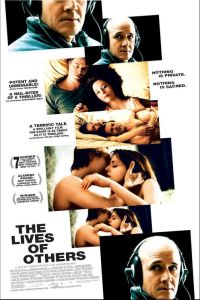 A mesmerizing and piercing human drama that burns into your memory long after it’s over. This Oscar-winner for Best Foreign Film actually deserved to beat out Pan’s Labyrinth. This vastly intriguing, dense, and extremely moving film explores life inside East Germany before the Wall fell, a life not often seen in the movies. The crux of the movie follows a career officer (Ulrich Mühe) in the secret police who has been assigned to eavesdrop on a playwright and his actress girlfriend. It is this assignment that shakes the man’s blind faith in his government, and The Lives of Others becomes nerve-wracking when our silent listener decides to become active in trying to protect his subjects from his boss. This is masterful, artistically illuminating filmmaking with a tight, deeply felt story and superb acting and direction. Germany has been crafting some of the world’s finest cinema as of late, including Oscar-winner Nowhere in Africa and Oscar-nominees Downfall and Sophie Scholl. See this film before Hollywood remakes it and ruins it. Tragically, Mühe died of stomach cancer in July 2007 just as American audiences began to see The Lives of Others and witness the depths of his talent. He will be missed by the world of cinema but his work in The Lives of Others is a lasting testament.
Nate’s Grade: A
Share this:

Freedom Writers (2007)
 Add this to the feel-good genre of true-life teacher-makes-a-difference movies. It is suitably well acted and uplifting and doesn’t necessarily pander even if it does hit all the expected stops of the genre. These kids have grown up in an area heavy with gang affiliations, and the film earns extra credit for dealing with the heavy reality of gangs better than most any other teacher-in-urban-setting flick. Hillary Swank relies on her mega-watt smile to communicate her character’s perseverance and idealism and does a fine job along with a strong supporting cast including Imelda Staunton as the doubtful, pessimistic, dismissive principal. Freedom Writers clings to the us-vs.-them model and builds a believable underdog tale that actually could inspire a few future educators out there. This film is cozy and familiar but it also made will skill and care.
Nate’s Grade: B
Share this:

Juno (2007)
 Juno is a hysterical teen comedy with equal parts sweetness and sour. The idea of an underage pregnancy certainly presents a lot of conflicts and seriousness but the film avoids direct messages on the big topics thanks to large doses of levity and some hard-earned wisdom. With this serving as a companion piece to Knocked Up, I suppose Hollywood is convinced there’s something inherently funny about unplanned pregnancy. Remember that, suddenly expectant fathers and mothers.
16-year-old Juno MacGuff (Ellen Page) drinks her “weight in Sunny D” to take pregnancy test after test, but each pee-dipped stick gives the same result: Juno is going to become a mommy. The father is Paulie Bleaker (Michael Cera), a fellow high school student who has a fondness for jogging shorts and orange Tic-Tacs. Juno’s father and step-mother (J.K. Simmons, Allison Janney) lament that they wish their daughter would have told them she was expelled or into hard drugs instead of being pregnant. Still, they are supportive and Juno decides to give away her bun in the oven to a childless couple, Mark and Vanessa (Jason Bateman, Jennifer Garner).
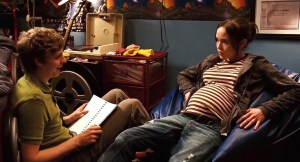 Juno doesn’t patronize or dismiss the gravity of what is indeed happening (a life is being brought into this world); Juno says she is trying to come to grips with issues “way beyond my maturity level.” There are moments that reveal real sadness and regret for some of these characters, and moments of palpable doubt about what it means to officially grow up and assume responsibility for another. Juno also refrains from easy high school stereotypes and coarse humor. Juno is an intelligent comedy that doesn’t make light of its circumstances even if the sarcasm is off the charts. It’s this winning combination of wicked wit and heart that makes [I]Juno[/I] destined to be a crowd-pleaser.
Writer/blogger/former stripper Diablo Cody makes one hell of an impressive screenwriting debut. The dialogue is practically sparkling and revels in the hip, hyper-literate realm that used to dominate the teenage speech patterns of shows like Dawson’s Creek. Sure, it’s not terribly realistic when characters can spout pithy one-liners mixed in with heavy jargon and lots of cool speak, but what do I care when I’m cracking up with laughter so often. But Juno cannot easily be dismissed as glib because Cody throws in some incisive moments that display shades of vulnerability and tenderness with her wacky assortment of characters. Even the aloof oddballs have moments that deepen them from just being quirky for quirky’s sake. These people are more than just receptacles for Cody’s wonderful words; they may begin that way but through the course of 96 minutes they manage to transform into flesh-and-blood where we, the audience, feel their pain and celebrate their happiness. You may be surprised, as I was, to discover yourself holding back tears during the movie’s inevitable and tidy conclusion.
The heavily acoustic score banks on a lot of pleasant, leisurely strumming but it suits the film and the song selections are apt. The very end involves a long acoustic duet rendition of the Moody Peaches’ “Anyone Else But You” and it may be one of the most disarmingly sweet, romantic moments of the year (the repeated lyric “I don’t see what anyone can see in anyone else” is a perfect summary for two outsiders finding their match). In fact, it’s probably the most potentially romantic song ever to include the line “shook a little turd out of the bottom of your pants,” but then again I do profess ignorance when it comes to romantic odes that include defecation references. Somewhere there has to be a Barry White song that has to cover this.
 Director Jason Reitman feels like a natural fit for this smart-allecky material. He lets the story take center-stage and, just as he proved with last year’s Thank You for Smoking, he can coax terrific performances from a strong body of actors. He keeps the pace chugging along and keeps form command of the many storylines and characters needing to be juggled. Juno is a comedy that says more about a character through a handful of smart, wry observations that cut to the bone, which is helpful considering the short running time means the film needs to do the most with its time.
Page should have been crowned a star immediately after her blistering performance as jail bait with claws in Hard Candy, but perhaps her top notch comedic turn in Juno will right this slip-up and give Page the opportunity to star in, at least, the same amount of movies as, oh, I don’t know, Amanda Bynes (Seriously, Hollywood, are you just throwing money at her?). Page is the perfect embodiment of the wiseacre teenager that thinks she knows more than anyone else. She recites the refined dialogue with such precision and ease, always knowing what segments to enunciate or de-emphasize to maintain a seamless comedic tone. Page brings great empathy to a know-it-all character and is the snarky spirit that makes Juno resonate.
The supporting cast around Page doesn’t let her down. Cera gives another fine performance of comic awkwardness befitting a teenager contemplating fatherhood. Simmons and Janney make a great pair of unflappable parents, particularly Janney who gives an ultrasound doc a memorable tongue-lashing for an off the cuff remark about Juno. Bateman works the same laid-back demeanor that he excelled at on TV’s Arrested Development. Rainn Wilson (TV’s The Office) makes a very funny cameo in the beginning.
 Garner as an actress has been somewhat hamstrung by her roles, either focusing on her multitude of ass-kicking abilities or landing her leads in romantic comedies that don’t require more than dimples and twinkling eyes. In Juno she is driven by her desire to have a baby; she’s affluent, prim, and an easy joke thanks to her stick-in-the-mud seriousness. But then Juno and the audience get a glimpse about how important being a mother is to Vanessa, and Garner nails a rather touching scene where she directly speaks to the growing child inside Juno’s belly upon Juno’s request. She speaks softly to the baby, briefly mentioning how loved they will be, and then she marvels at feeling the baby move. In lesser hands this scene could have induced eye rolls but instead seems genuine and a turning point for how we see Vanessa.
If Juno does have a flaw it is a minor one. The film places its teen romance on the back burner for so long that when it resurfaces and positions itself front and center the storyline lacks credence and believability. The conclusion would have had more emotional weight had the filmmakers spent more time on the teen romance angle, but regardless I was still amused, entertained, and grateful for the ending that came.
Juno is a delightfully tart and hysterical comedy that is easily quote-able thanks to Cody’s quick-fire retorts and snappy dialogue. Page is destined for greatness and Reitman proves once more that he can handle anything thrown at him with deftly comic aplomb. This is an impressive and assured comedy that bristles with comic vitality and confidence. This holiday season, make sure to take a trip to Juno.
Nate’s Grade: A


You must be logged in to post a comment.