Blog Archives
Iron Man (2008)
 Robert Downey Jr. and Jon Favreau seem like decidedly odd choices for a studio to hand over a multi-million dollar potential comic franchise. Iron Man certainly isn’t one of the better-known super hero properties but Marvel Studios felt confident that having Favreau behind the lens and Downey Jr. in a heavy suit of armor was the right direction. They couldn’t have been more right. Iron Man is a rock solid action vehicle that flies by in a blast. My biggest complaint: the film never utilizes the ready-made theme song by Black Sabbath.
Tony Stark (Downey Jr.) is the billionaire CEO of Stark Industries, a high-grade weapons manufacturer creating bigger and better ways for people to kill each other. His life is a never-ending party, going from gambling to girls to gizmos. His assistant, Pepper Potts (Gwyneth Paltrow), keeps Stark as grounded as he can be. Stark is traveling to Afghanistan to demonstrate the awesome might of some of his new missiles when his convoy is ambushed. One of Stark’s own weapons sends shrapnel into his chest. He is kidnapped by terrorists (read: Arabs with guns) and held captive inside a cave. Stark is kept alive by a glowing electromagnet do-dad in his chest that manages to keep the shrapnel from entering his heart. Raza (Faran Tahir) orders Stark to build him a missile or else. So Stark does what any mechanical boy genius would do: he builds a giant suit of armor and busts his way out.
 Stark’s friend Jim Rhodes (Terrence Howard), an Air Force officer, rescues him in the desert. Once back at home in his Malibu mansion, Stark has a personal epiphany. After seeing the human damage his weapons cause he no longer wants to manufacture weapons. His business partner Obadiah Stane (Jeff Bridges) and the board of directors are not interested in Stark’s revision. They want to keep doing what they do, making weapons for the highest bidder. Stark begins building a more advanced mechanical suit based upon the prototype from Afghanistan. He will use his technical expertise and great fortune to destroy his own weapons, even if he has to become an ironclad superhero to do so.
Downey Jr. is Iron Man, yes, but he IS Iron Man. He makes this character, this movie, and serves as the film’s ambassador to an audience that has grown tired of mopey teenagers imbued with super powers. His character is a man going through a mid-life crisis of sorts, reevaluating his life and trying to find meaning in his work. There’s something satisfying about watching an older adult wreck of a man taking on a genre that feels like it’ stuck in a high school atmosphere. Downey Jr. is a fantastically engaging, talented actor and when he turns on his narcissistic quick-witted charm it is impossible not to be won over. He provides the film with a tremendous spark and manages to make a womanizing, alcohol-swilling, super wealthy arms peddler/playboy into a figure of sympathy and a hero for the masses. Downey Jr. has expert comic timing and makes Tony Stark a cool swinging superhero. Just listen to his line deliveries and the energy and pacing he puts into the dialogue; it’s terrific. He also gives Stark the necessary drama to pull off the weight of guilt.
Iron Man is also a victory for Favreau as a director. The Swingers star has become a stealthily competent director. He helmed 2003’s Elf and 2005’s underappreciated Zathura and I suppose Marvel Studios saw what I saw in those films. The direction is focused and he makes smart decisions, never overwhelming an audience and always centered closely to the story. Favreau is more concerned with storytelling than noisy, empty special effects. Hell, Iron Man doesn’t even enter the film until an hour into it. There is a confidence and patience to his direction; it manages to convince an audience that they will be rewarded for their time.
 Favreau doesn’t pander and knows well enough that practical special effects will inspire the greatest sense of awe in a summer flick. Iron Man‘s special effects are almost seamless from the practical to CGI. I enjoy popcorn action movies so much more when I’m not nit-picking the special effects. This isn’t a slam on CGI itself, but computer effects have the tendency to declare their fakeness. Sure the special effects were amazing in last summer’s Transformers (how it lost the visual effects Oscar to the subpar Golden Compass I’ll never know), but the CGI-ness of it could be overpowering. When I cannot decipher a special effect automatically, then I know I have been fully immersed in the action. Favreau smartly lays out a bevy of nifty practical effects for the first half. By the time he transitions to broader CGI then he’s already laid the foundation for realism.
Favreau isn’t the best action director but this only presents an issue in the film’s last act. The action sequences in Iron Man take a back seat to watching Tony Stark piece together his new life. I was more interested in seeing Stark test and reconfigure his designs. The construction of Iron Man, to me, is more intriguing than seeing a man in an iron suit battle some guy in a bigger iron suit. The fun is watching him become Iron Man. The action sequences are serviceably kick-ass but too short. I loved watching Iron Man punch people and seeing their bodies fly backwards. Even at over two hours there just isn’t a whole lot of traditional action to Iron Man but this suited my tastes. I’d rather watch an actor with Downey’s talent interact with an A-list cast than watch robots fight and smash personal property.
Iron Man is aided by a strong script credited to two of the writers of Children of Men. It’s structured as an origin tale but it takes its time to set up events and characters that will have lasting meaning. Stark confronts being a weapons manufacturer in a post-9/11 world. He finally stops and asks, “What is the cost?” His own company is double dipping, selling weapons to both sides in a conflict, weapons that will kill U.S. men and women pledged to protect America. Stark has a true change of heart, both figuratively and, later, literally with the assistance of Pepper. There’s a political undercurrent to the film’s drama that manages to be timely and provide at least some thought to go along with the popcorn thrills. Iron Man finds a way to force its characters to combat real moral questions that result from their actions.
 The supporting cast has a combined seven Oscar nominations for acting, so this is a step above the acting level of a Fantastic Four. Howard is mostly underwritten but he provides a nice sense of camaraderie with his friendship with Stark. Bridges is an obvious villain just from the first sight of his bald dome and big, bushy beard. He’s got a mean scowl but Bridges provides a warm and fatherly guide for Stark. But man, when he gets menacing he is rather scary. But my highest praise in the supporting work goes to Paltrow, who coolly delivers arch snappy one-liners in a retro do-everything secretary role. And yet the role also offers some reflection, like after dancing in public with her boss she worries over gossip and what perception will construe the moment into. She, his employee, wearing a plunging backline dress that looks gorgeous on the actress, dances with her boss, an infamous womanizer. And then in this moment of doubt there’s a nice, unexpected moment for both a comic book movie and a would-be romance, and the “would-be” is the correct term. She has great chemistry with Downey Jr. and watching the two of them playfully bicker is another reason Iron Man soars above the confines of genre and formula. Plus she looks great with red hair.
Iron Man is a great start to the summer movie season and will be hard to beat. It doesn’t have the psychological depth of Batman Begins or the high-flying fun of Spider-Man 2, but this film certainly deserves to be mentioned in that same group. Favreau has crafted a respectful comic book movie that manages to place special effects in service of an interesting story played by extremely engaging actors. Downey Jr. is the movie’s secret weapon and he delivers a smart, witty, charming, sardonic and enormously entertaining performance that anchors a fine example of what big budget popcorn filmmaking done right looks like. Batman and Spider-Man might want to be on the look out because the new kid on the block is generating some serious heat.
Nate’s Grade: A-
Share this:

The Counterfeiters (2007)
 The Oscar-winner for 2007 foreign film is certainly a fine film and a respectable winner, but let’s be honest, the foreign film category was watered down a tad. France nominated Persepolis over The Diving Bell and the Butterfly because a country is only allowed to nominate a single film (sucks to be you, countries with good movies). This rule has resulted in past incidents like Spain nominating Tuesdays in the Sun over Pedro Almodovar’s Talk to Her, which ended up winning the 2002 Best Original Screenplay Oscar despite Spain’s snub. The hard decision by France was moot because Persepolis didn’t make the Academy 2007 shortlist of nine nominees. The biggest snub from that shortlist was Romania’s 4 Months, 3 Weeks, and 2 Days, a harrowing film about two college-aged women seeking an illegal abortion in 1980s communist Romania. It won the Palme d’Or at the Cannes Film Festival and also won the Best Picture award by the European Film Awards (Austria’s The Counterfeiters wasn’t even nominated). Then there was Israel’s amusing and touching film, The Band’s Visit, about an Egyptian band that takes a wrong bus and finds itself in an Israeli town. But the Academy’s foreign films ruled that The Band’s Visit had too much spoken English and therefore could not be ruled as a foreign film. Also left out were Germany’s Edge of Heaven and Spain’s The Orphanage. Nothing against The Counterfeiters but the foreign language field had already snubbed most of the main contenders.
The Counterfeiters is a deeply fascinating true-story about the world’s largest counterfeiting ring. Sal Sorowitsch (Karl Markovics, with a face as hard as flint) is a master forger leading a life of luxury in Berlin until the police capture him and send him to a concentration camp with his fellow Jews. As World War II carries on, the Nazis recruit Sal to lead a team to forge the British pound and the American dollar. The Nazis hope to destabilize their enemies’ economies. Sal is given greater freedoms in the camp and the S.S. officers try to become his chums. But he has to ask himself what his cost his actions will have. He could be prolonging the conflict and actually helping Germany win, but if he doesn’t assist the Nazis then he will surely be murdered as will his team.
Write/director Stefan Ruzowitzky creates great tension from scene to scene but it is the moral dilemmas that stick. What are principles worth? Are they worth dying for? Are they worth endangering others’ lives? The movie takes a docu-drama approach with bobbing handheld camerawork; even the film stock looks like it was soaked in grime for authenticity. And yet I wish The Counterfeiters had chosen to be less enigmatic. The main character is a criminal that keeps his emotions close to the vest, but Ruzowitzky cheats the audience by keeping Sal mostly in his head. The story is filled with factual intrigue and the natural tension given the situation, but after it’s over there isn’t much that’s memorable for a genre that expects more of itself. The Holocaust genre (and let’s not kid ourselves, it is a genre at this point) has some pretty high dramatic expectations and produces films that sear into our brains. The Counterfeiters is a very well told tale with great acting and some interesting character relationships but it can’t fully measure up to other Holocaust parables.
Nate’s Grade: B+
Share this:

Forgetting Sarah Marshall (2008)
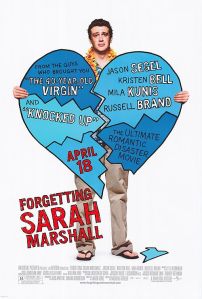 So much ink has been spilled on Jason Segel’s full-frontal nudity that you would think the public has never known that penises have appeared on film before. It seems that female nudity is used to titillate and male nudity is used for awkward laughs, and this is the case with Forgetting Sarah Marshall, which Segel stars in and wrote. His character Peter is humiliated by a breakup, even more so because the man is breaking down while in the buff. He even states at one point the naive belief that as long as he doesn’t put clothes on reality cannot hit. It’s funny and sad and he’s completely vulnerable, but Forgetting Sarah Marshall is much more than the story of one slightly doughy man and his penis. This is a story from producer Judd Apatow (The 40-Year-Old Virgin, Knocked Up) about heartache and mending and the struggle it takes to keep a relationship healthy. But it is also about a man and his penis.
Peter (Segel) is dating TV actress Sarah Marshall (Kristen Bell), star of the brilliantly reflexive title Crime Scene: Scene of the Crime. Peter provides the music for the TV show, which he laments is nothing more than “ominous tones.” Then one day she has some bad news. She’s breaking up with him (this is where Segel loses it, both emotionally and from a clothes perspective). Peter mopes and cries for days, goes out to clubs with his step-brother (Bill Hader), and tries to engage in meaningless sex but that too leads to crying and moping. Peter takes a vacation to Hawaii in order to forget his ex, but as chance would have it Sarah is already there with her new man, British rocker Aldous Snow (Russell Brand). Peter is stuck in the same hotel as his ex and her new lover. The hotel staff takes pity on Peter and they all seem to look out for him, setting him up in a $6,000 suite, involving him in hotel activities, and feeding him drinks. Rachel Jansen (Mila Kunis) works at the front desk and takes a special interest in Peter and his woes. She helps Peter get over Sarah and fin
 Forgetting Sarah Marshall is another hit from the Apatow brand. It features another leading man with an unorthodox physique and a healthy interest in geek culture. However, Peter doesn’t need to learn to be responsible, or outgoing, or to transition from boy to man. He’s actually fairly well adjusted and even has a job that suits his composing talents. His dilemma is heartbreak, a universal affliction if ever there was one. He’s a little frumpy and has a thing for puppets, but Peter is really a sweet guy who is working through the pain of a breakup. He was together with Sarah for over five years, so it feels strange when the characters keep harping on him to get over it in the span of a few weeks. He is awash in self-pity and wails so loudly that other guests complain about a woman crying in his room. He makes for a capable lead and his budding romance with Rachel allows him to heal. The romance is strongly felt and I was completely absorbed by wanting Peter and Rachel to have a happily ever after.
Segel is a charitable screenwriter. The could have easily become a vanity wish-fulfillment project, but instead he rounds out the main characters and builds a deep supporting cast that add delightful additions that enrich the narrative. I admire Segel’s decision making when it came to fleshing out his characters instead of writing them off as stock types. In an ordinary romantic comedy, the beautiful girl that dumps the lead is a bitch. It would have been extremely easy for Segel to demonize Sarah and keep her as an established antagonist, but instead he makes her feel real. She has real, solid reasons for her breakup with Peter, and she has several revealing moments that open her character up and humanize her. Aldous is another pristine example of Segel’s screenwriting skill. In an ordinary romantic comedy, the girl always dumps the nice guy for the douchebag, and Aldous starts in that territory. But a magical thing happens and as the film continues Aldous becomes very charming; he’s unpretentious and is the same transparent and genial man to everybody. He appreciates Peter’s music and gets him and Peter’s passions. Peter says at one point, “This would be so much easier if you weren’t so cool.” It would have been easy and even expected for Segel to cast both the ex-girlfriend and her new boyfriend as evil cretins. Instead, he broadens and rounds out all the central characters to the point that they feel like real people and not just comedy types.
 The movie is resolutely pleasant and amiable, lacking gut-busting laughs but offering plenty of cringe comedy. It’s not as outrageous as other Apatow comedies, or as good, but it is completely entertaining. There is one terrific sequence that stands out in my memory. It involves the two couples sitting at an awkward dinner. Then they comment on how awkward it is, then they comment on commenting how awkward it is. The dinner bathes in unease but then as it carries on you see the different tensions. Aldous and Peter hit it off discussing their dislike for a terrible horror script offered to Sarah that involved a killer cell phone (sounds like One Missed Call). They are genuinely bonding. Sarah hides her growing dissatisfaction with the decisions she’s made, but Rachel catches on. She kisses Peter long and hard and shoots Sarah a very knowing glance that all women know as “back off.” This dinner packs all of the different tensions of the movie into one well-written, expertly performed scene. The characters aren’t shouting their feelings point-blank but you can follow along to the conversations that are unsaid.
I love comedies that involve deep supporting casts, where a supporting player can enter at the right moment and deliver a perfect in-character addition. I was delighted at how wide Segel cast his net of characters and yet how well incorporated they are. There’s a newlywed couple (30 Rock‘s Jack McBrayer, Maria Thayler) that haven’t mastered the art of sexual intercourse. They’ve waited until marriage and know are wondering what all the fuss is about. Hearing McBrayer’s amped-up frustration is funny, but it’s even better when he solicits advice from Aldous on pleasing a woman. The tutorial between the two left me in stiches and made me like Aldous even more. I enjoyed spending time with all of these characters. Apatow regulars Jonah Hill and Paul Rudd pop up in hilarious cameos. Rudd is a super stoned surf instructor and Hill is an obsessed Aldous Snow fan who creepily doesn’t abide touching boundaries. The supporting players never outstay their welcome and add great splashes of variety to the story.
Forgetting Sarah Marhsall continues the Apatow tradition of mixing raunch with sentimentality. There’s plenty of dirty humor but it’s the little touches that won me over. I loved the title of Sarah Marshall’s TV show, perfect references to movies like The Buena Vista Social Club, Rachel reflecting Peter’s romantic advances only to initiate the first kiss, the brilliant music video for Aldous Snow where he carries an earnest sign that reads, “Sodomize Intolerance,” the flashbacks to Peter and Sarah’s relationship, the helpful advice of Dwayne the bartender and his great knowledge of fish native to Hawaii, and a vocally competitive dual of sexual intercourse. This is a comedy that works because even they details have been looked after with care.
 Segel easily conveys his character’s sweetness; the man can’t help but be sweet even in anger. Bell is given complexity with her role and nails bitchiness and tearful regret with the same skill she radiated on her defunct TV show, Veronica Mars. I never thought Kunis was capable of playing more than a shrill ditherhead thanks to her role on TV’s That 70s Show but she nicely handles the drama. She makes the romance more than believable but desirable. The actors all do a great job but it is Brand that steals every single scene he is in. His carefree demeanor and hysterical physical gyrations cast him early as one type of character, but his charisma rules the day and will win over audiences.
This is all familiar romantic ground covered by countless other movies. Boy loses girl, boy meets new girl, boy gets new girl, but Forgetting Sarah Marshall adds the Apatow touch. Another Freaks and Geeks alum writes another male-centric but hilarious comedy that deals with mature themes in untidy ways. The movie takes place in a world that resembles ours, where people are not cast in black and white, good or bad, victim and victimizer. Segel’s screenplay lets the audience empathize with a wealth of characters, and the humor is bittersweet but mostly on the sweet side. Any film that ends with a puppet musical about Dracula has to be seen as special.
Nate’s Grade: B+
Share this:

10,000 B.C. (2008)
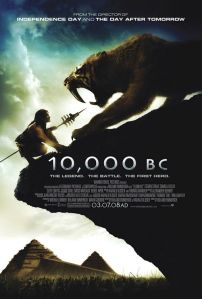 Roland Emmerich is a director used to making big budget, effects laden mainstream blockbusters that baffle film critics. I enjoy some of the man’s output but hold little pretension that Emmerich is not a filmmaker who knows the terms “nuance” and “subtlety.” 10,000 B.C. is another Emmerich flick in the would-be blockbuster mode. It has magazine cover leads, large-scale action set pieces, and a familiar rescue plot route. It also happens to be as dumb as rocks.
Way back in 10,000 B.C., life is more along the lines of nomadic hunting and gathering. The featured tribe has the old staple of the spiritual guide who lays out prophecies. This prophet foresees great calamitous change for the tribe. “Four-legged devils” will bring about destruction. But there is hope. D’leh (Steven Strait, Sky High) will save his tribe from annihilation. He is also destined to love Evolett (Camilla Belle, When A Stranger Calls), who is coveted because she has blue eyes. This, we are told, is a fortuitous sign. One day after a successful mammoth hunt, the tribe falls prey to raiders on horses. These raiders raze the huts and slaughter the people. They cart the rest, including Evolett, off to work as slaves building what appear to be pyramids or ziggurats in Egypt. D’leh must regroup and travel with Tic’tic (Cliff Curtis) all across Africa to save his loin-clothed love.
 This is a colossally stupid movie. Emmerich spins a host of clichés and prays it’s enough to stage some pre-history visual wonders. The movie’s visuals are certainly pleasing to the eye, but the plot and characters are totally vacant. The characters are one-dimensional morons. It’s not even worth mentioning what the numerous historical inaccuracies are (Egypt wasn’t even settled until 7,000 B.C.) because it would be less time consuming to simply state the historical accuracy the film presents. 10,000 B.C. makes Quest for Fire look like a documentary. The plot framework is your usual hero’s journey pastiche, where our lead must accept the responsibility that goes with being a leader. There’s also familiar plot turns like rescuing the damsel in distress, learning important back-story about an absent father, and finally, a slave uprising. 10,000 B.C. is a rip-off of Apocalypto and generally every historical uprising movie where the people band together under the leadership of an individual to tackle an antagonistic authority. This movie feels like it is barely held together by its plot threads, and those threads merely link to tired, groan-inducing clichés that act as placeholders for an actual plot.
What is even worse, 10,000 B.C. is a total bore. The only way something this silly and gleefully historically inaccurate could work is if it offered some adventure thrills. 10,000 B.C. seems to sputter for long stretches, having characters assemble and depart and walk and speak their ridiculous caveman speak. The pacing is rather slack and the action sequences, when they do occur, aren’t very well developed, hoping to leave their mark with plenty of long shots. Several action sequences are doomed from their very conception, like the laughable giant ostriches eating people. The action is just not good at all. Emmerich can generally pull out an exciting, functional action sequence even if it requires you to officially turn your brain off to enjoy. The first half of 10,000 B.C. has a few limited action sequences but they are brief and poorly staged. The second half has one climactic action sequence but it’s hard to tell what the hell is going on. Emmerich does not setup his climax and allow the audience to understand the attack process. When the climactic attack does occur it feels overly chaotic and senseless. How can the audience enjoy the progress of action if it cannot even verify what is happening? If I can’t follow what’s happening then I can’t enjoy it. The equation is that simple. The end of 10,000 B.C. is a big, mammoth-filled mess of a sequence that fails to serve as any payoff.
 The movie is so serious that the silly adventure heroics come across as downright insufferable. I cannot possibly sit through a 1 hour 45-minute film that deals with pet saber tooth tigers, traveling across the entire continent of Africa by foot at record speed, and giant freaking killer ostriches and have the movie try to uphold a serious reality. No movie in the history of mankind will ever be serious as long as it has a killer ostrich. 10,000 B.C. would classify as camp if it weren’t so resoundingly boring. I think Emmerich really stuck to his initial concept and decided somehow the movie would form by itself. He shows a definite interest in recreating sprawling vistas of a time long ago, but he shows barely a whiff of interest in depositing a story to go along with those oh so pretty pictures and ancient landscapes.
The film also feels eerily semi-racist. The good guys are slightly tanned but mostly Anglo-Saxon in their appearance. They even speak English, though really terrible monosyllabic English. Note to all filmmakers: if you are going to make a movie that predominantly features cavemen then do not give them any speeches. They sound absolutely hilarious trying to deliver a rousing speech in their stilted, monotone voices. The villains are outsiders who look very Arabic and Middle Eastern. They speak a different language. They come to terrorize the God-fearing hunters and gatherers, enslave their people, and drag them to a giant temple to be killed in the name of a competing God. I don’t know if the movie is necessarily anti-Arabic but I was given the opportunity to contemplate this subject with all the downtime 10,000 B.C. afforded me.
The special effects are bad. The acting is bad. The story is dreadful. The action is poorly planned and sporadic. And every aspect of this movie radiates stupidity. I suppose some moviegoers can discover some derisive pleasure from watching a really terrible movie about a dreadlocked boy trying to reclaim the only girl in 10,000 B.C. that vigorously tweezes her eyebrows. For me, the movie was far too stagnant and boring to enjoy derisively. 10,000 B.C. takes itself far too seriously for something far too silly. Emmerich has created a movie that manages to be dopey even by caveman movies standards, and this includes a 1981 movie actually called Caveman featuring Ringo Starr. My biggest question after the movie concluded was, “How in the hell did they get Omar Sharif to narrate this stone-age turkey?”
Nate’s Grade: D
Share this:

The Ruins (2008)
 Author Scott Smith is from Ohio, my home state, which makes me like him. What made me respect him was his adaptation of his own novel, A Simple Plan. The movie version was splendid and taut, well acted and riveting and disturbing. Smith even received an Oscar nomination for his screen adaptation. When Smith released The Ruins, his second book, in 2006 I was mildly intrigued but never got around to reading it. Something about tourists, and Mayan temples, and bad things, and it got plenty of good reviews. Then I saw that Hollywood was producing a film version and that Smith had written the screenplay himself. Well, I figured, I’m going to be in for a chilling treat. Let’s just say my opinion of Smith has been slightly diminished.
Four over privileged American tourists are enjoying their final hours of a vacation to Mexico. Jeff (Jonathan Tucker) is studying to be a doctor. His girlfriend Amy (Jenna Malone) is best friends with Stacy (Laura Ramsey), and the two pal around together. Stacy’s boyfriend Eric (X-Men’s Shawn Ashmore) is along for the ride and enjoying every sun-soaked, boozy second. Lounging around the hotel pool, the group comes across a German (Joe Anderson, Across the Universe) who has a map to a hidden Mayan ruin. It’s a bit off the beaten path but the group decides to witness some genuine history. They take a taxi 12 miles into the jungle, hoof the rest, and discover a not very well hidden path to a not very well hidden Mayan temple (seriously, you’re going to have to do better than a couple of palm leaves if you want to obscure the path and keep people out. Try a fence next time). As soon as they arrive so do a band of armed Mayans that really insist the tourists do not leave the site. The Mayans chase the tourists onto the ruins and then they set camp around the perimeter. The Americans are being kept quarantined. Why? Inside and atop the ruins are a deadly plant that has a powerful hunger.
 For a horror movie filled with unremarkable and generally unlikable characters, I must say that they at least don’t do anything incredibly stupid as is accustomed to the genre. Once they are chased to the top of the ruins you, the audience, are now put in their shoes. Every choice they make seems decently reasoned and cautious, exploring their surroundings and testing their boundaries. The Ruins features cheesy killer plants, yes, but the more interesting element to me was the survival game. These characters are quarantined in a remote area with little water, armed guards, and a handful of useful tools. What will they do next? This scenario grabbed my interest, as I played out my own personal survival scenario step-by-step and it wasn’t too different from what befalls the characters onscreen. However, I’m surprised no one tried setting the freakin’ plants on fire. The eventual psychological meltdowns and increasingly grim outlook help The Ruins maintain some level of credible drama.
But I think in the end I just couldn’t get over the fact that the main culprit was killer fauna. I can accept carnivorous plants, but seeing them is a whole different matter. Somewhere from pages to screen a step was forgotten to make them believable. The ancient plant system inhabiting the ruins looks like an overgrown swatch of ivy and marijuana leaves, and the vines would slowly inch forward to retrieve fallen pieces of meat. It’s downright comical to see a stringy piece of a vine trying to discreetly drag a dead body away, and frankly that’s where the movie fails. I shouldn’t be giggling at the killer plants. The execution comes across as way too goofy and made me shudder that I could be watching Little Mayan Shop of Horrors. I’m also wary that this highly localized plant has evolved to the point that it can duplicate exact sound. It mimics a specific cell phone ring tone to lure our vacationers deeper inside the ruins. Now, how in the world would it know well enough to do that? I can’t imagine in its potentially thousands of years of existence that it was come across a significant amount of cell phones. How would it know that exact sound would effectively lure others? I did enjoy the notion that the indigenous birds and insects have wised up and learned generations ago not to go anywhere near the ruins. Let this be a lesson to you, backpackers of America, that when insects refuse to go somewhere then perhaps you should take note.
 The Ruins should play out with a slow-burn sense of dread where the characters sadly realize with setback after setback that they are doomed; to be played right the plot needs to be methodical. Instead, Smith’s adaptation is more like a haunted house tale with crummy, obvious jump scares and lackluster spook setups. It seems like most of the film is intended to be a setup but the payoff is badly muffed, like seeing the stupid thin, twisty vines creeping out to sneak inside people’s open wounds. The Ruins has some fittingly disturbing scenes where something is moving and growing under the surfaces of people’s skin, but then you remember it’s just a plant vine and your mind starts racing with questions that illuminate how inane this whole situation comes across (How does a plant stem continue to grow inside a human body? What purpose does having an offshoot inside the prey serve? How does it penetrate open wounds without anyone noticing at all? Why should I be watching this?). I would have preferred if the under-the-skin creatures were some kind of insect or worm that had a symbiotic relationship with the plants. That would be cool and far creepier than stupid ivy vines.
From a gore standpoint, The Ruins has a few squirm-inducing moments. One character is badly injured and needs to have their legs amputated to survive. Oddly enough, this amputation sequence comes across as the most memorable part of a movie dealing with killer vegetation that can mimic cell phone ringtones and, later, lovemaking noises (now who goes out to have sex atop Mayan ruins?). The imprecise nature of the amputation is what makes it so gruesome. In one feel swoop, this character has to have leg bones crushed, then legs sliced off, and then have the stumps cauterized with a frying pan. And the only anesthetic is a bottle of Jack Daniels. Yikes. The amputation is played out with a deliberate pace and allows a satisfying buildup of nervous, queasy anticipation. Aside from that, there isn’t anything notable from the makeup department.
 None of the characters approach anything closely resembling characterization, but the acting is a notch above what you might expect from a horror movie populated with expendable, good-looking twenty-somethings. Tucker makes for a capable lead and projects a cool and controlled persona, never rising to hysterics. When he does realize the inevitable he begins to crack and it’s more effective because of how stoic he was before. The actor who gets tested the most is Ramsey, and this isn’t because she started her career in the derided “reality TV documentary” The Real Cancun. Her character is put through an emotional wringer and she sells the distress and Stacy’s fraying mental state. I never once was tempted to laugh even as she sliced herself open and fished around her insides. Malone and Ashmore are stuck being in the stock roles of whiny girlfriend and horny carefree dude.
The Ruins is a horror movie that’s far from horrible but not scary or perverse or funny enough to be recommended. The setup of isolation in unfamiliar territory could definitely produce some chills and thrills, however, when you throw in a ridiculous carnivorous plant that looks as menacing as your mother’s flower bed, well then, things just fall apart. I’m sure The Ruins worked well on the page, since it demands the reader create their own version of what goes bump in the night. Too bad that when you see it fully realized on the big screen it comes across as stupid. I really expected a lot more from Smith than this. The Ruins doesn’t justify why it should be treated any different than cheap, straight-to-DVD cheesy horror flicks (If there are multiple horror movies about killer snowmen, then there has to be an entire sub-genre of killer plants). I know M. Night Shyamalan’s upcoming summer release The Happening also features plants turning on humans. Let’s hope the creative force that brought us Lady in the Water can do more with the subject.
Nate’s Grade: C
Share this:

The Darjeeling Limited (2007)
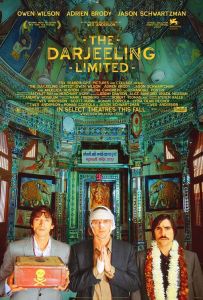 I’m starting to think Wes Anderson may become his own worst enemy. The man seems trapped in his precious, idiosyncratic style that revolves around intricate, dollhouse-style production design, slow-motion and simple pan shots, clever-to-smug characters, family dysfunction that coalesces somewhat by the end, and a soundtrack full of hip, retro songs. I like Wes Anderson; I loved his first three films, was rather lukewarm on 2004’s Life Aquatic, but The Darjeeling Limited is pretty much a bland rehash of the same. Instead of a father reconnecting with his long-forgotten son it’s three brothers reconnecting in the wake of their father’s death and mother’s abandonment. The humor is fairly subdued and while the movie is brief it seems to run out of gas early on and get repetitive. I think Anderson is more interested in showing off his highly elaborate production design than crafting interesting things for his characters to do inside those complex sets. I didn’t feel a blip of emotion for any of the character, all of who have some lasting fear of women ever since their mother ran out to become a nun. There’s kind of an unsettling misogynistic vibe in the movie against women, which is an unfortunate surprise. There’s a spiritual quest that some may relate to but I found it superficial at best, intended to gloss over the plot holes and character miscues. I wish Anderson well, but his next venture behind the camera might work better if he threw out his fraying filmmaker playbook.
Nate’s Grade: C+
Share this:

The Assassination of Jesse James by the Coward Robert Ford (2007)
 This is a harrowing, haunting, beautiful, mesmerizing movie that is easily one of the best films of 2007. Casey Affleck is an acting revelation as Robert Ford, the man who worshipped Jesse James and obsessed over him before eventually turning sour and killing his hero. This languid Western, paced at 2 hours and 40 minutes, establishes a mood of gnawing paranoia as the law closes in and Jesse suspects his gang members will betray him. The day-to-day worry and dread of a life of crime really translates, and Jesse James proves an intelligent, unstable leader to mix the pot. The movie builds slowly but the tension grows unbearable and puts knots in your stomach. The acting is outstanding all around, and Brad Pitt proves a great choice for a 19th century American icon weary of his legendary status. The movie presents a fascinating peek into Jesse James’s gang and presents a wealth of historical information, none more intriguing than when the public turned on Robert Ford for terminating one of American’s folk legends. The narration provides sharp, illuminating details in brief expository scenes, and thanks to Roger Deakins’ stunning cinematography, Jesse James is an authentic period picture that is a marvel to view. I was awed by this artistic achievement that still resonates with me long after I finished watching. This film simply envelops you.
Nate’s Grade: A
Share this:

The Invasion (2007)
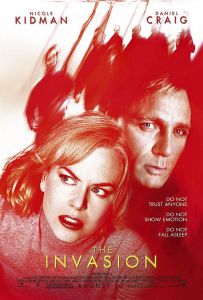 The fourth remake of The Invasion of the Body Snatchers is a more interesting behind-the-scenes story than as a film. German director Oliver Hirschbiegel (Downfall) created a movie that was described as more psychological thriller than action chase movie. The studio and producers scrapped many pieces of the film, hired the Wachowski brothers to rewrite portions of the story and cram in some action, and then James McTeigue (V for Vendetta) directed the reshoots. As a result, the movie is wildly displaced and hacked together and never feels whole. There’s a slow burn of intrigue and mob madness and paranoia that gives way to chase scenes, car wrecks, and a ridiculously contrived happy ending. I’m sorry, but when you do The Invasion of the Body Snatchers, you cannot have humanity win; that destroys the entire point of the story. It’s like having King Kong climb the Empire State Building and deciding to live there and dance for peanuts. Nicole Kidman and her lithe frame seem like an odd choice as humanity’s last hope with a gun. The Invasion flirts with some philosophical ideas about free will, assimilation, and the cost of peace, but then it speeds headfirst into an abrupt finish. This movie is unsatisfying to all parties.
Nate’s Grade: C
Share this:

Into the Wild (2007)
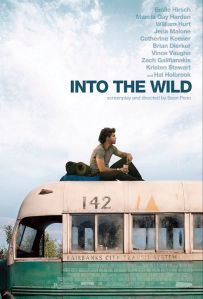 Undeniably well made, I just couldn’t emotionally connect with the main character, Christopher McCandless (Emile Hirch). Chris turns his back on his affluent parents and his bourgeois lifestyle and heads off into the wilderness to experience nature and find what has been missing in his life. Director/screen adaptor Sean Penn turns Chris into a Jesus-like figure that touches all those who he encounters on his cross-country tour that will meet its end in Alaska. I found the character treatment to be a tad naive and off-putting, and his lack of communication with his family, especially his younger sister who was in the same boat with him, seems especially cruel. And yet, the movie has its share of transcendent moments that bury themselves deep inside you, like when Chris befriends an 80-year-old widower (Oscar nominee Hal Holbrook) who is given new life. The closing moments, when Chris has accepted is fate, is profoundly moving and exceptionally performed, and this is coming from a guy that felt an emotional disconnect from the main character. Into the Wild is lovely to watch with top-notch cinematography, a fabulous score by Eddie Vedder, and fine acting by a diverse cast. I’m very impressed by what Penn has accomplished here. However, I admire the movie more than I can embrace it, and it all goes back to the character of Chris. He’s a mystery and both romantic and frustrating, which is kind of a fit summation for the movie.
Nate’s Grade: B
Share this:

Persepolis (2007)
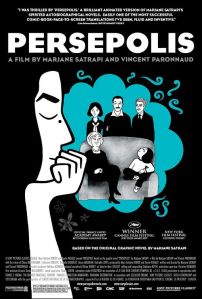 Marjane Satrapi has, by all accounts, a very unique life. Growing up under the repression of the Islamic Revolution, she settled in France and created a series of acclaimed best-selling graphic novels called Persepolis, based upon her life growing up in and out of Iran. The movie was France’s official entry for the 2007 Foreign Language Oscar, bypassing the equally lauded and inventive Diving Bell and the Butterfly. And yet Persepolis did not even make the short list of nine nominees, which eventually gets parred down to five (neither did 4 Months, 3 Weeks, and 2 Days, which WON the Best Film from the European Film Awards, over other movies that managed to make the Academy’s five nominees). I consider this a glaring omission. How could anyone not be entranced by Satrapi and co-director Vincent Paronnaud’s masterwork?
In Tehran, the capital of Iran, young Marjane and her family watch as rebellious forces overthrow the Shah in 1979. The Shah was the ruler of Iran and could readily be described as a dictator. He was friendly to Western countries and wanted Iran to follow their lead. Large forces unified and deposed the Shah, setting the stage for Iran to have its own system of rule that the people would decide upon. Marjane’s father swings her around in his arms and excitedly proclaims that democracy has come to his country at last. Landslide numbers “vote” for radical Islamic leaders to take control of the government, and Iran becomes a militant theocracy. Privileges and reforms are revoked, and women will have to wear long burquas and veils to be righteous. Marjane is too outspoken and her parents, fearing for her safety, send her to Europe to be educated. While she is absent Iraq attacks Iran and the countries are engulfed in a decade-long border war.
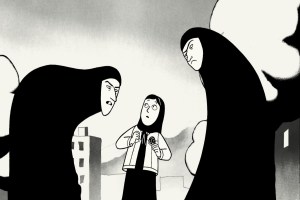 Persepolis is a gem of a movie, at once a personal coming-of-age account that manages to be fascinating and honest and also a universal tale of struggle for cultural identity. The evocative black and white animation is a joy to watch. The crisp drawing style manages to express so much with the seemingly simple, clean images. At times the visuals take on a lovely German expressionistic feel, and the world feels like it is made out of folded layers of paper. I would fall in love with a movement, a facial expression, that fact that smiles look like boomerangs, something small yet immeasurably enjoyable that struck a deep chord inside me. The arresting black and white visuals do not distract from the story in any way, in fact they help to mirror the repressive nature of what befalls Iran. A silhouetted group of protesters is shot at and one of them falls to the ground. Great inky blackness seeps out of the fallen body and merges with the rest of the screen, adding emotional heft that color could never capture.
Told for long stretches from the perspective of a child, Persepolis manages to find unique perceptions. The child point of view allows the film to unfold naturally with innocence and inquisitiveness, qualities that would soon be hard to recapture once the promise of revolution turned sour. Young Marjane feels jealous and competitive that her cousin can brag that her father spent more time as a political prisoner. It’s an odd stance for an adult and yet it feels entirely within reason for children. Marjane deals with issues she cannot fully understand as a child but she tries her best. The eyes of children also let the filmmakers mingle with the fantastic. Marjane speaks to God at points, and after a horrible tragedy God is trying to apologize and explain but little Marjane will not hear any of it. She orders God to leave her and so He departs. A little girl turning her back on God will hit you is the kind of devastating stuff that can put a permanent lump in your throat.
I was dumbfounded at the emotional depths the film plumbs in a scant 95 minutes. This is an incredibly powerful tale, richly told with poignant insights and grace. There were several times I was overcome with emotion and had to dab my eyes. Satrapi achieves great emotional resonance with minute details, making the film exciting in how engaging it continues to be from beginning to end. Marjane’s relationship with her family anchors the movie and you can feel the power of their love and bonds. Imprisoned uncles who spouted communist dogma are released only to be seen as a danger once again. Marjane’s mother is worried when Marjane keeps showing a fiery outspoken spirit. One day she shakes a teenage Marjane, screaming at her the horrid possibilities that can happen to women under this regime. She cites one teenage girl who was executed, but they don’t believe in killing virgins, so the guards took care of that bothersome roadblock. Marjane’s mother is wild-eyed with fear and what might await her little girl, and her gnawing concern is resoundingly powerful. Marjane’s grandmother serves as her emotional compass throughout her life. Grandma stresses that Marjane should be proud of her cultural identity and stay true to herself. When Marjane gets older she hears her grandmother’s voice to set her straight in times of doubt.
 But while the movie can be heartwarming, it does not fall victim to sticky sentimentality. Satrapi deals with some harsh truths about life in Iran and also her time in Europe as a blossoming woman without a country. She doesn’t sugarcoat reality and Marjane’s parents make it a point to be up front with their daughter about what is happening; an uncle tells little Marjane, before he is executed, that knowledge must live on and she, the youth, must be the one to keep it alive. The Iran-Iraq war ends in a stalemate with millions in casualties. Persepolis details life behind the veil and the shift the country took to radical Islamic rule but the film isn’t all doom and gloom. There’s a natural curiosity about a story of a girl who becomes a woman in a repressive society. Marjane’s spiky rebellious spirit makes for genuinely human comedy. She shops for Iron Maiden tapes on the Iranian black market, wears a jacket that states, “Punk is not ded,” and screams with joy at ripping her veil off during a car ride and letting the wind gust through her hair. There is a bounty of humor to be found in unexpected places. Marjane is running to catch a bus and is stopped by two policemen who complain that when she runs her butt moves “in an obscene way.” She simmers and finally yells, “Then stop staring at my ass!”
If Persepolis has any shortcomings it’s that the narrative peaks a bit too early. Seeing a child come of age during the Islamic Revolution is generally more interesting than watching a teenager navigate unfaithful boyfriends in Europe. Persepolis never stops being entertaining or relevant, it just so happens that the greater emotional rewards are tied to life and family in Iran.
Persepolis is a marvelously moving and unique coming-of-age tale set against a unique time. Marjane Satrapi’s graphic novels have fluidly been translated into a film that resonates with great emotional turmoil and inspiration. The alluring black and white visuals and clean animation style dazzle the eyes, while the enthralling personal story reaches deep inside and touches the heart. The film is brilliant, beautiful, harrowing, deeply human, fascinating, and ultimately inspiring. It’s rare to find a movie that can hit so many emotions with finesse, animated or live action. Persepolis is a bold vision and a revealing and lovely film that I cannot wait to revisit often. This is more than just a cartoon, folks. This is art.
Nate’s Grade: A


You must be logged in to post a comment.