Blog Archives
Trance (2013)
 Danny Boyle is a director that can make anything watchable. The man made an entire movie about a dude trapped under a rock and it was spellbinding. With that in mind, he does his very best to turn the trippy, Inception-like crime thriller Trance into a workable, watchable experience for the audience. The main issue is that the movie is so busy that once it slows down you realize there really isn’t anything going on. James McAvoy plays an art auctioneer who stashed a valuable painting during a heist. He undergoes hypnotherapy by Rosario Dawson so the crooks can determine where the loot resides. The premise allows for plenty of fake-outs, and you’ll be conditioned to doubt just about everything you see on screen. The film does a nice job of applying that doubt to the characters as well; the good guys may not be so good and the bad guys may not be so bad. With Boyle’s hyperkinetic visuals and some fast-paced editing, Trance is serviceable in the moment, but when the characters literally spell out everything you realize how shallow the movie is as well as these characters. The lone truly memorable moment is a scene where Dawson jets off to a bathroom, we hear an electronic buzzing, and she comes out fully nude, presenting herself as a shaven offering. The fact that this relates to an actual plot point is practically incidental. The movie isn’t as smart or as fun or as entertaining as it thinks it is, and I wish Boyle had taken advantage of dream/mind mechanics and gone crazier with his visuals. Still, if you’ve got a couple hours, some low expectations, it’s worth at least one watch.
Nate’s Grade: B-
Share this:

Amour (2012)
 No other foreign film in 2012 racked up as many awards as Amour, a.k.a. Love, by Austrian writer/director Michael Haneke. It’s a love story but it shows the end of that love story, the part where the happily ever after meets the uncomfortable reality we must all eventually face. So, essentially, Haneke has crafted a horror film about getting old (this can happen to you, youngsters!). It’s a hard film to watch, though for me not just because of the subject matter but also because of the maddening ways that Haneke chooses to tell his art-house tales of woe.
Anne (Emannuelle Riva) and Georges (Jean-Louis Trintignant) are an 80-year-old married couple living in Paris. They are both retired musical teachers, they go about their days together, enjoying one another’s companionship. Then Anne suffers a stroke and starts slipping into senility. Her condition worsens and Georges tries to care for her increasing needs himself, buoyed by her fleeting moments where it seems like her normal self returns. But there’s only one way this story can end, and George must come to terms with letting go of his life’s love.
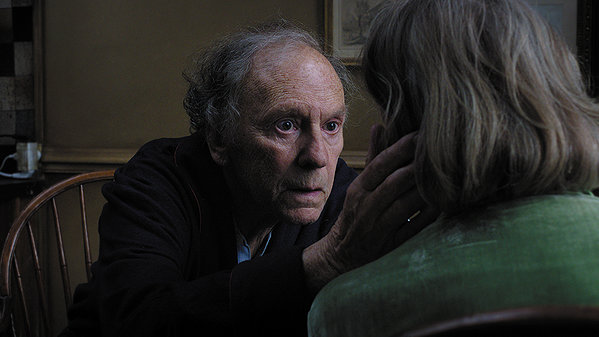 I will probably come across like a heartless bastard but that is the risk I’m willing to take; I found this movie to be rather boring and was, after an hour, just waiting for Anne to die so that the movie would likewise be at a merciful end. I’m just not a Haneke fan. I didn’t like Cache, I didn’t like (both) Funny Games, and I didn’t like The White Ribbon. In fact, while watching Amour I was reminded of all the reasons I dislike Haneke’s style. There was a sequence where a character leaves a room, but rather than follow that character or cut, the camera holds on the scene for an extended period of time, like 40 seconds, until the actor returns. I said, “Oh, I just remember he did the same thing in The White Ribbon, and I hated it then and I hate it now.” Want to watch an old man chase after a pigeon for five minutes? Oh, I get it, the pigeon is a metaphor, but did I need five minutes of it? I find Haneke’s sense of storytelling to be so glacial and, mostly, a spiral of kamikaze nihilism that’s usually distasteful. He’s such a cold filmmaker and the idea of him handling a “love story” seems dubious. It’s hard to watch a Haneke film and feel good about it. And that’s fine, the world needs downer filmmakers who will tackle serious subjects, but this guy is just not for me. With that said, take everything I recount in my review and analysis with a measure of consideration.
I know my power of empathy is alive and well, so I have to stop and run a diagnostic examination as to why I found it hard to really engage with this movie. I’m sure part of it is my relative youth in comparison to the onscreen couple. Death is still a mostly abstract concept I choose to be blissfully ignorant over. But that can’t be fully it. I went through a similar experience helping to care for my 91-year-old grandmother when she died (she lived with my parents for years before her eventual passing). It’s not the same as losing a spouse, naturally, but I do have a relatable entry point. Maybe it was the acting, which was free of any sort of showy actorly tricks we may expect from people reaching the big end. Death scenes have long been a staple of overacting, but underplaying it can also rob the movie of worthy emotional opportunities, and with an artist like Haneke, you may not get many more opportunities to soak up. While I had heard raves about Riva, and make no mistake she is quite good, I cannot help but think, “Yeah… but….” She’s quite convincing at showing the frailty of aging but she’s also practically comatose for half of the movie (I know I’m a Jennifer Lawrence homer, but glad she won the Oscar). And then Haneke tries to get clever with his ending, especially since he had been so straightforward for the previous two hours. The ending, a possible point of confusion, doesn’t feel like it fits the exacting, grounded reality I just barely stayed awake for.
 Amour is really less about Anne, the one slowly dying, as it is Georges coming to terms with his own selfishness, prolonging his love’s life after the point of dignity and mercy. It’s about how he comes to terms with the reality that he cannot care for his beloved, that she is too much of a burden, and that she ultimately wants to die and will fight her husband to achieve this wish. Again, this is an extremely dramatic storyline that could have developed some monstrously powerful examinations about end-of-life care. Sadly, I just didn’t, well, care too much. The relationship between Anne and Georges is very thinly realized onscreen. I’m sorry but I hate it when a character is afflicted so early in a story and that affliction becomes the stand-in for what should be proper characterization. All I know about Anne is her deteriorating condition. I don’t know about her life, her personality, her relationship with her husband before senility sets in. I’m just supposed to automatically feel for her because she’s old and suffered a stroke and her husband really cares a lot. Haneke’s storytelling has not done an adequate job to involve me. The actors, both quite good, can only do so much. There’s a reason that Hollywood has its heroines start the Cough That Symbolizes Terminal Illness when we hit the third act because by that time we’ve gotten to know them and care about their ultimate plight.
Now, Amour goes about its death business in a very sensitive but unsentimental way, which has and will likely emotionally devastate many a viewer. There are serious and hard discussions the movie gives adequate attention to, like how far can one spouse cope with care, when does holding on serve as a detriment, breaking the news to heartsick family members that your loved one isn’t getting any better, coming to terms with the inevitable, the tricky debate about what comes next as far as inheritances, and whether the person who is suffering should have a say in their care or lack thereof. It’s refreshing that serious decisions are given serious consideration, but like everything else, Haneke drags these out to great lengths that I stopped caring.
I find Haneke to be an outrageously overrated filmmaker of clinical coldness and occasional contempt. Just watch Funny Games to see what the man’s opinion is for most movie audiences lapping up your rote thrillers. Better yet, if you’re like me, don’t see Funny Games, and don’t see The White Ribbon, and don’t see Amour. I fully acknowledge I’m out on a critical limb here, cherishing my minority status, but I found this Oscar-winning film to be painfully ponderous and emotionally closed off. I’m happy people can watch Amour and see a great, tragic, affecting love story, because I don’t see it. The actors do fine jobs but the characterization is weak, relying upon circumstance and affliction in place of characterization. Maybe, and this is just a harebrained theory, but maybe Haneke dragged his movie out so long to symbolize Georges’ journey, so that we too, the audience, felt like when the end came it was a relief. I know for me, it did. Whatever Haneke does next, you can count me out. I’m done with the guy. After all, life’s too short to endure more plodding Haneke films.
Nate’s Grade: C+
Share this:

Seeking a Friend for the End of the World (2012)
 It’s the end of the world as we know it and I oddly felt fine… which is not a good sign for your apocalyptic movie. Seeking a Friend for the End of the World is a peculiar thing, all right. It takes place in the last three weeks of the human race. And lest you think the film wimps out on the promise of its title, think again. I was bemused for the first forty minutes, where writer/director Lorene Scafaria indulges in a series of one-scene vignettes of how humanity comes to terms with the certainty of annihilation. There’s an adult party where people joyfully try heroin, a hit man-for-hire service to bring back some of the mystery of death, and a restaurant where all the workers are spaced out on Ecstasy. I found each of these moments to be funny and a well though-out extension of the premise. But then the film’s diversions give way to the rom-com of our main characters, played by Steve Carell and Keira Knightley as your standard manic pixie girl. And the more time I spent with them the more I found myself not getting engaged. My emotional empathy was kept to a minimum; they’re nice people and all but I didn’t find them that interesting. The resulting movie feels like one of the weakest avenues given the premise. I credit Scafaria for not wimping out in the end, but as these characters faced oblivion together, I felt little emotional stirrings in my chest.
Nate’s Grade: C+
Share this:

Anna Karenina (2012)
 I’ve never read a Russian novel before, mostly because I don’t need to read 900 pages of bleakness and repressed happiness. With that said, I knew very little going into Anna Karenina (the very title sounds too heavy in syllables, like you’re stuttering). What didn’t help matters was director Joe Wright’s edict to set the story as if it was being performed on a living stage. This bizarre visual concept is interesting for a little while until you realize that it never goes further than the obvious note that the lives of the elites were played out in public for cruel judgment. The staging also gave me many periods of confusion where it felt like a character fantasy was taking place. The peculiar staging seems superfluous and the real draw for the film, not the relatively fine performances or Tom Stoppard’s (Shakespeare in Love) adaptation. I don’t think it works as a movie because, much like Wright’s Atonement, it feels too self-satisfied in its own mannered artifice. It’s an overload on style and the film neglects to give me a reason to care about the story and the characters. Keira Knightley as the titular heroine is hard to embrace, Aaron Taylor-Johnson (Savages) seems miscast as her dashing lover, and Jude Law (Hugo) comes across as unreasonably tolerable of his wife’s flights of fancy, so much so it makes it hard to sympathize with her downward spiral. It’s a pretty movie and I applaud its attempt to do something different, but Wright’s Anna Karenina feels too fanciful to come across as tragic.
Nate’s Grade: B-
Share this:

Celeste and Jesse Forever (2012)
 Celeste (Rashida Jones) and Jesse (Andy Sandberg) have been best friends ever since high school, the couple everyone admired. They’ve been married for six years but now they are in the middle of divorce proceedings. Why? Celeste loves her longtime best friend but worries he’s not maturing or stable to be her marriage partner. During their separation, Jesse admits he’s found another woman whom he cares about. Celeste professes to be happy but deep down is troubled, second-guessing her decision now that there’s a real threat she might lose Jesse. The two buds act like nothing has changed, goofing around and paling it up, but how long can they keep up this façade? Eventually, someone is going to get hurt because divorce cannot be shrugged off. Reality has a way of outliving ironic detachment.
Can you remain best friends with someone you once loved? How about someone you once knew as your spouse? Celeste and Jesse are certainly trying but their idealistic “BFF” status seems destined to meet a harsh reality. Celeste and Jesse Forever is labeled as a “loved story” and I think that’s a pretty apt description. These two characters clearly have a deep affection for one another, but after six years the feelings just aren’t enough. What happens when you marry your best friend but that just isn’t enough? I was hoping for some greater answers from the movie, or at least a harder examination on why some relationships fall apart when things look like they should work. That’s not exactly what the movie offers. For a film with an aim to be more realistic about the fallings out of love, the movie follows a familiar formula. There’s the cute guy at yoga (Chris Messina) into Celeste, but first she has to get settled. I think I wouldn’t have minded this character if he didn’t feel so much like a plot device, a hasty happy ending meant to be put in a holding pattern until called upon. The “Jesse” half of the title will be gone for lengthy chunks of the movie. His portrayal also borders on simplistic. I wish we got more of his side of the relationship, especially since he’s going through sudden change himself. After seeing the trailer, I thought I was going to find the movie immensely relatable. Maybe I just got all the recognizable personal drama out of my system with The Five-Year Engagement (double feature for bitter lovers?).
 Fortunately, the movie is also fairly funny. The comedy can feel a tad sitcomish at times with misunderstandings and catching people in embarrassing situations. The screenplay by Jones and co-star Will McCormack (TV’s In Plain Sight) is routinely amusing, settling with soft chuckles rather than anything histrionic. It fits the subdued tone of the movie, since it’s about people coming to terms with messy emotions and not whacky mishaps. Then there’s a whole subplot involving a teen pop star (Emma Roberts) that feels recycled from a whole other movie. This storyline leads to a few good jokes but it doesn’t seem to add anything of value to the plot. The comedy doesn’t overpower the dramatics, and Celeste and Jesse Forever finds a nice tonal balance between the heartache and humor. I wouldn’t say the film is necessarily quirky but it certainly operates to an offbeat comedic rhythm. There are a few cringe-worthy editions but the characters and the actors make it worth any personal discomfort.
If Jones (TV’s Parks and Recreation) needs a good boyfriend I will gladly volunteer my services. My God this woman is beautiful. I don’t want to set off any alarm bells, but this woman is a goddess. She’s also extremely talented and a naturally charming presence. Her chemistry with Sandberg (That’s My Boy) is out of this world. They are so relaxed together, so amiable, so enjoyable, that it really does come as a shock when their unamused friends have to sternly remind them they are getting a divorce. They have a wealth of in-jokes and secret couple codes, and they’re so cute together that you wonder if maybe, just maybe, they’ll reconcile by the end. Sanberg is better than I’ve ever seen him, giving a strong, heartfelt performance as a nice guy trying to make sense of his eroding situation. But this movie is Jones’ movie, and she shines. While her facial expressions can get a little overly animated at times (TV-ish mannerisms?), this movie is a terrific showcase for her dramatic and comedic talents. This woman will excite you, frustrate you, break your heart, make you laugh, but you’ll be glued to the screen.
 The tricky part is that Celeste is both our protagonist and antagonist. She is the root of her own unhappiness, and coming to terms with the fact that she was wrong is a big moment of personal growth, however, it’s not exactly the direction audiences may be happy with. It’s harder to root for a character that is sabotaging her own progress. Jessie, especially as played by Sandberg, is pretty much an adorable puppy dog throughout the whole movie; it’s hard to stay upset with him, and occasionally Celeste will lead him on and then punish him for following. She tells him to move on but then pulls him back to her when he threatens to do just that. She chastises him for not being serious enough, for not having direction, yet you get the impression throughout the movie that Celeste bares some responsibility in this situation as well. Jesse is laid back, though hardly the arrested development slackers dotting most of modern comedy these days. As one character notes, perhaps Celeste enjoyed keeping her husband grounded, limited, stuck. I don’t chalk it up as malice, more a comfortable situation that Celeste is afraid to disrupt. She’s the overachiever, he’s the underachiever, they compliment one another, that is, until Celeste decides they don’t. Then when it looks like Jesse’s growing up, she wants him back, or thinks she does, at least this newer version of Jesse. As you can see, it’s complicated. At no point would I dismiss Celeste as a callous person, but the movie is tethered to her personal growth of being able to admit fault. Her window with Jesse has passed. The movie is about her journey to realizing that.
Celeste and Jesse Forever feels like a movie of small waves. It doesn’t have the Big Declarative Moments of most rom-coms or indie romances, and that’s because it’s not a romance as much as an autopsy on why a romance went down for the count. It’s melancholy without getting mopey. It has certain hipster tendencies but nothing that rises to an insufferable level of twee; it’s routinely adorable and rather heartfelt in places, though I wish it had offered more potent insight into its characters. This isn’t going to be a movie that people build up great emotion for. By nature it’s pretty low-key, choosing to handle its emotional pyrotechnics with delicacy and the occasional comedic set piece. For a comedy about divorc,e this si surprisingly sensitive. These are nice people, good humored, and you sort of wish the movie would just scrap any indie ambitions and substitute a happy ending. You want to shout at the screen, “Just reconcile already!” Maybe that was me just using the movies as good old therapy again (see: The Five-Year Engagement review, or don’t). Celeste and Jesse Forever is an agreeable, affable, bemusing movie, with enough laughs and emotion to justify giving it a chance.
Nate’s Grade: B
Share this:

Like Crazy (2011)
 The prevailing thought I kept having while watching the twee indie romance (?) Like Crazy was that this is like silly. I spend fifteen minutes with the young happy couple, Jacob (Anton Yelchin) and Anna (Felicity Jones), and then there’s already trouble. Rather than have to wait two and a half months to see one another again (a.k.a. eternity), Anna decides to overstay her visa because it’s not like that would be taken seriously in a post-9/11 world. Naturally, there are repercussions and Anna is banned from reentering the U.S., effectively putting a hitch in her romance. It’s such a short-sighted, impulsive, boneheaded decision, and it’s one that completely made me lose all sympathy for a couple that couldn’t bother to be apart for a mere two and a half months. Jacob and Anna try and hold it together but the constant starting and stopping, as well as the comforts of people closer, provide major roadblocks. I’m not a hardhearted person; I’m a sucker for a good romance. Many of my favorite movies of the past few years have strong romantic elements (Eternal Sunshine, Once, Moulin Rouge, WALL-E), but I felt next to nothing for this whiny, pitiful couple. First off, they’re only together for fifteen minutes before being ripped apart, which doesn’t exactly allow me enough time to emotionally engage. And then there’s the fact that these “crazy kids” have absolutely no passion between them, no spark, no nothing that would compel them to be together against all odds. You don’t feel anything approaching romance. And to top it off, Jacob has a perfectly lovely, charming, and available alternative played by the lovely and charming Jennifer Lawrence (The Hunger Games). She even makes this doofus breakfast in bed. This movie felt like an entire montage of small moments that never accumulated into anything believable or compelling. I’ll take Lawrence and breakfast in bed and be grateful.
Nate’s Grade: C
Share this:

My Week with Marilyn (2011)
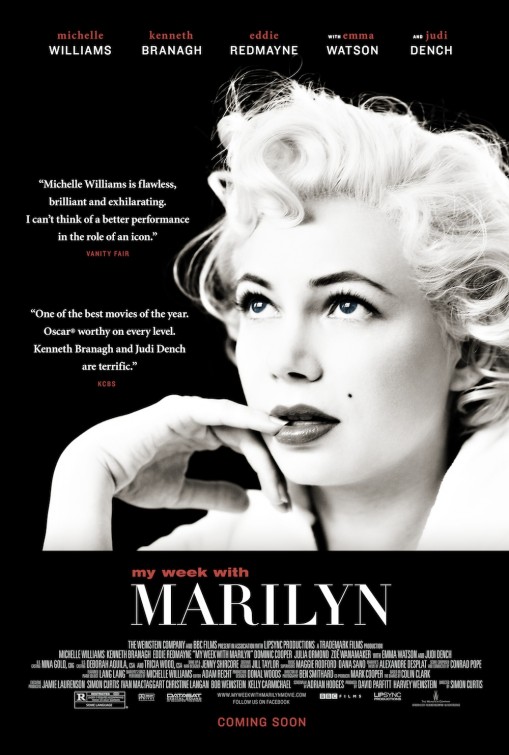 In 1957, Marilyn Monroe (Michelle Williams) was the biggest star in the world but she wanted to be taken seriously as an actress. Laurence Olivier (Kenneth Branagh) was an award-winning thespian considered to be acting royalty, but he was looking to siphon some of Monroe’s fame and vigor. Monroe flew over to England to shoot the light comedy The Prince and the Showgirl, directed by and starring Olivier, and it was here that she changed the life of Colin Clark (Eddie Redmayne). Clark was an ambitious young chap who served as the third assistant director and Oliver’s personal assistant as well. He was mainly a glorified go-fer but the position allowed him to glimpse the world of Marilyn Monroe and her various handlers, Paula Strasberg (Zoe Wanamaker) and Milton Greene (Dominic Cooper). Monroe’s flighty behavior and struggles with acting drive the more professional Oliver stark raving mad. Monroe’s rocky marriage to playwright Arthur Miller (Dougray Scott) is causing her fits of depression. Who better to cheer her up than young Colin Clark? Over the course of nine days, the two become inseparable and Clark falls head over heels for the world’s most glamorous woman.
The character of Colin Clark seems to be stripped of all defining personality traits. He’s this bland kid caught in continual awe. He just seems to be smiling and twinkling those big, compassionate eyes of his, typifying the earnestness of young love. I think he’s been rendered into a cipher for the audience to put themselves in his shoes, becoming star struck with Monroe’s attention. The screenplay takes far too much time on showing Clark coming to the repetitive rescue. His romance with a costume girl (Emma Watson) is a nonstarter and the movie doesn’t even try and hide the fact. She’s the backup romantic option, so the fact that he goes back to her after being spurned by Monroe and we’re supposed to feel that this is growth seems disingenuous and a bit caddish. Perhaps she didn’t take it too hard; if you’re going to be dumped for anyone else, there’s no shame if it’s Marilyn Monroe. Judging by the movie’s depiction, Clark is a rather boring young man, and I didn’t buy for a second that Monroe would cling to him as her hero.
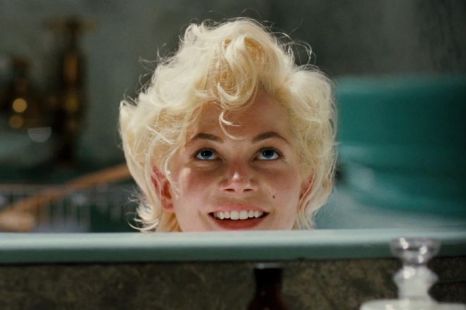 My Week with Marilyn is really focused on the titular star. Clark is just out path to the real star. I doubt there’s anything particularly revelatory about Monroe here. She was plagued with insecurities, a need to be loved, and the fatigue of “playing” herself all the time, all hips swivels and winks. At one point Clark and Monroe are taking a walk and met with a group of fans. “Shall I be her?” she coyly asks Clark and then turns into the vampy goddess the public loved, striking poses and smiling wide. By the very constricted nature of the timeline, we’re not going to learn too much about the famous beauty. She flubbed her lines, she and Olivier didn’t get along, and a mini-entourage of sycophants who were meant to be a surrogate family for the troubled gal surrounded her. Was she a lonely gal crushed by the weight of stardom or a manipulative lady who knew how to get what she wanted? The movie doesn’t take a side, instead serving up all sides of Marilyn Monroe, including a few in the buff. The film has some enjoyable juicy bits, particularly the friction between Monroe and Olivier, but the movie ultimately becomes another fawning admirer of its star. There are a couple musical numbers with Monroe that feel clumsily reproduced and the tone seems too light too often for the dramatic moments to have any real bearing. It becomes another fan that celebrating her image and sponging off her fame and legacy.
While the film may not be revelatory, Williams (Blue Valentine) herself is the revelation. She’s not exactly a dead ringer for the curvaceous, buxom blonde beauty, but she inhabits the spirit of the woman rather than sticking to a breathy imitation. She doesn’t capture the baby-doll voice but the demeanor she has down pat; when she turns it on you can feel the screen light up with the luminescence of star power. There’s quite a difference between the sad, depressed, codependent Marilyn and the sexy pinup fantasy. It’s an incredible performance in an otherwise so-so movie, though I wish the screenplay had given her more complexity to work with. Branagh (Valkyrie) is great fun as the stuffy, overbearing Olivier who gets plenty of snappy lines to vent his frustration over Monroe’s antics (“Teaching Marilyn how to act is as useful as teaching Urdu to a badger!”). Both actors are so good, and so good together, that I wish we could just remove the “my week with” from the title and focus on the relationship between Monroe and Olivier.
Allow me to question the voracity of Clark’s account. He waited until 1995 to publish his film set diaries, and then after his first memoir of his time with Monroe sold well he published another one in 2000, this one filling in a nine-day gap he says was that fateful week with the sex icon of the twentieth century (eat it, Clara Bow!). The second memoir was written fifty years after the fact and from the nostalgic perspective of an old man looking back to his youth. I feel that the particulars have been smoothed over and romanticized. The fact that surviving actors from The Prince and the Showgirl cannot verify any sort of relationship, and that several sources say that Monroe and her new husband Miller were inseparable at the time, cause me to doubt the validity of this personal account. In his first memoir, Clark even criticizes Monroe’s physical appearance (“Nasty complexion, a lot of facial hair, shapeless figure and, when the glasses came off, a very vague look in her eye. No wonder she is so insecure.“). Yet in the second book he becomes her defender. So which is it? Who wouldn’t, with sixty years of hindsight and a best-selling first memoir, embellish their one-time dalliance with a star like Monroe? The most desired woman in the world and he, a 23-year-old nobody, was the one to become her confidant? Aren’t we full of ourselves? And he crawled into her bedroom and was asked to stay the night and didn’t consummate that relationship? In the book she offers and he declines. Talk about the biggest mistake of your life.
 If you’re going to embellish, then you might as well get some action out of it. Then again, maybe in the books Clark says that Monroe gave him a pity handjob and the filmmakers deleted this (I can hear him screaming from beyond the grave, “You fools! The handjob was a metaphor. The whole tale falls apart without it!”). If I ever had even a fighting chance of getting lucky with Marilyn Monroe, you’d best believe I would be telling that story so often that my grandkids would roll their eyes in disgust (“Geez, we get it grandpa. Marilyn gave you a handy once.”). The post-script tells us that after The Prince and the Showgirl, Monroe went on to Some Like it Hot and Olivier went back to the theater for some of his best-reviewed runs of his career. So clearly, these two stars owe all their good success to the heroics of Colin Clark, who nudged them from greatness to legendary. We have only Clark’s take since Monroe cannot dispute Clark’s claims so I feel like the memoir, and the film adaptation, is an exercise in serving Clark’s ego.
My Week with Marilyn is a light, weightless movie that retells the shooting of a light, weightless movie. Well done, everyone. The emphasis on this bland kid and his fairly unbelievable whirlwind romance of the twentieth century’s most iconic sex symbol makes the movie feel self-serving. Does anyone honestly believe the events of this story? Whatever the validity of the events, a movie should be entertaining on its own rights. My Week with Marilyn has its bouncier moments and is saved by stellar acting from Branagh and the radiant Williams. But even the best acting in the world can’t save a movie that feels like it’s completely some old man’s exaggerated, embellished, and somewhat boring fantasy. If this is the relaxed standard for getting a movie made, then I look forward to the eventual film adaptation of my soon-to-be-released novel titled, My 28 Hours of Incredible Sex with Angelina Jolie.
Nate’s Grade: B-
Share this:

Tuesday, After Christmas (2011)
 Who knew that Romania, of all places, was the wellspring of tremendous artistic talent? Over the last five years or so, Romania has been home to a burgeoning renaissance of daring, provocative, and naturalistic films, its own New Wave of Eastern-bloc cinema. Some of these gems include The Death of Mr. Lazarescu, 12:08 East of Bucharest, the understated, cerebral Police, Adjective, and the award-winning, grueling abortion drama, 4 Months, 3 Weeks, and 2 Days, winner of the prestigious 2007 Cannes Palme d’Or. Director/co-writer Radu Muntean’s Tuesday, After Christmas is a worthy entry into the ever-growing canon of stupendous Romanian cinema. It and many other of these Romanian renaissance pictures are available via Netflix streaming, so if you’re unfamiliar with these great movies, now is as good a time as any to play catch-up.
Paul (Mimi Branescu) is a middle-aged man coming to a crossroads at his life. He loves two women: Adriana (Mirela Oprisor), his wife of ten years who they share a young daughter, Mara; and Raluca (Maria Popistasu), a dentist in her late 20s. His mistress has accepted her role but wouldn’t mind reaching out to Paul’s daughter. Paul is unhappy with his wife but is he unhappy enough to come clean about his infidelity? Over the course of a few days around Christmas, Paul will decide which woman he will stay with.
 This movie is something of a small miracle in how naturalistic it plays. The dialogue is splendid, reverberating with the rhythms of real speech but also giving weight to the characters, fleshing out personalities, relationships, and penetrating subtext. I was luxuriating in the dialogue and its nuances. To some people Tuesday, After Christmas will be a boring movie, but for me I was on the edge of my seat thanks to the dialogue and characterization. If ever Richard Linklater (Dazed and Confused, Waking Life) were to make a Romanian film, it would be this. Like Linklater’s Before Sunset, watching these actors speak such truthful, personable, revealing dialogue is like listening to birds sing. It’s such a pleasure for the ears. Take the first scene, a sexy, nearly six-minute unbroken shot of a couple in bed. Over the course of those six minutes Muntean (Summer Holiday) and his actors peel away the layers, revealing more and more of these characters and their situation. We can tell from their playful, affectionate, and relaxed manner that they are lovers. Also the fact that they are naked seems rather telling. Then we learn who they are naturally. He pretends to take offense at her admission of other lovers’ penis sizes, and pretends to bite her nipple, which makes her examine his teeth and chide him that smoking harms his teeth. Right there we learn about her sexual past, his mixed feelings about it, their teasing relationship, and her profession. And then, of course, we learn that the man is married and this is the “other woman.” That six-minute scene is near perfection. It sets up the characters, the conflict, and not a single point felt false or contrived. The rest of the movie follows suit, from the mundane moments of married life (the manner of rubbing a spouse’s feet) to the quiet storm of indecision.
There isn’t a wasted line of dialogue or a camera shot in this entire movie. Part of that is because Muntean deals in extremely long takes. There isn’t one camera shot that lasts under a minute; most of the camera shots last for several minutes, some approaching double digits. In other hands, the glacial pace of the camerawork would make the movie feel trapped and stagnate, as I felt watching the clinically dull movie, Shame. Instead, this movie is captivating because of the draw of the characters and the inherent drama/irony presented with the romantic triangle. A dental appointment for Mara becomes an uneasy, squirmy situation of great ironic tension, watching Paul shift uncomfortably and trying to mentally figure out what direction to take as his mistress speaks to his wife. Tuesday, After Christmas feels more like a stage play than anything cinematic, unless you’re counting John Cassavetes or the French New Wave (and why shouldn’t you?). The scene where Paul mulls over whether to tell his wife is more suspenseful than most Hollywood movies. The devastation that follows is heartbreaking but completely absorbing. This tiny Romanian film is so astutely well observed when it comes to human foibles and interaction that the film almost feels like a documentary. The patient, deliberately elongated takes further crystallize this sensation, making us feel like we are inappropriately eavesdropping on some very serious personal drama.
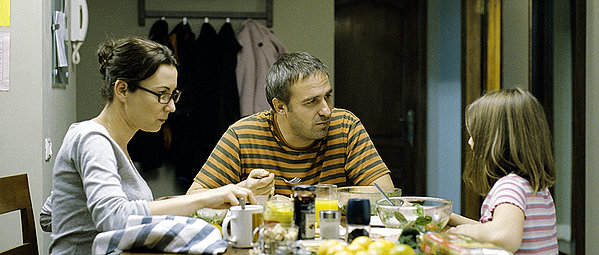 The acting is equally remarkable. For this movie to really work the three actors must step up their game, and all three came to play. First off, Branescue (Outbound) has to do his best to engender empathy because our introduction to the guy is during a romp with his mistress. But in those early moments we see how kind, lively, and peaceful he can be. Maybe this arrangement is good for him, we question. Then we see his interaction with his wife, and they are less lively, as the day-to-day grind of marriage can take its toll, but their interaction is warm, personable, and even through the mundane activity of Christmas shopping, we can piece together their relationship, which doesn’t seem troubled but resting in that comfortable position long-term relationships can plateau. Branescue never comes across as a scheming cad to vilify or a romantic victim. Instead his performance makes him spookily identifiable – this could be anyone. This could be you, assuming “you” are male and possibly living in Romania. The everyday nature of the character and his conflict, and Branescue’s nuanced performance, makes the guy empathetic even when his world is crashing around him and it’s his fault.
The women of Tuesday, After Christmas are also unforgettable. Popistasu (Midnight Man), as the mistress, is mesmerizing, a beautiful woman reminiscent of a Romanian Melanie Laurent (Inglourious Basterds), able to communicate so much with her body language. That first scene with her nude in bed establishes her as a charming, intelligent, rationale ingénue, neither calculating nor flighty. She feels like a real woman, and her relationship with Paul seems to bring out her spark, judging from that sparkling opening sequence. Likewise, Oprisor (Youth without Youth), as the wife, is equally compelling a figure, a woman settled into her marriage and her job and being a mother. Her reaction to Paul’s admission of infidelity is the movie’s dramatic highpoint, and we witness the actress seemingly go through every stage of grief in a manner of minuets, from anger and betrayal to thinking out the next course of action.
I know “Romanian relationship drama” probably doesn’t sound like a rollicking night out at the movies, but Tuesday, After Christmas is such an expertly crafted film, carefully observed, impressively acted, gloriously naturalistic in dialogue and direction, and even humorous. Yes, for a movie about infidelity and the possible explosion of a marriage, there is plenty of humor to be found naturally. You may feel stirring of romantic intimacy with Paul and Raluca, so much so that you too share in Paul’s guilt. You’ll feel the disquiet during that meeting of mistress and wife. You’ll feel the ache when Adriana really lays into Paul, a deserved and withering attack. You’ll understand where every person is coming from. But mostly you’ll feel like you’ve watched a really good movie. Tuesday, After Christmas is richly attuned to the subtleties of human joys, conflict, and reactions, and a movie that will linger with the ring of truth. Don’t be a stranger to Romanian cinema. Start here and work your way back. The rewards are worth it.
Nate’s Grade: A
Share this:

Passion Play (2011)
 You would think that a movie where a jazz musician (Mickey Rourke) gets in trouble with a mobster (played by Bill Murray!) and while on the lam he discovers a girl (Megan Fox) with angel wings working in a circus sideshow would be interesting. How could you go wrong with all those interesting elements? Mobsters, circus freaks, angels, Mickey Rourke! Well Passion Play found a way, a triumph of failure. This would-be parable just sleepwalks from scene to scene, rarely making much of its fantastical sci-fi elements. Fox swears she’s no angel, just a girl born with bird wings, and people let this be a conversation ender. Rourke’s character is a pathetic coward who nets little empathy. Not reverent or weird enough, Passion Play was the passion project of writer/director Mitch Glazer but the movie feels devoid of anything approaching passion. The actors seem bored, the romance between Fox and Rourke is a non-starter, and the lame ending borrows a page from An Occurrence at Owl Creek as a last-ditch attempt to interject some meaning into this unholy mess. The only reason I can foresee (sober) people watching this is for the mistaken belief that they might glance upon some heavenly nudity from Fox. Sorry boys, the gal keeps her purity. The entire production is just so wrong-headed and listless; I can’t even work up a good dose of bile to proclaim its utter inanities. This is a terrible, silly, puzzling, dopey movie made even worse by its pseudo-intellectual twist ending.
Nate’s Grade: D
Share this:

Circumstance (2011)
 Despite a slate of quality movies by homegrown filmmakers, Iran is not exactly the most film friendly country conceivable. Governed by a strict set of Islamic moral laws, filmmaking has often been conflated with Western cultural corruption. In 2010, Jafar Panahi, an internationally renowned Iranian filmmaker, was sentenced to six years in prison for nebulous charges of conspiring against ruling forces. He was also banned from making any movies, or even scriptwriting, for 20 years. Just imagine what the country’s moral authority would say about Circumstance, an independent drama about teen lesbians. The controversial movie was filmed in Lebanon and populated with Iranian-born actors living in North America. The movie is, no surprise, banned in Iran.
Atafeh (Nikohl Boosheri) and Shireen (Sarah Kazemy) are two teenage girls living in modern-day Tehran. They are both free-spirited and yearning for the freedoms not afforded under strict Islamic law. They sneak away from their families to go to parties where they drink, smoke, listen to forbidden music, and dance with boys. The two girls’ lives become even more complicated when they start having new feelings for one another. Shireen’s parents are dead and she lives with her traditional uncle, who is looking to marry the girl off. A suitable suitor is Mehran (Reza Sixo Safai), Atafeh’s older brother. Mehran is back after an, unsuccessful, stint in drug rehab and looks to stern religion to guide him. Shireen and Atafeh must keep their love a secret or risk losing everything they hold dear.

Circumstance seems, under the circumstances of geopolitical intolerance, to be casually tagged as “that Iranian lesbian movie,” much like Brokeback Mountain was initially dismissed as that “gay cowboy movie.” In a sense the movie doesn’t rise beyond the sum of its parts, but it does portray an intriguing slice of life hidden from mainstream society. You pretty much expect that things are not going to work out for these star-crossed Iranian girls, but that doesn’t stop you from hoping that they’ll beat the long impossible odds (the girls talk about running off to Dubai where “anything is possible”). The character work can be lacking, sadly. The girls will drift from scene to scene, perhaps metaphorically indicating the limited role of women in this strict environment. Then again it could just be a screenwriting deficiency. There’s enough interest in a secret lesbian romance behind the veil, but the story would have resonated greater had the characters been given greater attention. They seem real; there’s little in the film that seems inauthentic. The girls and their lives of limited options feels pressingly real, I just wanted to buy into their romance more. The friendship is there but the establishment of desire is taken for granted. A couple of sequences with roaming hands do not substitute for laying down character work. By the end of the movie, one of them blithely accepts her destiny as an unhappy subjugated bride, while the other escapes for a life abroad with possibility. The emotional impact of the ending is diminished. We feel sorry for them, but do we feel the ache of tragedy? I could not, and the unreasonably abrupt ending left zero in the way of resolution.
If you’re looking to quicken a few heartbeats, Circumstance should do the trick. Naturally a story about two young women falling for each other has a spark of eroticism. Writer/director Maryam Keshavarz offers a welcomed feminine perspective on budding sensuality. Her camera lingers on close-ups of hands, fingers dancing across goose bumped flesh. The film manages to be erotic without dipping into exploitation; there is only the briefest of partial nudity and the girl-on-girl activity is tastefully portrayed. Keshavarz could have pushed further so that the audience would feel the sense of longing that drives Shireen and Atafeh.
The unrequited lesbian romance is practically a genre unto itself in independent cinema. It’s a natural magnet for drama: suppressed feelings, oppressive regimes forbidding the forbidden love, and the spark of sensuality at the bloom of youth. I would argue that 1999’s Aimee and Jaguar is the best unrequited romance of modern cinema, gay or straight. Like Circumstance, that film dealt with a surprising lesbian romance during a time when homosexuals were persecuted (Germany in World War II). It seems given the terrain that you’d expect Circumstance to walk the line between unrequited lesbian romance and coming of age tale. While not as fully convincing about the sickness that first love can develop, like 2004’s teen lesbian romance My Summer of Love which gave the world Emily Blunt, Circumstance does present an interesting story due to the particular hostilities the girls must evade. Iran is a rather hostile place for women of all stripe, let alone ones with homosexual tendencies. This is, after all, the same country whose leader publically proclaimed that Iran did not have one gay citizen. The pressures to conform are omnipresent. Atafeh and Shireen are detained simply for going out late and wearing makeup in public. I wish the film had gone into greater specifics about the dangers the girls faced, rather then operate on the assumption that their actions would easily fall in the “no-no” category. I don’t consider myself a sadist, but more scenes like the police detention would dial up the peril as well as better articulate the impossibility of their romance.

While not living to its potential as an unrequited romance, Circumstance succeeds in other ways, namely as a showcase of the cultural struggles of modern-day Iran. We get an interesting glimpse into the underground youth culture, showcasing a world that fights for existence where young people will risk their lives for a taste of Western or modern culture. The particulars of this underground scene are not dealt with in any meaningful way; the characters just seem to duck into hidden parties and peel off their street clothes. One of the characters in the film states that everything is political, and just by showing the flourishing underground youth culture Keshavarz has made a political statement. I would have enjoyed more examination on this cultural schism. We see friends of Atafeh discussing the finer qualities of Milk in a hidden video store, discussing the relatability of the human rights message. They even plan on dubbing it over into Farsi and attaching it to a bootleg of the Sex and the City movie for maximum exposure. When this youthful rebellion gets uncovered late in the film, Iranian officials blame a widespread conspiracy involving Israel and the United States to weaken Iran. Circumstance oddly steers clear from showing many consequences of being caught. As a result, the hidden youth culture feels too protected from the country’s powerful Morality Police.
The Mehran character is the movie’s biggest stumbling block. He’s supposed to be an antagonist in some respects, though his long creepy lustful stares don’t seem to amount to much. His transition from failed musical student to religion convert is poorly handled. He’s seen smoking hardcore drugs but then it appears that Mehran is never tempted again with drugs. I assume that, as presented, Mehran has replaced drugs with religion (Karl Marx would nod to himself). The film’s conflict between modernism and theocratic rule is minimally addressed. The fact that the father, an affluent, college-educated middleclass secular man who was a rebel in his youth, is drawn back to religion by the film’s end is hard to swallow without more convincing evidence or commentary. The entire storyline where Mehran secretly spies on his family with hidden videos seems completely superfluous. It’s just another way to make the guy look creepy, which is just piling on. The hidden surveillance, the idea that women are always being scrutinized, could make for an interesting addition, but not as presented.
The two female leads, Boosheri and Kazemy, are both lovely ladies, giving tender, emotional, affecting performances. I just wish that Circumstance were less shallow when it came to its characters and specific plotlines. This unrequited romance is missing some necessary ingredients to work as a movie. The character work and plot can be frustratingly shallow at times, and the obvious peril of being young, female, and gay in Iran is too often left assumed. Circumstance is an interesting cultural document of Iran, but as the “Iranian lesbian movie” it fails to stretch beyond this simplistic branding.
Nate’s Grade: B-


 nathanzoebl
You must be logged in to post a comment.