Blog Archives
Legion (2010)
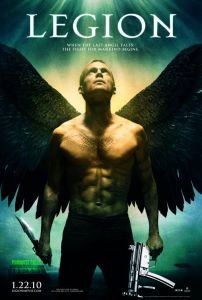 Just to be upfront, I am a big fan of action movies making use of Christian mythology (sorry if the use of the word “mythology” offends some). You tell me a tale about angels, demons, in a contemporary setting no less, and I’m hooked. You give those two sides weapons and have them fight over the fate of mankind, and I’m already revving my engines. So please know that no matter what the artistic achievements of Legion may be, I was predisposed to enjoying a movie that features the angel Michael (Paul Bettany) on the poster with a sword in one hand and an automatic weapon in the other. The premise of Legion is that God has finally had it with mankind and is making good on his threat to “turn this thing around right now.” He’s sending a host of heavenly angels to … eliminate humanity. Michael rebelled, believing man was still capable of making good on its promise. So he fights alongside a handful of characters shacked up in Dennis Quaid’s greasy spoon diner in the middle of nowhere. The action isn’t really involving but the movies does have some cool moments, like when Michael goes mano-a-seraphim with Gabriel (a marble-mouthed Kevin Durand). Legion deals with an antagonist (God) that is so powerful that there have got to be arbitrary limits placed on that power. So the attacking angels don’t overwhelm the tiny diner with their superior numbers, nor does the Almighty just blink the troublemakers out of existence. The end doesn’t really give much in the way of clarity but I got what I wanted from a movie like Legion. Though, in retrospect, I really didn’t want sizzling acid popping from boils.
Nate’s Grade: C+
Share this:

Paranormal Activity (2009)
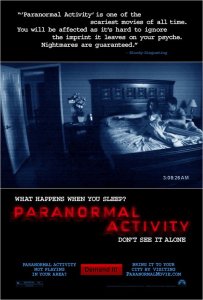 My eyes are bleary. I feel like a walking ghost. My body aches just a tad. I’m over responsive to sudden movement. Not only have I just seen Paranormal Activity, the small indie horror film that has been sweeping the nation, but also I’ve just endured my first post-Paranormal night of sleep. To say it was refreshing would be an outright lie. My then-partner was tossing and turning, routinely grabbing my arm to hold her, also sitting straight up to peer through the darkness of our bedroom, and occasionally she would request that our dog jump on the bed to sit with us for extra support. She and I have seen scary movies before but none have interrupted my sleep patterns like this low-budget sensation. That alone is the best blurb that I could possibly offer to the Paranormal Activity marketing gurus: this movie will make it difficult for you to sleep in your home.
The back-story to this Cinderella tale is that writer/director Oren Peli was hearing unexplained strange noises in his San Diego home. After some research he said, “Why don’t I set up a camera and make a movie about this?” He then hatched a plot involving a young couple, Katie (Katie Featherston) and Micah (Micah Sloat), who hear some bumps in he night while they sleep. Micah sets up a stationary video camera to record the strange happenings as a cool project. It begins with small, subtle noises, then the presence of something unwelcome becomes much more pronounced. Micah taunts the antagonistic spirit, coaxing some kind of response. Katie is terrified because, as they learn from a psychic, this is the same entity that has been following and haunting Katie her whole life; her family home burned down unexplainably when she was a child. It wants Katie. That was the story, though Peli says most of the dialogue was improvised (it shows). The actors doubled as camera operators, the movie was shot over seven days in Peli’s own San Diego home, and the total cost was $11,558, a pittance for a Hollywood movie. So how did this cheap home video haunting take the nation by storm, becoming the indie phenomenon of 2009 and one of the most profitable films in modern history?
 Let’s start with the fact that it’s actually scary. That’s likely what audiences have been responding to — competency. The film is presented as “found footage” much like the similar low-budget horror sensation, The Blair Witch Project (can you believe it?s ten years old already?). The story is presented as factual footage, and Peli makes a point of not breaking the terms of reality. Some of the spook stuff is easy to explain, like lights going on and off in the distance, but there are some moments that are more dramatic and give no hint of special effects. I am impressed by the ingenuity of Peli on his super low budget. I went from being startled to admiring the technical craftsmanship. Paranormal Activity isn’t a big scream movie, it’s more unsettling and the majority of its scary moments occur while the camera is on its bedroom tripod (the tripod should receive third billing in the credits, frankly). Sure, a creaking door or lights magically turning on doesn’t sound like surefire moments of blood-curdling terror, but the fact is that stuff is happening while this couple sleeps, a time when we are most vulnerable, is the point and why it’s scary. Peli structures the movie so that it fosters a slow burn of suspense. By making the camera the only viewpoint, we as an audience feel trapped, much like the characters. The idea that something will get us while we sleep isn’t new but it’s certainly creepy.
The actors work well enough not to betray the “found footage” motif as well. Neither gives a spellbinding performance, mind you, but Featherston and Slout are believable for almost every second onscreen. They’re a couple experiencing a home invasion of a different sort. Micah is more interested in his technical toys than the traumatic state of his girlfriend of three years, and Katie even admonishes him after a scare, “Did you actually run and get the camera first?” Featherston exhibits the most fear and trepidation, and her squeals and cries can be alarming. Their interaction and intimacy doesn’t really communicate a couple of three years time. However, this does not detract from the flick because the title isn’t Relationship Drama, now is it?
 So at this point I need to ask myself, why was I scared during Paranormal Activity and merely amused by the similar exploits in The Blair Witch Project? Maybe it’s the location. The bedroom is supposed to be your sanctuary, your respite. It’s a bit more universal than getting lost in the woods to make a movie. I also think the concept is responsible for my different reactions. In Blair Witch, they were being haunted by a forest ghost who had a thing for arts and crafts. Waking up to stone piles and stick figures just doesn’t resonate like footage of something happening to you while you sleep unaware. Peli does a fine job of making an audience dread what is to come next. Just as I wrote ten years ago for Blair Witch: “The anticipation of the unknown is far more frightening than being slowly chased by a man in a rain slicker. It’s no typical horror flick, it lets you create the fear in your head and let you drive yourself mad with it.” This is why Paranormal Activity works as well as it does. You can immerse yourself and then grip the armrest in fear and then laugh about it later. I also appreciate that Peli solved my number one problem with haunted house movies. You see, if your house is haunted then — MOVE! Simple, huh? Why try sticking it out to regain the resell value when the walls are dripping blood? At least in Paranormal Activity says that the evil spirit is attached to Katie.
Thanks to weeks spent at the top of the box office, even besting the lingering Saw franchise, it is inevitable that Paranormal Activity will balloon in hype that it cannot compete with. Rather than its budget limitations hindering the final product, Peli and his actors have embraced their low-budget aesthetics and produced something effectively eerie and occasionally ingenious. What these people have done with $11,000 (probably the budget for bagels on the pseudo true story, The Fourth Kind) is worth applauding. Like most horror movies, this one will play better with a full crowd ready to ride the roller coaster wave of screams and giggles. Paranormal Activity is proof that you don’t need stars and major budgets to get audiences scared. Your feelings of terror are the great equalizer, which is why cheap but smart and inventive horror movies can easily outpace their bigger budget brethren. Just be prepared for a few rough nights of sleep afterward.
Nate’s Grade: B+
Share this:

Drag Me to Hell (2009)
 Sam Raimi returns to his spook roots in this delightfully disgusting horror flick. Drag Me to Hell has such a gleefully playful and perverse personality, alternating between being scary, being gross, being funny, and circling back for more. This is camp of the highest hokey order, and Raimi infuses every moment with inspired schlock. Poor Alison Lohman, the bank loan officer cursed to be dragged to hell in three days time. She gets a lot of fluids sprayed into her face (there’s an oral obsession to this movie; lots of mouth stuff) and she takes it like a trooper. She’s put through a physical wringer here and maintains her dignity and believability among staples to the head, grave digging, and talking goats. The ending seems to be coasting to a predictable finish and then it hits you in the head, upsetting your sensibilities. I loved it. Drag Me to Hell, ultimately, is little more than a glossy, entertaining blow-off, a reminder what an inventive director can do with the horror genre. It doesn’t all have to be nubile teenagers escaping a knife-wielding maniac. If there is one lesson I’ve learned from movies and television, you do not anger the gypsies. They have a monopoly on curses and they are not afraid to use them.
Nate’s Grade: A-
Share this:

Silent Hill (2006)
 Video games will never be translated into a good movie. There, I said it. I caught some grief before by this opinion. Think about it. Unlike say comic books, video games are dependent on user interactivity, on game involvement, and not necessarily story or character. A video game requires an audience to be interactive, whereas movies require an audience to be passive, letting a story envelope around them and take them some place. Video games just aren’t structured in a way that lends itself to storytelling. Just look at some recent results: House of the Dead, Alone in the Dark, Doom, Bloodrayne, Double Dragon (remember that movie?), Mortal Kombat 1 & 2, Street Fighter, etc. Granted three of those are Uwe Boll films, but what does it say when the best video game adaptation yet was Super Mario Brothers?
Now comes Silent Hill based on the very popular horror video game series. The screenplay is written by Roger Avary, who used to be Quentin Tarantino’s writing partner and wrote and directed one of my all-time guilty pleasures 2002’s Rules of Attraction. I guess I foolishly expected more, but with Silent Hill what I got was further fuel to my theory that no video game will make a good movie.
Rose (Radha Mitchell) and her husband Christopher (Sean Bean) are very troubled about their adopted girl, Sharon (Jodelle Ferland). She has the habit of sleepwalking and uttering “Silent Hill” repeatedly. So what’s a 21st century mother to do? Look up Silent Hill online, put her tyke in the car, and drive to the ghost town herself, much to the dismay of her husband left behind. It seems that Silent Hill was a town in West Virginia that had a horrible coal mining accident in the early 70s, killing many and condemning the town. We’re told the fires are still burning underground to this day. Along the way, a roadside motorcycle cop (Laurie Holden) gets suspicious of Rose and chases her. They crash their vehicles along the road and wake up to falling ash. Rose’s daughter is missing and she looks inside the nearby Silent Hill, a presumably deserted town. Then there are routine air sirens warning of an approaching darkness. The world changes form and nasty creatures come to life, like disjointed bodies, charcoal-skinned children, and malevolent evil spirits. It’s about here where I’d just say, “Oh well. I can adopt again.”
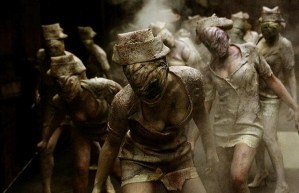 The movie is paced and structured like a video game, which means it’s just as tedious to sit through. The first two acts of Silent Hill center on Rose going from Point A to Point B, finding clue that leads her to a new point, and repeating this tiresome exercise. There?s a scene where there’s a giant hole in the floor and Rose has to navigate across scattered beams to get to the other side. It’s portrayed exactly like a video game level, as are most of her encounters. Worst of all, the movie follows a code of logic that dares to only exist in video games. Why does Rose instinctively know she needs to reach inside the mouth of a corpse to find a sign? How does she know a hidden room lay behind a portrait? Why does Rose know that light attracts the “Thriller” dance team/nurses with potato sacks on their heads? How come the evil presence that basically created this limbo world of the undead cannot penetrate a church? The plot is mostly incoherent and intentionally surreal, but that doesn’t excuse the fact that the story is just plain awful.
Silent Hill completely collapses once the third act begins. It was plodding up until that point, but now the film becomes downright ridiculous and painful. We’re amongst a crazy group of fundamentalist witch burners that, for whatever reason, dress in hazmat suits to venture outside their grounds. It’s at this point that the surreal nature stops and we find the answer to our questions: another vengeful spirit from beyond the grave. Ho hum. The protracted climax goes overboard and practically rapes the stellar ending of Carrie. Also, Silent Hill expects its Big Reveal to be shocking or surprising, but it cannot be anything except redundant because the film spelled it out an hour ago.
The dialogue is howl-inducing. There’s a moment that Rose says, “Don’t worry honey, everything’s going to be okay. You’re going to be alright.” And this immediately precedes the little girl watching the religious cult burn someone’s face off. There’s another moment, more than an hour in, where Rose says, “Something bad happened here.” You think? All of the dialogue can be fitted into two categories: either expository or instructional. It’s like to be true to a video game they also decided to lift the terrible dialogue as well. The plot meanders for the longest time, allowing Rose to visit place to place, and then Avary decides to bludgeon his audience with a 5-minute chunk of exposition meant to clarify everything up to that point.
The acting is pretty bad. Mitchell gives a valiant effort and has a nice scream, but she can’t escape the dead weight of the dialogue and total lack of characterization. Bean is entirely wasted and his “American” accent seems to waver quite a bit for such short screen time. Holden is more a fetish figure fantasy than a character, evidenced by her tight leather pants being the first thing we ever see of her. Still, it’s somewhat interesting seeing the romantic lead from 2001’s The Majestic kickin’ some unholy ass. It’s hard to say if any actors of any caliber could have redeemed the film, but this collection of thespians doesn’t even try to put a polish on the dialogue. You can tell because the howler lines are still howlers.
 Lest I forget, this thing is OVER two hours long. There’s no reason Silent Hill should even be teetering over 100 minutes, especially for a film as sparsely plotted as this one, that is, before Avary’s exposition head rush. I don’t know why the filmmakers included the pointless subplot involving Christopher on the search for his wife. The subplot adds no deeper insight, affords no opportunity to help shape the plot, and only serves to whisk the audience out of the moment and remind them how pointless Silent Hill is quickly becoming. And is it ever pointless.
Director Christophe Gans (Brotherhood of the Wolf) has a great taste for visuals, Silent Hill‘s only positive marks. Some of the images in this movie are truly horrifying and have, reluctantly, stuck in my head days afterwards. The Pyramid Head man, with a 20-foot sword, makes little sense but is a jarring and memorable image. When those loud sirens sound there is a slight amount of dread, but really it’s more of a morbid curiosity at what kind of hellish transportation will happen next. The excellent production design and cinematography also contribute to the film’s eerie, striking, sometimes suffocating atmosphere. But, alas, an interesting visual palate cannot save a slow, dimwitted, inane movie. Otherwise What Dreams May Come may have worked. But it didn’t.
Silent Hill is pointless, plodding, incoherent, far too long and far too boring. The bad dialogue, acting, and plot don’t seem to help matters either. Gans creates a moody atmosphere with some powerfully nightmarish imagery, but that’s the only thing Silent Hill has going for it. Whether it be a man with a Pyramid for his head ripping the flesh off someone like a coat or a little demonic girl dancing in a literal blood shower, Silent Hill has its small potent visual moments. However, these small moments of visual potency cannot make up for the giant black hole of suck. This movie is simply dreadful and designed too faithfully as a video game adaptation, which means the same gaps in logic and pacing are present. I certainly expected better from Avary. I told my friend Dan that I was embarrassed we’d forever know we saw Silent Hill on its opening night, so much so that I bought him food after the show to make up for dragging him along. This is the first movie I’ve ever attended where I heard booing afterwards from my audience. I would have joined them but I was too busy getting out of the theater as soon as the end credits rolled.
Nate’s Grade: D
Share this:

Constantine (2005)
 I’ll admit it; I’m a sucker for Christian mythology played against thriller and action settings. I may be the only person to have watched all of The Prophecy flicks, and probably the only person that eagerly chows down on the cheesy sequels to The Substitute, yet shy away from seeing the first film. I’m captivated by the imagery, the discussion of Heaven and Hell and its mythical logistics, and just the psychology of supernatural biblical beings. With this in mind, I was strongly anticipating the release of Constantine. What I got wasn’t exactly what I expected but I’d be lying if I said I wasn’t entertained.
John Constantine (Keanu Reeves) is a very troubled man. Since his youth he’s had to live with his gift that allows him to see through earthy disguises and witness angels and monstrous demons walking among us. He’s parlayed this ability into a modest side job of exorcising demons and sending them back to Hell. Constantine figures his loyal service should grant him passage into the pearly gates, but Archangel Gabriel (Tilda Swinton) reminds him that that’s not how it works. Constantine is doomed to go to Hell because he tried taking his own life, and if that’s not enough he also has terminal lung cancer from smoking like a chimney. “In other words, you’re f***ed,” Gabriel confides to Constantine.
 Police detective Angela Dodson (Rachel Weisz) is investigating the suicide of her twin sister (also Weisz). She swears her mentally disturbed sis wouldn’t do such a thing, and she seeks out the help of Constantine. He challenges her beliefs, stating that God and the Devil (Peter Stormare) have a wager over the souls of mankind but cannot directly interfere. But now something is breaking this rule and it looks like demons may be getting closer to entering our plane, and it looks like Angela’s dead sister may have known more than people would have thought.
The plot of Constantine is rife with contrivances, aborted subplots, underwritten and nearly forgotten supporting characters, and sketchy logic (staring at a cat can transport you to Hell? No wonder I’m a dog person). Often the film feels overwhelmed by good special effects, as they seem to be the crux of the film?s purpose of being and not, on the other hand, a theological playground of ideas. Constantine gives veiled glimpses of something smart, but routinely shuts that door to focus more on annoying jump scares.
In fact, Constantine seems rather old-fashioned with its theology, still clinging to the Roman Catholic belief that suicide is a one-way ticket to the fiery abyss. I understand its use as motivation for our lead, but will progressive audiences accept something they may find archaic? I suppose it could be worse. Constantine could have briefly gone to Hell for eating meat on a Friday.
It’s interesting that after spending two years making The Matrix sequels, Reeves would choose to attach himself to another big-budget theological action flick. His acting never really rises beyond morose loner but somehow he does make for a satisfying, brooding hero. Reeves? low-key monotone speaking voice allows him to spout cheesy dialogue with a straight face and mercifully keeps the audience grounded.
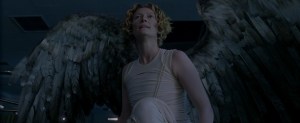 The true stars of Constantine are the memorable supporting players in this celestial smack down. Swinton uses her androgynous looks to forge what David Bowie might be like as an angel: angular, mysterious, waif, and somewhat creepy. Stormare delivers a performance so kooky and tic-heavy, that it could only be compared to the weirder moments of Christopher Walken. Both actors liven up the film and seem to be having the most fun by far with their cheeky roles.
The genius of Constantine is in its one-upsmanship game it holds with the audience. Granted, suspension of disbelief is needed to even go along for the ride, but when we start learning that Hell has its own line of bibles (and they’re longer) we’ve gone beyond suspension of disbelief and into wacky Anne-Heche-speaks-to-aliens land. While sitting through Constantine, we the audience think, “There’s no way this movie could get any sillier.” And then it does! We think, “Alright, that was crazy. Now there’s no way after that this film could get any sillier.” And then it does! Constantine is an amazing ascent into movie madness. After a while, I became drunk from the film’s insanity and wanted it to get even crazier, if possible. It almost seems like there’s a drinking contest between the movie and the audience, and Constantine isn’t afraid to piss its pants to win.
By the time Lucifer shows up, clad in all white like Tom Wolfe, and the Dark Lord appears to have Tourette’s Syndrome and/or a speech impediment, Constantine has hit the bottom of its Kool-Aid cup. Sure the film’s cinematography is slick, and the premise is intriguing, but the real draw of Constantine and the real enjoyment of the flick is how bat-shit crazy it is. I cannot even think of comparable films. I hope David Lynch was taking notes if he saw this.
For a while there, it seems director Francis Lawrence wanted Constantine to be a companion to Wesley Snipe’s Blade character. Maybe the two of them can set up a play date and go destroy otherworldly creatures. There’s a visually striking sequence late in the film involving Constantine in a room full of demons. He’s “contaminated” the water system by placing a giant cross inside, thus holy-fying the water before he can bottle it and sell it to the masses. He holds a lighter to the sprinkler system, demons growling all around him ready for their kill, and then water sprays down across the room. “Holy water?” one female demon says in a stunned voice, watching her flesh sizzle away. Then Constantine marches through the wet room blowing away demons into splashes of ash with his comically unwieldy cross-shotgun. It’s filmed wonderfully with dark hues and is a great idea; however, it’s a bit of a rip-off of the opening sequence in the first Blade.
 This seems to be a repeated sentiment in Lawrence’s direction. He has a sharp visual eye and several camera angles come from odd yet exotic places, but his film is borrowing so heavily from so many other films. What you’re left with is the impression of a stylish if very derivative looking action film. One exception is when Lawrence shows us glimpses of the blistering burnt orange world of Hell. It seems Hell is an exact model resemblance of Earth, only with the fire, brimstone, and crawling demons with their heads sliced open (there is a scary level beneath the surface where we witness a sea of people being tortured). The second or third time we traveled to Hell, I began to wonder what my house would look like and the logistics of upkeep for the homeowner in Hell. Surely the heating bills wouldn’t be the same.
Constantine is funny, frustrating, confusing, gorgeous, and just plain insane in the ole membrane. The film exhibits a rare and engaging form of insanity that may glue audience eyeballs to the screen to see what happens next. I’ve seen Constantine twice (don’t ask why) and even though I knew all the weird plot turns I still found myself getting an enjoyable contact buzz from the film. Who knows how long such a novelty can sustain itself, though. Comic book fans, especially those with a spiritual bent, should get a kick out of Constantine as will anyone else searching for a pristine example of how wonderfully out of control Hollywood moviemaking can be. Sometimes in a good way.
Nate’s Grade: B-
Share this:

Hellboy (2004)
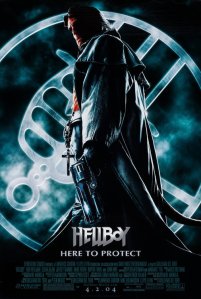 Guillermo del Toro loves things that go bump in the night. The Mexican born writer/director has shown prowess at slimy, spooky creatures with Cronos and 1997’s Mimic. He helmed the 2002 sequel to Blade, which had super vampires whose mouths would open up into four sections with rows of chattering teeth. The man sure loves his movie monsters. del Toro also loved Mike Mignola’s cult comic book Hellboy enough to turn down directing Harry Potter 3 and Blade 3 to ensure he could bring Hellboy to the big screen. Was it worth the sacrifice?
Let me just explain to you the villains of this movie as an example of how ridiculously stupid Hellboy is. The villains are Nazis. Yes, the tried and true villains everyone can hate Nazis. But these ain’t yo daddy’s Nazis; they’re immortal and led by zombie Rasputin (yes, the Rasputin). They all wish to puncture a hole into another dimension. What’s in this alternate dimension? Why nothing except for a giant floating spaceship that houses, I kid you not, the Seven Gods of Chaos, which all happen to be gigantic space squids. Why would anyone create a universe that has nothing but the imprisoned gods of evil? That seems awfully precarious. How exactly are giant squids going to take over the industrialized, nuclear-age world? Shoot ink at everyone? Sorry, space ink?
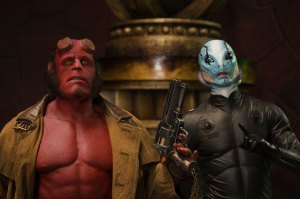 Let me not forget a Nazi assassin and his handy dandy arm-length blades. This assassin is also 100 years old and his body is filled entirely with sand. He winds himself up like a big clock. But if his body is filled completely with sand how can the clock gears work inside? You see what the normal audience member has to deal with? Plus these are just the villains, there’s a whole plot left to toil over as well.
The story revolves around a hulking, red demon named Hellboy (veteran character actor Ron Perlman). Hellboy escaped the space squid dimension in the 1940s when the Nazis unsuccessfully tried to open a dimensional hole large enough for your everyday on-the-go space squid. Now, Hellboy is an elite soldier for the governments Bureau of Paranormal Research. He fights the creepy crawlies. He has to deal with a wide-eyed rookie, the watch of his father (John Hurt) and an attempt to rekindle a romance with a mentally troubled fire starter (Selma Blair). Oh yeah, and all the Nazi/Rasputin/space squid stuff mentioned before.
Perlman is really the only redeeming thing about this movie. The makeup is impressive, and he gives an enjoyably droll performance as a man who fights monsters with the same ho-hum-ness as a plumber reacts to clogged sinks. The rest of the acting runs the gambit of either being too serious (Im looking at you Blair) or just too over-the-top silly (Im looking at you, league of villains).
Hellboy is strung together with bizarre inanities, flat one-liners, heavy Catholic imagery, conflicting logic and contradictions, ridiculous villains, painful comic relief, half-baked romance and frustratingly ever-changing plot devices.
Watching Hellboy is like playing tag with a kid that keeps making up new rules as he goes (“You cant tag me; I have an invisibility shield!”), and after awhile you lose any interest. Late in the film, the Nazis will all of a sudden decide not to be immortal, and at a very inopportune time. Why? How? I don’t know. Hellboy also gets sudden new powers for some reason. Like he can bring people back to life by whispering otherworldly threats in their ears. For some reason nobody’s clothes burn when theyre set on fire.
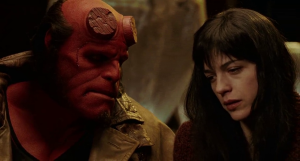 Not only does Hellboy frustrate by changing the rules of its world arbitrarily, it will also frustrate out of sheer uninhibited stupidity. How come characters cant hear or see a pendulum the size of the Chrysler building? How come during a vision of the apocalypse we see a newspaper that actually had the time and staff, during the Apocalypse, to print an issue that reads, “APPOCALYPSE”? Why doesn’t Blair use her pyro superpowers immediately to vanquish all the H.P. Lovecraft creatures instead of letting Hellboy foolishly wrestle with them all? The gaping holes in Hellboy are large enough to squeeze a gigantic space squid through.
All this frustration and insanity might have been moot if the action sequences were somewhat thrilling. Sadly, they are not. Del Toro’s action sequences seldom matter. There’s such little consequence of what’s going on that the action becomes stiff and lifeless. The first time we see Hellboy chase a creature through city streets it’s a fun experience, but soon the novelty wears off. The overuse of CGI wears down the audience, and after the third or forth time we watch Hellboy battle the same monster, the audience is ready to go to sleep. There’s little entertainment in the film’s action sequences, but just as much frustration and stupidity.
I have never watched a film that induced more eye rolls, shoulder shrugs, raised eyebrows, pained and confused glances and mutters of, What the hell (boy)? By the time the resurrected torso of a Russian skeleton appears to make cheesy puns and wisecracks, you should have left the theater, demanded full compensation, and maybe, if you’re into it, destroyed whatever Hellboy display was within burning distance. Comic book aficionados may enjoy the fruits of Hellboy but general audiences will simply shrug. I’m amazed that the majority of film critics seem to think positively about this movie. Maybe I’m the last sane person in an insane world but Hellboy is one of the worst films of the year and one of the craziest films you could ever hope to see in a lifetime.
Nate’s Grade: D+
Share this:

Toy Story 2 (1999)/ Princess Mononoke (1999)
 There is a false prejudice circulating the land of merry movie goers as they skip from one theater to the next. This assumption is that animation is a kids only event, that’s it’s something to appease the screaming masses under three feet of height. Lately movies are giving more credit to the cause that animation can be a wonderful escape and isn’t just for the kids.
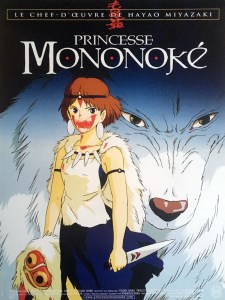
Animation can take people to worlds that otherwise could not have existed, and so is true with Princess Mononoke the 1997 Japanese import with a fresh English dubbing. Mononoke speaks of the battle between harmonious nature and forging industrious man. Often the film displays such scenes of visual passion that it seems like an animated love letter to those wishing to venture out to find it. The story is vivid and non-judgmental, you see the stories and reasons behind both warring forces and not everything is easily black and white. The English dub does not distract from the overall enjoyment as many professional actors yield their vocal talents to this masterpiece. Princess Mononoke leaves a spellbinding impression of intense ecological thought and aching beauty. The best anime has to offer.
 At the other end of the animation spectrum lies Toy Story 2, the kid friendly three-dimensional quest of action figures and plush dolls. What is amazing about Toy Story 2 is how it not only matches its ground breaking predecessor but even surpasses it both in visuals and story. Story is packed with sly humor not just for kids, and it contains a poignant message about mortality and what one seizes with the opportunities they are given. The animation is mesmerizing and the humor is fast and fierce. Toy Story 2 proves that not all sequels are bad ideas.
Fresh from the gate are two examples of the great gifts animation has to offer. Couple these with the wonderful The Iron Giant, a ferociously funny South Park movie, an okay Tarzan, and the upcoming Disney redux Fantasia 2000 and it appears to be a solid time for animation. Go out and see some.
Nate’s Grade: Both movies A
Share this:

Dogma (1999)
 In a time where simply having faith in anything, let alone religion, is scoffed at, Kevin Smith daringly and passionately expresses his personal search for answers and understanding. But while the zealots decree Dogma as blasphemy, what they truly miss is the biggest commercial for faith and God that American audiences have seen in decades of cinema.
The story of the religious epic causing all the hubbub begins with a pair of fallen angels (Ben Affleck and Matt Damon) spurned from the pearly gates of Heaven and banished to Wisconsin. One discovers a re-dedication of a church imploring a little used Catholic practice of plenary indulgence allowing whoever to enter through the church’s arches to have their slate cleaned of all sin. The two seize this opportunity of a dogmatic loophole to sneak back into heaven. The only slight problem is that by doing so they reverse a decree of God and disprove the Almighty’s unfallability, and thus will wipe out all of existence. The voice of God (Alan Rickman) recruits a lapsed Catholic named Bethany (Linda Fiorentino) for a Holy Crusade to halt the scheming angel’s plans for the good of the universe. Along the way she is aided by two unlikely prophets (the dynamic duo of Jay and Silent Bob), an racially discredited 13th Apostle (Chris Rock), and a shapely strip-teasing muse (Salma Hayek) as they engage with demons, seraphims, angles, and all sorts of celestial “who’s who” to stop the end of existence.
 Smith’s direction has taken strides since the point-and-click days of his earlier works; however, there’s still an awkward flatness to his framing and action. Fiorentino plays the role of a grounded character well. Rickman as the bitter Brit shows why he can still take anyone toe-to-toe for acting chops. Affleck and Damon have terrific chemistry together and play off one another for great comedy. Jason Mewes has never been funnier as the terminally stoned and foul mouthed Jay. Rock shows he can restrain his abrasive personality. Salma shows… well she shows she can dance. Jason Lee as an air conditioning-adoring demon and George Carlin as a used car salesman type Catholic Cardinal are so commanding in their presence and excellent in their performances that it’s a sin most of their scenes were cut during editing. Even Alanis Morrisette works as a humanly childish God. She’s given no lines but expresses great feeling and humor anyway.
Dogma is rambunctiously hilarious and a never ending joyride of fun as it jumps from jokes about demons made of excrement to “Buddy Christs” to insightful and sensitive thoughts on religion. Rarely does it bore even with the large plot it must always keep in successive movement. The only drawback Dogma suffers from is the amount of religious points it desires to make. The characters will reach a subject, chat, then directly move on to the next. The sporadic nature can easily keep an audience’s head spinning, but is brought back down to gentle rest from Smith’s Divine wit and sharp writing. Some of the opus’ many characters appear for only brief stretches as Hollywood’s A-list battle for valid screen time among each other.
 Smith is not one to shy away from controversy, or his quota of sexual innuendos and profanity. But the protestors for this film attacking its vulgarity are beyond missing the point; Dogma is reaching people the church hasn’t and can’t. It may be an audacious tweaker of a flick, but ultimately it’s bringing up religion into open debate and discussion amongst the masses where there was none before. And isn’t that in itself glorifying some type of achievement?
It would do well the opponents of Dogma to venture into a darkened theater sometime to see the movie and realize it is a humorous affirmation of faith and beliefs. The story of a crisis of faith is relatable to a society too jaded and cynical. Smith’s wrestle with theology is the public’s gain, and his halo only glows a little brighter for having the courage to do so.
Nate’s Grade: A-


 nathanzoebl
You must be logged in to post a comment.