Blog Archives
Zootopia 2 (2025)
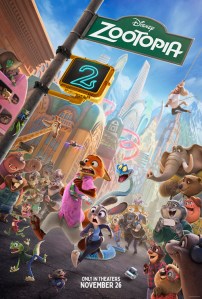 I’m genuinely shocked it took nine years for Disney to drum up a sequel to their billion-dollar “woke” allegorical hit, Zootopia. It used anthropomorphic animals living in a modern metropolis to analyze prejudice, racism, and segregation through the dichotomy of predators (untrustworthy animals beholden to vicious nature) and prey (docile animals). Specifically, it was about plucky police officer Judy Hopps (voiced by Ginnifer Goodwin) learning to work with con artist-turned-ally Nick Wilde (voiced by Justin Bateman). Now the partners are back and on another wild case uncovering yet another long-standing mystery of the city’s history entrenched in blame and suspicion of a “kind of people,” namely serpents/reptiles, who were driven out of town generations ago. There is a slight repetition in the message about looking beyond staid stereotypes and accepting other animals as equals (will Zootopia 3 be about finally accepting insects?), but when the tolerance message is essential to what made the 2016 original movie so much more thoughtful and relevant and satisfying, then keep it. The movie rises on the bickering but engaging buddy dynamic between Judy and Nick, who obviously love one another but don’t know how to admit it (consider me a shipper). The mystery tackles themes of gentrification, forced relocation, on top of its anti-prejudice and pro-tolerance foundation, so there’s plenty to unpack thematically while also taking in the visual whimsy and action slapstick. I laughed heartily at several points, including a very unexpected but transparent reference to a classic horror film complete with heavy music cues. It’s not as fresh or as finely developed as its predecessor but Zootopia 2 is further proof that this universe and its creativity can house many adventures, even if some of those plots and themes get repetitive.
Nate’s Grade: B
Share this:

Nightmare Alley (2021)
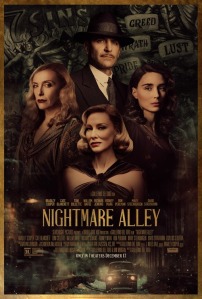 I’ve now watched both versions of Nightmare Alley, the 1947 movie and the 2021 Guillermo del Toro remake, and I guess I just shrug at both. Based upon the 1946 novel by Lindsay Gresham, we follow an ambitious yet troubled man, Stanton (Bradley Cooper), who finds refuge in a traveling carnival, mentors as a phony mentalist, and then uses his skills of manipulation to fleece the rich and privileged while possibly losing his own soul in the process. I kept watching this 150-minute movie and waiting for it to get better, to hit another level, and I had to keep asking, “Why isn’t this playing better for me?” It’s del Toro, an early twentieth-century freak show, a dashing of film noir, and a star-studded cast (Cate Blanchett, Willem Dafoe, Rooney Mara, Toni Collette, David Strathairn), and all those enticing elements should coalesce into something special and dark and adult and transporting, like del Toro’s 2017 Best Picture-winning Shape of Water. However, for me it just feels so turgid and overly melodramatic. I wish the movie had stayed with the traveling carnival and the colorful weirdos that it ditches halfway through. I think it’s because the movie plays to your exact expectations. You expect it to be beautifully composed, and it is, with a flair for the grotesque, a del Toro specialty, and the beats of its film noir-heavy story with femme fatale and double crosses comes across so predictably but minus substantial depth to compensate. I kept waiting for the themes to deepen, to be a better reflection of ourselves, but it’s one man’s circular downfall that doesn’t play too tragic because he’s already an unrepentant scoundrel. Cooper also just seems too old for the part, especially when everyone refers to him as a “young chap.” You might not see a better looking movie from 2021. The cinematography, production design, costumes, and stylish panache that del Toro trades in are all present and glorious to behold. I just wish I could get more from Nightmare Alley besides an admiration for its framing and less about what is happening to the characters within such doting artistry.
Nate’s Grade: B-
Share this:

Nomadland (2020)
 Part poetic elegy for an America of old, part sunset-tinted road trip, part condemnation of economic fragility, part character study of a lost soul who prefers wide open spaces, Nomadland is a small indie trying to say a lot but in as few words as possible. Consider writer/director Chloe Zhao’s film a mixture of the compassionate, languid colorful character-driven slice-of-life Linklater movies and the romantic, spiritual hymns to nature and the universe from Terrence Malick. It’s ultimately about Fern (Frances McDormand) as a woman who travels the American southwest from season to season in her van, going from one temporary job to another. The temptation would be to make it about her running away from her past, her pain, and need to finally process her grief in a transformative way before she can settle down and make herself a home. Zhao’s movie rejects that easy formula; there are several moments where characters implore Fern to plant roots, to have a comfortable life with a man who adores her, but she can’t. She has to keep moving, from job to job and state to state. It’s not like a rejection of privilege and standing like 2007’s Into the Wild. If Fern could be rich, she’d happily not have to crap into a bucket in her van or sleep in parking lots or scrounge for food. She’s one of millions on the fringes of society because of how disposable so many corporations view their laborers. The opening text tells us that within one year of the factory in Fern’s hometown closing, the chief employer of the town, that its zip code was dissolved. Nomadland doesn’t ever feel like a preachy movie but it definitely has points it wants to raise about how we treat people in need, how business exploits them and their lack of options, and how others view these itinerant Americans and their plight. Really, though, it’s a movie of moments and there are some that are beautiful and powerfully poignant, like a woman stricken with cancer talking about her final desire to return to a lake frequented by birds, or another character discussing the death of his son and how that has informed his view of God and an afterlife. It’s these moments where a character just seems to take center stage and become fully developed, adding to Zhao’s humanist thesis about how every person, no matter their circumstances, is worthy of compassion and consideration. I enjoyed McDormand (Three Billboards) and thought she was a fine entry point into this under-seen world. I also think she was better served as a sort of living journalist letting us discover non-professional actors that open up their hearts and lives and feel like genuine human beings with a wealth of life inside them just waiting to be learned. That gracious, affirmative spirit hangs over every lovely frame and moment in a movie that could be described as Frances McDormand Tries All the Jobs. Still, it’s a movie of moments, and some of them truly sing and others just sort of go by without leaving as much of an impression. Nomadland is a pretty, thoughtful, meditative movie about persistent, stubborn creatures, namely us.
Nate’s Grade: B
Share this:

The Bourne Ultimatum (2007)
 I think the best aspect of the The Bourne Ultimatum, the third in the memory-troubled spy series, is how kinetically improvised it feels. Jason Bourne (Matt Damon) is a human weapon and he thinks constantly with his body, feeling the situation and his environment, and he comes up with improbable weapons, be them pens, magazines, or kicking ass with just a book (knowledge is power). Bourne doesn’t rely on fancy gadgets or a caustic wit; he just outsmarts the competition by reading his world and reacting instinctively, and that is thrilling to watch. The Bourne films have separated themselves from other spy series like James Bond and standout because of how viscerally realistic they play out. That said, Bourne still survives scrapes that would kill any mortal. At this point, we know just about all we need to know with most of the characters, so Ultimatum is one long, fantastic, and gripping series of chases between Bourne and the CIA operatives that want to rub him out. Ultimatum is Paul Greengrass’ (United 93) second film in the series and he enhances the excitement through his docu-drama style of shooting. The editing is constantly roving and perfectly channels the nervous wariness of a spy that is constantly looking over his shoulder. The action sequences are stellar and raft with suspense and top notch stunt work amongst exotic locales. Ultimatum tacks on some awkward political commentary (black hoods, secret CIA torture, breaking the law to “win” the battle against terror) and tries squeezing its story into a fight between Bourne and the dangerous and lawless elements of the American government that have flourished under President Bush’s watch. It doesn’t quite work in the context of a summer action movie, but thanks for trying. The Bourne Ultimatum is a spry and refreshing action movie that serves to cleanse the summer palate of huge special effects blockbusters.
Nate’s Grade: A-
Share this:

Good Night, and Good Luck (2005)
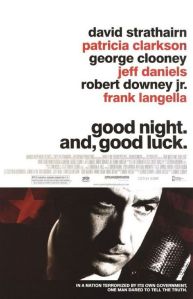 George Clooney’s pet project is articulate and a tad dull. The black and white cinematography is elegant; you can practically taste all the smoke onscreen. The idea of press vs. fear-mongering politician is very relevant today, and the film’s insight into the running of TV news is really interesting, but this is a movie that works best as a study and not as strict entertainment. It?s not stuffy or ideologically overwhelming; in fact it’s easy to follow and easy to get into, even if it leans too heavily on speeches. Clooney, as I predicted, is transforming himself into a terrific director with a great feel for his material. With Good Night, and Good Luck it seems like he got exactly what he wanted, regardless if an audience is going to walk away feeling they got their money’s worth.
Nate’s Grade: B


 nathanzoebl
You must be logged in to post a comment.