Blog Archives
I, Frankenstein (2014)
 Why wouldn’t Frankenstein’s monster (henceforth referred to as Adam) be the focal point in a war between heaven and hell? And why wouldn’t the angels really be gargoyles and live in cathedrals? And why wouldn’t the demons be trying to get their demony hands on Dr. F’s book on reviving the dead? And why wouldn’t we jump ahead 200 years to modern-day, where “Adam” should be a rotted corpse? Transparently an attempt to replicate the surprisingly enduring Underworld franchise, this secret supernatural war is a lame monster movie disguised as a lamer superhero film. It’s also absurdly idiotic in just about every capacity, as if no department had any communication with one another. Aaron Eckhart grumbles and trudges his way through this awful mess but you can feel his disdain for the entire enterprise. It’s not even deliciously campy, choosing to try and re-envision the classic monster in a modern and realistic setting. The action sequences are mundane when they’re not incoherent. I, Frankenstein feels like a movie version based upon the video game of some other source material. It’s loud and inept and campy but mostly outrageously dumb. I can’t wait to watch someone else in Hollywood recycle this cheap plot setup for a desperate supernatural franchise (“Okay, the Creature from the Black Lagoon finds itself in the center of a war between centaurs and…”). When people talk about the dregs of Hollywood, and the echo chamber of stripping away creativity, let I, Frankenstein be a prime example of the worst of us.
Nate’s Grade: D
Share this:

Guardians of the Galaxy (2014)
 Who would have guessed that a movie that featured a talking tree and an anthropomorphic raccoon would be one of the best films of the year and one of the top grossing films of the summer? At this point for audiences, the Marvel name can do no wrong, but really it’s the degree of latitude given to Guardians of the Galaxy, an admittedly weird movie with strange characters, that allows this unique film to shine. Attaching offbeat director James Gunn (Super, Slither) to be writer and director was a risk that paid off tremendously, as Guardians is the Marvel film most entrenched with the particular personality of its creative director. This is a gleefully imaginative film that enjoys wading deep into weirdness, dancing to its adventurous Star Wars throwback beat, always with its focus set on comedy but not at the expense of quality drama or character development. Really, the characters are the focus of this entry into the franchise, and Gunn and his actors do a bang-up job of gathering the team and getting you to care about each and every one of them. Each one of these characters has a goal, several payoffs, and each is given their proper attention. In an ordinary superhero film, the archetypes would be ironclad. With Guardians, the tough guy made of muscle can also be a source of unexpected comedy with his literal-minded speech patterns. With Guardians, the talking raccoon can also be an emotionally disturbed victim of genetic experimentation who doesn’t know how to play well with others. These are damaged characters and their formation of an unconventional family unit is deeply satisfying and rather touching. I have seen the film twice and gotten teary-eyed both times. The real star of the film is Chris Pratt (TV’s Parks and Recreation), and what a breakout role he is afforded; he’s like Han Solo’s more juvenile nephew. But like the others, the part is surprising in its depth, with a well of sadness and displacement he still hasn’t processed while he scavenges the galaxy. The plot can be a bit unwieldy at times but pays off better for repeat viewings. This is a world I want to spend far more time exploring and with these characters as my merry prankster guides. With a movie this action-packed, thoroughly entertaining, and gratifying, why come back to Earth?
Nate’s Grade: A
Share this:

Snowpiercer (2014)
 I have seen Snowpiercer twice and it’s still a hard movie to describe. It’s the English-language debut of Korean filmmaker Joon-hoo Bong, notable for The Host (the good one) and Mother. It’s based upon a French graphic novel only printed in France and South Korea. It’s an international production, filmed in the Czech Republic, and populated with recognizable actors like Octavia Spencer, Tilda Swinton, John Hurt, Ed Harris, and Captain America himself, Chris Evans. It’s a dark dystopian allegory about class warfare, it’s a stunning sci-fi action movie, it’s a parable about humanity, it’s a stylish thriller that puts most of Hollywood to shame; it’s many things, chief among them, an incredible movie that demands to be seen on the big screen when able.
To combat global warming, world leaders disperse a chemical to lower temperatures, and oh boy does it work, inadvertently causing a new Ice Age that kills almost all life on the planet. Almost, because a few hundred got aboard the train owned and operated by Wilford (Harris), a rich and secretive industrialist. He built a train that can circle the globe, running on a perpetual motion motor. The last of humanity is housed on Wilfrod’s train. After seventeen years aboard, the class system has become rather rigid. The important and wealthy are at the front of the train, and the poor are crammed in the back, given gelatinous protein blocks to eat, and kept in line by armed guards. Curtis (Evans) is plotting a revolt, biding his time, consulting with the wise Gilliam (Hurt), an aging leader missing several limbs. Together, they storm ahead, capturing effete Wilford spokesman Mason (Swinton) as a hostage, rescuing an engineer (Kang-ho Song) with a drug addiction who will help them open the train cars, fighting car by car to take control of the train. Naturally, those in power fight back in force to maintain the uneven status quo.
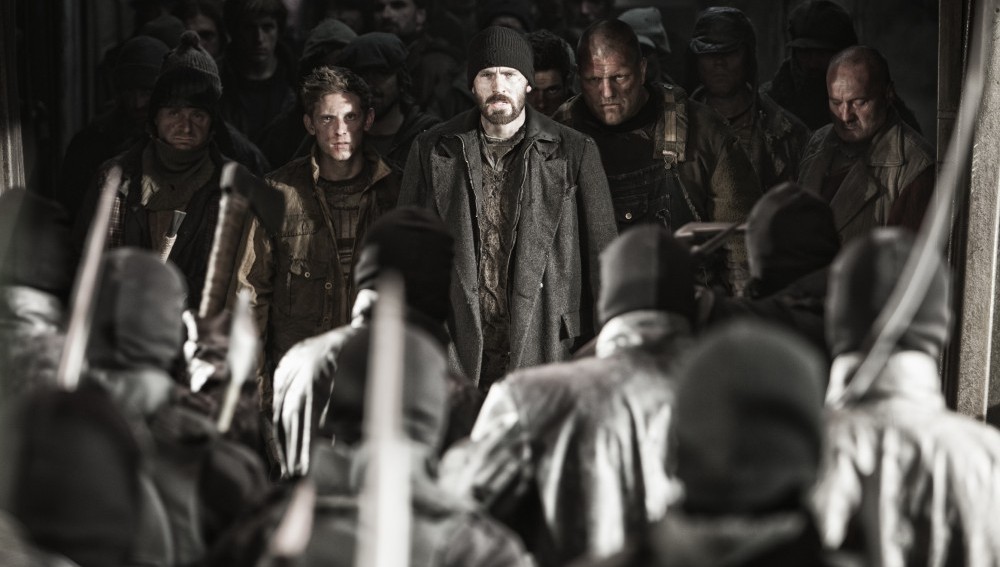 Short of the adrenaline-soaked Raid 2, there hasn’t been a better action movie this year than Snowpiercer. It starts slow, drawing the audience in, setting up its initial burst as a prison break of sorts where the tail section passengers have to figure out a way past the guards and several security doors open for only a few seconds. When the break does happen, in a clever fashion, you feel the full rush of the new opportunity thanks to the movie properly setting up the stakes and obstacles. Each new car presents a new world and a new obstacle. There’s one car where Curtis and his revolutionaries are met with fifty ski-mask wearing grunts with axes. This is the standout action sequence because of how it keeps changing. At first its brawn versus brawn, complete with swinging axes. Then the fighting stops briefly and all the grunts put on night vision goggles. The train enters a long tunnel, condemning Curtis and company to the dark. The grunts then go to town, spearing and slashing the hapless passengers blindly swinging in the dark. I won’t spoil the solution to this scenario but it too is properly set up and leads to some extremely satisfying action imagery, the kind of stuff that pops in a trailer. There’s an entirely different sequence later that also stands out. As the train goes into a long curve in the track, certain train cars are visible from others. Our chief heavy, listed as Franco the Elder (Vlad Ivanov), sees Curtis in the car ahead and starts firing. Eventually Curtis and Franco blast small holes in the protective glass and wait, wait for their moment, for their shot. It’s a tense neo-Western standoff moment, and another delightful addition. The accumulative action has a surprising degree of variety and development.
Snowpiercer is a stirring action movie that keeps your eyes glued to the screen, but it does an equally impressive job of building its world and adding dimension to its storytelling. Reportedly, Harvey Weinstein wanted to cut twenty minutes out of the 126-minute film, but I’m puzzled as to where those edits would come. Every scene in this movie drives the film forward or imparts crucial pieces of information or metaphor that will play out later. Even something as comical as stopping for sushi in the aquarium car (balancing the ecosystem) has greater meaning and subtext when you look back at the film as a whole. Joon-hoo Bong and his co-screenwriter Kelly Masterson (Before the Devil Knows You’re Dead) have given serious consideration to how this world operates and what life would be like when all of humanity is confined to one long train. The past is revealed incrementally, gingerly allowing the audience to become consumed with this odd dystopian landscape, our fascination brewing with each new puzzle piece being added. I was enthralled with the rich details, the cruel methods of keeping those in the tail section in line, the regular head counts, the protein block bars and what they truly are made of, the annual celebration of passing a certain bridge marking their own New Year, and especially the deification of Wilford. The characters worship the engine, and why not since it is the source of life for them, or as the chirpy schoolteacher (Alison Pill) sings: “What happens if the engine fails? We all freeze and die!” The later reveals are the best, giving full explanation why tail section children are important and, particularly, why Curtis is so ashamed at having two good arms. That monologue by Evans, looking back on the earliest and most cruelly chaotic days on the train, is a whopper. I truly hope that aspiring actors will use it during future auditions. It will make an impression.
 Its dark sense of humor and political and philosophical subtext provide an even richer texture to this strange, bleak world. The political commentary isn’t exactly subtle, I’ll admit, but it’s exceedingly better executed and integrated into its plot than, say, last year’s Elysium. The class-consciousness provides a greater depth to the proceedings, providing a new spin on the have/have nots that’s just as relevant today. It’s not just tacked on, either. The political commentary is intertwined with the mechanics of the plot, as we’re witnessing class warfare against inequality, how barbarous acts can be co-opted for personal gain. When Curtis and his small company finally reach Wilford and the engine, it’s a moment akin to visiting the Wizard in Oz, the man behind the curtain they’ve heard so much about. There’s a great degree of incredulous humor from Wilford’s vaulted perspective, but the longer you listen, the more you start to follow his twisted logic and why exactly the status quo must be upheld despite the bloody consequences. Then there’s the macabre humor, which can be bracing at points, none more so than the school car sequence with Alison Pill (TV’s The Newsroom). Also doing plenty of comedic heavy lifting is Swinton (Only Lovers Left Alive, We Need to Talk About Kevin) with such an odd authority figure character. With a mouthful of fake teeth, some owlish glasses, and a peculiar speech pattern, it feels like she stepped out of a Terry Gilliam movie, and we’re all the better for it. Often she’s the only source of humor in what is otherwise a dreary story about the strong preying upon the weak.
Stylish, intelligent, rewarding in surprising ways while still being thoroughly entertaining, with tremendous technical attributes such as production design, Snowpiercer is a sci-fi flick that borrows from many but creates its own unique and enthralling landscape. Rare is the movie going experience where you sit at the edge of your seat, completely taken in by the creativity of the artists at work, transported to somewhere new and exciting, and you dread the approaching end credits. Snowpiercer is an experience that’s hard to describe beyond an unrelenting checklist of positive, glowing adjectives. Simply put, it’s movies like this that make going to the movies special.
Nate’s Grade: A
Share this:

X-Men: Days of Future Past (2014)
 Ever since Marvel’s Avengers destroyed the box-office in 2012, every studio with super hero franchises has been looking to follow suit. It’s not just about comic book franchises; it’s about building a comic book universe. It’s been a long dark period for the X-Men ever since the regrettable 2006 debacle The Last Stand, which callously killed characters, butchered others, and botched the most famous storyline in the history of the comic. In 2011, Matthew Vaughn proved there was still life to be found in the franchise with his terrific 60s-era prequel, X-Men: First Class. Now, post-Avengers, Fox is salivating at combining the past X-Men and the present X-Men into one colossal movie with a colossal budget. Back on board is director Bryan Singer, the director of the first two X-Men films and the man who helped kickstart the modern superhero era. If that wasn’t enough riding on the film, X-Men: Days of Future Past also follows the second most famous storyline in the history of the comic.
In the horrible future, killer robots known as Sentinels hunt down mutants. These are the invention of Dr. Boliver Trask (Peter Dinklage), a military scientist who was killed back in 1973 by the vengeful shape-shifting mutant, Mystique (Jennifer Lawrence). The murder convinced humans to subsidize Trask’s killer robot plan of defense. Thanks to experiments replicating Mystique’s mutant ability, the Sentinels have the ability to adapt to any power, turning them practically indestructible. In the future, the Sentinels are eradicating all mutants, mutant sympathizers, and eventually human beings. Magneto (Ian McKellen) and Professor Xavier (Patrick Stewart) have teamed up with a small band of surviving mutants, including Wolverine (Hugh Jackman). Thanks to the phasing powers of Kitty Pryde (Ellen Page), they can send Wolverine’s consciousness back to 1973 so that he can prevent the Trask assassination. The only ones who can help Wolverine is the younger Xavier (James McAvoy) and Magneto (Michael Fassbender), former mentors to Mystique. Except Xavier is a recluse and strung-out on drugs to dull his powers and Magneto is locked away underneath the Pentagon.
 The X-Men films have always had a topical advantage to them that provided a weightier sense of drama than your typical story about a reluctant soul blessed with amazing powers. The mutant allegory automatically applies to any sub-group facing oppression mostly through fear and ignorance. What other superhero franchise has two opening scenes in a German concentration camp? The stakes are even larger with this movie because of the Horrible Nightmare Future that must be prevented. Now we all assume said Nightmare Future will be avoided by film’s end, so the movie provides a proverbial reset button that the filmmakers can have fun with, and they do (look out future mutants). Excluding the Nightmare Future framing device that becomes an unnecessary parallel storyline, the majority of the film takes place in 1973. If X-Men: First Class tapped into the groovy optimism and “take me for what I am” sense of social justice of the time, then this film certainly taps into the disillusionment of the 1970s, where the promise of reform and hope morphed into anger and cynicism (hey, that’s like us today!). This loss of innocence is typified in Mystique, who becomes the central figure of the movie in many ways. Her seething desire for vengeance is what animates her, as well as the pain of betrayal from the men closest in her life, as well as the world who once held such promise. Also, Jennifer Lawrence (The Hunger Games) has become one of the biggest female stars on the planet, so it makes sense to bolster her role. The central conflict is stopping an assassination, one domino that leads to many others, but it’s emotionally about Mystique having to confront her feelings of hate. It’s another platform for the ongoing conflict of perspectives between Xavier (restraint, tolerance) and Magneto (strong defense, eye for an eye). But as I found in First Class, it’s hard not to agree with Magneto as human overreaction leads to rash and thoughtless actions, like Horrible Nightmare Future.
That’s not to say that X-Men: Days of Future Past fails to deliver when it comes to the popcorn thrills and action highs we crave in our finest summer blockbusters. The action set pieces are large without dwarfing the characters, playful and imaginative without losing a sense of edge and danger. I loved how the character Blink (Bingbing Fan) would utilize her mutant power of opening portals as a fighting strategy. It makes action sequences so much more inventive and visually exciting to throw a series of portals. The pacing is swift short of the second half of Act Two, gearing up for the climactic showdown in D.C. that dominates Act Three. The time travel story starts with a lot of exposition but it gets smoothed out as it goes, the rules of the story fall into place. Every action sequence hits, some admittedly better than others, but it’s the small touches that Singer injects that made me smile most. I enjoyed Magneto pointing a gun, being toppled, but still using his power to have the gun fire in midair. I enjoyed the animalistic nature of the Beast/Wolverine brawl. Jackman is looking even veinier than usual in his bulked out form. Thankfully the fish-out of-water timeline jokes are kept to a minimum. Wolverine is the perfect glue to hold both timelines together. And then there’s that standout Pentagon prison break sequence (more on that later). Singer might not have the most natural instincts developing and staging action, but the man is a surefire talent when it comes to staging eye-catching visuals (I would say the same about Christopher Nolan). Even his unfairly maligned Superman Returns is proof of the man’s cinematic gifts. As far as entertainment value, this is right up there with X-Men 2. I still view Vaughn’s savvy First Class as the best X-film of the bunch, which has only gotten better the more I’ve watched it.
 And if that wasn’t enough, Singer’s new film does what every fan has been hoping for: (spoilers) it erases all the crummy X-Men movies, namely 2006’s Last Stand and the first Wolverine solo effort, from the official timeline. It’s time to start anew, toss out the old stuff nobody liked, and forge ahead with a new unified timeline. There can be two parallel X-Men franchises, one present/future and one with the prequel casts, and they can go on forever as desired, or until the prequel cast prices itself out. In one fell swoop, Singer and company have reset the mother franchise and given fans new hope about the possibilities. Make sure to stick around to the very end of the credits for a scene that indicates directly who the next major villain will be in the 2016 sequel.
Let me take time to single out just how expertly Evan Peters (TV’s American Horror Story) steals the entire mutant-heavy movie. First, he’s the most comically attuned character, which is a nice break from how serious, and rightly so, every character is so often. Quicksilver provides a whole new jolt of entertainment, and when he checks out after the prison break sequence you’ll dearly miss him. The character is a rapscallion (as my late grandmother might have termed) that enjoys using his super speed powers to mess with people, to test his limits, to see what he can get away with, and a Pentagon jailbreak is right up his alley. Ignore the silly yet period appropriate outfit and ignore what initially seems like Peters’ smirking self-involvement from trailers and ads. When this character is onscreen the movie has a joyful sense of irreverence. He is instrumental to freeing Magneto and the onscreen depiction of his super speed is the best illustration of the power ever conceived in film and TV. There is a segment sent to Jim Croce’s “Time in a Bottle,” and some wonderful special effects, which is just so playful, so giddy, and so cool that it very well might be my favorite moment in any superhero movie… ever. It is definitely an applause-worthy moment and my audience responded in kind. Quicksilver is a perfectly utilized supporting player in a movie stuffed to the gills with characters.
The time travel geek in me has a few quibbles with the parallel lines of action from past and present. Wolverine’s consciousness is sent back in time but he film plays out like it’s happening simultaneously to the events of the future. So if Wolverine is pulled out in the middle of the movie, he’ll have failed his mission to change the future, even though by going back in time he’s already, blah blah blah butterfly effect. Anyway, I understand how they want to make the future story have a sense of urgency but it’s not like waking Wolverine from a dream; the times are not happening concurrently. He’s in the past, meaning that the moment he goes back there, the future will already be altered due to the consequences of his actions, for better or worse. There is no race against time to keep his consciousness back in time until he complete his mission. I can see why they went this route for a summer blockbuster, but that doesn’t quell the quibbles.
 X-Men: Days of Future Past is a time-hopping, unabashedly fun time at the movies; well as fun as preventing nightmarish futures built from the consequences of oppression and prejudice can be. With Singer back in the saddle and the bridging of the two X-Men universes, the series is back on track and once again the promising font of stories and characters. The newest X-film is one of the most entertaining, funny while still being dramatic, and while burdened with the largest cast of any super franchise, finds notable moments for its characters big and small to remind us that these people matter. While less philosophical and funky than First Class, this is one of the best films in the franchise, on par with X2. The action sequences and visual eye-candy are great fun with some inventive and memorable touches. It’s also nerdy fun getting to watch the past and present interact, and for many this is their first return since 2006’s crappy Last Stand. It’s not a perfect movie; I wish there was more early Sentinel action, I wish Dinklage had much more to do, and I wish that the plot didn’t so transparently hinge on Xavier not having his powers. The slate is clean and all X-Men fans can breathe a sigh of relief. The future is once again rosy. The X-Men, and not just Wolverine, are relevant once again.
Nate’s Grade: B+
Share this:

Captain America: The Winter Soldier (2014)
 A welcome addition to the Marvel Cinematic Universe, the second Captain America film brings the square superhero to our modern-day and presents a complicated national setting where the enemy is the U.S government. The challenge with a Captain America (played by Chris Evans) movie is just how outdated his whole sensibility seems, an irony-free nationalistic hero. Smartly, the filmmakers have pushed his loyalties to the test, and the movie transforms into something along the lines of a Jason Bourne thriller, where the government is hunting down a rogue fugitive. It’s certainly the most timely superhero film since 2008’s The Dark Knight, and the political commentary on the NSA spying and drones is a welcome big screen subversion. But the action is still what people come for and in that the Winter Soldier is quite an entertaining movie. Directed by the Russo brothers, known mostly for their comedy work in TV like Community, the movie packs quite a punch with a variety of action/thriller sequences, each well staged and well developed. My favorite might be Nick Fury under assault and desperate to escape in his car from overwhelming enemy forces. An opening sequence rescuing hostages on a boat serves as a great reminder why Captain America is indeed so super. The movie does have some issues but nothing so large as to derail the enjoyment. First off the villain is way too obvious, but also the movie lets the U.S. government off the hook, falling back on a select evil group that has been undercover perverting the government. Secondly, the Winter Soldier of the title is one plotline that doesn’t feel needed or well integrated. It’s another super soldier for Cap to combat and this guy has a mysterious link to our hero. It feels like one plotline too many, a story that deserves better attention on its own. Still, Captain America: The Winter Soldier is an engaging, thrilling, intelligent, and altogether entertaining addition into Marvel’s sprawling cinematic canvas.
Nate’s Grade: B+
Share this:

300: Rise of an Empire (2014)
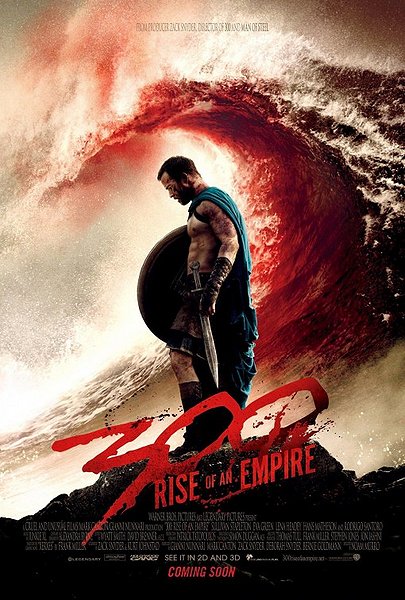 In 2007, the gory, shouty, beefcake-y action flick 300 came out of relative nowhere and took the world by storm, earning over $400 million worldwide and launching the careers of Gerard Butler and director Zack Snyder (Man of Steel, Watchmen). The movie burrowed itself into pop culture, readily mocked and parodied along with its highly stylized action. So where to go next? Also based on a Frank Miller graphic novel, though one that is incomplete as of release, 300: Rise of an Empire is a return to the same stylized excess that made careers. Except now seven years later, what once dazzled seems empty; visually alluring but hollow by all accounts.
Following the brave stand of King Leonidas and his 300 Spartans, Xerxes (Rodrigo Santoro) is pushing forward with his plans to subjugate the city-states of Greece. Long ago, Themistokles (Sullivan Stepleton) killed King Darius during Persia’s first invasion attempt. Xerxes has sworn vengeance since, goaded into action by his second-in-command, general Artemisia (Eva Green). She commands Xerxes’ mighty naval fleet, and she looks to “dance across the backs of dead Greeks.” The many city-states of Greece are squabbling over an appropriate response; Themistokles argues they should unite, while others contend for surrender to Xerxes. Themistokles rallies what armies and ships he can to meet the Persians on the sea and prevent the overpowering invasion.
 The difficulty with a follow-up to 300 is that Snyder’s highly stylized original has been copied and pasted so many times by cheap imitators, so what’s new? The film’s visual style follows the original closely, all those gauzy panoramas and human bodies lovingly showcasing in slow-mo the ugly beauty of bloodshed and violence. The rippling muscles, the glistening sweat, the geysers of blood; it’s all here and in displayed in fawning 3D detail. I didn’t see the film in 3D, but I noticed that every campfire scene was littered with annoying floating embers. However, Rise of an Empire manages some pleasant surprises because a majority of its action takes place at sea. This is a movie devoted to ancient maritime combat, and that’s pretty interesting. The scope of the action is much larger this time, with far more than 300 soldiers in play. The naval battles are brought to life with Hollywood excess but they’re still fairly exciting and fun to watch. The action is well orchestrated, usually easy enough to follow, and suitably thrilling, with each sequence differing from the last. The pumping score by Junkie XL works as a strong driving force with pounding percussion and horns (check out “History of Artemisia”). There are also less nutty monstrous evil henchmen this go-round as well, which helps bring a needed sense of internal reality to all the fantastical action. There are no goat people and blade-handed executioners this time. I don’t think anybody is going to take the movie to task for historical accuracy, but it’s appreciated all the same. Though who’s going to hire Blade Hands now? The guy has a very limited skill set for a workplace.
Plot-wise, the first 300 film was an underdog tale, a group of proud warriors fighting against overwhelming odds eventually giving their lives for the cause. It’s an early chapter in the Noble Lost Cause storytelling playbook, meant to inspire. It’s a Greek Alamo. The problem is when you pick up the story after the Noble Lost Cause. Now the Greeks have to fight the whole of Xerxes’ mighty forces with their own, and while it’s still an underdog story at its core, watching one huge army fight a huger army doesn’t have the same entertainment value. That may be why the film also works as a prequel. There are three flashbacks to fill out the first act’s worth of table setting: the initial war with Persia, Xerxes, and Artemisia. We get storylines happening concurrently with Leonidas and his men, though Gerard Butler declined to reappear in the film. You definitely miss his animalistic fire and screen presence. Ultimately, I don’t know if there’s much of a story here besides a big-screen version of Stratego, where the Greeks move, then the Persians, now everyone is dead or defeated. That’s a glib oversimplification, yes, but the plot boils down to an increasing series of episodes on how the Greeks repel the Persian invaders. Without greater characters and storylines to populate the downtime, it all becomes soulless exercises in CGI bloodshed chasing after whatever is cool looking.
The big problem with 300: Rise of an Empire, despite the ever-present sameness of it all, is that the heroes are bland and the villains are charismatic, which makes it easier to root for the bad guys, which I heartily did. The heroes are chiseled from the blandest of hunks of one-note characterization, with only three real characters being formed. There’s Leader Guy a.k.a. Themistokles, who wants to unite Greece into one power. There’s Father, a.k.a Scyllias, who has a slight scar on his jaw to better identify him, and then there’s his Son, a.k.a. Calisto, who wants to fight. Ladies and gentlemen, that is it, which is all you get when it comes to your heroes. What a shameful pittance. There aren’t even flamboyant supporting characters in their ranks. The heroes are boring, and the father/son storyline plays out exactly as you’d expect, which is a reverse from the original 300. These are not characters you’d follow into uncertain danger. These are characters leftover after all the good ones have been prematurely slain. These are some lackluster leftovers.
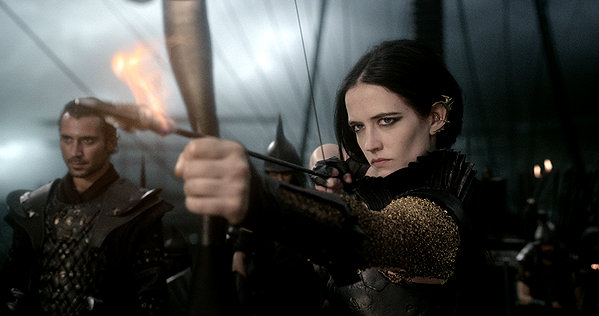 Now, let’s take a look at the enemy camp, namely with chief antagonist, Artemisia. It helps leaps and bounds that she is played by Eva Green (Casino Royale, Dark Shadows), and it’s even more helpful that Green gives it her all, sinking her teeth into the campy villainy. Artemisia is a fierce sword fighter, no-nonsense general, and overall badass supreme. She kisses decapitated heads, is not above fighting topless, and wears wicked outfits with spikes and all sorts of goodies. Every time she departs a scene, you’re left counting down the minutes until you see her again. She’s so delightfully entertaining, chomping at the bit for vengeance and Greek blood. She’s also a woman commanding warships in 500 BC, not exactly a time that recognized women as equals. Another wrong move on the filmmakers’ part was illuminating Artemisia’s back-story. We learn via flashback that Artemisia watched her family get raped and slaughtered by the Greeks. She was sold into sexual slavery at a young age, imprisoned in the bowels of a Greek ship, repeatedly raped for years. Then when these horrible men had had their fill, she was dumped onto an anonymous road and left to die. After seeing this sequence, what person isn’t going to welcome Artemisia? Does she not deserve her vengeance? I was emotionally engaged with her from that moment onward, and so I rooted for her to burn Greece down and vanquish our lame heroes.
The rest of the actors on screen are rather bad. The beefy men on screen could have used some extra work on their underutilized acting muscles. Stapleton (Gangster Squad, TV’s Strike Back) is absent any notable charisma to distinguish him from the stubbly-bearded pack of screaming male heroes. Santoro (The Last Stand) has a certain dour intensity to him, though he spends much of the film watching from a distance. The rest of the cast doesn’t even merit mentioning because the film treats them like featured extras rather than genuine characters. Only Lena Headey’s (TV’s Game of Thrones, The Purge) handful of scenes will grab your attention. It’s ironic that a film that glorifies the heroics of male soldiers, as well as the their chiseled physiques, and the only two women in the entire film are easily the most memorable and entertaining people. Dump the dudes.
While it offers enough thrills and visual power to satisfy a trial viewing, 300: Rise of an Empire is just too empty a spectacle to warrant anything beyond a cursory glance. Director Noam Murro follows Snyder’s blueprint to the best of his abilities, soaking the screen in blood, rippling flesh, and visual grandeur, but the movie goes into convulsions when somebody is forced to talk without kicking people in the face. The plot amounts to little more than a series of attacks played out like stages in a video game. While the original is no masterwork, at least it had characters that we could gravitate toward. Absent any hero worth rooting for, it’s no wonder that Green and her memorable villain reign supreme. She is excellent and has a reasonable motivation for her vengeance. If it had been her movie, 300: Rise of an Empire might have developed into a worthy spectacle anchored by its fiery heroine. Alas, the actual movie is just a Saved by the Bell: The New Class of half-naked men going off to CGI battle, and that’s just not enough.
Nate’s Grade: C+
Share this:

Blue is the Warmest Color (2013)
 The French drama Blue is the Warmest Color has been bathed in publicity and controversy ever since its debut at the prestigious Cannes Film Festival. It’s a three-hour lesbian romance about sexual awakening and finding a deep human connection, but all anyone wanted to talk about was the graphic sex. The drama split audiences down the middle, with people like Steven Spielberg praising its unflinching examination on the craving and heartache of young love, and others like New York Times film critic Manohla Dargis called the director/writer Abdellatif Kechiche “oblivious to real women.” It’s an impressive film, a rapturous love story for the twenty-first century that defies swift categorization. This isn’t just a gay film. This isn’t just a romance. This is a highly relatable, appealing, and heartbreaking movie of the first-order; however, both the defenders and detractors of Blue have substantial merits to their claims.
Adele (Adele Exarchopoulos) is a normal 17-year old girl trying to gather a sense of her self. Her peers are pressuring her to lose her virginity with a popular guy, but it’s another person, a mysterious blue-haired lass, that Adele can’t stop thinking about. This woman, the somewhat older Emma (Lea Seydoux) is an art student and an out lesbian. One night, Adele follows her into a lesbian bar and they strike up a friendship, one that quickly translates into something more romantic. Over the rest of the movie, we cover several years of Adele and Emma’s lives together and learn that each has left an indelible mark on the other, for good and bad.
 Let’s tackle the portion that’s gotten the most coverage in the media, the graphic sex sequences that earned the film the rare stateside NC-17 rating. You may have thought 2011’s sex addict drama, Shame, earned its NC-17 rating, but Blue trounces it. Short of unsimulated sex scenes in movies like Shortbus and 9 Songs, I doubt many audience members have experienced sex sequences this explicit and this lengthy (you may start checking your watch at some point). At its Cannes premier, the critical response breathlessly hyped a sexual encounter that went on for 18 minutes. That number may be the total onscreen copulation time; the longest sex scene is seven minutes or so, but you do feel the vigorous extension. Is there a particular reason the steamy sex scenes needed to be this long or this graphic? Kechiche likely wanted to communicate an explosion of immeasurable passion unlike anything Emma or Adele will experience in their lives. But did this need to be communicated with seven minutes of orgasmic fingers, lips, and tongues exploring every crevice of their bodies? Would six minutes of enthusiastic sex prove insufficient? I’d be a hypocrite if I said I found little entertainment in watching. I just don’t think the film demanded as much drawn out sex when the drama is this strong.
And that’s the mass appeal blurb when it comes to Blue is the Warmest Color: come for the intensity of the sex, stay for the intensity of the feelings. You will swiftly feel the nervousness and sexual tension that comes from the exploration of attraction. All those high school butterflies come fluttering back. The depth of feeling is easily relatable. The characters are searching for unparalleled human connection but also discovering more about who they are. This is a moving, absorbing, and crushing love story, but it’s just as much about two people falling out of love. That was a major surprise for me. What’s more is that the forces behind their breakup are completely understandable and you can see them coming; at heart, they are two different people that operate in different worlds, and they do change over time. That’s excellent storytelling when one can feel for both sides of a breakup, comprehend how this moment arrived, and looking back, see how inevitable a conflict like this would be. Emma’s sphere of friends is one that Adele does not feel a comfortable place within. Emma worries that Adele needs to find a sense of identity outside their relationship. Adele is still too timid to admit the truth about her relationship with a woman to her colleagues and family. These are major conflicts and they simmer and gestate in ways that feel like real life. Beyond some of the specifics in the bedroom (more on that later), there isn’t a moment that feels unbelievable in the entire three hours. This is a naturalistic love story that unfolds in small waves, allowing us to get to know the characters and their lives.
 The two actresses are outstanding and bare much more than their flesh for this film. Exarchopoulos and Seydoux disappear into their characters. These are richly developed characters, and each actress does her best to bring them to startling life. Exachopoulos (who looks like a Parisian Maggie Grace) has so much of the film riding on her 19-year-old shoulders since her character is the film’s major point of view; we often see the world through her perspective. She’s excellent as the curious, anxious, bashful young woman, and her encounters with Emma open her world up, allowing Adele to broaden as a person. She’s still not confidant, given to doubts that Emma seems to lack, but Exarchopoulos convinces you of the difference. Every step along her journey is credible, acted with poise, even the uncontrolled weeping. In a just world, this French newcomer would be up for serious acting award consideration. Seydoux is the more assured character, the one who sizes up her interest, but when hurt, the ferocity of Emma’s fury is staggering. This is not a woman to scorn, and Adele will learn this the hard way. Later in the film, as the history hangs in the air between Emma and Adele, we get a powerful sense of how conflicted both women are, having never turned off their feelings but trapped by circumstance and consequences. You feel each member cycle through the myriad of emotions, fumbling between desire and desperation. The actresses work together beautifully, raising one another’s performance, and giving one another the environment to get truly intimate, emotionally and physically.
The film is more a representation of a man’s fantasy of lesbian sex. The male gaze, a term referred to often in feminist film criticism, is trenchant in this film. Kechiche’s camera doesn’t just love his two young stars; it fawns over them, lusts over them. The camera is always within inches of Adele’s face, glued to tight shots lingering over Exarchopoulos’s pouty lips. Seriously, the actress has her mouth open the entire movie, her lips forever pillowy, forever pouting. It’s a sensual movie, yes, but does every shot of young Adele need to be so tawny and voyeuristic, her hair always slightly askew in her face, her body positioned just so that her assets are featured? Critics like Dargis are correct about Kechiche’s fawning camera pushing over into the boundary of erotic fetishism. This is where my questioning of sexual positioning comes back; going ass backwards when it comes to cunnilingus (and yes, I will intend that pun) is aesthetically pleasing in a sensuous manner, and that feels like the dictum of Kechiche’s intimate camerawork. It’s heterosexual male pleasure represented on screen, at least in its depiction. Otherwise, with the camera always tethered inches away from Adele’s face, why don’t we remain focused on her face during all this physical pleasure? It can be just as erotic. However, with all that out there, why can’t lesbian sex be given the same ridiculous fantasy depictions of heterosexual sex in the movies? I can almost guarantee that pool tables are not a prime location for indulging one’s urges. And just showcasing lesbian sex onscreen between a committed couple (not just girl-on-girl flings like in Black Swan) and normalizing it, whatever intention, is a virtue.
 But it’s not just the sex scenes that could use some judicious snipping; the entire three-hour enterprise could be easily consolidated. The film is replete with loping scenes that sort of drift along, recreating the ordinary rhythms of life rather than the plot beat connect-the-dots we associate with most film narratives. That’s fine, you need time to establish characters and setting, but do we need people interpreting poetry at length and indulging in gender philosophy for minutes on end? Perhaps if I watched Blue is the Warmest Color a second time I’d be more tolerable of the narrative bloat, finding added subtext and metaphor to all those ponderous philosophical discussions over the nature of the self and gender identity. Of course seeing a three-hour movie, again, is going to take a significant time commitment.
Sensual throughout, beautifully developed, richly observed, and brought to life with bristling and audacious acting, Blue is the Warmest Color is a love story that hits hard with emotional force. By nicely realizing the characters, providing them depth and fallibility, we can empathize with them along the different stops of their romantic journey, seeing where each is coming from and understanding the yearning, frustration, and passion. When things are good, there’s a frisson on screen, a palpable sense of desire accentuated by Kechiche’s loving (and occasionally obsessive/fetishized) camerawork. The acting by Exarchopoulos and Seydoux is as raw and fevered as their onscreen lovemaking. I doubt it needed to be a full three hours long, and I doubt the notorious NC-17-earning sex scenes needed to be as graphic to communicate delight, but I’m most pleased that Blue is offering a full movegoing experience, watching the formation of two characters over time and how they change. It’s easily watchable even during its more ponderous, dare I say French-y, sidesteps. The ending is a slight misstep, calling out for greater certainty, but the French title for the film was, Adele: Chapters 1 & 2, the implication being there may be future cinematic adventures that await these people. I don’t know if this will ever come to fruition considering the original graphic novel by Julie Maroh is a mere 160 pages, rather shrift considering the medium, but I can hope. Romances this involving, observant, and intense don’t come around too often and deserve to be cherished. Just consider the sex a bonus.
Nate’s Grade: A
Share this:

Thor: The Dark World (2013)
 Loosely based off the Norse mythology, Marvel’s hammer-wielding hero isn’t exactly the easiest character to relate to even as a superhero. Thor is a god after all. Not to be outdone, the man is also royalty, next in line to be king, so he’s in a special class of privilege. And yet 2011’s Thor was a pleasant surprise, a superhero movie that didn’t take itself too seriously, had modest aims, and embraced its sci-fi fantasy mélange. It was a movie where the sillier it got the better it worked. Now Thor: The Dark World, a.k.a. Thor 2, is ready to dominate the fall box-office and prove that Joe and Jane Popcorn can cheer for a pagan god.
Following the events of The Avengers, Loki (Tom Hiddleston) is taken back to his home world of Asgard and put in prison. Loki’s brother, Thor (Chris Hemsworth), is trying to get back to Earth to reunite with his love, scientist Jane Foster (Natalie Portman). Thor is being groomed for the throne of Asgard by his father, Odin (Anthony Hopkins). Meanwhile, the nine worlds are nearing a convergence and dimensional gateways are opening, including one that infects Jane with an ancient biological weapon, the aether. The aether was used as a weapon by the dark elves, a race of creatures that was long ago defeated but its general, Malekith (Christopher Eccleston), has been dormant and in hiding. Alterted, he assembles his surviving army to attack Asgard, kidnap Jane Foster, retrieve the aether, and destroy all life in the universe.
 Thor is still a second tier character when it comes to Marvel superheroes (the guy just isn’t that interesting) but his franchise has, in only two starring films, become the most interesting. The scope of the Thor movies seems infinite. Whereas the other Marvel heroes are Earthbound and straightforward, Thor transports an audience to all sorts of alien worlds/cultures/conflicts, all of which open up more tantalizing storytelling avenues. Nothing seems out of place in a setting such as this, and so the surprises are more satisfying. I thought the best parts of 2011’s Thor were the Asgard moments, less the strained fish-out-of-water comedy of Thor assimilating on Earth. Thankfully, almost all of Thor 2 takes place off Earth save for a rousing, creative, inter-dimensional hopscotch of a climax. The realm of Asgard is given suitable scope thanks to the screenwriters and first-time feature film director Alan Taylor, who worked in TV for years. Taylor’s notable work on HBO’s Game of Thrones is probably what got him this gig, and his vision with fantasy is given significant breadth here. The Thor universe is an interesting mix of fantasy and sci-fi, reminiscent of Star Wars, and Taylor provides the necessary sweeping visuals, exciting action, and glorious shirtless close-ups we come to expect from our fantasy vistas. I was consistently impressed with Taylor’s command of visuals and shot selection, particularly how the man was able to juggle the various tones and needs of the script while still keeping an exposition-heavy film fun and light.
With rainbow bridges, dark elves, and enchanted hammers, thank goodness that Thor 2 keeps a steady and welcome sense of humor, never getting too serious even with the end of existence on the line. This jovial tone is refreshing when properly executed and contributes to the overall fun of the picture. We’ve had such sturm und drang when it comes to our superhero movies, particularly last summer’s Man of Steel misfire. I appreciate a dark and gloomy superhero tale like Nolan’s Batman films, or a satirical swipe like the original Kick-Ass, but we need stories that fit with their tone. When it comes to Thor, he’s still saving the world, rescuing his damsel, but the attitude, while on its face regal and serious, is anything but. The Thor movies accept the absurdities of its setting and just shrugs, plowing along. And now with Jane on Asgard, the fish-out-of-water comedy gets a different perspective. She gets to meet Thor’s parents (awkward) and an Asgardian who has a thing for the hunky Norseman (double awkward… I’ll stop the 90s catch phrases now). Thor 2 also gives Jane Foster much more to do, placing her front and center as a person integral to the stability of the universe. During the snazzy climax, she gets to run around and contribute in a meaningful manner. The there’s the plucky Kat Dennings (TV’s 2 Broke Girls) who gets to rattle off one-liners like a pro, many of them grounding the elevated levels of silliness. Much of the humor comes from the cocksure characters and their quips, particularly Loki.
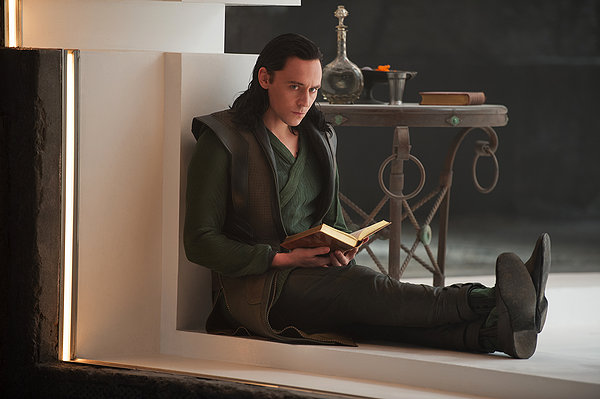
And that’s as good as any place to interject my notion that Thor isn’t truly the main character in this film, despite what the title preceding the colon may lead you to believe. That honor goes to Loki, the greatest villain in any modern Marvel movie by far. He’s got the clearest arc in the movie, going through arguably the most personal pain, coming to a crossroads, and his conclusion certainly sets up sizable ramifications down the road for the presumptive Thor 3. Played by Hiddleston (War Horse), the character draws you in, even when he’s throwing his self-aggrandized temper tantrums you want to spend more time with him. He’s far and away the most developed and interesting character onscreen, and Hiddleston has such a gleeful malevolence to him that makes the character all the more electric and unpredictable. Thor 2 is really the story of Loki coming to terms with his life’s choices, the choices his adopted parents made, his sense of self and birthright, and moving forward, becoming his own man again. This is why Thor 2 ascends another entertainment rung by tying Loki into the main story, forcing him and Thor to work together against a common enemy.
 In a film dominated by a charismatic Loki, it’s no wonder that Thor 2’s real bad guy falls woefully short. Malekith is a confusing and altogether lackluster antagonist in every conceivable way. He has no personality to him; he’s simple-minded with the goal of eradicating the universe. I don’t know about you, but my bad guys better have a pretty good reason for destroying the universe since they kinda live there too. This is one of the lazier villain plot devices because it has no nuance, no shading. Apparently before there was a universe there were dark elves. I don’t want to get caught in a chicken-egg paradox here, but was there a universe before the universe, cause I look at the universe like existence’s garage. The cars inside may change but the garage was standing before it all. Anyway, Malekith wants to destroy all life because he wants to, because certainly you’d think there would be enough space in space. He’s not even that threatening or given any particular advantage beyond some firepower. It’s no wonder that Loki runs circles around this chump in the villain department. Eccleston (Unfinished Song) is not at fault. The heavy makeup he’s under smothers the actor’s ability to polish this terrible character.
The rest of the acting fares better. At this point, we know what we’re getting with Hemsworth (Snow White and the Huntsman) as the title character. He’s a sturdy leading man with just enough appeal to satisfy, though part of it is that Thor is just dull as a hero. He was more entertaining when he was cocky and irresponsible. Portman (Black Swan) holds her own though the romance between her and Thor feels more forced. Hopkins (Red 2) strikes the right mix between regal and camp. While their roles aren’t exactly integral, it’s nice having a superhero movie stuffed with great actors like Idris Elba, Ray Stevenson, Adewale Akinnuoye-Agbaje, Clive Russell, and there’s even an amusing appearance by Chris O’Dowd, who effortlessly oozes charm (take note, Thor).
This a superhero movie that separates itself by its sheer sense of fun. Thor: The Dark World takes what worked in the previous movie and provides more of it. The campy, silly Asgard stuff is given even more time, the mischievous sense of humor is renewed, the fantasy worlds given more depth and better action/effects, and fan favorite Loki gets a big starring role this time with extra brotherly bickering. It’s not the best superhero movie, nor is it the best Marvel film of recent years, but Thor 2 knows what kind of movie it wishes to be and how to best achieve this. It’s a loopy, droll, and rather imaginative big-budget superhero film, while still finding ways to be somewhat generic with its overall plotting and character turns. While the action is suitably epic, it’s the character interactions that are the most enjoyable aspect. It seems excessively lazy to say that if you enjoyed the first Thor, you’ll probably enjoy the second one as well, but there it is. Perhaps next time the storyline won’t be as convoluted and we can get even more Loki. Barring that, I’ll accept additional Chris O’Dowd screen time.
Nate’s Grade: B
Share this:

Kick-Ass 2 (2013)
 It’s hard for me to discuss Kick-Ass 2 without sounding like a hypocrite. I enjoyed the first film’s visceral thrills, style, and satire of superhero tropes. The sequel gives me more of the same except not nearly as well polished, and in typical sequel mentality, it goes bigger, expanding the world and the height of the sick puppy violence. Kick-Ass (Aaron Taylor-Johnson) and Hit Girl (Chloe Grace-Moritz) are trying to live ordinary lives but keep feeling the need to don their suits and fight crime. Kick-Ass joins a ragtag team of other costumed vigilantes to battle a super villain team, lead by the former Red Mist (Christopher Mintz-Plasse). For long stretches, the movie seems like an unwanted Heathers knockoff as Hit Girl attempts to fit in at high school. She has some particularly nasty vengeance against a popular bully, and if there is a line, it may have been crossed here. I don’t know what it says about me, but I guess I’m fine with a pint-sized kid slicing up bad guys and cursing like a sailor, but making a woman simultaneously vomit and defecate herself, watching both projectile streams spray out her ends, is too much for me. This is a darker, cruel, and mean-spirited feel with the material, and writer/director Jeff Wadlow fails to compensate for the lack of creativity this go-round (I miss you Matthew Vaughn). The humor is still lively, but the plot is predictable at every step, the characters behave in ways that don’t make sense, and the action sequences are poorly filmed, leading to an anticlimactic ending that simply peters out. Kick-Ass 2 won’t be knocking anyone out.
Nate’s Grade: C+
Share this:

The Wolverine (2013)
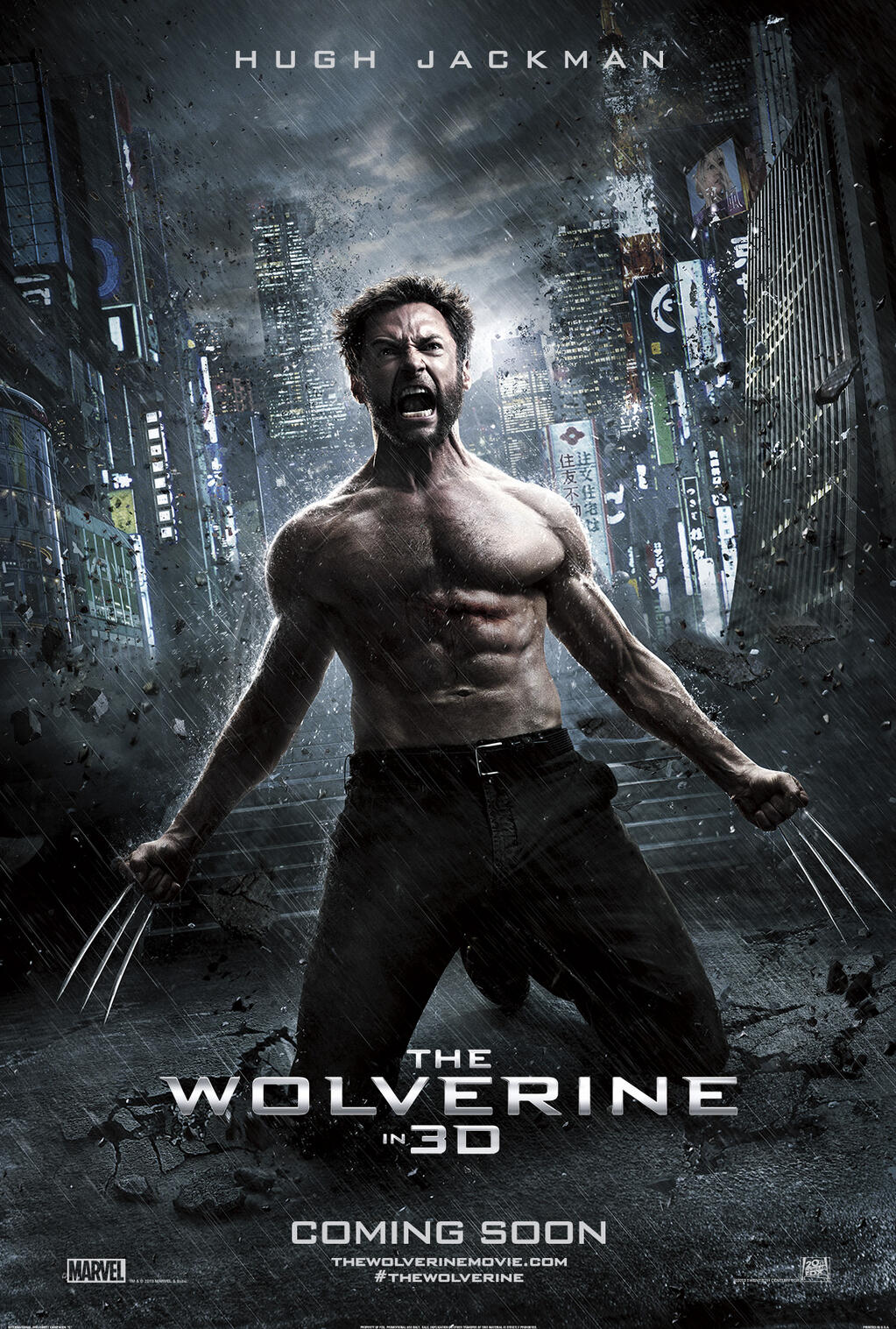 For a character universally beloved by comic and movie fans, Wolverine has fallen on some hard times. It’s hard to find too many supporters for either 2006’s X-Men 3: the Last Stand or 2009’s X-Men Origins: Wolverine. He had a fun cameo in 2011’s retro X-Men First Class, but other than that we’ve gone almost a decade without a respectably good movie starring Wolverine. It looked like Darren Aronofsky was going to be the answer to that drought of quality. The Black Swan director, who worked previously with Jackman on the intensely personal The Fountain, spent six months developing a Wolverine film set in Japan. Then Aronofsky dropped out, making this the second superhero franchise he missed out on (he was tapped to reboot Batman before Christopher Nolan landed the job). James Mangold (Knight and Day, Walk the Line) stepped into the director’s chair and now we have the directly titled semi-sequel, The Wolverine. It’s a step up quality-wise but even that comes with qualifiers.
Many years after the events of X-Men 3, Logan (Hugh Jackman) is living a solitary life amid the Canadian wilderness. He’s looking to lay low and he’s haunted by visions of his lost love, Jean Grey (Famke Janssen), the woman he was forced to kill to save the world. Yukio (Rila Fukushima), a mutant with the ability to foresee people’s deaths, finds him for her employer. He’s invited to Tokyo at the request of a wealthy and dying businessman, Yashida (Hal Yamanouchi). Back during World War II, Logan saved Yashida’s life, shielding him from the atomic blast that wiped out Nagasaki. Yashida has an offer for Logan. He can make him mortal again and take away his advanced healing ability. Thanks to a sketchy mutant, Wolverine loses that ability and goes on the run to protect Yashida’s granddaughter, Mariko (Tao Okamoto), from gangs and rival businessmen.
 Benefiting from low expectations, The Wolverine is a solid summer superhero tale that’s more interesting in its divergences from… summer superhero movies than it is when it follows that basic script. I appreciated that here is a superhero movie that actually doesn’t have to be wall-to-wall action. It allows a story to take place. Now, that story has its problems most certainly, but at least it has room to breathe. Also, there are barely any mutants in this movie at all. Excluding the title character, we get two super-powered mutants though neither really has a power that lends itself well to combat. I appreciated that there was hardly any gunplay at all in the movie. Mangold allows the hook of Wolverine, the hand-to-hand combat, to flourish amidst teams of adversaries following the ways of the samurai. I also appreciated the lack of familiar faces. While Jackman and Janssen will be recognizable to fans, I doubt too many others have a deep familiarity with a wide selection of Japanese actors. Then there’s an excellent post-credits scene that sets up the forthcoming X-Men universe crossover, Days of Future Past, arriving summer 2014. For all of these reasons, and some decent action, I’d say The Wolverine is worth seeing especially by fans burned by the character’s last two starring ventures.
With that said, this is a movie that still feels like it has problems that stop it from reaching its potential. The crux of the plot hinges on Wolverine losing his healing ability, thus becoming mortal. I understand that it’s hard to make an indestructible man vulnerable, but his friends and loved ones aren’t. The loss of powers doesn’t seem to raise the stakes because there isn’t a noticeable difference in the dude’s actions. He still acts the same except he recoils a bit longer from punches. The guy gets shot a bunch of times and stabbed and even clings to dear life atop a bullet train (more on this later), but he never really seems fazed. There’s also the nitpicky comic book nerd criticism that, if removed of his healing ability, there’s no way his body could sustain an entire skeleton made of metal. I’ll overlook it. This storyline seems even weaker when Wolverine (spoilers) gets his powers back for the third act (is that really a spoiler?) so he can fight the giant bad guys. The movie needs him back at full strength. It doesn’t feel like much was accomplished narratively or with the character to rob him of his invulnerability. That storyline could work, as it has in the comics before, but it just doesn’t seem like the ramifications are really explored beyond the surface.
Then there’s also to the issue with how cluttered the plot is with characters. There are far more characters in this than necessary, many of whom contribute very meagerly or could have been combined. The entire Yashida corporate storyline is just overburdened. There’s Mariko’s gruff father, there’s her mysterious boyfriend, there’s her would-be fiancé who works as a justice officer, there’s a snake-like mutant who really doesn’t add anything but poison samples. And you don’t really care about any of them. Whenever the story takes too many steps from its core (Wolverine protecting Mariko, getting his power back) is when the movie loses your interest. The final showdown and the participant involved should also be obvious, especially since Yukio point blank tells the audience about a red herring. Speaking of Yukio, I think she was easily the best addition to the movie. She forms a buddy relationship with Wolverine, a notorious loner, and watching them spar is just fun. Plus she’s a badass with a soul. Her mutant power also curses her with knowing how every loved one, every dear friend, every family member will die. She must see it, live it, all the while knowing what is to come. And that’s all you ever see – people’s deaths. That is some heavy stuff, and the movie treats it with sincerity, showing how haunted Yukio can be with these unsolicited peaks into the future. I would have greatly preferred more screen time for Yukio, who ducks out for far too long for my tastes. Plus the actress has a very striking, unique look to her. I don’t know if there are plans to continue her character into Days of Future Past, but I hope they do.
 Then there are moments that strain credibility even for a summer superhero movie. It’s funny, because if you’re being entertained, your brain will ignore these moments. Well there’s one action sequence that stands out that seems to break every law of physics. I know we’re dealing with mutants, I know we’re dealing with superheroes, and I know it’s a summer action movie, but my God this bullet train sequence just does too much. There is a fight scene between Wolverine and a standard Yakuza thug atop the speeding top of a bullet train zipping by at 300 miles per hour. It’s actually the most memorable action piece in the film, but it’s also memorable for wrong reasons. Wolverine is using his claws to pin himself to the top. The Yakuza thug is using a standard knife. Are the tops of the bullet train this easily penetrable? I’d worry, Japanese commuters. Then they hop over signs and ledges, still landing atop the train. This isn’t a Western with a locomotive that one could feasibly keep their footing atop. This is a train going 300 miles per hour. You think you can jump onto something going that speed and keep your balance? Think you can hold onto something while you speed at 300 miles per hour? How can a human arm maintain that sort of physical exertion? It’s too ridiculous to enjoy. If the rest of the movie had a similar over-the-top tone, then this sequence would be acceptable. However, The Wolverine plays itself so seriously that moments like this truly negatively stand out.
Jackman (Les Miserables) is a perfect fit for this character. I agree with my friend and colleague Ben Bailey; while the X-Men movies have faltered in quality, Jackman never has. He’s played this role six times now and it’s still a pleasure to watch. There is a question of how much longer the man can keep this up, though. Even at 45, the man can still get jacked with the muscles; just look at Stallone, or don’t. The real problem is presented in the mythology of the character developed in the first Wolverine solo outing, namely that the man is close to immortal. He doesn’t stop aging; he just ages very slowly. This is the same problem with twenty-somethings playing vampires, or Arnold as a timeless robot (why would they make slightly older looking models?). Age catches up to all of us, though Jackman’s own constricts the use of the character in the future. Regardless, this man can play this part until he’s in a nursing home and I’ll be happy.
There are elements that work, particularly Wolverine’s thematic relevance to the samurai of old and the feudal system of honor, and I enjoyed his buddy relationship with badass-in-training Yukio. The action is serviceable, there are some sweeping visuals with referential touches to Kurosawa, and Jackman is still a strong and capable hero. There’s just so much more this film could have been. The setting could have been fleshed out, the characters pared down to essential storylines, and the plot of Wolverine losing his powers could have actually mattered rather than just play out like a momentary setback. There’s just as many things I enjoyed as I didn’t, so this is a tough call for me. The Wolverine is clearly a step above the previous two movies, but those were both fairly bad films, the solo one poisoning the well for future X-Men solo bids. If you enjoy the character and want something slightly different but recognizable, then The Wolverine will pass the time acceptably. It’s hard for me to work up much passion for this film, and I’ll be surprised if any hardcore fans feel otherwise. Here is a superhero movie that lands right dead center between bad and good. I suppose most would call that mediocrity, but given how poor X-Men 3 was and Origins, I think I’ll call it progress.
Nate’s Grade: B-


 nathanzoebl
You must be logged in to post a comment.