Blog Archives
Superman Returns (2006)
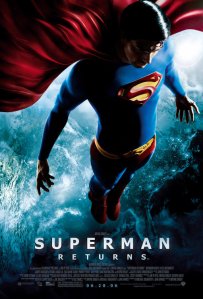 It’s been a total of 19 years since we saw Superman grace the silver screen in the mega-bomb Superman IV: The Quest for Peace. The big question is… did we miss him at all? I know a lot of people that say they just can?t get into Superman as a character. He’s always been a do-gooder, someone with infinite power but too great a sense of nobility to abuse it. Does the Man of Steel still hold relevancy in today’s more erratic, cynical, fearful world? Is it possible to make an indestructible alien relatable or empathetic? Director Bryan Singer is interested in finding out, and he brought nearly his whole X-Men 2 team with him. Instead of retooling the franchise Singer has adopted the idea of starting shortly after the events of 1980’s Superman II. (Yes, I know Richard Lester is credited with directing Superman II but it’s still contentious that Richard Donner, who helmed the first super outing, directed a majority of the sequel. From here on out, Donner will cited as the director of Superman and Superman II).
Superman (Brandon Routh) has been absent for five years trying to look for pieces of his home world, Krypton. Lex Luthor (Kevin Spacey) and his moll (a cheerfully batty Parker Posey) have got some big plans up their villainous sleeves. Using crystals from Superman’s home world, they plan on building a new continent of land to prosper with. He also has a nice supply of kryptonite to make his own fortress with. When Clark Kent does arrive back in town, coincidentally along the same time Superman rescues Lois Lane (Kate Bosworth) in a plane crash, he’s shaken by the changes that have taken place in his absence. Lois is engaged to Richard (James Marsden), nephew of The Daily Planet‘s editor in chief, Perry White (Frank Langella). She’s also won a Pulitzer Prize for her article, “Why the World Doesn’t Need Superman” (a kiss-off letter to a lover if ever there was one). To top it all off she also has a five-year-old son, which would put him within the realm of having a super dad (Lois and Supes took a roll in the hay at the Fortress of Solitude in Superman II). The Man of Steel has a lot on his plate, obviously.
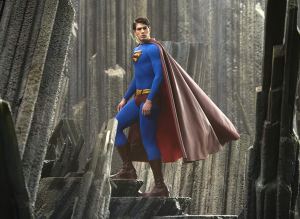 This is rumored to be the most expensive movie of all time, with budget predictions going as high as $260 million. If that?s true than Singer let’s you see every dollar onscreen. As a movie going experience, Superman Returns has little to no equals. The special effects are astounding and the imagery is simultaneously iconic and awe-inspiring. We now exist in a world where we can see a man in a red cape zoom through the sky and have it become believable. Singer, after two X-Men flicks, has a terrific eye for glistening visuals and boy does he know how to conduct Hollywood bombast with equal parts genuine character. His loss was considerably noticeable with X-Men 3, which wilts in direct comparison as unfair as it may be (it’s like the difference between a Van Gogh and a third grader’s imitation of a Van Gogh). The difference is that you can feel the respect the filmmakers had for superman; not so much with X-Men 3. But alas my countrymen, I come here to praise Superman not to bury X-Men 3. The sheer breathtaking visual artistry of Superman Returns demands to be seen on as big a screen as possible. Singer has crafted a wonderful tableau for the eyes and ears, filled with religious symbolism, opening the wonderful possibility of the movies just a little wider.
Singer’s film is a show-stopping pop spectacle, which is good, because the story itself, upon fresh perspective and distance, is good, but not great. The story doesn?t pursue character as strongly as last year?s fellow franchise reboot, Batman Begins, nor does it interlace themes as well. The characters in general are pained but left with little other expressions. Lex Luthor’s evil scheme is grand in cataclysmic scope but at the end of the day it’s still a real estate scam. It’s like if Donald Trump was human or less evil (he’s definitely got the same hair stylist as Luthor). How exactly is Luthor planning on keeping control of a new continent of land? I would think the world would have some way of establishing order. Once again a villain’s scheme is ruined by the less dastardly, more squeamish baddie in the entourage. In fact, the villains are on their own for a long while, embarking on their own tangential movie to play alongside the return of superman. The first hour is slower paced and the final climax could have used an additional boost, but these are quibbles. Superman Returns could have done a lot more with their characters, especially considering their take-off point is two films hence, but this movie is more about reassembling the pieces. To that end, Singer’s satisfying retread is forgivable for its shrift characterization.
 Do not let any misgivings about character and story betray how awesomely entertaining Superman Returns is when it turns on the magic. Even at a bladder-unfriendly 2 hours and 40 minutes in length, the film has little drag and a great sense of confidence of a crowd pleaser that knows how to play to an audience while respecting their intelligence. The movie is self-indulgent (how many slow-mo shots do we need of Superman in the air?) but it never falls short on thrills. Between plane crashes, bank robberies, sudden explosions, and spontaneous, cavernous land masses, you’ll likely be glued to your seat waiting for the outcome, which even with a nigh indestructible being isn’t always a given.
The action is grand in scale but Superman Returns also has the unmistakable stripes of a chick flick. Lois is jilted, moves on to a good man, and suddenly the man of her dreams, the one she thought was gone for good, reenters her life. The film’s sharpest plot point is the complication of its love triangle with Richard and a child in tow. The romantic yearning and interplay give the film its biggest emotional involvement. Even though the filmmakers are deliberately vague, the answer of who’s the father should be rather easy to deduce. Still, the audience has an increasing desire to know the paternal truth.
Singer’s louder, brighter Superman is a loving tribute to the Richard Donner Superman films, you know, before Richard Pryor, evil twins, and the rather rash, though very effective, decision of hurling the world’s supply of nuclear weapons into the sun (the less said about The Quest for Peace the better). It even exists in the same universe so we don’t have to go the origin tale route, though we do get flashbacks to Clark’s past. Marlon Brando’s original performance as Jor-El, father of Superman, is reused and John Williams’ theme gets a new polish. Even the opening title graphics, so horribly dated like a “cutting-edge” Atari game, are the same from the Donner era. There’s such reverence for nostalgia and a fondness for what makes Supes Superman, and that’s why it gets closer than even the Donner flicks, which are good but have weathered with age and can come across as too silly or cheesy.
Even Routh looks uncannily like Chistopher Reeve. Routh is an interesting choice; he’s chiseled, handsome, and questionably appealing. He comes across more like a being finding his place, like a kid fresh out of college, than a being of incalculable power protecting our blue planet. At any rate, Reeve played the comedy better, being both suave hero and clumsy earthling. I wish Superman Returns would go further exploring the perils and expectations of being Superman, a life devoted to servitude and always being an outsider. There’s a small scene where he orbits the Earth listening to 1000 overlapping voices crying for help before zeroing in on one. Otherwise, the movie doesn’t pay much notice to the burdens of Superman, which may unfortunately keep many at a distance.
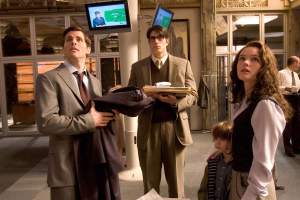 Bosworth is just too young for her role; she resembles Lois Lane’s baby sister, not the feisty Margot Kidder incarnation that left such an impression. This Lois Lane doesn’t so much bicker as she does harrumph. It’s like they took the role, dolled her up, muted her, and then told her to play Lois Lane as if she had stayed up all night binging on Sex and the City reruns. Bosworth is at the mercy of her character, a figure pressed into danger more than she is into emotion. There are some nice moments, like a midnight stroll through the atmosphere with her knight in blue tights. I just wish there were more.
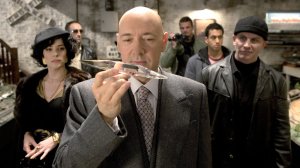
But at least there’s two-time Oscar winner Spacey, who’s terrific as the infamous Lex Luthor. He’s got a funny quirkiness and a perfectly deadpan sarcasm. The opening that reveals how Luther earns back a sizeable fortune is hilarious and perfect to a T. Everyone else seems a bit dour but Spacey is having a ball; he’s even employed Kumar as part of his muscle (you’re a long way from White Castle, Kumar). However, Spacey’s spirited take is a lot more menacing than Gene Hackman’s version, which always came across as an oily used car salesman, more huckster than arch villain/evil genius. Spacey has a really strong disdain for the Man of Steel and his eyes sparkle at the opportunity to get vicious. I’m all for a darker, angrier, down-and-dirty villain to better torment Superman. Not to be out done, used car salesmen have their moments of intimidation.
The story may be good, not great, but Superman Returns is a first-rate cinematic spectacle. Singer and his X-Men 2 team have crafted a nostalgic, reverent movie that smartly addresses whether today’s world has outgrown a big blue Boy Scout. The action sequences and special effects are astounding, and, for the first time in a Superman movie, they are wholly believable. This helps when the main guy wears his underwear on the outside and shoots lasers from his bullet-proof eyeballs. The film stalls when it comes to characterization and the interplay of strong unified themes, but much is forgivable because Singer has worked his ass off getting a storied franchise back on its feet with dignity.
After three super hero films in a row, each with an escalating budget and running time, I’d say the man needs a break, perhaps a tiny independent movie to rejuvenate the batteries. But after watching Superman Returns, what I really want is for Singer to get right back to work as fast as possible. We’ve got this world back in order. Now it’s time for Superman to truly take flight.
Nate’s Grade: B+
Share this:

X-Men: The Last Stand (2006)
 The story behind the making of X-Men: The Last Stand is more interesting than most. Bryan Singer had directed the first two X-Men films and had done a fine job establishing many loveable characters and the universe that housed them. Warner Brothers has been trying to get their Superman franchise flying for so long, going all the way back to 1996 when Kevin Smith wrote the script, Tim Burton was to direct, and Nicolas Cage was going to be the man in tights. Since then directors and drafts of screenplays have come and gone, including Brett Ratner, best known for directing both Rush Hour movies and a slate of mostly mediocre movies. Then Warner Brothers poached most of the X-Men 2 team to make Superman Returns, hiring Bryan Singer as director, plus X2‘s screenwriters, cinematographer, editor/composer, and maybe even the cat that licked Wolverine’s claws. Fox was left without a captain for X-Men 3. They daringly picked Matthew Vaughn (Layer Cake) but then he dropped out for family reasons. Then Fox went with their second choice … Brett Ratner. Both directors had essentially switched projects. Hollywood’s funny like that.
It’s been a few months since the events in X-Men 2. Scott “Cyclops” Summers (James Marsden) is still mourning the loss of his love, Jean Grey (Famke Jannsen), who sacrificed herself to save the rest of the X-Men. He’s tormented by her voice, whispering all around him and pleading with him to return to Alkali Lake, the site of her death. Miraculously, Jean returns from the dead but she’s much different. Her persona has broken and the Phoenix has taken over, a destructive killing force unparalleled on earth.
Magneto (Ian McKellen) has great use for such a force. There’s been news of a new drug that suppresses the gene that causes people to be born as mutants. This discovery has been dubbed a cure. The question persists, is should being different be curable and what would that even mean? Magneto sees the writing on the wall, knowing that any cure would only be voluntary for so long. He collects new mutant fighters along with his stalwarts the shape-shifting Mystique (Rebecca Romijn) and fire starter Pyro (Aaron Stanford), a former student at Xavier’s School for the Gifted.
 Over at Professor X’s (Patrick Stewart) school, the mutant students are each questioning life with a cure. Rogue (Anna Paquin) is considering it so she can finally touch her boyfriend, Bobby “Ice Man” Drake (Shawn Ashmore) without killing him. Plus, so he’ll stop spending so much time with Kitty “Shadowcat” Pryde (Ellen Page), a girl who can walk through matter. Storm (Halle Berry) and Wolverine (Hugh Jackman) are left to run the team after some disastrous setbacks. Henry “Beast” McCoy (Kelsey Grammer) is a man covered in blue fur and appointed as head of Mutant Relations for the president. He senses the growing danger and anxiety the administration has with mutants and joins the X-Men to do what he feels is right.
It feels like that in a rush to production that character development, subtlety, and subtext were chucked out the window to make time for more boom-boom action. The first two X-Men flicks juggled the characters and introductions but still managed to squeeze in one great moment for the characters we cared about. The plot moved at a mature pace, insightful and touching on elements of psychology, politics, and personal struggles to fit into a society that fears you. There was some sophisticated, relevant stuff bandied about this franchise in between the kick-ass action. But with X-Men 3, you basically have Halle Berry doing less with more. She’s got more screen time, in part to her demands, and now she can use that extra time onscreen to show us how perfectly bland her character is as the film’s most laughable moral ideologue. The idea of a cure for the mutant gene is vastly interesting with all kinds of great avenues for character introspection and socio-political debate. But X-Men 3 renders all of its debate to be merely superficial, another in a series of plot points to get the action moving quicker.
The X-Men franchise was already overpopulated with lots of characters vying for screen time, so I don’t understand the decision to add even more characters to the ensemble and cut down the running time to a brisk 100 minutes. As a result, certain characters sit out for long stretches of the film, are inactive during key moments, some are mostly forgotten, or some meet unjustifiably hasty ends. If I was still an ardent comic book fan, and a follower of the X-Men, I might view the third film as heresy. Why even bother bringing the character of Angel into the movie if he’s just going to be on for two minutes, including a forehead-smacking deus ex machine moment? The Dark Phoenix storyline is the most pivotal storyline in the comic’s history, so why even bother dragging it into X-Men 3 if it’s just going to be Zombie Jean Grey? It feels like Ratner is off screen with a pole poking Janssen whenever the story needs her to wake up and stir up some stuff.
 I hope comic fans enjoy the brief glimpses of some of their favorites, because X-Men 3 does a good job of throwing characters into a meat grinder. I had to check online to just to find out who they were, and even then my realization was followed by, “Her? Him? What?” And what the hell is up with Porcupine Face? That has got to be the worst mutant ability of all time. What’s he going to do to his enemies? “Hey, will you come a little closer. I have a secret to tell you. Closer … closer … closer still … that’s right, now please lean against my face.”
The movie trades character for action, so is the action even good? Ratner is a workmanlike director devoid of any personal style, which further brands X-Men 3 as ordinary. The action sequences aren’t anything extraordinary, there just happens to be more of them. The climax pits mutant against mutant in short-lived bursts. A battle between Ice Man and Pyro should be awesome, but Ratner stages the showdown like he was choreographing his neighbor’s kids. This battle lasts a whopping 45 seconds. The climactic end battle, the “war to end all wars,” is rather sloppy. Ratner keeps cutting back and forth between his pairing of Good mutant vs. Evil mutant (why do the two black girls seem forced to fight each other?), but his showdowns are all too quick to quicken the pulse. Wolverine’s brawls in the woods never rise up to the adrenaline-soaked fights in X-Men 2. The special effects and make-up are just as good; they’re just not being put to as good a use. If Ratner is going to dump character for action he has to make his action exceptional. The movie feels on autopilot.
Ratner is not fully to blame for the shortcomings of X-Men 3. Screenwriters Simon Kinberg and Zack Penn (Elektra) have crafted an overly rushed story that is more tailored for getting the job done than telling a good story. They present some big ideas and interesting elements, like a love triangle between Rogue-Ice Man-Shadowcat, but then most of the promise is either skipped over or dropped. They’re trying to juggle too many balls at once, and it just makes me miss Singer and the X2 screenwriters and how effective they were in defining character even in the smallest of moments. Some of the X-Men 3 dialogue is awfully stilted, like “You of all people know how fast the weather can change” and “Sometimes when you cage the beast, the beast gets angry.” There’s also a silly subplot about Storm teaching Wolverine what it means to be responsible. Try and count how many times you roll your eyes with that one. How many times are they going to have the president look blankly at a TV screen and gasp, “My god”? There’s some clever use of mutant powers during battles (mostly involving Shadowcat) but there’s just as many routine moments as well.
 The acting is all over the map. Jackman owns his role as Wolverine. McKellen and Stewart bring a needed dose of grandeur to the proceedings. The X-kids are enjoyable, and Ellen Page (knocking ’em dead in Hard Candy) makes a very nice addition to the fold. I’ve likely enjoyed Paquin the most in this series, next to Jackman of course, so it’s so frustrating that she just plays Jealous Girlfriend at Window. I think it’s criminal how little she’s examined in the movie, especially since the supposed cure has the most questions and ramifications for her. Grammer is essentially Frasier in blue fur, but that’s essentially what Beast is so it works. He has a very nice moment when he sees what life would be like minus his mutant likeness. It’s really hard to judge most of the performances because of how short they appear in the movie.
X-Men: The Last Stand is far from boring but it’s more serviceable than special, and lacks the maturity and imagination that its previous films held. This was a franchise full of limitless potential, so to see it drop to something ordinary is sad, especially if this is the rumored end of the franchise (a record opening gross over Memorial weekend says otherwise). This franchise feels dumbed down; yes it’s still entertaining on a mass market level but it doesn’t have the creativity and precision that Singer’s movies had. X-Men 3 is fast-paced and not without its great geek moments, but it’s also the least emotionally involving of the films. When the deaths and departures come you’ll probably shrug your shoulders because of how the film presents them. X-Men 3 is fine, but I expect better from this franchise.
Nate’s Grade: C+
Share this:

V for Vendetta (2006)
 Legendary comics author Alan Moore has a particular disdain for Hollywood adaptations. They just haven’t gone so well for this scribble scribe. There was 2001’s From Hell (I may be the only one in the world that actually likes it, Heather Graham’s atrocious cockney accent aside) and 2003’s The League of Extraordinary Gentleman. Moore is even responsible for the creation of the John Constantine character, who had his own 2005 big screen venture. I suppose you could see why he has certain contempt for the movie versions of his much-heralded stories. Now comes V for Vendetta, based on Moore’s 1988 comic and adapted into a screenplay by the Wachoswki brothers. While I may have no idea how close V for Vendetta is to Moore’s graphic novel, I can say that the movie is a smart, superb thriller that dares you to think while you?re stuffing popcorn into your mouth.
“Remember, remember, the fifth of November, gunpowder treason and plot. I see no reason why the gunpowder treason should ever be forgot”
In the future, America has lost its super power status after overextending itself in war. Britain has turned into a hostile totalitarian government, led by chancellor Sutler (John Hurt). Evey (Natalie Portman) works for the state-controlled TV station. One night, while walking out past curfew, Evey is attacked by some undercover cops looking for a good time. A mysterious masked man named V (Hugo Weaving) comes to her rescue. His grinning, bearded mask resembles Guy Fawkes, a revolutionary that tried to blow up the British Parliament 400 years ago on November 5th. V starts taking out high profile government figures and then infiltrates the government airwaves, asking others to rise up against the corruption they see around them. He promises to blow up parliament one year to the day of this message. Finch (Stephen Rea, so expressive with his hangdog demeanor) is assigned to find out who this V is and how to deal with him. In reality, Finch discovers a lot more troubling information about his own government. Evey is linked with V and tracked down for interrogation and potential execution. As the date approaches, Evey must battle her own loyalties and strike out against what she feels is right and just.
 What makes V for Vendetta so exciting is its playground of ideas. This is a dynamically intelligent, complex movie but it never lets the smarts get in the way of a rousing good time. This is a very political movie that’s very relevant today, like the exchange of freedom for security and the use of fear mongering to serve an agenda. I love that the government’s leaders were a rogue?s gallery of corruptible figures; the Bill O’Riley-like TV pundit blowhard, the church leader who just happens to be a pedophile, the scientist whose good intentions justify the worst in human experimentation. V for Vendetta is a thinking man?s comic book movie, one that actually has actual respect for its audience and refuses to dumb down its message. The movie starts at a gallop and never lets up intellectually, and that’s so wonderfully refreshing from a film of any stripes. While I would not classify myself in the camp that views V for Vendetta as an anti-Bush administration screed, I’d have to say the movie does stir people out of a sense of apathy. I was even moved by the film’s hopeful conclusion, which is more than I can say about any other comic book movie (yes, even Elektra).
Director James McTeigue has previously served as the Wachoswki brothers’ assistant director. V for Vendetta is his debut as a director and what an auspicious debut it is. The movie is visually lush thanks to Aliens cinematographer Adrian Biddle (sadly, he died December 2005), but the smartest notion McTeigue accomplishes is putting story above special effects (ahem, George Lucas?). The command McTeigue has as a first-time director is impressive; how many people would be this restrained with all the fancy tools Hollywood has to offer? It’s his restraint and priorities that allow V for Vendetta to excel. And when the film does call for action, McTeigue judiciously uses visual trickery to enhance the scene. A late scene involving slow-mo V taking out a cadre of soldiers while they reload is amazing both in its “hey, look at this!” visual acuity and that it fits perfectly within the narrative. Nothing is self-consciously showy for the sake of wowing an audience, and every beat of action feels organic to the storyline. V for Vendetta is a terrific debut with some great set pieces.
Weaving is awesome as our hero. Since at no point does V ever take off his mask, it wouldn’t have been unheard of to simply hire a stunt guy to play the part and dub Weaving’s voice in later. But no, Weaving decided to be the part and adds so much to the character. He knows when to turn his head, nod, lean to a side, just like a silent film star interpreting the moment through action; it sounds ridiculous but it definitely helps paint a clearer picture of V. Then there’s Weaving’s incredible voice, making V sound like the world’s craziest, coolest Shakespearean lit professor.
Portman has finally made me appreciate her as an actress. She had a long winter between 1994’s The Professional and her 2004 one-two punch of Garden State and Closer, but I now finally see that Portman is a fine actress and not just a promising talent. She’s the heart of the film, the focal point for the audience to journey along, and she’s excellent at every point. I also give her props for having her head shaved on camera (I can only imagine what the eventual porn version will do with this scene).
 I’m left in the cold by this over inflated discussion on how “daring” V for Vendetta is by having the hero of a major Hollywood movie be a terrorist, one that says things like, “Violence can be used for good,” and, “Sometimes blowing up buildings can change the world.” Yeah, sure, but it’s a well-mannered, well-read, cultured terrorist versus a giant evil totalitarian government that kidnaps people, strips them of their rights, and enforces cruelty and prejudice. So exactly how daring is that? Of course audience sympathy is going to fall to the little guy, in this case a terrorist, which is the only hope of shaking things up and righting wrongs in the system. That doesn’t exactly strike me as subversive. This movie isn’t promoting terrorism any more than Munich was when Spielberg allowed the Palestinians to have a voice. The movie is anti-oppression if anything.
My only complaints are minor. The movie gets a bit repetitious in its windup to the climax (oh look, we’ve cut again to the Big Brother round table), and that somewhere along the middle V for Vendetta gets log-jammed with subplots. Everyone has a story to tell in V for Vendetta and we see every personal tale, and after a while it kind of grinds the flow of the story down. However, this problem is sidestepped after awhile and V for Vendetta gets back on track, driving full-force toward its conclusion like a runaway train.
What sounds on paper as something incredibly silly, including a kissing scene involving a motionless clay mask, V for Vendetta plays out with such excitement, visual prowess, and vibrant intelligence; this is a very political movie that?s very relevant today and I loved it all the more for it, but V never forgets to be entertaining at the same time. McTeigue has fashioned together a stirring and fascinating directorial debut, and even though the Wachowski brothers have their fingerprints all over this film, the pretension is kept to a minimum. V for Vendetta is exactly what the Matrix sequels should have been: a pulpy mix of brains and action, not a snore-fest that beats you down before putting on a show. It’s a shame Moore didn’t want his name attached to the finished product, because V for Vendetta is 2006’s first great movie of the year.
Nate’s Grade: A-
Share this:

Batman Begins (2005)
 I have been a Batman fan since I was old enough to wear footy pajamas. I watched the campy Adam West TV show all the time, getting sucked into the lead balloon adventures. Tim Burton’s 1989 Batman was the first PG-13 film I ever saw, and I watched it so many times on video that I have practically worn out my copy. Batman Returns was my then most eagerly anticipated movie of my life, and even though it went overboard with the dark vision, I still loved it. Then things got dicey when Warner Brothers decided Batman needed to lighten up. I was only a teenager at the time, but I distinctly remember thinking, “You’re telling the Dark Knight to lighten up?” Director Joel Schumacher’s high-gloss, highly stupid turn with Batman Forever pushed the franchise in a different direction, and then effectively killed it with 1997’s abomination, Batman and Robin. I mean these films were more worried about one-liners and nipples on the Bat suits. Nipples on the Bat suits, people! Is Batman really going, “Man, you know, I’d really like to fight crime today but, whoooo, my nipples are so chaffed. I’m gonna sit this one out”?
For years Batman languished in development hell. Warner Bothers licked their wounds and tried restarting their franchise again and again, only to put it back down. Then around 2003 things got exciting. Writer/director Christopher Nolan was announced to direct. Nolan would also have creative control. Surely, Warner Brothers was looking at what happened when Columbia hired Sam Raimi (most known for low-budget splatterhouse horror) for Spider-Man and got out of his way. After Memento (My #1 movie of 2001) and Insomnia (My #5 movie of 2002), Nolan tackles the Dark Night and creates a Batman film that’s so brilliant that I’ve seen it three times and am itching to go again.
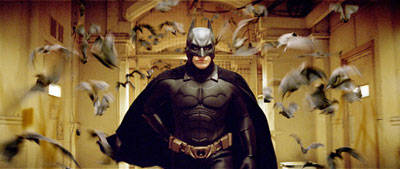 The film opens with a youthful Bruce Wayne (Christian Bale) in a Tibetan prison. He’s living amongst the criminal element searching for something within himself. Henri Ducard (Liam Neeson) offers Bruce the chance to be taught under the guidance of the mysterious Ra’s Al Ghul (Ken Watanabe), the leader of the equally mysterious warrior clan, The League of Shadows. Under Ducard’s direction, Bruce confronts his feelings of guilt and anger over his parents’ murder and his subsequent flee from his hometown, Gotham City. He masters his training and learns how to confront fear and turn it to his advantage. However, Bruce learns that the League of Shadows has its judicial eyes set on a crime ridden Gotham, with intentions to destroy the city for the betterment of the world. Bruce rebels and escapes the Tibetan camp and returns to Gotham with his own plans of saving his city.
With the help of his trusted butler Alfred (Michael Caine), Bruce sets out to regain his footing with his family’s company, Wayne Enterprises. The company is now under the lead of an ethically shady man (Rutger Hauer) with the intentions of turning the company public. Bruce befriends Lucius Fox (Morgan Freeman), the company’s gadget guru banished to the lower levels of the basement for raising his voice. Bruce gradually refines his crime fighting efforts and becomes the hero he’s been planning on since arriving home.
Gotham is in bad shape too. Rachel Dawes (Katie Holmes), a childhood friend to Bruce, is a prosecutor who can’t get anywhere when crime lords like Falcone (Tom Wilkinson) are controlling behind the scenes. Most of the police have been bought off, but Detective Gordon (Gary Oldman) is the possibly the city’s last honest cop, and he sees that Batman is a figure trying to help. Dr. Crane (Cillian Murphy) is a clinical psychologist in cahoots with Falcone. Together they’re bringing in drug shipments for a nefarious plot by The Scarecrow, a villain that uses a hallucinogen to paralyze his victims with vivid accounts of their own worst fears. Bruce is the only one who can unravel the pieces of this plot and save the people of Gotham City.
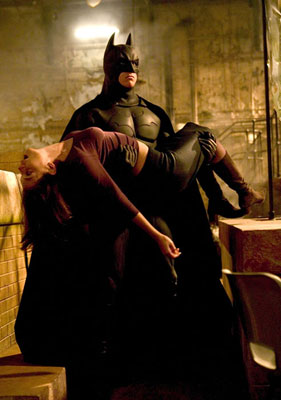 Nolan has done nothing short of resurrecting a franchise. Previous films never treated Batman as an extraordinary character; he was normal in an extraordinary world. Batman Begins places the character in a relatively normal environment. This is a brooding, intelligent approach that all but erases the atrocities of previous Batman incarnations. Nolan presents Bruce Wayne’s story in his typical nonlinear fashion, but really gets to the meat and bone of the character, opening up the hero to new insights and emotions, like his suffocating guilt over his parents murder.
Nolan and co-writer David S. Goyer (the Blade trilogy) really strip away the decadence of the character and present him as a troubled being riddled with guilt and anger. Batman Begins is a character piece first and an action movie second. The film is unique amongst comic book flicks for the amount of detail and attention it pays to characterization, even among the whole sprawling cast. Nolan has assembled an incredible cast and his direction is swimming in confidence. He’s a man that definitely knows what he’s doing, and boy oh boy, is he doing it right. Batman Begins is like a franchise colonic.
This is truly one of the finest casts ever assembled. Bale makes an excellent gloomy hero and really transforms into something almost monstrous when he’s taking out the bad guys. He’s got great presence but also a succinct intensity to nail the quieter moments where Bruce Wayne battles his inner demons. Caine (The Cider House Rules, The Quiet American) is incomparable and a joy to watch, and his scenes with the young Bruce actually had me close to tears. This is by far the first time a comic book movie even had me feeling something so raw and anything close to emotional. Neeson excels in another tough but fair mentor role, which he seems to be playing quite a lot of lately (Kingdom of Heaven, Star Wars Episode One). Freeman steals every scene he’s in as the affable trouble causer at Wayne Enterprises, and he also gets many of the film’s best lines. Oldman (The Fifth Element, Harry Potter and the Prisoner of Azkaban) disappears into his role as Gotham’s last good cop. If ever there was a chameleon (and their name wasn’t Benicio del Toro), it is Oldman. Holmes works to the best of her abilities, which means she’s “okay.”
The cast of villains are uniformly excellent, with Wilkinson’s (In the Bedroom) sardonic Chicagah accented mob boss, to Murphy’s (28 Days Later…) chilling scientific approach to villainy, to Watanabe’s (The Last Samurai) cold silent stares. Even Rutger Hauer (a man experiencing a career renaissance of his own) gives a great performance. Seriously, for a comic book movie this is one of the better acted films of the year. And that’s saying a lot.
Batman Begins is such a serious film that it almost seems a disservice to call it a “comic book movie.” There are no floating sound effects cards and no nipples on the Bat suits. Nolan really goes about answering the tricky question, “What kind of man would become a crime-fightin’ super hero?” Batman Begins answers all kinds of questions about the minutia of the Dark Knight in fascinating ways, yet the film remains grounded in reality. The Schumacher Batmans (and God save us from them) were one large, glitzy, empty-headed Las Vegas entertainment show. No explanation was given to characters or their abilities. Likewise, the Gothic and opulent Burton Batmans had their regrettable leaps of logic as well. It’s hard not to laugh at the end of Batman Returns when Oswald Cobblepot (a.k.a. The Penguin) gets a funeral march from actors in emperor penguin suits. March of the Penguins it ain’t. Nolan’s Batman is the dead-serious affair comic book lovers have been holding their breath for.
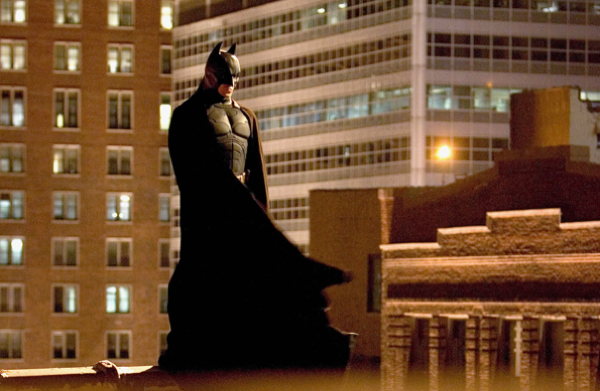 The action is secondary to the story, but Batman Begins still has some great action sequences. Most memorable is a chase sequence between Gotham police and the Batmobile which goes from rooftop to rooftop at one point. Nolan even punctuates the sequence with some fun humor from the police (“It’s a black … tank.”). The climactic action sequence between good guy and bad guy is dutifully thrilling and grandiose in scope. Nolan even squeezes in some horror elements into the film. Batman’s first emergence is played like a horror film, with the caped crusader always around another turn. The Scarecrow’s hallucinogen produces some creepy images, like a face covered in maggots or a demonic bat person.
There are only a handful of flaws that make Batman Begins short of being the best comic book movie ever. The action is too overly edited to see what’s happening. Whenever Batman gets into a fight all you can see are quick cuts of limbs flailing. My cousin Jennifer got so frustrated with the oblique action sequences that she just waited until they were over to see who won (“Oh, Batman won again. There you go.”). Nolan’s editing is usually one of his strong suits; much of Memento’s success was built around its airtight edits. He needs to pull the camera back and let the audience see what’s going on when Batman gets physical.
Another issue is how much plot Batman Begins has to establish. This is the first Batman film to focus solely on Batman and not some colorful villain. Batman doesn’t even show up well into an hour into the movie. As a result, Batman Begins perfects the tortured psychology of Bruce Wayne but leaves little time for villains. The film plays a shell game with its multiple villains, which is fun for awhile. The Scarecrow is really an intriguing character and played to gruesome effect by the brilliant Cillian Murphy. It’s a shame Batman Begins doesn’t have much time to develop and then play with such an intriguing bad guy.
Batman Begins is a reboot for the film franchise. Nolan digs deep at the tortured psyche of Bruce Wayne and come up with a treasure trove of fascinating, exciting, and genuinely engrossing characters. Nolan’s film has a handful of flaws, most notably its oblique editing and limited handling of villains, but Batman Begins excels in storytelling and crafts a superbly intelligent, satisfying, riveting comic book movie. The best bit of praise I can give Batman Begins is that I want everyone responsible to return immediately and start making a host of sequels. This is a franchise reborn and I cannot wait for more of it.
Nate’s Grade: A
Share this:

Sin City (2005)
 Like film noir on steroids. Director Robert Rodriguez has made the most faithful comics adaptation ever; giving life to Frank Miller’s striking black and white art. The visuals are sumptuous but the storytelling is just as involving, a perfect mix of noir/detective elements and subversive, highly memorable characters. Sin City may be the most violent studio film … ever, but the over-the-top tone keeps the proceedings from becoming too nauseating, even after limbs are lost, heads roll (and talk), and dogs pick away at living bodies. This is a very ball-unfriendly movie; lots of castrations. The blood even looks like fluorescent bird crap. The stories become somewhat repetitious (anti-hero saves distressed woman), but Miller and Rodriguez keep their tales tight, pulpy, comic, and unpredictable. My friend turned to me after it was done and said, “That was a great movie.” I could not argue.
Nate’s Grade: B+
Share this:

Constantine (2005)
 I’ll admit it; I’m a sucker for Christian mythology played against thriller and action settings. I may be the only person to have watched all of The Prophecy flicks, and probably the only person that eagerly chows down on the cheesy sequels to The Substitute, yet shy away from seeing the first film. I’m captivated by the imagery, the discussion of Heaven and Hell and its mythical logistics, and just the psychology of supernatural biblical beings. With this in mind, I was strongly anticipating the release of Constantine. What I got wasn’t exactly what I expected but I’d be lying if I said I wasn’t entertained.
John Constantine (Keanu Reeves) is a very troubled man. Since his youth he’s had to live with his gift that allows him to see through earthy disguises and witness angels and monstrous demons walking among us. He’s parlayed this ability into a modest side job of exorcising demons and sending them back to Hell. Constantine figures his loyal service should grant him passage into the pearly gates, but Archangel Gabriel (Tilda Swinton) reminds him that that’s not how it works. Constantine is doomed to go to Hell because he tried taking his own life, and if that’s not enough he also has terminal lung cancer from smoking like a chimney. “In other words, you’re f***ed,” Gabriel confides to Constantine.
 Police detective Angela Dodson (Rachel Weisz) is investigating the suicide of her twin sister (also Weisz). She swears her mentally disturbed sis wouldn’t do such a thing, and she seeks out the help of Constantine. He challenges her beliefs, stating that God and the Devil (Peter Stormare) have a wager over the souls of mankind but cannot directly interfere. But now something is breaking this rule and it looks like demons may be getting closer to entering our plane, and it looks like Angela’s dead sister may have known more than people would have thought.
The plot of Constantine is rife with contrivances, aborted subplots, underwritten and nearly forgotten supporting characters, and sketchy logic (staring at a cat can transport you to Hell? No wonder I’m a dog person). Often the film feels overwhelmed by good special effects, as they seem to be the crux of the film?s purpose of being and not, on the other hand, a theological playground of ideas. Constantine gives veiled glimpses of something smart, but routinely shuts that door to focus more on annoying jump scares.
In fact, Constantine seems rather old-fashioned with its theology, still clinging to the Roman Catholic belief that suicide is a one-way ticket to the fiery abyss. I understand its use as motivation for our lead, but will progressive audiences accept something they may find archaic? I suppose it could be worse. Constantine could have briefly gone to Hell for eating meat on a Friday.
It’s interesting that after spending two years making The Matrix sequels, Reeves would choose to attach himself to another big-budget theological action flick. His acting never really rises beyond morose loner but somehow he does make for a satisfying, brooding hero. Reeves? low-key monotone speaking voice allows him to spout cheesy dialogue with a straight face and mercifully keeps the audience grounded.
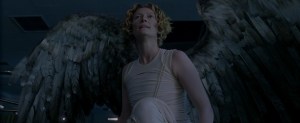 The true stars of Constantine are the memorable supporting players in this celestial smack down. Swinton uses her androgynous looks to forge what David Bowie might be like as an angel: angular, mysterious, waif, and somewhat creepy. Stormare delivers a performance so kooky and tic-heavy, that it could only be compared to the weirder moments of Christopher Walken. Both actors liven up the film and seem to be having the most fun by far with their cheeky roles.
The genius of Constantine is in its one-upsmanship game it holds with the audience. Granted, suspension of disbelief is needed to even go along for the ride, but when we start learning that Hell has its own line of bibles (and they’re longer) we’ve gone beyond suspension of disbelief and into wacky Anne-Heche-speaks-to-aliens land. While sitting through Constantine, we the audience think, “There’s no way this movie could get any sillier.” And then it does! We think, “Alright, that was crazy. Now there’s no way after that this film could get any sillier.” And then it does! Constantine is an amazing ascent into movie madness. After a while, I became drunk from the film’s insanity and wanted it to get even crazier, if possible. It almost seems like there’s a drinking contest between the movie and the audience, and Constantine isn’t afraid to piss its pants to win.
By the time Lucifer shows up, clad in all white like Tom Wolfe, and the Dark Lord appears to have Tourette’s Syndrome and/or a speech impediment, Constantine has hit the bottom of its Kool-Aid cup. Sure the film’s cinematography is slick, and the premise is intriguing, but the real draw of Constantine and the real enjoyment of the flick is how bat-shit crazy it is. I cannot even think of comparable films. I hope David Lynch was taking notes if he saw this.
For a while there, it seems director Francis Lawrence wanted Constantine to be a companion to Wesley Snipe’s Blade character. Maybe the two of them can set up a play date and go destroy otherworldly creatures. There’s a visually striking sequence late in the film involving Constantine in a room full of demons. He’s “contaminated” the water system by placing a giant cross inside, thus holy-fying the water before he can bottle it and sell it to the masses. He holds a lighter to the sprinkler system, demons growling all around him ready for their kill, and then water sprays down across the room. “Holy water?” one female demon says in a stunned voice, watching her flesh sizzle away. Then Constantine marches through the wet room blowing away demons into splashes of ash with his comically unwieldy cross-shotgun. It’s filmed wonderfully with dark hues and is a great idea; however, it’s a bit of a rip-off of the opening sequence in the first Blade.
 This seems to be a repeated sentiment in Lawrence’s direction. He has a sharp visual eye and several camera angles come from odd yet exotic places, but his film is borrowing so heavily from so many other films. What you’re left with is the impression of a stylish if very derivative looking action film. One exception is when Lawrence shows us glimpses of the blistering burnt orange world of Hell. It seems Hell is an exact model resemblance of Earth, only with the fire, brimstone, and crawling demons with their heads sliced open (there is a scary level beneath the surface where we witness a sea of people being tortured). The second or third time we traveled to Hell, I began to wonder what my house would look like and the logistics of upkeep for the homeowner in Hell. Surely the heating bills wouldn’t be the same.
Constantine is funny, frustrating, confusing, gorgeous, and just plain insane in the ole membrane. The film exhibits a rare and engaging form of insanity that may glue audience eyeballs to the screen to see what happens next. I’ve seen Constantine twice (don’t ask why) and even though I knew all the weird plot turns I still found myself getting an enjoyable contact buzz from the film. Who knows how long such a novelty can sustain itself, though. Comic book fans, especially those with a spiritual bent, should get a kick out of Constantine as will anyone else searching for a pristine example of how wonderfully out of control Hollywood moviemaking can be. Sometimes in a good way.
Nate’s Grade: B-
Share this:

Elektra (2005)
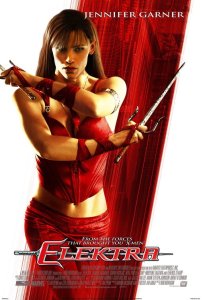 January is typically a cinematic wasteland. It’s the place where films go to die. So imagine my surprise when I heard that Elektra, a comic book movie built around a nimble sai-spinning assassin, was going to be released in January 2005. I remember at one time there were plans for a summer release, which means Elektra had fallen from the very top to the very bottom of expectation. After viewing Elektra for myself I can perfectly understand why anyone would want to dump this clunker.
Elektra (Jennifer Garner) is a feared assassin-for-hire (she even has an agent for her hits). She’s been brought back to life by a powerful sensei, but has ignored a possible higher calling to make her money killing folks. Apparently she is the mythical warrior that will keep the balance between good and evil, or something or other. Her next hit ends up being a nice guy (Goran Visnjic) and his teenage daughter. Elektra doesn’t have the heart to kill them, so she joins them and all three run away from the really bad guys, an ancient group known as The Hand.
Elektra doesn’t really bare comparison to other comic book films because Elektra feels more like a video game. In true video game fashion, I’ll numerically list the likenesses:
1) There is no such thing as characterization, just definition by super power. One assassin is super strong, another can suck the life out of creatures, and a third has the amazing ability to have his tattoos come to poorly rendered life (lucky this guy doesn’t have butterflies and fairies). With a powerful lack of imagination, these assassins are called Stone, Pestilence, and Tattoo (not the Russian girls who make out with each other. That’s Tatu.).
 2) The only sense of a story is pitting Elektra against one bad guy after another. There aren’t character arcs and subplots so much as there are end stage boss battles. It gets really repetitious.
3) The film seems like it’s bending over backwards to get character special moves into the story. With 1995’s Mortal Kombat, the writers, and I use that term in the loosest possible sense, had to work a story that included popular video game moves. Working so hard to include something so trivial and arbitrary really ties the storyteller’s hands. Elektra feels like the film would rather try and include some character’s special move rather than formulate a cogent storyline.
4) Once our assassins are vanquished they burst into clouds of yellow dust. I am not kidding. When they die they explode into clouds of mustard-hued gas. Just like in a video game, once you kill the bad guy they disappear with no necessary cleanup. It’s really thoughtful of them.
5) A second player can jump in at any time! In Elektra, different characters magically appear whenever it’s convenient and I?m not even talking about the super assassins.
6) Just like in a video game, you get an extra life! I don?t know why the producers of Elektra didn’t just make a prequel. With a sequel they have to work around their heroine’s untimely death in 2003’s Daredevil, and so we are introduced to the idea that a warrior of great mind can bring people back from the dead. So if Elektra dies (again) she can just be brought back to life. This whole idea practically eliminates any sense of danger and consequence.
So little of Elektra makes any kind of sense. Characters make rash choices and surprise appearances. The villains are a bland, cliched crop from some back order of ancient kung-fu brotherhoods. The plot is mysteriously oblique and has the frustrating habit of using cheats to get around logical roadblocks. About halfway through Elektra I gave up shrugging my shoulders and rolling my eyes. There is no definition on character limits, so anything can happen, and when it does it’s usually very stupid.
 Even worse is how dreadfully dull Elektra can be. The last two acts are compromised of nothing but a long, boring chase scene. The action sequences are brief and unoriginal, which include the thousandth inclusion of a hedge maze. There’s one moment where Elektra is battling in a room that has sheets flying all around for no good reason. It’s visually reminiscent of a Where’s Waldo? page. Take that for what you will.
The film is brisk, clocking in at just 90 minutes, but you don’t care about the characters because 20 minutes is spent establishing them, and the remaining 70 is spent watching them run.
The only redeeming quality of Elektra is its star. Garner is suited for the running, jumping movies, but she also has great acting chops behind her square jaw and impeccable physique. She casually generates intensity but also has a light, humorous touch. It doesn’t hurt that she looks fabulous in a red bustier. Her character is given OCD but then this plot is dropped entirely. Without the appeal of Garner, Elektra would simply be Catwoman.
Elektra is a flat comic adaptation that plays more like a video game, and just like in real life, watching a video game is no fun at all. Things happen, characters appear, people explode into clouds of yellow dust, and it’s all a bunch of uninteresting, half-baked nonsense. Elektra is frustrating, labored, ridiculous, and empty of thought and enjoyment. Why should I pay to watch Garner kick ass when I can watch Alias on TV and see Garner kick ass for free? And the plots of Alias are brazenly complex, fun, and high-spirited. I care about the people and events on Alias. With Elektra, the only thing I cared about was when the film was going to be over.
Nate’s Grade: D
Share this:

Catwoman (2004)
 Halle Berry has not exactly followed up her 2001 Best Actress Oscar with the wisest choices. There was a starring role in a James Bond movie, Die Another Day, there was Gothika, a spooker that didn’t scare anyone, except studio executives who saw the final gross. Now there’s Catwoman, a big-budget superhero film that’s got such a ripe odor to it to smell from miles away. It’s not good when a studio pulls a trailer because fans laugh at it, and it’s certainly not a good sign when the studio hires reshoots a month before the film is released. Catwoman’s looking for a big chunk of the superhero money out there, but will it land on all fours?
Patience Phillips (Berry) is a frazzled, down-on-her luck graphic designer at Hedare, a giant cosmetics corporation led by husband and wife team George and Laurel Hedare (Lambert Wilson and Sharon Stone). Patience is described as being “fun-deficient,” and lets people walk all over her. She tries saving a cat from a ledge one morning, and Officer Tom Lone (Benjamin Bratt) jumps out of his car to intervene, thinking she’s a jumper. He rescues her, though she doesn’t need it, and then asks to go out some time for coffee, the universal first date without it having to be a date.
 Patience is returning her designs late one night and overhears that Hedare’s newest product has the unfortunate side effect of making people’s faces melt if they discontinue use. The Hedare goons chase her down a water drain and flush her into a river. She’s revived somehow by the same cat she tried saving from the ledge. Patience reawakens with superhuman powers, heightened sense, and expert agility. There are some kinks, though. She sleeps in odd places, gobbles tuna by the handful, and loves to swing a whip. Who knows what she does to go to the bathroom. The new Patience is a bit confusing to Tom, but he goes along for the ride. He’s also on the hunt for the Catwoman, a mysterious leather-clad woman responsible for some jewelry theft. Patience unravels Hedare’s cosmetics conspiracy and aims to stop George and Laurel from mass production, all the while staying one step ahead of her boyfriend’s investigation. But Laurel is also experiencing some growing pains of her own. Unsatisfied with being pushed out her company’s advertising spotlight for being “too old,” she begins using heavy amounts of their newest beauty product and makes her skin as tough as living marble. With this new power, she schemes to retake power from her husband, as well as eliminate a pesky Catwoman.
Let’s not mince words and get directly to the elephant in the room: Berry’s hideous, trashy costume. This is, by far, the worst costume ever in a superhero movie, and possibly the worst costume in cinematic history. It’s so overwhelmingly ridiculous that perhaps the filmmakers felt Catwoman’s ultimate weapon against evil was having it die from laughter. It’s a bizarre combination of a mask with large mouse ears, leather bra, criss-crossing belts, gloves with diamond-tipped nails, and leather pants that look like they were mauled by a bear. Oh, and then there’s also the open-toed shoes. What? A superhero who wears open-toed shoes? All evil doers would have to do is step on her feet. The only purpose the outfit serves is to make Berry look sexy, but you didn’t need a stupid, tacky outfit for that.
The story of Catwoman takes a giant leap into weird mythology. Apparently, possibly immortal cats decide someone will become a Catwoman, a woman we’re told is not bound by our foolish rules. There’s no explanation why the cats choose who they do, what the purpose of this is, or what is even expected in return. We do get a montage of Catwomen through the ages dating back to ancient Egypt. Apparently, Catwomen follow the same lines of mythology like Buffy the Vampire Slayer: “Unto each generation, a Catwoman is born.” It’s also kind of funny that a film called Catwoman, about mythic Catwomen, has a crazy old cat lady (poor Ruth Fisher).
 The villainous scheme in Catwoman is awful. I can’t imagine the FDA not having some grumblings when their test bunnies start having their faces melt off. More importantly, what company would EVER release a product that melts your face in our litigious society? Just think of the mounting class action lawsuits that could very likely bankrupt that company. So, right there the villain’s plot is moronic for two big reasons. Don’t even get me started on Stone’s superhuman strength aided by the beauty cream we learn melts faces.
The acting is what you would expect. Berry is a beautiful woman, no doubt, but her performance is split between flighty wallflower and naughty dominatrix, neither of which is convincing. Bratt is the worst police officer ever (he can’t identify Catwoman even though only a tiny part of her face is obscured) and tries valiantly to hold his own amongst the ridiculousness. Wilson was such a stock corporate villain that they could have erected a cardboard cut-out of him and gotten the same performance. I never thought I’d say this, especially after The Muse, but Sharon Stone is the best thing about this movie. She’s an ice queen, but an entertaining one until she goes overboard on her beauty cream.
Catwoman is the first superhero film for Warner Brothers since their disastrous franchise-killing Batman and Robin in 1997. It’s hardly a coincidence that Catwoman is the also the worst superhero film since Batman and Robin. The film is trying really hard to be Spider-Man. Before her feline transformation, Berry is a frumpy dweeb, and afterwards she gets heightened senses, a new jolt of self-confidence, and the love of her man. Catwoman even has the guts to rip-off Daredevil, an amusing but fairly flawed movie itself trying to be Spider-Man. There’s a scene where Patience and Tom play a competitive game of basketball surrounded by chanting children. This is a direct rip-off of the scene in Daredevil where Ben Affleck and Jennifer Garner play fight on a playground. I don’t know about you, but when you’re ripping off Daredevil of all movies, you have problems.
This film has five credited writers, which works with my Rule of Five for films: if there are five or more people responsible for the script, then there was no script. Who amongst the five wants to take credit for all the dreadful cat puns in the dialogue, like Catwoman saying, “What a purrr-fect idea.” There’s also this wonderful repartee where Laurel says, “For you, Patience, it’s game over.” Then Catwoman responds, “It’s overtime!”
 Catwoman is director Pitof’s (perhaps short for Pitof-ful?) first real break as a director. He began his career as a visual effects artist on films like Alien: Resurrection, City of Lost Children, and The Messenger, but can anyone recount a visual effects artist that went on to become a decent director? (If you bothered to answer with Joe Johnston, then I don’t think you understood the question)
Movie Director Pitof has a love for cheesy CGI shots, but what’s more harmful is his penchant for confusing quick-cut edits. After watching Catwoman, I had to pop some Advil when I got home because the film’s editing had actually caused me a headache. It became so annoying that I started counting “one Mississippi, two Mississippi, etc.” to gauge the average length of a shot. Let’s just say that we didn’t make it past “one Mississippi” about 95% of the time. Now, there’s nothing inherently wrong with quick-edits; The Bourne Supremacy used them effectively to keep a lively, unpredictable experience. Catwoman’s editing is just jarring, especially during action sequences where you’d be hard-pressed to figure out what’s exactly going on.
The effects work is also rather pathetic. Pitof adores zooming exterior shots that become tiresome after the eighth or ninth time. Worse are all the scenes where Catwoman jumps and leaps through the city like she’s Spider-Man’s long-lost sister. The film is bending over backwards to try and ape Spider-Man, and these joyless, silly sequences of CGI Halle Berry crawling and jumping around the city don’t help the comparison. I do suppose that making a CGI Halle Berry flex and bend in her leather outfit was probably the most rewarding work for an animator since digitally making a breast grope itself in Hollow Man.
Who exactly is this movie intended for? If the filmmakers were going for fans of the Catwoman character, then why did they break away from the comic’s history and create something distant and different? If the filmmakers were strictly making an action movie, then why all the visual fluff, idiotic romance, and headache-inducing editing? I suspect that the producers felt that the names Catwoman and Halle Berry would be enough to put butts in the seats. So, then, I deduce that the selling point of Catwoman is, “Wanna see Halle Berry in a sexy leather outfit?” Now, most males will say, “Sure thing,” but why would they pay seven to ten dollars to see sexy non-nudity when they could go online. The short answer to who this film is intended for is, of course, no one.
 Catwoman is derivative, incomprehensible, dumb, and just plain boring. The only people who will get a kick out of Catwoman are either hormonal teenagers aroused by Berry’s outfit, or those who enjoy jeering a terrible movie. I can’t even recommend seeing Catwoman because of its ineptness. It’s bad, oh boy is it bad, but it’s not insanely idiotic like Bulletproof Monk or Dungeons and Dragons to the point where the lunacy is a must-see. It’s just boring bad, enough that it almost put me to sleep.
Perhaps the funniest thing of all, Berry has publicly stated in interviews weeks after Catwoman’s release that she’d love to don her leather outfit and do a sequel. Maybe she needs to talk to the producers who lost a bazillion dollars and inadvertently created a midnight movie howler. Catwoman will certainly get delegated to the litter box, but how many lives does Berry have left in Hollywood?
Nate’s Grade: D
Share this:

Hellboy (2004)
 Guillermo del Toro loves things that go bump in the night. The Mexican born writer/director has shown prowess at slimy, spooky creatures with Cronos and 1997’s Mimic. He helmed the 2002 sequel to Blade, which had super vampires whose mouths would open up into four sections with rows of chattering teeth. The man sure loves his movie monsters. del Toro also loved Mike Mignola’s cult comic book Hellboy enough to turn down directing Harry Potter 3 and Blade 3 to ensure he could bring Hellboy to the big screen. Was it worth the sacrifice?
Let me just explain to you the villains of this movie as an example of how ridiculously stupid Hellboy is. The villains are Nazis. Yes, the tried and true villains everyone can hate Nazis. But these ain’t yo daddy’s Nazis; they’re immortal and led by zombie Rasputin (yes, the Rasputin). They all wish to puncture a hole into another dimension. What’s in this alternate dimension? Why nothing except for a giant floating spaceship that houses, I kid you not, the Seven Gods of Chaos, which all happen to be gigantic space squids. Why would anyone create a universe that has nothing but the imprisoned gods of evil? That seems awfully precarious. How exactly are giant squids going to take over the industrialized, nuclear-age world? Shoot ink at everyone? Sorry, space ink?
 Let me not forget a Nazi assassin and his handy dandy arm-length blades. This assassin is also 100 years old and his body is filled entirely with sand. He winds himself up like a big clock. But if his body is filled completely with sand how can the clock gears work inside? You see what the normal audience member has to deal with? Plus these are just the villains, there’s a whole plot left to toil over as well.
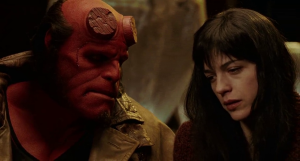
The story revolves around a hulking, red demon named Hellboy (veteran character actor Ron Perlman). Hellboy escaped the space squid dimension in the 1940s when the Nazis unsuccessfully tried to open a dimensional hole large enough for your everyday on-the-go space squid. Now, Hellboy is an elite soldier for the governments Bureau of Paranormal Research. He fights the creepy crawlies. He has to deal with a wide-eyed rookie, the watch of his father (John Hurt) and an attempt to rekindle a romance with a mentally troubled fire starter (Selma Blair). Oh yeah, and all the Nazi/Rasputin/space squid stuff mentioned before.
Perlman is really the only redeeming thing about this movie. The makeup is impressive, and he gives an enjoyably droll performance as a man who fights monsters with the same ho-hum-ness as a plumber reacts to clogged sinks. The rest of the acting runs the gambit of either being too serious (Im looking at you Blair) or just too over-the-top silly (Im looking at you, league of villains).
Hellboy is strung together with bizarre inanities, flat one-liners, heavy Catholic imagery, conflicting logic and contradictions, ridiculous villains, painful comic relief, half-baked romance and frustratingly ever-changing plot devices.
Watching Hellboy is like playing tag with a kid that keeps making up new rules as he goes (“You cant tag me; I have an invisibility shield!”), and after awhile you lose any interest. Late in the film, the Nazis will all of a sudden decide not to be immortal, and at a very inopportune time. Why? How? I don’t know. Hellboy also gets sudden new powers for some reason. Like he can bring people back to life by whispering otherworldly threats in their ears. For some reason nobody’s clothes burn when theyre set on fire.
 Not only does Hellboy frustrate by changing the rules of its world arbitrarily, it will also frustrate out of sheer uninhibited stupidity. How come characters cant hear or see a pendulum the size of the Chrysler building? How come during a vision of the apocalypse we see a newspaper that actually had the time and staff, during the Apocalypse, to print an issue that reads, “APPOCALYPSE”? Why doesn’t Blair use her pyro superpowers immediately to vanquish all the H.P. Lovecraft creatures instead of letting Hellboy foolishly wrestle with them all? The gaping holes in Hellboy are large enough to squeeze a gigantic space squid through.
All this frustration and insanity might have been moot if the action sequences were somewhat thrilling. Sadly, they are not. Del Toro’s action sequences seldom matter. There’s such little consequence of what’s going on that the action becomes stiff and lifeless. The first time we see Hellboy chase a creature through city streets it’s a fun experience, but soon the novelty wears off. The overuse of CGI wears down the audience, and after the third or forth time we watch Hellboy battle the same monster, the audience is ready to go to sleep. There’s little entertainment in the film’s action sequences, but just as much frustration and stupidity.
I have never watched a film that induced more eye rolls, shoulder shrugs, raised eyebrows, pained and confused glances and mutters of, What the hell (boy)? By the time the resurrected torso of a Russian skeleton appears to make cheesy puns and wisecracks, you should have left the theater, demanded full compensation, and maybe, if you’re into it, destroyed whatever Hellboy display was within burning distance. Comic book aficionados may enjoy the fruits of Hellboy but general audiences will simply shrug. I’m amazed that the majority of film critics seem to think positively about this movie. Maybe I’m the last sane person in an insane world but Hellboy is one of the worst films of the year and one of the craziest films you could ever hope to see in a lifetime.
Nate’s Grade: D+
Share this:

The League of Extraordinary Gentlemen (2003)
 This movie is certifiably insane. While a very literary X-Men seems like a great idea, what exactly does Tom Sawyer bring to the table? What, is he going to convince the bad guys to white wash a fence? And yet, this highly operatic bombast almost succeeds on its sheer level of lunacy, like when you realize you’re watching Sawyer get a crush on a vampire on a giant underwater submarine that’s so big it has end tables and vases in its hallways. Still, the handling of Jekyll/Hyde here is what Hulk should have been like. League of Extraordinary Gentlemen almost works, but its falls apart amidst shabby special effects, outlandish plotting, and very wooden dialogue. The director doesn’t make it any easier to follow, trumping his action sequences with rapid fire edits. Ah well, my bafflement was more entertaining.
Nate’s Grade: C


 nathanzoebl
You must be logged in to post a comment.