Blog Archives
Watchmen (2009)
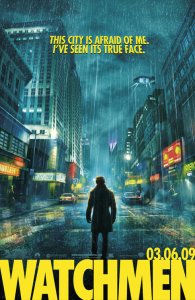 In the realm of comics, Watchmen is tantamount to the Bible. It consisted of 12 issues released between 1986-1987 but it arguable changed the medium forever afterward. TIME magazine listed the book, by author Alan Moore and artist Dave Gibbons, as one of the 100 greatest 20th century novels. Therefore, there has always been heavy trepidation within the geek community when Hollywood came courting the Watchmen property. Different directors have tried tackling the material, going back to the late 1980s when Terry Gilliam was hired to direct and producer Joel Silver was adamant about getting Arnold Schwarzenegger to portray Dr. Manhattan (back then, they totally just would have painted him blue — like they did when he was Mr. Freeze). The movie would seem like a tantalizing possibility and then the production would collapse, most recently in 2004 with director Paul Greengrass attached. Director Zack Snyder (300) understood all of the concerns from the notoriously vocal geek community and attempted to make the most faithful Watchmen film possible. He accomplished that goal. But was it the right goal?
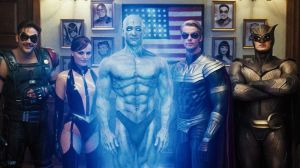
In this alternative account of history, masked crime fighters exist and were even bankrolled by the U.S. government. President Nixon is re-elected to a third term, thanks in part to superheroes winning the Vietnam War, and then he outlaws all masked vigilantes. Flash forward to 1985, and Nixon is on his fifth term and staring down Soviet aggression into Afghanistan. It appears that the world on is on the brink of nuclear annihilation by the dueling super powers engaged in a staring contest. Edward Blake, a.k.a. the Comedian (Jeffrey Dean Morgan), is thrown from his apartment window and killed. Blake used to belong to a second-generation superhero team in the 1970s called the Watchmen. The other members consisted of Dan Dreiberg, a.k.a. Night Owl (Patrick Wilson), Rorschach (Jackie Earle Haley), Adrian Veidt (Matthew Goode), a.k.a. Ozymandias, the glowing blue man Dr. Manhattan (Billy Crudup), who was transformed into a god-like figure of power after a laboratory accident, and then there’s Laurie Jupiter, a.k.a. The Silk Spectre (Malin Akerman), who was following in her mother’s (Carla Gugino) footsteps, the first Silk Spectre. The death of the Comedian brings the old team back together and rekindles some interest in putting on the super suits and fighting crime one more time. It seems someone out there is trying to knock off the retired superheroes, and Rorschach is convinced that a bigger conspiracy is unwinding.
 It’s difficult for me to formally express my feelings and reactions to the Watchmen film adaptation. Count me among the throng of fans that feels that Moore’s source material is a remarkably dense and witty deconstruction of the superhero mythos. Imagine a Superman that can’t be bothered to help out humanity because he feels life is overrated, or a group of super heroes that don’t necessarily do anything heroic; when they beat up the bad guys it’s because they get a sexual thrill from the rush of violence. My voice was among the cacophonous crowd screaming, “Don’t you dare butcher this great work! Keep it as close to the comic as possible!” And that’s pretty much what Snyder delivers. But now I’m left to wonder if a literal-minded interpretation is truly what I wanted all along. Watchmen is not like Sin City, a comic that was already a movie in panels. Frank Miller’s ode to film noir was ready and waiting to be a splashy action movie with style to spare. Watchmen is not a ready-made action vehicle, as it really only has about two extended pieces of action. Moore’s story examined what kind of people would become vigilante crime fighters if the government approved the practice. Surprise, it’s a bunch of sociopaths that are now getting checks from Uncle Sam! Watchmen is a nihilistic account of human behavior and far more cerebral than any superhero film that has ever graced the screen. Seriously, what other superhero movie opens with a fictitious episode of PBS’ political yak fest, The McLaughlin Group? So I suppose this paragraph is a sheepish way of admitting that perhaps Watchmen should have stayed place on the page unless, gulp, it was advantageously adapted for the medium of film.
It’s not that Snyder does a bad job or that the film itself is poor. While Snyder isn’t the best man to handle actors, he is certainly a skilled visual tactician and knows how to make some immensely pleasing imagery. He breathes great life into the images of the comic book and filled in the blanks nicely, and his one big artistic addition is one of the film’s best moments. In the opening credits we get a series of shots that perfectly establish this alternative universe, where JFK shakes Dr. Manhattan’s hand on the White House lawn only to be later gunned down by none other than the Comedian in Dallas. The segment is cleverly set to Bob Dylan’s “The Times They Are A Changin'” and is a terrific intro into a re-imagined America. I wanted to spend more time exploring the differences, like watching a giant Dr. Manhattan win the Vietnam War in one week’s time. In many ways, Watchmen is Snyder’s epic pop commentary on the history of the United States. Dr. Manhattan takes the first pictures of the astronauts on the moon. It is a female crime fighter that swoops a woman off her feet for that iconic celebratory kiss marking the end of World War II. The flick even has a period appropriate, synth-aided score, which is fine, though the use of period pop songs can be distracting. Watching Laurie and Dan make love to the raspy tunes of Leonard Cohen’s already overused tune “Hallelujah” is a deeply uncomfortable moment. Also, the aging makeup is horrendously bad. Gugino looks like she has a turkey waddle and the older Nixon looks like a freaking Halloween mask.
 At what cost did Watchmen make it to the screen? Wacthmen plays as an adaptation like the first two Harry Potter movies, like there was an assigned checklist rather than a fully developed script. I achieved a brief understanding with the characters and each central figure provides a glimpse of the trouble beneath the surface. Laurie is a girl with daddy issues who’s been pressured to follow her mother, a rape victim who still loves her rapist. Dan is a self-pitying putz who has never felt more alive than when he puts on a costume. Rorschach has the same pessimistic view of mankind that Travis Bickle did, viewing many people as vermin clogging the gutter. Yet Rorschach also is the most single-minded of all the characters and abides by an innate moral code and sense of duty, never mind the fact that he may have lost his mind. Dr. Manhattan has been turned into a supreme being and has lost his connection to humanity. The Comedian is a man of wanton desire who declares himself to be the epitome of the American dream: giving in completely to the id. Watchmen has been deemed as an unfilmable book, and perhaps they were right. It feels like Watchmen and looks like Watchmen, but the movie never seems to become anything grander than the sum of its parts. The Dr. Manhattan back-story, where we see him live life in the past, present, and future simultaneously may be one of the best moments in the movie, but it doesn’t add up to much more than an interesting aside. The trips to Mars and Antarctica provide nice visual landscapes but do little else. The other quandary is that everything Snyder cut from the comic (the side characters, the pirate comic, the alien squid) is something that ultimately was unimportant. All of the important and memorable moments from the comic are here, though abbreviated and truncated. Even a 2-hour and 40-minute movie feels like too much of a sprint through such rich material probably better suited to the more accommodating narrative confines of a glossy HBO miniseries. The movie ends up becoming a handsomely mounted and reverent homage to the source material, but I question if the movie serves any other purpose than as an advertisement to go read the book. Will people unfamiliar with the book enjoy a movie practically tailor-made to appeal to fans of the book? Who will watch the Watchmen?
Make no mistake, Watchmen is a hard R-rated movie and if any parent takes their child to this flick because it has men in capes, then that parent should have their child removed. Snyder has ramped up the book’s adult elements, which were originally a commentary on how comics flirt with sex and violence but never get their hands too dirty. Snyder has gotten his hands dirty all right. Instead of zapping others into poofs of smoke, Dr. Manhattan turns them into explosions of human goo that stick to the ceiling. Instead of the Comedian being thrown from the window, we see an extended fight sequence that seems to indicate that the Comedian’s apartment is full of nothing but breakable glass tables. When Dan and Laurie get into a street brawl where bones pop through skin. The sex scenes now involve an almost-agonizing level of thrusting. This is an adult tale in a very simple sense: there are boobs and blood. But the movie is also adult in the fact that it trades in complex political, psychological, and philosophic ideologies, asking hard questions that do not come with easy answers. Do the ends ever justify the means or is mankind destined to always destroy itself? Is humanity worth saving and at what cost? This is probably the most subversive studio-backed movie to come out of Hollywood since 1997’s pro-fascism melodrama, Starship Troopers.
 The three best performances in the movie all come from the three weirdest and most messed up characters. Haley (Little Children) fully inhabits the grisly character of Rorschach and growls his way through the movie. You can tell just by the man’s face how much he has weathered. Crudup (Big Fish) and his gentle voice make Dr. Manhattan an intriguing yet beleaguered super being. Morgan (TV’s Grey’s Anatomy) makes the Comedian one consummate bastard but a bastard that you cannot stop watching, nonetheless. The rest of the cast does suitable jobs and I don’t feel that Goode (The Lookout) or Akerman (27 Dresses) deserve the drubbings they’re getting through the critical community. I actually liked Goode’s portrayal of Ozmanydias, though he fails to express the heavy crown the smartest man in the world must bear. Gugino (Sin City) is terrific when she’s the young, spunky Silk Specter and the opposite of terrific when she’s the troubled, alcoholic older version on screen.
Snyder has served up the Watchmen that fans have been demanding for years, but is this really what everyone truly wanted? Snyder made an adaptation for the fans but what do the fans know except for lavish loyalty? The book utilized the medium of comic books to accentuated its story while commenting on the history of comics and superheroes, and when translated to the big screen as is Watchmen can feel like an artistic stillborn. I’m now more curious than ever to read the previous drafts out there, the ones that directors like Darren Aronofsky and Greengrass were going to film until the financing got pulled. One of the drafts transplants the world of Watchmen to modern day and replaces the nuclear brinksmanship with the Russians to the ongoing War on Terror. It may not be faithful to the fabulous source material, and it quite possibly would have made a terrible movie, but it would have been more interesting as a film project because it would have been an adaptation. Snyder’s Watchmen is reverent to a fault but I cannot complain too much. This is likely the most faithful recreation of a complex book that fans could hope for. I feel satisfied and yet unsatisfied with the finished product. It was everything I was looking for in a Watchmen movie and maybe, in the end, that was the problem. I think instead of buying the DVD I may just read the book again.
Editor’s Note: I have warmed up to this film much, much more on Blu-Ray, especially the 3-hour director’s cut. It’s Snyder’s best work to date.
Nate’s Grade: B
Share this:

The Incredible Hulk (2008)
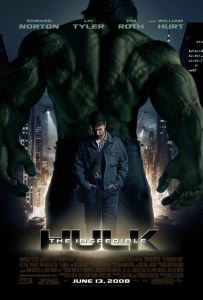 Maybe the American public just doesn’t care for the jolly green giant. The second incarnation of a big screen Hulk flick is better paced, with more action sequences and better special effects, but I just kept shrugging my shoulders the whole time. I was never truly engaged by the movie at any point. Edward Norton fills the role of Bruce Banner for the second go-round and does an admirable job. The climax involving one giant CGI monster battling another giant CGI monster gets tiresome. This is a fairly middle of the road movie that might pass the time but does little else with style.
Nate’s Grade: C+
Share this:

The Dark Knight (2008)
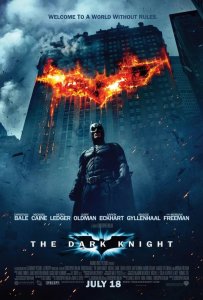 In 2005, Christopher Nolan’s reboot of the Batman series was a critical and commercial success. Gone were the campy and opulent sequences of old and the nipples on the Batsuit felt simply like a bad dream. Nolan served as director and screenwriter and brought serious psychological depth to his story and characters. As a life-long Batman fan, I loved it and wanted a sequel immediately with the exact same people responsible. The Dark Knight has been overshadowed by the passing of actor Heath Ledger, a gifted young actor nominated for a Best Actor Oscar for 2005’s Brokeback Mountain. He’s gone from gay cowboy to the criminally insane, and it’s all anyone can talk about. The buzz on Ledger and The Dark Knight is deafening and I am about to join that joyous chorus. This is a movie for grown-ups and makes lesser super hero adventures look downright stupid.
Bruce Wayne (Christian Bale) is dealing with the repercussions of his choice to assume the masked identity of Batman. He’s cracked down on Gotham City’s mobsters, and in their desperation they have turned to a crazed anarchist that likes to wear strange makeup. The Joker (Ledger) promises to return Gotham back to its old ways but even he knows this isn’t possible. “You’ve changed things,” he tells Batman. “There’s no going back.” The Joker wants to break the will of Batman and Gotham City and sets up elaborate and disturbing moral dilemmas that push many to the edge. His purpose is chaos, which isn’t exactly what the Mob had in mind when they subcontracted his services. Bruce must rely on his trusted butler Alfred (Michael Caine) and company tech guru Lucius Fox (Morgan Freeman) to help him combat a man that “just wants to watch the world burn.” Gotham also has a new district attorney, Harvey Dent (Aaron Eckhart), who is willing to put his name on the line to clean up the city. He’s butting heads with Lt. Gordon (Gary Oldman) because of Gordon’s secrecy and his reliance on Batman to do the things the law won’t allow. Dent wants to prosecute mobsters and is willing to put himself in jeopardy. He believes Batman is waiting for men like him to take the baton. Bruce’s old squeeze Rachel Dawes (Maggie Gyllenhaal replacing Katie Holmes — upgrade) has fallen for Dent. He’s an emotionally available man who wants to do good. Naturally, Dent and Rachel will becomes targets of the Joker.
 First off, believe the hype because everything you’ve read and heard about Ledger’s performance is the gospel truth. The actor vanishes completely underneath the gnarly latex scars, stringy hair, and smeared makeup. He transforms into this menacing figure and he makes Jack Nicholson look like a circus clown in comparison. He’s creepy and funny in a totally demented and spooky way, but he almost comes across like a feral creature that enjoys toying with his prey. Ledger fully inhabits his character and brings a snarling ferocity to the role. The Joker is given no back-story and he takes a macabre delight in crafting differing versions of his sordid past depending upon the audience. Ledger’s Joker is like a mixture of sadist and intellectual, of Alex from A Clockwork Orange and Hannibal Lector; he finds a way to get inside your mind and unleashes torment. There’s a great scene where he’s left alone in a holding cell with a police officer. The Joker taunts the man, getting little reaction from the trained lawman, but then he hits a nerve. The Joker asks how many of his friends, his fellow officers has he murdered. He then rhapsodizes the finer points of using knives instead of guns because guns are too quick. With knives he can see who people truly are in the final moments of existence. “So in a way, I know your friends better than you ever did,” he tells the officer. “Would you like to know which of them are cowards?” This triggers the officer to break his protocol and play into the Joker’s scheme. I’m not ready to say Ledger’s performance overtakes Javier Bardem’s Anton Chigurh (No Country for Old Men) as the most menacing villain of late, but Ledger certainly will make your skin do more than crawl.
Ledger gives a performance worthy of posthumous Oscar consideration. Toward the end of the film I found myself lingering on sadness that, well, this was it. This is all we are ever going to get of the Joker, such a fabulous character, but even more, this was the last full performance we are ever going to get from Ledger. His unnerving performance will stand the test of time when it comes to haunting screen villains, and I’m sure the actor had many more incredibly performances left in him before he passed away.
 The Dark Knight has less in common with other superhero series and should be considered a modern crime drama. It has more in common with Heat than with Spider-Man. Even compared to Nolan’s excellent Batman Begins, this is the first Batman film that feels like it occurs in a real city in our own reality. In Batman Begins, we had the CGI ghetto that happened to be conveniently where all the city’s scum lived, an ancient league of ninjas that wanted to wipe an entire modern city off the map, and then a super microwave that zapped water molecules in the air. Even though it was the most realistic Batman yet, it still had some fantastic elements that kept it from feeling fully believable. This newest Batman adventure feels more like a real city and a city that is being torn apart. You get to see a lot of Gotham City’s moving parts and different social circles and then see the Joker tear them apart. The knotty screenplay by Christopher Nolan and his brother Jonathon is dense and packed with subtext and ambiguity not seen in the likes of other spandex-clad super hero movies. This isn’t a super hero movie so much as an enthralling crime thriller with better gadgets.
Whereas Batman Begins focused on the psychology of a man that dresses up in a costume and fights crime, now the attention turns into examining the impact of Batman. There has been escalation, just as Gordon hinted at the close of the last film. Batman has stepped up law enforcement and now Gotham’s criminal element has placed their trust in a psychopath that promises results. This is a movie about symbols and ideals and about the tenets of civilization. The movie presents an arsenal of mature questions and rarely gives absolute answers. Batman I supposed to be a hero but does he play by the law? Can he make decisions that no one else can? Batman believes in the goodness of others and serves as a symbol for the city to stand up against corruption, but can Batman be corruptible? Does he have a breaking point? Is implanting hidden surveillance and spying on 30 million people in the name of security overstepping? Is it acceptable to cross a line if your enemy crossed it first? The Joker lives at the other ideological end and believes that human beings are selfish and will eat each other when the chips are down. He devises disturbing social experiments that test the limits of ordinary citizens and how far they are willing to go out of self-interest. The Joker is an anarchic force that seeks to tear down civilization itself, and that is a far more interesting and devastating plot than vaporizing water molecules with ninjas. When the movie covers the tired “we’re one in the same” territory that most super hero flicks hit (the Joker responds to Batman with, “I don’t want to kill you. What would I do without you? You complete me.”), it even makes sense given the psychological and philosophical complexity at root.
And oh boy, is The Dark Knight dark. This flick racks up a body count that could compete with movies usually involving some cataclysmic act of nature. The Joker’s unpredictable nature, and the dark twists the film plumbs, creates an atmosphere where you dread anything happening at any time, and mostly bad things happen. Batman must come face to face with his limitations and the realization that his actions, no matter how altruistic, will have negative consequences. This is not a movie for young children. If any parent buys their child a Joker doll and takes them to see this movie then expect years of therapy bills down the line. Much of the violence is implied but the overall effect is still chilling. It’s difficult to call The Dark Knight a “fun” movie. Batman Begins was fun as we followed Bruce Wayne tinker and become his crime-fighting avenger. This movie watches much of what he built get taken away. The movie makes gutsy decisions and for a super hero movie, let alone a summer blockbuster, and this is one decidedly dour flick where no character ends in a particularly pleasant place, especially poor Harvey Dent.
 Speaking of Mr. Dent, while Ledger is deservedly getting all the buzz and plaudits, Eckhart’s excellent performance is going unnoticed. Dent gets just as much screen time as Batman and is the white knight of Gotham, the man unwilling to break the boundaries of the law to merit out justice. Like Batman, he serves as a symbol for Gotham City and its resurrection from the stranglehold of crime. Batman fights in the shadows and serves as an anonymous vigilante but Dent is the face that can inspire the city. That’s what makes his transformation into Two-Face all the more tragic. You really do care about the characters in this movie, so when Dent turns on his principles and seeks out vengeance you feel a weighted sense of sorrow for the demise of a truly decent man. Eckhart and his lantern jaw easily sell Dent’s idealism and courage. After his horrific transformation, Eckhart burrows deep enough to show the intense hatred and mistrust he has even in fate. He gives a terrific performance that plays a variety of emotions and does justice to them all.
The rest of the cast, just to be mentioned, is excellent yet again.
Nolan has also stepped up his directing skills and delivered some high-intensity action. His first foray with Batman had some dicey action sequences that suffered from choppy editing, but he pulls back his camera lens and lets the audience see the action in The Dark Knight. The explosive high point is a long car chase where the Joker tries to attack an armored police car via an 18-wheeler truck. The police look for safe detours to escape the Joker’s line of fire, and when Batman surfaces with the sleek Batpod motorcycle thing get even cooler. What makes the sequence even better is that all of the peripheral characters behave in semi-logical ways, meaning that your secondary cop characters are respectable decision makers. Nolan also shot several sections of the film in IMAX, which boasts the highest resolution possible for film stock. The panoramic views of Batman atop buildings are breathtaking and may strike vertigo in some moviegoers. The movie looks great and it delivers the action goods but it’s really more of a tense thriller with more tiny moments of unease than an out-and-out action flick with gargantuan explosions and blanket gunfire.
Despite the undeniable brilliance of The Dark Knight, the movie is rather exhausting. After a decent 45 minutes of establishing the characters and setting up the stakes, the movie is essentially two hours of climax after climax, and you will be perched on the edge of your seat and tense until the end credits crash onto the screen. It’s exciting and overwhelming but you will feel wiped out by the end of the movie. There are a lot of characters and a lot of subplots and while I’m thrilled the movie has so much intricacy it also makes it hard for the film to come to a stop. The climax with Two-Face and Gordon’s family also feels misplaced. At a tremendous 2 hours and 30 minute running time, The Dark Knight will test your endurance skills in the best way.
 I honestly have no idea where Nolan and crew can take the story now. The Dark Knight seems unlikely to be topped. This is an intense, epic crime thriller with a labyrinthine plot that is packed with emotion, subtext, philosophy, penetrating open-ended questions, and genuine nerve-racking tension. It’s hard for me even to think of this movie as a super hero flick despite that fact that it’s about a billionaire in a rubber suit. This is an engrossing modern crime drama that just so happens to have people in weird costumes. Nolan and his brother have crafted a stirring addition to, not just the Batman canon, but to cinema as a whole. Ledger’s character is the driving force behind the film, the man that makes everyone else react, and his incredibly daring and haunting performance will stand as a last reminder of what talent was lost to the world when he passed away. I for one will be amongst the throng crying out for Oscar recognition but not just for Ledger, for The Dark Knight in general. And I may not be alone. The Dark Knight is currently breaking every box-office record imaginable and seems destined to finish as the number two highest grossing movie of all time, steadily behind James Cameron’s Titanic. If the Academy is looking for a way to shore in better ratings for the Oscars, it might seriously consider nominating The Dark Knight in some key races. It certainly deserves recognition.
Nate’s Grade: A
Share this:

Wanted (2008)
 Wanted isn’t so much a movie as a fetish vehicle for teen males, with sexy cars, sexy guns, and sexy tatted-up Angelina Jolie, daring the predominantly male audience to decide which is sexiest (I am not a car aficionado nor a gun person, so I’ll say that Jolie easily outpaced her competition).
Wesley (James McAvoy) is a pathetic office drone that sweats out his days never raising his voice. His best friend is constantly screwing Wesley’s bitchy girlfriend, his boss constantly harangues him into panic attacks, and, saddest of all, a Google search results in nothing for Wesley Gibson’s name. He tells us he has done nothing with his life. This all changes when a mysterious woman named Fox (Jolie) tells Wesley that the father he never knew has just died. Not only that, Wesley’s father was one of the world’s greatest assassins and he might just be a chip off the old block. Wesley is recruited into The Fraternity, a thousand year-old organization whose membership includes the best-trained killers. Sloan (Morgan Freeman) is the leader who assigns the targets. He gets his orders, literally, from the Loom of Fate, a weaving loom that writes binary letters via stitches. The Loom of Fate decides whom the planet would be better off without. Fox and her cohorts train Wesley to accept his destiny and avenge his father’s murder.
 The movie fails to establish any form of internal logic or continuity, so anything preposterous suddenly becomes accessible. That means people can jump from one skyscraper to another, you can outrun a moving train, cars will do the damndest things, and that you can curve a bullet simply by rotating your hand and shutting off that little part of your brain that says, “This is defying all laws of physics.” For some reason, people are able to shoot bullets down in mid-air as a defensive maneuver but they rarely take aim at the person, surely a bigger and slower target. It’s like The Matrix outside of the Matrix with no reason for being Matrix-y. The idea is that these super assassins have super hearts that beat like 400 times faster, which pumps more blood and allows their senses to heighten. This somehow allows them to slow down time, zoom in on subjects, and react extra fast. It doesn’t make any sense but then again this is a movie where the killers are taking orders from the Loom of Fate. While I’m on the topic, really, a loom that stitches targets in binary code? Isn’t there an easier way for fate to decree who should be bumped off than someone scrutinizing the stitch work of a rug? What happens when it lists a name with more than one owner? How many “John Smiths” must be killed to secure that the correct Mr. Smith has been erased? My father thought the Loom of Fate was the most bizarre and interesting aspect of the movie.
Despite the freewheeling action, there is something decidedly depraved about fully embracing Wanted. The premise of awesome killers demands awesome carnage, and Wanted dishes out violence as an act to be savored and glorified. Wesley’s self-actualization is linked with getting better at making others suffer, and in the end the film advances a questionable message to follow suit. The movie exists in a hyper-realistic video game universe devoid of consequences. I can see future news reports of idiot teenagers playing their own deadly game of curving bullets (they may have to establish a Wanted category for the Darwin Awards). But yet the most disconcerting feature of Wanted is its dismissive nature toward human life. I’m not even talking about the assassin premise, though trained killer flicks usually work better when the pros have some sort of personal code. Wanted is a fetishistic worship of human bodies being taken apart in loving, gory detail under the auspices of being “cool.” Innocent life barely merits a half-hearted shrug. When Wesley and Fox bring their fight on board a train the eventually force the vehicle off a cliff, and the movie makes no mention of all those innocent people plummeting to their doom. That would get in the way of the film being “cool.”
With all that said, Wanted can feel like a high-octane rush to the senses. This film is soaked in adrenaline. The stunt work is astounding and the action is ramped-up to ridiculous levels. I say ridiculous because the film never establishes any form of internal logic or continuity, but I also say ridiculous because the action can be tremendously exciting and embellished with stylistic flourishes. Wanted is a slick and imaginative action movie, and the fact that it often dances with satisfaction makes me sick for enjoying it so. Summer is the perfect opportunity for empty calorie movies with style to spare, and Wanted is a five-course meal of glossy, disposable artifice. Director Timur Bekmambetov previously directed the Russian vampire films Night Watch and Day Watch, but Wanted is a giant leap forward in budget and sheer scope. Life inside this man’s head must be crazy. He takes the outlandish and makes it seem common.
 The story is rather derivative and smashes the plots of Fight Club and The Matrix together, proving that not only were screenwriters Michael Brandt and Derek Haas alive in 1999 but they were also furiously taking notes. The whole notion has been done to death, a loser who secretly harbors superior talent and ability waiting to be realized. It still proves to be a popular and mostly pleasing storyline because it taps into a universal desire to be special. Brandt and Haas aren’t so much constructing a story as they are constructing a series of eye-popping moments. There is very little substance beneath all the fireworks (stand up for yourself and slay your antagonists?). Normally I’d take issue with a film’s trashy vapidity; however, when that film happens to be so good at being so good looking.
McAvoy is rather believable when he plays the dweeb eking out a miserable existence. He knows how to play meek and anxiety-riddled while maintaining a vulnerability that stops his character from coming across as a figure of annoying inaction. He sure gets beaten up a lot and I’m not quite sure why this is supposed to make him more inclined to join The Fraternity, but then again it hasn’t stopped thousands of college males from wanting to join their own fraternities. McAvoy is less believable when he suddenly transforms into a super soldier, like a pint-sized Rambo. Jolie relies on her exceptional sex appeal in lieu of acting, which is fine with me. It’s good to see her in a role where she can fully make use of her physical talents. Freeman is essentially in the Samuel L. Jackson role and even gets a chance to drop an MF-bomb.
Wanted is a crazy cool and mostly crazy action thriller that is more than a little sick in the head. Its video game universe covets beautiful bloodshed and exquisite carnage. It’s rather depraved and morally questionable not in approach but in execution (no pun intended, well maybe). Wanted is a gory, profane, darkly humorous action movie that secretes adrenaline with every frame. The imagination on display is impressive but you may wish that it had been used for better purposes.
Nate’s Grade: B
Share this:

Iron Man (2008)
 Robert Downey Jr. and Jon Favreau seem like decidedly odd choices for a studio to hand over a multi-million dollar potential comic franchise. Iron Man certainly isn’t one of the better-known super hero properties but Marvel Studios felt confident that having Favreau behind the lens and Downey Jr. in a heavy suit of armor was the right direction. They couldn’t have been more right. Iron Man is a rock solid action vehicle that flies by in a blast. My biggest complaint: the film never utilizes the ready-made theme song by Black Sabbath.
Tony Stark (Downey Jr.) is the billionaire CEO of Stark Industries, a high-grade weapons manufacturer creating bigger and better ways for people to kill each other. His life is a never-ending party, going from gambling to girls to gizmos. His assistant, Pepper Potts (Gwyneth Paltrow), keeps Stark as grounded as he can be. Stark is traveling to Afghanistan to demonstrate the awesome might of some of his new missiles when his convoy is ambushed. One of Stark’s own weapons sends shrapnel into his chest. He is kidnapped by terrorists (read: Arabs with guns) and held captive inside a cave. Stark is kept alive by a glowing electromagnet do-dad in his chest that manages to keep the shrapnel from entering his heart. Raza (Faran Tahir) orders Stark to build him a missile or else. So Stark does what any mechanical boy genius would do: he builds a giant suit of armor and busts his way out.
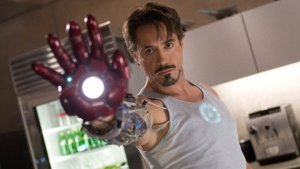 Stark’s friend Jim Rhodes (Terrence Howard), an Air Force officer, rescues him in the desert. Once back at home in his Malibu mansion, Stark has a personal epiphany. After seeing the human damage his weapons cause he no longer wants to manufacture weapons. His business partner Obadiah Stane (Jeff Bridges) and the board of directors are not interested in Stark’s revision. They want to keep doing what they do, making weapons for the highest bidder. Stark begins building a more advanced mechanical suit based upon the prototype from Afghanistan. He will use his technical expertise and great fortune to destroy his own weapons, even if he has to become an ironclad superhero to do so.
Downey Jr. is Iron Man, yes, but he IS Iron Man. He makes this character, this movie, and serves as the film’s ambassador to an audience that has grown tired of mopey teenagers imbued with super powers. His character is a man going through a mid-life crisis of sorts, reevaluating his life and trying to find meaning in his work. There’s something satisfying about watching an older adult wreck of a man taking on a genre that feels like it’ stuck in a high school atmosphere. Downey Jr. is a fantastically engaging, talented actor and when he turns on his narcissistic quick-witted charm it is impossible not to be won over. He provides the film with a tremendous spark and manages to make a womanizing, alcohol-swilling, super wealthy arms peddler/playboy into a figure of sympathy and a hero for the masses. Downey Jr. has expert comic timing and makes Tony Stark a cool swinging superhero. Just listen to his line deliveries and the energy and pacing he puts into the dialogue; it’s terrific. He also gives Stark the necessary drama to pull off the weight of guilt.
Iron Man is also a victory for Favreau as a director. The Swingers star has become a stealthily competent director. He helmed 2003’s Elf and 2005’s underappreciated Zathura and I suppose Marvel Studios saw what I saw in those films. The direction is focused and he makes smart decisions, never overwhelming an audience and always centered closely to the story. Favreau is more concerned with storytelling than noisy, empty special effects. Hell, Iron Man doesn’t even enter the film until an hour into it. There is a confidence and patience to his direction; it manages to convince an audience that they will be rewarded for their time.
 Favreau doesn’t pander and knows well enough that practical special effects will inspire the greatest sense of awe in a summer flick. Iron Man‘s special effects are almost seamless from the practical to CGI. I enjoy popcorn action movies so much more when I’m not nit-picking the special effects. This isn’t a slam on CGI itself, but computer effects have the tendency to declare their fakeness. Sure the special effects were amazing in last summer’s Transformers (how it lost the visual effects Oscar to the subpar Golden Compass I’ll never know), but the CGI-ness of it could be overpowering. When I cannot decipher a special effect automatically, then I know I have been fully immersed in the action. Favreau smartly lays out a bevy of nifty practical effects for the first half. By the time he transitions to broader CGI then he’s already laid the foundation for realism.
Favreau isn’t the best action director but this only presents an issue in the film’s last act. The action sequences in Iron Man take a back seat to watching Tony Stark piece together his new life. I was more interested in seeing Stark test and reconfigure his designs. The construction of Iron Man, to me, is more intriguing than seeing a man in an iron suit battle some guy in a bigger iron suit. The fun is watching him become Iron Man. The action sequences are serviceably kick-ass but too short. I loved watching Iron Man punch people and seeing their bodies fly backwards. Even at over two hours there just isn’t a whole lot of traditional action to Iron Man but this suited my tastes. I’d rather watch an actor with Downey’s talent interact with an A-list cast than watch robots fight and smash personal property.
Iron Man is aided by a strong script credited to two of the writers of Children of Men. It’s structured as an origin tale but it takes its time to set up events and characters that will have lasting meaning. Stark confronts being a weapons manufacturer in a post-9/11 world. He finally stops and asks, “What is the cost?” His own company is double dipping, selling weapons to both sides in a conflict, weapons that will kill U.S. men and women pledged to protect America. Stark has a true change of heart, both figuratively and, later, literally with the assistance of Pepper. There’s a political undercurrent to the film’s drama that manages to be timely and provide at least some thought to go along with the popcorn thrills. Iron Man finds a way to force its characters to combat real moral questions that result from their actions.
 The supporting cast has a combined seven Oscar nominations for acting, so this is a step above the acting level of a Fantastic Four. Howard is mostly underwritten but he provides a nice sense of camaraderie with his friendship with Stark. Bridges is an obvious villain just from the first sight of his bald dome and big, bushy beard. He’s got a mean scowl but Bridges provides a warm and fatherly guide for Stark. But man, when he gets menacing he is rather scary. But my highest praise in the supporting work goes to Paltrow, who coolly delivers arch snappy one-liners in a retro do-everything secretary role. And yet the role also offers some reflection, like after dancing in public with her boss she worries over gossip and what perception will construe the moment into. She, his employee, wearing a plunging backline dress that looks gorgeous on the actress, dances with her boss, an infamous womanizer. And then in this moment of doubt there’s a nice, unexpected moment for both a comic book movie and a would-be romance, and the “would-be” is the correct term. She has great chemistry with Downey Jr. and watching the two of them playfully bicker is another reason Iron Man soars above the confines of genre and formula. Plus she looks great with red hair.
Iron Man is a great start to the summer movie season and will be hard to beat. It doesn’t have the psychological depth of Batman Begins or the high-flying fun of Spider-Man 2, but this film certainly deserves to be mentioned in that same group. Favreau has crafted a respectful comic book movie that manages to place special effects in service of an interesting story played by extremely engaging actors. Downey Jr. is the movie’s secret weapon and he delivers a smart, witty, charming, sardonic and enormously entertaining performance that anchors a fine example of what big budget popcorn filmmaking done right looks like. Batman and Spider-Man might want to be on the look out because the new kid on the block is generating some serious heat.
Nate’s Grade: A-
Share this:

Persepolis (2007)
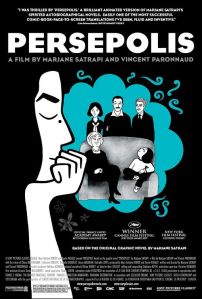 Marjane Satrapi has, by all accounts, a very unique life. Growing up under the repression of the Islamic Revolution, she settled in France and created a series of acclaimed best-selling graphic novels called Persepolis, based upon her life growing up in and out of Iran. The movie was France’s official entry for the 2007 Foreign Language Oscar, bypassing the equally lauded and inventive Diving Bell and the Butterfly. And yet Persepolis did not even make the short list of nine nominees, which eventually gets parred down to five (neither did 4 Months, 3 Weeks, and 2 Days, which WON the Best Film from the European Film Awards, over other movies that managed to make the Academy’s five nominees). I consider this a glaring omission. How could anyone not be entranced by Satrapi and co-director Vincent Paronnaud’s masterwork?
In Tehran, the capital of Iran, young Marjane and her family watch as rebellious forces overthrow the Shah in 1979. The Shah was the ruler of Iran and could readily be described as a dictator. He was friendly to Western countries and wanted Iran to follow their lead. Large forces unified and deposed the Shah, setting the stage for Iran to have its own system of rule that the people would decide upon. Marjane’s father swings her around in his arms and excitedly proclaims that democracy has come to his country at last. Landslide numbers “vote” for radical Islamic leaders to take control of the government, and Iran becomes a militant theocracy. Privileges and reforms are revoked, and women will have to wear long burquas and veils to be righteous. Marjane is too outspoken and her parents, fearing for her safety, send her to Europe to be educated. While she is absent Iraq attacks Iran and the countries are engulfed in a decade-long border war.
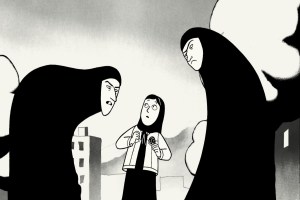 Persepolis is a gem of a movie, at once a personal coming-of-age account that manages to be fascinating and honest and also a universal tale of struggle for cultural identity. The evocative black and white animation is a joy to watch. The crisp drawing style manages to express so much with the seemingly simple, clean images. At times the visuals take on a lovely German expressionistic feel, and the world feels like it is made out of folded layers of paper. I would fall in love with a movement, a facial expression, that fact that smiles look like boomerangs, something small yet immeasurably enjoyable that struck a deep chord inside me. The arresting black and white visuals do not distract from the story in any way, in fact they help to mirror the repressive nature of what befalls Iran. A silhouetted group of protesters is shot at and one of them falls to the ground. Great inky blackness seeps out of the fallen body and merges with the rest of the screen, adding emotional heft that color could never capture.
Told for long stretches from the perspective of a child, Persepolis manages to find unique perceptions. The child point of view allows the film to unfold naturally with innocence and inquisitiveness, qualities that would soon be hard to recapture once the promise of revolution turned sour. Young Marjane feels jealous and competitive that her cousin can brag that her father spent more time as a political prisoner. It’s an odd stance for an adult and yet it feels entirely within reason for children. Marjane deals with issues she cannot fully understand as a child but she tries her best. The eyes of children also let the filmmakers mingle with the fantastic. Marjane speaks to God at points, and after a horrible tragedy God is trying to apologize and explain but little Marjane will not hear any of it. She orders God to leave her and so He departs. A little girl turning her back on God will hit you is the kind of devastating stuff that can put a permanent lump in your throat.
I was dumbfounded at the emotional depths the film plumbs in a scant 95 minutes. This is an incredibly powerful tale, richly told with poignant insights and grace. There were several times I was overcome with emotion and had to dab my eyes. Satrapi achieves great emotional resonance with minute details, making the film exciting in how engaging it continues to be from beginning to end. Marjane’s relationship with her family anchors the movie and you can feel the power of their love and bonds. Imprisoned uncles who spouted communist dogma are released only to be seen as a danger once again. Marjane’s mother is worried when Marjane keeps showing a fiery outspoken spirit. One day she shakes a teenage Marjane, screaming at her the horrid possibilities that can happen to women under this regime. She cites one teenage girl who was executed, but they don’t believe in killing virgins, so the guards took care of that bothersome roadblock. Marjane’s mother is wild-eyed with fear and what might await her little girl, and her gnawing concern is resoundingly powerful. Marjane’s grandmother serves as her emotional compass throughout her life. Grandma stresses that Marjane should be proud of her cultural identity and stay true to herself. When Marjane gets older she hears her grandmother’s voice to set her straight in times of doubt.
 But while the movie can be heartwarming, it does not fall victim to sticky sentimentality. Satrapi deals with some harsh truths about life in Iran and also her time in Europe as a blossoming woman without a country. She doesn’t sugarcoat reality and Marjane’s parents make it a point to be up front with their daughter about what is happening; an uncle tells little Marjane, before he is executed, that knowledge must live on and she, the youth, must be the one to keep it alive. The Iran-Iraq war ends in a stalemate with millions in casualties. Persepolis details life behind the veil and the shift the country took to radical Islamic rule but the film isn’t all doom and gloom. There’s a natural curiosity about a story of a girl who becomes a woman in a repressive society. Marjane’s spiky rebellious spirit makes for genuinely human comedy. She shops for Iron Maiden tapes on the Iranian black market, wears a jacket that states, “Punk is not ded,” and screams with joy at ripping her veil off during a car ride and letting the wind gust through her hair. There is a bounty of humor to be found in unexpected places. Marjane is running to catch a bus and is stopped by two policemen who complain that when she runs her butt moves “in an obscene way.” She simmers and finally yells, “Then stop staring at my ass!”
If Persepolis has any shortcomings it’s that the narrative peaks a bit too early. Seeing a child come of age during the Islamic Revolution is generally more interesting than watching a teenager navigate unfaithful boyfriends in Europe. Persepolis never stops being entertaining or relevant, it just so happens that the greater emotional rewards are tied to life and family in Iran.
Persepolis is a marvelously moving and unique coming-of-age tale set against a unique time. Marjane Satrapi’s graphic novels have fluidly been translated into a film that resonates with great emotional turmoil and inspiration. The alluring black and white visuals and clean animation style dazzle the eyes, while the enthralling personal story reaches deep inside and touches the heart. The film is brilliant, beautiful, harrowing, deeply human, fascinating, and ultimately inspiring. It’s rare to find a movie that can hit so many emotions with finesse, animated or live action. Persepolis is a bold vision and a revealing and lovely film that I cannot wait to revisit often. This is more than just a cartoon, folks. This is art.
Nate’s Grade: A
Share this:

Fantastic Four: Rise of the Silver Surfer (2007)
 No better or no worse than the original, this less than fantastic follow-up to the cruddy 2005 superhero dysfunctional family melodrama ups the apocalyptic ante with the emergence of the powerful Silver Surfer, the herald for a cosmic cloud, yes cloud, that consumes the life forms of planets. The special effects run the gamut from fake and awful to passable, but what ultimately kills this movie is how little substance there is. It’s lightweight, shallow, and more interested in making the kids giggle. Example: The Human Torch, after touching the Surfer, can now switch powers with any of the members after they touch him. The Thing, covered in spongy orange rock, is lamenting his state but finds solace in his relationship with a blind woman. The Human Torch asks what Mr. Rock Dude what would do if he had but a few moments left in this world. Now, I’m thinking that the Human Torch is going to swap places with his buddy so that The Thing can enjoy even one night as a regular flesh-and-blood human being with his sweetheart. Maybe they could even knock boots without her getting serious rug burn. But no, the movie does nothing and just moves along because it doesn’t have the scope, the interest, or even the time to flirt with anything outside its limited plot. The storyline, what little there is, is predictable from beginning to end and the action sequences, while expanded from the first film, still fall far short of eliciting tension or tickling the imagination. I swear the only reason the flying jet thing is introduced was to sell toys. You have a bunch of people with unique super powers; the least the script could do is think of exciting things to do.
Nate’s Grade: C
Share this:

Ghost Rider (2007)
 Nicolas Cage’s career has been flaming out, so what better role than a burning skeleton biker who serves as a bounty hunter for the Devil, in this case Peter Fonda. A cliché-riddled script, laughable performances, cheesy effects and dull villains doom any entertainment prospects this movie might have had. Cage, as the titular rider, gets to fight a group of escaped demons who all have one connection to an element; one has the power of fire, another the power of wind, etc., it’s like a hellish Captain Planet squad. But what’s the point when Ghost Rider simply vanquishes them so easily? It’s repetitive and goes nowhere. There’s one moment Sam Elliot “turns” into an older ghost rider/bounty hunter and rides along with Cage to save the day. But then he says, “Well, I could only do that once more, so good luck.” What? You could only turn into a flaming ass kicker one more time and you wasted it on riding a horsey through the desert? Eva Mendes is awful as her role of “girlfriend from past,” and why, if she and Cage grew up as childhood sweethearts, does he look over 15 years older than her in the present? I guess working for Satan can really take a lot out of you.
Nate’s Grade: D
Share this:

Spider-Man 3 (2007)
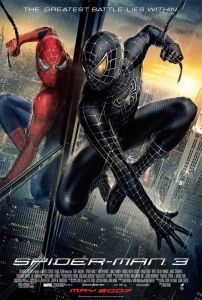 Who the hell are you Spider-Man 3 and what have you done with the franchise I loved? After the massive commercial success of first two Spider-Man chapters, my expectations had been raised fairly high. The more time that passes the more I reflect on how disappointing Spider-Man 3 sadly is. Part of my dashed hopes are because the 2004 Spider-Man sequel was a wonderful follow-up to a pretty swell introduction, and I placed that movie in my Top Ten list for the year and consider it one of the best comic book movies of all time. There’s some great popcorn entertainment to be had with Spider-Man 3, but man is this film just beside itself in wasted potential, a lack of focus, and some really poor choices.
Things are going pretty well for Peter Parker (Tobey Maguire). He plans on asking Mary Jane (Kirsten Dunst) to marry him and New York City is planning a parade out of appreciation for Spider-Man. But the good times can’t last long. Harry Osborn (James Franco) has accepted his fate and become a second generation Green Goblin villain, out to avenge his father’s death at the hands of Spider-Man. But Peter also has to be on the lookout for his job at the newspaper. Eddie Brock (Topher Grace) is an unscrupulous photographer out to replace Parker and nab a picture of Spider-Man caught in a bad light. An alien substance has also hitched a ride to Earth via meteorite and sought out Peter Parker. The black goo attaches itself to Peter and forms a black Spidey suit, one that gives him intoxicating power and a slimy menace. The new Peter cavalierly flirts with bouncy lab partner Gwen Stacy (Bryce Dallas Howard), hurts his friends, and loses his do-gooder ways.
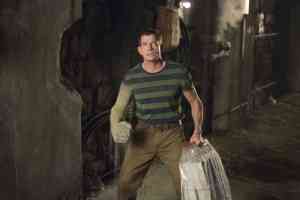
Meanwhile Flint Marko (Thomas Haden Church) has escaped from prison. It seems the police got it wrong and now inform Peter that Marko confessed to being the one who killed Peter’s uncle. While on the run Marko happens to tumble into an open pit that is a science experiment and becomes fused at a molecular level with sand. He uses this new power to rob banks in order to save his sick daughter at home. Peter, with the power of the alien suit, hunts the Sandman to get his own slice of sticky vengeance.
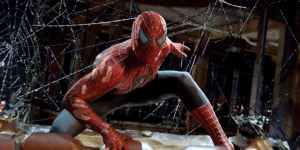 The film has way too much on its plate. There are too many characters, too many undeveloped storylines, too many coincidences, too many contrivances (Amnesia? Really? Really?), and too many aborted moments of drama. Spider-Man 3 is an undisciplined mess. The film practically stumbles from one scene to the next and lacks the coherency and intelligence of the earlier entries in the series. The third film tries to do too much and please too many interests, and as a result it may end up pleasing few fans. I had some trepidation when I learned that there was going to be upwards of three villains for this movie, but I swore that it could work since Batman Begins confidently worked around a trio of big bads. Three villains do not work in Spider-Man 3. Let me dissect this rogue’s gallery and where they fall short.
1) The Sandman is kind of a lame idea from the start. His power seems to limit his available locations, and I’m surprised that he wouldn’t stick to beach areas as a means of playing to his sandy strengths. Regardless, the character plays no part in almost anything that happens, and the Sandman is given one note to play. He’s got a sick daughter and he robs to try and pay for her medicine. That’s great on paper but it never really seems to give the character any sense of urgency or frustration. If he got special sand powers why not sneak into banks through cracks in walls instead of forming as a giant sand monster? Church attempts to imbue the character with a sad soul but he just comes across as being wooden. If he was really on the hunt for money to save his daughter then why does he just slouch around all the time? Wouldn’t it be easier to rob a city not patrolled by a web slinging super hero? How can he say he’s a misunderstood victim of luck just minutes after he tried killing Peter? He seems like a dull lunkhead. The Sandman is given a tiny wisp of character detail (sick kid!) and that’s it. He doesn’t get any other characterization and is kept on the run and pops up whenever the film needs him. He becomes a token character until the very end where Church is given 2 minutes to pour his heart out to Peter. Two minutes of character at the start, two minutes at the end, and a gaping center. The Sandman isn’t so much a character as the ideal of some issue that the filmmakers want to have Peter work through.
And what is that issue? Why vengeance and forgiveness. You see, Spider-Man 3 foolishly rewrites its own history and now it was the Sandman hat killed Peter’s Uncle Ben. This revision does not work at all and actually legitimately damages Spider-Man. Just like Bruce Wayne is tackling crime to alleviate his guilt, so too is Spider-Man, who can never shake the fact that he could have prevented his uncle’s death had he done the right thing moments before. By introducing a new killer it means that Peter has no responsibility for his uncle’s death. This completely strips away the character’s guilt and rationale for what compels him to swing from building to building to fight crime.
 2) Eddie Brock/Venom is wasted as well. Director Sam Raimi has said before he’s not a fan of Venom and doesn’t get the character, and I feel that his contempt carried over into the film. Venom and the black alien goo are given about the same abysmal care as other half-baked plot points. Eddie Brock has about three total scenes before he gets to transform into Venom thanks to the alien substance, and none of these scenes fully flesh out who the character is or justify his relationship with Peter Parker. When we do see Venom in the finale its all too rushed and hokey. The effects make him look less like alien and more like a wax figurine (I suppose there could be intelligent wax life amongst the stars). For whatever dumb reason the alien suit has to retreat so we can see Grace’s face while he taunts and mocks with bad vampire teeth that are meant to inspire what exactly? The character is rushed and underdeveloped and should have been saved for the next sequel instead of being given lip service in this one. Venom is supposed to be the evil doppelganger to Spider-Man, not some smart-alleck with frosted hair that gets about 15 minutes of screen time. I like Grace, I really like him a lot and envision him as his generation’s Tom Hanks, but he does not work in this movie. He could, but I get the sneaking suspicion that Raimi sabotaged the Venom role on purpose or at least subconsciously. The villain goes out with a whimper and it feels like a giant, foolish wasted opportunity that becomes more maddening the more I discuss it. The presence of Venom feels like a shallow attempt to placate a younger generation of comic fans and to sell more action figures.
The alien goo suit is supposed to tempt Peter and bring out his wicked wild side. So what does he do? He acts like he’s auditioning for the lead in The Mask. This embarrassing sequence is painfully goofy and will make you cringe and shield your eyes. Peter flirts with girls and dances at a jazz club, and this is supposed to be the dark side of Spider-Man? What the hell? I acknowledge that Peter has always been an unpopular dork and would be a dork even if he ventured to the dark side, but how does this square with the more serious and edgier tone the film is grasping for? Evil Peter seems more like a broody emo kid, with shocks of black hair in his eyes and traces of eyeliner. The dark side of Spider-Man, much like the rest of the film, is given little time or thought. Peter’s trials with the symbiotic suit last about a reel or two and then it’s abruptly finished.
 3) Harry should have been the main focus of this sequel and it?s a shame the filmmakers had to cram so much crap into a story already heavy with plot leftovers. Harry has the most obvious arc through the three movies and deserves better than to be knocked out of commission by amnesia. The conflict between Peter and Harry is where the film finds its emotional core and it would have been wise to expand this section and eliminate one of the other underutilized villains (my vote: both Venom and Sandman). Harry’s vow to avenge his father is far more interesting than what the other two villains have as motivation, and plus Harry requires no extra time-consuming setup to slow the pacing down. I’m glad the final battle encouraged Harry to come out and play; the film finally gives Franco the screen time he deserves, but it should have been more. The worst plot device in the film involves Harry’s all-knowing butler who has some vital information he most certainly should have shared years ago. So much time is spent on storylines that go absolutely nowhere, and the musical chairs of villains, that the film resorts to having a freakin’ butler tap someone on the shoulder and say, “Excuse me sir,” just to tie things up in the most awkwardly shrift way possible. And even if what the man says is true, how does his perspective add any clarity to the situation? Think about it. I have.
The romance between Peter and Mary Jane feels awfully trite and meandering. Spider-Man 3 lacks the tight focus of the second film. It throws contrivances to place a wedge in their relationship, like the fact that Mary Jane is fired from her Broadway gig but doesn’t tell Peter, or the fact that they never seem to answer the phone on time when the other person is apologetic. Gwen Stacy is less a character than simply a dimwitted blond tool to make Mary Jane jealous and sulk. The ups and downs in this relationship feel pretty forced and some moments defy all human understanding. At one point Mary Jane is forced by Harry to break up with Peter to spare both their lives. So she breaks the news in a park, and Peter is devastated, but why in the world does she never say anything again? Why would she not clear things up after time had passed to explain her actions? Spider-Man 2 ended with Peter finally getting the girl but also on a hint of doubt, and it was marvelous. Spider-Man 3 just sort of ends with everyone presumably in the same place they started.
Spider-Man 2 really succeeded on how focused it was and how it related its action with character. Spider-Man 3 has to resort to cheap and lazy devices to cover its storytelling pitfalls. Don’t even get me started on the fact that the film has to resort to a newscaster narrating our final battle where he actually asks, “Is this the end of Spider-Man?” This might be the end of the quality associated with Spider-Man.
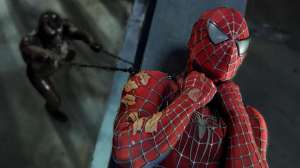 After having spent a whole slew of words detailing in length where the film goes wrong, allow me to illustrate some of what the film does right. Whenever it sticks to action, that’s when Spider-Man 3 works, and Raimi has cooked up some wonderful whiplash-inducing action sequences. The first battle between Peter and Harry is intense and sets the film on the right path, but the action as a whole isn’t as closely tied to Peter’s domestic life and emotional troubles as it was in the other films. A high-rise rescue from a crumbling office building will stir some 9/11 memories but it is awesome to behold. The effects have improved and the swinging shots through New York look the best they ever have. The greatest moment in the film is perhaps the birth of the Sandman as he rises grain by grain from a pile of sand and attempts to reform himself. Aided by some lovely music, the moment takes on a beautiful and unexpected poignancy. This is where Raimi and the CGI wizards hit it out of the park. Nothing rivals the train sequence in Spider-Man 2, though.
It might be dangerous to say, but I feel jilted from this film and either new blood needs to be brought in or the filmmakers need more time and control to make a Spider-Man sequel worthy of its name. This is the gold standard for super hero movies and its been tarnished and sullied. Spider-Man 3 has moments to dazzle and excite but it also feels battle fatigued from carrying the dead weight of extraneous characters and half-baked storylines. There are too many balls in the air for Raimi to juggle. This Spidey chapter squeezes too many ideas in too short a space. After obliterating box-office records, Sony has stated that they plan on three more Spider-Man sequels. If this film is the tipping point, then I’m afraid of what will be swinging down the pipe in years to come.
Nate’s Grade: C+
Share this:

300 (2007)
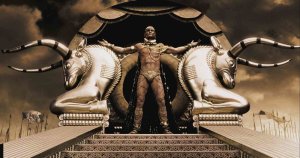
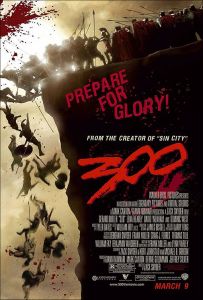 The story of the 300 is the story of the Battle of Thermopylae in 480 B.C, 150 years before Alexander the Great. Xerxes (Rodrigo Santiago) has deemed himself a “God king” and his Persian army has been conquering Asian nations and acquiring the most massive military force of its time. He sets his sights on conquering Greece, and to do so must go through the narrow passage of Thermopylae.
King Leonidis (Gerard Butler) assembles 300 of his finest Spartan warriors to thwart the Persian invasion. The Spartans were the super soldiers of their time, a society that valued brute strength and the honor of combat. Children born with imperfections were cast onto the rocks to perish; the society couldn’t afford a weak link in its protection. One day a Persian emissary rides into Sparta carrying the skulls of other kings and princes and a message from Xerxes: submit or you’re next. Well, after the emissary insults Queen Gorgo (Lena Headey), he refutes the message and kicks the emissary down a giant black pit in the middle of town (is this where they dump their garbage?). Thus, as they say, it is on. The Greek city-states have no sense of nationalism, so Leonidis commands little support to thwart the advancing Persian hordes. The Spartans have discipline and superior equipment, and because of these advantages they are able to hold back overwhelming numbers from the Persian army.
 Back at the home front, Queen Gorgo is wheeling and dealing behind the scenes to state her case to the Spartan assembly. She needs to shore support for more troops to help her husband. Theron (Dominic West) is a member of the priesthood that looks to sexually charged Oracles for guidance. However, he’s willing to drop his pacifist stance if the queen drops her robe and grins and bares it.
Xerxes is not a happy “God king.” He tries appealing to Leonidis, insisting that if he will simply bow down and relent than he will be spared. “Imagine what horrible fate awaits my enemies when I would gladly kill any of my own men for victory,” he threatens. Leonidas replies, “And I would die for any of mine.” The two men (well one man and one God king) go back to their corners ready for another round of this epic slugfest.
The action sequences are intense and director Zack Snyder (2004’s Dawn of the Dead) heightens their realities with surreal touches. He fondly gives life to the bloodshed and exaggerated combat popularized from Frank Miller?s graphic novel. The Sin City author has created another testosterone-soaked hyper-real adventure. The movie doesn’t even flirt with the notion of rigid historical accuracy (I doubt the Spartans fought rhinos, giant mutants, and were done in by a disgruntled hunchback); the film uses Miller’s artwork as a jumping point, which means that the Spartans fight in leather codpieces and red capes and that combat is more one-on-one even after we learn about the important of the phalanx. But quibbling over inaccuracies is a waste of time, because 300 is a pumped-up, super cool action movie that plays out in a vivid dreamscape. The movie was filmed with extensive green screen, much like Sin City was, and it feels like a direct transition of Miller’s pulpy comic book. Even the farewell sex between the King and Queen is stylized and seems to be snippets or panels from a comic book.
Let’s all be honest, there’s something undeniably homoerotic about 300. The movie worships the male form, with rippling abs and bulging biceps lovingly showcased in glowing, sweaty, fawning detail. The movie also focuses on manly men primarily spearing one another with phallic weaponry while the spurting blood dances across the camera in balletic CGI spasms. There?s a definite gay appeal to this film, not that there’s anything wrong with that. However, 300 also manages to curiously be homophobic at the same time (I swear this came to me independently, Phil). Xerxes is designed very as being very fey even at a massive height of eight feet. He lays his hands against Leonidis’ shoulders and asks for him to submit, and you can’t help but wonder what the teen boys in the audience are thinking. Xerxes also has a party tent filled with whores, the disfigured, transvestites, and the overall effeminate opposite of all those Greek macho muscle men the film postures as elite specimens.
 The acting is set to one tempo and that’s a mesmerizing use of yell-speak; it’s part guttural and part long-standing bellow that makes any piece of dialogue sound macho. King Leonidis growls, “SPAAAAAAAARTANS! TONIGHT WE DINE IN HELLLLLLLL!” After two hours of this primal style of speech, it becomes somewhat infectious and you want to try it in everyday situations in your life. Next time you’re out with friends at a fine dining establishment, I suggest asking for the salt thusly: “DINING PAAAARTNAAAAAH, COULD. YOOOOOOOOOU. PAAAAAAAAASS. THE SAAAAAAAAAAAALT?!” You’ll be guaranteed to get a reaction. It strains my throat even writing about the 300 yell-speak.
300 is a rousing movie going experience that plays out in a beautiful, pristine dreamscape that closely resembles our planet. The action is highly stylized and frenetic. It’s just that when the film stops to take a breath you start to look elsewhere, and when you do you realize there isn’t much below the blood-caked eye candy shell. 300 is grand spectacle that elicits thrills and chills, but the movie fails to touch on emotions beyond loyalty and courage. Both are essential for a soldier, and one as dedicated as a Spartan warrior, but the lack of substance keeps 300 from being anything other than a visually arresting, if ultimately disposable, two hours at the movies. There’s nothing wrong with a movie whose sole purpose is to quicken the pulse for a short supply of time, and 300 succeeds smashingly with this singular ambition. It is an ass-kicking history lesson that makes me wish I could learn more about Persian executioners with blades for hands at my local library.
Every culture has their own account of a last stand, a small group that heroically held off seemingly superior forces (remember the Alamo?). Snyder and Miller present an entertaining hack-and-slash primer through history that’s rarely dull and often enchanting to the senses. Deep down, there may not be much more to 300 than a lot of pretty pictures and a bunch of chiseled hunks, but that?s enough for most carnage fans with a free afternoon.
Nate?s Grade: B


 nathanzoebl
You must be logged in to post a comment.