Blog Archives
Father of the Bride (2022)
 Those familiar with the 1991 Steve Martin movie, or the 1950 original with Spencer Tracy, or even the 1949 novel by Edward Streeter, who was born in 1891, will understand that Father of the Bride is an old story that can still be relatable with new wrinkles and details. The core elements of the story, about the stress and chaos of wedding planning, or the pressure and patience of family, are still present with this new version where Andy Garcia and Gloria Estefan star as the parents of the bride (Adria Arjona). Garcia is a first-generation Cuban-American, a successful Floridian architect about celebrating old traditions, and a bridezilla of epic proportions terrorizing every soul in Miami. He is an awful person, holding to outdated and cringe-inducing misogyny and at several points making demands that because he is the father of the bride, he will be dictating exactly how his daughter’s wedding will proceed no matter the objections from the bride. Even when the groom’s wealthy Mexican family comes into the picture, neutralizing his power of the purse, Garcia’s bad dad just gets even more pushy and prissy. Ultimately, of course, he sees the error of his ways, the opulent wedding is nixed for something more spur of the moment combining traditions old and new, and everyone seems to get along by the end as one big happy family. I liked the added subplot of Garcia and Estefan hiding the fact that they are getting a divorce, which provides farcical potential. However, some of the subplots feel lightly developed, especially the other daughter being tasked with making all the bridal dresses for her sister. She wants to be a designer but cannot get a break, and yet the final reveal of the wedding gown is absent any drama, taking away from the relationship between the two sisters. Same with a friend who may or may not be queer and vibing for the bride’s sister. It’s strange that the two daughters get underdeveloped when they’re so essential to the wedding, and especially considering the movie is practically two hours long. I wish the filmmakers had trimmed some of the redundant “Andy Garcia is awful” moments and given more time to other supporting players. Father of the Bride is a chuckler of a movie, never netting bigger laughs but providing a few chuckles and smiles here and there. It’s a pleasant movie to watch, though I don’t think Garcia’s tyrannical father has earned his epiphany and forgiveness by the end. Given a Hispanic spin, the personal details and cultural authenticity allows an old story to feel fresh or at least fresher.
Nate’s Grade: B-
Share this:

Mr. Deeds (2002) [Review Re-View]
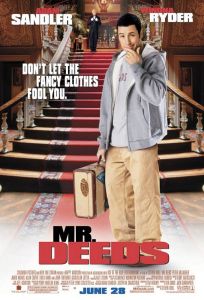 Originally released June 28, 2002:
Adam Sandler seems like the reason they created the “no shirt no shoes” policy for restaurants. His niche is playing the lovable goodhearted goofball that triumphs over the pretentious jackass and somehow wins the heart of the fawning one-dimensional love interest. Sandler appeals to the masses as our nation’s greatest warm-hearted simpleton. He’s the Jimmy Stewart of slobbery. So why mess with that? Well for starters, if you want entertainment anymore you might want to.
Mr. Deeds, Sandler’s latest idiot opus, is disastrously, even tragically unfunny. In the film Sandler stars as the only known heir of a multi-billionaire media mogul. Longfellow Deeds (Sandler) is a simple New Hampshire pizza delivery boy who treats people with respect and kindness. However, the mantra “cruel to be kind” must be alive and well because Sandler mercilessly beats people to about an inch of their life throughout Mr. Deeds for brutish comic effect.
Peter Gallagher and his monstrous eyebrows serve as the stand-in villain. Hes a greedy tycoon who wants the Deeds fortune all to himself. Gallagher actually plays his part well and seems to at least have some fun with the broad comedy role. Winona Ryder, on the other hand, does not. Ryder has never proven she can handle any comedy other than black, and slapstick just ain’t her thing. She painfully goes from scene to scene clueless as a tabloid journalist hiding her identity so she can get the scoop on Deeds, only to fall madly in love with him.
The film has some glimmers of comedy, mostly from its supporting cast including John Turturro as a very sneaky Spanish butler. It’s nice to see Turturro in something this high profile and get some recognition this journeyman deserves. There’s also a really funny cameo served up by a former tennis giant himself known for his boorish temperament. Steve Buscemi should be charged with grand theft movie because his three minutes on screen as the crazy-eyed local are funnier than anything with Sandler onscreen.
 The movie becomes far too redundant of Sandler’s other comedies to the point where seeing former stars like Rob Schneider in his Big Daddy character is somehow supposed to be funny. This kind of stuff is strewn throughout the film. It feels like everyone’s going through the motions. Now I’m not a total Sandler basher, because I do believe the man can be funny when worked right. Billy Madison is still hysterical to me upon every viewing and I do get some fun watching The Wedding Singer, but Mr. Deeds is sub-par Sandler even for Sandler.
I’m sure most of the people buying tickets for this have no idea that the concept is based upon the Frank Capra film starring Gary Cooper. But what good is Gary Cooper? He didn’t write cutesy greeting cards or save a litter of kittens from a raging inferno like Sandler’s Deeds. In the end, this mostly laugh-free comedy is short on imagination, energy, and entertainment.
Nate’s Grade: C-
——————————————————
WRITER REFLECTIONS 20 YEARS LATER
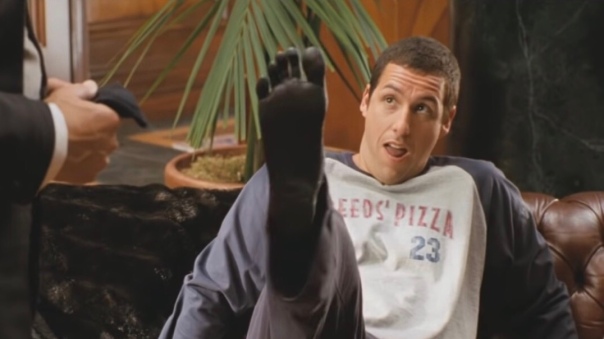
Adam Sandler became his own industry. The Saturday Night Live funnyman became a movie favorite starting in 1995’s Billy Madison, still my favorite of the early Sandler era, finding the right balance of stupid, irony, absurdity, and crass humor. His ribald comedy albums were must-owns for any teenager in the 1990s. By the early 2000s, he had accumulated a team of collaborators of directors (Steve Brill, Frank Coraci, Dennis Dugan) and writers (Tim Herlihy, Fred Wolf, Steve Koren) who would churn out comedies on a near yearly basis. From 1998-2015, Sandler starred in 20 movies that can be deemed Sandler vehicles, a soft-spoken schlub with a heart of gold who is prone to explosions of violence and seems endlessly underestimated or misunderstood by a larger world of condescending, out-of-touch elites. There is a wild spectrum of quality during this period, and as the years progressed Sandler began to transform from the slovenly goofball provocateur to the laid-back, wisecracking family man trying to convince non-believers of his righteous old-fashioned wisdom. His once outsider status had calcified into a sentimental, middle-aged “these kids today don’t get it” laziness. Many of his later movies felt like glorified excuses for his family and friends to take extended vacations around the world. Since 2016, Sandler has migrated his slob squad to Netflix and continued his usual schtick to lesser publicity. The only time Sandler seems to have broken through since he hit that late 2000s plateau is his occasional dramatic performance, like 2019’s intense and gritty Uncut Gems. He’ll even star in a basketball drama for Netflix this month (Hustle). The real reason I picked Mr. Deeds to re-watch for this month was so I could better compare and contrast for a later re-watching of 2002’s Punch-Drunk Love, Sandler’s first dramatic acting revelation thanks to Paul Thomas Anderson. As for Sandler’s take on Frank Capra, it never overcomes his trademark laziness.
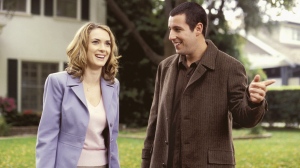 The story of Mr. Deeds began as a heartwarming tale about a small-town man whisked away to the big city who provides a little small-town good charm to those in need. 1936’s Mr. Deeds Goes to Town was nominated for five Academy Awards including Best Actor for Gary Cooper, Best Picture, which it lost to The Great Ziegfeld, and Capra winning the Oscar for Best Director. It’s a well-regarded and wholesome movie that champions many of the major themes prevalent in Capra’s popular filmography. To take this starting point and say, “what if we made Adam Sandler the star and he just assaults people before convincing people to follow their dreams?” The problem with Mr. Deeds is that everything comes at great ease for our protagonist, who is never asked to change or think differently; no, it is the world that needs to change and be a little more like Longfellow Deeds (Sandler). He’s a humble man-of-the-people who will literally carry the elderly on his back to help them cross the street. The New York City natives just view him as a small-town rube but he’ll convince them all that his simple ways are the real way to live. Except if you watch this movie and think, “I need to pattern myself after that guy,” then you are either wholly susceptible to the slightest influence or you’re looking for an excuse to hurt others with impunity. Mr. Deeds regularly beats the crap out of people who he feels have crossed a line. His newfound riches essentially inoculate him from any consequences (as is the American way). I guess the slapstick is supposed to be riotous but it just made me uncomfortable and bored. Apparently, when Sandler tackled Allen Covert to the ground to beat him silly, Covert really did hit his head against the pavement and went unconscious for a minute. The entire concept of the movie rests upon Deeds being a likeable fellow others wish to emulate, but under the guise of Sandler-ification, he comes across as the kind of guy you’d walk across the street to avoid.
Let me use one example to highlight the failure of the Deeds character. He’s in a fancy restaurant and is hailed over by a gathering of rich elites who want to hobnob with the newest moneyman. For whatever reason, their suck-up turns into broad insults, which is confusing considering how many of them are financially dependent on his company. As they yuk it up in sycophantic laughter, Deeds shakes his head and says, “You all invited me here so you could look down on me. Well, let me tell you that here you may all laugh at me, but down in Mandrake Falls we would laugh at you all.” Examine that for just a little bit longer, dear reader. He’s not saying that the good people of his hometown would act better than these big city folk, accepting others for who they are and being welcoming and sincere. No, he’s saying if they were in Mandrake Falls, they would be laughed at and made fun of for being all different. It’s less a declaration that his small-town way of life is better and more wholesome and more a confessed threat if they ever found themselves in the minority. I think Sandler and company thought they had their hero on a moral high ground, but this line proves otherwise, and then he just physically assaults them all too.
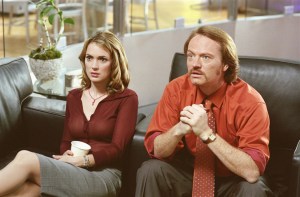 The comedy is predictable and lackluster, and the longer the movie went the further I sank into a general state of apathy. The poems by Mr. Deeds are supposed to be lame, so I guess the comedy is just how bad they are? That just sounds like excuse-making, though thankfully it’s just one trifling example and not much is hinged upon Deed’s greeting card dream. Much of the movie revolves around the budding romance with an undercover reporter, Babe (Winona Ryder), who comes to love the man for some reason unknown to anyone observing. It becomes a bit of a screwball comedy with her attempts to keep her cover, but by the end she’s meant to serve as the audience surrogate and convince us that this man was worth our investment. The only parts of Mr. Deeds that made me smile or come close to laughing were the absurd supporting characters getting little moments. I loved Steve Buscemi, who became a Sandler regular, as a crazy-eyed town weirdo spouting bon mots like, “Time heals all wounds… except these crazy eyes.” I enjoyed John Turturro’s commitment to his sneaky yet helpful Spanish butler. I enjoyed the John McEnroe cameo and night on the town indulging their boorish behavior. I enjoyed watching Jared Harris go broad comedy as an obnoxious newsman. The actor has such innate, weathered pathos to him that I cannot even recall ever seeing him in another comedic role. I liked Eric Avari (The Mummy) as the second-in-command guy who chums it up with Deeds. I enjoyed moments that didn’t involve Sandler or Rider, but those are the two main stars, so time away from them was fleeting though appreciated. The general unfunny nature didn’t offend me like some other bad comedies, but it sapped whatever care and energy I had for the movie.
In the realm of Sandler cinema, Mr. Deeds is on the lower end. It’s not among the worst of his worst. It’s passable to watch if you’re just skimming for the occasional comedy nugget. I didn’t feel insulted but I was also coming to this movie with decades of hindsight of the Sandler cinematic universe, able to discern his more prominent themes and cliches and reflexes. I’ve never watched the 1936 Capra movie though I’m curious to do so now for the simple reason of seeing just how far away Sandler’s version veers. They also turned the Mr. Deeds story into one season of a 1970 TV series starring Monte Markham (Captain Don Thorpe on Baywatch!). There’s something inherently engaging about a moral person placed in a new environment and how the environment changes to that person rather than the other way around. It’s essentially the plot of WALL-E, one of my favorite movies. It works. Except with Sandler’s version, the filmmakers were on Sandler autopilot, a condition he rarely broke free from (Drew Barrymore collabs seem to be the exception). From here, the Sandler movies got lazier and stodgier and more sentimental yet also phonier. I haven’t watched a Sandler-lead comedy since 2016’s The Ridiculous Six, his first Netflix release. I genuinely wish he would stick to more dramas. He has real acting strength, first explored in Punch-Drunk Love (you can’t get here soon enough), and I’m hoping I’ll only better appreciate that movie having re-watched a shining example of what Paul Thomas Anderson was aiming to deconstruct.
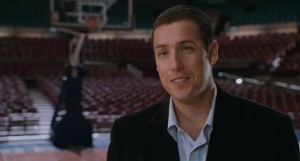 As for my earlier review in 2002, it’s entirely accurate. Everything I said still applies, even the C-minus grade. You could charitably say Mr. Deeds was where the Sandler formula became fully entrenched. It was a big hit ($170 million worldwide) and vindication after Sandler attempted something truly weird and different that flopped (2001’s Little Nicky). You can see the gears turning, and so the next decade-plus brought us more of the same Sandler schtick. For one of the most dangerous comics, he became safe and sated and all too happy to pack it in for mass appeal. Consider this otherwise forgettable movie a footnote in the arc of Sandler’s comedy oeuvre, and that’s about it. Mr. Deeds is just as shrug-worthy in 2022 as it was back in 2002.
Re-View Grade: C-
Share this:

The Bad Guys (2022)
 Even though it’s based on a popular series of children’s books, if you’ve seen Zootopia, you’ve seen the better version of The Bad Guys. As far as entertainment aimed at the wee ones, you can certainly do worse. It’s brisk, silly, and the animation is quite enjoyable, adding hand-drawn overlays and accents that really make the images pop and provide additional, gratifying textures. The story, on the other hand, is the same old-same old. We have a group of “scary animals” in a world where anthropomorphized creatures walk side-by-side with humans. These spooky creatures get a bad rap because people fear them, so they lean into social prejudices and become a notorious criminal gang. Except now they might want to go good because being good feels better than being bad. Thematically, it’s the same territory that Zootopia trod and with better world-building. We have “bad animals” that are tired of being looked as bad because people wrongly interpret them as scary threats. It’s the predator/prey dynamic but without the depth. Having an all-animal heist crew provides some creative entertainment and Ocean’s 11-style moments of frothy fun; I especially enjoyed that the giant shark is the team’s master of disguise and always very obvious. The character arcs, supposed betrayals, redemption, and plot should be familiar and predictable, which means much of the movie must coast on the appeal of the animation, vocal actors, and general sense of humor. The comedy can be amusing but too often falls upon cheap gags, like the piranha’s defining trait of being a nervous farter. The Bad Guys is suitable for animation aficionados, fans of the book series, and people who have never seen Zootopia, and if that’s you, then just watch Zootopia.
Nate’s Grade: C+
Share this:

Human Nature (2002) [Review Re-View]
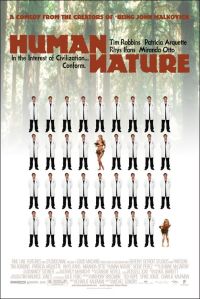 Originally released April 12, 2002:
Screenwriter Charlie Kaufman jumped on to Hollywood’s A-list when his feature debut Being John Malkovich was unleashed in 1999. Malkovich was a brilliant original satire on identity, be it celebrity or sexual, and was filled with riotous humor but also blended beautifully with a rich story that bordered on genius that longer it went. Now Kaufman tries his hand expounding at the meaning of civilization versus animal instinct in Human Nature. As one character tells another, “Just remember, don’t do whatever your body is telling you to do and you’ll be fine.”
Lila (Patricia Arquette) is a woman burdened with excessive body hair ever since she was old enough for a training bra (with the younger version played by Disney’s Lizzie McGuire). Lila feels ashamed by her body and morbidly humiliated. She runs away to the forest to enjoy a life free from the critical eyes of other men. Here she can commune with nature and feel that she belongs.
 Nathan (Tim Robbins) is an anal retentive scientist obsessed with etiquette. As a young boy Nathan was sent to his room for picking the wrong fork to eat his meal with. He is now trying his best to teach mice table manners so he can prove that if etiquette can be taught to animals it can be ingrained toward humanity. Lila and Nathan become lovers when she ventures back into the city, eliminating her body hair for now, because of something infinitely in human nature – hormones. The two of them find a form of content, as neither had known the intimate touch of another human being.
“Puff” (Rhys Ifans) is a grown man living his life in the woods convinced by his father that he is an ape. One day while walking through the woods, Nathan and Lila discover the ape-man and have differing opinions on what should be done with him. Nathan is convinced that he should be brought into civilization and be taught the rules, etiquette, and things that make us “human.” It would also be his greatest experiment. Lila feels that he should maintain his freedom and live as he does in nature, how he feels he should.
What follows is a bizarre love triangle over the reeducation of “Puff,” as Nathan’s slinky French assistant Gabrielle (Miranda Otto) names him. Lila is torn over the treatment of Puff and also her own society induced shame of her abundant amount of body hair. Nathan feels like he is saving Puff from his wayward primal urges, as he himself becomes a victim of them when he starts having an affair with Gabrielle. Puff, as he tells a congressional committee, was playing their game so he could find some action and “get a piece of that.”
 Kaufman has written a movie in the same vein as Being John Malkovich but missing the pathos and, sadly, the humor. Human Nature tries too hard to be funny and isn’t nearly as funny as it thinks it is. Many quirky elements are thrown out but don’t have the same sticking power as Kaufman’s previous film. It’s a fine line between being quirky just for quirky’s sake (like the atrocious Gummo) and turning quirky into something fantastic (like Rushmore or Raising Arizona). Human Nature is too quirky for its own good without having the balance of substance to enhance the weirdness further. There are many interesting parts to this story but as a whole they don’t ever seriously gel.
Debut director Michel Gondry cut his teeth in the realm of MTV making surreal videos for Bjork and others (including the Lego animated one for The White Stripes). He also has done numerous commercials, most infamously the creepy-as-all-hell singing navels Levi ad. Gondry does have a vision, and that vision is “Copy What Spike Jonze Did as Best as Possible.” Gondry’s direction never really registers, except for some attractive time shifts, but feels more like a rehash of Jonze’s work on, yep you guessed it, Being John Malkovich.
Arquette and Robbins do fine jobs in their roles with Arquette given a bit more, dare I say it, humanity. Her Lila is trapped between knowing what is true to herself and fitting into a society that tells her that it’s unhealthy and wrong. Ifans has fun with his character and lets it show. The acting in Human Nature is never really the problem.
While Human Nature is certainly an interesting film (hey it has Arquette singing a song in the buff and Rosie Perez as an electrologist) but the sum of its whole is lacking. It’s unfair to keep comparing it to the earlier Malkovich but the film is trying too hard to emulate what made that movie so successful. Human Nature just doesn’t have the gravity that could turn a quirky film into a brilliant one.
Nate’s Grade: C+
——————————————————
WRITER REFLECTIONS 20 YEARS LATER

I’m at a loss with 2002’s Human Nature. I thought in the ensuing twenty years I would have more to say with coming back to the early burst of brilliant writer Charlie Kaufman in the immediate wake of his successful debut, 1999’s Being John Malkovich. 2002 was a big year for Kaufman; he had three movies released that he wrote, all of them wildly different. His best work was Adaptation, a reteaming with Malkovich’s Oscar-nominated director Spike Jonze, that earned Chris Cooper a Best Supporting Actor Oscar and Kaufman was close to winning for Best Original Screenplay and sharing the honor with his pretend twin brother, the both of whom were portrayed by Nicolas Cage. It was the most challenging and creative and fulfilling of the three. There was also Confessions of a Dangerous Mind, the debut for George Clooney as a director, was a lark of a movie, taking Gong Show host Chuck Barris’ “unauthorized autobiography” where he claimed he was doubling as a CIA black ops hitman. I recently re-watched this one months ago and my opinion even lowered because there’s nothing to the movie beyond the central irony of the unexpected reality of this unexpected man being a spy and assassin. There’s no real insight into Barris as a character and he comes across as scummy and unworthy of a big screen examination. It’s a story that only exists to be ironic and missing the messy humanity and pathos of Kaufman’s best.
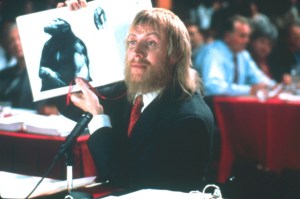
But Kaufman’s most forgotten movie in his screenwriting career is definitely Human Nature, the debut film for Michel Gondry, one of Kaufman’s other collaborators along with Jonze, both men having gained great acclaim for eclectic and visionary and just plain weird music videos. It follows three main characters, each debriefing their tale to an audience. Lila (Patricia Arquette) is accused of murder and discussing her lifelong malady of growing intense amounts of body hair, enough so that she worked as a gorilla woman in a circus sideshow. Puff (Rhys Ifans) is a man raised in the wild who intended to be an ape and returned to society, been trained in etiquette, and become an example of the transformative power of civilization. Dr. Nathan Bronfman (Tim Robbins) is telling his story after death with a bullet hole in the middle of his pasty forehead, as the scientist who found Puff, trained him, and romanced Lila before cheating on her with his French assistant (Miranda Otto). Immediately, the movie presents questions for us to unpack: how did Nathan die? Who was really responsible? What will be the connections between these three very different characters? Then there are assorted kooky side characters that come in and out, but the focus is mostly on this trio, perhaps a foursome with Otto, and the shame is that there is only one really interesting character among them.
Lila is the only protagonist worth following. She feels like a freak, even served in a “freak show,” and must hide her secret from lovers who would object to her untamed mane. She’s vulnerable and hopeful but pressured to conform to be accepted, and her journey to radical self-acceptance would have been an entertaining movie all on its own. However, by fragmenting the narrative with Puff and Nathan, she gets far less attention and her story becomes, for far too long, just her willfully sublimating herself to Nathan’s standards of beauty. Lila frustratingly feels like a character furiously trying to do whatever she can to keep the affections of a bad man. It’s reductive to the movie’s most interesting character. Puff and Nathan, in contrast, just feel like ideas, opposite poles in a discussion over the differences between animal instinct and the ideals of human civilization in all its hypocritical splendor. Even though both men are given comic-tragic back-stories, neither is really a richly defined character. Puff is all impulses and his urges become a tiresome comic device when we watch him hump somebody or something for the eightieth time. Nathan’s preoccupation with social niceties is meant to be absurd (teaching table manners to mice?) and petty, a meaningless articulation of “high culture and values.” I did laugh out loud when Nathan was teaching Puff how to respond at the opera, complete with a constructed box seat. Nathan is a satirical punching bag for a bourgeois sensibility. Neither him nor Puff feel like characters, instead more like conflicting points of view of humanity.
 The other disappointing aspect to Human Nature is as I declared in 2002, it feels like quirky for quirky’s sake screenwriting. Kaufman has become a screenwriting legend and he’s able to marry absurd, bizarre, and dangerous elements into meaningful and subversive and satirical masterstrokes, but the man cannot be expected to perform at the highest heights every time. Human Nature is stuffed full of wacky moments and wacky characters and it doesn’t feel like it ever amounts to more than the sum of its transitory parts. In contrast, 2022’s Everything Everywhere All At Once is an example of how one can take the most bizarre ideas and still find ways to tie them back in meaningful ways that braid into the larger theme. However, much of Human Nature feels like a quirk dartboard being hit over and over, a catalog of strange visuals and goofy ideas (Lila breaks out into song!) that fails to coalesce into a larger thesis like an Adaptation or an Eternal Sunshine of the Spotless Mind or the vastly underrated Synecdoche, New York, Kaufman’s directorial debut. He’s a master of the idiosyncratic, but Human Nature suffers because ultimately what does it have to say? Puff is set up for ridicule. Nathan is set up for ridicule. Even Lila is set up, though for murder. In the end, when Puff returns to the wild in a public galivanting that feels like a ceremonial bon voyage from the society that came to love him, he then scampers out of the woods and escapes back to the comforts of society with Nathan’s French mistress. In the end, is the point that we’re all rubes and hypocrites?
This was Gondry’s first film and it feels like a training vehicle for what would be his real masterpiece, 2004’s Eternal Sunshine of the Spotless Mind, one of my favorite films ever. Gondry’s style is still recognizable, especially reminiscent of his tactile, kitschy, avant garde music videos he directed for Bjork, the queen of weird 1990s music videos. Gondry’s hardscrabble, idiosyncratic style was a natural match with Kaufman’s vivid imagination. It’s surprising that they never reunited after Eternal Sunshine. Gondry had a few movies (2006’s The Science of Sleep, 2008’s Be Kind Rewind) but they felt lacking, trifling without a stronger writer to guide and ground them in human drama. Gondry even tried his hand at studio action to middling results with 2010’s The Green Hornet. He mostly retreated back to music videos and commercials and had a short lived series on Showtime with Jim Carrey as a former children’s TV entertainer whose fantasy is blending with reality. It seemed like a good fit for Gondry, and a nice starring role for Carrey, but it was canceled after two seasons. Even the realm of music videos seems so far removed now, where Hollywood was snatching up every visual virtuoso.
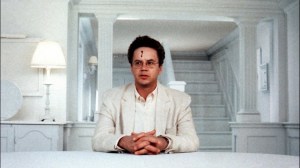
Human Nature has plenty of familiar faces, no doubt eager to attach their names to a daring Kaufman movie. Arquette is winning and the best part of the movie. She would later win an Academy Award for her decade-in-the-making performance in Richard Linklater’s Boyhood. Now I enjoy her in a chilly, villainous role as the shady corporate boss on Apple TV’s stunning sci-fi satire, Severance. Robbins is officious to a fault here. He too would later win an Oscar for 2003’s Mystic River. Poor Ifans, so big after his scene-stealing role in 1999’s Notting Hill, who never seemed to capitalize on his success (even his Spider-Man villain got the weakest treatment in No Way Home). He’s had a long career and prominent TV roles with Berlin Station and the Game of Thrones prequel series, House of the Dragon. I did laugh out loud at his “yahoo” after being zapped by his electric shock collar. You’ll also see Rosie Perez, Peter Dinklage, Robert Forster, Toby Huss, Hillary Duff, and Mary Kay Place. As I said in 2002, acting is not the problem with Human Nature. It’s the writing and characterization that lets these people down.
I usually like to devote a paragraph to going back and re-evaluating my initial words from twenty years ago, but I agree with everything I wrote. Everything. That’s initially why I thought this would be a shorter review. What more am I going to say other than my initial opinion of this movie is the same opinion I have upon re-watching? With the distance, it’s even more clear to me that Human Nature is the weakest film of Kaufman’s career. Even a movie I didn’t really gel with, like 2020’s I’m Thinking of Ending Things, at least has a lot more ambition I can recognize. It’s a character study obfuscated with too much eccentric clutter but there’s still an artistic vision there, even if it didn’t work for me. Kaufman is too unique a voice to only have made three movies in the last 14 years, and it makes it even more frustrating when I don’t connect with his long-in-the-making projects. Human Nature is too limited in scope and characterization. It’s slightly interesting as a footnote to a great screenwriter but little more.
Re-Review Grade: C
Share this:

Sonic the Hedgehog 2 (2022)
 While not as enjoyable as the first outing, Sonic 2 mostly fulfills what you would be looking for with a sequel. This is the kind of kids movie that is aimed primarily for the little ones, and that’s okay, not every movie intended for children has to work on multiple levels of maturity. We follow our signature alien speedster as he meets two of the other famous faces from the video game franchise, Tails (voiced by the game’s original actress) and Knuckles (Idris Elba), except Knuckles is working with a returned Doctor Robotnik (Jim Carrey) to find a hidden gem of ultimate power. The plot is just a disposable excuse to set up some big screen adventure-seeking, and everything is kept at a very low-stakes realm of entertainment, breezy and quippy and pleading with you to just accept it on its own minor terms. At points, the Sonic sequel can feel like a direct continuation of its predecessor and Carrey is once again the MVP. I enjoyed the Knuckles character because the screenwriters have made this new alien warrior very much like the literal-minded himbo, Drax (Guardians of the Galaxy). Plus I just enjoy Elba’s natural British voice. The length of the movie is a bit padded at over two hours, a full twenty minutes longer than the 2020 original, and the attempts at heart feel strictly boilerplate and perfunctory. The subplot about a destination wedding in Hawaii feels included just to give the humans something to do away from the action, and while I enjoyed Natasha Rothwell (Insecure) getting to go full avenging bridezilla ham, this stuff could have easily been cut as much as it matters to the bigger picture of world-saving and robot-smashing. If you were a fan of the first Sonic movie, which I found to be a pleasant surprise, then you’ll likely relive those same feelings but just a little less potent. It’s still a fun, agreeable kids movie and one that can be enjoyed on that level even by adults, though the fun just might not be the same size as before.
Nate’s Grade: B-
Share this:

Everything Everywhere All At Once (2022)
 Even after only two movies, I would trust the directing duo Daniels (Daniel Kwan and Daniel Scheinert) with any movie. They have earned a lifetime pass from me. If these men can make the farting corpse of Harry Potter not just one of the weirdest movies of 2016, not just one of the best films of that year, but also one of the most insightful toward the human condition, then these men can do anything. It’s been six long years for a follow-up but it sure has been worth it. Everything Everywhere All At Once is, to be pithy, a whole lot of movie. Everything Everywhere (my preferred shorthand from here) is a miracle of a movie. It’s a wonder that something this bizarre, this wild, this juvenile, this ambitious, and this specific in vision could find its way through the dream-killing factory that is Hollywood moviemaking. This is the kind of movie you celebrate for simply existing, something so marvelously different but so assured, complex but accessible, and deliriously, amazingly creative. I’m throwing out a lot of adjectives and adverbs to describe the experience of this movie and that’s because it filled me with such sheer wonder and divine happiness. I am thankful that the Danirels are making their movies on their terms, and two movies into what I hope is a long and uncompromising career, I can tell that both of these gentlemen deserve all the accolades and plaudits they have coming. I’ll try my best not to sound like a simpering moron while I try to explain why this movie is so thoroughly outstanding.
Evelyn (Michelle Yeaoh) is a middle-aged Chinese immigrant who is taking stock of her disappointing life. She and her husband, Waymond (Ke Huy Quan), own a floundering coin-operated laundromat. They’re under audit by a dogged IRS agent (Jamie Lee Curtis). Evelyn’s disapproving father, Gong Gong (James Hong, still so great even into his 90s), has moved from China to live with the family, and he was never a fan of Waymond, looking down on his daughter for marrying the man. Then there’s Joy (Stephanie Hsu), Evelyn and Waymond’s twenty-something daughter, who wants to bring her girlfriend to dinner but mom still doesn’t accept her daughter’s queerness and uses the excuse of Gong Gong’s generational disapproval. Then, at the IRS agency, Waymond’s body is taken over by another Waymond, Alpha Waymond, who informs Evelyn that she is the key to saving a universe of universes, and she’ll have to tap into her alternate selves and their abilities to battle the evil destroyer, Jobu Tupaki, who wants to destroy all existence, and who also happens to be an alternate universe version of Joy.
 Multiverses are definitely all the rage right now as they present nostalgic cash-grabs and cameos galore, but Everything Everywhere is a multiverse that is personal and specific. It’s based on all the paths the protagonist never took, and each allows her confirmation of what her life could have been, often more glamorous or exciting or initially appealing. A movie star. A famous singer. A ballerina. A skilled chef. Evelyn is a character paralyzed by the disappointment of her life’s choices, the malaise that has settled in, and the nagging feeling that things could have and should have been better. In one of the best jokes early on, Evelyn is told she’s the Chosen One not because she is special but because she is, literally, living the worst of all possible lives of the multiverse of Evelyns (then again the pinata Evelyn didn’t look like an upgrade). She has taken all the many bad paths and dead ends, but this positions her as the only one who has the power to tap into every other power and ability from her multiverse duplicates. It’s one thing to be feeling like you should have made a different choice in the past, and it’s another to get confirmation. This backhanded revelation could just serve as its own joke but it actually transforms into a philosophy that coalesces in the final act, that of all the universes and possibilities we could have had, the best one is the one we are actually present for. In another universe, one very much styled like In the Mood for Love, where a Waymond who was rejected by Evelyn long ago reconnects with her, mournful of what could have been, and says, “In another life, I would have really liked doing laundry and taxes with you,” in reference to Evelyn’s dismissive summation of what his unrequited romantic “what if” would have lead to. It’s such a poignant moment. By the end of the movie, it’s become a journey of self-actualization but tied to self-acceptance, where kindness and empathy are the real super weapons and the answer to the tumult of postmodern nihilism.
Smartly, the Daniels have made sure that a universe-hopping threat is actually connected to our hero in a meaningful manner. By making the villain an alternate version of Joy, it raises the stakes and forces Evelyn to have to confront her own parenting miscues and frayed relationship with her daughter. It’s the kind of decision-making that reinforces the emotional and thematic core of a movie that is spinning so fast that it feels like you might fall off and vomit new colors. Joy is an avatar of generational disconnect, inherited disappointment and resentment, but what really makes her relatable is the growing feeling of being over it all. Given the power to see everything in every universe, Joy concludes that life is overwhelming and without meaning. It’s the same sort of nihilism we might feel today as we doom scroll through our phones, eyes glazed over from the barrage of bad news, outraged click bait, and feeling of abject helplessness while the world spins on in an uncertain direction. It’s not hard to feel, as Joy, that it’s all too much to bear, and if she can experience everything then does it present value to anything? If she can always just sidestep to another universe, what does that do to the value of life? That’s the ethical conundrum with Rick and Morty, a show where they can swap characters from other dimensions to fix more costly mistakes. What Daniels attempts with Everything Everywhere is to tackle the same question but approaching a different answer: that despite everything, life matters, our relationships matter, and kindness and empathy matter most. Watching Evelyn and Joy, and their many different versions of mother and daughter, try to reach an understanding, it’s easy to feel that struggle and relate to wanting to feel seen. As Evelyn encouragingly says to one character at their lowest point, “It is too much to handle, yes. But nobody is ever alone.”
 This is a dozen different kinds of movies, all smashed together, and each of them is utterly delightful and skillfully realized and executed. If you like martial arts action, there are some excellent fight sequences including a showstopper where Waymond wrecks a team of security guards with a fanny pack. The action is exciting and the martial arts choreography is impressive and filmed in a pleasing style that allows us to really appreciate the moves and countermoves. If you like wild comedies, there are many outlandish moments that combine low-humor and highbrow references. I’ll simply refer to one as finding payoffs for IRS auditor trophies shaped like butt plugs. This is one of the funniest American comedies in years. If you like family dramas, there is plenty of conflict across the board between Evelyn and Waymond and Joy, plus the specter of Gong Gong, and each person trying to communicate their dissatisfaction and desires for a better life. If you removed all of the crazy sci-fi elements, googly eyes, people’s heads turning to confetti, and what have you, this would still be a compelling human drama. When the movie isn’t working through ridiculous tangents, or eye-popping action, or a staggering combination of kitsch and intelligence, it’s building out its emotional core, the heart of the movie, the thing that makes all the gee-whiz fun matter, the family in flux. Likewise, this is a powerfully optimistic movie, life-affirming in all the best ways without being pandering, and one that is without any flash of ironic condescension. Sincerity is powerful and all over.
The movie is elevated even higher by the strength of the performances. Yeoh (Crazy Rich Asians) has spent decades as a martial arts master, and of late she’s been branching out in more demanding dramas, but this is easily the finest performance of her career for nothing less than playing a dozen different characters. She is sensational. The early Evelyn is full of despair and regret, and as she gets to explore each new version of herself, there’s an excitement that’s bristling, as she gets to see the successes she could have been and celebrate. Yeaoh is hilarious and deeply affecting in the central role and still very much a badass. She showcases starting range, it makes you weep that she has never gotten to play so many different kinds of roles because she’s so good at all of them. Hsu (The Marvelous Mrs. Maisel) is the wounded soul, and her sneers and seen-it-all attitude are killer without losing track of the pain at the core of the character. Her emotional confrontations with her mother still hit hard. But the secret weapon of this movie is Quan, the former child actor best remembered as playing Data in The Goonies and Short Round in Temple of Doom. Yes, that same actor. He too gets to play such a wide, wild variety of Waymonds, from the doting and meek husband, to the confidant warriors, to the smoldering former flame, but with each new Waymond, Quan makes you fall in love with the original more. The character of Waymond and his central philosophy of kindness is so moving and needed, that we almost get to fall in love and re-evaluate this man the same way Evelyn does. Also of note, Curtis (Knives Out) is having an absolute blast as her menacing IRS agent.
 It’s truly amazing to me that a movie can have some of the silliest, craziest, dumbest humor imaginable, and then find ways to tie it back thematically and make it yet another important thread that intricately ties into the overall impact of the movie. The genius of Daniels is marrying the most insane ideas with genuine pathos. Take for instance that one of the many multiverses involves people with hot dogs instead of fingers. It’s a goofy visual, and it could simply have been that, a passing moment to make you smile, but the Daniels don’t stop there. They continue developing their ideas, all of their ideas, and find additional jokes and purposes few could. Okay, so this is a big divergence from history, so how could humans evolve to have hot dogs for fingers? Well the movie actually showcases this moment in a hilarious 2001: A Space Odyssey reference. And then the film says, “Well, if this was the way of life, what other practices would evolve from here when it comes to communication and intimacy?” It’s that level of development and commitment that blows me away. The same with what starts as Evelyn’s misunderstanding of the Pixar movie Ratatouille. It works just as a joke in the moment, but then it comes back as its own reality, and even that reality has a thematic resonance by the end. This level of imagination, to take the weirdest jokes and make them meaningful, is special. In one second, I can cry laughing from a raccoon and in the next second a rock can make me want to cry. In essence, even though Everything Everywhere is beyond stuffed, nothing is merely disposable.
That doesn’t mean that the film doesn’t also fall victim to repetition at points. My only criticism, and it might even be eliminated entirely after a second viewing, is that Daniels can over indulge when it comes to their narrative points. Some things can get stretched out, so that they hit points with five beats when three could have been sufficient. It’s this kind of mentality that pushes the running time to almost two hours and twenty minutes, which feels a bit extended. However, the messiness and overstuffed nature of the movie is also one of its hallmarks, so I don’t know if this criticism will even register for many, especially if you’re fully on board their wacky wavelength.
If you can, please go into Everything Everywhere All At Once knowing as little as possible. The carousel of surprise and amazement is constant, but the fact that there is a strong emotional core, that all the many stray elements become perfectly braided together, no matter how ridiculous, is all the more impressive. This is stylized filmmaking that is very personal while also being accessible and universal in its existential pains and longing. It’s style and substance and exhilarating and genius and emotionally cathartic and moving and everything we want with movies. It’s the kind of movie that reignites your passion for cinema, the kind that delivers something new from the studio system, and the kind that deserves parades in celebration. Simply put, as I said before, this is a miracle of a movie, and you owe it to yourself to feel this blessing.
Nate’s Grade: A
Share this:

The Bubble (2022)/ Moonfall (2022)
 What to do with a comedy that just isn’t that funny? I come to co-writer/director Judd Apatow’s The Bubble with a rhetorical surgeon’s scalpel ready to figure out this conundrum. There are plenty of funny people involved with this Netflix project. Apatow has been an industry unto himself in developing comedic talent going back to his Freaks and Geeks TV days and with such heralded twenty-first century comedies to his credit like The 40-Year-Old Virgin and Knocked Up. The cast assembled for The Bubble has great comic potential. Even the premise is fun, a group of spoiled actors trying to film a bad sci-fi action movie under the challenges of the COVID-19 quarantine. So what went wrong here and why is The Bubble Apatow’s least engaging and least funny movie to date?
We follow the Hollywood production of Cliff Beasts 6, filming in rural England under the supervision of studio execs trying to keep the secluded production as problem-free as possible under the 2020 COVID outbreak. Karen Gillan (Avengers Endgame) plays Carol Cobb, an actress returning to the franchisee she had once left behind to star in a misguided Oscar bait movie where she, a white woman, was the solution to solving the Israeli-Palestinian conflict. She’s hoping to save her career, while her coworkers are just hoping not to go insane with the forced isolation and new safety protocols during their film shoot.
 So let’s circle back to the central question of why The Bubble isn’t funny, and I think I have some theories. First, we can acknowledge comedy is subjective but at the same time also acknowledge that the construction of good comedy can be academically identified and appreciated, that there are tenets that hold and maintain, like setups and payoffs, rules of threes, etc. I think one of the big problems is that nothing is really that surprising throughout the protracted and unfocused duration of The Bubble.
The characters are intended to be shallow but are too shallow to even register as distinct comedy types played against one another. There are levels of general buffoonery, but so many of these characters are missing out on a more definite angle or perspective. Take for instance the smug movie star (David Duchovny) who takes it upon himself to rewrite the script. This should be an obvious route where the story comes undone or character actions are inconsistent or that other characters, especially those who had larger roles, become subservient to the star and his ballooning ego. There needs to be distinct differences for the comedy to land and be an indication of his ideas about what he thinks would be an improvement. This doesn’t really happen. Take the recent Oscar winner (Pedro Pascal). He’s not haughty and pompous, thinking himself beneath this kind of genre filmmaking. He’s simply a dumb hedonist who is seeking out pleasure he is denying himself. That’s fine, as at least one character is set up to be more of a wild card to stir trouble. This character spends the entire movie whining and having unfunny fantasies when they should be the one causing havoc and unexpected consequences from their behaviors. What a waste. Every character falls into this nebulous underwritten area without being distinct enough to be considered stock and ultimately useful for comparisons and generating comedic conflicts.
Another lack of surprise is how every character is exactly how they are presented, so with no points of change it all gets very redundant. If this was going to be the case, Apatow needed to be far more exacting with his satirical barbs. If he wants to really send up the industry and self-absorbed actors, we need something akin to 2008’s Tropic Thunder, which, by the way, had very distinct character differences it used for maximum comedy. This movie feels more like an extension of the privileged world populated by the bourgeoisie characters from 2012’s This is 40, a marked misstep for Apatow and his idea of recognizable midlife struggles (“Oh no, we’ll have to move from our ridiculously large house to… just a very large house!”). It’s the same pitiable rich people whining about their lives while they quarantine in luxury. Watching montage after montage of them being bored in their private hotel suites is not funny. It doesn’t even work as a criticism of the characters on display. They aren’t doing anything out there or particularly telling, they’re just being bored, and just watching bored people is boring.
 The moviemaking process and the film-within-a-film itself is also shockingly unfunny. Apatow has worked in Hollywood for decades, so I was expecting harder-hitting satire of the moviemaking industry and the way that films are continuously compromised. As another example of shallow character writing, take the director (Fred Armison), a Sundance award-winning indie artist tackling their first studio project. The expected route would be to start with this character having big ideas about a grand artistic vision, taking real chances, and trying to do something different and compelling within the realm of giant dinosaur action movies, and then little by little, they have to compromise and delete this grand vision, taking studio notes, limitations from the actors, and bad luck. This would provide a foil for every bad item complicating the production, the artist struggling to watch their dream die piece-by-piece. This doesn’t happen and the director’s indie background is never utilized as a contrast for comedy.
Apatow plays the same trick over and over with the film-within-a-film. It will be a dramatic sequence and then cut to the actors running on a treadmill or swinging behind a green screen, the same undercutting gag on repeat. It’s not funny and, frankly, gets tiresome. The ridiculous nature of blockbuster filmmaking should be ripe for satire (again, Tropic Thunder did it) but Apatow never pushes too hard, settling on the same soft-pedaled jokes on simple characters. Pascal is left to practice funny accents, but none of what they say within the movies is funny-bad; it’s just tin-eared dialogue that is merely bad only. The only segment that genuinely had me laughing was when the young actress (Iris Apatow) teaches a raptor how to do the latest TikTok dance. This is the only moment that feels biting on the out-of-touch desperation of modern moviemaking to chase and incorporate vaporous youth trends to remain hip. The Hollywood film gone awry should feel like a mess, it should be getting progressively worse or more out of control or at least something so outlandish it separates itself from its targets. I suppose shooting the CGI genitals off dinosaurs is something you don’t see every day but it too gets old fast.
 Fortunately, these actors can still be charming even with lesser material, but you’ll simply walk away feeling enormous sympathy for them. Everyone is trying to do so much with so very little, and it can get painful at points, like Pascal’s character clinging to an amorphous evolution of an accent. There are very funny people here. Keegan Michael-Key is very funny, but he gets nothing here, especially with a ripe subplot where he might be starting a self-help cult. Maria Bakalova is very funny, and was even nominated for an Oscar, a rarity for a comedian, but she gets nothing here, being a horny hotel worker. Gillan is very funny, but she too gets nothing here as a slumming actress desperate to rehabilitate her career. It’s remarkable considering she’s the main character but really just an insecure straight man role. The main character needed to be Gavin (Peter Serafinowicz), the producer on location doing his best to herd all these spoiled and irresponsible people into getting this movie made and on time. You want to focus on the character with the most chaos to try and control, and that’s him. It just feels criminal that a cast this good, with fun supporting players like Samson Kayo (Our Flag Means Death) and Harry Trevaldwyn (Ten Percent) to round out the more famous faces.
This also made me think to reflect on the recent release of Moonfall, which looks like the big, schlocky sci-fi disaster movie that Judd Apatow would be satirizing with The Bubble. It’s a Roland Emmerich disaster movie where he does exactly what Roland Emmerich does best: expansive scenes of cataclysmic destruction on the biggest scale possible. It was believed by industry watchers that Moonfall would be the kind of epic that people would go back to the movies to experience, watching the scale of destruction on the biggest screen and cheering along. It didn’t work out that way and Moonfall reportedly will lose over a hundred million dollars for its investors. It seemed like a smart bet as disaster movies have performed well for Emmerich, like 2012 and The Day After Tomorrow. In times of struggle, human beings enjoy fantasies about surviving fantastic odds, or at least that was the established way of thinking. After two years of life during COVID-19, maybe our idea of sci-fi escapism isn’t quite what it used to be.
I watched Moonfall with general indifference. It felt like a mediocre hodgepodge of other Emmerich disaster movies and veered into campy nonsense at many points. It’s the kind of movie that demands you shut off your brain and just go along with the scientific gobbledygook, especially once the moon begins making Earth’s gravity go all haywire. At that point the movie becomes an inconsistent video game with its liberal use of physics. It doesn’t seem like it matters, but watching characters do Super Mario Brother-level jumps has a fun appeal as well as being impossibly goofy. One character says, “The moon can’t do these things,” and another character waves away that pertinent thought and says, almost directly to the audience, “Yeah, but this isn’t a normal moon, so forget everything.” The special effects are also quite hit or miss. Plenty of the larger effects are quite awe-inspiring and suitably terrifying in depicting an awesome reality, and then others look like they didn’t quite have enough money when it came time to render. Some of the CGI reminded me of moments from 2008’s Torque, where the high-speed backgrounds resembled badly composited video game texture blurs. If your movie is going to exist primarily in a junk food realm, then you need to either have as minimal distractions as possible to rip you from the believability of this world, or you simply need to veer into it and accept that the instability and chaos will be part of the general appeal. Provide the goods, and Moonfall just doesn’t.
 The movie also takes an inordinate amount of time to get back to space after a prologue, almost halfway through its two hours. This first half stalls with setting up so many characters to follow that you simply won’t care about. I didn’t care what happened to anyone back on Earth. When the rednecks found our party (again!) in a petty car chase, I literally laughed out loud. The alien/moon mythology is also convoluted and vague enough to simply apply a good versus evil designation for technology, and the big sacrifice doesn’t feel so big when you find that character to be annoying for the duration of their grating screen time. It’s another movie tipping you off about a possible linked sequel and one that appears more appetizing than the film we just witnessed (just like Emmerich’s 2016 Independence Day sequel). In short, Moonfall is a bit of a mess, a mess I can imagine others enjoying and laughing with, but definitely one of the lower outputs in Emmerich’s long career of destroying global landmarks and formerly pristine vistas.
I found Moonfall and The Bubble to both be poor examples of what Hollywood thinks audiences will desire as escapism in the wake of COVID-19 disrupting routines and lives. Each of the movies is disappointing because it doesn’t fulfill what it promises. The Bubble has a bunch of combustible characters in a combustible scenario and squanders its time with weak satirical gags and lazy characterization. Moonfall wants to be the big, fun epic of Emmerich’s past, but it takes its sweet indulgent time with uninteresting characters, convoluted and underwritten lore, and a plot that would have been more entertaining had it better embraced the absurdity of its implications. You may likely have an enjoyable time watching either movie, and they’re almost the same length too, but I found both to be middling examples of Hollywood’s attempt to try and give the people what they think they want and missing the entertainment mark.
Nate’s Grades:
The Bubble: C
Moonfall: C+
Share this:

The Lost City (2022)
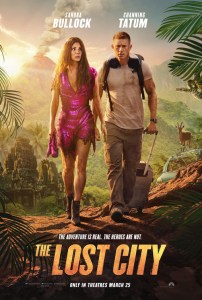 It’s a new spin on Romancing the Stone and as long as the leads are charming and the movie is fun, I have no problem with rehashing this formula. The Lost City mostly succeeds thanks to the winning chemistry between Sandra Bullock and Channing Tatum. She plays a self-loathing romance author and he’s her hunky and clueless cover model, and they both get into a treasure-hunting escapade and chased by scary men with guns thanks to a crazed rich kid (Daniel Radcliffe) looking for a titular lost city of yore to bolster his own rep. The movie stays on a consistently light wavelength even when death and sudden violence occurs. That jokey mentality assures the audience that the movie will not take things too seriously, and that relaxed-yet-antic attitude translates into fairly amusing banter with our leads. The movie does a good job of spacing out its comic set pieces and keeping things moving for its short 90 minutes. Not everything works as well as the leads though. Some storylines feel underplayed or forgotten until called upon for moments that don’t feel earned. Radcliffe feels wasted as a petulant baddie without any fun or memorable angle. One of the best aspects is what happens to the movie’s surprise cameo (spoiled via the movie’s own trailer) but the ending resolution of this feels entirely pointless and undercuts its nerve. It’s a movie that delivers exactly the kind of experience it advertises, and it’s nice to still be able to see a comedy in theaters lifted by the appeal of two stars having a ball together. The Lost City is a formula rom-com with enough good-natured screwball comedy and enjoyable zaniness to coasts on charm and star power.
Nate’s Grade: B
Share this:

Turning Red (2022)
 It’s fair to start to wonder whether Disney has some kind of grudge against Pixar at this time. The last three Pixar movies have been pulled from theatrical release and made exclusively available as part of their streaming war chest with Disney Plus. You can blame COVID for Soul being pulled, and the theatrical market was still recovering by the time Luca was scheduled to be released during the middle of summer 2021, but this didn’t stop Disney from releasing both of its own in-house animated efforts to theaters. Both Raya and the Last Dragon and Encanto played in theaters in 2021 and both under-performed at the box-office, which is clearly not close to where it was pre-pandemic. No animated movie has earned over $100 million at the U.S. box-office since COVID, and maybe that’s the reason that Turning Red has become the third Pixar movie to go directly to streaming. There are rumors that this trend has been demoralizing for Pixar employees, and explanations by Disney brass that these movies move valuable subscribers to their service, but I guess we’ll see when the Buzz Lightyear movie comes out summer 2022. Regardless, Turning Red is a high quality movie that made me feel warm and fuzzy all over.
 Meilin Lee (voiced by Rosalie Chiang) is a 12-year-old student trying to live her best life in Toronto circa 2002. That means she’s one way with her friends and one way with her domineering mother, Ming (Sandra Oh). Mei is an overachieving student, devoted daughter to her family’s business caring for a Chinese temple honoring their ancestors and red pandas, and a fangirl in the extreme for the popular boy band, 4-Town (even though there are five members). Mei’s mother does not approve of her devotion to this band, or the influence of her friends, and doesn’t understand the new person her daughter is turning into. However, Mei also happens to turn into a giant red panda whenever she feels any strong emotion. She has to keep herself in check, which is hard to do with mean students, an embarrassing mother, and the prospect of scrounging up enough money so she and her three besties can see their favorite boy band live.
I had to consider what about Turning Red worked for me and what about Luca did not. They’re both relatively smaller scale movies about characters who transform into fantastical creatures, who have to hide their secret, deal with parental disapproval, and come of age while pushing their personal boundaries and re-examining who they are and what they felt was important. There are several points of comparison but I found Luca to be broadly lackluster and low in stakes. With Turning Red, I found the movie to be much more engaging and poignant. So what’s the difference where one feels shallow and the other feels personal and resonant? I think the difference is that Turning Red’s relationships feel more realized and complex. The mother-daughter dynamic is fraught with tension, as trying to live up to the standards of the prior generation is often a surefire way to disappointment. That stuff is relatable, and the drama is potent, but the movie doesn’t lose sight of the generational love underneath all the headaches. Both movies are in essence about growing up and finding your identity, relishing different parts of you that stand out as unique, and coming to terms with differences in perception, but I felt with Turning Red that the film embraced these themes, integrated them better, and also built a sturdier foundation of enriched character relationships.
 The animation is irrepressibly gorgeous but I really enjoyed the added style of Turning Red. It had a more tactile physical presence that reminded me of the Aardman models (Wallace and Gromit, Chicken Run). The color balance also emphasized bright colors that popped with subdued hues as a background. I especially enjoyed playful little touches from anime that emphasized the overly dramatic nature of the personal stakes, like when Mei is sweating over whether her mom will find her notebook filled with pictures of a crush that she felt compelled to draw. There’s a definite energy to this movie that’s missing from plenty of other Pixar movies. It follows the perspective of its heroine, so it’s joyfully excitable and goofy at points and definitely over-the-top, like when she’s calling out her besties and we flash to a rotating mountain they’re all triumphantly scaling. It’s adopted her perspective in a way that makes the movie feel more personable, and I appreciated Mei’s character even more. Special credit should go to whoever was in charge of designing the fur textures for the red panda. When she fully panda’s out, Mei resembles a wonderfully realized version of a Totoro-styled demigod.
It was the third act where Turning Red went from amusing to surprisingly poignant for me. The central conflict is between Mei trying to be herself and the version her mother thinks she should be, which is naturally more deferential and devoted to the family at the expense of independence. This isn’t the first story to explore the difference between traditional families and their children becoming more influenced by Western pop-culture. It’s also not the first story about finding your voice and making a stand, or about parents coming to terms with the realization that their little kid isn’t so little any more. That’s fine. The supernatural elements are also pretty straightforward to follow and in service of the central relationships and metaphors. It’s the personal details that make this movie feel specific to its voice while still being accessible and relatable. It’s easy to cringe when Mei’s mother shares Mei’s private drawings with her fleeting crush. While many of us might not have been diehard fans of a boy band, we all had some phase where we felt more mature, more grown up, and dramatically different because of what this interest meant for us. I found myself battling genuine tears by the end. The end comes down to a conflict between mother and daughter, itself an echo of past conflicts, of overbearing generations being less flexible. It’s also ultimately about acceptance, but the idea that the aspects about yourself that you feel embarrassed or insecure about do not need to be expunged from your identity I think is a worthwhile message about growing up. It’s not about shedding parts of yourself, killing off things you dislike. It’s more about transformation and acceptance of self.
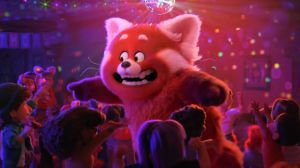 Turning Red is a briskly paced comedy with a precise, charismatic lead character letting us in on the pressures of her world and of being a teenage girl in the early twentieth century. It’s colorful and frenetic at points but feels completely in keeping with the personality of our plucky protagonist. The combination of puberty and monster transformation has been a ripe area for films especially in the realm of horror. This also might be the horniest Pixar movie to date, and a climactic confrontation involves shaking one’s butt, as they kids are wont to do in leisure. It’s got the substance I felt was missing with Luca and the simplified and streamlined world building that I felt could have improved Soul. In short, Turning Red isn’t top-tier Pixar but it’s an irresistible urban fantasy that has plenty of heart and whimsy to enchant audiences no matter the age.
Nate’s Grade: B+
Share this:

The Adam Project (2022)
 Watching the trailer for Netflix’s The Adam Project, I wasn’t too impressed. It felt like a combination of familiar and popular movies like Back to the Future, E.T., and Looper. It seemed like another assembly of popular sci-fi movie tropes and I wasn’t expecting much else. Then as I watched the movie, I realized how enjoyable and engaging this original story by writer T.S. Nowlin was and what must have attracted Tom Cruise to want to star and produce this project in 2012. It met a long developmental hell, as is common in the industry, before being given a second life at Netflix with Ryan Reynolds as star and director Shawn Levy (Free Guy). It kind of muffs the action and sci-fi spectacle, but The Adam Project is a movie that’s big where it counts.
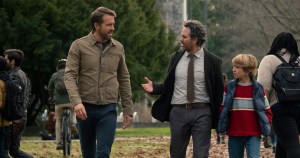
Adam (Reynolds) is a pilot in 2050 who is fighting against a corporate evil that uses time travel to enshrine its power. Adam’s own wife (Zoe Saldana) crash landed in 2018. In desperation, he travels back in time to find her and team up against their future foes, except he lands not in 2018 but in 2022, and he meets his younger, twelve-year-old self (Walker Scobell). It so happens that Adam’s ship is marked to respond only to his DNA, so he needs his younger self to help while he recovers from his injuries. Unfortunately, the future is antsy to eliminate Adam and sends killer super soldiers and missile-launching spaceships. Both Adams come to the conclusion the only way to prevail is to stop the initial first steps of the invention of time travel, meaning going back further to see their departed father, Louis Reed (Mark Ruffalo), the inadvertent creator of time travel.
 Where The Adam Project really shines is with its core ideas and relationships, which is the emotional heart of a movie. It’s peculiar because we’re so used to seeing the other half, the sci-fi action spectacle, prioritized at the expense of story and characterization. Usually a studio puts much more emphasis on a movie looking good, or at least passably entertaining, and less on the substance that would make it meaningfully so. Credit to the filmmakers that they understood what the core appeal of this movie was and that is the idea of characters out of time getting a chance to interact, learn, and reconcile. Who among us wouldn’t want another opportunity to talk with a loved one before they are gone? Who among us would not be hesitant to eliminate the special confluence of events that lead a special someone into our life? The idea of two different aged versions of one character butting heads is inherently fun but also meaningful, because every one of their squabbles or disagreements is telling from a character standpoint. We’re learning about the differences between these two versions and two different timelines. The older Adam is resentful of his younger self, of his naivety, and looking to toughen him up or settle some scores he thinks will be cathartic. The younger version resents his older self for being so domineering, for being so cynical, and for pushing him into uncomfortable situations to relieve long-standing grudges that he hasn’t dwelled over yet. It also allows older Adam to remember things that he has forgotten from the perspective of his younger self. The buddy banter is capable and spry but it’s also revelatory about the characters, which makes every interaction more important.
Adam’s father doesn’t come back until the second half of the film, and then the movie transforms into a real family affair and takes on extra pathos. Dear old dad is the square pushing back against the ethical implications of knowingly participating with time travel. Here we have three different characters, all related, but each has a different perspective and competing goals: Younger Adam wants to beat the bad guys but also is freshest in his grief over his dad and wants to save him; Older Adam wants to rescue his wife but also has a score to settle with his departed father; and Dad gets a chance to see his grown son, something he will never otherwise witness, but is adamant about refusing to help and prosper from time travel foreknowledge shenanigans. That’s a good combination of conflicts and personality differences, and through the relatable lens of broken relationships repairing between two sons and their father, it elevates each routine action moment later.
 My other surprise was how mundane the action plays in The Adam Project. I started to notice how the action was usually pretty small-scale with only a handful of future soldiers fighting in relatively open and empty spaces. The big future addition is an electrified baton that older Adam utilizes, as younger Adam gushes, much like a lightsaber. It has the power to propel enemies in a force blast that launches out in a circumference, but I kept questioning why Adam wasn’t knocked over by this force as well? It’s a cool device but little else is utilized to separate the past and future. When the characters murder people, they vanish in fiery clouds, free of blood, and we’re told this is what happens when a person is killed outside their timeline. I think it was meant to make the audience forget the mechanics or downplay that all these vanishing soldiers are actually being murdered from existence. The younger versions of these characters are still present but it’s not like there’s another version that will take their place. Their lives ended in this moment as they traveled back in time to this final fate. No do-overs for them. The finale of The Adam Project is a mess of bad CGI and a world-destroying machine; both it and the plot are on apocalyptic autopilot at this point. The preceding movie was much better to simply fall victim to such a dumb climax. It’s not enough to dent the positives that came before it, but the movie succumbs to the pressures of big blockbuster silliness it had avoided.
Here is a vehicle that makes perfect use of the charms of its leading man. Reynolds (Free Guy) has always been a charismatic performer, a fast-talking rogue you can’t help but fall for, but not every movie role allows him to play to his strengths, Sometimes he’s just on quip overload and can come across like the overly ironic, insincere, vacuous version of his motormouth persona. His glib demeanor has a way of eating him whole. Here, the actor gets to essentially be playing off himself, and it works so much better. Reynolds is also a natural with kids (see 2008’s Definitely, Maybe) and there’s an inherent big brother/little brother vibe to the Adam interactions that makes them heartwarming while also amusing. Newcomer Scobell is able to hold his own with Reynolds, no small feat. He has a vibrant, excitable energy that feels youthful without getting into annoying Anakin “yippee” Skywalker territory. Reynolds may be the star but you’ll enjoy spending time with young Adam too, and this is also a credit to Scobell and his performance. Ruffalo and Jennifer Garner (a welcomed 13 Going on 30 reunion) are enjoyable if extremely under utilized; each could have had a whole movie from their vantage point.
 The Adam Project is an action movie that looks like typical pandering studio junk at first glance but gets the hard stuff right, namely the reasons why you should care about any of the flying bodies, explosions, and world-ending CGI. It’s about the characters, and here we have a dynamic that keeps things interesting and fun while also making the dilemma personable and emotional. The same stakes given to saving the world are also given to having one more conversation with a departed father or with trying to get things right in your past while time is still ahead of you. The Adam Project might be overlooked or discounted because of how its parts appear to be generic and stale, but it’s the care with which they are assembled that won me over. I’m just amazed that, for once, a Hollywood big-budget tentpole release emphasized the right stuff.
Nate’s Grade: B


 nathanzoebl
You must be logged in to post a comment.