Blog Archives
Fright Night (2011)
 Horror is a genre that’s been notoriously cannibalistic, especially as of late. I don’t mean flesh-eating, I mean the glut of remakes that has polluted the horror market in recent years. After remakes of Halloween, A Nightmare on Elm Street, Friday the Thirteenth, The Hills Have Eyes, House of Wax, Prom Night, My Bloody Valentine, The Amityville Horror, The Fog, The Texas Chainsaw Massacre, Black Christmas, Sorority Row, Dawn of the Dead, The Crazies, Don’t Be Afraid of the Dark, I Spit on Your Grave, Last House on the Left, The Thing, and scads more, you’d be forgiven for believing that the remake of 1985’s Fright Night would be another soulless cash grab. It turns out that it’s way better than even the original and quite an entertaining movie that got lost in the shuffle.
In a quiet little suburb outside Las Vegas, students are going missing. Ed (Christopher Mintz-Plasse) suspects that there is a vampire in town. Ed’s former friend, Charley Brewster (Anton Yelchin), dismisses this idea, especially since the would-be vampire in question is his new neighbor, Jerry (Colin Farrell), a home construction worker who seems to work at night mostly. But lo and behold, after Ed goes missing, Charley concludes that his old friend was right all along. Jerry has his eyes set on Charley’s single realtor mom, Jane (Toni Colette), and maybe even Charlie’s sprightly girlfriend, Amy (Imogen Poots). The only ally Charley can muster is a drunken Vegas magician in the Criss Angel tradition. Peter Vincent (David Tennant) has been studying vampires for years due to his tragic personal connection to vampires, notably Jerry.
 Fright Night finds that horror sweet spot, equal parts scary and funny. Credit screenwriter Marti Noxon who cut her teeth on TV’s seminal show (yeah, I said it) Buffy the Vampire Slayer; there’s even a reference to a “Scooby gang” for we Buffy fans. Noxon does a terrific job of establishing a suspenseful situation and then developing it nicely, teasing it out. There’s a sequence where Charley is trying to rescue a neighbor lady that just involves a series of hiding places but uses a simple setup of ducking around corners so well. When our plucky protagonist checks in with Vincent for some assistance, we’re introduced to an array of exotic vampire-hunting weapons and artifacts that the Vegas magician has under glass. With a setup like that, you better believe we’re going to be using those weapons later, and how. The character development is richer than most teens-battle-monster genre films. The relationship between Charley and Ed, and the awkwardness and resentment of two friends growing apart, feels rather believable even dropped into the middle of a vampire adventure. The standard girlfriend role is given a bit more weight, as she’s the one who feels confidant and aggressive. She knows what she wants, and as played by the adorably named Imogen Poots (Solitary Man), you want to be what she wants. Seriously, this actress is striking in her Grecian features and I like a woman who knows how to handle a mace. There are also small touches that I really enjoyed that helped round out the movie. At one moment, a woman is being fed on by Jerry and she spots Charley hiding behind a door. Rather than cry out for help, she carefully draws a shaking finger to her mouth, wishing him to keep quiet and not to save her. The resolution of this rescue attempt is shocking in all the right ways. It’s a surprise that feels completely within reason, and organic twists and turns are always the most satisfying.
Noxon’s script continually surprises even when it starts to follow a by-the-numbers plot. Instead of an axe lopping off a vampire’s head, it just goes about halfway through thanks to the rigidity of bone. That’s a nice touch, but then when that same vampire tries to bite our hero and can’t move his fairly severed neck closer, then that’s when Noxon has capitalized on her cleverness. And she capitalizes often enough for Fright Night to be a real step above most vampire action flicks. Noxon also finds clever spins on vampire mythos; to get around the whole can’t-enter-without-an-invitation rule, Jerry just attempts to blow up the Brewster’s home to drive them out (“Don’t need an invitation if there’s no house”). There’s a particularly ingenious method to light a vampire on fire. And the entire character of Peter Vincent, played brilliantly by Dr. Who actor David Tennant, is a hoot and a great addition. He’s a riot as a cynical, profane, and selfish stage performer. His character is such an enjoyably comic foil, and Tennant plays him with aplomb, that you almost wish for a Peter Vincent spinoff movie.
Director Craig Gillespie shows that he is shocking adept when it comes to staging a horror film. I would not have expected this level of competency from the director of Lars and the Real Girl. It embraces its R-rating and the bloodshed is plentiful though the gore is restrained. Gillespie draws out scenes with judicious editing, letting the dread build steadily. The tension of something simple like Jerry standing in a doorway, waiting for any verbal slipup to come inside, can be terrific. Gillespie also has some nifty visual tricks up his sleeve to complement Noxon’s crafty screenplay. There’s one scene where Jerry walks into a hotel lobby and is confronted by a security guard. The camera pans over a series of security monitors that do not pick up Jerry. Then in the background we see Jerry hurl the guard to the ground to bite him and in the foreground we see the security footage minus Jerry. There’s an ongoing tracking shot inside a fleeing minivan that’s not exactly Children of Men but still a good way to feel the fever of panic. The final showdown between Charley and Vincent versus Jerry is suitably climactic and rewarding, nicely tying back elements that were introduced earlier and giving Poots an opportunity to vamp out, literally and figuratively.
 Farrell (Horrible Bosses) is a charming, sexy, alluring menace as Jerry, which is exactly what you’d want in a vampire (sorry Twilight fans). Vampires are supposed to be seductive; they’re inherently sexual, what with all that biting and sucking and sharing of body fluids. If Jerry is going to be dangerous, he also has to be seductive, and Farrell is exactly that. With his swaggering walk, with his pose-worthy stances, with his grins, he’s a great ambassador for vampire kind. But this guy does more than preen; he’s also a credible threat. He’s the bad boy that is actually quite bad. Farrell’s enjoyment of his villainous role is noticeable. Jerry taunts Vincent: “You have your mother’s eyes.” He shoots and misses the big bad vamp. “And your father’s aim,” he add, chillingly. Having a strong villain can do wonders for an action movie, and Jerry is a formidable foe played with great relish by Farrell.
Not everything goes off without a hitch. The special effects can be dodgy at times, especially when Jerry goes into full CGI vampire face. The vampires tend to look like shark people, with long exaggerated jaws and rows of gnarly teeth. It’s not a particularly good look. While Noxon’s script excels in most areas, there is still enough dangling plot threads. Charley’s mother is really never a figure of significance. Her potential romance of her neighbor/vampire is a storyline that is never capitalized upon, oddly enough. That seems like the kind of storyline you’d build a whole movie around. She’s written out of the movie in hasty fashion, immediately going from a sequence of driving to being unconscious in a hospital bed. How did that happen exactly? After the Brewster house explodes, nobody seems to make a big deal out of this, like it’s just some regular neighborhood occurrence. What kind of neighborhood watch is this?
Fright Night is just a fun night out at the movies. It’s got plenty of laughs thanks to Noxon’s clever script, plenty of scares thanks to Gillespie, and plenty of sex appeal oozing from Farrell (though “sex appeal” and “oozing” don’t sound like an advisable linguistic match). It’s not much more than a vampire action flick but it’s a really good vampire action flick, clearly a cut above the dreck that usually just relies on its audience’s understanding of genre convention to cover up for its shortcomings. There’s no reason you cannot be a good movie with this genre, and Fright Night is proof of that. Convincingly acted, cleverly staged, and surprisingly well-executed, this is one genre movie that hits the right vein.
Nate’s Grade: A-
Share this:

Blubberella (2011)
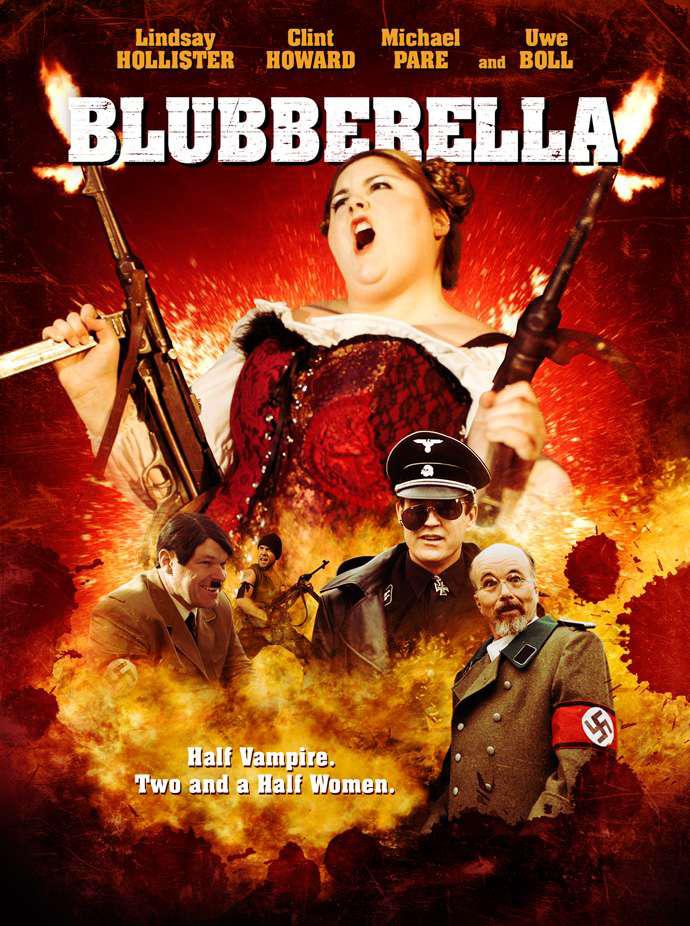 The action/horror spoof Blubberella is Uwe Boll’s second attempt at (intentional) comedy. He did re-release a “funny” version of his 2003 disaster, House of the Dead. That seems like the same opportunistic rebranding and dubious retconning that Tommy Wiseau pulled when he tried to claim that his magnus opus of suck, The Room, was always intended as a “quirky black comedy.” Sure, Tommy. Boll’s first attempt at comedy, 2007’s Postal, almost worked despite itself; the taboo-smashing genre of wacky comedy seems like a better fit for Boll’s cinematic tendencies. Blubberella is proof that Boll should stick to schlock and leave comedy to the professionals.
Blubberella (Lindsay Hollister) is a dhamphir, half-vampire/half-human, but really she’s just looking for a good man and a good meal. It’s 1944 Germany, and Blubby has joined forces with a resistance group lead by Nathaniel Gregor (Brendan Fletcher). Together, the group, along with the sassy gay soldier Vadge (William Belli), must battle a mad scientist (Clint Howard), a vampire Nazi general (Michael Pare), and the prospect of an immortal Adolf Hitler (Uwe Boll himself!).
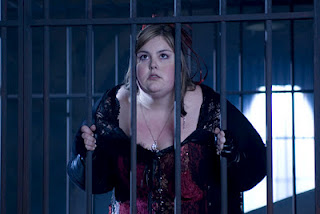 Leaden puns, obvious jokes, clueless pacing and comedic construction, tiresome one-liners, incessant yet flaccid sex jokes, a desperation to be shocking, Blubberella is a bizarre and staggering failure even by Boll standards. Rarely does the movie actually land a funny line (you want to know the best line? Here it is: “My friend says I replace sex with food… but then he raped me, so that kinda shot that theory.” Yes, that is the best one). The jokes aren’t textured in the slightest and can’t be bothered with basic constructive issues like setup, context, and payoffs. Instead, the movie is rife with random sexual and scatological references. It’s like the film is the living embodiment of a Tourette’s child. Belli (TV’s Nip/Tuck) is a braying gay stereotype that wears out his abrasive welcome in no time flat. At one point Pare just goes into a garbled Marlon Brando impersonation for no clear reason, and then it’s done. This would-be comedy, in name only, confuses randomness for clever. Here’s an example: a group of characters are crouched waiting for an all clear signal, and Vadge blurt out, “If you’re going through the drive-thru get me a Frosty.” Just because it’s a random line and anachronistic does not cover up the fact that it’s simply not funny in any context. There is no joke there. Everything in the movie just seems like a meaningless throwaway gag, never accumulating or having any connection to situation. Randomness does not excuse sheer ineptness. Given the understated title, I’d expect there to be a plethora of fat jokes that the movie would routinely fall back on for easy punchlines. I actually counted: there are approximately 35 fat-related jokes; at barely 75 minutes, that comes to about one fate joke every 45 seconds. I’m shocked they had that much restraint considering the opening minute of the movie featured Blubby walking into a giant walk-in freezer filled with enough blunt Flintstones-style sight gags.
Even worse, Blubberella relies on pitiful attempts to be “shocking” to rouse the audience into laughter. And so we endure scenes like the resistance fighters relocking a boxcar full of concentration camp victims (“No wonder they took you. That hat does nothing.”), Blubby killing a man by farting on his face, playing RISK with Hitler and then there’s the blackface. In the movie’s most obscene, whiplash-inducing moment, Blubby suddenly morphs into a Caucasian version of Precious being berated by her abusive and spiteful mother. Belli portrays the monstrous mother in drag and blackface. Amazingly, this is not the only character Belli plays in blackface. There’s another regrettable moment during that Hitler RISK sequence where Belli plays Hitler’s black assistant (“One of our new allies from Africa,” Hitler explains), and the guy can’t go a single sentence without referring to people as MF-ers. Whoo boy. Here’s the thing about the attempted Precious parody: just taking a situation and copying and pasting it to a new location doesn’t make it a parody. The blackface moments, in particular the Precious aside, feel completely out of place and tacky at best. Just because something is supposedly shocking or in bad taste does not mean it is funny without due context and setup. Blubberella does not understand this comedy truism, and so we get more of the same wearisome crass crap.
Blubberella was shot simultaneously with Bloodrayne: The Third Reich, utilizing the same sets, costumes, actors (literally everybody does double duty), recycled action footage, and more or less the same script. It’s not like the script for Bloodrayne 3 was that strong to begin with to warrant a copycat. It’s like Boll’s version of Rosencrantz and Guildenstern are Dead, though with more Nazis. Actually, just that very description is giving the movie far more credit than it could possibly ever hope for. There’s nothing clever about Boll’s alternative spin on his third Bloodrayne vehicle; just replacing Rayne with a 300-pound actress and making her go through the same motions doesn’t mean it’s a comedy. The laziness on display is powerfully lulling. I don’t think anyone on the entire planet was praying for a wackier retread of Bloodrayne 3. The funny thing is I don’t think the change of tone makes that much difference to Clint Howard.
 Blubberella plays out like a tired improv game that has gone on for an eternity. The film is stuffed with scenes that just seem to spin on and on, lacking momentum and any discernable direction. Scenes will just wander aimlessly like Boll is just waiting for his actors to somehow produce quality jokes spontaneously. Newsflash: this isn’t a Judd Apatow movie. Hollister and company will just spout random lines and riff off one another, acting like a troupe of lobotomized circus acts that have stumbled into a war zone. The results are pitiful, though occasionally they will hit a somewhat amusing idea that will be aborted in the next breath/stab at improv. It’s merely a numbers game and if they fire 100 jokes maybe 2 find some footing. Such shrug-worthy moments include Blubby holding a soldier’s hand to her stomach and saying, “If there wasn’t a baby in there, would that be okay?” Huh? At one point, Boll’s narration pops up to declare the following scene “boring,” and yet the entire scene from Bloodrayne 3 plays out uninterrupted or unedited. What was the point of that? If you’ve already made an attempt to side with your audience by declaring your scene boring, then why leave it unabridged? Why is keeping this scene vital from a plot standpoint for what is intended to be a silly spoof? Why does plot continuity even matter?
I noted with Bloodrayne: The Third Reich a theory that Boll, a notorious cinematic pick-pocket, was trying his hand at recreating Quentin Tarantino’s Oscar-winning WWII drama, Inglourious Basterds. Well after sitting through this movie, I can confirm without a doubt that Boll has a raging hard-on when it comes to Tarantino homage. The movie is broken up into chapters, including such delightful titles as “Titty Titty Fang Bang,” the score will resort to periods of long whistling, Hitler screams “nein nein nein,” and for older references, one character says, “Wakey wakey, eggs and bakey,” and another, “I’ll kill every last mother fuckin’ last one of you.” Are you going to tell me that is all a coincidence?
The lingering problem with Blubberella, besides its overwhelming incompetence and inexplicable existence, is that it feels more like a gag reel accrued for the cast and crew of Bloodrayne 3. This doesn’t feel at all like a movie or even an attempt at a movie. I’m of a mixed mind when it comes to Hollister. The central Ohio native (represent, girlfriend!) is probably not going to get many starring roles, though she has shined in guest roles on numerous TV shows like My Name is Earl, Big Love, Law and Order: SVU, and Scrubs, so I can’t blame her for jumping at the chance to be the lead star, the headliner (she and Belli are also listed as co-writers). Hollister is actually a pretty nice actress and has strong comedic instincts; however, that doesn’t mean she will rise to the occasion if left to her own devices by Boll’s paucity for scripted jokes. Boll isn’t exactly the most creatively nurturing collaborator. It’s all one big fat mess. You want the most telling moment? It occurs during the dull outtakes peppered throughout the end credits. One of the actresses, little seen in the flick, remarks astutely, “It’s not working. It’s not funny.” In six short words, she has summarized Blubberella better than I could ever hope to.
Nate’s Grade: D
Share this:

The Smurfs (2011)
 What a smurfin’ terrible movie. This big screen debut for the little blue commune dwellers is a painful experience, magically transporting the little creatures to New York City. They find themselves in the care of Patrick (Neill Patrick Harris), an ad man who’s pretty much a jerk, especially to his doting, pregnant wife. At one point, in his ad man frenzy, he yells, “ I never wanted any little people running around here!” Oh no, what a bizarre outburst that somehow cuts directly to his fears of being a father. The movie spends so much time with the human characters, who are shrill, exasperating, and dull form the get-go. The comedy is a mixture of slapstick and insufferable kiddie wordplay, replacing “Smurf” for just about any word in a sentence for a miserable attempt at humor. It’s like the screenplay was a Mad Libs page (Am I being too generous crediting a whole page to the script?). The Smurfs is clearly designed for a 3D audience, hence there is crap flying at the screen at every turn. Yeah, another stupid thing thrown at the screen. Hank Azaria plays the thankless role of Gargemel, the man who created Smurfette (voiced, not too badly actually, by pop singer Katy Perry) but schemes to capture Smurfs for their… smurfness. I don’t know. If this guy could create his own Smurf, why doesn’t he just keep doing this? Instead, Azaria runs around New York speaking in an arch manner, falling down a lot. I suppose the real question is whether this piece of blue excrement could entertain children, its target audience. Perhaps the youngest of tykes will be tickled by the Smurf adventures, but I think most kids will be puzzled and bored and weirded out by the movie, wondering what they had done wrong to deserve watching this dreck.
Nate’s Grade: D
Share this:

The Artist (2011)
 Ever since it charmed audiences at the Cannes Film Festival, The Artist has been one hot commodity. The Weinstein Company snapped up the film rights though they have a bit of a hard sell. The movie takes place in the era of silent movies and it also happens to be a silent movie itself. Ignoring Mel Brooks’ unsung efforts, asking paying customers to sit through 100 minutes of silence, albeit accompanied by a musical score, may be a risky financial bet. That’s where the appeal of being an award-winner comes into play. The Artist has been racking up awards since Cannes and has been tagged by many as the favorite to take home a Best Picture Oscar. This celebration of the Hollywood of old is a nostalgic trip through the ages, but I’m doubtful that the film is deserving of the gushing admiration. I think this would have been better had it been one of them new-fangled talkies.
In 1927, the biggest star in Hollywood is George Valentin (Jean Dujardin). His latest spy caper is knocking them dead. He’s prancing before a sea of photographers when he bumps into Peppy Miller (Berenice Bejo). He graciously brings her into the act and the two pose for pictures. “Who’s the new girl?” demands the newspaper headlines. Peppy is given her big break as George’s co-star in his spy series. Peppy is a natural and over the course of two years she becomes a bona fide star. Also over those two years Hollywood has undergone a drastic makeover. New “talkies” are all the rage with the public, who now demand to hear their favorite actors speak. George is adamant that talking pictures are only a fad and he plunks his personal fortune to bankroll his directorial debut. The movie is a flop. George is viewed as a has-been; yet Peppy has been keeping a watchful eye on her old friend and waiting for the time to reveal her love for the fallen star.
 The Artist is a completely silent movie except for two key sequences; one of them a nightmare where George hears objects make noise. The film is an unabashed love letter to old Hollywood, and writer/director Michel Hazanavicius makes witty use of the storytelling techniques of the silent era. Much relies on editing and reactions for shaping the narrative. The story, therefore, is broken down to its simplest incarnation. Peppy Miller’s star rises, as George’s grows fainter. Still, The Artist has many recognizable pieces for fans of the silent era. George even has a trusted Jack Russell Terrier at his side, a clever pooch with keen mimicking abilities. There’s a cute moment where Peppy slips her arm into George’s coat hanging on a coat rack and pretends to caress her self as him. It’s a small yet slyly tender moment. It’s not a prerequisite to be well versed on silent cinema, though it helps. While a French film (a foreign designation seems superfluous when it’s silent), the movie was shot in Los Angeles and is stocked with English stars like John Goodman (TV’s Treme) as a film director, James Cromwell (Babe) as George’s dutiful butler, Penelope Ann Miller (Flipped) as George’s unhappy wife, Missi Pyle (Big Fish) as a silent film co-star, Beth Grant (Donnie Darko) as a maid, Ken Davitian (Borat) as a pawnbroker, and Malcolm McDowell (Halloween II) as a dismissive old man in a chair (the role he was bon to play). It almost becomes a side game of cameos.
It’s a sprightly, charming, sometimes enchanting little experiment, but in the end an experiment is all the movie turns out to be. The Artist is no great story; in fact it’s pretty much the 80th rendition of A Star is Born. The transition between silent films and talkies is a subject rife with drama, and a lead character who sees his fame and fortune crumble by being left behind in a changing society, well that should be interesting. What’s surprising to me the most about this film is how little you invest with it. I don’t know if it’s the silent gimmick or just the idle characterization, but I found myself never really engaging with the movie, always a step removed. The characters were nice but I neither celebrated their triumphs nor bemoaned their hardships. The entire affair has such a slight feel to it; the movie is a confection, a sweet treat that melts away instantly after viewing. If you strip away all the old Hollywood nostalgia, there is very little substance here. Praise Hazanavicius for his dedication to silent filmmaking techniques, but let’s be reasonable here because The Artist is a pleasant experiment but nothing more. The characters and story do not bear scrutiny. This story would have been more interesting had the movie been a traditional talky. Alas, we are limited to a handful of title cards with single lines of dialogue and extreme amounts of pantomiming. If you took away the central gimmick, would anyone be interested in this movie? I wanted to be swept away by The Artist after reading all the fawning accolades, but I wasn’t. The commitment of the artists on screen is commendable but the finished product is little more than an amusing trifle of a movie.
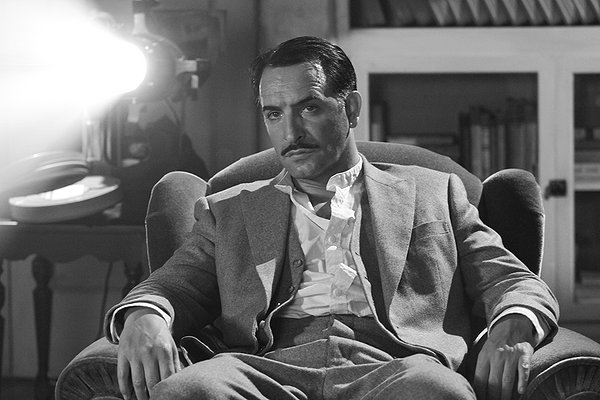 Dujardin (OSS: Lost in Rio) and Bejo (Modern Love) look like they stepped off the screen from an old Hollywood movie, al la Purple Rose of Cairo. Dujardin is a suave presence with great comedic physicality at his disposal. There’s a poignant moment where George, broken down and washed up, looks into a tuxedo store window, seeing his reflection appear above the neck of the tuxedo. He gingerly smiles, wistful of times gone by, and in that sad, face crinkling little moment, Dujardin reveals more about the man behind the flashbulbs than the script ever will. Even without a word spoken, you can tell that Dujardin and Bejo have great chemistry. Bejo, the wife of the director by the way, matches Dujardin note for note in terms of star wattage. She’s got a terrific smile and one of those classic faces for an Age When They Had Faces. It’s a shame that the characters don’t have more interaction.
The Artist is a fine film but ultimately disappointing given the hype. The saddest part about my reaction to The Artist is how little I find myself having to say about this much-ballyhooed silent film. It’s an exercise in nostalgic back-patting, but if you strip away the silent movie gimmick I feel like there’s so little at heart here. I walked away liking the movie, being charmed by the actors but feeling unengaged and mildly indifferent. The threadbare story is too familiar, the characterization is slight, and the movie ultimately becomes light, airy, and insubstantial. The novelty eventually does wear off and you may find yourself adding a mental commentary to the film to fill in the blanks. You’d have to be a Scrooge to resist the film’s whimsy and the talents of the charismatic performers, but I’m scratching my head at the adulation give to The Artist. In a year heavy with reminiscence, The Artist overdoses on feel-good Hollywood nostalgia, and in a down year at the movies, perhaps that’s enough when it comes time for awards.
Nate’s Grade: B
Share this:

The Zookeeper (2011)
 A lamebrain comedy with a horrible, repulsive romance where we watch a sweet, hapless zookeeper (Kevin James) romance a shallow woman (Leslie Bibb) who dumped him years ago and wants him to change, despite the fact that he’s great at his job, loves what he does, an the animals love the big lug as well, so much so that the animals all take turns giving the guy mating advice. That doesn’t sound like a bad premise for a comedy, though James takes the admission that animals could always talk a little too in stride. Their advice typically amounts to stuff like “puff out your chest” and “pee on this tree.” The potential of the premise is dashed when the comedy usually takes one of two routes: 1) James being clumsy, or, 2) James being fat. Rarely will The Zookeeper stray from these two troughs of canned laughs. There’s a bizarre montage of product placement for T.G.I. Friday’s where James takes a gorilla out to the restaurant. There’s Rosario Dawson looking splendid as the Obvious Love Interest Who Will Not Materialize Until James Has to Chase Her Down to Stop Her From Leaving. And there are poop jokes. Oh, the poop jokes. At one point there was a studio bidding war over this screenplay, which has five names attached to the finished product. I can’t imagine the end result was worth fighting over when it’s so predictable, flat-footed, and unfunny. And why have animals singing over the end credits? Surely that little dash of CGI was an extra few million dollars that could have been spent wiser, like purchasing a different script.
Nate’s Grade: C-
Share this:

Young Adult (2011)
 The basis for the movie Young Adult sounds like writer Diablo Cody settling a few sore scores. You’d think winning an Oscar for Best Original Screenplay for 2007’s Juno would have sufficed. Reteaming with her Juno director, fellow Oscar-nominee Jason Reitman (Up in the Air), the duo takes aim at the bitchy, stuck-up, popular girl that seemed to rule the school. Young Adult is much more than a vicarious act of vengeance on mean high school adversaries. It’s a revealing, awkward yet compelling dark comedy about the perils and pitfalls of arrested development.
Life hasn’t turned out exactly the way Mavis Gary (Charlize Theron) would have thought. The former high school queen bee has left her small town for life in Minneapolis. She’s the ghostwriter for a successful series of young adult books, a series that is coming to an end. She’s divorced form her husband, facing financial ruin, and living alone with her tiny Pomeranian, Dolce, her only friend. Mavis decides to forgo writing the last book in the cancelled series and instead return to her hometown the triumphant mini-celebrity she knows herself to be. She’s determined to find her old boyfriend, Buddy Slade (Patrick Wilson), and win him back. The fact that Buddy is married and has a newborn baby is no real impediment to Mavis’s crazy plan (“Hey, I’ve got baggage too,” she reasons). Once home, she runs into Matt Freehauf (Patton Oswalt) in a bar. Matt and Mavis went to high school together, though she has long forgotten the likes of him. Matt’s claim to fame was that a bunch of jocks in high school savagely beat him thinking he was gay. Matt sees right through Mavis and the two of them become an unlikely pair as Mavis plots and schemes her way to victory.
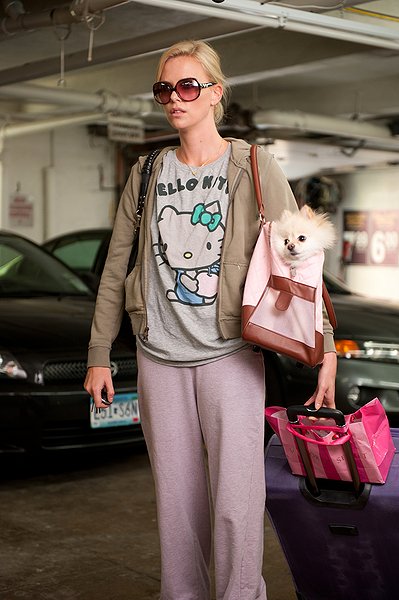 Young Adult is one of the most enjoyable squirmiest times you can have at the theater. Much of its humor, and it is very funny, is built around the pained awkwardness of Mavis’ self-involved, self-destructive mission. My friend was nervously fidgeting in his seat the entire time (he may have just had to go to the bathroom). The sense of dread is palatable; we’re watching a slow-moving car crash, waiting for the inevitable to hit. Every scene carries the apprehension of, “What is she going to say/do next? Is this it?” And yet Cody’s sharp, pointed writing makes the film compulsively watchable. We dislike Mavis, an irredeemable character who doesn’t even try to be likeable, and yet by the film’s conclusion most audience members will likely feel more pity for Mavis than outright hatred. I’ve had some friends ask me if Young Adult was anything like Bad Teacher, another movie about an abrasive, selfish, unlikeable bad apple. This movie is different. This movie is actually good. Mavis is not some wacky cartoon character, and Reitman has kept his reaction shots to a minimum, abstaining from having to remind us via public reaction how inappropriate Mavis can be. Unlike Bad Teacher, this grown-up meanie feels all too real, and her actions come across as believably threatening. This woman could do some serious damage on her way to massage her damaged ego. The movie never condones her actions, though Reitman and Cody make a point of piling on against Mavis. This woman is an ugly wreck, and Cody’s writing and Theron’s gutsy performance speaks volumes. Cody’s writing isn’t the hyper-literate, stylized dialogue we’re accustomed to from Juno. The dialogue and characters are eerily recognizable, miles away from the cuteness of Juno’s sunny, optimistic fairy tale inhabitants. Young Adult is a more nuanced, droll, mature work that deserves as much recognition as Juno and cements Cody, in my mind, as one of the most thrilling writers today (I can almost forgive her for Jennifer’s Body. Almost).
Along with all the bleak comedy, Young Adult lands a surprising number of poignant dramatic blows. Cody has crafted an exacting character study on a severe case of arrested development. Many of us can relate to knowing that one gal in high school, the pretty, popular one who had everything in life handed to her. In Young Adult, Cody shows the devastating consequences of a lifetime of entitlement and zero introspection. Mavis secretly knows that she’s past her prime, that all the people she left in her Podunk town have moved on to richer lives while she’s stayed in the same holding pattern her whole life. Some part of her has never left high school. She’s an emotionally stunted woman trying to live out the fantasy of one of her undervalued books (her misreading of the end of The Graduate into a love-conquers-all message is rather telling). Mavis’ life is hardly the stuff of Champaign wishes and caviar dreams, but to the people of her hometown, life in the “Mini-apple” is the Big Time. There’s a fabulous scene where Mavis goes into a bookstore and sees her series on a clearance stack. The bookstore employee tells her they don’t sell and will be most likely sent back to the publisher. Mavis takes out her pen and autographs one, informing this minimum-wage peon that she is the fabled author of the series. She’s expecting fawning admiration. The employee flatly tells her, “If you sign them, we can’t send them back to the publisher.” In her disgust, she tries to sign as many as she can as an act of defiance. Later in the movie, Cody sheds light on Mavis’ family life, offering intriguing clues for how this woman became so broken. Her parents just seem to shrug off Mavis’ admission of alcoholism, like they’re used to their daughter acting out, even if she might really be crying out for help. She’s a fascinating character to watch crash and burn.
What gives the film its most potent sense of heart (Grinch-sized though it may be) is the unlikely yet compelling relationship between Mavis and Matt. Unlike Mavis’ perceived slings and arrows, Matt has suffered real trauma from high school. His bones were shattered from that brutal beat down and he’s left to limp with a crutch. He hasn’t been able to mentally leave high school behind completely himself, but then again he has a constant reminder. Mavis is strangely her most open with Matt, possibly because she doesn’t view him as a threat or a credible alternative (the joys of high school revisited – the pretty gal ignoring the existence of the lower classes). He’s portrayed as the film’s voice of reason, voicing concern over Mavis’ kamikaze narcissism. Together they form what could charitably be described as a friendship. She seeks him out to talk at odd hours of the night and he’s straightforward with her. He thinks her plan is nuts, but he’s also secretly enjoying his unexpected friendship with the queen bee of high school, albeit twenty years later. “Guys like me are made to love girls like you,” he confides to Mavis. Oswalt has shown some dramatic skills in the underappreciated sports fanatic flick, Big Fan. With this movie, Oswalt gives an achingly felt performance, the most empathetic character in the whole movie and a joy to watch onscreen in a high-profile role that fits him like a glove.
 But the true star of the film is Theron, who gives a fully formed and entrancing performance as someone who is as ugly on the inside as she is beautiful on the outside. Her character could have easily slipped into being an unsympathetic monster; someone the audience wants punished (like Cameron Diaz’ character in Bad Teacher). But the actress finds her own twisted, tricky way to center the character. Every detestable glance, every pained inhalation, every rigorous attempt at seduction, it feels like the character coming alive before our eyes. Theron has dissolved into the abhorrent mess that is Mavis Gary. She’s convinced that Buddy could never be happy with such a mundane life in a mundane town (“There’s a restaurant that’s a Pizza Hut, Taco Bell, and KFC in one building” she says incredulously). Her perspective is so deluded that you start to see the manufactured world Mavis has so cautiously built around herself as a defense from reality. She watches wall-to-wall reality TV, the perfect metaphor of our times concerning the idolization of idiocy and self-absorption. She may not be likeable but she’s definitely compelling, and Theron is so good as that-girl-from-high-school all grown up, that she might even win over some slight sympathy by the film’s end. At one point, the inner fear of Mavis reveals itself, and she expresses her confusion about the attainability of happiness. Why can others find happiness with so little, and she cannot find it with everything that she has?
Young Adult is a dark comedy of squirm-inducing, uncomfortable bleakness and a drama of surprising poignancy and depth. It’s the good kind of uncomfortable, the kind where you can’t look away or leave the vicinity of your seat. Theron and Oswalt are fantastic. Cody’s gift with words, teamed up with Reitman’s gift with actors, makes a beautiful combination even when the end product is charting the misery or a miserable person. The measured tone is kept from start ot finish, meaning even when the movie appears on the precipice of life-lessons and Mavis might turn her life around, it pulls back. There will be no hugs and gained wisdom with this movie, a crackling comedy that’s also one of the best pictures of the year. Take that, popular girls who never gave me the time of day.
Nate’s Grade: A
Share this:

The Change-Up (2011)
 For once, I’d love somebody to construct a body-swap movie where the characters realize the tropes and clichés of the body-swap pictures, a parody of the genre. It’d be nice if the characters instantly accepted their situation and knew that they would each have to learn some form of a life-lesson before changing back, and they tried to falsely engineer these saccharine life-lessons. Then it would be fun if they rented all the body-swap movies to write down notes and pointers on how best to deal with their unusual situation. Then, and here’s the best part, both body-swap participants realize that they prefer their new situations. They reject turning back and simply enjoy the whims that come with their new existential home. They reject learning life-lessons and simply make the best of things. For a brief second, I thought The Change-Up might be that very movie but no such luck.
Dave (Jason Bateman) is a business-obsessed lawyer working his way to make partner in his firm. His wife, Jamie (Leslie Mann), and his three children, including twin babies, are neglected at home. Mitch (Ryan Reynolds) is a struggling actor/womanizer who inexplicably is best friends with Dave. After a night at a bar, the fellas relieve themselves in a public fountain. The fountain lady statue obviously has taken offense and thus curses the both of them. The next morning, each awakes to discover they are in different bodies. The business guy has to act like a jerk! The jerk has to act like a business guy! And then there’s the matter of Jamie, who Dave/Mitch has strictly forbidden Mitch/Dave from sleeping with. Complicating matters further, the fountain has been moved by the Atlanta parks department and lost in bureaucratic limbo.
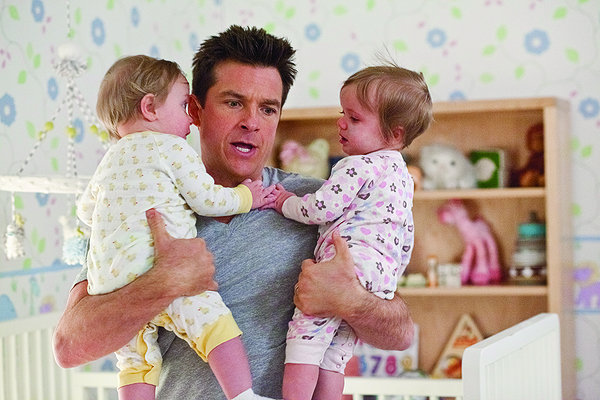 I knew I was in trouble by the first minute of the grossly unfunny Change-Up. Not only do we suffer a poop joke so early, we have to witness a baby firing a stream of fecal matter into Dave’s open mouth. That’s just a taste of the unpleasantness that follows. The movie plays like an exaggerated, sophomoric cartoon written by children. It seems to exist in the same broad universe of 2009’s abominable rom/com The Ugly Truth. What I wrote for that movie could easily apply to The Change-Up: “It’s questionable whether the comedy even reaches juvenile levels. It’s tasteless and piggish, but the weird part is that it comes across as knowledgeable on the subject of sex as a ten-year-old kid who just discovered his dad’s secret stash of Playboys. It talks about the right stuff but does so in a clueless manner. It’s like an exaggerated randy cartoon that chiefly plays to a male fantasy.” I’m not opposed to raunchy sex comedies. However, I am opposed to sex comedies that can’t figure out how to be funny without relying on easy gags. There’s a difference between gross-out humor and simply being gross, though I don’t believe this film knows what that difference is. So we’re treated to an over-the-hill porn star, some anal defilement, a voraciously sexual nine-months pregnant lady, even more poop jokes, and 90 minutes of penis discussion. There’s one actually interesting section where the guys debate the moral ambiguity of body-swap sex. Is it really cheating if Dave/Mitch is in somebody else’s body? What is Mitch/Dave to do if his wife wants to have relations? Sadly, this lone moment of interest is crushed to death by more penis jokes and then forgotten. Reynolds (Green Lantern) and Bateman (Horrible Bosses) try to stay above the fray, fighting the good fight, but even they succumb to the unfunny script and disjointed direction.
After being a distasteful cartoon for so long, the film wants to be dramatic. It wants to be emotional. Tough break, Change-Up, because you cannot have it both ways. The dramatic parts ring resoundingly false, a last-ditch attempt to class up what is a deeply unclassy picture. The tonal shifts are jarring and land with crashing thuds. It’s mostly because these characters are deeply unlikely, particularly the Mitch persona. He’s not just some brash, rude individual who sidesteps social mores, no this guy is downright sociopathtic. He’s egotistical, mean-spirited, and constantly boorish to every person in Dave’s life. He’s cruel to the daughter, he tells Dave’s wife that she’s not attractive, and then there’s the babies whom he treats like a couple of rag dolls to toss around. At one point, Mitch/Dave is on the phone and the kids are left to get in trouble with the kitchen. We’re not talking about getting messy with food, we’re talking sticking their tiny hands in a spinning blender, throwing knives, and licking electrical outlets (it’s like the Roger Rabbit cartoon that opened that flick). Instead of getting off the phone immediately, he continues talking and casually tends to the troubled tots per potential disaster. He teaches Dave’s daughter “violence is always the answer.” Mitch is an unrepentant jerk, and even when Bateman plays Mitch he’s still irredeemable. Am I supposed to feel sorry for this obnoxious guy just because his dad thinks low of him? I think low of him. I detest him. Therefore, when Mitch/Dave is having his Big Emotional Catharsis, it seems facile and hollow. We can generally find a point of likeability for uncouth characters, but not Mitch. As presented, this character has no introspection and few redeeming qualities, so why do I want to spend nearly two hours with this person? You’d think Dave would be the “nice guy” alternative, but he’s smarmy and neglectful too. Besides the “family man/pussy” and “playboy/prick” designations, the characters aren’t different enough to warrant a change of scenery.
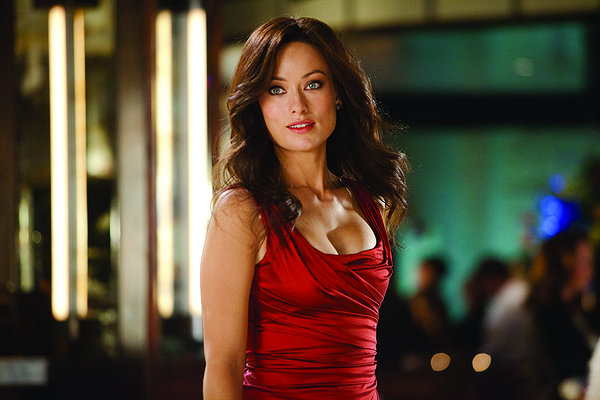 The Change-Up has the single most bizarre moment of any film this calendar year, and it has nothing to do with the metaphysical mechanics of body swapping. Wilde (Cowboys & Aliens, TRON: Legacy) at one point gets rather frisky and takes off her clothes, the last piece her brassier. Mitch’s hands cover her breasts for most of their onscreen freedom except for a handful of side angle shots where Wilde’s breasts are out and ready to greet the audience. Except those are and are not Wilde’s breasts per se. The in-demand actress had pasties to cover her nipples. The pasties were then digitally removed in post-production and replaced with CGI nipples. Let me repeat that for the slower among you – CGI nipples! It was some guy’s job to spend weeks painting nipples onto Olivia Wilde’s breasts. When I see nudity, can I trust that it’s real, or was it doctored by some computer technicians who are laughing at me the whole time? What is happening to this world when it makes me distrust the very sight of breasts?
The Change-Up is a mean-spirited, objectionable, nasty, classless, clueless comedy that’s tonally all over the place. The characters are unlikable, the comic setups are cartoonishly drawn, and the dramatic shifts are flatly false. What’s even worse is that the movie just seems downright hostile toward women. Just because it has a scene where Mann gets to vent the frustrations of the put-upon wife/mom doesn’t mean women are given a fair shake. I’d be more forgiving if the vulgar comedy was ever funny. The Change-Up erroneously believes that having characters say dirty words or inappropriate remarks is the same as comedy. It can be a component of comedy but rarely does it work as a whole substitute. The jokes fall flat, the drama feels forced, and the characters range from nitwits to jerks to deviants and back to jerks once more for good measure. Why would anyone subject themselves to nearly two hours with these people? I just felt bad watching this movie. The Change-Up makes humanity look like a species that deserves an extended time-out.
Nate’s Grade: D+
Share this:

Tucker & Dale vs. Evil (2011)
 This delightful indie comedy turns old, creaky horror conventions upside down, and in doing so becomes one of the most surprisingly enjoyable, surprisingly sweet little movies of the year. The titular Tucker (Alan Tudyk) and Dale (Tyler Labine) are a couple of hillbilly buddies going out to a cabin for a relaxing weekend of fishing. Their vacation is ruined by a group of snotty college coeds who are convinced, via a chain of misunderstandings and ignorance, that Tucker and Dale are out to kill them. The judgmental college kids go on the offensive and they keep getting killed through macabre accidents. The movie aims to show the “other side” of horror movies, from the mistakenly creepy redneck perspective. Tucker and Dale are a loveable pair of guys who react with genuine horror about all the trail of death that follows them (they think the college kids are a part of a suicide cult). The movie will play best for fans of horror that will recognize all the references and satire. Even if you’re no fan of the bloody, grisly stuff, Tucker & Dale vs. Evil is a clever movie that provides plenty of chuckles. You may not roll in the aisles with laughter, and the film’s aim is a tad slight, but the sweet, bumbling nature of the titular duo will keep you consistently amused.
Nate’s Grade: B+
Share this:

The Muppets (2011)
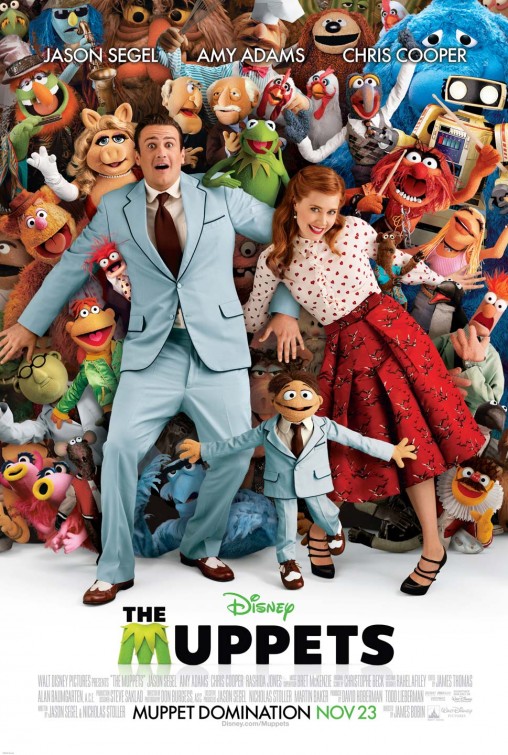 You’d hardly expect the duo behind the raunchy, R-rated comedy Forgetting Sarah Marshall to be the saviors of the Muppets, the famous puppet crew that has been languishing since their last big screen outing, 1999’s underwhelming Muppets in Space. Actor Jason Segel took a meeting with Disney after the Jim Henson Company did some puppet work for Sarah Marshall. He just point-blank asked them what their plans were after acquiring the Muppets. They had nothing. Segel and Nicholas Stoller (Get Him to the Greek) put together a script and, lo and behold, the two self-described Muppet enthusiasts were given the opportunity to bring new life to the classic creatures. The Muppets is just about everything a Muppet lover could ask for and will be sure to entertain a new, younger generation of fans with the Muppets core brand of silliness and sweetness.
Set in the town of Anywhere, Gary (Segel) and his girlfriend Mary (Amy Adams) are planning a trip to Los Angeles. She’s hoping that he’ll finally propose to her in the scenic city of angels. There’s one catch: Gary’s brother Walter is coming along too. Oh, and Walter is a Muppet. Walter is obsessed with the Muppets ever since he watched their TV show in the 1980s. The show was an escape for a kid who felt… different. Walter is anxious to visit the Muppet studios, but the studio is in disarray and the Muppets have all gone their separate ways. Tex Richman (Chris Cooper), what else but an evil oil barren, plans to buy the Muppet studio and tear it down. Walter, Gary, and Mary must seek out the Muppets to rescue the old studio, and the only way to raise enough money in time is to put on one more rendition of The Muppet Show.
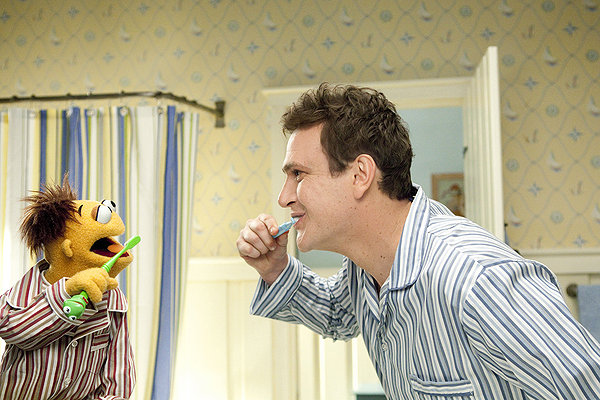 The Muppets is a refreshingly retro and charming vehicle that reminds you of all those warm and fuzzy feelings you had for this crew. It’s unironic, innocent, sweet and wholesome in a way that doesn’t make you gag but self-aware and silly enough to continuously be clever. When a big song-and-dance number breaks out in the town of Anywhere, once the stars have left the townspeople collapse in exhaustion. The gang decides it’ll be quicker to “travel by map,” so we cut to a map and see a red line charting onward. Muppets will regularly break down the fourth wall, with Fozzie commenting on a sudden explosion, “Wow, I didn’t think we had that in the budget.” Tex Richman actually verbally articulates “maniacal laugh.” The group gathering is sped up when the character 80s Robot suggests streamlining the rest in a montage. It’s not the kind of jokes that will make your sides ache with laughter but it pins a smile to your face from beginning to end, although Chris Cooper’s out-of-nowhere rap number left me in stitches. The very question of whether the Muppets can fit into our snarky, over-caffeinated, self-indulgent culture is addressed. Segel and Stoller have found a way to reenergize the Muppets for a new generation while staying true to what makes them special. My friend Eric Muller said watching The Muppets was like “getting an oil change for your soul.” He couldn’t be more right.
Watching the movie, I’m awash in feelings of nostalgia for Jim Henson’s finest creations. Segel is an unabashed Muppets fan and the movie is a celebration of the TV show that inspired him; the TV show is lionized for its inspiration to children. Because of that heavy helping of nostalgia, Muppet fans will feel like their spirits have been lifted. Those who had a mild curiosity about the Muppets will probably just scratch their head and call the film pleasant. The movie’s goal is rather huge: to make the Muppets relevant again. However, the vehicle for this goal, the old puttin’ on a show routine (Mickey Rooney has a cameo!), can feel slight. Also, the Disney product placement can be a bit annoying at times. Really, thanks for reminding us once again about how poor Cars 2 was thanks to a billboard advertisement. The movie isn’t in the same league as Henson’s troika of Muppet movies from the 1970/80s, but Segel and Stoller’s efforts should be a delight for Muppet fans waiting for the triumphant return of their favorite characters. You may find yourself unconsciously singing along to “Rainbow Connection” at the close of the film.
One aspect that is never spoken openly about is the fact that Gary and Walter are brothers, a human and a Muppet. I was expecting some throwaway reference to Walter being adopted, or maybe there could even be a funny sit-down where Walter is given the devastating familial news. We see a montage of the two brothers growing up, and while Gary shoots up like a weed Walter remains at the same height through the years. Does this mean that Muppets attain maturity at a faster rate? That Muppets are fully formed at birth? The mysteries of the universe are left undisturbed.
The music is cheerful and eminently hummable. Recent Muppet outings in the 1990s tried to keep the musical comedy formula going, but the result was some rather tin-eared musical numbers. I challenge anyone to be able to recite more than a few bars from Muppet Treasure Island (my favorite of the three), Muppet Christmas Carol, or Muppets from Space. To everyone’s good fortune, this newest Muppet incarnation has Bret McKenzie, one half of the daffy Flight of the Conchords, supervising the songs. You can instantly tell the musicianship has been raised considerably. The opening number “Sing a Happy Song” is a catchy and bouncy track, putting the audience in the right kind of upbeat mood. “Man or Muppet” is a ballad where Gary and Walter must confront their identity crises. It’s played completely straight, which makes the song even funnier as it builds into a crescendo of self-actualization: “If I’m a man that makes me a Muppet of a man.” There’s also a G-rated performance of Cee-Lo Green’s famous f-bomb kiss-off song, this time performed entirely by chickens. And the aforementioned rap by Chris Cooper is just astoundingly random, and not that bad either. The funny and cheerful music greatly adds to the overall enjoyment of the film.
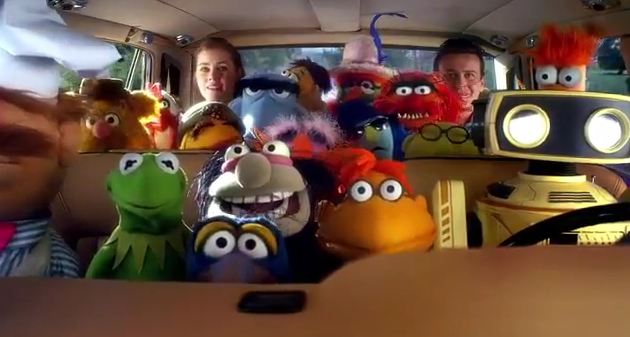 Segel (I Love You, Man) is pretty much a big goofy human version of a Muppet. He’s a winning presence, much like Adams, who slides right back into her adorable Enchanted-flavored M.O. The two actors are a near perfect union of humans who capture the ineffable “Muppetness.” The multitude of celebrity cameos makes for some fun sightseeing (Jack Black has the most extended stay, not by choice). “Hobo Joe” might be my favorite of the cameos. But while the new characters are the initial focus, the emphasis on the film is rightly placed upon the classic Muppets. Kermit and Miss Piggy and the gang are back and the film’s entire plot is essentially their reunion. That means we get wonderful sequences rediscovering the Muppet team, like getting the gang together for a heist. These characters need one another; the bonds are undeniable. It’s actually touching when the Muppets speak candidly about how much they need one another. Fozzie has fallen on hard times especially. Kermit’s mournful song about losing touch with his old pals includes the line, “Was there more I could have said?/ Now they’re just pictures in my head.” While the film’s goal is to really just gather the Muppets back together, you’ll be glad that this goal is accomplished. You will be amazed how much you feel for felt.
The Muppets is a triumphant return to form and rekindles the fondness fans have felt for Jim Henson’s lovable creations. Thanks to Segel and Stoller, and the whimsical direction of Flight of the Conchords director James Bobin, the Muppets is a delightful, charming, and heartfelt family film that will give you a serious case of the warm fuzzies. The songs are catchy, the jokes are amusing, the pacing is swift, and the movie is fun from the start. As a Muppet fan, it left me with a smile pinned to my face the whole time. Like the big screen Simpsons movie, the universe of the Muppets is too big for 90 minutes, so naturally some favorites will be shortchanged when it comes to screen time. Since Disney paid half a billion dollars for the Muppets, I’d expect they plan on making use of the property. After this splendid relaunch, one can only hope that we won’t have to wait too long for the next Muppet movie.
Nate’s Grade: A-
Share this:

The Descendants (2011)
 We’re so used to seeing George Clooney as a smooth operator, a guy who coasts on his suave charm and chiseled-from-granite good looks. But in The Descendants, Clooney is more vulnerable than he’s ever been, trying to keep his family together, and as the film plays out we realize just how mighty a task this goal is. His character is ill equipped to take the lead of his family, especially a family of growing girls he is consistently confused with. His journey is much more than just becoming a better father. That lesson would be far too pat for director/co-writer Alexander Payne. It’s been a good while since Payne’s last film, 2004’s Sideways, but in that time away he has shaped another outstanding human comedy that manages to squeeze in more emotion than most Hollywood movies could ever hope for.
Matt King (George Clooney) is a self-described “backup parent” who has been thrust into the lead role. His wife, Elizabeth, is in a coma after suffering a traumatic head injury from a Jet Ski accident. The doctors say that she has no hope of waking up and she will die in a matter of days. Matt must break the news to his 10-year-old daughter Scottie (Amara Miller) and his rebellious older daughter, Alexandra (Shailene Woodley). The headstrong Alexandra clashes with her faltering father, finally revealing the reason why she blew up at mom months ago. She found out that Elizabeth was having an affair. Matt is reeling and searching for answers from friends, family, and his two daughters.
 Payne’s specializes in pitch-perfect bittersweet character-based comedies, ones that seem to unfurl over a journey of self-awakening. His fictional worlds feel exquisitely rendered, where every character beat and every line of dialogue feels genuine. That’s quite an achievement for a filmmaker of any scope. Even when dealing with caricatures (like in 2002’s About Schmidt), somehow Payne gets away with it. With The Descendants, the sunny setting of Hawaii is just an exotic backdrop for some wonderful, and wonderfully relatable, family drama. It’s hardly the worry-free paradise. Uncovering his wife’s secrets has lead Matt to reassess the woman he loved. The movie completely upends the standard deathbed goodbye trope. Instead of characters openly bawling about the loss of a saintly soul taken far too soon, we have characters dealing with real conflicted emotions, particularly anger, directed at the indisposed and unfaithful mother. Every character is approaching grief differently, and every character is trying to make sense of their feelings before Elizabeth’s inevitable passing. Matt’s father-in-law (Robert Forster) is harsh with accusations at the ready, blaming Elizabeth’s tragedy on Matt’s shortcomings as a husband. His pain is raw but al too recognizable. Matt and Alexandra are plotting how much info to reveal to young Scottie, trying not to ruin her image of her mother, a tremendous challenge with no easy answer.
This is the stuff of grand drama, and Payne doesn’t skimp on the heart-tugging moments. The Descendants is also a great comedy, naturally finding humor drawn from the situation and characters. The advertising has made The Descendants appear like a broad family comedy, with Clooney flapping around in his noisy flip-flops. This is not the case. The comedy doesn’t feel insensitive or too macabre, instead it adds another enlightening level to these people and their pain. We try and make sense of our world, to cope with our struggles and failures, with comedy, and so too does Matt and his family. You’ll probably be surprised how often you laugh and then in the next moment feel a lump in your throat. The character of Sid (Nick Krause) starts off as a questionable plot tagalong, a doofus for some easy laughs. His reaction to an elderly woman with Alzheimer’s is the movie’s one point of questionable validity. As the film progresses, this laid-back guy is revealed to have more layers, just like the rest of the clan. The second half of the film becomes something of a minor key detective story as Matt and Alexandra search for the elusive “other man.” As Alexandra eggs him on, the two bond over this manhunt and Matt becomes bolder, more confident, and clear-headed about the hard decisions that are necessary for his new life. The emotional rewards of the film are nourishing. Watching Matt and his daughters sit on the couch watching a movie together (March of the Penguins no less. Draw your own connections about parental turmoil), you’ll feel satisfied that this broken family has begin to heal itself.
The Descendants takes an interesting turn when we learn more about the other man’s background. Matthew Lillard (Without a Paddle) is actually respectable as Brain Speer, the real estate titan having the aforementioned affair with Elizabeth. Matt’s confrontation is subdued, sidestepping righteous grandstanding for a better attempt to seek understanding. Instead of lecturing Brian, he wants to know more about what his wife was after that Matt could not offer. Sure he’s still angry and doesn’t let the guy off easy. Complicating matters is the fact that Brian has a wife, Julie (Judy Greer), and two children. Matt is trying to find answers without willfully harming Brain’s family. Greer (Love Happens) has an outstanding sequence where she feels beholden to forgive rather than hate, a note of grace that feels rather profound.
Clooney at one point says he’s just trying to keep his head above water, and you can see why. The man shows a great deal of range as his character confronts his grief. There is no “right” way when it comes to grieving, something deeply personal. Matt’s dilemma is given an unlikely situational twist, but the feelings of betrayal and confusion are all too believable. Matt is looking for answers when the person who holds them all lies sleeping. As he develops a lager picture of his wife and her unhappiness, Clooney expertly flashes through a multitude of thoughts. While arguably not as textured as his performance in Up in the Air, Clooney is in fine form, showcasing a deeper sense of loss and anxiety. Matt is trying to find his footing while his world radically adjusts, and nothing has adjusted more than his feelings toward his wife. Clooney doesn’t have any Big Moments of Great Emotion, though lashing out at his comatose wife comes close, but the man’s nuanced portrayal of a life in flux is the stuff that award ceremonies were made for.
 Woodley is a remarkable discovery, more than holding her own with Clooney. She is excellent in her portrayal of an aggressive, mouthy, rebellious teenager. It’s all the more astonishing because Woodley’s long-running TV show, The Secret Life of the American Teenager, is one of the worst shows still running on television. The show is so inartful, the dialogue is so tin-eared, and the acting is wooden like the actors have been imprisoned. Where has this actress been the whole time? Woodley’s performance is so alive with genuine feeling, stripping away any reservations of the too typical bratty teen role. She’s much more than a troubled teen sent off to boarding school. Her every inflection, hesitation, motion feels completely natural for her character, and when Woodley gets her big dramatic scenes she is a force to witness. Upon the sudden news that her mother will die soon, she plunges underwater in the family pool and screams as loud as she can, tears squeezing out of those sorrowful eyes. For goodness’ sake, this girl cries underwater. An Oscar nomination is assured for the 20-year-old young actress. Maybe she can quit her crummy TV show after the wave of good press and fawning praise that await her.
The Descendants is an incredibly observed human drama, a humane and touching comedy, a movie so engaged and plugged in to the messiness of human emotions, eschewing the bitterness of some of Payne’s earlier works. This is a thoughtful and nuanced flick that is elevated to even grander heights due to the excellent performances of father/daughter team Clooney and Woodley. The film hits all those traditional emotional notes but on its own terms. The movie approaches a graceful resolution by accepting the incomprehensible disarray of life. The Descendants is just about everything you’d want in a movie: supreme acting, strong characters, an affecting story, and emotions that are completely earned. Payne’s mature and tender movie is, by the end, rather hopeful, a celebration of family overcoming adversity. It’s not schmaltzy in the slightest but a powerful antidote to simple cynicism. This holiday season, be a good movie citizen and spread the word of The Descendants.
Nate’s Grade: A


 nathanzoebl
You must be logged in to post a comment.