Blog Archives
The Way, Way Back (2013)
 A throwback to the youthful summer movies of the 80s, The Way, Way Back is a delightful coming-of-age film that manages to excel at both comedy and drama. Oscar-winners Jim Rash and Nat Faxon (co-writers of 2011’s The Descendants) graduate to directors, guiding the famous cast with ease yet squeezing enough satisfying emotional truth into the formula of a screwy, Meatballs-style comedy. We follow 13-year-old Duncan (Liam James) as he spends the summer with his mother (Toni Collette) and her bully of a boyfriend (Steve Carell). My one gripe is that the film spends far more time than it needs to establish just how unequivocally awkward Duncan is. You will likely cringe. When Sam Rockwell enters the picture as a charming goofball water park employee who takes Duncan under his wing is when the movie ascends to a new level of comedy. The Way, Way Back hums along with its own sense of charm, presenting familiar characters/scenes but giving them added texture and relatability. You will be surprised at how much you feel for these characters, you may get a bit misty at points, especially when they behave like people and not zany cartoons. Carell as a bad guy is a real eye-opener; he’s a passive aggressive bully rarely seen in movies. James is an authentically awkward teen but you also buy every step of his journey. It’s just such a sweet, enjoyable, and cute movie, exuding charm and sincerity. Here is a movie that just makes you smile. You’ll leave The Way, Way Back feeling warm and fuzzy, and Rash and Faxon have another winner on their hands.
Nate’s Grade: B+
Share this:

The Kings of Summer (2013)
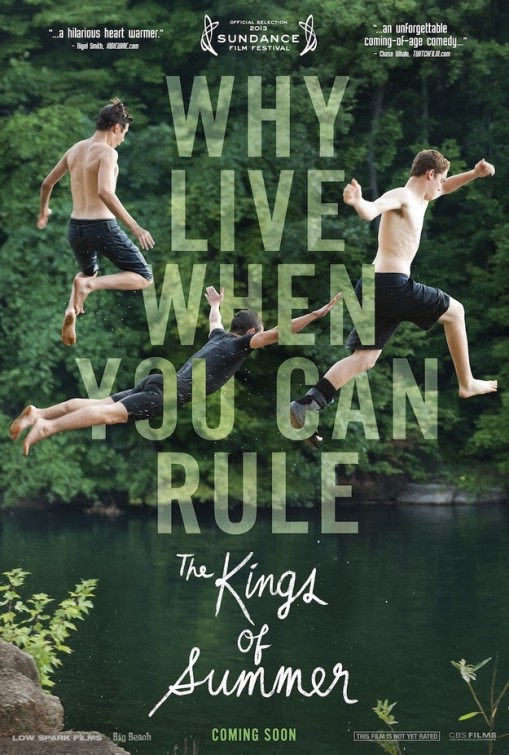 Working part-time at a movie theater in the summers, I come across, let’s say, an interesting selection of customers with… interesting opinions. One middle-aged woman openly opined, while looking at the poster for the coming-of-age comedy The Kings of Summer, that she’s had enough with movies told from a teenage male perspective. While this same woman had very specific and narrow demands for an acceptable movie, she got me thinking. Why do we get so many coming-of-age movies from a male perspective? Let’s forget the easy answer that Hollywood has a lot more male filmmakers than female. There’s always that sense of romance with coming-of-age films, a nostalgic look back at a supposedly simpler time that now seems better appreciated. Maybe men are just more prone to romanticizing the past while women look forward to the future. Or maybe there are really just more men calling the shots about films get made. Whatever the reason, the woman didn’t go see The Kings of Summer, and judging by her attitude, I don’t think she missed out.
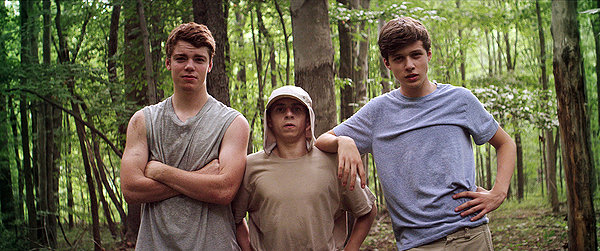 Joe (Nick Robinson) has just finished his freshman year in high school. He has a long summer ahead butting heads with his no-nonsense father (Nick Offerman). Then Joe gets the brilliant idea. He and his pal Patrick (Gabriel Basso), who is also sick of his annoying parents, will build their own home in the woods, a sanctuary where they can set the rules. Joe and Patrick pack up their belongings, find a quiet spot in the woods, and build that dream home. Biaggio (Moises Arias), a weird and gangly kid, takes an interest in the youthful declaration of independence and joins in. The guys invite girls over, explore the wilderness, grow patchy wisps of facial hair, and live out their fantasies of roughing it like real men. Of course it helps when a Boston Market is just down the road.
From start to finish, The Kings of Summer kept me laughing. I did not expect the comedy to be as consistent and thorough as it was, but writer Chris Galletta has a sure handed way of making the comedy derive from the situations and characters. Even with some outsized elements, notably Biaggio and the fact that the boys home-away-from-home is way too advanced for a kid who blundered through shop class, the humor never feels forced. That is an accomplishment, though the script also overly relies on Biaggio to say outlandish or weird lines. I especially enjoyed his one-scene pep talk with his father late in the movie. That confidant sense of humor goes a long way to relax an audience, allowing us to attune to the mellow waves of the film. It’s fun to watch the guys try to forage a life out in the woods, slowly learning how hard this whole survivalist lifestyle may actually be. The adults are viewed as blithe buffoons or hardasses, though they don’t come across as caricatures. Credit the attention paid to Offerman’s (TV’s Parks and Recreation) character as Joe’s father and credit Offerman’s uncanny ability to make gruff parenting endearing. This is an easy film to like, to go along with the flow, and to enjoy. It never really falters in entertainment and routinely has another joke at the ready to make you smile. It’s a sweet movie that does enough to keep you charmed.
While pleasant, I had to stop and reflect that there was absolutely very little to these characters. The boys all kind of blend together in their youthful romanticism of freedom and rebellion of lame parents, but you’d be hard-pressed to describe them beyond core physical descriptions. The moments that do supply character development are mostly broadly comedic or somewhat generic in their coming-of-age tropes, notably the broken heart administered by a guy’s crush. Example: Biaggio is essentially little more than a walking punchline machine. While quite funny and well acted, every line of his dialogue feels like a punchline. He comes from nowhere. At one point, Joe advises Biaggio that a girl may be interested in him, but Biaggio demurs and says that won’t work out. All right, here we go. Here’s where the movie sheds some light on him. Biaggio admits to being gay. The very next line involves him confusing gay with cystic fibrosis. It’s a funny joke but it turns a moment where a character was getting added dimension and just manufactures another punchline. Again, The Kings of Summer is a very pleasant film going experience, and one that made me laugh consistently, but objectively, the impact is too limited because of the lack of proper characterization.
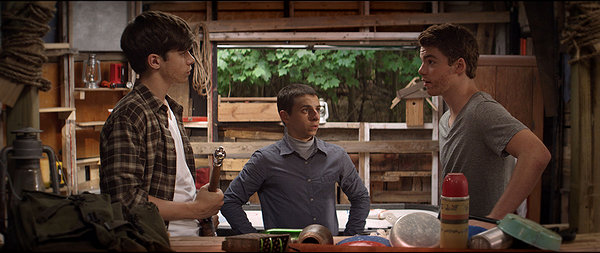 And I suppose this leads into a bigger question of whether this lack of substantial characterization even matters. Coming-of-age movies, like any subgenre in film, have their own expectations and conventions. We all have our different tolerance levels for narrative familiarity, and depending upon the genre, familiarity may be a necessity. Fans of coming-of-age films want to see those familiar elements. They want to see the bonds of friendship, the neglectful parents, the first crushes that lead to first heartaches. It’s just like fans of romantic comedies finding comfort in the two leads hating one another until, inevitably, they love each other, or the public sing-alongs. I think many coming-of-age films at some level tend to be somewhat broad or generic to make them more relatable. Perhaps I’m just being too generous to formulaic pictures. If you’re a fan of coming-of-age movies then you’ll probably be quite forgiving of the shortcomings in The Kings of Summer. Me, I prefer Jeff Nichols’ Mud and its more textured, empathetic look at adolescence in a working poor Missouri riverbed community.
Director Jordan Vogt-Roberts (TV’s Mash Up, Funny or Die Presents…) makes the film look beautiful. The romanticism of the youth running away to live in nature is improved with some spectacular looking natural settings and compositions. The film was primarily filmed in Cleveland and northern Ohio, and as a native Ohioan, I have to puff my chest. Vogt-Roberts is also skilled at handling his actors and balancing tone; while I criticize the over reliance on comedy at the expense of fleshing out characters, the tone is not divergent. It plays within the same cohesive wavelength throughout. If there is a breakout actor from this movie, it would have to be Arias (TV’s Hannah Montana, The Middle). The kid has a tremendous ability to tap into an oddball character, making him quirky rather than insufferable. He also has a unique look to him, and that’s got to be a plus for a working actor. Just ask Steve Buscemi.
Genial and undemanding, The Kings of Summer isn’t anything close to royalty in the coming-of-age genre but it’s consistently funny and enjoyable. The acting is good, the jokes work, and the movie’s out after 90 minutes. It’s a nice summer diversion but doesn’t contain the resonance to be considered more than that. The weak characterization and broad humor, while opening its wide appeal, also makes the film less substantial. It’s sweet and funny but little to distinguish it from other sweet and funny coming-of-age entries. If you’re a fan of the genre or looking for a mellow and pleasant evening at the movies, think of The Kings of Summer. Just don’t think it’s going to be anything more.
Nate’s Grade: B
Share this:

The Heat (2013)
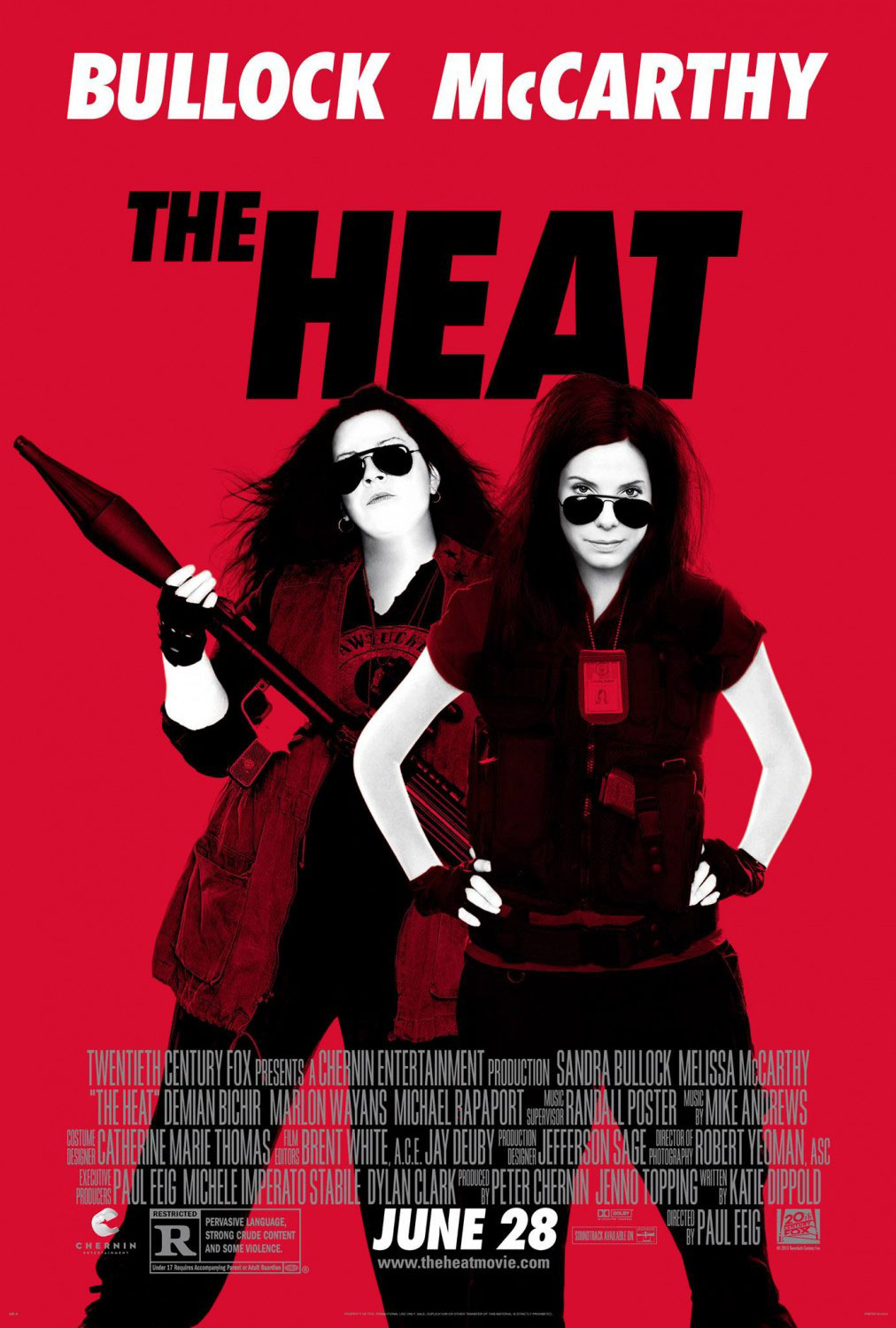 Essentially a buddy cop movie with the typically macho roles swapped out to women, The Heat is an intermittently enjoyable action comedy thanks to the chemistry between Sandra Bullock and Melissa McCarthy. The joke ratio of hits to misses has a lot of whiffs but I laughed solidly every ten minutes or so, some of the comedic set pieces were well developed, and McCarthy’s strong ability to improv saved many flailing scenes. I enjoyed that these two women were seen as professionals and didn’t need to be bogged down with the kind of plot elements you’d find in your standard Katherine Heigl vehicle. There isn’t a romantic interest nor a love story; in fact, various guys come up to McCarthy throughout asking why she hadn’t called them back after a one-night stand. It’s a little thing but it establishes that a woman like McCarthy’s can have a fruitful love life and have it be no big deal. The overall plot about a dangerous drug baron with a mole inside the government is given more complexity than necessary, and I’m not sure the action bits feel well integrated into the movie as a whole. Part of this may just be because director Paul Feig (Bridesmaids) seems much more interested in grounded, human comedy, but I think it’s mostly because we’d rather be spending more time with our leads arguing. Bullock and McCarthy are an engaging team, their comedic styles nicely ping-ponging off one another, and there are enough ribald gags to justify watching it. The Heat isn’t revolutionary by any sort but maybe, in the end, that’s the point. Also it’s got Dan Bakkeddahl (TV’s Veep) as an albino DEA agent. So there’s that too.
Nate’s Grade: C+
Share this:

Frances Ha (2013)
 Noah Baumbach is a filmmaker I generally don’t care for. I quite enjoyed his first feature, the college comedy Kicking and Screaming, and his co-authorship of Wes Anderson’s Fantastic Mr. Fox was a worthy venture. But I normally associate such unrepentant misery with this guy’s movies, chiefly because they’re generally about miserable people being miserable (The Squid and the Whale, Margot at the Wedding, Greenberg). I was surprised then when his new movie Frances Ha got ringing endorsements from several of my trusted female friends, the kind who would not cotton to Baumbach’s usual pedigree of filmmaking. I took the plunge and was captivated by the shrewd, funny, and surprisingly affectionate portrayal of a twenty-something woman finding herself late (ish) in life.
Frances (Greta Gerwig) is an apprentice for a dance company in New York City waiting her turn at much in life. She’s waiting for her post-college life to fall into place; however, her world gets shaken up when her roommate and best friend since college, Sophie (Mickey Sumner), moves out. The distance grows beyond physical proximity and Frances feels like she’s drifting away from her closest friend. In the meantime, she sputters trying to become an adult herself, swapping roommates and living conditions, and getting into trouble with guys, money, and Sophie.
 While a bit freeform in its plot momentum, Frances Ha is a perceptive and ultimately poignant film exploring female friendship dynamics and the perils of growing up. Frances is something of an adorable mess but she’s been treading water for some time, bouncing around, but her window for avoiding the adult world is coming to a close and she knows it, which is why she feels the anxiety that she does. There’s something completely relatable about the anxiety of entering into the “adult world,” and yet it’s a transition we must all endure. Frances, now 27, has put it off as long as she could but even her “other half,” Sophie, is making the transition, and with it growing apart from her BFF. Frances may be living in New York City but she hasn’t had a charmed existence, the kind of hipster nouveau rich experience we see detailed in Lena Dunham’s Girls (a show I genuinely enjoy, though the second season was a bit iffy). When Frances is out on a date, an event she engineered because she just got her tax return, she discovers she has to pay in cash. She then runs several blocks looking for an ATM. When she finds one she stands in great deliberation at the screen. She’ll incur a $3 fee for withdrawing. When she returns, she apologizes to her date, saying, “I’m sorry. I’m not a real person yet.” Despite these economic bearings, she makes impulsive decisions but pays for them. A spontaneous weekend getaway to Paris, which she spends most of it sleeping or moping, results in Frances working back at her alma mater in a menial fashion.
There’s also Baumbach’s signature dark humor that follows Frances like a dark cloud, her life regularly a series of more downs than ups. However, Baumbach’s caustic sensibilities have been sanded down, perhaps thanks to co-writer/girlfriend Gerwig’s involvement, and the movie adopts a tone less scabrous and more knowing. It doesn’t position us to laugh at Frances as a self-involved moron who makes poor decisions; we’re laughing from the standpoint of perspective. I noticed little judgment (when she says “my friends make fun of me because I can’t explain where my bruises come from,” I thought of a few female friends in my life who could relate). Not much goes right for Frances through the duration of the movie, but by the end she appears to have come out the stronger. She’s got the beginnings of her entrance into the adult world and the movie leaves the impression that she’s going to be okay. I appreciated that she didn’t abandon her passion with dance as if becoming a grown-up meant stepping away from what you care about. That concluding uplift provides a reward for the audience and Frances after so many missteps and struggles. There’s a tenderness here that’s refreshing for Baumbach.
I also thought Frances Ha was a very insightful and interesting look at female dynamics, something that rarely gets such a thoughtful and high profile examination. Friendships, especially those between women, can function like romantic relationships when it comes to intimacy, minus the sex. Frances and Sophie comment that their relationship is like an old lesbian couple that has stopped having sex. They are each other’s other half, attuned perfectly to one another’s peculiar sensibilities. When Frances tries to recreate these sensibilities with another woman, she responds in annoyance. At the very beginning, Frances gets into a fight and breaks up with her boyfriend all because he wanted her to move in with him and thus away from Sophie. We feel her grief then when this important person, this long-standing friend that Frances has defined her own sense of identity with, is moving on and moving out. We’ve all had those people in our lives whose personal successes force us to reflect upon our own life trajectories, and we may grimace. It’s an unavoidable part of growing up but our relationships will alter and the people important in our lives will fluctuate, many times through no fault to either party. Frances and Sophie are at that crossroads as Sophie settles down with a career and an emerging and serious relationship, while Frances is sputtering and trying to hold onto the past. The end even borrows a literal nod from 2011 Bridesmaids, one of my favorite films of that year. Frances yearns for a love that is so powerful so transcendent, that all it needs is a look, a silent nod of communication that both parties share, invisible to all others. It doesn’t take a genius to infer that this look will be between Frances and Sophie by film’s end.
 Gerwig (Arthur, To Rome with Love) has been an up-and-coming It Girl for some time in Hollywood, rising in the ranks of mumblecore cinema and becoming a muse for Baumbach. Frances Ha is tailor-made to her amiable strengths; the woman is easy to fall in love with. Watch her skip and dance through the streets of New York, set to David Bowie’s “Modern Love,” and try not to smile. Gerwig has a natural, easy-going charisma and a screen presence that grabs you. Her cheerful, unmannered dorkiness grounds Frances’ vanity, making her far more relatable and worthy of our rooting. France sis no mere Manic Pixie Dream Girl sketch of a woman; here is a three-dimensional figure for the taking. Gerwig also has fantastic chemistry with Sumner (TV’s The Borgias), daughter of Sting. You instantly get a feel for the history these two have shared with their relaxed interactions. And speaking of HBO’s Girls, Adam Driver, a.k.a. Adam, has a substantial supporting role and another Frances Ha actor, Michael Zegen (TV’s Boardwalk Empire), will appear in season 3. Small world.
Frances Ha owes as much to the French New Wave as it does to the observational mumblecore movies of Gerwig’s early roots. Here is a film that’s perceptive, dryly funny, poignant, and relatively lovely in its quieter moments of everyday life and relationships, rich with feeling. It’s angst and ennui without overpowering self-absorption. Your ultimate judgment is going to rest on your opinion of Gerwig and the Frances character, but I found both to be charming and easy to relate with. We want this woman to land on her feet, find her place in the world so to speak, but the movie refrains from casting condescension. Frances isn’t stupid; she’s a bit naïve and a bit impulsive and oblivious, but this woman is also hopeful, passionate, persistent, and a good person at heart. Losing her closest female friend is akin to the worst breakup of her life. She’s sputtering to redefine herself, to find traction with the adult world she knows she cannot hold off any longer. In that sense, Frances Ha is also a winning look at late-bloomers. It’s Baumbach’s best film since Kicking and Screaming and one of the best films of 2013 thus far.
Nate’s Grade: A-
Share this:

The Hangover Part III (2013)
 I was no huge fan of the first Hangover movie and I cited its 2011 sequel, a carbon copy of the original, as one of the worst films of the year. The supposed final chapter ditches the blackout formula, which on its face seems like a step in the right direction, but now we have a Hangover movie with no titular hangover and at heart this is a movie for no one, even hardcore Hangover fans. I became quite cognizant how little I was laughing, not just because the jokes were badly misfiring, which they were, but also because there were so few jokes. You’d be hard-pressed to label this a comedy. It’s really more of an action thriller. What humor does arise is usually mean-spirited, curdled, or just off-putting, particular the reoccurring theme of animal cruelty (maybe opening your film with a decapitated giraffe is not the best idea). The other major hurdle is that annoying supporting characters played by Ken Jeong and Zach Galifianakis are elevated to co-leads. Both of these characters are best when reacting to others rather than being the main actors in the story. This movie is so abysmal as a comedy that you start to think director Todd Phillips should try his hand at a straight action thriller; the guy has a strong eye for visual composition. The actors all look extremely bored. Could Justin Bartha, the character who always gets sidelined, just get murdered and they have to hide his body? Oh no, I think I just came up with The Hangover 4. I apologize already.
Nate’s Grade: D
Share this:

Pitch Perfect (2012)
 Take the plot of Bring it On, add remixes and mash-ups of popular music thrown through the Glee grinder, Rebel Wilson’s adlibbed one-liners, and shake, and you have Pitch Perfect, an a cappella singing comedy that was a sleeper hit last fall. My female friends raved about it. It’s from a 30 Rock writer. It’s from the director of the irreverent musical Avenue Q. I like Wilson and the movie’s star, Anna Kendrick (Up in the Air). I wanted to like it, and while I found most of it passably cute, I could not get too attached and the chief reason was Kendrick’s character. She’s so surly and standoffish and just plain bratty, and for no good reason. It gets really annoying. Her rote romance with a bland hunky guy is made even more incredulous because Kendrick, get this, hates movies. Not certain kinds of movies or movies with certain actors, just the entire medium. Who is like this? That’s like disliking all of music entirely. The overall comedic spirit of the movie is amiable with a few oddball touches that keep things interesting, notably one girl who talks very quietly and says outrageous confessions. Listen well. The performance segments are impressive in their own right enough so that I wish there were more of them. There’s also a level of reality to projectile vomit that I was not prepared for. Overall, Pitch Perfect is a fitfully amusing comedy that never really settles down a functional tone, and Kendrick’s bratty character drags the movie down. It’s far from perfect but depending upon your love of a cappella, it could be good enough.
Nate’s Grade: B-
Share this:

The Incredible Burt Wonderstone (2013)
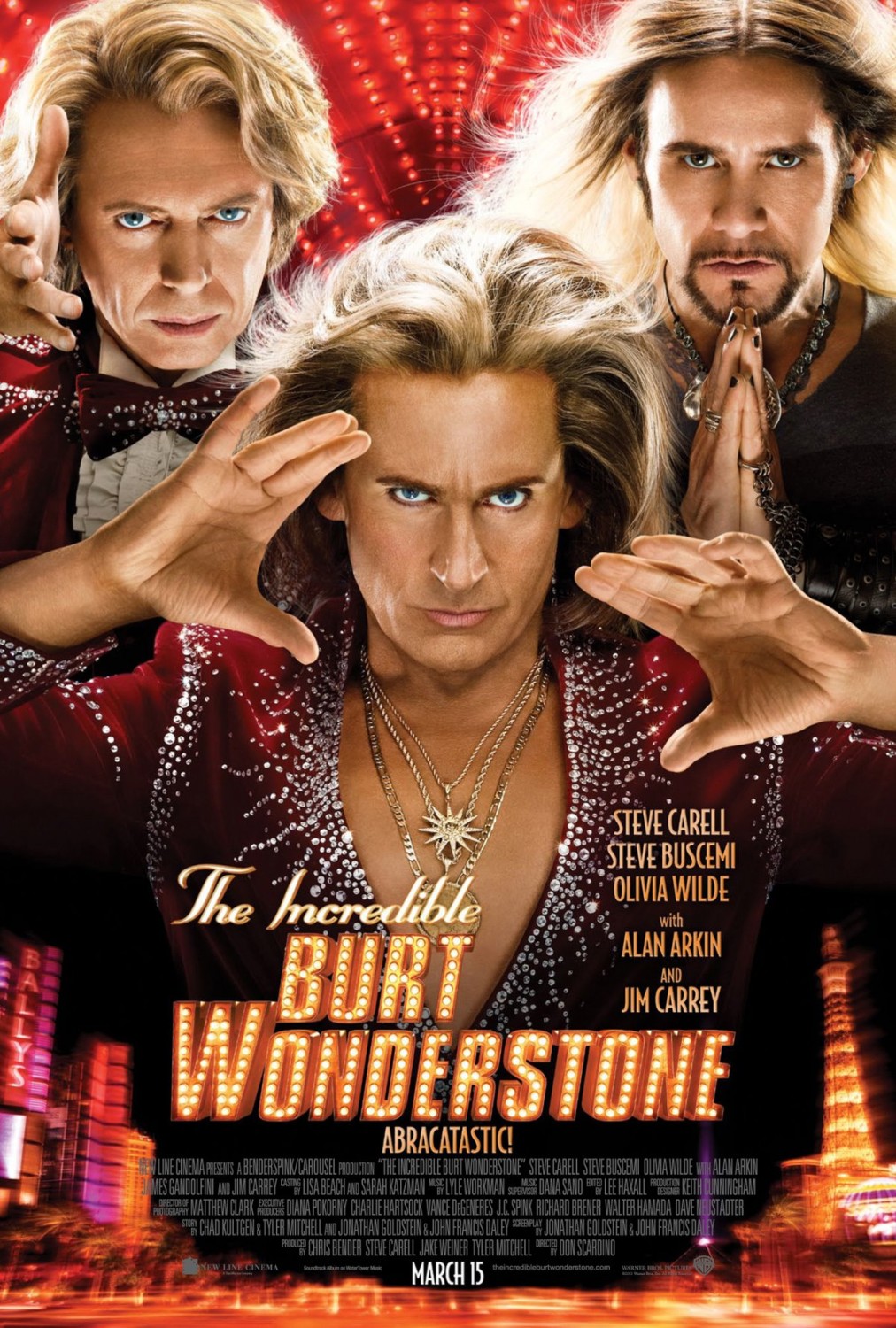 The Incredible Burt Wonderstone is a far better comedy than it has any right to be. It’s not perfect by any means, but it finds clever or darker angles to take that surprise, at least until it hits the next big marker on its jerk-learns-a-lesson plot playbook. The titular magician (Steve Carell) has a falling out with his longtime assistant and even longer-time (is this a word?) friend played by Steve Buscemi, who is disarmingly affable and warm. Their Vegas act is old hat in the face of younger, hipper, and more danger-seeking magicians, notably the Chris Angel-styled Steve Gray (Jim Carrey). While only a supporting character, Carrey’s bits onscreen are easily the best thing he’s done in a decade, comedy-wise. His physical comedy finds a perfect outlet. Gray’s schtick is more Jackass than David Copperfield, and the movie does well to explore this division and why people gravitate to magic in the first place. It’s ultimately a sweet film about the bonds of friendship, with Carell and Buscemi taking the bulk of the running time, and while it has plenty of silliness there’s also sincerity there. It all builds up to a great climax and a conclusion that left me laughing so hard I was in stitches. Make sure to stay through the credits. The Incredible Burt Wonderstone, from the writing team behind Horrible Bosses, is a charmingly broad comedy that has enough heart, committed comedic performances, takes enough clever turns to justify a viewing.
Nate’s Grade: B
Share this:

The Watch (2012)
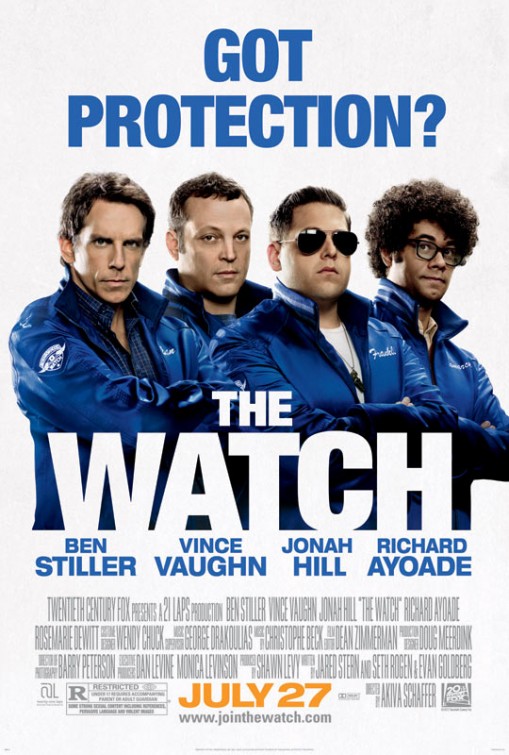 If scientists could take time away from, you know, curing diseases, and craft the perfect blend of “meh” in a lab, it would be The Watch. It’s not particularly offensive or terrible but it’s certainly not good. The humor of boys misbehaving and talking tough doesn’t ever seem to get further than the initial concept. The movie ends up becoming a more crass version of Ghostbusters, with a special fascination for the male member. This is a very penis-obsessive movie. Usually guy-centric sex raunchy comedies will definitely feature strong discussion/comedy revolving around male genitalia, but this is one of the few movies where complete storylines hinge upon penises (weird imagery, I’ll admit). Ben Stiller, Vince Vaughn, and Jonah Hill are more annoying than anything else. Poor Rosemarie DeWitt as the underwritten wife role in what is essentially a boys-behaving-badly movie (also her second 2012 movie where she’s trying to get pregnant). When the movie goes full-force into action mode, it loses just about any semblance of comedy. I laughed about three times, and that was thanks to Richard Ayoade (TV’s The IT Crowd) and, believe it or not, Will Forte (MacGruber). Sitting through 105 minutes with little laughs, irritating characters, and poorly conceived action in place of genuine comedic payoffs, well it’s not exactly a recipe for a successful summer comedy. And yet, with all its obvious faults, I couldn’t hate the movie as others have. It’s certainly not likeable but it does go about its business with a certain swagger, albeit misguided. Cocky loudmouths failing at entertainment are still marginally better than artists who don’t even try. It sounds like I’m reaching, and I am, but The Watch, certainly a bad comedy, may eventually be worth a watch when, you know, it’s on TV and you can half-heartedly pay attention to it while you go about your day.
Nate’s Grade: C-
Share this:

Pirates: Band of Misfits (2012)
 Delightful from beginning to end, Aardman’s stop-motion animated caper Pirates: Band of Misfits is hands down the best animated film of the year. Its wry British humor is mixed with inspired slapstick and a child-like sense of folly as the Pirate Captain (voiced by Hugh Grant) and his motley crew try to prove themselves to their pirate peers. Then they run into Charles Darwin, discover their parrot is really the last remaining dodo, and have to face off against a double sword-wielding Queen Victoria. The imagination on display is remarkable. Even the puns are funny. The pacing is swift, with gags flying so fast you’ll likely want a second viewing to catch them. The voice acting is spot-on and Grant anchors the film with his gleeful impulsivity. The story is simple but well executed and fun. I absolutely loved this movie. Its action sequences are well orchestrated, its comedic sensibilities are silly but often satisfying (a monkey butler who speaks in pre-written cards, a member of the crew that is merely a fish with a pirate hate on), it’s self-aware without being too self-conscious, and the animation is wonderful. There’s something about stop-motion that other animations cannot replicate, a physicality to its world that can make it so rich and immersive in the right hands. Kids will miss the references to, among others, Darwin, Jane Austen, and John Merrick, but adults will appreciate the nods. Pirates: Band of Misfits is a wildly entertaining family-friendly animated adventure that has it all.
Nate’s Grade: A
Share this:

Warm Bodies (2013)
 Given the explosion in zombie culture and the avalanche of zombie movies, it was only a matter of time before a studio pitched the romantic possibilities. They may be dead but they still have needs. Based on Issac Marion’s young adult novel, Warm Bodies attempts to tell a love story from a zombie’s perspective. Writer/director Jonathan Levine, so skillful with tone in the comedy/drama 50/50, tackles an even trickier balancing act, making a zombie romantic. With some visual flair, an eclectic soundtrack, and a winning onscreen pair, Warm Bodies is a sweet love story that does enough right to leave you smiling.
In the aftermath of a zombie apocalypse, R (Nicholas Hoult) is a zombie who spends most of his days shuffling through an airport. Occasionally he has a series of conversations with his pal, M (Rob Corddry), which mostly amount to grunts. R can’t remember who he was before he became a zombie, or even what life was like before it all went to pot, but there is one thing that will make him feel alive again – human brains. You see, this tasty delicacy allows zombies to relive the memories of their victims. It’s a nice release from, you know, decomposing. The zombies that have completely given up all sense of self peel off all their skin, becoming the Bonies, a wraith-like band of creatures that will feed off anything, even the dead.
 This is R’s life until his chance encounter with Julie (Teresa Palmer). He’s smitten instantly and feels something weird in his chest. His heart has started beating again. He doesn’t want to eat her, just protect her. Of course he did also happen to eat her now-ex-boyfriend (David Franco). R whisks her to safety to his home in an airplane cabin. They listen to records and he instructs her on ways to pose as a zombie. She’s cautious but grows fond of her zombie protector (zombie Stockholm syndrome?). But R is proof that the zombies can change and that humanity can be saved. There’s just the matter of convincing Julie’s father, General Grigio (John Malkovich), who had to shoot his own wife after she turned. He wants them all dead and will do whatever it takes to protect the last bastion of the living.
Levine has found what may be one of the only optimistic zombie films out there. Usually these movies end one of two ways: 1) everybody dies (the preferred option), or, 2) the heroes manage a final escape but are most likely doomed beyond all hope (just pushes the inevitable off screen and into our imaginations). Tethered to a genial but winning romance, Warm Bodies is a zombie movie with a genuine sense of hope, revival, and even finds way to carve out a happy ending that, while predictable, feels right tonally.
The twee romance has a lot more in common with indie stylings than it does, say, Twilight, which will likely be invoked by many a critic and ticket-buyer alike. It’s not so much the brooding, sullen, exasperating kind of “romance” Twilight has primed people to expect when monsters date young girls. Thanks to the helpful voiceover, we see R as a thoughtful (being generous here considering his peers) guy who, like most teens, is trying to battle his inner urges and sense of awkwardness. He may be a zombie but Levine and Hoult have found a way to make R relatable and a likeable dead chap to root for. It also helps that he and Palmer (I Am Number Four) have above average chemistry together. Sure it’s a little weird that she takes the whole guy-crushing-on-me-kinda-ate-my-old-boyfriend, but like any relationship, there are just obstacles you’re going to have to overcome together. And as my pal Eric would attest, any Franco had it coming (his big bro did lead to the end of mankind in 2011, so maybe he’s responsible for the zombie apocalypse).
I appreciated that even with a PG-13 rating the movie still has a bite to it. Premise-alone, there is plenty room for some intriguing mismatched comedy. I enjoyed the aspect that consuming human brains unlocks that person’s memories. I like that R saves brains for later snacks. I liked that he used this absurd plot device to help him get closer with Julie and makes him feel guilty. Warm Bodies finds a way around the whole bodies decomposing issue, which is important since we don’t want our Romeo to be too disgusting for the teen girls. It refrains from overt gore, relying on implied carnage and preferring a chaste smearing of blood on lips, like he just got carried away eating a cherry pie. Honestly, I didn’t miss the gore. While the concept of a completely putrid corpse, with its flesh rotting and falling from its face, finding romance would be darkly comical, I think Levine chose the savvier path, forming a romance that doesn’t overdose on irony, which it would if the dead-boy-meets-girl romance were more grotesque. That’s the reason the Bonies exist, to provide a more grotesque and more evil foe that can provide perspective on the nobility of the not-all-the-way-dead people.
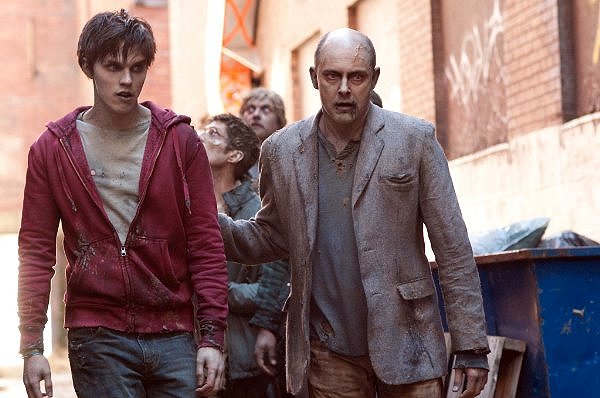 Levine works enough comic angles that the comic possibilities feel explored, although much like the horror and romance could have been pushed even further. As is, I found R’s musings wryly enjoyable, and his undead bromance with M provides some of the funniest moments in the film. Corddry (TV’s Children’s Hospital) is terrific in the movie and even finds what little room he can to add a touch of poignancy with his character. Often the humor, like the horror elements, is pretty relaxed but effective, refraining from oversized wackiness. You seriously would think that the movie would go bigger with its comedy considering everything at play.
Hoult (X-Men: First Class, TV’s Skins) does a credible job as a zombie, let alone an American zombie; it’s not all shuffling and caveman monosyllabic grunts. The actor is adept with communicating the awkwardness of his character in physicality. It’s funny how much you end of empathizing with a character that is dead. Hoult is also a pretty hunky guy, Vulcan eyebrows and all, but his amiable demeanor and young love clumsiness will win over as many guys in the audience as ladies. Palmer, also sporting an American accent, gets the blood pumping. Julie is underwritten but rises above just being a typical damsel-in-distress. It’s nice that later in the movie, when R breaks into the human camp, the roles are reversed, and Julie gets to protect him with her wits and will. Malkovich (R.E.D.) gets the worst of it just because his character is so rote.
I suppose I could lambaste the movie’s love-conquers-all logic with a dash of critical cynicism, but I feel like its low-key yet unfailingly romantic side is another of the movie’s charms. Sure, the idea that teenage love changing the world one beating heart at a time sounds like someone took the lyrics from an 80s power ballad and had it come to life (I’m reminded of the Patton Oswalt bit about the music video of an 80s hair band against the police: “He’d deflecting the bullets with the power of his rocking!”). There’s no real explanation why the zombies are getting better, though the concept of reclaiming their humanity appears to be contagious. I guess you could make some mild commentary on the healing power of human connection, but I don’t think Levine goes too far with any sort of subtext/social allegory, though there are enough slipshod Romeo and Juliet parallels. To the audience members who rankle at the unexplainable zombie cure, I would like to draw attention to the fact they are ignoring the fantastical logical puzzle of corpses coming back to life in the first place. If nobody minds why the zombie virus/crisis starts, then I don’t see why I should be sweating over what solves it.
Warm Bodies is a return to horror for Levine. Before his Sundance breakthrough The Wackness, the man got his start directing 2006’s All the Boys Love Mandy Lane. He’s made what may be the only zombie movie that I can say is “cute,” and that’s perhaps the best word for Warm Bodies. It’s a cute movie, perfectly pleasant, charming in its low-key sweetness while still managing to be clever. It’s dark but not too mordant, and sweet but not sappy. The last act doesn’t feel like it has the proper balance that the rest of the movie coasts with, but it wasn’t enough to ruin the film. At its core, it’s a cute love story, a zom-rom-com that’s much better than being relegated as “Twilight with zombies.” Yes it could have been darker, more macabre with its humor, and there are plenty of gloomy opportunities afforded by the premise of an undead boyfriend, but Levine and his actors have conceived a film that manages to be many things, chief among them enjoyable. It’s a zombie movie that might make you feel squishy but under completely different circumstances.
Nate’s Grade: B


 nathanzoebl
You must be logged in to post a comment.