Blog Archives
Lazer Team (2016)
 What makes a disappointing comedy? It’s a question I kept thinking about while watching the sci-fi comedy Lazer Team from the online comedy collective better known as Rooster Teeth, responsible for the longest running online Web series, Red vs. Blue. These are people who know how to be funny. They have a fine resume of shorts to prove their comedy bonafides, but what was it about their first foray into features that diminished their funny? I’ll try my best to provide a critical autopsy for the case subject of Lazer Team, a disjointed and disappointing buddy comedy that died on screen.
A concerned alien species has sent a warning to Earth. A hostile alien race is heading toward our planet with the intent to conquer, pitting their champion fighter against a champion from Earth. This gladiatorial showdown inspires Earth’s military and scientists to train a select warrior (Alan Ritchson) from birth for this mission. The problem is that the wrong people get hold of that alien technology. Disrespected sheriff Hagan (Burnie Burns), his old high school has been pal Herman (Colton Dunn), redneck moron Woody (Gavin Free), and insufferable quarterback Zach (Michael Jones) come across a downed alien ship that they happened to knock out of the sky with drunken fireworks. Each of the foursome puts on a piece of the alien armor, which attaches permanently. Herman gets a pair of super fast boots, Woody a helmet that instantly makes him smarter and British, Zach an arm canon, and Hagan a retractable shield. The bickering idiots are forced to work together over the fate of the planet, and the warring alien species has sent a few of its parasitic infantry to retrieve the special suit.
 To be fair, Lazer Team is not an atrocious comedy that singes your eyeballs with pain, something along the likes of InAPPropriate Comedy or any Friedberg/Seltzer suckfest. You can tell that the Rooster Teeth squad understands the tenets of comedy and what makes for a good joke, which is what makes their final product all the more baffling. For my pal George Bailey, there’s nothing worse than a bad comedy (his worst film for 2015 was Mortdecai). A comedy has one job to do and that is to make people laugh. This should be obvious but you’d be surprised at how often this principle seems to get lost. Rarely does a larger budget make a comedy funnier, a lesson learned the hard way over and over again with Hollywood. With Rooster Teeth’s first movie, they wanted to make a throwback to the sci-fi buddy comedies of the 80s. They raised almost two and a half million dollars via the crowd-source site Indiegogo, a record until Broken Lizard’s Super Troopers 2. It feels odd to say that what amounts to a meager budget by most productions could be at fault for the ultimate disappointment, but I think it leads into the chief problem of the movie: prioritizing the action over the humor.
It’s not uncommon for the comedy to get obliterated by the action in action-comedies, but from a comedy collective I was hoping for more emphasis on the ha-ha and less on the kablooey. Lazer Team has a solid comic premise that pays homage to a pastiche of 80s inspirations and pop-culture. I wanted to laugh. I think I even compelled myself to give it some pity laughs, but after 40 or so minutes a realization could no longer be ignored, and that was that Lazer Team just wasn’t that funny. The enthusiasm of its key cast members and their amiable nature go a long way to disguise the threadbare nature of too many of their first-draft jokes. The foursome never stretches beyond the entrenched lines of their formulaic archetypes. You come to expect specific jokes delivered from them, assigned by type in a way that reminds me of TV’s The Big Bang Theory. The character will rarely surprise you, which is also because their character arcs are so transparent. Hagan will atone for his failure to act and protect Herman while Herman will learn to move on from a past misfortune. Zach will learn to be less selfish. Woody will… well he doesn’t so much have an arc because he’s instantly made smarter thanks to the lien tech. The expected is a deathblow for comedy; if you can anticipate the joke, it’s rarely funny. Lazer Team so rarely subverts your expectations, playing things too safe.
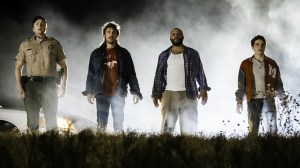 The central conflict of four losers learning to work together as a team to save the world is rife with comic possibilities, even with the locked-in archetypes, but there’s far more attention spent on the sci-fi action and special effects. It’s a low budget film but there are plenty of action set pieces and special effects, many done in-house by the Rooster Teeth team. The effects range in effectiveness but are generally passable and even impressive at turns, especially with properly calibrated expectations. The problem is that the action sequences that are eating up so much creative space aren’t remotely memorable. There’s one car chase in the middle of the film where it feels like the guys have found a tone that works, one where the action incorporates the comedy and they work. For a fleeting moment I thought, “Maybe the whole movie will resemble this new shift.” The other problem is that it feels like the Rooster Teeth squad was stuck with how to get this story to feature-length. Structurally, this thing sure feels padded with additional set pieces that lurch and fail to justify the added time, especially the ex-wife cabin sequence.
The acting foursome is the best aspect of the movie and their amiable interaction is the one thing that Lazer Team has that got me through to the end. These actors know how to sell jokes, when to mug, and their amped-up enthusiasm helps sell the lesser material. I wish this foursome had a better script. Imagine something more low-key in concept that involved less explosions and more emphasis on utilizing their comic talents? I wish less time had been spent on Jones’ obnoxious egotistical quarterback and more on Free’s redneck-turned-British genius, a setup that seems to have far more potential than just being an expositional device. The slobs vs. snobs approach only gets the movie so far, and after that we have to care about the characters, and I just didn’t. Because of how one-note the characters are it’s hard to care about them. After your good will depletes with the actors, you’re left with a bunch of running around but little funny.
Lazer Team is a movie that’s hard to hate, especially if this kind of genre comedy is a favorite launching ground for jokes. It’s nowhere near as wretched as The Watch but it can’t come close to the sci-fi comedies that influenced the Rooster Teeth creative unit. What’s even more frustrating is that these guys have the talent to tell an original and hilarious movie and are creative enough to engineer some fun sci-fi set pieces. They have the talent and expertise to do better than this, to do better than Lazer Team, a movie that is too safe, too predictable, too padded, too formulaic, and just not funny enough. I demand more from people who specialize in comedy.
Nate’s Grade: C
Share this:

Where to Invade Next (2015)
 With agitator-in-chief Michael Moore at the helm and that provocative title, you’d think this was Moore’s critique of the United States’ foreign policy in the Middle East. That’s what I thought too. I was surprised to find that Moore’s doc is really a rather gentle and optimistic examination of policies abroad that America should consider appropriating. Moore travels from country to country under the guise of “invading” them and taking their best ideas back to the mainland. It’s really a travelogue of the world and various ideas that give exception to the belief of American exceptionalism. In Italy workers get eight weeks paid vacation. In France, students get gourmet lunches. In Slovenia, there is free college tuition even to foreign students. In Portugal, they’ve decriminalized drugs and watched their crime rates drop thanks to an emphasis on treatment over punishment. Moore is still cherry-picking his facts (Italy’s high unemployment rate, Slovenia’s small population, etc.) and ignoring the multitude of cultural and government variables that allow these good ideas to flourish in their native lands, but he raises enough good points worth consideration. The humor of the enterprise is often forced and eye roll-inducing, with Moore playing baffled interviewer who just can’t fathom how these people live. The best segment is strangely slotted in the middle of the film where Moore travels to Germany. The sins of the past, namely the Third Reich and the Holocaust, are purposely remembered in monuments and education policy. It’s important not to forget the mistakes of the past. Moore then wonders what the U.S. would be like if we acknowledged the darker moments of the past instead of finding ways to excuse them (see: D’Souza’s doc and the worst film of 2014, America: Imagine a World Without Her). Ignoring uncomfortable realities is counter-productive, and Moore’s doc is all about accepting and implementing the good ideas of others to better our own country. The extra irony is that Moore himself is ignoring realities that conflict with his rosy message. Where to Invade Next feels like an extended segment of one of Moore’s old TV shows. It’s a bit rambling and dull and the whole framing device is too facile, but its simple mission of trying new things is laudable.
Nate’s Grade: C+
Share this:

Mortdecai (2015)
 It’s not going to be called conventionally appealing, or successfully funny, but Mortdecai is not exactly the colossal unwatchable bomb that critics brought out their knives for in the first month of 2015. It’s a curiosity that has some merit in its failure but it’s hard to lambaste this lark too much because it never takes itself too seriously. Johnny Depp plays Mortdecai, a roguish art dealer who also traffics in stolen paintings. Gwyneth Paltrow is his co-conspirator and wife. Paul Bettany is Mortdecai’s long-suffering manservant always getting into dust-ups or occasionally shot by his master. The weird left turns the comedy keeps taking don’t exactly make the movie better but they save it from being completely unmemorable. Your enjoyment factor will weigh heavily upon your tolerance for Depp in full foppish mode, an effete dandy who struggles with his conflating love of his mustache and his wife’s distaste for it. The entire story is a shaggy dog caper about stolen art that involves the Russian mafia, MI 5, and Nazi gold, and nothing matters. The actors look to be having a good deal of fun, playing dress up and trying on silly accents. I can’t say I laughed out loud but I did occasionally smile at the absurd commitment. I mostly sat wondering how something like this gets made, and then I saw that Depp was one of the producers and that answered that question. Mortdecai may not be worth the invective but that doesn’t mean it’s good.
Nate’s Grade: C-
Share this:

The Visit (2015)
 For the past ten years, M. Night Shyamalan has been a figure of piñata-whacking derision, and yet the man has consistently been at work on films big and small. You would think a decade of duds would lead to Shyamalan being unable to direct more than a junior high theater production, and yet people like Will Smith were specifically seeking him out to direct inevitably terrible movies like After Earth (oh is that one bad). The association has been burned into our minds: Shyamalan and bad movies. Is it even possible for a man whose name has become a punchline to turn his career around? A low-budget lark like The Visit allows Shyamalan the freedom of risk. If he fails, he’s only made one more bad found footage horror movie in a near infinite sea of them, and the budget number isn’t one that will bankrupt his generous producers. Perhaps it’s through the benefit of low expectations cultivated over ten grievous years of filmmaking, but The Visit is a modest little thriller that has enough suspense and campy humor that it works, mostly. I walked out of the theater generally satisfied and entertained, which are two attributes that haven’t been associated with Shyamalan films since… Signs? Goodness, that was back when Mel Gibson was a box-office titan.
15-year-old Becca (Olivia DeJonge) and her 13-year-old brother Tyler (Ed Oxenbould) are visiting their grandparents for the first time. Becca is a budding documentary filmmaker and brings her camera along to make a movie about the five-day visit. Nana (Deanna Dunagan) and Pop Pop (Peter McRobbie) live deep in the woods of rural Pennsylvania (the local police force consists of one guy). Everything is warm and cozy until it’s nighttime and Pop Pop insists that, for their safety, the kids stay in their rooms after nine o’clock. The strict rules and forbidden areas of the home encourage the kids to go exploring. Their grandparents may just be more than weird and old.
 The premise is deceptively simple and yet perfectly relatable and dripping with potential. I heartily enjoyed the fact that for a solid two acts, The Visit is a horror film where the horror elements are old people. Nana and Pop Pop both display fraying mental states, and Nana has an unusual trance-like state that kicks in once the sun goes down. I was expecting something supernatural or vaguely related to fairy tales to emerge to explain the overall weirdness and creepy affectations, but it never does. For most of the movie, the ravages of aging provide the scary business, and I think that’s great. Telling the story from the perspective of Becca and her camera also reinforces the cross-generational peculiarities, where the elderly and their older system of rules and way of life seem even more alien and alarming. Shyamalan, to his credit, does a fine job of coming up with suspense sequences built around his premise. Watching Becca and Tyler debate opening their bedroom door at night, especially after a series of unsettling scratching noises, is a well developed moment that revs up the audience imagination. Of course they shouldn’t open that door but boy do we want them to and discover what is going on. The performances from Dunagan and McRobbie hint at something menacing lurking below the surface but in a casual way. Nana asking Becca to literally crawl inside the oven to clean it is the kind of memorable what-the-hell moment that makes a horror thriller.
The offhand comments from the grandparents and their occasional erratic behavior are also played for laughs thanks to the camp factor of the actors. There is a clear absurdity to the scares and tension, and Shyamalan smartly embraces this. The Visit encourages you to laugh. Apparently, Shyamalan delivered three different edits of the movie: one pure comedy, one pure horror, and one a mixture of the two. The horror/comedy edit was the one released to theaters, and the film is better because of the inclusion of its offbeat humor. Without it, the movie would risk being too serious. To be fair, the movie isn’t making fun of dementia or ridiculing the elderly just because they’re out of touch. When the kids first see signs of Nana and Pop Pop getting confused, they behave very compassionately, like when Pop Pop dresses for a costume party he doesn’t know anything else about. Strangely enough, my theater was mostly populated with people over the age of 50, which made me wonder if they were duped into what kind of movie they were seeing or relished the chance to be seen as the scary boogeyman to teenagers.
 Which leads me to the point of the review where I discuss the parts of The Visit that don’t work quite as well. I don’t think Shyamalan knows how to write for teenagers because Becca is far too precocious for her age (using terms like “elixir” and “mise-en-scene” as everyday vocabulary) and Tyler is just downright annoying. There are three separate incidents of Tyler free-style rapping and it’s about as successful as you would expect, though it provides me amusement thinking about Shyamalan writing free-style raps for a thirteen-year-old white kid from the suburbs. My engagement with The Visit was more tethered to a general sense of morbid curiosity than a concern for the teen characters. I would have been perfectly fine if the teens didn’t make it out alive. I knew that was never going to happen because of the PG-13 rating, which does put some limitations on just how far out there Shyamalan can go. Though it doesn’t limit a scant shot of elderly nudity used for comic purposes. There is a great reveal that leads into the third act that ups the stakes, but it also shifts the movie into a more definitive slasher territory, and a PG-13 rating is going to further limit that territory. There are plot holes (a disabled laptop Webcam; the fact that they don’t have cell phone service but can Skype with their mom) and several mysteries are short-lived and anticlimactic (What’s in the shed? Oh, it’s just soiled adult diapers – incontinence!). Like many found footage movies, the movie fails to justify or incorporate this forced narrative device. Becca is a teen with two cameras and yet she stages them so counter-intuitively. For her first meeting with her grandparents, she sets down the camera and then runs into the distance to hug them. Would it not make more sense to get a closer shot of this first meeting? The found footage structure also provides a coda that frustratingly undercuts the climax of tension and replaces it with a sentimental monologue. It makes sense as a movie-within-a-movie but it’s a poor choice to end a horror/comedy that just hit its peak with an unnecessary and tonally-unwarranted resolution meant to warm the heart.
Shyamalan has a long road ahead to atone for his cinematic sins, and while I wouldn’t call The Visit an outright success, the movie succeeds more often than it fails. I think more could have been done to subvert and push the premise further, but the limitations of the rating and the found footage structure keep the movie from getting too crazy. There are some well-drawn suspense sequences and the use of campy humor is a strong asset that allows the shortcomings to be more forgivable. It’s the best Shyamalan movie in over a decade, which is really saying everything you need to know. Who knows? Maybe the comeback starts here with a tiny horror movie with rapping kids and dirty Depends. Stranger things have happened in Hollywood.
Nate’s Grade: B-
Share this:

The Man from U.N.C.L.E. (2015)
 Guy Ritchie’s big screen reboot of the 1960s TV show is the right kind of fizzy summer escapist entry that goes down smooth and entertains with just enough swanky style to pass the time. The Man from U.N.C.L.E. is equal parts spy thriller and straight-laced genre satire, hewing closer, and more successfully, to a marriage between Ritchie early cockney gangster flicks and his big-budget Sherlock Holmes action franchise. It’s often fun and surprising at how well it holds its tone between comedy and action; it almost feels like a screwball romance with guns and bombs. The trio of leads, Henry Cavill as the American agent, Armie Hammer as the KGB agent, and Alicia Vikander (Ex Machina) as the German asset, make an engaging group with plenty of conflicts to explore. It’s surprisingly more character-based than driven by its action set-pieces. Cavill shows far more life and personality than I’ve ever seen from him on screen. Vikander and Hammer have an amusing chemistry together and the movie allows them to roughhouse without pushing either character in a direction that feels too safe. Their series of will-they-won’t-they near misses will drive certain portions of the audience mad. The movie gets into danger when Ritchie and his co-screenwriter Lionel Wigram get too cute, especially with a narrative technique where the movie doubles back or highlights action that was in the background at least four times. The world of this movie is also another asset, as the period costumes, soundtrack, Italian locations and production design are terrific and further elevate the swanky mood. It’s an ebullient throwback that serves up enough entertainment with its own cock-eyed sense of throwback charm.
Nate’s Grade: B
Share this:

Entourage (2015)
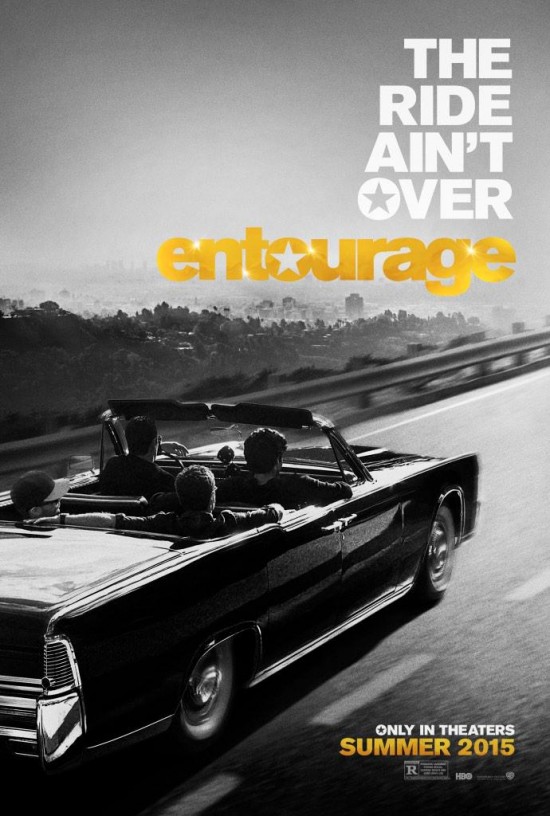 When Entourage first aired on HBO in 2004, it felt like a fun peak behind the glamorous world of Hollywood. A group of four friends were doing their best to navigate the land of dreams while staying true to themselves. For the first four seasons, Entourage felt fresh, fun, and engaging. And then it kept going for another four seasons, overstaying its welcome and proving to have worn out all credible story material several seasons before it went off the air in 2011. Creator Doug Ellin just didn’t want to leave the party, enough so that four years after finally leaving he’s back with his boys, co-writing and directing an Entourage feature film, answering all of the burning questions left unanswered. Does Ellin justify the move to the big screen, especially when you realize that the TV show already had gratuitous nudity and celebrity cameos?
Vincent Chase (Adrian Grenier) is nine days removed from his honeymoon where he and his wife decided they really weren’t meant to be, so they amicably split but not before having awesome sex one last time (oh yeah!). Back on the scene, Vinnie is hungry to direct and his debut is a $100 million adaptation of Jekyll and Hyde starring Vinnie and his older brother/desperate actor, Johnny Drama (Kevin Dillon). The problem is that Vinnie feels he needs more money to finish his masterpiece before he can show it to the studio. Ari Gold (Jeremy Piven), formerly Vinnie’s agent and now the head of the studio, has a lot on the line if this movie is a hit or a flop. He checks in with a financier for more money but the Texan moneyman insists his son Travis (Haley Joel Osment) go along to Hollywood and act as go-between. It’s not long before Travis is demanding drastic changes to Vince’s movie (oh no!). Here to help is Turtle (Jerry Ferrara), who works a business and a romantic angle with MMA fighter Ronda Rousey, and Eric (Kevin Connolly, who is weeks away from becoming a father with longtime girlfriend Sloan (Emmanuelle Chirqui). Can Vinni save his movie? Can Ari save his job? Can Turtle seal the deal with Ms. Rousey? Can these bros get any bro-ier (oh yeah)?
 The plot of the movie is almost insulting with how little conflict there is and when there is any how easily it all wraps up into lazy wish fulfillment. The main conflict of the film is that Vinnie wants more money for his directorial debut, even after blowing through $100 million. He needs just a pinch more for his movie to be able to be complete. Rather than having a disaster on their hands, which would be far more interesting and provide a wealth of conflicts with how to salvage what is there, the biggest perceived problem with Vinnie’s debut is whether it will be a box-office blockbuster and earn awards. Everyone sings the movie’s praises, though the concept sounds ridiculous and the little footage we see looks ridiculous as well. A Jekyll/Hyde DJ who fights “the system” and spreads his magic elixir at his club concerts… does that sound like the formula for Oscars? If Entourage were still functioning as an industry satire, there might be added commentary on how something so flatly terrible would be hailed as an awards darling, but entourage stopped being a satire midway through its television run. It’s just a consistent reward system for characters that stumble from one good thing to another. Even though Vinnie has never directed before everyone can’t help themselves but talk about what a superstar he is and how great the movie will be. Will he get tons of money, acclaim, and have sex with an attractive woman, or will he get tons of money, acclaim, and have to wait to have sex with another attractive woman? What a pressing conflict for a feature film. With that established, it’s no wonder then that Travis makes such an ineffectual antagonist. I was actually enjoying his hostility toward Vince and his dumb movie. Eric might have wanted to punch him in the face but I wanted to pat him on the back.
Another significant problem is that these guys are just too old to be going through these same tired arrested development routines. I think it says everything about Entourage the TV show that after eight seasons the characters were basically the same people except each had become more successful. Their shtick was already getting tiresome on TV. Flash forward four years, though the movie takes place months after the end of the TV show, so that means we’re in 2012 I think. Anyway, these guys should have accumulated some sort of personal growth as characters and they just haven’t. Except for Turtle’s weight loss, which becomes a running joke, it feels like they’re all the same. This is also featured in the Eric/Sloan relationship, which was an exhaustive subject on the TV show. As the series ended, they were together and having a baby, and as we pick up with the movie they’re, shocker, apart again just so they can get back together. The inevitability of this storyline offers a glimpse at what Ellin felt he had to squeeze in for Eric, which amounts to sleeping with two hot women and having a crazy mix-up. When it appears like there will be actual conflict here and Eric will be held accountable for his behavior, the movie instantly shrinks away and lets him off the hook. Every character’s interaction with women is regrettable, as women are served up as easy comforts. Ronda Rousey at least takes a stand but then retreats yet again under the supposed charm of these dolts.
The humor is low-grade and often missing, substituting references and celebrity cameos for well-developed comedic scenarios. There’s some humor in how self-deluded these guys are, especially the increasingly unhinged antics of Johnny, but they’re far too bland to generate consistent laughs. Except for Johnny, the other guys aren’t even given opportunities for comedy, which makes their storylines all the more painful. Do we really need to see Turtle’s courtship of Rousey, and what does she see in this guy? None of the cameo appearances are even used beyond just a ten-second-reference point with no greater impact than on the ten seconds of that very scene. Take for instance the cameo of Mark Wahlberg and his hometown buddies. He’s an executive producer on Entourage the TV show, based upon his own experiences coming to Hollywood. He’s shilling his own reality TV show he produces in the move based upon his old HBO show. That’s like product placement/plug inception. The problem is that Ellin has confused cameos as punch lines, which was also an issue with the original show. Just because I see someone famous doesn’t mean there’s a joke attached. Oh look, it’s Pharell and he’s wearing that big hat. Thanks for showing up, Pharell. Now go cash that check, you won’t be required for any other work on this set. Scene to scene, it feels like some sort of party that the filmmakers expect you to be grateful for attending. It’s not even a fun party.
 The most entertaining person is the movie is still Ari Gold and Jeremy Piven has always played him to the hilt, winning multiple Emmys in the process. I desperately wish this was more Ari’s movie, or told more from his studio perspective, because he’s the infinitely more interesting and entertaining character than the super relaxed and super boring Vince. Even though Ari’s vulgar outbursts have grown tiresome, he’s still the most exciting character because he’s transparent about his passion but also, more than any other character in this expanded TV universe, he works for his goals. Ari doesn’t just sit by and let good stuff fall into his lap, he’s working all angles to get the desired outcome, and that’s always more interesting than watching the life of a vacant actor go from great to even better. The subplot with Ari’s former assistant Lloyd getting married feels like setup for a comic set-piece that never materializes. It does, however, provide a cameo for George Takei to officiate the wedding. Hooray, more cameos.
If you were a fan through all eight bro-tastic seasons of the TV show, chances are you’ll probably find the movie easy-going and enjoyable. If you’re like me and grew tired of their boorish antics, the repetitive humor and plotting, and the casual misogyny, then a big-screen version where the boys get to continue their ways and get more rewards, where everything works out for everyone, will be highly fatiguing. Entourage the movie doesn’t aspire for much but its stunted ambitions and minor conflicts never allow the movie to be anything other than a particularly meandering and dull extended episode. Much like the main characters, it has confused mediocrity with success and being amiable with being interesting. Ellin said in interviews that he hoped this would be the start of an Entourage trilogy of movies. Thanks to the low box-office returns, at least I can credit America with stopping that plan. If this is indeed the last ride for Vince and the boys from Queens, well they went out pretty much like they did four years ago, and isn’t it great to still be a rich white guy in Hollywood? Oh yeeeeeah. Oh yeeeeeeah.
Nate’s Grade: C
Share this:

Me and Earl and the Dying Girl (2015)
 In many ways Me and Earl and the Dying Girl feels like the perfect specimen that was programmed and brought to life in some mad scientist Sundance film lab. It’s got a hip point of view, a meta commentary on its plot and the directions it doesn’t take, style to spare with lots of self-aware camera movements, and even Wes Anderson-styled intertitles and colorful visual inserts, including stop-motion animation. It’s about two amateur filmmaking teenagers, Greg (Thomas Mann) and Earl (R.J. Cyler), who befriend Rachel (Olivia Cooke) who happens to have terminal leukemia. The movie has a good heart and it deviates from convention with its storyline, though it has to stop and add narration to point out how it does this, like it demands a pat on the back for not being a “typical cancer weepie.” The big problem is that we’re stuck with the perspective of Greg, who is the least interesting character and just trying to stay invisible. He has a low opinion of himself and his friendship with Rachel will somehow make him a better person. Earl and Rachel are both tragically underwritten but valiantly played by their actors. The annoying aspect is that Greg makes everything about him and so does the movie. The supporting parts are broadly portrayed and fit awkwardly with the larger setting, like Greg’s overenthusiastic teacher, Rachel’s lush of a mother who seems one drink away from committing statutory rape, and Greg’s mom, who forces Greg to hang out with Rachel, even though they were acquaintances at best, because the plot demands it. The script by Jesse Andrews, based upon his YA book, sets up the completed tribute film as an emotional climax that cannot be met, and the abstract movie results prove it. This is a likeable, funny, and entertaining indie with a sense of style and wit. It’s good, but it could have been better. I wish the “Me” had been removed from its title.
Nate’s Grade: B-
Share this:

Ant-Man (2015)
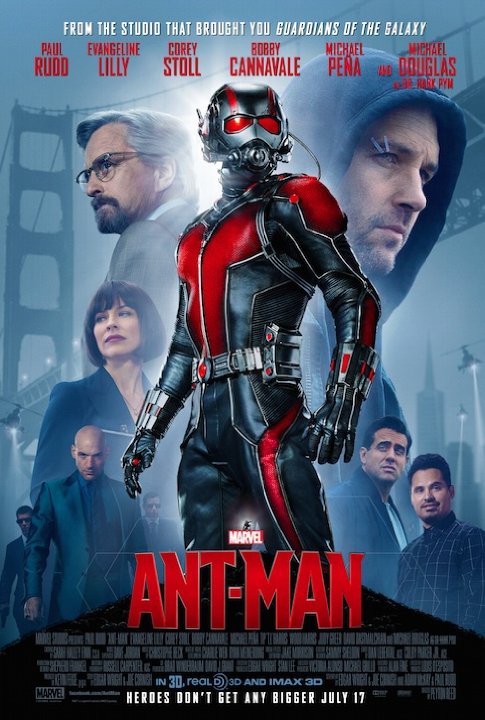 For the longest time it looked like Ant-Man might be the first dud of the runaway successful Marvel cinematic universe (MCU), a film franchise that was practically printing money at its leisure. It’s a strange setup and the man responsible for the movie even existing, writer/director Edgar Wright (Scott Pilgrim vs. the World), walked away six weeks before cameras were going to roll. Wright was a big fan of the character and has been working on and off on a screenplay with Joe Cornish (Attack the Block) for the past eight years. Before there was an MCU, there was Wright pushing for Ant-Man. I’m pretty sure Marvel execs weren’t thinking the relatively unknown character was worth sinking money into, but Wright kept pushing. I was far more excited for an Edgar Wright superhero movie than I ever was for Ant-Man, and then it all went away. Neither side has spilled too many details but it appears the divorce was a result of “creative differences,” which is odd since Marvel approved Wright’s script through eight years of development. Several directors were auditioned and Peyton Reed won the spot. The fact that Marvel has gained a rep for being a formula-driven creative committee and they literally hired a director with a film credit called Yes Man is an irony I don’t know that fully sank in. If Marvel was going to miss, this was the film. A funny thing happened in the ensuring year. Ant-Man is a visually engaging, energetic, and funny superhero caper that stays fun from start to finish and is a more entertaining movie than Avengers: Age of Ultron. Didn’t see that coming.
Scott Lang (Paul Rudd) is a master cat burglar just finishing the end of his prison term. Lang was punished for a “cool crime,” stealing millions a large corporation had illegally bilked form customers and returning it to the very victims, but it makes it hard to secure gainful employment. Scott falls back with his old crew, lead by his pal Luis (Michael Pena), and break’s into Hank Pym’s (Michael Douglas) safe. Expecting cash and jewels, Scott is disappointed to only find a weird looking suit, which he takes anyway. Hank observes Scott and communicates with him about the power of the suit. The wearer can shrink down to the size of n ant with the push of a button in the glove. Hank needs a protégée to wear the suit now that he’s too old. His estranged daughter, Hope (Evangeline Lilly), is working for Darren Cross (Corey Stoll), a scientist close to breaking through on replicating the amazing shrinking formula of Pym’s. As soon as Cross cracks the code, he’s going to sell the technology to the highest bidder (hail HYDRA). Hank must convince Scott to become the Ant-Man and sneak inside Cross’ secured workshop and steal his technology before it gets in the wrong-er hands.
 Arguably weirder than last summer’s Guardians of the Galaxy, which had a talking tree and space raccoon amongst its main characters, Ant-Man is the hardest property to sell by Marvel yet, and it smartly aims its sights lower and succeeds with the modest goal of just being a fun and enjoyable time at the movies. It helps that the movie doesn’t take itself too seriously and has characters pointing out the absurdity of its premise and developments, but not past the point where it would be detrimental. Let’s face it, a guy who can shrink down to ant-size isn’t that weird when you consider the applications, especially in espionage. The filmmakers do an admirable job of selling a superpower that pales in comparison to most other heroes on the market. However, the weirder power is that Scott has the ability to communicate and control ants via brainwaves. That seems like the even bigger superpower but it also begs the question, why simply ants? Of all the animals or living creatures who could be harnessed with this technology, we go with the tiny ones. There may be an explanation in the history of Ant-Man comics I’m missing but that doesn’t matter when we’re talking about the execution of the movie. The guy is able to control different species of ants with his mind. He is no Ant-Man but the Ant-King. Anyway, I think this power could be much more effective applied elsewhere. The ants are Scott’s friends and he has to train himself training them, getting them to coordinate and assist him properly, or else… there’s not much else at stake because they’re expendable. Perhaps their queen could have eaten Scott if he were unsuccessful.
On its surface, this movie should not work and is too goofy and insubstantial to engage, and yet that’s precisely what appealed to me. Not every superhero film needs to be averting a cataclysm that will destroy the planet. If the stakes feel big to our characters, and if the audience cares, then the stakes feel plenty big for us too. Scott simply foiling the corporate bad guy to be in a better position to see his daughter, that’s workable. Then the storyline is told through a heist, one of cinema’s most enjoyable plot mechanics. Heists are programmed for audience pleasure because it requires teamwork, which utilizes our cast in different and fun ways, it brings plenty of conflict and complications, and it lays out its steps one-by-one and provides a series of payoffs with the completion. It’s a tribute to Reed and the filmmakers that the heist portion of the film isn’t even the most fun part of the story. The majority of the middle is Scott coming to terms with the suit, his powers, his relationships in his life, and the mission. There’s probably one too many training montages (yeah, you get those sugar cubes you ants!) but the pacing is so breezy and the sense of fun so palpable, I didn’t mind. The use of humor never diminishes and Rudd is such a charismatic anchor for the movie, and yet he’s actually somewhat underplayed. He has it within him to be much funnier, but I guess he had to dial it down to effectively be seen as an action hero, hence the presence of newfound abs.
I didn’t have a lot of hope for the film once Wright left but I have to credit Reed for what he has achieved. It’s impossible for me to divorce myself from Wright’s involvement, and what kind of kinetic fireworks he would have birthed, but Reed manages to make Ant-Man come alive visually. Reed’s prior history shows an affinity for comedy but the films have never needed to be visually stylish, though I’d argue my super not-guilty pleasure Bring it On had an above average sense of visual spunk. Still, Ant-Man is a consistently visually immersive film that manages to find new perspectives. Scott’s first foray as a shrunken Ant-Man is an entertaining adventure through the dangers of a house party. The action sequences in miniature are treated just as we would expect a large-scale superhero epic to be treated, and then Reed pulls back at times for prime comic effect, like a battle atop a train that’s really just a child’s toy set. The visuals grandeur is patterned after the typical Hollywood action epic but the movie pulls back repeatedly to remind us how silly everything can be. The small world perspective opens up the movie in its storytelling and definitely in its action choreography. Because the Ant-Man has super strength when small, it behooves him to shift between small and human sizes when fighting. We’ll watch Scott race across the barrel of a gun in one second and then full-sized and hurling a security guard through a plate glass window the next. It provides a new sense of dynamism to basic fisticuffs. Reed takes advantage of the visual possibilities of his pint-sized super hero, like a clever battle that takes place entirely inside the contents of a briefcase. I chose not to watch this film in 3D, as my preferred option, but this is one I would almost consider going 3D. The shrunken worlds use a lot of macro photography to maximize the effect of depth.
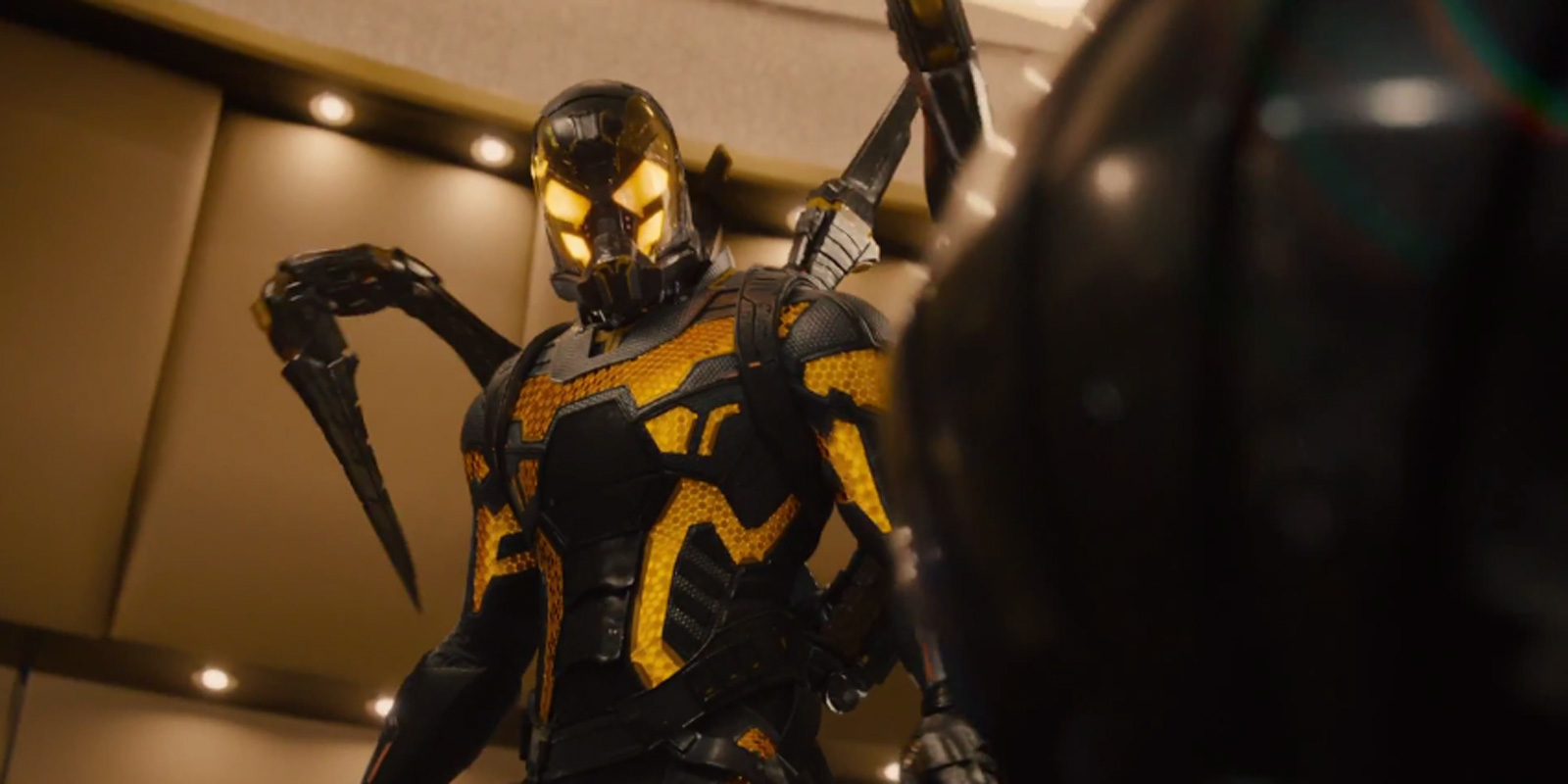 The cast also seems to be perfectly attuned to the comic rhythms of the story and several supporting players make the most of their moments to shine. Pena (Fury) is hilarious as the easily excitable friend given to lengthy diversions when retelling his tales of intrigue. The two instances where Pena breathlessly recaps what so-and-so said to so-and-so are two of the most playful and comically fulfilling sequences in the movie. I also enjoyed the fact that he’s always making waffles for his friends but this is never overtly commented upon. While Pena provides another dose of humor, the heart of the movie is really the father-daughter relationship, and it’s nice that Lilly (The Hobbit: Battle of the Five Armies)’s character is given such prominence. She resents Scott because she feels like by every right she should be the Ant-Man; the movie presents the two like bickering rivals fighting for the approval of a father figure. Hope’s credible grievances with her father are treated with weight and her reconciliation is given as much screen time as Scott’s training, pairing the two more as equals. Douglas (Last Vegas) is a warm and welcoming presence as a mentor working through his regrets late in his life. The de-aging CGI effects are amazing early on, showing a 1989 version of Douglas that looks pristine. He looks like he just stepped off the set of Ruthless People. The only weak point is Stoll (TV’s The Strain) but that’s because his underwritten villain is just too generic to blend in amidst all the colorful characters and comic mayhem.
It’s impossible to watch Ant-Man and not try to imagine what it would have been like had Wright remained as its director. Wright’s presence is still felt in stretches and he and Cornish are still the top-billed screenwriters, with the addition of Adam McKay (Anchorman) and Rudd himself performing a rewrite. I’d love to one day read what Wright’s full script was like and what Marvel eventually decided they could not abide. Whatever the case may be, the Ant-Man that made it to the big screen across the world is a surprisingly entertaining and spry piece of work. Reed provides a nice dash of visual flavor without losing its sense of the comedy or drama, Rudd is effortlessly charming, and the structure provides plenty of payoffs. Above all else the movie maintains a sense of fun and a lightness in an arena too often overwrought with doom and gloom. I don’t imagine there will be any Ant-Man sequels soon since the character is rather limited, but expect to see Rudd popping up in other MCU titles (he’s already been spotted filming Captain America 3). Ant-Man is a fun diversion but even Marvel knows not to push its luck too far.
Nate’s Grade: B
Share this:

Paul Blart: Mall Cop 2 (2015)
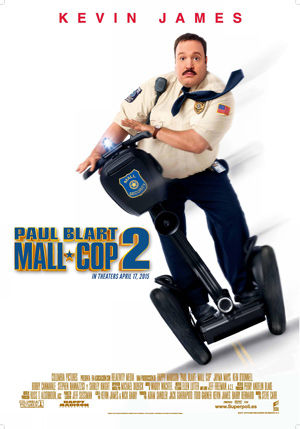 The first Paul Blart movie was fairly inoffensive. Much like its titular hero, it was buffoonish and loud and something to simply shrug and ignore the idiocy. It had a couple funny moments tweaking action movie conventions, less so with Kevin James’ numerous pratfalls. The world didn’t need a sequel beyond the demands of the first one making money. And much like the Die Hard sequels, the “spiritual forbearer” of Blart, our security guard finds himself miraculously being put in the same miraculous position again, this time in a different location. While Die Hard 2 is a fairly mundane follow-up, Paul Blart: Mall Cop 2 is a true test of everything we hold sacred. Midway into the movie, I thought my review was just going to be my unintelligible suicide note.
Blart (James) is in Las Vegas for an annual security convention. He’s brought along his teen daughter Maya (Rami Rodriguez) for some valuable father-daughter time, especially in light of Blart losing his wife and mother. It’s at this convention where Blart runs across a team of art thieves lead by Vincent (Neal McDonough). It’s up to the most unlikely mall security cop to save the day again, Vegas-style. Oh, and when traveling in Vegas, make sure to stay at the luxurious Wynn Casino and Hotel. Can I get a check too for the self-promotion like this movie?
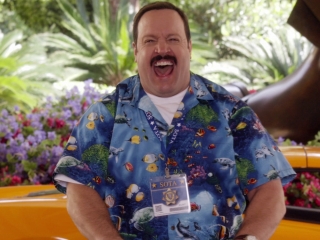
Kevin James laughs at your pain.
Somewhere along the way, James and co-writer Nick Bakay decided the lovable lug needed to be a modern-day Pagliacci and be the crying clown America deserves. The opening act feels like notorious cinematic sadist Lars von Trier designed it. In the opening minutes, Blart’s wife (Jayma Mayes) divorces him not even a full week into marriage. She couldn’t stop vomiting from the thought of being married to him (this literally happens). His mother is run over and killed by a milk truck. His daughter has been accepted into UCLA but fears telling her father this joyous news because she doesn’t want to push him over the edge. This and he’s still emasculated and looked down upon by an assortment of industry peers at the Vegas convention. All of this culminates in Blart becoming a paranoid, overbearing bully who loses the sense of likeability that comes naturally to James even in dreck. Take a moment where Blart intervenes with his drunken friend. The guy has been obnoxiously making sexual advances on a woman (played by Adam Sandler’s wife) who just wants her privacy respected, and Blart saves the day by… convincing the woman that she should be flattered by the drunk’s advances. Yeah. He rejects his daughter’s academic accomplishment and demands she attend a lesser school closer to home for his own selfish benefit. He’s pushing her away. Then there’s the weird ongoing joke about his arrogant assumption that an attractive hotel employee is hitting on him; he’s dismissive of her throughout and, here’s the weird part, it ends up working. She falls for him (“I can’t say no to you”). That’s right folks, Paul Blart successfully “negged” himself a date. He’s not a loveable loser any more. He’s just an angry, bullying, self-pitying loser.
There won’t be a joke (I’ll be charitable and refer to them as “jokes”) that you won’t see coming a mile away and still roll your eyes when they arrive. When the movie has an exotic bird walk out, you know it’s only a matter of seconds before it comically engages in a fight with Blart. When he steps back onto the familiar confines of a Segway, you know it’s only a matter of seconds before he does something stupid. The crux of the humor of this movie is about 90 minutes of a fat guy falling down, and it still takes 47 minutes for the plot to get in gear. Let me repeat that for those in the cheap seats: a movie that is built upon the frail premise of being a Die Hard parody takes 47 unholy minutes to actually have its plot kick into gear. I watched Blart fight a stupid bird before the movie had the villain’s scheme play out. Naturally, the film would have been bereft without that man-on-bird action (sorry to disappoint those who came here vis-à-vis a salacious SEO keyword search). Likewise we needed 28 shots of James falling over. Anything less would have been unacceptable to the viewing public. If you’re going to be a dumb comedy just be a dumb comedy and don’t waste my time. 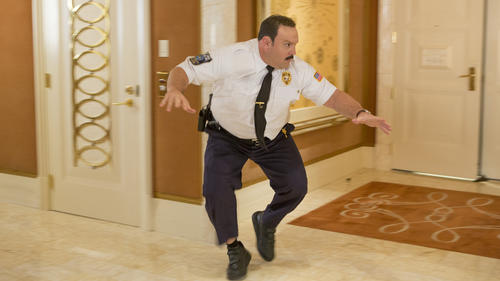
And oh what a dumb comedy it is. The first Blart film wasn’t going to be confused with Tom Stoppard but it at least had some action conventions it could tweak. This go-round can’t even manage that, and so we’re inundated with tired slapstick and comedy that rarely rises above the most obvious joke at every opportunity. Blart gets ready to attack an intruder and, wouldn’t you know it, he ends up punching an old lady. Hilarious. Even funnier is that the injured hospitality worker apologizes to her attacker. There’s also a thinly disguised gay panic joke where Blart freaks out when a guy eats a brown banana. Who cares about how brown a banana is? At one point Blart hides inside a suitcase positioned at the top of the stairs. Why? Well so that the suitcase can fall down those stairs and hit the bad guy in the head. Don’t you get it? He’s fat. There are few comic setups or developments, no payoffs. Scenarios that should be comic, like Blart stumbling on stage of a Vegas dance show, are practically played straight, with the visual of Blart cavorting his large torso as the only joke itself. In case you forgot, he’s fat.
I should not have been expecting much from Paul Blart 2 simply by the choice of jokes highlighted in the trailer. If you wanted a cursory reminder, it included Blart fighting a bird, Blart punching an old lady, Blart running into a plate glass window, and Blart getting kicked by a horse in what should be a spine-obliterating accident. Let’s take this last gag and really explore how it’s indicative of Paul Blart 2. The foundation is a dumb act of slapstick, but that’s not good enough and so it’s exaggerated to even dumber magnitude. With the help of self-loathing CGI artists (they can’t all be Jurassic World), Blart ricochets across a street and violently bounces against a car door. It’s not enough that a horse kicks this guy; he has to get kicked by a super horse because it just wasn’t funny enough. That sums up the comic ethic of Paul Blart 2: when stupid isn’t enough, amp it further, and then be proud about what you’ve done.
Nate’s Grade: D
Share this:

Inside Out (2015)
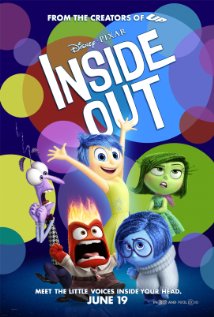 It feels immeasurably satisfying to finally have the Pixar we all fell in love with back and running. There’s been a sharp decline in the company’s quality since 2010’s Toy Story 3. Did we really need a sequel to Cars and a prequel to Monster’s Inc.? It started to look like Pixar was steering away from the kind of bold and brilliant storytelling that had earned its audience trust. With Inside Out, Pixar tackles the intricacies not of the secret world of toys, bugs, monsters, or sea life, but of the human brain itself and our embattled emotions, finding new ways to wow us once again and remind us just how magical the right combination of story and storyteller can be. Inside Out is a luminescent piece of filmmaking, brimming with intelligence, imagination, and it is powerfully moving while also being deeply relatable and entertaining. In looking inward, Pixar has found the path out of their recent rut, and Inside Out is a shining example of their ingenuity.
Inside 11-year-old Riley is a complex world. Five primary emotions help oversee her day-to-day functions; they’re the caretakers of Riley. Joy (voiced by Amy Poehler) is the effervescent leader of the bunch, along with Sadness (Phyllis Smith), Fear (Bill Hader), Disgust (Mindy Kaling), and Anger (Lewis Black). These five are entrusted with Riley’s well being and her memories. Riley’s core memories, the moments that make up who she is, help to form personality islands: honesty, hockey, goofball, and family. Riley and her family have recently moved from Minnesota to San Francisco, and Riley’s having a hard time adjusting. Her parents don’t know what’s happened to the daughter they knew. Sadness seems to be “tainting” Riley’s memories, and Joy tries her best to keep Riley happy at all times. Joy and Sadness get accidentally sucked away wrestling over Riley’s core memories. They’re sent to the outer reaches where the aisles of long-term memories are vast. The two emotions have to work together to get back to headquarters before the remaining emotions convince Riley to run away from home.
 Even just reading that again, it’s easy to see how complicated this movie can be with its world building and internal logic, and yet under the guidance of director Pete Doctor (Up) and his writers, the movie is at no point confusing. Pixar once again does an amazing job of guiding you through a new world and its various parts, all while expanding and complicating this environment while staying true to its internal logic and keeping an audience properly oriented. I can’t imagine many screenwriters would be able to tell this story while still being as clearly understood. The simplicity of the story, the ease to follow along, the natural development and connection of the storylines and characters coming together, is the greatest credit one can offer. It’s ostensibly a buddy adventure film like many Pixar tales, with the unlikely team of Joy and Sadness having to find their way back to headquarters and learning important life lessons along the way. It’s also a smart way to explore the various other elements at work in Riley’s brain. It’s not just an interesting descent but each new station further opens up Riley as a character. Her subconscious (and fear of clowns), her dream theater projections, her working abstract concepts, all tie back together in satisfying ways. Though the greatest side character is unquestionably Riley’s former imaginary friend, Bing Bong (voiced by Richard Kind). He’s wandering around her memories, and at first you have your suspicions, but then you realize, like the other characters, that he just wants what’s best for Riley. Coming to terms with the fact that Riley has moved on, and his time, while cherished, is now left behind, is a complete character arc, and that’s for a comic side character. Oh, and if you’re like me, Bing Bong’s conclusion just wrecked your tear ducts.
You know you’ve watched an impactful film when even thinking back on moments starts the process of tears welling in your eyes. It’s somewhat strange to think about characters as ephemeral as emotions and imaginary friends and the like, but they really work on two levels: the emotions themselves are exaggerated figures with distinct points of view but they also better inform the whole of Riley. There’s a depth there that gets even more impressive the more you analyze the creative process. What’s also impressive is the vital message of the movie, which is that growing up is hard and that being sad is okay. Seriously, the journey of Joy is to accept that being sad isn’t necessarily an emotion to minimize but a vital part of being human and an essential process. Much of the conflict that drives Riley is her avoidance of being sad, her postponement of accepting her real feelings and accepting that San Francisco is not going to be like her old home. It’s also a realization that to be a fully functioning person, you have to own the sadness in life. When Riley eventually unburdens herself of all her troubles and fears, and the tears flow, that’s when the healing can begin, and that’s when her parents swarm in for the group hug, and even now my eyes are starting to water. Damn you, Pixar.
 Don’t be mistaken by my words thus far, Inside Out is also a wonderfully funny and inventive comedy. The sense of discovery with the movie is alive and well, and each new revelation of Riley’s inner mind adds to the fun. The jokes are consistently paced. The vocal cast is expertly chosen and each emotion gets some good jokes. There’s a terrific running gag about a catchy jingle that the memory workers just enjoy kicking back and forth for their own impish amusement. The film dives into other minds other than Riley’s, including both parents trying to communicate during a family dinner meant to soothe their daughter. It doesn’t lean too heavily on tired gender stereotypes when it comes to the differing thought processes of men and women, which is a relief. During the end credits, we zoom into the mind of a schoolteacher, a bus driver, and a dog and a cat, and it’s an enjoyable way to leave the theater and gather yourself emotionally. The greatest comic asset is Joy, particularly as voiced by Poehler. As fans of TV’s Parks and Recreation can attest, Poehler can make insufferable optimism endearing, tip toeing around what should be annoying and instead finding stronger comic rhythms. If you’re looking for the closest thing to an antagonist, it’s Joy who got the whole mess started and yet we don’t ever really side against her. Part of that is because she’s not doing what she does as some weird power play but because she wants what, she thinks, is best for Riley. The other part is because Poehler is such a skilled vocal performer.
If I had to find some point to quibble, the world isn’t as beautifully realized in a visual sense as other Pixar classics. I think this was a deliberate decision to ground what is such an unusual environment into something a little more familiar and less flashy. I also don’t think that Disgust seems as well articulated as a necessary emotion. She’s well played by Kaling but her application seems lacking in comparison to the other four main emotions.
It’s remarkable that the summer is still young and already we have two instant classics in theaters; first Mad Max: Fury Road and now Pixar’s Inside Out. I’m still riding high from my screening, but I’d feel safe to call this a top-three Pixar film. I wouldn’t even begrudge those who cite it as their best. Far more than a big screen version of the 90s comedy Herman’s Head (anybody remember this one?), this is an exceptional animated film that will appeal to all ages but, I suspect, hit adults even harder than their little ones. It’s a wonderfully poignant film about the struggles of growing up, of holding onto your past definitions of yourself, of accepting the full barrage of emotions, including the necessity of sadness. It’s relatable in many aspects and this further compounds its power. It’s dazzling with its creativity, it left me cackling with laughter (a superb Chinatown reference almost had me fall out of my chair), and it left me weeping at various points. Inside Out is a return to form. This is the Pixar we remember.
Nate’s Grade: A


 nathanzoebl
You must be logged in to post a comment.