Blog Archives
People We Meet on Vacation (2026)
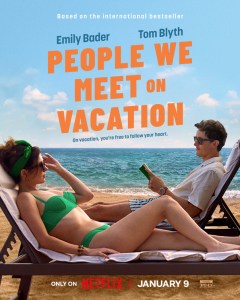 I’ll readily confess, I enjoy a good romantic comedy. I’ve even written a few rom-com Web series. Who doesn’t want to be captivated by charming characters, witty, banter,, and a yearning for a romantic coupling? The Sony-by-way-of-Netflix-acquisition People We Meet on Vacation is based on popular author Emily Henry’s 2021 breakthrough novel of the same name. I was expecting lots of fizz and frivolity, which can be had in doses, but I think the adaptation makes a few key mistakes that hampered my rom-com good time vibes. People We Meet on Vacation is not whom I was expecting, and maybe that’s me being too demanding, or maybe my travel companions made me think about switching seats.
I’ll dispense with the exact plot details further into this review, but the story in general is thus: Girl and Guy are friends but maybe also secretly like each other but also sometimes have other people, boyfriends.girlfriends, that they’re supposed to like more instead. Eventually, they grapple with these confusing feelings while also visiting global tourist destinations as “platonic vacation buddies.”
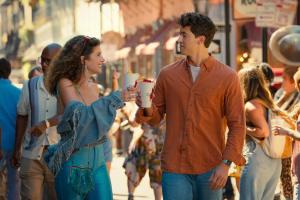 First, I didn’t buy the main characters as close friends. We’re introduced to them as they travel home to small-town Ohio together for the holidays from their freshmen year at Boston College, and they’re immediately bickering and annoying and can’t stand one another. The film is following a friends-to-lovers path, but I guess at first it decided to become an enemies-to-friends storyline. Even as the animosity thaws, I never really bought what compelled these characters to be best friends, so much so that they make a plan to make a trip every summer across the world together (the disposable income these newly indebted college grads have access to blows my mind; he’s a teacher!). The premise is workable, and as you would expect there are feelings that begin to get messy over the years of vacation, but I never felt the core friendship, so whether or not they ruined it with a burgeoning romance never felt like a credible threat for me. What is there to ruin exactly? We’re jumping from vacation to vacation summers apart, the gaps are meant to serve as storytelling glue; we’re meant to just assume, “Oh, they became good friends,” without seeing it for ourselves. I think this misstep could have been avoided simply by making the two of them less acrimonious in their earliest introduction. Make the friendship credible, and even better, make me like them together and see that they bring out other sides in one another that others fail to elicit.
This could also be a factor of my second misstep, namely the casting. I did not feel a flicker of chemistry between Emily Bader (My Lady Jane) and Tom Blythe (young sexy Snow in 2023 Hunger Games prequel), and I think it’s mostly the guy’s fault. I was getting 2011 Oscar hosting flashbacks. Here me out, dear reader. In 2011, Anne Hathaway and James Franco were hired as hosts to have the awards show appeal to a younger demographic (begin knowing laughter). Franco’s energy was so low that critics joked he might have been stoned the whole time. As a result, Hathaway had to overcompensate for his dearth of charisma and energy and was stuck doing far too much. In People We Meet on Vacation, our female lead, Poppy, is a chatterbox extrovert, and our male lead, Alex, is a sullen introverted homebody. Naturally, opposite personality dynamics can make for engaging relationships, but the work needs to be careful. I found Alex to be a bore. The most he gets pushed out of his comfort zone is by skinny dipping and, separately, pretending to be on a honeymoon for free drinks. That’s it. That’s Mr. Wild on Vacation (more on that next). Most of the time he’s just converting oxygen to carbon dioxide on screen. As a result, Bader has to go above and beyond, talking circles around her taciturn scene partner and bowling him over with personality, so much so that her outsized personality begins to flirt from charming to dangerously annoying. The misaligned character dynamics and characterization form a ceiling of my engagement.
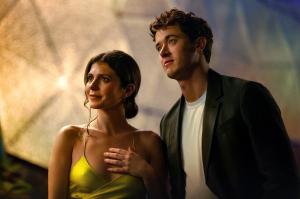 Thirdly, I was expecting more of a flirty freedom from the premise. Poppy works as a travel writer and fantasizes about being someone completely new on vacation. With that concept, you would assume the story would explore that dichotomy, the woman who uses these trips to reinvent herself, try on different versions of herself that can be dramatically different, adopting new personas and exploring aspects of herself that she didn’t feel comfortable embracing as regular ole Poppy. This seems like the most obvious direction to take the story with a title like People We Meet on Vacation (the new people we meet are… ourselves). Astonishingly, the movie is not that. There is only one instance of Poppy and Alex leaning into the freedom afforded to them through their vacations to pretend to be different people. While in New Orleans, they pretend to be newlyweds and this grants them free drinks, and this new persona gets Alex to dance provocatively; he even does The Worm. Does this different version of Alex lead to anything more? No. It would make sense with all their free drinks for this to be the moment that Alex and Poppy get even closer, imitating newlyweds, and cross a line of their friendship. Does this happen? No. That’s a whole other international vacation where the characters aren’t pretending to be other people. We can break this down on an even smaller level. Maybe the characters have events in these vacations that push them out of their comfort zones and challenge them in ways that change them as people, like discovering an aspect of themselves they hadn’t given thought to before. If you’re going to Tuscany, do something that’s unique to Tuscany. Do something that matters. It never feels like the travel is actually making an impact on these two characters. Rather, the vistas change but the focus is always on their will they-won’t they, which isn’t dependent on their setting. They could have just gone down the block for the same results. At 118 minutes long, some of these various vacations might have been consolidated if they are so inconsequential.
Lastly, when the movie isn’t separating itself from the pack by embracing its unique story elements, it falls back on the familiar cliches of the genre. I’m talking stuff that even a layman to rom-coms would even know, things like the big kiss in the rain, the big Act Three dash, usually out of an airport. It’s stuff like that, and cliches by themselves are not inherently bad but they have to feel authentic to the characters and stories. It might be a cliche to simply say that you need to make the cliches your own. If I genuinely cared about the characters, and felt their chemistry, then I wouldn’t be nitpicking and noticing the cliches as much. It just so happens that a shaky adaptation can make reliance on genre cliches more noticeable.
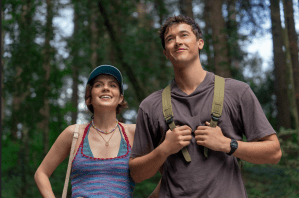 Now, I know the majority of this review has been critical of People We Meet on Vacation, and that’s mostly because I think this movie could have been better from some pretty obvious missteps. The version of People We Meet on Vacation is… fine. It’s consistently cute and amusing and harmless, an afternoon movie that can pass the time well enough especially for those predisposed to romantic comedies. It’s a fairly good-looking movie with an impressive war-chest for music licenses, including Ms. Taylor Swift. My middling frustrations with the movie seem to be echoed by many of Henry’s fans, that whatever made this story special seems to have been emptied, replaced with cozy genre cliches. I liked the ending, cliches and all, because it felt fitting for those characters, their different dynamic, and felt it had been sufficiently set up to serve as a payoff. I wanted more moments like this, that felt unique to this story, to these characters, and actually made use of their specific settings. No other characters in this movie matter other than our leads, so it’s a shame that I didn’t feel particularly excited for their eventual coupling. I didn’t find their characters repellent or mean-spirited, just ordinary, lacking a distinct personality. They were blandly likeable but the kind of people you’d meet and forget easily, vacation or no. People We Meet on Vacation is an agreeable movie that had the possibility for more, and that’s what lingers longest for me.
Nate’s Grade: C+
Share this:

The Secret Agent (2025)
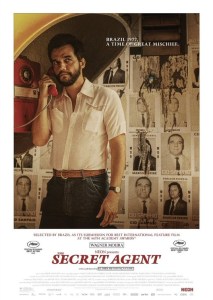 The Secret Agent is a hard movie to fully categorize. It’s set in 1977 Brazil and with its title you might think it’s about some clandestine espionage operation or fighting against a corrupt government, and it does fit those descriptions but not in a traditional Hollywood way. We follow Wagner Moura (Narcos, Civil War) as a former grant-supported energy scientist who comes to clash with a powerful businessman who then hires an assassination team to kill this know-it-all. It’s also about entrenched police corruption and coverups, a found family of people seeking protection and new lives, the search for memory and proof of life, a father wanting to connect with his son in the wake of his mother’s death, and then there’s a running story about a severed leg that goes into the wildest, most unexpected places. It is a leisurely paced movie at almost two hours and forty minutes in length, but each scene is its own luxurious moment to dwell in. Take for instance the opening scene where Moura drives his car to a dusty, rural gas station and finds a dead body covered in newspaper. Nobody wants to come claim the corpse, and then the police do arrive but they take particular interest in Moura, wanting to search his car and ask him questions. Do they know something? Who is this man? A similar early scene involves the police investigating a dead shark where a severed human leg was found inside its mouth, and the way it unfolds and escalates is so naturally fascinating. The Secret Agent juggles many different tones, from nostalgic drama to crime thriller, but every scene is so expertly written and paced by writer/director Kleber Mendoca Filho (Aquarius, Pictures of Ghosts). You may grow weary by its length, but when I was in every scene, I didn’t want it to end because it feels so well-realized in its moment. There’s a subversive switch-out with its climax that reminded me of No Country for Old Men, and the ending coda ties together the flash-forwards and hits hard with the theme of uncovering and honoring the past. This is a lot of movie, much of it I admired more than I outright loved, but it’s such a fascinating balancing act that I would recommend The Secret Agent as a sprawling dive into Brazilian history, culture, and its own political reckoning.
Nate’s Grade: B+
Share this:

Wake Up Dead Man (2025)
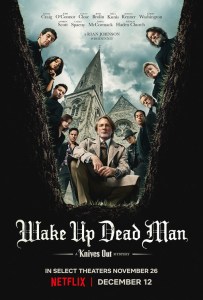 Being the third in its franchise, we now have a familiar idea of what to expect from a Knives Out murder mystery. Writer/director Rian Johnson has a clear love for the whodunit mystery genre but he loves even more turning the genre on its head, finding something new in a staid and traditional style of storytelling. The original 2019 hit movie let us in on the “murderer” early, and it became more of a game of out-thinking the world-class detective, Benoit Blanc (Daniel Craig). With the 2022 sequel Glass Onion, the first of Netflix’s two commissioned sequels for a whopping $400 million, Johnson reinvented the unexpected twin trope and let us investigate a den of tech bro vipers with added juicy dramatic irony. With his latest, Wake Up Dead Man, Johnson is trying something thematically different. Rather than adding a meta twist to ages-old detective tropes, Johnson is putting his film’s emphasis on building out the themes of faith. This is a movie more interested in the questions and value of faith in our modern world. It still has its canny charms and surprises, including some wonderfully daffy physical humor, but Wake Up Dead Man is the most serious and soul-searching of the trilogy thus far, and a movie that hit me where it counts.
In upstate New York, Pastor Jud (Josh O’Connor) has been assigned to a church to help the domineering Jefferson Wicks (Josh Brolin). The congregation is dwindling with the exception of a few diehards holding onto Wicks’ message of exclusion and division. The two pastors are ideologically in opposition, with Pastor Jud favoring a more nurturing and welcoming approach for the Christian church. Then after one fiery sermon, Wicks retires to an antechamber and winds up dead, with the primary suspect with the most motivation being Pastor Jud. Enter famous detective extraordinaire Benoit Blanc to solve the riddle.
 I appreciated how the movie is also an examination on the different voices fighting for control of the direction of the larger Christian church. Wicks is your traditional fire-and-brimstone preacher, a man who sees the world as a nightmarish carnival of temptations waiting to drag down souls. He sees faith as a cudgel against the horrors of the world, and for him the church is about banding together and fighting against those outside forces no matter how few of you remain to uphold the crusade. Pastor Jud rejects this worldview, arguing that if you think of the church as a pugilist in a battle then you’ll start seeing enemies and fights to come to all places. He’s a man desperate to escape his violent past and to see the church as a resource of peace and resolution but Wicks lusts for the fight and the sense of superiority granted by his position. He relishes imposing his wrath onto others, and his small posse of his most true believers consider themselves hallowed because they’re on the inside of a special club. For Pastor Jud, he’s rejecting hatred in his heart and looks at the teachings of Jesus as an act of love and empathy. It’s not meant to draw lines and exclude but to make connections. These two philosophical differences are in direct conflict for the first half of the movie, one viewing the church as an open hand and the other as a fist. It’s not hard to see where Johnson casts his lot since Pastor Jud is our main character, after all. I also appreciated the satirical tweaks of the church’s connections to dubious conservative political dogma, like Wicks’ disciples trying to convince themselves the church needs a bully of its own to settle scores (“What is truth anyway?” one incredulously asks after some upsetting news about their patriarch). It’s not hard to make a small leap to the self-serving rationalizations of supporting a brazenly ungodly figure like Trump. At its core, this movie is about people wrestling with big ideas, and Johnson has the interest to provide space for these ideas and themes while also keeping his whodunit running along pace-for-pace.
There is a moment of clarification that is so sudden, so unexpectedly beautiful that it literally had me welling up in tears and dumbstruck at Johnson’s capabilities as a precise storyteller. It’s late into Act Two, and Blanc and Pastor Jud are in the thick of trying to gather all the evidence they can and chase down those leads to come to a conclusive answer as to how Pastor Jud is innocent. The scene begins with Pastor Jud talking on the phone trying to ascertain when a forklift order was placed. The woman on the other side of the line, Louise (Bridget Everett, Somebody Somewhere), is a chatty woman who is talking in circles rather than getting to the point, delaying the retrieval of desired information and causing nervous agitation for Pastor Jud. It’s a familiar comedy scenario of a person being denied what they want and getting frustrated from the oblivious individual causing that annoying delay. Then, all of a sudden, as the frustration is reaching a breaking point, she quietly asks if she can ask Pastor Jud a personal question. This takes him off guard but he accepts, and from there she becomes so much more of a real person, not just an annoyance over the phone. She mentions her parent has cancer and is in a bad way and she’s unsure how to repair their relationship while they still have such precious time left. The movie goes still and lingers, giving this woman and her heartfelt vulnerability the floor, and Pastor Jud reverts back to those instincts to serve. He goes into another room to provide her privacy and counsels her, leading her in a prayer.
 The entire scene is magnificent and serves two purposes. This refocuses Pastor Jud on what is most important, not chasing this shaggy investigation with his new buddy Blanc but being a shepherd to others. It re-calibrates the character’s priorities and perspective. It also, subtlety, does the same for the audience. The wacky whodunit nature of the locked-door mystery is intended as the draw, the game of determining who and when are responsible for this latest murder. It’s the appeal of these kinds of movies, and yet, Johnson is also re-calibrating our priorities to better align with Pastor Jud. Because ultimately the circumstances of the case will be uncovered, as well as the who or whom’s responsible, and you’ll get your answers, but will they be just as important once you have them? Or will the themes under-girding this whole movie be the real takeaway, the real emotionally potent memory of the film? As a mystery, Wake Up Dead Man is probably dead-last, no pun intended, in the Knives Out franchise, but each movie is trying to do something radical. With this third film, it’s less focused on the twists and turns of its mystery and its secrets. It’s more focused on the challenging nature of faith as well as the empathetic power that it can afford others when they choose to be vulnerable and open.
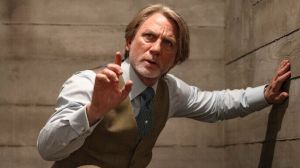
Blanc doesn’t even show up for the first forty or so minutes, giving the narration duties to Pastor Jud setting the scene of his own. Craig (Queer) is a bit more subdued in this movie, both given the thematic nature of it as well as ceding the spotlight to his co-star. Blanc is meant to be the more stubborn realist of the picture, an atheist who views organized religion as exploitative claptrap (he seems the kind of guy who says “malarkey” regularly). His character’s journey isn’t about becoming a true believer by the end. It’s about recognizing and accepting how faith can affect others for good, specifically the need for redemption. Minor spoilers ahead. His final grand moment, the sermonizing we expect from our Great Detectives when they finally line up all the suspects and clues and knock them down in a rousing monologue, is cast aside, as Blanc recognizes his own ego could be willfully harmful and in direct opposition to Pastor Jud’s mission. It’s a performance that asks more of Craig than to mug for the camera and escape the molasses pit of his cartoonish Southern drawl. He’s still effortlessly enjoyable in the role, and may he continue this series forever, but Wake Up Dead Man proves he’s also just as enjoyable as the second banana in a story.
 O’Connor (Challengers, The Crown) is our lead and what a terrific performance he delivers. The character is exactly who you would want a pastor to be: humble, empathetic, honest, and striving to do better. It’s perhaps a little too cute to call O’Connor’s performance “soulful” but I kept coming back to that word because this character is such a vital beating heart for others, so hopeful to make an impact. It’s wrapped up in his own hopes of turning his life around, turning his personal tragedy into meaning, devoting himself to others as a means of repentance. He’s a man in over his head but he’s also an easy underdog to root for, just like Ana de Armas’ character was in the original Knives Out. You want this man to persevere because he has a good moral center and because our world could use more characters like this. O’Connor has such a brimming sense of earnestness throughout that doesn’t grow maudlin thanks to Johnson’s deft touch and mature exploration of his themes. O’Connor is such a winning presence, and when he’s teamed with Blanc, the two form an enjoyable buddy comedy, each getting caught up in the other’s enthusiasm.
Johnson has assembled yet another all-star collection of actors eager to have fun in his genre retooling. Some of these roles are a little more thankless than others (Sorry Mila Kunis and Thomas Haden Church, but it was nice of you to come down and play dress-up with the rest of the cast). The clear standout is Glenn Close (Hillbilly Elegy) as Martha, the real glue behind Wicks’ church as well as an ardent supporter of his worldview of the damned and the righteous. She has a poignant character arc coming to terms with how poisonous that divisive, holier-than-thou perspective can be. Close is fantastic and really funny at certain parts, giving Martha an otherworldly presence as a woman always within earshot. Brolin (Weapons) is equally fun as the pugnacious Wicks, a man given to hypocrisy but also resentful of others who would reduce his position of influence. The issue with Wake Up Dead Man is that elevating Pastor Jud to co-star level only leaves so much room for others, and so the suspect list is under-served, arguably wasted, especially Andrew Scott (All of Us Strangers) as a red-pilled sci-fi writer looking for a comeback. The best of the bunch is Daryl McCormack (Good Luck to You, Leo Grande) as a conniving wannabe in Republican politics trying to position himself for a pricey media platform and Cailee Spaeny (Alien: Romulus) as a cellist who suffers from deliberating pain and was desperate for a miracle delivered by Wicks. He’s the least genuine person, she’s hoping for miraculous acts, and both will be disappointed from what they seek.
Wake Up Dead Man (no comma in that title, so no direct command intended) is an equally fun movie with silly jokes and a reverent exploration of the power of faith and its positive impact, not even from a formal religious standpoint but in the simple act of connecting to another human being in need. This is the richest thematically of the three Knives Out movies but it also might be the weakest of the mysteries. The particulars of the case just aren’t as clever or as engaging as the others, but then again not every Agatha Christie mystery novel could be an absolute all-time ripper. That’s why the movie’s subtle shifts toward its themes and character arcs as being more important is the right track, and it makes for a more emotionally resonant and reflective experience, one that has replay value even after you know the exact particulars of the case. If you’re a fan of the Knives Out series, there should be enough here to keep you enraptured for more. Because of that added thematic richness, Wake Up Dead Man has an argument as the best sequel (yet).
Nate’s Grade: A-
Share this:

Zootopia 2 (2025)
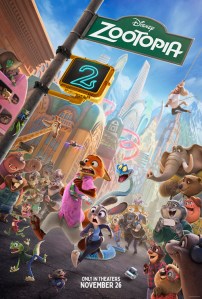 I’m genuinely shocked it took nine years for Disney to drum up a sequel to their billion-dollar “woke” allegorical hit, Zootopia. It used anthropomorphic animals living in a modern metropolis to analyze prejudice, racism, and segregation through the dichotomy of predators (untrustworthy animals beholden to vicious nature) and prey (docile animals). Specifically, it was about plucky police officer Judy Hopps (voiced by Ginnifer Goodwin) learning to work with con artist-turned-ally Nick Wilde (voiced by Justin Bateman). Now the partners are back and on another wild case uncovering yet another long-standing mystery of the city’s history entrenched in blame and suspicion of a “kind of people,” namely serpents/reptiles, who were driven out of town generations ago. There is a slight repetition in the message about looking beyond staid stereotypes and accepting other animals as equals (will Zootopia 3 be about finally accepting insects?), but when the tolerance message is essential to what made the 2016 original movie so much more thoughtful and relevant and satisfying, then keep it. The movie rises on the bickering but engaging buddy dynamic between Judy and Nick, who obviously love one another but don’t know how to admit it (consider me a shipper). The mystery tackles themes of gentrification, forced relocation, on top of its anti-prejudice and pro-tolerance foundation, so there’s plenty to unpack thematically while also taking in the visual whimsy and action slapstick. I laughed heartily at several points, including a very unexpected but transparent reference to a classic horror film complete with heavy music cues. It’s not as fresh or as finely developed as its predecessor but Zootopia 2 is further proof that this universe and its creativity can house many adventures, even if some of those plots and themes get repetitive.
Nate’s Grade: B
Share this:

Sorry, Baby (2025)
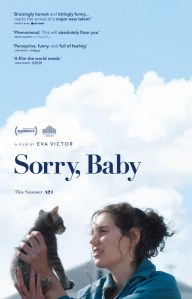
Sundance favorite Sorry, Baby takes several serious subjects and provides its own little bittersweet treatise through a character study of one woman navigating her complex feelings after being assaulted by her college professor. Written, directed, and starring Eva Victor, the movie feels like a combination of one of those small-town slice-of-life hangouts and something a little more arch and peculiar, but it still coasts on its vision and authorial voice. Victor’s portrait rings with honesty and empathy as her character, Agnes, wants to live a “normal life” but doesn’t quite understand what that might be. Her best friend is pregnant from a sperm donor, she’s adjusting to her workload as a literary professor at her alma mater (in an ironic twist, she occupies the same office as her former mentor and attacker), she’s flirting with the possibility of a romance with a nice neighbor (Lucas Hedges), and she just adopted a stray cat. The present, suffused in indecision and depression, is juxtaposed with flashbacks to her before, immediately after the assault, and the infuriating aftermath. This is where some of Victor’s darker sense of humor arises, like when Agnes is consoled by university officials who tell her there’s nothing they can do because her attacker has resigned but, hey, they’re also women, so, you know, they get it. Sorry, Baby walks a fine line between making you wince and making you want to laugh. It’s an impressive debut for Victor on many fronts, though I wish I felt like it amounted to something more emphatic or emblematic. It can feel more like a lot of self-contained scenes than a full movie, like Agnes going through jury selection before being excused when she has to confess her own history and her conflicted view of her attacker. I really enjoyed the concluding monologue Agnes gives to a newborn, explaining that the world she’s just entered will probably eventually hurt her but that there’s still good people and goodness that can be found. It’s heartfelt but in-character and feels completely on her own terms. Sorry, Baby is a little slow and a little closed-off, but it also deals with trauma and perseverance in a manner that doesn’t feel trite, condescending, or misery-prone.
Nate’s Grade: B
Share this:

Elizabethtown (2005) [Review Re-View]
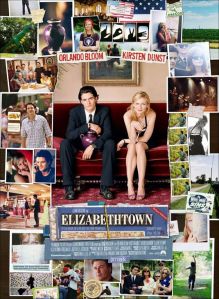 Originally released October 14, 2005:
Cameron Crowe is a filmmaker I generally admire. He makes highly enjoyable fables about love conquering all, grand romantic gestures, and finding your voice. His track record speaks for itself: Say Anything, Singles, Jerry Maguire, Almost Famous (I forgive him the slipshod remake of Vanilla Sky, though it did have great artistry and a bitchin’ soundtrack). Crowe is a writer that can zero in on character with the precision of a surgeon. He’s a man that can turn simple formula (boy meets girl) and spin mountains of gold. With these possibly unfair expectations, I saw Elizabethtown while visiting my fiancé in New Haven, Connecticut. We made a mad dash to the theater to be there on time, which involved me ordering tickets over my cell phone. I was eager to see what Crowe had in store but was vastly disappointed with what Elizabethtown had to teach me.
Drew Baylor (Orlando Bloom) opens the film by narrating the difference between a failure and a fiasco. Unfortunately for him, he’s in the corporate cross-hairs for the latter. Drew is responsible for designing a shoe whose recall will cost his company an astounding “billion with a B” dollars (some research of an earlier cut of the film says the shoe whistled while you ran). His boss (Alec Baldwin) takes Drew aside to allow him to comprehend the force of such a loss. Drew returns to his apartment fully prepared to engineer his own suicide machine, which naturally falls apart in a great comedic beat. Interrupting his plans to follow career suicide with personal suicide is a phone call from his sister (Judy Greer). Turns out Drew’s father has died on a trip visiting family in Elizabethtown, Kentucky. Drew is sent on a mission from his mother (Susan Sarandon) to retrieve his father and impart the family’s wishes. On the flight to Kentucky, Drew gets his brain picked by Claire (Kirsten Dunst), a cheery flight attendant. While Drew is surrounded by his extended family and their down homsey charm and eccentricities, he seeks out some form of release and calls Claire. They talk for hours upon hours and form a fast friendship and stand on the cusp of maybe something special.
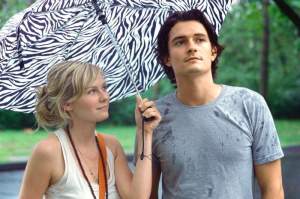 I think the most disappointing aspect of Elizabethtown for me is how it doesn’t have enough depth to it. Crowe definitely wears his heart on his sleeve but has never been clumsy about it. Elizabethtown wants to be folksy and cute and impart great lessons about love, life, and death. You can’t reach that plateau when you have characters walking around stating their inner feelings all the time, like Drew and Claire do. They might as well be wearing T-shirts that explain any intended subtext. Crowe squanders his film’s potential by stuffing too many storylines into one pot, thus leaving very little attachment to any character. Elizabethtown has some entertaining details, chiefly Chuck and Cindy’s drunk-on-love wedding, but the film as a whole feels too loose and disconnected to hit any emotional highs. If you want a better movie about self-reawakening, rent Garden State. If you want a better movie about dealing with loss, rent Moonlight Mile.
This is Bloom’s first test of acting that doesn’t involve a faux British accent and some kind of heavy weaponry. The results are not promising. Bloom is a pin-up come to life like a female version of Weird Science, a living mannequin, possibly an alien with great skin, but he isn’t a real compelling actor. He has about two emotions in his repertoire. His whiny American-ized accent seems to be playing a game of tag. He’s not a bad actor per se; he just gets the job done without leaving any sort of impression. To paraphrase Claire, he’s a “substitute leading man.”
Dunst is chirpy, kooky and cute-as-a-button but is better in small doses. Her accent is much more convincing than Bloom’s. Sarandon deserves pity for being involved in Elizabethtown‘s most improbable, cringe-worthy moment. At her husband’s wake, she turns her time of reflection into a talent show with a stand-up routine and then a horrifying tap dance. Apparently this gesture wins over the extended family who has hated her for decades. Greer (The Village) is utterly wasted in a role that approximates a cameo. Without a doubt, the funniest and most memorable performance is delivered by Baldwin, who perfectly mixes menace and amusement. He takes Drew on a tour of some of the consequences of the loss of a billion dollars, including the inevitable closing of his Wildlife Watchdog group. “We could have saved the planet,” Baldwin says in the most comically dry fashion. Baldwin nails the balance between discomfort and bewilderment.
 Elizabethtown wants to be another of Crowe’s smart, feel-good sentimental field trips, but it falls well short. I was dumbfounded to see how little the story progressed. It lays the groundwork for a menagerie of subplots and then, in a rush to finish, caps everyone off with some emotionally unearned payoff. To put it simply, Elizabethtown wants credit and refuses to show its work. The film is packed with characters and ideas before succumbing into an interminable travelogue of America in its closing act, but what cripples Crowe’s film about opening up to emotional growth is that the movie itself doesn’t showcase growth. We see the rough and tumble beginnings of everyone, we see the hugs-all-around end, but we don’t witness that most critical movement that takes the audience from Point A to Point B. The results are beguiling and quite frustrating. Take the subplot about Drew’s cousin, who can?t connect to his father either and wants to be friends to his own son, a shrill little terror, instead of a father. Like most of Elizabethtown‘s storylines, these subplots die of neglect until a half-hearted nod to wrap everything up. Father sees son perform and all is well. Son does little to discipline child but all is well. Elizabethtown is sadly awash in undeveloped storylines and characters and unjustified emotions, and when they’re unjustified we go from sentiment (warm and fuzzy) to schmaltz (eye-rolling and false). I truly thought Crowe would know better than this.
Crowe has always been the defacto master of marrying music to film. Does anyone ever remember people singing Elton John’s “Tiny Dancer” before its virtuoso appearance in 2000’s Almost Famous? Crowe has a nimble ear but his penchant for emotional catharsis set to song gets the better of him with Elizabethtown. There’s just way too many musical montages (10? 15?) covering the emotional ground caused by the script’s massive shortcomings. By the time a montage is followed by another montage, you may start growing an unhealthy ire for acoustic guitar. Because there are so many unproductive musical numbers and montages, especially when we hit the last formless act, Elizabethtown feels like Crowe is shooting the soundtrack instead of a story.
Elizabethtown is an under-cooked, unfocused travelogue set to music. Crowe intends his personal venture to belt one from the heart, but like most personal ventures the significance can rarely translate to a third party. It’s too personal a film to leave any lasting power, like a friend narrating his vacation slide show. Elizabethtown is gestating with plot lines that it can’t devote time to, even time to merely show the progression of relationships. The overload of musical montages makes the movie feels like the longest most somber music video ever. Bloom’s limited acting isn’t doing anyone any favors either. In the end, it all rings too phony and becomes too meandering to be entertaining. Elizabethtown is a journey the film won’t even let you ride along for. This movie isn’t an outright fiasco but given Crowe’s remarkable track record it can’t help but be anything but a failure.
Nate’s Grade: C
——————————————————
WRITER REFLECTIONS 20 YEARS LATER
I truly hope some day Cameron Crowe reads this. I owe him an apology.
I’ve always considered Elizabethtown the turning point in Crowe’s career, where things took an errant path that he’s been stuck on ever since, though there were certain warning signs with 2001’s Vanilla Sky. I was disappointed by this movie and the ensuing twenty years have only made me think back less favorably, since this was the juncture where Crowe’s hit-making streak of such tender, personal, and tremendously entertaining studio dramedies came to an end, where the Crowe projects afterwards felt more like Crowe was chasing after the idea of what makes a Cameron Crowe movie and losing his sense of self. I selected Elizabethtown for my 2025 re-watch mostly because I’ve never gone back to it in the proceeding two decades but also because it’s an important switch point in a popular artist’s career. What I wasn’t expecting when I re-watched the movie was to be so taken in by it considering my own personal circumstances.
 This is a movie about grief, about putting one foot in front of the other, about coming to terms with mistakes and regrets, and ultimately looking ahead. It’s still a little corny, and it’s still got some flaws, but in 2025, having lost my own father not even a year ago as of this writing, Elizabethtown hit me square in the chest. It made me a mess of emotions and I could plug myself into this bittersweet yet gentle nudge of a film. Even the amiable tone and gentle, searching nature worked for me, as it felt like it was expertly channeling the fog of grief upon experiencing significant loss. Your body is sort of operating on autopilot and you feel outside yourself, like you’re watching a documentary about your life. You feel numb and recognize you’re in pain but you never really want to talk about it yet you crave human connectivity, and even when people awkwardly ask the question, “Are you doing okay?”, while the answer is obvious to all parties, you’re still unexpressively grateful for someone else granting the kindness of reaching out. This movie encapsulates this drifting feeling of loss and shock better than any I can recall. And in Crowe’s universe, which is like a more filled-in and colorful version of our own, strangers will take a moment to recognize your emotional pain and give you a hug. It’s a universe that cares about you, where even a guy getting married in your same hotel wants to invite you to his reception. There are no cynics in a Cameron Crowe universe, or at least if there are, they will be converted by the end like a Charles Dickens tale. It is a universe supremely about feeling and connectivity, and that’s what Drew (Orlando Bloom) has to learn.
Drew is under personal and professional crises. He’s been cast off at his job as an athletic shoe designer because his big design was recalled to the cost of a billion dollars. He says he’s begun cataloging “last looks” by co-workers, when people think this will be the last time they see him again. It’s a nice detail that comes back but also gets us thinking about the later drama with life and death, how every one of us will give our last looks to the people in our lives, we just won’t have the same sense of clarity. Drew is traveling to Kentucky to retrieve his father’s body and return home to his immediate family. This is intended to be a pit stop, a brief sojourn with extended family he doesn’t really see often, a respite before he gets his life back together. These significant loops in life become a natural reflective point, and that’s where Drew is coming from. His life has seemingly bottomed out, and the movie functions as his therapy session to process his grief and his shattered self-image. His sister, an undervalued Judy Greer, keeps asking if he’s had his “big cry” yet, and reminds him that it’s coming. By the end of the movie, it’s not Drew having come full-circle and found his way out of his grief fog. The whole movie is about just setting him up to actually address the loss and feel the completeness of his sadness. Under this perspective, the movie’s many menial supporting characters that dot the plot feel like gentle well-wishers. I complained about them in 2005 but in 2025 it makes the entire world feel like therapy accessories.
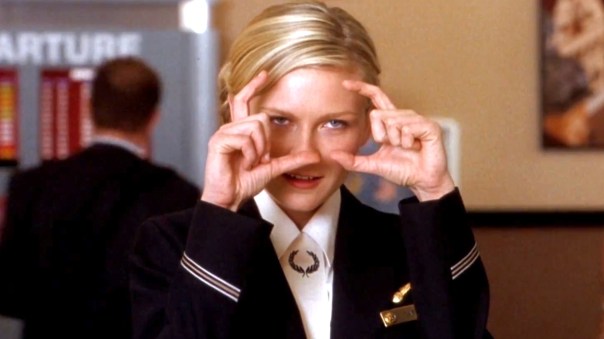
 Much of the movie is also pinned on the romance between Drew and quirky flight attendant Claire (Kirsten Dunst), and it was her performance that coined the term Manic Pixie Dream Girl (MPDG). She can definitely fit that mold but there’s a more subtle sadness to her that you see along the edges, like she’s putting so much effort into maintaining this front in public lest the mask drop and she has to deal properly with her own loneliness and disappointments. I think a more accurate depiction of the MPDG trope as a transparent sop to male fantasy is 2004’s Garden State with Natalie Portman’s spunky character. There is a sense that Claire’s off-screen long-distance bad boyfriend, Ben, is actually made up, an excuse to stop her from getting too close. She uses the term “tourist” to describe herself and Drew, and it’s fitting. The reality of her job makes her feel like she’s constantly in motion without setting down roots, prone to a thousand superficial human interactions that get washed from her memory as the day resets. It’s a transitory life and it can make a person feel outside of themself, questioning which version is their true self. The romantic dance between Claire and Drew really is all about both of them working up the nerve. It’s less a relationship that is fully formed and banging the drum of love; it’s far more an infatuation, where each side is circling over whether to risk the fun for something more. Under that guise, I’m more forgiving of the movie not exactly “showing its work” as I criticized in my original review. It’s not there because they aren’t there. This isn’t a relationship but a flirtation and friendship coalescing. It’s sweet and pleasant, like much of the movie, falling right in line with Crowe’s compassionate, humanist vibes.
It’s hard to exactly quantify but Elizabethtown is more of its moments and the gradual pull that is tugging Drew toward his ultimate destiny, which amounts to self-acceptance and fully processing his grief. I originally castigated Drew’s mother (Susan Sarandon) trying out new hobbies as a means of busying herself in the wake of her husband’s demise, including turning the wake into a standup comedy audition. The jokes themselves can be a little cringey or in poor taste for a funeral, but the overall effort is about this woman trying to define her life now that her partner, the old sturdy definition, has departed. I see something similar with my own mother in the wake of my father’s death. I’m not expecting my mother to start making boner jokes like Sarandon, but I see how this identity crisis can become all-too familiar. I love the absolute chaos of the actual wake that erupts into a literal flaming bird while the family band jams out to Lyndard Skynard’s “Free Bird,” and as that famous guitar solo hits the stratosphere, the movie’s built-up pressure all seems to come to a head, and the continued playing of the song despite all the chaos is its own defiant act of catharsis. It unbounded something inside me as it does for the characters. Then there’s the extended conclusion where Drew drives all over with his father’s ashes and with Claire’s travel guide, notes, and curated soundtrack as companion. It’s a lot, but it’s also the final stretch that gets Drew to finally accept his feelings, to finally feel the totality of loss but also that totality of love, and while his father may be gone, that does not eliminate the lessons and love and memories that live within him. Having this personal deeper dive happen on a father-son road trip actually feels rather fitting and poignant even.
 This is the third Cameron Crowe movie I’ve re-examined for my twenty-year re-reviews and it’s also my last. I never formally reviewed any of Crowe’s follow-up movies after 2005. I’ve already talked about how his career has taken a different track in other re-reviews, but I’ve come around on Elizabethtown, and that makes me wonder if maybe I’ll be more charitable to We Bought a Zoo or Aloha in time as well. In 2005, I found Elizabethtown to be a disappointing grab bag of Crowe’s touchy-feely familiarity, and now twenty years later, the movie really gelled for me. Perhaps I needed to go through a similar experience as the protagonist to be more open to its charms and artistic waves, or perhaps I’m getting nostalgic for Crowe’s kind of big-hearted romantic storytelling that hasn’t exactly been proliferating cinemas for some time. Perhaps I’ll watch Elizabethtown again years later and feel completely different, but I kind of doubt it, because now this movie is linked with my own reconciliation of grief after my father’s passing. It’s now been elevated from a disappointment from a revered filmmaker to something personal and passingly profound. It exemplified the foggy feelings and desire for connection for me post-funeral. As Claire says, “We are intrepid. We carry on.” Responding to failures and regrets should continue to resonate, and so Elizabethtown might actually become a personal movie I cherish over the years. It’s not the masterpiece that Almost Famous is, an all-timer, but hardly any other movies will rise to that level. I’ll accept Elizabethtown on its own terms in 2025, and those were the exact terms I needed to feel more whole.
So thank you Cameron Crowe. It took twenty years but I’ve come around. This isn’t a folly, a failure, and certainly no fiasco. It’s actually a sweet and moving tale about trying to find your direction in the face of grief and shame and just finding your way out the other side of the fog. For me, this whole movie was about the universe working through a million cheerful helpers to nudge Drew back onto his feet, including our love interest, which seems less damnable if the entire movie is achieving the same results. For a person looking through tragedy and asking why, it’s just enough encouragement, wisdom, and empathy to feel nourishing without feeling overwhelming, and it doesn’t feel phony at all to me in 2025.
Elizabethtown was what I needed. I love you dad and miss you every day.
Re-View Review: B+

Share this:

The Naked Gun (2025)
 Relaunching a seminal spoof series in today’s environment is going to be a risk. I’ve discussed how comedy seems to have been relegated to TV and streaming in a post-COVID theatrical era, but there is still an immense appeal of watching something funny with a jovial audience. The Naked Gun series was a spoof on police procedurals with the indefatigable Leslie Neeson as the dumbest straight man to the absurdity of the Zucker-Abrahams-Zucker boys. This time it’s Liam Neeson as the lead but he’s thankfully keeping to the same spirit, playing the entire movie straight rather than being in on the joke, and it makes his performance that much more seriously funny. A scene where he and Danny Huston unexpectedly declare their irony-free love of The Black Eyes Peas made me laugh hard because of the sheer conviction of their performances. The intrinsic nature of spoofs is that they are uneven. It’s hit-or-miss but because the pacing is multiple jokes every minute, if one of the gags doesn’t make you smile, you only have to wait a short while for the next. I’d say my laugh percentage was about 20-33% of the jokes, which I think is a pretty solid batting average for yuks. Naturally, your mileage will vary. Neeson is terrific and so is Pamela Anderson as his co-star. She has a delightful impromptu scatting performance that is silly beyond words, which is a good overall description of the movie. I wish there were more visual gags and running gags (I enjoyed how frequently people discarded coffee cups for more coffee cups) to compensate for the heavy verbal whimsy, double entendres, and slapstick. There are some deranged sequences that go in directions I could not predict, like a holiday montage that gets freaky for several reasons. I wish the movie had more sustained sequences like this but I’m grateful we got as many as we did. It’s also a little weird that the villain’s plan is exactly the same as 2015’s Kingsman but nobody mentions this. Regardless, the new Naked Gun is refreshingly stupid and a good silly time at the movies.
Nate’s Grade: B
Share this:

KPop Demon Hunters (2025)
 I’ve watched KPop Demon Hunters four times in the last week on Netflix, so I may be a bit partial to it. Sony Animation’s newest genre-bending stunner is an action musical with surprising heart to ground the supernatural multi-dimensional battles between the forces of good and evil. Our main characters are the three young women who form the Korean pop group Huntrix; they play sold-out arenas by day and slay demons by night, working toward sealing a barrier that will protect mankind from soul-sucking demons. They meet their match when the demons form their own boy band, the Saja Boys. Handsome, charming, and media savvy, the Saja Boys begin pushing Huntrix out of the top spot and stealing their fans and their souls. It’s a cute premise buoyed by spry and colorful animation with terrifically designed and pleasing action sequences. It also helps that every song is an absolute banger, with some exceptional melodies and anthemic choruses. It may prove impossible to resist the songs, making those dastardly yet dreamy demons all the more likeable. What works just as well is the character work put into establishing the friendship between Huntrix, whose lead singer, Rumi, is keeping a secret that she is herself part demon. She finds herself drawn to Jinu, the leader of the Saja Boys, who seems more complicated than simply being a remorseless creature. He has plenty of real remorse and feeling, as Rumi has plenty of self-repression and shame, and they find the other more complex and mysteriously appealing as they feel out a possible romance. There’s a lesson here about self-acceptance and being open with the ones you love, and it’s effectively developed to the point that, during the grand climax, with the crowd chanting in unison with our ladies, affirming that solidarity, you too might get a little misty of the eye. That’s the amazing part of a movie literally titled KPop Demon Hunters: it can have you bopping your head one minute and drying your eyes the next. The animation can get exaggerated into cartoon comic absurdity (eyes literally pouring popcorn another person gobbles down), but it’s the sincerity and messages about acceptance and tolerance that rise highest. Plus there’s that music. It’s all such a vibrant blast, and it’s got the infectious jams of the summer all in a tight yet playful and poignant 90 minutes.
Nate’s Grade: B+
Share this:

The Phoenician Scheme (2025)
 It’s so nice to connect with a Wes Anderson movie again. I’ve been mostly a fan from the beginning but his career has as many ups as downs for me, often getting lost in his distinct dollhouse style of artifice and losing the sense of wounded humanity that marks his best movies. I haven’t truly loved a Wes Anderson movie since 2014’s The Grand Budapest Hotel, which I consider one of his very best. It’s been a long ten years of feeling indifferent or distant to that signature Anderson twee whimsy. I took my wife to see 2021’s The French Dispatch in the theater, and this was her first Anderson movie, and it also happened to be his worst movie, plus with Timothee Chalamet, an actor she isn’t fond of. I feel like I ruined her impression of this indie auteur and the question over his enduring popularity. 2023’s Asteroid City had some interesting ideas and dramatic potential, but its multiple framing devices and layers of obfuscation smothered what I could have enjoyed about its drama buried underneath. It is with that accruing disappointment that I began to question whether new Wes Anderson movies just weren’t for me, and that’s why I find The Phoenician Scheme a welcomed return to form that makes me relieved. The idiosyncratic tactician that is Anderson can still make a movie that engages me on different levels, including an emotional one, which I’ve been missing for so long from his recent output.
So I’m going to do something a little different with this review. I’m going to specify and articulate why this movie works for me, namely why it resonates and succeeds where his other movies of late have not. I suppose you could argue every film critique is charged with explaining the nuts and bolts of an opinion, but I’m going to really try and crack open why The Phoenician Scheme is a better movie overall.
 1) Emotional investment. Primarily Anderson is known for his heavily mannered, expertly curated style, which is why he seems to be the go-to pastiche for A.I. film juxtaposition experiments (“What if Wes Anderson directed Star Wars?” etc.). Many of Anderson’s movies are populated with hurt people trying to reconnect, a subject that has great emotional appeal. However, if you cannot connect with the characters or their dynamic or the relationship stakes, then it can feel like an afterthought to all that fancy production design and camera placement. With The Phoenician Scheme, the movie is an adventure film but it’s really about a father (Benicio del Toro as Zsa-Zsa Korda) trying to reconnect with his estranged adult daughter (Mia Threapleton as Sister Liesel). The father is a billionaire robber baron set in a vaguely mid 19-century setting. The daughter is a newly enshrined nun who believes that her father had her mother killed. Right away, we have very different perspectives and exciting conflict between them. He’s an arms dealer and willing to have key parts of his scheme involve a famine and slave labor. Her very involvement in the convent is itself a reaction to her father, who sent her away to live there at age five. She doesn’t want to be like him, who she views as on the wrong side of morality, but she also wants to get to know this man better and get her own answers. Her convent needs her to proceed to get a significant donation from her father. He wants to hire her on a trial basis to see if she’s fit to be his sole heir. They’re stuck together on an adventure that forces them closer, and the ensuing relationship that begins to build, with old hurts melting away to new revelations and new aches of yearning, comes across as very involving and emotionally rewarding. I was actually quite taken by the father-daughter relationship and their bickering, which organically gives way to better understanding and personal growth from both parties. They make each other a little better than they could be, and they recognize that despite their differences and hurt, they do genuinely care about the other. Korda is such an unflappable dilettante and yet the very notion that his daughter thinks he might have killed her mother from rumors deeply upsets him. The rest of the movie is essentially both characters directly and indirectly trying to prove themself to the other and also acknowledge and accept the other person. The core of this movie works because the core relationship is given serious and deliberate development to be meaningful. It’s about a broken family recognizing their connection to one another and desire to be connected.
2) The vignettes do add up. The folly of The French Dispatch was that it was a collection of short films, meaning that every twenty-minutes or so it felt like having to start over again with character introductions and relationship development. It didn’t feel like it added up to much. With The Phoenician Scheme, the film is structured around the different investors that Korda has to convince to cover a higher percentage of a budget shortfall for the big plan. It might sound pretty lackluster on paper but it becomes a larger goal that each segment builds to, and each new investor and setting allows Anderson to explore a new aspect of his characters. One situation involves a literal game of basketball and another involves taking a bullet to save an investor. Each situation allows us to change things up without losing the momentum of building toward that larger goal, as well as continuing to build the progression of the character relationships. With a vignette movie, each segment is a beginning, middle, and end that starts over with the next. With this, we have those mini stories with each new investor, but the whole is still advancing. It allows Anderson to explore a variety of comedy and story options while still keeping his attention to the bigger picture, thus earning our continued investment and more payoffs.
 3) This is still a very funny movie. That droll yet whimsical tone we expect from Wes Anderson is very present, and I was smiling and laughing throughout. I particularly loved a running joke where Korda offers each new guest a hand grenade like a welcome present. Korda also has repeated assassination attempts, which is the impetus for him reaching out to his daughter because he knows he won’t outlive every assassination attempt. However, in the meantime, each new assassination attempt is presented as another predictable annoyance, and I enjoyed that with every one Korda admits, “I think that guy used to work for me.” The basketball game of horse is wonderfully absurd and dryly serious at the same time, elevated by Bryan Cranston’s considerable commitment to the bit. Another great source of comedy is Michael Cera as the third significant character to the adventure, Bjorn, an assistant to Korda and also an entomologist. He’s such a delightful nonplussed addition to the trio, providing an outsider perspective to the family drama and reminding us how not normal everything is. I heartily enjoyed how his nerdy passion for bugs keeps inserting itself in all sorts of unexpected situations. The excesses of Korba’s lifestyle, and his seeming history of amorality, allows for just about anything to be possible or referenced, opening the comedy even further into surreal asides still tethered to characterization.
4) The added religious elements provide a deeper introspection for the characters and the viewer. Every time Korba has a near-death experience from his latest assassination attempt, we have a black and white sequence of Korba interacting with the afterlife. In one sequence he’s being judged by St. Peter, then God, then his own deceased wives. Each opportunity with the afterlife is a reminder for Korba about his sins and mistakes and a motivator to do better. The stylized realm is mysterious without being overt in its directions, allowing Korba to stumble around looking for guidance, like when God is annoyed that He isn’t recognized as the Big Guy. I was amused by these little interludes but they also act like a moral intervention for our main character, and his growing interest is a sign that his daughter’s influence is affecting him. It adds a depth to the character as well as a weightier sense of celestial consequences for a life of misdeeds, and it helps to better realism the character’s arc as well as set him up for change. It allows an introspection over legacy. These are also the segments you’ll get the most blink-and-miss-them cameos, like Bill Murray, Willem Dafoe, Charlotte Gainsbourg, and F. Murray Abraham.
 5) Smaller ensemble to devote characterization. Everyone wants to work with Anderson, and he keeps an impressive list of actors who continuously reappear, even if it’s only for seconds, anything to just be back into the ornate world of a Wes Anderson fantasy. His last few films have been stuffed with characters but there wasn’t enough for everyone to do (go ahead, try and remember what Steve Carrell did in Asteroid City). The narrative gets fractured trying to provide enough moments and screen time for all these distaff characters. A larger cast is not inherently a doomed prospect, but it does mean more attention and development needs to be made, and with less time, to ensure those characters are meaningful and well developed. The French Dispatch and Asteroid City couldn’t do that for me. This time Anderson condenses his important characters down to a manageable trio. We have other supporting players but they typically come and go through the different vignettes, each getting their turn with the main players. This keeps the focus on the winning character dynamic of the father-daughter buddy comedy, and with Bjorn bumbling along and finding himself becoming more fond of Liesel. There are some fun twists and turns with the three characters but no matter the external obstacles or silliness, the emphasis remains on these three and their relationships. It all works so much better.
6) The acting by the Anderson newcomers is greatly enjoyable. It’s shocking that this is the first time Michael Cera (Scott Pilgrim Takes Off) has been in a Wes Anderson movie because his comic sensibilities are a natural fit for this universe. The direction his character goes lets Cera have even more ways to have fun, and each new turn made me love his character and the performance even more. I also love that, despite all the revelations, at his core, Bjorn really is a nerd who loves talking about insects. The real discovery is Threapleton (The Buccaneers), though maybe we shouldn’t have been so surprised considering she is the adult daughter of Kate Winslet (do you feel old now too?). She holds her own with her many scenes with del Toro and is able to hone her withering glare into a considerable weapon of disapproval. Watching her character blossom and test her boundaries, like when she says she’s only drank communion wine and is introduced to a new form of alcohol at every jaunt that she feels compelled to try. It’s a character that is slowly recognizing more about herself and the possibilities of this life.
 The Phoenician Scheme isn’t a deviation from the tried-and-true Wes Anderson formula; it’s a better calibration of what makes that style and formula continue to resonate for so many fans. I’m apparently in a small minority with my esteem for this picture, and that’s fine by me. I’ve outlined through this review the reasons why it was a much more enjoyable and worthwhile entertainment for me, and if you found yourself nodding along, then perhaps it could work its query magic on you as well. It’s nice to be charmed again by a Wes Anderson movie but to also feel something rather than distant appreciation for the carefully composed sets and photography. I actually cared about these characters and their journey. The end results mattered to me. Their plights mattered. If you’re like me and falling from the Wes Anderson bandwagon, then perhaps The Phoenician Scheme might pull you back aboard.
Nate’s Grade: A-
Share this:

A Minecraft Movie (2025)

I was fully prepared to dismiss A Minecraft Movie as junk for its target audience, and then a funny thing happened in fact pretty early in the movie: I was laughing. Then I laughed again. Genuine laughter. I’m here to say that the Minecraft movie is not the silly and stupid kid’s movie you may have dreaded. It’s actually a pretty pleasant fantasy adventure movie that, while aimed for kids, can still be enjoyable for like-minded adults looking for some colorful and silly escapism. It’s hip to be square, baby.
Steve (Jack Black) is a guy who loves to create, and mines for whatever reason, and finds a portal to another very cube-centrist world. In this new world, Steve finds friends and freedom, but this is ruined when a nefarious force comes through wanting to conquer this new world as well as Steve’s home world. He sends out help and seals off a portal. Years later, a pair of siblings, Henry (Sebastian Hansen) and Natalie (Emma Myers), move into Steve’s old home and discover his portal, along with an middle-aged arcade game champion and local legend, Garret (Jason Momoa), and realtor, Dawn (Danielle Brooks). These newcomers must adjust to this strange world and defend themselves against zombies, creepers, and other dangers. Fortunately, Steve serves as a valuable guide, but can they all defeat the evil forces?
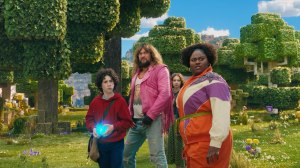
There’s a robust silliness to Minecraft that invites you to not ever take things too seriously and have fun with the vibes. Much like the Super Mario Brothers adaptation, there isn’t really a story to adapt here. There were several moments that felt like it was a satirical parody of the fantasy adventure movie while also working as examples of fantasy adventure tropes. Refreshingly, much of the humor is not derived from fish-out-of-water juxtaposition. This could have easily been a “Well, that happened” kind of nonchalant comedy, holding up the weirdness to scrutiny for easy yuks. It finds better jokes through pushing further than simple observational irony (“My dad says math has been debunked”). It’s good-natured humor that keeps things positive and goofy, channeling the open-sandbox creativity of the video game. Its “be yourself” message is easier to accept than more disingenuous kid’s movie junk like The Emoji Movie. The Minecraft world is presented less as a purchasable video game rather than a new world to explore that rewards exploration (during daylight hours). The very enemy of the movie is a sorceress (voiced by Rachel House) that hates creativity and sees it as a waste in her pursuit of always plundering and hoarding more gold. I might be reaching but there seems even like a possible A.I. reading there, with our giant pig sorceress standing in for tech bros who are trying to eliminate avenues of creativity because all they care about is wealth and cannot understand the appeal of creativity. The movie has several little comic asides that caused me to chuckle and laugh and smile, and I looked over at my adult friend beside me for my screening, and his response was the same. We both had been surprisingly taken by the genial silliness of this movie.
Black (Jumanji) has become a kids’ movie juggernaut thanks to his zany energy and willingness to go above and beyond no matter the request. He’s a charming and delightful performer by nature, whether he’s voicing an animated character or singing a sexually explicit song about all the positions he will execute. He dips out for the first half hour after the exposition dump that opens the movie, but once he’s back on screen, it’s easy to remember there just isn’t another actor like Black. He’s funny and completely bought-in with whatever the movie asks for, but every single line and every single gesture is at a ten. He is selling every second of this movie and I can completely understand why some people just might get overstimulated by Black’s histrionics. You can tell the filmmakers were like, “We want our own version of ‘Peaches’ to go viral,” and so we get three different moments of Black singing original songs. This aspect was the most transparent and contrived decision that felt based upon chasing after the success of another movie popular with the kids. The actor I enjoyed the most was Momoa (Fast X) who has lots of fun undercutting his own masculine image and his character’s over-inflated ego masking his insecurity.
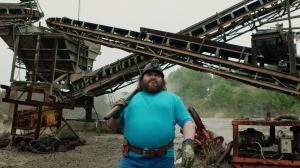
The visuals are bright and enjoyably retro. The Minecraft video game is famously low-grade with its pixelated graphics, more akin to the visual landscape of video games from the 1990s than 2011 when it was first published (it has since become the best-selling video game of all time). Starting with that visual scheme, it allows the movie to be good looking without having to be photo-realistic with its CGI. We have a stylized world to explore that’s full of vibrant colors and characters. This is easily the best looking movie of director Jared Hess’ (Napoleon Dynamite, Nacho Libre) career. His skewed sensibilities work as a nice fit with the comic direction of the movie, and there are some engaging visual arrangements.
Regrettably, this adventure is a bit of a boys-only club. The female half of our adventurers don’t really get the attention that the boys do. Both Natalie and Dawn sit out for long stretches of the movie that I forgot they were in the movie. Usually, these kinds of stories make it so each character has some kind of arc that can be fulfilled by the end, even if it’s minor. I suppose you might be able to argue that Natalie is learning to accept the responsibility of being a parental figure to her younger sibling, and Dawn getting the gumption to quit her job to pursue her dream of running a petting zoo. I’m not keen on bestowing credit for just having a scene at the end where the characters celebrate whatever their goals had been. If you don’t see the work and the development toward those goals, then you don’t get the credit. Why can’t these women have their own adventure that meaningfully connects to the larger plot? Or, even better, why can’t they also go along and contribute to the quest along with all the boys? It’s not like I think the movie is actively trying to downplay the role and importance of women, but it’s also disappointing that there are clear tiers of the characters as far as what kinds of fun and story integration they ultimately earn.
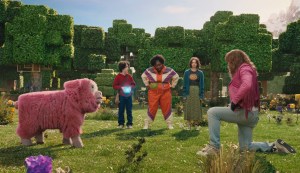
Behold, the Gen Alpha cultural epoch and its name is “chicken jockey.” By now you may have heard of this infamous scene that has caused some theaters to erupt in a calamity of noise, rowdy behavior, and throwing a live chicken at the screen. I even had a theater employee warn our audience before the movie began what is acceptable behavior and how people not abiding by these expectations would be removed from the theater. I’ve been watching movies my entire adult life and other than special screenings for movies intended for audience interaction, like Rocky Horror and The Room, I have never had a theater employee warn me about proper decorum, and this was before the Minecraft movie. It’s astounding. What’s also astounding is how ultimately meaningless this moment is. It’s a baby zombie that falls atop a chicken and rides it, and from what I’m told, this is a very rare occurrence in the game, but I guess it means something more to a generation of fans relishing a rare reference in their favorite game. While I was standing outside the restroom waiting for my own kid to return, a little girl was impatiently asking her father if he was done using the restroom, much to his growing annoyance. “Please hurry. I don’t want to miss the chicken jockey part,” she explained in desperation. I’m happy that this moment seems to be so highly anticipated for millions of fans, but as an outsider, this moment feels so incidental and flimsy that it would be like a generation excitedly waiting for Indiana Jones to lean against one particular wall.
This movie could have been so much worse, and the fact that it’s relatively breezy, funny, and entertaining for non-fans of Minecraft, such as myself, counts as a success in my book. It’s telling that the title is A Minecraft Movie and not The Minecraft Movie. It is but one story in this universe, and given the popularity, it will surely not be The Last Minecraft Movie. Its runaway success at the box-office means we’re probably headed for even more Gen Alpha-centered game adaptations, like some Roblox game you’ve never heard about if you’re over the age of twenty. Hey, it all might work somehow. This one did.
Nate’s Grade: B


 nathanzoebl
You must be logged in to post a comment.