Blog Archives
Juror #2 (2024)
 Clint Eastwood’s possible last movie as a director (the man is 94 years old, people) was buried at the theater through a limited release by its studio, which is a shame because Juror #2 is a fairly solid adult drama with some grueling tension built right in. I was wondering how screenwriter Jonathan Abrams was going to make this premise work, where a recovering alcoholic and expectant father, Justin Kemp (Nicholas Hoult), is impaneled on a jury for a murder case and discovers, over the presentation of evidence, that he might actually be the culprit. That same night, at the same location of where the supposed murder took place, is where Justin thought he hit a deer. What follows is a soul-searching account of one man being torn apart as far as what he should do. Does he let this other man take the blame so Justin can live out his life with his new baby and wife? Or does he come forward and admit his own firsthand knowledge of the events would present a very reasonable doubt for this trial? The movie becomes an extended balancing act of how long Justin can keep this secret and what angles he will work, trying to push the jury one direction or another through persuasive appeals. It’s familiar dramatic territory to anyone who grew up on 12 Angry Men, though with an extra high-concept twist. It’s a fairly straightforward drama that allows the story to take center stage and puts the focus on one man’s personal crisis. The acting is strong all around with Hoult (Nosferatu) being the predicted standout, showing the heavy weight of his guilt wirh every pained expeession. I think the ending does a disservice to the kind of movie that came before it, namely that it should be more definitive in its conclusion and provide a fitting resolution. This isn’t exactly the kind of movie that benefits from prolonged ambiguity, so the abrupt ending feels like a miscalculation and hampers a bit of the ending’s impact. However, Juror #2 is a good squirm session.
Nate’s Grade: B
Share this:

Million Dollar Baby (2004) [Review Re-View]

Originally released December 15, 2004:
Million Dollar Baby, much like its fledgling female boxing character, has come out of nowhere and made a considerable deal of noise. This little homespun film directed by Clint Eastwood didn’t have the glitz and sheen of other awards friendly movies, but now it seems that Eastwood?s own baby may clean up come Oscar time. Can Million Dollar Baby tackle the enormous hype surrounding it? Yes and no.
]Frankie (Eastwood) is a hardened boxing trainer too concerned for his fighters’ welfare to allow them to fight in championship bouts. He’s the kind of cynical old man that enjoys pestering a priest and causing him to unleash an F-bomb. Frankie and his longtime friend Scrap (Morgan Freeman) run a rundown gym and talk un-sentimentally about their older days as prize fighters. Then along comes Maggie (Hilary Swank), a 32-year old waitress who’s got nothing to believe in except her possibility as a boxer. She wants Frank to train her into the champ she knows she can be. He refuses saying he doesn’t train girls. She’s so determined she won’t take no for an answer. Frank finally agrees, especially after some help from Scrap, and starts to teach Maggie everything she needs to know to be a star pugilist. The two begin to open up to each other emotionally and Maggie seems destined to become a force in the ring.

Million Dollar Baby‘s greasiest attribute is its trio of knockout performances. Swank owns every second of this movie. She’s unremittingly perky, conscientious but also dogged, stubborn, and irresistibly lovable. Swank embodies the role with a startling muscular physique and a million dollar smile. Her performance is equal parts charming and heartbreaking. Maggie’s the heart of Million Dollar Baby and Swank doesn’t let you forget it for a millisecond. Come Oscar time, I’m sure she will be walking onstage to grab her second Best Actress Oscar in five years.
No one does grizzled better than Eastwood, and maybe no other actor has made as much of an acting mark by squinting a lot. Million Dollar Baby is probably his best performance to date, though for a good while it sounds like Frank has something lodged in his throat (pride?). Frank has the greatest transformation, and Eastwood brilliantly understates each stop on the journey until landing in a vulnerable, emotionally needy place.
Freeman once again serves as a film’s gentle narrator. There isn’t a movie that can’t be made better by a Morgan Freeman performance. His give-and-take with Frank feels natural and casual to the point that it seems improvised on the spot. Freeman unloads some great monologues like he’s relishing every syllable, chief among them about how he lost his eye. It’s wonderful to watch such a great actor sink his teeth into ripe material and deliver a performance that may net him a long-awaited Oscar (I think he’s due, and likely so will the Academy).
For whatever reason, Eastwood is hitting a directing groove in his twilight years. First came Mystic River, an ordinary police whodunnit made exceptional by incredible acting. Now Eastwood follows up with Baby, an ordinary sports film made extraordinary by incredible acting. Hmmm, a pattern is forming. The cinematography is crisp and makes great use of light and shadow to convey emotion. Eastwood’s score is also appropriately delicate and somber. The boxing sequences are brief but efficient.
Million Dollar Baby is a very traditional story that is at times surprisingly ordinary. Maggie’s the scrappy underdog that just needs a chance, Frank’s the old timer that needs to find personal redemption, and Scrap’s the wise old black man. Once again, an old curmudgeon takes on a rookie and in the process has their tough facade melt away as the inevitable victories pile up. Million Dollar Baby is a very familiar story but then again most boxing tales are fairly the same in scope.
What eventually separates Million Dollar Baby from the pack is its third act twist. You think you know where Eastwood’s film is headed, especially given the well-worn terrain, but you have no clue where this story will wind up. The plot turn deepens the characters and their relationships to each other in very surprising ways. You may be flat-out shocked how much you’ve found yourself caring for the people onscreen. It almost seems like Eastwood and company have used the familiar rags-to-riches underdog drama to sucker punch an audience into Million Dollar Baby‘s final 30 minutes. We’re transported into an uncomfortable and challenging position, and Eastwood won’t let an audience turn away.

Million Dollar Baby is not the colossal masterpiece that critics have been drooling over. For one thing, the group of antagonists is not nearly as textured as our trio of leads. They’re actually more stock roles that further enforce the ordinary story of Million Dollar Baby. Maggie’s trailer trash family is lazy unsupportive batch of stereotypes. The evil female boxing champ just happens to be a German who doesn’t mind playing dirty. One of the boxers at Frank’s gym is an arrogant showboat just waiting to be nasty while the teacher’s back is turned. Million Dollar Baby excels at showing depth and humanity with its lead trio, yet it seems if you aren’t in that circle you’re doomed to wade in the shallow end.
Eastwood shows that great acting and great characters you love can elevate a common framework. The package may be similar to a lot of films before about scrappy underdogs, but Million Dollar Baby lacks comparison in its genre when it comes to its enthralling acting and characters. The father-daughter bond between Frank and Maggie is heartwarming. The final reveal of what her Gaelic boxing name means may just bring tears to your eyes. The results are a very fulfilling movie going experience, albeit one that regrettably may not live up to such hype.
Million Dollar Baby has been showered with heapings of praise and become a formidable Oscar contender. The story treads familiar waters but its outstanding acting and deep and humane characters elevate the material. The film can’t match the hyperbole of critics but Million Dollar Baby is an ordinary but greatly satisfying ride led by compelling acting. The film hums with professionalism and seems to just glide when everything comes together magnificently, particularly in that last 30 minutes. Eastwood is hitting an artistic stride and it’s actually exciting to see what Clint will do next. Million Dollar Baby may not be a first round knockout but it definitely wins by decision.
Nate’s Grade: B+
——————————————————
WRITER REFLECTIONS 20 YEARS LATER

Million Dollar Baby was its own underdog story that showed its strength when it mattered most, taking the 2004 Best Picture Oscar, as well as Best Actress for Hilary Swank and Best Supporting Actor for Morgan Freeman. It wasn’t even on many award prognosticators’ radar until the final month of the year. The odds-on favorite for most of 2004 had been Martin Scorsese’s Howard Hughes biopic The Aviator, a lavish recreation of Old Hollywood with the power of Harvey Weinstein behind it. After 2002’s Gangs of New York went 0-10 with its Oscar nominations, Weinstein vowed this would not happen again and that he would get Scorsese that first directing Academy Award, so no expense was spared with a $110 million-dollar budget, exceeding the previous highest Miramax budget from 2003’s Cold Mountain. The narrative was set, the power of Weinstein was behind it, and the context of Hollywood celebrating its own history has long been an appealing formula for an easy Oscar victory. Then came Clint Eastwood’s scrappy little boxing movie and it sucker-punched the established awards narrative, taking the top prize (Sorry Harvey, but if it was any consolation, The Aviator improved upon Gangs’ ratio, winning 5 of 11 noms).
Twenty years later it’s impossible to discuss the legacy of Million Dollar Baby without talking about the legacy of Eastwood as a director. He’s been directing movies ever since 1971’s Play Misty For Me. He initially stuck to what he knew, thrillers and Westerns, with the occasional passion project like 1988’s Charlie Parker biopic, Bird. It all changed for Eastwood with 1992’s Unforgiven, a searing deconstruction of the Western and masculinity and conveniently digested American myth-making that won Best Picture and Best Director for Eastwood. From there, the flinty-eyed, gravelly-voiced filmmaker was seen as an Oscar favorite, though he was only nominated for Best Director three other times out of the twenty-five films he directed after. Eastwood’s been regarded as some higher-minded adult director, but looking over his long list of directorial efforts, the man has always kept to his preferred milieu of thrillers and Westerns with the occasional somber biopic. The more assumed Academy-friendly projects typically gained minimal traction, usually acting nominations like with Richard Jewell, Invictus, and The Bridges of Madison County. Sometimes they’ve just been complete artistic whiffs, like J. Edgar, Jersey Boys, or Hereafter.

The movies that got the most acclaim from Eastwood as director were the elevated genre movies, be they crime thriller (Mystic River), Western (Unforgiven), or sports underdog drama (Million Dollar Baby). The man has an inherent interest in genre movies. He may make a WWII drama from the point of view of the Japanese, completely in Japanese, but then next he’ll make a movie about being a “Get off my lawn” grumpy grandfather taking on street gangs. He made a movie about sending geezers into space, a juror realizing he may actually be guilty of the crime he’s intended to judge, and a corrupt president covering up his crimes (that guy wasn’t even a convicted felon upon inauguration -ha). The man is at his best when he sticks to what he knows, and when he can collaborate with writers who can get the best out of his instincts, the results can be exceptional. He’s a man interested in telling genre stories, and I can respect that. He’s notoriously spartan in his directorial approach with actors, typically only allowing two or so takes before moving on, a.k.a. the anti-Kubrick. The photography is so stark is might be confused for being black and white. There is a stripped-down-to-its-studs quality to the best of Eastwood’s movies, which is why deconstructionist examinations over genres can be especially rewarding. It allows for a larger space for characters to expand and grow and challenge our expectations, which is where Million Dollar Baby still works so well twenty years after it unexpectedly KO’d the awards circuit.
This is a Cinderella sports story balanced by an invigorating surrogate father-daughter relationship. Maggie Fitzgerald (Swank) is so eager to prove herself as a boxer, and we’re so happy to see her gain success and dignity, helping to give her trainer Frankie Dunn (Eastwood) a new sense of purpose. Everything is going right for this pair and it feels like the Hollywood movie we would all know and love, and then it all gets violently torn away when Maggie is injured in the ring and becomes paralyzed from the neck down. From there, Million Dollar Baby transforms from its sports movie formula and becomes something so much more meaningful and interesting and emotionally affecting. We’re constantly playing a mental contrast from before and after the accident. She’s so optimistic and bouncy and full of life. To see the joyous Maggie using her body to give her confidence and identity and overcoming adversity and intimidating more professional opponents through force of will, and then to see her bedridden, wheezing through a ventilator, and so deeply lost in her slack eyes, it’s something awful. She survived the injury but her spirit has been obliterated. Now, this isn’t a commentary on how disabled people cannot live fulfilling lives and might as well be euthanized. Maggie is the one who makes the choice to be euthanized and she will not be swayed, and this decision puts it to her coach, a lifelong Catholic, to demonstrate his love for his pupil through assisted suicide. To me, all that is WAY more dramatically interesting than if she had simply won the big title fight and proven all her many doubters wrong.

Swank rightfully won her second Oscar for Best Actress with a performance of such vitality and despair. At the end, when she’s stuck in that hospital bed, and she’s trying to chew off her own tongue so she can bleed to death, it’s such a devastating change from the chipper, optimistic scrappy underdog. Eastwood is gruff and growly and nearly unintelligible at points, but his reactions and his generosity as an actor help Swank achieve even higher acting greatness. Strangely enough, while Freeman is perfectly good in his Oscar-winning role, you could have cut him completely from the movie and affected very little, besides needing a new outlet for Eastwood to unintelligibly grumble towards.
It can feel like Million Dollar Baby is two different movies smashed together, one without an ending and one without a beginning. If you felt like you were plugged into that rousing sports underdog movie, I can understand feeling cheated by the rug pull. I feel like the version of this movie, by its end, is the one it wanted to be all along, and it’s using your emotional investment in these characters to make the decisions all the more grueling and tragic. Twenty years later, I think I enjoyed the moments before the accident a little less and the moments after the accident much more, and considering the ending seems like the whole point for Million Dollar Baby, that seems like an endorsement for its staying power two decades hence. It still has enough power today from the performances and where it pushes those characters. Million Dollar Baby is still a winner because it fit so well as a vehicle that Eastwood could elevate. He’s 94 years old and not likely directing too many more movies, but if anyone can keep making movies into their triple digits, it’s this man.
Nate’s Grade: A-
Share this:

Richard Jewell (2019)
 As I was watching Richard Jewell, a shocking realization began to form in my mind, something I had not anticipated from an awards-friendly venture from the likes of director Clint Eastwood – I was watching a strange secular version of a Kirk Cameron movie. Suddenly it all made sense where I had experienced this exact feeling before while watching a movie I knew wasn’t working. For those who have never watched the low-budget Christian indie dramas starring Cameron, such as Fireproof or the hilariously titled Kirk Cameron Saves Christmas (spoiler: he encourages materialism), they aren’t so much movies as they are filmed sermons, morals that have been given lackluster attention to turn into actual stories with actual characters. They don’t quite exist in a recognizably human reality, so they are often heavy-handed, tone deaf, and very very clunky, and sadly I can ascribe those very same qualities to the movie Richard Jewell.
Jewell (Paul Walter Hauser) is an eager, kind, awkward man who desperately wants to become a police officer and serve the public. His experience with law enforcement hasn’t quite worked out, so he’s currently serving as a security guard during the time of the 1996 Atlanta summer Olympics. He spots a suspicious bag during a concert in Centennial Park, follows protocol alerting others, and in doing so saves lives as it turns out to be a homemade bomb. At first Jewell is a national hero, and the everyman is on talk shows, thanked by strangers, and has a potential book deal in the works. Then the FBI, led by Agent Tom Shaw (Jon Hamm), and the media, represented by Atlanta journalist Kathy Scruggs (Olivia Wilde), turn the scrutiny onto Jewell himself. Suddenly the narrative twists and Jewell is believed to have planted the bomb to become the hero. Jewell is harassed by law enforcement, media speculation, and the pressure of trying to clear his name. He reaches out to an old colleague, rascally lawyer Watson Bryant (Sam Rockwell), to launch a defense and fight back against the Powers That Be.
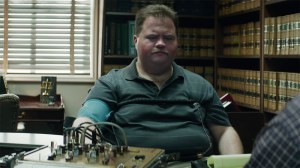 This is the passion play of Richard Jewell but nobody actually feels like a human being, let alone the person at the center of attention. There isn’t a single person onscreen that feels like a person, though the closest is the lawyer, Bryant. Jewell’s mother, Bobi (Kathy Bates), serves no other purpose but to act as her son’s cheerleader through good times and bad. When she has her teary media speech late in the film, I was relatively unmoved, because she was a figurehead. Everyone in the movie represents an idea or an organization, thus serving them up for double duty. Much like a passion play, we’re just here to watch the suffering and scold the abusers. It’s a movie meant to get our blood boiling, but other movies have been made to provoke outrage, especially highlighting past injustices under-reported through history. There’s nothing wrong with a movie that is made with the direct purpose of provoking anger at the mistreatment of others. The key is to make that central story relatable, otherwise the main figure is simply a one-dimensional martyr who only has the emotion of suffering. Without careful plotting and characterization, it can become an empty spectacle. With Richard Jewell, the main character is simply too boring as presented to be the lead. He’s an ordinary guy, but rarely do we see him in moments that provide layers or depth to him. And maybe that’s who he was, a transparent, average man who was too trusting of authority figures and a fair system of justice. Still, it’s the filmmakers’ responsibilities to make Richard Jewell feel like a compelling and multi-dimensional character in a movie literally called Richard Jewell. Even if the character arc is this poor sap starts to stand up for himself, this is severely underplayed. I sympathized with him but he felt more like a Saturday morning children’s mascot. He doesn’t feel like a person, let alone an interesting person, and that’s a big problem when he’s the closest thing the movie offers as a character and not a figurehead.
By far the worst character is Wilde’s media stand-in, a character so abrasively tone deaf and odious that when the bombing happens, she prays that she will be the one to get a scoop. The Evil Media Lady, which is what I’m renaming her because that’s all she serves in the story, is an awful amalgamation of the worst critiques people have with the media: rushing to judgment, callous indifference, and naked self-serving greed. The fact that she’s an invented character means she’s meant to represent the whole of the media, and yes, the media is one of the bad guys in the Richard Jewell story. They deserve ample criticism and condemnation, but when you serve them up in this careless, over-the-top manner, the vilification becomes more apparent than their culpability. Evil Media Lady literally sleeps with an FBI agent to get her scoops, scoops that end up being wrong, because she’s so devious and doesn’t care about The Truth. There is literally a dialogue exchange where she says, “I print the facts,” and another character retorts, “What about the truth, huh?” And wouldn’t you know, by the end, when Jewell’s mother gives her speech, who is listening and having a completely out-of-character turnaround but Evil Media Lady. I texted my friend Joe Marino as this was happening: “The power of her old white lady sad is making EVIL MEDIA LADY sad too, which means old white lady sad is the most powerful sad on Earth.”
 The FBI are also portrayed as a group of conniving snakes who must have thought Jewell was the dumbest human being on the planet the way they interacted with him. When the FBI sets its sights on Jewell as the prime suspect, they bring him in under the guise that they’re filming a training video and he needs help them with some role-playing scenarios. It’s so obvious that it feels fake, and yet my pal Joe Marino replied that this was a real moment, that the FBI had such a low opinion of Jewell that they could get him to sign away his confession through trickery: “We’re going to… pretend… see, that we brought you in as a suspect… and pretend we read you your rights… and you’re going to… pretend… you’re the bomber. Now please actually sign this… pretend form and do not ask for a real lawyer.” I almost need a Big Short-style fourth-wall break where somebody turns to the camera and says, “This really happened.” In fact, a Big Short mixture of documentary, drama, and education would have served this movie well. Here’s the problem with serving up the media and FBI in this manner. They deserve scorn and scrutiny, but when you turn them into exaggerated cartoons of villainy, then it colors the moments onscreen when they’re actually doing the things that they did in real life. This is mitigating the movie’s level of realism as well as the emotional impact. It’s not a person versus a system but rather a martyr versus a series of cartoonish cretins all trying to punish this good Christian man.
The shame of the matter is that Jewell was done great harm for acting courageously, and there is definitely a movie in his tale, but I think the way to go would have been making his lawyer the main focal point. That way there’s more of a dynamic character arc of a man putting it all on the line to defend a media pariah, it could open up to the doubts the lawyer has early on, especially as Jewell is aloof or cagey about certain damaging info (he didn’t pay taxes for years?), eventually coming to realize the quality of man he was defending. Jewell, as a character, is static and stays the same throughout despite his great emotional upheaval. A story benefits from its protagonist changing through the story’s circumstances, and that’s where Rockwell’s character could come into view. He’s also by far the most engaging person and he has enough savvy to be able to fight back in the courts and court of public opinion, becoming an effective ally for a desperate man. That way it’s a story of trust and friendship and righting a wrong rather than a good-if-misunderstood man being martyred.
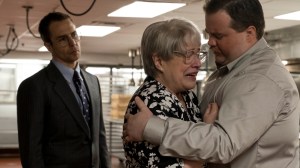 Throughout the two hours, Richard Jewell kept adding more and more examples of being a clunky and heavy-handed exercise. It would have been better for the bombing to be the inciting incident rather than the Act One break, sparing us so many scenes that do little and could be referenced rather than witnessed. Do we need to actually see Jewell getting fired from jobs to feel for him? There’s a reoccurring motif of Jewell bringing Snickers candy bars to Bryant as a friendly gift, and it’s so clumsy and weird. I started wondering if maybe Mars, Incorporated had paid for the bizarre product placement (“When you definitely did not plant a bomb in Centennial Park, break into a Snickers!”). There’s a dramatic beat where Jewell is trying to coax his distraught mother on the other side of a closed door. He just keeps repeatedly saying, “Momma please,” over and over while the music builds, and I guess the magic number was 17, and after that iteration she opens the door and they hug. It’s such an amazingly awkward scene. The dialogue has that same unreality as the rest of the movie, trying too hard to be declarative or leading, giving us lines like, “I’d rather be crazy than wrong,” and, “A little power can make a man into a monster.” It’s the kind of portentous, inauthentic dialogue exchanges I see in those Kirk Cameron movies. I wouldn’t have been that shocked if, by the end, the patriarch of Duck Dynasty showed up, running over the Evil Media Lady, and then they held a benefit concert for the persecution of white Christian males. I’m being a bit facetious here but Richard Jewell shouldn’t remind me of the derelict storytelling and characterization in hammy message-driven religious panoplies.
I was honestly shocked by Richard Jewell. I was expecting far more given the caliber of talent involved in the project as well as the inherent injustice in Jewell’s plight. Eastwood’s modern passion play feels too insufficient in passion. It’s an awkward movie that doesn’t give us a real character at its center, and it plays like every other human being in the universe is a representative of some storytelling function to service that empty center. There were lines of dialogue I just had to scoff over. There were moments that made me roll my eyes. I just couldn’t believe something this clunky could be designed for a late run for awards. The acting is all suitable, and Hauser does fine work as a mild-mannered everyman in a crucible, though I think he showed more adept skill in the enormously compelling I, Tonya. In fact, that 2017 movie could have been a lesson in how to tackle the filmic story of Richard Jewell, mixing in non-fiction elements to retell a story from multiple, fractured, contentious points of view that leapt off the pages. It feels there are many steps that should have been taken instead. Richard Jewell isn’t an awful or irredeemable movie, even though Eastwood’s typically plain shooting style feels even more strained and bland. It’s a movie I could see a contingent of the public genuinely enjoying, especially those already with a healthy mistrust of the FBI and media (you know who you are). But for me, it felt like I was watching the awards-friendly version of Kirk Cameron’s Christians are People Too. And again, Jewell deserves a major expose to chronicle his real injustices. He also deserves better than this.
Nate’s Grade: C
Share this:

The Mule (2018)
 Clint Eastwood plays a real-life 90-year-old drug mule, though I must inform you dear reader that at no point does he hide his cargo in a very uncomfortable place. The Mule is an interesting story about the most unexpected mule. Eastwood plays a man broke and on the outs with the family he’s neglected their entire lives. He takes up an offer to simply drive albeit for a Mexican drug cartel. As with most life-of-crime movies, what starts off uneasily becomes second nature as our characters get in over their heads. Except that doesn’t really happen in The Mule. I would estimate twenty percent of the movie is watching Eastwood drive and sing along to the radio. There are some tense near misses where he’s almost caught, but these are confined to the first half. In the second half the cartel becomes the chief source of danger, all because he doesn’t go by their routes. If he’s their most successful mule, having never had a ticket in his life, then why micromanage? There are some other nitpicks that nagged at me, like the cartel knows the DEA agents (Bradley Cooper and Michael Pena) are pulling over a very specific color and kind of car, but at no point do they change out Eastwood’s car. Also, Eastwood is spending vast sums of money in public for a man who was losing his house, and yet no red flags there. Eventually Eastwood has to make a choice of family over angering the cartel and risking his life, and I think you’ll know where his character arc is destined. The dramatic shape of the movie feels a little too inert for the stakes involved, leading to an all too tidy conclusion. Eastwood delivers a fine performance, as does every other actor involved. The movie kind of coasts along, much like Eastwood in his truck, on the inherent interest of its premise and the star power of its lead/director. The Mule might have worked better as a documentary.
Nate’s Grade: B-
Share this:

The 15:17 to Paris (2018)
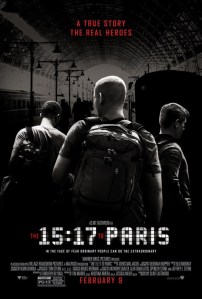
Spencer Stone, Alek Skarlatos, and Anthony Sadler were three ordinary servicemen taking a train ride into Paris when they found themselves in the middle of an armed terrorist attack. The three men rushes into danger, disarmed and subdued the attacker, and treated the injured on the scene. The 15:17 to Paris is a big screen movie directed by Clint Eastwood (American Sniper) that tells their life stories played by the men themselves. It got some of the worst reviews of Eastwood’s storied career (mine won’t be better). There are two gigantic miscalculations when it comes to 15:17 to Paris: 1) having the real-life subjects play the adult versions of themselves, and 2) that there was enough material here to fill out an engaging, enlightening, fulfilling film experience.
I assumed telling this real-life story as a movie was going to be a challenge to produce enough meaningful material to eek out a feature-length running time, and within the first five minutes I knew that I was doomed. We’re sitting down to two single moms discussing their boys with their classroom teacher, and that teacher literally says, “If you don’t medicate them now they’ll just self-medicate later. Statistically, boys of single moms are more likely to have problems.” My response: “What the hell, lady?!” This character was obviously engineered, from her very foundation, to be a walking, talking point of exposition and disagreement. No real teacher would ever utter these words so callously. It was this rude awakening that made me realize what a terribly written slog I was in for. At no point were these supporting characters going to come across as authentic human beings. Instead, it’s a world populated by robots with bad social skills or unshakable faith played by familiar actors (Judy Greer, Jenna Fischer, Thomas Lennon, Tony Hale, Jaleel White of all people). Also, what little kid has a Full Metal Jacket poster in his bedroom? Did he not understand what that movie was about?

These men can rightly serve as an inspiration, rising to the occasion in a true test of courage. No one will challenge the heroism. But what else is there to this story? The attack is presented as the framing device and as it plays out we segue into lengthy flashbacks about their lives leading up to this pivotal point in time. It’s just that these three men lived fairly uneventful, normal lives until finding themselves in a unique situation. We don’t seem to trace any significant, formative moments. Spending time with them as kids, then teens, and finally as adults doesn’t so much provide greater understanding of them as people as it does pad out the running time. We watch them get in trouble twice at school for not having a hall pass. We watch them watch football. We watch them endure training montages. We watch the trio tour the sights of Italy and eat gelato. We watch an Army team retrieve a backpack. We watch Spencer get demoted for not stitching properly. Seriously, this is given time. It’s not even until a full hour-plus into the movie before they confront the attack on the train.
Chronicling the lives of normal, real-life people under extraordinary circumstances is not by itself a fatal flaw, as evidenced by the masterful and mournful United 93. The power of empathy allows us to leap into a multitude of perspectives. However, with United 93 there was an ongoing story that could unfold because of the scope of events. There were developments, deadly complications, and the slow realization of what was happening, what was going to happen, and what needed to be done. With 15:17 to Paris, the attack is uncomplicated and over relatively quickly. There’s a reason Eastwood saves the train attack for the end because it cannot function as a sufficient movie plot on its own. Eastwood had a similar predicament with his previous film chronicling the heroism of the pilot who landed a plane on the Hudson River. The plane crash was thrilling and Tom Hanks added some layers to the portrayal of a man uncomfortable with the spotlight. 15:17 to Paris doesn’t even have that much. It’s a tedious trek to an all-too swift climax.
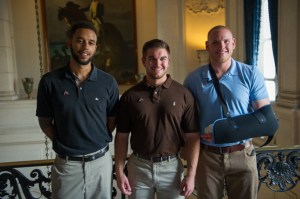
The other large miscalculation was having the real-life actors portray themselves. These guys just are not actors. I suppose Eastwood felt the real-life figures would best understand the emotions of each scene, in particular the attack, but another approach would be simply teaching actors. The forced verisimilitude feels like a marketing gimmick meant to appeal to a select audience. Making things more difficult is that these guys just aren’t that interesting as subjects. Sure there are broad strokes of characterization applied here and there but it’s with very minimal effort (see above for some of the just-had-to-include plot moments). This is another reason actors would have been preferable, because these guys’ lives don’t have to be interesting for my benefit. Their lives were not destined to one day entertain me on the big screen. They can simply be normal people. On the other hand, watching normal people do normal, boring things without a more enriching sense of introspection, personalities, or depth is like being trapped watching someone else’s home movies on a loop. Spencer Stone performs the best of his buds but none of them should expect a second career as an in-demand thespian.
I feel bad saying this but I really just didn’t care, and that’s because the movie gave me no reason to do so here. Yes, these three men are heroes and their sense of normality might lend itself toward a larger theme about the everyday capabilities of heroism, but there isn’t enough here to make me care beyond the train attack. The screenwriting does not present them as multi-dimensional characters and perhaps that’s because of the guys’ limitations as actors, exacerbating a spiral that only makes 15:17 to Paris less involving as it chases after the idol of authenticity. Eastwood is known for being an economical filmmaker but it feels like he should have been even more judicious here. The adherence to strictly the facts strips the film of some of its larger emotional power. There’s far too much filler and not enough substance to balance out 90-plus minutes. You’ll grow restless. If there’s a lesson to be learned from The 15:17 to Paris, let it be that every story needs a reason to exist and, when in doubt, trust actors to deliver that story.
Nate’s Grade: C-
Share this:

Sully (2016)
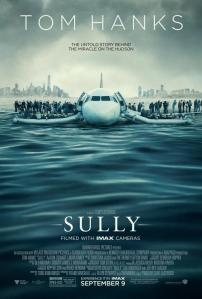 I think I had the same initial thought that most did when they saw the news that there was going to be a movie about the Miracle on the Hudson airline pilot: where exactly is the feature-length story? The flight itself lasted only about 200 seconds before landing on the river, and the sequence is thrillingly recreated and held off until halfway through the movie. The hero in the cockpit, Sully (Tom Hanks), is consumed with ensuring each and every last passenger is accounted for. When he gets the news that all survived, he can finally allow himself to breathe, to take in the full magnitude of the events, and it feels like a cleansing moment of deep emotional catharsis for him and the audience. But what’s the movie here? Apparently the NTSB and the airline insurance companies are disputing whether Sully could have safely landed the plane back at an airport instead. It’s exactly the kind of flimsy, manufactured conflict that sets itself up for moral grandstanding and a courtroom confrontation where our heroes will be vindicated, and we get all that. Sully’s unexpected spotlight wears on him as he feels like an ordinary citizen not worthy of the term “hero.” No other plane has successfully landed in water without a loss of life, so I’m sorry pal, but you’re a hero, even if you think you were just doing your job. Hanks is suitably low-key and humble and strong and emotionally resonant, though he was better on just about every front with Captain Phillips. The direction from Clint Eastwood is respectful without going into hagiography. The overall message is one of uplift, widening the focus from Sully to other heroes in New York City that day that came together to help others. It’s a moving message without having to resort to melodrama. At a mere 96 minutes, Sully gets you in and out and provides a solidly entertaining glimpse at the people who rose to the challenge when needed most. It’s a well-made movie that goes as far as it can without trying your patience.
Nate’s Grade: B+
Share this:

American Sniper (2014)
 When killing is a man’s gift, what effect does that have on the man? American Sniper follows the real-life heroics of the most prolific sniper in United States history. With director Clint Eastwood attached and awards buzz building, you’d expect that the film would get at the heart of a complex man who placed himself back into danger by choice. For a biopic on Chris Kyle, the man seems to get lost in the fog of war (movies).
Chris Kyle (Bradley Cooper) enlisted in the military right before 9/11 and served four tours of duty in Iraq. He served as cover for many missions, protecting thousands of soldiers. The troops just felt better knowing that Kyle had their back. Kyle got married and had several kids with his wife (Sienna Miller) but he kept leaping back into the fight, the place he felt he belonged.
 From the opening sequence on, American Sniper is often a gripping suspense piece. The opening moral dilemma sucks you right in. Should Chris shoot the mother and child? Are they a threat or is there just a misunderstanding? Will they change their minds and turn away? Is there time to debate all this with advancing U.S. troops? Eastwood does a great job of drawing out the tension with shot selections and the precise editing. The bulk of the movie hews closer to a conventional action movie, with Chris and his team clearing out Iraqi insurgents. We get to know a bit about the mechanics of sniper warfare. But Kyle gets restless being the guardian angel of death for the ground troops, and he goes down to their level and clears neighborhoods. This causes some conflict with his superiors because Kyle is far more valuable as a sniper. His reputation for killing is also getting him notoriety with his enemies. There is a price on Kyle’s head and skilled snipers are seeking him out for the prize. This is a natural way to build suspense as Kyle keeps returning back into Iraq with multiple tours, every tour increasing his personal danger. It allows for real consequences for the increasing prowess of our super sniper. There’s a sense of collateral damage to every kill, as every dead body creates more enemies and those enemies grow more incensed to take him out. Even if you know how exactly Kyle met his untimely end, there’s still plenty of suspense and well-orchestrated action sequences to please casual fans of the genre and true-life military thrillers.
It does feel like the complex story of Kyle, as well as the Iraq War, are being simplified into action movie fodder. There’s a steady supply of interchangeable supporting players, soldiers and spotters and the like, all of them without much to distinguish them as characters. They’re here to be sacrificed, to watch the splatter of red, and to increase the sense of loss because we know that Chris Kyle will not be taken down so we need other expendables. As expected, Miller gets rather short shrift as Kyle’s wife who gets to alternate between worry and unease. The screenplay by Jason Hall sets up some excellently harrowing suspense sequences but seems better engineered like its establishing video game stages of combat than complex people. As a result, when we lose characters it doesn’t feel like we’ve lost people we care about. It doesn’t have an impact beyond sudden shock, and even that is tempered in time with the sniper angle. You start expecting characters to get popped in mid-sentence.
 Where the film leaves you lacking is at its center with the man who is supposed to be the focal point of American Sniper. At the start we’re told that Kyle is the deadliest sniper in U.S. history and by the end that’s about all we know about the guy. He’s an ace killer. The movie has some top-notch suspense sequences with Kyle killing people. The early scenes with Kyle’s family do the bare minimum to establish a sense of pride in not backing down from a fight. There’s a scene where his girlfriend explains to him and the audience exactly why he’s difficult. It’s pretty transparent exposition but it’s also the last bout of clear characterization you’ll get until the end. There’s a slight nod to the mounting PTSD that is transforming Kyle into a man who feels whole only on the battlefield, but these are notes of characterization that are only cursory. It’s only at the very end does the movie remember to flesh out Kyle as a person rather than as an action hero, and by then there’s only enough time to hint at elements we’ve seen explored better in other war movies, particularly The Hurt Locker. As an action film, the movie works and works quite ably, but as a biopic on Chris Kyle it forgets what makes him human, instead focusing on his superhuman killing ability.
Cooper (American Hustle) bulked up a considerable amount of muscle to portray Kyle. He fits the part well and has the acting ability to communicate the troubled psychology of a man making sense of his old world after the trauma of war. It’s then a shame that he’s not given more opportunities to use those acting muscles. There is one phone call where Cooper wordlessly finally breaks down, allowing all the scar tissue to finally be seen on his haunted character, but it’s a moment rather than a culmination.
If you go into American Sniper hoping for an elevated thriller with some well-wrought suspense, then you’ll mostly be pleased with the film as a slice of entertainment. As a war commentary or a psychological study of the horrors of war, it comes up lacking, falling back on the action tropes of its genre and neglecting to properly build around its characters. The action is often biting, and a late sequence involving an oncoming sandstorm is an intense climax. However, it’s also emblematic of the shortfalls of the film. While it’s a sequence of action entertainment, it also reduces war into a video game and reminds you that the characters onscreen are not so much portrayed as people but holders of weapons. Kyle was a complex man who was more than his uncanny ability to kill, but you won’t get more in American Sniper. The nature of his death demands a more insightful exploration of the lasting effects of PTSD and what kind of treatment, or failure of treatment, many servicemen receive once they come home.
Nate’s Grade: C+
Share this:

J. Edgar (2011)
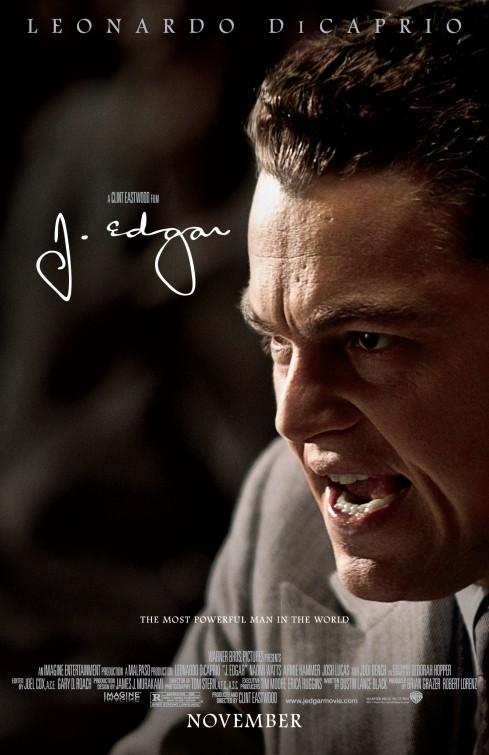 J. Edgar has all the qualities you’d want in a high profile, awards-friendly movie. It charts the life of legendary FBI head J. Edgar Hoover, it stars Leonardo DiCaprio in its title role, and it has Oscar-winner attached as screenwriter (Dustin Lance Black) and director (Clint Eastwood). The only way this movie could be bigger awards bait was if Hoover personally challenged Adolf Hitler to a duel. At a running time of 137 minutes, J. Edgar misses out on explaining why this complex man was who he was, a difficult prospect but I would have at least appreciated some effort.
J. Edgar Hoover (DiCaprio) was, at his height, said to be the second most powerful man in the United States. The first director of the Federal Bureau of Investigations served under eight presidents and for over 50 years. The man rose to power fighting against radicals and Bolshevik terrorists in 1919. Hoover successfully arranged for America to deport foreigners with “suspected radical leanings.” He was appointed to head the, then, Bureau of Investigations, where Hoover remade the agency in the image he desired. His agents were going to be clean-cut, college-educated, physically fit, and God help you if you had facial hair. Hoover also fought to bring modern forensic science into investigations and trials, proposing a centralized catalogue of fingerprints, which at the time was dismissed by many as a “speculative science.” Hoover also amassed an extensive system of confidential files on thousands of American citizens he felt were potential threats or if he just didn’t like them. Hoover wasn’t afraid to bully presidents with this secret catalogue. On a personal level, Hoover was admittedly without any friends or interests outside the agency he felt responsible for. His life was defined by three close personal relationships: his mother (Judi Dench), whom Hoover lived with until the day she died; Helen Gandy (Naomi Watts), his loyal secretary and confidant of 40 years; and Clyde Tolson (The Social Network’s Armie Hammer), an FBI agent that Hoover shared a decades-long unrequited romance with. Upon Hoover’s death in 1972, Tolson was given Hoover’s burial flag, and Tolson’s own grave is a mere couple plots away from J. Edgar’s.
 The movie feels trapped in a closet alongside Hoover. The guy was rather enigmatic and hard to nail down, but I would have appreciated Eastwood and Black at least trying to figure the guy out. They treat the subject with such fragility, such sympathetic stateliness about his more salient personality points. It feels like Eastwood doesn’t want to get his hands too dirty, so the provocative material, like the gay stuff, is kept to very period appropriate acts of discretion. A handholding in the backseat of a car is practically scandalous given the treatment on the gay material. The oft rumored cross-dressing aspect is hinted at but explained, in context of the scene, as Hoover’s way of mourning the loss of his mother. With Hoover, there was only his public persona of a moral crusader, a face that he never removed even in his private moments. The guy could never embrace happiness, only duty. It feels like Eastwood couldn’t decide on what stance to take, and thus the film settles on a bloodless examination that won’t upset any of the, presumably, delicate sensibilities of the older audience members. A towering figure of moral certainty, extreme paranoia, righteous conviction, a vindictive streak against his mounting collection of enemies, and a shaky hold on the truth, all in the name of protection against America’s many real and imagined enemies – I feel like the blueprint has been established for the eventual Dick Cheney biopic. It’ll just be slightly less gay.
Let’s talk more about the gay factor. It feels like this area is where Eastwood definitely could have pushed much further, but the old school director seems to be of the opinion that a biopic need not pry nor speculate. Excuse me, but you’re telling me about a man’s life, the least you could do is dig deeper. A domineering mother, who said she’d rather have a dead son than one of those “daffodils,” and the moral restraints of the time, are easy enough to identify why Hoover was a repressed homosexual. That doesn’t separate him from probably a far majority of homosexual men in the first half of the twenty-first century. What makes Hoover, a repressed homosexual, tick? This is no Brokeback Mountain style whirlwind of untamable emotion. Eastwood keeps things chaste, choosing to view Hoover as a celibate man. Hoover and Clyde becomes inseparable “companions,” eating every dinner together, going away on trips, and enjoying the pleasure of one another’s company – the life of the lifelong “bachelor.” But that’s as far as the movie is willing to go (remember the scandalous handholding?). There are hints about how socially awkward Hoover can be, a guy who seems downright asexual at times. He proposed to Helen on a first date where his attempts to charm included showing off his card catalogue system at the Library of Congress (“I bet you show this to all the girls…”). You get the impression he’s not comfortable with this necessary area of human biology. That’s fine room to start, but J. Edgar doesn’t do anything but start its characterization ideas. It gives you ideas to toy with and then moves along. The relationship with Clyde hits a breaking point when Hoover discusses, during one of their weekend getaways, the prospect of finally choosing a “Mrs. Hoover.” Naturally Clyde does not react well to this development, and the two engage in a brawl that ends in a shared bloody kiss. This is about as passionate as Eastwood’s movie ever dares to get.
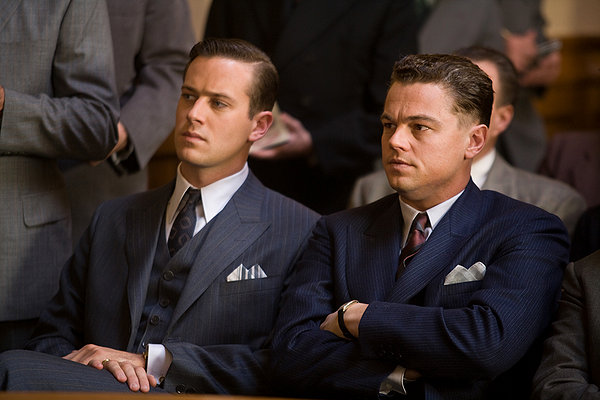 I expected more from the Oscar-winning writer of Milk. Black’s lumpy script can often be confusing, lacking a direct narrative through line. Some leaps in time can just be confusing, like when J. Edgar is asking his junior agent typist what figure was most important in the 20th century thus far. The agent answers, “Joe McCarthy,” and then we have a new agent sitting there, and Hoover asks again. Finally we have another agent who responds with Hoover’s desired answer, “Charles Lindbergh.” I suppose we’re left to assume that Hoover fired his typists until he found one who mirrored his own thoughts. There is also far too much time spent over the Lindbergh baby case. I understand it’s the so-called Crime of the Century and, as Black sets up, a situation for Hoover to prove his bureau’s value when it comes to modern criminal science. It just goes on for so long and rarely offers insight into Hoover. Sans Clyde, the majority of the supporting characters offer little insight as well. Hoover’s mother never goes beyond the domineering matrimonial figure. Helen seems like a cipher, rarely giving any explanation for her decades of loyalty despite clear objections to certain choices. She’s too often just a “secretary” there to move the plot along by introducing more characters of minimal impact. With Hoover being such an enigmatic and closeted figure, the supporting characters could have been the areas we found the most insight into the man. Nope.
The entire plot structure feels like a mistake. Hoover is dictating his memoirs so we primarily flash from the 1930s, when Hoover was making a name for himself, to the 1960s, when Hoover is fighting a secret war against, of all things, the Civil Rights movement and Martin Luther King Jr. (he was convinced King was tied to communists). The back-and-forth nature of the story can lead to some confusion over facts and timelines, but the concept of Hoover dictating his memoirs means that the movie becomes a greatest hits compilation, a showcase of Hoover’s finest hours in an attempt to win public support back. He can explain his obsessions and justify his overreaches. That’s why Hoover’s entire catalogue of secret files on thousands of American citizens, including presidents, is given such short shrift. Why would he want to discuss his own subversive tactics hunting subversive elements? The only time the screenplay discusses this secret catalogue is when Hoover and Clyde want to have a good laugh over Eleanor Roosevelt’s lesbian paramour (irony?). Richard Nixon covets these files, so Helen swears that upon the death of her boss that she will shred every page before Tricky Dick can get his hands on them (J. Edgar is rated R for “brief strong language,” and they are all provided by potty-mouthed Nixon). Black attempts something of an Atonement-styled ending with an unreliable narrator, but the effects are slight and only superficial and too late.
 At this point it’s probably going to be rare for DiCaprio (Inception, Revolutionary Road) to give a dud performance. The actor isn’t the first name you’d think of for a Hoover biography. Regardless, the guy does a great job especially with the emotional handicaps given to him by Black’s script and Eastwood’s direction. Given all the emotional reserve, it’s amazing that DiCaprio is able to make his character resonate as much as he can, finding small nuances to work with. Hoover’s clipped speaking style, likely the most readily recognizable feature of the man, is here but DiCaprio does not stoop to impression. He’s coated in what looks like 800 pounds of makeup to portray Hoover in the 1960s. The old age makeup looks good on DiCaprio, though the same cannot be said for his inner circle. Older Clyde looks like he is suffocating behind a gummy Halloween mask; the man looks like he is mummified in his own liver-spotted skin. Older Helen just looks like they powdered her face and added some gray to her hair.
The movie seems to take its emotional cues from its subject; far too much of J. Edgar is reserved, hands-off, and afraid to assert judgment on what was a highly judgmental man of history. What makes Hoover compelling is his array of contradictions. He’s defined by three personal relationships (mother, Clyde, Helen), all of whom he could never have. That’s got to mean something. Instead of exploring these contradictions in any meaningful psychological depth, Eastwood seems to take his hand off the wheel and the film just casually drifts along, steered by the self-aggrandizing of Hoover himself, given so much room to explain detestable behavior in the name of protecting America. J. Edgar is a handsomely mounted biopic with some strong acting, but from Eastwood’s impassive direction (his piano-trinkle score isn’t too good either) and Black’s lumpy script, the finished work feels too closed off and arid for such a controversial subject worthy of closer inspection.
Nate’s Grade: B-
Share this:

Changeling (2008)
 This is one crackerjack of a story. The true-life tale of a mother, Christine Collins (Angelina Jolie), who loses her son, only to have the LAPD give her a different boy is easily gripping. The pace is a bit elegiac but the movie never gets boring, partly because Christine is beset by a multitude of adversity by the corrupt members of the 1920s LAPD who want the case to go away. Changeling can seem to fall prey to outrage cinema, and the audience is clearly going to demand some justice after watching Christine undergo a torture chamber of abuse. And justice is what we get. The last 45 minutes of this movie is protracted courtroom sequences where the antagonists get stomped upon with righteous fury. It just keeps going on and on, as if to compensate for the massive grievances Christine endures. Writer J. Michael Stracynzski (Babylon 5) makes the drama stick close to the facts of the case, which is admirable but it also makes Changeling anchored to reality when there is nothing, repeat nothing, subtle in this movie. It’s hardcore melodrama all the way through, but I didn’t mind one bit. Jolie’s frantic performance suits the melodramatic material. She leaves it all on the floor, as they say in sports. Clint Eastwood doesn’t seem to be too enraptured by the material, routinely slipping into his understated direction that seems at odds with such a juicy story. Changeling feels like a tremendously fascinating story that isn’t necessarily presented in the best fashion. Still, this is fine stuff.
Nate’s Grade: B+
Share this:

Gran Torino (2008)
 Clint Eastwood is an icon but he’s also proven to be a remarkable and thoughtful director in his twilight years. When the star first traveled behind the camera he mostly stuck with the action films that were his cinematic bread and butter. Then he showed something grander with 1992’s Unforgiven and rebounded back to that quality with a string of critically lauded flicks like Mystic River, Million Dollar Baby, Flags of our Fathers, and Letters from Iwo Jima. Three of those films were nominated for Best Picture, including three Best Director noms, and Baby won. The prolific screen icon has taken his directing skills up to another level in his older age and Eastwood has chosen to work on somber, mature, and meditative tales. Gran Torino is a movie caught between two different eras of Eastwood direction. It has the sheen and intentions of one of the recent loftier works and the film also taps into the suspense of his earlier action vehicles. It’s the only non-Batman movie targeted for Oscars this year that features ass kicking.
Walt Kowalski (Eastwood) is a retired Korean War veteran living in Detroit. He worked on the Ford factory lines for over 30 years and now has the pleasure of seeing his spoiled children driving foreign cars. His neighborhood has been inundated with Hmong immigrants from South East Asia. It seems the Hmong people sided with the Americans during the Vietnam War, and when the Americans left, well, it didn’t turn out so well for them. One old Hmong lady chastises Walt as a stupid old man and doesn’t know why he hasn’t fled like the other whites that used to live in the neighborhood. Things aren’t like they used to be. Gangs run rampant and terrorize the people into silence. We’re told that when it comes to the Hmong, the women go to college and the men go to jail. A Hmong gang keeps trying to recruit Tao (Bee Vang) into their ranks. He is looked down upon as a weakling and for doing women’s work, like gardening and the dishes. His initiation into the gang is to steal Walt’s pristine 1972 Gran Torino, the old man’s prized possession and one he helped build on the assembly line. Walt catches Tao in the act and eventually the boy works for Walt to repay the offense. Together, Walt and Tao form an unlikely bond. His Hmong neighbors cherish Walt for saving Tao from the gangs and the community opens its arms to him. Walt helps Tao find a job and stand up for himself, but the pull of the gangs is too strong. Walt realizes that Tao and his bright sister Sue (Ahney Her) will never be allowed to have a future as long as the Hmong gang is around.
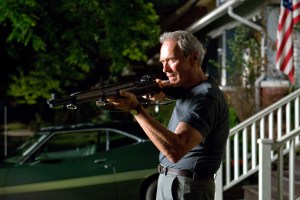 It’s hard to take the movie purely on the surface without some preparation. Because in synopsis, Gran Torino sounds like a ham-fisted after school special where Old Man Dirty Harry teaches the youngsters about the dangers of gangs and violence. The film is hard to fully describe without it sounding like a parody. Yet Gran Torino manages to come together along the journey. The movie balances gracefully even when it seems like it is going to dip into self-parody. Simply put, having Eastwood point a gun and growl, “Get off my lawn,” the quintessential geezer line, is almost calling out for ridicule. The gang storyline feels at times incredibly natural in approach and its casual, realistic dialogue, and at other times the storyline, like the film, feels like it is leading you by the nose. Some of the stock characters are sketched so thin, like the self-centered granddaughter who wears a midriff-bearing outfit to her grandmother’s funeral (all the better to witness your navel piercing, my dear). The spoiled children and grandchildren come across as too broad to be believable. The messages are all familiar, the characters are even somewhat familiar, but Gran Torino emerges as something more understated and perceptive than “Archie Bunker with a gun.” It’s a moderately rich character piece that follows one man resorting to his better nature in his golden years. Walt’s redemption may be predictable from the first minute but that doesn’t make Gran Torino any less satisfying. In fact, the movie on a whole is an embarrassingly entertaining experience. Sure, there’s a certain primal rah-rah vengeance angle to it, and watching a 78-year-old man kick around some youngster is always worth watching. But the novelty of the movie is not cheap xenophobic wish fulfillment, watching an old white war vet eliminate the immigrants in his neighborhood. The draw of this movie is an old-fashioned tale told well, which is equally earnest and glum.
The dialogue can be forcibly blunt as it spits out every offensive racial epithet, slur, and stereotype known to human ears (it’s practically the comedy routine of the unfunny Carlos Mencia). The screenplay by Nick Schenk confuses racist pabulum with comedy gold, like hearing an old lady cuss, but Eastwood manages to make it work. The rampant racist dialogue tends to get tiresome unless it begins to chip away and reveal more about a character. Naturally, Walt shuns being politically correct because he is uncompromising. He shakes his head and glowers at what the kids today have turned into. He’s meant to make others feel the same discomfort he feels in today’s world, and words are his weapons at his old age. The backbone of the script is the friendship Walt forms with Tao and his family. Because it begins so reluctantly and moves at a steady pace, the audience is emotionally invested and the friendship is rewarding to witness. The movie presents a fairly universal message about the redemptive power of human kindness, of helping one’s neighbor. It’s a petty big melting pot out there and there’s no reason to dig in and combat change. Gran Torino lacks the forced sanctimony and transparent manipulation of other “important” race-relations movies, like 2005’s Best Picture-winning Crash.
 The movie is impossible to view without it also becoming a commentary on an iconic actor’s screen legacy. What does a retired Dirty Harry at 80 look like? I imagine something like Walt, an embittered war vet grumbling about the change all around him that he is powerless to ignore. Eastwood takes great pains to be an angry curmudgeon even until the end, which allows the actor to tap his little seen comic ability. There’s a funny scene where Walt takes Tao to the barbershop for a lesson in how to “talk like a man,” which naturally involves playfully insulting your fellow man. Eastwood knows how to make a racist and standoffish character sympathetic and engaging. It’s a pleasure watching Walt become affectionate and protective, and yet the character’s redemption doesn’t ever feel contrived. His character is scarred and weary and wears his pants up to his armpits, but Clint makes it work. He can be sad and badass and appalling all at the same time. The character is somewhat similar to his character in Million Dollar Baby, a grumpy man closed off to the world who mentors a young kid. The flick presents a semi-dignified swan song to what happens when men of action grow old.
Eastwood directs with his typical steady hand and cool decision-making. The camerawork is intimate and sparing, never yanking the audience out of the story. The visuals mimic the characters in that nothing feels over polished. I enjoyed the small bits that pointed to something deeper, like Walt pointing his finger, a pistol and lining up his antagonists. I also enjoyed that Walt refrains from ever spilling his guts about his guilt during the Korean War except in a way that feels true to the character. Eastwood also shows a bit of his directorial prowess by hiring a bunch of Hmong actors that have had no acting experience. Some of them fare better than others, and some are in fact kind of bad, but this decision makes the movie feel more authentic. Now, it’s rare for me to cite sketchy acting as a plus for a movie, and that should be a testament to Eastwood’s directing skills. The man has a way with people; since 2003 he’s directed four different actors to Oscars. It must have been what Angelina Jolie was hoping for when she signed up for Changeling, the earlier Eastwood directorial effort from the fall. I think the biggest mistake Eastwood makes as a director is singing the closing song that unrolls right before the credits. Clint’s raspy singing voice is not the best way to close a movie.
 Gran Torino isn’t among the same ranks as Eastwood’s other output, like Letters from Iwo Jima or Mystic River, but it’s a small-scale story told with fortitude. Even as I write this review, and you dear reader read them, I feel like I’m failing in my attempt to make the movie sound good. True, on the surface it sounds like a bizarre after school special that would be destined to slip into self-parody and open mockery. Eastwood as star and director makes the material click. Walt’s journey from grumpy bigot to grumpy bigot who has opened up and made amends is greatly entertaining and humorous throughout. Gran Torino can be seen as a deconstructionist take on the fading era of Dirty Harry and Eastwood’s cinematic tough-guy legacy. Clint fans will eat all of this up.
Nate’s Grade: B+


 nathanzoebl
You must be logged in to post a comment.