Blog Archives
In the Heart of the Sea (2015)
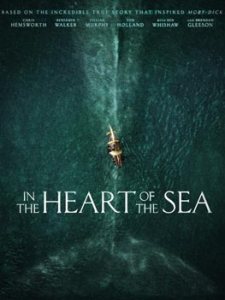 In 1822, the men aboard the Essex, a whaling ship sailing from Nantucket, Massachusetts, encountered a beast unlike any they have ever seen. Captain Pollard (Benjamin Walker) and his first mate, Owen Chase (Chris Hemworth), were at odds throughout the voyage, that is until they encountered a 100-foot long white whale. The creature destroyed the Essex, forcing the crew to drift at sea and hope to find land, but the whale follows them as well. Tom Nickerson (Tom Holland as a young man, Brendan Gleeson as the older version) recounts this traumatic survival tale to author Herman Melville (Ben Whishaw), who is desperate to write this true story.
There’s an old-school throwback vibe to In the Heart of the Sea with its high seas adventure, but there’s just not enough attention to adventure, character, or even plot for this movie to really set sail properly. The first act feels so sluggishly long. It’s trying to set up life on a whaling vessel in the early 19th century but I didn’t feel like we got a coherent sense of life aboard the seas or how the various components worked. I didn’t know that whalers row out from the main ship, so there’s that. The opening act sets up the dull conflict between Chase and Pollard, which can be summarized as blunt upstart vs. unchecked privilege. The conflict doesn’t evolve from this dichotomy. Both men are boring in their unyielding simplicity. Hemsworth (Avengers: Age of Ultron) made a stronger impression in Rush, but a humorless movie role is not in his best interests as an actor. When the action does arrive, it can be genuinely thrilling. Director Ron Howard does a slick job of conveying the danger and destruction of the whale attack. Sadly, it’s over too soon and then the remainder of the movie is 45 minutes of a survival drama adrift in the ocean reminiscent of last year’s Unbroken. This period of isolation forces the characters to make some hard choices, yet we don’t feel the impact of those choices because the narrative, too, feels adrift. Implausibly, the giant whale has followed them for thousands of miles. Are whales really this vindictive? The documentary Blackfish makes me wonder but it still feels unbelievable. What was the whale waiting for? For the men’s spirits to be completely broken before it might attack again? We’re told this whale is a “demon” but who exactly are the bad guys in this story?
 I believe another stopping point for this story is that the culture has moved beyond the acceptance of whaling as an honorable profession, to the point that I, and I assume others, was on Team Whale after witnessing a bloody hunt. It’s pretty gross, especially when they’re harvesting the whale body for the precious oil. Perhaps modern audiences, so far removed from hunting as an essential component of life have become more squeamish, or perhaps modern audiences just recognize something as barbaric when they see it. As a result, it’s hard to root for these guys. When the giant whale attacked it felt like retribution. My sympathies were more for the large mammal than the bipeds on ship. At the end of the film (some spoilers), the white-haired moneyed men of Big Whale Oil are worried what the truth will do to their industry. They want the surviving crewmen of the Essex to deny the existence of this gargantuan whale. This makes little sense to me other than awkwardly forcing a Big Business cover-up for relevancy. First off, whaling seems like a pretty unsafe working environment to begin with, especially considering voyages could last up to three years. Would the reality of one big bad whale destroy an industry? I doubt it since there is such money to be had. If anything it might rejuvenate the timber industry to reinforce the ships to make them more durable against larger whale attacks.
At first I thought a framing device was entirely superfluous; why do we need to watch Melville elicit this tale rather than simply just watching the tale itself? It seemed like a distraction, but as the movie progressed I understood that this framing device was its own sub-story and had its own complexity, namely the older Tom coming clean to the decisions that still haunt his soul. It’s an unburdening for both gentlemen, as Melville admits his deep fear that he is a mediocre writer (he’s no Nathaniel Hawthorne) and that he will be unable to tell this story as well as it truly deserves.
As these two men are allowing themselves to become more vulnerable and sharing their demons and doubts and worst fears, I started to realize that this framing device was weirdly more compelling than all the whale action. That’s because older Tom and Melville are the best drawn characters in the movie, which seems like a screenwriting mistake of sizable proportions. Obviously the nautical survival stuff should be the most compelling, and yet I as more taken with two men sitting by an oil lamp discussing their lives. Older Tom is infinitely more interesting than younger Tom; part of this is because young Tom hasn’t experienced the full effect of the events that shape older Tom, but most of this is from the very clear fact that young Tom is kind of a mute witness in this movie. He rarely speaks and is just kind of there, taking up space. There’s one personal harrowing moment when he’s thrust inside a hollowed out whale carcass to extract more blubber, but that’s the only personal perspective offered through young Tom. A question concerning the framing device: how is older Tom retelling events he had no participation or witness to? Another issue is that the characters on board the Essex are bereft of anything that would allow us to feel for them beyond simple human survival. Chase and Pollard are given one note to play and their eventual understanding and cooperation is fine but it feels like fleeting details in a story, lost to memory or disinterest.
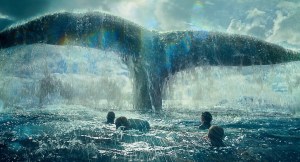 From a purely technical aspect, this is one of the better Howard films. The cinematography by Anthony Dod Mantle (Slumdog Millionaire) is rich and often breath taking, with plenty of stunning aerial and underwater images. The whale attack sequence is harrowing and thrilling. Howard finds ways to imply the harsher aspects of this life without going overboard, maintaining that PG-13 rating. While the look of the film has an enhanced color palate thanks to the extra boost of CGI filters, I still appreciated the vibrancy of the on screen images. As I said with the similarly boosted Mad Max: Fury Road, I’d rather have vibrant and bright colors than a drab and washed-out color palate. Even as the movie drifts and the characters fail to grab you, at least the visuals are pretty. While sitting through the second half, I started to rethink my own prejudices concerning Howard as a filmmaker, a man who lacks a distinctive style but has a definite feel for how to tell a story. I’m not going to excuse him for The Grinch and other misfires, or his tendency to settle for maudlin in place of subtlety, but the man is a born filmmaker.
In the Heart of the Sea is an old school movie that feels too sluggish, too underdeveloped, and too free of characters for the audience to invest in. When the framing device scores the biggest emotional pull, you better start rethinking your rip-roaring high-seas adventure. Master and Commander this is not. As the inspiration for Moby Dick, I wish I had just watched a remake of Melville’s actual novel (now with extra chapters about rope!). If you ever wanted a movie that ends on a blurb by Nathaniel Hawthorne as a payoff for Melville’s artistic neurosis, then your wait is over. In the Heart of the Sea feels like a whale of a tale that is hard to believe, which ends up inspiring a far greater story, which made me yearn for just watching that superior tale. Sometimes the “truth” behind famous stories is less interesting.
Nate’s Grade: C+
Share this:

Thor: The Dark World (2013)
 Loosely based off the Norse mythology, Marvel’s hammer-wielding hero isn’t exactly the easiest character to relate to even as a superhero. Thor is a god after all. Not to be outdone, the man is also royalty, next in line to be king, so he’s in a special class of privilege. And yet 2011’s Thor was a pleasant surprise, a superhero movie that didn’t take itself too seriously, had modest aims, and embraced its sci-fi fantasy mélange. It was a movie where the sillier it got the better it worked. Now Thor: The Dark World, a.k.a. Thor 2, is ready to dominate the fall box-office and prove that Joe and Jane Popcorn can cheer for a pagan god.
Following the events of The Avengers, Loki (Tom Hiddleston) is taken back to his home world of Asgard and put in prison. Loki’s brother, Thor (Chris Hemsworth), is trying to get back to Earth to reunite with his love, scientist Jane Foster (Natalie Portman). Thor is being groomed for the throne of Asgard by his father, Odin (Anthony Hopkins). Meanwhile, the nine worlds are nearing a convergence and dimensional gateways are opening, including one that infects Jane with an ancient biological weapon, the aether. The aether was used as a weapon by the dark elves, a race of creatures that was long ago defeated but its general, Malekith (Christopher Eccleston), has been dormant and in hiding. Alterted, he assembles his surviving army to attack Asgard, kidnap Jane Foster, retrieve the aether, and destroy all life in the universe.
 Thor is still a second tier character when it comes to Marvel superheroes (the guy just isn’t that interesting) but his franchise has, in only two starring films, become the most interesting. The scope of the Thor movies seems infinite. Whereas the other Marvel heroes are Earthbound and straightforward, Thor transports an audience to all sorts of alien worlds/cultures/conflicts, all of which open up more tantalizing storytelling avenues. Nothing seems out of place in a setting such as this, and so the surprises are more satisfying. I thought the best parts of 2011’s Thor were the Asgard moments, less the strained fish-out-of-water comedy of Thor assimilating on Earth. Thankfully, almost all of Thor 2 takes place off Earth save for a rousing, creative, inter-dimensional hopscotch of a climax. The realm of Asgard is given suitable scope thanks to the screenwriters and first-time feature film director Alan Taylor, who worked in TV for years. Taylor’s notable work on HBO’s Game of Thrones is probably what got him this gig, and his vision with fantasy is given significant breadth here. The Thor universe is an interesting mix of fantasy and sci-fi, reminiscent of Star Wars, and Taylor provides the necessary sweeping visuals, exciting action, and glorious shirtless close-ups we come to expect from our fantasy vistas. I was consistently impressed with Taylor’s command of visuals and shot selection, particularly how the man was able to juggle the various tones and needs of the script while still keeping an exposition-heavy film fun and light.
With rainbow bridges, dark elves, and enchanted hammers, thank goodness that Thor 2 keeps a steady and welcome sense of humor, never getting too serious even with the end of existence on the line. This jovial tone is refreshing when properly executed and contributes to the overall fun of the picture. We’ve had such sturm und drang when it comes to our superhero movies, particularly last summer’s Man of Steel misfire. I appreciate a dark and gloomy superhero tale like Nolan’s Batman films, or a satirical swipe like the original Kick-Ass, but we need stories that fit with their tone. When it comes to Thor, he’s still saving the world, rescuing his damsel, but the attitude, while on its face regal and serious, is anything but. The Thor movies accept the absurdities of its setting and just shrugs, plowing along. And now with Jane on Asgard, the fish-out-of-water comedy gets a different perspective. She gets to meet Thor’s parents (awkward) and an Asgardian who has a thing for the hunky Norseman (double awkward… I’ll stop the 90s catch phrases now). Thor 2 also gives Jane Foster much more to do, placing her front and center as a person integral to the stability of the universe. During the snazzy climax, she gets to run around and contribute in a meaningful manner. The there’s the plucky Kat Dennings (TV’s 2 Broke Girls) who gets to rattle off one-liners like a pro, many of them grounding the elevated levels of silliness. Much of the humor comes from the cocksure characters and their quips, particularly Loki.
And that’s as good as any place to interject my notion that Thor isn’t truly the main character in this film, despite what the title preceding the colon may lead you to believe. That honor goes to Loki, the greatest villain in any modern Marvel movie by far. He’s got the clearest arc in the movie, going through arguably the most personal pain, coming to a crossroads, and his conclusion certainly sets up sizable ramifications down the road for the presumptive Thor 3. Played by Hiddleston (War Horse), the character draws you in, even when he’s throwing his self-aggrandized temper tantrums you want to spend more time with him. He’s far and away the most developed and interesting character onscreen, and Hiddleston has such a gleeful malevolence to him that makes the character all the more electric and unpredictable. Thor 2 is really the story of Loki coming to terms with his life’s choices, the choices his adopted parents made, his sense of self and birthright, and moving forward, becoming his own man again. This is why Thor 2 ascends another entertainment rung by tying Loki into the main story, forcing him and Thor to work together against a common enemy.
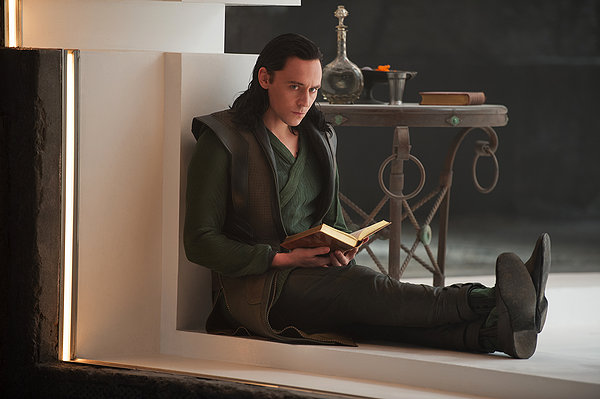 In a film dominated by a charismatic Loki, it’s no wonder that Thor 2’s real bad guy falls woefully short. Malekith is a confusing and altogether lackluster antagonist in every conceivable way. He has no personality to him; he’s simple-minded with the goal of eradicating the universe. I don’t know about you, but my bad guys better have a pretty good reason for destroying the universe since they kinda live there too. This is one of the lazier villain plot devices because it has no nuance, no shading. Apparently before there was a universe there were dark elves. I don’t want to get caught in a chicken-egg paradox here, but was there a universe before the universe, cause I look at the universe like existence’s garage. The cars inside may change but the garage was standing before it all. Anyway, Malekith wants to destroy all life because he wants to, because certainly you’d think there would be enough space in space. He’s not even that threatening or given any particular advantage beyond some firepower. It’s no wonder that Loki runs circles around this chump in the villain department. Eccleston (Unfinished Song) is not at fault. The heavy makeup he’s under smothers the actor’s ability to polish this terrible character.
The rest of the acting fares better. At this point, we know what we’re getting with Hemsworth (Snow White and the Huntsman) as the title character. He’s a sturdy leading man with just enough appeal to satisfy, though part of it is that Thor is just dull as a hero. He was more entertaining when he was cocky and irresponsible. Portman (Black Swan) holds her own though the romance between her and Thor feels more forced. Hopkins (Red 2) strikes the right mix between regal and camp. While their roles aren’t exactly integral, it’s nice having a superhero movie stuffed with great actors like Idris Elba, Ray Stevenson, Adewale Akinnuoye-Agbaje, Clive Russell, and there’s even an amusing appearance by Chris O’Dowd, who effortlessly oozes charm (take note, Thor).
This a superhero movie that separates itself by its sheer sense of fun. Thor: The Dark World takes what worked in the previous movie and provides more of it. The campy, silly Asgard stuff is given even more time, the mischievous sense of humor is renewed, the fantasy worlds given more depth and better action/effects, and fan favorite Loki gets a big starring role this time with extra brotherly bickering. It’s not the best superhero movie, nor is it the best Marvel film of recent years, but Thor 2 knows what kind of movie it wishes to be and how to best achieve this. It’s a loopy, droll, and rather imaginative big-budget superhero film, while still finding ways to be somewhat generic with its overall plotting and character turns. While the action is suitably epic, it’s the character interactions that are the most enjoyable aspect. It seems excessively lazy to say that if you enjoyed the first Thor, you’ll probably enjoy the second one as well, but there it is. Perhaps next time the storyline won’t be as convoluted and we can get even more Loki. Barring that, I’ll accept additional Chris O’Dowd screen time.
Nate’s Grade: B
Share this:

Snow White & the Huntsman (2012)
 Snow White & the Huntsman is meant to be a darker, splashier, more action-packed retelling of the classic story, and when compared with the earlier 2012 Snow White venture, Mirror, Mirror, it certainly merits all those descriptions. With Twilight star Kristen Stewart at the helm, this movie seems tailored for teens looking for some girl power. I have no problem with reworking fairy tales to suit our modern-day cultural interest, but just giving a person a shield and a sword does not instantly make them a warrior. And just plopping Snow White into a medieval war does not instantly make this a movie worth watching.
The wicked Queen Ravenna (Charlize Theron) killed the king and installed herself on the throne. She sucks the youth directly from ingénues to keep those good Theron looks of hers. She is the fairest of them all but she is warned that one day the king’s daughter, Snow White (Stewart), will overtake her in fairness. Snow’s been living in a prison cell for about ten years since her evil step-mom took power. She escapes her imprisonment and flees to the Dark Forrest beyond the castle grounds. The Queen’s powers will not carry over into the Dark Forrest (for whatever unexplained reason), so she hires the Huntsman (Chris Hemsworth) to retrieve Snow White. The Huntsman changes sides, allies himself with Snow, and some dwarves, and then everyone bands together to retake the kingdom under Snow’s stout leadership.
 Snow White & the Huntsman falls victim to that age-old screenwriting curse of failing to show us its work. I get so sick of movies, or any narrative really, that heaps praise upon some person and then never shows us any convincing evidence. If somebody is said to be a great poet, I want to hear one of his or her great poems. If somebody is said to be a great leader, then I want to see him or her inspire. To make up for the plot shortcomings, the screenplay reminds us at every moment of downtime how special Snow White is, how glorious she is, how different she is, how she is the only one to bring down the tyrannical rule of Ravenna. At no point did I believe any of this. Just because I have characters tell me, ad naseum, that someone is special doesn’t make it so. I need to see the evidence, and from what Snow White has to show, it is not that impressive. She’s somewhat resourceful, escaping from captivity, but she’s not exactly a figure of compelling strength, magnetism, or inspiration. She gives one “rally the troops” speech that gets the townspeople all fired up to go to war; it’s no St. Crispin’s Day speech, but even if we’re grading on a curve, it’s a pretty weak motivational speech. There’s no reason these people would line up behind this displaced damsel other than the fact that the plot requires them to do so. This Snow lady has, much like the infamous Bella Swan, the personality of a dead plant, and all the proclamations to the contrary will not change that fact. Snow White is just not an interesting of compelling person, period.
There are two reasons why Stewart is completely wrong for this part. First off, when we’re objectively talking about one who is “fairest of them all,” and Charlize Theron is in your movie, you’re going to lose every time. I’m not saying Stewart is wretched looking; quite the contrary. Debut director Rupert Sanders finds ways to film her that make her look lush and vibrant. Some would argue “fairest of them all” is not in references to physical beauty, which it has always been, but to the fact that Snow’s heart is so pure and good. If that’s the case, that’s just stupid. Then why even make it Snow White if the nemesis to the evil queen is simply somebody who is morally just? You could have had a commoner play the role and that would have brought about more interesting class conflicts. Secondly, Stewart is such a modern era actress, someone who has so effectively channeled the rhythms of a blasé generation of young people, that dropping her into a medieval time period is jarring. She doesn’t fit. Everything about her aloof acting style screams modern times. Maybe that’s why her speaking is kept to a minimum. She can ride on horseback, dress in Joan of Arc armor, but she’ll never strike anyone as a fitting Epic Heroine. I feel that her acting has blended with the sullen nature of Bella Swan to the point that it’s hard to separate the two. I’m not a Stewart hater at all. I actually think she can be quite a capable actress (see: Speak, Adventureland, the upcoming adaptation of Kerouac’s On the Road) when paired with the proper material. Snow White & the Huntsman is not the proper material.
Aside from casting errors, this dark fairy tale doesn’t find any time to settle down and develop anything that could approximate characterization. Case in point: all we know about Snow is that she is a princess, everyone tells us how beautiful she has always been, she runs away, and then leads a rebellion, then she become queen (don’t pester me about spoilers). What else do we know about her? She’s defined entirely by outside forces, especially the charitable words of others. Snow White is not a character but a symbol, the prophetic Chosen One. She’s really a placeholder for every lazy archetype needed for epic fantasy. Stewart cannot connect with the material, so she seems to wander around, mouth agape, almost like she’s stumbling drunk through the whole movie. It seems that Snow White & the Huntsman just provides us the familiar elements of the story (evil stepmother, huntsman, dwarves) and expects us to fill in the rest with our own wealth of knowledge over the famous fairy tale. The rote insertion of a long-lost childhood friend/eventual love interest (Sam Claffin) is made tolerable only by the fact that he does not eventually become a love interest. This Snow doesn’t need a man, and good for her.
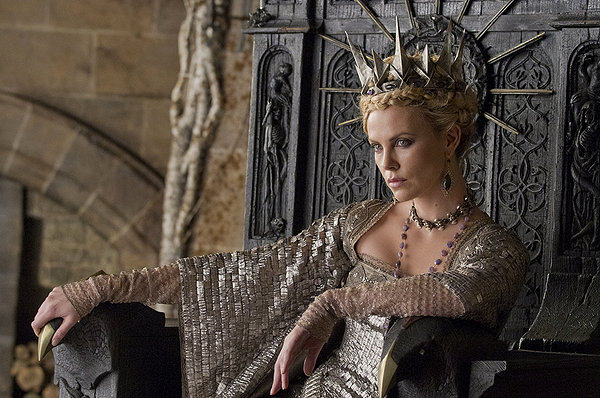
Sanders’ background in commercials definitely shows in his superb visual palate. The man knows how to frame a beautiful shot, and the visual highpoint is Snow’s hallucinogenic shamble through the Dark Forrest. Without the narrative traction, though, the movie starts to resemble one very long, very excruciating perfume ad, particularly when Snow comes across a white horse just laying down in the surf. Some of Sanders’ “ain’t nature great” creations deeper into the forest reminded me very strongly of Miyazaki’s Princess Mononoke, especially with the godly stag. Despite its considerable faults, Snow White & the Huntsman is a great looking movie. Sanders’ crisp visuals are further enhanced by wonderfully theatrical costumes from multiple Oscar-winner Colleen Atwood (expect another award on that mantle come 2013). Queen Ravenna has more eye-catching outfits than Cher in her heyday. They seem to be made out of interesting organic elements, like a gown accented with diminutive bird skulls. She may be a ruthless tyrant, but man does that lady know how to dress. The fashion choices became so exotic and intriguing that it provided another reason for me to hope we’d get more time with the queen. The production design by Dominic Watkins (United 93) is fittingly medieval. At least there’s always something nice to look at with this monotonous bore.
I don’t really get the geography of this kingdom. By all accounts, it looks like one poorly guarded castle, one poor mud town, and a deep expanse of forest. The fact that it’s labeled as the Dark Forrest seems shortsighted, since it takes a few hours continued walking to come across all sorts of other civilizations, including our scarred matriarchal society. And then there are dwarves too. It all feels so listless, lacking any sort of connective tissue to help round out this magical world. After a while, it just becomes an assortment of cool stuff just put into a movie because it’s cool. The fact that none of these magical creatures or assorted villagers ever pop back again, except for our coronation in the resolution, means they were meaningless to this story other than being a rest stop.
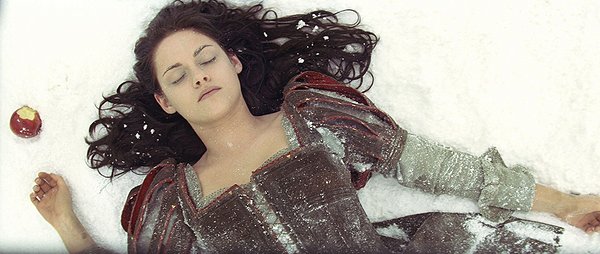 The screenplay is surprisingly rushed; rarely do we spend more than five minutes in any location. I was interested in a city of women with self-inflicted facial scars to protect themselves from Ravenna coming for them. Just as things start to get interesting, it’s like the movie gets antsy and has to keep moving, and we’re off again. It’s hard to work up any sort of emotional engagement for anyone when we just spend a few minutes with these characters. The brisk pacing also gives the impression that the characters really don’t matter in the end. If it weren’t for a scene where the Huntsman blatantly explains every feeling he has to a comatose Snow White, we’d know nothing about him. The Huntsman is grieving over the loss of his wife, and oh she just happens to have been killed by Ravenna’s creepy albino brother (Sam Spruell). The pigment-challenged dolt confesses this convenient bit of information at a strange time. Why confess to killing a man’s wife when you’re battling to the death? Confess afterwards. It’s another example of lame screenwriting and nascent characterization. Even the queen gets a bizarre throwaway bit of characterization. For whatever reason, we have a flashback to when she was a child and her mother forced her to drink the magic immortality elixir. Why did we see this? It’s too late to make her sympathetic. And yet, even this brief glimpse at Ravenna’s back-story makes her more interesting than our feckless Snow White.
The bleakly brilliant Young Adult renewed my fondness for Theron as an actress. For a while, she seems to really sink her teeth into the role, lapping up the villainy in a satisfyingly menacing manner. It’s at this lower level of burn, the quiet intensity, where Theron is most enjoyable. When the movie requires her to raise her voice is when things start to go bad. She shrieks in such a campy, over-the-top, weird overly enunciated style. Any hope of secretly enjoying this movie died with Theron’s stagy agitation. Hemsworth (The Avengers) adopts a thick Scottish brogue but does little else. At times I found that he looked remarkably like a cartoon tough guy; just something about his face lends itself to clean, burly definitions. The best actor in the movie is Bob Hoskins (Mrs. Henderson Presents) as a blind dwarf, and perhaps that sentence alone should say all that needs saying.
This film is more Lord of the Rings than fairy tale. It’s got some battles and some siege action to pacify the men folk, but this is obviously aimed at the ladies. It’s a feminist, Robin Hood-esque reworking of the Snow White tale, recasting the damsel as action heroine, and I’d have no problem with this revision if: 1) the film made her an actual character, 2) it had been played by anyone other than Kristen Stewart. It’s got all the familial elements but they have no context in this reworking; it lacks internal logic. If I did not have sufficient background knowledge about this tale, I’d be left wondering why any of this should make sense (apples are poisonous now?). At every turn, the movie has to tell us why things should matter rather than showing us. There’s no evidence onscreen why this Snow White lady deserves any fuss. Snow White & the Huntsman is a movie obsessed with appearance and precious little else. Snow White & the Huntsman is one boring, truculent, dreary chore of a movie that goes on far too long. Just because it’s darker doesn’t make it more mature or exciting. Fairest of them all, my ass.
Nate’s Grade: C
Share this:

The Avengers (2012)
 For the past four years, Marvel has been seeding its all-star super hero collective in the storylines of its summer blockbusters. And with six super heroes, The Avengers carries some super expectations. The creative mind behind the film is none other than Joss Whedon, best known for creating and shepherding cult TV shows like Buffy the Vampire Slayer, Angel, and Firefly. Not exactly the first name you’d think Marvel would assemble to front a $200 million movie. For geeks, Whedon has become a reliable standard of quality (the patchy TV show Dollhouse notwithstanding). Here is a man who can marry big ideas with sharp characterization and delightfully skewed dialogue. In Whedon, geek nation has a savior, and Marvel knew this. The Avengers is 142 minutes of geek arousal stretched to orgasmic heights.
Nick Fury (Samuel L. Jackson), head of the agency S.H.I.E.L.D., has a dire need for Earth’s mightiest heroes. Loki (Tom Hiddleston) has traveled through a portal and plans on conquering Earth thanks to an approaching alien army. Fury has tasked Tony Stark (Robert Downey Jr.) a.k.a. Iron Man, Steve Rogers (Chris Evans) a.k.a. Captain America, and special agent Natasha “Black Widow” Romanof (Scarlett Johansson) with stopping Loki and rescuing one of S.H.I.E.L.D.’s own agents, the skilled marksman Clint “Hawkeye” Barton (Jeremy Renner), who is under Loki’s devious mind control. Loki’s brother, Thor (Chris Hemsworth), would like to cite jurisdiction and bring his wicked brother back to his home world. The only person who may be able to locate Loki’s path is Dr. Bruce Banner (Mark Ruffalo), a guy with his own anger issues. With this many egos, it’s bound to get dicey. As Banner puts it, “We’re not a team. We’re a time bomb.” Can they put aside their differences to unite to save the Earth? Does a Hulk smash?
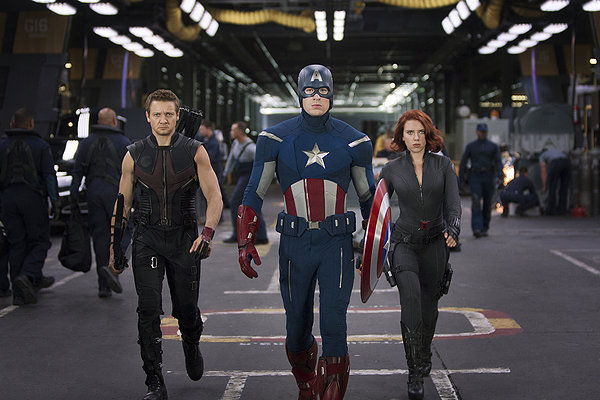 Whedon, the king of clever genre deconstruction last seen in the excellent meta-horror film Cabin in the Woods, plays it relatively straight, giving his big, effects-driven film a straight-laced sense of sincerity. It’s not making fun of these sort of big-budget, effects-driven smash-em-ups, it just wants to deliver the biggest smash-em-up yet. To that end, The Avengers achieves maximum smashitude (trademark pending). By its rousing finish, the movie has become so massively entertaining that you forget the draggy first half. The scope of this thing is just massive. The last thirty minutes is solid action across miles of crumbling, just-asking-to-be-exploded city landscape. But the trick that Whedon pulls off is how to orchestrate action on a monumental scale without losing sight of scale, pacing, and character. You’d think with a full deck of superheroes that somebody would be shortchanged when it came time for the rough and tumble stuff. Not so. Instead of fighting one another, the prospective Avengers work together in all sorts of combinations. The characters are well integrated into the fracas, making particular use of their abilities, and finding new locations of focus every few minutes. This expert hero shuffling keeps things feeling fresh amidst the constant din of chaos.
In fact, the movie finds time to give every hero his or her due, finding a small moment to reveal some characterization. I thought Whedon’s biggest challenge was going to be the juggling act of balancing so many heroes and so much screen time, but the man found a way, like he regularly does, to squeeze in character with ensemble action. The Hulk fares the best. After two movies, it feels like Whedon has finally nailed the character; granted, this success may be credited to the fact that Bruce Banner (all hail Ruffalo) is kept as a supporting character. The struggle of the character being likened to a recovering addict is a smart way to present the character without getting too morose (I enjoyed the revelation that the “Hulk” half prevented Banner from killing himself). When he’s told his mission is to smash, you can feel the exuberant joy of an unleashed Hulk id. The Hulk had two great audience-applause moments that made my theater go berserk. I also really liked the attention given to Black Widow and her lonely back-story. Hawkeye was a complete badass, though he only gets to do fun stuff in the madcap finale. The trouble with the hero team-up franchises is that not everyone’s on the same level of power. Thor is a god for crying out loud, Iron Man has super weapons, Hulk is Hulk, Captain America at least has superhuman strength but what do Hawkeye and Black Widow bring to the team? When you’re competing with all that power, being good with guns or a bow seems pretty puny. And with Hawkeye, there’s going to be a limit to his effectiveness unless he has a magic bag of replenishing arrows. Still, Whedon finds ways to make the heroes badass and humane in equal measure, and surprisingly funny, which is welcomed.
It’s hard to believe that Whedon had only directed one feature film before (2005’s Serenity, based upon Whedon’s canceled Firefly show) being given the keys to the Marvel universe. He’s directed several TV episodes of his signature shows but the man has never produced anything on this scale before. Given a gigantic canvas, Whedon delivers the goods. His action sequences are rollicking and fun and, best of all, shot and edited in a fashion where you can understand what is happening (take some notes, Hunger Games franchise). The action is well choreographed and elevated with organic complications and particular attention paid to location, like the Nicky Fury airship. Whedon is a master of the plot payoff, setting up his elements and then piloting the narrative to satisfying conclusions and integrations (Cabin in the Woods is also a pristine example of this gift). If you’re going to introduce an airship, you better believe that sucker is going to threaten to crash. I’m glad that Loki was brought back as he was the best Marvel big screen baddie yet, though I’m disappointed they essentially put him on ice for an hour.
 The technical elements are ably polished even for this kind of film. The cinematography by Seamus McGarvey (Atonement) is terrific, utilizing bright color in a way that the visuals pop. The special effects are top-notch and you just feel immersed into the action. The destruction is cataclysmic but rarely does the movie feel phony. I was impressed by the Hulk designs and the sequences in inky space with our alien adversaries. For that matter, are these aliens robots? It’s unclear whether the giant flying centipede-like ships are creatures. The 3D conversion is one of the better outings due to the fact that it doesn’t keep throwing stuff in your face. Plus, viewing Johansson’s leather-clad assets in 3D certainly has its own appeal, as does Gwyneth Paltrow in jean shorts. Hey How I Met Your Mother fans, Cobie Smulders looks practically smoldering in her S.H.I.E.L.D. agent outfit too. Okay, I swear I’m done with the female objectification.
I hesitate calling The Avengers the greatest super hero/comic book movie of all time, as the teaming hordes of Internet fanboys foaming at the mouth are wont to do. If your definition of a comic book movie is a giant sandbox with all the coolest toys, then this is your film. This is a comic book turned flesh. The Hulk and Thor fight and prove who is the strongest Marvel man, that’s got to be a geek’s wish come true. Many of the infighting sequences felt like, servicing the tastes of the fanboys, and after a while the constant hero on hero action felt tiresome. I get that we have a clash of egos going on here, but the movie suffers from a lack of narrative cohesion, by which I mean that the first hour of the movie feels like a series of guest appearances by heroes on loan. The movie doesn’t fully come together until the point where the team comes together; I doubt Whedon intended that symbiotic relationship. The movie feels more like a patchwork of standout scenes and memorable moments that a fully formed and cohesive story. If you haven’t seen the previous four Marvel movies (Iron Man, Iron Man 2, Thor, Captain America), you’ll be pretty hard-pressed to follow the story. Loki’s motivation and plan seems rather sketchy other than causing discord amongst the heroic ranks. His powers seem inconsistent and vague. Also I found the musical score by Alan Silvestri to be bland and unworthy.
The Avengers is sure to be geek nirvana for many of the comic book faithful. It’s an audience pleaser of mass scale, and I’m sure that your theater will be cheering in abundance. Whedon has pulled off the near impossible. The movie is a thoroughly entertaining, exciting, and witty popcorn spectacle of the first order. But where the movie hits the ceiling, at least for me, is that it ONLY wants to be the best super hero movie and this seems like limited ambitions. It’s like making the very best possible women in prison movie (great, but is this really all you set your sights on?). I had a great time watching Whedon’s handiwork but I wish it mined the outsized territory for bigger themes, a little more than audience-satisfying pyrotechnics, something I feel that X-Men: First Class did a better job of handling. Don’t get me wrong, I greatly enjoyed The Avengers and it’s a fantastic start to the summer movie season, but by no means is it The Dark Knight or even aspiring to be, and that’s okay. Enjoy the busy escapades of Marvel’s next smash franchise. Who knows when they’ll be able to wrangle everyone together for another adventure, but judging by the sounds of ringing cash registers, the answer is sooner than we think.
Nate’s Grade: B+
Share this:

The Cabin in the Woods (2012)
 The Cabin in the Woods has been building an avalanche of buzz in the time it’s been sitting on the shelf. Originally filmed in 2009, the horror comedy from Buffy the Vampire Slayer creative heavyweights Drew Goddard and Joss Whedon has been patiently waiting to unleash its wicked Jack-in-the-box of surprises. Directed by Goddard, and written by Whedon and Goddard, The Cabin in the Woods is a brash enterprise, a blast of entertainment and a breath of fresh air in a genre that typically teeters into self-parody. If you haven’t seen the movie yet and have a strong, or even curious, desire to do so, then stop reading. Go in as blind and unspoiled as possible. Then you can come back and read my witty words. It’s okay. I won’t take offense. In the meantime, I’ll keep myself busy. Back? Good, let’s get started then.
You know the setup. A group of dumb teenagers spend a weekend at a friend’s cabin in the middle of nowhere. There’s the jock (Chris Hemsworth), the slutty girl (Anna Hutchinson), the stoner (Fran Kranz), the bookish one (Jesse Williams), and the mousy girl-next-door virginal type (Kristen Connolly). There’s the scary old guy at the gas station, there’s the promise of debauchery and sweet oblivion. But we’re not the only ones watching the gang. A group of lab techs, led by Hadley (Bradley Whitford) and Sitterson (Richard Jenkins), is watching their every move. They control the cabin and its surroundings and are manipulating events to lead to slaughter. But why are they going to all this trouble? That’s just the tip of the iceberg here.
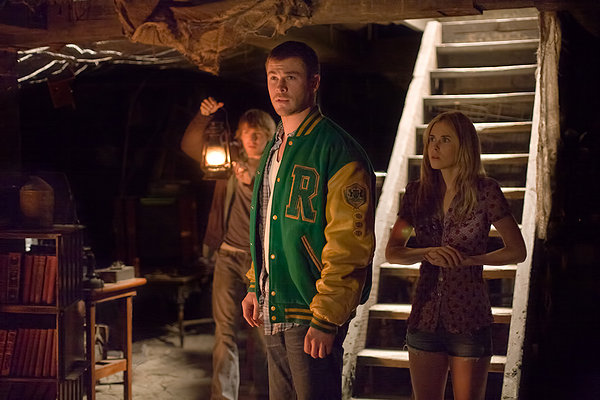 The macabre sense of humor is what will immediately separate Cabin in the Woods from its blood-and-guts brethren. The sharp dialogue is routinely laugh-out-loud funny, absurd in the right parts. Whitford’s downbeat reaction during a joyous moment of celebration had me howling. The movie is so smart, sometimes too smart for its own good. If you’re going to level one major charge against the movie, it’s that it isn’t really ever scary. Oh sure it has some stuff that should be scary given the particulars, and its 31 flavors of horror should find something that tingles everyone’s spine on some level. But this is much more of a deconstruction of the horror genre and its audience than an actual horror movie. Whedon and Goddard undercut their horror almost at every turn, settling for the ironic laugh or satirical tweak and repeatedly cutting back to the lab guys to provide a few good laughs and commentary (Jenkins has a terrific foul-mouth rant aimed at children that left me doubled over in laughter). Do not be mistaken; the lab stuff is easily the best part of the movie. Upon my second viewing, I found myself growing weary with the teens-in-a-cabin stuff and anxiously waiting our next detour into the weird and wonderful lab. The duo of Whitford (TV’s The West Wing) and Jenkins (Friends with Benefits) makes for some terrific and biting middle management corporate satire, as well as satirizing the jaded, bloodthirsty audience of slasher movies. You can tell that Whedon and Goddard love horror movies and are frustrated with the nihilistic rut the genre has found itself mired in. And as a deconstructive exercise, Cabin in the Woods is first-class. Roger Ebert succinctly called the movie a “fanboy final exam.”
It can be a tad clinical at times, failing to give us any true attachment to the characters even in an ironic sense, but when a movie is this fun, this wild, and this clever with its deconstruction of genre, I concede the point of having to root for somebody. The characters break the stereotypical mold; the jock is on academic scholarship, the smart guy happens to also be a hunky jock, the slut isn’t really slutty, the virgin isn’t squeaky-clean, and the stoner is the smartest guy in the group, aided by his cannabis (As one character later reasons, “We work with what we got”). He’s the only one who seems to be able to notice the strange manipulations at work. Once you dig into it, the very nature of how and why we watch horror is analyzed by Cabin in the Woods (get ready for some voyeurism parallels). The nature of fear and sacrifice is given some thought, though this stuff gets a bit lost in the madhouse of a final act. The movie becomes a funhouse of horrors and the frenetic carnage and chaos elevates the energy level. I cannot think of a movie that ended in such a whirling dervish of excitement and deep, demented satisfaction. This is one movie that doesn’t just end with a bang; it ends with every bang you can think of. Horror fans are going to be hopping out of the theaters, foaming at the mouth, desperate to tell every one of their friends what they just witnessed. I wish several of my friends would hurry up and see Cabin in the Woods so I had somebody to talk about its many pleasures, thrills, and surprises with. The movie has several terrific payoffs. This is the most fun I’ve had with a horror movie since 2003’s Cabin Fever. Must be something about cabins that brings out the meta-ness.
 Considering this was on the shelf for over two years while MGM worked out its bankruptcy dealings, it’s fun to see how fate has been to this lot of actors. The biggest name has got to be Hemsworth, better known as the flaxen, hammer-wielding God of Thunder Thor in the Marvel movies, and Whedon’s upcoming Avengers ensemble. He’s rather enjoyable onscreen and his hero moment is one that will definitely be a talking point. The two standouts from the cast, other than Jenkins and Whitford of course, are Connolly (“iGirl” on the Web series, iChannel) as the nubile Final Girl and Kranz (TV’s Dollhouse) as the clever pothead. Connolly has got a great face for movies, looking like the younger sister of Ellie Kemper (TV’s The Office) or Jayma Mays (The Smurfs), and I’m always a sucker for a redhead. Kranz is so good with the comedy that you may fail to notice all the work he’s actually putting into his role, which quickly becomes the audience’s voice of reason.
But the strangest quirk for a movie knotted with them comes to the casting of its resident “slut” played by Hutchinson. The woman has a sultry side that comes through without going overboard into parody. Scanning through her resume, I see that Hutchinson portrayed the Yellow Power Ranger (Lilly) for 32 episodes in Power Rangers: Jungle Fury. Now here’s where things get interesting. Being the movie aficionado that I am, I recognize that Cabin Fever also had an actress, Cerina Vincent, who portrayed the Yellow Power Ranger (Maya) for 45 episodes in Power Rangers: Lost Galaxy. Here’s where it gets even weirder. Both Hutchinson and Vincent are the only cast members in their movies to go nude in their respective films. So two actresses, both different versions of the Yellow Power Ranger, both get naked and star in horror genre deconstructive movies with “cabin” in the title! Is this one of the Mayan signs? Should I contact Dan Brown? Does it say something that the yellow ranger appears to be the most comfortable with nudity? This may be the greatest and most obscure observation I’ve ever made.
Of course there are so many fun surprises that it puts me in a bit of a critical bind. I don’t want to go into too much detail because that would spoil the fun, though rest assured that The Cabin in the Woods does not live or die based upon unknown plot twists. You may think you know given what’s already been revealed via the trailers, but really you have no idea how deep this thing goes and to what ends. Unless you just happened to be me, which at last count there was only one of (my evil twin long since slain… or was he?). I say this not as some point of pretentious bragging, but it’s because I wrote a horror screenplay a year ago that also satirized the genre tropes (for those few interested, it was called Blood Wake). I won’t go into spoiler detail, but both of our bad guys were called into question as being bad, from a greater good standpoint, and the killers had more on their minds than simply punishing dumb, horny teenagers. Well, after watching Cabin in the Woods, I know that screenplay goes back in the shelf now where it will live in eternal slumber thanks to core similarities. But if somebody’s got to be wielding the knife, at least it’s my man crush Joss Whedon.
Nate’s Grade: A-
Share this:

Thor (2011)
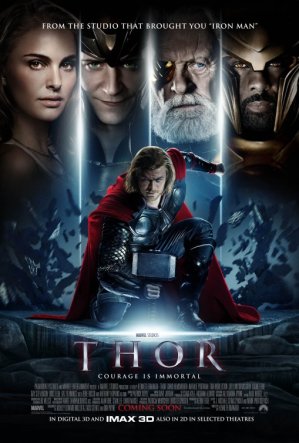 I had strong misgivings going into Thor. How was a powerful Norse god going to seem remotely relatable? How was the most improbable member of Marvel’s Avengers ensemble going to be explained in a way that didn’t feel like a ton of cheese richly slathered in hokum? I was expecting this movie to be a silly, trippy, LSD-enhanced flashback (rainbow bridges! Pass the bong!) that could barely strain any sense of believability. It’s one thing to have stories about super heroes who have gotten their powers via genetic defect, scientific accident, or act of God. But what about when your character happens to be a god? It just seemed too goofy for it all to be pulled off with any conviction. A Thor movie seemed destined for some Xanadu-level of camp. Get a load of the blonde with the big hammer, boys. Not every super hero flick has to be as brooding and dark as The Dark Knight. Marvel’s own Iron Man was a great example of a briskly entertaining movie. Now that I’ve prefaced my experience, let me publicly admit that Thor is indeed a somewhat silly but mostly fun entry in the mighty realm of summer blockbusters.
Thor (Chris Hemsworth) is the god of thunder on Asgard, a distant planet populated by the Norse mythical figures (apparently, they visited Earth and the Scandinavian amongst us worshipped these… space aliens?). Thor waits to inherit the throne from his father, Odin (Anthony Hopkins), a wise king who has kept a tenuous truce with the fierce Frost Giants, inhabitants of another planet. But Thor is not ready to assume the responsibilities of leadership. He’s quick to action and temper, arrogant, and defies his own father’s orders by trying to start some intergalactic conflict with the Frost Giants on their home turf. Thor is robbed of his powers, his mighty hammer, and banished to Earth to walk amongst the smelly Earthlings. He crashes in the New Mexico desert and is retrieved by a team of scientists (Kat Dennings, Stellan Skarsgard) led by Jane Foster (Natalie Portman). The group wants to learn where exactly this man from the sky came from. So does the government, led by the S.H.I.E.L.D. agency who takes possession of Thor’s hammer. Thor thinks if he can reunite with his beloved hammer, then he can go home. But for a thunder god, he’s got a lot of lessons to learn. While Thor is out of the picture, his younger brother, Loki (Tom Hiddelston), plots to take what he feels he is owed – the kingdom of Asgard.
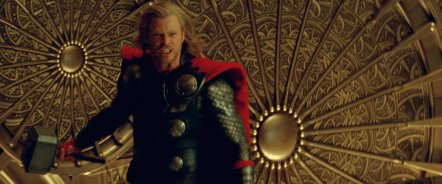 The biggest surprise for me was that the Asgard sequences are the best part of the movie; thankfully the majority of the running time is spent in this fantastic realm. I credit Kenneth Branagh’s direction, which neither hides the silliness of the material nor fully acknowledges it. By the time Thor hurtles to Earth, I was completely engaged in the operatic tale of fathers and sons, gods, jealousy, hubris, intergalactic conspiracies, you know, the stuff of juicy drama. It jus so happened that these characters wear funnier costumes. The family dynamic between Thor and Loki, the infighting and the scheming, intrigued me. Some critics have thrown around the word “Shakespearean” to describe the movie’s outsized family conflict, but I think that’s just the critical community getting lazy. Would they even approach that term is Branagh was not the director? This opening section of Thor effectively explains the history of Asgard as well as its place with the other eight worlds, the shaky relationship with the Frost Giants, the family responsibilities at play as Odin must decide the future of his ABBA-infused nation, as well as the various mechanics of how this different world operates, like Idris Elba (The Wire, Luther) stationed at the end of the rainbow as a gatekeeper to the other worlds. I liked discovering how all the pieces of this world fit together. If analyzed out of context, any part of the Asgard section just seems stupid. But taken in the film, Thor‘s crazier, more fantastic elements come together and spark genuine interest. I wanted to spend more time in this magical realm. The more ridiculous and fantastical that Thor got the more interesting it became.
But unfortunately Thor was sent tumbling to our ordinary planet. It is the Earth section that seriously deflates the movie’s vibe. It’s a relief that the fish-out-of-water comic relief is kept to a minimum, because the character of Thor isn’t an idiot, just an arrogant brat. But it’s the period on Earth where the God of Thunder learns his Really Important Lessons and finally understands what it means to be a good leader. It’s all very expected and the execution is less than inspired. The trio of scientists that Thor encounters (Portman, Skarsgaard, Dennings) could easily have been consolidated into one character. Their contributions to the story are weak. Skarsgard is mostly there for fatherly advice and the occasional expository ejaculation. As a gawky little sister scientist, I don’t even know why Dennings is in this film other than to make my eyes happy. I anticipated that Portman would assume the “love interest” spot in comic book movies that we now reserve for Oscar-winning actresses, and I assumed that role would be underwritten. But I never expected Portman’s part to be this underwritten. She’s practically nonexistent except for that winning smile of hers. Over the course of… two days, she falls in love with our banished brute. But to be fair, it’s not every day that a guy looking like Hemsworth falls out of the sky. New Mexico isn’t exactly looking like a great singles mingles hotspot. Anyway, their relationship is supposed to be the trigger that makes Thor realize he’s been a selfish and reckless fool. But their scenes lack any tension, any charm, anything of interest. They feel like two actors sitting in chairs telling stories. You don’t feel any romance between them. The drabby Earth sequences only serve as a losing contrast to the crazy Asgard territory. You can’t compete with rainbow bridges (imagine the tolls on those suckers).
 Branagh has never directed anything of this magnitude in size before, and it shows at parts. While none of the action sequences are particularly bring, none of them are particularly thrilling. The beginning battle between Thor and his pals on the Frost Giant planet (Jotunheim) is so poorly lit that the darkness forces you to squint to focus on what’s happening. Why spend $150 million on a super hero flick and shoot a dankly lit action scene? What’s the point in that? The choppy editing can also be too hectic to follow with all the quick-cuts that fail to orient the action geography. Really, there are only three serious action sequences in Thor, but then again I remember Iron Man having a light load when it came to on screen action. That film was devoted to character and performance. This film, under Branagh’s watch, is devoted to just making the entire universe of Thor credible. It’s a lot to take in, and Branagh’s biggest accomplishment is producing a sense of grandeur to the film that saves it from falling into the sticky clutches of camp. The world of Asgard feels convincing in production design and infrastructure; the cities look like pipe organs. Branagh’s film expands the Marvel universe significantly, broadening the scope for future installments. Mercifully Thor does not hard sell the upcoming Avengers movie as appallingly as Iron Man 2.
The acting in Thor is as splashy as the Asgard scenery. Hemsworth gave a notable performance as the doomed father of James Kirk in 2009’s Star Trek. He as only in the film for that ten-minute prologue, and yet the actor found a way to do much with what he was given. You got to see his character hurdle through a gauntlet of emotions: fear, duty, relief, desperation, and acceptance. His sacrifice still can make me tear up, and Hemsowrth deserves some of that credit. However, Thor is a different matter entirely. Obviously it’s going to be a more challenging role to play a buff cocky god with a magic hammer. Buff he does quite well. Cocky he does fairly well, but this is not a great starring vehicle for the actor. Hemsworth looks too self-satisfied, like he’s playing his character as an intergalactic hotel heiress. In sharp contrast, Hiddelston (Wallander) commands your attention. Those penetrating eyes, the cold yet calculated demeanor, this is an actor who feels like he walked off a Shakespeare production and just changed his headgear. You want to spend more time with Loki than watch Blondie futz around on Earth. Loki has much more depth to him than Thor; he feels betrayed by his family and an outcast to his society. I’m glad that we’ll be seeing more from this trickster in future Marvel movies (have I said too much?). Hopkins knows how to sell silliness like few other actors. And for those who have been wondering where Renee Russo has been for the last six years, well here she is, as Thor and Loki’s mother, a role that’s best suited to confirm that she is still alive.
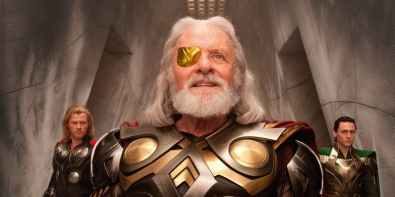 I was expecting far worse judging upon the scraps I had seen from the Thor advertising campaign. So I suppose that beating my low-flying expectations might not necessarily be something to champion. Thor is an inherently goofy, yet mildly satisfying and credible action film. It doesn’t have the style or panache of other heroes, but the fact that Branagh could make a two-hour Thor film that didn’t cause me to laugh derisively from start to finish is an accomplishment. Again, that sounds rather dismissive. I’m just very surprised that this movie works. Because if you take it apart, it doesn’t seem like it should. The acting ranges wildly in quality, with Hiddelston outshining everyone else. Thor is a solid if inconsistent start to the summer season of blockbusters. If you must turn your brain off for some movie, you’d do far worse than Thor. It has pretty colors.
Nate’s Grade: B
Share this:

Star Trek (2009)
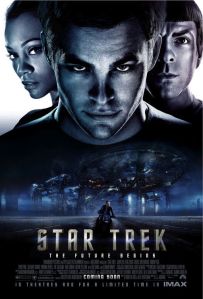 Star Trek has a hold on geek culture like no other franchise. It’s lasted over forty years, sustained five television series, and ten feature films (about four of them good), and let’s not forget the plethora of fanatical merchandise that includes everything from Trek cologne to Trek coffins. Star Wars has all the box office clout, but Trek has followers so devoted that they will create and learn a separate language, Klingon, that almost assuredly will never be spoken by anyone else outside of the festival circuit (you will never see a written Klingon exam that asks you “Where the library is?”). The Star Trek fans have been a foundation of geek culture for over four decades. People take this stuff very seriously. Trek has always been a headier brand of sci-fi, more devoted to ideas and moral dilemmas than shoot-outs and space chases, though Captain Kirk did teach the universe how to love, one green-skinned buxom alien babe at a time. 2002’s abominable Star Trek: Nemesis was meant to open up the franchise to a wider audience, but the film was the low-point for a franchise that also included William Shatner writing and directing the fifth flick (Nemesis also broke the odd/even movie curse).
When director J.J. Abrams approached Star Trek with the purpose of reinvigorating the flagging film series, you would think the man would wade into such a storied franchise with trepidation. Nope. He openly said he was making a “Star Trek movie for people who weren’t fans of Star Trek.” He was even going to change Trek canon. I imagine Trekkies (and no, I will never use the preferred nomenclature “Trekkers”) were nervous about an outsider, the author of the cinematic classic Gone Fishin’, meddling with hallowed ground. As I suspected, these fears were unfounded. The newest Star Trek does more than put a new coat of paint on an old franchise. This movie boldly goes where none of the Trek movies have gone before — turning reverent geek culture into a grand populist entertainment smash.
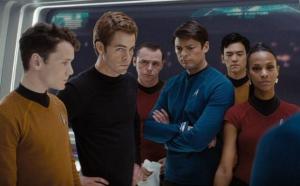 This new incarnation looks backwards, explaining how the crew of the U.S.S. Enterprise came together. The movie shows the path of Jim Kirk (Chris Pine), from troubled youth to eventual starship captain. Kirk’s father captained a starship for about 10 minutes, but he managed to save 800 lives under attack, including the birth of his son. Captain Pike (Bruce Greenwood) recruits Kirk to Starfleet Academy with the promise of doing something more with life. We also witness the boyhood of Spock (Zachary Quinto), who is teased for being half-Vulcan and half-human. His human mother (Winona Ryder) encouraged Spock to embrace his human emotions instead of cutting them off, Vulcan-style. Kirk and Spock clash at the Academy, and then an emergency requires all the recruits to saddle up for their first mission in space. Nero (Eric Bana) is a dastardly Romulan who has traveled back in time. In the future, he blames an older Spock (Leonard Nimoy) for the destruction of his home planet and the deaths of billions of Romulans. To ensure this does not happen, Nero is going to eradicate Starfleet home planets, starting with Vulcan and then Earth.
J.J. Abrams is a geek’s best friend. He understands geek culture, and yet the man is able to take genre concepts and make them easily accessible to the unconverted while still making a finished product that is respectful, playful, and awesome. Abrams is an expert on the pop culture catalogue, and he knows how to make genuinely entertaining productions that succeed on brains as well as brawn. He brought tired spy conventions into the twenty-first century with the cool, twisty Alias and Mission: Impossible III, which was really an extravagant two-hour episode of Alias, and I mean this in the best way. He has an innate understanding of action sequences and knows well enough that an audience needs to be engaged emotionally, so he makes the action as character-based as much as possible. Abrams has a terrific imagination behind the camera, and he reminds me of a young Steven Spielberg in his ability to marry artistic integrity with big-budget crowd pleasers. Abrams and his screenwriters Alex Kurtzman and Roberto Orci (Transformers, TV’s Fringe) have crafted a stellar Trek that will appeal to die-hards and those who couldn’t tell a Romulan from a Vulcan (I fall somewhere in between).
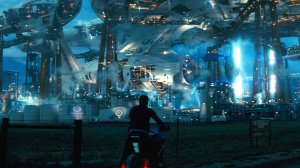 The time travel storyline could have used more juice, however, it serves its purpose by establishing a parallel Trek universe to work with. Beforehand, Trek had established so many previous stories that it hamstrung writing new stories because they had to be extensively researched to make sure they did not conflict with 40 years of canon. Abrams and company wrestled free from the grip of the established history and can now play around unencumbered to a degree. I mean, fans don’t want to see something radically inauthentic, but Uhura and Spock as a couple? Sure, why not? The fan favorite character catch-phrases (“She’s givin’ it all she’s got,” “Dammit Jim, I’m a doctor?,” etc.) are organically worked into the story so that they don’t become falling anvils.
Star Trek‘s pacing can be whiplash inducing. It speeds through two hours of action and setup while still maintaining an emotional connection to the characters involved. The movie has a boyish enthusiasm for adventure and it’s fun watching well-known characters assemble and amble into new and interesting directions. The action is routinely thrilling and I enjoyed Abram’s small touches, like watching a crew member get sucked out into space and cutting all sound to illustrate the cold, empty vacuum. The amount of humor injected into the movie can be distracting at times, not because it isn’t funny but because of the brisk tone breaking. One second it’s a life-or-death scenario and the next Kirk is running around with giant goofy hands. Still, it’s good to see some humor in the Trek universe that isn’t related to alien culture clashes.
The young ensemble is amazingly well cast. I didn’t think a younger generation of actors would be able to step right in and play such lived-in characters, but they pull it off. The hardest shoes to fill are unquestionably Kirk’s, and Pine (Smokin’ Aces, Just My Luck) carries that same cocksure bravado without stooping to a stilted Shatner impersonation. His performance feels at times like Han Solo and Luke Skywalker rolled into one, and he’s an appealing presence that captures the essence of a dashing and rebellious scrapper. This Kirk is still an adventure-seeking, skirt-chasing 1960s kid at play. Quinto (TV’s Heroes) is blessed to look remarkably similar to Nimoy, but the actor also gets to explore the human side of Spock. He feels compelled to harness emotion, like all Vulcans, yet it’s intriguing when certain emotions slip out and build a bigger picture about what’s going inside the mind of a being dominated by logic. Quinto has less to work with by design and yet the man finds interesting ways to ensure Spock can be recognizable. Each of the supporting actors has their moment, but my biggest surprise was Karl Urban as Dr. Leonard “Bones” McCoy. Urban has mostly been confined to lame action movies as of late, like Doom and Pathfinder. But he’s really funny and his performance captures DeForest Kelly’s mannerisms down without turning into a caricature.
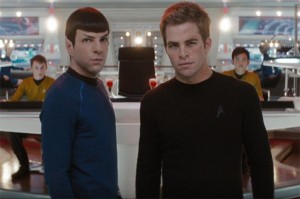 If there is a main weakness to Abrams’ Trek outing it’s that it feels far more like the opening act of a larger movie. Nero is a fairly weak villain, though Bana gives him a nicely polished glower. The villain is really just a tie-in for the time travel storyline, which is also a narrative quirk to secure an open field for further stories. Meaning, that much of the movie can be seen as assembling the pieces to simply move forward on their own. It’s an expensive set-up movie, and Abrams makes sure that the audience sees every dollar of the splashy visuals onscreen. Personally, I was also getting tired of the cinematography decision to fill the screen with as many light flares as possible. It seemed like every other moment had a blast of light beam in from some direction. After a while it sort of felt like an eye exam where the optometrist shines a flashlight back and forth. And it takes far too long for Scotty (Simon Pegg) to appear in the movie.
J.J. Abrams does more than hit the restart button. He has made a Star Trek that manages to be respectfully reverent but at the same time plays along to the mainstream visual sensibilities of modern cinema. It’s fun without being campy, reverent without being slavish, and this Trek never forgets to entertain from the opening assault on a starship to the Michale Giacchino’s closing credits score. This is an enjoyable rush of sci-fi escapism. The Star Trek series was always deeply hopeful and humanistic, believing in the best for humanity and that man, in cooperation, could achieve greatness. I think further escapades with this cast and Abrams at the helm could reach greatness. For now, I’ll be happy with this rollicking first entry into a franchise that seemed adrift in space. Bring on more of the green-skinned women.
Nate’s Grade: A-


 nathanzoebl
You must be logged in to post a comment.