Blog Archives
Incredibles 2 (2018)
 The prevailing problem with Pixar sequels (and prequels) lacking “Toy” in their title is that they never feel like stories needing to be told, tales that will enrich our understanding of the characters and their larger world. I would much more gladly like a Monster’s Inc. sequel where Adult Boo is visited by her old closet-dwelling friends rather than an inoffensively cute prequel explaining how characters became friends long ago. The Incredibles universe always seemed like the one most demanding of a real sequel. Writer/director Brad Bird created a rich retro-futuristic world with numerous possibilities. I’m happy to report that Incredibles 2, while not soaring to the exact heights of its predecessor, is still a very worthy sequel that even manages to outshine the original in select areas.
Taking place literally seconds after the conclusion of the 2004 film, the Parr family fights together against the Underminer. The city, however, is none too happy about the collateral damage. Superheroes are still illegal. There’s no more relocation either. The Parrs are stuck, until a pair of billionaire siblings (voiced by Bob Odenkirk, Catherine Keener) reaches out to try and repeal the superhero ban. They want to position Helen Parr a.k.a. Elastigirl (Holy Hunter) for the public relations campaign (she causes a lot less collateral damage than her husband). Bob Parr a.k.a. Mr. Incredible (Craig T. Nelson) encourages his wife to go out and save the day, though he’s barely holding back his jealousy. He takes on the domestic duties, helping Dash (Huck Milner), moody daughter Violet (Sarah Vowell), and the young baby, Jack-Jack (Eli Fucile, reprising the role of voicing a baby, for real). A villain known as the Screenslaver is terrorizing the city and hypnotizing citizens through hijacked broadcasts. Elastigirl tries to uncover the mystery of the Screenslaver while Mr. Incredible tries to juggle the realities of stay-at-home parenthood.
 Bird’s sense of visual inventiveness is still heartily alive and whimsically well in the medium of animation. Bird’s original film was an imaginative marvel with its intricate action sequences, some of which are the best in any medium, animated or live-action. He’s a choreographer of action that upholds the basic tenants of action, namely that if you have characters with special abilities, they should be utilized, along with attention toward geography and the purpose of the scene. It’s a genuine pleasure to watch well developed action sequences that go beyond flashy style, that account for mini-goals and organic complications. Take for instance Elastigirl’s motorcycle chase scene. It’s exciting as is but when the bike breaks apart, taking advantage of Elastigirl’s stretchy powers, that’s when it becomes even more gratifying and clever. There is a group of lesser super heroes that come out of the shadows thanks to Elastigirl’s heroics. At first they’re played for primarily comedic value, but Bird smartly turns them into a force to be reckoned with when they band together. I especially appreciate having a character with portal-manifesting powers and finding many opportunities to explore this unique power. When the film is humming with its visual energy and inventiveness, Incredibles 2 is a gloriously entertaining and satisfying action movie told by one of the best on the business.
The action is on par (no pun intended) with the first film even as the overall experience lacks the emotional stakes and depths of the first Incredibles. That should not be seen as some destabilizing deficiency as The Incredibles was a nearly flawless film (it’s my second favorite Pixar film after WALL-E). There were moments in the original film that transcended the superhero setting, where they Parr family felt like real people with real emotions and relatable stakes, like Mr. Incredible’s confession that he’s not strong enough to suffer the loss of his family. While Bird’s film made several homages to the James Bond cannon, there were real stakes. People could die. Many superheroes did, albeit mostly off-screen. This was Pixar’s first PG-rated film and that’s because it dealt with some heavy thematic issues in a mature manner. The bad guys weren’t like the movies, Helen Parr warned; they would kill children if given the chance. Incredibles 2 doesn’t have any real moments like that to cut through the whiz-bang.
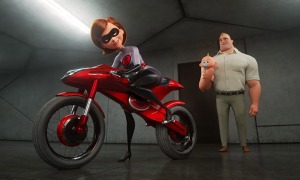 This time it’s Elastigirl enjoying the limelight, and there’s a notable feminist message of a woman finally getting her due. She relishes the adventure though is willing to sacrifice it for her family if needed, which her husband will refuse to allow her to do. Her success is his success, he reminds himself. The sooner she succeeds the sooner he can also get back out there to fight crime. I think one of the reasons the characterization isn’t as developed this time is because of the abbreviated time frame. We’re literally picking up seconds from the first movie and dealing with the immediate consequences. We’re only following the events of a few weeks, maybe months at most, and while the Parr family undergoes trials and disappointments, It feels like maybe there just wasn’t enough space for the characters to have succinct arcs and grow substantially. This is a quibble for an otherwise great movie. Incredibles 2 still stay true to the characters you love.
The exploration of Mr. Incredible’s descent into domestic life was my favorite part of the film, and I had been worried it would be outdated Mr. Mom-style jokes. The movie steers away from most of the tired gender tropes, moving past simply having an incompetent man performing household duties in hilariously incompetent ways. The jokes aren’t dependent upon a man doing them so much as someone who feels out of step and beleaguered, so parenthood in general. The first movie was about midlife identity crises and that has carried over into this sequel as well. Bob has a meaningful challenge with each one of his children, having to re-learn old concepts with his son and adapt to new ones, having to tackle the minefield of dating with his daughter and finding the right tone, and the increasingly the demands of a child with, let’s call them, special needs. The Jack-Jack segments are inspired pieces of old school Looney Tunes slapstick. Each new power provides another point of discovery for our characters that, remember, are initially clueless about Jack-Jack’s amazing abilities. Mr. Incredible is so eager to get back to being a super hero that forcing him to confront his own inadequacies as a parent is a smart way to better open him up as a three-dimensional character. I enjoyed the action of Elastigirl’s spotlight missions but I kept looking forward to returning to the other Parrs.
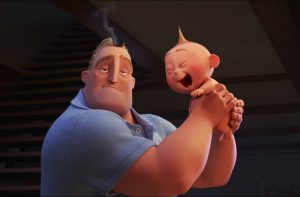 In a few areas I would even say Incredibles 2 has its original beat, especially in the realm of comedy and visual inventiveness. Part of that is simply the advancement of the technology allowing Bird more freedom to up the ante as well as showcase more intricate facial emotions. There are some areas that just cannot compare, which is not to say that they are bad on their own. The late twist of the villain’s identity should be more than obvious for anyone paying attention. The themes of this movie are much hazier this time around. There are a few that pop up, like police surveillance and body cams, then a general screed against the general social malaise brought on from technology, then breaking unjust laws to serve a more realized sense of justice, and then finally the movie settles on what seems like its true theme, the danger of being too dependent on, essentially, government assistance. If the superheroes represent the government, the villain’s plot is to shake people away from waiting for the superheroes to fix everything and growing over reliant on outside assistance (finally a summer blockbuster with a message even Paul Ryan could love). Bird has featured some Randian ideals in past films, The Incredibles a prime example. My pal Ben Bailey strongly believes that the first film’s villain had the right idea though wrong method. Superheroes are by design egotistical. The belief that there are people who are better and deserving of a elite, preferential status seems antithetical with the sequel’s major theme. Or maybe it’s the mutated evolution of Ayn Rand’s sense of political objectivism. Feel free to debate at the kitchen table with your own family.
If the major fault of Incredibles 2 (there is no “The;” look it up if you doubt me) is that it can’t quite live up to the dizzying heights of the original, then that’s hardly a damning fault. In the 14 ensuing years, the superhero movie has become the dominant Hollywood blockbuster, and Bird needed to think long and hard about how his return visit would distinguish itself from a cluttered landscape of super heroics. Bird finds meaningful and interesting stories for both the “normal” version of his family unit as well as their super selves. Fans of the original should find more than enough to entertain themselves with even if the depth and characterization aren’t as wonderfully realized. There’s great comedy, great action, and great fun to be had with Pixar’s best sequel not with “Toy” in its title.
Nate’s Grade: A-
Share this:

Tomorrowland (2015)
 Crafting movies around theme park rides is a rather risky creative proposition. For every Pirates of the Caribbean mega-franchise, there’s a Haunted Mansion. Theme park rides are more locations then they are stories, so it’s an adaptation where there’s nothing really to adapt except for a setting starting point. Tomorrowland has a few nods to its spiritual source material, but it’s an original science fiction film with much on its mind beyond entertainment. With Brad Bird (Mission: Impossible Ghost Protocol, The Iron Giant) turning down the new Star Wars to make Tomorrowland, I had definite expectations. Bird hasn’t made a bad movie yet. He still hasn’t but Tomorrowland is definitely the worst film in Brad Bird’s heretofore-unshakable pedigree.
Casey (Britt Robertson) is a dreamer with a capital D. While her teachers bemoan the cataclysmic shape of world events and instability, she doggedly raises her hand to ask, “Yeah, but what can we do to fix it?” Her father works for NASA but the nation has lost interest in space and has stopped looking at the stars. Casey sneaks out every week to thwart the demolition of a NASA launch platform. She can’t let it go. She comes across a mysterious pin that, when touched, transports her to a hidden world, a future city called Tomorrowland. But there are others that are looking for this city too. A slew of androids chases after her to retrieve the pin. Robot child Athena (Raffey Cassidy) becomes a protector for Casey and the two set off to find Frank (George Clooney), a hermit and mechanical mastermind who once lived at Tomorrowland before becoming disillusioned.
 This is one of the few movies where the more characters explained the plot the more confused I ultimately became. The story by Bird, Damon Lindeloff (Prometheus, HBO’s The Leftovers) and Jeff Jensen doesn’t exactly a clear narrative, and that begins with the structure, inserting two framing devices that are too cute for the movie. The first 15 minutes is Frank’s childhood experience discovering Tomorrowland, and this is probably because we won’t see Clooney’s grown-up Frank until an hour into the movie. It takes far too long to get going, instead becoming a series of unnecessary plot detours, like a trip to a collectibles store in Austin or a trip to the Eiffel Tower. Is there a reason that a return to Tomorrowland is saved for the very end of its final act? Probably because utopias are boring, which the movie itself admits and admonishes us for accepting. You see, dear reader, it’s all of us and our collective negativity poisoning the planet. Our use of cynicism and our love of dystopias in movies and literature are to blame. In this proclamation, a movie as madly genius as Mad Max: Fury Road is leading to the downward spiral of humanity, and nobody who sees that brilliant film could accept that. Tomorrowland has some legitimate points, precisely aimed at the inconvenience of action over the convenience of stasis. In one of the better articulations of its shiny happy message, a character says that people accept the worst because “they don’t have to do anything today.” It’s the global equivalent of, “I’ll start my homework tomorrow,” knowing we’ll probably never get around to it, to our own detriment.
Tomorrowland’s idealism would be easier to swallow if it wasn’t so oppressively scolding. First, allow me to reject its notion that popular culture wallows in darkness and there is no inherent value with this predisposition. If this was true then no one would read the wealth of Russian literature, which is reams and reams of pages of suffering, unrequited longing, confusion, anxiety, pressure, and finding what grace one can. One of Casey’s teachers upholds George Orwell’s 1984 as a living testament to what we’re going through today, but Orwell’s novel isn’t popular or well revered just because it’s desolate. Would millions of readers be foolish for finding something powerful and poignant in Cormac McCarthy’s award-winning dystopian cannibal road trip, The Road? Just because one is optimistic doesn’t mean you’re in the right, and just because one is pessimistic it doesn’t mean you’re in the wrong. Perhaps the culture is too hesitant to take necessary action because it’s easier to buy into the argument that our actions are meaningless; hence why the newest argument against environmental reforms to curb the effects of climate change amount to, “Yeah, but what difference will it make now?” If Tomorrowland was trying to rouse its audience into action, it went about it the wrong way. The movie’s tone is far too scolding and stuck on can-do platitudes to be anything beyond an earnest motivational poster that will ultimately be ignored.
Then there’s the film’s restricted view on what constitutes the Right Dreams. Casey refuses to allow the NASA launch station to be demolished because it supplies her dad with a job, but really it comes down to her idealism of man’s capacity to achieve. And yet, her chosen way of expressing this, besides general perkiness, is to cling to an older definition of what constitutes achievement. The space shuttles were grand but we’ve outgrown them and space travel itself has migrated into the private sector. Just because U.S. astronauts aren’t being launched into space with the frequency they once were, does that means the country has somehow lost its ideals? Or are we allowed to adapt to the demands of the times? Strangely, Tomorrowland holds onto a retro definition of what constitutes achievement, something also touched upon in Interstellar, where Matthew McConaughey shook his McConaugh-fist at all these young kids for not having the same level of interest in the old technologies and pursuits. Tomorrowland fixates on the scientific dreams of the 1960s, but that’s no longer a representation of our world. What it ends up pining for is a throwback to Disney’s own era of gee-whiz futurism, a world where flying cars are valued above, say, the Internet.
If you think about it, Tomorrowland’s utopia is pretty much a progressive version of Ayn Rand’s Atlas Shrugged. In Rand’s famous ideological tome, the “best and brightest” (a.k.a. rich industrialists) decide they’ve had enough with the common man getting in their way, and so they up and leave and start their own secret paradise where they won’t be disturbed by the likes of us “normies.” With Tomorrowland, it’s not the business types who take their ball and go home but the inventors, scientists, and artists, the creative class, who are given magic passage to a hidden world where their work will be undisturbed by those deemed less creative and/or essential. It’s intended to be inspirational but it awkwardly falls into a murky class-consciousness it can’t escape. Who defines the value of creativity exactly? Is there a Tomorrowland board of directors that says, “You know what, we definitely need that guitar player. Forget having plumbers.” Are the day-to-day laborers and paper-pushers, the ordinary people that keep the infrastructure of the world running, are they just deemed less significant? Tomorrowland apparently only has the best and brightest when it comes to all things, including the people that take out your garbage and unclog your sinks. Are the gravediggers the finest from around the world? Is the world’s greatest and most creative gravedigger still a few notches below a rather lackluster environmental scientist? As you can see, it invites all sorts of questions that will go unanswered because, again, the film’s message is everything, and the particulars of its invite-only exclusive society are off limits.
 The action sequences are also strangely dull for a filmmaker such as Bird. Each sequence has its moments of inventive orchestration, especially a brawl in the sci-fi collectible shop that squeezes in lots of homage. Too often the action is missing the creative spark Bird has showed in so many of his past films, particularly 2004’s The Incredibles. The mayhem is also a little too intense for younger children, especially with real people being so callously zapped into dust out in the open (not exactly keeping a low profile, robot henchmen). There’s also a child robot who factors into a lot of the peril, and then very uncomfortably into a late scene where she expresses her love for the grown-up Frank. I understand they had a connection when they were kids but the movie still ends with Clooney cradling a child in his arms and talking what could have been their tale of romantic love. It’s just a little creepier than affecting. Speaking of which, are children going to be entertained by something this message-laden and obtuse in plot? Are adults going to be entertained with this movie? Who is this movie actually for?
The saving grace of Tomorrowland is the performance of its plucky heroine played by Robertson (The Longest Ride, TV’s Under the Dome). She’s got great presence on screen and a naturally charm that is far less oppressive than the material she’s delivering. Clooney (The Monuments Men) is his standard appealing, handsome, wounded leading man, and it’s a mistake to hold his character out of the action for so long. When George Clooney is on the poster for your big-budget sci-fi movie about the power of dreamers, you shouldn’t wait a whole hour to get around to his character. Magnifying this problem is the fact that the narrative has so few characters who actually matter, mainly four, and one of them isn’t significant until an hour in and another isn’t until the very final act.
Tomorrowland is a sincere, hopeful, and idealistic film that shoves its message in your face and doesn’t offer much in the way of an alternative besides, “Do better.” The problem is that this message of hope and agency is lost amidst a plot that is swallowed whole by near-constant exposition, a clunky framing device, and a world-destroying scheme that seems horribly convoluted in a manner unfitting for the supposed smarty-pants antagonists. It’s simply not a very good story, not told in a very good way, and a message that needs to go beyond a simplistic slogan to be more inspirational. It’s a pretty film with some fun moments, but Tomorrowland is a reminder that not all nostalgia is credible, not all dreams are equal, and messages are digested better when the audience cares about what is happening and (key point here) understands it. Me? I’ll prefer going to see Mad Max: Fury Road again, but that’s just me dooming humanity. Worth it.
Nate’s Grade: C+
Share this:

Mission: Impossible – Ghost Protocol (2011)
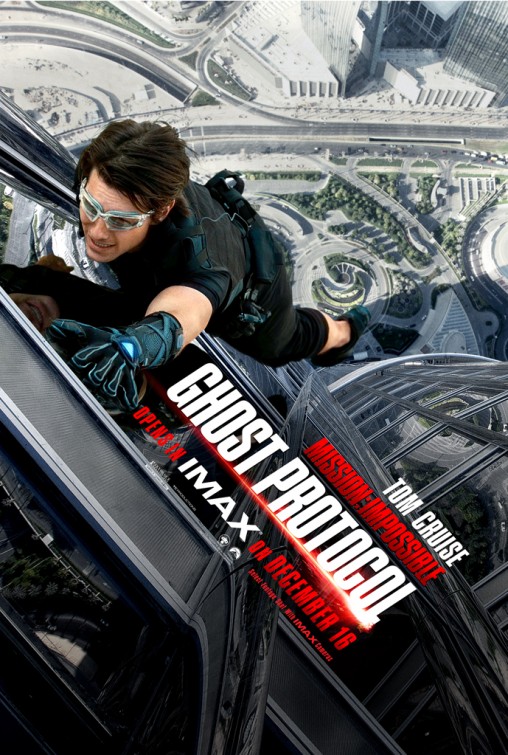 In the span of three months, two Pixar vets will be making their live-action filmmaking debuts. Andrew Stanton (WALL-E, Finding Nemo) is directing Disney’s big-budget John Carter of Mars adaptation, which will be released this March. But first is the awkwardly punctuated, colon-hoarding Mission: Impossible: Ghost Protocol (henceforth referred to as M:I 4), directed by Brad Bird. Any fan of The Incredibles (and who isn’t) knows that Bird is a terrific visual stylist who can compose remarkably exciting action without overlooking characterization. If anyone was ready for the leap into live-action, surely it was this man. Bird is the real star of the movie, and he aces his debut. I think he’s finally living up to the potential he showed with TV’s Family Dog (please note the tongue firmly planted in cheek here).
Ethan Hunt (Tom Cruise) and his IMF squad are on the run. They’ve been framed for an explosion that took out the Kremlin. The president has invoked “ghost protocol” meaning that the IMF no longer exists, and every member is cut loose. That means Ethan and his newest team, techno wizard Benji (Simon Pegg), feisty Jane (Paula Patton), and the mysterious Brandt (Jeremy Renner), have no backup. They are considered rogue agents and Russian’s own special police force is hunting them down as well. Hunt and his team must track down and stop an international terrorist, Hendricks (Micheal Nyqvist, the Swedish Girl with Dragon Tattoo series), who sees the global benefit of nuclear catastrophe (I suppose surviving would be the catch). Hendricks has gotten hold of Russian nuclear launch codes and now is looking to put the final pieces together to initiate a war between the United States and Russia, plunging the world into disaster. Hunt’s team travels around the globe to stop this bad man and his bad plan.
 Bird delivers in a major way in his live-action film debut. The man behind two of the best animated films of all time and Ratatouille, has shown that his keen skills of directing animation have easily translated to real people and real-ish explosions. Bird is a mad genius when it comes to staging elaborate action sequences; he teases out his action with organic consequences and his camera makes adept use of space and geography, and best of all you can easily follow what’s going on in the frame. So when we have an action sequence that takes place in the tallest skyscraper in the world, you know Bird is going to make fine use of this fact to accentuate his action. And the man does so in spades. The Dubai sequence is probably the how-did-they-do-that? standout that people will be most talking about. Hunt has to climb the outside of the aforementioned tallest building in the world using nothing but some special sticky gloves that don’t always work right. He has to climb several stories up, and then there’s the matter of going back down without them. But M:I 4 doesn’t rest on its laurels, because immediately after this sequence we have a feast of thrills. We segue right into a meeting between two parties where Hunt’s team has to pose as each member of this sit-down, orchestrating two separate simultaneous false meetings with the real bad guys. The two meetings dovetail one another as far their needs, making for a blissful parallel of escalating suspense. And then even after this, we get a foot chase into a sandstorm, which then becomes a dangerous car chase into a sand storm. And there are even more great stunts and spectacular action to come, notably a fight in a futuristic car park where the cars tumble from level to level.
Bird has such a firm command of his action, exercising his inspired imagination and all the tools in the special effects paint box. The screenwriters deserve recognition as well, Josh Applebaum and Andre Nemec, both of whom honed their writing chops on J.J. Abram’s sublime spy show, Alias. Their opening sequence, an escape from a Russian prison, sets the stage with Bird’s smart execution; setting up a problem and then letting the situation play out in surprising yet logical and clever ways. It may not have the epic scope of a Michael Bay flick, but Bird’s action is cool without having to be exhausting or noxious. The frenetic pacing rarely lets room for breathing. One of the film’s quiet moments ended in such a jarring fashion that it startled me and I kicked the patron sitting in front of me. I must also credit Applebaum and Nemec for producing the only Mission: Impossible movie that did not involve a turncoat. I was starting to think that IMF’s Human Resources department was in needing of a good housecleaning. Bird, and the screenwriters, has delivered a Mission: Impossible movie so good, with such kinetic and rewarding action sequences, logically utilized gadgets, sexy cars, sexy gals, and exotic locales. They’ve basically made the best Bond movie not to bear 007’s likeness.
Like the previous Mission: Impossible flick, this one emphasizes the team aspect, which makes a more fulfilling and interesting set of missions. M:I 2 became the “Ethan Hunt kicks people in the face for two hours movie,” which Chuck Norris might approve but otherwise was lacking. When J.J. Abrams got on board in 2006, the brand finally got back to its roots. And a team working together with individual strengths makes for a much more satisfying mission that also allows for multiple points of action. Simply out, if you have three people that need to do stuff in synchronicity, it plays out much better than watching Cruise kick people in the face. Choreography is always better when you have more dancing partners. Anyway, with M:I 4 we get some terrific teamwork that can be just as thrilling as the action sequences. Besides the breathless Dubai sequence, there’s a great sequence where the team has to infiltrate a sleazy Indian businessman’s (Anil Kapoor, the TV host from Slumdog Millionaire) cocktail party to get some special satellite codes. Jane is tasked with seducing the sleazy guy, Benji is left to operate a mechanical rover with a powerful magnet that will levitate Brandt, in a metal suit, across the system’s super hot inner mainframe, and Hunt is trying to lose his Russian pursuers. It’s a great sequence where all the pieces come together for maximum effect.
 Cruise has done plenty in the last five years to destroy audience good will, so it’ll be interesting to see if audiences warm back up to the man with the million-dollar smile. Cruise has always been an actor of ebullient energy and charisma, and this has always aided him in action settings and M:I 4 is no different. He’s still a credible action hero and a born movie star, whatever audiences think about his increasingly polarizing personal activities. Lessening Cruise’s load is a smart move, and Pegg (Paul) can provide needed comic relief while Patton (Precious) supplies the sizzle. My goodness can this woman fill out a dress in marvelous ways. Not to be completely sexist, she does a fair amount of ass-kicking too. Her fight with the French femme fatale agent (Lea Seydoux) was all kinds of awesome. Renner (The Town) seems groomed as a potential heir apparent for the franchise. His character is given a small amount of depth to work with, the guilt of a mission gone wrong that has a very personal connection to Hunt. At this point, Renner can do no wrong as an actor in my book. Although there’s only a nine year age difference between Cruise and Renner, so I don’t know how much more mileage that gives you as a franchise. Regardless, Renner is an actor of great conviction and intensity even when he’s silent.
In terms of the franchise, I’d say this fourth installment is just as good as Abrams’ M:I 3, though Abrams had a much better villain and the added emotional urgency of hunt’s wife in distress. Seriously, this is one really boring and completely interchangeable villain. For a movie about the world being on the brink of thermonuclear Armageddon, why do the stakes feel so low? It’s probably because the movie has deliciously orchestrated and eye-popping set pieces but very little urgency. World War III has never felt so ho-hum. Still, it’s hard to fault an action movie when it delivers such high amounts of adrenaline, perfectly packaged in well-developed action beats. This is a high-flying popcorn spectacle of the top order, a grandiose piece of Hollywood escapism. Mission: Impossible 4 is pretty much everything you’d want in a summer blockbuster, only shuttled to winter. I think Bird’s future is limitless, in animation and live-action, and I think the Broccoli family would do us all a favor by tapping Bird to direct a Bond movie. M:I 4 is a pretty good resume for the gig. That would be one mission to die for.
Nate’s Grade: A-
Share this:

Ratatouille (2007)
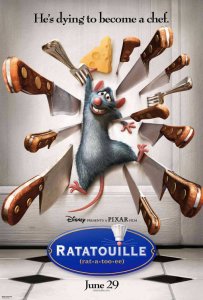 This movie continues to grow on me every day after I saw it. Writer/director Brad Bird yet again impresses with a deceptively simple story that manages to hit big themes in organic ways. The comic possibilities are fully realized with the setup of a man and a rat teaming up to be a great Parisian chef. There is a jubilant spirit alive and well throughout the film, and it’s difficult not to get swept up in the wit, the wonder, and the magnificent visual feast.
Nate’s Grade: A
Share this:

The Incredibles (2004)
 You’ve been there before. You know the drill. You’re staring up, mouth agape, at the multiplex’s list of new titles wondering what to see. It happens to the best of us. Who can you trust in these situations? Most people used to think they could trust Tom Hanks, but after his accent experimentation in The Ladykillers and The Terminal, not to mention his giant creepy mustache in The Polar Express (with accents!), that train of trust might have left the station. A lot of people felt they could trust an Oliver Stone movie, and, well, look how that turned out. No, moviegoers, the only trustworthy name that won’t let you down is Pixar. With hits like Toy Story and Finding Nemo you know that those computer wizards are looking out for you. Their newest work, The Incredibles, will keep Pixar alive in the moviegoer circle of trust.
The Incredibles takes place in a world where superheroes walk, run, jump in single bounds, and zip through the sky. They’re beloved and revered, with the super-strong Mr. Incredible (Craig T. Nelson) at the head of the pack. But then a fiend strikes more powerful than any dreaded super villain: litigation. A mountain of lawsuits pile up against superheroes, and the government disbands its programs and relocates all super-abled beings into new identities and homes.
Fifteen years later, Bob Parr, a.k.a. Mr. Incredible, has married Helen (Holly Hunter), a.k.a. Elastigirl, who can stretch her shape, which comes in handy keeping their two children in line. Dash (Spencer Fox) begs his parents to allow him to use his power of super speed, especially at his schools sports. Violet (Sarah Vowell), all long haired Goth angst, uses her power of invisibility to just disappear during school and other functions she feels she doesn’t fit. It seems the only member of the family fully adjusted and happy to a “normal” life is Jack Jack, the Parr’s infant son who may or may not develop super powers of his own. Bob feels crushed by the grind of office work and hiding what makes him and his family special. He escapes at nights with old friend Frozone (Samuel L. Jackson) and the two of them relive the good old days with attempted heroic acts. Helen catches on and they have a huge fight with the kids as witnesses. Helen explains to her family in the best way that she can that their days as superheroes are over. They have to adjust to a different life now.
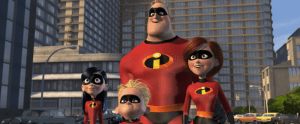 Bob’s wanderlust is soon quenched when he receives a mysterious invitation from a beautiful, white-haired woman named Mirage. She offers Bob the chance to become Mr. Incredible once more, to use his gifts and abilities to stop a robot on the loose on some island. Bob leaps at the chance, hiding his ongoing super exploits from his wife, and regains a sense of purpose. He hasn’t been this happy in ages; however, it all comes to a head when he learns that Syndrome (Jason Lee), the one responsible for the run-amok robots, has other plans. Not only this, upon capture Mr. Incredible realizes that he has ties to Syndrome way back during one of his less-than-super moments.
Helen is shocked when she finds out what Bob’s been up to, but also partially relieved it’s not an affair. She visits their old costumer Edna Mode, whose glasses and black wig may be bigger than the rest of her shrimpy body. Edna has redesigned a team of superhero costumes, and with them in hand Helen becomes Elastigirl once more and takes Dash and Violet on a journey to save their father and become a family once more.
The Incredibles is a film bursting with entertainment. This is an explosion of imagination, of wit, of grand storytelling, that the audience should sit and soak up every loving and beautiful second of it.
The voice work is wonderful. I’m sure Disney execs were scratching their heads over Craig T. Nelson, but I cannot imagine anyone else that could deliver as much in the role. Hunter is excellent, as always, as a doting mother and crime fighter. Lee is great with a villainous role that has a lot more depth to it than near any live-action film. His verbal gymnastics are perfectly suited for a slighted super villain.
Writer/Director Brad Bird’s first feature was the 1999 masterpiece, The Iron Giant, which I consider the finest animated film of all time (you heard me, Walt). Bird’s first film was a masterful mixture of little boy fantasy, reality, strong characters, humor, and excuse-me-there’s-something-in-my-eye tenderness. I know many people who, after seeing The Iron Giant, say they were, “crying like they watched a puppy get hit in the face with a shovel.”
 With this being said, my trust in Bird as a master storyteller is still there. The Incredibles is the first Pixar film concerning real people, not just toys, ants, fish, monsters, and, uh, more toys, and the results are astounding. This is a film rich in complexity, human insights, family warmth, and, again, realism. Bird has fully realized The Brady Bunch of superheroes. They feel just as flesh and blood as any characters I’ve seen in any film this year. They have desires, secrets, shame, guilt, anger, burdens, pride, and above all, love. I mean, how many animated films have an actual subplot involving marital suspicion? You won’t find that in The SpongeBob Squarepants Movie. When Elastigirl and the kids go off to save her heroic hubby, she has a sit-down with her children and warns them that, yes, death is very real, and that these people will indeed kill them if discovered (this is the first PG-rated Pixar film, by the way). It’s a great moment that reminds you how much you care for these people.
Bird’s imagination seems incomparable. He has a razor-sharp feel for comedy, like Elastigirl’s scene caught between several sliding doors or the lively, hysterical Edna Mode personality, but he also possesses the ingenuity for crafting some of the most exciting action sequences in a long time. The Incredibles has uncanny action scenes, set to Michael Giacchino (TV’s Lost) blazing jazz score, which should make the James Bond producers die from envy.
Bird has created a stupendous action film, a heartwarming family drama, a hilarious comedy, and a gorgeous film to watch. Movies rarely get this entertaining, but for Pixar, it’s all just part of the norm. I hope someday we don’t take Pixar’s accomplishments and staunch consistency for granted, because they aren’t just reinventing what animation can do, they’re also reinventing what films themselves can do. You can have all the accents you want Tom Hanks; I’ll gladly take The Incredibles and its bounty of offerings.
Nate’s Grade: A
Share this:

The Iron Giant (1999)
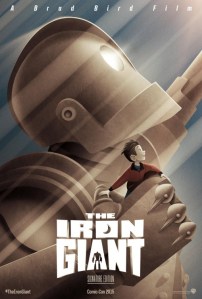 There is a magic that animation has that a regular film can never capture. It can delve into our imaginations and conjure up emotions and laughter that regular celluloid can rarely get a firm grip on. So why has every animated film this decade fallen under a strict formula that bogs down the quality of the efforts? Now comes a movie like The Iron Giant, which restores faith in all that is good with cinema.
The Iron Giant is reminiscent of E.T., but has a distinct voice of its own. The main question might be, “Is it enjoyable for people other than kids who can’t touch the floor with their feet?” I can answer that question easily: Yes! Adults, teenagers and children will have just as much fun with this picture together. It is a movie for all ages and for all time.
The animation is strikingly brilliant and deserves an ovation of its own. Never have I seen voice-over-to-mouth animations done so fluidly. The sight of the giant itself is awe-inspiring, but never terrifying. The movie also perfectly captures the innocence, patriotism and Cold War hysteria that defined American living in the ’50s.
But the truly biggest thing The Iron Giant has to offer is magic and heart. The characters are all well-developed, and the audience is made to feel great attachment to each one. The script for the feature is right on, and never is a scene wasted. And the tale is very touching as it heads toward its climax. I don’t mind admitting my eyes were quite moist toward the end.
The Iron Giant breaks the common mold of animated flicks. There are no cuddly animals and slapstick sidekicks, no dopey forced love interests, no one-dimensional villain, and thank God, no Grammy wannabe songs breaking up the drama. The Iron Giant sends out a strong message and breaks free of a Disney-controlled industry. I dare say this is the greatest animated film of this entire decade, by far. I urge everyone to go out and experience some of the magic and warmth that is The Iron Giant. This is destined to become a classic, mark my words.
Nate’s Grade: A+


 nathanzoebl
You must be logged in to post a comment.