Blog Archives
The Spiderwick Chronicles (2008)
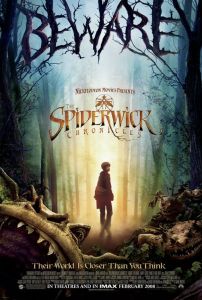 This imaginative fantasy family film is adapted from five books from the Spiderwick series, so you’ll be forgiven for thinking that it packs a lot of storylines at a brisk pace. This 97-minute film should appeal to all members of the family because, while derivative, it has plenty of action, interesting fantasy characters, and even some palpable thrills. The movie has a better handle over interspersing psychological real-world drama with the monsters. Freddie Highmore is the best special effect in the film as he plays two twins who are vastly different in personality and temperament. Director Mark Waters (Mean Girls) deals with the fantastic but also makes the film feel grounded, never letting the otherworldly elements to take over. The movie is a modestly entertaining escapade.
Nate’s Grade: B
Share this:

The Sisterhood of the Traveling Pants 2 (2008)
 The ladies that inhabit The Sisterhood of the Traveling Pants 2 are not the same group of gals that charmed the pants off of me in the 2005 original film. This time the foursome is feeling some strain because they’ve all graduated and moved onto insanely ludicrous positions. Tibby (Amber Tamblyn) is making movies at NYU; Lena (Alexis Bledel) is studying art at the Rhode Island School of Design; Bridget (Blake Lively) is assisting with an archeological dig in Turkey; and Carmen (America Ferrera) is at the Brown theater department where she gets the lead in a summer production. Let’s face it, these are not the down-to-earth girls that were presented before. Was it too much to ask that one of the girls have a modestly plausible scenario? The drama is again split into two camps, the petty and comedic (Lena must choose between boyfriends, Carmen has to practice her lines) and the melodramatic (Bridget still has to deal with her mom’s suicide, Tibby has a pregnancy scare). The movie doesn’t work this go-round because every beat of the plot is wholly predictable (of course the guy Lena flirts with in art class will end up being the nude model), and much of the conflict is just inane. The characters act in stupid and contrived ways because the plot demands it. Sure the condom broke but can’t Tibby get the morning after pill at least? Sisterhood 2 also packs a baby birth, reunion between granddaughter and the grandmother she never knew existed, and a climactic trip to Greece for some serious girl power. It’s drama overload and lacks the notable sincerity of the first film.
Nate’s Grade: C
Share this:

Twilight (2008)
 It’s only been three years since the first book in the Twilight series was published, but man has it already become a phenomenon among young girls. Author Stephenie Meyer was a Mormon housewife who professed to never having seen an R-rated movie, so of course she seems like a natural fit for vampire literature. Meyer has taken the torch from Anne Rice and created an insanely popular series of books that chronicle the lives of humans and vampires in the rainy Northwest United States. I had never heard about the books until the spring of 2008, months before the hotly anticipated release of the fourth and final book in the series. Then again, I’m not a preteen girl, so excuse my ignorance. I decided to bear the hormonal, high-pitched squeals and sit with a packed house to experience the movie with the Twilight faithful. Judging from my screening, I think it might be mandatory for all girls between the ages of 7-14 to go see the Twilight film.
Bella Swan (Kristen Stewart, Into the Wild) is the new kid in school. She’s moved back to live with her father (Billy Burke), the sheriff of a tiny Washington town with a population of 3,000 people. Bella has her sights set on the Cullen family, a group of weird kids that are pale and keep to themselves. Edward Cullen (Robert Pattinson) goes out of his way to avoid Bella, and of course this just makes him more mysterious. He tells her that they shouldn’t be friends. Then one day at school he saves her life by stopping a van from crushing her. Bella suspects that this Cullen kid might not be a usual teenager. He’s not. He’s a vampire who hasn’t aged since 1918. Bella is smitten with her otherworldly protector. It’s your typical high school relationship. Bella doodles Edward’s name on her notebook and falls in love with an unattainable boy. Edward must resist the constant temptation to drink Bella’s blood (he and his vamp family are “vegetarians,” meaning they only drink animal blood).
 Let’s examine the distinctions of the Twilight vampire incarnation. Now, the vampire myth is not written in stone, so it allows for creative interpretation. Some vampires cast a reflection, others don’t. Some vampires are thwarted by garlic and crosses and others are not. Some vampires sleep in coffins and others just prefer a comfy mattress. It seems that the two characteristics that follow every vampire tale involve the insatiable thirst for blood to drink and the fact that sunlight is a vampire’s enemy. Meyer’s vampires don’t even adhere to this. They walk around in the daylight with no concern; in fact, we learn they never sleep at all, which means they must have all the late night infomercials memorized by this point. Removing the danger of daylight from the vampire myth proves to be somewhat troublesome decision. This is because, when you think about it, there are little to no drawbacks or limitations to being a vampire in Meyer’s world. Yeah you’ll live forever and crave an unorthodox beverage, but as a vamp you get super abilities, super strength, super speed, and a laughable diamond-like glow when the sun hits your exposed skin (think of those people that encase cell phones in tacky “bling” jewelry). If this is what it means to be a vampire in Meyer’s world then I wouldn’t be surprised if every freaking teenager in the world was signing up to join the army of the undead. The vampire myth brings with it plenty of baggage but it also helps to patch up holes in a narrative; just introducing the concept of a vampire allows an author some free pass with the details. However, vampire tales bring with them a certain set of expectations due to audience familiarity with the popular concept. I could care less if Meyer’s vampires have fangs or chow down on garlic bread, heavy on the garlic, but she loses me when she has vampires roam around during the day with little to no drawbacks. They just don’t feel like vampires. What they feel like are superheroes with skin conditions and a unique appetite. Which is fine, but don’t call it a traditional “vampire” flick.
I completely understand the enormous appeal of the Twilight series because it’s totally pre-teen wish fulfillment. I’m positive that the majority of the pre-teen readership projects themselves as Bella, the typical Every Girl. She encounters a sexy boy who ignores all the flashy and trashy girls and recognizes that special something in the Every Girl. In fact, he respects her and doesn’t want to be physical with her because he’s afraid of giving in to his urges (a rather obvious abstinence metaphor). He wants to love her forever and protect her. He has a dangerous bad boy angle but yet he’s still safe. In short, Edward Cullen is the idealized male for a nation of pre-teen girls who are just stepping into the world of boys (Bella also becomes an object of affection for no less than three boys at school). The Twilight tale even pulls a gender flip: the girl is pressuring the boy to give in to his carnal urges. And yet I can also understand why the books appeal to an older, mostly female, readership as well. If you remove the vampire angle from the story, it’s that old classic literary tale about a gal falling in love with the rebel, the boy who’s misunderstood. Hollywood has been making those sorts of love stories for decades, and so Meyer is able to tap into this classical romantic appeal.
 Twilight never delves too deeply into the dramatic dynamics of a 17-year-old girl dating a 90-year-old vampire. There are a lot of dramatic consequences drawn from dating somebody who cannot age. The Buffy the Vampire Slayer TV show explored the ins and outs of human-vampire relationships with wit and sincerity. Edward is forever seventeen but does that mean he still digs the high school girls? If you’re trapped in the body of a teenager does that mean you are still attracted to teenagers? If I were almost a century old I think I might seek out the comfort and conversation of a more mature woman, which is precisely the notion I’m sure the older female readership also fantasizes about (for all those guilty soccer moms, it doesn’t qualify as fantasizing an underage when he’s undead). Talking to teenagers for the rest of your life seems like a strange form of penance, as does repeatedly completing high school. Are the vampires just bored and attend school to pass the time? Don’t they know that TV was invented?
Twilight doesn’t have much of a plot to fill out a two-hour running time; the bulk of the movie consists of two characters feeling each other out. When the film does introduce an exterior threat (Cam Gigadet as a vamp obsessed with the hunt) it never feels that dangerous or fitting. The outside threat is saved for the very end and is easily dispatched, so the movie would have been better off without forcing a last-minute life-or-death dilemma into its love story. The love story itself doesn’t feel as properly nourished as it needed to be. The whole film experience feels like one long introduction and set-up, not so much an open-and-shut story.
Now, with all of that established, the Twilight film itself isn’t too bad. The movie is well made and certainly has a pulpy romantic vibe. The movie never feels overly burdened by excessive emotion or fake drama. It also follows a leisurely pace but never becomes dull. The actors are a big help. The leads don’t seem like they stepped out of a magazine photo spread; Stewart and Pattinson (Harry Potter and the Goblet of Fire) have a palpable chemistry that simmers throughout. Stewart is a terrific actress that embodies a typical teen, and Pattinson has the heartthrob glower down cold. I think there is rarely a scene where Edward isn’t glowering. Director Catherine Hardwicke (Thriteen) might as well provide onscreen instruction telling the audience when to swoon. Hardwicke is a filmmaker that doesn’t wallow in pretension, so she knows what kind of flick she has at her disposal. On the other hand, she is able to tamp down the inherent cheesiness that can go with a gooey supernatural love story. Twilight is able to work because it strikes the right balance between romance and silliness.
 Fans of Twilight should be delighted by the big screen adaptation of their favorite characters and heartthrobs. Sure the plot is a tad lightweight, the vampires might not be vampires as we traditionally understand them, the characters make giant leaps in their proclamations of love, and the outside conflict is a bit too poorly manufactured, but the movie has some bite. The movie isn’t moody, it isn’t too heavy, and it can come across as entertaining, though I’m at a loss to explain its extraordinary popularity. Now that Hardwicke and company have established the Twilight inhabitants, I hope the inevitable future installments will be better at providing resonating story and characters. If you doubt the certainty of sequels, need I remind you yet again that it is mandatory for girls age 7-14 to see this movie. The Twilight phenom has yet to reach its peak. Get used to it. It’s only a matter of time before Hollywood starts cranking out the Twilight knock-offs. Then, perhaps, I will join the armada of pre-teen girls and shriek wildly.
Nate’s Grade: B-
Share this:

The Other Boleyn Girl (2008)
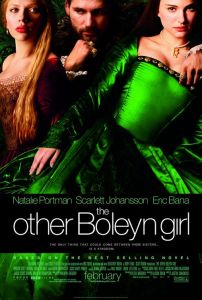 The story of Henry the Eighth and his many wives is a tale full of romance, danger, betrayal, and sweeping historical changes; it’s the most popular soap opera of its age. The 700-page book was naturally going to get slimmed down as a feature film, and The Other Boleyn Girl feels a bit too streamlined for all the heavy historical events that take place. The production values are all top-notch and the story has some juicy moments. It presents an intriguing angle by showcasing the conniving rivalry between the Boleyn sisters (Scarlett Johansson, Natalie Portman). The acting falls under that period film gravity where the actors all speak stately and enunciate every syllable slowly, like they were testing out the sound for the first time. Portman is especially fun in a villainous role. Eric Bana is completely at odds with history as Henry VIII, but I suppose it would be harder for modern audiences to accept young nubile ladies vying for the affection of a huge, ugly man with a leg of mutton in his grip.
Nate’s Grade: B
Share this:

Nick and Norah’s Infinite Playlist (2008)
 When you’re a teenager, sometimes there is nothing more important in life than music. Generally one of the most prominent means for a teenager to outwardly define his or her emerging personality is by music. Coming of age and maturing musical tastes seem to go hand in hand. I may date myself here but I can recall my own personal blossoming thanks to the likes of Green Day, the Smashing Pumpkins, and the Offspring (you couldn’t go anywhere in 1995 without hearing “Self Esteem”). Nick and Norah’s romantic interlude begins over common musical tastes and move from there. Having a person “get” you seems to be linked with having a person “get” your music. Nick and Norah’s Infinite Playlist is an inviting and mostly successful teen comedy that “gets” it.
Nick (Michael Cera) is nursing the common teen ailment of a broken heart. He’s one part of a queer core punk band and just happens to be the only heterosexual band member. Nick has been sending mix CDs to his ex-girlfriend, Tris (Alexis Dziena), but she’s been tossing them in the trash. Norah (Kat Dennings) has been fishing those mix CDs and falling in love with her unknown musical soul mate. Norah’s best pal Caroline (Ari Graynor) has informed her that her favorite indie band, Where’s Fluffy?, is playing a secret late-night show in New York City. The slew of characters, Norah and Caroline and Tris and her new boyfriend, attend a nightclub where Nick’s band performs. Awkward. Norah poses as Nick’s new girlfriend and the two take off together to drive a very drunk Caroline home. It is here that they begin an unforgettable odyssey filled with gross toilets, drag queens, Norah’s ex-boyfriend (Jay Baruchel), jaunts to recording studios, and many stops along the way to try and find Where’s Fluffy?
 Nick and Norah isn’t anything altogether remarkable but its charm comes in how, well, unremarkable it comes across. I do not mean this as faint praise or a backhanded compliment. The majority of teen-oriented films have the habit of slotting characters into rigid archetypes. Earlier this year, the documentary American Teen was released and barely made a blip. The director of this documentary condensed an entire high school year into a feature-length film, but she framed her characters as entrenched stereotypes patterned after movies (movies began the stereotype, now is life merely following its lead?). The marketing even had its main “characters” recreate the Breakfast Club poster with the requisite Jock, Geek, Princess, etc. It’s so easy to paint in broad, well-established strokes when it comes to teenage characters and a high school setting. So it’s genuinely entertaining and encouraging to see Nick and Norah where the characters just are people. Granted the gay characters are a bit too cutesy by half, though they never become swishy stereotypes and the slutty manipulative ex-girlfriend character is a pretty familiar and clichéd antagonist. But the real charm of the movie is seeing characters that cannot be painted in broad strokes, characters that do not hide who they are, and characters that refuse to be typecast. Just watching Nick and Norah interact, I felt like I was watching two friends instead of high school archetypes having the same tired class warfare. Making the characters reasonably realistic and unremarkable is a breath of fresh air.
Not all the elements in Nick and Norah entertain; some feel like they’ve been surgically attached from different movies. The entire subplot involving the sloppy drunk escapades of Caroline seems extraneous at best, providing an unnecessary plot point that keeps Nick and Norah together for the night. It provides some laughs due to Graynor’s highly amusing drunken performance, but the subplot also pushes the movie into outlandish gross-out humor, like when Caroline vomits into a toilet, drops her gum in the same toilet, and then decides to foolishly go after the gum. The same piece of chewing gum has its own fantastic journey. The coupling between Nick and Norah is also given a weird and somewhat unseemly addition. Clearly these two kids “like like” each other and the wild night presents different coupling obstacles before these fun kids eventually decide to make a move. In one scene Norah is taunted by Tris about never having had an orgasm. So then the movie makes it a point that when nick and Norah do hook up that we are presented with Norah earning her first O-face (the whole climactic sequence is done off camera and only with audio). Orgasmic proof was not needed to convince the audience that Norah has finally found a worthy guy. The fact that they’re high school-aged students brings an unsettling, seedy element into an otherwise wholesome film. It wasn’t needed.
The plot of Nick and Norah has a few bumps along the way because the emphasis is on the groovy and genial atmosphere. Watching the movie is somewhat akin to attending a party with some cool people. You leave the theater with your spirits lifted a tad, a smile on your face, and some fond memories for the time being. I’m not saying that Nick and Norah is comparable to the best teen comedies of all time but it manages to spin a little magic. I couldn’t help feel wistful as I watched the teen characters romp through the late night music scene of New York City, a character all its own. The movie manages to capture the exciting essence of being young and alive in an authentic way.
 The two leads are deeply enjoyable. Dennings (The 40-Year-Old Virgin) is a great find and comes across as a natural teenager. She’s not precocious or glib, but she seems grounded, unassuming, and yet intelligent in a way that doesn’t pass as hyper-literate. Dennings gives a spunky performance that is tinged with awkwardness and heartache, as she explores the scary yet exhilarating prospect of romance. She’s also got a bashful beauty to her, like the girl next door that would never admit that she could be attractive. She’s got lips like red licorice and classic features that could work in old Hollywood. Dennings gives every scene a boost of heart and the movie shines brightest every minute she’s onscreen. Cera (Juno, Superbad) seems to have patented his nervous stammer that he’s previously showcased. I wonder what Cera’s acting range actually is because he seems to be playing different variations on the same character. However, I have written before that Cera is the living master of comic understatement and the well-timed pause, and he proves it again. He mopes a bit too much through the movie but Cera manages to make him empathetic and not pathetic. The two of them have a sweet chemistry and it’s easy to yearn for their coupling.
Nick and Norah’s Infinite Playlist exists in a world that doesn’t exactly resemble our own but seems like a swell place to visit. The movie almost contains a certain innocence to its teenage shenanigans. Dennings and Cera make for engaging leads and an adorable couple onscreen. Not all of the parts come together as well as Nick and Norah do, but the movie’s overall vibe is authentic and low-key, apt to provoke cheerful smiles more than laughs.
Nate’s Grade: B
Share this:

21 (2008)
 Glitzy, breezy, and 100 percent predictable, 21 is a simple con movie that goes through the motions with hyper realism. The most interesting part of the film, by far, is learning the systems that help these coeds fleece Vegas for thousands of dollars. In fact, the true story is far more interesting than this typical tale about a good kid who gets a big ego, pushes his true friends away, is humbled, and then learns a lesson while getting the girl too. What’s a MIT engineer want to go to Harvard med school for? And for that matter, you’re telling me there are no scholarships out there to brainy MIT students? Whatever the case, 21 will pass the time nicely without damaging your brain. The card games are ramped up with zooming camerawork and flashy special effects by director Robert Luketic (Legally Blonde), but it’s all window dressing to an interesting story that was white washed into a bland but undeniably commercial movie. It’s a fine time but, like Vegas, will leave you empty in the end. Still, you could do worse than overly stylized con movies about math whiz card sharks.
Nate’s Grade: C+
Share this:

The Ruins (2008)
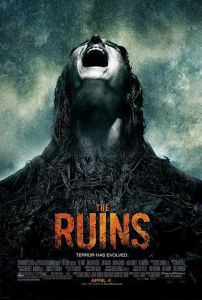 Author Scott Smith is from Ohio, my home state, which makes me like him. What made me respect him was his adaptation of his own novel, A Simple Plan. The movie version was splendid and taut, well acted and riveting and disturbing. Smith even received an Oscar nomination for his screen adaptation. When Smith released The Ruins, his second book, in 2006 I was mildly intrigued but never got around to reading it. Something about tourists, and Mayan temples, and bad things, and it got plenty of good reviews. Then I saw that Hollywood was producing a film version and that Smith had written the screenplay himself. Well, I figured, I’m going to be in for a chilling treat. Let’s just say my opinion of Smith has been slightly diminished.
Four over privileged American tourists are enjoying their final hours of a vacation to Mexico. Jeff (Jonathan Tucker) is studying to be a doctor. His girlfriend Amy (Jenna Malone) is best friends with Stacy (Laura Ramsey), and the two pal around together. Stacy’s boyfriend Eric (X-Men’s Shawn Ashmore) is along for the ride and enjoying every sun-soaked, boozy second. Lounging around the hotel pool, the group comes across a German (Joe Anderson, Across the Universe) who has a map to a hidden Mayan ruin. It’s a bit off the beaten path but the group decides to witness some genuine history. They take a taxi 12 miles into the jungle, hoof the rest, and discover a not very well hidden path to a not very well hidden Mayan temple (seriously, you’re going to have to do better than a couple of palm leaves if you want to obscure the path and keep people out. Try a fence next time). As soon as they arrive so do a band of armed Mayans that really insist the tourists do not leave the site. The Mayans chase the tourists onto the ruins and then they set camp around the perimeter. The Americans are being kept quarantined. Why? Inside and atop the ruins are a deadly plant that has a powerful hunger.
 For a horror movie filled with unremarkable and generally unlikable characters, I must say that they at least don’t do anything incredibly stupid as is accustomed to the genre. Once they are chased to the top of the ruins you, the audience, are now put in their shoes. Every choice they make seems decently reasoned and cautious, exploring their surroundings and testing their boundaries. The Ruins features cheesy killer plants, yes, but the more interesting element to me was the survival game. These characters are quarantined in a remote area with little water, armed guards, and a handful of useful tools. What will they do next? This scenario grabbed my interest, as I played out my own personal survival scenario step-by-step and it wasn’t too different from what befalls the characters onscreen. However, I’m surprised no one tried setting the freakin’ plants on fire. The eventual psychological meltdowns and increasingly grim outlook help The Ruins maintain some level of credible drama.
But I think in the end I just couldn’t get over the fact that the main culprit was killer fauna. I can accept carnivorous plants, but seeing them is a whole different matter. Somewhere from pages to screen a step was forgotten to make them believable. The ancient plant system inhabiting the ruins looks like an overgrown swatch of ivy and marijuana leaves, and the vines would slowly inch forward to retrieve fallen pieces of meat. It’s downright comical to see a stringy piece of a vine trying to discreetly drag a dead body away, and frankly that’s where the movie fails. I shouldn’t be giggling at the killer plants. The execution comes across as way too goofy and made me shudder that I could be watching Little Mayan Shop of Horrors. I’m also wary that this highly localized plant has evolved to the point that it can duplicate exact sound. It mimics a specific cell phone ring tone to lure our vacationers deeper inside the ruins. Now, how in the world would it know well enough to do that? I can’t imagine in its potentially thousands of years of existence that it was come across a significant amount of cell phones. How would it know that exact sound would effectively lure others? I did enjoy the notion that the indigenous birds and insects have wised up and learned generations ago not to go anywhere near the ruins. Let this be a lesson to you, backpackers of America, that when insects refuse to go somewhere then perhaps you should take note.
 The Ruins should play out with a slow-burn sense of dread where the characters sadly realize with setback after setback that they are doomed; to be played right the plot needs to be methodical. Instead, Smith’s adaptation is more like a haunted house tale with crummy, obvious jump scares and lackluster spook setups. It seems like most of the film is intended to be a setup but the payoff is badly muffed, like seeing the stupid thin, twisty vines creeping out to sneak inside people’s open wounds. The Ruins has some fittingly disturbing scenes where something is moving and growing under the surfaces of people’s skin, but then you remember it’s just a plant vine and your mind starts racing with questions that illuminate how inane this whole situation comes across (How does a plant stem continue to grow inside a human body? What purpose does having an offshoot inside the prey serve? How does it penetrate open wounds without anyone noticing at all? Why should I be watching this?). I would have preferred if the under-the-skin creatures were some kind of insect or worm that had a symbiotic relationship with the plants. That would be cool and far creepier than stupid ivy vines.
From a gore standpoint, The Ruins has a few squirm-inducing moments. One character is badly injured and needs to have their legs amputated to survive. Oddly enough, this amputation sequence comes across as the most memorable part of a movie dealing with killer vegetation that can mimic cell phone ringtones and, later, lovemaking noises (now who goes out to have sex atop Mayan ruins?). The imprecise nature of the amputation is what makes it so gruesome. In one feel swoop, this character has to have leg bones crushed, then legs sliced off, and then have the stumps cauterized with a frying pan. And the only anesthetic is a bottle of Jack Daniels. Yikes. The amputation is played out with a deliberate pace and allows a satisfying buildup of nervous, queasy anticipation. Aside from that, there isn’t anything notable from the makeup department.
 None of the characters approach anything closely resembling characterization, but the acting is a notch above what you might expect from a horror movie populated with expendable, good-looking twenty-somethings. Tucker makes for a capable lead and projects a cool and controlled persona, never rising to hysterics. When he does realize the inevitable he begins to crack and it’s more effective because of how stoic he was before. The actor who gets tested the most is Ramsey, and this isn’t because she started her career in the derided “reality TV documentary” The Real Cancun. Her character is put through an emotional wringer and she sells the distress and Stacy’s fraying mental state. I never once was tempted to laugh even as she sliced herself open and fished around her insides. Malone and Ashmore are stuck being in the stock roles of whiny girlfriend and horny carefree dude.
The Ruins is a horror movie that’s far from horrible but not scary or perverse or funny enough to be recommended. The setup of isolation in unfamiliar territory could definitely produce some chills and thrills, however, when you throw in a ridiculous carnivorous plant that looks as menacing as your mother’s flower bed, well then, things just fall apart. I’m sure The Ruins worked well on the page, since it demands the reader create their own version of what goes bump in the night. Too bad that when you see it fully realized on the big screen it comes across as stupid. I really expected a lot more from Smith than this. The Ruins doesn’t justify why it should be treated any different than cheap, straight-to-DVD cheesy horror flicks (If there are multiple horror movies about killer snowmen, then there has to be an entire sub-genre of killer plants). I know M. Night Shyamalan’s upcoming summer release The Happening also features plants turning on humans. Let’s hope the creative force that brought us Lady in the Water can do more with the subject.
Nate’s Grade: C
Share this:

The Assassination of Jesse James by the Coward Robert Ford (2007)
 This is a harrowing, haunting, beautiful, mesmerizing movie that is easily one of the best films of 2007. Casey Affleck is an acting revelation as Robert Ford, the man who worshipped Jesse James and obsessed over him before eventually turning sour and killing his hero. This languid Western, paced at 2 hours and 40 minutes, establishes a mood of gnawing paranoia as the law closes in and Jesse suspects his gang members will betray him. The day-to-day worry and dread of a life of crime really translates, and Jesse James proves an intelligent, unstable leader to mix the pot. The movie builds slowly but the tension grows unbearable and puts knots in your stomach. The acting is outstanding all around, and Brad Pitt proves a great choice for a 19th century American icon weary of his legendary status. The movie presents a fascinating peek into Jesse James’s gang and presents a wealth of historical information, none more intriguing than when the public turned on Robert Ford for terminating one of American’s folk legends. The narration provides sharp, illuminating details in brief expository scenes, and thanks to Roger Deakins’ stunning cinematography, Jesse James is an authentic period picture that is a marvel to view. I was awed by this artistic achievement that still resonates with me long after I finished watching. This film simply envelops you.
Nate’s Grade: A
Share this:

Into the Wild (2007)
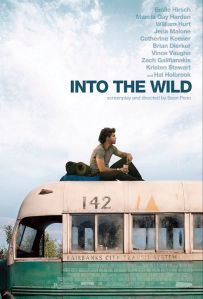 Undeniably well made, I just couldn’t emotionally connect with the main character, Christopher McCandless (Emile Hirch). Chris turns his back on his affluent parents and his bourgeois lifestyle and heads off into the wilderness to experience nature and find what has been missing in his life. Director/screen adaptor Sean Penn turns Chris into a Jesus-like figure that touches all those who he encounters on his cross-country tour that will meet its end in Alaska. I found the character treatment to be a tad naive and off-putting, and his lack of communication with his family, especially his younger sister who was in the same boat with him, seems especially cruel. And yet, the movie has its share of transcendent moments that bury themselves deep inside you, like when Chris befriends an 80-year-old widower (Oscar nominee Hal Holbrook) who is given new life. The closing moments, when Chris has accepted is fate, is profoundly moving and exceptionally performed, and this is coming from a guy that felt an emotional disconnect from the main character. Into the Wild is lovely to watch with top-notch cinematography, a fabulous score by Eddie Vedder, and fine acting by a diverse cast. I’m very impressed by what Penn has accomplished here. However, I admire the movie more than I can embrace it, and it all goes back to the character of Chris. He’s a mystery and both romantic and frustrating, which is kind of a fit summation for the movie.
Nate’s Grade: B
Share this:

Gone Baby Gone (2007)
 Ben Affleck doesn’t necessarily establish any gifted visual style with his directing debut, however, Affleck the Screenwriter and Affleck the Actor ensure that the movie succeeds swimmingly as a murky morality play. The film is an actor’s showcase and they get plenty of room to maneuver, with standout performances by Ed Harris as an embittered cop and Amy Ryan as the living embodiment of the worst white trash would-be mother on the planet. Where Affleck earns his artistic stripes is by asking hard questions with moral ambiguity and not dishing out easy answers. This is an above average crime thriller that uses its lower class Boston setting as an additional character. There are only a handful of relevant flaws, like Michelle Mongahan’s character being pointless except to cry, and a mystery that clever moviegoers will have figured it out early thanks to the economy of characters and some shifty glances. The missing child mystery allows Affleck to explore some very dark places and non darker than the human soul. Affleck may not dazzle with visual prowess, but the man sure knows how to tell a damn good story and direct actors to award-winning levels. Give this man another movie.
Nate’s Grade: A-


You must be logged in to post a comment.