Blog Archives
The Revenant (2015)
 Which do you value more, verisimilitude or narrative? If you’re looking for an intense, immersive filmgoing experience that’s just as harrowing as it is beautiful, then perhaps The Revenant is your movie. If you are looking for characters and a story to engage with, then maybe it won’t be. Leonardo DiCaprio plays the real-life frontiersman Hugh Glass who was mauled by a bear and left for dead by his companions. He miraculously survives and tracks down those who betrayed him for some frontier justice Under the unyielding vision of director Alejandro Gonzalez Innarito (Birdman), the movie opens up its scary world with an exhilarating sense of detail. Inarritu favors lots of natural light and long, gorgeous tracking shots, which creates a spellbinding sense of realism. The attacks and escapes and moment-to-moment survival communicate the remarkable dangers of this natural world. The cinematography by Emmanuel Lubezki is flawless, using light and camera placement to stunning effect. However, The Revenant (meaning a person who has come back from the dead) is a series of beautifully rendered moments delicately stretched over a ponderous running time of 157 minutes. There’s just not enough plot events to fill that running time, so to compensate Inarritu gives way to some Terrence Malick (Tree of Life) impulses that try for philosophical poetry but miss. DiCaprio is getting plenty of plaudits for his demanding role, and he’s quite good and visceral (and no, he does not get raped by a bear). I was more impressed with Tom Hardy, who plays the target of Glass’ fury. Hardy imbues depth into his antagonist, and while you won’t exactly be rooting for him to get away you can see the guy as more pragmatist than mustache-twirling rogue. He even has an interesting back-story surviving being scalped that informs his decision-making. Much of the film is watching Glass endure physical hardship after physical hardship, which may grow wearying for many audience members, especially those most squeamish. When it’s firing, The Revenant is a magnificent and stunningly realized survival thriller with sprinkles of engaging human drama. The problem is that there isn’t enough to go around for its running time.
Nate’s Grade: B
Share this:

Brooklyn (2015)
 If you’re looking for an Oscar movie this award season that will be perfect for grandparents, I direct you to the perfectly pleasurable Brooklyn. Beyond the throwback to the 1950 setting, it’s a movie that can appeal to multiple generations of audiences. There’s an admirable classical sense of filmmaking with Brooklyn, a delightful and charming movie with a healthy dose of nostalgia and heartfelt sincerity that should find a wide range of appeal to all ages.
Eilis (Saoirse Ronan) is an Irish immigrant who leaves her sister and mother to start a new life in Brooklyn. Thanks to a kindly Irish priest (Jim Broadbent) who had settled from her village, Eilis finds housing and a job. New York takes some getting used to, especially the density. Eilis is attending night classes to become a bookkeeper, but by day she works at a department store counter. It’s at one of the socials in her new Irish neighborhood where she meets Tony (Emory Cohen), a smitten yet confident Italian boy. She agrees to go on a date, actually two upfront, and it’s no time before Tony is walking her home from her night classes and talking about all his dreams. Eilis must return to Ireland for a family emergency. While she’s there, a bookkeeping job opens that needs her help, and a nice boy named Jim Farrell (Domhall Gleeson) grows closer to her with affections that aren’t exactly unwarranted. Eilis must decide which place to call her home and which life she wants to seek.
 While the story is set in the early 1950s, this movie could have been made in any decade of the film industry. It would not be out of place with the films of the 40s and 50s, hopeful and romantic odes about women finding new lives in the land of opportunity. There’s a classical sense to its storytelling that is rather universal about the struggles of self and independence. While this movie is awash in the period details of 50s New York City, it really could be told anywhere. The personal struggles of Eilis are completely relatable, which makes her an instantly engaging heroine. She’s a kind-hearted woman who’s trying to step out and discover who she wants to be, and this promising reality is a pleasure to watch. We’re watching the maturation of a person, watching her find her footing and gain confidence small victory after small victory. There aren’t any large or arch plot events to navigate. It’s the small moments in life, from starting a job, to becoming more sure of one’s self, to knowing whom to open up and trust. The movie is kept at a pleasantly low simmer of intensity, which works just fine. The gentle tone does not imply a lack of urgency but more so the beguiling and romantic spell. Thanks to writer Nick Hornby, who is becoming an ace screenwriter, the movie tells such a heartfelt and emotionally rich and resonate story in 100 carefully paced minutes. There’s a general joyous sensation that washes over you, elongating smiles naturally. The dialogue is often clever without being glib and the characters come across as realistic and humane. There’s only one character that is thinly drawn to approach being stock (well two counting the precocious “tells it like it is” kid). The others are hopeful, yearning, and fundamentally decent people. There’s something quite nourishing about watching decent people try and navigate their desires while maintaining their decency.
I think that’s what makes the love triangle work as well as it can, the fact that both options, not just the gentlemen at the center, are appealing. New York and Ireland both present options that afford Eilis opportunities in a career she wishes to pursue, both have compassionate men who have expressed an interest in her and are supportive of her education and goals, and both locations have a support system of friends. It may sound boring that Eilis can’t really go wrong with where and whom she chooses but I think that makes the ultimate decision that much more engaging. If these options weren’t so appealing then it wouldn’t be so interesting to watch. The mistake is that because the choices are good that there is less at stake when the opposite is true. She could rightfully be happy with either choice but which representation of Eilis will she decide? One life represents the old, the other he new. As I stated above, the characters in Brooklyn have an commendable decency to them, which makes the love triangle more difficult. Tony loves her completely but fears she may not come back, and yet he knows he has to let her go and she has to decide on her own where to call home. Jim is thoughtful and even though he obviously has feelings for her Jim knows that now is not the right time to ask, and so he too waits and hops he presents enough worth staying over. It’s a love triangle where you like all three participants, which happens so rarely in movies.
 Another strength of the film is that Ronan (The Grand Budapest Hotel) delivers a wonderfully felt performance. Much is placed upon her shoulders as our entry point into this world, and Hornby doesn’t resort to his characters explaining everything they’re thinking and feeling. Eilis is a woman who doesn’t speak in paragraphs but in short succinct sentences. She’s guarded but observant, and Ronan’s face is our great tapestry for understanding Eilis and her changing demeanor. We can watch her process the intimidating and invigorating world and read her thinking. It’s the most realistic Ronan has come across on screen as she has a habit of coming across slightly robotic, whether it’s as a pint-sized killer (Hanna), slain teenager (The Lovely Bones), or whatever the hell they were going for with the atrocious Violet & Daisy. With Ronan’s care, Eilis comes across like a resourceful young woman who is growing her sense of self. She’s a deserving lead for our simply story told with excellent care.
The only problem with a simple story told well is that it can also be predictable, which is a minor fault that doesn’t negate the impact of Brooklyn’s conclusion but does make it easy to anticipate. I’ll dance around spoilers but in a way I feel like even discussing the topic is going to be sufficient for you, dear reader, to accurately infer what direction the movie takes and which choice Eilis makes in the end. In short, Eilis makes a decision before leaving back to Ireland that somewhat stacks the deck in the favor of one of the two locations. This kept me from feeling like the choices were evenly considered. In the end, it’s a decision for Eilis about embracing her home and native culture and sense of community or branching out on her own and building something new and exciting. It’s possibility and independence versus comfort and family. It’s what can be versus what she’s known. It’s a decision that is universally relatable. Few of us have had romantic suitors and prosperous situations to vie over but many people have to make the normal decision of what path to embark, whether it’s the risk of something different or the reassurance of what is familiar and what has been earned. These aren’t the life-and-death stakes we see typically in the movies but they’re the decisions that often dictate fates.
Brooklyn is an easy movie to be carried away with. It’s full of honest and earned emotions that resonate from its reletability, tender heart, and gentle observations of watching a woman navigate the choices of her life. It’s an immigrant story and a coming-of-age tale, a romantic triangle with some fish-out-of-water elements. It’s a lot more than the sum of its parts, but with actors this good and with a script this tailored to deliver emotional uplift and satisfaction, those are some mighty impressive parts. If you’re on the hunt for a feel-good movie that won’t make you roll your eyes or overdose on sap, then I advise you and your family take a trip to Brooklyn and enjoy the sights.
Nate’s Grade: A-
Share this:

The Danish Girl (2015)
 While you watch The Danish Girl, you can feel the full weight of everybody’s good intentions. The filmmakers and cast all seem to realize that they are telling a story that will humanize and help others better understand trans issues. It’s the first sexual reassignment surgery and a community that is still fighting for wider acceptance. Nobody wants to screw up this story and do a disservice to representing the stories of the trans community. You feel the earnest good intentions with every frame, and yet I would argue those same good intentions end up paralyzing the movie and its impact.
Lili Erbe (Eddie Redmayne) is living her life as Einar Wegener, a Danish landscape painter of some renown in the 1920s. His wife, Gerda (Alicia Vikander), is a portrait artist trying to be more than the wife of a famous painter. One day, Gerda’s model is absent and she asks Einar to step in. He puts on stockings, holds a gown to his body, and it’s a revelation. Soon after Einar is wearing women’s garments under his clothes and Gerda dresses him up with makeup and a wig. It’s a fun diversion and something of a turn-on for Gerda, and then her husband informs her that Lili isn’t the costume, Einar is. Lili tries to find a sense of explanation with disdainful psychiatrists and doctors but is deemed aberrant. Lili is struggling with this crisis of identity and self-acceptance, and then a new beginning emerges with a helpful doctor who can physically transform Lili from a man into a woman. The surgery is not without risk but Lili is willing to do whatever it takes to feel whole (note: since Lili is the chosen gender identity for the film’s subject, I shall be referring to her as Lili and using feminine pronouns).
 Redmayne (The Theory of Everything) gives a suitably affecting performance that is full of empathy and a halting sense of fragility. He seems like he’s about to crumble at any moment, his nervous smile and pleading and confused eyes communicating Lili’s trepidation and flights of exciting discovery. Redmayne’s delicate androgynous features and long-limbed dancer’s body play to his strengths, as he adjusts his physicality to reflect his mind’s experimentation of what it would be like to be a woman. There’s a rather lovely visual where Lili visits a peep show in Paris. After a few minutes of bashful eye contact, she begins to mimic the peep show model’s physical poses, and the camera’s focus melts between the two. It feels like a dance between the two and in this simple visual much is communicated. Unfortunately, the majority of the movie lacks the impact of this poignant visual. Redmayne too often retreats into his stable of nervous gesticulations and halted speech. It’s a performance that feels too detached and too opaque to make you feel the full turmoil of Lili. There’s an interesting moment when, dressed as Lili, a smitten man kisses her without permission. Lili is upset at the lack of consideration, to which the man replies, “I couldn’t chance you saying no.” That little moment highlights the challenges of women in a society that doesn’t respect their agency. It’s too bad the movie doesn’t present more scenes that explore this new dynamic that Lili will have to adjust to. Instead the move repeatedly falls back on her as Brave and Strong. As presented, Lili is more catalyst than a fleshed-out character, which is remarkable considering the movie is reportedly about her struggles. Rather, the real focus of the story seems to be Gerda, who, incidentally, is the only person on screen referred to as “the Danish girl.”
Gerda is given equal attention in the screen adaptation by Lucinda Coxon (The Crimson Petal and the White), which is generous and will likely leave several viewers confused. First, Gerda is given the most complete character arc and a surprising amount of consideration for her perspective. I suppose she could be the audience’s entry point into this story, the relatable position for many audience members trying to better understand a loved one saying they were born in the wrong body. The movie presents greater empathy for Gerda’s plight than it does Lili, which is definitely unexpected and perhaps misplaced. Surely finding the courage to embrace a controversial identity that precious few will even acknowledge, let alone the bastions of contemporary medical science declaring such thinking to be signs of a degenerative brain, is a bit more of a risk than being a supportive spouse. I don’t want to mitigate Gerda’s own personal struggles dealing with the outward transformation of Einar into Lili. It’s a position that deserves deep empathy and the movie has it in spades, as we watch Gerda try to be supportive while the person she fell in love with erases himself. Vikander (Ex Machina) also kills it. Her performance is full of the breadth of emotions that I found wanting in her screen partner. Vikander’s face registers all the complicated emotions; she’s in a sense saying goodbye to her husband and a specific life they shared, and while for her it can feel like mourning, for Lili it is a rebirth. Viankder’s compassionate and nuanced performance as Gerda is the exclamation on one hell of a year for the Swedish actress.
Director Tom Hooper (Les Miserables, The King’s Speech) gives everything the proper stately appearance with his signature visual indulgences (the man loves his asymmetrical one-shots and generous head room in the camera frame). There are several landscapes or venues that look gorgeous or given a dream-like sense just from Hooper’s framing. His handling of his actors is first-rate, and there’s a comfortable sensuality to scenes between Einar and Gerda, further communicating just how enraptured each is with the other. The musical score by Alexandre Desplat (The Grand Budapest Hotel) is a bit over excited to explain all the many emotions you should be feeling, but other than that the technical aspects of The Danish Girl are pleasing to the senses and enhance the story. I just wish the screenplay gave us so much more to think about when it comes to Lili.
 As a strange aside, I’d like to question what the MPAA is referring to with its disclaimer that The Danish Girl is R-rated for such content as “full nudity.” I understand the concept of partial nudity since you’re only seeing a fraction of the form, but what exactly makes one’s nudity full? Do they mean “complete” as in you see everything, front to back? If so, I thought that content was already covered in the oft-used term of “graphic nudity.” For you ratings aficionados out there, or people who are intrigued with arcane movie trivia like myself, I’ve discovered that “graphic” often means two things: the sight of a penis or pubic hair. If its breasts, bottoms, or female genitals absent the appearance of hair, it’s commonly categorized plainly as “nudity.” There’s likely a larger essay on why male genitals are thought of as “graphic,” and especially why seeing pubic hair on women is somehow a sight in need of more forewarning than simply “nudity,” but I’ll set that bit of cultural soul-searching aside for a later day. If you must know, there’s a brief shot of Redmayne tucking his genitals behind his legs and creating the image of a woman. I double-checked and the MPAA hasn’t revised the rating rationale for 1991’s Silence of the Lambs (also a prominent film tuck display), but I’ll let you know, dear reader, if any more information comes across my news desk on this very weird subject.
Tasteful to a fault, The Danish Girl is a reserved biopic that goes about its story with a sincere and earnest sense of responsibility. It wants to tell its story correctly instead of telling its story in the best-developed and executed fashion, and there is a difference. The performances are strong, though Viankder is the standout as the film’s surprising focus. Redmayne feels too timid and fragile to make Lili’s story resonate beyond common human compassion. The screenplay doesn’t place us insider her mind. Instead, we’re treated more to how Lili’s choices are impacting her supportive but anguished wife. In 1930, a mere four months after the fourth and final surgery, Lili died from complications related to the operation, lending a greater sense of tragedy (this fact is left out of the concluding text). It’s a movie that feels too distant even from itself. Everything is so reserved, so tasteful, so artfully opaque, so afraid of making the wrong step that The Danish Girl ends up being an Oscar-bait biopic that feels too hesitant and bloodless.
Nate’s Grade: B-
Share this:

Mortdecai (2015)
 It’s not going to be called conventionally appealing, or successfully funny, but Mortdecai is not exactly the colossal unwatchable bomb that critics brought out their knives for in the first month of 2015. It’s a curiosity that has some merit in its failure but it’s hard to lambaste this lark too much because it never takes itself too seriously. Johnny Depp plays Mortdecai, a roguish art dealer who also traffics in stolen paintings. Gwyneth Paltrow is his co-conspirator and wife. Paul Bettany is Mortdecai’s long-suffering manservant always getting into dust-ups or occasionally shot by his master. The weird left turns the comedy keeps taking don’t exactly make the movie better but they save it from being completely unmemorable. Your enjoyment factor will weigh heavily upon your tolerance for Depp in full foppish mode, an effete dandy who struggles with his conflating love of his mustache and his wife’s distaste for it. The entire story is a shaggy dog caper about stolen art that involves the Russian mafia, MI 5, and Nazi gold, and nothing matters. The actors look to be having a good deal of fun, playing dress up and trying on silly accents. I can’t say I laughed out loud but I did occasionally smile at the absurd commitment. I mostly sat wondering how something like this gets made, and then I saw that Depp was one of the producers and that answered that question. Mortdecai may not be worth the invective but that doesn’t mean it’s good.
Nate’s Grade: C-
Share this:

Room (2015)
 It’s hard to think of a more emotionally grueling and uplifting movie this year than Room. It drops you right into a scary world and, thanks to its carefully balanced tone, the film eschews sensationalism and gets at the beating heart of its survival story, namely the love and protection of a mother for her son. It is an emotionally powerful story that hits the big moments, the small moments, and everything in between. It left me analyzing it and rethinking it for hours, the repercussions still reverberating through me.
Ma (Brie Larson) has been held in a single soundproof room for seven years, the captive of an older man who is termed “Old Nick” (Sean Bridgers). Complicating matters is that Ma has a five-year-old son Jack (Jacob Tremblay) born into this captivity. It is the only world he’s known. To spare him the full horror of their circumstances, Ma has created an elaborate world for him that only exists in Room. After his fifth birthday, Ma tries speaking honestly to her son, lifting the veil of kind fabrications. Together they will scheme to escape their one-room world, but it comes with tremendous cost.
 It would be easy to fall onto the more unseemly elements of this harrowing story and linger on just how bad things are and the horrifying lengths that Ma has to go through to survive. Director Lenny Abrahamson (Frank) doesn’t have to wallow in depravity to get its point across. There’s a sensitivity that manages to temper some of the abuse in a manner that won’t make you run out of the room screaming. When Old Nick enters the room for his special time with Ma, we don’t need explicit detail to understand what is happening and what Ma is shielding Jack from by demanding he stay in the closet. The reality of their captivity is enough without underlining the worst of the worst for the lowest common denominator. The emotional weight of everything is clear without having to be bludgeoned. The implications are always just peaking around the corners from the safer version of reality Ma has proposed to protect her child. As the audience, we can see the cracks, we can see her front, and we can see the effort and the toll it’s taking on Ma. The stakes are clear as well, and so when Ma is instructing Jack and preparing him on their joint escape plan, you’ll start to feel waves of anxiety travel through your body. I was shaking with suspense that something could go wrong but also because Ma and Jack are such vulnerable characters that rely upon one another completely. I knew what was going to happen in broad strokes but I was still on the edge of my seat and that’s because the movie made me deeply care about the characters and their plight. The escape scene was on par with some of the better suspense sequences in the equally brilliant Sicario.
It’s not really a spoiler to say that Ma and Jack do get out of their one-room prison because the second half of the film deals with the ongoing consequences and challenges of adjustment. We’d like to think that we can be plugged into our old lives after spending time away, but that’s just not how things work, let alone for people who have experienced substantial psychological and physical trauma. Ma is struggling to readjust to her old life under the care of her mother, Nancy (Joan Allen). She looks through old high school pictures and you can tell she laments “what could have been” and even bears some resentment for her old friends who got to live the lives she should have had. Just because she’s free doesn’t mean she’s better. Her father Robert (William H. Macy), since divorced from Ma’s mother, can’t even look at Jack because of the pain it causes; Jack is a child of rape, but Ma demands he be acknowledged as her flesh-and-blood, and even that can be too much too soon for Robert. He’s more about seeking justice through the courts and as a result stays on the peripheral of the story for most of the movie. There is no exact time table for PTSD and Ma goes through highs and lows, none lower than when pressed with the question of why she held onto Jack after he was born. Would he not have had a better life in someone else’s care, assuming Old Nick would have abandoned him rather than kill his own blood? It’s a hard question and it stings.
For an obviously punishing story about the worst of humanity, I am not kidding when I say Room is an uplifting film. The darkness is easy to identify and Old Nick is a fearsome and all too real antagonist, one who could roam our very streets in anonymity. However, what stays with me several days after watching Room is not the suffering but the resiliency of spirit, the knack human beings have to persevere amid the worst. Ma’s recovery is rockier but more understandable for us to trace and relate with. Hers is an experience where she can finally begin to focus on something other than her child’s safety and deliverance, namely her own well-being. For Jack, there is no playbook. He’s spent his entire life inside a small room and never seen the outside world. His sense of understanding has been extremely limited and yet his sense of exploration is alive. Jack slowly and surely builds trusting relationships with Ma’s relatives, engaging in other activities, and acclimating to his new surroundings, reforming his sense of the world. It’s ultimately Jack who is able to make the greatest breakthrough to his mother, and it’s this moment of sacrifice and love that unleashed the last torrent of my tears. Previously I had cried two times over the horrors and Ma’s love as her strength, and it was this final moment, this sharing of his “Strong,” that let loose the happy tears.
It should go without saying but Larson gives an exceptionally powerful performance. After 2013’s stupendous Short Term 12, I knew this actress was destined for great things, especially the way she can zero in on a character and inhabit them fully. With Ma (she’s never given any other name) Larson is able to convey a multitude of emotions, many of which she has to hide from her son out of loving deference. He can’t know just how scared and exhausted she is, though these emotions do take over at time. Larson is tremendous as she exhumes maternal might as she does everything in her power to save the two of them. Early on, she’s the character we empathize with the most because she’s had her world taken from her and hoping to return. She’s so resourceful, from the way she’s able to answer her son’s questions about the world, to the way she’s able to practice and drill their escape plan to a child with no concept of “outside,” this is a powerful woman driven by the instinct to endure. When Larson’s façade breaks down with Jack, that’s when the movie started stabbing me like daggers. In the second half, her character has a long road to go to recovery, if that’s even an appropriate word, and Larson gives sensitive and empathetic consideration to every exhausted development. She is easily going to be the one to beat this year for the Best Actress Oscar.
 Paired with Larson is the remarkably natural child actor Jacob Tremblay, and his performance is worthy of awards consideration itself. At first his worldview is precocious because of how unique it is, which makes him more a figure of fascination than tragedy. He’s bright and active with the world around him, turning household items into useful toys and emotional attachments. The film uses parts of his narration to give better insight into just how he’s processing the world he knows versus the world as it exists. These bouts of narration never come across as cloying. As the movie continues, he learns more about how his preconceptions of the world are wrong, but he’s more intrigued than frightened. During the escape plan, when Jack gets to see the outside world for the first time, it’s a transcendent emotional moment. His guarded behavior around others is necessary as Jack builds positive associations with men who are not Old Nick. Tremblay is utterly magnificent; there is no hint of artifice to his performance, which is especially rewarding considering his is a role that could have been suffocated with eccentricities and tics. You feel like you’re watching a child grow before you through supportive nurturing.
Within the first twenty minutes of watching Room I already knew this was one of the best films of 2015. It just connects so vividly and succinctly, effortlessly powerful and yet skillfully avoiding sensationalism and exploitation while telling an entertaining survival story that still resonates with emotional truth. The performances from mother and son are outstanding and Larson and Tremblay form a heroic duo that take hold of your heart. It doesn’t mitigate the darkness or the cruel realities of its premise but Room also doesn’t dwell in the darkness, castigating its characters as hapless victims forever broken from their incalculable suffering. They are resourceful and resilient and while their trauma will not be forgotten it is not the one defining moment of their burgeoning lives. It may sound maudlin but it is the power of love that resonates the longest with Room. That love at first is about protecting the innocent, and then it transforms into healing and acceptance. I hope everybody gets a chance to see Room, a remarkable film with two remarkable performances and plenty to say about the humanizing benefit of love.
Nate’s Grade: A
Share this:

The Hunger Games: Mockingjay Part Two (2015)
 The Hunger Games: Mockingjay Part Two may be the bleakest Young Adult-adaptation ever put to film. It’s a franchise that began with the televised spectacle of children killing children, so it’s never exactly been the cuddliest environment for our emotions. This is a conclusion that is overwhelmingly dark and pushes the boundaries of the mainstream PG-13 ratings. If you’re expecting a happy ending, look elsewhere.
Katniss Everdeen (Jennifer Lawrence) is the face of the revolution between the Capitol and the thirteen districts of Panem. Peeta (Josh Hutcherson) has been returned but he is recovering from intense brainwashing from the Capitol. He doesn’t know whether Katniss is a friend or foe. The fight is now being taken directly to the Capitol and President Snow (Donald Sutherland). The cagey leader of District 13, President Coin (Julianne Moore), wants Katniss to stay behind with the members of her propaganda team. Katniss sneaks off to the front lines of conflict with her District 12 pal/potential love interest Gale (Liam Hemsworth). The Capitol’s gamemakers have designed a series of fiendish surprises for the rebels on every block. While Katniss and her team are behind the fiercest fighting, she is still a high-profile target sought for prompt elimination.
Mockingjay Part Two doesn’t hold back when it comes to the ugly realities of war, namely the innocent casualties in the pretext of an ends-justify-the-means pragmatism. I was reminded of World War II stories and photographs as Katniss and crew stumble through the bombed-out ruins of Capitol neighborhoods. There’s something eerie in the silence amidst miles of rubble. In Part One we saw similar carnage with Katniss’ home district, incinerated by Snow, and to the film’s credit it doesn’t pretend that only one side of this conflict suffers. It’s not exactly a cutting edge commentary on the atrocities of war but it’s still appreciated. Put simply: plenty of bad things will happen and others will attempt to justify these bad things, and at one point that includes the knowing slaughter of innocent children as a political gambit (for you book readers, the body count remains the same. Sorry if you were hoping for a reprieve for certain characters). The series has explored the nature of trauma and nobody gets out free. When Katniss is making her way to the Capitol, it can be easy to forget all the prior character work animating her decision-making. When a Capitol loyalist points a gun at her head and asks for a reason he shouldn’t kill her, she says, “I don’t have one.” In a sense, that can be looked upon as lazy screenwriting or, and I’ll give the movie the benefit of the doubt here, perhaps acknowledging the realities of entrenched conflict when it comes to class warfare.
 The attention to social and political commentary has helped give The Hunger Games a bit more maturity than the rest of its YA ilk who often rely upon simplistic oppressed/oppressor conflicts that naturally fall into authority vs. individuality. I appreciate that the filmmakers have followed author Suzanne Collins’ approach to human conflict, which doesn’t dabble in black and white but a larger series of grays (50 shades of them? I’m sorry). This intelligence has given the franchise a depth that could be easily ignored, either by audiences looking for their next fix or studio execs that demand dumbing things down. Part Two forgoes the political gamesmanship for more traditional action suspense sequences, several of which are quite entertaining. There’s an underground chase with snarly mutants that is terrifically teased out suspense-wise. I do appreciate conversations started on how exactly one moves on from tyranny and how easy it is to follow in the same footsteps in the name of justice. However, if you don’t predict where Katniss’ final arrow is going, then you aren’t paying attention to the lessons on recrimination being underlined by explicit on-the-nose dialogue.
There are a few improvements including finally making Peeta an interesting character. He was the noble, nice guy, the somewhat boring conscience for Katniss, but after being returned from the Capitol’s brainwashing, he’s struggling to identify what is real and what is false. It’s still hard to believe that Coin would allow his inclusion on Katniss’ team making its way to the Capitol that is until you remember that Coin also sees Katniss as a political threat for post-war leadership. The love triangle has long been the least interesting aspect to the entire Hunger Games series and part of this falls upon the character of Peeta, who, removed from the manufactured romantic narrative for the cameras, has struggled to be ore than a weak link. Here he can be a threat at any moment, triggered by whatever daunting stimuli that may make him slip back into psychosis. He becomes a ticking time bomb and something far more risky than a romantic alterative. When Peeta becomes a “bad boy” is when he finally becomes worthy of our attention.
If Mockingjay Part One was all protracted build-up to the climax, then Part Two is all climaxes, and yet given the lugubrious allowances afforded by filling the running time of two separate movies, the movie is oddly anticlimactic as well. We’ve been waiting for the confrontation between Katniss and Snow for three whole movies, and Part Two picks up immediately after where Part One ended, and yet we’re still made to wait. Coin wants Katniss to still be primarily a propaganda tool and stay miles behind the front lines, which causes more of Katniss chaffing against authority like she does. Once she does get to the gates of the Capitol, the movie follows a familiar deadly games setup, this time in a more open terrain but the basics are the same: Katniss and crew have to battle a series of deadly booby-traps to reach their goal and kill the bad guy. In a sense, the plot mechanics are similar to video game stages needing to be cleared. It’s a setup that predictably picks off the more expendable members of Team Katniss One, though I’ll give them credit for spreading out the sacrifices. The losses would hit harder if we actually cared about any of these characters on a personable level. Oh well. I also could have used more screen time for many of the supporting actors, notably Moore, Woody Harrelson, Elizabeth Banks, Jenna Malone, Natalie Dormer, and the late Phillip Seymour Hoffman. This is the last we’ll ever see of Hoffman on screen, and that fact made me quite melancholy by the end.
With the games long gone and the revolution at hand, The Hunger Games has always had some difficulty figuring out how to fill the space before the inevitable showdown with President Snow. In Part One we were mostly stationed in the bunkers of District 13 while we watched the other districts revolt. Like Katniss, we’ve been itching to get to the front lines, especially after Part One’s more plaintive pacing. Once we get to the action it’s more like mop-up duty, which robs the movie of some sense of satisfaction, which turns into a key theme. With the games we had the veneer of “paying” roles as media manipulation for survival, and with Part One we had the study of propaganda. With Part Two, it’s all dour action. I hope viewers aren’t expecting a fantastic finale between Snow and Katniss and their collective forces because then you shall be disappointed. The filmmakers, hewing very close to the novel, have the conclusion to the revolution play out in more realistic and grounded terms, which add points for realism and relevance, but it does detract from some sense of overall satisfaction.
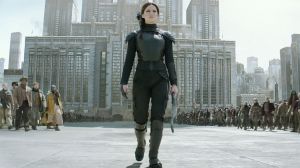 Director Francis Lawrence (I Am Legend) has guided the franchise with sturdy skill and a keen eye for visual arrangements, but if there’s one significant visual complaint I have it’s that these movies are too damn dark. I’m not talking thematically, as I’ve already explained above, but simply from a light level. These movies are just hard to see. Lawrence seems to favor low-light environments to create an ambivalent mood. That’s fine, but I’d also like to see what’s happening on screen. In the last movie we spent a majority of our time in dank underground bunkers, but Part Two is an outdoors kind of picture, so why is it still so hard to distinguish what’s happening?
With the approaching end of The Hunger Games (until Lionsgate milks more money from its lucrative cash cow) it’s appropriate to take stock of its legacy. No other YA franchise has tapped into the cultural zeitgeist like The Hunger Games, but its ultimate legacy will probably be cementing the once promising young actress Jennifer Lawrence firmly into the upper echelon of Hollywood. In the time since our first foray to Panem, Lawrence has won an Oscar, been nominated for another, and proven to be one of the hottest stars on the planet, the kind of actress that esteemed directors are fighting to work with and studio heads want to tap as their lead. Much like Katniss’ meteoric rise to renown, Lawrence has become her own version of the Girl on Fire. She has been better than the Hunger Games movies for some time, and yet Lawrence hasn’t failed in her primary duty to provide an anchor for the audience. Her gritty, conflicted, and commanding performances in the franchise have been a unifying resource for audiences and a reminder of her considerable talents. The Hunger Games: Mockingjay Part Two brings to a close a massively successful film franchise and an important chapter in the ascendancy of Ms. Lawrence. It’s thrilling, bleak, and inhabits most of the hallmarks that have come with the Hunger Games films, though in somewhat less supply to make way for the onslaught of action climaxes. There’s more anticlimax then you’d expect, and I credit the filmmakers for sticking with it even at the detriment of the experience. Mockingjay Part Two does enough to end the franchise on an appropriate if somber note. I’ll see everyone at the proposed theme park (seriously, look it up).
Nate’s Grade: B
Share this:

Steve Jobs (2015)
 Dizzying with its dialogue, Steve Jobs tells the story of its titular man through three Apple product launches, 1985’s Macintosh computer, 1988’s Apple rival and failure, Next, and 1998’s iMac, the beginning of the re-emergence of Apple into ubiquity. It’s really an Aaron Sorkin movie above all else, which means we get absurdly intelligent characters walking and talking at rapid-fire with brilliant one-liners and snappy dialogue that bristles with musicality to it, the kind that your ears perk up for. It’s a feast for the ears; however, Steve Jobs is really an emotionally cold stage play on film. Danny Boyle (Slumdog Millionaire) is the director but the staginess of the conceit is too much for the visually nimble filmmaker to overcome. There are a few small visual flourishes as inserts but the star is Sorkin’s verbose screenplay. We get a glimpse into the prickly, egotistical, bullying, visionary, and curious man that was Steve Jobs. His continual denial of being the father to his daughter is a source of great contrarian insight. The structure of the script lends itself to repetition and artificiality. All these characters keep turning up and having these important conversations at these moments? After a while it feels like the characters are talking in circles and waiting for catharsis, and the concluding ten minutes is a detour into unearned sentiment. The movie and its major themes just do not come together with the clarity or force that the filmmakers believe. Michael Fassbender is superb as Jobs and there isn’t a bad performance in the bunch. It’s an engaging movie in the moment but I don’t feel like I know Jobs any better than before. In attempting to tell the life of one influential man, Sorkin has made the movie about himself, but The Social Network this is not.
Nate’s Grade: B
Share this:

Pan (2015)
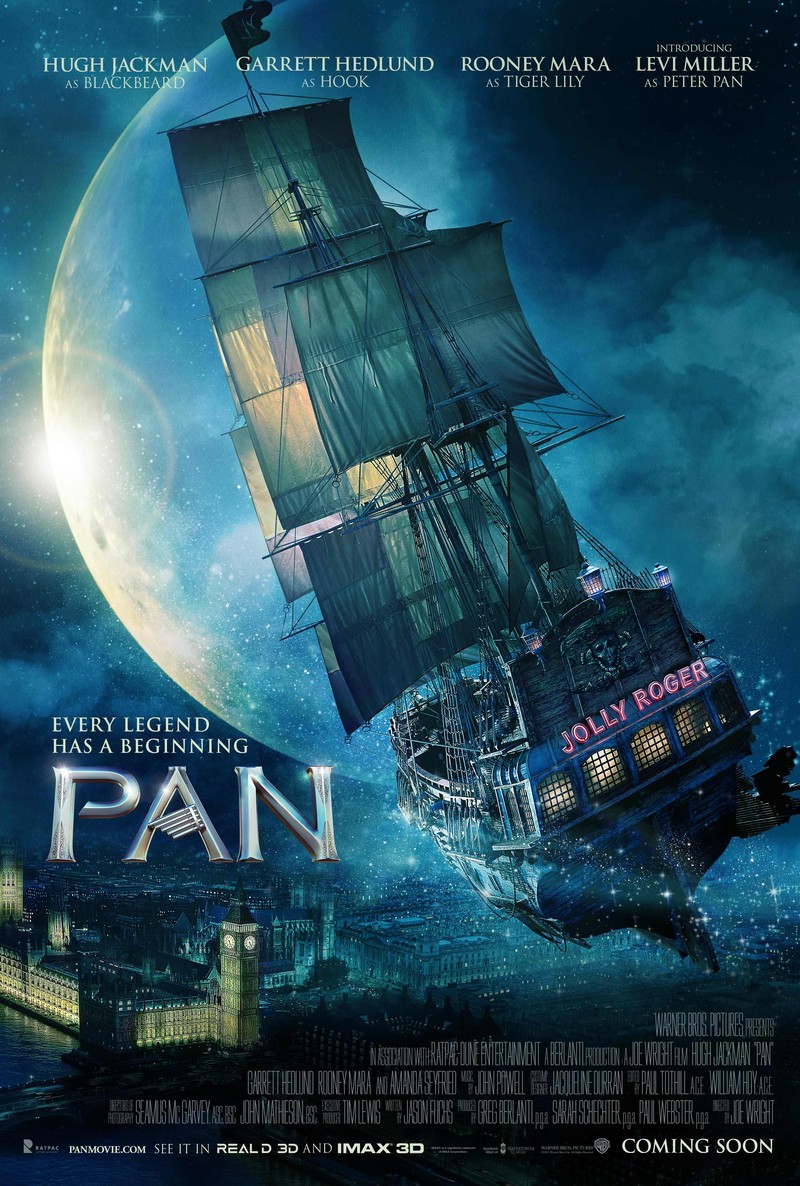 Reminiscent of the Patton Oswalt bit concerning The Phantom Menace, often fans rarely need the “before” when it concerns the characters they love; did anyone really need to know what Peter and Hook were up to before they became mortal enemies? Pan attempts to tell the story before we know it about how Peter Pan became the character we know. It was originally planned for a summer 2015 release and was pushed back until the fall, ostensibly for more time to finish visual effects. the studio, Warner Brothers, pulled a similar move with Jupiter Ascending, and we know how that turned out.
Peter (Levi Miller) is an orphan living in London during World War II. He and a few of his best parentless pals are abducted in the middle of the night by a group of pirates and their flying pirate ship. He’s taken to Neverland to work in the mines belonging to Blackbeard (Hugh Jackman), who has an addiction to fairy dust. During a scuffle, Peter discovers he has the ability to fly, though he can’t exactly master it. There has been a prophecy that The One would be able to fly and they would topple Blackbeard. Peter and another miner, James Hook (Garrett Hedlund), escape, finding their way into the land of the “natives,” which includes Tigerlily (a miscast Rooney Mara). The “Pan” has been prophecized to help lead their people and discover the bridge into the world of the fairies, and Blackbeard won’t stop until he finds the source of his pernicious pixie smack.
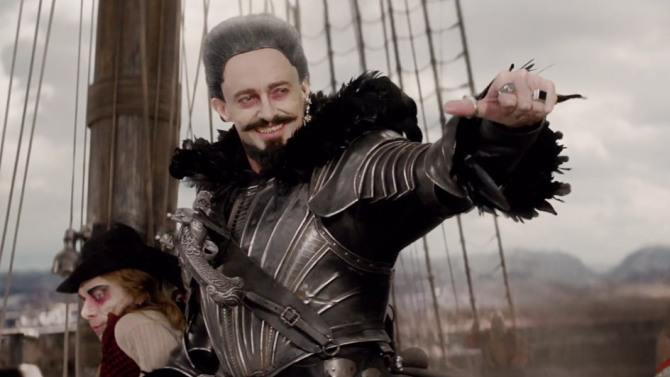 Who exactly is Pan intended for or what story needed to be told prior to our introduction to the world of Neverland? The first act sets the stage for the miscalculated tonal mishmash that never truly settles: we jump from a cruel orphanage, with Peter comically plucky, to the horrors of the London bombing during the Blitz, to a bunch of pirates kidnapping the orphans (tacitly with the approval of the evil head nun running the orphanage), and from there we’re whisked away across space to a mine of slave workers digging for pixie dust minerals who serenade their pirate slave lord with the lyrics to Nirvana’s “Smells Like Teen Spirit” for… some reason. Is this a movie intended for younger children and families? Is it intended for teenagers? The tone veers wildly, sometimes within the same scene, going from serious and gritty to colorful and ridiculous. It’s a campy experience that makes me wonder who exactly was supposed to enjoy an attempt to open the Peter Pan mythos, a world that is generally shallow.
At no point does Pan justify its existence beyond a flimsy corporate attempt to take a familiar world and expand upon it for sweet franchise money. When you get down to the world of Neverland, at least as represented on film, what exactly is there? There are pirates, “natives,” mermaids, and fairies, and that’s about it. They all kind of exist in their own individual movie that fails to blend together, making the new groups of characters feel like little more than a new theme park attraction before moving on to the next autonomous ride. The fantasy figures themselves just aren’t that interesting because there just isn’t much to them beyond superficial descriptions. I suppose then that this would allow plenty of opportunity at world building to take these familiar staples and give them greater depth, and that’s Pan’s biggest missed opportunity. Far too often, the movie feels on Fantasy autopilot and what we’re given is the old clichés of the Great Prophecy and the Chosen One meant to bridge worlds, etc. the events in the film do little to explain how Peter became Peter Pan, besides learn to fly. The problem with the prophecy trope is that it robs characters of agency in place of just accepting their capital-D destiny.
You learn nothing new about Peter or Hook as people, and the nods to the greater Pan lore are annoying at best with how unsubtle and clunky they are. The movie doesn’t even lay the groundwork to explain what conflicts will eventually drive Peter and Hook apart. Peter is a bland hero who is defined by the mystery of his absent mother and her own lineage. He’s special because his mom was special and if he just believes hard enough then perhaps he can be even more special. It’s pretty simplistic stuff. The references to the Pan lore always seem to stop the movie dead in its tracks. The relationship between Peter and Hook isn’t explored in any capacity other then they appear to have both escaped together and been running side-by-side. It’s a relationship not out of bonding but out of sheer proximity. The concluding lines are literally Peter saying, “We’re going to be friends forever,” and Hook replying, “What could possibly go wrong?” Oh my goodness is that one hacky groan-worthy wink to the future.
 Pan is made serviceably watchable from director Joe Wright and the campy performance of Jackman. Wright is a premier visual stylist in cinema though his artistic instincts can lead him to try and smash as many ill-fitting square pegs as he can into round holes, last evidenced by the 2012 Anna Karenina adaptation that made all the world a literal stage. The visuals are often splendid to behold and Wright has a wonderful feel for color hues. The final act feels climactic and visually alive in ways the movie doesn’t even deserve, and Wright’s vision, weird as it can be at points (Nirvana?) gives the movie an energy that keeps its worth an initial viewing. For a movie filed with fantasy realms, I enjoyed the scenes in the orphanage and with the wicked head nun the best (is she knowingly selling the boys into slavery on a magic pirate ship or is it just extreme negligence on her part?). The other aspect that at least held my attention was Jackman. In a movie filled with bland and the occasionally bizarre performance, Jackman offers an anchor to lean upon. It’s not a good performance by normal circumstances but it provides a sense of life and feels in place. Hedlund (On the Road) is amazing in just how strange his rakish Harrison Ford-esque performance persists. Why didn’t anyone tell him to stop? His speaking voice fascinated me and I spent the entire moving trying to figure what it sounded like and my best description is Heath Ledger’s impression of Al Pacino.
While not being a colossal disaster of artistic self-indulgence, Pan is a disappointing and mostly tedious experience because of its failure to capitalize on expanding upon the Neverland universe and exploring what should be formative experiences to central characters. If this was going to be a crazy artistic romp then it needed to be crazier. If you’re going to have two brief anachronistic songs, then do more or at least draw in more influences from other timelines. If you’re going to be a straight-laced pilot for a budding fantasy franchise, at least give us more flights of fancy and wonder. Make us fall in love with this world or at least some of the characters. Instead Pan uses the audience’s pre-existing association with the characters and the environment in place of doing anything meaningful with a story. Peter becomes Peter Pan, so he doesn’t have to be a character he just has to be the pre-Pan Peter. The same for Hook and Smee and Tigerlily and that’s really the only characters worth mentioning until those Darling children come visit. I thought I was going to ridicule Pan with the glee I had taking apart Jupiter Ascending but I couldn’t muster much effort. It didn’t feel like the Pan filmmakers did either.
Nate’s Grade: C
Share this:

The Martian (2015)
 Based upon Andy Weir’s nuts-and-bolts scientific “what if” tale, The Martian is the movie equivalent of Apollo 13 crossed with Cast Away. Just far less personable volleyballs. But there are potatoes. Space potatoes.
After a powerful storm on Mars forces NASA’s crew to flee, astronaut Mark Watney (Matt Damon) is presumed dead and left behind. He wakes up hours later, shrapnel in his gut, and retreats back to the Mars mission base. He has to survive close to two years before he has any hope of being rescued on the hostile world. Before that, he has to establish some kind of communication with NASA, and even before that he has to somehow grow food in the arid Martian soil. Back at home, NASA is debating their limited options to bring back Watney and whether or not they should tell his crewmates that he survived.
In conversations with my friend and critical colleague Ben Bailey, he said that The Martian was the opposite of Gravity, a film he subsequently loathed, because it was smart people making smart decisions. There is an inherent enjoyment watching intelligent people tackle and persevere over daunting challenges, and this sets up The Martian for lots of payoffs and satisfaction. We see both sides of the problem and it provides even more opportunities for challenges and payoffs. Naturally the stuff on Mars is more compelling because of its extreme dangers and isolation, but the Earth scenes are also enjoyable as the NASA determines the soonest they might reach their lost astronaut. Just like the similarly themed Apollo 13, there are challenges to be overcome and the solutions are not without risk themselves. I enjoyed how the screenplay kept throwing out new obstacles; just when you think you can breath for a while the status quo is upset again. The slew of new obstacles doesn’t feel contrived either but rather realistic setbacks. It’s a wonderful storytelling structure that constantly keeps things moving forward and ramps up the urgency. As a result, we don’t ever feel safe right until the climax, and even then you’re still sweating it out because of all the complications and adjustments.
 It’s revitalizing to watch a movie that treats science with a sense of reverence. Mark Watney endures in the most hostile of environments through his ingenious use of the resources he has because of his understanding of science and math. Just as MacGyver proved there was something satisfying about watching a guy make a bomb out of a toilet paper tube, some chewing gum, and a bobby pin, it’s entirely enjoyable watching Watney think his way out of problems, and this starts early on. Watney’s first problem after he regains consciousness is to remove an embedded piece of shrapnel in his gut. The scene plays in a methodical fashion without any obtrusive edits, allowing the full task to settle in with the audience. The man has to perform surgery on himself and dig inside himself, and if he doesn’t get this done soon, sepsis might set in (no doctors without borders here). From there, the situation only gets more serious as Watney’s food supply, even when generously rationed, will only last a fraction of the time it would take NASA to send a rescue team. He has to grow food on an alien planet. That itself could be its own movie, a glossy crossover special from the SyFy Channel and the Home and Garden network. This is a survival story that doesn’t rely upon coincidence or some sort of divine intervention but on the understanding and admiration of science and its possibilities. Though America’s favorite astrophysicist Neil deGrasse Tyson says that in this movie universe, all the science decisions are being made by science professionals rather than, you know, politicians who adamantly open ignorant statements with, “I’m not a scientist.”
Another aspect I wasn’t quite expecting but took hold of me is how uplifting The Martian turns out to be. It’s a celebration of human endeavor and particularly cooperation, as the United States reaches out to other nations for assistance. Watching the determined souls risk their lives to retrieve one fallen man is the kind of thing that represents the best in us. Sure, there’s something to be said about the fact that it’s one prized American life that countries are spending billions of not trillions of dollars to rescue and perhaps that money would be better spent helping more lives on Earth. There’s also the curious fact that the world has spent a ton of money rescuing Matt Damon in movies. From Saving Private Ryan, to Interstellar, and now The Martian, we seem to value Damon above all else.
This isn’t exactly a one-man show with half of the running time flashing back to Earth but Damon’s star quality and acting chops makes it so you don’t mind being marooned with this man. Watney’s recorded messages are a slick way to deal with the internal thinking of its protagonist while giving the character more opportunities to charm thanks to a rich sense of gallows-level humor. At no point is Mark Watney flippant about his unique predicament but his sense of humor goes a long way to further engender the audience’s good will. He’s not moping and having existential crises; he’s getting to work, and it’s through the problem solving that we get to know this character, his ingenuity, his personality, his fears, and his distaste for disco music. Damon steers clear from playing the character too large and bearing his soul as the metaphorical representative for all of humanity and its place in the cosmos. He’s just one guy who happens to be lost millions of miles from his home planet, and he’s making the best of it.
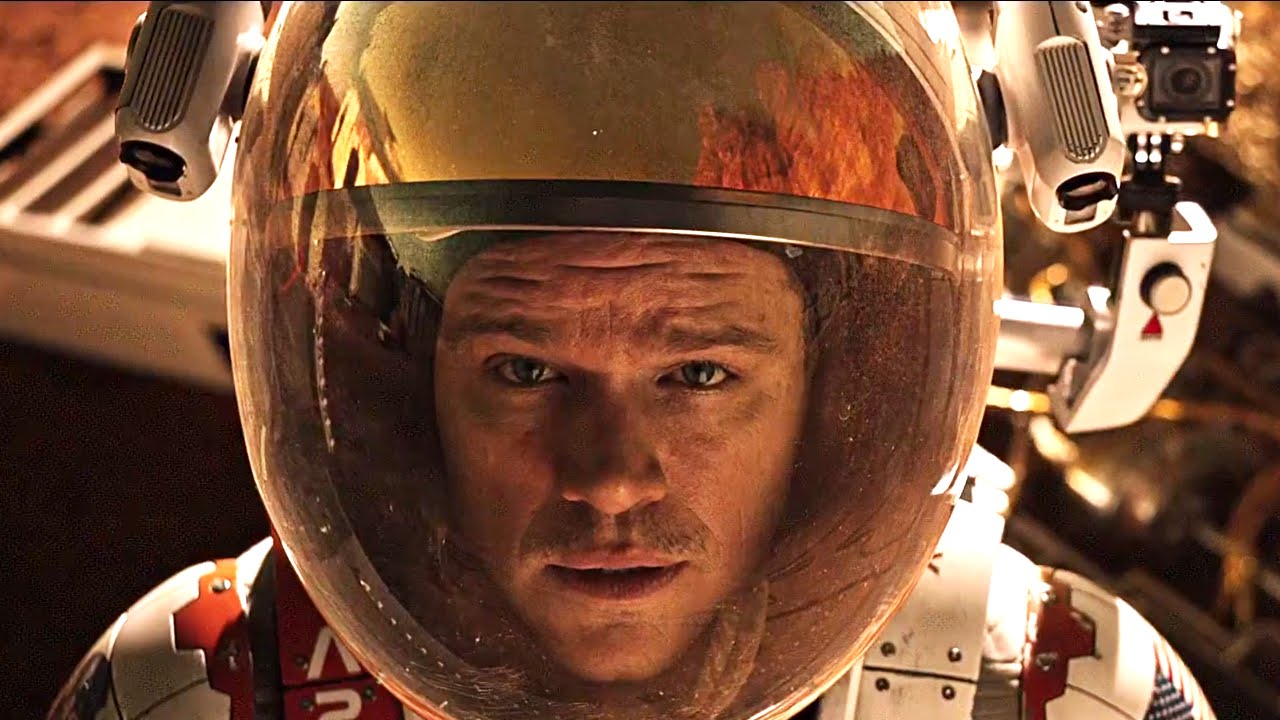 Being a Ridley Scott film, naturally the film is downright impeccable from a technical standpoint. The photography is great, communicating the frightening and awe-inspiring scope of the alien topography, especially when compared to maps for scale. The visuals find ways to further help communicate Watney’s dilemma and diminished resources. Scott’s visual sensibilities are so naturally attuned to developing tension. I was holding my breath at times from the suspense of certain sequences even though I long assumed that Watney would make it back home safe and sound. A scene with a desperate need for duct tape was a real nail-biter. There isn’t a bad performance among the star-studded cast of actors who must have been grateful for even a tiny morsel of screen time. I have no idea what Kirsten Wiig really does in this movie as the NASA PR person besides fold her arms in rooms, but hey, she’s there, along with Donald Glover as a socially awkward physicist. Jessica Chastain (Zero Dark Thirty) gets to pour over the regret of leaving a friend behind, Jeff Daniels gets to once more practice his skill of being an authoritarian blowhard he honed from The Newsroom, and I even was able to tolerate Kate Mara (Fantastic Four), so that’s something.
The Martian is a natural crowd-pleaser. It’s engineered from the start to engage an audience with its survival thrills, present a series of increasing payoffs with new challenges and solutions, and by the end of our journey we’re treated to a rousing finish that carries a poignancy and sense of inspiration about the best in all of us, what can be accomplished through grit and cooperation and sacrifice. It’s a movie that let’s the science of survival be the ultimate star, with Damon serving as a handsome host to guide us through the marvels of the universe and duct tape. When dealing with the vastness of space and the vulnerability of human life, it’s easy to feel insignificant in comparison, but that’s where the human will to endure and to work together comes in and reconfirms the possibilities of the collective inhabitants of this giant blue orb. The Martian is a sci-fi thriller, a potent human drama, and one of the best times you can have at the movies.
Nate’s Grade: A-
Share this:

The Maze Runner: The Scorch Trials (2015)
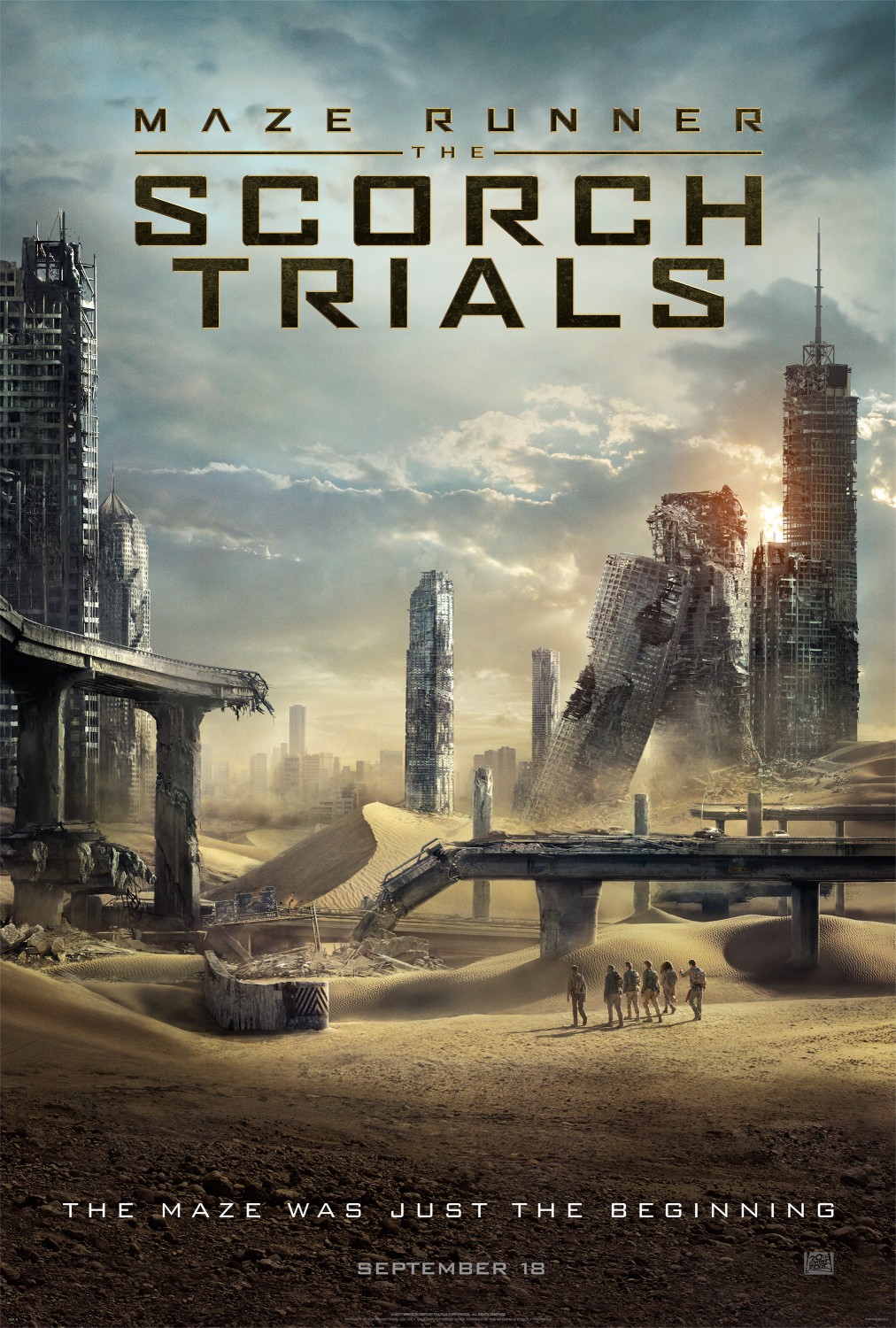 It’s called The Maze Runner: The Scorch Trials, though the trials appear more as “general struggles,” The Scorch appears as but a brief expanse of desert before the mountains, and then there’s the lack of any and all maze running (there is plenty of running, however). This sequel to the YA-inspired hit lives up to my biggest worry: the only thing interesting about this franchise was the maze, and now that’s gone. The mystery of the maze, and its cool factor, gave this story something memorable. Now it’s just generic YA pap. Beyond its boring protagonist, it would be a scorch trial for me to even assign description to these characters. They don’t even get one note to play; they have no notes. That’s because so much of this tedious and bloated sequel is our group of maze survivors running from one outpost to another, seemingly safe and then predictably not. It’s a plot routine that gets redundant quickly, and yet little else seems to occur. They go from stop to stop gaining characters but little else. The momentum feels stalled and there’s no sense of direction to guide the characters. It feels so aimless and dull and far too flimsy to justify even half of the movie’s 132 minutes. I just don’t care about these characters so I rooted for the bad guys. Weirdly enough, the bad guys use tasers and the good guys use bullets. There are some scant highpoints, namely the direction of Wes Ball, who finds ways to make the chase sequences visually stylish and fleetingly exciting, and a self-destruct sequence set to a Patsy Cline tune. There’s enough to get your hopes up before the grim reality of the overwhelming onslaught of YA tropes comes crashing down again. Can we stick these dumb kids back inside a maze already?
Nate’s Grade: C


 nathanzoebl
You must be logged in to post a comment.