Blog Archives
The Substance (2024)
 In 2017, French filmmaker Coralie Fargeat released her debut movie, Revenge, her daring spin on the rape-revenge thriller. It was an immediate notice that this filmmaker could take any genre and spin it on its head, providing feminist influences on some of the most grisly and male-dominated exploitation cinema. Even more so, she makes whatever genre her own and on her own terms. The same can be said for The Substance, a movie that utilizes sensationalism to sensational effect. It’s a movie that is far more than the sum of its Frankenstein-esque body horror parts.
Elisabeth (Demi Moore) is a television fitness instructor who has been massively popular for decades. Upon her 50th birthday, she’s promptly dismissed from her job by her studio, concerned over her diminished appeal as a sex symbol. She gets word of a mysterious elixir that can help her reverse the ravages of aging. It arrives via a clandestine P.O. box in a container with syringes and very specific instructions. She needs to spend seven days as her younger self, and seven days as her present self. She needs to “feed” her non-primary self. She also needs to understand that she is still the same person and not to get confused. Elisabeth injects herself with the serum and, through great physical duress, “Sue” emerges from her back like a butterfly sprouting from a fleshy cocoon. As Sue (Margaret Qualley), she’s now able to bask in the fame and attention that had been drifting away. Sue becomes the next hot fitness instructor and everything the studio wants. Except she’s enjoying being Sue so much that going back to her Elisabeth self feels like a punishment. Sue/Elisabeth starts to cheat the very specific rules of substance-dom, and some very horrifying results will transpire as she becomes increasingly desperate to hold onto what she has gained.
 Let me start off this review looking at the substance of The Substance, particularly the criticism that there is little below its surface-level charms. First off, let me defend surface-level charms when it comes to movies. It’s a visual medium, and sometimes the surface can be plenty when we’re dealing with artists at the top of their game. Being transported and entertained can be enough from a movie. Not every film needs to force you to re-evaluate the human condition. It’s perfectly acceptable for films to just be diversionary appeals to the senses. With that being said, the simplicity of the movie’s story and themes works to its benefit. The plotting is very clear, setting aside the rules, and then we watch the spiraling consequences when Elisabeth, and then Sue, decide to go against the rules and pay dearly. The ease of the storytelling is so precise with its cause-effect escalation, so that even when things are getting crazy, we know why. The commentary on aging in Hollywood isn’t new or subtle; yes, the industry treats young women like products to be exploited for mass consumption until they get older and are seen as less desirable. Yes, the pressure to fight the irreversible pull of aging can lead to increasingly desperate actions. Yes, being forced to cede the spotlight to someone you feel inferior can be humiliating. It’s nothing new, but it presents an effective foundation for what becomes a highly engaging, garishly repellent, and jubilantly visceral body horror deconstruction into madness. Rarely do we get an opportunity to say a movie must be seen to be believed, and The Substance is that latest must-see spectacle.
I found the exploration of identity between Sue and Elisabeth to be really interesting, as we’re told repeatedly in the instructions that the two are the same person, and yet the two versions view the other with increasing resentment and hostility. For all intents and purposes, it’s the same woman trying on different outfits of herself, but that doesn’t stop the dissociation. In short order, the two versions view one another as rivals fighting over a shared resource/home. Sue becomes the preferred version and thus the “good times” where she can feel at her best. The older Elisabeth persona then becomes the unwanted half, and the weeks spent outside the coveted persona are akin to a depression. She keeps to herself, gorges on junk food, and anxiously counts the prolonged hours until she can finally transform into Sue. Again, this is the same character, but when she’s wearing the younger woman’s body, it can’t help but trick her into feeling like a different person. This division builds a fascinating antagonism ultimately against herself. She’s literally fighting with herself over her own body, and that sounds like pertinent social commentary to me.
 While The Substance might not have much to say about aging and Hollywood that hasn’t been said before, where the movie separates itself from the pack is through the power of its voice. This is a movie that announces itself at every turn; it is a loud, emphatic personality that can take your breath away one moment and leave you riotously laughing the next. The vision and filmmaking voice of this movie is unmistakable, and while we’re covering familiar thematic ground on its many subjects, the director is assuring us, “Yes, but you haven’t seen my version,” and after a few minutes, I wanted to see wherever Fargeat wanted to take me. I loved the very opening sequence that catalogues our star’s career through a time lapse shot of her Hollywood Walk of Fame star. We see the public unveiling, arguably the height of her stardom, and then progress further, from tourists taking their picture with the star, to people ignoring it, a passing dog peeing over it, and a homeless shopping cart wheeling over it. In one shot, Fargeat has already efficiently told our character’s rise and fall through imaginative and accessible visuals. There are other elements like this throughout that kept me glued to the screen, eager to see the director’s take on the material.
This is a first-rate body horror parable with wonderfully surreal touches throughout. The creation of Sue, being born from ripping from Elisabeth’s back, is an evocative and shocking image, as is the garish stapling of Elisabeth’s back/entry wound (why it makes for the poster’s key image). It’s reminiscent of a snake slithering out of its old skin, but to also have to take care of that old skin, knowing you have to metaphorically slide it back on, is another matter entirely. The literal dead weight is a reminder of the toll of this process but it’s also like they’ve been given a dependant. The spinal fluid injections are another squirm factor. I loved the way the Kubrickian production design heightens the unreality of the world. I won’t spoil where exactly the movie goes, but know that very bad things will happen beyond your wildest predictions. The finale is a tremendously bonkers climax that fulfills the gonzo, blood-soaked madness of the movie. If you’re a fan of inspired and disturbing body horror, The Substance cannot be missed.
Demi Moore is a fascinating selection for our lead. While it might have been inspired to have Qualley (Maid, Kinds of Kindness) play the younger version of her mother, Andie McDowell (Groundhog Day), it’s meaningful to have Moore as our aging figure of beauty standards. Here is an actress who has often been defined by her body, from the record payday she got for agreeing to bare it all in 1996’s Striptease, to the iconic Vanity Fair magazine cover of her nude and pregnant, to the roles where men are fighting over her body (Indecent Proposal), she’s using her body to tempt (Disclosure), or she’s using her body to push boundaries (G.I. Jane). It’s also meaningful that Moore has been out of the limelight for some time, mimicking the predicament for Elisabeth. Because of her personal history, the character has more meaning projected onto her, and Moore’s performance is that much richer. It reminded me of Nicolas Cage’s performance in Pig, a statement about an artist’s career that has much more resonance because of the years they can parlay into the lived-in role. Moore is fantastic here as our human face to the pressures and psychological torment of aging. She has less and less to hold onto, and in the later stretches of the movie, while Moore is buried under mountains of mutation makeup, she still manages to show the scared person underneath.
 Qualley has more screen time in the second half of the movie and has the challenge of playing a very specific kind of character. Sue is the idealized form for Elisabeth which makes her character even more exaggerated and surreal. She’s a figure of pure id, strutting her stuff because she can, luxuriating in the sense of power she has because of the desire that she produces. Qualley goes full hyper-sexualized cartoon for the beginning part of the role, where she’s the coveted version riding high. It’s the second half, where things begin to slip away, that Qualley shines the most as the cracks begin to take hold in this carefully arranged persona of confidence.
Much needs to be said about the hyperbolic sexualization of its characters, particularly Sue as the new young fitness star. Obviously our director is intending to satirize the default male gaze of the industry, as her camera lingers over tawny body parts and close-ups of curves, crevices, and crotches. However, the sexual satire is so ridiculously exploitative that it passes over from being too much and back to the sheer overkill being the point. This is not a movie of subtlety and instead one of intensity to the point that most would turn back and say, “That’s enough now.” For a movie about the perils and pleasures of the flesh, it makes sense for the photography to be as amplified in its rampant sensuality. There are segments where every camera angle feels like a thirsty glamour shot to arouse or arrest, but again this is done for a reason, to showcase Elisabeth/Sue as the world values them. The over-the-top male gaze the movie applies can be overpowering and exhausting, but I think that’s exactly Fargeat’s point: it’s reductive, insulting, and just exhausting to exclusively view women on these narrow terms. This isn’t quite our world, as the number one show on TV is an aerobics instructor, but it’s still close enough. I can understand the tone being too much for many viewers, but if you can push through, you might see things the way Fargeat does, and every lingering and exaggerated beauty shot might make you chuckle. It’s body horror on all fronts, showing the grotesquery not just in how bodies degrade but how we degrade others’ bodies.
On a personal note, while I’ll be back-dating this review, I wrote portions of it while sitting at my father’s bedside during his last days of life. He’s the person that instilled in me the love of movies, and I learned from him the shared language of cinematic storytelling, and one of my regrets is that I didn’t go see more movies with my father while we could. I really wish he could have seen The Substance because he was always hungry for new experiences, to be wowed by something he felt like he hadn’t quite seen before, to be transported to another world. He was also a fan of dark humor, ridiculous plot twists, and over-the-top violence, and I can hear his guffawing in my head now, thinking about him watching The Substance in sustained rapturous entertainment. It’s a movie that evokes strong feelings, chief among them a compulsive need to continue watching. It’s more than a body horror movie but it’s also an excellent body horror movie. Fargeat has established herself, in two movies, as an exciting filmmaker choosing to work within genre storytelling, reusing the tools of others to claim as her own with a proto-feminist spin and an absurdist grin. The Substance is the kind of filmgoing experience so many of us crave: vivid and unforgettable. And, for my money, the grossest image in the whole movie is Dennis Quaid slurping down shrimp.
Nate’s Grade: A
Share this:

It’s What’s Inside (2024)
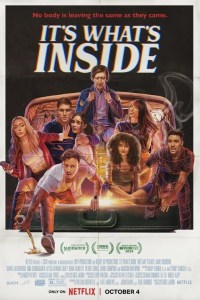 This sneaky little movie is exactly what I’ve been asking for from low-budget genre cinema, where creative ingenuity and imagination are the dominant forces to offset budget limitations. It’s What’s Inside is ostensibly a body swap movie between a group of friends stuck in a mansion overnight. A device allows eight people to swap into other hosts, and it plays as a silly party game early, before writer/director Greg Jardin increases the stakes. People pretend to be someone else and then explore that freedom, which usually means having affairs and getting a little too comfortable in other people’s bodies. Then there are… complications, and watching the characters frantically debate their new challenges and limitations with growing mistrust, exasperation, and betrayal makes for a delicious 90 minutes of surprises. Because there are multiple rounds of body-swapping, and eight starting characters, Jardin takes particular points to better clarify identities, from characters wearing Polaroids to a red-tinted sort of x-ray showing the real characters underneath the confusing physical surface. All of it helps, though I still had to ask who was really who quite often. I think watching it a second time would make it more coherent but also give me even more appreciation for Jardin’s slippery, shifting screenwriting. Here is a movie with rampant intrigue and imagination to spare, that maximizes its creativity to tap the body swap as an illuminating and destructive device to explore secret insecurities, desires, jealousies, and dissatisfaction in a friends group. It’s a wild trip, elevated by energetic and helpful editing, where the ideas are the main feature. It might not be much more than a bad overnight stay with bad people but It’s What’s Inside is top-notch genre filmmaking. It’s what’s inside the movie that matters most, its big imagination and fulfilling execution. Greg Jardin, you have my full attention with whatever movies you want to make from here on out.
Nate’s Grade: A-
Share this:

Freaky (2020)
 A body swap movie set in a slasher universe, Freaky is a fun and gory romp that still feels like it could have been even more entertaining with the possibility of its premise. A masked serial killer (Vince Vaughn) stabs a teenage girl (Kathryn Newton) with a magic Mayan knife and they swap places and must learn to cope in their new bodies and roles. The teen-in-adult body is wonderfully played by Vaughn, who seems to be really enjoying himself with a silly role that pushes him outside his smooth-talking leading man roles. He might be playing up the girlishness and higher-pitched voice but his energy level is high and provides plenty of entertainment with the absurdity. There are a few inspired moments developed from the crazy premise, like when Vaughn has a heart-to-heart with his/her mother at work, able to offer insight into the daughter she feels she is failing, and the mother becomes romantically intrigued by this mysterious man. There is a first kiss sequence in the backseat of a car that is so awkward but owns its outrageous quality. I wish the movie from co-writer/director Christopher Landon (Happy Death Day) made better use of its fruitful premise. There are so many more bizarre scenarios that could be gleaned here, especially if the masked serial killer had more of a personality. Clearly modeled after the silent stalkers like Michael Myers and Jason Voorhees, this makes the film feel too one-sided with ideas. Sure the teenage girl is now to be feared, dresses sharper, and kills her high school annoyances, but it doesn’t make for much of a creative cat-and-mouse game when it comes to outsmarting the original owner of this new body. I will also champion the gory kill scenes as above average in their conception and execution. It’s really over-the-top and memorable and I wish there had been even more wild splatter. Freaky is a decidedly fun movie from the Blumhouse assembly line but I can’t help wishing it was a little bit funnier, a little bit weirder, and little bit more imaginative. The parts were there to make this hilarious and brilliantly creative, and settling for chuckles and disposable entertainment feels like a nagging compromise.
Nate’s Grade: B
Share this:

Jumanji: The Next Level (2019)
 Think of this action-comedy sequel as the enjoyable DLC to 2017’s main campaign. The Next Level feels rather familiar as it dishes up slight variations on what made the 2017 Jumanji reboot so enjoyable, namely a game cast ready to be silly and physical, fun and flourishing action set pieces, and a clever satire of video game mechanics. The excuse to get the gang back together one year after events from the first film is flimsy, but I didn’t care because I enjoyed these characters and especially the actors playing their in-video game avatars. The twist this time is a body swap that involves two elderly men (Danny DeVito, Danny Glover) joining the mix, allowing The Rock to do his best… old Jewish man impression? It certainly doesn’t come across like DeVito, as funny voices isn’t exactly a specialty for The Rock, but it hardly matters. There’s still more worlds to explore, new obstacles/levels to be tackled, and with the body-swap mechanic, a fun switch-up for the main actors to portray a variety of characters inhabiting their bodies. I was extremely happy that the film rejected recycling jokes from its predecessor. It would have been very lazy (a.k.a. lazy) to simply go back to a few funny wells that worked the first time, but every time the film brings back an element from the first adventure it builds off of it rather than rehash a reference point. Once again Karen Gillan (Avengers: Endgame) steals the show. The humor isn’t as gut-busting or satisfying as the previous incarnation but part of that is because we now know what to expect from this renewed franchise, and The Next Level manages to deliver what a fan would request while finding enough variations and tweaks to make it feel like its own movie, even if it won’t live up to the high standard of entertainment that came before it. If you were a fan of 2017’s Welcome to the Jungle, I’m confident you’ll walk away relatively satisfied and smiling from The Next Level. However, chart this as another movie that ends with a preview of a sequel that I wish I had seen instead of the movie I got (stay tuned through the immediate end credits). Jumanji: The Next Level is a worthy sequel to one of the more fun, clever, and visually inventive action-comedy franchises. As long as they can maintain this level of quality, I’ll happily pre-order the next edition.
Nate’s Grade: B
Share this:

Shazam! (2019)
 It seems like the secret to the success of the DC movie universe is making fun, lower stakes adventures with the characters the public has the least knowledge about. Shazam actually begun as a “Captain Marvel,” and now comes on the heels of the MCU’s Captain Marvel. We follow Billy Batson (Asher Angel), a teenage orphan trying to find his missing mother. He stumbles into a wizard’s realm and is given a special power whereupon he turns into a square-jawed, broad-shouldered superhero (Zachary Levi) by saying “Shazam.” What follows is like a superhero version of Big and it’s goofy, charming, and reminiscent of an 80s Amblin movie, where children’s movies were allowed to be a little creepy and weird. The movie is light, cheerful, and heartfelt with its doling out of family messages to go along with the slapstick and personal growth. It’s very much envisioned from a young boy’s fantasy perspective of being a super-powered adult, where the first things to be done include buying beer, going to a “gentleman’s club,” in between testing out bullet invulnerability and flight. Levi (TV’s Chuck) is excellent at playing an adult version of a kid. I was initially dismissive of his casting but he’s perfect for this part. There’s a satisfying sense of discovery for Shazam and his excitable foster brother (Jack Dylan Grazer) that doesn’t get old. The movie is more concerned with how the superpowers are affecting Billy’s relationships and sense of self than any larger, planet-destroying danger. The film even sets up its villain (Mark Strong) by giving him a decent back-story and opening the movie to explain his crummy family. It’s not a three-dimensional villain by any means but the attention given to make him something more is appreciated. The other foster kids in Billy’s new family are more archetypes but amusing, and their involvement in the final act raises the joy level of the finale. Shazam! is a movie where people are genuinely excited to be superheroes or associated with them, and that gleeful, buoyant revelry is downright infectious.
Nate’s Grade: B+
Share this:

Self/less (2015)
 The most surprising thing about Self/less occurred approximately 115 minutes into the film itself, when it revealed that Tarsem Singh was the director. Tarsem is known for lavish visual cinematic canvases such as The Cell and Immortals, and to realize that this is the same man responsible for an otherwise disappointing and visually mundane sci-fi thriller, well it was a shock. Why hire a visual stylist and then restrict him to such a limited palate? Self/less is an intriguing premise (borrowed a tad from Seconds) and it keeps all the interesting ethical and psychological questions at bay to follow a generic thriller formula. There’s not one real surprise in this film; even the reveals and surprises will be easily telegraphed. Ben Kingsley plays Damian, a dying rich man who undergoes a risky experiment to live longer, having his consciousness transferred into a younger human host played by Ryan Reynolds. It’s another chance to be young, party, enjoy sexual relations with women who are more likely to go home with somebody who looks like Reynolds. There’s a catch: if he stops taking his special red pills, the host’s brain will take over control. That’s because, surprise, the bodies aren’t grown in labs but are human volunteers. Here could be some topical class exploitation and social commentary, but Self/less ignores the more intriguing direction at every point to play it safe. Damian finds his host’s family and from that point on it’s a series of chases with bad guys. One of those chases is actually fairly entertaining, utilizing a conjoined automobile in a clever and devastating way. It never feels like Reynolds and Kingsley are playing the same character. Reynolds’ charm is subsumed by this role and he feels adrift. I’ll admit that this movie is efficient and each scene pushes the story forward; it’s just the direction of that story I’d like to alter. Alas, Self/less is a competent but fairly underwhelming thriller that squanders its premise.
Nate’s Grade: C+
Share this:

The Change-Up (2011)
 For once, I’d love somebody to construct a body-swap movie where the characters realize the tropes and clichés of the body-swap pictures, a parody of the genre. It’d be nice if the characters instantly accepted their situation and knew that they would each have to learn some form of a life-lesson before changing back, and they tried to falsely engineer these saccharine life-lessons. Then it would be fun if they rented all the body-swap movies to write down notes and pointers on how best to deal with their unusual situation. Then, and here’s the best part, both body-swap participants realize that they prefer their new situations. They reject turning back and simply enjoy the whims that come with their new existential home. They reject learning life-lessons and simply make the best of things. For a brief second, I thought The Change-Up might be that very movie but no such luck.
Dave (Jason Bateman) is a business-obsessed lawyer working his way to make partner in his firm. His wife, Jamie (Leslie Mann), and his three children, including twin babies, are neglected at home. Mitch (Ryan Reynolds) is a struggling actor/womanizer who inexplicably is best friends with Dave. After a night at a bar, the fellas relieve themselves in a public fountain. The fountain lady statue obviously has taken offense and thus curses the both of them. The next morning, each awakes to discover they are in different bodies. The business guy has to act like a jerk! The jerk has to act like a business guy! And then there’s the matter of Jamie, who Dave/Mitch has strictly forbidden Mitch/Dave from sleeping with. Complicating matters further, the fountain has been moved by the Atlanta parks department and lost in bureaucratic limbo.
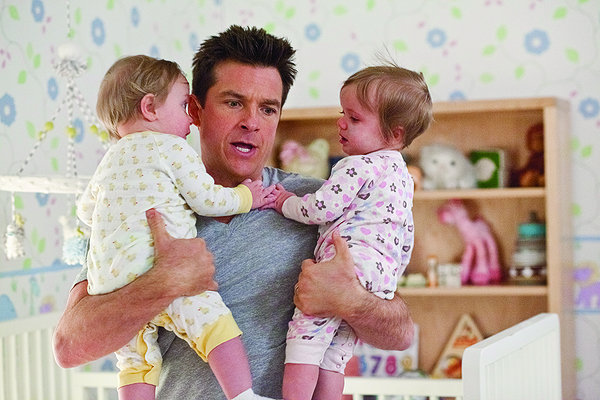 I knew I was in trouble by the first minute of the grossly unfunny Change-Up. Not only do we suffer a poop joke so early, we have to witness a baby firing a stream of fecal matter into Dave’s open mouth. That’s just a taste of the unpleasantness that follows. The movie plays like an exaggerated, sophomoric cartoon written by children. It seems to exist in the same broad universe of 2009’s abominable rom/com The Ugly Truth. What I wrote for that movie could easily apply to The Change-Up: “It’s questionable whether the comedy even reaches juvenile levels. It’s tasteless and piggish, but the weird part is that it comes across as knowledgeable on the subject of sex as a ten-year-old kid who just discovered his dad’s secret stash of Playboys. It talks about the right stuff but does so in a clueless manner. It’s like an exaggerated randy cartoon that chiefly plays to a male fantasy.” I’m not opposed to raunchy sex comedies. However, I am opposed to sex comedies that can’t figure out how to be funny without relying on easy gags. There’s a difference between gross-out humor and simply being gross, though I don’t believe this film knows what that difference is. So we’re treated to an over-the-hill porn star, some anal defilement, a voraciously sexual nine-months pregnant lady, even more poop jokes, and 90 minutes of penis discussion. There’s one actually interesting section where the guys debate the moral ambiguity of body-swap sex. Is it really cheating if Dave/Mitch is in somebody else’s body? What is Mitch/Dave to do if his wife wants to have relations? Sadly, this lone moment of interest is crushed to death by more penis jokes and then forgotten. Reynolds (Green Lantern) and Bateman (Horrible Bosses) try to stay above the fray, fighting the good fight, but even they succumb to the unfunny script and disjointed direction.
After being a distasteful cartoon for so long, the film wants to be dramatic. It wants to be emotional. Tough break, Change-Up, because you cannot have it both ways. The dramatic parts ring resoundingly false, a last-ditch attempt to class up what is a deeply unclassy picture. The tonal shifts are jarring and land with crashing thuds. It’s mostly because these characters are deeply unlikely, particularly the Mitch persona. He’s not just some brash, rude individual who sidesteps social mores, no this guy is downright sociopathtic. He’s egotistical, mean-spirited, and constantly boorish to every person in Dave’s life. He’s cruel to the daughter, he tells Dave’s wife that she’s not attractive, and then there’s the babies whom he treats like a couple of rag dolls to toss around. At one point, Mitch/Dave is on the phone and the kids are left to get in trouble with the kitchen. We’re not talking about getting messy with food, we’re talking sticking their tiny hands in a spinning blender, throwing knives, and licking electrical outlets (it’s like the Roger Rabbit cartoon that opened that flick). Instead of getting off the phone immediately, he continues talking and casually tends to the troubled tots per potential disaster. He teaches Dave’s daughter “violence is always the answer.” Mitch is an unrepentant jerk, and even when Bateman plays Mitch he’s still irredeemable. Am I supposed to feel sorry for this obnoxious guy just because his dad thinks low of him? I think low of him. I detest him. Therefore, when Mitch/Dave is having his Big Emotional Catharsis, it seems facile and hollow. We can generally find a point of likeability for uncouth characters, but not Mitch. As presented, this character has no introspection and few redeeming qualities, so why do I want to spend nearly two hours with this person? You’d think Dave would be the “nice guy” alternative, but he’s smarmy and neglectful too. Besides the “family man/pussy” and “playboy/prick” designations, the characters aren’t different enough to warrant a change of scenery.
 The Change-Up has the single most bizarre moment of any film this calendar year, and it has nothing to do with the metaphysical mechanics of body swapping. Wilde (Cowboys & Aliens, TRON: Legacy) at one point gets rather frisky and takes off her clothes, the last piece her brassier. Mitch’s hands cover her breasts for most of their onscreen freedom except for a handful of side angle shots where Wilde’s breasts are out and ready to greet the audience. Except those are and are not Wilde’s breasts per se. The in-demand actress had pasties to cover her nipples. The pasties were then digitally removed in post-production and replaced with CGI nipples. Let me repeat that for the slower among you – CGI nipples! It was some guy’s job to spend weeks painting nipples onto Olivia Wilde’s breasts. When I see nudity, can I trust that it’s real, or was it doctored by some computer technicians who are laughing at me the whole time? What is happening to this world when it makes me distrust the very sight of breasts?
The Change-Up is a mean-spirited, objectionable, nasty, classless, clueless comedy that’s tonally all over the place. The characters are unlikable, the comic setups are cartoonishly drawn, and the dramatic shifts are flatly false. What’s even worse is that the movie just seems downright hostile toward women. Just because it has a scene where Mann gets to vent the frustrations of the put-upon wife/mom doesn’t mean women are given a fair shake. I’d be more forgiving if the vulgar comedy was ever funny. The Change-Up erroneously believes that having characters say dirty words or inappropriate remarks is the same as comedy. It can be a component of comedy but rarely does it work as a whole substitute. The jokes fall flat, the drama feels forced, and the characters range from nitwits to jerks to deviants and back to jerks once more for good measure. Why would anyone subject themselves to nearly two hours with these people? I just felt bad watching this movie. The Change-Up makes humanity look like a species that deserves an extended time-out.
Nate’s Grade: D+
Share this:

17 Again (2009)
 My introduction to tween sensation Zac Efron came last fall. After hearing about the dominance of the High School Musical franchise I decided to finally watch the first made-for-Disney Channel film and see why exactly tween girls were screaming themselves hoarse. And after watching the musical I felt, well, how can I put this diplomatically? It sucked. Hard. First off, the plot only covered auditioning for a musical, not the actual show. What the heck is up with that? How does a movie musical climax around callbacks? Amidst the bland vanilla pop tunes, goofy hoofing, and painfully simplistic life lessons about class-consciousness, there was the overall dreadful acting by the cast. Efron wasn’t the worst actor of the lot but he seemed to go on autopilot, beaming dreamily and leaving his mouth agape long enough to stockpile flies for a long winter. I could not understand why young girls and the media were making such a fuss over Efron. I am clearly not in Efron’s core flock of fawning fans, but after catching his fairly nimble work in 17 Again I think perhaps this guy might be able to break out from the clutches of Disney and grow into his own, unlike Miss Miley Cyrus, who I believe has an ankle bracelet that will detonate if she travels further than 100 feet from the Disney execs. They don’t want another Hilary Duff getting away and sticking a scorpion down her shorts (see: War, Inc.).
Mike O’Donnell (Matthew Perry) hates his life. He’s 37, just been passed over for a promotion at his job, is getting divorced from his wife Scarlett (Leslie Mann), and his two teenage children (Sterling Knight, Michelle Trachtenberg) think dear old dad is a doofus. Apparently, everything was better 20 years ago, in 1989 when Mike was a 17-year-old basketball phenom who had his whole life ahead of him, until he walked out on a climactic game to tend to Scarlett, who just revealed that she was pregnant. Mike wishes he had one last shot to be 17 and have his whole life ahead of him again. Thanks to a magic janitor (I believe it’s really the magic hobo from The Polar Express, except now he’s gone through a work program and become a respectable community custodian), Mike transforms into the visage of his 17-year-old self (Efron). Mike seeks help from his childhood pal Ned Gold (Thomas Lennon), who poses as Mike’s father and enrolls him in the same high school his children attend. This leads to many awkward family encounters.
 The body swap genre can be counted on for some decent fish-out-of-water laughs and some earned wisdom. Usually transporting young people into older bodies allows for more comedy because it leads to more socially awkward moments and the exaggerations of trying to be old before your time. 17 Again is consistently amusing enough and I was pleased that it found fun plot developments to explore from its body swap angle. So Mike is young once more but that doesn’t stop him from having, on the surface, inappropriate feelings for Scarlett. On top of that, teen Mike must beware the romantic advances of his own teenage daughter. Yes, the movie simultaneously explores robbing-the-cradle romance while dodging incestuous pratfalls al la Back to the Future. There is uncomfortable father-daughter sexual tension without getting too perverse. These two wrinkles nicely take advantage of the older person body swap premise and add some spice to an otherwise safe and sunny movie. Besides that, if you’ve seen any body swap movie from the past (and the 1980s were littered with body swap movies) then you’ll know exactly how everything will turn out with 17 Again. The movie is mostly silly, mostly the fun kind, but it doesn’t dip into being outrightly dumb. It’s derivative but it’s not fluff. I mean the essential premise revolves around a man regretting supporting his pregnant teen girlfriend/eventual wife. You won’t find that in the Hannah Montana Movie no matter how hard you try, perverts.
17 Again isn’t great art but it works as a showcase for its appealing star, the dewy-eyed, shaggy-coifed Efron. The filmmakers clearly know their target audience because Efron is shirtless and sweaty by minute one, displaying killer abs. By minute four, he’s dancing before his big basketball game (does this kid have a clause in his contract that he must play basketball in all his movies?). 17 Again asks little of Efron and he easily delivers on that mandate with a convincing performance that easily charms. He’s also adept at comic timing, particularly when he’s sparring with Lennon. Efron has a fabulous toothy grin and he’s a good-looking pup, but the jury’s still out on whether or not this kid can go the distance. He’s improved considerably since the first High School Musical launched his mug onto thousands of household products. He probably doesn’t have an Oscar in his future but he certainly will be headlining movies for years to come. He’s more movie star than actor, but let’s not mince words, the kid is a star (fun fact: Efron’s first acting credit is for an episode of Joss Whedon’s Firefly).
The supporting cast surrounding Efron greatly add to the film’s surprise enjoyment. The subplot involving adult dweeb Ned romancing the principal (Melora Hardin) is an amusing diversion that manages to make me like all of the characters more. Lennon (Reno 911!) steals every moment he’s onscreen and develops a kooky chemistry with Hardin (TV’s The Office). The more these two actors interacted the more I wanted the movie to ditch everyone else. Mann gets the thankless job as “upset wife” but brings a spark to the character without coming across as grating. Trachtenberg (Euro Trip, TV’s Gossip Girl) is actually 23 years old but her youthful looks seem to lock her into teenage girl roles. Look out for cameos by comedians like Jim Gaffigan and Margaret Cho. Perry must have enjoyed working for about a week and cashing his check. Also, Perry looks absolutely nothing like Efron and appears to be over a foot taller than his younger, more genetically blessed doppelganger.
 I feel sympathy for the editor of 17 Again, because clearly script supervisor Steve Gehrke must have been asleep for the entire film shoot. There are continuity gaps galore in this movie. Now, normally I don’t care so much about mild continuity errors in a movie because that’s just part of moviemaking. So if a character sits up in bed and the sheets are a few inches lower, or in a different ruffled state, well who cares? But when errors compile wildly and become flagrant distractions, then the movie has a problem and the script supervisor, the person in charge of catching those errors in progress, failed miserably. When teen Mike eats a hamburger in the school cafeteria it goes from being in his hands, out of his hands, having a bite out of it, and then magically reformed. Even worse is a moment when teen Mike is nursing a battle wound and his wedding ring keeps changing hands. Why would anyone even bother switching hands for a ring to begin with? That sounds like an easily avoidable hassle. To be fair, there are several factual errors that are not Gehrke’s total fault, though I’m dumfounded why no one else caught these. In 1989, the coach yells at Mike to quite dancing and refers to him as “Vanilla Ice,” but Vanilla Ice didn’t release his debut album until 1990 (apparently the coach knows his underground white hip-hop). What’s even more puzzling is that this pop culture reference is destined to sail over the heads of Efron’s target tween audience. All of this is easily verifiable. I won’t even get into Mike referring to “hippogriffs” 10 years before Harry Potter was published.
17 Again is a pleasant enough confection that is undemanding and yields some laughs and enough heart. The movie manages to be more mature than expected thanks to some kinky-for-PG-13 sexual tension and yet the movie is a harmless good time at the movies. Efron carries the movie ably but he’s got a great supporting cast to help carry the comedy load. Body swap movies are all invariably the same, and truly 17 Again must have been born with the sentence, “It’s reverse-Big.” It’s playful and light and cheery and pretty much an adept project for its star. It’s a small step in the right direction for Efron, and perhaps his fan base will start including more than squealing teenager girls primed to swoon at a moment’s notice. Swooning: it’s not just for the youngsters any more.
Nate’s Grade: B
Share this:

Freaky Friday (2003)
 The body-swapping movie was so en vogue a while back. It began with the original 70s film Freaky Friday (which co-starred Jodie Foster), and then the 80s hit and we had Fred Savage trading places with the likes of Judge Reinhold and Tom Hanks becoming Big. Heck, Disney even remade Freaky Friday in the early 90s starring Shelly Long (where have you gone, Shelly Long?). So will audiences welcome a second Freaky Friday remake when it appears that body-swapping films went the way of synth scores?
Tess Coleman (Jamie Lee Curtis) is a therapist with a long list of needy clients and access to about every portable electronic on the planet. Shes planning her wedding to Ryan (Mark Harmon), and as the details get crunched so does more and more stress. Her 15 year-old daughter Annabell (Lindsey Lohan) is the spunky and defiant teen that just cant see eye-to-eye with mom. Shes tormented by a bratty younger brother and is trying to get her pop-punk band (which has three, count em, three guitarists; a bit much I think) into competitions. Annabell is perturbed with her mom for remarrying so quickly after her father’s death. Is there anyway these two can get along? They’ll find out when they swap places due to a mystical Chinese fortune cookie.
Curtis is simply magnificent. She gets to have the most fun as the teen cutting loose in the adult body. She has her teen mannerisms and vocal tics down cold. Most of all, Curtis is having loads of fun and it becomes infectious, but not in the strained and superficial way Charlie’s Angels 2 tried to convince you with. She turns in a splendid comedic performance utilizing her tomboy magnetism. Shes a pure joy to watch because she goes for broke with her performance. I cant even think of what Annette Benning would have been like in the role. Ditto Kelly Osbourne as her daughter (they were originally cast).
 Lohan is equally up to the plate. She has a natural flair for comedy and also gets Curtis stilted mannerisms down to a T. Her line delivery is great. Lohan was in the 1998 remake of The Parent Trap, but with Freaky Friday she’s grown up into Avril Lavigne apparently. I also feel that Lohan has much more charisma and acting ability than in all of Hilary Duff.
The body-swapping gimmick is generally a straight forward path for the characters to literally walk in each others shoes and learn valuable lessons. But even so, I found myself getting choked up toward the end. It was surprising the amount you care for these two characters. Sure you know exactly how this whole enterprise will end, but exceptional acting and clever writing elevate the material.
Even more surprising is some risqué elements in the story. When Annabell is in her mothers body, her hunky crush starts falling for mom. Of course the Disney folks dont let this ever reach Mrs. Robinson territory before a tidy resolution. Even more risqué is the impending marriage of Tess. If the two ladies cant reverse their body-swap, Tess daughter will be stuck in the grown-up body, the same one that will be married and, yikes, be engaged in all kinds of honeymoon activities. A 15 year-old marrying and having sex with a 50 year-old man? Creepy.
Some things of Freaky Friday feel tacky and out of place, like a near racist portrayal of nosy Chinese women. And it’s never explained what Annabell’s hunky crush does at her high school. He works there, but your guess is as good as mine for what exactly he does besides wandering the halls and making doe-eyes at young girls.
Freaky Friday is exuberant, poppy, charming and refreshingly fun. The acting from our two female leads is strong and the steadied direction from Mark Waters (The House of Yes) balances a quick pace with airy humor and pathos (and a strong soundtrack of pop-punk covers). I think Im more surprised than anyone that the three Disney films released summer 2003 (Finding Nemo and Pirates of the Caribbean as well) were, by far, the three most sheer enjoyable films during the summer of 2003. Freaky indeed.
Nate’s Grade: B+


 nathanzoebl
You must be logged in to post a comment.