Blog Archives
Surviving Christmas (2004)
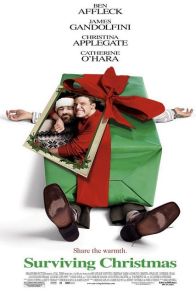 Surviving Christmas was originally supposed to be released, get this, a whole year ago for Christmas 2003. Paramount objected to the original release, saying it was too close to the release of their own Ben Affleck action flick, Paycheck (I doubt anything could have helped that turkey). So Dreamworks held onto it for another year and released it around the holidays. Halloween that is. The nation hasn’t even experienced Halloween or Thanksgiving yet, and we’re already getting a Christmas movie in our stocking. Given Affleck’s recent track record (the man hasn’t had a hit movie since 2002’s Sum of All Fears), audiences might not expect more than a lump of coal when his name’s above the title.
Drew (Affleck) is a cynical ad executive trying to figure out his plans for the approaching Christmas season. He gives his girlfriend tickets to Fiji, but she expected an engagement ring, so she dumps him right there claiming he doesn’t know what family life is. Drew finds his old family home now populated by the Valco family. He offers Papa Valco (James Gandolfini) $250,000 for him and his wife (Catherine O’Hara), son, and daughter (Christina Applegate) to be his family for Christmas. Papa Valco accepts. Drew is a stickler for family tradition, and mandates tree shopping, hat wearing, dinner script reading, and sleeping in his old room. The family’s hostility begins to wear down but things get even stickier when Drew falls for the Valco’s daughter, and then his ex-girlfriend shows up wanting to see his family.
 The central flaw of the film is Affleck’s character. Drew is a jerk. That’s all there is to it. Somehow Affleck has become the go-to actor for arrogant, work obsessed men that desperately need to see that there’s more to life (Bounce, Jersey Girl, Forces of Nature). I think this is also the second or third time he’s played an ad executive. Surviving Christmas seems to exist in some weird dimension where a jerk shows us the true meaning of Christmas and family togetherness. What’s even worse is that Drew doesn’t change as a character, he doesn’t seem to grow, and the ending actually seems to reward him for his selfish, material, obnoxious ways.
I like Affleck, I really do. I like his work in Kevin Smith’s films, and he can make a good action hero if given the right material (Say a Sum of All Fears, and not so much a Paycheck). The man is charming, he’s eloquent, and he’s self-deprecating and constantly funny. He’s the kind of guy you want to buy a beer. Now, having said all this, Surviving Christmas is Affleck’s worst performance of his career. Affleck can do comedy, and not just in a Greek tragedy kind of way with his life in the tabloids. In Surviving Christmas, Affleck mugs like nothing is sacred. His eyes bug out. He exaggerates near any expression, from his smug grin to his childish fits. For a man who has Gigli, Reindeer Games, and Pearl Harbor to his credit, it’s something when it’s said that Surviving Christmas may be his acting low point.
Gandolfini seems to have been cast to play against type. He’s still got that flinty stare and slow simmer of anger, but he’s generally wasted. He’s the comic foil to Affleck’s jerk, and yet he still doesn’t come across that much better. His monstrous woolly beard is also mildly disturbing. Applegate brings more life to her love interest role than the role deserves. Her romance with Drew seems so spontaneous, especially given her natural hostility to him. The only actor that has any real moments to stretch and shine is O’Hara. A veteran of improv, O’Hara has some of the film?s funnier moments, like when she makes mini marshmallows with a butcher’s knife, or her wild photo shoot Drew arrangers for her.
Surviving Christmas is indeed a chore to sit through. The movie, at its gooey heart, doesn’t know what kind of holiday film it wants to be. A good example is the opening montage of holly jolly Christmas sequences. In between standard, saccharine moments of feeling, there?s an old grandmotherly woman who bakes a tray of gingerbread men, with frosted frowns, and then sticks her head in an oven. Huh? Surviving Christmas tries to have it both ways. It wants to lampoon Christmas sentiment with the occasional touch of dark humor, but then it plays into a feel-good holiday formula complete with sled rides, tree lighting, and hot cocoa. The result is a schizophrenic comedy that doesn’t work being dark or cuddly.
 The whole wacky premise of Surviving Christmas screams sitcom, and the conventional proceedings and stock characters that follow guarantee it. The only way this could be more of a sitcom is if they drew a line down the middle of the house, the boss was coming over for dinner unexpectedly, and a pesky cat swallowed someone’s wedding ring. Surviving Christmas‘ relation to a sitcom is the only way I can explain why the film has stale jokes about internet porn (What, there’s porn on the Internet? When did this happen?). There’s even horny old men and wedgie jokes too! This is a movie in desperate need of a laugh track. I kept expecting everyone to turn their heads and go, “Dreeeeeeeeew” and then Affleck shrugs his shoulders, bugs his eyes out, smirks, and the studio audience goes wild.
It probably doesn’t help that Surviving Christmas is credited to over five writers and was directed by the director of Deuce Bigalow: Male Gigolo. The comedy rarely hits its marks because it’s so frustratingly tied up in its identity. The film wants to make incest jokes, but then in the same breath it wants us to listen to some syrupy back story explaining why Drew is the lonely, socially challenged jerk he is. The laughs of Surviving Christmas are mostly limited to broad slapstick and the occasional inappropriate remark. The preview audience I watched the film with seemed to be rolling in the aisles while I mostly rolled my eyes.
There will be a section of the public that enjoys Surviving Christmas. Fans of Christmas cheer and broad PG-13 comedies may find laughs amongst the wreckage. Surviving Christmas doesn’t have the gusto to commit to black comedy like Bad Santa (a new Christmas classic), but it also doesn’t build its characters strongly enough for an audience to care about them. They’re all mainly jerks and twits. This is a Christmas movie that doesn’t know what stripes it is. How else to explain it coming out in late October.
Nate’s Grade: C
Share this:

Jersey Girl (2004)
 Writer/director Kevin Smith (Dogma) takes a stab at family friendly territory with the story of Ollie Trinke (Ben Affleck), a music publicist who must give up the glamour of the big city to realize the realities of single fatherhood. Despite brief J. Lo involvement, Jersey Girl is by no means Gigli 2: Electric Boogaloo. Alternating between edgy humor and sweet family melodrama, Smith shows a growing sense of maturity. Liv Tyler stars as Maya, a liberated video store clerk and Ollie’s real love interest. Tyler and Affleck have terrific chemistry and their scenes together are a playful highlight. The real star of Jersey Girl is nine-year-old Raquel Castro, who plays Ollie’s daughter. Castro is delightful and her cherubic smile can light up the screen. Smith deals heavily with familiar clichés (how many films recently end with some parent rushing to their child’s theatrical production?), but at least they seem to be clichés and elements that Smith feels are worth something. Much cute kiddie stuff can be expected, but the strength of Jersey Girl is the earnest appeal of the characters. Some sequences are laugh-out-loud funny (like Affleck discovering his daughter and a neighbor boy engaging in the time-honored game of “doctor”), but there are just as many small character beats that could have you feeling some emotion. A late exchange between Ollie and his father (George Carlin) is heartwarming, as is the final image of the movie, a father and daughter embracing and swaying to music. Jersey Girl proves to be a sweetly enjoyable date movie from one of the most unlikely sources.
Nates Grade: B
Share this:

The Battle of Shaker Heights (2003)
 Ben Affleck and Matt Damon, being the egalitarian champions we all know celebrities to be, started a contest called Project Greenlight that allowed aspiring screenwriters to enter for a chance to have the winning script made into a movie by Miramax and the process documented for a behind the scenes reality show to run on HBO. Project Greenlight‘s first winner was the hapless Pete Jones. His winning screenplay gave birth to Stolen Summer, a maudlin coming-of-age story about a Catholic boy trying to get his ailing Jewish friend into heaven. You can feel the grating precociousness already. While Stolen Summer was an artistic yawn the HBO series was a hit as we the viewers saw every stupid mistake, naïve decision, and screaming matches during the production. Pete Jones’ pain was our gain.
Unlike the first contest, this one had a separate entry for directors and the tag-team of Efram Potelle and Kyle Rankin were picked to direct the winning screenplay The Battle of Shaker Heights, by Columbus, Ohio (represent) grad student Erica Beeny. Project Greenlight on HBO showcased the tension created by these butting heads. Beeny seemed ready to meltdown at a moments notice, probably because she let her good nature be taken advantage of by the egotistical, passive-aggressive, non-communicative, hilariously self-absorbed directors. This raises the question; did Affleck and Damon pick the best people or the people most likely to create the best television?
 Once again, the winning screenplay involved a coming-of-age story, this time revolving around the life of Kelly (Shia LeBeouf), a glib teenage war re-enactor. Kelly befriends Bart (Elden Henson) during a battle reenactment. Bart is from a wealthy Wasp-y household where his college is already predetermined. Kelly, on the other hand, must sullenly deal with his father (William Sadler), a former junkie who wasted away his college fund, and his flighty mother (Kathleen Quinlan). Bart and Kelly scheme to teach a schoolyard bully a lesson, and in the process Kelly starts falling for Bart’s attractive older sister Tabby (Amy Smart).
The character of Kelly doesn”t seem to have any deep reflections of life or anything of substance, just wicked one-liners. The fact that Kelly comes off as a sympathetic hero goes fully to the charming LeBeouf, who displays a laid back sense of humor and allure that is reminiscent of a young John Cusack. LeBeouf gives a star-making performance that keeps the audience engaged, even if the story is turning them off.
One of several problems Shaker Heights suffers from is that the finished product is a one-man show. Kelly is such a dominating character, a whirlwind of misplaced rage that everyone that gets in his path suffers. His relationship with Tabby seems like nothing more than unrequited puppy love that doesn’t need so much screen time being spent on a tired will they or wont they diversion. Kelly’s parents come off like theyre invisible. If you blink you may miss their entire time on screen. The father is more an absent force to drive Kellys angst, while his mother doesn’t seem to have any purpose or influence whatsoever.
 Shaker Heights feels like a film made by committee because as Project Greenlight astutely documented it was made by a committee. Miramax executives decided they could sell the film better as a pure comedy so they removed most of the winning screenplays drama. So now, with this new incarnation of Shaker Heights, the comedy never really emerges from more than a handful of superficially cute lines, and whenever a bit of drama does emerge it seems alien and disorienting. The heavy-handed direction by Potelle and Rankin paints in broad strokes, so the dramatic efforts come off as forced and overblown when they sneak up on an audience.
This incarnation of the movie may be entertaining to some, but with these cuts and directorial choices Shaker Heights seems horribly ordinary. Kelly is a disaffected teen with smart-ass comments; he lusts after the older girl who, of course, is with a supposed loser; his parents just don’t know what to do with him. The story is dulled down and all the edges seem polished off, and what an audience is left with is scenes, characters, and a story we’re already well familiar with. Does Project Greenlight seem to have a desire to select coming-of-age stories and then water them down to the point of distilling any original voice? The only interesting diversion in Shaker Heights is the war reenactment section, which is tragically too short.
The Battle of Shaker Heights is another theatrical dud from the Project Greenlight crew. Fans of teen melodrama might get some moderate enjoyment from it, but realistically, the only people who are going to pay any sort of money to see Shaker Heights are the people who avidly followed the Project Greenlight TV series. And in the end, one cant shake the feeling that The Battle of Shaker Heights ultimately feels like a disappointing season finale to Project Greenlight.
Nate’s Grade: C+
Share this:

Gigli (2003)
 It’s the feel-good movie of the year revolving around a lunkhead mobster (Ben Affleck) and his mentally challenged kipnapee and their attempts to covert a lesbian hitman (Jennifer Lopez) in between her yoga/horrific monologues concerning the superiority of female genitalia. Believe the hype people; Gigli is indeed as bad as they have told you. It’s not even entertainingly bad, like Bulletproof Monk, no folks; Gigli is just mundane and awful. During the entire two hour stretch, which feels much much longer, I kept saying one thing aloud: “How could anyone making this think they were making a goodmovie?” Did they think audiences would find it funny that Affleck’s mother (the mother from My Big Fat Greek Wedding) shows us her big fat Greek behind? Did they really think that a mentally retarded kid (who has an affinity for gangster rap and wishes to travel to the mythical “Baywatch”) would come off as endearing? Well instead it comes across as insulting. And what else is insulting is the laugh-out-loud dialogue Lopez is forced to spit out concerning her attraction for women. I can’t think of any actress that could say the line, “I love my pussy” convincingly. And I’m sure a lot of actresses out there have true affection for it. The writing is just atrocious. And so much else fails as well. The score is a perplexing mix of upbeat jazz and inappropriate string orchestra. I don’t understand what emotions they were going for during scenes in Gigli but a full string orchestra playing music better suited for a real drama does not fit. Maybe it was for a tragedy. In that case, then it’s right on the money. You won’t see a more sloppily executed, horribly acted, painfully written, lazily directed, inept film this year. And what the hell did Christopher Walken walking in have anything to do with anything?
Nate’s Grade: F
Share this:

Daredevil (2003)
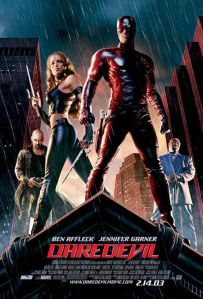 Not as bad as it could have been. That’s the best way to sum up Ben Affleck in tights.
Nate’s Grade: B-
Share this:

Changing Lanes (2002)
 Don’t be misled by fancy marketing, Changing Lanes is no more a thriller than In the Bedroom (now that was some fancy misleading marketin’). At its core Lanes is a morality tale hiding under the clothing of thriller ilk. But while the film is surprisingly engaging the majority of it centers on Ben Affleck and Samuel L. Jackson doing a good or bad deed and countering one. And in this dilemma the deck is stacked for audience favorability. Jackson is a down-on-his-luck father fighting an impending divorce and trying to get a loan to purchase some real estate so his wife and kids won’t move away. Affleck is a cocky lawyer in a big firm who had an affair with his secretary (the chipped-tooth looking Toni Collette). Who do you think is the “good” guy? The film seems to bend over backwards to try and make Affleck not so bad, like showing him remorseful and pushed to the edge, under threats from his father-in-law and firm partner (Sydney Pollack), and being urged into a dark unethical territory by his own wife (Amanda Peet).
Jackson underplays his role, despite the snippets of vocal outbursts, and earns the compassion of the audience. Affleck plays Cocky Lawyer Man Who Becomes Humble and does a fine job. The supporting cast really shines in Changing Lanes especially Peet. Her one true scene involving her chilly sit-down with her husband is great in its sharp veer from what is expected.
Changing Lanes was directed by Roger Mitchell (Notting Hill) with a bit of nerves. Some scenes are shot from obtuse angles and the score has an inappropriate electronica taste. In the end though, Changing Lanes is an involving morality tale with some good lead performances.
Nate’s Grade: B
Share this:

Jay and Silent Bob Strike Back (2001)
 Kevin Smith returns back to his comedy roots. No more movies with a message (Chasing Amy and Dogma) it’s back to good ole’ snowballing and stink palming. His latest, Jay and Silent Bob Strike Back, is like a giant thank-you card to all his fans that have made the man who he is today. It ties up the entire View Askew universe so Kevin can drift off into uncharted ventures of film making and not have to keep referencing the same damn characters. Plus there’s plenty of good-natured vulgarity to go around.
 The plot of Jay and Silent Bob is nothing too heavy but seems to keep the film on a continuous pace, unlike the sometimes stagnant feel Mallrats had (what, they’re in one location for 90 minutes). It seems that after getting a restraining order at the Quick Stop on them, Jay and Silent Bob learn that Miramax is making a movie from a comic book that is in fact based off of them. Learned of the riches they could make they seek out the comic’s author Holden McNeil (Ben Affleck’s first appearance in the film) and demand a piece of the pie. Holden tells them that he long ago sold his right to his partner Banky Edwards (Jason Lee, in his second appearance in the film) and that there’s nothing they can do to stop the film. Jay suddenly gets the idea that if they stop the movie from ever getting made then they don’t have to worry. So off go our stoner duo on a mission to sabotage and satirize Hollywood.
Along the way are a hitch-hiker (George Carlin) advising the best way to get a ride is to go down in your morals, a confused nun (Carrie Fisher), the cast of Scooby Doo offering a ride (which will be 100x funnier than the feature film coming out this summer), a beautiful band of international diamond thieves (Eliza Dusku, Ali Larter, Jennifer Swalbach-Smith, Shannon Elizabeth), a rescued chimpanzee, a dogged Wildlife agent (Will Ferrell), and a full barrage of hilarity once Hollywood is finally hit.
 The best barbs are laid out by Ben Affleck and Matt Damon bickering about the other’s film choices on the set of Good Will Hunting 2: Hunting Season. This moment is truly inspired and full of great humor from Gus van Sant too busy counting his money to yell action to Damon turning into a vigilante hero. I almost fell on the floor laughing during this sequence.
When Jay and Silent Bob hit Hollywood is when the comedy starts hitting its stride as this Jersey Greek chorus interacts with the Hollywood life and encounters many a celebrity. The jokes are usually right on target except for Chris Rock’s performance of a racism obsessed film director. Rock’s portrayal becomes grating to the moviegoer far before it’s over, though he does get a few choice lines.
Smith as a director has finally elevated his visual art into something that can sustain itself instead of his earlier just-hold-the-camera-and-shoot movies. There are pans, zooms, quick cuts, cranes, action sequences, and even CGI. Smith is evolving as an artist but still staying his “dick and fart joke” self, and Jay and Silent Bob Strike Back is evidence. And that’s fine by me.
Nate’s Grade: B
Reviewed 20 years later as part of the “Reviews Re-View: 2001” article.
Share this:

Pearl Harbor (2001)
 It turns out we went to war in 1941 not because of Japanese aggression, Hitler’s dominance in Europe, or the protection of freedom and democracy. Sorry kids. The real reason we went to war was to complicate and then clear up Kate Beckinsale’s love life. At least that’s what director Michael Bay and screenwriter Randall Wallace would tell you with their indulgent epic Pearl Harbor.
We open in Tennessee in the 20s with two boys who dream of being pilots. Rafe (Ben Affleck) and Danny (Josh Hartnett) grow into strapping young lads who flash their hot dog flyin’ skills at basic training, which brings them chagrin from superiors but admiration from peers. Rafe falls in love with a young nurse named Evelyn (Kate Beckinsale), who goes against ARMY rule and passes Rafe in his eye exam portion when he has a slight case of dyslexia. But he’s just so cuuuute. The romance builds but Rafe feels like he’s grounded when all he wants to do is fly, and volunteers to fight in the RAF over in Europe. He promises he’ll be back to see his lovely Evelyn. Of course he gets into an accident and everyone assumes that poor dyslexic Rafe is fertilizing a lawn somewhere with his remains. Hence Danny slowly but surely develops something for Evelyn in their periods of mourning, and the two consummate their puppy love with a tango in parachute sheets.
All seems well until Rafe returns back from the dead throwing a wrench into Evelyn’s second date parachute plans. Thus the Hollywood favorite of the love triangle endures until the end when the two fly boys enlist in the Doolittle attack against Japan, months after the ferocious attack on Pearl Harbor. The real purpose of the Doolittle attack was not militarily, but merely for morale. The real purpose it serves in the movie is to shave off an end on our love triangle.
 Pearl Harbor allows us to follow a group of youthful and innocent starry-eyed kids from training to combat. Each seems pretty much exactly the same to each other. It’s near impossible to distinguish which character is which. It’s like the screenwriter didn’t even have the gall to resort to cliche supporting character roles, and he just made one character and duplicated it. The only one who was noticeable for me was the character of Red (Ewen Bremner, julien donkey boy himself), but that was simply because the man had a speech impediment. We also have our handful of young nurses alongside Beckinsale, and I had an easier time distinguishing between them; everyone had different hair colors.
]If you look in the pic, or the credits, you’ll see that two of the nurses would turn out to be Jennifer Garner (Alias) and Sara Rue (Less than Perfect), both stars of ABC shows, and ABC is owned by, yep, Disney. Coincidence? Probably. When they ran this on TV they actually advertised Jennifer Garner above Kate Beckinsale. That reminded me of when Seven ran on TV shortly after Kevin Spacey had won his well-deserved 1999 Best Actor Oscar for American Beauty, and they gave him second-billing in the advertisement over Morgan Freeman, the movie’s true main character.
Affleck has a hayseed Southern twang, but seems to mysteriously disappear for long stretches. Hartnett seems to talk with a deep creak, like a door desperately trying to be pushed open. Beckinsale manages to do okay with her material, but more magnificently manages to never smear a drop of that lipstick of hers during the entire war. We could learn a lot from her smear-defying efforts. Gooding Jr. is pretty much given nothing to work with. I’m just eternally grateful he didn’t go into a usual Cuba frenzy when he shot down a Zero.
Michael Bay has brought us the ADD screenings that are the past, loud hits of The Rock and Armageddon. Teamed up with his overactive man-child producer Jerry Bruckheimer once more, Pearl Harbor is less Bay restrained to work on narrative film as it is Bay free-wheeling. His camera is loose and zig-zagging once more to a thousand edits and explosions. Bay is a child at heart that just loves to see things explode. When he should show patience and restraint he decides to just go for the gusto and make everything as pretty or explosive as possible. This is not a mature filmmaker.
Despite the sledge hammer of bad reviews, Pearl Harbor is not as bad as it has been made out to be. The love story is inept and the acting is sleep-inducing, unless when it’s just funny. It doesn’t start off too badly, but twenty minutes in the movie begins sinking. The centerpiece of the film is the actual Pearl Harbor bombing that clocks in after ninety minutes of the movie. The forty-minute attack sequence is something to behold. The pacing is good and the action is exciting with some fantastic special effects. The movie is bloated with a running time a small bit over three hours total. Maybe, if they left the first twenty minutes in, then gave us the forty minute attack sequence, followed by a subsequent five minute ending to clear up our love triangle’s loose ends… why we’d have an 80 minute blockbuster!
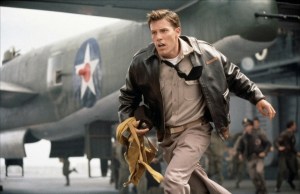 Pearl Harbor doesn’t demonize the Japanese, but it feels rather false with their open-minded attempts to show both sides as fair minded. It gets to the point where they keep pushing the Japanese further into less of a bad light that it feels incredibly manipulative and just insulting. It seems like the producers really didn’t want to offend any potential Pacific ticket buyers so the picture bends backwards to not be insulting. The only people who could be offended by Pearl Harbor are those who enjoy good stories. Oh yeah, and war veterans too.
The cast of Pearl Harbor almost reads like another Hollywood 40s war movie where all the big stars had small roles throughout, kind of like The Longest Day for the Pepsi generation. Alec Baldwin plays General Doolittle and is given the worst lines in the film to say. Tom Sizemore shows up as a sergeant ready to train the men entering Pearl Harbor. He has five minutes of screen time but does manage to kill people in that short window. Dan Akroyd is in this for some reason or other, likely because Blues Brothers 3000 has yet to be green lighted. John Voight is easily the most entertaining actor to watch in the entire film. He gives a very authentic portrayal of President Roosevelt. I still find trouble believing it was Voight under the makeup.
The blueprint for Pearl Harbor is so transparent. They took the Titanic formula of setting a fictional romance against a disaster, with the first half establishing characters and our love story, and then relegating the second half to dealing with the aftermath of the disaster. It worked in Titanic (yes, I liked the film for the most part), but it doesn’t work here. Pearl Harbor is a passable film, but the mediocre acting, inept romance, square writing, and slack pacing stop it from being anything more. Fans of war epics might find more to enjoy, especially if they don’t regularly have quibbles over things like “characters” and “plot.” To paraphrase that know-it-all Shakespeare: “Pearl Harbor is a tale told by an idiot. It is full of sound and fury, signifying nothing.
Nate’s Grade: C
Reviewed 20 years later as part of the “Reviews Re-View: 2001” article.
Share this:

Bounce (2000)
 The romantic comedy genre is in a slum of development, it’s own personal ring of hell. It’s become a playing field with a paint-by-numbers coloring book. Color in this section blue for the ignoring bastard of a boyfriend that the heroine is attached to, color this section red for some “misunderstanding” to occur that shatters the perfection of the relationship for ten minutes before a wise-cracking best friend convinces otherwise and reveals their honest true feelings, color this part yellow for eccentric yet lovable colloquial supporting relatives… etc. You hopefully get the idea. It’s all been done before. But can you make a romantic comedy that sticks to the aforementioned rules but is still enjoyable in a non-brain sucking sort of way?
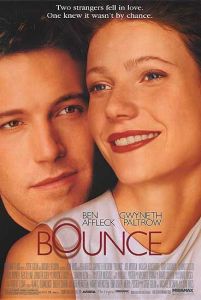
Ben Affleck plays a cocky ad guru with malicious flair. He’s brimming with confidence and a sly charm. One evening he encounters two strangers in an airport bar. One is a sexy blonde that Buddy works his moves to make his own layover. The other man just wants to get back to his wife and family for Christmas but his flight isn’t until the next afternoon. Buddy does the honorable win-win situation and gives up his ticket. The man cheerfully thanks Buddy for his generosity and beams about on his way toward the flight home. Buddy beams about on his way back toward a hotel bedroom. That is until he flips on the TV to see a news report of flaming wreckage that was supposed to be his plane.
 The realization of his close encounter with death and the grief of sending another man to replace him takes its toll. Buddy becomes an alcoholic and belligerent at an awards special where his agency is responsible for spinning the crash for the airline. After some time spent to recover buddy feels the personal need to search for the widow of the man he exchanged tickets with and see if she is doing okay. His widow is played by a brunette Gwyneth Paltrow and little do each think that they will fall in love with one another.
Granted, the story and all the so-called surprises that happen in it are telegraphed much sooner than their arrival. We know he’ll fall for her, we know she’ll find out, we know they’ll be a blow out, we know there will be a reconciliation. We just know. What makes Bounce surge from the formula is the ability of the actors and the wit of writer/director Don Roos. The sophomore film from the man who gave us The Opposite of Sex and lesser screenplays shows controlled and understated direction when dealing with the emotions of his characters.
Affleck quite possibly is showing his finest acting work yet. His Buddy runs the transformation of cocky socialite to a man haunted by grief and weary of his advances on the woman he accidentally widowed. The chemistry between Gwyneth and Affleck is electric and they mesh together very positively. In my later review of Proof of Life I mentioned how because Ryan and Russel Crowe fooled around during film that it didn’t transpire to anything on film. Well the past relationship of the two leads here sure as hell allows for some sizzle. Paltrow is quite fine as a harrowed widow trying to raise her boys. A scene where she slowly discovers the truth of her husband’s fate is wrenching. She also looks good as a brunette.
Roos may have to still play by the rules of romantic comedies but at least he utilizes skill to come away with something that doesn’t seem like Pretty Woman meets Random Hearts. And you know what Random Hearts could have used to make it a little livelier? A supporting performance by Johnny Galecki of course. Well, then again nothing could save that movie.
Nate’s Grade: B
Share this:

Boiler Room (2000)
 Boiler Room is like a Wall Street for the dot-com kids, hell they even have a scene where they openly quote and recite Glengary Glen Ross. Giovanni Ribisi plays the son of a judge and the head of a gambling front he runs in his home that decides to cut his teeth in the world of stocks and options. Boiler Room begins as an insightful and well-paced inside look toward the cut-throat world that crunches the numbers and keeps the leg of our economy afloat. I find it fascinating that a good base of our economy is based upon round table rumor and the opinions of a select few. But the brash and stirring scenes of the politics of a sell are then given up when the FBI is introduced and Gio tries to take the company out from its dirty inside. The movie then falls to the wayside of entertainment. Boiler Room is a surprisingly engaging film that decides to go down the wrong path.
Nate’s Grade: B


You must be logged in to post a comment.