Blog Archives
9 (2009)
 9 began its life with acclaim. Director Shane Acker won a Student Academy Award and a 2004 Oscar nomination for Best Animated Short for his eleven-minute tale of post-apocalyptic ragdoll people. Blown up to feature length and with a screenplay by Pamela Pettler (Corpse Bride), 9 the film is being sold on the name appeal of producers Tim Burton and Timur Bekmambetov (director of Wanted). It’s being sold to gloomy animation aficionados. I can hear the producers saying, “These guys will see anything that?s dark and different.” I advise everyone to surf YouTube and watch the eleven-minute original short by Acker. You’ll save eight bucks and see the more effective and satisfying version of 9. If you wanted to boil 9 down, it’s like The Brave Little Toaster starring the villainous robots from The Matrix. Sound like a winner?
War machines have killed humans. The only life on our planet is a handful of numbered ragdoll creatures. The main hero, #9 (voiced by Elijah Wood), awakes in the home of a dead scientist. The outside world is demolished. He finds other little ragdoll people like him, each numbered 1-8. Together they must try and make sense of this scary new world and survive the roaming robots still on the hunt for… something. #9 accidentally gives life back to the monstrous Machine, who we learn is responsible for the downfall of mankind. Way to go, ragdoll. The Machine is patching together mechanical minions to take over the ashen remains of a post-apocalyptic world absent life. Seriously, I’m at a loss what the big evil Machine hopes to accomplish. Then again, maybe it’s just in need of a hobby.
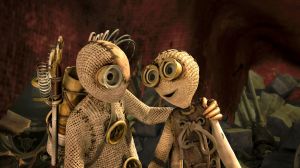 Even at a scant 79 minutes, 9 the movie still feels stretched and draggy, chiefly because the plot is lousy and the character work stopped at the design stage. I was bored throughout, I didn’t care about any character, and the movie failed to even arouse my curiosity to solve the mysteries of the movie. I didn’t even care if I found out why these ragdoll creatures existed or what had happened to leave the world in chaos. I sat in my chair, completely uninvolved with what was happening onscreen. Part of this is because a majority of the plot involves these tiny characters walking from one point (a church) to another (a factory) over and over again; the plot could be substituted by a linear line connecting Point A and Point B. It’s all so crushingly repetitious. And these are not short distances either, compounded by the fact that it’s little eight-inch ragdolls walking these great expanses of land. I invite every reader to position two fingers on their hand, index and middle, and then proceed to pretend to walk across. That, ladies and gentlemen, is the miniature plot of 9 magnified for your edification. Just imagine weird robots chasing after your fingers and you get the drill. There’s not enough story here to make the jump and fill out a feature film.
The characters have an interesting design, to be sure. Each has different sewn parts but Acker makes the mistake of animation where the design is the full personality of the character. #8 is a big dolt, #1 is an old tyrant, #6 is a loon (voiced by Crispin Glover, naturally), #7 is a lady rag doll warrior complete with some purposeful enhanced womanly hips, and so on. The bland characters don?t ever take a moment to ask more important questions. These creatures have just been given life in a hostile world absent of life, so how about a moment where they ponder something a bit existential (Why am I here? What is life?) before they immediately speak English fluently and assimilate perfectly in a world they were born into moments earlier? The characters are a challenge to feel any empathy for.
The mechanical monsters designs also come across as highly derivative; then again, so does the movie as a whole. The main villain, The Machine, looks exactly like the Sentinels from the Matrix movies. It has a central red glowing eye, a head lined with pistons, lots of twisty tentacles, and even creates shockwaves of electricity that seem to bathe over the mighty creature. I think it even makes a similar noise as the Sentinels. Then there’s also one mechanical minion whose key design feature is a mutilated doll head. Too bad I already saw this exact same design in Toy Story 14 years ago. Here’s the thing: I don’t automatically cry foul whenever a design concept looks familiar, but when things just keep hitting you in the face with familiarity then it develops into a pattern. The overall film feels stitched together by the parts of other, better movies.
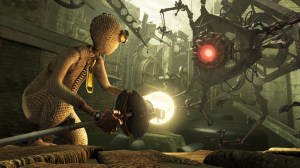 At least there’s a saving grace with bad animated films: you have something moderately interesting to watch considering the painstaking work that goes into every frame. That is not the case with the dreary 9. The entire landscape is post-apocalyptic, which means the sets are little more than ash, ruins, and barren remains. There are only so many scattered mechanical remains you can see before it all just starts resembling one vast junkyard. The setting is not 21st century, but more like mid twentieth in some unidentified Eastern European city (a film reel reveals that we’re in communist territory). I’m not saying that it’s impossible to find beauty in destruction, but this movie misses out. Acker and company has created a competently animated movie with a somewhat different look and feel, but there isn’t a single moment of wonder or awe to be had. It lacks an imaginative spark.
This animated tale lacks a sense of wonder, a sense of intrigue, even a sense of scale. The visuals and story are derivative of other sci-fi/fantasy films. In the original short, the characters were silent, causing the viewer to work harder at interpreting body language and context. If the ragdolls are just going to spout lame exposition gunk, they should have stayed silent. Director Rob Marshall’s upcoming big screen musical, Nine, need not worry about being confused with this film. In about two weeks, everyone except those with Hot Topic punch cards will have forgotten this mediocre movie. People who say, “It’s only an animated movie, give it a break,” are deluding themselves. No matter the genre, an audience should expect to be entertained. 9 just makes me hopeful that in the future Acker proves why he was targeted as a talent on the rise.
Nate’s Grade: C
Share this:

Waltz with Bashir (2008)
 A mix between animation, documentary, and war drama, this Israeli film is something uniquely different and remarkable. Filmmaker Ari Folman interviews fellow veteran servicemen from Israel’s 1982 invasion of Lebanon in hopes of jogging his memory. He has blocked out the painful memories of war but his mind is reawakened as he reexamines the truth about the conflict and eventual massacre of Lebanese Arabs. Folman utilizes a rotoscope style of animation, which gives it a heightened reality and an intoxicating painterly beauty. He also takes advantage of the fact that atrocities can be easier to stomach when presented through the barrier of tasteful animation. However, it will be hard to keep from being affected (a scene of dying horses got to me bad). The realms of reality, fantasy, nightmare, and memory can crash together in fascinating ways, and eventually the movie transforms outright into a full-fledged documentary that melts away any last obstacle of empathy, ending with real disturbing footage of the massacre’s aftermath. Waltz with Bashir does not come with an agenda in tow, which allows the movie to explore the ambiguities of being young, nationalistic, confused, and armed in a hostile land. Folman is trying to peel away at the unbiased truth of the matter and cleanse his curiosity and, perhaps, his conscience. His filmic journey to that elusive and painful truth is a movie that crosses cultures and redefines what a documentary can be.
Nate’s Grade: A
Share this:

Up (2009)
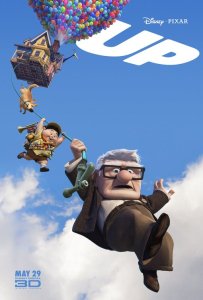 With every new movie Pixar re-establishes itself as the most creatively reliable studio in the business. And every year some critics beat the drum that THIS is the movie that will break free from the animation ghetto and earn a Best Picture Oscar nomination. If anyone out there would like to tell me how The Reader could be a superior film to WALL-E, by all means enlighten me. Pixar has been producing engrossing and complex entertainment, not merely cute cartoons. But if WALL-E failed to score a nomination in a so-so film year, then I doubt that Pixar’s latest, Up, will fly into the winner’s circle.
Carl Frederickson (voiced by Edward Asner) is a cantankerous 78-year-old man who wants nothing more in life than to be left alone. He lives in a house he built with his late wife, Ellie. They met when they were kids and bonded over a shared love of thrill-seeking adventure, like their hero, explorer Charles Muntz (Christopher Plummer). Ellie’s dream is to eventually travel to Paradise Falls in South America, but she never lives to see it. Carl is about to be thrown into a retirement center and have his home demolished, so the geezer hatches an escape plan. The former balloon salesman attaches thousands of balloons to his house and floats away headed for Paradise Falls. Carl is ready to enjoy the quiet when he gets a knock at his front door. He has a stowaway. Russell (Jordan Nagai) is an overweight eight-year-old determined to get his last Wilderness Scout badge, which involves helping the elderly. Together, they journey through the jungles of Venezuela and find remarkable discoveries and constant danger, including the presence of a sinister and still very-much-alive Charles Muntz.
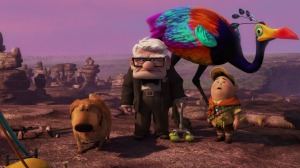 Up is the colorful tale of a dreamer who longs for escape, and you feel the same rush of excitement to be unbound and take off. Naturally, there will be bonding between the grouchy old man and the earnest kid. Up really becomes an altogether different movie once it lands in Venezuela. It transforms into an unconventional adventure story replete with talking dogs and giant birds. I loved the Dug character and was bemused at hearing the scattered thought patterns of man’s best friend (“I have just met you and I love you”). The side characters somewhat steal the show and, at the same time, feel overextended. With that said, I’ll probably end up buying my wife a talking stuffed Dug. The last act soars with about 20 minutes of thoughtful, exciting, well-constructed action weighted by an emotional connection to character. At the same time, Up tackles some major issues and does so without getting mired in sappy sentimentality. Carl is dealing with loss and has hardened against a world he feels indifferent to. Up almost had me in tears within the first 10 minutes during its elegant wordless montage charting the courtship and marital life of Carl and Ellie. It’s a fabulous moment and greatly economical, packing an emotional punch unequaled by the rest of the film.
The visual storytelling is still top of the line entertainment. The animation is superb as usual. The flying house is an explosion of colors and instantly brought a smile to my face. Carl’s character design looks like he was a Lego character that was brought to life. He’s all square and boxy whereas Russell is round to the point of being an Easter egg with legs (is Russell Asian-American or biracial, or is it just a character design that I’m reading too much into?). The South American jungles are lush and filled with inventive creatures. I saw the movie in a conventional theater but the option is out there to catch the movie in Disney 3-D, but I don’t think it will add much to the whole experience.
The central image is lovely and instantly iconic: the house floating through the clouds thanks to thousands of colorful balloons. It’s a beautiful image and a perfect metaphor for the memory of Carl’s deceased wife. They built that house together and lived a full life inside, he refers to the house as “Ellie,” and at one point Carl even ties the floating house to his back, tethering her memory to Earth while simultaneously carrying his grief with him at every step. The idea of a flying house tickles the imagination and yet never once demands more critical examination. We accept that Carl has rigged the house to take flight and never once stop and question the extreme engineering improbabilities. The flying house is just the mode of transportation for the characters to complete their story, but it is not the whole story. Think of it as a more comfortable mode of family flying than a queen-sized mattress that included Angela Lansbury (1971’s curious Nazi-fighting family flick, Bedknobs and Broomsticks). The rest of the movie never quite matches the directness and depth of that visual metaphor.
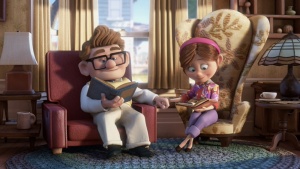 Up ducks out on making its tale more of a feeling, living movie, something more than striking visuals and some fun set pieces and odd characters with a dash of sentiment. Up establishes its strange story elements but then doesn’t plausibly make much more out of them. The story becomes a somewhat constricted rescue caper to return a Mama bird to her babies and keep her out of the hands of a Bad Man. Charles Muntz is a fairly weak villain. I’ve also got a burning question: if Carl is 78 years old, how old exactly is his childhood hero, Muntz? It’s a bit simplistic and that’s fine, and it’s still an enjoyable conclusion, but the movie doesn’t ascend from the sum of its parts like the finest works of Pixar, like WALL-E and The Incredibles. This one’s just missing some of that Pixar magic. Yeah, there’s the overall arc of Carl overcoming the loss of his wife and softening his hard exterior, but tell me what exactly else happens that matters? The kid makes a friend? It’s about human connection but how exactly is that best served by giant birds and talking dogs flying biplanes? Up also isn’t as visually arresting or creative as previous Pixar flicks, aside from that floating house. As far as Pixar films go, this is about square down the middle (between Monster’s Inc. and Finding Nemo, better than Cars and A Bug’s Life). But even that statement is prefaced by the fact that Pixar’s output is generally head and shoulders above every other studio in technical precision, creative ingenuity, and emotional heft.
Up takes some fancy flights of imagination and has plenty of humor and charm to make it a family-friendly winner. I have some reservations with the movie and its plot, but there’s no question that Pixar knows how to construct a movie that manages to appeal to everyone, even if it involves cranky old men as unlikely action heroes. I feel like perhaps Up is suffering because it has the rotten luck of following the release of WALL-E, a timeless masterpiece that I have since watched probably over 30 times. Up is a warm-hearted and engaging film even if it never reaches the creative and emotional heights of other Pixar masterworks. Still, a “pretty good” Pixar movie has a legitimate shot at being the best movie I see this summer.
Nate’s Grade: B+
Share this:

Coraline (2009)
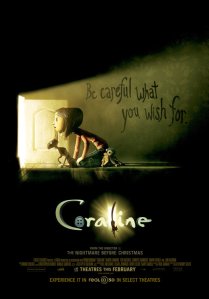 The beauty of stop-motion animation is that everything is painstakingly handcrafted so that it’s like watching a whole other world. Coraline is a wonder for the eyes and I loved just watching the movement of characters, their facial expressions, which were all done in great fluid motions. I loved that I could see Coraline thinking just through how her eyes were animated. The story, based upon the Neil Gaiman book, is about an alternative world where people have buttons for eyes provides enough eerie intrigue and some creepy imagery to spook younger kids. This is a fantasy film that doesn’t shy away from childhood scares. Coraline has an altogether pleasant feel with its spunky heroine and fine vocal cast (Dakota Fanning did not get on my nerves at all), but what’s most special is just watching the movie come alive; it’s enchanting to watch this world simply exist. There are some terrific displays of imagination in the alternative world, and it all looks even snazzier in 3-D where the world takes on further depth. Director Henry Selick (Nightmare Before Christmas) is the master of this peculiar art and thankfully Coraline follows its own visual style, never stooping to imitating Nightmare (like Corpse Bride). This is a visually stunning movie that may not leave much of an impression once it’s over (predictable story, thin plot, kind of slow ending). Coraline is a feast of artistic talent with something to discover in every awesome second.
Nate’s Grade: A-
Share this:

WALL-E (2008)
 At this point, is there anything Pixar can’t do? They’ve explored the secret life of toys, what’s under the sea, the pains of rearing a family of super heroes, and of course a rat that dreams of becoming a chef. Seriously, anyone that can make that last one not only work but one of the most sparkling, imaginative, enchanting, and poignant films of the year deserves every accolade in the book. Pixar’s newest film, WALL-E, is certainly its most ambitious and potentially its most rewarding yet.
The year is 2700 and the planet Earth has long been left behind by mankind. Humans have exhausted their resources and left behind a planet that looks like one never-ending landfill. Skyscrapers are being built out of garbage cubes. The Waste Allocation Load Lifter – Earth class (WALL-E) robots have been left to toil away and clean up mankind’s mess. There is but one WALL-E robot left and it leads a solitary life of routine. It gets up, it compacts trash into cubes, and it assembles those cubes into eventual giant structures. Then one day a probe lands called EVE. This floating capsule-like robot is easily frustrated and quick on the trigger and WALL-E falls completely in love with his unexpected new companion. The two become close and then EVE is taken away unexpectedly. WALL-E hitches a ride on the ship that collects his beloved and journeys through space to save her.
 I was having reservations citing certain words of praise but this film deserves every ounce of praise; WALL-E is a masterpiece. This is a beautiful story told in a beautiful way in a beautiful looking movie. I imagine kids will be tickled by the funny robots but I really believe that this film will play much better for adults, and when was the last time a mainstream, American family film did that? Most “family” films are an excuse to do something lowbrow and cynical to make a quick buck, like the atrociously cringe-worthy trailer I saw for Beverly Hills Chihuahua (seriously, a civilization of singing/rapping Taco Bell dogs?). Pixar, and God bless them, are proving with each new release that family films need not be brain-killing hours. That reliable Pixar quality touch is never more present than with WALL-E. If you told me that a film that takes place on a trash-filled Earth, with minimal dialogue, and a romance between two robots would be the most thrilling, moving, and wonderful film of 2008, I would have scoffed.
Writer/director Andrew Stanton (Finding Nemo) relies on a universal visual storytelling language to tell the bulk of his tale. WALL-E plays like a gloriously enjoyable silent movie where body language and physicality advance the storyline and provide surprising depth; ignoring brief TV clips of Fred Willard and Hello Dolly, the movie doesn’t have actual dialogue until the 45-minute mark. And it is fantastic. The character of WALL-E is immediately empathetic and the audience will see slivers of themselves inside this independent robot that finds another reason for being. It’s a simple love story told in simple strokes, but it just so happens that Stanton has provided great emotional heft to those strokes. The film has such a huge and vibrant heart. More is said in indecipherable robot bleeps than in much of the tripe Hollywood calls dialogue. Watching WALL-E court EVE, a bit unsuccessfully at first, begins as cute, moves into being adorable, and ends up being greatly touching and flirting with the profound. How many other movies, let alone romances, end with the long-desired climax of two characters merely holding hands? This movie is a delight from beginning to end and a classic example of the power of expert storytelling.
When the film transitions into space is when the potent environmental message, and subversive satire, emerge. Beforehand we have witnessed the awe-inspiring landscape of Earth littered with garbage and empty shopping centers. Humans left the Earth to wait for the robots to do all the work and make the planet hospitable for life once again. For the last 700 years humans have been living in a heavy-duty luxury spaceship. Humans have grown to be fat, lazy, and completely self-involved; people only communicate with others through video screens, even when the other person is inches away. The movie also manages to satirize consumer culture, and in the future one corporate behemoth essentially dictates life’s choices; I found it highly amusing that the former president of the future (a live-action Willard) is also the CEO of the super corporate conglomerate. Business and government have merged completely. The social commentary isn’t as merciless as Mike Judge’s Idiocracy, nor is the environmental message subtle in the slightest, but the satire is sharp enough and blunt that some viewers might be offended, and I think that is genius.
Being a Pixar film, naturally WALL-E is resplendent to look at. The animation is superb and the imagination on display seems limitless. This is one of those films I’m certain I could watch again and again and find something new every time. I don’t really need to say much more about the visuals because they are breathtaking to behold (Roger Deakins, by the far the greatest living cinematographer, was even consulted to help with the look of the film. How awesome is that?).
 And yet even though WALL-E is primarily a love story the film also manages to be greatly exciting and equally funny. Stanton’s screenplay nimbly assembles characters and reintroduces them at key points to push his story onward. I loved that WALL-E is introduced to all sorts of unique robots on the mankind’s space ship and that he even stumbles into, more or less, a group of malfunctioning robots that come to his aid (think the Island of Misfit toys). Stanton manages to reconnect his storytelling threads so that every moment in this movie matters. The last third of the film is a back and forth cat-and-mouse struggle that manages to pump up suspense in smart ways. Stanton lays out his scenario for action and then builds organic complications. I am deeply satisfied when a filmmaker has a firm command of action that they can setup a situation, establish the rules, and then naturally construct obstacles and surprises that feel natural and germane to the story. Pixar has always been able to craft exciting action scenes that felt fully realized and WALL-E is no different.
If there is but one minor quibble I have with this near-perfect film, it is the missed opportunity to explore the mortality of robots. While WALL-E is going through his day-to-day duties he passes by older versions of other WALL-E models. The movie could have pushed just a little harder with the concept that this tiny robot is going to live to collect trash and then die like all the rest, becoming another piece of forgotten garbage. I think if Stanton had only explored this idea a little more it would have made his robo-love story even richer considering that both robots are going against their programming because they have found something that completely changed their world — love. The idea of mortality was explored to excellent effect in 1999’s Toy Story 2, so perhaps the Pixar folk didn’t want to fall into a philosophical repeat.
WALL-E is a wonderful love story, a heartfelt and immensely charming character piece, and a thrilling sci-fi tale that soars to broad heights of imagination. It’s timeless while still being rather timely thanks to its environmental message. Moments after the movie was over I wanted to see it again. I think I’ll feel the same way after the second viewing and the third. This is a phenomenal movie that will stand the test of time as one of the greats.
Nate’s Grade: A
Share this:

Persepolis (2007)
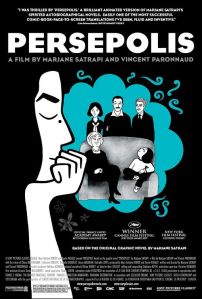 Marjane Satrapi has, by all accounts, a very unique life. Growing up under the repression of the Islamic Revolution, she settled in France and created a series of acclaimed best-selling graphic novels called Persepolis, based upon her life growing up in and out of Iran. The movie was France’s official entry for the 2007 Foreign Language Oscar, bypassing the equally lauded and inventive Diving Bell and the Butterfly. And yet Persepolis did not even make the short list of nine nominees, which eventually gets parred down to five (neither did 4 Months, 3 Weeks, and 2 Days, which WON the Best Film from the European Film Awards, over other movies that managed to make the Academy’s five nominees). I consider this a glaring omission. How could anyone not be entranced by Satrapi and co-director Vincent Paronnaud’s masterwork?
In Tehran, the capital of Iran, young Marjane and her family watch as rebellious forces overthrow the Shah in 1979. The Shah was the ruler of Iran and could readily be described as a dictator. He was friendly to Western countries and wanted Iran to follow their lead. Large forces unified and deposed the Shah, setting the stage for Iran to have its own system of rule that the people would decide upon. Marjane’s father swings her around in his arms and excitedly proclaims that democracy has come to his country at last. Landslide numbers “vote” for radical Islamic leaders to take control of the government, and Iran becomes a militant theocracy. Privileges and reforms are revoked, and women will have to wear long burquas and veils to be righteous. Marjane is too outspoken and her parents, fearing for her safety, send her to Europe to be educated. While she is absent Iraq attacks Iran and the countries are engulfed in a decade-long border war.
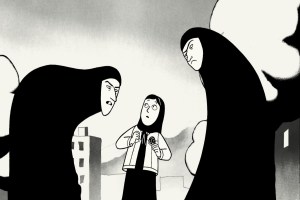 Persepolis is a gem of a movie, at once a personal coming-of-age account that manages to be fascinating and honest and also a universal tale of struggle for cultural identity. The evocative black and white animation is a joy to watch. The crisp drawing style manages to express so much with the seemingly simple, clean images. At times the visuals take on a lovely German expressionistic feel, and the world feels like it is made out of folded layers of paper. I would fall in love with a movement, a facial expression, that fact that smiles look like boomerangs, something small yet immeasurably enjoyable that struck a deep chord inside me. The arresting black and white visuals do not distract from the story in any way, in fact they help to mirror the repressive nature of what befalls Iran. A silhouetted group of protesters is shot at and one of them falls to the ground. Great inky blackness seeps out of the fallen body and merges with the rest of the screen, adding emotional heft that color could never capture.
Told for long stretches from the perspective of a child, Persepolis manages to find unique perceptions. The child point of view allows the film to unfold naturally with innocence and inquisitiveness, qualities that would soon be hard to recapture once the promise of revolution turned sour. Young Marjane feels jealous and competitive that her cousin can brag that her father spent more time as a political prisoner. It’s an odd stance for an adult and yet it feels entirely within reason for children. Marjane deals with issues she cannot fully understand as a child but she tries her best. The eyes of children also let the filmmakers mingle with the fantastic. Marjane speaks to God at points, and after a horrible tragedy God is trying to apologize and explain but little Marjane will not hear any of it. She orders God to leave her and so He departs. A little girl turning her back on God will hit you is the kind of devastating stuff that can put a permanent lump in your throat.
I was dumbfounded at the emotional depths the film plumbs in a scant 95 minutes. This is an incredibly powerful tale, richly told with poignant insights and grace. There were several times I was overcome with emotion and had to dab my eyes. Satrapi achieves great emotional resonance with minute details, making the film exciting in how engaging it continues to be from beginning to end. Marjane’s relationship with her family anchors the movie and you can feel the power of their love and bonds. Imprisoned uncles who spouted communist dogma are released only to be seen as a danger once again. Marjane’s mother is worried when Marjane keeps showing a fiery outspoken spirit. One day she shakes a teenage Marjane, screaming at her the horrid possibilities that can happen to women under this regime. She cites one teenage girl who was executed, but they don’t believe in killing virgins, so the guards took care of that bothersome roadblock. Marjane’s mother is wild-eyed with fear and what might await her little girl, and her gnawing concern is resoundingly powerful. Marjane’s grandmother serves as her emotional compass throughout her life. Grandma stresses that Marjane should be proud of her cultural identity and stay true to herself. When Marjane gets older she hears her grandmother’s voice to set her straight in times of doubt.
 But while the movie can be heartwarming, it does not fall victim to sticky sentimentality. Satrapi deals with some harsh truths about life in Iran and also her time in Europe as a blossoming woman without a country. She doesn’t sugarcoat reality and Marjane’s parents make it a point to be up front with their daughter about what is happening; an uncle tells little Marjane, before he is executed, that knowledge must live on and she, the youth, must be the one to keep it alive. The Iran-Iraq war ends in a stalemate with millions in casualties. Persepolis details life behind the veil and the shift the country took to radical Islamic rule but the film isn’t all doom and gloom. There’s a natural curiosity about a story of a girl who becomes a woman in a repressive society. Marjane’s spiky rebellious spirit makes for genuinely human comedy. She shops for Iron Maiden tapes on the Iranian black market, wears a jacket that states, “Punk is not ded,” and screams with joy at ripping her veil off during a car ride and letting the wind gust through her hair. There is a bounty of humor to be found in unexpected places. Marjane is running to catch a bus and is stopped by two policemen who complain that when she runs her butt moves “in an obscene way.” She simmers and finally yells, “Then stop staring at my ass!”
If Persepolis has any shortcomings it’s that the narrative peaks a bit too early. Seeing a child come of age during the Islamic Revolution is generally more interesting than watching a teenager navigate unfaithful boyfriends in Europe. Persepolis never stops being entertaining or relevant, it just so happens that the greater emotional rewards are tied to life and family in Iran.
Persepolis is a marvelously moving and unique coming-of-age tale set against a unique time. Marjane Satrapi’s graphic novels have fluidly been translated into a film that resonates with great emotional turmoil and inspiration. The alluring black and white visuals and clean animation style dazzle the eyes, while the enthralling personal story reaches deep inside and touches the heart. The film is brilliant, beautiful, harrowing, deeply human, fascinating, and ultimately inspiring. It’s rare to find a movie that can hit so many emotions with finesse, animated or live action. Persepolis is a bold vision and a revealing and lovely film that I cannot wait to revisit often. This is more than just a cartoon, folks. This is art.
Nate’s Grade: A
Share this:

Ratatouille (2007)
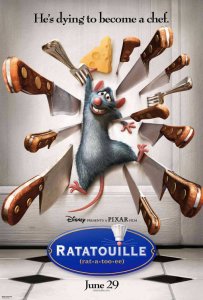 This movie continues to grow on me every day after I saw it. Writer/director Brad Bird yet again impresses with a deceptively simple story that manages to hit big themes in organic ways. The comic possibilities are fully realized with the setup of a man and a rat teaming up to be a great Parisian chef. There is a jubilant spirit alive and well throughout the film, and it’s difficult not to get swept up in the wit, the wonder, and the magnificent visual feast.
Nate’s Grade: A
Share this:

The Simpsons Movie (2007)
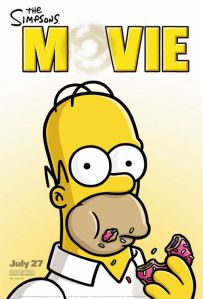 No movie has carried the burden of expectations quite like what befalls The Simpsons Movie. The animated TV satire has become a cultural phenomenon in its 18 seasons on the air. The Simpsons is a unique comedy with something for everyone; sharp cultural and political satire, slapstick, sincere family values, crass jokes, witty pop-culture zingers, and sly sight gags that take the eighteenth viewing to fully capture. In fact, I can only slightly explain the significance the show has had on my own life. For starters, it has influenced my sense of humor and writing, but the show also pretty much takes up full-time residence in my brain. I have told people for years that I believe 85% of my grey matter is filled with movie trivia and Simpsons quotes. There isn’t an experience in life that cannot be linked by an appropriate Simpsons quote (“Every time I learn something new it pushes something old out of my brain.”). I can quote episodes like some people can quote Bible verse. To many, The Simpsons is like a modern Bible for comedy.
With that said, the long-in-development movie version of our favorite yellow-skinned Springfield family is now in theaters. The loose plot of the film follows a typical Homer screw-up. He’s adopted a pet pig and disposed of its waste in the endangered Springfield Lake. The environmental calamity causes the EPA, led by a duplicitous department head (Albert Brooks), to place a dome over the town of Springfield. It doesn’t take long for the town to figure out it was Homer that doomed them, so the Simpsons family flees to Alaska to start anew before they learn that the government has plans to fully wipe Springfield off the map.
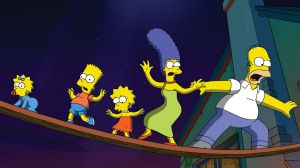 I suppose expectations will create a different prism for each person to view the film. The Simpsons TV show has never been terribly rude, and when it comes to satire it jabs more than eviscerates; in reality, the show has a terribly large heart and treads in moral and ethical dilemmas. It’s been more sweet than sour. Some fans might be hoping for the same transformation that South Park took when it hit the big screen in 1999. South Park made the leap with a brilliant movie that seemed to stretch the scope of what the show could do; it was more than a bigger and longer version of the TV show, it was an exceptional and blistering and hilarious satire that also was the most damn infectious musical of the decade. The Simpsons Movie doesn’t take full advantage of the opportunities a movie offers, though we do have a handful of non-network appropriate items like Marge uttering a blasphemy and Bart going the full yellow Monty. The Simpsons Movie doesn’t push the series into something too vulgar or unfamiliar. The movie feels like three episodes strung together. Whether or not that’s good enough for your entertainment dollar will be questionable. For me, having a feature-length version of my favorite TV show that’s written by the “Golden Age” writers is enough to guarantee at least two viewings.
The Simpsons Movie is easy to enjoy. The 11, count ’em 11, former show writers know exactly what makes the series work and how to stay true to the core of the show. There is some great lampooning of elected officials, including President Schwarzenegger declaring he “was elected to lead, not to read.” There are plenty of solid moments from the great plethora of supporting characters, like Ralph’s reaction to seeing a naked Bart, Mr. Burns remarking that for once the rich white man has the power, Cletus the Slack-Jawed Yokel idiot-proofing a safety measure, and Kent Brockman describing the environmental disaster as so serious, “it has its own theme music.” The Simpsons has such a large cast of memorable characters that it’s only fair that some will grumble that their favorites didn’t get more screen time (more Ralph and Mr. Burns, please), but the beauty of The Simpsons is that every person has their own set of favorites. The guest appearances by Tom Hanks and Green Day are well incorporated and fun. Albert Brooks has a long involvement with the show and is fantastically droll as always.
 However, ignoring my fan-coated bliss, the movie is not a comedy home run. The film does seem to lose some comedic momentum when it spends time on action. The emotional interludes feel a bit awkward but they still hit hard for me because I’ve followed these characters since I was 7 years old. The subplot involving Bart looking for a better father figure in Flanders has been done before and better like when Bart got a Big Brother to spite his father (“Simpsons did it!”). That’s the trouble with 400 episodes; there’s little material the show hasn’t already covered. The family excursion to Alaska never really feels like it fits with the plot, but then again the TV show always takes unexpected diversions. The Simpsons Movie is consistently funny, always amusing, fairly clever, but rarely will anything prompt uncontrollable laughter. It’s a bit of an easygoing good time, but will that be enough for the die-hard fans who are hoping the movie will contend with the pinnacles of all human artistic creation?
I think The Simpsons will go on forever. It’s a handful of seasons away from breaking Gunsmoke‘s record as the longest-running prime time TV show (20 years). The big screen version is an entertaining and amiable version of the show. That’s good enough for me. I just pray that a sequel takes less time to hit the theaters.
Nate’s Grade: B+
Share this:

The Incredibles (2004)
 You’ve been there before. You know the drill. You’re staring up, mouth agape, at the multiplex’s list of new titles wondering what to see. It happens to the best of us. Who can you trust in these situations? Most people used to think they could trust Tom Hanks, but after his accent experimentation in The Ladykillers and The Terminal, not to mention his giant creepy mustache in The Polar Express (with accents!), that train of trust might have left the station. A lot of people felt they could trust an Oliver Stone movie, and, well, look how that turned out. No, moviegoers, the only trustworthy name that won’t let you down is Pixar. With hits like Toy Story and Finding Nemo you know that those computer wizards are looking out for you. Their newest work, The Incredibles, will keep Pixar alive in the moviegoer circle of trust.
The Incredibles takes place in a world where superheroes walk, run, jump in single bounds, and zip through the sky. They’re beloved and revered, with the super-strong Mr. Incredible (Craig T. Nelson) at the head of the pack. But then a fiend strikes more powerful than any dreaded super villain: litigation. A mountain of lawsuits pile up against superheroes, and the government disbands its programs and relocates all super-abled beings into new identities and homes.
Fifteen years later, Bob Parr, a.k.a. Mr. Incredible, has married Helen (Holly Hunter), a.k.a. Elastigirl, who can stretch her shape, which comes in handy keeping their two children in line. Dash (Spencer Fox) begs his parents to allow him to use his power of super speed, especially at his schools sports. Violet (Sarah Vowell), all long haired Goth angst, uses her power of invisibility to just disappear during school and other functions she feels she doesn’t fit. It seems the only member of the family fully adjusted and happy to a “normal” life is Jack Jack, the Parr’s infant son who may or may not develop super powers of his own. Bob feels crushed by the grind of office work and hiding what makes him and his family special. He escapes at nights with old friend Frozone (Samuel L. Jackson) and the two of them relive the good old days with attempted heroic acts. Helen catches on and they have a huge fight with the kids as witnesses. Helen explains to her family in the best way that she can that their days as superheroes are over. They have to adjust to a different life now.
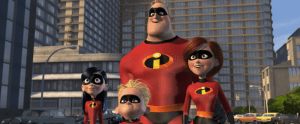 Bob’s wanderlust is soon quenched when he receives a mysterious invitation from a beautiful, white-haired woman named Mirage. She offers Bob the chance to become Mr. Incredible once more, to use his gifts and abilities to stop a robot on the loose on some island. Bob leaps at the chance, hiding his ongoing super exploits from his wife, and regains a sense of purpose. He hasn’t been this happy in ages; however, it all comes to a head when he learns that Syndrome (Jason Lee), the one responsible for the run-amok robots, has other plans. Not only this, upon capture Mr. Incredible realizes that he has ties to Syndrome way back during one of his less-than-super moments.
Helen is shocked when she finds out what Bob’s been up to, but also partially relieved it’s not an affair. She visits their old costumer Edna Mode, whose glasses and black wig may be bigger than the rest of her shrimpy body. Edna has redesigned a team of superhero costumes, and with them in hand Helen becomes Elastigirl once more and takes Dash and Violet on a journey to save their father and become a family once more.
The Incredibles is a film bursting with entertainment. This is an explosion of imagination, of wit, of grand storytelling, that the audience should sit and soak up every loving and beautiful second of it.
The voice work is wonderful. I’m sure Disney execs were scratching their heads over Craig T. Nelson, but I cannot imagine anyone else that could deliver as much in the role. Hunter is excellent, as always, as a doting mother and crime fighter. Lee is great with a villainous role that has a lot more depth to it than near any live-action film. His verbal gymnastics are perfectly suited for a slighted super villain.
Writer/Director Brad Bird’s first feature was the 1999 masterpiece, The Iron Giant, which I consider the finest animated film of all time (you heard me, Walt). Bird’s first film was a masterful mixture of little boy fantasy, reality, strong characters, humor, and excuse-me-there’s-something-in-my-eye tenderness. I know many people who, after seeing The Iron Giant, say they were, “crying like they watched a puppy get hit in the face with a shovel.”
 With this being said, my trust in Bird as a master storyteller is still there. The Incredibles is the first Pixar film concerning real people, not just toys, ants, fish, monsters, and, uh, more toys, and the results are astounding. This is a film rich in complexity, human insights, family warmth, and, again, realism. Bird has fully realized The Brady Bunch of superheroes. They feel just as flesh and blood as any characters I’ve seen in any film this year. They have desires, secrets, shame, guilt, anger, burdens, pride, and above all, love. I mean, how many animated films have an actual subplot involving marital suspicion? You won’t find that in The SpongeBob Squarepants Movie. When Elastigirl and the kids go off to save her heroic hubby, she has a sit-down with her children and warns them that, yes, death is very real, and that these people will indeed kill them if discovered (this is the first PG-rated Pixar film, by the way). It’s a great moment that reminds you how much you care for these people.
Bird’s imagination seems incomparable. He has a razor-sharp feel for comedy, like Elastigirl’s scene caught between several sliding doors or the lively, hysterical Edna Mode personality, but he also possesses the ingenuity for crafting some of the most exciting action sequences in a long time. The Incredibles has uncanny action scenes, set to Michael Giacchino (TV’s Lost) blazing jazz score, which should make the James Bond producers die from envy.
Bird has created a stupendous action film, a heartwarming family drama, a hilarious comedy, and a gorgeous film to watch. Movies rarely get this entertaining, but for Pixar, it’s all just part of the norm. I hope someday we don’t take Pixar’s accomplishments and staunch consistency for granted, because they aren’t just reinventing what animation can do, they’re also reinventing what films themselves can do. You can have all the accents you want Tom Hanks; I’ll gladly take The Incredibles and its bounty of offerings.
Nate’s Grade: A
Share this:

Brother Bear (2003)
 Kenai (voiced by Joaquin Phoenix) is the impulsive younger brother in a tribe of Native Americans living in Northern America. Where exactly? Well, I don’t know but someplace where Kenai and his brothers can surf wicked glaciers dude. Kenai wants to be accepted into his people more than anything. Too bad hes a screw-up. Some fish he leaves out attracts a bear that inadvertently kills Kenai’s older, wiser brother. Kenai swears revenge against the bear and kills it. But lo, this upsets the spirits of nature and they turn Kenai into a bear himself. Oh the irony. Kenai must learn all about coping in the animal kingdom while looking after a young cub Koda, whose looking for his lost mother. Take a guess what happened to his mother. No, seriously, go on and guess. I’ll sit here and wait. Done? Okay then.
The story of Brother Bear has as much life as a bearskin rug. Once again we have a hotheaded jerk that walks a mile in someone else’s paws and learns valuable life lessons through their bizarre transformation. The only thing this movie is missing is Rob Schneider in the main role.
I don’t know what the makers of Brother Bear were intending. Is this for young kids? Well there is endless slapstick and cutesy woodland creatures. However, the first part of the story is quite dark and all about family loss. Great way to start a family film huh? With some family killings? If this is also intended for kids I’m pretty sure they’ll be bored at the preachier moments talking about animal cruelty and tolerance.
Disney once again plays it too safe and by trying to please everybody they end up likely pleasing nobody. This is 20,000 leagues below the artful Finding Nemo. Why does it seem like when the Diz does things in-house theyre so adverse to risk? What the audience is left with is a formulaic piece of fluff thats only memorable attribute is being extraordinarily ordinary.
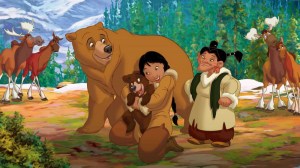 The ending is so bad that its beyond belief, so allow me to spoil it. Kenai transforms back into a human after hes learned his valuable lesson. He then chooses to remain a bear to watch after Koda. What? Why dont they turn Koda into a boy? Or turn everyone into bears? Or why not turn everyone in the audience into people watching a different, better movie?
The animation of Brother Bear is clunky and awkward amidst a crayola-colored backdrop. The visuals often seem drab or like the templates for a better movie. The human characters appear so stocky. The best element of Brother Bear is the voice work of Dave Thomas and Rick Moranis doing a moose variation on their McKenzie brothers.
Phil Collins provides the painfully monotonous pop claptrap thats cued whenever a montage is needed. How the hell did this man win an Oscar for Best Song over the likes of Aimee Mann, Sarah McLachlan, and the creators of South Park? The best way to describe Collins collection of unmotivated ditties is that theyre like soup for the ears: runny, bland, forgettable, and dreadfully unsatisfying. If you cant tell, I dont really care for soup (Soup is too a food!).
Brother Bear is yet another half-hearted effort from the Mouse House. The story, animation, and voice acting are all sub par. Its the same sing and dance al over again, except this time its in the woods, and this time the sing and dance is your senile grandfather with his pants around his ankles doing the jitterbug. Yeah. You get the idea.
Nate’s Grade: C


 nathanzoebl
You must be logged in to post a comment.