Blog Archives
Batman vs. Superman: Dawn of Justice (2016)
 Batman and Superman have been a collision course for a while. The two most famous superheroes were once scheduled to combat in 2003. Then the budget got a tad too high for Warner Brothers’ liking and it was scrapped. Flash forward a decade and now it seems that money is no longer a stumbling point, especially as Batman vs. Superman: Dawn of Justice cost an estimated $250 million dollars. I wasn’t a fan of director Zack Snyder’s first take on Superman, 2013’s Man of Steel, so I was tremendously wary when he was already tapped to direct its follow-up, as well as the inevitable follow-up follow-up with 2017’s Justice League. You see DC has epic plans to create its own universe of interlocked comics franchises patterned after Marvel’s runaway success. Instead of building to the super team-up, they’re starting with it and hoping one movie can kick off possibly half a dozen franchises. There’s a lot at stake here for a lot of people. That’s what make the end results all the more truly shocking. Batman vs. Superman isn’t just a bad movie, and I never thought I’d type these words, it’s worse than Batman and Robin.
Eighteen months after the cataclysmic events of Man of Steel, Metropolis is rebuilding and has an uneasy relationship with its alien visitor, Superman (Henry Cavill). Billionaire Bruce Wayne (Ben Affleck) is convinced that an all-powerful alien is a threat to mankind, especially in the wake of the dead and injured in Metropolis. But how does man kill a god? Enter additional billionaire Lex Luthor (Jessie Eisenberg) and his acquisition of a giant hunk of kryptonite. Bruce runs into a mysterious woman (Gail Gadot a.k.a. Wonder Woman) also looking into the secrets held within Luthor’s vaults. Clark Kent is pressing Wayne for comment on this bat vigilante trampling on civil liberties in nearby Gotham City, and Wayne is annoyed at the news media’s fawning treatment over an unchecked all-powerful alien. The U.S. Senate is holding hearings on what responsibilities should be applied to Superman. Lois Lane (Amy Adams) is worried that her boyfriend is getting too caught up in the wrong things. Lex Luthor is scheming in the shadows to set up one final confrontation that will eliminate either Batman or Superman, and if that doesn’t work he’s got a backup plan that could spell their doom.
 I think it’s only fitting to tackle each of the particular heavyweights in this huge showdown and devote time to dressing down why exactly the movie fails them.
Let’s start with Batman because quite frankly he’s the character that the American culture prefers (his name even comes first in the title for a Superman sequel). Ben Affleck (Gone Girl) was at the bad end of unrelenting Internet fanboy-fueled scorn when the news came out that he was going to play the Caped Crusader, but he’s one of the best parts of this movie, or perhaps the better phrasing would be one of the least bad parts. He’s a much better Bruce Wayne than Batman but we don’t really get much of either in this movie from a character standpoint. There isn’t much room for character development of any sort with a plot as busy and incomprehensible as Batman vs. Superman, and so the movie often just relies upon the outsized symbolism of its mythic characters. We have a Batman who is Tough and Dark and Traumatized and looking for (Vigilante) Justice. We only really get a handful of scenes with Batman in action, and while there’s a certain entertainment factor to watching an older, more brutal Batman who has clearly given up the whole ethical resolve to avoid killing the bad guys, under Snyder’s attention, the character is lost in the action. The opening credits once again explain Batman’s origin story, a tale that should be burned into the consciousness of every consumer. We don’t need it, yet Snyder feels indebted to what he thinks a Batman movie requires. So he’s gruff, and single-minded, and angry, but he’s never complex and often he’s crudely rendered into the Sad Man Lashing Out. He’s coming to the end of his career in tights and he knows it, and he’s thinking about his ultimate legacy. That’s a great starting point that the multitude of live-action Batman cinema has yet to explore, but that vulnerability is replaced with resoluteness. He’s determined to kill Superman because Superman is dangerous, and also I guess because the Metropolis collateral damage crushed a security officer’s legs, a guy he’s never met before. The destructive orgy of Metropolis is an excellent starting point to explain Bruce Wayne’s fear and fury. I don’t know then why the movie treats Wayne as an extremist. I don’t really understand why there’s a memorial for the thousands who lost their lives in the Metropolis brawl that includes a statue of Superman. Isn’t that akin to the Vietnam Wall erecting a giant statue of a Vietcong soldier stabbing an American GI with a bayonet? This may be the most boring Batman has ever been onscreen, and I repeat, Ben Affleck is easily one of the best parts of this woefully begotten mess.
Next let’s look at the other titular superhero of the title, the Boy Scout in blue, Superman. The power of Superman lies with his earnest idealism, a factor that has always made him a tougher sell than the gloomy Batman. With Man of Steel, Warner Brothers tried making Superman more like Batman, which meant he was darker, mopey, theoretically more grounded, and adopted the same spirit of being crushed by the weight of expectations and being unable to meet them. Cavill (The Man from U.N.C.L.E.) was a Superman who didn’t want to be Superman, where dear old Pa Kent advocated letting children drown rather than revealing his powers (Father’s Day must have been real awkward in the Kent household). It wasn’t a great step and I wrote extensively about it with Man of Steel. The problem is that Superman and Batman are supposed to be contradictory and not complimentary figures. If one is brooding and the other is slightly more brooding, that doesn’t exactly create a lot of personal and philosophical conflicts now does it? It clearly feels that Snyder and everybody really wanted to make a Batman movie and Superman just tagged along. Superman clearly doesn’t even want to be Superman in the Superman sequel, often looking at saving others with a sigh-inducing sense of duty. He’s still working as a journalist and making moral arguments about the role of the media, which seems like a really lost storyline considering the emphasis on blood and destruction. He wants Superman to be seen as a force of good even if others deify him. That’s a powerfully interesting angle that’s merely given lip service, the concept of what Superman’s impact has on theology and mankind’s relationship to the universe and its sense of self. Imagine the tectonic shifts acknowledging not only are we not alone but we are the inferior race. We get a slew of truly surprising cameos for a superhero movie arguing this debate (Andrew Sullivan?) but then like most else it’s dropped. Clark is trying to reconcile his place in the world but he’s really just another plot device, this time a one-man investigation into this bat vigilante guy. The other problem with a Batman v. Superman showdown is that Superman is obviously the superior and would have to hold back to make it thrilling. We already know this Superman isn’t exactly timid about killing. The climax hinges on a Batman/Superman connection that feels so trite as to be comical, and yet Snyder and company don’t trust the audience enough to even piece that together and resort to a reconfirming flashback.
 Arguably the most problematic area of a movie overwhelmed with problems and eyesores, Eisenberg’s (Now You See Me) version of Lex Luthor is a complete non-starter. He is essentially playing his Mark Zuckerberg character but with all the social tics cranked higher. His socially awkward mad genius character feels like he’s been patched in from a different movie (Snyder’s Social Network?) and his motivation is kept murky. Why does he want to pit Batman and Superman against each other? It seems he has something of a god complex because of a nasty father. He is just substantially disappointing as a character, and his final scheme, complete with the use of an egg timer for wicked purposes, is so hokey that it made me wince. If you’re going with this approach for Lex then embrace it and make it make sense. Late in the movie, Lex Luthor comes across a treasure-trove of invaluable information, and yet he does nothing substantive with this except create a monster that needs a super team-up to take down (this plot point was already spoiled by the film’s marketing department, so I don’t feel guilty about referring to it). If you’re working with crafty Lex, he doesn’t just gain leverage and instantly attack. This is a guy who should be intricately plotting as if he was the John Doe killer in Seven. This is a guy who uses his intelligence to bend others to his will. This Lex Luthor throws around his ego, nattering social skills, and force-feeds people Jolly Ranchers. This is simply a colossal miscalculation that’s badly executed from the second he steps onscreen. The movie ends up being a 150-minute origin story for how Lex Luthor loses his hair.
The one character that somewhat works is Wonder Woman and this may be entirely due to the fact that her character is in the movie for approximately twenty minutes. Like Lois, she has little bearing on the overall plot, but at least she gets to punch things. I was skeptical of Gadot (Triple 9) when she was hired for the role that should have gone to her Furious 6 co-star, Gina Carano (Deadpool). She didn’t exactly impress me but I’ll admit I dropped much of my skepticism. I’m interested in a Wonder Woman movie, especially if, as reported, the majority is set during World War I. There is a definite thrill of seeing the character in action for the first time, even if she’s bathed in Snyder’s desaturated color-corrected palate of gloom. Realistically, Wonder Woman is here to introduce her franchise, to setup the Justice League movies, and as a tether to the other meta-humans who each have a solo film project on the calendar for the next four years. Wonder Woman gets to play coy and mysterious and then extremely capable and fierce during the finale. One of the movie’s biggest moments of enjoyment for me was when Wonder Woman takes a punch and her response is to smile. I look forward to seeing more of her in action and I hope the good vibes I have with the character, and Gadot, carry onward.
 The last act of this movie is Snyder pummeling the audience into submission, and it’s here where I just gave up and waited for the cinematic torment to cease. The action up to this point had been rather mediocre, save for that one Batman fight, and I think with each additional movie I’m coming to the conclusion that Snyder is a first-class visual stylist but a terrible action director. The story has lacked greater psychological insights or well-rounded characters, so it’s no surprise that the final act is meant to be the gladiatorial combat Lex has hyped, the epic showdown between gods. In essence, superheroes have taken a mythic property in our pop-culture, and Batman and Superman are our modern Mt. Olympus stalwarts. This showdown should be everything. The operatic heaviness of the battle at least matches with the overwrought tone of the entire movie. It’s too bad then that the titular bout between Batman and Superman lasts a whole ten minutes long. That’s it, folks, because then they have to forget their differences to tackle a larger enemy, the exact outcome that every single human being on the planet anticipated. I’m not even upset that the film ends in this direction, as it was fated. What I am upset about is a climax that feels less than satisfyingly climactic and more like punishment, as well as a conclusion that no single human being on the planet will believe. Snyder’s visual style can be an assault on the senses but what it really does is break you down. The end fight is an incoherent visual mess with the screen often a Where’s Waldo? pastiche of electricity, debris, smoke, fire, explosions, and an assortment of other elements. It’s a thick soup of CGI muck that pays no mind to geography or pacing. It’s like Michael Bay got drunk on Michael Bay-filmmaking. What the hell is the point of filming this movie in IMAX when the visual sequences are either too hard to decipher or something unworthy of the IMAX treatment? Do we need an entire close-up of a shell hitting the ground in glorious IMAX? The Doomsday character looks like a big grey baby before he grows his spikes. I was shocked at how bad the special effects looked for a movie that cost this much money, as if ILM or WETA said, “Good enough.” Once it was all over, I sat and reflected and I think even Snyder’s Sucker Punch had better action.
Another problem is that there are just way too many moments that don’t belong in a 150-minute movie. There’s an entire contrivance of Lois disposing of a valuable tool and then having to go back and retrieve it that made me roll my eyes furiously. It’s an inept way of keeping Lois involved in the action. How does Lois even know the relevancy of this weapon against its new enemy? Then there’s her rescue, which means that even when the movie shoehorns Lois into the action to make her relevant, she still manages to become a damsel in needing of saving. She feels shoehorned in general with the screenplay, zipping from location to location really as a means of uncovering exposition. Then there’s the fact that there is a staggering THREE superfluous dream sequences, and we actually get a flashback to one of those dumb dream sequences. The most extended dream sequence is a nightmarish apocalyptic world where Batman rebels against a world overrun by Superman and his thugs. There’s a strange warning that comes with this extended sequence of future action but it doesn’t involve this movie. Batman vs. Superman suffers from the same sense of over-extension that plagued Age of Ultron. It’s trying to set up so many more movies and potential franchises that it gets lost trying to simply make a good movie rather than Step One in a ten-step film release. In the age of super franchises that are intertwined with super monetary investments, these pilot movies feel more like delivery systems than rewarding storytelling. Payoffs are sacrificed for the promise of future payoffs, and frankly DC hasn’t earned the benefit of the doubt here.
 I must return to my central, headline-grabbing statement and explain how Batman vs. Superman is a worse movie than the infamous Batman and Robin. I understand how loaded that declaration is so allow me to unpack it. This is a bad movie, and with that I have no doubt. It’s plodding, incoherent, tiresome, dreary, poorly developed, and so self-serious and overwrought to the point that every ounce of fun is relinquished. It feels more like punishment than entertainment, a joyless 150-minute exercise in product launching. By the end of the movie I sat in my chair, defeated and weary. Here is the most insidious part. Batman vs. Superman: Dawn of Justice obliterates any hope I had for the larger DC universe, let alone building anything on par with what Marvel has put together. If this is the direction they’re going, the style, the tone, then I don’t see how any of these will work. What’s to like here? “Fun” is not a dirty word. Fun does not mean insubstantial nor does it mean that larger pathos is mitigated. If you’re going to have a movie about Batman and Superman duking it out, it better damn well be entertaining, and yes fun. It’s not a Lars von Trier movie. The Marvel movies are knocked for not being serious, but they take their worlds and characters seriously enough. They don’t need to treat everything like a funeral dirge, which is what Batman vs. Superman feels like (it even opens and closes on funerals). This movie confirms all the worst impulses that Man of Steel began, and because it gutted all hope I have for the future of these oncoming superhero flicks, I can’t help but lower its final grade. Batman and Robin almost killed its franchise but it was in decline at the time. As campy and innocuous as it was, Batman vs. Superman goes all the way in the other direction to the extreme, leaving a lumbering movie that consumes your hopes. The novelty of the premise and seeing its famous characters standing side-by-side will be enough for some audience members. For everyone else, commence mourning.
Nate’s Grade: D
Share this:

Big Eyes (2014)
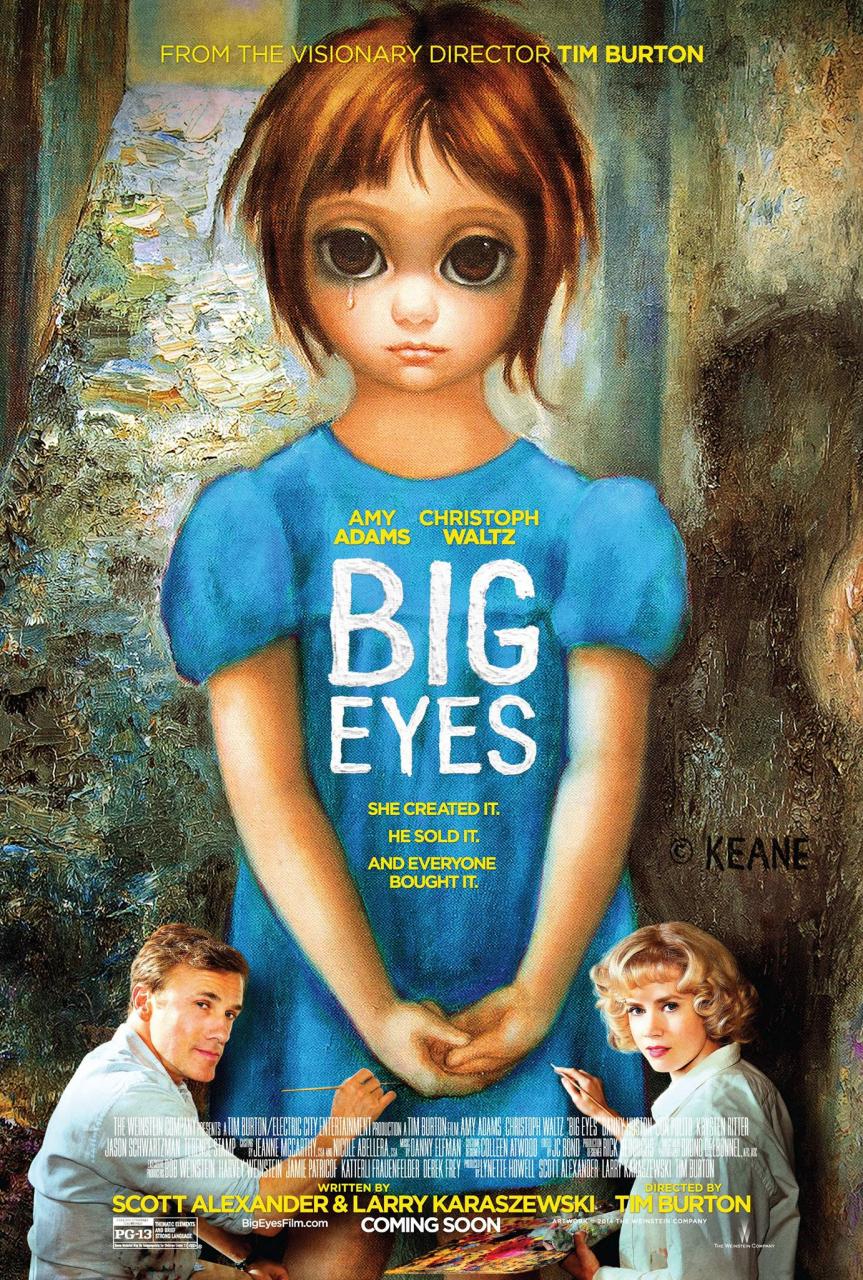 Like most people, Tim Burton is a filmmaker who likes working with a select set of familiar faces. Since 2001, Burton’s wife Helena Bonham Carter has appeared in every one of his films. Johnny Depp has appeared in every Burton film since 1999’s Sleepy Hollow, save for Planet of the Apes. It got to the point where you knew if Burton were attached as director, these two would be riding shotgun. No so fast, as Big Eyes is absent Depp, Carter, other longtime collaborators like editor Chris Lebenzon, and really any noticeable sign that Burton actually was the director. This bizarre biopic about a scandalous secret in the art world fails to justify more than a casual viewing.
In the 1960s, Margaret Keane’s (Amy Adams) portraits of waifish children with large, tragic eyes were the most popular art of the decade. They fascinated the public who couldn’t get enough, including clamoring for reprints so everyone could have their own Keane work of art. Except the world at large never knew that Margaret had painted them. Her husband, Walter (Christoph Waltz), was posing as the real creator. He appeared on television, ran with famous celebrities, and always looked for the next platform to elevate the Keane name, all while Margaret stayed home and painted. She agreed to go along with Walter’s version of events because the public was more accepting of a male painter, and Walter was such a natural salesman. The world could never know the truth.
 Being a true-life story, there are certain limitations inherent in sticking to the facts while still telling an engaging story, and Big Eyes suffers from this. There is an interesting story here, no doubt, and that is clear and on display when Margaret and Walter square off in court as a majority of the third act. Before then, the screenplay by Scott Alexander and Larry Karaszewski (Ed Wood, The People vs. Larry Flynt) plays in a very linear fashion, telling the story very conventionally except for the annoying narration of a news reporter (Danny Huston). The reason this character is clumsily inserted into being our narrator is because the real main character, Margaret, spends two acts being so passive and often hidden before she gathers the courage to challenge her husband and expose him. Naturally, there’s got to be a realistic character arc where our heroine goes from naïve and inactive to stronger and active, but it takes most of the movie. In the meantime, she paints and paints and literally hides herself from the world. It feels like the movie forgets about her while Walter is gallivanting around on her fame. Ironically, the movie actually becomes a series of men attempting to tell Margaret’s story; the first is her husband but the other is the invented and unnecessary narrator.
To make up for the time the film seems to paint a more flattering than deserved picture of Walter. I think perhaps they want the audience to fall under his spell just like Margaret and then slowly come to the same dawning realization. His initial argument is that female artists are not taken as seriously in their era, and I’m sure there’s truth to this. It was generally harder for a woman to be seen as legitimate in just about any capacity other than homemaker in the 1960s. We spend a full two acts with him charming others and hoodwinking the art world. He’s portrayed as more of a used car salesman con man than what could be described as a dangerous egotistical drunk who exploits his wife. The movie gives him a few nasty moments but it seems to portray Walter with light judgment, even after he endangers Margaret and their daughter’s lives. With Margaret figuratively and literally a kept woman cooped up for so long, Walter’s antics start to come across as vamping, filling time until Margaret hits that point on her character arc to leave him. It becomes tiresome then to just watch Walter sputter and spin his way to greater fortune and fame, though he deserves credit for popularizing the printing of painting reproductions that sell for cheap. Walter Keane, footnote in the art world for commercializing it for the masses. Waltz (Django Unchained) is an effortlessly entertaining actor and charming cads with a thinly veiled air of menace are his specialty. It’s a waste of his talents because Walter is kept as an ongoing mystery rather than an opportunity to explore a complicated character’s psyche. We find one falsehood after another, but in the end, he’s still just a mystery left unsolved.
There is amusement to be had at points as to be expected when it comes to keeping up a con, almost getting caught, the scrambles to continue hiding the big lie. This fun is at the expense of Margaret, which the movie wants you to think about and not think about at various points. There are streaks of comedy but I’d hardly call Big Eyes a comedy (sorry Golden Globes categorization). Terrence Stamp is enjoyable as a disapproving art critic who cannot believe what Walter is doing or why he is popular. The final act is easily its most entertaining as Margaret finally gets to call out her scoundrel of a husband for his bad behavior. It takes several unexpected turns that seem too fanciful to be true, and yet they are. The courtroom setting feels right for this script, and if there were a rewrite, I would have used it as the primary setting. The story could be introduced through a series of flashbacks. At least that way we don’t have to wait for Margaret to be the strong heroine we need, and we don’t have to be constrained by the wait of linear storytelling. This approach would strip away some of the redundancies of the plot and at least allow Margaret an opportunity to be the one telling her story.
 Another problem with Big Eyes is that at no point does it feel like a Tim Burton film. The man is better known for his dips into Gothic fantasy, but in 1994 he showed he could more than pull off a conventional film in Ed Wood. Just because the story doesn’t involve weird fantasy characters and violence doesn’t mean that Burton cannot still add value being the man to tell that tale. Unfortunately, there is no point while watching Big Eyes that feels like it was directed by Burton. The director could have been anybody. If you kept the identity of the director secret, I cannot imagine more than a slim number of participants accurately guessing who directed the picture. I wonder what attracted Burton to the script, which does have its share of true-life eccentrics and hucksterism, both appealing aspects for the man. It’s just lacking a sense of vision that Burton usually has in spades, even if that vision over three decades has become a tad commoditized. I won’t go as far to say the film is poorly directed because a majority of the problems remain with its script rather than the actors or shot selections. Still, Burton doesn’t bring much to elevate the material. Perhaps that’s a positive, he didn’t attempt to overpower the narrative with a superfluous detour in style, but then why hire Burton?
Adams (American Hustle) is a consistently good actress and she does her best with the part, but the limitations are even too much for her talents. By no means is she bad but she’s playing a passive character often given to worry. She’s stashed away for a majority of the movie. You feel like Adams is acting with one hand tied behind her back.
Big Eyes is a movie that intrigues you with its potential only to frustrate you with its eventual execution. The true story behind the film is juicy and outlandish, crying out for the venue of cinema. The struggle between husband and wife over the ownership of an empire is a conflict that hooks an audience. Thanks to a repetitive plot structure and character vamping, the film limits the heights it can achieve. Burton’s presence is not felt at all throughout the film. The comedy often sours when you realize the full context of what’s going on, a much more serious affair than the film often wants you to think about. The characters are kept at a distance and given arcs rather than deeper exploration. She will become active and find her voice, fighting for credit. He will be the con man who wants to keep everyone distracted, fueled by jealousy at his wife’s abilities. There’s more psychological complexity here, but Waltz and Adams are slotted in very narrow boxes. They have little to work with and their performances show it. Big Eyes isn’t a bad film but it’s one that deserved to be better in just about every regard. It’s a fleeting curiosity more than a fully developed film, and that’s a shame given the source material. Expect Burton to return back to the safe embrace of Johnny Depp’s arms at any moment.
Nate’s Grade: B-
Share this:

American Hustle (2013)
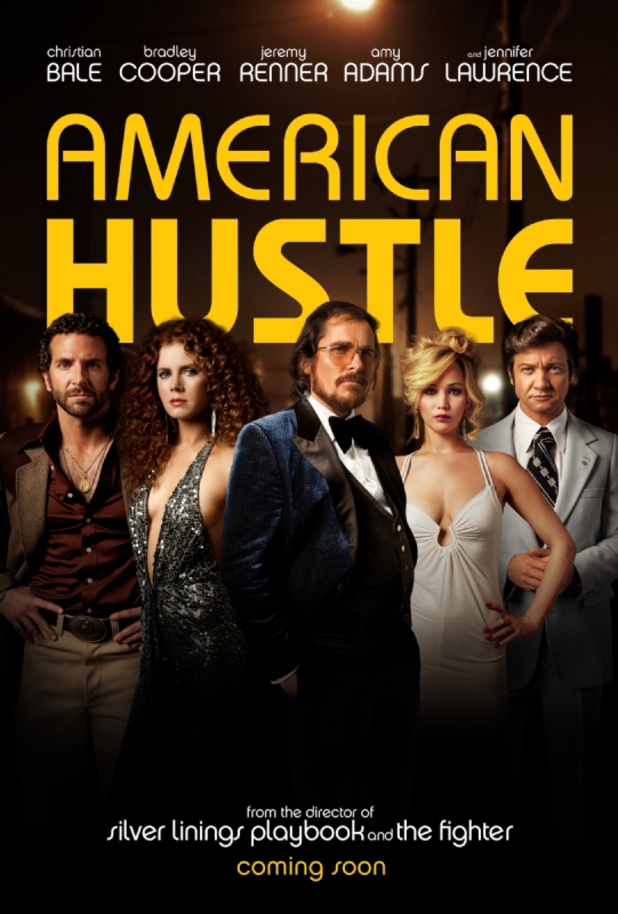 With two movies, writer/director David O. Russell has vaulted to the top of Hollywood. Previously known for his own difficult behavior, Russell’s last two films, The Fighter and Silver Linings Playbook, were both critical and commercial hits (Silver Linings made over $230 million worldwide). Both brought a bushel of Oscar nominations as well, making Russell one of the hottest directors for actors and producers. But a new side seems to have emerged over these last two movies, one less of Russell the domineering director and one of Russell the open collaborator. It feels like he’s just hitting his stride too. American Hustle is Russell’s latest and it’s sharply written, engrossing, lively, surprisingly comic, and readily entertaining.
In the late 1970s, the FBI set up an undercover sting to nail political corruption, ultimately nabbing several U.S. congressmen and one standing U.S. Senator. Richie DiMaso (Bradley Cooper) is an FBI agent who snags the perfect assistance. To catch a crook you have to think like a crook, and so Richie has strong-armed a pair of lucrative con artists into helping him. Irving Rosenfeld (Christian Bale) is a professional down to his elaborate hairpiece. He’s used to fleecing desperate people and selling phony artwork to the gullible, but he’s been too shy about making too much noise. If you stay small, you go unnoticed. Irving’s partner in crime is Sydney Prosser (Amy Adams), a kindred spirit who has reinvented her self. She and Irving are in love, and now they’re trapped by Richie to set up New Jersey mayor Carmine Polito (Jeremy Renner). The one unpredictable element is Irving’s young wife, Rosalyn (Jennifer Lawrence), who could blow up the whole operation with her careless and self-involved tantrums.
 Russell has once again given audiences one of the most entertaining films of the year, this time allowing them to participate vicariously in a con game, trying to anticipate the twists and turns and assessing everyone’s personal angle. This is a fictionalized rendition of the Abscam case (the opening text drolly says, “Some of this actually happened”) and it gives us a slew of meaty characters that have something going on. The central point elaborated in this pop crime caper is that we’re all cons, we’re all pretending, on some level, to be different people; Russell’s film just takes this notion to the extreme. Irving and Sydney are trying to escape lives of ordinary malaise, of being victims, of the more powerful dictating their options for them. With Sydney, she’s pretending to fall for Richie, but we don’t fully know which side she may choose to end up on. Richie is trying to also escape his dull life of desk jobs and lower middle-class dinners. His ambitions get hold of him, and with Irving’s aid, he catapults himself toward achieving those oversized dreams of his, never mind the ethical lapses in nabbing the bad guys. For Carmine, he’s so fiercely devoted to his community that you don’t doubt his loyalty for a second. He’s a man who sincerely wants to help others and is knowledgeable enough about how the world works, knowing he may have to grease some wheels to get the progress started. He is the most moral figure of the five main players and you may find yourself rooting for him to escape the snare closing in on him. Then there’s Rosalyn who has her hooks in Irving, looking for a sense of stability for her and her child. She’s a volatile cocktail of emotion but she knows what she needs to do to keep Irving anchored to her needs, though she’s also cognizant enough to latch onto a better provider if one materializes. Mixing and matching those characters, you have an eclectic mix of personalities clashing, many at odds with one another as far as goals, and the conflict stirred up is delicious.
Russell also attaches on his Martin Scorsese filter, delivering a freewheeling film about criminals from their wizened point of view, explaining the ins and outs of their hustle with flamboyance, style, and vigor. While the opening is a tad slow, including an opening minute watching Irving work his almost breathtaking comb over hairstyle, we plow right along into this world of hustlers and con men, learning tricks of their trade (hint: desperate people are desperate) and the tools to stay ahead of detection. We’re awash in multiple perspectives, each with voice over, a frenetic camera, and emboldened editing. It’s the Scorsese approach given studious application to the Abscam affair. It’s a great thing that Scorsese is the finest living filmmaker and devoting a two-hour-plus homage to the man’s most stylized crime pictures is a plus. Russell’s movie feels alive but also hungry, like many of his characters, restlessly searching for something. The scenes land but they don’t feel like they’re standing still; everything is propulsive in this movie. The small operation of Irving and Sydney is taken to the big leagues thanks to Richie’s ego, and the FBI’s desire for splashy headline busts, but wider exposure also exponentially multiplies the danger. Once the gambling scheme attracts the investment of the Mob, that’s when everyone has gone too far. I was clenching my fists in suspense toward the end, worried that our fictional cons may be too far in to survive.
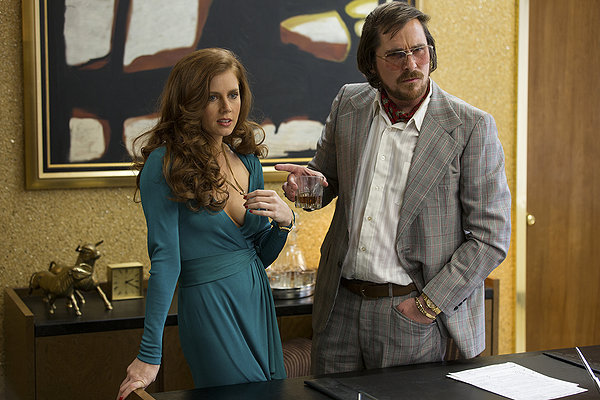 Russell hasn’t lost his magic touch with actors. His last two films have netted seven acting Oscar nominations and three wins, and the cast of American Hustle meets that same level of excellence. Perhaps even more so than The Fighter, the characters are given a very broadly comic brush, easily and routinely stepping into a carnival row of over-the-top behavior. It provides plenty of entertainment of the mishap and absurd variety, but there are also lone piercing moments of great empathy with these messy people. Mostly, the various actors all seem to be in a great syncopation, each one contributing where the other left off, building a great and compelling picture. When this ensemble is firing, it’s hard to beat. Special mention to comedian Louis C.K. (TV’s Louie) making the most of every scene he’s in as an FBI party pooper. His running gag involving a personal ice-fishing story is one of the film’s best jokes.
Bale (Out of the Furnace) is our guiding voice in this world, a flimflam man of the first order who fools maybe even himself. He’s got his own code of ethics and a heart behind that pot belly (another physical transformative performance by Bale the chameleon). He’s briskly entertaining but my only complaint is that, by being so suave and slick, he seems a tad too low-key at points given the risk involved. I know it’s part of the act, but from an audience standpoint, it makes him seem a tad too modulated. His equal is Renner (The Bourne Legacy) who is so earnest that it practically breaks your heart when he oversteps into morally murky territory.
However, Bale’s performance is compensated by the sheer craziness of the Silver Linings co-stars, Cooper and Lawrence. Cooper (The Place Beyond the Pines) is a lawman but also the film’s biggest antagonist. He gets drunk with power and the credit he’s receiving at the FBI. He’s also a deeply insecure man who is trying to style himself like Irving and Sydney as a posh reinvention. Cooper gives him a manic energy and taps back into his reservoir of eager-to-please egotism. Lawrence (Catching Fire) is the most unpredictable character. She acts on impulse, flirts with sabotage, and soaks up the spotlight she’s so rarely afforded. Lawrence is having the time of her life playing a loud, shrewish, vampy housewife who has a noticeable habit of starting house fires.
Beforehand, I would have thought that Lawrence and Adams should have swapped roles (still an interesting experiment), but having now seen the film, each suits them well. Adams (Man of Steel) is the saddest character of them all to me because she’s the bruised dreamer anxious to be anyone but who she really was. She relishes the con, more so than Irving, and ties much of her self-identity to her shyster skills.
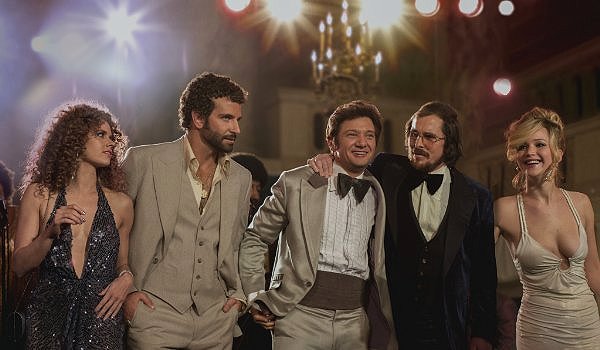 I’ve been dragging my feet writing my review and I’ve been trying to determine why, beyond, obviously, holiday-related sloth. American Hustle is readily a good movie that provides plenty of entertainment, meaty characters, and fun, but why do I keep feeling like it’s missing one undetermined ingredient? I can’t even articulate what at the moment but after having seen the film two times now, I feel like perhaps my emotional involvement was stunted. It’s a finely tuned script that delivers big performances for big-time actors, with a dandy ending that manages to dish out satisfying conclusions to its bevy of wheeler-dealers. But why didn’t I care more, why didn’t I feel more resonance by the time the end credits landed? The best theory I can surmise at this time is that we’re caught up in the con game, where everyone is pretending to be somebody else out of necessity or desire, that when it’s all over, we reflect on what a fun ride it’s been with fun characters but do we feel like we’ve gotten anywhere? I feel like I was more interested in the characters than attached to them. Again, American Hustle is still a sensationally entertaining movie and this paragraph is but a quibble, but it’s enough to thwart me from fully embracing and celebrating Russell’s film (confession: having already seen Scorsese’s brilliant Wolf of Wall Street, this could be coloring things for me with Russell’s Scorsese homage).
American Hustle is a fun ride with arresting performances, oodles of style, energy, and comedy. It’s a crime caper of the first order, easing you into this world and watching people play all sides. Even better, we’re given a volatile mix of personalities that clash, forming new and lasting conflicts, some of which could endanger the entire operation. These are interesting people to spend time with and so we can excuse the indulgences of a 140-minute movie that offers even more with this fantastic cast. Russell with a Scorsese filter is an even more improbably entertaining filmmaker. This is a crowd-pleasing sort of movie, much like Silver Linings, that doles out punchlines and payoffs with aplomb. It’s easy to go along for the ride, laugh uproariously, and then by the end sort of wonder whether it was all worth it. The emotional detachment to the characters may be a minor complaint for a film this largely satisfying, but since we’re spending so much time on our characters, I think I would have preferred something a tad more substantive by the end. It’s a great ride, with great characters and great humor, but there is a nagging concern that it may have been a better ride than a story. Regardless, American Hustle is an enjoyably alluring con that mines the absurdist fashions, personalities, and political overreach of the 1970s, painting a tale of criminals who may be the real heroes of the American dream.
Nate’s Grade: A-
Share this:

Her (2013)
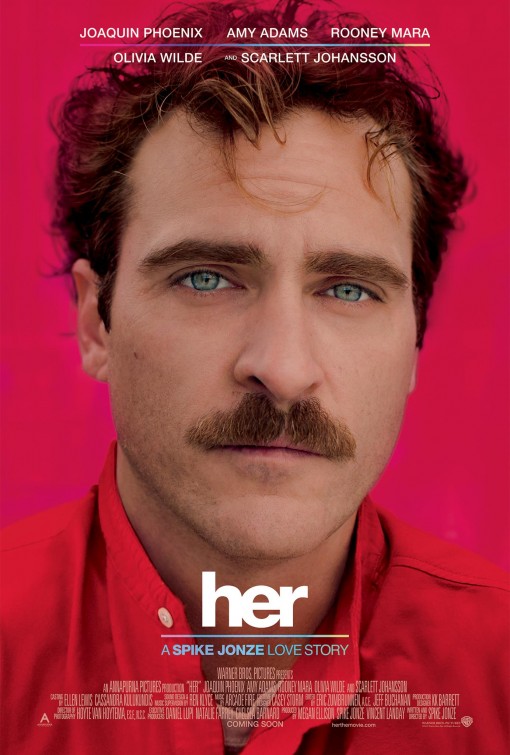 It’s been several years for Spike Jonze since he escaped the turmoil around Where the Wild Things Are, an ambitious adaptation that ran afoul with studio execs over the oppressively sad tone (I agreed with the execs). He’s one of the most stylish visual directors working today, but Her is something very different for the man. For starters, it’s a film Jonze wrote himself; no collaboration with Charlie Kaufman this time. It’s also a pared down love story, focusing heavily on two characters and their exciting and emerging union. There are no visual tricks, no gimmicks, no overt special effects, nothing to distract from the central relationship commanding the screen. It’s a different kind of film from Jonze but one that’s just as brilliantly well made as his best. Her is a beguiling winner.
Theodore (Joaquin Phoenix) is a man struggling to get his life back together. He’s a star at his job where he writes other people’s personal letters for them, but he’s a sensitive soul still refusing to sign the divorce papers from his ex-wife, Catherine (Rooney Mara). He doesn’t want to lose that part of his life. After watching an ad, Theodore buys a new computer operating system (OS) that promises to be the most lifelike possible. He pops the software onto his computer and, voila, the voice of Samantha (Scarlett Johansson) emerges, chipper, helpful, and compassionate. Theodore is a new man with her assistance, and soon they grow even closer together on a romantic scale. Theodore and Samantha embark on the greta unknown together, but can a relationship work when it’s with a voice in your computer.
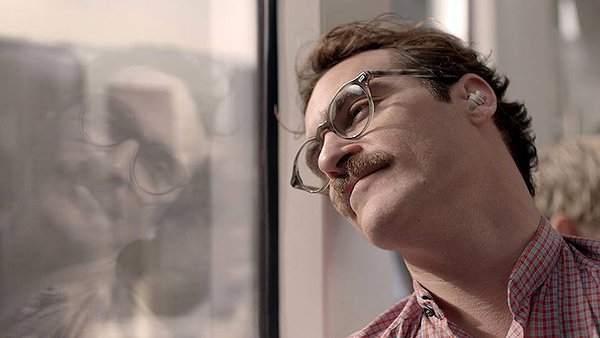 It’s been weeks since I first watched Her and I keep thinking back upon it, turning it over in my mind, finding more and more to like about this captivating little movie. It’s a tenderhearted and poignant movie that also manages to have something to say about human connection. And this really is a love story, and an engrossing one at that, despite the fact that it’s man and machine. The romance between Samantha and Theodore is never looked down upon, marginalized, the setup to some punch line about how nerd can’t get dates with real women. You think the film might go there, and then Theodore’s co-workers just shrug when the truth comes out and treat his relationship like any other. I suppose you could make all sorts of analogues, but they are unnecessary because Samantha truly feels like another person. She’s given complexity, curiosity, impulses, and, yes, as voiced by the husky-voiced Johansson, an alluring edge. Because she’s a disembodied voice minus form, theirs is a relationship built upon intellect, conversation, personality, and a burgeoning connection, though they do cover the sex part as well. In fact, the climactic (pardon the pun) vocal exploration is simultaneously awkward, funny, heartfelt, and yes, even a little sexy, and the music crescendos to give it even more oomph. Samantha is learning just as much about herself as Theodore is. Their relationship is opening both of them up to the possibilities they might never have sought. In that respect, Jonze’s film falls under that sweet spell all engaging romances achieve where our spirits are lifted and we swoon along with the onscreen coupling.
I’ve found it tricky to talk about Her at least in describing the premise to other people; comparing Samantha to Siri has helped rather than just referring to her as an “operating system.” One concern I had was that Jonze was just going to deliver the premise in a very expected manner and Her would serve up more of the same. But he doesn’t. While this is a light science fiction film, it is extremely well developed and thought out. Jonze has taken remarkable care to flesh out his story and enrich the not too distant future world. It felt like a world that could reasonably exist. I enjoyed the fact that there were so-called surrogates for hire, people that would serve as the physical embodiments of the OS personalities, providing a different kind of encounter, one meant to converge intimacy with touch. I could see these people existing if this were the future. Even better, Jonze takes great care to develop the central relationship between his lovers, so that every unique complication is given some form of respectful coverage. They discuss the limitations but not just what you would assume. Yes Samantha has no body, but she can also be in many places at once, doing many things at once, and simply will outlive all her carbon-based life form companions. Can they make this last? Even with the technological component, old problems can rear their head, particularly jealousy, like when Samantha begins communicating with other OS personalities. Then there’s Theodore’s lingering divorce with his wife, a woman who can stir up old feelings and doubts. Without giving too much away, the end manages to be hopeful, melancholy, expected, and satisfying.
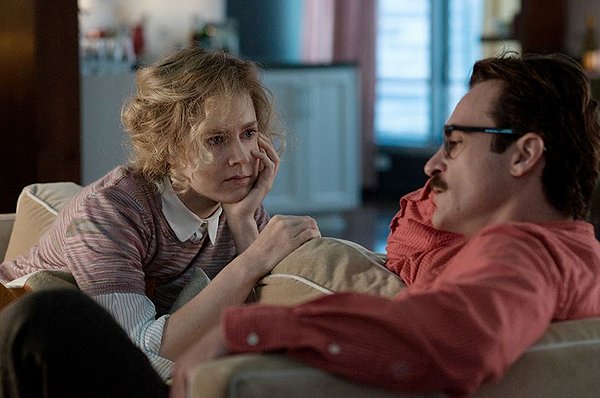 Jonze also manages to slide in some subtle jabs about the state of communication and connection. There’s an early shot where Theodore is riding a train and everyone on board appears to be talking except that they’re all talking to their OS, each person an isolated unit. Theodore’s job also seems like a perfect social commentary as well as a clever conceit for a man who has unsurpassed skill with words but difficulty with the flesh-and-blood interaction. It works directly with the theme of the film. I also find it humorous, and a bit subversive, that Theodore has long-standing relationships with clients. He’s been writing letters for certain couples for years going all the way back to their first meeting. Think about that, this couple’s communication and courtship rest upon the words of an intermediary paid for his services. These people could go their entire lives thinking their partner is the author of such wonderful, heartfelt, observant words. That’s the dearth of honest communication plaguing human relationships, but it’s not a new problem. We’ve all ducked hard conversations. Many of us would love to have someone come in and do the dirty work while we sit back and reap the rewards. But a relationship built upon deceit or convenience will ultimately fall apart, or, in this new age of technological isolation and greater deception, will it?
Jonze’s direction seems invisible, like we’re dropping in on these characters and peaking on their lives. The overall technical aesthetic of Her is a clean, simplified look and feel for a love story that manages to be new and familiar. The production design has an eye-catching degree of colors, which bathe the film in a consistently dreamy, gauzy aura, echoing the screenplay’s warm heart. The score by the Canadian alternative band Arcade Fire is low-key but just as vulnerable, resonant, and special as the characters in the film. It’s mostly pared down piano trinkles but the reoccurring motifs stick in your head, elevating Jonze’s film. When Samantha takes up composing songs to express her sum total feelings of a moment, capturing a snapshot of a particular time as she refers, it’s nice to have talented musicians able to bring this to life.
Phoneix (The Master) gives such a tender, vulnerable performance that you worry that he’s going to be crushed by life. He has this remarkable way of making you want to hug Theodore, like he’s this sad puppy that just needs a good home. There are moments in the film where just one perfectly executed crinkly-eyed crooked smile tells me everything about this character. Phoenix plays his character as a good-hearted, amiable, and deeply romantic individual, and the sheer strength of his performance will knock you back. Theodore has such great pools of empathy, and a poet’s soul, which allows him to excel at his job but it also makes relationships hard. A relationship takes work, and Theodore may have not been up to the labor, as his ex-wife argues. Personally, I found a lot of striking points of similarity with the character and I think others will as well. Who hasn’t, in a moment of dark-clouded funk, wondered if they’ve reached the apex of their emotional experiences, that everything will somehow be lesser variations? Who hasn’t feared that they somehow tapped out on their ability to love as powerfully as before? As Theodore is picking up the pieces of his life, trying to determine his new sense of self, we’re learning alongside him exactly how Samantha is changing him.
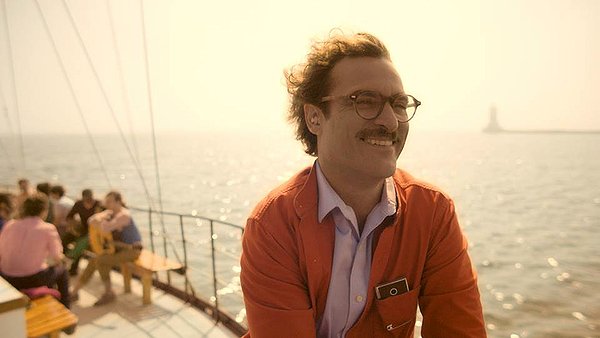 Before this movie, I would have said a Johansson (Don Jon) performance minus her body would be a travesty, but damn if she doesn’t give a performance that is worthy of the Oscar buzz. It’s easy to understand why Theodore falls for Samantha, and you will too. Johansson has never been this winsome and loveable but she’s far more than some idealized Super Girlfriend to be placed precariously on a pedestal. She’s learning too, making choices, some of them bad, and exploring the consequences. The depth of emotion she’s able to convey with a character only heard audibly is impressive. Samantha is a fully formed character that wants to be treated as such, and Johansson give her all the shadings of a living being. She’s inquisitive, funny, curious, but also eerily human in her mannerisms, like when she uses short breaths when feeling awkward even though she has no use for breath, obviously. Johansson is so easily sultry, voice included, but Samantha is not relegated to some high-tech toy, some quirky sexual fantasy. She feels real, which is why their relationship feels genuine and so moving and charming.
Who knew the most affecting love story of 2013 would involve a man and his computer? Her is an insightful, touching, and rewarding movie that hits you on many levels, satisfying all of them. It’s a smart film that explores the various complications of its premise while widening its scope further, it’s heartfelt and humble as it approaches relatable matters of love and loss and feeling adrift, it’s sweetly romantic while at the same time being tethered to reality, finding a perfect balance, and at its core it’s the tale of two people, one human and one mechanical, that find happiness in one another. People will likely pick the movie apart to search for personal messages from Jonze about his own divorce from filmmaker Sofia Coppola in 2003. Maybe that stuff is buried in there, but Jonze has crafted something far more applicable and enjoyable. Her is an openly romantic film that doesn’t shortchange heartache, and it posits that love is love no matter whom it’s directed at. Her is an extraordinary sort of movie and one I plan on revisiting again. Give this unconventional romance a chance and you may be delightfully surprised.
Nate’s Grade: A
Share this:

Man of Steel (2013)
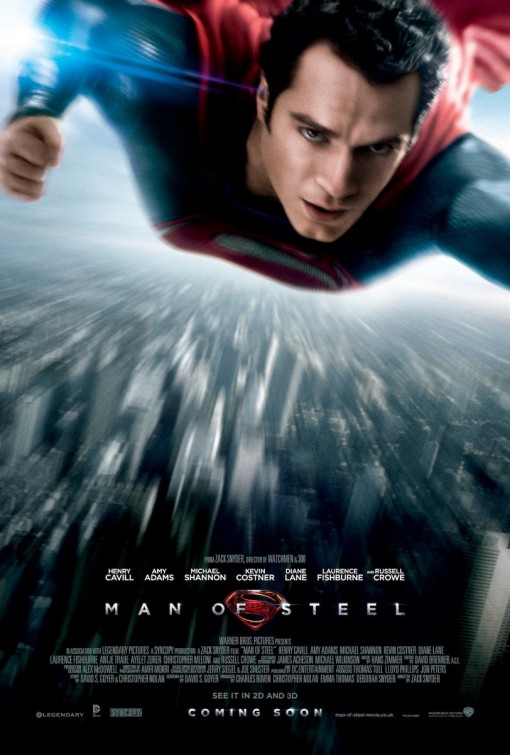 I think I began my review for 2006’s Superman Returns the same way but I don’t care. Does Superman have any relevant appeal in today’s society? I understand being a moral pinnacle has been his MO from the start, and I understand that today’s generation likes its heroes dark and broody and tortured. I know you can make Superman into an interesting figure (the man just celebrated his 75th anniversary, so there have to be some people who identify), though it is a bigger challenge, surely. I think taking a darker tack can be achievable but needs finesse. Christopher Nolan and David Goyer, having fashioned the highly successful Dark Knight trilogy, seem like a formidable pair to shepherd a darker Superman into the twenty-first century. Combine that with director Zack Snyder (300, Watchmen), and you’re guaranteed a pretty movie. Where does Man of Steel go wrong?
You know the drill at this point: Superman a.k.a. Clark Kent (Henry Cavill) was originally born on the doomed alien planet Krypton. His biological father, Jor-El (Russell Crowe), sent his son to Earth with the hope that he could survive and achieve great things. Raised by Jonathan and Martha Kent (Kevin Costner and Diane Lane), he then accepts his destiny to be mankind’s protector, butting heads and flirting with dogged reporter Lois Lane (Amy Adams). Except now Superman has the entire genetic code of Krypton’s history (?) transported into him via a “codex” (whish resembles a charred baby skull). General Zod (Michael Shannon), imprisoned off planet when Krypton was destroyed, is determined to retrieve that code and start his race anew. He and his crew travel to Earth and demand superman turn himself in, or else Earth will suffer.
 Where this movie gets into deep trouble is that it fashions Superman into an inactive loner, turning him into a super bore. He has such superhuman strength at his command but his doubtful dad has taught him that humanity would lose its mind if he revealed himself. And so Superman goes through half this movie hiding his super ability. He actively avoids conflict and confrontation. It’s basically the same formula as the Incredible Hulk TV show, where Bruce Banner would drift from town to town, warning others not to make him angry, then mournfully have to leave yet again. He can’t help himself save lives but, in flashback, dearly departed dad admonishes him for it (Clark: “Should I just have let them die?” Pa Kent: “Maybe.”). I think the isolation the character endures is essential to understanding his heavy burden, but at the same time this was compensated by Clark Kent, Superman’s opportunity to blend in with the natives, assume a frail phony identity, and to flash some much needed personality. In Man of Steel, he doesn’t become Clark Kent, news reporter, until the very last scene. It’s not a movie about a man becoming Superman but Clark Kent, experience-free reporter.
Two of the chief complaints about Bryan Singer’s 2006 Superman movie were that it was too reverent to its source material, namely the Richard Donner films, and it lacked sufficient action. Well, both of those issues are tackled in the very opening of Man of Steel. Goyer reworks plenty of Superman mythology from a science fiction angle, and so we get stuff about alien invaders, genetic bloodlines, clone baby labs, teraforming, and all sorts of spaceships. The characters keep referring to Superman as “the alien,” and dad worries that the knowledge of his super son will upset people’s worldviews about humanity and God (have no fear, there’s still messianic imagery to sledgehammer you with). I’m fine with Goyer playing fast and loose with Superman’s history but his alterations need to have solid reasoning. Nolan played around with Batman’s history and it worked because, in the context of the world and characters he developed, it fit. Does Jor-El riding a dragon like a live-action Heavy Metal fit? Does a billion people’s DNA transposed into Superman’s cells fit? Do Superman’s actions during the quite controversial ending fit? Does Clark’s stepdad, Jonathan Kent, willingly dying in a tornado fit? Does Lois Lane immediately knowing who Superman is, before he even adopts the Clark Kent disguise, fit? I doubt it, though it still could have worked. However, Goyer’s script is a mess structurally, preventing the story from gaining serious traction. First, we start with twenty-something minutes on Krypton, which could be condensed in half, then we slam into the present and this new formula appears: present, flashback, present, flashback, present. That happens for another twenty minutes. Then there’s 40 minutes of Superman dithering as the reluctant hero. Then the last hour plus is a nonstop barrage of meaningless action that squeezes out room for character growth.
I’ll credit Snyder and company for likely tripling the action quotient of any previous Superman movie (maybe even all of them combined), but I never thought such action would be so boring. Oh sure, it delights for a while with advanced special effects and Snyder’s eye for visuals, but the action sequences drag out far too long. A long action sequence? Isn’t that what you’re always demanding, critic Nate? Well anonymous and theoretical detractor, yes, I enjoy a well-developed and sustained action sequence. The problem with action sequences is that they have to matter. They have to accomplish something even if it’s just there are less enemies or the hero got from point A to point B. There has to be, at bare minimum, something that is accomplished. Sadly, this is not the case with the action in Man of Steel, which is why the sequences drag and feel like they are twice as long as their already bloated length. There’s a brawl between two evil Kryptonians and Superman and after a whole 10-15 minutes of sparring, the bad guys get on a ship and leave. Come on, Zod has like a crew of twelve henchmen. Can’t one of them at least die in a preliminary battle? Worse, the final confrontation between Zod and Superman could just as easily been eliminated. They punch and yell and punch and yell and stuff gets all smashy, but by the end of the fight, nothing has substantially changed, except the foundational surroundings (more on that below). Having two invincible beings punch each other for a half hour is not engrossing. For a lengthy action sequence to work there need to be complications, organic to the situation, and the stakes should escalate. James Cameron and Steven Spielberg are masters at crafting escalating action. J.J. Abrams is pretty good himself. Even Michael Bay has his merits. I don’t know whether to lay the crux of the blame on Snyder or the screenplay he had to give life.
 As the plodding action continued to pound me senseless, I was left to seriously ponder just how epic the scale of Superman’s collateral damage truly is. At one point, when Supes is fighting in the small-town center of Smallville, he tells the residents to, “Stay inside. It’s not safe.” What then proceeds to happen is a fight that rips up almost all the pavement in town, takes down a helicopter, a few fighter jets that crash in town, exploding, as well as a train car, plenty of ricocheting gunfire, and debris everywhere. But have no fear because those citizens stayed away from the windows and locked their doors! More than likely they are dead. The concluding clash in Metropolis is like 9/11 times eight. I counted three different skyscrapers that came tumbling down, and this is after the Krypton gravity field has ripped up the city and smashed it to dust, as well as missiles exploding around the city and Zod’s various spaceships. Then there’s the fight where Zod and Superman are blasting through just about every high-rise office building, and even when they collide outside it creates such force that buildings crater. They even fly into space, destroy a satellite, which then comes down as fiery debris that rains down on poor Metropolis. The final plan to foil the bad guys involves, get this, opening a black hole above a major city. It’s not like that sounds as if it will have catastrophic blowback.
The 9/11 imagery is unmistakable and I don’t care if it has been 12 years now. Couldn’t Superman at least react to the desolation he was causing? I really hope some enterprising soul via the Internet tallies the number of estimated deaths because I sincerely believe it would reach into the millions (Update: Ask and ye shall receive). Superman decimates the city and I thought less about the gee-whiz factor of the special effects and more about the innocent lives being lost amidst the CGI devastation. It looks like an atomic bomb went off. Perhaps a sequel will start with Lex Luthor rebuilding Metropolis.
And that’s the problem when you try and make sense of Man of Steel’s more realistic, grounded approach. This is a Superman that came of age in the 80/90s. While touches like young Clark experiencing sensory overload with his powers, like a scared autistic child, are clever and nice avenues toward relatability, you still have to square the more bombastic, over-the-top, and downright stupid moments that clash with that refined tone of greater realism. Nolan wanted Batman to exist in a recognizable world, so it makes sense that he and Goyer would attempt to do likewise with DC’s other champion. The prospect of an invincible alien among us is a potent source for some thoughtful and topical drama. It’s just not going to happen when Superman can demolish cities without blinking an eye or when anyone else fails to register the scale of this tremendous trauma. We don’t even have outside reactions or opinions to the earth-shattering revelation that we are not alone in the universe.
Then there are just the little things that annoyed me. Jonathan Kent dies in an effort to save the family dog. This comes off as lame, especially when Superman could save dad but has to hold back, per pa’s wishes, so as not to expose himself. Except, by the end, when the United States accepts Superman, doesn’t this invalidate all of Pa Kent’s worldview? If so, then the man died for nothing. Also, General Zod wants to transform Earth into Krypton. Except… on Earth all Kryptonians have godlike powers. Wouldn’t the man just want to keep that? Also, why does Zod never dispatch more than two Krypton lackeys to fight Superman? He has all these godlike warriors and decides to just keep them locked away in his spaceship. That just doesn’t make sense from a tactical standpoint. Also, Pa Kent tells his son to do his best to blend in, but in one scene bullies harass Clark as he’s reading from Plato. Yes, because your typical teenager can’t rip himself or herself away from the likes of Plato. Careful: Plato is a gateway read to Epicurus. Then there’s the overbearing product placement. Usually I give movies a pass if they’re not obnoxious with product placement; however, Man of Steel stages entire action sequences so we can get long-lasting looks at the logos for Sears, 7-11, and IHOP: “This callous destruction brought to you by the good (surviving) people at Sears.”
 Cavill (Immortals, TV’s The Tudors) sure has the look for the part. He’s appropriately bulky but because the role is too often inactive loner, always holding back, that makes his performance somewhat bland and more reticent than necessary. Part of this is also that Snyder has historically been a poor actor’s director. You can tell throughout the film as talented, Oscar-nominated and winning thespians like Crowe and Shannon will just give off deliveries, little tinny trills that clunk, moments that a director should have stepped in for. Shannon (Take Shelter, Premium Rush) is one of our best working wacko actors, but even he comes across as a bit too unrestrained and stiff, especially when he has to scream “I will find HIM” half a dozen times in a row. I thought Zod’s second-in-command played by German actress Antje Traue (Pandorum) had more personality and better moments. Adams (The Master, Trouble with the Curve) is a good choice for a plucky Lois Lane, especially one sharp enough to see through Clark’s disguise. The movie is packed with good character actors like Laurence Fishburne, Harry Lennix, Christopher Meloni, Michael Kelly, Richard Schiff, Mackenzie Gray, and two actors from Battlestar Galactica. That’s nice. The best actor in the movie is Dylan Sprayberry as teen Clark.
Snyder’s reworked Superman for our modern age just doesn’t cut it as popular entertainment. Its misshapen structure, heavy with exposition, doesn’t provide enough space for the characters to develop, and the general edict to make Superman an inactive loner on the fringes of society is a surefire way to keep an audience at bay. The CGI-heavy action sequences feel like they go on for an eternity, straining and struggling to keep your attention because the stakes fail to escalate or have consequences outside ridiculous amounts of collateral damage to rival the worst of Mother Nature. The over-amped sci-fi reworking tries to make a clean break from the demands of Superman’s mythology, and while some revamps work, most feel needless and ham-fisted, like Pa Kent’s somewhat pointless death. But the worst charge is that the movie is just too boring. I know people have levied this charge against Superman movies in the past, particularly the 2006 Singer film that I will still stand by my positive review for. Man of Steel is a good looking movie for certain, often a great looking movie, but all those pretty pictures are for naught because of a flawed approach and overindulgence with tedious action sequences. Given its box-office riches, I expect this Superman retread will garner the sequel that Singer’s film did not. I just hope the next chapter in the new adventures of Superman experiences a Dark Knight-level rise in quality.
Nate’s Grade: C+
Share this:

The Master (2012)
 Writer/director Paul Thomas Anderson met with great resistance when he was shopping his script around for The Master. It was dubbed the “Scientology movie” and reportedly based upon the controversial religion and its leader, L. Ron Hubbard. It looked like Hollywood was spooked by the prospect of a movie that appeared to take on Scientology. Eventually Anderson got his financing and made the movie he wanted to make. Calling it the “Scientology movie” is misleading. I wish The Master was a Scientology expose because that would be far more interesting than the exasperating film I got, which is one nutty guy who dabbled in a Scientology-like cult. Maybe the resistance Anderson experienced wasn’t an indication of the subject matter. Perhaps it was only an indication that The Master just wasn’t a compelling story, a charge I can agree with wholeheartedly after viewing this disappointing film.
Freddie Quells (Joaquin Phoenix) is struggling to adjust to life after World War II. Fresh out of the Navy, he works as a department store photographer, until his rage and social awkwardness lead to him being fired. He’s drifting about and hops onto a ferry leaving town. Onboard is Lancaster Dodd (Phillip Seymour Hoffman) who describes himself as “a writer, a doctor, a nuclear physicist, a theoretical philosopher, but above all, a man.” Dodd has gathered a revered following. He believes that people can regress to past lives trillions, yes you read that right, of years into the past. Dodd’s own children admit that dear old dad is “making it up as he goes along.” His movement, known as The Cause, has been called a cult by detractors, the will of one man, and the followers don’t take kindly to challenges from the outside. Dodd adopts Freddie as a project. He’s on the verge of completing his second major treatise and Freddie seems to be an inspiration for him. Freddie finds some measure of acceptance within Dodd’s community of followers, but his erratic behavior keeps people on constant edge.
I found The Master to be boring; uncompromisingly boring, hopelessly boring, but worse than all that, pointlessly boring. Was this really a story that needed to be told? I cannot fathom why Anderson chose to tell this story or, in particular, why he chose to tell it through the character of Freddie Quell. A story about a huckster exploiting people with a religion he made up is a fascinating story with or without the Scientology/L. Ron Hubbard connections. That’s a story worthy of being made. Now, instead of this, we have two hours of a guy acting nuts. I would better be able to stomach the Freddie character if I felt like anything of significance was happening to him. He’s a broken man, clearly mentally ill in some capacity, and prone to outbursts that turn violent. Does he change? Does he grow? Does he do anything? Does his life have anything of significance happen to him over the course of 137 minutes? Not really. He’s pretty much the same guy from start to finish; his arc is essentially that he’s crazy at the start, meets Dodd, and then is crazy at the end. We get it, the guy is messed up. He makes a drink out of paint thinner for crying out loud. I didn’t care about him at all. I don’t need to see static scene after static scene of this guy acting out. I wasn’t a There Will Be Blood fan but at least Daniel Plainview was a strong central character with enough dimensions to carry a film. Freddie Quell just isn’t that interesting or entertaining. He’s actually a tiresome character because you get a perfect sense of who he is in just 10 minutes. The rest of the movie just seems to remind you what you already know.
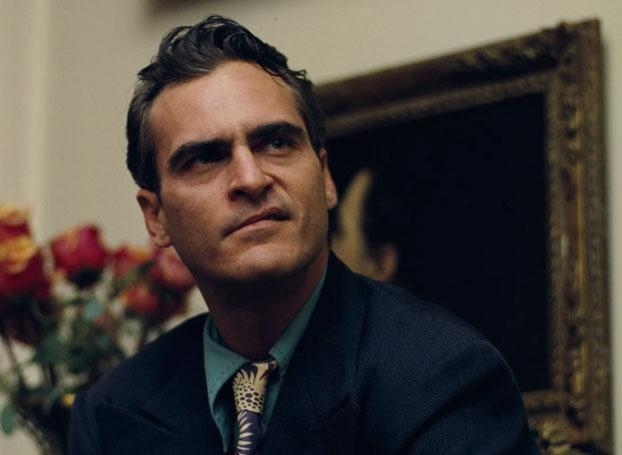 It is a disappointing realization but I feel like the Paul Thomas Anderson I enjoyed is slipping away, as his flashy, propulsive, plot-heavy early work has given way to opaque, reserved, and plotless movies. It’s like I just watched someone with the verve of Martin Scorsese transform into a poetic film somnambulist like Terrence Malick; not a good move. I don’t know what Anderson’s message is or what he was trying to say, and I’m unsure why he decided to use a limited character like Freddy Quells as his prism. It almost feels like Anderson is compensating for his plot-driven films of his early career, like he has to balance the scales in his mind. I shudder where this recompense might take Anderson for his next film. I like to think of myself as an intelligent moviegoer who enjoys being challenged by movies. But that doesn’t mean I’ll accept anything challenging as quality. Case in point: Jean-Luc Godard’s Film Socialism, which was contemptuous of its audience. I don’t mind doing work but you have to give me a reason. There has to be a reward, either with the narrative or with the characters. I found no rewards with The Master and it’s not because I didn’t “get it,” film snobs, it’s because the movie was too opaque to say anything of substance beyond simplistic observations about the abuse of power and influence.
When I say plotless I don’t mean that we’re simply watching paint dry, though there are stretches of The Master where I would feel that could be a suitable test from Dodd. There are events. There are scenes. There are changing relationships. It’s just that none of this seems to matter, or at least it never feels like it does. There’s no build, no increase in urgency, and The Master just sort of drifts along to the detached rhythms of Freddie. The movie can feel interminable, and you may ask yourself, on a loop, “Is this going anywhere?” There are two scenes that stand out because there are so few that seem to matter. One is shortly after Dodd and Freddie have been arrested. The two men are locked in opposing cells and they explode in venomous anger. It feels like Anderson can finally allow his characters to vent out what they’ve truly been feeling. Another memorable scene, just for weirdness, is when we jump inside Freddie’s head. All the women, young and old, at a social gathering suddenly lose their clothing (think: Choke). It’s one of the best scenes at exploring Freddie’s sexual compulsions, plus it’s just peculiar. I wanted more scenes like this where we try and get inside the man’s mind. The rest of the characters are underwritten, especially Amy Adams (Trouble with the Curve) as Dodd’s wife and fierce protector. This is a movie about two strong-willed men and everybody else gets relegated to minimal supporting positions. I miss the sprawling humanism of Boogie Nights and Magnolia.
From a technical standpoint, the movie is very accomplished. The 1950s era setting is lushly recreated, aided by cinematography that seems to present this bygone age in a colorless manner. By this I mean that the world feels muted, repressed, the colors are there but they don’t pop, and I think this look fits the movie marvelously. Anderson shot the film in 70mm, which would offer startling detail to his images. I did not see the film projected this way (as will most) but you could sense the time and effort put into getting the details of his world right. The musical score by Johnny Greenwood is minimalist but effective, with a few key strokes of a guitar to note rising tension.
 The true draw of the film is the performances, which are excellent and at least provide a reason for staying awake. This is Phoenix’s first role since his two-year performance stunt documented in I’m Still Here. It feels like his off-putting, confrontational, bizarre antics for that faux documentary were all just training for playing the character of Freddie. The man has sad, droopy eyes, a fixed sneer that denotes his permanent displeasure and cocksure attitude. He speaks in mumbled sentences, he walks with his arms pinned out, donning the posture and behavior of a chicken. It’s at once an odd and striking performance, and Phoenix does his best to make the character worthy of your attention. He gives it his all, but sadly Freddie just doesn’t merit prominence. Hoffman (Moneyball) is equally alluring as the charming huckster who seems to come alive under a spotlight; the man exudes an oily presence, and yet there are a handful of moments where he lashes out, venting the roiling anger that seems to be barely contained at times. Hoffman’s performance is one of willful self-delusion rather than rampant self-destruction, which makes him far more compelling in my opinion. I would have preferred a Lancaster Dodd movie rather than a Freddie Quells movie.
The Master is a confounding, airless, opaque character study that is far from masterful. The faults of the film and its stilted ambitions lay squarely at the feet of its flawed central character, Freddie Quell. The movie adopts Freddie’s demeanor, managing a distant, standoffish, defiant attitude that thumbs its nose at audience demands. Don’t you know entertainment has no place in art, silly filmgoers?
Anderson is still a vastly talented filmmaker but I lament the path his career has taken. I adored the first four movies of Anderson’s career, but now I wonder if I’ll ever get something along the likes of Boogie Nights or even Punch-Drunk Love again. At this point Anderson has earned enough artistic latitude to tell whatever stories he so chooses. This is why my frustration has mounted because I am at a loss to why he feels compelled to tell this story and in this manner. The Master is an artistically stillborn affair. You want to believe there’s more under the surface but I don’t see it. The main ideas and themes are hammered with little variation, the slight plot drifts aimlessly finding no sense of momentum, and the characters are kept at such distance that the film feels clinical, like we’re observing creatures under glass for study. It just so happens that none of these characters warrant the attention. The Master will be praised by a plethora of film critics. Peter Travers of Rolling Stone said it renews your faith in American cinema. I had the opposite reaction. The Master made me lose faith, mainly that I’ll ever enjoy a Paul Thomas Anderson film from this point on.
Nate’s Grade: C
Share this:

The Muppets (2011)
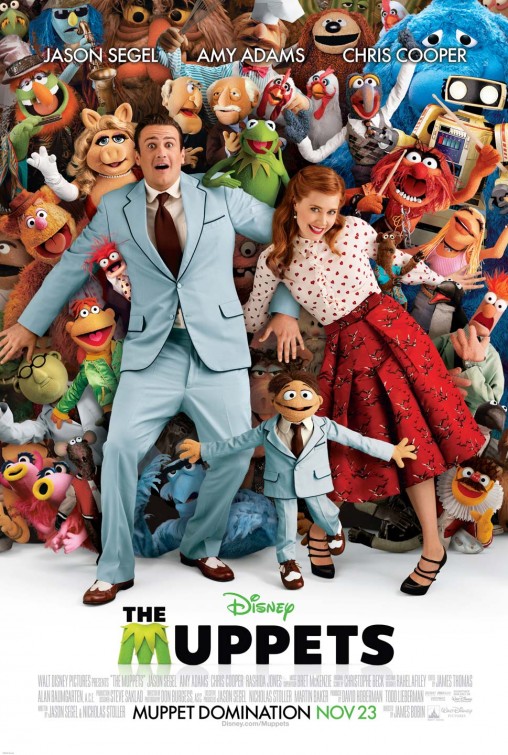 You’d hardly expect the duo behind the raunchy, R-rated comedy Forgetting Sarah Marshall to be the saviors of the Muppets, the famous puppet crew that has been languishing since their last big screen outing, 1999’s underwhelming Muppets in Space. Actor Jason Segel took a meeting with Disney after the Jim Henson Company did some puppet work for Sarah Marshall. He just point-blank asked them what their plans were after acquiring the Muppets. They had nothing. Segel and Nicholas Stoller (Get Him to the Greek) put together a script and, lo and behold, the two self-described Muppet enthusiasts were given the opportunity to bring new life to the classic creatures. The Muppets is just about everything a Muppet lover could ask for and will be sure to entertain a new, younger generation of fans with the Muppets core brand of silliness and sweetness.
Set in the town of Anywhere, Gary (Segel) and his girlfriend Mary (Amy Adams) are planning a trip to Los Angeles. She’s hoping that he’ll finally propose to her in the scenic city of angels. There’s one catch: Gary’s brother Walter is coming along too. Oh, and Walter is a Muppet. Walter is obsessed with the Muppets ever since he watched their TV show in the 1980s. The show was an escape for a kid who felt… different. Walter is anxious to visit the Muppet studios, but the studio is in disarray and the Muppets have all gone their separate ways. Tex Richman (Chris Cooper), what else but an evil oil barren, plans to buy the Muppet studio and tear it down. Walter, Gary, and Mary must seek out the Muppets to rescue the old studio, and the only way to raise enough money in time is to put on one more rendition of The Muppet Show.
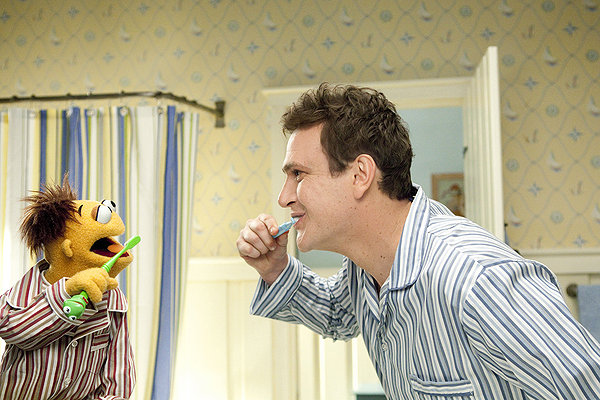 The Muppets is a refreshingly retro and charming vehicle that reminds you of all those warm and fuzzy feelings you had for this crew. It’s unironic, innocent, sweet and wholesome in a way that doesn’t make you gag but self-aware and silly enough to continuously be clever. When a big song-and-dance number breaks out in the town of Anywhere, once the stars have left the townspeople collapse in exhaustion. The gang decides it’ll be quicker to “travel by map,” so we cut to a map and see a red line charting onward. Muppets will regularly break down the fourth wall, with Fozzie commenting on a sudden explosion, “Wow, I didn’t think we had that in the budget.” Tex Richman actually verbally articulates “maniacal laugh.” The group gathering is sped up when the character 80s Robot suggests streamlining the rest in a montage. It’s not the kind of jokes that will make your sides ache with laughter but it pins a smile to your face from beginning to end, although Chris Cooper’s out-of-nowhere rap number left me in stitches. The very question of whether the Muppets can fit into our snarky, over-caffeinated, self-indulgent culture is addressed. Segel and Stoller have found a way to reenergize the Muppets for a new generation while staying true to what makes them special. My friend Eric Muller said watching The Muppets was like “getting an oil change for your soul.” He couldn’t be more right.
Watching the movie, I’m awash in feelings of nostalgia for Jim Henson’s finest creations. Segel is an unabashed Muppets fan and the movie is a celebration of the TV show that inspired him; the TV show is lionized for its inspiration to children. Because of that heavy helping of nostalgia, Muppet fans will feel like their spirits have been lifted. Those who had a mild curiosity about the Muppets will probably just scratch their head and call the film pleasant. The movie’s goal is rather huge: to make the Muppets relevant again. However, the vehicle for this goal, the old puttin’ on a show routine (Mickey Rooney has a cameo!), can feel slight. Also, the Disney product placement can be a bit annoying at times. Really, thanks for reminding us once again about how poor Cars 2 was thanks to a billboard advertisement. The movie isn’t in the same league as Henson’s troika of Muppet movies from the 1970/80s, but Segel and Stoller’s efforts should be a delight for Muppet fans waiting for the triumphant return of their favorite characters. You may find yourself unconsciously singing along to “Rainbow Connection” at the close of the film.
One aspect that is never spoken openly about is the fact that Gary and Walter are brothers, a human and a Muppet. I was expecting some throwaway reference to Walter being adopted, or maybe there could even be a funny sit-down where Walter is given the devastating familial news. We see a montage of the two brothers growing up, and while Gary shoots up like a weed Walter remains at the same height through the years. Does this mean that Muppets attain maturity at a faster rate? That Muppets are fully formed at birth? The mysteries of the universe are left undisturbed.
The music is cheerful and eminently hummable. Recent Muppet outings in the 1990s tried to keep the musical comedy formula going, but the result was some rather tin-eared musical numbers. I challenge anyone to be able to recite more than a few bars from Muppet Treasure Island (my favorite of the three), Muppet Christmas Carol, or Muppets from Space. To everyone’s good fortune, this newest Muppet incarnation has Bret McKenzie, one half of the daffy Flight of the Conchords, supervising the songs. You can instantly tell the musicianship has been raised considerably. The opening number “Sing a Happy Song” is a catchy and bouncy track, putting the audience in the right kind of upbeat mood. “Man or Muppet” is a ballad where Gary and Walter must confront their identity crises. It’s played completely straight, which makes the song even funnier as it builds into a crescendo of self-actualization: “If I’m a man that makes me a Muppet of a man.” There’s also a G-rated performance of Cee-Lo Green’s famous f-bomb kiss-off song, this time performed entirely by chickens. And the aforementioned rap by Chris Cooper is just astoundingly random, and not that bad either. The funny and cheerful music greatly adds to the overall enjoyment of the film.
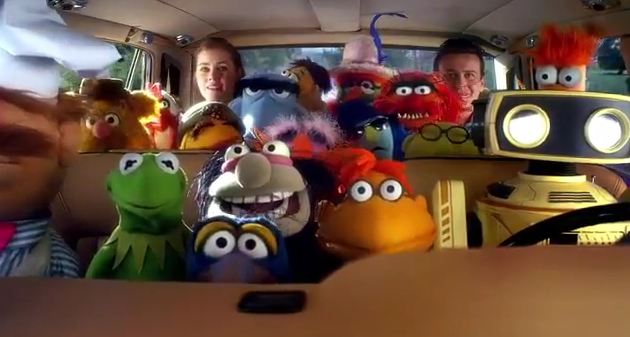 Segel (I Love You, Man) is pretty much a big goofy human version of a Muppet. He’s a winning presence, much like Adams, who slides right back into her adorable Enchanted-flavored M.O. The two actors are a near perfect union of humans who capture the ineffable “Muppetness.” The multitude of celebrity cameos makes for some fun sightseeing (Jack Black has the most extended stay, not by choice). “Hobo Joe” might be my favorite of the cameos. But while the new characters are the initial focus, the emphasis on the film is rightly placed upon the classic Muppets. Kermit and Miss Piggy and the gang are back and the film’s entire plot is essentially their reunion. That means we get wonderful sequences rediscovering the Muppet team, like getting the gang together for a heist. These characters need one another; the bonds are undeniable. It’s actually touching when the Muppets speak candidly about how much they need one another. Fozzie has fallen on hard times especially. Kermit’s mournful song about losing touch with his old pals includes the line, “Was there more I could have said?/ Now they’re just pictures in my head.” While the film’s goal is to really just gather the Muppets back together, you’ll be glad that this goal is accomplished. You will be amazed how much you feel for felt.
The Muppets is a triumphant return to form and rekindles the fondness fans have felt for Jim Henson’s lovable creations. Thanks to Segel and Stoller, and the whimsical direction of Flight of the Conchords director James Bobin, the Muppets is a delightful, charming, and heartfelt family film that will give you a serious case of the warm fuzzies. The songs are catchy, the jokes are amusing, the pacing is swift, and the movie is fun from the start. As a Muppet fan, it left me with a smile pinned to my face the whole time. Like the big screen Simpsons movie, the universe of the Muppets is too big for 90 minutes, so naturally some favorites will be shortchanged when it comes to screen time. Since Disney paid half a billion dollars for the Muppets, I’d expect they plan on making use of the property. After this splendid relaunch, one can only hope that we won’t have to wait too long for the next Muppet movie.
Nate’s Grade: A-
Share this:

The Fighter (2010)
 Somewhere along the line, the boxing film became the perfect metaphor for the underdog story. Two men at battle with only their fists and iron wills. Somehow this match up has come to symbolize man’s eternal struggle against himself and society. From Body and Soul to Rocky and Raging Bull, it’s hard to imagine the filmic landscape without the tropes of boxing. It’s also a pretty staid and tired genre, where filmmakers often rely on those tropes to fill in the gaps for lazy storytelling. The Fighter is a true story that star Mark Wahlberg has been nursing for years trying to get it off the ground. It’s the knockout acting and attention to character that separates The Fighter from the competition. Rarely has such a sedate formula felt so freshly presented.
In the mid 1990s, Mickey Ward (Wahlberg) is a man trying to come to grips with his life. His welterweight boxing career has stalled thanks primarily to his trainer, his unreliable half-brother Dicky Eklund (Christian Bale). Big brother used to be the pride of Lowell, Massachusetts, once fighting Sugar Ray Leonard and boasting about knocking the giant down (this claim is in dispute as replays show that Leonard may have simply tripped). Dicky’s boxing career went away about the same time that Dicky became addicted to crack cocaine, spending long hours inside Lowell’s many crack houses. An HBO documentary crew is following around Dicky, which he mistakenly believes is a ticket to his comeback. Mickey’s mother, Alice (Melissa Leo), also serves as manager to both her boys. Dicky is clearly the apple of her eye and Alice enables his destructive behavior. Mickey is pushed into fights to feed his extended family (eight siblings), and the thrill is gone. Then one day he’s approached by a promoter who will give Mickey one more chance. The only catch is that Mickey has to cut his family loose.
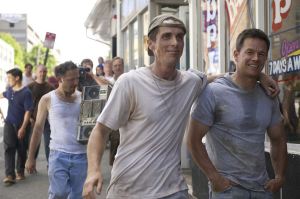 Truth be told, The Fighter isn’t really much of a boxing movie. Sure that’s the selling point and it allows for a rousing, crowd-pleasing finish, but Mickey could just as easily be striving to open a deli or striving to go back to school. The real story is the family. The boxing is only a backdrop, and if it weren’t for the true-story basis I would say it serves as little more than a metaphor for the punishment Mickey has taken in life. The Fighter is about a man working up the courage not to step into the boxing ring but to break away from his self-destructive family weighing him down in misery. This is a dysfunctional family drama disguised as a Rocky-style boxing redemption picture. The boxing aspects are small, mostly contained to the final act as Mickey’s career finally begins to gain some traction. For some, this will be disappointing news. But for me, I loved the family drama stuff. This is a fractured family with deep lines of division, nursing grudges, resentment waiting to boil over, all the marks of meaty drama. The focus is on Mickey trying to break away from the pull of his harmful older half-brother and his boorish mother. His mother enables Dicky, her favorite child, to the detriment of the rest of her brood. Her relationship with Dicky is fascinating and complicated, like a mother sacrificing the rest of her clan to help her most damaged child. You can catch some of the invisible ripples from these decisions, like the seven sisters all forming one unified hive-mind to survive. They’re like a block of cheerleaders for mother, only able to get attention and some form of affection by doing so. The extensive family unit revolves around Leo’s matriarch, fiercely protective and fiercely myopic. She refuses to remove herself from Mickey’s management team, and thus Mickey and his career suffer. It’s downright Oedipal. If only he can escape the clutches of his family, perhaps Mickey can taste success that has eluded him so long. The family drama makes up a good majority of The Fighter, and that’s just fine with me when I get characters this damaged and complicated.
And all of this is blissfully entertaining. Director David O. Russell is miles away from his other films like Three Kings and I Heart Huckabees. This is different kind of redemption story where the main guy winning a title is nice, and we can all celebrate, but it’s really his separation from a harsh family dragging him down. The film also produces an engaging romance for Mickey, which gives him a renewed sense of purpose to finally break free of his family. Amy Adams (Enchanted, Doubt) is a bartender at a local hangout with some college under her belt, a point that irritates Mickey’s family. The Eklund sisters lash out at Mickey’s squeeze in childish ways. Adams, playing Charlene, shies away from the daffy or genteel roles of her past. She gets to spit profanities with glee. Her relationship with Mickey serves as a foil to his family, showing what strength a positive, healthy relationship can achieve. But while the family is presented in an antagonistic sense, they are not blithely demonized. Russell and his team of writers and actors use humor to find surprising pockets of warmth amidst all the darkness and shattered dreams. This isn’t an addiction story that plumbs the depths of human weakness. The production feels bathed in authenticity and the city of Lowell, Massachusetts and its lived-in, blue-collar culture feels like another vital character. When the HBO documentary finally airs, you feel the cloud of hurt that covers the entire town in shame. Nobody wants to be known as a town famous for crack addiction (you can watch the 1995 doc online for free).
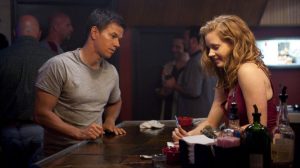 The acting is also some of the best you’ll see all year. Wahlberg is a sturdy center, used to the abuse and underplaying his character’s transformation from punching bag to assertive human being. This is Wahlberg’s home turf, and he’s been shopping the story for years in Hollywood, so it’s no surprise that everything comes so natural for the Beantown kid. But his understated work is going to get obscured with the flamboyant performances from both Bale and Leo. Bale (The Dark Knight, Rescue Dawn) has long been considered one of the finest actors of his generation, his Method devotion and versatility a godsend. In The Fighter, he’s a live wire, a bundle of energy in a haunting skeletal frame. He’s a figure of lost promise, of tragedy and bruised ego, trying to live vicariously through his younger brother. He’s deluded himself into thinking that this HBO documentary will launch a comeback at 40. Bale excels with the bombastic bits, practically bouncing off the walls, but then he nails the quieter, smaller moments of his character, where Dicky realizes that he’s wasted his gifts. Leo (Frozen River) could easily fall into an outsized monster of large hair and nicotine-stained fingers, but the Oscar-nominated actress finds exciting ways to tap into her character’s humanity. She fully knows that her beloved child is a crack addict, but watching her rationalize and justify her actions is exciting.
The Fighter is a meaty family drama, stirring tale of redemption, and a showcase of superior acting. In an awards season where it feels like many films are missing some secret ingredient, The Fighter has it all together. It’s an underdog story of a different flavor that manages to be authentic, entertaining, charitable, and engrossing even while staying within the boundaries of a predictable framework. We all know that Mickey will triumph in the ring; otherwise his tale would never have caught the notice of Hollywood producers. This is a fresh take on old material. The focus is on the fractured family dynamic and the many characters, not on a simplistic rising through the rankings of sport. It’s because of the tremendous acting and character work that the first half of the film easily outshines the second. Once the family is sidelined, and Mickey’s boxing career takes off, The Fighter turns into a more conventional genre picture, though still engaging. The movie ends on a satisfying note of uplift that feels fully earned without a twinge of naiveté. This Oscar season, expect audiences and voters alike to find something to cheer about in this return to the ring.
Nate’s Grade: A-
Share this:

Leap Year (2010)
 It’s not funny. It has more clichés than imaginable. The very premise that a woman has to travel all the way to Ireland to be “allowed” to propose to her long-time boyfriend is bizarre and borderline offensive. And yet, the unmistakably lowball chick flick is watchable thanks to the charms of leads Amy Adams and Matthew Goode. The two actors pretend like they’re in a different, better movie, and the illusion lasts just long enough for the film to come to its typical happy ending before you sit back and say, “Hey, that was pure junk.” Ireland is treated yet again as this quaint place of hospitality and magic, like it’s some postcard wonderland. Granted, the scenery is beautiful, and director Anand Tucker (Hilary and Jackie, Shopgirl) is quite taken with his shooting locations, highlighting the natural beauty of the Emerald Isles. With all the attention on the scenery, and not so much the plot, you realize that everyone signed up for this movie as a means of having a paid vacation. And I can’t blame them or hate their movie, but that doesn’t mean I have to like it either.
Nate’s Grade: C
Share this:

Julie & Julia (2009)
 Meryl Streep is as she always is, which means to say she’s terrific as famous jubilant chef Julia Child. She’s got the sing-songy voice down cold, and Julia comes across like a spigot of joy, yelping with delight like a child. It’s hard to not find it adorable, and her husband (Stanley Tucci) is a kind, caring man who complements her well. The scenes between the Childs can be heartwarming and delightfully comic. However, for some weird reason, the Julia Child section is only half of this movie. Writer/director Nora Ephron decided to frame the movie with the biography of Julie Powell (Amy Adams) writing a blog in 2002. Huh? Powell wants to prepare all 500 recipes from Child’s best-selling book on French cuisine in one year. As you might expect, this whole section turns into a lot of narration over food preparation and Powell becoming increasingly narcissistic about her blog fame. The only real purpose this modern storyline serves is to add perspective to the Julia Child storyline, giving historical context to what we see Streep and Tucci struggle over. The real resonance is with Streep as the larger-than-life cooking personality and her upward climb to be taken seriously as a chef and as an author. I don’t care about Julie Powell. She keeps interrupting a better storyline. Apparently the real Julia Child didn’t care for Powell either, because late in the movie Powell discovers that the real Child (who died in 2004) thinks the whole blog thing is a gimmick. And isn’t it? Then again, isn’t having Streep as Julia Child a gimmick of casting? Julie and Julia would have been better served if it had completely carved off the Julie section.
Nate’s Grade: B


 nathanzoebl
You must be logged in to post a comment.