Blog Archives
2012 (2009)
 Let’s get this out of the way. The world isn’t going to end in 2012. Well, it might, but it won’t be because the Mayans said so. Because truth be told, the Mayans didn’t say anything about the world ending. The Mayan calendar exists in large circular amounts of time, and the largest period of time is called a bactun. An epoch, 13 bactun, will be coming to an end somewhere around December 21, 2012, but this in no way is a signal for the end of days. It just means that one cycle of time has come full circle and we begin anew. This is entirely a Western invention. If you learn nothing else from this review, know that the world will be fine come 2012. At least in this regard. Who knows about nuclear holocaust, biological warfare, religious fanatics bringing about the end of days, Sarah Palin running for president. The world could still end, but don’t blame the Mayans. They’re already dead anyway. They didn’t see that one coming, either.
2012 is the latest disaster movie from director Roland Emmerich, who fondly destroyed the world in Independence Day and The Day After Tomorrow. In news interviews, Emmerich has insisted that 2012 will be his last disaster movie (yeah right!), so he wanted to pull out all the stops. And he does. 2012 is like the disaster movie to end all disaster movies. It’s great escapist fun but it’s also silly and cheesy and hokey and all things a great memorable disaster movie should be. The movie packs so much that you may likely experience fatigue by the end.
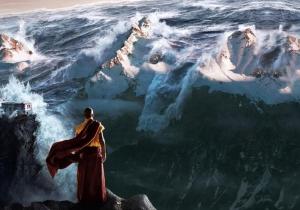 Like previous Emmerich movies, we follow a dispirit group of people from all walks of life who coincidentally come together. Jackson (John Cusack) and his wife Kate (Amanda Peet) are separating. Kate is currently seeing a new guy, Gordon (Thomas McCarthy, the writer/director of The Station Agent), and Jackson’s son thinks highly of new dad (maybe he saw the excellent Station Agent). Jackson is trying to become a better dad and take the kids camping to Yellowstone National Park. It’s there that he runs aground with government officials and a conspiracy radio host (Woody Harrelson) warning about impending doom. He puts enough pieces together to hatch a plan to save his family and escape. The government was alerted by a geologist (Chiwetel Ejiofor) in 2009 and has been preparing for massive seismic shifts. The president’s chief of staff (Oliver Platt) has been planning the “continuity of our species.” The elites have secured a place on massive arks built in the Himalayan mountain range. Jackson and his family must find a way to reach the arks in China for any hope of surviving the next chapter in human existence.
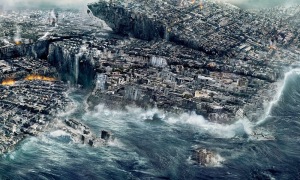
Emmerich packs so much earthly chaos into this movie that it can get flabbergasting. It’s not enough that California is upending by earthquakes and gaping chasms, it has to be thrown into the sea city block by city block. It’s not enough that Yellowstone National Park emits a thunderous volcanic discharge; it has to explode with the might of three mushroom clouds. It’s not enough that a 150-foot tidal wave strikes Washington D.C., it has to drag along a U.S. aircraft carrier that topples the memorable architectural sights of the city. It seems like Emmerich is trying to one-up everything that has come before in disaster cinema, but beyond the cheesy Irwin Allen movies of the 1970s, his only real competition is himself. No one wreaks havoc upon the world like Emmerich. He has the same destructive tastes of a mad scientist of Godzilla. He’s a big kid that likes to see things fall down and go boom. And in that regard, Emmerich has no equals. Not even Michael Bay, who certainly has panache to his record of ruination, can compete with this German master of disaster. No one can do enjoyable cheesy entertainment on such a mass scale like this man.
 The special effects in 2012 are first-rate and the true draw to see this thing on the big screen. Large-scale global devastation has never looked so pretty. This is a full-blown summer movie in the midst of the fall prestige season. The destruction is often awe-inspiring thanks to Emmerich and his team of visual wizards, and the buildup of suspense can be palatable as well. The pacing is better than you would expect for a movie that runs over 150 minutes, but that didn’t stop the contingent of teenagers in my theater from standing up and leaving whenever there wasn’t violent death. At least Mother Nature wasn’t taking out specific monuments with pinpoint precision like She normally likes to do in these things. And just like in disaster movies, the “chosen few” are gifted with the amazing ability to outrun fireballs, earthquakes, falling debris, falling buildings, and just about everything falling at high velocity. Sure the immediate heat from an explosion at Yellowstone would instantly fry the characters, and sure an airplane can?t fly through a pyroclastic cloud, but it’s all part of the territory for the genre. If it was really true to life than we’d all be dead and the movie would be considerably shorter.
So what is the protocol for enjoying mass entertainment that coincides with massive death? Emmerich is usually very good about his disaster sequences to keep his focal point at long distance angles, both so that the audience can get a full vision of the mayhem and also to make sure that we cannot concentrate on the little people fruitlessly scurrying away for their lives. If you stop and think, practically every second of on screen destruction in 2012 involves thousands of nameless, faceless people dying horribly, and these are the big moments when the audience chows down on greasy fistfuls of popcorn. It reminded me somewhat when the news kept repeating the planes crashing into the World Trade Center towers as pieces for their 9/11 segments, and I’d stop and think, “You know, you just paused an image and in that image is the reality that hundreds of people are dying.” It’s a strange thing to contemplate, which is probably why Emmerich overloads your senses with (safe distance) disaster carnage. There is an image that does cross a line, where we witness office building workers tumbling out of the crumbling high rise. That’s one 9/11 image that’s just too distasteful even for a disaster flick.
 Naturally the reason to see these kinds of movies is the big bangs for your bucks, but what happens during the downtime? I was genuinely surprised how involved I became with the collection of characters. I’m not saying that this is deep, penetrating writing, but it’s easy to wring some pathos out of a story when you have one character after another delivering a teary “Goodbye, I always loved you” speech to their soon-to-be-dearly-departed relatives. I cared about these characters enough to wince when they began being picked off one-by-one when the script called for heroic sacrifice upon heroic sacrifice. Burrowed beneath the avalanche of special effects, like really really buried in there, is an interesting philosophical argument about how people would behave during the end of the world. Would they be selfless or selfish? Would they step on their neighbor’s neck for another minute of life or would people sacrifice? Personally, I’m a bit of a pessimist, but the debate is intriguing. I also thought that 2012 had a vital conversation about who exactly gets to survive. In the story, a seat on the super arks are a billions Euros, which gives the insanely rich a huge advantage, but it’s because of the insanely rich private sector that the world’s governments are able to build these massive arks and plan for a future. So there you have it: a future world with the likes of billionaires and politicians. Who will get them all coffee? Who will pick up their dry cleaning? Who will take their calls? Is this even a world worth living in?
2012 is dopey and self-serious and way too long but man is it entertaining. The fabulous special effects are the real star of the movie, though the assorted cast does well. 2012 is deemed Emmerich’s last disaster picture, and if that holds true then he’s making sure there isn’t anything left to destroy. This is disaster pornography on a scale rarely seen in the movies. It deserves to be seen on the big screen for maximum enjoyment of maximum destruction.
Nate’s Grade: B
Share this:

The X-Files: I Want to Believe (2008)
 To all fellow X-Files fans out there, the movie is not nearly as bad as you may have been lead to believe. That said, it’s pretty much a so-so standalone episode of the TV show needlessly expanded. And yes, for all concerned fans, Mulder (David Duchovny) and Scully (Gillian Anderson) kiss on more than one occasion. The plot that reunites the characters is fairly mediocre, something about a ring of mad scientists that want to be a modern-day Dr. Frankenstein. You don’t need a two-headed attack dog to know that plot is way too hokey. The most intriguing aspect of the film is a priest (Billy Connolly) who also receives psychic visions, cries tears of blood, and, oh yeah, is a convicted pedophile. Could God be responsible for his special abilities as well as the abhorrent sexual urges? There is so much great conflict and human drama in this character worth examining, so it’s a pitiful shame that he just gets shoved off so the third act can concentrate on the lame mad scientists. A majority of the flick occurs in snowy West Virginia, which doesn’t translate into anything too special to look at. I’ll admit, my rating is inflated because I was an ardent fan of the TV show until the last years when it felt like they weren’t even trying any more. If you stripped away my allegiance, I’d say that the second X-Files movie serves little purpose other than to add a tiny coda to a TV show that went off the air in 2002. The characters are worth revisiting, just not in this tepid tale.
Nate’s Grade: C+
Share this:

Martian Child (2007)
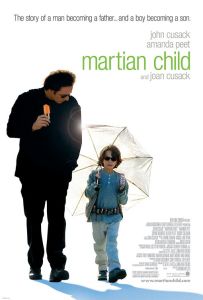 When in doubt for a sentimental story pair up a lonely man with a kid. It worked for Charlie Chaplin, Dustin Hoffman, and even Adam Sandler. There is something fundamentally appealing in an old school Hollywood way about seeing a grown man become kinder, gentler, and loving. Attaching children to slobs and jerks has been historically beneficial in the realm of cinema; they tend to think beyond themselves and become better people. In fact, doctors should take heed and start using children as medicinal services (“Feeling depressed? Raise this adorably precocious child for an indefinite period of time!”). Martian Child is the latest pre-programmed entry in this favorite Hollywood combination.
David (John Cusack) is a science fiction writer still in mourning for his dearly departed wife. He decides to stay true to a plan he and the dead misses had to adopt a child. Enter Dennis (Bobby Coleman), a kid who spends his time in a large box because he believes he’s from Mars. The adoption agency believes that a kid who thinks he’s a Martian would be ideal for a science fiction writer. David reflects that he was an outcast as a kid as well and he sees a side of himself in this spacey kid. David agrees to become a father but is placed on a trial basis because the film needs something to come to a head for Act Three. Dennis says his mission is to learn about “human beingness” but he has other quirks as well; he only eats Lucky Charms cereal, he takes lots of photos as documentation, and he steals items for further study. David learns that parenthood can, shocker, be hard.
 Martian Child champions the tireless idea of the individual in a society of people that follow the herd. You’ll be beaten over the head with the movie’s rampant message of individuality and being true to yourself. David tries teaching his would-be alien tyke that there are benefits in being like everyone else and fitting in, but of course we in the audience know the only reason he would say something against his character’s nature is so that it can be repeated back to him in a time of decision-making. And sure enough, when David’s book editor chastises him for not “being what we want you to be” I felt like Martian Child had given me brain damage with the weight of its browbeating message. The problem, though, is that Dennis is not the center of the film and he’s treated as a gloriously fortuitous writing opportunity. Because of this kiddy K-Pax, David is able to shake off his writer’s block and turn in a story based upon his own experiences being a father to a being from another planet. The point of triumph doesn’t seem to be resolving Dennis’ fragile psyche as it does proving David’s book editor wrong, who we must see gingerly crying as she finishes reading the last page of the manuscript. Take that, heartless barons of mass media!
This would all be fine if Dennis was just different or defiantly eccentric, but Dennis has serious emotional problems and deep psychological issues that David is simply not equipped to handle as a novice parent. Dennis shares a lot of symptoms with Asperger’s Syndrome, a higher functioning level of autism. Watching his developmentally delayed social interaction, his total fascination with a specific topic, and his rigid routine, it seems clear that Dennis does have some form of autism, and autism is a whole lot more than being the fun weird kid that a Hollywood movie can glamorize as an outsider crushed by conformity. The whole setup feels inauthentic and potentially irresponsible.
Much of my displeasure comes back to my feelings about the character of Dennis. Personally I couldn’t stand the kid. Maybe my heart is too cold but I never could find myself getting attached to the pint-sized Martian. In fact, I found him increasingly annoying and his squeaky, horse voice to be like nails on a chalkboard by the end of the film. I was also put off by how the filmmakers seemingly turned little weird Dennis into a miniature version of Michael Jackson – pasty white face, ruby red ring of lips, sunglasses, and a parasol to hide from the oh so hazardous rays of the sun. He does show off some nice Martian dance moves, however, if we recall, Jackson also was adept at walking on the moon.
 Martian Child is also hobbled by a reliance on cloying clichés. Dennis learns to play baseball. Dennis and David have a food fight but not before bonding over smashing a ridiculous number of home items to prove an earth-shattering point that material possessions don’t matter. Inspirational speeches will be recycled later during key points. David is of course a widower because that’s what single men need to be in romantic comedies in order to be acceptable romantic beings. I remember a slew of Disney animated films where most of the main characters had a parent dead or were orphaned, but now it seems that romantic comedies are following suit as well and working under the guideline that it’s better to be dead than divorced. The overt flirtation with his dead wife’s sister (Amanda Peet) seems awkwardly mishandled and needs further elaboration for any of it to sustain credibility. But the most mawkish moment has to be when Dennis is describing his Martian powers and informs us that Martians have the power to grant wishes, and that he will pass one Martian wish over to David to use at his discretion. You better believe that this is going to be referenced during a late third act hug while the music swells. Martian Child may pretend its different but it follows a very well trodden road all the way to the same happy, predictable destination.
I feel bad for Cusack. He deserves better than to headline such a maudlin misfire like Martian Child. This movie wants to aim squarely for the heart but it feels so phony. Watching Cusack interact with a kid is further proof that this man can do damn near anything but he needs some assistance and a sappy story, an annoying child, and a perplexing half-hearted romance aren’t helping. I felt more emotionally involved to the trailer for Cusack’s upcoming Grace is Gone that played before Martian Child than during any of the 108 minutes of this sentimentally cumbersome load. The film is competently made, however, it all comes back to it feeling overwhelmingly phony, being a manufactured tearjerker from the Hollywood factory line. Everything that follows feels like it’s coming from a formula playbook and there’s nothing new or interesting to offer. Perhaps I am jaded and heartless but Martian Child left me envious for the cold reaches of space.
Nate’s Grade: C
Share this:

Syriana (2005)
 Written and directed by Stephen Gaghen, Syriana is very reminiscent of his Oscar-winning work with Traffic. It’s very dense, complex, and demanding of its audience, which is both its best and worst aspect. I needed a notepad to keep up with the multiple criss-crossing storylines. It’s similar to Traffic in scope and texture, but this film seems a whole lot angrier. Whereas Traffic felt like it was trying to hold a mirror up to society, show us the truth of the failing War on Drugs, this movie feels like a wake-up call as well as a call to arms. Syriana is desperate to shake people out of complacency and show them how the world is running. I love the fact that the “Free Iran” committee in the film that preach Iran’s desire for democracy are not backing the emir’s son that wants to educate his country, install democratic freedoms, put women on equal footing as men because … he wants to open the oil fields to China because they’re offering more money. They are backing the less-enlightened son because he’s willing to give America what it wants: oil. The movie is a mostly potent microcosm about questioning who has our best interests at hand. It’s a bit slow at parts and incredibly rushed at others, and your head will be left spinning trying to keep track of the wealth of information it throws at you. It is thought-provoking even without an emotional connection. This flick reminded me of The Constant Gardener, also a screed against the evils of big business though grounded in an evolving love story. This is a movie I admire more than I can say I enjoyed.
Nate’s Grade: B
Share this:

Changing Lanes (2002)
 Don’t be misled by fancy marketing, Changing Lanes is no more a thriller than In the Bedroom (now that was some fancy misleading marketin’). At its core Lanes is a morality tale hiding under the clothing of thriller ilk. But while the film is surprisingly engaging the majority of it centers on Ben Affleck and Samuel L. Jackson doing a good or bad deed and countering one. And in this dilemma the deck is stacked for audience favorability. Jackson is a down-on-his-luck father fighting an impending divorce and trying to get a loan to purchase some real estate so his wife and kids won’t move away. Affleck is a cocky lawyer in a big firm who had an affair with his secretary (the chipped-tooth looking Toni Collette). Who do you think is the “good” guy? The film seems to bend over backwards to try and make Affleck not so bad, like showing him remorseful and pushed to the edge, under threats from his father-in-law and firm partner (Sydney Pollack), and being urged into a dark unethical territory by his own wife (Amanda Peet).
Jackson underplays his role, despite the snippets of vocal outbursts, and earns the compassion of the audience. Affleck plays Cocky Lawyer Man Who Becomes Humble and does a fine job. The supporting cast really shines in Changing Lanes especially Peet. Her one true scene involving her chilly sit-down with her husband is great in its sharp veer from what is expected.
Changing Lanes was directed by Roger Mitchell (Notting Hill) with a bit of nerves. Some scenes are shot from obtuse angles and the score has an inappropriate electronica taste. In the end though, Changing Lanes is an involving morality tale with some good lead performances.
Nate’s Grade: B
Share this:

Whipped (2000)
 The ailing problems with Whipped aren’t with its inept acting, writing, and direction, though those do add up. The true problem is that Whipped isn’t just a bad movie as say Battlefield Earth; no my friends, Whipped is a viciously ugly movie, the type of which that force you to take an hour long shower afterwards.
The story of Whipped unspools over a familiar diner with four friends bantering over female conquests, misogynistic games and chest pounding, and general nastiness. Our core of characters the usual stereotypes with the supposedly sensitive one, the yuppie Wall Street kid, the playa’ etc. Writer/director Peter M. Cohen tries his darnedest to raise eyebrows with vulgarity and raunch, but minus any wit, just making it seem shallow and inane, which is a perfect description of Whipped in any kind of masochistic nutshell.
The three guys eventually fall head over heels for the same woman in Amanda Peet. Eventually these crass individuals all learn some kind of lesson when Peet plays each of them for the same kicks the men derive. Is this supposed to be a feminist statement in the end of a movie so full of hatred for women that it could have been In the Company of Men minus the quality? Whipped is billed to expose the politics of dating but what it perceives as breaking new ground and insights in dating we all learned many years ago, some of it on the schoolyard playground.
Whipped has such ugly contempt for basically anything living as we carry along with the four pathetic human examples. The humor is dead-on-arrival and horribly bad. The acting is so amateurish. Yet Cohen gets the worst for his flat and lifeless direction.
Whipped may prove not to be the worst movie of this year already full of its fair share of bad, but I defy anyone to discover a film that is more ugly, spiteful, and horribly uncomfortable to sit through.
Nate’s Grade: F


 nathanzoebl
You must be logged in to post a comment.