Blog Archives
V/H/S/2 (2013)
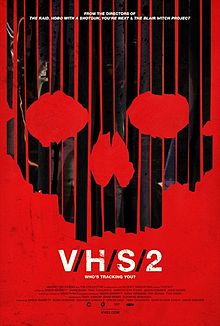 The second entry in the found footage horror anthology (and less than a year after the first to boot) is not as clever as V/H/S but more polished, better paced, and full of enough ingenuity to recommend, especially for horror fans. In my review of the first film I championed a shorter format, giving an audience the thrills they crave faster rather than slogging through an hour of slow buildup. The results are still fairly hit or miss, though none of the four segments is a misfire per se. The weakest is probably the last, “”Slumber Party Alien Abduction,” where the poor camera quality makes it hard to tell what is actually going on. The best, by far, is The Raid director Gareth Evans’ “Safe Haven” about a team of journalists picking perhaps the worst day to tour a creepy cult’s compound, notably during the apocalypse the cult predicted. This one takes a bit to wind up but when all hell breaks loose it goes nuts with glory. The wraparound segment tying everything together is more palatable and points to a promising mythology around the collection of these haunted VHS tapes that people keep watching and then dying over. All together, this is a concept that just works for horror and I’ll welcome presumed sequels as they come off the assembly line. This is found footage done right, with faster payoffs, more variety, and greater focus and ingenuity. If you enjoyed the first film, or are a fan of horror anthologies in general, then pop in V/H/S/2.
Nate’s Grade: B
Share this:

Pacific Rim (2013)
 Pacific Rim is director Guillermo del Toro’s (Hellboy, Pan’s Labyrinth) giddy ode to the great monster movies of his youth, and if you’re fond of men in suits and large-scale cardboard destruction, then this movie is definitely for you. The word “awesome” seems too inadequate to describe the rock ‘em sock ‘em action of this picture. This is likely the most realistic and serious this concept will ever be realized, with a gargantuan budget and some top-notch special effects. del Toro, already something of a god in fanboy circles, will get his chiseled bust alongside Joss Whedon. Pacific Rim is a transporting blockbuster that doesn’t pull its punches, at least when it’s dealing with robots fighting monsters. If this is why del Toro dropped out of directing The Hobbit then I think it’s a good trade off.
In the near future, a rift opens at the bottom of the Pacific Ocean that opens a gateway to another dimension. Through this portal, giant horrifying monsters the size of skyscrapers appear to wreck havoc on coastal cities. The monsters, known as kaiju, take a whole lot of work to go down. “To battle monsters, we had to make monsters, “ say a character in the prologue. The world unifies and responds with a program where two people pilot giant mechanical robots known as jaegers (yes college kids, you read that right). These pilots are psychically linked via a process known as the Drift; they work in tandem, sharing one mind. Raleigh (Charlie Hunnam) is a former jeager pilot recovering from the loss of his co-pilot/older brother in battle. Stacker Pentecost (Idris Elba) recruits him back to the final days of the jaeger program, a defense that has fallen out of favor with world leaders once the kaiju started winning again. Stationed in Hong Kong, Raleigh is looking for a new co-pilot and by all accounts it seems Pentecost’s diminutive assistant, Mako Mori (Rinko Kikuchi), is the best candidate, though Pentecost won’t allow it. Add some wacky scientists (Charlie Day, Burn Gorman) and an underground monster parts trader (Ron Perlman). The last days of the beleaguered jaeger program are all that stand between mankind and annihilation from giant beasts.
 It’s undeniable how well Pacific Rim taps into your inner ten-year-old, the kid who crashed his toys together imagining larger-than-life battles. Truthfully, if I were ten years old, I’d likely declare Pacific Rim the greatest movie of all time, that is, until I saw one with boobs in it. Conceptually, this feels like just about every anime brought to life, and fans of anime, as well as monster movies in general, should be in heaven. It’s so much fun to watch but it also doesn’t get lost in the cacophony of special effects like many modern blockbusters. del Toro has a wonderful way of showcasing his action without losing track of the scale or the destruction. Unlike Man of Steel, we have city-wide devastation that feels like devastation. Giant monsters are a state of life for the world and so is the day-to-day anxiety that one’s coastal existence is about to be in ruins. The movie doesn’t get bogged down in post-9/11 solemnity, but at the same time I appreciated that del Toro makes his violence feel significant and the loss feel real.
The action onscreen is often exciting and screenwriter Travis Beacham (Iron Man 3) employs a nice system of escalating the stakes by applying a category system to the kaiju, rating them on a 1-5 scale. It provides a natural progression of opponents. Plus, besides the inherent excitement with the premise, Beacham and del Toro drop us into the middle of this story, years after the jaegers have fallen out of favor as a means of defense, thus providing another hook – underdogs. Our heroes don’t just control giant fighting robots, they are also underdogs and have to prove their mettle to dismissive authority figures. I was hooked.
del Toro has always been a man who can create living, breathing worlds that you just want to explore, and Pacific Rim is the same. I loved immersing myself in the minutia of this world, learning the different fighting techniques of the robot designs, the cultures that harvest the kaiju bodies (there are monster groupies as well), the rock-star status of the jaeger pilots, and most of all, the Drift. Psychically linking the pilots is an ingenious way to add to the emotional investment of what are otherwise fairly clichéd character types. They have to be in synch mentally, which requires a whole other level of trust and connection. The tragic back-story of Raleigh is given even more weight knowing that not only was he witness to his brother getting eaten alive by a giant scary monster, he was psychically linked and felt his brother’s overwhelming fear and pain. That would definitely shake me. The Drift also provides a unique way to include back-story without feeling like forced exposition. Seeing Mako’s horrifying childhood survival account is quite affecting, but it works even better knowing this is also a chance for Raleigh to understand and bond with her. That sequence, Mako as a child, is stunning, staying with her pint-sized perspective as she tries to outrun a ferocious monster bearing down on her. It slows things down and allows the true terror of the situation to seep in. Beacham and del Toro have put a great amount of thought with how this world operates, and it’s appreciated as seemingly every detail adds to a richer big picture.
Naturally, the special effects are just about every positive accolade you can put together. It’s a CGI heavy film that doesn’t look like a cartoon; something Michael Bay’s Transformers have difficulty overcoming. The robot designs aren’t overly busy. In fact, the main robot reminds me a lot of Metroid’s Samus suit (anybody?). The monsters are all a bit too similar in design though. They all start to bend together making it hard to differentiate them from one another, especially when they’re supposed to be getting bigger and badder. Part of my lukewarm reception with the monster designs, besides from del Toro’s sterling past reputation when it comes to creature designs, is that so many of the epic fight scenes happen with some level of visual obfuscation. They fight at night, they fight in the rain, they fight in the fog, they fight underwater, but rarely will they fight in a setting where you can clearly focus on the fighters. This very well could be a budgetary decision, allowing less work for visual effects artists so they can cover the scope of del Toro’s imagination. Still, it’s hard for me to compose an argument that a $200 million-dollar movie needed just a bit more money to properly show off the goods.
 When it’s not wrecking havoc onscreen, the story can drag and you’ll notice how thin the characters are developed. It’s another reluctant hotshot and learning to get over a personal tragedy, trusting a new co-pilot, and taking stern advice from a begrudging father figure. That doesn’t mean they don’t work within the framework of the story; Hunnam (TV’s Sons of Anarchy) is solid if unspectacular, Elba (Thor, TV’s Luther) is the universe’s most authoritative badass, Day (Horrible Bosses) and Gorman (The Dark Knight Rises) provide a nice array of comic relief, and Kikuchi (Babel, The Brothers Bloom) makes for a formidable upstart hero. The character roles are familiar and thinly sketched but they come together in a satisfying manner, each contributing to the mission, and each finding a moment to make you care. When the fate of the world is at stake, it’s hard not to feel some investment in our ragtag assembly of heroes. With that being said, you will still feel drag in the middle, waiting for the next attack and for our heroes to suit up and do what they do best. The extended second act involves denying Raleigh and Mako the opportunity to do what we all know they need to do – man a jaeger. It can get restless as we keep getting roadblocks to something that seems inevitable. It’s akin to waiting too long for John Reid to accept his outlaw status in The Lone Ranger. I will give Beacham and del Toro extra credit for not leaving themselves open for an immediate sequel. Also, do stay through the credits for a nice treat.
I can easily recommend Pacific Rim with minor reservations, and if giant fightin’ robots and monsters is your thing, then the reservations won’t even matter when you get a movie this entertaining, fun, and skilled at providing the gee-whiz factor. I wish all summer movies were this fun. I was squealing with glee watching a giant robot drag a cargo ship across the streets of Hong Kong, gearing up to beat down a huge monster. The movie is packed with little moments like that. As with other del Toro productions, the world feels nicely realized, lived in, and sprawling with detail, even if the monsters all start looking the same (monster racism?). The plot does suffer a bit when it refocuses on the humans, but then again what plot wouldn’t suffer when it takes you away from giant robots fighting aliens? Pacific Rim isn’t the first of its kind. Besides the anime, Godzilla, and even Power Rangers influences that spring to mind, there have been numerous movies that follow a similar premise of Giant Thing A squaring off against Giant Thing B. What sets Pacific Rim apart is del Toro’s innate ability to channel your childlike glee at the concept, turning something monstrous into something fun while still giving respect to the weight of the moment. This is not a dumb action movie. del Toro’s sprawling artistic sensibility takes on summer blockbuster filmmaking and shows you how it can be done right for optimal effect without making your brain hurt. Now I need round two.
Nate’s Grade: B+
Share this:

Man of Steel (2013)
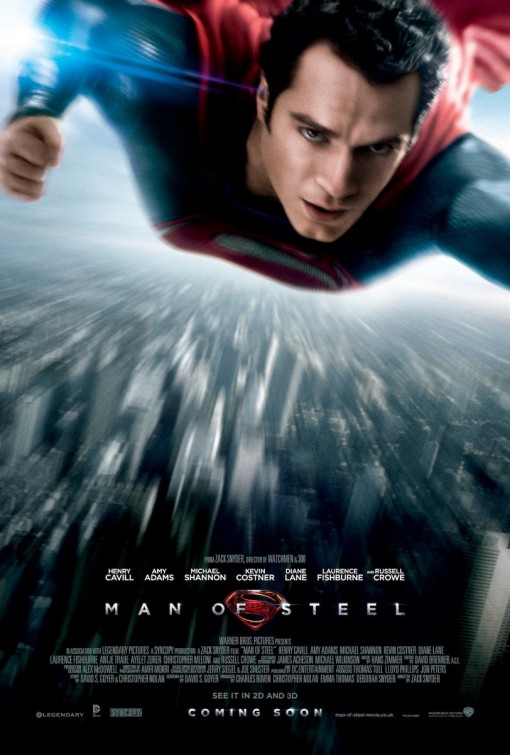 I think I began my review for 2006’s Superman Returns the same way but I don’t care. Does Superman have any relevant appeal in today’s society? I understand being a moral pinnacle has been his MO from the start, and I understand that today’s generation likes its heroes dark and broody and tortured. I know you can make Superman into an interesting figure (the man just celebrated his 75th anniversary, so there have to be some people who identify), though it is a bigger challenge, surely. I think taking a darker tack can be achievable but needs finesse. Christopher Nolan and David Goyer, having fashioned the highly successful Dark Knight trilogy, seem like a formidable pair to shepherd a darker Superman into the twenty-first century. Combine that with director Zack Snyder (300, Watchmen), and you’re guaranteed a pretty movie. Where does Man of Steel go wrong?
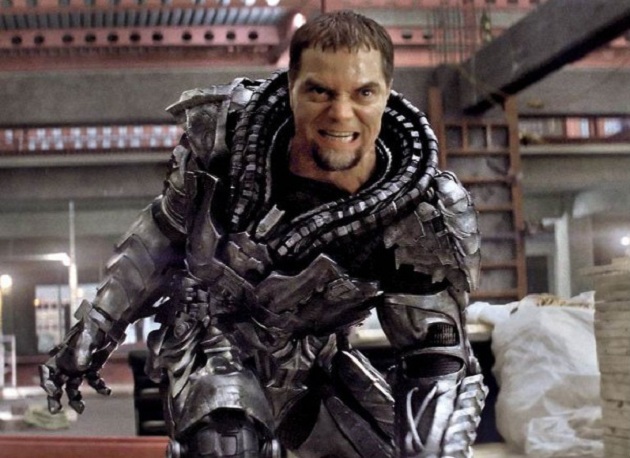
You know the drill at this point: Superman a.k.a. Clark Kent (Henry Cavill) was originally born on the doomed alien planet Krypton. His biological father, Jor-El (Russell Crowe), sent his son to Earth with the hope that he could survive and achieve great things. Raised by Jonathan and Martha Kent (Kevin Costner and Diane Lane), he then accepts his destiny to be mankind’s protector, butting heads and flirting with dogged reporter Lois Lane (Amy Adams). Except now Superman has the entire genetic code of Krypton’s history (?) transported into him via a “codex” (whish resembles a charred baby skull). General Zod (Michael Shannon), imprisoned off planet when Krypton was destroyed, is determined to retrieve that code and start his race anew. He and his crew travel to Earth and demand superman turn himself in, or else Earth will suffer.
 Where this movie gets into deep trouble is that it fashions Superman into an inactive loner, turning him into a super bore. He has such superhuman strength at his command but his doubtful dad has taught him that humanity would lose its mind if he revealed himself. And so Superman goes through half this movie hiding his super ability. He actively avoids conflict and confrontation. It’s basically the same formula as the Incredible Hulk TV show, where Bruce Banner would drift from town to town, warning others not to make him angry, then mournfully have to leave yet again. He can’t help himself save lives but, in flashback, dearly departed dad admonishes him for it (Clark: “Should I just have let them die?” Pa Kent: “Maybe.”). I think the isolation the character endures is essential to understanding his heavy burden, but at the same time this was compensated by Clark Kent, Superman’s opportunity to blend in with the natives, assume a frail phony identity, and to flash some much needed personality. In Man of Steel, he doesn’t become Clark Kent, news reporter, until the very last scene. It’s not a movie about a man becoming Superman but Clark Kent, experience-free reporter.
Two of the chief complaints about Bryan Singer’s 2006 Superman movie were that it was too reverent to its source material, namely the Richard Donner films, and it lacked sufficient action. Well, both of those issues are tackled in the very opening of Man of Steel. Goyer reworks plenty of Superman mythology from a science fiction angle, and so we get stuff about alien invaders, genetic bloodlines, clone baby labs, teraforming, and all sorts of spaceships. The characters keep referring to Superman as “the alien,” and dad worries that the knowledge of his super son will upset people’s worldviews about humanity and God (have no fear, there’s still messianic imagery to sledgehammer you with). I’m fine with Goyer playing fast and loose with Superman’s history but his alterations need to have solid reasoning. Nolan played around with Batman’s history and it worked because, in the context of the world and characters he developed, it fit. Does Jor-El riding a dragon like a live-action Heavy Metal fit? Does a billion people’s DNA transposed into Superman’s cells fit? Do Superman’s actions during the quite controversial ending fit? Does Clark’s stepdad, Jonathan Kent, willingly dying in a tornado fit? Does Lois Lane immediately knowing who Superman is, before he even adopts the Clark Kent disguise, fit? I doubt it, though it still could have worked. However, Goyer’s script is a mess structurally, preventing the story from gaining serious traction. First, we start with twenty-something minutes on Krypton, which could be condensed in half, then we slam into the present and this new formula appears: present, flashback, present, flashback, present. That happens for another twenty minutes. Then there’s 40 minutes of Superman dithering as the reluctant hero. Then the last hour plus is a nonstop barrage of meaningless action that squeezes out room for character growth.
I’ll credit Snyder and company for likely tripling the action quotient of any previous Superman movie (maybe even all of them combined), but I never thought such action would be so boring. Oh sure, it delights for a while with advanced special effects and Snyder’s eye for visuals, but the action sequences drag out far too long. A long action sequence? Isn’t that what you’re always demanding, critic Nate? Well anonymous and theoretical detractor, yes, I enjoy a well-developed and sustained action sequence. The problem with action sequences is that they have to matter. They have to accomplish something even if it’s just there are less enemies or the hero got from point A to point B. There has to be, at bare minimum, something that is accomplished. Sadly, this is not the case with the action in Man of Steel, which is why the sequences drag and feel like they are twice as long as their already bloated length. There’s a brawl between two evil Kryptonians and Superman and after a whole 10-15 minutes of sparring, the bad guys get on a ship and leave. Come on, Zod has like a crew of twelve henchmen. Can’t one of them at least die in a preliminary battle? Worse, the final confrontation between Zod and Superman could just as easily been eliminated. They punch and yell and punch and yell and stuff gets all smashy, but by the end of the fight, nothing has substantially changed, except the foundational surroundings (more on that below). Having two invincible beings punch each other for a half hour is not engrossing. For a lengthy action sequence to work there need to be complications, organic to the situation, and the stakes should escalate. James Cameron and Steven Spielberg are masters at crafting escalating action. J.J. Abrams is pretty good himself. Even Michael Bay has his merits. I don’t know whether to lay the crux of the blame on Snyder or the screenplay he had to give life.
 As the plodding action continued to pound me senseless, I was left to seriously ponder just how epic the scale of Superman’s collateral damage truly is. At one point, when Supes is fighting in the small-town center of Smallville, he tells the residents to, “Stay inside. It’s not safe.” What then proceeds to happen is a fight that rips up almost all the pavement in town, takes down a helicopter, a few fighter jets that crash in town, exploding, as well as a train car, plenty of ricocheting gunfire, and debris everywhere. But have no fear because those citizens stayed away from the windows and locked their doors! More than likely they are dead. The concluding clash in Metropolis is like 9/11 times eight. I counted three different skyscrapers that came tumbling down, and this is after the Krypton gravity field has ripped up the city and smashed it to dust, as well as missiles exploding around the city and Zod’s various spaceships. Then there’s the fight where Zod and Superman are blasting through just about every high-rise office building, and even when they collide outside it creates such force that buildings crater. They even fly into space, destroy a satellite, which then comes down as fiery debris that rains down on poor Metropolis. The final plan to foil the bad guys involves, get this, opening a black hole above a major city. It’s not like that sounds as if it will have catastrophic blowback.
The 9/11 imagery is unmistakable and I don’t care if it has been 12 years now. Couldn’t Superman at least react to the desolation he was causing? I really hope some enterprising soul via the Internet tallies the number of estimated deaths because I sincerely believe it would reach into the millions (Update: Ask and ye shall receive). Superman decimates the city and I thought less about the gee-whiz factor of the special effects and more about the innocent lives being lost amidst the CGI devastation. It looks like an atomic bomb went off. Perhaps a sequel will start with Lex Luthor rebuilding Metropolis.
And that’s the problem when you try and make sense of Man of Steel’s more realistic, grounded approach. This is a Superman that came of age in the 80/90s. While touches like young Clark experiencing sensory overload with his powers, like a scared autistic child, are clever and nice avenues toward relatability, you still have to square the more bombastic, over-the-top, and downright stupid moments that clash with that refined tone of greater realism. Nolan wanted Batman to exist in a recognizable world, so it makes sense that he and Goyer would attempt to do likewise with DC’s other champion. The prospect of an invincible alien among us is a potent source for some thoughtful and topical drama. It’s just not going to happen when Superman can demolish cities without blinking an eye or when anyone else fails to register the scale of this tremendous trauma. We don’t even have outside reactions or opinions to the earth-shattering revelation that we are not alone in the universe.
Then there are just the little things that annoyed me. Jonathan Kent dies in an effort to save the family dog. This comes off as lame, especially when Superman could save dad but has to hold back, per pa’s wishes, so as not to expose himself. Except, by the end, when the United States accepts Superman, doesn’t this invalidate all of Pa Kent’s worldview? If so, then the man died for nothing. Also, General Zod wants to transform Earth into Krypton. Except… on Earth all Kryptonians have godlike powers. Wouldn’t the man just want to keep that? Also, why does Zod never dispatch more than two Krypton lackeys to fight Superman? He has all these godlike warriors and decides to just keep them locked away in his spaceship. That just doesn’t make sense from a tactical standpoint. Also, Pa Kent tells his son to do his best to blend in, but in one scene bullies harass Clark as he’s reading from Plato. Yes, because your typical teenager can’t rip himself or herself away from the likes of Plato. Careful: Plato is a gateway read to Epicurus. Then there’s the overbearing product placement. Usually I give movies a pass if they’re not obnoxious with product placement; however, Man of Steel stages entire action sequences so we can get long-lasting looks at the logos for Sears, 7-11, and IHOP: “This callous destruction brought to you by the good (surviving) people at Sears.”
 Cavill (Immortals, TV’s The Tudors) sure has the look for the part. He’s appropriately bulky but because the role is too often inactive loner, always holding back, that makes his performance somewhat bland and more reticent than necessary. Part of this is also that Snyder has historically been a poor actor’s director. You can tell throughout the film as talented, Oscar-nominated and winning thespians like Crowe and Shannon will just give off deliveries, little tinny trills that clunk, moments that a director should have stepped in for. Shannon (Take Shelter, Premium Rush) is one of our best working wacko actors, but even he comes across as a bit too unrestrained and stiff, especially when he has to scream “I will find HIM” half a dozen times in a row. I thought Zod’s second-in-command played by German actress Antje Traue (Pandorum) had more personality and better moments. Adams (The Master, Trouble with the Curve) is a good choice for a plucky Lois Lane, especially one sharp enough to see through Clark’s disguise. The movie is packed with good character actors like Laurence Fishburne, Harry Lennix, Christopher Meloni, Michael Kelly, Richard Schiff, Mackenzie Gray, and two actors from Battlestar Galactica. That’s nice. The best actor in the movie is Dylan Sprayberry as teen Clark.
Snyder’s reworked Superman for our modern age just doesn’t cut it as popular entertainment. Its misshapen structure, heavy with exposition, doesn’t provide enough space for the characters to develop, and the general edict to make Superman an inactive loner on the fringes of society is a surefire way to keep an audience at bay. The CGI-heavy action sequences feel like they go on for an eternity, straining and struggling to keep your attention because the stakes fail to escalate or have consequences outside ridiculous amounts of collateral damage to rival the worst of Mother Nature. The over-amped sci-fi reworking tries to make a clean break from the demands of Superman’s mythology, and while some revamps work, most feel needless and ham-fisted, like Pa Kent’s somewhat pointless death. But the worst charge is that the movie is just too boring. I know people have levied this charge against Superman movies in the past, particularly the 2006 Singer film that I will still stand by my positive review for. Man of Steel is a good looking movie for certain, often a great looking movie, but all those pretty pictures are for naught because of a flawed approach and overindulgence with tedious action sequences. Given its box-office riches, I expect this Superman retread will garner the sequel that Singer’s film did not. I just hope the next chapter in the new adventures of Superman experiences a Dark Knight-level rise in quality.
Nate’s Grade: C+
Share this:

After Earth (2013)
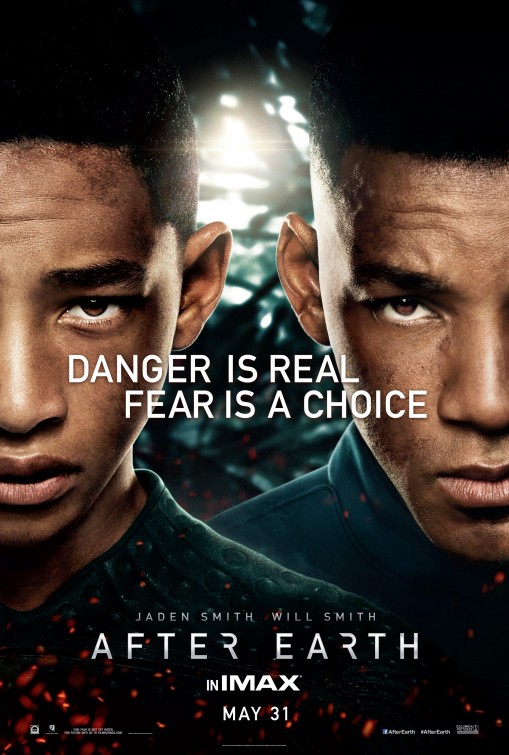 Rare is the movie that just seems to fail at every level of filmmaking, from writing to direction to pacing to casting to production design to logic to, well, you name it (perhaps the craft services were the exception to the rule). Director M. Night Shyamalan’s After Earth is one of those exceptional, big-budget passion project failures that just mystify on every account, making you scratch your head and wonder who could possibly be passionate about something this utterly terrible? I’m reminded of John Travolta’s 2000 sci-fi Scientology-ode, Battlefield Earth, for a comparison that comes close to approaching After Earth’s star-powered ineptitude (this movie also has plenty of vague Scientology references as well). While I doubt this will kill anyone’s careers associated, though it probably eliminates some good will for the Smith clan, it definitely piles more dirt on the grave that was Shyamalan’s film career. Enough preface, let’s get into the meat of why After Earth is one of the worst sci-fi films in years.
In a sloppy bit of exposition, we’re told that humans left planet Earth after we made it too unsustainable. The human race then colonized an alien world except that the indigenous aliens weren’t too happy about this. The aliens made a space monster, known as an Ursa, which would track and kill human beings by sniffing out their fear pheromones. Cypher Raige (Will Smith) rises in the ranks of the Ranger corps because he has the unique ability to “ghost.” Because the man does not register fear he is able to sneak around the Ursa as if invisible. His relationship with his teenage son, Kitai (Jaden Smith), is strained at best. Dad has been gone a long time and has high standards for his boy; the kid has to refer to him as “sir” even at the dinner table. Father and son are traveling through space when their ship crash-lands on good old Earth. Cypher’s legs are broken and he entrusts his son to make the trek to send out the distress call. The dangers of Earth, we’re told, have only magnified since humans left, and the Ursa onboard their ship has escaped.
Oh boy, where to even start with this one?
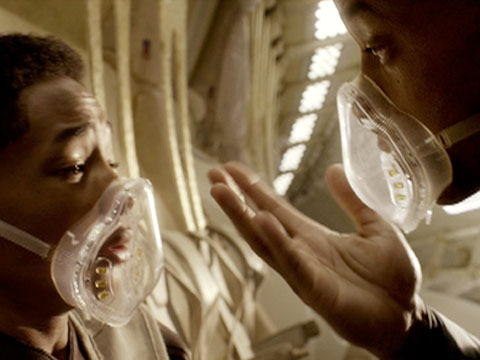 I’ve got a great idea, let’s take one of the world’s most charismatic actors and then turn him into a stone-faced hardass, terse with words of encouragement, and mostly sidelined so that his son can go on his stupid hero’s journey. I suppose Smith deserves some credit for stepping outside his comfort zone to play against type, but that praise only matters when the portrayal works. Smith is arguably miscast in his own passion project. That’s because this was really a $130 million dollar birthday present to his son, trying to use dad’s star power to establish Jaden as a star. It’s less a movie and more like a product launch. On its face, I don’t really have an issue with this. Nepotism has been alive and well in Hollywood for over 100 years and those in power have been producing vanity vehicles for their beloved for even longer. What I chafe at is that the finished product is so lacking and unconvincing. Jaden was cute in 2010’s The Karate Kid remake, a movie that was far better than it ever should have been. Unfortunately, After Earth came at that special time in his life known as puberty, so he gets his lanky, squeaky-voiced, awkward growth stage forever captured on film. Thus when he gets into a huff, squeals at his dad, and then become the world’s most improbable super warrior by film’s end, it mostly brings about snickers. You don’t buy a second of this character’s ascent to hero.
Let’s tackle the ultimate elephant in the room here, namely the involvement of Shyamalan. This is his first project he didn’t conceive; Smith himself came up with the story and personally hired Shyamalan. Who deserves more of the blame? There’s a reason why the marketing for After Earth has not breathed a word about Shyamalan’s involvement. In my theater, when the end credits appeared and it opened with Shyamalan’s director credit, the guy behind me remarked, “Well, that figures.” His sense of dissatisfaction now had a tangible culprit. It’s almost become a joke how much of a critical punching bag Shyamalan has become as a filmmaker. The man has genuine talent but it’s five duds in a row (I am counting The Village) and not even the world’s most bankable star could have saved this movie. As anyone who witnessed the atrocious Last Airbender can attest, Shyamalan is not a filmmaker who works well with a big special effects canvas. I’d suggest that Shyamalan, besides taking some time off, which may be a self-prescribed death sentence in Hollywood, find a smaller project to foster, perhaps something more personal and intimate. Nobody except the sadistic enjoys watching once-promising talents keep hitting a brick wall. Then again, people also dislike having to pay for terrible movies, especially when the director of said terrible movies keeps getting the opportunity to deliver more disappointment.
The plot, which Shyamalan is credited as a co-writer for, is so dull that I found myself almost falling asleep. You would think father and son surviving crash on a hostile alien world would be packed with survival thrills and excitement. You’d be wrong. It’s as if Shyamalan takes a page from Smith’s ranger character, and just goes about its business in the most thankless, ho-hum, undeterred manner. When we have characters that don’t react to the danger they’re in it has the misfortune of feeling less real, less urgent, and less dangerous. This was a problem with The Matrix films when Neo became a super being because then the stakes evaporated. It’s hard to sympathize with characters that don’t reflect the reality of their setting. With that said, so much of this script is just Kitai running off and running into different animals. He meets baboons. He meets a tiger. He meets an eagle. He meets a slug. Scintillating stuff. Such ambition. If this is what the execution was going to be like, why didn’t Smith and Shyamalan just make the planet an actual alien world? It would certainly open up the storytelling options. Or they could have gone in the opposite direction, setting this survival tale on a modern Earth. That would probably have made it much more relatable and resonant and also far cheaper.
 The character back-story is also woefully familiar and just as ineffective. Before it even happened, I knew that there would have to be some tragic personal history so that Kitai could overcome his past. We’re given some cringe-worthy moments of flashbacks to the family’s happier times, when Kitai’s older sister Senshi (Zoe Kravitz) was still alive. It’s a plodding and contrived plot device for the father to preposterously blame his son for, who was like seven years old at the time. I kid you not, during one of these oh-so-necessary flashbacks, Senshi tells dad she got a copy of Moby Dick and a boy let her hold it. Dad doesn’t get it, though I don’t know if this is meant to be some lame sex joke. This back-story is ladled in with no real logical connection to events. All of a sudden, Cypher will be thinking about his broken leg and then, whoosh, we’re thinking about Moby Dick.
There’s also the issue of its tenuous grasp on reality. I know this quality is a give-and-take depending upon the tone of the sci-fi film, but After Earth is so drearily self-serious that it becomes even more unbearable when it so clearly conflicts with credulity. This movie’s big message that it pounds into your head repeatedly is that fear is a choice, fear is not real, and that fear is a hindrance for mankind’s progress. This is nonsense. Fear is what kept our ancestors alive rather than trying to play with larger predators. Fearlessness is a great way for your species to end. You know an animal without fear? Lemmings. The fact that the movie has to literalize this conflict in the form of a fear-smelling alien monster is just beyond absurd. Let’s keep this literalizing-of-theme going; maybe next the aliens will fashion a monster that smells intolerance or illiteracy. Why are these aliens even genetically creating a monster to do their dirty work? If they have the superior scientific prowess to create a gnarly beast, I’m pretty sure they can take care of mankind. On top of this assertion, why would you make a beast that is effectively blind and only reliant upon one sense and then you limit that one sense to “fear”? Why not just have the alien monster smell human beings? That seems to make a lot more sense.
What also buggers my mind is the fact that, according to After Earth, everything on the planet has evolved to kill humans. First, I don’t think substantial leaps in evolution work in meager thousand-year spans; secondly, these evolved creatures are really just slightly larger versions of familiar animals, which doesn’t really make much sense either; and lastly, if humans have been off planet for a thousand years, how did these animals evolve to kill something they no longer have any interaction with? Then there’s the fact that the Earth drops rapidly into freezing temperatures overnight, for no good reason. How do all those plants survive? As an extension, Kitai’s super suit is just a prime example of a poorly developed idea that just as easily could have been abandoned. He has a special leotard that changes to his environment. We’ll watch it change colors though we’re never given any worthwhile reason why this is happening. However, Kitai’s suit will not shield him from Earth’s sudden temperature drops. So he’s wearing this super suit that adjusts to his environment… except temperature? If you’re going to present something all super scientific and then give it such obvious limitations, then you never should have introduced it in the first place. This is an ongoing theme with the film.
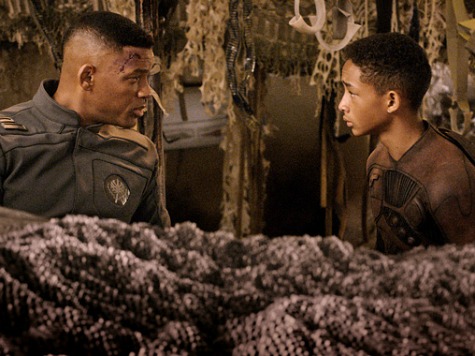 Then there are just nit-picky things like my total distaste for the production design of this movie. The spaceships look so chintzy. They have plastic flaps separating sections, like what you’d see in an office building when there’s construction. The spaceship interiors, as well as home interiors, also look like some bizarre mix of honeycomb and bamboo. I’m all for thinking outside the box when it comes to futuristic design, but this is just stupid. One of the great possibilities of sci-fi is to capture our imagination with out-of-this-world visuals, the unfamiliar, the spectacle of the alien. If your spectacle is good enough, it can even save a so-so movie, like last year’s Prometheus. Being stuck on Earth, only slightly different, emphasis on slightly, fails to deliver anything visually that will captivate an audience too often settling into boredom. Apparently After Earth looks pretty much like Earth except for Mount Doom popping up. The special effects are also lackluster and the score by James Newton Howard will try and trick you at every turn into thinking what’s happening onscreen is a lot more interesting than it is.
If you value your entertainment, please ignore After Earth. It doesn’t even work from a derisive enjoyment angle. The movie is lethargic and unimaginative to its core. It’s predictable at every turn and underwhelming throughout. The plot consists of the most boring father-son team in recent memory and a hero’s journey that feels false at every step. This big-budget star vehicle doesn’t work when its star doesn’t have the intangibles to be a star, nor does it help when the story is so poorly developed. The science feels boneheaded, the characters are dreary, the pacing sluggish, the spectacle clipped, and the world building to be bland. The shame is that this premise, even this exact same premise on a future Earth, could have easily worked as a suspense thriller. Smith seemed more interested in building an After Earth enterprise, since companion books were commissioned, and extending the reach of the Smith family empire. Making a good movie, it seems, was secondary. Being fearless also has its disadvantages.
Nate’s Grade: D
Share this:

Star Trek Into Darkness (2013)
J.J. Abrams’ return to the final frontier had me extremely excited for what the sequel to 2009’s smash Star Trek would be. It’s a different sort of Trek, a more rough-and-tumble, popcorn entertainment with the recognizable flavor of that other famous space opera that Abrams is steering into theaters come 2015. Having seen Star Trek Into Darkness twice, certain things became very clear to me. First, this is about everything you could ask for in a summer popcorn action movie. The set pieces are thrilling (my fave may be a human bullet shoot through a field of debris), there’s something new and dangerous going on just about every fifteen minutes, the stakes are constantly changing, and there are a bevy of well plotted character arcs for a deep and well acted ensemble. It’s about everything you’d want in a Star Trek movie… if you were a big fan of the 2009 film. If you’re a lifelong fan, you may have some reservations, notably the inclusion of a famous villain that shouldn’t be too hard to guess. The second half references to Trek cannon, especially Star Trek 2, feel weird for a film that broke away into a parallel universe so that it could chart its own course rather than relive the old stories. There’s homage and then there’s just subservience. Still, there are plenty of resonant themes, like friendship, sacrifice, and family, that are given adequate attention, amidst all the big-budget escapist thrills. There are even some surprisingly poignant moments that the actors ace. Benedict Cumberbatch (TV’s Sherlock) is incredible as the villain, a terrorist with a menacing, velvety voice that I could listen to all day. The vast majority of Into Darkness is tremendously entertaining, with a great pulse and sense of scene construction. The Abrams team knows how to make blockbusters in the old Spielberg variety, spectacle with humanity and humor and sweep. If this is what he can do with the Trek universe, just wait until Episode VII people.
Nate’s Grade: A-
Share this:

Oblivion (2013)
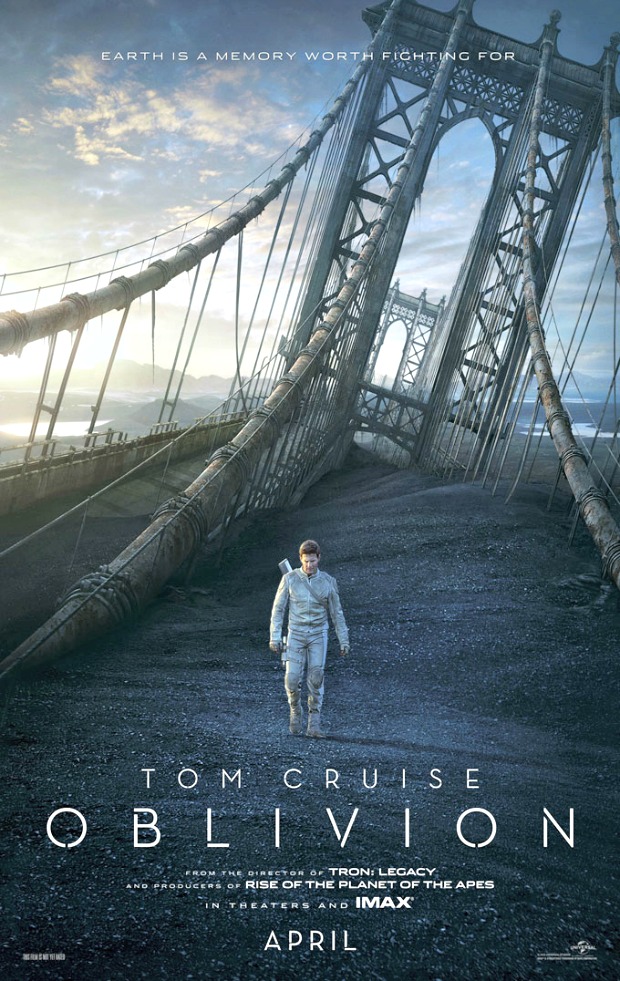 It’s late in the twenty-first century, decades after humanity battled an alien species in a war for the planet, and while humanity won the war Earth is desolate. The moon destroyed. The remaining members of humanity live on a starship around Saturn’s moon, Titan, and the oceans of Earth provide the energy resource. Jack (Tom Cruise) and Victoria (Andrea Riseborough) are the team stationed with repairing drones, the flying machines that protect the energy plants. There are still pockets of alien scavengers that need to be dealt with. Jack and Victoria make a great team, and dip into romantic companionship, until Jack meets a mysterious woman (Olga Kurylenko) professing to be his wife. Jack begins to doubt the purpose of his mission and wonder if the alien scavengers are the enemy.
If you’ve been keeping up with sci-fi cinema in the last couple decades, you’ll likely recognize more than a few elements with Oblivion. From its themes to its plot points to its revelations, there’s little here to designate as original. So the real question remains how derivative can we take? I think when the execution is nimble then it’s one of the easiest sins to remember. Especially in the realm of sci-fi cinema, it’s hard to put together a new story, let alone one set up as a Hollywood star vehicle, without borrowing from other established movies. This in itself is not an issue. Tarantino is a master borrower but he always recontextualizes his artistic influences into something new and different, and while we critics lament his less original career path of late, the man’s box-office profits have never been better in his career. I think when we feel like we’re getting a good story we don’t care when that story has been told before in other manners. Star Wars, after all, has many cultural fathers, but it was a rollicking good time with characters we cared about, so nobody seemed to mind. Likewise, Oblivion has many forbearers from Independence Day to I Am Legend to 2001 to an indie film from a few years ago I shall refrain from mentioning because even the very mention will spoil key plot points. Some will decry the film as a rip-off of superior, headier fare, but I never minded. I was having too good of a time and found the movie too satisfying to quibble.
 I won’t say the movie is smart per se but it’s far more measured than I would have expected. The advertising makes it look like Cruise fights a bunch of aliens and robots, and while there is that aspect, it’s almost an afterthought to a slow-burning mystery that patiently parcels out its revelations, even to the very end of the film. I’m trying to be cagey about certain plot points to avoid spoilers. It’s a film that has more on its mind than explosions, but when it goes into explosion mode, director Joseph Kosinski (TRON: Legacy) makes it count. The larger action elements are well staged and polished with some above average special effects. The sight of the moon dashed across the sky is definitely an evocative image. I love the overall look of the film, Kosinki’s clean, spare, bubbly Apple-esque aesthetics. The drones themselves manage to have personality even with a limited, streamlined design and some choice sound design. The man knows how to hold onto an image and when to keep pushing. The action is suitably thrilling and the drama suitably suspenseful. Actually, better than suitably. I enjoyed the details of this world. It’s probably the spiffiest post-apocalyptic landscape you’ll ever see. This is an entertaining movie that finds nice ways to satisfy, and given the particulars of its sci-fi plot, finds a way to have its cake and eat it too. As a result, Oblivion is a sci-fi flick that offers enough to engage the mind and audience demands for big effects and big thrills.
 I’ve never been a Cruise hater. I even thought the man tried his damndest to make a movie like Rock of Ages worth watching (a valiant effort but not enough). His character is pretty affable at first and we get to watch as everything he knows comes undone. It’s a role that would lead to overacting, but Cruise underplays the part, more alarmed naïf than flinty action hero. I’m not expecting Oscar-caliber performances in every role but Cruise does a fine job of anchoring the audience and selling his character’s journey. He also has good chemistry with not one but two ladies. Kurylenko (Seven Psychopaths, To the Wonder) is an actress of great beauty and questionable talent, but perhaps being paired up with a genuine star like Cruise brings out the best in her. They’re good together, though my preference was for Riseborough (W.E., Never Let Me Go), an actress who brings a tremulous vulnerability to an otherwise underwritten and confused character that’s more a plot device. Riseborough makes the character so much more than she is on the page. She’s still a relatively new actress so I look forward to her future performances. There are other familiar faces, like Morgan Freeman and an especially unsettling Melissa Leo, but it’s really a three-person acting exercise.
Oblivion is a visually alluring sci-fi thriller that also manages to have enough heart and smarts to leave a satisfying impression. The pacing is more deliberate but offers plenty rewards, doling out revelations up until the end, unpacking its mystery with finesse. The first twenty minutes or so, establishing the particulars of this world and the routine of our protagonists, is downright exceptional. The rest of the film doesn’t quite live up to that start but it continues to be an engaging and entertaining movie with some top-notch visuals. The musical score by electronic band M83 also provides a stirring counterpoint to the glossy, clean visuals (the band’s song “Outro” was also very effectively used in that lovely five-minute trailer for Cloud Atlas). You may figure things out as you watch, but you won’t mind, at least I didn’t. The more I step away the more I think back with renewed enthusiasm for the film. It’s smarter, slicker, and just a more satisfying film than we’re accustomed to with this kind of budget and from Hollywood.
Nate’s Grade: B
Share this:

The Host (2013)
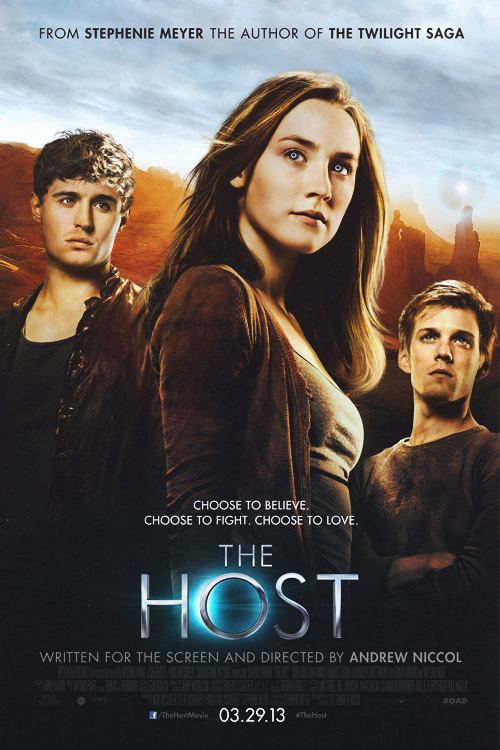 It’s impossible for me to ever separate The Host, a sci-fi would-be romance based upon the best-seller by dubious author Stephenie Meyer, and the demise of famous film critic, and personal influence, Roger Ebert. On April 4, 2013, America’s most prominent film critic, a man who with Gene Siskel changed the face of film criticism and the dialogue with movies, died after his cancer had returned. Upon hearing the news, I was overcome with grief and shed a few tears for the loss of a great writer and a great man who influenced a generation of online film critics like myself. Then I saw what was Ebert’s last published film review — The Host. Knowing his last review on this Earth is this awful movie, that it may be the last new release he ever saw, well it just feels ignoble. The man deserved better and so does anyone else who watches The Host, a movie I saw the very day of Ebert’s death.
Set on earth years after an invading alien race has already conquered, life isn’t too bad. There aren’t any wars or pollution or hunger. The aliens, looking like little glowworms, latch onto the spines of humans and use them as hosts. They control the bodies of the humans but some of us won’t go down willingly. Melanie (Saoirse Ronan) is an 18-year-old gal who fights as part of a resistance movement, led by her Uncle Jeb (William Hurt). The aliens abduct her and Melanie’s body gets a new owner – Wanderer, also referred to as Wanda. Good old Melanie is still in her head, feisty, and goading Wanda into finding Melanie’s family hiding out in the desert with Jeb. Also there is Melanie’s boyfriend, Jared (Max Irons), who is upset that his girlfriend has become “one of them.” Ian (Jake Abel), on the other hand, is adjusting well to the change, as he falls for Wanda and she him. In between these hormonal complications, Wanda is being chased by the appropriately named Seeker (Diane Kruger), who is deadest on bringing some human-style violence to Wanda/Melanie and the resistance fighters.
 The Host, like much of Meyer’s more popular Twilight saga, is a rather dramatically inert story that just seems to exist with little sense of momentum or direction or purpose, beyond providing another bloodless onscreen romance that ceaselessly finds unsettling messages to convey to young girls. Once again it all comes down to a stifling romantic triangle where none of the participants ever seems to work up the necessary passion to garner continual interest. There’s a bit more heavy petting going on but even when these people are having sex dreams, they imagine Melanie with her bra on (such a limited imagination). Please don’t confuse this as some implicit regret on my part that the movie didn’t sexualize its lead heroine (she’ll be turning 19 soon, so fear not pervs). At least the Twilight movies can be seen through the prism of pre-teen wish fulfillment. The Host, on the other hand, is just an Invasion of the Body Snatchers-style sci-fi movie where no one seems that preoccupied with anything too urgent. If the aliens are really that gung-ho to root out the resistance fighters, why aren’t they looking for heat signatures? Why aren’t they studying truck movements? The fighters aren’t very stealth-like in their comings and goings either. Hell, why don’t they even just keep a lookout for people wearing sunglasses, an obvious sign they have something to hide. It’s like the aliens and the humans are simply just going about their business without any danger. That’s because the ultimate fulcrum with which all the plot hinges upon is the romantic whims of a teen girl teaching an alien how to love. Sigh.
The least successful adaptation is likely including Melanie in the action through the use of bratty voiceover. She likes to chime in with snide remarks and pushes Wanda away when she starts getting feelings of her own for another boy. It is simply unbearable. You ever been stuck in the car with a really annoying brat? That’s what it felt like. Now I realize that having the dueling voices was an easier prospect on the printed page, but a similar challenge was tackled with 2003’s Dreamcatcher when an alien possessed Damien Lewis. We had a visual representation of Lewis taking refuge inside his own head. That was better than watching him, and it pains me even now to type it, engage in an argument with himself where the voice of the alien adopts a British accent. Maybe we could have had a better visual representation of Melanie inside Wanda, or maybe something with mirrors, that’s always a good go-to visual for characters of dueling minds. As developed, The Host feels like Melanie’s strapped in next to you, providing incessant and annoying commentary, and all you want to do is tell the kid to shut up.
Given the world-conquering plot elements, I can’t help but think Meyer found one of the least interesting stories to tell within this world. The invasion aspect seems far more compelling a story to tell than one girl stuck in a love triangle. I suppose it’s because Meyer is bringing a different perspective to science fiction, but I found most of this movie to be unbearably boring. And her premise, while flawed, could have been workable. Learning to live a symbiotic relationship with an alien that controls your physical being, there’s plenty of room there to tell an interesting and insightful story. The issues of identity and control could be richly explored. Instead, we get Melanie liking one boy and Wanda liking another, and so Melanie fights from inside to stop Wanda from acting out her exciting new feelings. Given the scope of everything going on, alien invaders and underground resistance organizations, it all feels so slight and myopic and overindulged melodrama. I suppose the whole thing could be a metaphor for puberty, a teen girl whose body is taken over by an alien presence, causing her to act irrationally and deal with swoons of affection she doesn’t know how to properly handle, causing her to act out and alter her perceptions of herself. Then again, I may just be giving Meyer and the movie more credit than they deserve.
The saddest part for me was that Andrew Niccol directed this movie as well as adapted the screenplay. He is responsible for these characters, these plot beats, these samples of dialogue. This is the man who gave us The Truman Show, Gattaca, and Lord of War. Granted, Niccol’s last movie, 2011’s In Time was a great idea in need of a far better script, but I always have high hopes with this man given his track record. From a visual standpoint, he takes a few pages from Gattaca where everything in the world is sleek and shiny and looking like an orgasmic car commercial. The shimmering cinematography by Roberto Schaefer (Marc Forster’s longtime DP) is crisp with plenty of cool colors to signify the mood of our pleasant overlords. There are plenty of nice things to look at, and female fans will likely extend that compliment to the young men duking it out for Melanie/Wanda’s affections. It’s just that everything moves so glacially, so stubbornly slow, that the movie feels like it’s run out of gas long before it’s over. At over two hours, there desperately needed to be some judicious chopping with this movie’s flabby midsection. If you’re not a fan of Meyer’s book, Niccol fails to give you any tangible reason why you should care or keep watching. I even thought about leaving at one point, and that’s an urge I can usually quell, so that’s how monotonous it truly got.
 It’s nice to see Ronan (Hanna) growing into the capable leading lady we all thought she could be, though this movie does her no favors (gone is the gangly awkwardness of The Lovely Bones). I understand that for the majority of the movie she’s playing Wanda, the alien controlling the body of Melanie. There are going to be certain limitations to this portrayal, but Ronan just sounds overly sedated for most of the movie. Then there’s her annoying voiceover, which dips into a Southern accent at several intervals. I guess when Mel gets mad it brings out her roots? Likewise with Meyer’s heroine du jour, Bella Swan, I just don’t see what all the fuss is about over this character. She’s a pretty plain heroine with courageous whims but it’s another example of a film where the supporting characters have to key us in on character traits we just aren’t picking up on our own.
I’m always puzzled when filmmakers decide to make their aliens so, well, alien. Independent evolution in a different star system is going to develop some funky designs, sure, but when you got magical glowworms as your sentient life, I find it hard to believe that they built all that super duper technology to achieve their world-domination. A glowworm made a spaceship? With its glowworm tentacles and its size of about three inches? At least the aliens on Star Trek looked like they knew there way around auto shop. For that matter, we’re in the future where everybody drives a crazy shiny vehicle no matter how off road it gets, but the stupid alien occupiers can’t master the tricky science of contact lenses? And this goes for the human rebels as well. The telltale sign you’re controlled by the aliens or not is the translucent blue ring around your iris, but why hasn’t either side just popped in some contacts to blend in? The aliens can master space travel but get squeamish about things touching their eyes?
The Host is another of Meyer’s poorly plotted, insipid melodrama that manages to be all about teen hormones except those hormones feels so hermetically sealed off. It’s another neutered romance, and this was supposed to be her so-called “adult book”? It’s the same themes and tropes from her non-adult Twilight series, just with a coating of sci-fi rather than supernatural. Even Niccol, admittedly in a bit of a slump, can’t save this picture, and ultimately the overly long, lightly plotted, and tremendously tedious affair lumbers to its predictable conclusion, replete with happy ending (let’s just say that Ian gets a hotness upgrade as far as his lover). The concept of an alien species stripping human beings of free will and living not just amongst us but within us, that’s a solid idea that could make for a compelling story. Meyer found the dumbest story to tell, her bread and butter, a love triangle where both guys have struck her at some point in the film (dwell on that). It pains me that The Host may have been Roger Ebert’s last movie. As far as I’m concerned, this movie murdered Ebert.
Nate’s Grade: D
Share this:

The Watch (2012)
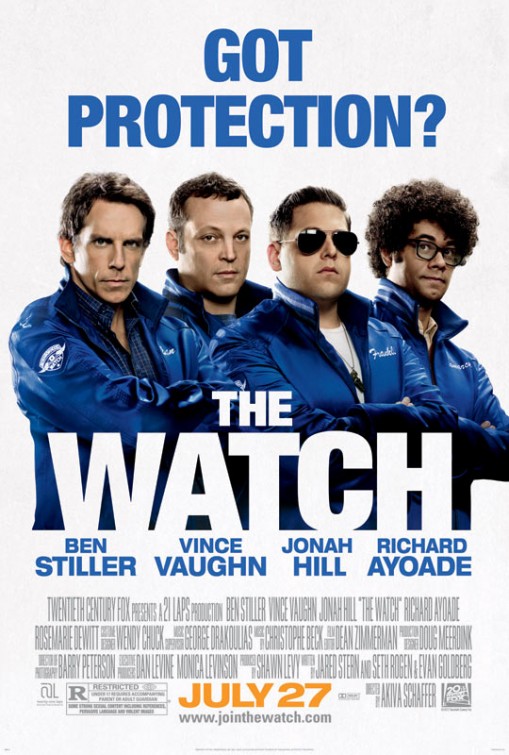 If scientists could take time away from, you know, curing diseases, and craft the perfect blend of “meh” in a lab, it would be The Watch. It’s not particularly offensive or terrible but it’s certainly not good. The humor of boys misbehaving and talking tough doesn’t ever seem to get further than the initial concept. The movie ends up becoming a more crass version of Ghostbusters, with a special fascination for the male member. This is a very penis-obsessive movie. Usually guy-centric sex raunchy comedies will definitely feature strong discussion/comedy revolving around male genitalia, but this is one of the few movies where complete storylines hinge upon penises (weird imagery, I’ll admit). Ben Stiller, Vince Vaughn, and Jonah Hill are more annoying than anything else. Poor Rosemarie DeWitt as the underwritten wife role in what is essentially a boys-behaving-badly movie (also her second 2012 movie where she’s trying to get pregnant). When the movie goes full-force into action mode, it loses just about any semblance of comedy. I laughed about three times, and that was thanks to Richard Ayoade (TV’s The IT Crowd) and, believe it or not, Will Forte (MacGruber). Sitting through 105 minutes with little laughs, irritating characters, and poorly conceived action in place of genuine comedic payoffs, well it’s not exactly a recipe for a successful summer comedy. And yet, with all its obvious faults, I couldn’t hate the movie as others have. It’s certainly not likeable but it does go about its business with a certain swagger, albeit misguided. Cocky loudmouths failing at entertainment are still marginally better than artists who don’t even try. It sounds like I’m reaching, and I am, but The Watch, certainly a bad comedy, may eventually be worth a watch when, you know, it’s on TV and you can half-heartedly pay attention to it while you go about your day.
Nate’s Grade: C-
Share this:

Prometheus (2012)
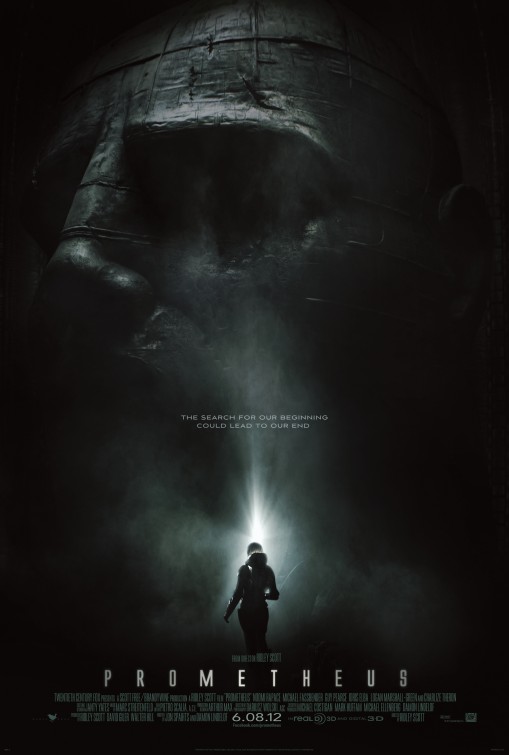 Ridley Scott has always wanted to go back to the Alien franchise that began with his 1979 sci-fi staple. There have been a lot of coy discussions over whether his big-budget sci-fi spectacle Prometheus is indeed an Alien prequel or not. Scott keeps hinting it has the DNA of the franchise but exists on its own. This movie has some Big Questions on its mind, like where did we come from, but the biggest question out there is whether it really is an Alien prequel or not. Well rest assured, that question will be sufficiently answered. Now if you have more than that, you will be left empty-handed with this gorgeous but ultimately confounding sci-fi thriller.
In 2089, a team of archeologists, lead by Elizabeth Shaw (Noomi Rapace), discover an ancient star map from 30,000 years in mankind’s past. This is not the only ancient illustration displaying the same constellation. Sure enough, in every ancient civilization across the globe, the same star pattern. Shaw believes it is an invitation and th key to finding the “engineers” who may be responsible for life on Earth. Four years later, the wealthy Peter Weyland (Guy Pearce) has funded a trip to that exact point in space, which harbors a moon that seems extraordinarily like Earth and capable of sustaining life. The ship is run by Meredith Vickers (Charlize Theron). who keeps asserting her company’s authority on this mission. Along for the ride is a cocksure pilot (Idris Elba), an android named David (Michael Fassbender), and Shaw’s own lover, a scientist in his own right, Charlie Halloway (Logan Marshall-Green). When the gang gets to that moon, they uncover large buried structure with some nasty surprises inside. Suffice to say, they should have stayed home.
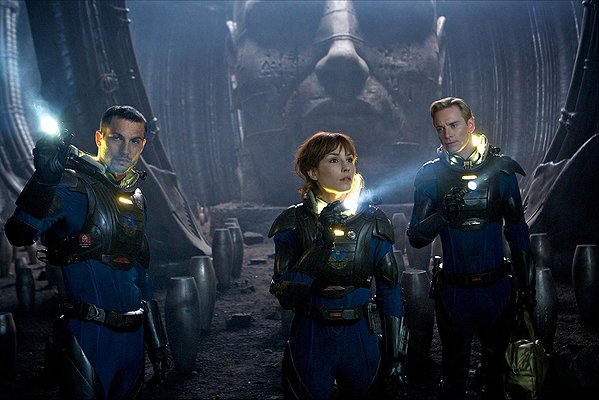 You can always count on Scott to deliver a visually extravagant picture, and Prometheus is packed with stunning, arresting visuals that fill up the big screen with lovely detail. The scale of some of these sets is massive, and your eyes just want to soak up every detail. The alien world is vast and eerie and you just want the characters to spend the rest of their lives exploring it (Scott shot in Iceland but it looks remarkably like a whole different world). The interior sets on the space ship are also sleek and cool. There’s a terrific sense of immersion in the movie. Scott has always done a great job at building worlds that feel completely lived-in, and Prometheus is another example of his talents. The special effects are astonishing but best when not dealing with the biological life forms. The giant spaceship is incredible; its inhabitants? Not so much. Apparently our DNA grandfathers looked like giant Michelin men (thankfully we take more after our mother’s side). Prometheus demands to be seen on the biggest screen possible.
Prometheus harkens back to the original Alien in its suspenseful “haunted house in space” setup. The movie has some terrifically taut moments and a great overwhelming sense of dread. The scientists let curiosity get the better of them, so they poke their heads in dark corners, touch unknown alien material, and get up close and personal with things better left unmolested. If slasher movies elicit a “Don’t go in there” audience response, then Prometheus certainly elicits a “Why are you touching that?” reaction. And yet, deep down, we want them to keep pushing further because like the best suspense films, we can’t stand the tension but we really want it to keep going. Probably the most memorable scene of them all involves Shaw performing her own hurried abdominal surgery to remove an alien from inside her. It’s creepy and caused me to wince repeatedly, but man is it fun and gruesome and a nice payoff to an earlier setup. The rest of the movie is pretty standard with its thrills, including the canon fodder supporting characters getting picked off unceremoniously, and the large-scale devastation climax. The movie delivers the goods when it comes to entertainment and suspense, though mostly in the first half. It’s almost like the movie is awed by the visuals as well, and then halfway in remembers, “Oh yeah, we got to do more than just poke at things,” and then it’s a rush to the end with a cascade of conflicts that don’t seem properly developed.
The film lays out a very essential question about the origins of mankind and plays around with theological concepts but it only plays in the shallow end of the philosophical pool. The screenplay by Jon Spaihts (The Darkest Hour) and Damon Lindelof (co-creator of TV’s Lost) deals with the conflicting origin stories via religion and observable science but never goes into specifics. “Religion” is always symbolized as a cross necklace that Shaw wears and her falling back point upon what she “chooses to believe.” The discovery that our alien forefathers have a similar appearance would be a huge revelation, except the movie spoils it with a clumsy prologue that shows us right off the bat what the “engineers” look like. Prometheus actually posits an Intelligent Design argument for human existence, albeit one the Raelians have been promoting for years, the idea that intelligent life outside our galaxy seeded Earth. Yet the one scientists on the crew, the one who objects to 300 years of evolutionary evidence, remains mum on the matter. I suppose the filmmakers didn’t want their monsters-in-space movie to be bogged down with that much pithy philosophy, but I would have appreciated some meatier conversations other than, “Should we touch this?” It’s not nearly as thought provoking or as compelling as it thinks it is.
As I sit here and I write this, the plot becomes a wispy memory of strong set pieces and eerie mood, but I cannot connect the story. It makes little sense and by the end of its 124 minutes we’re left with hardly any more answers than we started with (some spoilers to follow). Our genetic “engineers,” as they call them, remain pretty nebulous. I suppose one could argue that it would be impossible to fully understand an alien race’s habits and purposes without resorting to pandering, but that strikes me as a cop out (I’m reminded of Spielberg’s similar approach in Kingdom of the Crystal Skull, where the characters that wanted to know were punished for their intellectual curiosity by alien forces). Why did these super aliens create life on Earth and leave maps to a planet that was little more than a weapons depot? Why would these superior beings create life hundreds of thousands of years ago and then leave clues 35,000 years ago that would lead to the destruction of their little experiment? The motivation seems rather hazy. It’s not like the aliens created life on all these planets and waited to be contacted so that they knew their little biological Easy Bake oven was done and then they could reclaim a new planet. It’s not some imperialist empire or colonization scheme; it appears to just be wanton destruction. That seems like a waste of effort. Did these aliens keep checking back, see our ancestors hunting and gathering and go, “Oh my Space Deity, I can’t believe we created life on this planet? We were so wasted. Well, just wait until they conquer space travel and then we’ll kill them with a weird biological weapon.” If your desire is to destroy life, why even have a waiting period? If these “engineers” wanted to destroy Earth why not do it when there was far less clean up? Is there some kind of parent-child relationship I’m just not getting here?
 Fassbender (X-Men: First Class) makes the biggest impression as the fastidious android, David. He’s by far the most interesting character and he’s not even human. It doesn’t take long to figure out that David has his own agenda, and Fassbender plays the character with this eerie passive-aggressive arrogance. You get the sensation that he looks down on his human clientele, but you don’t know what lengths he will go. “How far will you go to get your answers?” he asks before doing something very not nice. He makes statements like, “Who doesn’t want to kill their parents?” and there’s an icy placidity to him; he’s just off enough to be menacing and unsettling without going overboard. Fassbender is excellent.
The rest of the cast cannot be at fault for failing to measure up to Fassbender (is that a Shame joke I stumbled upon?). Rapace (Sherlock Holmes: A Game of Shadows) is given top billing and does an admirable job of being a kickass heroine, which we already knew she was fully capable of in the Swedish Girl with the Dragon Tattoo trilogy. She even has a Ripley-esque haircut, which I doubt is a coincidence. Theron (Snow White & the Huntsman) gets to once again practice her ice queen routine, but I wish she had more to do than occasionally glower and bark orders. Her character’s secret background should be obvious to anyone well versed in the film economy of characters. Elba (TV’s superior Luther) tries to stick it out with some twangy Texas accent but can’t make his way through. His natural British accent pokes through routinely. Then there’s Guy Pearce (Lockout) as the wealthy benefactor who bankrolled the whole project. Apparently he was hired to film viral videos as himself, because in the movie he’s like a 100-year-old man in some pretty poor makeup (he resembles old Biff in Back to the Future: Part 2). Why hire an actor of Pearce’s caliber if you’re just going to hide him under a veil of old-age makeup? The actors do what they can but the film doesn’t give them much to work with. They’re stock roles and absent development. You don’t notice for a long while because you’re so caught up in the exploration and the gorgeous visuals, but when the end comes you realize that you hardly knew these people.
After all the pre-release coyness about whether this belonged in the Alien universe, Prometheus seems to be a victim of its own sky-high hype. The movie is moody and dark and intriguing and visually magnificent, but the plot does not hang together at all. The central mystery of the origins of mankind is given a face to start with, but that’s about it. The confusing story tries to mask its plot holes but eventually they just overtake the movie. It’s an entertaining movie in the moment but Prometheus pretty much evaporates as soon as you leave the theater and start thinking, “Hey wait a minute, that didn’t make any sense.” Why are mankind’s “engineers” a regretful bunch of jerks? Scott’s visuals are impressive, the film has a killer mood that’s hard to shake, but the plot is pretty shaky and reliant on supposedly smart people making pretty dumb decisions (why yes, I’ll try and touch the alien snake monster thing). That’s fine for basic thrills but it doesn’t elevate the movie into something headier, meatier, and more satisfying, like the original Alien. Prometheus was never going to meet the unattainably high expectations of fans stoked by tremendous trailers and the promise of Scott’s triumphant return to sci-fi, but much like the characters in the film, I was glad to go on this journey but wished I had more to take home with me.
Nate’s Grade: B
Share this:

Men in Black III (2012)
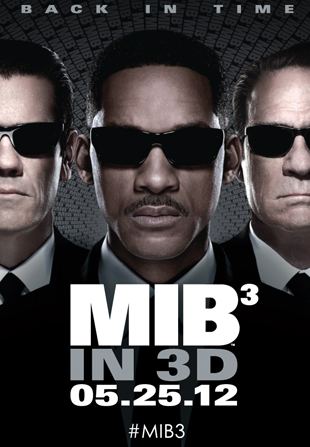 It wouldn’t be a Men in Black film without script problems. The first film languished for some time, originally taking place in Kansas of all places, before director Barry Sonnenfeld became attached and insisted upon a New York City location. The 1997 sci-fi buddy cop comedy was a hit, and rightfully so, and Will Smith became a megastar. Then the 2002 sequel’s climactic action sequence had to be rewritten due to the fact that it was originally going to take place in the World Trade Center. If only that lackluster sequel had gone through more extensive creative revisions. However, these past hiccups don’t seem to come close to Men in Black III, which to Sonnenfeld’s admission, started shooting in late 2010 without a finished script. It had a beginning, an ending, but nothing definite to tie together. So the whole production took eight months off to work on the meat of that movie sandwich. Hollywood movies, especially modern films of huge-scale budgets and set release dates, have routinely started production without completed scripts, including Gladiator, Jaws, Apocalypse Now, and Lawrence of Arabia. Naturally, those are the exceptions to the rule.
Boris the Animal (Jermaine Clement) has escaped from pison and out to seek revenge on the man who put him away and took his arm – Agent K (Tommy Lee Jones). Boris travels back to July 1969, when a young Agent K (Josh Brolin) thwarted the big bad Boris. Boris kills Agent K and alters the future. The Earth is now vulnerable to an alien invasion from Boris’ species. Agent J (Smith) has to travel back in time to save his old partner and the planet.
It’s been ten years since the spotty Men in Black II and almost four years since Smith has been seen in a movie. Where did the time go? Fortunately, this third movie hews closer to the droll brilliance of the first film. Part of that is a sharper story with a more clearly defined goal and a return of the playful exuberance that belies the franchise. Also, I must say that absence has made the heart grow stronger, because I’ve missed Smith’s effortless charisma onscreen. Agent K is such a natural fit for the guy and it’s just fun to watch him stumble through strange alien encounters (this time we learn all super models are aliens; listen good, young women of America who punish themselves to fit this image of beauty). Time travel is usually employed when a franchise seems like it’s all out of gas; it’s usually more focused on the comic fish-out-of-water possibilities, which there are a few in Men in Black III. As one characters notes, 1969 wasn’t exactly a great time for black people in America, and J combats casual racism, black panic, and ignorance with a defiant attitude that is amusing to watch. I’m glad the whole race-relations reality was addressed, though it’s also for the best that the movie doesn’t get bogged down with scenes of Agent J conflicting with bigoted authority. Men in Black III remembers that we’re here to have fun, and the screenplay by Etan Coen (Tropic Thunder) has a light-handed touch. I enjoyed the opening jailbreak sequence with Boris, though I would have thought a lunar prison would have better security. Bill Hader (Superbad) has a fun cameo as a self-hating Andy Warhol, really an undercover MIB agent, though the idea that Warhol’s Factory artists as aliens seem a tad simple. The glaring cameo omission was Jon Hamm (TV’s Mad Men) as a scotch-drinking MIB ladies man of legend.
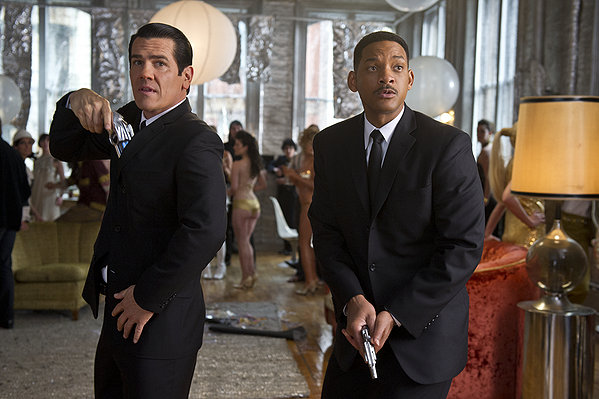 As evidenced from the trailers and marketing, Men in Black III is really Brolin’s movie. The guy establishes an uncanny Tommy Lee Jones impersonation. The eerie brick-faced stoicism, the melodic lilt of his voice, the syncopation of his speech patterns; Brolin nails it all. Watching his interaction with K are the film’s most enjoyable segments. At this point in the series, Agent J and K have gone beyond the rookie/mentor phase and now have something of a friendship, though their arguments at year fifteen of their partnership sound more like the arguments they would have in year two (you need to “open up” and be less grumpy, sounds elementary). Still, there is a personal connection to this case that eluded the last movie, and it gives the film a sense of urgency even when the comic shenanigans seem to hog the spotlight. The personal reveal in the last act didn’t have as much emotional power for me, mostly because I did the math and realized whom a certain unseen character of significance was before we got their true identity. The end does give the film series a circuitous sense of finality.
For a franchise that seems like it can go anywhere at any time with limitless possibilities, the worst thing you can do is be shut off to better avenues of storytelling. Take for instance the climax at Cape Canaveral, which itself is a rather anticlimactic sequence involving the launch of Apollo 11 (don’t they know that alternative 1960s history was sooo summer of 2011?). J has his time travel doohickey that lets him travel back. He gets to use this device once during the climactic fight, allowing him to travel back one minute in time so he knows how to properly duck. That is it. What a fantastic waste. If you’ve got a device that essentially allows for unlimited do-overs, then I want this device to be an integral part of the climax. I want J to have to regularly use it to fix past mistakes and learn more and more from each time jump. Just memorizing how to duck is lame. The entire subplot with Agent O (Emma Thompson in the present, Alice Eve in the past) and her dalliance with K is so carelessly thrown away that I wonder why the filmmakers even bothered to include it. Then there’s our villain, Boris, whose name itself is even lazy. He’s just a bad dude with some sort of insect that lives in his hand and shoots spikes. That is it. He’s a guy who can fire projectiles. So what? What about that makes him interesting? An unrecognizable Clement (Flight of the Conchords) does his best but the character just doesn’t have anything about him that deserves special attention; he could have been any villain (I think Vincent D’Onofrio was undervalued in his go-for-broke physical performance as the first film’s villain). I did like the idea of Present Boris arguing with Past Boris, but like most promising ideas in Men in Black III, this space-time sparring is never fully realized. While enjoyable, there’s little you’ll be able to think back on with Men in Black III and say, “That was well developed.”
Paradoxically, I think Men in Black III has a character that might simultaneously be the best and worst thing about the film. Allow me to explain. About halfway in, we’re introduced to the alien Griffin, played by the great Michael Stuhlberg from A Serious Man and TV’s Boardwalk Empire. He’s a creature who can see nigh unlimited timelines, all the variations of choice and possibility play out before his eyes, one after another. He never knows which timeline he’s in until the moment occurs, thus he’s constantly worried about every moment to come in his life. This foreknowledge sounds like a wretched curse, and with Stuhlberg gives a forlorn edge to his character’s eccentricity. So when J and K meet the guy, there are some clever moments, like when Griffin details every peculiar aspect of chance that lead to the 1969 Mets World Series victory. The moment, and by extension the character, is a nicely reflective idea that every moment is a miracle of causation. Griffin is just an interesting character. Here’s where the worst part comes in. Rarely is he treated as a character because, you see, Griffin is really a magic plot device. He can tell the Men in Black agents whatever they need to do at any point, instantly providing a narrative cheat. When in doubt, just ask the guy who sees the future and he’ll steer you without fail to the next necessary plot point.
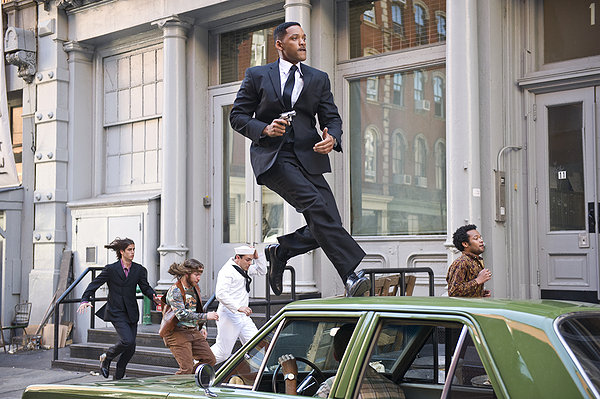 I saw this movie in 3D, not by choice mind you, and for the first half hour it felt like one of the better 3D conversions out there. Sonnenfeld’s camera plays a lot with depth of field and primarily forward-backwards movement, which made for a slightly elevated viewing experience. But somewhere around the halfway mark, I swear the movie forgot it was supposed to be 3D and the dimensional differences became negligent. It never really recovers, and so I advise all potential ticket-buyers to skip the 3D screenings.
With most time travel escapades, there’s going to be some plot holes. Working with a flurry of alien technology, it would have been exceptionally easy for the filmmakers to just explain away the plot holes with some magic device, much like the Paradox Machine in Dr. Who. Hey, there’s a machine that makes sure we don’t have paradoxes? Good enough for me. It’s like in Thank You for Smoking when Rob Lowe’s character explains why actors would be able to smoke in an all-oxygen space environment: “It’s an easy fix. One line of dialogue. ‘Thank God we invented the… you know, whatever device.’” The fact that Men in Black III doesn’t even address its biggest plot hole astounds me. If Agent K is killed in 1969, then he was never alive to recruit Agent J into the service. Let’s even assume that J’s credentials would still get him noticed and staffed with the MIB; if Boris killed Agent K in the past, then there was no reason for Boris in the future to travel back in time to kill Agent K. Again, these aren’t nit-picky gripes, these are major, easily understood plot holes, and I’m dumbfounded why no characters even address them. I could nit-pick over why Boris decides to go to 1969 when he just as readily could have gone to a time when K was a child and thus more vulnerable. Surely a child is easier to dispatch than a 29-year-old man.
Men in Black III is a far improvement over its stilted predecessor, but it still ends up falling well short of the potential it flashes. It’s intermittently amusing with some fun cameos and some visual panache, but this movie should have been stronger, stranger, and more playful with its central time travel conceit. It’s hard to work up that much distaste for the movie, especially since it has such a lively, jocular feel. Not all of the jokes work, but enough do, and the movie maintains an overall pleasant sensibility, zigzagging in imaginative directions that most Hollywood movies never beckon. It’s the stuff that works that illuminates the potential left behind as it goes into summer blockbuster territory. Men in Black III is an example of diminished returns, yes, but some franchises start so high that even latter, lesser sequels will have more entertainment value than their competitors. While it won’t set the world on fire, Men in Black III exceeds expectations and provides enough entertainment that it’s worth a look and little else.
Nate’s Grade: B


 nathanzoebl
You must be logged in to post a comment.