Blog Archives
The Holdovers (2023)

Oscar-winning director Alexander Payne and Paul Giamatti re-team for a poignant and crowd-pleasing holiday movie about outcasts sharing their vulnerabilities with one another over the last week of 1970. Giamatti stars as Paul Hunham, a rigid history teacher at an all-boys academy who just happens to be liked by nobody including his colleagues. He gets the unfortunate duty of staying on campus during the Christmas break and watching over any students who cannot return home for the holidays. Angus (Dominic Sessa) is the last student remaining, a 15-year-old with a history of lying, defiance, and on the verge of expulsion. The other holdover member is Mary (Da’Vine Joy Randolph) as the kitchen staff forced to feed them, a woman whose own adult son recently died in Vietnam. The teacher and student butt heads as they try and co-exist without other supervision, eventually connecting once they lower their defenses and attempt to see one another as flawed human beings with real hurts and disappointments. It’s a simple movie about three different characters from very different experiences pushing against one another and finding common ground. It’s a relationship movie that has plenty of wry humor and strong character beats from debut screenwriter David Hemingson. There may not be a larger theme or thesis that emerges, but being a buddy dramedy about hurt people building their friendships is still a winning formula with excellent writing, directing, and acting working in tandem, which is what we have with The Holdovers. It’s a slice of-life movie that makes you want bigger slices, especially for Mary’s character who thought having her son attend the same prep school would set him up for a promising future (he was denied college admission and thus deferral from the draft). It’s a beguiling movie because it’s about sad and lonely people over the holidays, each experiencing their own level of grief, and the overall feel is warm and fuzzy, like a feel-good movie about people feeling bad. That’s the Alexander Payne effect, finding an ironic edge to nostalgia while exploring hard-won truths with down-on-their-luck characters. The Holdovers is an enjoyable holiday comedy with shades of bitterness to go along with the feel-good uplift. It’s Payne’s Christmas movie and that is is own gift to moviegoers.
Nate’s Grade: B+
Share this:

Downsizing (2017)
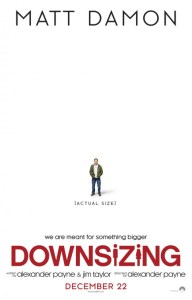 Alexander Payne is not exactly the first name you would think of when it comes to science fiction. The man has a history of road trip comedies, average Midwestern men, mid-life crises, and the colorful miscreants of society. The fact that the director of Sideways and The Descendants is tackling The Incredible Shrinking Man is a bold move. Payne is outside his comfort zone with Downsizing, and it shows at points. While never quite satisfying the possibilities of its premise, Downsizing is still worth watching for its memorable moments and for the sheer brilliance of one outstanding performance.
In the not-too-distant future, science has developed the technology to shrink human beings to five inches tall, approximately 1/100th of their size. A middle-income couple can live like the top one percent because their money goes further. Paul Safranek (Matt Damon) is a schlubby, regular guy suffering from the ennui of a job he hates and a life that feels unfulfilled. He and his wife, Audrey (Kristen Wiig), decide to undergo the downsizing procedure, which is irreversible. Paul’s wife backs out at the last minute but he doesn’t find out until after he’s gone small. Now with a McMansion all to himself, Paul has to readjust to what he thought his new life would be like. He moves into a condo and shirks the offers to join the parties of his hedonist neighbor, Dusan (Christoph Waltz). Paul finally decides to live life and embraces new experiences, the biggest befriending Ngoc Lan Tran (Hong Chau), a one-legged Vietnamese cleaning lady who was downsized against her will for being an overseas political activist. Paul feels drawn to this woman and she opens his eyes to the larger world around him.
 The strangest part of Payne’s movie is that the main thrust of the story could have been told without all of the science fiction dross. This is very much a romantic comedy/drama that follows the formula of a man jilted at the altar who has to get his life back together, finds someone new who changes his perspective on life, and then they get together by the end. You could have plucked this story and set it in an ordinary world and it still would have worked, which begs the question whether the world of Downsizing is properly applied. The consumer commentary seems muddled, with the rationale for downsizing being helping the planet, reducing the population so to speak, but really it’s an escape into a fantasy of wealth. People are downsizing so they can live in luxury and leisure. This should set up Payne for his incisive brand of satire as he skewers the selfish and self-righteous foibles of mankind, except that doesn’t really happen. Sure, eventually in the second half the movie opens up its tiny world a little wider, revealing the not-so-hidden subculture of immigrant labor toiling away to keep everything stable and pretty. It’s obvious social commentary and rarely does it go a step further than just recognition. And so the film becomes another in a long line of movies about a man who must be shaken from his malaise and enjoy the possibilities of life he never knew existed. Downsizing eventually ignores its sci-fi conceit to tell a relatively ordinary tale of self-actualization.
Payne’s premise would have best been explored through the more open parameters of a television series. Downsizing is an interesting concept that leads to other natural questions over how this tiny world operates and also how it interacts with the larger community. There’s a small scene where a drunk overhears Paul’s plan to shrink and argues that little people shouldn’t be granted the same voting rights as “normal-sized” citizens. The normies contribute more to society and should be given more credit, he argues, before being shooed away. This political division could have made for an interesting topic of reflection itself, but like many of Payne’s pit stops, it comes and goes after whetting your appetite for further examination. What about a story where downsizing is a punishment to do away with the “undesirables” of a nation? A TV series would have allowed more room to explore, with finer nuance, the details and possibilities of this fanciful world. Payne allows his movie to breathe, taking extended jaunts on different ideas but rarely enough to satisfy your sense of curiosity. The last act takes place at the original downsized colony in Norway, though at their diminutive size I wonder if it took them months to travel in Dusan’s yacht. It’s meant to think about what will come after humankind has passed the point of no return when it comes to climate change. Paul has to rethink what he wants his legacy to be and what meaning his life will have, which then pushes him into a rather simplistic choice of go with the girl or the cause. Given the rest of the movie’s focus, you shouldn’t be surprised what decision he ultimately makes.
 However, the real reason you should legitimately see Downsizing is for the astounding, star-making, can’t-take-your-eyes-off-her performance by Hong Chau (Inherent Vice, Big Little Lies). I cannot recall another movie where a character comes in at the halfway mark and just takes over completely, single-handedly lifting the movie up. Every moment she is onscreen is made better. You’ve never seen a character in a mainstream movie quite like Ngoc Lan Tran. She’s a political dissident, amputee, and lower-class cleaning woman who teaches Paul about the class divides. Tran is tragic, comic, caustic, lovable, and Chau is an acting revelation. I’ve read several reviews that found her to be a cringe-worthy, borderline racist depiction of an Asian woman meant to be laughed at, and I strongly disagree. At no point was I laughing at Tran because of her status, her ethnicity, or her broken English cadences. I was laughing because she was a force of nature that blew away the pretensions of others, that cut to the chase, and spoke her mind in a carefree and honest manner. Her matter-of-fact affectations are so perfectly delivered in accordance with the character’s personality. There are moments where her character is being set up for one thing and Tran goes entirely in another direction, and whereas you might have laughed at the start she surprisingly earns other emotions. Take for instance a scene where Dusan tries to ditch her by making an excuse about a sudden travel commitment. Tran takes this moment and turns it into a genuinely poignant monologue about the unexpected nature of fate. By the end she’s crying out of sheer elation, and those tears are not meant for ridicule. Downsizing realizes what an asset it has and makes her the deserved focal point of the second half. You’ll fall in love with her too. Chau doesn’t just deserve an Oscar nomination; she deserves to win everything.
Downsizing is an episodic high-concept comedy where the shrinking is irrelevant to the main storyline that evolves over two plus hours. This is an adult movie that explores some mature topics with surprising time and scrutiny, and then it can also be a simplistic rom-com that misses the mark on larger, Swiftian social satire. It’s another story in a long line of disaffected, middle-aged men finding their groove again, except then it becomes the story of a Vietnamese activist and her unique persona. Hong Chau is the reason you should see Downsizing above all. She doesn’t so much steal her scenes as just take full ownership over the back half of the movie. Her performance is so uniformly excellent that you wish the rest of Payne’s uneven movie could meet her commitment. There are a lot of ideas here that seem to get brushed aside for the conventional formula of a romantic union, even if the pairing is rather unconventional. Downsizing is an entertaining movie that doesn’t quite amount to more than the sum of its little parts.
Nate’s Grade: B
Share this:

Nebraska (2013)
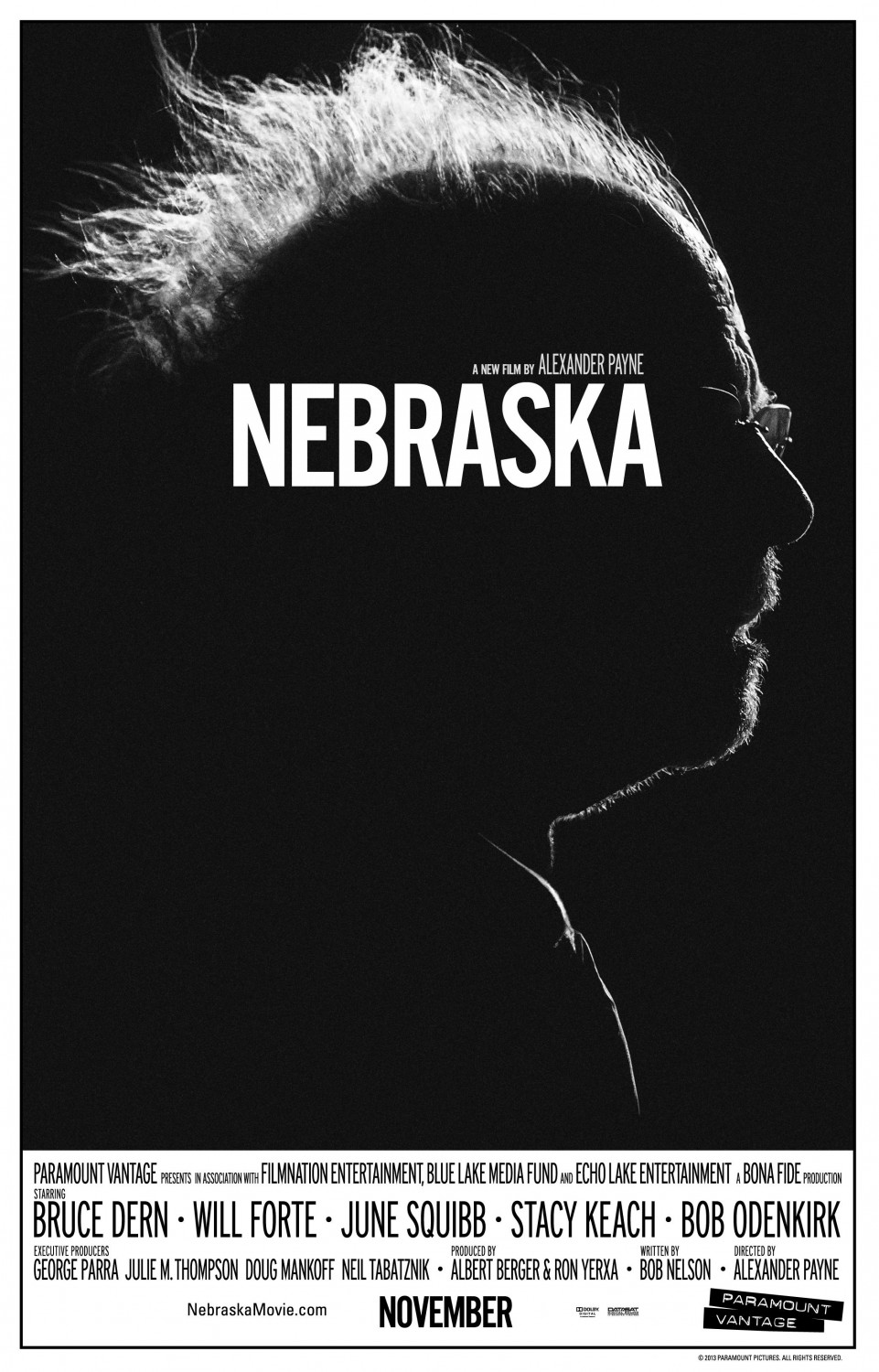 Nebraska is a slow burn, wryly-funny character study of understated proportions, highlighting Midwestern culture rarely given its big screen due. So, in essence, it’s an Alexander Payne movie.
Woody Grant (Bruce Dern) is an elderly man convinced he has won a million dollars and all he needs to do is travel to Lincoln, Nebraska to claim his loot. It’s one of those mass mailings really meant to get people to buy magazine subscriptions, but Woody will not be stopped, sneaking out to walk all the way to Nebraska from his home in Billings, Montana. David (Will Forte) is in a rut himself. He’s recently been dumped, his job is going nowhere, and his father refuses to accept his million dollars isn’t real. There’s a question of how lucid Woody is, and so to placate his old man, David decides to drive his father to pick up his winnings, to humor him before his mind may be gone for good.
 Despite the overtly sitcom machinations of the inciting incident, which even the characters dismiss, the film is really a drama about the relationship between a father and son and the culmination of our life choices. Woody and David are not close by any conventional means but over the course of their road trip, David begins to see his father in a different light; the old wounds are not forgotten, but David is learning about who his father is through others. He’s been so mad at his father for so long that it was the only identity he had for the man. Now in his deteriorating mental state and physical fragility, his father has a sense of vulnerability that brings about decidedly mixed emotions. In his fragile state, is he the same man or at least the same man David remembers? Then there are all the family revelations springing out from the situation. With a genuine millionaire in their midst, the family is coming out of the woodwork clamoring for their own pieces for all the unpaid assistance they’ve given Woody over the years. Initially, it makes Woody look like he’s been stuck trying to find his footing his whole life, as we learn about the lingering post-traumatic stress effects from his war service. Was he lazy, undiagnosed PTSD, or, as another character surmises, too ashamed to say no when others asked for help, and so he was taken advantage of in the guise of assistance from unscrupulous friends and family. The question remains who is Woody?
This is one of those observational slice-of-life films, and your enjoyment of it will depend on your threshold for the taciturn types. These are the strong silent types who keep most of their feelings to themselves. There’s a very funny sequence where Woody and his aged brothers have gathered around a TV, and to listen to the dry mostly car-related conversation bounce back and forth like a dead, floating wiffle ball, is a great comic moment but also a nice insight into an older generation and their communication. Given the perspective of the film, it’s hard to deduce whether the plainspoken people are being satirized or whether it’s a loving send-up of a specific culture. With Payne’s involvement, I lean more on the affectionate tweaking rather than a mean-spirited ridiculing of small town folk and their small town ways. There are funny situations, like David and Ross teaming up for some misplaced justice, and there are characters more broadly drawn for laughs, particularly Woody’s wife (June Squibb), but the overall interaction of the characters, their speaking vernacular, and how they viewed themselves, that is what made me laugh the most and appreciate the script. You feel like you’re dropping in on these people’s lives; every character feels like they could be a real person, not a stereotype. And boy does money really bring out the worst in people.
With Woody and his son visiting his old haunts, the movie inevitably becomes a reflection of a man taking stock of his life, regarding the choices he made and did not make. The pit stop in town opens up the character and David learns far more about his father, with old girlfriends, old business partners, and old rivals. What I appreciated further is that Nebraska doesn’t try and soften Woody; he’s not going to be some old curmudgeon who over the course of 90 minutes has his icy heart thaw and comes to realize the errors of his ways. Nope. Our views on the old man may soften when we get a fuller picture of who he is ad the life he’s lead, but the man himself is the same. He’s readily belittled, insulted, looked down upon, even by his own family members, especially his sassy wife. It’s easy for him to retreat into alcohol and wonder what if. As the family picture broadens and becomes more clear, the film approaches simply yet touching revelations about the family and the nature of legacy. There’s a father/son examination, but there’s also the discussion of what to do when your parents become too ill to take care of themselves. It’s not exactly The Savages, but there’s a circling sense of burdensome decision-making that provides an extra level of pathos to the sitcom setup. By the end, Nebraska squeezes out some earned sentiment without losing its edge or sense of identity. There’s a lot more going on then just some send-up of rubes.
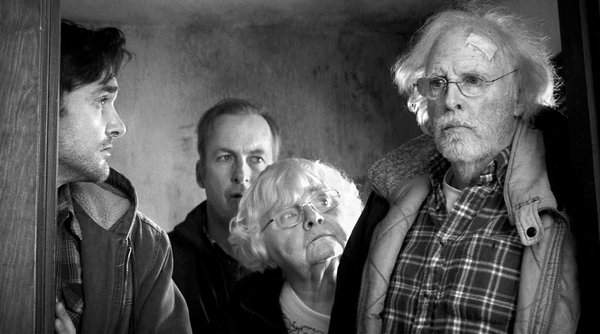 People have been raving about Dern (TV’s Big Love, Django Unchained) ever since the film’s Cannes premier, where the man earned top acting honors. The man deserves every positive words penned. He’s simply fantastic. The character vacillates between outward hostility, spacing out, and general Midwestern emotional reserve, and Dern is able to sell you on every emotional beat without breaking character. He’s unrepentant and demands to be taken for who he is, and his matter-of-fact bluntness has a certain charm to it, like when he admits to David that he never had any plans for kids. He just liked to “screw” and their mother was a Catholic (“You do the math”). I even appreciate that Woody would use the term “screw,” which seems more appropriate. As a two-man show, it’s a shame that Forte (TV’s 30 Rock, The LEGO Movie) doesn’t exhibit the dramatic chops to keep up with his onscreen pop. It’s nice to see him attempt something so different but his limitations are too evident; it’s just another gear that’s not present. At no point would I call Forte’s performance bad but he’s just unable to keep up. Squibb (About Schmidt, Meet Joe Black) is a hoot though the character seems to be permanently stuck in “wacky” mode. She’ll crack you up with her unrestrained commentary, but you may wonder if there’s any more to this character than saying outrageous, curt comments.
This was the last Best Picture nominee I’d failed to catch up with, and while it’s entertaining, funny, and unexpectedly touching thanks to terrific acting and a sharp script, but it also might be the weakest Alexander Payne film yet. This is the first film that the Oscar-winning director hasn’t written himself. Bob Nelson’s screenplay may never have even been glanced over by Payne had it not been for the state of its title (Payne’s films general take place in Omaha). It’s got Payne’s stamp, as would any film he directs, but it also feels like it’s missing something ephemeral, not to get too pretentious. This is a quality study of a cracked group of characters that, upon further review, aren’t as cracked as we may think. They’re just flawed people trying to get along as best they can. Even amidst the snide and antagonistic conversations, there’s gentleness here about the value of family that resonates above the din of the shouting. By film’s end, what started as a cockeyed sitcom transforms into a film that has more meaning and emotion, never betraying its guarded sense of self. When I say the weakest Payne film, this is not an insult but merely an observation. Even the weakest Alexander Payne film is going to be so much better than just about everything out there.
Nate’s Grade: A-
Share this:

The Descendants (2011)
 We’re so used to seeing George Clooney as a smooth operator, a guy who coasts on his suave charm and chiseled-from-granite good looks. But in The Descendants, Clooney is more vulnerable than he’s ever been, trying to keep his family together, and as the film plays out we realize just how mighty a task this goal is. His character is ill equipped to take the lead of his family, especially a family of growing girls he is consistently confused with. His journey is much more than just becoming a better father. That lesson would be far too pat for director/co-writer Alexander Payne. It’s been a good while since Payne’s last film, 2004’s Sideways, but in that time away he has shaped another outstanding human comedy that manages to squeeze in more emotion than most Hollywood movies could ever hope for.
Matt King (George Clooney) is a self-described “backup parent” who has been thrust into the lead role. His wife, Elizabeth, is in a coma after suffering a traumatic head injury from a Jet Ski accident. The doctors say that she has no hope of waking up and she will die in a matter of days. Matt must break the news to his 10-year-old daughter Scottie (Amara Miller) and his rebellious older daughter, Alexandra (Shailene Woodley). The headstrong Alexandra clashes with her faltering father, finally revealing the reason why she blew up at mom months ago. She found out that Elizabeth was having an affair. Matt is reeling and searching for answers from friends, family, and his two daughters.
 Payne’s specializes in pitch-perfect bittersweet character-based comedies, ones that seem to unfurl over a journey of self-awakening. His fictional worlds feel exquisitely rendered, where every character beat and every line of dialogue feels genuine. That’s quite an achievement for a filmmaker of any scope. Even when dealing with caricatures (like in 2002’s About Schmidt), somehow Payne gets away with it. With The Descendants, the sunny setting of Hawaii is just an exotic backdrop for some wonderful, and wonderfully relatable, family drama. It’s hardly the worry-free paradise. Uncovering his wife’s secrets has lead Matt to reassess the woman he loved. The movie completely upends the standard deathbed goodbye trope. Instead of characters openly bawling about the loss of a saintly soul taken far too soon, we have characters dealing with real conflicted emotions, particularly anger, directed at the indisposed and unfaithful mother. Every character is approaching grief differently, and every character is trying to make sense of their feelings before Elizabeth’s inevitable passing. Matt’s father-in-law (Robert Forster) is harsh with accusations at the ready, blaming Elizabeth’s tragedy on Matt’s shortcomings as a husband. His pain is raw but al too recognizable. Matt and Alexandra are plotting how much info to reveal to young Scottie, trying not to ruin her image of her mother, a tremendous challenge with no easy answer.
This is the stuff of grand drama, and Payne doesn’t skimp on the heart-tugging moments. The Descendants is also a great comedy, naturally finding humor drawn from the situation and characters. The advertising has made The Descendants appear like a broad family comedy, with Clooney flapping around in his noisy flip-flops. This is not the case. The comedy doesn’t feel insensitive or too macabre, instead it adds another enlightening level to these people and their pain. We try and make sense of our world, to cope with our struggles and failures, with comedy, and so too does Matt and his family. You’ll probably be surprised how often you laugh and then in the next moment feel a lump in your throat. The character of Sid (Nick Krause) starts off as a questionable plot tagalong, a doofus for some easy laughs. His reaction to an elderly woman with Alzheimer’s is the movie’s one point of questionable validity. As the film progresses, this laid-back guy is revealed to have more layers, just like the rest of the clan. The second half of the film becomes something of a minor key detective story as Matt and Alexandra search for the elusive “other man.” As Alexandra eggs him on, the two bond over this manhunt and Matt becomes bolder, more confident, and clear-headed about the hard decisions that are necessary for his new life. The emotional rewards of the film are nourishing. Watching Matt and his daughters sit on the couch watching a movie together (March of the Penguins no less. Draw your own connections about parental turmoil), you’ll feel satisfied that this broken family has begin to heal itself.
The Descendants takes an interesting turn when we learn more about the other man’s background. Matthew Lillard (Without a Paddle) is actually respectable as Brain Speer, the real estate titan having the aforementioned affair with Elizabeth. Matt’s confrontation is subdued, sidestepping righteous grandstanding for a better attempt to seek understanding. Instead of lecturing Brian, he wants to know more about what his wife was after that Matt could not offer. Sure he’s still angry and doesn’t let the guy off easy. Complicating matters is the fact that Brian has a wife, Julie (Judy Greer), and two children. Matt is trying to find answers without willfully harming Brain’s family. Greer (Love Happens) has an outstanding sequence where she feels beholden to forgive rather than hate, a note of grace that feels rather profound.
Clooney at one point says he’s just trying to keep his head above water, and you can see why. The man shows a great deal of range as his character confronts his grief. There is no “right” way when it comes to grieving, something deeply personal. Matt’s dilemma is given an unlikely situational twist, but the feelings of betrayal and confusion are all too believable. Matt is looking for answers when the person who holds them all lies sleeping. As he develops a lager picture of his wife and her unhappiness, Clooney expertly flashes through a multitude of thoughts. While arguably not as textured as his performance in Up in the Air, Clooney is in fine form, showcasing a deeper sense of loss and anxiety. Matt is trying to find his footing while his world radically adjusts, and nothing has adjusted more than his feelings toward his wife. Clooney doesn’t have any Big Moments of Great Emotion, though lashing out at his comatose wife comes close, but the man’s nuanced portrayal of a life in flux is the stuff that award ceremonies were made for.
 Woodley is a remarkable discovery, more than holding her own with Clooney. She is excellent in her portrayal of an aggressive, mouthy, rebellious teenager. It’s all the more astonishing because Woodley’s long-running TV show, The Secret Life of the American Teenager, is one of the worst shows still running on television. The show is so inartful, the dialogue is so tin-eared, and the acting is wooden like the actors have been imprisoned. Where has this actress been the whole time? Woodley’s performance is so alive with genuine feeling, stripping away any reservations of the too typical bratty teen role. She’s much more than a troubled teen sent off to boarding school. Her every inflection, hesitation, motion feels completely natural for her character, and when Woodley gets her big dramatic scenes she is a force to witness. Upon the sudden news that her mother will die soon, she plunges underwater in the family pool and screams as loud as she can, tears squeezing out of those sorrowful eyes. For goodness’ sake, this girl cries underwater. An Oscar nomination is assured for the 20-year-old young actress. Maybe she can quit her crummy TV show after the wave of good press and fawning praise that await her.
The Descendants is an incredibly observed human drama, a humane and touching comedy, a movie so engaged and plugged in to the messiness of human emotions, eschewing the bitterness of some of Payne’s earlier works. This is a thoughtful and nuanced flick that is elevated to even grander heights due to the excellent performances of father/daughter team Clooney and Woodley. The film hits all those traditional emotional notes but on its own terms. The movie approaches a graceful resolution by accepting the incomprehensible disarray of life. The Descendants is just about everything you’d want in a movie: supreme acting, strong characters, an affecting story, and emotions that are completely earned. Payne’s mature and tender movie is, by the end, rather hopeful, a celebration of family overcoming adversity. It’s not schmaltzy in the slightest but a powerful antidote to simple cynicism. This holiday season, be a good movie citizen and spread the word of The Descendants.
Nate’s Grade: A
Share this:

About Schmidt (2002)
January at the theaters is a tale of two kinds of films. One type are the studio bombs (take Just Married and Darkness Falls, please take them far away). The other type are the prestige pictures expanding their releases in hopes of garnering some of that Oscar magic. A lot of prestige films were released around the holidays and though not every one could be a winner, they were all better than Kangaroo Jack. Well, except for The Hours.
 About Schmidt (2002)
Premise: Retired and recently widowed, Warren Schmidt (Jack Nicholson) must learn to live his own life for the first time. Warren travels across the country to rediscover himself and stop his resentful daughter from marrying a man-child with a mullet.
Results: Nicholson downplays his usual shark grin to deliver one of his best performances in a funny, tragic, savage yet warm-hearted film. About Schmidt, from the creators of Election and Citizen Ruth, is one of the best films of 2002.
Nate’s Grade: A


 nathanzoebl
You must be logged in to post a comment.