Blog Archives
Prince of Persia: The Sands of Times (2010)
 This video game adaptation has the curious distinction of being both too simplistic and too complicated, sometimes in the very same breath. The harried screenplay could have used a lot more clarity concerning back-story, exposition, character roles, setting, rules of this Middle Eastern time period, supernatural rules, etc. At the same time, Prince of Persia is saddled with a pretty dopey story with weak characters. The plot is far too repetitious; somebody has the magic dagger that can turn back time, they lose it, they regain it, they lose it, repeat for over an hour. It feels like the story is never getting anywhere despite the fact that new, and still weak, characters are being introduced. The tone and look of the movie feels too beholden to its video game roots; the action is momentarily rousing but then seems overly coordinated to squeeze in all the game’s special signature moves. You’ll grow tired of all the wall flipping, wondering if a controller is stuck somewhere. For a movie dealing with a time-traveling dagger, give me more time travel. This fantastic plot device is used too sparingly in a ho-hum plot about an adopted son (Jake Gyllenhall, buff and with a sporting accent) of the king being accused of killing the king. Despite the Disney name, this feels less like a Pirates of the Caribbean knockoff and more cut from the same cloth that gave us the Mummy sequels. It’s loud, stuffed with empty special effects, and feels like junk food for your brain but it’s not even good junk food. Weirdest of all, the movie is one big metaphor for the U.S. invasion of Iraq (acting on false intelligence about some country aiding an enemy by manufacturing weapons). Seems Prince of Persia is Hollywood’s second attempt to rewrite our past political blunders in the Gulf and come up with a dubious happy ending.
Nate’s Grade: C
Share this:

Up (2009)
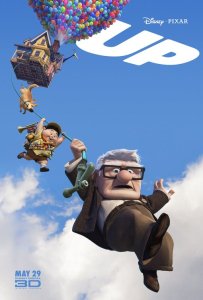 With every new movie Pixar re-establishes itself as the most creatively reliable studio in the business. And every year some critics beat the drum that THIS is the movie that will break free from the animation ghetto and earn a Best Picture Oscar nomination. If anyone out there would like to tell me how The Reader could be a superior film to WALL-E, by all means enlighten me. Pixar has been producing engrossing and complex entertainment, not merely cute cartoons. But if WALL-E failed to score a nomination in a so-so film year, then I doubt that Pixar’s latest, Up, will fly into the winner’s circle.
Carl Frederickson (voiced by Edward Asner) is a cantankerous 78-year-old man who wants nothing more in life than to be left alone. He lives in a house he built with his late wife, Ellie. They met when they were kids and bonded over a shared love of thrill-seeking adventure, like their hero, explorer Charles Muntz (Christopher Plummer). Ellie’s dream is to eventually travel to Paradise Falls in South America, but she never lives to see it. Carl is about to be thrown into a retirement center and have his home demolished, so the geezer hatches an escape plan. The former balloon salesman attaches thousands of balloons to his house and floats away headed for Paradise Falls. Carl is ready to enjoy the quiet when he gets a knock at his front door. He has a stowaway. Russell (Jordan Nagai) is an overweight eight-year-old determined to get his last Wilderness Scout badge, which involves helping the elderly. Together, they journey through the jungles of Venezuela and find remarkable discoveries and constant danger, including the presence of a sinister and still very-much-alive Charles Muntz.
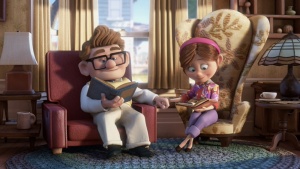
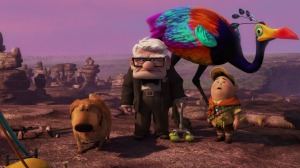 Up is the colorful tale of a dreamer who longs for escape, and you feel the same rush of excitement to be unbound and take off. Naturally, there will be bonding between the grouchy old man and the earnest kid. Up really becomes an altogether different movie once it lands in Venezuela. It transforms into an unconventional adventure story replete with talking dogs and giant birds. I loved the Dug character and was bemused at hearing the scattered thought patterns of man’s best friend (“I have just met you and I love you”). The side characters somewhat steal the show and, at the same time, feel overextended. With that said, I’ll probably end up buying my wife a talking stuffed Dug. The last act soars with about 20 minutes of thoughtful, exciting, well-constructed action weighted by an emotional connection to character. At the same time, Up tackles some major issues and does so without getting mired in sappy sentimentality. Carl is dealing with loss and has hardened against a world he feels indifferent to. Up almost had me in tears within the first 10 minutes during its elegant wordless montage charting the courtship and marital life of Carl and Ellie. It’s a fabulous moment and greatly economical, packing an emotional punch unequaled by the rest of the film.
The visual storytelling is still top of the line entertainment. The animation is superb as usual. The flying house is an explosion of colors and instantly brought a smile to my face. Carl’s character design looks like he was a Lego character that was brought to life. He’s all square and boxy whereas Russell is round to the point of being an Easter egg with legs (is Russell Asian-American or biracial, or is it just a character design that I’m reading too much into?). The South American jungles are lush and filled with inventive creatures. I saw the movie in a conventional theater but the option is out there to catch the movie in Disney 3-D, but I don’t think it will add much to the whole experience.
The central image is lovely and instantly iconic: the house floating through the clouds thanks to thousands of colorful balloons. It’s a beautiful image and a perfect metaphor for the memory of Carl’s deceased wife. They built that house together and lived a full life inside, he refers to the house as “Ellie,” and at one point Carl even ties the floating house to his back, tethering her memory to Earth while simultaneously carrying his grief with him at every step. The idea of a flying house tickles the imagination and yet never once demands more critical examination. We accept that Carl has rigged the house to take flight and never once stop and question the extreme engineering improbabilities. The flying house is just the mode of transportation for the characters to complete their story, but it is not the whole story. Think of it as a more comfortable mode of family flying than a queen-sized mattress that included Angela Lansbury (1971’s curious Nazi-fighting family flick, Bedknobs and Broomsticks). The rest of the movie never quite matches the directness and depth of that visual metaphor.
 Up ducks out on making its tale more of a feeling, living movie, something more than striking visuals and some fun set pieces and odd characters with a dash of sentiment. Up establishes its strange story elements but then doesn’t plausibly make much more out of them. The story becomes a somewhat constricted rescue caper to return a Mama bird to her babies and keep her out of the hands of a Bad Man. Charles Muntz is a fairly weak villain. I’ve also got a burning question: if Carl is 78 years old, how old exactly is his childhood hero, Muntz? It’s a bit simplistic and that’s fine, and it’s still an enjoyable conclusion, but the movie doesn’t ascend from the sum of its parts like the finest works of Pixar, like WALL-E and The Incredibles. This one’s just missing some of that Pixar magic. Yeah, there’s the overall arc of Carl overcoming the loss of his wife and softening his hard exterior, but tell me what exactly else happens that matters? The kid makes a friend? It’s about human connection but how exactly is that best served by giant birds and talking dogs flying biplanes? Up also isn’t as visually arresting or creative as previous Pixar flicks, aside from that floating house. As far as Pixar films go, this is about square down the middle (between Monster’s Inc. and Finding Nemo, better than Cars and A Bug’s Life). But even that statement is prefaced by the fact that Pixar’s output is generally head and shoulders above every other studio in technical precision, creative ingenuity, and emotional heft.
Up takes some fancy flights of imagination and has plenty of humor and charm to make it a family-friendly winner. I have some reservations with the movie and its plot, but there’s no question that Pixar knows how to construct a movie that manages to appeal to everyone, even if it involves cranky old men as unlikely action heroes. I feel like perhaps Up is suffering because it has the rotten luck of following the release of WALL-E, a timeless masterpiece that I have since watched probably over 30 times. Up is a warm-hearted and engaging film even if it never reaches the creative and emotional heights of other Pixar masterworks. Still, a “pretty good” Pixar movie has a legitimate shot at being the best movie I see this summer.
Nate’s Grade: B+
Share this:

The Spiderwick Chronicles (2008)
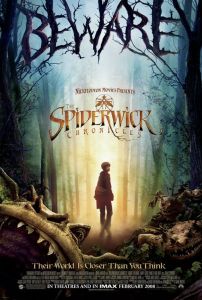 This imaginative fantasy family film is adapted from five books from the Spiderwick series, so you’ll be forgiven for thinking that it packs a lot of storylines at a brisk pace. This 97-minute film should appeal to all members of the family because, while derivative, it has plenty of action, interesting fantasy characters, and even some palpable thrills. The movie has a better handle over interspersing psychological real-world drama with the monsters. Freddie Highmore is the best special effect in the film as he plays two twins who are vastly different in personality and temperament. Director Mark Waters (Mean Girls) deals with the fantastic but also makes the film feel grounded, never letting the otherworldly elements to take over. The movie is a modestly entertaining escapade.
Nate’s Grade: B
Share this:

Indiana Jones and the Kingdom of the Crystal Skull (2008)
 I lived in New Haven, Connecticut for a year while then-partner was earning her Master’s degree at Yale. We hated it. New Haven is a college town that doesn’t know it’s a college town, so everything closes at 10 PM, there are no student prices for anything, and the people there more or less sucked. We were happy to depart from the Nutmeg State. Then the week after we were going to leave was when Steven Spielberg, Harrison Ford, and the production team for Indiana Jones and the Kingdom of the Crystal Skull were coming to town. They were going to film a motorcycle chase along Chapel Street (where I walked to work every day) and all along the Yale campus. Finally, a reason to stay in New Haven presents itself and it has to happen after we escape. It’s not often one of the most anticipated movies comes to your doorstep.
I could have been an extra in the motorcycle chase, which set in 1957, could have used a long-haired Beatnik type (played by yours truly) for an exaggerated reaction shot. I could have been sipping on an espresso and then Indiana Jones could have zoomed by on the bike snatching by hot beverage, leaving a long-haired Beatnik type (me again) to mug shamelessly for the camera. It would have worked. Alas, it was not to be, though it certainly would have made this ages-in-development sequel more enjoyable on my part.
It’s been a long time since part-time archeology professor and full-time treasure hunter Henry “Indiana” Jones (Ford) beat the Nazis. The world has gotten a lot more complicated thanks to the Cold War, the atomic bomb, and the fact that Jones is now well into his 60s. It’s been 19 years since his last adventure but the man with the bullwhip and the dusty fedora still has a knack for intrigue. Soviet KGB agents have captured Indy and his friend Mac (Ray Winstone) and taken them to the Area 51 warehouse. They’re seeking a recovered artifact of alien origins that can wield tremendous power, as they always do. Irina Spalko (Cate Blanchett) is the head KGB agent and likes to threaten her enemies with a riding crop (perhaps she earns some extra money on the side punishing bad, bad comrades). Indiana Jones manages to escape and is pursued by the Soviets and blacklisted by his government due to his perceived involvement with Russia.
 Mutt Williams (Shia LaBeouf) seeks out the help of Dr. Jones. Mutt is a greaser on a motorcycle that might be a chip off the old block. His parents are in trouble. The stepfather that raised him (John Hurt), an old archeology buddy of Indy’s, has traveled to South America and found a legendary crystal skull. The bizarre artifact would lead the way to the mythical golden city and crazy amounts of Mayan supernatural power. Unfortunately, the skull has also made him as batty as a bat and Spalko is going to kill him. Indy and Mutt fly down to South America to save the crazy old man. Oh, and Mutt’s mother is also in danger, and she would be none other than Marion Ravenwood (Karen Allen), who has plenty of romantic history with a certain swash-buckler afraid of snakes.
Seeing Ford back in action just feels right. His character has grown into a bit of a curmudgeon but he’s working the same territory Bruce Willis did last year in the long gestated Die Hard sequel. He’s an old man serving some justice to all these young punks that won’t get off his lawn. The film acknowledges his age and mostly uses it as a means for comedy (he cracks that a life of adventure isn’t “as easy as it used to be”). Ford looks more alert than he has in years.
Blanchett is one of our finest actresses on the planet but she has serious trouble maintaining her Ruskie accent; she alternates between Russian and British the whole movie. Her dominatrix-styled villainess is certainly interesting, and man does she have great posture, but the film doesn’t really know what to do with the Soviet bad guys. They become more or less Nazi stand-ins and seem to repeat the same ambitions that the Nazis carried out in two or the three previous films. Allen has aged magnificently and is a welcome return. She and Ford have terrific screwball comedy chemistry and pick up right where they left off in 1981’s Raiders of the Lost Ark. LaBeouf does a solid job even though he doesn’t have any meat to his character after his Marlon Brando-like introduction in leather jacket and motorcycle. Instead, Spielberg continuously winks at the audience about Mutt’s obvious familial line. It wouldn’t be a Spielberg movie without some family dynamic.
 I’m pleased to reunite with Indiana Jones, I like the new characters, and I even like Mutt, but the story the characters are saddled with is lousy. This is the script that Ford, Spielberg, and co-creator/producer George Lucas all agreed upon? I’m not one of those people that have an issue with aliens being the primary movers and shakers in the plot (in informal talks with friends, many are upset that little green men are the stars). The first three Indy films dealt with a religious supernatural power and now this new installment covers a space alien supernatural power, so that doesn’t concern me. What bothered me is that Crystal Skull is a murky mash-up of [i]Temple of Doom[/i] and Stargate. Once the primary characters reach their hidden temple the movie takes a nosedive. Spielberg almost crafts an anti-intellectual message, where finding out the reality behind the magic ruins the soul. The exact story behind the Crystal Skull is frustrating in how oblique it is, and Spielberg doesn’t want to offer any clarity. I’m at a loss to explain exactly why anything happened in the concluding 20 minutes, least of all how an alien race must have a very different definition of the word “gift.”
Never before has the action in an Indiana Jones film come across as so campy. This is likely the most disappointing part of Crystal Skull: the action is too tongue-in-cheek. There were moments where I thought the film was one step away from Army of Darkness. Spielberg is enough of a brilliant tactician to know how to setup and build satisfying and stylish action, which normally involves organic complications and letting the audience fully grasp what’s happening. This means no rapid-fire edits and plenty of long, high angle shots to get the big picture. And when he’s in his groove, there are few that can top Spielberg when it comes to an action sequence. There are points in Crystal Skull where the action is rollicking and joyously packed with excitement and wonder. The opening sequence inside Area 51 starts the film off with a bang, the motorcycle chase through Yale is well choreographed, and a car chase in the jungle is fantastic in the amount of back-and-forth scuffles and emerging obstacles. It’s by far the film’s high point and then there was one point where Mutt was swinging from vine to vine like freaking Tarzan and he enlisted the help of monkeys. It took me completely out of what had been a rip-roaring action sequence. Then there’s the moment where Marion drives everyone off a cliff and onto a tree that bends to drop them safely before smacking back like a rubber band. I’m not asking for complete believability in an action caper but I’d prefer it not become an embarrassing Looney Tunes cartoon. Crystal Skull is filled with little moments that will completely yank you out of the movie.
The action sequences feel too pat for the material the film wants to cover. Even that great jungle car chase could have been boosted with some extra ingenuity. The scene opens with the Soviets driving a vehicle that is slicing the forest to splinters and clearing a path for the caravan of cars to follow. Now I know the Spielberg of 1981 would never have introduced such an interesting machine in a unique setting without using it later. The Spielberg of 2008 is different because this nifty blade mobile isn’t even seen again after its initial introduction to establish how a car chase in a jungle could be possible. The action relies too heavily on distracting CGI that takes the action sequences on annoying, over-the-top detours. Just because computers can make it happen doesn’t mean it’s always a good avenue to go down. In short, the CGI is undercooked and over used.
 I also need to speak frankly about the CGI — it is terrible. However, when I watched Crystal Skull my party got a tad lost on the way to the theater so the only seats left were the third row from the screen. I spent the entire movie with my neck craned up. Perhaps if I saw the film in a position it was more intended to be seen the special effects would come across as more professionally polished, but from my neck-cramping position they looked pitifully amateurish for a major summer blockbuster with Spielberg and Lucas’s names attached. The effects work is shockingly shoddy, but the practical production design is amazing. Unfortunately, this does not balance out in the film’s favor.
I’m coming across as harsh but I only get this way when my expectations are raised because of a pattern of quality. The three prior Indiana Jones films were lively, imaginative, and deeply charming and satisfying adventures that leaned toward the exaggerated but still managed to thrill without feeling dumb. Raiders of the Lost Ark is one of the few perfect movies in existence, in my opinion, and set the standard for all action/adventure movies to follow. It’s unfair to expect the same sensation watching a sequel 19 years after its predecessor, but Kingdom of the Crystal Skull does manage to hone in on the same spirit that made the other Indy films such high-flying thrill rides. If you set your brain to a low frequency, enter the theater with lowered expectations, and already know that at one point Mutt will swing from vine to vine like freaking Tarzan, then Crystal Skull will provide the necessary popcorn entertainment you’d seek in a summer blockbuster. It is possible to think Crystal Skull ranks up with its predecessors but that requires so much contortion that I wouldn’t know how to arrive at that opinion. I suppose we should all resort to the consolation that even with E.T. taking over the plot, this thing could have been a lot worse. Just remember that if an alien offers you a “gift” to run in the other direction.
Nate’s Grade: C+
Share this:

Into the Wild (2007)
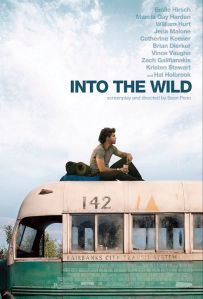 Undeniably well made, I just couldn’t emotionally connect with the main character, Christopher McCandless (Emile Hirch). Chris turns his back on his affluent parents and his bourgeois lifestyle and heads off into the wilderness to experience nature and find what has been missing in his life. Director/screen adaptor Sean Penn turns Chris into a Jesus-like figure that touches all those who he encounters on his cross-country tour that will meet its end in Alaska. I found the character treatment to be a tad naive and off-putting, and his lack of communication with his family, especially his younger sister who was in the same boat with him, seems especially cruel. And yet, the movie has its share of transcendent moments that bury themselves deep inside you, like when Chris befriends an 80-year-old widower (Oscar nominee Hal Holbrook) who is given new life. The closing moments, when Chris has accepted is fate, is profoundly moving and exceptionally performed, and this is coming from a guy that felt an emotional disconnect from the main character. Into the Wild is lovely to watch with top-notch cinematography, a fabulous score by Eddie Vedder, and fine acting by a diverse cast. I’m very impressed by what Penn has accomplished here. However, I admire the movie more than I can embrace it, and it all goes back to the character of Chris. He’s a mystery and both romantic and frustrating, which is kind of a fit summation for the movie.
Nate’s Grade: B
Share this:

National Treasure: Book of Secrets (2007)
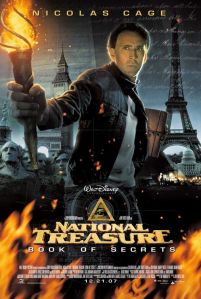 National Treasure: Book of Secrets is like a big dumb puppy that just wants love. It does a trick and thinks it deserves some form of recognition, and me with my cold heart just wants to shrug and move on with my day. How can I be so unmoved when there’s even a cartoon before the movie? For any prospective moviegoers, if you enjoyed the 2004 National Treasure, where I remind all that the U.S. Declaration of Independence had a secret treasure map on its other side, then chances are good you’ll enjoy Book of Secrets. That’s because they’re pretty much the same movie.
Ben Gates (Nicolas Cage) and his father (Jon Voight) are basking in their newfound respect from proving that their crackpot treasure schemes were in fact real. Their respectability is turned upside down, however, when Mitch Wilkinson (Ed Harris, with a dollop of a Southern drawl) has evidence that great-great-grandaddy Gates was responsible for planning President Lincoln’s assassination. He has a piece of John Wilkes Booth’s diary and a list of conspirators is jotted down, with great-great granddaddy Gates listed right there. The diary is authenticated and the Gates are devastated but ultimately unconvinced. They know their Civil War era ancestor would never betray his country and was unknowingly decoding a secret that could lead the Confederacy to an ancient golden temple, something that could help turn the tide of the war. This ancestor ripped pages out of the diary and threw them in a fire to protect the welfare of his country and was then shot by a secret Confederate soldier. In order to clear his ancestor’s good name, Ben Gates will have to find this hidden treasure, which is precisely what Mitch has wanted from the start.
 Gates re-teams with his pals from their first successful adventure, computer whiz Riley (Justin Bartha) and Abigail (Diane Kruger), who has thrown Gates out of their home due to his single-minded focus. Dating a treasure hunter is a certain path to a rocky relationship, ladies. Riley, who even wrote a book about his treasure exploits but still can’t get recognized, is game but Abigail has to be tricked into help. The group finally figures out that the only way to verify the temple’s hidden location is by getting their eyes on the mysterious President’s Book of Secrets, which only presidents can read. This means that Ben has no choice but to get the president (Bruce Greenwood) alone and beg to see a book not meant for outside eyes.
Book of Secrets is a little less dopey than the first preposterous National Treasure adventure, but that doesn’t mean it isn’t chock full of stupidity. According to these movies, apparently damn near everything in this country is built over an Indian burial ground or a giant cavern of treasure. I advise all readers to try digging in their backyards because it appears that the odds are in their favor (also: beware of your real estate company moving the tombstones but not the bodies). The clues are a little less mind-boggling, so instead of a single brick that’s been undisturbed for 200 years we get matching furniture for the Queen of England and the President of the United States. One doozey of stupidity is that one clue requires people to douse a large rock formation with water in hopes that they hit exactly the right spot and have an invisible eagle make its appearance. The plot is still structured on the clue-leads-to-other-clue template, which can be exhausting after a while because there’s never any indication of progress until the end arrives.
The subplot about kidnapping the president is ridiculous in the fact that, while already being dumb, it adds needless conflict. When Gates “”kidnaps” Mr. President he does so through a secret tunnel under George Washington’s Mt. Vernon estate. The passage closes behind them and cuts off the frantic Secret Servicemen. It is here where Gates makes his plea for the titular Book of Secrets, which the president confirms but cannot confirm publicly (well, it is a secret book of secrets). Instead of sensibly saying to his men, “Sorry guys, you know how old these places are, we got trapped, but Mr. Gates here helped get me out,” the movie tries to claim that the next course of action is that Gates will be on the run for kidnapping the leader of the free world. Huh? What makes this sequence stand out is how easily explainable it could all pass, and yet Book of Secrets figures the movie is better served by a contrived complication to add more outside pressure on Gates and his treasure hunting crew.
Of course all of the silliness and off-the-wall shenanigans would be acceptable if the film delivered some exciting action sequences that pinned you to your chair, but just like the first National Treasure, this movie is pretty much devoid of a well-thought out action sequence. Returning director Jon Turtletaub has no real visual flair and lets the material simply lay there on screen without much effort to jazz it up. Many action sequences are brief and never really flirt with complications. Usually, the script will propose a simple sequence of events like, say, “Good Guys on Run from Bad Guys” and then Turtletaub will show us exactly that, no better no worse. There’s nary a scene that actually utilizes its globetrotting destination to its advantage; most of the action is not geographic based, which means that it could happen anywhere because it doesn’t take advantage of the specifics of exotic locales. That is inexcusable to me, a big fan of good action sequences. A lengthy trip to an underground golden temple tries the patience as it rambles on and unabashedly apes the Indiana Jones series. Book of Secrets has a halfway decent car chase through the streets of London and that ends up being the highlight of the film. The trouble is that there’s more than an hour left at that point.
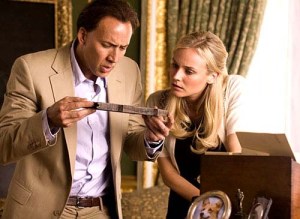 Book of Secrets is a slightly better film than the original. It jumps around in time through the lineage of the Gates clan and gives a better sense of the personal stakes for Ben and his father. Having their long-dead heroic family members linked to a dastardly assassination is good motivation for action, even if that action is ultimately finding an underground temple of gold (how A+B = C I will never know). The production design is skillful and the various European locations bring some sense of grander excitement that, sadly, will never be fully capitalized upon. The characters are still pretty shallow and one-note, but it seems like it’s less annoying this time because there’s less setup on who these characters are, which is, in short, shallow and one-note.
Cage is on autopilot and plays up his goofy mannerisms and William Shatner-esque line readings. This is a paycheck job for Cage and nothing more. Just because the first flick made tons of money is a lark to him and not an indication that he should try something different. He’s giving the people what they seemingly want, which is a wacky Nicolas Cage hamming it up with his patented version of kooky acting. Kruger is the exact copy of her character from the previous National Treasure, meaning she’s the bickering blonde counterweight to the conspiracy theorists on the journey. I suppose she plays a damsel in distress adequately. Voight gets more screen time this go-around thanks to a plump subplot involving the team seeking out the assistance of his ex-wife, played by Oscar-winning actress Helen Mirren. Yes, that Helen Mirren. Harris is given a do-nothing part as the villain and then the movie can’t even follow through on that. Everyone seems to have fun with all the nuttiness and goofy stunts, so I can’t fault them too much for faking it in a big Hollywood blockbuster.
I understand the appeal of these movies, which have found a sizeable audience willing to lap up a Cliff Notes of History along with their popcorn thrills. I imagine the fans of the original will show up in droves and make sure that National Treasure 3: The Mystery of Franklin’s Syphilis is fast-tracked for a future holiday release. I don’t mean to be a killjoy (my mother really enjoys these films) but I cannot get behind the National Treasure movement when the movies are riddled with rampant stupidity, contrived situations, convoluted conspiracies, one-note characters, and inept action sequences that never amount to much of anything beyond teetering homage to better adventure films. Book of Secrets is essentially the exact same movie reheated to take the chill off. Replace Sean Bean for Ed Harris as rival treasure hunter, add another female character, and there you have it, a mostly undisturbed formula that proved profitable in 2004.
Nate’s Grade: C
Share this:

The Mummy Returns (2001)
 Does this mean the following sequels will be called The Mummy Forever and The Mummy and Robin? Our tale takes place ten years after the first. Our archeological heroes in Brendan Fraser and Rachel Weisz are now married and the proud parents of a blonde English boy (Freddie Boath) – who of course, gets into as much trouble as his parents do. Supposedly there’s this buried army of dog warriors from an Egyptian God. The trick is, you have to defeat their leader The Scorpion King to gain control over their ranks. So our good guys stumble upon setting things in motion accidentally, while our bad guys raise Imhotep (our mummy from the first one) with plans of him toppling The Insect Marvel.
 The story of Mummy redux deals a lot with past lives and destinies. It seems miraculously everyone in our story is related to one another be it past or present (and we ain’t talking inbreeding). They fulfill their destinies – or whatever, mainly just fight with pointy things.
Many of the same characters return from the first one, almost like an ongoing serial. There’s the cowardly bumbling brother-in-law (John Hannah), the Arabic prince sworn to protect society form the evils of mummy-ness (Oded Fehr), and hell, even the damn mummy himself (Arnold Vosloo). We even get more of Vosloo’s dead girlfriend from the first picture. She has the honor of sharing a grotesque screen lip-lock with the decaying mummy. Talk about commitment.
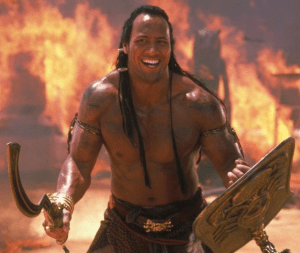
Somehow pro wrestler The Rock (Is he in the phone book as “Rock, The”?) got into this film. His role is The Scorpion King, a cursed uber warrior of ancient Egypt. As you would expect from someone so elegantly named after a large, un-moving, mineral – The Rock’s acting is largely un-moving. He has one line in a different language, poorly delivered as well, then has five minutes of screen time battling people two feet smaller than him with the pearliest whites this side of the Nile. He shows up again later as a scorpion/human hybrid but is replaced with (say it with me class) CGI.
The acting is pure cornball, but to some degrees pleasantly so. We can’t have people taking themselves too seriously while being chased by little dead pygmy babies. Fraser seems to be leading the way for the next generation of action stars. Adewale Akinnuoye-Agbaje appears in a small role as one of the big bad’s henchmen. After watching him for years on Oz it was a personal pleasure to see him on screen. Boath is the real surprise. If he were grating (like some lil’ Star Wars kid) I’d root for any undead creature to suck his nine year-old bones dry. He is fun to watch and acts like a kid, not a child actor acting like a kid.
 The Mummy Returns will enchant you if you were enchanted by the first one. My stance on the mummy’s predecessor was that it was a tongue-in-cheek dose of cheese and adventure. It was nothing to write home about but it was a fun popcorn flick. However, The Mummy Returns throws the gauntlet down with the “bigger is better” rule of thumb almost tripling everything the first tried. It practically throws everything at you in its onslaught including a CGI kitchen sink. You’ll get computer everything. It’s almost like the producers are having a mummy wholesale – “everything must go!” As in reference to there is so much computer generated images in this film that it could be classified as the first living cartoon.
The action in The Mummy Returns is relentless. The pacing is fast and must be the bane to all those people who must squirm in their chair afraid they will miss something – you will. Most movies move through plot points, like from A to B. With The Mummy Returns, on the other hand, everything just bleeds together in a linear mess. It’s rather exhausting to watch.
The Mummy Returns continues to have its tongue firmly planted in cheek. Except with its onslaught it almost resembles a scene from Species with said tongue going in cheek then outside of brain cavity. If you’re hungry for an all-you-can-eat version of a movie, then The Mummy Returns might whet your appetite.
Nate’s Grade: C+
Share this:

The Road to El Dorado (2000)
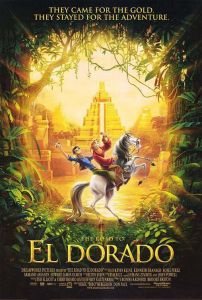 Tulio (Kevin Kline) and Miguel (Kenneth Branaugh) are two 16th Century Spanish con men who somehow speak in English accents and appear to have a secret gay relationship. I calls ’em as I see ’em people. Through a strange comedy of errors the boys end up marooned on a far off land with a horse in their possession as well as a mysterious map. The map leads to the unfold treasures of the mysterious fable of the city of El Dorado. They partner with a saucy native (Rosie Perez) with hips bigger than shoulders and a pining to be taken away.
Dreamworks has scored big with previous strong ink and paint outings, but El Dorado seems to be a disappointment. At times the banter between Kline and Branaugh is lively and humorous but the energy is never sustained for long. El Dorado lulls unexpectedly quite often. Katzenberg created the very successful Disney animated formula, and still sticks by it regrettably. The Iron Giant showed originality can work, so why is no one listening?!
The animation is surprisingly shoddy at times. The contrast between 3-D and 2-D animation is easily noticeable, unlike the work in Prince of Egypt. Perez seems miscast, what with her Puerto Rican accent, and close to all the characters are poorly underwritten, even the damn horse.
Elton John and Tim Rice buddy up after their successful pairing with the Diz blockbuster The Lion King to unleash wave after wave of senseless drivel. None of the monotonous songs are memorable, or even downright humable. After seeing these pop regurgitation it’s easy to see that everyone makes a bad step. Consider this one.
El Dorado is an animated attempt toward the bumbling road pictures of Hope and Crosby, but this tank is too low on gas for the entire trip.
Nate’s Grade: C+


 nathanzoebl
You must be logged in to post a comment.