The Florida Project (2017)
 Director Sean Baker has become one of indie cinema’s most probing, humanist voices for the outliers of our society. His previous films looked at aspiring adult film industry performers, transsexual prostitutes, and now with The Florida Project, an assortment of low-income and homeless families. The film has been buzzed about by critics for months and has started to pick up some serious awards traction. The film does an admirable job of illuminating a childhood on the fringes of society. I just wish it had done more.
Moonee (Brooklyn Prince) is a young child living in a rundown motel miles from Disney World. Her mother, Halley (Bria Vinaite), relies chiefly upon hustling Disney tourists to make money. Bobby (Willem Dafoe) is the manager of the motel. He’s sympathetic to the families turning their stays into homeless residency, but he also needs rules to be abided and rent money paid. He’s concerned about Halley’s choices and how they are impacting, and will impact, the life of her daughter. Over the course of a few weeks during the hot summer, Moonee’s life will never be the same.
 The Florida Project is a slice-of-life drama from the perspective of a young child, and to that end it’s quite immersive and empathetic. Little Moonee and her group of friends feel extensively real, so much that I wouldn’t be surprised if director/co-writer Baker just turned on his camera and simply said, “Go,” and sat back. Much of the movie, and perhaps even half, is watching Moonee and friends play, explore, and interact with a larger world that they don’t fully understand. There are heavier realities kept at the peripheral. Moonee doesn’t know that she and her friends are living in poverty. She doesn’t know that her fun mom is actually an irresponsible parent. She doesn’t know that the weird guy watching them play that Bobby forcefully removes is very likely a pedophile. She doesn’t know the illegal activities of her mother to make ends meet. This limited perspective is also the same given to the audience. A mother/daughter photo session that seems innocuous and a little sweet is later revealed to have seedier ulterior motives. We follow Moonee on her jaunts to investigate the rundown neighborhood, and somehow in that missing time Halley has gained money for rent. It’s not quite a whimsical, romanticized version of life in poverty like the misguided yet critically beloved Beasts of the Southern Wild. Instead, it’s more a selective perspective that focuses on the innocence and imagination of children but without romanticizing the reality of poverty. It’s like a different coming-of-age film where future versions of characters would look back and think about all the things they didn’t know when they were just kids.
Baker and his production do an excellent job of making you feel the day-to-day reality of modern poverty and the struggles of people to simply exist and without condemnation. Halley would be charitably described as a bad mom, and yet she finds ways to provide for her child even if they jeopardize her custody. Halley is far too immature to be responsible for another human being, but not all of the other women are that way. Other women in the purple motel find legal means to provide and they take a concerted interest in the well being of their children. Halley’s adult friend is able to hold down a stable waitress job. Halley is too unruly, immature, and careless to do the same. Halley’s last job was working as a stripper, though she never tries getting a job at what I have to assume are a plethora of competing strip clubs adjacent to the commercial Disney tourist empire. This is very much a visual document of systemic poverty that illuminates the hardscrabble lives of people on the fringes of society trying to stay afloat. It’s rich in details like the knowing swapping of residents between local motels for one day a month to skip past residency declaration laws. It’s an interesting hidden world that feels rarely given this kind of caring close-up.
 Baker has a great talent at finding non-actors who have great acting potential to essentially play versions of themselves. From Starlet, Tangerine, and now Florida Project, Baker has a tremendous gift for discovering people. There is an absence of mannered performance tics; the characters feel real because the actors are acting very naturally. These unsupervised kids are behaving like bratty kids. Brooklyn Prince is phenomenal as Moonee and a born performer. She has an innate charm that left me laughing often. Her improvisation is terrific although some of her lines definitely out themselves as being the written ones (“I can always tell when adults are about to cry”). Vinaite (Harmony Korine’s upcoming Beach Bum) is aggravating and yet you still wish that at some point she would turn it around or come to some latent epiphany. Halley feels, infuriatingly, very authentic in every one of her moments. She is dooming her child to a comparable trapped life of limited appeal and escape, but she can’t help herself and only focuses on the immediacy of life when life is so transitory and pessimistic. Dafoe (Murder on the Orient Express) is the moral center of the film and you feel his genuine unease in every pained glance. He has to hold his authority but he’s still very sympathetic for the motel’s collection of people that modern society has easily forgotten about.
With that being said, I understood what Baker and The Florida Project was going for and I found it to be underwhelming because there wasn’t much more than an established world. This is a movie with a very loose definition of plotting. After a while, without a better sense of plot momentum, it all starts to blend together into redundancy. It doesn’t help when many of the scenes can be less than ten seconds long. Here’s Moonee and her pal eating ice cream. Here’s Moonee and her friend running in the rain. Here’s Moonee and her friend hugging. Here’s Moonee in the bathtub. It becomes a lower class triptych of establishing its world and mood, but a little goes a long way. All of that could have been established and sustained in the first act, and then the story could have launched into a greater sense of change. I may lose some hipster critic cred points but as it continued I was partly wishing that the movie had been more conventional. Perhaps Bobby becomes more involved in the life of Moonee, taking custody of her while her mother was missing or going through social services review. He’s already a quasi-surrogate father figure so why not better explore that dynamic? The characters lack a depth to them, partially because we’re following children just being children, partially because we have characters drifting through life. It’s still lacking.
 This was another example of an indie film sacrificing character and story to the altar of realism. I wrote a similar complaint in my 2012 pan of Beasts: “But all of these setting details do not take the place of an involving story and characters we should care about. I felt sorry for the various residents and their lot in life, but I never felt attached to any of them. That’s because they’re bland and simplistically drawn, but also because Beasts doesn’t bother to do anything else other than create its rich, tragic, harsh world. It’s authentic all right, but what does all that authenticity have to add to genuine character work? Artistic authenticity is not always synonymous with telling a good story.”
Immersive and genuine, The Florida Project is awash in details for a way of life rarely given this much attention and empathy. The acting is very natural and the young children especially behave recognizably like young children. Keeping the perspective of the film attached to the child is an interesting gamut as it keeps some of the harsher aspects of this world and the people from the same kind of direct exposure. It allows the film to have a degree of innocence without romanticizing poverty as some kind of fairy tale. It was a perfectly fine movie that I just happened to want more from, in particular a non-redundant story with more significant plot events and characters that felt multi-dimensional and developed over the engagement. I kept waiting for more and was simply left waiting. Even the symbolism of being on the outskirts of Disney World, the materialistic “happiest place on Earth,” felt barely toyed with. The Florida Project is a good start to a good movie but it needed continued refinement and attention to be something more than an inquisitive magazine article brought to careful cinematic life.
Nate’s Grade: B-
Share this:

Murder on the Orient Express (2017)
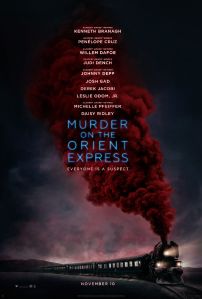 Take my opinion with all the caution you need when I say this: I’m not a fan of Agatha Christie mysteries. Sacrilege, I know, but I just don’t find enjoyment from a mystery that is too convoluted, oblique, dense, and purposely unable to be solved until the clever detective explains everything. That’s not a mystery that engages an audience; it’s a problem that is followed by an intermediate period of downtime. Murder on the Orient Express is a remake of the 1974 Oscar-winning film, this time with Kenneth Branagh directing and starring as Christie’s brilliant Belgian sleuth Hercule Poirot. The original film’s appeal wasn’t the story (see above) but in spending time with the colorful suspects played by many older actors decades removed from their Hollywood peak. It was scenery chewing of a first order. The 2017 Orient Express has some slick production design and requisite big name actors but that’s about it. There are a few alterations here and there but the big moments are the same as is the ending, which means it’s another mystery primarily of obfuscation. I just don’t find these fun to watch. I wasn’t bored but I wasn’t really involved. It failed to provide ways for me to connect, to put the clues and pieces together, and confused volume with development. The new actors feel wasted, especially Judi Dench. I was most fascinated by Branagh’s extensive mustache that seems to have grown its own mustache. If you’re a fan of Poirot, Christie, or the original film, there will probably be enough in this new edition to at least tide you over. I wasn’t too sad to get off this train by the end.
Nate’s Grade: C+
Share this:

Goodbye Christopher Robin (2017)
 The young author sub-genre has become an awards season cottage industry. We’ve seen recent stories about J.M. Barrie, Jane Austin, P.L. Travers, Beatrix Potter, Ernest Hemingway, and a whole assortment of the Beats. Even in 2017 there have been stories about a young J.D. Salinger (Rebel in the Rye), the creator of Wonder Woman (Professor Marston and the Wonder Women), and soon Charles Dickens (The Man Who Invented Christmas). We seem to relish watching the formation of brilliance, or at least watching a recognizable creative voice find their flights of inspiration. Goodbye Christopher Robin is meant to be another in the tradition of young author movies served up on a platter for season-ending awards and recognition. Goodbye Christopher Robin is so serious, clumsy, and tacky in final execution that it enters awards bait self-parody.
Alan Milne (Domhnall Gleeson) is coming to terms with his PTSD after his experience sin WWI and trying to re-enter the literary and theatrical world of London. He finds inspiration through the imaginative play dates with his young son, Christopher Robin a.k.a. “Billy Moon,” and in time the formation of Winnie the Pooh’s world. The book is met with immediate success and Alan and his wife, Daphne (Margot Robbie), are all too ready to ride the wave of fame. Christopher is raised by his kindly nanny, Olive (Kelly Macdonald). Eventually, Christopher grows to resent his parents, the public’s assumption about himself, and the very name of Pooh itself, so much so that he volunteers to go to war as a means of just escaping the overbearing attention of the spotlight.
 The opening act of this movie is the best part, and it’s all pre-Pooh. It also helps that it focuses more on Alan Milne rather than his son, who will take a far larger role later. Milne is already a slightly prickly character who doesn’t exactly fit in with the British upper class. He’s also trying to process his PTSD and return to some semblance of a normal life. He’s also struggling artistically, and this is where the film is at its most interesting because it has the most focus. We get to really delve into the triggers and emotional state of a character in a way that feels engaging. We spend time establishing a person, a trauma, and how it impacts his relationships. It’s not the most singularly compelling drama but it’s still more effective than what regrettably follows.
Where things start to go irreversibly downhill is the exact emergence of Pooh. While Milne is spending more time with the son he doesn’t fully know how to relate to, he’s also pumping his boy for ideas during their play for a children’s story. We get the expected but still lazy moments of all the little signifiers in their lives that connect with future characters. Then one Pooh gets published it becomes an international best seller and the movie just zooms through plot. It goes from releasing the book to everyone in the world loving it literally in a minute of screen time. The Milne family, and especially Christopher Robin, can’t go anywhere without being recognized and hounded by fans. This is also where the film makes a sharp turn and reveals Alan and Daphne Milne to be really terrible parents. As soon as success appears, they’re actively exploiting their child at every opportunity, including such stunts as a radio station also listening in to father wishing his son a happy birthday over the telephone. If there’s a chance they can sell more books, get extra publicity, or simply parlay their fame into something, they take it, and often Christopher Robin is left home alone with his nanny while mom and dad lap it up. Rarely have you seen childhood neglect made to appear so strangely whimsical.
 Even this abrupt plot turn could have worked as an interesting and unexpected portrayal of a literary family that lost the “family” sensibility once fame and fortune arrived. Unfortunately, this is not really a movie about consequences being felt because we’ve got to speedily move onto the next plot point in order to fulfill the formula. After Olive has her big speech about how the Milnes have been mistreating Christopher Robin, it’s literally two scenes later where Alan comes to agree. Lot of internal turmoil there, huh. Christopher Robin’s life gets so bad he’s practically begging to go to war. Even his fate during the war is something the film doesn’t leave unanswered for long. Why dwell on the consequences of decades of bad parenting when we can still careen into a feel-good ending that will attempt to poorly wipe clean the slate? Everything is resolved so rapidly and without larger incident that rarely does the story have time to register. We’re never going to feel great insights into these characters if the film doesn’t give us time. Who cares about hardships and betrayals if they’re just going to be erased in the next scene or if some life lesson will be ham-fistedly learned, but not earned, in short succession?
This is not a subtle movie by any means. The second half of Goodbye Christopher Robin is all about how the boy’s life is awful and how much he dislikes the spotlight. The father comes up with the solution of sending Christopher Robin to a boys’ home way out in the country. As soon as dad leaves, the boys instantly start bullying and harassing Christopher Robin, literally throwing him down flights of stairs while chanting insults. Dear reader, the next part astounded me. It is during the shot of him being pushed down the stairs that the movie uses this sequence as a transition device. By the time Christopher Robin stumbles to the bottom of the stairs he is now a teenager. It’s as if he has been falling down the stairs for a hellish decade. Then there’s the moment where dad sees his son off to war at the train station. As he looks back, for a brief moment it’s not teenage Christopher Robin boarding that train but young child Christopher Robin. I laughed out loud at this moment. It’s too earnest and too clumsy not to.
 The acting cannot save this movie. Gleeson (The Revenant) gets to be that kind of aloof where the actor pronounces words with great care. His acting style is a bit too removed and opaque to really feel much for his character, especially when he cedes the spotlight to his neglected and exploited son. Robbie (Suicide Squad) is just completely wasted. She might be the film’s biggest villain and her disapproving stares look like they should be accompanied by cartoon steam coming out of her ears. Macdonald (HBO’s Boardwalk Empire) fares the best mostly due to her genuinely appealing nature. It also doesn’t help matters when it appears that our young Christopher Robin, newcomer Will Tilston, was hired for his toothy grin and dimples. This is not an especially good child performance. It’s powerfully winsome but in an overly cloying manner. It was hard for me to work up much empathy for Christopher Robin because the performance kept left me cold.
Goodbye Christopher Robin is a feel-good movie that made me feel like checking my watch. It’s tonally off with its mixture of sentiment and indifference, zooms through important plot points rather than dwell on the impact of decisions, and looks for any opportunity to bludgeon an audience rather than deliver something genuine and subtle. If you’re a major fan of Winnie the Pooh perhaps you’ll get something out of it knowing its author was a terrible parent. This wasn’t a movie that made me feel authentic emotions. It felt too clumsy, too mechanical, and ultimately too miscalculated. The only awards this might be contending for at the end of the year are not the kind it’s going to want.
Nate’s Grade: C-
Share this:

The Killing of a Sacred Deer (2017)
 Greek filmmaker Yorgos Lanthimos might just be the most perversely ingenious creative mind working in movies today. After Dogtooth and The Lobster, I will see anything that has this man’s name attached to it, especially as a writer/director. Lanthimos’ latest, The Killing of a Sacred Deer, is a challenging revenge thriller, a macabre comedy, a morality play, and a generally uncomfortable watch that is just as alienating as it is totally brilliant.
Steven Murphy (Colin Farrell) is a heart surgeon with a loving family that includes his wife, Anna (Nicole Kidman), teen daughter Kim (Tomorrowland’s Raffrey Cassidy), and young song Bob (Sunny Suljic). Then there’s Martin (Barry Keoghan), the lonely son of a patient who died on Steven’s operating table. He won’t leave Steven alone and doesn’t understand boundaries, even trying to hook up Steven with his lonely mother (Alicia Silverstone, yep you read that right). Martin even takes an interest in Kim. However, once Steven’s son falls victim of a mysterious illness and becomes paralyzed, Martin makes his true intentions clear. He’s poisoned all three of the Murphy family members and they are destined to die slowly unless Steven kills one of them. He has to choose which family member’s life to take with his own hands, or else they all die.
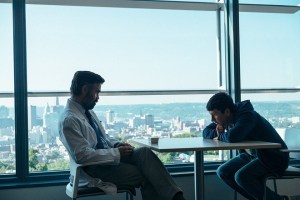 It’s hard for me to think of whom exactly to recommend this movie to because it is so intentionally off-putting. It’s intended to make you awkwardly squirm and question what you are watching. This will not be a fun watch by most accounts unless you’re a very select person who has a dark sense of humor and an appreciation for something different. Lanthimos seems to be purposely testing his audience’s endurance from the start. We open on several seconds of black to test our patience and then an extended close-up of real open-heart surgery. My pal Ben Bailey had to shield his face from the screen. From there, the movie defies your expectations at most turns and digs further into its depths of darkness. This is one of those movies where you wonder whether it will go “there” and it most assuredly goes there and beyond. One minute you’ll be cringing, the next you’ll be cackling, and the next you’ll be deeply unsettled, and then maybe back to laughing if you’re like me. Much like Lanthimos’ other movies, his deadpan sense of comedy is his prescription for an absurd world. It’s a movie where you have to actively work to adjust to its bizarre wavelength, but if you can, there are rewards aplenty. I can’t stop thinking about it.
Unlike The Lobster, this doesn’t exist in a completely parallel universe but more of a cracked, heightened version of our own. Lanthimos’ breakout film, 2009’s Dogtooth, dropped the audience into a strange world and expected us to catch up. This is similar. The flatly comic conversations become a sort of absurdist poetry. Everyday moments can be given one extra strange beat and become hilarious. Scene to scene, I didn’t know what would happen. The movie allows its story to properly breathe while finding room for its characters to discover intriguing diversions and insights, like Martin’s recollection of how he and his father eat spaghetti the same way. There’s an unusual sexual kink that involves giving oneself completely to another that makes more than one appearance, enough to question the connection between them. The very geneses of that kink I think alligns with a character’s god complex, but that’s my working interpretation. It made me rethink about the aberrant concepts of sexuality in Dogtooth, a.k.a. the nightmare result of helicopter parenting. The handling of pubescent sexuality, and the idea of incorrectly applying information learned from other settings, is just one more tool to make the audience uneasy. Killing of a Sacred Deer exists in a closer approximation of our world in order for there to be a better sense of stakes. Somebody is going to die, and if Steven cannot choose then everyone will die. This isn’t a fantasy world but a real family being terrorized by a demented and vengeful stalker. This gangly teenager is more terrifying and determined than just about any standard slasher villain.
 This is a modern-day Greek tragedy literally inspired by an ancient one. Prior to the Trojan War, Agamemnon was hunting and killed one of the sacred deer belonging to Artemis. The angry goddess stranded Agamemnon’s ships and demanded a sacrifice in order for the winds to return. He had to choose one of his family members to kill, and Iphigenia got the short end of that one. Euripides’ classic work gets a fresh retooling and Lanthimos is not one to merely stand on ceremony. He smartly develops his premise and takes it in organic directions that feel believable even given the ludicrous circumstances. That is Lanthimos’ gift as a storyteller, being able to make the ludicrous feel genuine. After the half-hour mark, where Martin comes clean, the movie really takes off. Does Steven tell his family and how much? Does he take matters into his own hands to convince Martin to stop? Is he actually culpable for the death of Martin’s father? Once the reality becomes clear and people starting getting increasingly sick, the movie becomes even direr. Steven is given the unenviable position to choose life and death, though he frequently shucks responsibility and only continues to make matters worse. Once his family comes to terms with the reality of Martin’s threat, they each try different methods to argue their personal favor to dear old dad. They vie to be father’s favorite or, at least, not his most expendable loved one. It’s a richly macabre jockeying that had me laughing and then cackling from the plain absurdity. Lanthimos presents a tragedy and forces the audience to simmer and contemplate it, but he doesn’t put his characters on hold either. They are adapting and have their own agendas, mostly doing whatever they can to campaign for their lives at the expense of their family (Vin Diesel’s Fast and Furious character would loath this movie with a sleeveless fury).
The end deserves its own mention but fear not dear reader I won’t spoil it. It’s a sequence that had me literally biting my own hand in anxiety. I was pushing myself backwards in my chair, trying to instinctively escape the moment. It’s the culmination of the movie and feels entirely in keeping with Lanthimos’ twisted vision and the depiction of Steven as a weak man. There’s a strange sense of inevitability to it all that marks the best tragedies. I don’t know if I’ll sit through a more intense, uncomfortable few minutes in 2017, and yes I’ve seen, and appreciate, Darren Aronofsky’s mother! of difficult 2017 sits.
As much as this is a thriller it also feels just as much a satire of overwrought Hollywood thrillers. The killer isn’t some shadowy evil genius. He’s just a very determined teenager in your neighborhood. There are several moments that are difficult to describe but I know Lanthimos is doing them on purpose as a critique of thrillers. At the end, a character shakes a generous heaping of ketchup onto a plate of French fries, and we’re meant to get the lazy metaphor of the sloshing ketchup as spilled blood. However, under Lanthimos’ heavy direction, the shot holds longer, the accompanying soundtrack becomes an operatic crescendo, and the whole thing turns comic. Lanthimos has to know what he’s doing here, commenting on the lazy symbolism of dread in overwrought thrillers. There’s another instance where Martin has severely bitten into Steven’s arm. Martin’s apologetic and promises to make it right and then proceeds to bite a chunk of flesh out of his own arm and spit it onto the floor as an offering. That would have been creepy enough but then Lanthimos goes one step further. “Get it, it’s a metaphor,” Martin explains. It’s one in a series of moments where Lanthimos goes a step further into pointed genre satire. It’s possible I’m reading too much into the rationale behind some of these oddities but I don’t really think so. It seems too knowing, too intentional.
 The Killing of a Sacred Deer is a movie that invites discussion, analysis, and just a general debriefing in the “what the hell did I just watch?” vein. This is a movie experience that calls upon the full range of human emotions, and sometimes in the same moment. Lanthimos’ modern Greek tragedy serves up a self-aware critique of its own genre, as he puts his personal stamp on the serial killer thriller. This is also an alienating film that doesn’t try to be accessible for a wider audience. It almost feels like Andy Kaufman doing an experiment replicating Stanley Kubrick (and it was filmed in Cincinnati). Even if you loved Lathimos’ most high profile work, The Lobster, I don’t know if you’d feel the same way about Killing of a Sacred Deer. It wears its off-putting and moody nature as a badge of honor. I found it equally ridiculous and compelling, reflective and over-the-top, sardonic and serious. Dear reader, I have no idea what you’ll think of this thing. If you’re game for a demanding and unique filmgoing experience and don’t mind being pushed in painfully awkward places, then drop into the stunning world of Lanthimos’ purely twisted imagination. Killing of a Sacred Deer just gets better the more I dissect it, finding new meaning and connections. If you can handle its burdens of discomfort, The Killing of a Sacred Deer is one of the most memorable films of the year and also one of the best.
Nate’s Grade: A-
Share this:

Thor: Ragnarok (2017)
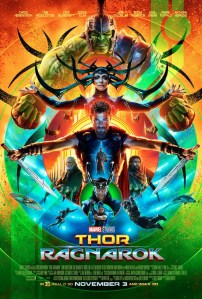 With the continued runaway success of the box-office juggernaut that is the Marvel Cinematic Universe (MCU), it becomes more and more preposterous just how strange and unique it can be. You would think a mega franchise this valuable would be more prone to playing it safe, hiring established visual stylists who can produce product. Instead, the MCU finds interesting creative voices that can succeed within their very big sandbox. Enter New Zealand actor and quirky director Taika Waititi (What We Do in the Shadows), one of the most surprising directorial hires in a decade of blockbusters. The Thor movies are generally considered some of the weakest films in the MCU, so there’s already plenty of room for improvement. With Waititi, Thor: Ragnarok is easily the best Thor movie and one of the funniest to date for the MCU. It’s finally a Thor movie that embraces its silly, campy, ridiculous world and finds space to cram in more eccentricity.
Thor (Chris Hemsworth) has returned to his home world of Asgard to find it in great peril. His brother Loki (Tom Hiddleston) has been ruling in their father’s stead, and that’s not even the worst part. Thor’s heretofore-unannounced older sister Hera (Cate Blanchett) has been unleashed from her prison and is seeking the throne she feels is rightfully hers. She is the goddess of death and chafes at Asgard’s revisionist history, trying to paint over its history as conquerors for something kinder and gentler. Thor is banished to an outlying planet, Sakaar, that’s essentially a junkyard for the universe. He’s captured by Valkyrie (Tessa Thompson) and sold to fight in the Grandmaster’s (Jeff Goldblum) arena. Thor is trained to fight in gladiatorial combat, and his opponent and reigning champion is none other than the Hulk a.k.a. Bruce Banner’s (Mark Ruffalo) alter ego. Thor must break free, convince the Hulk for help, get off this planet, and save Asgard before it’s too late.
 Waititi has acclimated himself extremely well in the large-scaled world of blockbuster filmmaking, and yet his signature quirky sense of style and humor are still evident throughout, making Ragnarok the best Thor film. Let’s face it, the Thor films are completely ridiculous and trying to treat them as anything but is wasted effort. These movies involve alien Norse gods traveling by rainbow bridges and even though they can traverse the cosmos in spaceships they still sling giant broad swords. The more the films embrace the inherent silliness of the series the better. Ragnarok is the Thor movie that gets all the serious stuff out of the way in the first act, tying up loose ends from 2013’s Dark World, checking in with Anthony Hopkins’ Odin and the requisite MCU cameo (a superfluous Doctor Strange), and then introducing Thor’s long-lost twisted sister. From Blanchett’s intro, the movie becomes what it was set out to be, a lavish and consistently funny buddy comedy. Gone are all the Earthly constraints from the prior two films. It’s all aliens from here on out. Thor has everything stripped from him, his hammer, his family, his hair, and becomes an underdog once again. It’s a surefire way to make a living god more relatable. Fighting from the ground up, Thor makes all sorts of new friends and enemies, and it’s this evolution into an ensemble comedy where Waititi’s film shines. There’s a jovial touch to the world building that extends from the visuals to the variety of odd characters. Thor has never been more entertaining as Hemsworth (Ghostbusters) is able to stop being so serious and embrace his underutilized comedic chops. The man has a stunning sense of comedic delivery and a dry wit that’s right at home for Waititi. Hemsworth and his daffy sense of humor have never been better in the MCU.
Even with the added comic refinery, Thor is still the most boring of the Avengers, so Ragnarok solves this by introducing a new bevy of side characters that steal the show. The wacky world of the Thor universe was always its best aspect, and each new film pushes the boundaries a little further out, revealing more weird and wild planets and creatures. It feels like a Star Wars where we spend our time with the weird, scuzzy part of the universe. Ragnarok pushes those boundaries the furthest yet and introduces an entire cadre of loveable supporting players that you want to spend more time with. Tessa Thompson has a wonderful and intimidating introduction as she swoops in on a spaceship, makes her badass claim of her prized bounty, and then trips and falls, as she is quite tipsy from drinking. She regains her literal footing and still seems a bit out of it, but the ensuring process she goes through to claim what is hers is thoroughly impressive. As a Valkyrie, this is one tough woman, and Thompson (Creed) has great fun playing bad. She really reminded me of a female Han Solo. Thompson has a wily screwball chemistry with Hemsworth, and both actors elevate the other with lively give-and-take. Thompson is a terrific new addition. She has an enticing, irascible appeal without overt sexualization that sometimes befalls the Marvel female sidekicks (Black Widow, Pepper Potts).
 Another character you’ll fall in love with is Korg, a rock monster gladiator played in motion-capture and drolly voiced by director Waititi himself. My question: is it possible for a director to steal his own movie? This is a character that feels stripped from one of Waititi’s dry, absurdist comedies and placed into the MCU. Korg is a would-be revolutionary but really he’s a joke machine and just about every line is gold. By the end of the movie, I needed a Korg spin-off series to further explore this unusual character.
The requisite villains of the film definitely play their roles to full camp, enjoying every moment. Blanchett (Carol) is like a Gothic Joan Crawford, marching with a slinky step and a sneer. Her multi-antler helmet completes the operatic sweep of the character. You’ll forgive me for my above comment on recognizing female characters independent of their sexuality, but man oh man does Goth Blanchett make me happy (especially with her hair down). It’s a shame that the movie doesn’t really know what to do with Hela though. Every time we cut back to her I found myself getting somewhat impatient. I wanted to return back to the weird and wild world Thor was on. Blanchett is entertaining but her character can’t help but feel a bit shoehorned in (“Hey, you had a long-lost sister, and oh by the way, she’s basically Death itself, and she’s coming by to retake everything, so have fun with that and sorry for the short notice”). Goldblum (Independence Day: Resurgence) is left to his Goldblum devices and it’s everything you would want. His signature stuttering deadpan is just as potent in the MCU, and the film finds strange little asides for him to make him even more entertaining. Karl Urban (Star Trek Beyond) has a plum role as Hela’s second-in-command who doesn’t really want the job. They actually gave this guy a character arc. It’s simple, sure, but it was more than I was expecting.
 Ragnarok is a swan dive into a stylized, candy-colored explosion of 80s album covers come alive. The visuals and action feel inspired as much from the art of Jack Kirby as they do the pages of Heavy Metal. The overwhelming feel is one of irresistible fun, something you lean back, soak up, and smile from ear to ear in between handfuls of popcorn. The final battle feels suitably climactic and revisits Led Zeppelin’s immortal “Immigrant Song” once the action peaks, coalescing into a crescendo of cool. The trinkly 80s synth score from Mark Mothersbaugh (The Lego Movie) is fantastic and helps to achieve an extra kitschy kick. This movie is just flat-out fun throughout. It finds fun things for the characters to do, like when Banner has to not Hulk out on an alien world filled with stressors to trigger such an occurrence. That sequence almost feels like the grown-up, polished version of Adam West desperately running around as TV’s Batman in need of trying to find a place to dispose of a lit bomb. There’s an archness to the action and character interactions that is playful without being obnoxiously glib. I also enjoyed a climax that involved more than just out-punching the villains. Some might even charitably read it as a commentary on the over reliance of apocalyptic grandeur.
Playing from behind because of its hero’s limitations, Thor: Ragnarok finally embraces the silliness of its franchise, opening up more comic channels and vastly improving its entertainment quotient. The weird word and its collection of odd and oddly compelling characters is the best feature, and though it takes Ragnarok a bit of time for house cleaning, it becomes a steadily amusing big-budget blockbuster that maintains a cracked and lively sense of humor. It’s allowed to be strange and silly and campy. Waititi’s imaginative voice is still very present throughout the film, pushing the movie into fun and funny directions while still delivering the sci-fi action spectacle we’ve come to expect from the MCU. Ragnarok isn’t as deep as Civil War, as perfectly structured as Homecoming, or as subversive and different as Guardians of the Galaxy, but with a droll creative mind like Waititi, it becomes about the best possible Thor movie it can be.
Nate’s Grade: B+
Share this:

Suburbicon (2017)
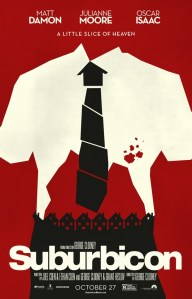 Suburbicon began as a script written by Joel and Ethan Coen back in the 1980s. They shelved it and went on to other stories and justifiable acclaim. George Clooney came across the old screenplay and rewrote it with his longtime partner Grant Heslov (Monuments Men). Clooney’s version of suburban strife is a wash and also easily the worst effort of Clooney’s Oscar-nominated directing career. I wish Suburbicon would make up its mind on which of the three different movies it wants to tell. This is possible proof that Coen brother stories should best be left chiefly to the Coens.
Set amidst the 1950s, an African-American family moves in to an all-white suburban neighborhood and instantly changes the climate. The Mayers have upset the other middle-class white neighbors who want them gone, and they don’t mind subjecting this black family to all forms of harassment to get the job done. Meanwhile, Gardener (Matt Damon) and his wife (Julianne Moore), her twin sister (also Moore), and his son, are threatened by loan shark goons. The family is never the same but there’s more than meets the eye to this domestic tragedy, and the costly cover-up ensnares everyone in danger.
 This is a movie that feels badly stitched together with competing ideas and storylines. Two of these competing movies are so haphazard and lazily explored that it feels like Clooney and company tacked them on for some sort of extra failed social commentary about The Way We Live Now. The shame of it is that either of these vestigial storylines could have existed as their own compelling movie. The integration of the suburbs with a black family brings about an intense reaction. Fellow suburbanites harass the family at all hours of the day, destroy personal property, and do everything to let them know they are unwelcome in this “good-natured” community. The reactions are so virulent and disgusting, and all for a family just existing on the block, shopping at the same grocery store, thinking they too were eligible for the American Dream. There’s a movie there in its own right because, as evidenced in Suburbicon, it’s just background for a larger indictment on suburban values hypocrisy that never generally materializes. At no point does Clooney give the racist response any depth, nuance, or even a deserving spotlight. The only thing we learn is that it’s wrong, which should already be obvious. The entire storyline feels so unfairly attached to another unrelated movie. This family’s story is worth telling right rather than just having something else to cut back to.
Then there’s the larger satire on suburbia itself and its reported family values philosophy. Just because bad people exist and bad things happen in a “nice” community does not mean your satirical work is done. You’re just supplying air quotes to your location. This is the most facile form of irony, lazily slapping together something vulgar against an idyllic setting of morality. That’s why I had no interest in The Little Hours, a comedy that looked to be built around one sole joke, unexpectedly offensive nuns (“Oh ho, that pious person used profanity, and that will never not be funny”). Suburbicon is a story that could have existed in any setting, which further devalues any attempt at legitimate social satire. This isn’t about The Way We Live Now or Even Then.
If you look closely you can see the bones of a Coen brothers’ story here, the only movie of the three that could have worked for Suburbicon. An insurance fraud scam that involves murder and complications is a juicy start for a thriller with some dark comedy edges. This aspect of the movie is the most compelling because it’s obvious that the most attention has been paid to it. Also, there are reversals and unexpected turns that keep the story twisting and turning while accessible. However, the impact of the story is limited by the fact that none of the characters are generally likeable or that interesting. You won’t really feel anxiety over whether or not these people get away with their scheme, which deflates the film’s acceleration of tension despite the best efforts of Alexadre Desplat to replicate an ominous Carter Burwell, a.k.a. “Coen brother,” score. If you don’t care about the characters then they better get into some crazy escalating collateral damage. For a while, it feels like Clooney and Suburbicon understand this principle and begin to ratchet up a body count, though oddly it’s far too fast. Oscar Isaac (The Force Awakens) turns up as a nosy insurance investigation and is taken care of only in his second appearance. The film doesn’t take the time to force the characters to luxuriate in the unease. It just goes straight for the sudden violence, and after awhile it becomes pat and expected.
 This is Clooney’s weakest directorial effort yet. He’s clearly working from the visual framework of the Coen brothers’ classics, using the cookie-cutter production design of colorful suburbia for intended kitschy menace. Even some of the camera angles feel like something lifted from the Coen brothers. Alas, Clooney is not the Coens. He is a director capable of great things depending upon the subject matter, but this movie is a misfire from the start. Clooney cannot decide what the tone is supposed to be, so different actors seem to be operating in their own separate, competing movies. Damon (The Martian) is at either turn hapless or malevolent. I never knew what his read on his character was supposed to be. Moore (Kingsmen: The Golden Circle) is so over-the-top as a distressed housewife that you think she might start bouncing off the walls. It’s only Isaac that feels like he finds the sweet spot of what Clooney must have been going for, and thus it’s even more disappointing about his character’s limited screen time.
Messy, tone deaf, and lacking greater commentary, Suburbicon is a fatally flawed, overbearing dark comedy that has things on its mind and no clear idea about how best to articulate them. It feels like dissonant movies badly stitched together. The overall execution is lazy and relies upon the simplest form of irony to substitute as subversive suburban satire. The tone veers too wildly and the actors are desperate for some better sense of grounding. The characters are pretty flat and poorly developed. It’s an altogether mess that has a few inspired moments and a whole lot more uninspired. The victimized black family deserves to have their own movie and not be the backdrop of somebody else’s broad comedy. The racism is far too real to mesh with the comic goofiness of the rest of the criminal shenanigans. Clooney needed to settle on the movie he wanted to tell. I doubt the final version of Suburbicon that I saw is close to the Coen’s original screenplay. There may have been a good reason that they originally shelved it. Clooney shows that replicating the Coen look and style can be a fool’s errand even by an otherwise talented director. This is the worst Coen brother movie and it’s not even theirs.
Nate’s Grade: C-
Share this:

Bong of the Living Dead (2017)
 I’m in a movie. That’s a pretty vain opening sentence but I wanted to get it out of the way. I was one of the very fortunate horror fans to attend the Nightmares Film Festival, which in two short years has already vaulted to being one of the top film festivals in the nation. I came to see the premiere of Bong of the Living Dead, a stoner zombie comedy that filmed in my hometown of Columbus, Ohio back in 2013 (oh what a simpler time). I had the good fortune to be a zombie extra, and wouldn’t you know, my shambling, bloody, stupid self made the final cut. I mention this not out of braggadocio but out of a desire for transparency. I am friends with many of the people in front of and behind the camera on this movie. I have personal connections to the production, Backwards Slate, and I’ve worked with several of the actors on other projects and plan to work with them again. I am going to write the most objective review I can for the film, as you would expect of me dear reader, but you should know of my potential personal biases. I was really dreading writing a review if the movie sucked. Happily, Bong of the Living Dead is still an enjoyably fun comedy even if you regrettably don’t happen to know anyone involved.
The zombie apocalypse is coming to Clintonville, Ohio, and our group of stoner friends has been waiting their entire lives for this moment. Childhood friends Hal Rockwood (Dan Alan Kiely), Christ Moser (Eric Boso), Tara Callahan (Laura E. Mock), and Jon Lance (Dan Nye) spend most of their time smoking pot and pontificating on the minutia of zombie pop culture. Christ is trying to hook up with a spacey new girl, Danielle DeWitt (Cat Taylor), and Tara and Jon seem to have something unspoken between them. Dr. Kate Mitchell (Tiffany Arnold) has been hearing strange cases of an infection passed through biting. Sure enough, the dead rise up and feast on the flesh of the living, and our stoners barricade themselves inside their house and gear up for the onslaught to come.
 This feels like it was plucked out of the 90s, and I do not mean that as a criticism at all. It feels like the kind of movie Kevin Smith would have made in his geeky prime (a mischievous recitation of randy porn titles seems wholly inspired from Smith). The core idea allows genre satire as well as genre self-indulgence: what if a group of pop-culture savvy potheads became embroiled in the zombie apocalypse? They speak in rapid-fire, hyper-verbal references because that’s how they process the world, as one long catalogue of pop-culture footnotes and influences. These characters are downright giddy with the prospect of finally getting to live within the realm of some of their favorite horror cinema, plus the added bonus of violence without a wider set of consequences. They get to be the stars of their own movie now. Except, to the credit of writers Tim Mayo and Max Groah, they don’t even know that they’re still the bit players. They oversleep a zombie cleanup mission and wake up late into the morning to discover much of their neighbors having already taken care of the task (one of them makes the entrepreneurial step of starting a zombie-aided car wash). Hal can’t hide his disappointment: “The whole point of the zombie apocalypse is that there’s not supposed to be any people around.” The apocalypse isn’t what it’s cracked up to be, and so the characters retreat and sulk, their knowledge of pop-culture raising their expectations to a level that could not be fulfilled.
It’s this clever undercutting of genre expectations where Bong of the Living Dead breaks from the mold of other zombie comedies. These characters are obsessively aware of zombie lore, and it’s a safe bet that a majority of the audience will have a loving knowledge base as well. They quickly accept their world-ending situation and it barely fazes them, perhaps still too inured by the inoculating effect of comparing it to the movies. It keeps the reality of the horror at a safe distance. Even while boarding up windows they can’t help but argue the merits of fast zombies versus slow zombies. A character makes a meta reference to breaking out a weapon that has never before been mentioned, and it was a big gut-busting laugh. Another clever undercutting is when the film transforms into more of a drama in the last act. I don’t know if enough has been established to make the leap from the Act One cartoon versions of the characters to the Act Three dramatic versions, but it was an interesting and unexpected development.
There’s one scene in particular that really exemplifies this dramatic pivot best while still undercutting the genre expectations (some spoilers). After all the close calls and zombie bashing, a character collapses and convulses not from having been bitten but simply from an ordinary and common medical emergency. The other characters are helpless and we watch the fear permeate the scene as everyone comes to the awful realization that this person is going to die from and there’s nothing that can be done. The panic in people’s eyes is genuine. This moment is without setup but I think it works better that way, placing the audience in the same confused and helpless position as the other characters. Groah, as director, gives the scene its necessary breathing room. In this world people can still die in ordinary, everyday ways, and death is not something that’s cool and distant. It’s terrifyingly real.
 The loose, genial vibe of the overall production seeps into the script as well, especially during the lackadaisical second act that involves a lot of our characters just sitting around. Bong is a movie that finds time for little comic arias that other movies would blithely skip over. The loose feel allows the movie to find extra weirdness. There’s an ongoing run of silly media satire that reminded me of Paul Verhoeven’s social commentary. There’s a glib news anchor (Ralph Scott) trying to make the most of the dour news cycles, an opportunistic politician (Vidas Bardzukas) already promising to protect his constituency, a spookily spastic exercise host, a Spanish shopping channel host making love to the camera with his eyes, and a series of cheesy barbarian movies called Swords and Bitches with an evil whip-wielding arachnid queen (Brianne Jeanette). Bong of the Living Dead is chock full of little comical asides that you wouldn’t expect to be so good.
Though it’s also during the second act that I wish more had been going on. I wanted more examination on the difference between their perception of a zombie apocalypse and the reality they’re stuck with. I wanted a bit more setup for the payoffs, like maybe revealing that smoking pot slows down the zombie virus, etc. I wanted more of the VHS-quality flashbacks with the perfectly cast younger versions of the main gang. There aren’t as many central plot elements to make the bridge from start to finish. For much of the middle period, our characters kind of just sit around. They hang out, debate cereal superiority, and even go to the last remaining video store on Earth. It feels a bit like the movie is stuck in neutral, which might have also been the point to communicate the characters’ general malaise. I understand the absurdity of asking for more plot in a stoner comedy but this isn’t any ordinary stoner comedy, as its dovetail into heavy drama indicates. The first act is a lot of fun, the third act is effectively dramatic, but I wanted a bit more connective tissue. The characters could have been better developed (what exactly do they do when not smoking?) but I still cared when things got serious.
The performances across the board are good to great, with every actor, no matter how small the part, finding their specific comedic lane to work within. The biggest breakout performer is definitely Kiely (Axe Giant, Horrors of War) who is, to put it in a topical and never-to-be-dated analogy, the Tiffany Haddish of this particular Girls Trip. He goes above and beyond the call of duty to keep you entertained. Hal is the character that gets the most excited about the zombie apocalypse. The other characters are interesting but fairly subdued for the most part, as one would expect prolific stoners to behave. When Hal first sees a confirmed zombie, his wide-eyed expression is like a child on Christmas morning, and it’s the biggest applause moment for the film. Kiely is a live wire of energy that jolts every scene he’s in. His eyes speak a devilish madness. He reminded me of Jason Lee’s raucous debut in Mallrats, a full force that sweeps you away. After watching Bong of the Living Dead, you’ll wish every movie had a Dan Kiely in it.
 The rest of the ensemble find their moments, giving all the other moments to Kiely and his glorious beard. Arnold (Born Again, Seven Hells) is playing the most straight-laced of all the characters, a doctor trying to make sense of the irrational. Arnold has an instant screen presence and poise that causes you to sit up and pay attention. Her softer moments shared with Hal also help provide a nice antidote for the no-nonsense doctor. As much as Kiely is the draw of our attention, it’s Arnold that is often the one who grounds the picture. Boso (Underground 35) relentlessly pushes his character outside the box of socially awkward outcast. There’s a heaviness he feels from the consequences of getting close to others, and he doesn’t know fully how to deal with his frustrations with himself and the apocalypse, so he embraces his darker, nihilistic impulses. Boso is such a memorable film presence that it feels like he stepped off the set of a Richard Linklater film. Cat Taylor has a charming sense of daffy innocence to her. You can’t tell whether she’s dazed, cheerful, or not altogether there, and it fits very well for her character joining the group. She reminded me of Hannah Murray from the BBC’s Skins series. Nye (Harvest Lake, Dark Iris) is movie star handsome and has some sharp moments of comic aloofness. The romantic undercurrent he shares with Mock (The Tribunal) allows both of them something at stake that the audience can invest in. Nye and Mock have good heated exchanges that wake up the audience and allow each actor to effectively broaden their character range.
And then there are the little performances that make the most of their abbreviated screen time, like Ralph Scott’s (Stitches) wonderful clench-jawed bravado, Bardukas’ (The New Mr. Phillips) hilarious loose-elbow springiness in front of a green screen, Bill Koruna’s (The Shoes) crotchety neighbor, Ben Brown (After) as a powerfully self-loathing jock jerk who is wonderful fun to hate, Sarah Starr as a ditzy and easily bored sex object prone to gratuitous nudity, and the entire team inside the Conan-esque barbarian videos are a hoot for how committed they are to being silly. Just thinking about the Spanish home shopping host and his faces makes me smile and giggle to myself.
Bong of the Living Dead is a shaggy, scrappy, loose and lively zombie comedy with a charm all its own. It’s reliably fun and finds hidden gems of comedy from its deep supporting cast of oddballs. The main characters do fine work pushing at the boundaries of their stock archetypes, with Kiely as the wild man standout. There’s a definite love for the material here, over zombies and dumb comedies and the bonds of friendship. It’s evident in the care taken to creating a movie that doesn’t seem like it was churned out of a Hollywood assembly line, or something calculatingly checking the genre boxes (though the nudity does seem to linger a bit long…). Not everything always works but it’s a movie that tries a multitude of options. Bong of the Living Dead zigs instead of zags, undercutting the characters and our own expectations, finding ways to surprise as well as elate, and that includes going all-in on drama toward the end. It’s a silly movie that just might make you feel something by the time the credits roll. I don’t know what the release plans are for this homegrown horror flick, so stay alert for it on the horizon. Toke up, Backwards Slate Productions. You’ve earned it.
Nate’s Grade: B
Share this:

American Made (2017)
 American Made is a movie that floats by on the sheer enjoyment of Tom Cruise’s charismatic, devil-may-care performance as Barry Seal, a man who flew secret missions for the CIA, Colombian drug cartels, and Nicaraguan contras. It’s an appealing story with fun anecdotes of a scoundrel playing all sides against each other. Seal is unrepentantly without introspection and is simply having the time of his life. Under Doug Liman’s direction and Cruise’s sly performance, the movie flies by on good vibes until its inevitable crash once Seal cannot get out of the mess he’s made for himself. The film doesn’t have much in the way of depth or commentary on Seal’s actions or the CIA’s. Domnhall Gleeson (The Revenant) plays the enigmatic CIA handler who brings Seal into action and plots behind the scenes, and I wish he had a larger presence in the film. His character is the closest the film approaches legitimate satire. Other supporting characters leave little impression or have such limited roles, from Sarah Wright’s complicit wife, to Caleb Landry Jones’ bizarre screw-up of a brother-in-law, to Jesse Plemons as a small-town sheriff, to Jayma Mays as a frazzled prosecutor who can’t take down Seal. The near-escapes and comical skirting of legal consequences provide enough interest without making the film seem episodic. I’m even struggling to say more about the film because that’s how quickly it evaporates from memory. American Made isn’t going to make much more than a fleeting impression, but it’s fun while it lasts and a reminder about how entertaining movies can be when paired with a magnetic actor cutting loose.
Nate’s Grade: B
Share this:

Mark Felt: The Man Who Brought Down the White House (2017)
 We’ve seen this story before, the efforts to uncover the Watergate scandal and its sloppy cover-up from the perspective of Washington Post reporters Woodward and Bernstein who tirelessly collected clues, followed leads, and investigated the facts. That movie was All The President’s Men and was terrific. This movie is all about Mark Felt, the man who was the “Deep Throat” confidential informant, and it’s a bit less than terrific. It’s hardly even a movie because Felt’s story just isn’t that interesting. The film offers little new insights into Felt as a character or his personal struggles working against his own government. The FBI director is portrayed like a glowering Bond villain. The other characters come in and out, leaving little impact except to remind you that they’re famous. Felt’s personal life is also a bore, including Diane Lane in a thankless role as his alcoholic wife distraught over Felt being passed over as the new FBI director. He also has a missing daughter who ran off to a commune. There’s one moment where Felt feels paranoid and tears apart his office, but then we simply move on. There’s not enough here to justify a full-fledged movie. Whatever writer/director Peter Landesman (Concussion) does it’s not enough to make this story interesting, and that’s because Felt’s involvement in Watergate is minimal at best. All the President’s Men was about journalists uncovering the evidence and putting together the pieces. This movie is just about a guy who knows everything and has to get it out there. It’s inherently less interesting. Even the subtitle of The Man Who Brought Down the White House seems misinformed; I’m fairly certain that was Nixon. The Mark Felt story was told better when he was merely a minimal figure in someone else’s Watergate story. Just watch All the President’s Men instead.
Nate’s Grade: C
Share this:

The Snowman (2017)
 The Snowman is an awfully dumb movie that mistakenly believes it is smart. It’s convoluted, impenetrable, serious to the point of hilarity, and a general waste of everyone’s times and talents. When the best part of your movie is the scenic views of Norway, and unless it’s a documentary about Norwegian winters, then you have done something very, very wrong. The Girl with the Dragon Tattoo this ain’t.
Harry Hole (Michael Fassbender), possibly the most regrettably named protagonist in recent memory, is a brilliant detective on the hunt for a killer in Oslo. Someone is abducting women and chopping them up into snowmen. The killer even sends Harry a taunting note with a crude drawing of a snowman. Together with a new partner, Katrine Bratt (Rebecca Ferguson), they try and hunt the cold-blooded killer with a penchant for snowmen.
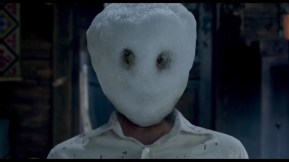 The plot is so convoluted and hard to follow that it’s a challenge just to work up the energy to keep your eyes open as scene after scene plods along. The Snowman doesn’t so much exist as a functional screen story but more a series of incidental scenes that barely feel connected. It feels like one scene has no impact upon the next, which eventually sabotages any sense of momentum and direction. It feels like it’s going nowhere because none of these moments feel like they’re adding up to anything. There are entire subplots and characters that are, at best, tangential to the story and could have been culled completely with no impact. J.K. Simmons’ wealthy sleaze and storyline about securing the World Cup for Oslo comes to nothing. The self-recording police device seems destined to record something significant. It does, but then the killer just erases the footage. This entire storyline could have been achieved with a smart phone, including the part where a severed finger is required to break the device’s fingerprint lock. Val Kilmer’s flashbacks (he sounds weirdly dubbed and looks sickly) as a murdered detective don’t really come to anything or offer revelations. In fact the revelations that do arise are not gleaned from clues but are merely told to us with incredulous haste. The Snowman poster boasts “I gave you all the clues” but I challenge anyone to tell me what they are. What’s the point of a mystery where nothing matters? It’s a film stuffed with nonessential details and lacking a key point to engage.
I’ll give you another example of how moronic and wasteful this movie is, and it involves none other than Oscar-nominated actress Chloe Sevigny (Boys Don’t Cry). Harry Hole and Katrine visit Sevigny’s character and (mild spoilers but who really cares?) approximately two minutes later she is decapitated. Seems like a pretty big waste of an actor of Sevigny’s caliber on a do-nothing part. The police show back up on the scene and Sevigny is still walking around alive, this time introducing herself as the twin sister we never knew about. Ah, now perhaps the inclusion of Sevigny will be warranted and maybe the killer having confused his victims will be a significant clue that leads the detectives onto the right path. Think again, hopeful audience members. Sevigny is never seen from again, never heard from again, and never even referenced again. Why introduce the concept of an identical twin and do nothing with it? Sevigny had not one but two do-nothing parts in this mess.
Even the ending (again spoilers, but we’ve come this far, so why the hell not?) elicited guffaws. Harry Hole tracks down the killer outside onto an icy lake and screams for this person to confront him. The killer then immediately shoots Harry in the chest, immobilizing him. The killer then slowly stalks Harry and then simply walks into an open hole in the ice and drowns. Was that there the entire time? Did Harry somehow create it? Did he find it and strategically position himself near it? Did the killer not see this hole in the ice at all considering they were walking up on Harry from a distance? It’s such a hilariously anticlimactic ending that it feels like the killer, and so too the movie, is meekly giving up and accepting defeat.
 The main character is just as uninteresting as the gruesome killer. Harry Hole is reportedly a brilliant detective and one whose past cases are so revered that they are taught in places of higher learning. Yet, at no point in the movie do you gain the impression of his oft-stated brilliance. He seems pretty bad at his job, plus he constantly loses track of his gun. It’s another example of the movie telling us things without the requisite proof. Harry Hole (referred to as “Mr. Hole” and “the Great Harry Hole” too) is your typical super driven alcoholic detective who pushes his family away because he’s too close to his work. There is the germ of a starting idea of a character that is too selfish to make room for his family, but this isn’t going to be that story. At one point, Harry Hole’s ex-girlfriend (Charlotte Gainsbourg) seems to be having a self-destructive affair with Harry Hole, but this dynamic isn’t explored and only surfaces once. It’s a scene so short that it’s over before Harry Hole can literally get his pants off. We don’t see the brilliant side of the character and we’re also denied the evidence for his destructive side. Fassbender (Assassin’s Creed) is on teeth-gritting, laconic autopilot here and the English-speaking cast tries their own game of playing Norwegian accents while sounding mostly British or Brit-adjacent.
Even the title is one more example of how woefully inept this movie becomes. Surprise: the snowman means absolutely nothing. It’s not some key formative memory from the killer’s childhood or some integral icon attached to a traumatic experience. It’s not even a bizarre sexual fetish. The snowman doesn’t even mean anything to the guy making the snowman in the movie! You’d be forgiven for thinking that the presence of snowmen are entirely coincidental throughout Oslo and the whole of the film. It’s so stupidly misapplied as well, with the movie working extra hard to make the very sight of a snowman as a moment to inspire uncontrollable fright. It goes to hilarious lengths, like a camera panning around an ordinary snowman that then reveals… a second snowman built into its snowy back. OH NO, NOT THE DOUBLE SNOWMAN. There’s a moment when Harry looks down to his car parked on a street and sees… a snowman having been carved into the snow atop the car. OH NO, NOT A SNOWMAN INDENTATION. Just imagine the killer standing on the hood of the car and digging snow out on top to craft his masterpiece of snow-art-terror. I just start laughing. Then there’s the application of the murders. When the killer is severing heads and putting human heads atop snowman bodies, now we’re in business. That’s an image worthy of the genre. However, there’s also a scene where the killer blows someone’s head off and replaces it with a snowman’s head. It’s such an absurd image and it’s going to melt before most people find it, so what was the point exactly? Then there’s the idea of thinking of the killer rolling a severed head into a snowball, which just makes me laugh thinking about somebody stooped over and toiling to make this happen. Ultimately, the snowman is so peripheral and meaningless, my friend Ben Bailey remarked it would be as if you renamed Seven as Toast because the killer also ate toast occasionally (“No, no, trust me, the toast is more important than you think…”).
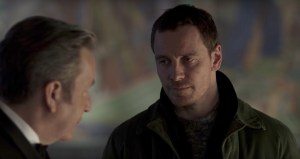 I thought at worst The Snowman was going to be a high-gloss Hollywood equivalent of a really stupid episode of TV’s really stupid yet inexplicably long-running show, Criminal Minds. This is far, far worse. At least with your casual Criminal Minds episode, it’s garish and lousy and icky in its sordid depiction of grisly violence against women, but you can still understand what is happening on the screen. You can still follow along. The Snowman is impenetrable to decipher, not because it’s complicated but because it’s all misinformation and filler. According to interviews, director Tomas Alfredson (Tinker, Tailor, Soldier, Spy) was unable to film about 10-15 percent of the script because of hectic schedule demands, so no wonder it’s so difficult to follow. Very little makes sense in this movie and what does has been done better in a thousand other movies. This makes The Girl with the Dragon Tattoo look like Shakespeare. With a dull protagonist who doesn’t seem exceptionally competent at his job, paired with a dull antagonist with no larger game plan or purpose, or even personality, and a mystery with a dearth of clues to actively piece together, the movie turns ponderous, punishing, and psychologically shallow. It’s a dumb, dumb, dumb movie that thinks it’s smart and contemplative with a cold streak of nihilism. This silly thing takes itself so seriously that, if you’re like me, you’ll find yourself cackling at its desperate attempts to make the visage of a snowman into the stuff of nightmares. This feels more like genre parody. The Snowman is an aggressively bad whodunit that fails to make an audience care about any single thing happening. You’re better off staying home and watching the worst of Criminal Minds instead.
Nate’s Grade: D


 nathanzoebl
You must be logged in to post a comment.