West Side Story (2021)
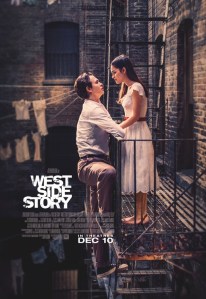 Steven Spielberg, now approaching seventy-five years of age, has experienced such rarefied success as a film director that the man can do whatever he wants. It just so happens he wanted to tackle his first big screen musical, something he’s a little late on considering peers like Martin Scorsese (1977’s New York, New York) and Francis Ford Coppola (1982’s One from the Heart) beat him to the musical punch early. The question isn’t why direct a musical at this stage of his glorious career, it’s why direct a remake of 1961’s Best Picture-winning West Side Story? We already have a perfectly good and revered movie version, and there are other musicals that haven’t even gotten their first big shining moment on the silver screen, so why go back to this particular show a second time?
Once again, we’re following the two New York City street gangs, the Jets, who are made up of Italian and Irish white kids, and the Sharks, made up of Puerto Ricans. Tony (Ansel Elgort) is trying to reform his ways after spending a year in prison for gang violence. The Jets are pleading with him to get back involved, to push back against the Sharks encroaching on their territory. He meets Maria (Rachel Ziegler) at a dance and the two fall instantly in love. The problem is that Maria is Puerto Rican, her brother is the leader of the Sharks, and this relationship would be forbidden and dangerous. Tony and Maria plan to run away together and escape the conflicts of this tragic turf war.
 I’ll risk musical theater heresy and admit outright that Spielberg’s West Side Story actually improves on the much-hallowed 1961 original in several ways. The most immediate and obvious is that we have Hispanic actors playing Hispanic characters. No regrettable brown face including the actual Hispanic actors this time (it’s just humiliating to watch Rita Moreno, in her Oscar-winning role, have to be darkened up to be “more Puerto Rican”). That’s a pretty good improvement already, though it’s not unexpected; 1961 was also the year Breakfast at Tiffany’s was released with its notorious Mickey Rooney performance in jaw-dropping yellow face. Granted, jaw-dropping today, not so back then. 1961 was still only a few years removed from John Wayne taping his eyelids back to portray Genghis Khan. This was the unfortunate norm.
Another immediate improvement is the visual dynamism of 60 years of technical filmmaking advancement. I recently re-watched the 1961 original, a film I haven’t watched since probably the 1990s as a teenager, and it’s a relatively good movie but it’s also a good movie of its time, and by that I mean there are limitations to the presentation. One of the most appealing aspects of movie musicals is how they expand upon our humdrum reality, the splashes of color and synchronicity and bold imagination. I’m not saying the movie musicals of the 1960s were particularly lacking, as there are many classics and favorites, but because of filmmaking practicalities and predilections, movies could only go so far at the time. With 60 years of technological advancements, today’s movie musicals, when under the right guidance, can expand the world of song-and-dance fantasy like few of the past. You need only compare the showstopper “America” in both films, the dancing high-point of either film. The original is on a rooftop for its entire duration. The new version is all over the city block, finally culminating on a crossroads and bringing the denizens of the town out in girl power empowerment. It’s such a high-energy and celebratory sequence and the scale and variance really make it feel so much more joyous and exciting. The choreography is also an improvement. Again, not a slight against the 1961 original, but in the ensuing 60 years we’ve also advanced in the technical precision and creativity of dancers. The 2021 West Side Story is impressive top to bottom with the dancing of all the performers, and with Spielberg as director, he wants you to best appreciate their talents while also making the movie as visually dynamic as he can.
 Spielberg proves an absolute natural at helming a big movie musical. Nothing against Robert Wise, the 1961 director who helmed plenty of influential Hollywood titles like The Sound of Music, The Day the Earth Stood Still, I Want to Live, and Star Trek: The Motion Picture. He was also the editor on Citizen Kane. The man clearly knew how to tell a big screen story across multiple genres. It’s not a shame to say his visual prowess doesn’t quite stack up to a Steven Spielberg, who just happens to be one of the most popular and versatile filmmakers of all time. Spielberg’s camera is much more active than the original movie, and he’s consistently bringing us into the scene, having characters duck in and out of frame, and circling around, always interacting with the world. It makes the movie much more visually immersive and exciting, enlivening an already lively number like the dance hall rivalry between the Jets and the Sharks where each side crowds the edges. The movie operates on a high level of visual pleasure because Spielberg knows exactly how to play to the strengths of the musical genre. Spielberg incorporates the location in each setting and has fun visual flourishes, clearly having given great thought how to visualize every line in each song. The opening of “America” involves women placing clothes on a line, and as the clothes move, it reveals our newest chorus member giving voice to the continuing song. The way the camera moves through the neighborhood to note the encroachment of gentrification. The way he frames the faces of our young lovers. The way he uses shadows as menace. The way he makes every space feel like it’s perfectly utilized for the best shots and edits. Now that Spielberg has proven so adept at handling musicals, somebody please give this man another for our collective benefit.
The top actors are not the leads but two very mesmerizing supporting players. Ariana DeBose, previously seen as one of the ensemble members in 2020’s Hamilton, is pure dynamite as Anita. She explodes with verve and personality and attitude and vibrant life, and the camera loves every second she’s on screen. She gets the bigger emotional arc than Maria. She gets the jubilant song, the aforementioned “America,” and gets her crushing moments of heartache as well. DeBose is phenomenal, and likewise so is Mike Faist (Panic) as the leader of the Jets. Like Anita, this character is brimming with anger and attitude and the movie does a much better job than the 1961 film of presenting him with a point of view that can develop some empathy. Faist is lanky yet so smooth in his movements, and he gets more dancing than just about anyone. He’s balletic in his dancing while still upholding his spiky attitude. Both of these actors are so self-assured in their roles, so vulnerable behind the surface, and so accomplished with their dancing and singing that one wishes the movie would devote more time to both of them.
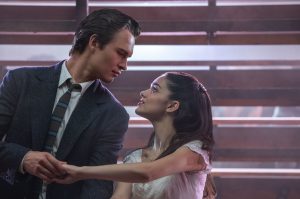 As for our leads, Ziegler and Elgort (Baby Driver) are good but unexceptional as our naifs in love. Ziegler can sing beautifully and definitely has a natural innocence to her appearance. Her eyes are so large and glassy that she reminded me of an animated character at points. Elgort is solid in his singing but I can’t help but feel that he’s been lapped by his co-stars. There is a comic relief musical number, “Gee Officer Krupke,” where the various Jets have fun imitating the nay-saying adults who hastily cast judgement upon these juvenile delinquents. It’s a silly number about guys goofing around and could easily be the first on the chopping block to be cut for time. However, over the course of this fun diversion, I realized that person-to-person in the Jets crew, the same guys that just appeared as background players to fill out a scene previously, how good every person is, and how much more time I wish they had gotten than Elgort. Part of this is that the romance aspect of West Side Story has always been the weakest part of the show. It’s based upon Romeo and Juliet and tied to those tragic plot events, but when both Maria and Tony are ready to run away and marry one another after a single night, and especially after the fateful rumble where Maria is so astonishingly quick to forgiveness (and horniess), the romance plays so incredulously. As a result, the two lovers are essential to the story but also the most boring characters too.
I think the adaptation by Spielberg screenwriting stalwart Tony Kushner (Munich, Lincoln) has smartly updated plenty of political elements, amplifying racial tensions but looking at it over a broader scope. Giving Tony a mentor figure in an older woman who runs her drug store shop, played by Moreno, is a great choice, especially as she represents a medium between the two sides as she is Puerto Rican but her deceased husband was white. It’s smart to have someone from the community and so wise to try and impart lessons to Tony, especially as he wants to change for the better. One update from Kushner didn’t quite jibe for me and felt like token-ism. The youngest member of the Jets, a prepubescent pipsqueak, has been replaced with a trans man fighting for membership. I understand the basic character arc is the same, the outsider trying to be accepted by the group, but the consideration of trans acceptance in the 1960s wasn’t exactly enlightening. The other Jets tease and question the gender identity of the trans man, but this perspective never feels well integrated into the play’s prejudicial world. I suppose more could have been done like having the Sharks harass this character, belittling them over their identity, and then the Jets feeling like one of their own had been attacked and in that they would finally be accepted. Except this inclusion would be around the degradation and potential assault of a trans person, which itself is not the best reason to include a trans character if you’re just setting them up for trauma. I don’t know. This character could have easily been removed if this was all there was.
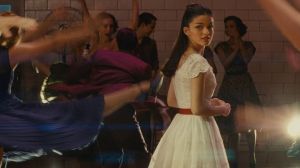 One other aspect I found cumbersome was the creative decision to not include English subtitles during the Spanish-speaking portions of the movie. I cannot understand the artistic rationale for this at all. Sure, Spanish-speaking viewers will be fine, and I could piece enough together with context clues and my rudimentary understanding of like 75 Spanish words, but what are we accomplishing here? It just feels alienating, and it inadvertently likens the viewing experience to what the Jets are going through, feeling like they cannot fully understand their new neighbors. I doubt that Spielberg and company wanted to reinforce the perspective of xenophobia, but purposely removing a key portion of your movie from the majority audience in the U.S. seems so strange to me. If it was just scant conversations or moments, I’d excuse it, but the untitled Spanish accounts for like ten percent of the whole movie. Imagine watching any foreign movie without the subtitles on screen. How much meaning are you able to devise on your own?
West Side Story 2021 is a good time for fans of musical theater and a testament that just because something is old and beloved doesn’t mean it can’t even be improved upon with the right people and goals. Both movies are about the same length, 150 minutes, which seems the de facto standard for movies this holiday season, and you’d have a good time with either. I think the updated version adds more visual creativity, impressive choreography, and remodeled racial and political considerations to make it land better for modern audiences. It might not have been needed but I’m glad all the same we now have two West Side Story movie musicals to cheerfully tap along to.
Nate’s Grade: B+
Share this:

Spider-Man: No Way Home (2021)
 This is going to be a difficult review to write. It’s the third Spider-Man movie in the Tom Holland era, though his sixth Marvel Cinematic Universe (MCU) appearance as the character, that much can be said. The MCU has been teasing a universe of parallel universes for a while now, even famously in 2019’s Far From Home, the previous Spider-Man film, and which No Way Home opens seconds later to deal with its immediate aftermath. The scuttlebutt with this new Spider-Man movie is that it is the most Spider-Man in all senses, bringing past iterations from the original Tobey Maguire run (2002-2007) and the maligned Andrew Garfield reboot (2012-2014). We know villains from each non-MCU Spider-Man film are making special appearances, and there are expectations for plenty more special appearances, so by that notion, writing a film review about a movie built upon surprise inclusions and secret revelations can be daunting to even be readable without giving too much away. I’ll do my best, dear reader. Spider-Man: No Way Home is not the best Spider-Man movie, in the MCU or prior, but it’s a rollicking adventure that will play like catnip for fans of the series, all iterations, and has some of the strongest moments of any web-slinging blockbuster.
In the wake of Mysterio framing Spider-Man (Holland) and revealing Peter Parker’s real identity, life has not been kind to your friendly neighborhood Spidey. The public has turned on him and even his best friends are suffering the consequences of their personal relationship. It’s enough that Peter seeks out his old pal, the wizard Doctor Strange (Benedict Cumberbatch), to cast a spell to erase the world’s memory of who Spider-Man really is. The magic spell, naturally, goes wrong, and villains of Spider-Man from other universes begin to appear. These larger-than-life characters are dangerous but also confused; this isn’t their universe, and this isn’t their Peter Parker. Doctor Strange is happy to send them all back to their primary universes, to correct the loose ends of the spell, but Peter doesn’t want to send them all to their fated deaths. He wonders if maybe they can be cured or reformed and if it’s too late to still do the right thing.
 First things first, you need to know that this movie is going to play much, much better if you are familiar with, and especially if you’re a fan of, the previous Spider-Man movies. No Way Home almost feels like it was written by a fan who has been nurturing a desire to do right by all past Spider-Man films. This feels like someone who had assembled a list of unresolved issues from different Spider-Man movies for over twenty years and said, “Hey, could I write these characters another ending that can redeem them and provide better closure in a way that is meaningful?” Because of that, each new character that comes through has a definite jolt of fan excitement like an all-star reunion, especially for characters you never thought you would see again. Certainly, some characters have more meaning than others, but I was pleasantly surprised how well integrated and written so many of the villains come across. Returning screenwriters Erik Sommers and Chris McKenna have ret-conned and redeemed the various Spider-Man missteps of old and have given characters more attention and fitting resolution, which makes this a surprisingly emotionally deep Spider-Man in ways you weren’t expecting. There are character reunions and resolutions that I didn’t know I needed, and I was smiling and even battling back tears of my own at various points. If you’re a fan of the recent Holland run, then the movie will still play well, but if you’ve been with Spider-Man from his cinematic beginning (if you really want to feel old, the original Spider-Man teaser involved the World Trade Center) then this movie will feel like a nostalgic blanket to warm you all over.
I think it’s safe to discuss some of the villains that have been prominent in the advertisement and later trailers, but if you wish to skip any character details, then skip to the next paragraph. It shouldn’t be much of a surprise that the two biggest villains are the ones with the biggest screen time and most allowance at redemption. Willem Dafoe as Norman Osborne (Green Goblin) and Alfred Molina as Doctor Octavius (Doc Ock) are treasures. It’s so good to see them again in these roles and each actor is just as good as you recall from their time 15-plus years ago. I was worried that bringing Doc Ock back could spoil the redemptive turn he has at the end of 2004’s Spider-Man 2, sacrificing himself to save the day from his own dangerous experiment. Little did I know that the entire movie was going to seek redemptive arcs for a veritable Sinister Six-worth of Spider-Man villains. It becomes the backbone of the movie, and I was skeptical at first but the movie found ways to win me over with just about every character’s inclusion. Norman and Octavius are similar in that they are battling other sinister personas in their heads, and when the real versions of each man break through, it’s often in heartbreaking moments of existential confusion and sadness. This is a movie that has time to fit in Spider-Man memes as well as question the moral culpability. It’s fascinating that a huge Marvel movie is so concerned with providing glimpses of humanity and compassion to bad guys from movies that the general public didn’t even generally like.
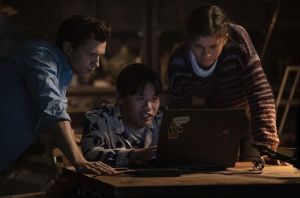 This is the best acting of Holland’s Spider-Man run. He really gets put through the wringer about the consequences of trying to make the moral choice, both good and bad. His most emotional moments got me each time because of the investment in his character growth over six movies as well as the added investment in the supporting characters too. This is the most integrated and important both Ned (Jacob Batalon) and MJ (Zendaya) have been to the plot, and they have a platonic hug at the end that sent me into a tailspin of emotions for what it meant. The humor and natural camaraderie of the actors is still there, a hallmark of the MCU Spider-Man series. I laughed plenty, especially with certain characters deconstructing their parallels and connections (“Gotta watch where you fall,” a villainous understatement). However, this is the most emotional Spider-Man likely ever, and the actors all perform ably. I want to single out Marissa Tomei as Aunt May because she’s been undervalued in these movies until now. This is the biggest role Aunt May has played and she serves as the voice of morality to push Peter to do what he knows is right even in the face of outlandish adversity and personal cost.
No Way Home works better thematically than as a well-constructed plot. The solutions to the villain redemption are laughably convenient, and while it’s not as expressly magic as Doctor Strange’s spells, it’s pretty much the equivalent of technological magic. That’s fine, because it’s less the struggle of invention and more the choice that matters for each character. The mechanics of the ending also feel overly convenient and tidy (you could have just done this the whole time?). When Doctor Strange is chastising characters for hasty decision-making, it’s the movie calling attention to its own cheats. The movie splits so much of its time across multiple villains and drafting off of your old feelings. There are other narrative shortcuts taken and abbreviated, especially Strange’s involvement. He’s left out of much of the movie for the same reason Captain Marvel was left out of much of the final battle with Thanos in 2019’s Avengers: Endgame: he’s too powerful to have on the board. I’m not saying the screenwriters made the wrong choices on what to emphasize. The emotional beats of this movie hit strongly, and if they have to rely on a few cheats and nit-picky hand-waves to get there, then so be it.
 From an action standpoint, I think this might rank last for me in the series. Returning director John Watts has never wowed me as an action director. He’s not bad at staging the big moments but he seems more present in zippy tone than in style on a big stage. The added wow factor of seeing the various characters assembled on screen will compensate for much of the action feeling contained to dank sound stages. I think this was done as a cautionary measure to keep the secrets from being leaked, but it also shortchanges the action possibility. There’s nothing in this movie, from a pure action standpoint, that rivals the Venice or London sequences in Far From Home. The movie utilizes portals, and it got my hopes up for clever action inventions, but it serves as more plot device than action complication. There have been some artistic sacrifices, narratively and visually, to accommodate the Spider-Man Movie All-Stars approach, and while I think the filmmakers have emphasized the correct parts, it does still feel like there are some nagging shortcomings to an overall experience that plays exuberantly.
Finding a comfortable medium between fan service and creative constriction, Spider-Man: No Way Home is not the best Spider-Man movie but at the same time it just might be. It serves as a salve to the rest of the franchise, five iterations across two different runs, and because of that level of attention and compassion, the past movies get a little bit better, with more added resolution, more character moments, and second chances to correct miscues and blunders. Who among us wouldn’t want another opportunity to correct our mistakes? While ostensibly setting up the troubles ahead for the MCU (the trailer for 2022’s Doctor Strange: The Madness of the Multiverse is the final post-credit scene), the movie feels entirely backward-looking, rewarding fans of the character and resolving to do better where other films had gone awry. Maybe (Disney)Fox could do something like this for the bad X-Men movies? I don’t know if the same punitive charges of being slavishly nostalgic will hit No Way Home like they’ve done for the new Ghostbusters and Star Wars. It’s definitely still accessible for newer fans but plays best to the people with the longest investment, but isn’t that every continuing movie series? No Way Home is a rewarding cinematic experience of many highs and fun surprises and cameos as well as a humane redemption for the sins of Spider-Man’s past. It’s not the best superhero movie but it might be the most joyous one yet.
Nate’s Grade: B+
Share this:

C’mon C’mon (2021)

Writer/director Mike Mills’ latest is a gentle and meandering movie, which is coming to be his indie specialty for me. C’mon C’mon features Joaquin Phoenix (in his schlubby every-man phase) as an audio journalist collecting interviews. He suddenly finds himself watching his young nephew (Woody Norman) after his sister (Gabby Hoffman) has to tend to her husband’s deteriorating mental illness. What follows is a lot of small moments that play quite naturalistic and in wry, nice dialogue exchanges. It’s also kind of sweetly boring. It’s a collection of moments of Phoenix struggling with how to relate to children, what we pass down to the next generation as legacy, and how to try and be a responsible parent and role model for an impressionable youth. It’s all messages and themes we’ve seen in dozens of other heartwarming parenting movies. The draw is the relationship between Phoenix and Norman, who proves to be a wonderfully natural performer, enough so that the movie often feels more observed than written. Their relationship is sweet but I felt like the movie was too often circling the same points and character differences for far too long. Perhaps others will get more out of this, find more to personally relate to, especially those finding themselves caring for children in unexpected circumstances. C’mon C’mon is reflective and compassionate and also kind of a snoozer.
Nate’s Grade: B-
Share this:

The Female Hustler (2021)
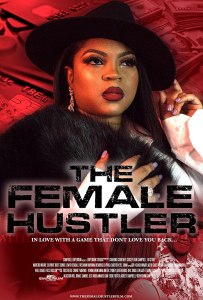
The Female Hustler is one of the top movies on the streaming site Tubi, which is available for free with minimal ad breaks. Anyone can check it out, and congrats to this Columbus, Ohio-made indie thriller written and directed by Columbus native Dom Campbell (Bad Business). He’s getting his feature film projects out into the world and a wider audience and that is definitely something to celebrate. However, I think considering a larger audience will do Campbell better, as The Female Hustler feels too inert to be more than the sum of its already familiar and genre-soaked parts.
Princess (Courtney Godsey) is struggling to save her friend from a pimp and help her brother get a better life. She’s looking for work when her chatty Uber driver, Omar (Campbell too), invites her into his multi-million-dollar identity theft scam network. From there, she rises through his ranks and becomes a threat to Omar’s leadership. We jump forward in time and Princess has become “The Female Hustler” and leading her own top-notch outfit. Omar is looking to take out his one-time protégé and regain his empire, but he might not be the only threat facing Princess.

Made for $50,000 and filmed throughout Columbus, as well as stops in Los Angeles, The Female Hustler has more than a few artistic merits. It’s a gangster genre movie that knows its audience well, which is likely why there are several close-ups of butts within minutes. Campbell recognizes that this movie is going to be less a complicated, nuanced, inter-textual crime story akin to something like The Wire and more like a knockoff of a knockoff of a blaxploitation film. I think a filmmaker knowing their genre and what makes it work is essential to playing to its strengths. The Female Hustler feels like it can walk its walk. I’ve watched enough lower-budget Ohio indies to tell when the photography is a step above, and the FIVE credited cinematographers for this movie at least deliver quality with their quantity. The grimy color grade is solid atmosphere but the crispness of the images and the use of lighting can actually be quite artistic for a lower-budgeted crime flick. The sequences outdoors at night were really good looking. I’ve watched enough barely-lit outdoor scenes that struggled to convey key info. These outdoor scenes have levels of clarity and color and even reminded me of Michael Mann’s digital video thrillers like Collateral and Miami Vice. That doesn’t mean all of the visual compositions feel dynamic; too many shots come across like they were clumsily composed on the spot. It works, but the skill of the camera quality, post-production, and/or camera operators are elevating the many perfunctory camera setups. The movie is packed with modern rap and its bouncy beats give a better sense of pacing and energy, especially when what’s happening onscreen is mostly people fronting poses. A lot of the acting is enjoyable too. I’m not going to say anybody is a star in the making, but the actors can be amusing or charismatic or intimidating when called upon, and Godsey is a worthy lead to build upon.
Where The Female Hustler doesn’t quite work is as a story with enough connective tissue and a satisfying conclusion. I was shocked that there is no ending offered at the conclusion of its 82 minutes. The entire back half of the movie is setting up a climactic confrontation between Princess and her former mentor, Omar, and they each bring their crews together for a fateful summit, and then everyone scatters, a betrayal is revealed from a supporting character, and the movie then rolls credits. I suppose maybe Campbell is intending to make this into an ongoing franchise, a move I would deem dubious given what we’ve been given in this first and so far only entry. However, given everything that transpired in this dawdling movie, there is no excuse to cheat your audience out of any ending. It’s not just that The Female Hustler has a bad ending; it doesn’t even have an ending. None of the storylines have been resolved, nobody has altered their standing, and no wrongs have been righted. It’s confounding that the movie just seemingly ran out of time after doing so little for forty-something minutes of characters making threats and bragging about their successes. The decision on the ending really harms the entire movie, looking backwards. It clearly feels like Campbell had an idea for a movie and little realization how to better develop and see it through. The concept of a woman rising to power through a criminal organization, a dangerous “man’s world” of intrigue and violence, is a fine dramatic template. Watching an underdog take out their obstacles and people doubting them is an inherently satisfying and engaging narrative. That is not really what we get with The Female Hustler, a movie too content to be a longer version of a trailer when it comes to minimal characterization, plot development, and surprising twists and turns.

I can summarize the main plot as three data points: 1) Princess is learning the criminal lifestyle, 2) Princess has become successful under Omar, and 3) Princess is even more prosperous as her own boss. You would expect there to be connective tissue and sequences that served as getting us from one station to another, scenes where Princess learned harsh lessons, or rose to the occasion and surprised her boss or herself, something to note the character development from a novice to a hard-edged leader. There are few of these sequences if any. The second half of this movie almost feels like a resume bragging about Princess’ accomplishments. It’s scene after scene of characters simply relaying the state of things. Naturally, I assumed these exchanges were to ground the audience so we could then chart later changes as what had been gained is now in jeopardy. However, this doesn’t happen and the movie is awash in wheel-spinning exposition. It’s almost comical how scene after scene involves this new character and that new character just telling Princess how good a job she’s been doing. Then we’ll have scenes of Princess nodding along. In some ways it’s reminiscent of little kids in role play, less worried about how things got to be and more about establishment (more “I’m the king of the universe,” and less how it got to be). That’s why this plot feels so bare-bones as to be mistaken as simply a larger version of its trailer. It just feels like we’ve dropped into three stagnant scenarios and stuck with repetitious scenes restating the status quo while we wait for some upheaval or climax that never actually arrives.
I felt that maybe the whole back half was leading up to the final confrontation between Princess and Omar, and when she kills her mentor, it would at least feel like she has moved forward. That’s the basic setup of this kind of story, where the mentor brings in the protégé, then they conflict and then the mentor has to be put aside permanently to fully achieve a higher level of success on their own terms, no longer held back by the definitions of the past. I just watched this basic narrative recently in House of Gucci with Lady Gaga as our change agent. That’s why I’m flabbergasted that The Female Hustler doesn’t so much end as implicitly say, “To be continued?” It doesn’t need to, especially when the movie is only 83 minutes long, especially when the movie hasn’t really done as much with those 83 minutes. We could have watched Omar, in his desperation, strike back at Princess’ empire, chipping away at her power, capturing and killing her valuable team members, and Princess having to process how far she’s willing to go to take out her competition, establishing lines only to question crossing them. It’s like Campbell has assembled his key characters for a crime epic and then merely given them place-holder dramatic scenes and rote dialogue bravado (“You should have had a crash course on me… now you’re a crash test dummy”). It’s a movie with nowhere to go in its imagination.

Why introduce members of Princess’ crew, one-by-one with flashbacks showcasing their skills, if the movie isn’t going to feature these characters outside of this scene? What does it matter to the audience knowing so-and-so is good with money or good with computer hacking if they don’t even contribute to the story afterwards? Why introduce the FBI agents following the criminal goings-on if these guys will never factor in again either? It’s like teasing future conflict that doesn’t ever materialize because Princess never feels in danger. Imagine watching a heist movie that is nothing but recounting 100 members of the crew, their unique skill set, and how they came to be recruited, and then they were never seen or heard again and the movie just ended. What would the point be? What have we accomplished moving a larger storyline forward?
This brings me to my biggest complaint with many Ohio indies, and sadly The Female Hustler appears to have fallen victim too: they are too insular and inaccessible that they seem to have forgotten about playing to an audience, thus only really prove appealing to friends and family of the production. There isn’t a thrilling story, or engaging characters, or a gritty, compelling world here to keep your attention through the overly padded 83-minute run time. I’m happy for local professionals when they can pool their efforts and actually put a movie together, but unless they want it to feel like an inside joke or something only intended for the most limited of viewing spheres, they need to constantly be thinking outside themselves and ask, “Why would anyone care?” The Female Hustler has some technical plaudits that allow it to rise above some of its fledgling peers. I think Campbell is a better director than a screenwriter and would benefit from collaborators in that field. He and his production company Emperium Studios have a spinoff with the brainy kid hacker character in the works, a TV series called A Kid Named Bug, and judging from early pictures, it looks like an entirely different tone for Campbell. Good for him. Keep hustling, young man, and remember to think about movies being intended for an audience, otherwise it’s a very expensive hobby for you and your closest friends.
Nate’s Grade: C-
Share this:

The Tender Bar (2021)
 When adapting a memoir into a movie, it’s important to ask whether the subject has lived an interesting life that people would want to see. With The Tender Bar, based on the 2006 memoir by journalist JR Moehringer, I think the filmmakers lost sight of this. Young JR has elements of an interesting personal experience; his father, a famous radio DJ, has been absent for his whole life yet JR still pines for him while listening to the radio (the father is simply referred to as “The Voice”); his mother goes through chemotherapy for cancer; his grandfather, whom he and his mother have been forced to move back home to live with, is suffering from dementia; his uncle Charlie (Ben Affleck) runs the local bar and pushes JR to read mountains of classic literature in order to become a better writer. Any of those elements could be further explored and mined for relatable human drama and bittersweet coming-of-age lessons. That’s not what The Tender Bar does. Strangely, it cavalierly jumps around these plot points, never really settling on one for long, only braiding them together in a way that feels fleeting and stalled for building momentum. The choice of mixing in non-linear flash forwards and flashbacks (as well as a narrator) complicates matters and feels like the adaptation was struggling to relay the info it needed. Too much of this movie dwells on the least interesting part of this story, namely JR falling in love with a girl in college who repeatedly dumps him. It’s so frustrating to watch especially when we have more interesting scenarios passed up just to watch this dumb kid get his heart broken by this same girl for the umpteenth time. I wish JR had just remained a youngster and we could have focused on his real father figure shaping him, his uncle, and their time spent running the local watering hole. Mysteriously, this movie is directed by George Clooney, who shows no real affinity for the story or its characters. The movie is generally warm and gauzy but bereft of significant personal details to make the drama more resonant. It’s like you took a coming-of-age story and melted it down to its most recognizable base components. The Tender Bar is assuredly a case where the appeal of the novel must have been from the voice of its author. The story, at least presented onscreen, is a wistful shrug of a movie with an above-average Affleck performance. It’s a nice but dull experience, which is likely an apt description of most ordinary people’s lives.
Nate’s Grade: C+
Share this:

Being the Ricardos (2021)
 Have you ever wondered what a week in the production of the I Love Lucy show would be like? Have you ever wondered about Lucille Ball and Desi Arnaz’s marriage? Have you ever wondered if Ball was secretly a communist? Well worry no longer, because Being the Ricardos is writer/director Aaron Sorkin’s ode to early television, the creative process, and recapturing something he was trying to articulate in his failed TV series, Studio 60 on the Sunset Strip. Yes, this feels like an especially long edition of that old show, with too many plotlines vying for attention like B-stories and C-stories for an episode of television, and several of them have curious conclusions. The storyline given such outward significance, whether or not Ball will be shunned as a possible communist in her youth, is wrapped up so anticlimactically and easily, and the storyline given such minimal coverage, Desi’s possible infidelity, is then given an ending that doesn’t feel nearly as setup to have its proper impact. The acting is another issue. Everyone is mostly good, but Kidman is no Lucille Ball, and while she doesn’t attempt a direct impression it’s still not a favorable comparison. Bardem is better as Arnaz but you can’t help but feel both actors are miscast. The supporting players, like J.K. Simmons as William Frawley, Nina Arianda as Vivian Vance, and Tony Hale as show creator Jess Oppenheimer, offer the more entertaining and insightful positions from the wings. Being the Ricardos feels like Sorkin trying to work his signature rat-a-tat snappy dialogue but missing a few rhythms, and part of that might be Sorkin serving as his own director for the third time. Director Sorkin plays everything too stately and serious, so even when the script is telling us these comedy writers are making a comedy show, the flow is off and everything is a little too self-important and reaching for culture war symbolic terms, reminiscent of, you guessed it, Studio 60 on the Sunset Strip. I guess my disappointment was not really getting to know more about Ball besides her perfectionism and underrated comedy savvy. This movie is just too busy with narrative devices; there are documentary-esque interviews with aged crew members in the future, a present-day storyline about workshopping one episode through a week’s schedule, and intermittent flashbacks to Lucy and Desi that can be confusing when past and present swap. Then there’s the black and white interludes of the show which are Lucy’s imagination of what may be? It’s a cluttered mess with pacing issues. You also get to watch Lucy and Desi have sex, which is like walking in on your parents. Being the Ricardos feels like an overly serious TV movie that’s too busy and scattered to remind itself that funny people can also be fun people.
Nate’s Grade: B-
Share this:

Ghostbusters: Afterlife (2021)

As I stated in my review for the 2016 Ghostbusters, allow me to wax nostalgic and explain my own private history with the franchise: “Growing up in the 80s, other kids had Transformers, or G.I. Joe, or He-Man, but I was a Ghostbusters kid. I fell in love with the 1984 original movie, slept below the poster for most of my childhood, and obsessively collected all of the action figures and toys, watched with glee the animated TV series, and hold the world and its characters in a special personal place.” This franchise means something to me. I think about the hours I spent playing in this world and my imagination and my own stories illustrated with marker and crayon, and it makes me extremely happy as well as reminds me how I fell in love with weird storytelling and macabre, ironic humor. I’ve been waiting for more Ghostbusters movies for my adult life. The 2016 movie was fine, I wasn’t enraged by it in the slightest, but it didn’t scratch that itch. While replicating some of the same plot beats, the 2016 movie was not reverent to its source material. Now the 2021 Ghostbusters, delayed over a year and a half from COVID, goes completely in the other direction. Ghostbusters: Afterlife is reverent to a fault, and while it has been met with mixed reviews and complaints of overdosing on slavish fan nostalgia, I found it to be a charming and fun family adventure that left me laughing, cheering, and even crying.
Egon Spangler (Harold Ramis, R.I.P.), original Ghostbuster, is dead, killed by a malevolent spirit. His estranged adult daughter, Callie (Carrie Coon), and her two teen children, Trevor (Finn Wolfhard) and Phoebe (Mackenna Grace), are shocked to learn of his death and their unexpected inheritance: a dirt farm in small-town nowheresville Oklahoma. They don’t know much about their grandfather and the kids are not exactly excited about relocating to a secluded mining town. Phoebe starts discovering weird pieces of technology hidden in the old house of her grandfather’s. A presence seems to be reaching out and trying to get the family to understand their real legacy. It appears that Gozer the Gozerian was not fully defeated on top of that New York City skyscraper in 1984, and Phoebe and her family must learn about the past in order to make sure we all have a future.

I can understand the charges of Afterlife being too nostalgic, but I don’t understand the charges of it being so enamored with its past that it poses a disservice to the movie standing on its own. This movie is intended at its very DNA to live within the shadow of the original films. The director and co-writer, Jason Reitman, is the son of the original films’ director, Ivan. It’s going to be reverent but that’s not an automatic bad thing. Whereas the 2016 reboot shrugged at past convention and went completely comedic, this edition takes the opposite approach, hugging onto the lore and past of Ghostbusters with heartfelt affection. If you’re a fan of the franchise, this adoring approach will likely be more favorable, not that the 2016 film is wrong for eschewing the established canon of the franchise and trying something new. If Afterlife had been a completely original story set in a Ghostbusters universe, I would have happily accepted that. However, just because something is outwardly nostalgic, or taps into fan service, does not mean it is destined to be an exclusive retread that only satisfies the hardcore base. I didn’t need the gratuitous Easter eggs of passing shots of a twinkie or Crunch bar, but they’re blink-and-you’ll-miss-them moments that don’t really relate to anything of consequence, so I can excuse them. Afterlife is similar to The Force Awakens in that it uses familiar plot beats to mirror events of its predecessors to ease back fans and new members to the fanclub, most especially in Act Three where Gozer’s demonic pooches are unleashed. I can understand many chaffing at this, but I feel that Afterlife does enough to justify its own creative existence even in facsimile rather than as some insular, facile, fan-stroking cash-grab.
This is, by far, the most dramatic of the Ghostbusters movies, a series that has existed in the realm of comedy. The prior movies were never spooky on adult terms, but they reached back into a primal, childlike curiosity and anxiousness over the unknown that made them creepy when they wanted to be. I don’t understand the umbrage some have expressed over Afterlife being more of a drama. First, the comedy is present throughout the movie with the characters making specific and wry observations that feel fitting for their situation. The humor is not as forced as the loping line-a-rama improv jazz riffs of Paul Feig’s 2016 film. I think this universe can sustain different kinds of stories being told, and I think that drama is perfectly acceptable as long as it’s earned, just like the comedy or horror elements. The central premise involves an estranged family coming to know the secret life of an absentee relative who abandoned them, so the more they learn about his Ghostbusting past and responsibilities, the closer they come to uncovering a clearer picture of who this man really was as well as their connections to him. Reitman and co-screenwriter Gil Kenan (Monster House) have smartly connected the investigation of the past into the development of personal relationships. We in the audience know the significance of the Ecto One and the ghost traps, but the new characters do not. We await them to understand the knowledge we already attain, but the movie doesn’t play this as characters dawdling. Each discovery unlocks new potential for the characters to shape who they choose to be, and each one gets them closer to their grandfather and reshaping their conception of the man who they wrongfully believed abandoned them for folly.
This all leads to a climax that had me genuinely in tears. I won’t exactly spoil it but Afterlife’s conclusion is less concerned with beating the Big Bad Gozer yet again and saving the universe. Reitman and company have smartly placed the real climax as an emotional catharsis; it’s more in keeping with Field of Dreams than some huge Marvel apocalyptic showdown. The ending is personal, emotional, and reaches into our universal desire for closure, for having that one last moment with a beloved who we no longer have any moments left to share, Reitman is clearly missing Ramis, a close family friend and inspiration who died in 2014, and this is his own way of processing his personal grief, offering an emotional output for the fans to share in, and allowing a grieving character/surrogate to find that needed release. It serves as a fitting conclusion and a special end note for any Ghostbusters fan who has held this franchise close to their heart for several decades, especially if shared with a paternal figure who may be gone.
The film also successfully channels a childhood perspective of awkward and awesome. It’s hard to create a story where a group of precocious adolescents discover strange things cooking in their sleepy small town without suggesting Stephen King and Stranger Things, but this isn’t necessarily a total negative. The earlier movies were always from a more cynical adult perspective. Yes, there were characters like Ray (Dan Ackroyd) and Egon who were true believers, but they were often set up for easy laughs. The tone of the series was mostly tied to the irony of the character of Peter Venkman (Bill Murray) that looked at the supernatural with droll detachment. This is the first Ghostbusters entry where the primary perspective is from children, and there’s something hopeful and heartfelt about a younger point of view with the supernatural material. These kids are excited and eager to learn more about the somethings strange in their neighborhood. It becomes endearing to ride along with them as they get to jump into the action. I loved the concept of a sidecar gunner seat for the Ecto One and how it felt like a childhood dream coming true. But it’s more than fan service because it serves as a point of progression for Phoebe’s sense of self, of embracing her scientific interests and roots, and taking charge in the face of unknown danger. It’s a coming out of sorts. When the kids are driving through (the always empty?) town and chasing a runaway ghost, wrecking storefronts from the boom of the proton pack, it’s a blast for them and us.

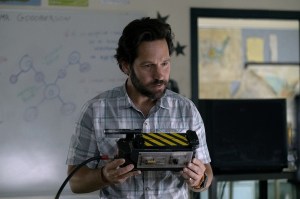
This is Reitman’s most commercial and mainstream film of his Oscar-nominated career. It’s interesting to me that this indie darling, who was on such a hot streak in the late 2000s, hit some speed bumps with the critical misfires of 2013’s Labor Day, 2014’s Men, Women, and Children, and 2018’s The Front Runner, so the next movie is a retreat to a big-budget franchise film. Reitman doesn’t necessarily have the best feel for large-scale spectacle, but he knows intimate character dramas and guides his actors well. Grace (Gifted, Haunting of Hill House) is wonderful as our plucky lead. Unfortunately for Wolfhard (It, Stranger Things), his dull character has nothing to do but pine for a local girl, scoff at his family, and then fix up the old ghostbustin’ mobile. Paul Rudd (Ant-Man) is as charming as ever as the school science teacher, especially as he nerds out over interacting with the Ghostbusters paraphernalia like an excitable fanboy living out his childhood dream. I wish Coon (The Leftovers) had more to do, but that’s my primary complaint in any movie where Carrie Coon is a supporting actress. Her chemistry with Rudd is strong and they could have done so much more together as adults trying to make sense of madness. They could have eliminated Wolfhard’s mopey older brother character entirely and given us more time with the goofy adults too. One feels like there is some secret contract where anything relating to 80s nostalgia requires the hiring of Wolfhard on hand.
Ghostbusters: Afterlife will not be the best movie of 2021. There are areas that could have been improved and streamlined and better developed. However, Ghostbusters: Afterlife will most assuredly be my favorite film experience of 2021. It’s a heart-warming continuation for fans with enough wit and whimsy to charm while owning its obvious and intended connections to the original. I may not be the most objective source on this particular matter, but I know what I like, and this movie had moments of pure happiness that just shot right through to my dopamine center. We’ll see if this movie can restart the dormant franchise, and strike more on its own, but even if this lone 2021 entry is all that we eventually get, I’m happy I got to experience this magic once again. I can’t wait to see it again with my dad.
Nate’s Grade: B+
Share this:

In the Bedroom (2001) [Review Re-View]
 Originally released November 23, 2001:
In the Bedroom hits all the right notes of agonizing pain, devastation and loss. The heart of the film is on the grief encompassing Matt and Ruth Fowler (Tom Wilkinson and Sissy Spacek) over the loss of their son. The Fowlers are well regarded in their cozy New England town. Matt is a flourishing local doctor and Ruth teaches a chorus of local high school girls.
In the Bedroom opens with Frank Fowler (Nick Stahl) chasing his older girlfriend Natalie (Marisa Tomei) across an open grassy field. Frank is a budding architecture student home for the summer and thinking of prolonging his time so he can stay together with Natalie. Frank and Natalie have a distinct age divide but also seem to have been given different lots in life. She has a pair of boys from her abusive husband Richard (William Mapother) that she is finalizing a divorce from. Richard is hopeful he can reconcile with Natalie if he just gets another chance, but Natalie is stern in her refusal.
 Ruth sees the relationship as a detriment to her son’s future. She’s even more upset that Matt is so casual with their son dating an older, working-class mother. Frank rushes over to calm Natalie after another of Richard’s outbursts of violence has left her house in shambles. She rushes her children upstairs just as Richard returns back. He manages to sneak in through a back door and confronts Frank in their kitchen, shooting and killing him. What should seem like a clear-cut case begins to unspool. Natalie admits she didn’t actually see the gun fire and the charges are dropped from murder to manslaughter. Richard is released on bail and free to stroll around occasionally bumping into the grieving and outraged Fowlers.
The majority of the film is the aftermath of the murder and the strain it puts upon Matt and Ruth and their marriage. Beforehand jealousy, anger, and bitterness would simply sit but slowly the tension begins to bubble to the surface. Ruth holds resentment and blames the leniency of Matt for the death of their son. Matt tries to get out of the house as much as possible, even if it means sitting in his car in their driveway at night.
One of the most harrowing scenes of In the Bedroom is also its emotional and acting centerpiece. After the mounting frustration with justice, Ruth and Matt explode into an argument that had slowly been building long before their son’s death. This is the first time they have truly talked about the whole situation and accusations fly like bullets in their first emotional confrontation. In the Bedroom could have easily fallen into the area of sticky made-for-TV land, but the exceptional performances all around by the cast and the deft and studied direction never allow it to falter.
Spacek (Carrie, Coal Miner’s Daughter) can begin writing her Oscar acceptance speech right now. Her portrayal of Ruth displays the pride and seething anger, but keeps her human throughout. She exhibits pure, raw emotion that strikes directly inside you leaving a knot in your stomach and in your throat. Her performance is truly breathtaking and so emotionally visceral to watch. Wilkinson (The Full Monty) plays Matt with passive-aggressive doubt and repression. He dominates in any scene he is in and takes the audience on a wide range of emotions. He has a commanding presence and compliments Spacek’s Ruth nicely. Perhaps the greatest thing Tomei (My Cousin Vinny, Slums of Beverly Hills) was known for was miraculously winning an Oscar and dumbfounding a nation. With In the Bedroom she is given the ubiquitous “And” credit at the end of the opening cast list. She has less to work with and less screen time to work it, fully earning the “And”‘ credit she has.
 Todd Field is an actor-turned-director and has appeared in such a wide array of films from Twister to Eyes Wide Shut. Field has layered his film with rich symbolism and an intelligent, patient pace. Most of the action in movies is centered on what is going on in a scene, but the most telling moments of In the Bedroom are what are not going on in the scenes. Field creates such an intimate portrait that the camera almost turns into another character, catching the lingering silences and the burgeoning inner turmoil. Field also adapted the screenplay from a short story by Andre Dubus, whom he dedicates the film to.
In the Bedroom is not going to be for everyone. Some will find it slow and some might even find it boring. As it stands, it is a powerful film on the study of loss that grips you and refuses to let go. You will feel all the blame, jealousy, anger, and pain of this family and for such emotions to resonate from the screen to the audience is a great achievement.
Nate’s Grade: A
——————————————————
WRITER REFLECTIONS 20 YEARS LATER

Twenty years later and it seems like nobody really talks about Todd Field’s In the Bedroom any longer, which is a crying shame. The movie was hailed by critics upon its release in late 2001 and earned five Academy Award nominations including Best Actor, Best Actress, Best Supporting Actress, and Best Picture. Field would then adapt Tom Perotta’s novel Little Children and direct its 2006 adaptation, again earning favorable reviews and multiple Oscar nominations, revitalizing the career of Jackie Earl Haley. And then Field seemed to vanish from view. There are a few dropped projects and a potential upcoming series with Daniel Craig, but Field has been too quiet as a director for over 15 years, and that’s far too long for a man that showcased such immediate natural talent from his very first opportunity in the director’s chair. In the Bedroom was a movie that I wasn’t exactly excited to come back to on my list of 2001 re-watches; it’s a heavy drama about grief and suffering and that’s not exactly the best entertainment remedy during the holidays. I’m happy to have gone back to the movie, as well as cross it off my list, because this return reaffirmed for me just how great Field is as a director, and a screenwriter, and just how vital this indie film feels. It’s the real deal when it comes to authenticity and emotional power, and watching this as a 39-year-old rather than a 19-year-old gave the enduring two hours added heft for its family tragedy.
The plot centers on the spiraling consequences of one death. Frank Fowler (Nick Stahl) is the 18-year-old son of Ruth (Sissy Spacek) and Matt (Tom Wilkinson), upper-middle class and pleasant but pointed. Frank is dating Natalie Strout (Marissa Tomei), an older woman and the ex-wife (though not yet legally divorced) of Richard Trout (William Mapother), a violent and unstable man and also heir to the local canning company. One fateful day, Richard angrily confronts Frank, a gunshot is heard, and Frank is dead. Richard swears it was self-defense, but Natalie is convinced her jealous ex was finishing the threats he had been making about her ever leaving him. The murder happens at the 40-minute mark, and from there the movie becomes a long examination on grief and guilt and blame, where characters drift from scene to scene like ghosts, some avoiding the painful realities of their enormous grief, finding hobbies or distractions, but most unable to fully articulate the resounding pain and emotions brimming under the surface.
 Under Field’s attentive care, there is a palpable dread hanging over every scene. The script allows different bereft perspectives, each person wrestling with feelings of personal guilt. Natalie blames herself for holding onto the relationship, bringing him into her world. Matt blames himself for not calling the police after an earlier fight between Frank and Richard, and he doubts whether he should have pushed harder on his feelings of reservation about the relationship with Natalie. Ruth has escaped into her insurmountable anger and uses it as the fuel to keep her going. The friends and neighbors do their best to be supportive but every conversation or poker game has the danger of veering too close to The Topic, and the awkward but well-meaning silences permeate and become more awkward. It’s a movie about people trying to get on with their lives but not knowing how to reassemble the broken pieces. By itself, that is enough meaty drama worthy of examination by top-notch actors and considerate screenwriting that allows us to really dwell in the beautiful discomfort. Field adds extra degrees of turmoil from the possibility that Richard will be given a slap on the wrists by the indifferent legal system. Richard posts bail thanks to his family’s wealth and even casually strolls through the town like nothing happened, making appearances while Ruth is shopping like her living in an inescapable nightmare. The Fowlers are consistently having their pain poked and prodded and reopened. One friend suggests if Matt has contemplated moving, and he admits he’s considered it, but it wouldn’t change what happened or lessen the pain of having their son’s killer protected by his status.
As you can imagine with that kind of material, In the Bedroom is an actor’s showcase. Wilkinson is the more featured role, and he’s the more laid back one, the one trying to make sense of things as best he can and failing. Wilkinson is terrific in the role and his hangdog expression from scene to scene denotes so much unspoken pain he’s grappling with behind his placid veneer. Just watching this man try and keep his life together is worthy of study. The weariness is harder to note with his performance but more rewarding to watch. Spacek is great herself but playing a role with less dimension. She is the stern voice of outrage and blame, the one who never liked Natalie and always suspected the worst. She has her signature blowup scene that serves as a long-in-the-making emotional confrontation with her husband, who she accuses of hiding from his grief rather than embracing it. However, her character is also painted in an unflattering and I would say unfair characterization. In the heat of their fight, Matt accuses his wife of being so controlling, so unforgiving that her son had no choice but to run away from her. While the character has been presented as cold and disapproving, she’s a victim too. This was Tomei’s confirmation as an actress that her surprise 1993 Oscar victory was no accident. She’s strong in her brief moments, especially when she’s recounting Frank’s murder under oath and realizes her inability to help the case with her conflicting witness testimony. It’s devastating to watch as she processes in the moment the doubt and then utter terror as she realizes that her next words, of honest yet painful reflection, will undermine the case she so desperately needs. I know the slap between Spacek and Tomei got more attention, but this is her clincher.
 All of this well-wrought examination of grief and guilt is sturdily handled, and it effectively sets up the last fifteen minutes of the movie into its own indie thriller. Finally pushed far enough, Matt takes matters into his own hands to find justice. The entire sequence is played out so deliberately that you might not breathe from the protracted suspense. Field and co-screenwriter Robert Festinger (Trust) have patiently built up these characters and their conflicts with such precision that they have developed genuine emotional stakes and uncertainty for the end. For first-time viewers, I imagine there will be legitimate doubt how the final events will play out. Is Matt being honest with his offer to have Richard run away from town? Is he making his stand in secret to absolve his wife of more pain and to rise to her verbal challenges of being too timid, or is she in collusion and possibly the Lady Macbeth from the bedroom shadows? It’s a long, taut sequence that feels like a fitting culmination of the many little details that have been set up, from character dimensions and motivations to small details that come together so smoothly, like a bridge worker or a friend’s large estate. It’s been twenty years since I’ve seen the movie and it still had my heart elevated, and I knew the ending.
Where In the Bedroom separates itself from the dramatic pack, and where it’s deserving of more attention and notoriety in retrospect, is how remarkably considered and assured this movie is about assembling its details and atmosphere. This is a deeply felt and deeply authentic movie that fills out the innumerable edges of this small coastal town with colorful characters that feel genuine, lives that feel lived-in, details that feel authentic without being obvious, and all without losing focus on the central performers as they struggle with their consuming grief. There are great artistic touches too for emphasis, like when Matt seeks out his lawyer to question points of strategy, and when the officious man retreats back to polite deferrals that fall back on the limits of the judicial system, the camera focuses on tight edits, first the man’s mustachioed mouth, then his fiddling hand in his pocket jangling his keys, a sound that intensifies into that of a jackhammer. It’s a clever and effective means of conveying the fractured, infuriating, dismayed response of Matt. However, most of the movie avoids flashy style that calls attention to itself. The very framing of the characters in the shots is so elegantly composed, making fine use of spaces and windows to help convey extra layers. This is a movie that does not feel like a first-time filmmaker or screenwriter. This same measured assurance can be seen in 2006’s Little Children, an equally well-observed, detail-rich, non-judgmental slice-of-life of small-town ennui. We need more Todd Field movies considering he’s two-for-two with literary adaptations.
 My original review in 2001 has some sentimental value for me. It was one of the first reviews I ever wrote for my college newspaper, The Chimes, in the position of film critic, an official role I held for five straight semesters (2002-2004). It was a goal of mine arriving at school and I saw it through, and this first review reminds me of the next stage of my career in film criticism and of my good times in small-scale publishing. My 2001 review gets some things right but I cringe at how awkwardly it’s trying to grasp for further meaning without understanding how to clarify my explanations. Maybe I was more taken with writing to my college-aged audience, hence why I devote a paragraph to explaining the use of the “And” credit in movie casting. There are some good points here and there, and the distillation of the plot and conflicts is solid, but as I’ve noticed with more than a few of my earlier reviews, the depth of critical analysis is shallower than I would prefer. Also, my hasty prediction that Spacek should “begin writing her Oscar acceptance speech now” was short-sighted, as she lost Best Actress to Halle Berry for Monster’s Ball (see you next in December, movie). In the Bedroom is a movie worthy of your time and a cultural re-examination.
Nate’s Grade: A
Share this:

House of Gucci (2021)/ The Last Duel (2021)
 The octogenarian filmmaker Ridley Scott has been a prolific and influential director for decades, but rarely has his high-powered work ethic been as obvious as within a 30-day window. Scott directed two movies, both aimed at adults and potential awards consideration, and both co-starring Adam Driver in a supporting role, and both as subtle as the outlandish fashions of the 1980s. Scott is not a subtle filmmaker by trade. He favors rousing excess and bold characters making bold decisions. This is not the first time Scott has managed to release two movies in a single calendar year (2017: Alien Covenant and All the Money in the World; 2001: Black Hawk Down and Hannibal) but for both movies to be released within a month, and share thematic similarities, is worth noting. The films also share many of the same artists (editor, composer, director of photography) as House of Gucci was filmed a mere four months after wrapping The Last Duel, which was delayed because of the pandemic. Both movies are based on true stories but go in different directions for artistic impact. House of Gucci veers into tragi-comic camp to its entertainment benefit, and The Last Duel spares subtlety for blunt political points.
The Gucci family has enjoyed nearly a century as fashion royalty. They’re known for their classic look, the care that’s put into their leather, and the long-standing resistance to change. Enter Patrizia (Lady Gaga), an ambitious young woman who doesn’t want to work for her father’s truck-driving company forever. She sets her sights on Maurizio (Driver), the mild-mannered son of Rodolfo (Jeremy Irons) and nephew to Aldo (Al Pacino), the co-heads of the Gucci empire. Their whirlwind romance leads to marriage and Patrizia insisting that her beloved take more control of the family business and make his mark as a Gucci.
 The real reason you should go to the theaters for all 150 minutes of gargantuan Gucci drama is because of the monumentally captivating performance by Gaga. I will suffer no fools on this subject: Gaga is flat-out wonderful. As the kids on the social media say, she clearly understood the assignment. Gaga is knowingly broad and hamming it up but she is having the time of her life. I was impressed with her acting in 2018’s A Star is Born and how natural she was onscreen. Now she’s playing a distinctly drawn character and she dissolves into the role, smirking it up and purring with every line. You won’t exactly trust this woman, who is proven to be conniving and ambitious but also effective at manipulating others and earning her position of prominence, but you’ll love watching her onscreen whether alone or dancing circles around her cohorts. Gaga understands completely that this sordid tale plays better intentionally dipping into camp, making bold and outrageous what otherwise could have been underplayed. It’s an outrageous story with outrageous wealth and privilege, and it deserves to be told in an outrageous manner. That doesn’t mean dismiss the drama as minimal, but it recognizes the tone that will best bring out the entertainment value of the soapy plot elements. No one needs this kind of story played miserably strait-laced and absent any light; nobody needs another astoundingly awful The Counselor (sorry, Ridley). Take the sex scene between Gaga and Driver. It is so loud, so obnoxious, so over-the-top, and it stays at that level for a thrust-heavy protracted period, that the movie, and Gaga especially, is inviting you to laugh along. Gaga is the one who fully understands the edict of more-more-more the most and demonstrates it with her charmingly over-the-top performance. She is fully deserving of Academy recognition and to be memorialized as a thousand memes and GIFs.
House of Gucci feels very much like a Ryan Murphy show condensed to a feature-length over-extended special. For those unfamiliar with Murphy’s genre-bending TV work on FX (American Horror Story, American Crime Story) and now Netflix (Ratchet, Hollywood), the provocateur never met a juicy twist or outlandish plot element he didn’t love to use, abuse, and inundate the viewer. He’s like a creative prankster freely celebrating the ridiculousness of the prime-time soaps of old while also providing ironic counterpoints to them. It can be a riveting experience when it all works together and an unmitigated yet often fascinating hot mess when it doesn’t. Subtlety also rarely factors into a Murphy show. He also loves opening up the fabulous lives of the fabulously wealthy, including the heralded Versace family, and the fabulous lives of Hollywood stars in tremendous acrimony, like Bette Davis and Joan Crawford, for our envious guilty pleasure consumption. The House of Gucci feels comfortably pitched in that Ryan Murphy sweet spot, especially if you’re a fan of the populist high-gloss escapism of Murphy’s campy forays.
 Because of this tragi-comic tone, House of Gucci keeps things rolling with eye-rolling excess and consistent laughter. It’s essentially watching Patrizia climb the ladder of power within the Gucci family, eliminating her enemies and neutralizing her opposition. She’s so strong-willed, ruthless, and successful, that it’s fun to watch this outsider, who was seen as a gold-digging harlot by some within the cloistered family, systematically tear apart the tut-tutting elites. It’s structured in many ways like a gangster movie with its rise-and-fall narrative and, in its final half hour, it becomes a full-fledged crime story, one whose outcome I had no idea about. If you’re unfamiliar with the Gucci family story and scheming, like me, the movie will play even better with its level of surprise and colorful characters. This is Scott’s most light-footed work since 2015’s The Martian.
Another shocking surprise is how enjoyable Jared Leto (The Little Things) is as clownish cousin, Paolo Gucci. The actor is buried under pounds of prosthetic makeup and is performing on the same tonal wavelength as Gaga; these two know best what kind of movie they’re starring in. Leto is so deliciously, amazingly over-the-top that all of his Method affectations are part of the appeal rather than being a distraction. This character is a riotous naïve hack, a Gucci with the worst ideas in fashion but the inability to recognize his creative shortcomings. He would be set up for tragedy in a different kind of movie, like a Falstaff if you want to go all Shakespearean, but in this version of this story, he’s a buffoon with no self-awareness. Every time he appears onscreen, it’s deserving of a live studio audience applauding like a TV sitcom character that has stumbled into a prestige drama by mistake. This performance is so hugely Italian is practically exhaling mozzarella cheese. He could be the missing Mario triplet. Watching Leto and Pacino go back and forth is like watching a competition over who can chew the most scenery with the most overblown Italian accent, and I gave in and loved every second of it.
 The overall length of House of Gucci starts to grate and the indulgence of the lavish lifestyles of the famous family gets repetitive. We don’t need five montages of wealth and luxury when one will do. Once Patrizia and Maurizio rise to control Gucci, the movie seems to coast, so much so that the eventual divide between the two seems arbitrary and undeveloped. When the movie transitioned to this point, I was left wondering what had exactly been their relationship breaking point. Maybe that’s the point and the absence is meant to convey how Maurizio has changed, given into the fast cars and fancy suits of a lifestyle he previously seemed indifferent to. The movie feels long and overly extended for a feature. The content could have worked as one of those glossy Ryan Murphy miniseries, but as a movie it could have used some judicious accounting.
House of Gucci is going to be the most entertaining for people seeking a less realistic, brooding, and contemplative drama about power and corruption and more seeking a delightfully baffling and campy mess of a movie. Lady Gaga and Jared Leto are playing their respective roles to the hilt, and it’s a hoot to watch them have as much fun with such broadly comic characters. Perhaps the tragi-comic tone will feel in poor taste for some (designer Tom Ford, a player in the Gucci resurgence in the 1990s, has said so), but I found House of Gucci to be a ridiculous movie that knew where it should go big and where it should go small, and it favored big early and often.
 In contrast, The Last Duel is based upon a true story of the last time France used judicial trial by combat. It’s the 1300s, and Sir Jean de Carrouges (Matt Damon) is a soldier for King Charles VI and looking to repay his mounting debts. He enters a marriage with Marguerite (Jodie Comer) for her dowry and promised land. However, Sir Jean finds his former squire and friend Jacques Le Gris (Driver) the recipient of the land, having been gifted it as thanks from the local lord, the carousing Pierre d’Alencon (Ben Affleck). Sir Jean is outraged by the offense. Then the bombshell hits: Marguerite accuses Le Gris of raping her. Le Gris denies it to his core. Sir Jean challenges his former friend to a trial by combat whereupon only one man will walk away alive.
The Last Duel could have also just as easily been titled, Sucks to Be a Woman: The 14th Century Edition. It’s a blunt assessment of systemic misogyny and the cruelty that was so casual that Church officials were blaming women for tempting men into raping them. This is an upsetting movie by design, and it’s filled with head-shaking arguments like a “real rape” cannot cause a pregnancy (“That’s science,” the court prosecutor says, in a nod to a future Todd Akin), that pregnancy is facilitated if the woman experiences an orgasm, so ipso facto how could the accused rape be in fact a rape if the lady is pregnant because that means she must have enjoyed herself. It hurts me to even type this diseased thinking, and I don’t consider it a spoiler to list some of the absurd arguments that will be unleashed in the name of institutional sexism. You could just as likely come up with your own ridiculous arguments playing a game of sexist Mad Libs and it will likely be featured at some point throughout The Last Duel. This is not a condemnation of the movie but a realization that its main journey is going to be a bleak grind, one that consistently makes you sigh deeply and feel uncomfortable for all the countless millions of women.
 I fully believe that there are important lessons to be had in empathy and shattering ignorance when it comes to uncovering history as it is and not history as it is written. For some, the events of The Last Duel will hardly be eye-opening, but that doesn’t mean that it cannot engender greater consideration and thought to not just the historical context of the Medieval period but on the classic tales of chivalry and masculinity that have been passed down verbatim through centuries. The division of character perspectives is almost like uncovering the historical perspective through layers of obfuscation and legend. We see the movie three times, each from the point of view of another. We start with Sir Jean who views his life as abused loyalty, a dutiful soldier who fights for God and country and is constantly attacked by scheming upstarts. This beginning perspective is the most basic one, lacking dimension and keeping to a rigid right/wrong dichotomy. This is the kind of boilerplate that goes into legends. The second perspective, and seemingly longest, presents the villain’s perspective but where he clearly views himself as a dutiful soldier whose loyalty is also abused. He becomes obsessed with Marguerite and dreams of her and is convinced that her evinced kindness is really flirtation. He completely views the rape as a consensual outing. This perspective is more reflective than the first and insightful insofar as it’s meant to convey how men of this society can fool themselves into thinking their abuse is requested and obliged. This perspective is meant to convey the, for lack of a better word, common thinking and confirmation bias of centuries of entrenched systemic misogyny.
Despite its grim subject matter, The Last Duel is assuredly a feminist film and does not condone or dismiss the actions of its sexual predators. In trying to showcase differing perspectives, the movie is not asking us to question whether the rape was real or not, it’s asking us to understand, not excuse, the perspective of the perpetrator to better understand, not excuse, the landscape that produced so many more perpetrators. It’s historical context that some will argue is exploitative. Do we need to have the brutality shoved in our faces to better understand the plight of women? The screenplay is written by Damon and Affleck, their first collaboration since 1997’s Oscar-winning Good Will Hunting, and they made the decision to have Nicole Holofcener (Can You Ever Forgive Me?) write the feminine perspective from their story.
 The third and final perspective is the one more aligned with the truth, and it’s here that we can begin to compare the points of difference between the prior two male perspectives. Early on, Marguerite’s marriage is de-romanticized. She is expected to bear a son at all costs. As time passes without a child, her husband begins to have his doubts about her worth. He didn’t have this problem with his first wife, he adds, to let her know where the problem is coming from. Yet Marguerite is also a natural problem-solver and manager, and when left alone to tend to her husband’s estate, she enacts policies that are clear improvements. Again, it’s another symbolic example of how many capable and intelligent women were intimidated into being primarily child-bearing mares. When she tells her husband she has been raped, Sir Jean takes it as an offense against him first and foremost. He also undresses and insists that Le Gris will not be the last man to “know [his] wife.” When Sir Jean boldly challenges Le Gris to a trial by combat, he fails to mention to his wife that if he were to lose, and thus found unfavorable in God’s eyes, then she will be burned alive as punishment for a false accusation. She asked for the justice of the courts, but that wasn’t good enough for her husband’s pride (to be fair, the courts were also stacked with bias to the liege lord). If the first perspective is the one most likely to be recorded, and the second most likely to be held by the men of this time, then it’s the final perspective that is reality, and one that has been ignored.
This all leads up to a climactic duel that had me rooting for both men to kill each other, unless that forfeited the life of Marguerite somehow through its arcane rules. I felt genuine tension because I was dreading the bloody outcome. I was suspecting the worst, with Le Gris to persevere and the movie to basically say, “Well, that’s what it was like, folks.” It’s a brutal sequence. The extended confrontation is thrilling exactly because the movie has done its work to establish genuine emotional stakes. I feared for the life of Marguerite, trapped in this ridiculous system of narcissistic men hitting each other for God’s favor rather than trusting the voice of the victim. It’s absurd in the same vein as drowning a woman to prove whether she was a witch is absurd. I won’t spoil the ending results, but I think it pays off the grind of the preceding two hours while staying true to the characters and their perspectives until the bitter end.
 The Last Duel is not exactly a subtle film, but when the political message is intended to be blunt and alarming, is it better to use the dross of artistic subterfuge or be blunt? The characters are more archetypes than multidimensional figures, and even the extra time with them produces more of the same but at least offers a reflection of their respective reality distortion fields. The symbols are rather obvious throughout, like Marguerite breeding horses (look, that mare is like you!) and the cultural lessons are not exactly revolutionary. But when people need to be shaken, to dramatically rethink their cozy relationship with historical assumptions, then I say you bring a rhetorical sledgehammer rather than a scalpel. One can almost hear a certain political figure of recent prominence flatly echoing, “But he strongly denies it,” as proof of innocence in the face of overwhelming evidence otherwise (“locker room talk” and the like). But this story of toxic masculinity and systemic victimization doesn’t deserve to be told subtle and with brave faces in the wake of quiet indignities. It’s trying to re-contextualize heroes and villains of chivalric legend without losing sight on the human viewpoint. Whether viewers think they need a 150-minute lesson in how awful it was to be a woman is going to be a personal decision, and the reason I think many adults stayed away (sorry Ridley, it’s not we Millennials that this movie was marketed toward). This could have been trimmed down, especially with all the overworked palace intrigue in the middle. It’s an uncomfortable movie by nature, but one with relevant power and empathy and grueling suspense. The Last Duel is an uncompromising movie that asks the audience to think most of the unseen perspective too often overlooked.
House of Gucci is meant for titillation and diversion. The Last Duel is meant for conversations and denied catharsis. Even when the movie ends, you’re left with the underlined impression that this one woman’s plight is the same as so many others who will never know the spotlight. Both movies take clear aim at distinctly different tones and achieve their aims through their devotion and execution. Scott is a brilliantly visual tactician who simultaneously makes the outdoors look their driest and wettest. I cannot say either movie is elevated to another level it would have been unable to achieve thanks to Scott’s able direction, but he feels more committed and invested in both stories, and in particular the performances, than in his most recent output. I’m happy that Hollywood is still making mature moves for grown-ups, even if The Last Duel looks like a costly box-office dud. Both of these Scott ventures are worth watching. It all depends on your desired mood. Do you want to lounge in luxury and laugh it up, or do you want to feel miserable but more educated? Either way, these movies will mostly deliver what they promise for your 150 minutes of attention.
Nate’s Grades:
House of Gucci: B
The Last Duel: B+
Share this:

The Eyes of Tammy Faye (2021)
 Deeply compassionate but perhaps a little too minuscule, The Eyes of Tammy Faye is the biographical movie about Christian broadcasting pioneer Tammy Faye and her rise and fall along with her bad husband, televangelist Jim Bakker. This is based upon the 2000 documentary by the same name, which is well worth watching the real Tammy Faye provide reflective insights into her unique life. For the live-action film, Tammy is played by Jessica Chastain, who apparently held onto the film rights of Tammy Faye for over a decade, meaning this has been a dream project for the Oscar-nominee. Chastain is fantastic and nails the chirpy voice, ebullient personality, and general naivete of a woman who was a true believer and loved all people so thoroughly that her empathy could be used against her, like when Jim (Andrew Garfield) chastises her for saying gay people are deserving of love, not condemnation, in front of none other than Jerry Falwell (Vincent D’Onofrio). The movie clearly presents Tammy Faye as a genuine soul, though part of this appeal is mitigated by the broadly comic tone of the movie. Under the direction of Michael Showalter, a man more known for farcical satires, The Eyes of Tammy Faye veers into stretches of camp bewilderment, where the movie is inviting you to laugh at its eccentricities. It never fully stabilizes, and the movie feels like it wants to humanize this woman but then also laugh at her. To be fair, Tammy Faye is such a broadly theatrical character who undergoes dramatic physical changes as she ages, her heavy makeup becoming like warpaint. The film’s makeup is likely going to be an Oscar-front runner as it completely transforms Chastain into the chipmunk-cheeked Faye over the course of four decades. The best parts of the movie for me were the strife between her and her husband, an insufferable man too high on his own ego and jealous of his wife’s success. When Jim Bakker confesses to his own infamous affair with his secretary and hasty cover-up, he tries to pin the blame on his wife, saying he must have done it to try and prove something to her. Tammy Faye is a unique woman who lived the gospel she preached when it came to unconditional love. She embraced those with AIDS in the 1980s (recreated in a moving interview), she saw her position as one to remind people of God’s kindness rather than his judgement, and her lifelong interest in puppets and children’s ministry shows her priority in making worship inclusive. The Eyes of Tammy Faye won’t tell you much more about Tammy Faye under the surface but then again maybe there wasn’t. She even says she’s an open book, what you see is what you get. The world would be a better place with more Tammy Fayes leading the way and fewer Jerry Falwells.
Nate’s Grade: B


 nathanzoebl
You must be logged in to post a comment.