River Road (2022)
 I was asked to review River Road by an Ohio producer, although he is the lone Ohio connection and it was filmed in British Columbia, so it doesn’t exactly count as an official Ohio indie. It’s written and directed by Rob Willey, a Canadian commercial and music video director with one previous feature credit, 2016’s Dark Cove, a horror thriller with a budget of only $25,000. Willey is definitely a talented visual stylist, that much is apparent from watching clips of his shorts or the trailers for his movies. He sure makes a pretty picture. My issue with River Road as a drama is that the plot, characterization, and structure felt not nearly on par with the alluring visuals.
Travis (Cody Kearsley, Daybreak) is a Vancouver guitarist living a wild life of drugs, sex, and rock and roll. He meets Zoe (Lexi Redman) at his journaling spot while he’s luxuriating at a friend’s home on the eponymous River Road. She’s an American visiting a friend and over the course of a party they hook up in more ways than one. Zoe’s cocaine ends up being heroin and now both become inexorably tied together, two addicts sinking lower and relying upon one another for support. Travis empties his bank account, sells his belongings, including his prized guitar, and then considers increasingly risky crime to be able to afford more drugs. This brings him and Zoe to their most dangerous option: robbing local drug lord, Fresno (Steven Roberts), and making a very bad man a very clear enemy who will want very real and violent vengeance.
 In short, I found these characters to be insufferable. This is billed as a crime movie but it’s really more of an addiction narrative following the descent of two people into more desperate and self-destructive behavior. As an addiction narrative, it’s best to start with some tangible semblance of what the “before times” are like so we have a baseline to contrast with the damaging effects of drug abuse. If we followed a story about a deranged homeless man with alcoholism who suddenly started using crack, that’s not enough of a dramatic contrast to effect much added drama and tension. This is the first error of River Road. Our introduction to Travis is that he’s a traveling hedonist, playing in a rock band and going through women like water. He has a montage about “getting clean” after the band’s last tour but this literally lasts minutes before he’s right back to snorting cocaine at the local parties (maybe we have different definitions of “clean”). With Zoe, we have one meet-cute first encounter, and then she’s already at the same party snorting cocaine and introducing Travis to heroin. This all happens fifteen minutes into the movie, so not enough time to effectively establish a “before” phase, but Willey errs by failing to give us more to either Travis or Zoe as characters. They were vague before and now, for the next hour, they will be defined by the depths of their addiction. However, I was never emotionally engaged with either of them so I found much of their rather redundant wallowing to be tedious and, shocking, failing to provide further needed characterization.
My engagement was also hampered by much of the clunky and inauthentic dialogue. When people speak, you don’t really feel like you’re learning much about them; it’s like empty air unless they’re directly expositing what is, by all other means, unclear. Travis says, via helpful future narration, that he never met someone “so alive” like Zoe and he was won over by her sense of humor. I shook my head and wondered where the evidence for this was, because the previous twenty minutes did not establish either of these aspects. The dialogue often falls into being redundant or exceedingly expository. We’re told Zoe has a great sense of humor, but where did we see it? We’re told this romance was electric, but where did we see it? The conclusions are being dictated to us rather than shared and earned. And then paradoxically we’re given scenes where characters will talk in circles but just hit the same note into oblivion. I found every scene with music producer Cash Dirty (Sunee Dhaliwal) to be excruciatingly long and unnecessary. I think he’s supposed to be “comic relief” but he’s just a more verbose version of most of the men, trading in the same levels of hedonism and casual misogyny. The big villain likes to keep taking but it’s the same improv note with too much time to fill. I’ve seen this kind of haphazard writing before in other indies that confuse “authenticity” with uninteresting and bland dialogue.
 If you’re making an addiction movie you chiefly go one of two tonal routes: tragedy or immersion. Naturally, you can combine the two like Requiem for a Dream, but usually a filmmaker wants you to feel an emotional connection or a vicarious immersion with an overload of style. So, if you’re falling short from a characterization standpoint you can at least provide a satisfying array of style to bring to haunting visual and auditory life what the addiction process is like. I suppose one could argue that depictions of addiction without even the attempted integrity of characters and drama is simply cheap exploitation, and that can be true. With River Road, the characters don’t cut it to supply the tragedy. It’s just not there. I think it was another screenwriting error to provide not one but two framing devices, Travis and Zoe each narrating from the future when they’ve both gotten some form of treatment or help. I understand why this would be appealing to Willey because you can immediately plug into a scene of the past and cut to the character literally explaining, via voice over, what they were thinking at any moment. The problem with this is that the insight of these future narrators is pretty deficient. We don’t need future Zoe to tell us such obvious statements like “once you’re high there is no pain, there are no worries.” I think we understood that through the serene expressions on their faces, plus the general nature of drugs. They’re appealing for a reason. The other problem is that having both of our participants in this doomed love story as future storytellers means they won’t die. It eases some of the tension of its more fraught Act Three when they begin their dangerous decisions.
There’s also a misplaced twist at the one-hour mark that I find absolutely self-defeating, but to explain further will require some spoilers, so if you want to remain pure dear reader, skip to the next paragraph. From the fifteen-minute mark until the one-hour mark, we’re beset with redundant scenes of Zoe and Travis getting high, wandering around, being happy, and then being mopey during their withdrawal times, which shockingly don’t take up more time. It’s awkward to watch Travis mess up recording his guitar part for a song, and this is one of the few instances where we at least get a semblance of personal before/after contrast, but how many stagnant scenes do we need of people getting high, then begging people for money, then getting high again? This descent into debauchery doesn’t feel like we’ve regressed too far. Then at the one-hour mark the twist detonates that Zoe… actually knew about Travis when she saw his band perform in New York City. She stalked him online and followed him and planned her “chance meeting,” and my response was to merely shrug. So what? What does this twist do for the narrative? They were addicted to heroin before the first act was finished, so what does her being a stalker change with their current addiction crisis? After he demands she leave, Zoe comes back, and it’s as if this weird twist never happened for all its minimal impact. Travis does get to scream that Zoe hooked him on heroin on purpose, to try and control him, but, again, this is not evident with what we’ve seen onscreen. Also again, what does it matter? They’re stuck now. The manipulative woman trope, added onto the crazy groupie trope, is tacky, though I don’t know if we’re supposed to adopt Travis’ assessment when he learns the real truth. If this twist were going to be effective, we needed a lot more work done with Zoe’s characterization, with more time spent establishing a clear persona before the drugs became the dominant force. As it’s written, the twist plays like, “Hey, that vague girl who got addicted to drugs really quickly had maybe some other motives while she was vague.” You can’t earn that Gone Girl-style twist without putting in the proper time and effort for the rug pulling to genuinely upend the viewer.
 From a technical standpoint, River Road is a slick-looking movie with moody, neon-drenched cinematography and an atmospheric and evocative film score, both done by Willey (he also edited and produced too). There are some fantastic visual compositions here and that’s where I think Willey has his true passion. The movie makes extensive use of montage where you can tell the shot composition and arrangement and editing are just much more ambitious. It almost feels like the drug montages and time lapse montages were what Willey enjoyed making the most. In contrast, the scenes of characters talking have less appealing composition, often relying upon a stifling shot-reverse shot rhythm where each person is left in a single shot. After a while, the discerning viewer can start to categorize the scenes that Willey prioritized more. Every filmmaker invariably does this to some degree; it’s just more apparent with River Road. The drug use sequences are entrancing, like the first taste of heroin leading to Zoe and Travis losing one another in the cosmos with snow falling on them being overlapped. I’m surprised we don’t have more visual sequences trying to convey the highs. Much of the scenes after this initial jolt are watching people close their eyes and nod in contentment. The editing in the montages is also smooth and seamlessly melting from shot to shot with ease. There are other scenes where the editing gets less prioritized as well. A scene where Zoe is laying perpendicular across Travis’ stomach kept cutting at sharp forty-five-degree angles that it ruined the flow of the scene. Likewise, a climactic foot chase is hampered from edits where the proximity is hard to judge. We needed more shots of Person A being seen with Person B. Without, or without clear markers to denote progression of the chase, it’s a jumble of frantic images without forming an important visual continuity.
River Road is a production where I would recommend just about every element with one big exception, the storytelling. I don’t blame the technicians nor the actors. It’s the screenplay that doesn’t know what to do with its 85 minutes, the wasted and redundant characterization, and the shrug-worthy climax (why do I care about an ultimate showdown between the big bad dealer and the guy who Travis works with at the gym?) that mitigate the other shining qualities. I think Willey is a filmmaker with some serious chops but maybe defer on the screenwriting next time.
Nate’s Grade: C
Share this:

Not Okay (2022)
 I don’t really know what writer/director Quinn Shepherd (Blame) was trying to say with Not Okay. It’s supposedly a jet black comedy about social media celebrity and FOMO, and the lead character Danni Sanders (Zoey Deutch) is definitely a callous hanger-on wanting to taste fame by gloming onto real-life tragedy, but the tonal inconsistency hamstrings the cohesion of the message and the overall entertainment value. The film begins well, establishing Danni as selfish and clueless, with some sharp lines like her feeling she missed out on a big millennial formative experience of 9/11 and asking, “Can tone deaf be a brand?’ She fakes being in Paris to impress a douchey vaping influencer (Dylan O’Brien) and during this time terrorists bomb the French capital. Sensing an opportunity, Danni pretends to be a victim and she is given a voice, a platform, and sympathy from strangers. Halfway through, however, the movie transitions into something more earnest by introducing a real survivor of trauma, Rowan (Mia Isaac), a school shooting survivor who advocates for political reforms. Until this character, everyone is the movie has been a stereotype, pastiche, or easy send-up, and now the movie wants us to take it seriously, and the satire just atrophies. You can either go one of two ways with a concept like this: satirize some aspect of our shallow society in go-for-broke style like World’s Greatest Dad, or turn it into a personal thriller of how far will she go to maintain the lie and will she be caught like Shattered Glass. Not Okay tries to do both and in doing so the accrued tonal dissonance causes both approaches to suffer. I don’t care whether she’ll get caught because she’s not interesting as a person because she’s made to be an avatar of attention-seeking validation, and also it’s easy to disprove her illusion. I am not laughing because the movie drops being a comedy for much of the second half and its satirical points are fairly broad and already been done in better movies. The problem is that Shepherd doesn’t own the unlikability of her protagonist. She wants her to learn a lesson and be affected by her harmful actions. The end has a blunt message about white saviors co-opting the voice and spotlight from genuine suffering of people of color, and in a smarter movie it would resonate more. However, with Not Okay, it’s just another example that all human suffering can be co-opted to make obvious insights appear more meaningful to the right audience.
Nate’s Grade: C+
Share this:

Adeline (2022)
 The story behind Greg James, the filmmaker from Ohio, is surprisingly tied to, of all things, dodgeball. In 2004, the movie Dodgeball: A True Underdog Story was released and grossed $168 million worldwide, but there were two legal challenges accusing copyright violation to writer/director Rawson Marshall Thurber, and both have central Ohio connections. The first was by writers Ernando Ashoka Thomas and David Price, a Bexley, Ohio native that put his own experiences as an adult dodgeball tournament organizer into the script. Where things get interesting is that this other script, entitled Dodgeball: The Movie, was passed along in March 2001 to Shaun Redick, who worked for an agency and was friends with Thurber. This was one month before Thurber finished and registered his draft of his dodgeball screenplay. During the copyright lawsuit in 2005, a judge determined that a jury might “reasonably infer” that Thurber had access to the other dodgeball screenplay via Redick. There were other similarities between the two scripts that appear to be more than just formula and genre trappings, like both featuring a wheelchair-bound former dodgeball champion who becomes a coach and dies in a freak accident midway through before the big game but then reappears as a ghost to cheer them on.
The second and lesser-known suit was for authorship of that other dodgeball script, and that’s where James comes in. He and Thomas worked together under the YNOT production company they founded. They directed and produced a movie in 2001, Raw Fish, that Thomas wrote. Afterwards, in 2001, Thomas was working on the dodgeball script and James claims he was a co-author (Price was not listed as co-author until 2004 in screenplay registration). Thomas listed himself as the sole author on all the drafts he copyrighted and shared, and because James did not assert his copyright dispute until 2005, the statute of limitations ran out. James said that Thomas removed James’ name from the cover page before submitting the draft but never inquired further because he trusted his would-be partner. Lacking proof of collusion, and beyond the three-year window, James’ case was dismissed. The suit with Thomas and Price against Fox was later settled for an undisclosed sum, and James was left with nothing.
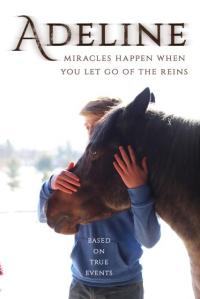
 James returned to Columbus after 25 years in L.A. and was inspired to make a local story into a feel-good family film that could inspire others. Adeline is based on a horse at Serendipity Stables that provided therapeutic care for children with disabilities and those on the spectrum. In 2002, a tornado struck and Adeline reportedly held people against a barn wall to protect them rather than running away from danger. The horse’s bravery was rewarded by locals donating over $15,000 to allow Adeline to receive life-saving surgery (Adeline lived another three years). Adeline is James’ homecoming, and it’s sweet and slickly produced to look like any number of other faith-based inspirational family films, and that’s also its problem, if you find that to be a problem.
In a small Ohio town, Kay (Jane Mowder) moves onto a horse ranch and her presence changes everything. Bethany (Orli Gottesman) is running from foster home to foster home for setting fires, but one encounter with Adeline the horse and she’s rethinking her pyromania. The town preacher John (David Chokachi) and his wife Terry (Erin Bethea) have an autistic son who takes a shine to Adeline and actually speaks. John is skeptical and worries putting faith into Kay and her holistic solutions will lead to another disappointment. He challenges his parishioners to not lose sight of where to place their faith, and then the big tornado comes twistin’ through.
 If you’re fans of sweet feel-good movies, Adeline will likely hit most of what you’re looking for, but I found the central idea a little too simplistic to the point of incredulity. In short, this is a magic horse. This is the only conclusion I must derive from what I see onscreen. I love animals. I always have. As my fiancé would attest, they flock to me. With that being said, I have a problem with animal movies because too many of them feel lazily projected onto the animal as its symbol. I had this same feeling with the 2020 inexplicably Oscar-winning My Octopus Teacher: “Does this octopus really see this man in a snorkel as a friend or an ally? She reaches out a tentacle to touch the appendage of this underwater man, but what does that mean? Is this signaling a friendship or is it merely signaling an animal taking stock of its surroundings? I don’t know and depending upon your personal relationship with the animal world, you will either accept everything [this man] says at face value without skepticism or you will see him as a slightly foolish romantic.” Adeline is such a magic horse that all it takes is Bethany looking once into her eyes to break her free from her fire-setting impulses. Adeline is such a magic horse that all it takes is a couple of rides and the preacher’s autistic son is now talking. This horse is spoken about in such grandiose terms and yet the screenplay by Sam Lewis doesn’t make the horse a character, which can be done for animals (see: Seabiscuit). The problem is that if effort is not put into giving the horse something, then the horse is merely a plot device for easy miracles. It might as well have been a magic couch whereupon every sit heals thy sitter. Given this horse’s track record, I’m surprised the town didn’t trot Adeline into their office to fix any budget shortfall. I know this is based on a true story, and I’m being more than a little facetious, but we need more from the drama than “Person A nuzzles horse or rides horse. Person A is now better. Repeat.”
Where the movie seems to want to go is the idea of alternate routes of healing, and this has dramatic potential that’s never fully realized. Much of the conflict revolves around John being skeptical and unwilling to see the benefit of the horse. His job asks him to put his faith in God and not a horse. He’s also hurting because of the frustrations with raising a non-verbal autistic child that he has difficulty communicating and connecting with. At one point, he even says he blames God for cursing his family (yikes). It looks like Adeline is going to be a conflict between traditional faith and alternative healing, an Old School versus New Age kind of battle. It appears that John might even feel threatened by the horse, like his parishioners will start looking to the special horse for answers and healing rather than their local minister. Does he feel threatened? Does he think his authority is being challenged by the horse or by God? Had the script really explored this personal crisis it could have made for an interesting character study about belief systems in conflict. Instead, it mostly plays as John being the most stubborn man who has to be the last one to accept the gift of Adeline. Lacking that depth, it means we’re just waiting for John to finally come around to the obvious, and it can be a frustrating waiting game. Even after the horse protects a dozen people from a tornado, David still pushes back. He even lays out a theory that since the horse farm was the only one hit by the tornado that God must disapprove (people literally groan and walk out of church in disgust after he proposes this theory). I think re-centering the movie on one man’s crisis of faith, accelerated by already feeling shaken from his son’s diagnosis, would be the smarter storytelling foundation rather than making the horse the magic new neighbor.
 The story has too many characters and subplots that don’t get enough attention, but at the same time Adeline benefits from a pacing standpoint by having more stories to switch over. The Bethany storyline could have been its own movie but she feels more like Exhibit A for the miraculous potential of the horse. We’re told that she can’t stop starting fires and bounces from foster home to foster home, and all of a sudden Kay agrees to adopt her on the spot, and why not if all it takes is one encounter with Adeline to prove curative for Bethany’s troubles? Because this conflict is amazingly resolved so quickly, we have to add the extra conflict of the town teenagers bullying Bethany for her past, though this is comprised to one scene where the kid she may or may not have a crush on, Jason (Jake Satow), stands up for her and punches the lead bully. This is the end of Bethany being picked on for her past. Having an outcast character in a small town is a good viewpoint and a natural source of conflict going up against community expectations. Unfortunately, Bethany is just treated like a testimonial. Likewise, the autistic child is merely a plot device, and the script then transforms Terry into little more than a pleading support network. She wants her husband to acknowledge the healing power of the horse. That’s about it. She’s the sweetly smiling, eyes-glistening “why won’t you see?” figure in these kinds of movies. I think the character that suffers the most is Kay. She doesn’t feel like a person but yet more of a plot device. She stirs up the status quo, and she has a mysterious past, and yet she’s just deliverer of miracles without further dimension.
Even though its budget was half a million dollars, Adeline looks and sounds like a professional movie that would ably fill the scheduling slots of a Hallmark or Christian TV network. The cinematography by Dan Parsons (Treasure Lies) is rich and autumnal in its color palate, and the use of dappled lighting and depth of field visual arrangements helps add an extra pleasing cinematic quality to the movie. The score is also quite nice by Erik Schroeder, a man with over 100 scoring titles to his name. It’s pleasant and twinkly without overwhelming the emotions on screen. The special effects with the tornado and its destructive wake are quite good for the budget. The acting is above average too. Mowder (Foxcatcher) is dignified, Chokachi (Baywatch) is perfectly flummoxed, Bethea (Fireproof) is winsome, and Gottesman (1-800-HOT-NITE) has a natural presence that makes me think she has even bigger opportunities on the horizon. Plus, there’s the always enjoyable Ralph Scott (Double Walker) as John’s unflappable friend and soothing voice of reason.
 There is plenty to enjoy with Adeline. It’s a passion project where you can feel the affection of everyone, and James has an invisible ease behind the camera. The acting and technical merits are solid and the pacing keeps things moving smoothly. Where Adeline frustrated me is with its screenplay that settled too often on its staid formula. We’ve seen these kinds of movies before and Adeline rests upon that familiarity a little too often for me. Genre fans will find enough to satisfy them, and everything is kept at such a family-friendly level of nice (even the disagreements are short and never more than G-rated) that is wholesome without feeling overly maudlin. I think the screenplay could have done much more with its pieces, but my opinion is going to be a minority for the movie’s target audience. Adeline is a nice movie about good people experiencing good tidings and will leave many people feeling, mostly, good.
Nate’s Grade: C
Share this:

Persuasion (2022)
 Jane Austen is one of those name brand institutions, and yet the pioneering author only has six actual titles to her name (a seventh was unfinished; two were published after her death, including Persuasion). There have been five previous adaptations of Persuasion, including one from 2021, so I wasn’t rankled when the early trailers for Netflix’s Persuasion took a chance with their adaptation. There are plentiful fourth wall breaks where our protagonist, Anne (Dakota Johnson), and handheld camerawork that makes it feel more faux documentary at points, and there is more modern jokes and modern rom-com sense and sensibilities, and judging by the social media response, there are a lot of angry Austen purists who loathe these changes (could this movie be more heretical than Pride and Prejudice and Zombies?). I found the 2022 Persuasion to be perfectly pleasant and easy to watch. Johnson is tailor-made for the headstrong, intelligent, yearning lead of an Austen movie, and with her directly speaking to the camera, I felt a kinship with her, and this stylistic choice also allowed the screenwriters to sneak in more of that flowery Austen prose. Some of the jokes are a little clunky but I laughed or smiled at most of the comedic elements, especially Richard E. Grant as Anne’s foppish and status-obsessed father. I enjoyed Henry Golding (Crazy Rich Asians) as the caddish Mr. Elliot, a man born with a Cheshire grin. I enjoyed plenty of this movie, including its racial diversity, and the staples of these Regency romances like the exquisite production design, costumes, and English countryside. I can understand some grumbling that this isn’t “their Persuasion,” but not every movie is for every person, and there’s nothing about the 2022 movie that retroactively cancels out other adaptations that fans would prefer. For 100 minutes, it felt like Austen had been re-framed as a rom-com blueprint, and Persuasion had renewed charm for me.
Nate’s Grade: B
Share this:

K-19: The Widowmaker (2002) [Review Re-View]
 Originally released July 19, 2002:
There’s a rule of thumb I’ve come to find in Hollywood, something so certain you could set your watch to it. No, not the Emmys nominating Frasier for everything. I’m talking about man-owl Larry King, who seems to dabble in the land of film reviews. Kindly readers beware, if you see an ad for a film and it has Larry King’s salivating blurb in it, run away. Run away like the plague, like Pamplona. Just run. The only films I can remember off hand (though this theory has come true every time) are 15 Minutes and Wind Talkers. And now there is the horrifically titled sub-sub movie K-19: The Widowmaker.
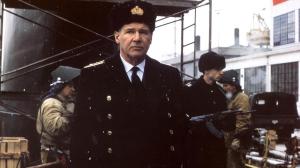
K-19 should not be confused with K-9, the Jim Belushi teams up with a dog to fight crime film. No this one takes place in the early 60s in the thicket of the Cold War. An opening title sequence tells us Russia has enough nuclear weapons to blow up the world two times, but the United States has enough to blow up the world six times over. Whoo! U-S-A! The maker of widows is itself a docked submarine in the Russian navy in preparation for combat. Before it even leaves the shore it is said to be cursed, having five men die already from its widow maker-y hands. Liam Neeson is the captain of K-19 and well respected and beloved by his crew. However, Neeson is willing to put the lives of his men ahead of the agenda of the state, so the Communist government places Harrison Ford on the sub and gives him the reigns of command. Ford is a rigorous taskmaster who puts his men through countless drills and does not exactly see eye-to-eye with the more empathetic Neeson.
 The story’s real turn comes about midway in, when after successfully launching a test missile above the arctic ice the nuclear core of the sub springs a leak. If something is not done to slow down the heating core the men could be vaporized in a mushroom cloud. Except that patrolling the waters nearby is a Unites States destroyer and thus would be destroyed as well, surely igniting the start of World War III. Crew members take shifts to enter the radioactive core area to try and do what they can. The situation gets even direr when the men come out looking like something from a George Romero film.
K-19‘s biggest fault is fictionalizing what would have been an interesting hour block on The History Channel. The Neeson and Ford characters feel like two sides of a debate, not exactly characters. The whole movie has been Americanized with heroic proportions. Instead of compelling drama we’re left adrift with what the studio wants as a summer movie with material that should no way be associated with it. I mean, the horribly dishonest marketing campaign actually has a crew member shout “Torpedo headed straight for us!” then shows a torpedo surging ahead. There was never a torpedo in the entire movie or a scene where they were being attacked! Somewhere in this ho-hum story is an exciting tale of the courage these men were forced into as well as the strain of not being able to tell their friends or family about anything that happened.
Submarine movies have so many limitations to them thats it’s hard to make a unique one anymore. Everyone knows there’ll be a point where they go beyond THE RED AREA with the needle and hear the hull ache and creak. Everyone knows they’ll have to stop an onslaught of water leaking. Everyone knows that if you talk about writing a letter to your girlfriend at home in case you die, well, the fates have it in for you. Either you love seeing these things a million times in cramped space or you grow tired of the expectations.
 Director Kathryn Bigalow (Strange Days) manages to give it the ole college try with the long camera movements inside and the close-ups of men glaring at one another. Although technically able, Bigalow doesn’t do anything to transcend the limitations she has to work with. And while she meets her mark as a director, it is neither spectacular nor worthwhile.
Ford has a horrible Russian accent he likes to flirt around with through the film. I don’t exactly know if people are supposed to like his character, being rigid and pragmatic at the expense of human life. Neeson, on the other hand, is quite capable and shines in his role. The rest of the crew alternates between Russian accents to even some Australian ones I heard.
K-19: The Widowmaker tells us that this story could not be told until the fall of communism, except at the end it shows a clip of the Berlin Wall coming down and the crew then gathering to finally remember their fallen comrades. Some people just don’t have their dates right, and some people just don’t know how to take an interesting unknown slice of history and tell it well. Damn you Larry King.
Nate’s Grade: C
——————————————————
WRITER REFLECTIONS 20 YEARS LATER

I just think submarine thrillers aren’t for me. I won’t argue there aren’t good movies based almost entirely in the tight quarters of subs, like Das Boot or Crimson Tide, but I think most of them just blur together into a wash of genre cliches. As I so presciently wrote in 2002 for my review of the submarine drama, K-19: The Widowmaker: “Submarine movies have so many limitations to them that’s it’s hard to make a unique one anymore. Everyone knows there will be a point where they go beyond THE RED AREA with the needle and hear the hull ache and creak. Everyone knows they’ll have to stop an onslaught of water leaking. Everyone knows that if you talk about writing a letter to your girlfriend at home in case you die, well, the fates have it in for you. Either you love seeing these things a million times in cramped space or you grow tired of the expectations.” I’ve grown even more bored by these sub-genre staples. In some ways, submarine movies are a precursor to the Hollywood fascination of the contained thriller, the limited location setting that acts as a pressure cooker of conflict. However, the setting isn’t as important and the people and the conflicts that reside inside those cramped quarters. For Crimson Tide, the reason that movie really worked is because of the feud between its stars, each man fighting for dominance and gaining allies and plotting mutinous moves in the name of security. You could have told that same story in a military base on land and it would succeed. The problem with K-19 is that the true story is more interesting than a rehash of submarine cliches.
 Here is a forgotten chapter in history of heroism and sacrifice, and the fact that it’s from a Russian perspective during the height of the Cold War makes it unique, at least as such in an American marketplace. The movie also feels so out of time thanks to the last decade of Russian aggression under Vladimir Putin. But for a time in the early 2000s, Russia opened up its naval shipyards to Hollywood to tell a very Hollywood version of their own history they had, for decades, insisted be kept only as secret. The crew aboard the K-19 avoided an escalation that would have likely triggered World War III. They were victims of their country’s arms race, building Russia’s first nuclear submarine to compete with the Americans but not building it to ship-shape shape, a point Captain Polenin (Liam Neeson) cites during an electrical malfunction. For those well-versed in USSR history, or having seen the truly excellent HBO mini-series Chernobyl, this shoddy workmanship is hardly uncommon when the government insists on results through fear and dire repercussions, and so the state meets its quota, though perhaps only on paper to satisfy a bureaucrat who doesn’t want to be shot by his own government. This is one reason why the real story of these men was withheld for 30 years, as it would cheapen the image of the Soviet state during a time where any mistake is viewed as weakness. I would have preferred a movie that opened up more of the men on this submarine, that really dealt with their hopes and fears more in a more personal and intimate way rather than just hand-waving “Cold War destruction” as it’s catch-all for drama and stakes. Let’s also really dwell on the sacrifices of these men taking turns to venture into a highly irradiated nuclear core to stop it from exploding. Let’s let these men feel like people rather than as indistinguishable and plentiful sacrificial offerings.
This could better be accomplished by removing the core of the script by playwright-turned-screenwriter Christopher Kyle (The Way of Water, Alexander), namely the fight for control of the sub between the old captain (Neeson) and the new captain, Vostrikov (Harrison Ford). The mutiny subplot even becomes the focus of the third act, even after the development with the broken reactor, as if settling this command squabble was more entertaining to an audience. Vostrikov is willing to risk the lives of the men for the goals of the state; Plenin is not. It’s an easy setup to root for one man and hiss at another, but their glorified personality clash doesn’t have near the crackle of Denzel Washington and Gene Hackman in Crimson Tide. The fact that a mutinous conspiracy can outflank the danger of a nuclear accident will only work if the characters are that compelling, and woe they are not. We’re given some fleeting information about their backstories, with Vostrikov’s father having once been a hero of “the Revolution” but ultimately ended up in a gulag like so many one-time heroes for the Soviet state. There just isn’t enough here to really care. We side with Neeson because he’s more loyal to his crew, but this is also benefited with the hindsight that we know this real incident did not trigger a real war. When either actor begins their hard-line posturing, it feels like watching two older dads argue in a parking lot. Both of the actors suffer from their catastrophically bad Russian accents. If I was director Kathryn Bigelow, I would have just given up and said, “All right, forget accents. Everyone just speaks in their native tongue and we’ll just shrug it off.”
A more interesting tangent, at least for me as a film critic, is my opening salvo savaging the film tastes of the late Larry King (1933-2021) and the topic of “blurb whores,” critics who are so easily amused that their excitable, adjective-ready blurbs in the advertisement for a movie can be a bad sign of the movie’s ultimate quality. A website (eFilmCritic) used to track the most egregious examples of “film critics” offering their “takes” on movies in a scathing series called Critic Watch. Neither the series nor the website seem to be active any longer, but I remember every year checking in and taking stock and shaking my head in incredulous disdain. These were usually populated by the same names like Peter Travers from Rolling Stone, Shawn Edwards from the local Kansas City news station, Jeffrey Lyons and then eventually his son Ben Lyons, Pete Hammond for Maxim, and the most curious case was that of Earl Dittman from Wireless, the publication being like one of those little insert pamphlets for oblivious satellite TV subscribers.
 Dittman was the king of blurbs on questionable movies, and his verbal ejaculate over Robots might be the best indication. He said of the 2005 animated film, “…Even more spectacular, computer-animated film than The Incredibles … In fact, the term ‘brilliant’ fails to accurately describe how wondrously witty and innovative Robot [sic] really is … If you thought the superheroes of The Incredibles and the ocean-dwellers of Finding Nemo were humorous, you haven’t heard nothing yet. The side-splitting humor of the mechanical beings in Robots is worthy of a capital ‘H’ … Forget The Incredibles, Robots is one heck of a funny animated comedy … Robots is a hilariously awesome and breathlessly inventive work of entertaining animated brilliance… You can’t afford to miss a single frame of this amazing, unforgettable animated classic.” Wow. He gave TEN different paragraph-length blurbs over Robots to the studio, an okay animated movie at best, and surely not one “more spectacular” than The Incredibles. I can even recall seeing a TV ad for Robots that was nothing but wall-to-wall Dittman quotes. With the man’s hyperbolic, effusive praise for even the crappiest of films, like calling Shark Boy and Lava Girl a “masterpiece” and Hostage as “more electrifying than Die Hard” (what????), there was a theory that the elusive Dittman didn’t even exist. Sony had been ridiculed when it was revealed in 2002 that “David Manning” was a fake critic they had created to positive blurb their movies (The Animal: “The producing team of Big Daddy has delivered another winner!”). Sony even had to pay out a modest settlement in a class action suit to any filmgoer having felt duped to see four movies. And then somebody proved Dittman was real, a freelance writer from Houston, and just a guy who seemed to love all movies and wasn’t that interesting. I don’t think he’s blurbed again since 2007. May he enjoy his retirement.
All of this is my way of saying K-19: The Widowmaker is a submarine movie where submarine movie stuff happens. If you can’t get enough of the likes of U-571 and Greyhound, then that would probably be all you would ask for in your nautical storytelling. Everyone attached has done better, though the old age makeup during an epilogue set in 1989 was eerie about what an older Harrison Ford would look like, so well done, makeup team. My review from 2002 rings so true twenty years later that I’ve had to resort to thinking what else can be added in discussion. That’s always nice, to recognize my critical self from twenty years hence was right on the money. K-19 is long, misshapen in its structure and attention, and bogged down with cliches. My initial grade still stands.
Re-View Grade: C
Share this:

The Gray Man (2022)
 Two movies removed from the Marvel Cinematic Universe (MCU), I’m starting to wonder if the brotherly directing duo of Joe and Anthony Russo are absent their own vision. Cherry was an exhausting and annoying experience overloaded with self-conscious stylistic choices that dominated the movie and squeezed it from its dramatic potential. Now we have The Gray Man, based upon the 2009 book by a former Tom Clancy writing collaborator, and it looks indistinguishable from any other big-budget spy thriller. It feels like The Russos doing their version of Michael Bay doing his version of the Jason Bourne series. It’s an expensive movie for Netflix, in the range of $200 million, and it just made me think about 2019’s Six Underground, their $200 million collaboration with Bay where he had creative freedom to make the most bombastic, hyper masculine, and tedious movie of his career. If you’re going to devote a fifth of a billion dollars for a Michael Bay-esque action movie, you might as well hire the real deal again. The Gray Man is a passable action movie, especially in its middle, but it’s wholly derivative and coasting off your memories of better spy thrillers and better characters.
The titular “Gray Man” is a super-secret Sierra agent given the code name Six (Ryan Gosling). He’s been the government’s indispensable tool for taking out bad guy and keeping the world safe for 18 years, working time off his prison sentence. Then it all goes wrong when, of course, his callous boss (Rege-Jean Page, Bridgerton) demands he “take the shot” even if it means the death of an innocent child in the process. Six declines, the covert assignment becomes much messier, and he learns that his target was a former agent from the sane secret Sierra cabal. The dying man gives Six a MacGuffin necklace that the big bad boss really wants. Six goes on the run, with the help of some allies like another agent (Ana de Armas) and his retired handler (Billy Bob Thornton), and the CIA sends every professional killer to get their man. This includes the mustachioed Llyod Hansen (Chris Evans), a ruthless private mercenary who brags about being kicked out of the C.I.A. academy for his lack of ethics and impulse control issues.
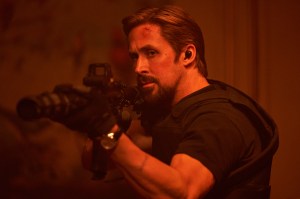 If you’re just looking for an action vehicle that provides enough bang and sizzle, The Gray Man can suffice. I’ll champion the highlights first before equivocating on them. There’s a recognizable blockbuster elan to the movie with enough energy to keep your attention. There is a significant uptick in the middle that gave me a false sense of hope that The Gray Man had transformed into a better movie. Again, this occurs well into an hour into a slightly under two-hour movie, but credit where its due, there is a nicely developed sequence of substantial action. For being a spy thriller, a majority of the movie takes place in and around Berlin. Six is handcuffed by German police to a park bench in the middle of an open square. Lloyd sends in vans of powerfully-armed goons that take out the police and then set their sights on Six. He’s trapped to the bench but still mobile, to a point, but he’s also unarmed. Watching the character react to these limitations and adapt is greatly pleasing. This is the stuff of good action cinema; supermen get boring without having to overcome legitimate obstacles and/or mini-goals. He’s able to escape and thwart his attackers and hides in a tram. This then becomes the next level of our action, and he has to utilize close-quarter combat to tease out his new attackers. And then a speeding truck with a rocket launcher shows up. And then de Armas shows up with a sports car for Six to try and leap into. And then both of those vehicles do battle while Six climbs atop the speeding tram and uses the reflection in a passing building to line up his shot to take out a goon inside the train underneath his feet. This entire middle action set piece is top-notch. It’s exciting, stylish without being too derivative, and there’s a clear set of cause-effect escalation. This is good action writing, and it’s a shame that this is also the peak with still 40 minutes left.
The beginning and closing of The Gray Man blunt whatever enjoyment I could gather. The film is oddly structured and uneven from reliable screenwriters Christopher Markus and Stephen McFeely (Avengers: Endgame). The opening scene watching Thornton recruit Gosling in his jail cell seems completely superfluous as something that could have been explained in passing, or needed no setup, but it’s at least short. There’s also a lengthy flashback in the middle of the movie that sets up Six’s allegiance to Thornton’s niece (Julia Butters, the little girl from Once Upon a Time… in Hollywood) as he babysits and saves her from kidnappers. Again, I don’t think we needed to have a set up why our protagonist would deign to save a child, but even if the movie wants to add more emotional heft to their relationship, why drop this in the middle of the movie? Why not even have this open the movie instead of the jailhouse recruitment? I like their scenes together. It reminded me of 2016’s underrated The Nice Guys. It’s just not enough to hang onto because there is no heart to this film; it is all quips and speed and flagging genre imitation. Just re-read the plot description. The genre cliches are all there, and we even have the old chestnut where the villain monologues that they and the hero are not so different.
 There’s also a questionable series of shorter flashbacks of Six as a kid surviving his abusive father’s rigorous “training,” including burning a kid’s arm with a cigarette lighter or dunking his head underwater. Again, I doubt we needed to visualize these scenes when Six could have explained his traumatic upbringing with Gosling’s acting. I was worried, and I’m still not dissuaded, that The Gray Man was establishing the parental abuse as having trained Six for these unique circumstances, that dear old bad dad somehow saved his adult son’s life. Do we need a flashback of his dad holding his head underwater to convey that Six, as his head is held underwater by Lloyd, does not like this? It reminded me of 2017’s Split when Shyamalan questionably had his character survive her captor because he recognized that she too had been abused. Did her trauma save her? The needless jumping around in time feels like The Gray Man attempting to be cleverer, or perhaps aping more of the genre expectations from an action movie of this size. The finale also lacks either the emotional catharsis or action climax that can serve as a satisfying conclusion. The last act is a compound assault set piece but it’s really just a series of interconnected gunfights and explosions. The mini-goals and engaging cause-effect escalation from before is absent.
There are a few commendable moments or choices among the blockbuster cruise control. I enjoyed that this was not just a Knives Out reunion between de Armas and a villainous Evans but it was also a Blade Runner 2049 reunion between de Armas and Gosling. I think de Armas deserves her own spy vehicle, especially after being one of the highlights of 2021’s No Time to Die (granted, it helps having Phoebe Waller-Bridge writing your character). I liked a hand-to-hand combat scene where Six utilized flares both to obscure his presence as well as an offensive weapon. Evans is fun to watch as a preening peacock of a villain, though there’s so little to his character beyond a bad mustache and smarmy attitude. There are some decent drone shots, though the dipping of the camera makes them feel more like point of view aerial assault shots. The Russos really, really like their drone shots in this movie (how much of the budget did this suck up?). However, the drone shots just made me think of the better drone shots from 2021’s Ambulance, Michael Bay’s newest movie, and it further cemented The Gray Man feeling like a clunky combination of other movies and artists. If you’ve seen any espionage action movie of the last ten years, you’ve seen enough to recognize all the key pieces of The Gray Man, and while its competent enough to satisfy the most forgiving of genre fans, it’s really just more empty noise.
Nate’s Grade: C
Share this:

The Black Phone (2022)
 This is the movie that director Scott Derrickson made after departing Marvel over “creative differences” with the Doctor Strange sequel, differences I feel like I can agree with. Based upon Joe Hill’s short story, The Black Phone is a return to Derrickson’s horror roots, along with regular screenwriting collaborator C. Robert Cargill, and you can feel the director’s reflexes resetting. It’s like three movies in one, not all of them needed or entirely coherent. It’s about generational trauma and abuse, a survival thriller about escaping a psychotic serial killer, and a little kid trying to hone her nascent psychic powers. The stuff with Ethan Hawke as “The Grabber,” a kidnapper of children who imprisons them in a locked basement dwelling with a broken black phone attached to the wall, is great, and Hawke is fascinating and unsettling. Each mask he wears seems to come with a slightly different persona attached, so with each appearance we get another sliver of who this disturbed man may have been. The story of survival is made even more intriguing when our protagonist, young Finney (Mason Thames), learns that the past victims can communicate with him through the mysterious black phone. The scene-to-scene learning and plotting is fun and efficient and requires Finney to be a little bit of a detective, exploring his dank surroundings and the failed escape attempts of the other kids to utilize for his own hopeful plan. The ghost kids also have limited memory of their experiences, which is smart so that he isn’t given a clear advantage without limitations. The parts that drag are where Finney’s little sister tries to convince the skeptical police officials that her dreams are real and can help find her missing brother. There is one hilarious moment where she prays to Jesus for guidance and then profanely expresses her disappointment, but otherwise it feels like a Stephen King stereotype leftover (Hill is his son; apple meet tree) that doesn’t amount to much besides padding the running time. It doesn’t even lead to big breakthroughs for Finney to be rescued. As a small-scale creepy contained thriller, The Black Phone is an engaging survival story with a supernatural twist that works as well as it does. It doesn’t have much more depth or meaningful characterization, it’s really just about a kid using the power of neighborhood ghosts to escape a crazy man, and that’s enough at least for a passably entertaining 100 minutes.
Nate’s Grade: B
Share this:

A Story for Winter (2021)
 Writer/director Nathan Weidner is a local teacher at Canal Winchester schools where he teaches video production and French. The 54-year-old has made two other movies before, both of which available on YouTube, but it’s clear that A Story for Winter is his passion project. The man wrote the first draft in 2009 and was rewriting it for over a decade. It’s inspired upon his own real-life family tragedy. Weidner’s daughter Meah was born in 1988 with cerebral palsy. She was non-verbal and Weidner said he always wondered what she could be imagining. The movie’s end is even dedicated to her with archival footage. Sadly, Meah was taken tragically when her mother’s new boyfriend shook her too violently (he is now serving a life sentence). In the summer of 2021, Weidner gathered former high school students, a budget of $3000, and his iPhone 12, and over the course of 15 August days he made his movie. Weidner was the photographer, editor, producer, and even wrote and performed a mournful song in the movie. A Story for Winter is currently available on Amazon and is a clear labor for love for Weidner and everyone involved wanting to see this through. Their intentions are pure and lovely. I wish the final movie was a bit more focused to better tap into its accessible emotions.
Dr. Owen Hughes (Adam Ashton Scott) is the new small-town Ohio doctor after his 80-year-old predecessor kicks the bucket. He’s chaffing under adapting to the new position, and he insists he will not see children for medical consultation. He freaks out when his newly eloped wife, Connie (Allison Kuck), even suggests they could have a child. His chilly stance begins to soften when he meets Winter (Chloe Gardner), an ailing child in town with cerebral palsy who was abandoned by her drug-addict parents. She’s being taken care of by the kindly Cora Preston (Cynthia Smith) who has opened her home to many foster children, most of whom have some form of special needs. She recognizes that Winter will not be long for this world but that doesn’t mean the life she has remaining cannot still have its rewards. As her condition worsens, Dr. Hughes opens himself up by telling allegorical fantasy stories to Winter about his own troubled family history.
 The first thing you have to acknowledge with A Story for Winter are its technical and professional limitations. It’s unfair to complain too much about obvious limitations of time and budget. You’ll notice that there is very little editing coverage or camera movement in the movie. Until the late narration-heavy fantasies, just about every shot is stationary. Characters will often talk directly in front of one another and the edits primarily feature a shot-reverse shot rhythm that feels born out of necessity than creative vision. The excuse of the newly moved couple explains the sparse nature of the home furnishings. However, there are some budgetary choices that made me scratch my head that could have been avoided. The setting is around Christmas to slot the movie as one of those feel-good holiday movies, a thriving industry unto itself. There are some references to Christmas as a theme of giving and blessings but it’s more a superficial connection, so I think the story could have stood on its own minus the holly jolly. Regardless, it’s a snowy Christmas season that keeps several characters housebound. Considering the budget and that it was filmed in the summer, I would avoid anything that would give away the unreality of the season. This movie disagrees. We see obvious green screen shots of Dr. Hughes driving in the snow. Even more befuddling, there is a plurality of exterior shots of the home except it has been rendered as a completely CGI model. It is not subtle. I kept wondering why even bother with these shots. Does it make the movie more seasonal? If so, why not use affordable stock footage or, failing that, wait until actual winter in Ohio and record thirty seconds of an establishing exterior shot of the same house but now with real snow? So even with being considerate to the limitations at hand, there are creative decisions that seem iffy.
I think many fans of sweet Hallmark movies will find A Story for Winter to be heartwarming and be inspired from its message. Characters talk about the value of human life as well as the prospect of human suffering in familiar Christian terminology. I’ve never been a big fan of “this person exists to teach you how to be a better person” as a plot device, but I can understand and sympathize with the human impulse to find larger meaning in personal tragedy. However, where the movie feels more complete, for me, on a message front is that even those who have limited times on this planet are still of value and our compassion. I’m reminded of 2016’s Arrival that hinged on a twist ending that the (six-year-old spoilers ahead) flashbacks were actually flash-forwards, and Amy Adams wasn’t mourning a past daughter but knew ahead of time that her eventual daughter would tragically die at a young age, and yet she chose to have her. For that review, I wrote, “Knowing what is to come means that a child was brought into existence to die sadly as a teenager and will suffer, but she will also live and love and laugh for many days beforehand, and knowing the end provides a lens that incentivizes every moment spent together. Yes, she will die eventually but any one of us could be snatched from the world at any moment. At least she got to know love and life for so many years before it was taken away from her.” I thought it was very nice when the movie gives Winter her voice, granted it’s through dream sequences, which means it’s Dr. Hughes’ conception of what that voice could be. I wish the movie had given her more time to express herself rather than utilize her as the key to getting Dr. Hughes to finally reveal his own family drama, though also through the lens of fantasy.
 My emotional investment was stalled because of two main factors: Dr. Hughes being a jerk and having far, far too many underdeveloped subplots competing for attention. Our protagonist is a prickly person, immediately dismissive and practically disdainful of his medical practice coworkers. He’s also a jerk to his wife and makes a snide comment whenever he feels she could have been doing more to settle their home. He keeps complaining about eating on disposable plates or Styrofoam containers. Hey, buddy, you can put dishes away too. They are recently married, eloped after a year of dating, and Connie’s extended family is not too happy about it. What better way to assure her than have her marital partner is the right person for her with him being a mean jerk? He’s also actively hiding his past and hastily establishes a cover story for not explaining to her that the town sheriff (Bryce Millikin) is his “uncle.” This should all be red flags to his wife, and how he treats her makes me dislike this man even more. For half of the movie, Dr. Hughes is a jerk, and then after the hour mark, he just spills his own personal history. There are short flashback clips peppered throughout of a young Owen with his distraught, inebriated, irritable mother and his younger sister suffering from an incurable illness. It’s enough to establish why a child with a terminal ailment would affect him so, never mind just general empathy. Now, beginning with a grumpy character and watching them transform is nothing new to storytelling. Ebenezer Scrooge wasn’t exactly a nice guy either, although we got glimpses of his past self so we knew there was a core of decency that could possibly return.
The movie cannot be a character study of Dr. Hughes finding his way back from his grief and grievance. The character doesn’t have enough dimension to him because the movie is divided with so many subplots. Namely, in our 100 minutes of movie, we have: 1) fitting into a new town and sliding into the shoes of a beloved predecessor, 2) being newlyweds with his wife and the strain of their marriage, 3) caring for Winter and opening up to her, 4) the many lives of Aubrey House, 5) Connie’s family unexpectedly coming over for a Christmas gathering, 6) Dr. Hughes explaining Winter’s past through a fantasy allegory, 7) Dr. Hughes communicating with Winter through his lucid dreams, 8) Dr. Hughes sharing his own family tragedy through a fantasy allegory, and 9) Dr. Hughes coming to terms with his relationship with his mother and forgiving her. There are more aspects to each of these, and some are more prominent than others, but that’s A Story for Winter. It’s easy to see the connected tracks but the narrative could have benefited with some careful pruning to better emphasize its most essential moments.
 I don’t think much is added by keeping Connie in the dark about her husband’s past. You can still dole out the truth over time, saving the full picture for the end of your movie. It’s not like she’s seriously second-guessing her marriage, or at least we are not given a scene that expresses this doubt. I also think little is gained through the first allegorical vehicle, using the realm of children’s fantasy to explain Winter’s own past to her. The character of Winter, again through the lens of Dr. Hughes’ subconscious mind, doesn’t seem too concerned about coming to terms with her own family’s faults. Perhaps she’s meant as the starter vehicle for Dr. Hughes to then come to terms, but why go through this process twice? Revealing Dr. Hughes’ backstory is also not a mystery that I was too desperate to uncover. The movie seems to think delaying the full information will provide more dramatic catharsis, but I’m not as certain. I think uncovering Winter’s past, then dealing with it through allegory, then doing the same with Dr. Hughes, is just making things too busy. Especially when Connie, her family, and everyone else is put on literal hold during these lengthy fantasy interludes, freezing them out from further development. The only two characters the movie really examines are Winter and Dr. Hughes, so why not consolidate? Too much feels ladled on to either pad the running time, make superficial connections to holiday film staples to satisfy its presumed audience, or reflect upon Owen’s emotional journey. If the world is cultivated to better bring one man to a change of heart, then let’s give enough room for that journey to feel well-developed and organic and satisfying.
The conclusion about acceptance and, more importantly, about forgiveness is sweet and still has some dramatic points that will hit plenty of viewers. Weidner knows how to craft a workable redemption story, though much of the comedy bits are a bit stale and hokey, though that could also be a selling point for fans of Hallmark movies that view hokey comedy as comfort food. My criticisms are directed at what could help make this the improved version of the screen story. Streamlining, being less precious with our protagonist back-story, and giving more consideration and depth to Connie would have benefited the overall emotional investment and uplift.
A Story for Winter is a nice movie made by people who really wanted to see the director’s vision become a reality, something so close to home and so personal. I won’t fault the limited budget, the bland editing and shot selections, or the amateur acting by the leads. However, creativity is not dependent on money. Even with its minuscule budget, I think Weidner could have made further judicious choices to maximize the characters and story he had on the page. There are interesting characters here but they are too defined by their circumstances, thus becoming static mouthpieces about their experiences and not enough about them in the present. Maybe I’m being a seasonal Grinch, as admittedly Christmas movies are not a salve for me, so take everything with whatever caution you’d heed. A Story for Winter feels a little too beholden to its message and its feel-good holiday genre trappings to really explore the human drama at its beating heart. It’s a commendable micro-budget DIY effort with all the right intentions, though some of its storytelling choices managed to hold back my full intrigue and investment.
Nate’s Grade: C
Share this:

Beavis and Butthead Do the Universe (2022)
 As my friend Ben Bailey told me in reference to Beavis and Butthead Do the Universe, this sequel scratched a nostalgic itch I didn’t know I had. I grew up casually watching Beavis and Butthead in the 1990s on MTV, and I found their general low-brow buffoonery to be amusing, especially how creator Mike Judge (Office Space, Silicon Valley) was satirizing the show’s own target audience. I had no attachment to the eternally horny yet dimwitted duo, and so a sequel to their first film foray in 1996 had limited appeal for me. But then a few minutes in to this Paramount Plus original, I started chuckling, and then there were points were I was laughing hard, and I appreciate Judge’s efforts at making stupid this clever. The realm of this movie is completely in the stupid comedy genre, and yet you have to be really smart to do stupid comedy so well for 90 minutes. Beavis and Butthead (both voiced yet again by Judge) are mistaken for science geniuses and taken on a space mission where they are jettisoned into a black hole sending them forward in time to 2022. Thankfully, the fish-out-of-water jokes are kept to a minimum, though the confrontation of their out-of-time ignorance with modern technology and social attitudes provides some of the best moments. I laughed silly when Beavis and Butthead learn about their white privilege from a college class and are mischievously empowered from this news, taking whatever they want in a food court because they have impunity. There’s a fun subplot where Beavis grows closer to self-reflection and emotional intimacy through the sheer act of talking to a woman on the phone, though he doesn’t understand it’s only the voice assistant Siri. There’s also an alternate universe “smart” Beavis and “smart” Butthead warning them about the dire consequences of space-time, and they admit that in no universe, with no iteration, have a Beavis or a Butthead ever “scored.” The humor is low and crude and heavy in double entendres, but it’s also consistent and fast-paced with plenty of comical misunderstandings. I would have said we, as a culture, had moved beyond Beavis and Butthead, whose modern-day ilk would likely be the self-loathing incels and trolls on 4Chan. However, Do the Universe lands enough of its juvenile jokes and satire and doesn’t overstay its welcome. It’s dumb done right.
Nate’s Grade: B
Share this:

Thor: Love and Thunder (2022)
 Thor: Love and Thunder reminds me a lot of Guardians of the Galaxy vol. 2, admittedly a film I’ve come more around on since my initial viewing in 2017. When Ragnarok was released later that same year, it was an irreverent blast, a breath of fresh air for a franchise that didn’t really know what to do with its hero, and under director Taika Waititi’s sensibility, the character had new, witty life. A similar response occurred with the original Guardians of the Galaxy as the world fell in love with the offbeat characters and storytelling and style from writer/director James Gunn. Before 2014, we didn’t know what to expect with a Guardians movie. When the sequel was released, we had a template of expectations, and the follow-up didn’t feel quite so fresh, quite so lively, and falling back on repeating too many of the same moments or jokes because it’s what was expected. It felt a bit burdened with the creative shackles of upholding these expectations. The same feeling of same-ness permeates Love and Thunder, and to be fair that’s also because the success of Ragnarok raised our expectations for a Waititi MCU movie.
Thor (Chris Hemsworth) is trying to find his way after the events of 2019’s Endgame. He’s gotten in shape, spent some time palling around with the Guardians of the Galaxy (returning in 2023!), and reconnected with the love of his life, Jane Foster (Natalie Portman). She’s been chosen by Thor’s old broken hammer to be its new wielder, granting her superhero status. Except in her human status, she’s dying from stage four cancer. Just as Jane comes back into his life, Thor might have to come to terms with losing her all over again.
 This movie just doesn’t feel like it has the same natural prankish energy of Ragnarok, though part of this again might be myself acclimating to Waititi as a filmmaker and storyteller. Prior to Ragnarok I had only known him for the delightful vampire mockumentary What We Do in the Shadows, and since Ragnarok Waititi has become his own industry, winning a screenwriting Oscar, lending his name and acting to hit TV shows, including a version of What We Do in the Shadows, and even Disney wants his mark on Star Wars. In short, the man is everywhere. In 2022, we now have a much better idea of what to expect from a typical Waititi project. Love and Thunder is recognizable to the man’s omnipresent brand, and still a fun movie with some solid gags, but it also feels a bit sloppy and repetitive.
I kept thinking about all the powerful dramatic potential in the different storylines that are barely explored because the driving plot is a universe-hopping caper to save a bunch of kidnapped children (yes, the children represent something, the next generation, renewal, legacy, but let’s carry on). Tackle the pathos of Jane Foster, who in her normal human state has her body betraying her. She feels weak and incapable of the greatness she feels burdened to still accomplish with her declining time. With the power of Thor, she becomes a superhero, and with super swole arms. However, this power trip also has its own ironic downside. Every time she powers up, the magic hammer is actually draining more of her life force, meaning she’s actually speeding up her terminal illness. Here is a character given a dire situation and an escape and yet that escape only worsens the illness. There’s such powerful drama there to explore as she comes to terms with how to spend her final moments, among them reconnecting with her super ex-boyfriend. This could have sufficed as the entire movie and told from her perspective.
Then there’s Gorr the God Butcher, gloriously played by Christian Bale like he’s in a James Wan horror movie. Here is another example where the villain doesn’t just have a sympathetic back-story but where they are correct in their aims, though maybe not in their methods (think Killmonger arguing Wakanda should do more). Gorr is tired of the gods crushing the little guy with their general entitlement, indifference, and selfishness. These fancy deities aren’t worthy of worship. The power structure needs upending. It’s easy to get behind Gorr’s plight and see connections to our own imbalanced world. This too could have sufficed as the entire movie and told from his perspective. Now, things could have gotten even more interesting and complicated for Jane, because she’s not officially a god unless she’s yielding Thor’s hammer and joins those rarefied ranks. It would pose another question of whether wielding this power would be worth her remaining time, especially with a heat-seeking missile coming for her on a righteous quest of vengeance that is slowly eating him alive. Both are dying but can they fulfill their goals?
 If these storylines had been given careful development and the necessary time to breathe, Love and Thunder could have been one of the most interesting movies in the ever-expanding MCU cannon. Instead, it’s galloping to work so hard to stick to the Waititi brand expectations, to reignite our feelings of Ragnarok, and so these promising elements ultimately get shortchanged by hit-or-miss comedy bits. I liked several of them even despite myself. The set piece where Thor and Jane and friends travel to Omnipotence City has such imaginative heights. Russell Crowe is having a grand time as a hilarious Greek caricature of Zeus that is more concerned about the upcoming company orgy and brushing feta crumbles from his beard. I loved the almost Lego Movie-esque zany sight gags of the cohabitation of gods from different religions (Korg’s god sits on an iron throne of scissors, its own visual joke). It’s such a fascinating concept that I wish we could have spent even more time here. Let’s see the Egyptian gods mingling with the Sumerian gods while pranking some weird alien deity. The set piece serves two narrative purposes: gathering a powerful magic weapon, and learning the gods are sitting out the battle with Gorr for their own short-sighted self-preservation. It’s mostly a pit stop. Again, there was more pathos that could have been explored here as people meet gods, but this is my cross to bear. The general banter is amusing and has more hits than misses even if the hit percentage is lower. I laughed every time the magic axe would silently pop onscreen in jealous judgement. I even enjoyed the screaming goats even though from their first moment they are the exact same joke. Regardless, whenever Thor and company would travel to a new place and I heard that familiar goat scream, it would make me giggle despite my reservations.
I also had my qualms with the concept of Eternity, a magical place located at the center of the universe but destined to grant a wish to whomever gets there first. It’s too transparent as a plot device and its very existence this far into the MCU creates too many nagging questions. In the history of the universe, no other creature successfully reached this wish-granting locale? And if this existed at least to Thor’s understanding, then why didn’t the characters think about this as an option to thwart Thanos and his universe-halving finger snap? I know the answer, because it wasn’t written into a movie until now, but this is the drawback of throwing ultimate power plot devices without more careful context. Eternity could have been a secret just to the inner circle of the famous gods, unknown to all but a few, but even that strains some credulity. If Zeus is such a carousing hedonist of legendary status, I’m sure he would have either blabber-mouthed its existence or sought it ought for his own gain. I genuinely liked the set piece at Eternity, a small planet that sucks all color from existence, making the imagery even more striking like the inky panels of a comic. The same question happens when Thor shares his power late in the movie. Couldn’t the Avengers have used this too?
I fully acknowledge that my criticisms are butting against the movie Waititi wanted to tell. I’m pushing for its inherent dramatic potential while it wants to be a more comic and romantic adventure about the power of love. I think by the end it gets there, and the dramatic confrontations have some emotional weight to them, especially about the idea of what we leave behind for others after we’re gone. Although, even this is mitigated by the general stakes-lowering reality that death never seems so permanent in the world of comics and monetarily useful IP. It’s a joke how many times Loki has been brought back from the dead and Thor doesn’t even know that his trickster brother has been brought back from the dead again (again again). We’ve now established time travel and an emphasis on the multiverse of alternate universes, which means at a moment’s notice, any meaningful death or sacrifice has the possibility of being undone. This is also the reality of a moneymaking machine that has dominated the movies and pop-culture landscape for 14 years. No death is ever going to be for real in this environment so why should I put so much emphasis on the dramatic potential of what losing a loved one, or your sense of self, can have? I can sit back and enjoy the lesser, but still enjoyable, Waititi quirk on display for two hours of silly.
 Hemsworth (Spiderhead) is so sharply skilled at comedy that I feign to remember his previous existence as a dramatic actor. He’s still on the same sublime, charismatic yet blithely self-effacing vibe he was with Ragnarok. Portman (Annihilation) comes back after close to a decade for a clear reason to leave her mark on what had been an otherwise forgettable character and giving her a renewed sense of power and direction and agency. Bale (Ford v. Ferrari), as mentioned, is fantastic. I appreciate that his character isn’t physically huge and bulky. He looks quite the opposite, like he’s wasting away, like somebody slathered an ashy coat of paint from living-skeleton Bale after The Machinist (yes, also the obvious Voldermort comparison). He is relishing every teeth-stained syllable as a nightmare creature living from the shadows. The prologue with his character is heartbreaking and yet understated (and truth be told, having young children in my household, it hit me more personally), and I turned to my fiancé and said, “I’m supposed to not like this guy?” I wish the opening credits were then a montage of Gorr seeking and slaying wicked gods. Bale is playing his role like he’s definitely not in a Waititi movie about goofy screaming goats; he’s playing Gorr like a tragic hero of myth. This is why I would have been happy had the whole movie been told from his perspective. The new characters from Ragnarok suffer the most and become sidelined as “Others Along on the Quest.” For Korg, this is fine, but for Tessa Thompson’s Valkyrie, I mourn her absence. Also, both characters are definitively queer now, though Korg might be more a question, making Love and Thunder the gayest movie in the MCU, and just after Pride Month, so take that for what you will, folks.
As a fun matinee, Love and Thunder will amuse and brighten, even if its comedy highs don’t quite hit as high this time under the burden of franchise expectations. Love and Thunder is a movie that will be best known for Portman and Bale, both of whom elevate the scattershot material with their dedication and professionalism. It might even be known for Crowe’s hammy scene-stealing, or the super-powered cadre of cute kiddos, or even the screaming goats. It’s a movie more of moments and ideas, too many underdeveloped or lacking the gravitas they deserve, especially concerning Jane and Gorr. I feel like a grump bemoaning that the big superhero movie should have more time spent on a woman contemplating her own existential demise as well as man’s relationship and fealty to our gods. Still, it’s Waititi doing his signature brand of quirk with $200 million of house money from Disney. Thor: Love and Thunder is a lesson in diminished returns but when you have Ragnarok as your starting point, it’s at least guaranteed to still be worth your two hours once and deliver some chuckles and smiles.
Nate’s Grade: B-


 nathanzoebl
You must be logged in to post a comment.