Teenage Mutant Ninja Turtles: Mutant Mayhem (2023)
 As an elder millennial, the Teenage Mutant Ninja Turtles have been a formative franchise for me. I grew up on the cartoon, got the toys for Christmas, died endlessly during the shockingly hard underwater stage of their Nintendo video game, and generally have a soft spot in my 80s nostalgia for the likes of Leonardo, Donatello, Raphael, and Michelangelo, plus their surrogate father, Master Splinter. Apparently Seth Rogen felt the same way, and he and his writing partner Evan Goldberg have spearheaded a new animated variation of TMNT that just so happens to also be co-written and directed by the man behind my favorite film of 2021, The Mitchells vs. The Machines. It was a recipe to guarantee my personal enjoyment, and Mutant Mayhem thusly delivered. The biggest selling point for me was how lovingly realized the “teenage” part of the title was, getting a foursome of actual adolescents to portray our heroes, and using high school experience about acceptance and fitting in as effective and even poignant parallels. I loved just hanging out with these characters, who view their surrogate dad (voied by Jackie Chan) with a mixture of love and embarrassment, and who want to be accepted by a world predisposed to finding them monstrous. Naturally, becoming crime-fighting heroes is their best method for winning over the public, with a young and aspiring journalist April O’Neil (The Bear‘s Ayo Edebiri) hoping to improve her own social standing at school by breaking the existence of these unknown mutants. The comedy is robust and layered while allowing for nice character details and moments, giving each turtle their own satisfying arc. The action is fun and inventively staged while still being thematically relevant. The vocal cast is great, and the young actors are tremendous together, sparking an enviable improvisational energy that made me smile constantly. The art style has an intentional messiness to it, like smeared colored pencil drawings, and the imperfections are themselves part of the vast visual appeal. It’s a family movie that will succeed with old fans and new, and Mutant Mayhem is the best film depiction yet of the famous heroes in a half-shell.
Nate’s Grade: B+
Share this:

The Rundown (2003) [Review Re-View]
 Originally released September 26, 2003:
In the beginning of the new action comedy The Rundown, Beck (The Rock), a bounty hunter, is entering a club on a job. On his way in Arnold Schwarzenegger passes him by and says, ”Have fun.” Consider it a proverbial torch passing, because while Schwarzenegger is going to be busting the campaign trail, The Rundown establishes The Rock as the fresh and capable marquee name for all future action films. This man is a star.
Beck is offered a chance to square off all debts to mobster Billy Walker by agreeing to journey into the Brazilian jungle. His mission is to retrieve Travis (Seann William Scott), a hyperactive screw-up who happens to be Walker’s son. One Beck travels to the Amazon he runs into Hatcher (Christopher Walken) who claims to own the jungle and whatever contents dwell within. He asserts that Travis has stumbled upon a wealthy artifact in his jungle and therefore refuses Beck to leave with Travis. It’s at this point that the chase is on.
I don’t care what your little sister told you, Vin Diesel is not the next face of action, no, it’s The Rock. Despite only appearing in three movies (and he was only in The Mummy Returns for like three minutes), The Rock displays a razor-sharp sense of comedy. He’s also huge, likeable, and he can even emote well during smaller moments, not that The Rundown will stretch you as an actor. He’s also honed in excessive eyebrow arching.
Walken exists in a plane of brilliant weirdness that we simple human will never be able to co-exist upon. His Hatcher is one mean villain who exploits indigenous workers, wears his pants up to his armpits, and says he put the heart in the darkness. Walken’s hysterical tooth fairy monologue is worth the price of admission alone.
Director Peter Berg (Very Bad Things) adds a delectable cartoonish flavor to the film. His action sequences pop with exaggerated energy and zestful humor, like when Travis and Beck roll down a hill for a near minute. This is everything an action film should be: lively, funny, with keen action sequences that are low on CGI but filled with characters we care about. The Rundown is the best summer film not released during the summer.
The Rundown is an adrenalized punch of fabulous action and hilarious banter. When you’re not laughing and spilling your popcorn you’ll be sitting straight up to catch every lovely eyeful of spectacular action. It’s a terrifically entertaining and fun flick. The Rock has arrived.
Nate’s Grade: A
——————————————————
WRITER REFLECTIONS 20 YEARS LATER

Looking back, The Rundown really was a sea change for action cinema, and it also helps that I called it all the way back in 2003, because even a little 21-year-old me could recognize what seems almost blindingly obvious over two decades of hindsight: The Rock was a born star.
The Arnold Schwarzenegger cameo in the opening scene of the movie feels even more like a passing of the baton, as Arnie was stepping out to join the world of politics and Dwayne “The Rock” Johnson was only beginning to get started building a movie career. “Have fun,” Schwarzenegger says in passing. The wrestling phenom had built a powerful following and had begun making the leap into mainstream features with 2002’s one-two-punch of The Mummy Returns and his spinoff, The Scorpion King (did you know there are five Scorpion King movies and the 2012 edition co-starred fellow wrestler-turned-movie star Dave Bautista? Well now you do!). His appearance in the Mummy sequel was minimal, and marred by some of the worst CGI of the new century, but his solo Scorpion King adventure wasn’t quite the launching pad Johnson’s team had hoped. It wasn’t really until his fortuitous inclusion with the re-surging Fast and Furious franchise in 2010 that Johnson finally hit superstardom. However, the same magnetic appeal that would come to define Johnson as one of the biggest and more consistent movie stars in the world can be seen so evidently in 2003’s The Rundown, an action-comedy vehicle that plays to all the man’s many strengths. He’s got an immediate presence, a trained comedian’s command of timing and inflection, a gift for slapstick and lack of vanity about being goofy, and the man is just an agile and impressive physical specimen who throws himself into the rough and tumble stunt work. In short, Johnson knows how to look cool, knows how to look tough, knows how to look silly, and knows when to change gears. He’s a generational talent. My friend Ben Bailey says Johnson should play Superman because he really is Superman hiding among us pitiably frail mortals.
 The Rundown, formerly known as Helldorardo, is also an excellent launching pad for director Peter Berg, who until this time had only one other movie on his resume as a director, 1998’s relentlessly dark comedy, Very Bad Things (a film I remember “enjoying,” if that could even qualify as the correct word). This was Berg’s coming out party for the realm of bigger studio fare, and while it didn’t launch his career much like his leading man, it led to Berg’s breakout, helming 2004’s Friday Night Lights. From there, Berg has directed blockbusters (Hancock), blockbuster misfires (the unjustly maligned Battleship), and five reportedly different Mark Wahlberg action dramas from 2013-2020, though you’d be forgiven if you inadvertently confused a Spenser Confidential with a Mile 22. Berg’s docu-drama style became entrenched in 2004, though it didn’t always suit every movie equally. That’s why the movies that stand out from this default cinema verite visual style are even more remarkable for me, especially when Berg showed he can do over-the-top flashy fun violence just as good as any other big screen movie maker. His zest for the outlandish makes the movie feel like a living cartoon, but in the best way. The screen is coursing with energy but within a dedicated vision of spectacle, unlike say the mass chaos and indifference to coherency that dominates a Micheal Bay extravaganza.
Chiefly, The Rundown is just such an overwhelmingly fun experience. The actors have an infectious and combustible chemistry, bringing to mind the likes of Midnight Run and Romancing the Stone. The plot holds up well and allows for momentous action and a pleasing revolt against an exploitative villain played with panache by none other than a cranky Christopher Walken. Even while being irreverent and ridiculous, the movie still works as a story and a buddy movie, and the ending feels fulfilling and satisfying on its own terms. As I said in my 2003 review, this is everything an action movie should be. It’s exciting with engaging set pieces and outlandish stunt work but it never loses sight of its characters and their fractious screwball relationship. I love movies where the two lead characters are working against odds and constantly one-upping each other, flipping who has the upper hand. It makes for a far more unpredictable experience and ensures neither character is ever too confidently in control.
 This is an excellent movie to just put on and dash away your cares for two hours. I’ve watched The Rundown probably a dozen times, introduced friends and students to it, and everyone walks away a believer. It’s got style and banter and enjoyable characters and surprises and is just one of those movies that nobody really ever talks about but deserves to be on everyone’s DVD shelf.
Re-View Grade: A
Share this:

Transformers: Rise of the Beasts (2023)
 Neither hitting the high of the character-centric, good-times 80s Ambin vibes of Bumblebee, nor the bombastic excess that defines Michael Bay’s OG series, Transformers: Rise of the Beasts is a new installment that flattens already well-trodden ground. It’s a mediocre action movie with big globs of CGI robots once again colliding in conflict that left me disengaged. We have more familiar Autobots in this one, including their leader Optimus Prime, and there’s a new slew of animal-themed robots, though I’m always left wondering why they choose specific builds and stick with them since it was established they can copy Earthly designs. Regardless, it’s another story about good robots and bad robots trying to beat one another to a special magical MacGuffin that may or may not destroy the universe, and it all feels a bit too same-y from the six other Transformers movies. The new characters are bland and stock, with Pete Davidson supplying our lead Transformer robot buddying up with the young man (Anthony Ramos) who turns to grand theft auto to try and pay for his little brother’s health care. To go along with our wide-eyed hero discovering this hidden war, we have a brainy sidekick (Dominique Fishback) who shares in the hyperventilating. I kept thinking about how filming these movies is just measuring out a lot of wide exterior shots and saying, “Yeah, there’s going to be a giant robot in there eventually.” Credit director Steven Caple Jr. (Creed II) for having relatively restrained editing to better orient his action and audience, which is not something we can say about Bay’s movies. The problem with Rise of the Beasts is that it’s movie number seven rather than the first, so it has no novelty and whatever differences it offers are microscopically minimal. If you’ve seen any of the other Transformers movies, you’ve seen essentially what this one has to offer, so unless you have young children who are heretofore unblemished in their cinematic knowledge of Transformers, feel free to just wait for a better movie.
Nate’s Grade: C
Share this:

Gigli (2003) [Review Re-View]
 Originally released August 1, 2003:
It’s the feel-good movie of the year revolving around a lunkhead mobster (Ben Affleck) and his mentally challenged kipnapee and their attempts to covert a lesbian hitman (Jennifer Lopez) in between her yoga/horrific monologues concerning the superiority of female genitalia. Believe the hype people; Gigli is indeed as bad as they have told you. It’s not even entertainingly bad, like Bulletproof Monk, no folks; Gigli is just mundane and awful. During the entire two-hour stretch, which feels much much longer, I kept saying one thing aloud: “How could anyone making this think they were making a good movie?” Did they think audiences would find it funny that Affleck’s mother (the mother from My Big Fat Greek Wedding) shows us her big fat Greek behind? Did they really think that a mentally challenged kid (who has an affinity for gangster rap and wishes to travel to the mythical “Baywatch”) would come off as endearing? Well instead it comes across as insulting. And what else is insulting is the laugh-out-loud dialogue Lopez is forced to spit out concerning her attraction for women. I can’t think of any actress that could say the line, “I love my pussy” convincingly. And I’m sure a lot of actresses out there have true affection for it. The writing is just atrocious. And so much else fails as well. The score is a perplexing mix of upbeat jazz and inappropriate string orchestra. I don’t understand what emotions they were going for during scenes in Gigli but a full string orchestra playing music better suited for a real drama does not fit. Maybe it was for a tragedy. In that case, then it’s right on the money. You won’t see a more sloppily executed, horribly acted, painfully written, lazily directed, inept film this year. And what the hell did Christopher Walken walking in have anything to do with anything?
Nate’s Grade: F
——————————————————
WRITER REFLECTIONS 20 YEARS LATER

Gigli. It’s a word that instantly trigger shudders and shivers, a code name for fiasco, for career-destroying miscalculations. Writer/director Martin Brest was a Hollywood heavyweight with hit adult comedies like Going in Style, Beverly Hills Cop, Midnight Run, and Scent of a Woman, and since the cataclysmic disaster that was Gigli in 2003, this man hasn’t directed a single thing in these twenty years. The man is still reeling from the wafting stink from this very bad movie. I thought it might be worthwhile to revisit what I dubbed the worst film of 2003, though I was not the only critic to make this distinction, but now I’m questioning why I even bothered. It’s not like this movie was somehow going to get that much better with two decades of safe distance. The amazingly miscalculated artistic decisions will still be the same, still bad. I guess it must have been primarily my own morbid curiosity, much like revisiting 2001’s Freddy Got Figured, about whether this famous flop could still live up to its reputation. Well, dear reader, allow me to put any lingering doubts to rest you may have had about Gigli. It’s still very very very bad.
I might possibly recommend watching this once in your life (depending upon how many years you are lucky to earn) for the sheer fascination; Hollywood so easily makes mediocre and boring and familiar movies that feel like pale imitators of some prior hit, but Gigli is something different in the realm of studio stinkers, a project where just about every single creative decision warranted the incredulous Tim Robinson gif response: “You sure about that? You sure about that?” Gigli feels like two tonally dissonant movies in conflict at every moment. The plot elements feel lifted from some mid-to-late 90s indie crime comedy, the likes where they would just throw together a grab-bag of ironic provocative plot elements you wouldn’t expect together. “Mobster doofus kidnaps mentally challenged kid who is obsessed with gangster rap and wants to visit the ‘Baywatch’ which he thinks is real! Romance with a lesbian! Severed thumb ruses!” The collection of strange parts feels like it’s supposed to be a madcap, wacky comedy, and yet the tonal approach is complete treacle, with a shockingly syrupy score that rises and falls throughout, trying to convince you that what you’re watching is quixotically aiming for Oscars. It is astounding if you stop and pay attention to the film score at any moment, no matter how strange, as it attempts to provide jazzy saunter to “comedy” scenes, like an ex-girlfriend showing up into an unstable situation, and then it segues to Spielbergian emotional heft, like when that same ex-girlfriend attempts to take her own life to convince Jennifer Lopez to come back. There were so many moments where my only response possible was to avert my eyes, shake my head, and wonder whether anyone at any stage had any misgivings, tried to reach out to Brest, but then shrugged and dismissed their very legitimate worries as, “Well, he made Midnight Run after all. What do I know?” You know enough that these different tonal approaches will not work.
 Apparently, the movie was intended to be a straightforward mob comedy but the studio wanted the focus to shift toward a romance because of the actual romance between its stars, Lopez and Ben Affleck. Whenever actors begin a relationship after a movie or over the course of making one together, it provides another lens to review the movie, to gauge their chemistry and, if you’re so lucky and observant, able to “see” them falling in love with one another. That is nowhere to be found with Gigli. Maybe it was the shared experience of finding what they could to cling to while making this movie that nobody fully understood but committed to anyway (I guess love can be described the same way under some circumstances). Regardless, the romance between the two characters is, like all other plot elements, haphazard and spontaneous and foolhardy.
The characters are all awful and they never remotely come across like relatable or even remotely interesting people. Affleck’s Italian lunkhead Larry Gigli is just awash in early 2000s misogyny and bravado, dubbing himself the “sultan of slick, the rule of cool, the straight-first-foremost, pimp-mack, hustler, original gangster’s gangster.” Allow that macho boast to also exemplify another critical problem with the movie in that almost all the dialogue will make you cringe. There’s an entire monologue by Lopez, while she’s contorting her body in a plethora of lithe yoga positions, all about how superior the vagina is in appearance and function. What about when Lopez, as an indication that she wants to engage in heterosexual congress, utters the immortal phrase: “It’s turkey time. Gobble gobble.” Larry slams a kid’s computer on the ground and triumphantly says to suck an appendage of his, but then adds, “dot com” because the kid’s a nerd or something because he likes computers. Ho ho, the kidnapped young man insists that he be read to before going to bed, and what does Larry have at his disposal? Not books, oh no, so he’s forced to read him instructions on shampoo and toilet paper. Hilarious, right? What about when this same mentally challenged kid says, “When my penis sneezes, I say, ‘God bless you.’” The early 2000s weren’t an enlightened time with depiction of mental handicaps, and poor Justin Bartha (National Treasure, The Hangover) goes fully into the worst of these impulses, making the performance feel like a minstrel show for those with mental challenges. At least this aspect is not alone. Nothing ages well in this movie and its comedy only falls flatter and the drama is only more inexplicable twenty years later. It’s a special kind of bad so rarely achieved at this level of Hollywood.
Given that the majority of the movie consists of kidnapping a naïf, most of the movie is set in Gigli’s apartment keeping the man unseen and unheard from. This makes the movie feel for a long stretch like a glorified one-set play, with special appearances from traveling guest actors popping through for a brief moment in the spotlight. Here’s Christopher Walken dispensing with a monologue and then never being seen again. thanks for coming. Here’s Al Pacino, yelling so hard I’m surprised Lopez and Affleck didn’t need to wash the layers of spittle off. Here’s Lanie Kazan (My Big Fat Greek Wedding) who needs an insulin shot in her butt and let’s make sure we see her thong while we’re at it. These incursions of well-known actors re-explain the plot, not that it was hard to keep up with, and it all feels like stretching for time when the movie is already two hours long. The resolution, where our characters drive off into their sunny endings, lasts twenty minutes itself, which feels as long as the endings of 2003’s Return of the King. It’s a screenplay that feels like it’s holding itself on ice, content that the kooky characters butting heads and trading quips and monologues would be enough, and one that feels unsure of those same impulses, relying upon a revolving door of one-scene guests to remind us what we already know. It makes you feel simultaneously trapped with awful characters yet also in the hands of someone who doesn’t quite think you’re understanding the nuance and hilarity of the strained effort.
 I’m not an automatic Affleck hater. I enjoyed his rise from the films of Kevin Smith to Hollywood leading man. I can understand the draw of working with a filmmaker like Brest, and it’s probably that same appeal that lead him to also star in 2003’s Paycheck, directed by John Woo, who like Brest never worked in Hollywood again. This was the period where Affleck’s star was on the decline, and Bennifer was dominating tabloid space, and if it weren’t for the failures we might not have ever gotten Affleck as film director, so maybe we never would have gotten The Town or Argo or Gone Baby Gone had it not been for Gigli, so there’s a silver lining for you.
Look, you already know you shouldn’t even get near Gigli and with good cause. It’s a rarity to see something this colossally bad with this level of artistic freedom to be bad, not simply having too many cooks in the kitchen but having one very wayward chef nobody felt they could interfere with. This was a runaway chef, the kind of fiasco that only comes from unchecked artistic hubris. In that regard, there may be some rubbernecking appeal here for those who can endure bad characters, bad drama, bad comedy, bad acting, and horrible depictions of human beings who never at any point sound like human beings. It’s hard to watch and two hours of your precious time. 2003 began as a rough year for movies, sporting fascinating disasters like Bulletproof Monk and The League of Extraordinary Gentlemen. Watch those movies if you’re looking for a good-bad time. With Gigli, it’s only going to be a bad-bad time, whether it’s 2003, 2023, or any year until the sun explodes. Hey, if Ben Affleck and Jennifer Lopez could put this movie behind them and reunite, and even get officially married in 2022, then we can put it behind us as well.
Re-View Grade: F
Share this:

Barbie (2023)

Who would have guessed a movie based upon a ubiquitous doll that dates back to the 1950s would become not just a cultural force and reclamation project but also the biggest moviegoing event of the year, as well as the highest-grossing movie in Warner Brothers’ history, even outpacing The Boy Who Lived? In 2023, it turns out we are all, every one, a Barbie girl living in a Barbie world. I came to this experience late, wondering if writer/director Greta Gerwig’s movie could live up to the lavish hype, the fawning praise, the hilarious offenses that many fragile males have levied against it. It couldn’t possibly be that good, could it? I saw it with three generations of women in my family, something I will privilege, and I must say, it is that good. Barbie is one of the best movies of the year and a shining example of what vision and passion can do to elevate any story. There’s so many ways this movie could have just been cheap corporate slop and instead it becomes an existential yet deeply personal treatise on life and death.
In the world of Barbies, women rule and the men are just afterthoughts. In this creation myth, the Kens were meant to compliment the Barbies. We watch “Stereotypical Barbie” (Margot Robbie) go through her daily routine of fun, frivolity, and nightly dance parties with all her best gal pals (no boys, er Kens, allowed). Then one day, this blonde Barbie started walking differently, started seeing the world differently, and started wondering about dying. Was there something wrong? Her human owner, in the real world, was in trouble, so Barbie sets off on an adventure to find her human owner and save the day, with help from her boyfriend, Ken (Ryan Gosling). Except for these two, the real world is very different from what they were expecting.

It’s easy to see how this movie could have been a mediocre fish-out-of-water comedy, with Barbie clashing in our modern-day world with its modern-day views of fashion, body image, and what skinny, buxom dolls represent to generations of young impressionable children. It’s clear to see what the scrapped version could have been when Amy Schumer was attached to star. What really impressed me with Barbie, beyond its delightful and inspired production values, is how ambitious and well-realized this movie is at every turn. It could have settled for easy jokes about Barbie and Ken not fitting in, not understanding human relationships and sex, and that stuff is there and it’s quite funny, but Gerwig and co-writer Noah Baumbach want to do so much more. This is a studio blockbuster, based upon a decades-long popular toy, that wants to do more with its platform. It aims higher, and in just about every measure, Barbie admirably succeeds. As a comedy, it had me howling with laughter, enough so that my response was providing another level of entertainment for my wife. There are jokes that are so specific, so beautifully targeted, that when they detonated, I was in awe and appreciation, (a reference to the literal definition of fascism and a Snyder Cut throwaway reference were perfectly attuned to my comedy sensibilities, thank you, Greta). As a frothy and fun fantasy, the movie has excellently crafted sets and costumes and retro visual aesthetics, making the movie a pink-accentuated sensory bombardment. But as a satire is where Barbie really becomes special.
Again, it would be easy for Barbie to learn lessons about body diversity and positivity and likely be browbeaten into what a good feminist is supposed to be, that the real world is a harder place for women than she previously thought. All of that is there, along with a consistent and entertaining critique of the faults of patriarchal society, but Barbie isn’t some reductive, man-hating screed to indoctrinate women into thinking they don’t need men (men are already very good at convincing women they don’t need men). This is a treatise on the power of inclusion and how this benefits society, both for men and for women. In Barbie Land, it’s a matriarchal society where girls rule and boys drool, but it’s a fantasy world reminiscent of a caste system, where the Kens will always be lesser afterthoughts because, well, they’re not Barbies, they’re just Kens. They are excluded in their own world. That’s why Gosling’s Ken is so excited by the real world, where the status quo is flipped, where the world is run by men, as he now sees this as an opportunity that has been denied to him. He wants to recreate his own version of the patriarchy not because he thinks women are inferior but because he just wants to be in power and respected, so he’s replicating his misguided understanding of what men in power are like, which naturally involves lots of horses. In the real world, Ken admonishes a suit-wearing corporate executive that they aren’t doing patriarchy right, to which the man winks and says, “We’re just better about hiding it.” The final act isn’t about “bringing down the patriarchy,” it’s about making a more inclusive world where people don’t have to feel marginalized and stuck and resentful.

Besides its social satire, there are other areas where Barbie goes deeper in surprising and affecting ways. There are more than a few applause-worthy moments explaining the perspective of women, particularly a monologue that is destined to be an audition piece for the rest of time, and it all works and is cutting without being too didactic. Gerwig even gets in a few jabs about corporate culture (“Are there any actual women in this boardroom?” “I’m a man with no power, does that make me a woman?”) and Mattel as an organization becomes another force of antagonism spearheaded by hapless buffoonish men (of course you get Will Ferrell to play the Mattel CEO). The biggest surprise is how emotional and deep the movie can become. There will be plenty that tear up just having a big Hollywood movie recognize their day-to-day emotional toil of being a woman in modern society. For me, the questions over what to do with the life we have flirted with some surprising existential contemplation, as Barbie is reminded at several points that death is a reality and yet would she want to move to the human world? An emotional highlight occurs when Stereotypical Barbie is speaking with the equivalent of her creator, and Billie Eilish’s tender-to-the-point-of-breaking song “What Was I Made For” lilts onto the soundtrack, and the sincerity of this sequence, topped with insert home video footage from the production cast and crew, really hit home how much more this movie is going for then bringing different dolls to life. It’s not just jokes about crotch-less creatures and weird feet, it’s about how we can live and why we do so, what inspires us. It’s a big studio summer release that flirts with the profundity and brevity of life.
There is one actor who deserves their own special recognition and that is Gosling (The Nice Guys), who so rarely gets to showcase his sharp comedy skills with the dour, serious, insular roles he gravitates to. Gosling is so committed to his role that he is operating on another plane of excellence, hitting sly jokes within jokes and selling every wonderfully stupid moment with Ken. This man isn’t afraid to look silly, he fully courts it, embraces it at every opportunity, and yet his performance doesn’t detract from Robbie but only makes them both shine brighter. He reminded me of Tommy Wiseau at points. His hilarious ballad “I’m Just Ken,” which segues into a wild West Side Story-style dance battle that is peak peacocking, is a phenomenal run of inspired silliness (the storming of the Malibu beach had me rolling), yet also connected to the character’s co-dependent arc and dissatisfaction with himself (when feeling down, just quote: “I’m just Ken, and I’m enough, and I’m great at doing stuff”). Ken has to learn to think of himself outside his combined definition with Barbie, and they both need to spend time discovering who they really are rather than who they think they’re supposed to be before considering forming attachments. I would not be surprised if Gosling earns a Best Supporting Actor nomination. It was the role he was born to play: insecure accessory doofus.

Gerwig has launched to mega-stardom with just three directing efforts (four if you count her co-directing effort in 2008 with Nights and Weekends, back in her early mumblecore breakout days). Already this woman has been nominated for Best Director, one of only seven ever, and she now owns the highest grossing movie of the year as well as in studio history. She’s proven herself with her 2017 coming-of-age semi-autobiographical Lady Bird, richly realized and achingly felt, with an established literary classic that is a foundation to generations, and had been adapted a dozen ways for the cinema, and yet she found ways to make her 2019 Little Women modern and personal, and now, on her biggest stage, being handled corporate IP that would be perfectly fine with just selling more toys, she has made a movie for the moment, something that compelled audiences back to theaters in droves, that will become a staple for a generation of film lovers. With just three movies, Gerwig has established herself in a league of her own as a director. Anyone who can turn the Barbie movie into a hilarious, poignant, and meaningful meditation on our times, on the relationships between mothers and daughters, and on life itself is a talent that deserves every creative latitude to achieve her vision. The voice and vision behind this, even to the smallest detail, is so impressive and fully committed and well developed and fabulous. Barbie is one of the best movies of the year and proof that studio blockbusters can indeed be more.
Nate’s Grade: A
Share this:

Talk to Me (2023)
 If you were at a party and were told that if you shake hands with a severed hand you could allow a ghost or spirit or whatever into your body, would you agree to this? I may be naive but I think most free-thinking adults would pass on this opportunity, but then again people are chasing all sorts of dangers as distractions or coping mechanisms, so perhaps I’m dead wrong. Now, if you present this same question to teenagers, I’m positive of different results. This is the kickoff for Talk to Me, the new hit horror movie of the summer. Mia (Sophia Wilde) discovers that this magic hand can allow her to see and talk with her mother, who killed herself about a year prior. How far will she go to reach out to her mother and what consequences is she willing to bear?
Reminiscent of Smile, the small horror hit from last year, Talk to Me is a small-scale horror thriller that might not have much extended thematic commentary but it knows how to goose an audience and ratchet up your sense of dread and compiling unease. The premise is gloriously straightforward and creepy from the start, allowing a possibly malevolent spirit to inhabit your body as a thrill. There are plenty of places to go with this premise, as flirting with the “other side” has been a staple of horror movies, just as much as teenagers making bad decisions. It’s a possession movie by way of an addiction metaphor, finding a new and impossible to replicate high, and this too as a vehicle for our protagonist to try and obliterate her grief. The characters feel downright euphoric afterwards, having communed with someone or something, and it certainly makes for fun spectator viewing. The vulnerability of losing control, and especially to a power that you have little understanding of, is a potent direction for the story. Naturally, once we’ve established “safe parameters,” we must then break them and suffer the consequences, and Talk to Me does a truly excellent job of making you feel that omnipresent trepidation. This is a creepy movie that makes fine use of practical effects and an engaged sound design. It’s nothing new from a technical standpoint but it’s yet another example of someone knowing what to do with their tools to create an affecting and uncomfortable atmosphere of uncertainty. It’s more a well-engineered thrill ride, much like my assessment of Smile, but when it’s this well done, you’re just happy to have a conductor who is operating on such a high level of execution.
 There isn’t much in the way of commentary with the movie besides some fleeting criticisms of transforming personal pain and discomfort into a spectator brand. The movie doesn’t have much to say on this front other than teenagers are predisposed to make bad decisions, and giving them cell phones, social media, and a magically cursed totem might be a damning combination. The different characters treat the possessions like a party, everyone with their phone ready to record the crazy and unexpected results, many of which they cannot fully understand. There’s something there about messing with forces beyond your control and feeling protected, possibly even nigh invincible, because you’re a bystander and not a direct participant, that holding a screen in front of your face somehow stops you from being complicit in the activity. The movie utilizes the severed hand as more of a plot device than a starting point for intriguing dimensions of social commentary. Thanks to how well executed the movie is, I forgave the oversight.
I wish the movie had explored some of its intriguing avenues a little further, but one area I’m glad we didn’t need to delve into was the origin of the severed hand. Many of these curse movies push the protagonist to investigate the mysterious origins of the Evil Thing and try to find the beginning of the chain of death and destruction, such as The Ring, Smile, and It Follows. There may be a fascinating story behind this totem but I’m more than comfortable just accepting it on its own vague terms as our catalyst for unrest. I don’t require its unholy backstory. This devotes more of the 90 minutes to focusing on the characters and their emotional turmoil, which allows the grief metaphors to really simmer. It also makes for an intriguing dilemma because Mia has been granted access to her deceased mother through these very unusual circumstances. She misses her dearly and is willing to break rules to continue that connection, which puts others at risk and brings about lingering consequences. Once mom is back, it becomes an ongoing game of whether or not this could be her real mother or something malevolent manipulating her. I found this storyline to be more compelling than a series of clues connecting to more clues to reveal the history of the severed hand, likely learning about a litany of prior owners who have experienced tragedy and ruin. This centered the movie more as an extension of our main character’s grief and the limits and risks she was willing to meet in order to find closure.
 The directors have been a mainstay on YouTube for a decade as the popular RackaRacka channel, and the Australian twin brothers Danny and Michael Philippou make a seamless transition into big screen horror. They don’t overload their movie with stylistic distractions, and the editing is very confident and patient to better build a sense of dread. It’s that atmosphere that proves to be the best element of Talk to Me, as the second half pushes the audience to question what we’re seeing and whether it’s reality or hallucination (also like Smile). When there are stylistic flourishes, it’s almost like its own form of a jump scare, a break from the normal. The opening house party sequence is filmed like one continuous tracking shot and it succeeds in building your unease and anticipation that some very bad things will be happening soon enough. I was especially impressed by the ending, which I won’t spoil in any significant sense, except to say that it’s a fitting and humbling conclusion that also provides a nicely morbid reversal.
If you’re in the mood for a spooky spine-tingler that delivers the goods with a streamlined story and extra emphasis on its protagonist’s fraying emotional state, then Talk to Me is for you. It’s nothing revolutionary but it is creepy and quite effective and evidence that the filmmakers have been taking careful notes about what makes horror stories and movies succeed. Sequels and prequels are likely inevitable, though I don’t know if the premise supports an extended universe of lore and complications, but I’m willing to be wrong. Go ahead. Take hold.
Nate’s Grade: B
Share this:

Heart of Stone (2023)
 Heart of Stone is pre-molded for the Netflix formula of star-driven action vehicles and spy thrillers that are meant to pass the time and do little else to stimulate your thinking or entertainment. These expensive and generally disappointing genre movies feel remote and mechanical, as if the almighty Netflix algorithm thought, after housing and documenting thousands of action movies, that it too could make a competent spy thriller.
Rachel Stone (Gal Gadot) belongs to MI-6 but also another organization, The Charter. They’re a clandestine peace keeping force powered by a super A.I. known as The Heart. Super hacker Keya (Alia Bhatt, RRR) is after the Heart, and she’ll wreck havoc until she gets it.
There are plenty of recognizable genre elements and inspirations here, but the problem with Heart of Stone is that it never gets beyond feeling like another bland summation of its formula-laden parts. You’ve seen bits and pieces of this movie before, so the viewing experience becomes a personal guessing game of how long it will take for Heart of Stone to utilize this genre cliche or that cliche. There’s no surprise or verve or quirk to be had here. Everything is pulled from a big bucket of cliches and then reassembled to best simulate a genre movie that you mostly remember seeing before. This lack of effort and finesse can make the movie quite a slog to sit through. The lack of imagination translates even to its generic title. See, her last name is Stone, and she works for a secret organization where people have code names after playing cards. Do you get it? This clunky name generator title feels like something that some feeble social media post would ask as it really intends to steal your identity from security questions.
 I keep going back to the very core construction of the plot and scratching my head in confusion. Stone is part of MI-6, a spy agency, but she’s also part of ANOTHER even more secret spy agency, which she must keep secret from her fellow secret keepers already doing their spy thing. Why do we need the extra layer of subterfuge? What does this add? The situation where the very deadly and skilled person is hiding in plain sight, the Superman pretending to be the bumbling Clark Kent, is already there with her being a hidden spy, so why do we need a second layer? It’s a complication that doesn’t add anything of value. She’s already on a mission and getting tech help from her own spy team and agency, and she’s also given even more secret tech help from the other more secret spy agency. It’s redundant. It’s not like TV’s Alias or Hydra in the Marvel movies where there was an opposition force within the spy agency, actively working against its aims. It also has the detriment of prolonging the eventual revelation and inevitable betrayal from within the team (don’t act like you didn’t see this coming from the opening mission). We all know it’s coming, so then I think that perhaps the filmmakers will use this extra time with these co-workers to better develop them, give them intriguing dimensions, or at least complicate the relationships with our protagonist who is actively lying to them about who she is. Nope. She does take care of one guy’s cat.
Another element that made little sense to me was the chosen villain. Spy and action movies lend themselves to larger-than-life characters that aim at world destruction and big swings. This movie introduces us to a super hacker who excelled in her field. Okay, and? The character feels more like a hostage than the antagonist that is masterminding the world-trotting schemes. There’s nothing of interest to this Keya character; she’s practically amorphous, so poorly defined that any other character can project onto her. I kept waiting for the motivation for why she’s resorted to her schemes, what she would want to do with the secret supercomputer, something to better add dimension or at least context for this character. Her motivation is just as frustratingly vague as the rest of her, as it’s revealed quite late that she wants the supercomputer to right the wrongs of the world, though what exactly those are, and whether she has a personal connection, who knows? She’s so bland as a villain that (mild spoilers) when she’s eventually deposed by another villain, I felt a little surge of relief that maybe someone else could do better villainy.
Even familiar genre movies can be saved with well constructed and exciting action, like those Chris Hemsworth Extraction movies that coast off the fumes of the most tortured military action cliches. Alas, there is no relief for Heart of Stone. The action is supremely bland and lacking better connections to the characters and their plights. It’s usually just chases and shootouts. There’s one sequence that takes place inside a floating satellite station, and I thought that for once things might get interesting. The subsequent action is just another fist fight and beating the other person to grab a thing before everything explodes from a gas leak. This could have just as easily taken place in a warehouse or a boat or a house or a basement or anywhere. Why introduce a fantastical setting and then ignore utilizing those unique aspects? I guess it does lead to a debris chase that reminded me of Black Widow’s finale. There is a mid-movie chase through the streets of Libson that has some life to it as we watch cars careen at high speeds, but it’s also nothing we haven’t seen before and better in a dozen other movies with more conviction than this one.
 Gadot has rocketed to fame from her Wonder Woman status and she can be a charming screen presence, but let’s acknowledge there are definite acting limitations as well. I challenge you, dear reader, to think of a beloved Gadot performance outside of her Amazonian warrior woman. Were you floored from Triple 9? Or Keeping Up with the Joneses? Or Death on the Nile? There’s a reason the producers decided to just make everyone on Wonder Woman’s ancient island mirror Gadot’s Israeli accent. With that said, Gadot seems so thoroughly bored here. It might be the groan-inducing dialogue that confuses what constitutes banter and quips; take for instance a moment when a member of the spy team remarks about her haphazard driving, “Are you trying to kill us?” and Gadot woodenly replies, “Actually quite the opposite.” The movie is filled with these lackluster quotes and genre buzzwords but without any real meaning behind the words. It’s a movie going through the motions, and Gadot is following suit. It’s not that she’s bad here. She’s never asked to really try.
The conclusion of this review is as good a place as any to talk about the implications of the story, something that Heart of Stone doesn’t seem slightly interested in. The “heroes” of the super secret spy agency have a supercomputer that makes scarily accurate predictions, enough so that the spy agency takes them on blind faith as operating orders. Nobody really asks whether this is a good thing, except for a scant reference by our antagonist before they decide to jump ship and join Team Follow the A.I. Nobody explores the more existential question of whether these things are accurate because the machine was right or because the people were just doing what the machine said, thus making these things become accurate because of the engineering direction. There’s a Minority Report aspect about free will and abdicating this to machines that is begging to be better explored. Unfortunately, this all-knowing supercomputer is just any other disposable spy thriller element jumbled together to best resemble another disposable product. I read that Netflix intended for this to be the start of a franchise, and without an intriguing world, lead character, spy agency, or set of ongoing conflicts, it’s hard for me to envision anything Heart of Stone could offer that people would request a return visit. If you need something loud and derivative to take a drowsy nap to, then Heart of Stone is the next The Grey Man.
Nate’s Grade: C-
Share this:

Guardians of the Galaxy vol. 3 (2023)
 It’s taken me longer to review the third, and reportedly final, installment of the Guardians of the Galaxy trilogy because I didn’t think that I nor my family had the emotional bandwidth when the movie was originally released to herald the summer. I’ve been a big fan of writer/director James Gunn’s comic book escapade efforts with the Marvel Cinematic Universe (MCU), as well as his first DC entry, 2021’s The Suicide Squad, the best DC film of the new era, so I’ve been highly anticipating a third Gaurdians ever since the second ended six years ago. Of course all fans have had to wait a little longer after Disney fired Gunn in 2019 for offensive social media posts they already knew about before the first Guardians film in 2014, and then they came to their senses and re-hired one of the most unique voices working within their giant sandbox of superheroes. The reason I decided to wait even longer is because I had been warned by many of my critical colleagues about the heavy thematic nature of the third entry, namely the frequent sequences of animal abuse. My family had to put down their household dog of over ten years in late April, and having to re-open that wound by watching pretend animals get abused was not the best for any of our emotional states. And so I waited until it was available on digital and in the comfortable sanctity of my home, and I alone in my family watched Volume Three, partly as a harbinger of future warning over what scenes to skip over for them. It’s a fitting end to a strange and funky series of movies that taught us to feel real emotions over racoons and trees, and even though I’d rate this as last in its respective Guardians standing, it’s still a winner and a topical reminder that these big-budget blockbusters are only ever as good as when the passion is evident.
The Guardians are on a mission to save their friend, Rocket (voiced by Bradley Cooper). He’s been incapacitated and is sought after by his creator, The High Evolutionary (Chukwudi Iwuji), a maniacal man with a god complex who is trying to create a perfect life form. This forces the Guardians to learn more about Rocket’s tragic past as a cruel science experiment, and it brings back Gomorrah (Zoe Saldana), though she’s not the same woman who fell in love with Peter Quill (Christ Pratt), and he’s having a hard time reconciling the different green girls. They’ll have to work together to rescue Rocket and stop the High Evolutionary from further harm.
 This is a movie built around the back-story and emotional connections of Rocket, a character that, prior to Gunn’s first film, had fewer than a dozen comic appearances but has had an outsized influence over the movies. If the first movie was about the formation of our team, and the second was deepening the supporting characters, as well as exploring Quill’s daddy issues, then the last movie is all about how we say goodbye to the ones we love. Volume Three is clearly structured like Gunn’s fond farewell for these characters rather than merely a pause in their contractually obligated appearances (whether Marvel overrules Gunn is another matter). It makes the interaction more meaningful and also more emotionally rich, not just because certain characters might perish, but because of the journey we’ve been privileged to hop along for, how far they’ve come and how much they matter to others, and by extension us, the audience.
Case in point: the emotional evolution of Rocket Racoon. He began as a surly visual joke, a teeny mammal with a big gun and a big attitude. It wasn’t until a drunken outburst in Volume One that you got a glimpse of the trauma and pain beneath that antisocial demeanor. With Volume Three, he gets sidelined pretty early, which means the majority of the time we spend with Rocket is through a series of flashbacks with baby Rocket and his cute pals, all ongoing science experiments (one needs only to recognize the absence of these childhood friends as grown-ups to anticipate where this is inevitably heading). In some ways, it is cheap and manipulative. It’s not hard to make an audience feel extreme emotions by introducing a slew of adorable animals as well as a villain who hurts them and sees them as expendable experiments undeserving of sympathy. I wish Gunn hadn’t gone so hard in this direction because it feels excessive in the ideas that the film bluntly communicates. Yes, a storyteller will need time to establish a baseline of relationships, conflicts, and looming change, but do we need six or seven flashbacks to settle the concept of animal testing and animal cruelty being a bad thing? I credit Gunn with making his thematic intent unambiguous; this is wrong, and you will feel it explicitly. However, sidelining Rocket for a majority of the movie and having characters project onto his unconscious body, while providing more insight through a system of excessive and heavy-handed flashbacks, might not be the best model for ensuring this character gets his due when it comes to this showcase. Quill keeps calling Rocket his “best friend” and I’m trying to remember when this happened. I re-watched Volume Two this summer, and now consider it the best of the trilogy, and I cannot recall the specific events that bonded these two bickering alphas into inter-species BFFs.
 Another facet of Gunn’s relevant themes is personified in the romantic realizations of Quill. Not to get too complicated, the current Gomorrah is a past version of herself and not the one who joined the Guardians, fell in love with Quill, and died in Infinity War. She’s back, but from her perspective she never left, and this moon-eyed dolt keeps projecting his feelings onto her. I respect that Gunn doesn’t try and wave away this complication, nor does he mitigate the agency and importance of this Gomorrah not having to follow the same path as her predecessor. The easy thing would have been for Quill to wait and for this new/old Gamorrah to see the same qualities that made the old/dead Gomorrah fall in love. It would be like one of those soapy romances where a person suffers amnesia and gets to fall in love with their spouse all over again. Gunn doesn’t do that. These are different people, and despite the aching desire of Quill to rekindle what he had, it has been lost, and this needs to be acknowledged and accepted. “I bet we were fun,” she says, and it’s a bittersweet summation that extends beyond the Guardians.
There is still Gunn’s signature sense of style and humor while checking the boxes of a big-screen action blockbuster. There’s an infiltration set piece that plays like a goofier Mission: Impossible setup but in a squishy bio-mechanical facility that reminded me of the eccentric and schlocky sci-fi diversions personified in the Lexx movies and TV series. There’s an entire planet of animal-human hybrids that feels wasted as further proof of the High Evolutionary’s already established evil. The entire character of Adam Warlock (a beefed up Will Poulter) is a himbo that definitely feels lacking in larger purpose now that the Infinity Era is over. There is one signature action scene involving a protracted fight through a crowded hallway, and it’s exciting and fun. The jokes are mostly contained to sardonic banter, which can be hilarious depending upon the combination of characters, though it also can be grating when it feels forced, like Mantis (Pom Klementieff) and Nebula (Karen Gillan) butting heads. The celebrated dad rock soundtrack has moved onto 90s and early 2000s music, and as a 90s kid, it gave me a personal nostalgic lift watching scenes jamming to dreamy whoo-hoo alt-rock acts like Radiohead and Spacehog and The Flaming Lips.
 This also might be the grossest MCU movie yet, and not just from the animal abuse but a face-peeling scene that will startle most. I had to pause the screen and drag my 12-year-old stepdaughter into the room with the promise, “Want to see the grossest thing ever in a Marvel movie?” She agreed that it was indeed that. It’s reassuring that no matter the budget, Gunn’s sensibilities that make him the unique storyteller he is, the same man who began with Troma, will be there. Though this point also concerns several of my friends wondering if Gunn can abandon these silly and schlocky tendencies to tell an earnest and tonally appropriate tale for his 2025 Superman reboot.
Guardians of the Galaxy volume 3 is the end of an era for Gunn and for the MCU. As the new head of the DC film and TV universe, it’s unlikely he’ll be lending his talents to Marvel any time soon, although the characters he made us fall in love with could carry on. Gunn clearly loves these characters, and especially identifies with Rocket, the angry malcontent lashing out in pain, so it’s fitting to give this character the big stage for a final outing, and if he can throw in some animal cruelty messaging along with silly humor and pathos, then so be it. This practically feels like Marvel is giving Gunn even more leeway as an apology for firing him. The Guardians trilogy stands out from the prolific MCU assembly because of how much Gunn has personalized these movies to make them special. They have permission to be weird, to be heartfelt, and to be reflections of their idiosyncratic creator, a much more benevolent force than the High Evolutionary. Perhaps there’s even a parallel to be drawn there, a filmmaker trying to endlessly tinker with their creation in the futile pursuit of perfecting it whereas the imperfections and rough edges are often the lasting appeal of a movie. I don’t know if the MCU will contain a series quite like this again, and that adds to the feeling of this serving as a farewell. It was a fun, messy, ridiculous ride, and it was all Gunn.
Nate’s Grade: B
Share this:

Asteroid City (2023)
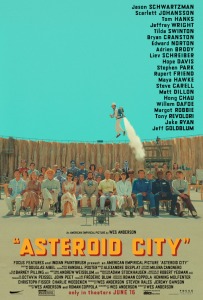 It’s not a good sign that a week after watching a movie I was racking my brain to try and remember what I had watched, and it’s even worse when it’s a movie by Wes Anderson, a filmmaker with such a distinct sense of intricate style it’s now become a go-to A.I. test for untalented people. Asteroid City has the makings of an appealing comic escapade set in a Southwest small town known for its tiny asteroid, and once aliens make their presence known, the entire town and its tourists and wanderers and scientists are quarantined. The problem comes almost immediately, as the movie is presented through several added layers of obfuscating framing devices. The story itself is a play, and we’re watching a movie version, but then also the play of the movie, and the behind the scenes of its now-deceased playwright toiling with his authorial messages and stubborn actors, and it feels like two different movies at odds with one another. The Asteroid City sequence is the more engaging, with some sweet storylines like Jason Schwartzman as a widower processing loss with his family, including his father-in-law (Tom Hanks) who never liked him, while beginning to find a possible romantic kinship with a struggling actress and single mom (Scarlett Johansson). I enjoyed weird little asides about the history of this little town, like a vending machine for land ownership, and s science fair with brainy whiz kids finding their own comradery. There’s even a nice moment in the meta-textual framing where the Schwartzman actor recites an exorcised dialogue scene with the actress who played his deceased wife in the play. It’s elegantly heartfelt. However, the added layers don’t really add extra insight or intrigue but serve as muddy trappings, making meaning less likely rather than more. It feels like Anderson didn’t have enough material with the central story so he added on the meta to make up the difference. There are too many moving pieces and too many characters, and versions of characters, here to settle into something grander. The whimsy and visual style of Anderson is still evident throughout every highly-crafted and pristine arrangement in the movie, so if you’re an Anderson diehard, he still has his charms. This is two Anderson movies in a row that felt disorganized, distracted, and chiefly under-developed, and I’m starting to worry that the form has taken over the function as storyteller.
Nate’s Grade: C+
Share this:

The League of Extraordinary Gentlemen (2003) [Review Re-View]
 Originally released July 11, 2003:
This movie is certifiably insane. While a very literary X-Men seems like a great idea, what exactly does Tom Sawyer bring to the table? What, is he going to convince the bad guys to white wash a fence? And yet, this highly operatic bombast almost succeeds on its sheer level of lunacy, like when you realize you’re watching Sawyer get a crush on a vampire on a giant underwater submarine that’s so big it has end tables and vases in its hallways. Still, the handling of Jekyll/Hyde here is what Hulk should have been like. League of Extraordinary Gentlemen almost works, but its falls apart amidst shabby special effects, outlandish plotting, and very wooden dialogue. The director doesn’t make it any easier to follow, trumping his action sequences with rapid fire edits. Ah well, my bafflement was more entertaining.
Nate’s Grade: C
——————————————————
WRITER REFLECTIONS 20 YEARS LATER

The League of Extraordinary Gentlemen is a fascinating film in that it cannot be good but it also cannot be bad; it exists upon an extraordinary plane where few movies ever transpire, not so-bad-it’s-good but an altogether different realm, where it would be impossible to be good while also impossible for it to be bad. It’s a bizarre yet fascinating contraption of a movie, a literary X-Men that plays to the lowest common denominator, making awe-inspiring mistakes as it careens to a bombast that approaches self-parody but lacks self-awareness to properly execute. I do not regret watching this again in 2023 but I cannot in good conscience recommend that you, dear reader, watch it, and yet I still want every one of you to.
It began as an adaptation of Alan Moore and Kevin O’Neill’s graphic novel which was itself a combination of high art (classic literature) and popular culture (super hero team-up), and from there that high-art mashup got even more… mashy… as it made its way through the Hollywood studio system to become a big, dumb summer blockbuster. You can see the appeal to the studio bigwigs, forming their own superhero team but from recognizable literary characters, and it’s fun to see these classic characters interact as well as slotted into superhero archetypes, though I’m sure there are a few academics that consider this a debasing of canonical literary figures. Jekyll and Hyde (Jason Felmyng) makes obvious sense as the Hulk of the group. Captain Nemo (Naseeruddin Shah) works as the tech-savvy Tony Stark. The immortal Dorian Gray (Stuart Townsend) is practically the group’s erudite Wolverine. I guess Mina Harker (Petra Wilson) would be this group’s Blade. There is a certain intellectual thrill watching classic characters in a new setting that relies upon them to work together and utilize their own special powers, highlighting that we’ve had superheroes long before the halcyon of the twentieth century.

Almost every artistic decision feels designed to fully baffle you if you think about it long enough, and while shattering any sense of reality, I can almost begrudgingly respect this creative license to simply go all out with the absurdity. This high/low combination makes every scene utterly ridiculous while also being fascinating. Nemo’s fantastical Nautilus sub is designed like a giant straight razor, yet the bustling interiors are so stately, including lengthy hallways with end tables and vases, a decorative motif that makes absolutely no sense on a submersible. There is a literal scene where Allen Quartermain (Sean Connery) teaches Tom Sawyer (Shane West in a terrible haircut) how to shoot better when the guy already shoots plenty good and Tom, completely oblivious, asks, “Did you teach your son to shoot like this?” But why would Tom ask that, in this moment, unless to touch upon the fact that Quartermain’s son is dead, a fact that we the audience already know? There are hidden bombs placed that will be triggered by a hidden frequency when played on a record, and somehow every corner of this floating city of a sub will hear this one record player in one room? Why even record a triggering device and have it linked to the villains explaining their plan? Why would you need to steal Da Vinci’s architectural plans for Venice when, I’m going out on a limb here, there are more accessible and modern city infrastructure plans in 1899 Venice?
So much of the character dynamics and characterization are condensed to their formula necessity. Our reluctant lead gets a surrogate son to try and mentor. Quartermain hates the British government because he blames them for his son’s death, but it’s not like he’s abandoned the luxuries of colonialism while retiring in Kenya. The invisible man (Tony Curran) gets an opportunity to prove that a criminal can reform and be counted upon. Jekyll and Hyde learn to work together rather than fighting for dominance. Mina Harker is a powerful vampire and yet her role is to be a possible love interest to the young kid on the team and to seek vengeance on her other lover, placing her entire character arcs as past romantic partner and future partner. Look at the poster art and you’ll see they had to make extra allowance to squeeze in her vampire cleavage, her real feature as far as the movie is concerned. You have a vampire on your team and the movie simply treats her as a walking set of boobs. I suppose Tom Sawyer is meant to serve as our entry point into this world as the rookie, but every character on the team is a rookie, so having an even bigger novice seems superfluous as they’re bringing the League back together, except it’s revealed later there was NEVER any League of the past, which means the bad guy literally commissioned oil paintings of past member combinations that never existed just to sell a false history that never amounted to anything (again, pick at any detail and the entire reality unravels). Even the villain’s plot is needlessly convoluted and also astonishingly simplistic: create conflict, sell arms, get money. The secondary scheme could have been accomplished by just asking each of the League members to sit for a blood test. You didn’t need to destroy Venice for this.

The colossal miscalculations extend beyond the screenplay. This movie essentially ended the career of Connery and its director, Stephen Norrington (Blade). The story goes that Connery was offered the part of Morpheus but turned it down because he didn’t understand The Matrix, and he was offered the role of Gandalf but turned it down because he didn’t understand The Lord of the Rings, and after both became cultural phenoms, Connery was determined not to let his own questions stand in the way of what could be the next sci-fi/fantasy blockbuster. Those notable “no”s lead him to regrettably saying “yes” to this silly movie, and then he was done. In the seventeen years before his death in 2020, Connery only gave a handful of vocal performances, the last one for 2012’s Sir Billie, the first CGI-animated feature from Scotland, and oh is it bad. Norrington and Connery didn’t get along during the production and at one point the director tried to goad Connery into punching him in the face. Norrington refused to make another studio movie and has gone back to his makeup and special effects background for film productions, including providing creature effects for Feast and Exorcist: The Beginning. The fact that Connery’s character dies but they end on his possible resurrection, for a possible sequel never to come, is especially hilarious knowing Connery and Norrington elected to quit their jobs after this.
At some point, you just give into the movie and try and ride its absurdist wavelength. The climax involves an assault on a giant munitions compound making… metal-cased men? Like armor? Don’t we already have that? The movie’s rules posit that the invisible man is only truly invisible when he’s fully naked, and the movie makes sure you understand this at several points, so having a climactic battle in a frigid mountain compound just makes you worry that he’s going to be blue and invisible. I love that Dorian Gray’s weakness, his infamous supernatural doppelganger painting, isn’t like locked in some impenetrable fortress but just something he carries with him, like Superman keeping kryptonite in his travel bag. I also groaned when, while fighting Mina, he stakes her to his bed and blithely says, “I always wanted to nail you one more time.” Again, simply amazing and flabbergasting. Why do we have one member of the team that shoots good when we already have another member of the team who already shoots good? I would have laughed out loud had the filmmakers actually resorted to Tom Sawyer tricking the minions of evil to white wash a fence instead of threatening the new world order. There are no standout action sequences, the special effects can be rather dodgy for its budget, and the editing is jumbled to likely mask the absence of good action choreography, but what this movie has, in rich abundance, is lunacy, a plethora of ridiculous plot elements to digest.

In 2003, I didn’t have many words to say about The League of Extraordinary Gentlemen but all of them are correct and still accurate twenty years later. This is a movie that almost works on its own level of schlocky absurdity, and yet it could never work with this approach, but it’s littered with bizarre, miscalculated ideas and plot elements that make it all the more fascinating, like a car crash of a painting. They don’t really make movies quite often on the scale of disaster that is League of Extraordinary Gentlemen, and we all benefit by examining how something like this slipped through, to remind us all of the folly of man and the strive to do better. Somebody dissect this like a case study for our benefit as a species.
Re-View Grade: C-


 nathanzoebl

You must be logged in to post a comment.