Legion (2010)
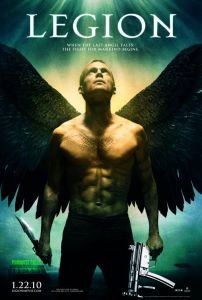 Just to be upfront, I am a big fan of action movies making use of Christian mythology (sorry if the use of the word “mythology” offends some). You tell me a tale about angels, demons, in a contemporary setting no less, and I’m hooked. You give those two sides weapons and have them fight over the fate of mankind, and I’m already revving my engines. So please know that no matter what the artistic achievements of Legion may be, I was predisposed to enjoying a movie that features the angel Michael (Paul Bettany) on the poster with a sword in one hand and an automatic weapon in the other. The premise of Legion is that God has finally had it with mankind and is making good on his threat to “turn this thing around right now.” He’s sending a host of heavenly angels to … eliminate humanity. Michael rebelled, believing man was still capable of making good on its promise. So he fights alongside a handful of characters shacked up in Dennis Quaid’s greasy spoon diner in the middle of nowhere. The action isn’t really involving but the movies does have some cool moments, like when Michael goes mano-a-seraphim with Gabriel (a marble-mouthed Kevin Durand). Legion deals with an antagonist (God) that is so powerful that there have got to be arbitrary limits placed on that power. So the attacking angels don’t overwhelm the tiny diner with their superior numbers, nor does the Almighty just blink the troublemakers out of existence. The end doesn’t really give much in the way of clarity but I got what I wanted from a movie like Legion. Though, in retrospect, I really didn’t want sizzling acid popping from boils.
Nate’s Grade: C+
Share this:

The Cove (2009)
 I never really wanted to watch the documentary, The Cove, and judging by its anemic box-office gross, I wasn’t the only one. A movie about dolphin slaughter felt like it was going to be a hard chunk of medicine, and I can’t really blame anybody who read about this acclaimed Sundance doc and said, “You know, I don’t feel like spending eight bucks to watch dolphins get harpooned to death.” I can’t argue with that and it was with great trepidation that I put the DVD into my player, hiding behind a blanket, dreading the animal cruelty and self-righteousness that would soon wait. And then a funny thing happened. In the first five minutes I really got into the movie, my nervous tension disappeared, and I was captivated by one of the best-edited and most thrilling movies of the year. For the squeamish, rest assured, the dolphin death footage isn’t graphic and used rather sparingly and tastefully. This is not just a PETA snuff film.
The Cove has two storylines at play that converge with a unified goal. The first explores the life of Ric O’Barry, the world’s premier dolphin trainer responsible for all those playful porpoises on TV’s Flipper (he even lived in the TV family’s house by the dock). It’s because of that popular TV show that the dolphin craze began where people wanted to see them do tricks and people wanted to swim with the cute dolphins. Sea parks sprouted up around the world and many dolphins were sold into captivity. O’Barry then drastically changed his mind about dolphins living in captivity after the death of one of the Flippers. Dolphins need to consciously breath, so they can actually hold their breath and die, which is what happened. The Flipper dolphin committed “suicide” in O’Barry’s arms, or so he says (he may be projecting a bit of his own guilt). He has been fighting ever since for dolphins to be freed and often O’Barry gets arrested for his activism efforts.
O’Barry’s biggest target is Taiji, Japan. It is this small coastal town that supplies dolphins to most of the world. Researchers and entertainment trainers will take their pick of the litter and the rest aren’t so lucky. The remaining dolphins get transferred to a small inlet where coastline bystanders cannot see and where large “Keep Out” signs are met with barbed wire. Then the waters run red. Tens of thousands of dolphins are slaughtered every fall and O’Barry has been trying to get the word out for years but has been stymied by the local fishermen, the meat corporations, and the Japanese government. Director Louie Psihoyos, a critical member of the Ocean Preservation Society, intended to make a film about depleting ocean reefs and intended to have O’Barry be one part of an overall bigger picture. Then, while traveling in Taiji, he became convinced that the real story was exposing the secret dolphin killings and why what goes on in that deadly cove matters to the rest of Japan and the world.
 What hooked me was that The Cove is structured like a real-life espionage thriller. Psihoyos and his technical crew wanted to go the legal route but were blocked by opposing forces. So he assembles a team of experts to infiltrate the Taiji cove and document what exactly is going on there. He recruits the best deep diver who can plunge to record-breaking depths on a single breath of air. He recruits a model maker at special effects studio ILM to make convincing rocks that will house hidden cameras. They recruit a man who knows all about cameras and body imaging technology. They even get an expert on flying toy helicopters so they can plant a camera on one. The director says it himself on camera, that he was gathering a real-life Ocean’s Eleven team. The tone of the movie follows suit, making for some great suspense. As soon as O’Barry enters Taiji, he’s tailed by several police officers and they even interrogate him in his hotel lobby to ascertain the purpose of his visit (caught on hidden camera). The billion-dollar dolphin entertainment/meat industry hires people to do nothing else but to film O’Barry himself, keeping track of his movements and trying to provoke an emotional reaction to disparage his cause and boot him from town. We then chart how far the connections go, all the way through to Japanese government officials bribing other Pacific island nations to join their fight to overturn whaling laws. It’s fascinating and frustrating as hell to watch.
Psihoyos is a rather accomplished filmmaker in his own right, spicing up an intriguing tale with some visual pizzazz and a great sense of pacing. This thing just flies by. It’s strange to say that a documentary about killing dolphins is one of the most gripping thrillers of the year, but there it is. This is an impeccably crafted opinion piece with a dash of espionage excitement. The movie is indignant, yes, but refrains from being self-righteous or condescending. At no point did I feel beaten over the head with some activist propaganda, though the film is clearly one-sided. Psihoyos manages to weave in a lot of useful information. I was dreading the actual dolphin slaughter footage even though, from a structural standpoint, that was the climax of the movie people have been waiting for. The footage is mostly at long angles, though you do see Japanese fishermen repeatedly jabbing harpoons into dolphin shapes. The most disturbing moments are earlier when a mortally wounded dolphin spaces past the nets and tries to swim for freedom. It’s spitting blood and wildly trying to break free but it eventually drowns. The final image of the hard-won footage is the blood-soaked shores of the cove, which are a deep, unsettling red that reminds you of a full-on Biblical plague. An easy plea to emotional appeals, perhaps, but effective nonetheless. I have no shame in admitting that The Cove put me to tears on three separate occasions.
 So is there really a difference here between killing and eating dolphins and the West’s industry of killing and eating cows? Is this all just a matter of cultural insensitivity? That’s a harder question. Which animals do we draw the line at eating? Is there a moral disparity between eating a hamburger and eating a dolphin, or eating a cat or a dog? I don’t know. Personally, given my Western biases and everything, I become repulsed when it comes to inhumane treatment to animals and when self-aware creatures are used for food. I am a content meat-eater but that doesn’t mean I want to snack on a dog sandwich. Certain animals are just more self-aware than others, which muddy the moral waters. When an animal reaches that sense of awareness then it becomes an even stronger ethical dilemma when it comes to killing them, because they are more cognizant of what is happening and the life being taken from them. It may all sound like semantics to some, but that’s my personal stance. To literally quote George Orwell’s famous novel: “All animals are equal but some animals are more equal than others.” That may seem hypocritical to people but I’d argue it’s a reigning opinion among a majority of Americans. The counter argument is that Westerners know that cows are being led to the slaughter, whereas the Japanese are purposely kept in the dark about the nature of the dolphin massacres. To make matters worse, dolphin meat is incredibly high in levels of mercury and the meat is labeled as other fish. The majority of the Japanese do not know that they are consuming poisoned dolphin meat. Americans at least know what they’re biting into (the jury’s still out with hot dogs).
The Cove only gives you the Western perspective on the subject because that’s what fits its agenda. It does take a few swipes at the arguments for dolphin hunting. The Japanese government views them as pests needed to be dealt with and blames the porpoises for declining fish levels, which to any rational thinking person would sound absurd. Which seems like the more likely scenario: pollution and over fishing lead to declining levels, or the sea creatures that have lived on the planet for millions of years are now to blame? The other token argument is that whale and dolphin killing is a part of traditional Japanese historical culture. This might hold true for some people; however, upon some minor research you find that the whaling tradition goes back only a couple centuries, no further than it did for European countries that have given up the practice.
But what the movie really fails to explore is why. Why do the Japanese fishermen, when offered the same money NOT to kill dolphins, decide to keep killing them? What is the psychology at foot in Taiji that links the town with annual slaughters? It’s a shame that Psihoyos devoted the entire bulk of the film to getting the footage. The focus of The Cove is a bit limited but I understand why. There needed to be an attainable goal: get the secret footage and spread the word. The movie is too entertaining and harrowing to really knock its limited scope, but The Cove could have been a much fuller depiction of this bloody reality.
The Cove builds a compelling, if one-sided, case condemning the ongoing actions of Taiji, Japan and the greater government. The conspiracy unfolds layer by layer and the movie ends up rallying others to action (O’Barry says you’re either an activist or an “inactivist”). I don’t know if anything will actually change now that the footage is out there, but at least people can be more aware of the annual dolphin slaughter. And after a year of wrangling, it appears that The Cove will be released in Japan this spring. Let’s see what kind of response comes out then and whether the Japanese are willing to pay the yen equivalent of eight bucks to watch dolphins die.
Nate’s Grade: A
Share this:

The Book of Eli (2010)
 Where did the Hughes brothers go? Albert and Allen Hughes have four movies to their names, one of them a documentary about pimps, and their last flick was 2001’s From Hell. I know that Jack the Ripper thriller underperformed at the box office, starring a pre-Pirates Johnny Depp, but was it enough to throw these guys in movie jail for nine years? The Hughes brothers are talented filmmakers, first evidenced by their debut feature Menace II Society, which they wrote and directed when they were only twenty years old. I actually really liked From Hell. I get that it isn’t anywhere as complex as the source material from famous comics scribe Alan Moore, but the movie was slick, stylish, twisty and twisted and satisfying (although, Heather Graham has the worst accent in the history of movies). Where have these brothers been all this time? Nine years later, the Hughes brothers take a whack at the popular genre of the moment –Apocalyptic Cinema. The Book of Eli kind of comes across like a Hollywood version of The Road. It’s all about duplicating the look, without getting too bleak, and failing to replicate the sense of humanity in desperation. Why worry about that when you can have explosions?
It’s been 30 years since the sun scorched the Earth. Food is scarce. Gangs roam the highways. The law is a forgotten concept. Eli (Denzel Washington) is a loner heading westerly and trying to make out a meager existence. He takes the boots off a dead man, hunts emaciated cats for food, and looks for a safe shelter from the blistering sun. He struts into a dusty town looking for clean water. The town is under the rule of Carnegie (Gary Oldman), a man in search of a very specific book for his own purposes. It just so happens that Eli is in possession of this book. Eli refuses to hand over his property, speaking about his mission to transport the book to where it belongs. Carnegie sends his thugs out to kill Eli and retrieve the book. Helping Eli is Solara (Mila Kunis), a teenage prostitute who feels Eli has answers that nobody else has.
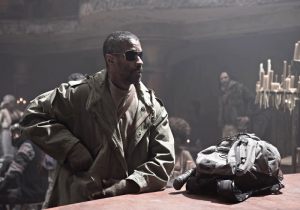 What we have here is a post-apocalyptic Western. Denzel is the lone drifter that comes into a town besieged by lawlessness or a corrupt agency of power. He even has a fight in a saloon that doubles as a whorehouse. He takes on an unlikely younger apprentice and enforces his own moral code through a series of shootouts. It just so happens that in Eli, he also has a giant machete and knows kung-fu. This is pretty strict genre stuff, mixing in apocalyptic elements for some extra flavor. The Hughes brothers give everything an ashy grimy gloss, making the most of desolate locations they shot in New Mexico (“When you need some place that looks like the end of the world, film New Mexico!”). The sparse locations and desaturated cinematography do well in establishing an unforgiving reality of the landscape.
The Hughes brothers certainly have a sense of style when it comes to the camera lens, yet they don’t approach being too self-conscious with their visuals. There’s an extended fight sequence that plays entirely in silhouette. There isn’t an overabundance of special effects in the film to clutter up the bangs and booms. There is one shootout outside a home (with Michael Gambon no less) that mimics some of the unblinking camerawork of Children of Men, swinging from side to side throughout the escalating firefight. It’s a fun visual motif that thrusts the viewer in the middle of the action. Otherwise, the action is all fairly standard stuff. It?s entertaining to watch Denzel take out a bushel of bad guys time and again, but what does that add up to with such a worn out story and half-hearted characterization? The script by Gary Whitta is heavy on apocalyptic mood and light on details. Cue more ass kicking.
Washington is stoic, almost Eastwood-like in his grit. He’s an easy antihero to root for, the reluctant avenger that manages to slice and dice his way through trouble. I won?t say this movie forces Washington to stretch his reserve of acting muscles, but it is undeniably pleasing to watch him perform his own fighting stunts. Oldman hasn’t gotten an opportunity to play a scenery-chewing villain in quite a while. Let’s face it; Evil Oldman will always overrule Good Oldman. This man was created to play sociopaths that have no ability to control the volume of their voice. This man needs a chance to bellow once every movie. Kunis proved she was a capable actress in Forgetting Sarah Marshall, but her role is fairly limited here to sidekick. She stares with her dark eyes and gets to hold a gun. That’s about it. The Hughes brothers have populated their post-apocalyptic world with familiar faces. Tom Waits is a merchant, Ray Stevenson (HBO’s Rome) as the Number One Henchman, Jennifer Beals as the blind mother to Solaris, and Gambon as a well-armed homeowner with an appetite for human flesh. That?s a good stable of actors to fill out a bunch of stock roles. It certainly makes The Book of Eli more entertaining.
The religious element doesn’t dominate the film but it does serve as food for thought. You see the book of Eli’s in high demand is actually he King James Bible. But you see, this isn’t any bible wrapped in leather with a metallic locked binding (all this for a Bible?); this is the LAST BIBLE ON EARTH. That is why Carnegie craves it. In the 30 years since the vague apocalyptic event, apparently mankind rounded up all the Bibles and burnt them, perhaps to express their displeasure with God. Eli operates on the premise that Denzel has the only Bible in the known world, which just seems downright silly. Did people search through every habitable dwelling, every library, and every hotel drawer? There have to be hidden Bibles out there. Even in this extreme setting, it seems to strain credibility to think that mankind is left with one copy of the most widely published book in the history of the world.
 Ignoring this fact, the religious element remains nebulous even though the film chronicles the journey of the Christian text. God is referred briefly but mostly the talk steers around the ideas of “faith” and “fate” and “the right path.” Eli feels he has been chosen for a special mission, and so he trudges west with his eyes on the prize. Carnegie wants to use the Bible as a “weapon” to pervert people’s faith into giving him more power. He wants to abuse religion as a motivational force to expand the reach of his control. Here’s the thing though, Carnegie has control over a town already and rules by fear. This seems to be working fine for him. So he wants to rule by love instead, using the Bible to spread the Gospel of discipleship? It’s somewhat unclear what exactly Carnegie plans to use the text for especially considering that most of the remaining population is illiterate anyway. He could just as easily hold up any book (The Da Vinci Code is shown, why not that one? It even has “code” in the title) and proclaim it the Word of God. It’s not like these people, struggling just to eat and find water, are going to question the power structure.
Not content with being a competent genre film, The Book of Eli ends on one of those ghastly twist endings that forces you to rethink everything that came before it. It doesn’t ruin the movie, but this twist certainly leads a charge toward building a counterargument toward disproving it. I won?t get into particulars but it seems unlikely that Denzel would be as good a shot as he was if the twist holds up.
The Book of Eli has its share of thrills and some interesting visual style, but there isn’t anything here you haven?t seen in hundreds of other post-apocalyptic movies. The dusty landscapes, the biker gangs, the aviator goggles, the cryptic threats, the necessity for leather as a fashion statement. This isn’t a bad movie by any means; it’s just another entry in a cluttered genre that, with our renewed fascination of the end times, is only getting more cluttered. Washington and the assortment of actors put in fine work but it’s ultimately the story that lets them down. This is a by-the-books genre flick with a touch more style courtesy of the Hughes brothers and a touch more gravitas courtesy of Mr. Washington. My advice to the human race: stock up on Bibles. Apparently, in the post-apocalyptic future, they will be more valuable than gold. Invest now while you still can. I got 15 of them and will entertain all offers.
Nate’s Grade: C+
Share this:

Extract (2009)
 Writer/director Mike Judge’s third movie isn’t quite as funny or just plain fun as his previous pair, Office Space and Idiocracy. Set in a local factory, we follow the misadventures of the boss (Jason Bateman) as he deals with incompetent employees, looming lawsuits, and a wife (Kristen Wiig) who he feels disconnected with. What Judge has is two competing movies; one of them garners the bulk of the first 45 minutes and proves to be funny. The other gets most of the second half and plays out sloppy and dumb. The more interesting half involves Bateman trying to feel guilt-free about wanting to have an affair, so his friend (Ben Affleck, very funny) hires a clueless gigolo to seduce the wife. This scheme actually works but causes humorous complications, like when the gigolo keeps going back for more. This comedic scenario would be enough for one movie. The other half of the tale involves Bateman trying to sell the company but the buyer is wary of an impending lawsuit due to an accident on the work floor that left a man sans his testicles (so much wasted potential here). Mila Kunis is the sexy con artist behind the scenes, encouraging the ball-less worker not to settle. Obviously Judge had work-related gags he wanted to tackle, but he proves that his real interests lie in the complicated relationship comedy. Extract fumbles forward not knowing what kind of movie its really wants to be, so it settles for hackneyed solutions and abrupt endings. Extract would have been a better comedy completely removed from the workplace.
Nate’s Grade: B-
Share this:

Crazy Heart (2009)
 Crazy Heart is more than a country tune come to life. This is a transfixing slice-of-life flick that serves up a big piece of country lifestyle. This is a dusty, slow burning character piece where consummate actors just dissolve inside the bodies of their characters. Jeff Bridges is country music legend “Bad Blake,” a chain-smoking, alcoholic, hard-living dude who’s given up on everybody in his life, he included. Fame long gone, he performs from hole-in-the-wall bars to bowling alleys for small change and the embrace of middle-aged groupies in seedy motels. Jean (Maggie Gyllenhaal), an aspiring journalist, interviews Blake and the two seem unable to keep their flirtation at bay. She’s prone to making bad decisions, and he’s looking for somebody that will actually care about him as a person. The relationship between these two is starkly realistic, and the actors interact with astoundingly unrestrained intimacy; there isn’t a glimpse, a pivot, or a nuzzle that feels trite. The love-of-good-woman-grants-second-chance plot device may feel overdone, but Crazy Heart is more than the sum of two great performances (and they are great). There’s a heavy, elegiac pall to the movie, where tiny details quiver with insight about Blake’s life. Writer/director Scott Cooper explores the grimy, dismal lifestyle of a man living on the fumes of fame, rethinking his life’s choices and becoming reinvigorated with creative inspiration. Even better, everyone performs their own singing and they are all, without fail, excellent. Who knew that Colin Farrell could be a convincing country music star?
Nate’s Grade: A-
Share this:

Daybreakers (2010)
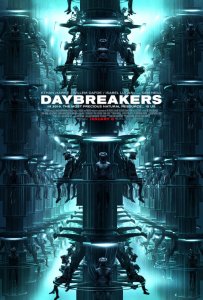 Taking a cue from zombie cinema, Daybreakers takes the idea of vampire-as-virus to an apocalyptic crescendo. The world is populated almost exclusively by vampires now. Human beings are farmed for blood but they are in such limited supplies. You see there is an extreme blood shortage because the vampires have lived beyond their means. That’s right, it’s a consumer consumption/environmental metaphor. The limited resources are dire because if vampires go without human blood they begin to devolve into senseless, winged mutating monsters known as “subsiders.” The poor cannot afford the skyrocketing blood prices so they are most fated to doom, while the rich argue that the blood supplies need to go to families first and not be wasted on the lesser dregs. The U.S. vampiric military, when not hunting humans, shackles the subsiders and marches them into the sunlight to be executed. Daybreakers has a lot more on its mind than most vampire movies, and it’s plainly fascinating to explore the realities of a world run by vampires (cars that drive during the day, the Subwalk, blood in your coffee). For most of its running length, Daybreakers is an intriguing setup that makes room for cool visceral action and social commentary. Then in the final act it sort of devolves itself into one big, dumb action movie. Ethan Hawke is a blood scientist trying to work on a synthetic substitute for a super vampire corporation that, of course, is evil. He stumbles upon an outlandish “cure” for vampirism and wants to resurrect humanity. This leads to a climax where Hawke and his human warriors wage battle inside the corporate HQ. For a promising concept, it’s depressing that Daybreakers had to end in such a typical manner. At least the vampires explode in the sun instead of sparkling.
Nate’s Grade: B-
Share this:

Cloudy with a Chance of Meatballs (2009)
 Thanks to a rambunctious comedic spirit and some delightfully colorful visuals, Cloudy with a Chance of Meatballs is absurdly amusing from start to finish. I was relieved when this animated family film stuck by its own manic comic sensibilities instead of pandering with scatological humor and bizarre and instantly dated pop culture references. The story has the familiar “believe in yourself” elements but it takes it another tasty level. Writer/directors Phil Lord and Chris Miller (MTV’s vastly underrated Clone High) pack the story with jokes of all levels, running gags with surprising payoffs, puns that manage to be funny, satirical one-liners, imaginative visual gags, and inventive action sequences when the film becomes an all-you-can-eat buffet of disaster movies. The pacing is frenetic and the eclectic vocal cast (Bruce Campbell as the villainous mayor! Mr. T as sheriff! Neil Patrick Harris as a talking monkey!) really, as the film says, “carpe some diem.” This isn’t an emotionally engaging movie whatsoever but it’s one of the best comedies of 2009 and certainly one of the most jam-packed, fun 90 minutes you could ask to sit through. Just prepare to be extremely hungry afterward.
Nate’s Grade: A-
Share this:

District 9 (2009)
 I can’t believe I forgot to review this some how. The sleeper hit of the summer, District 9 is an intelligent, and rather obvious, apartheid metaphor, and a grandly executed action thriller with a strong moral compass. Aliens crammed into ghettos and being mistreated and abused? Sounds like Alien Nation to those with longer memories, however, writer/director Neill Blomkamp forges a docu-drama that manages to be bristling with ethical questions and kick-ass action. It’s very easy to get wrapped up in all the excitement, so much so that I was trying to will the characters onscreen to take certain precautions. Blomkamp manages to take shots at some easy targets, like shady corporations and mercenaries, but that doesn’t make the movie any less affecting. The movie belongs to actor Sharlto Copley, who begins the film as a dithering bureaucrat and ends as a truly unlikely action hero, and you buy every single step of this man’s satisfying emotional arc. While the Academy is picky when it comes to genre films, Copley deserves Oscar consideration; I haven’t seen a more compelling performance by an actor all year. The special effects are astounding, and they were accomplished on a scant budget of 30 million, which is probably what Transformers 2 spent on one explosion. District 9 makes you feel that movies can still surprise you, as long as we have visionary, intelligent life working outside the studio system.
Nate’s Grade: A
Share this:

Final Destination 4 (2009)
 I felt that this franchise was creatively exhausted after the third film in 2006, and I see no reason to change that opinion. The fourth film has the added feature of being in 3-D, which means you get the luxury of having entrails exploding in your face. I watched the movie in the limits of two dimensions, which may be why I wasn’t thrilled having every other visual thrown at the screen. Regardless, the cruelly elaborate deaths are the draw. This is a horror movie built from the inside out, finding the thinnest of tissue to connect all the gory gross-out moments. A documentary set in writer’s room for a Final Destination movie would be more interesting than the finished product. It seems like the producers aren’t even trying any more; the one-note characters exist in a world bereft of adults, cops, media, and anybody with a brain. The film doesn’t waste any time on characters because they’re all just meat for the grinder. The film does, literally, the bare minimum just to move the plot along to the next fiendish death trap (this flick has a franchise record 11 death sequences). At one point, a character says, “Don’t make fun, but we Google-ed ‘premonitions,'” and then they explain the rules of the series like somebody handed them a manual. Later, the teens celebrate because they think they broke death’s chain, and I’m yelling at the screen, “That hasn’t worked for three movies, you stupid kids!” They’re all running through the same worn-out patterns that the audience already knows by heart. The big question is whether the gruesome death sequences deliver the goods. Flaming escalators and killer car washes? Clever or desperate, you be the judge. For me, the fun of this franchise was killed long ago when it gave over to the cynical bloodlust of its target audience. Since Final Destination 4 made the most money out of any of the previous films, expect more entrails in glorious 3-D.
Nate’s Grade: C-
Share this:

An Education (2009)
 In 1961 Britain, Jenny (Carey Mulligan) is a 16-year-old schoolgirl plowing away at her education. She?s on track to enroll at Oxford “reading English” and her parents (Alfred Molina, Cara Seymour) have overscheduled the girl with hobbies and clubs to help build her academic portfolio. Then one rainy night she meets David (Peter Sarsgaard), a thirty something man who offers to give her and her cello a ride. This enchanting man keeps coming back around to see Jenny, sweeping her off her feet. He invites her to go to concert recitals with his older friends Danny (Dominic Cooper) and Helen (Rosamund Pike), trips to the country, and even a fabulous getaway to Paris. “You have no idea how boring my life was before you,” she confesses to David. But David is coy about how he can pay for such extravagances. Jenny’s grades begin to suffer and it looks like she may miss out on being able to enroll at Oxford. She has to make a decision whether to continue seeing David or going back to her primary school education.
An Education is a handsomely recreated period drama that manages to be very funny, very engaging, and very well acted. It’s also rather insightful and does an exquisite job of conveying that strange wonderful heartsick of love, maybe better than any movie since My Summer of Love. You can practically just drink in all of Jenny’s excitement. Jenny isn’t a silly girl prone to naivety. She’s a smart and clever girl, and not just because other characters say so or we see her stellar test grades destined for prime placement on the fridge. You witness her intelligence in how she interacts through different social circles. Since the movie is entirely Jenny?s story, we need to be convinced that she’s smart in order to believe her willingness to be duped. She has reservations about David’s habits but doesn’t want to risk going back to a dull life of books and family dinners. She has to be a smart, vibrant girl anxious to keep a good thing going, willing to ignore certain warning signs that otherwise might cause her pause. Even Jenny’s parents get caught up in the seduction, swooning over David and his upper class connections and comforts.
 The teen-girl-with-older-male aspect might make us squirm, but in the realm of 1961 Britain, it’s acceptable. Jenny and David don?t need to hide their affair in dank hotel rooms and avoid any suspicious eyes. We don’t get any agonizing inner turmoil over dating a teenage girl, mostly because it’s from Jenny’s perspective and that everybody else seems okay with it all. This acceptance means that the drama for An Education can focus on something less seamy. That doesn’t mean that everybody approves. While Jenny’s friends think she hit the jackpot, and hang from her every word about her amazing sophisticated boyfriend, her literature teacher (Olivia Williams) sees through David?s whirlwind of charms. This isn’t the tale of some girl being drawn into the dark side, turning into an unsavory, rebellious teenager flouting the law and good manners. Jenny is not that kind of gal.
Mulligan is fantastic and delivers such a sumptuous performance that you feel like a human being is coming alive before your eyes. She lights up with the dawning realization that a charming and worldly man is courting her, and you feel every moments of her swirling delight and awe. Mulligan even goes so far as to get even the small details right, like the way Jenny opens her eyes to peak during a kiss to make sure it’s all not just some passing dream, or the way she has to look away at times and break eye-contact because she’s just so happy, with those twinkling eyes and a mouth curling like a cherry stem. She’s bashfully coquettish in her physical attraction to David, though in my praise it also sounds like I, too, have fallen for the girl. Much ink has been spilled declaring Mulligan as a rising Audrey Hepburn figure, mostly because she sports that famous short bob of a haircut that many girls had in 1961. To me, Mulligan gives a stronger impression as being the luminescent little sister to Emily Mortimer (Lovely & Amazing, Match Point). Mulligan is a fresh young actress that delivers a performance of stirring vulnerability. It’s a breakout performance that will likely mean that Hollywood will come calling when they need the worrisome girlfriend role for the next factory-produced mass-market entertainment (she’s finished filming the Wall Street sequel, so perhaps we’re already there).
 Adapted by Nick Hornby (About a Boy) from a memoir by Lynn Barber, An Education follows the coming-of-age track well with enough swipes at class-consciousness. But man, I was really surprised how funny this movie is. An Education is routinely crackling with a fine comic wit, and Jenny and her father have the best repartee. Molina is an unsung actor and he dutifully carries out the role of “uptight neurotic father” with more than a stiff upper lip; the man puts his all in the role. While he can come across as hysterical at times, Molina is paternal with a capital P. It’s refreshing just to listen to smart people banter at an intelligent level.
The movie’s theme ponders the significance of education. There’s the broader view of education, learning throughout one’s life from new and enriching experiences. She gets to learn a bit more of the way of the world, and Jenny feels that she can learn more and have fun with David than sitting through lectures and slogging through homework. She values what David has to teach her above what she can find in a textbook. Jenny’s father stresses the virtues of learning and thinking but once Jenny has a chance to marry an upper class, cultured male then education no longer matters. She is now set for life through David. All that learning to become a dutiful housewife in a lovely, gilded cage. Is that the real desired end to personal growth: to snag a husband? The school’s headmistress (Emma Thompson in practically a cameo) doesn’t serve as a great ambassador to higher learning: she stresses the lonely hardships, internal dedication, and she herself is openly anti-Semitic, proving that an intelligent mind is not the same as being open-minded. To her, Jenny is jeopardizing her lone chance at a respectable life.
 Jenny rejects the traditional route of education and chooses to pursue a life with David, that is, until the third act complications beckon. Jenny finds out about David’s secret rather too easily, I’m afraid (secret letters should never be hidden the glove compartment). While the end revelations are somewhat expected, what is unexpected is that every character pretty much escapes consequences by the end of the film. No one is really held accountable for his or her decisions. Pretty much everyone is exactly where he or she left off just with a tad more street smarts. It’s the equivalent of learning not to trust every person after getting ripped off.
Despite all the hesitation, and the age difference, An Education is an actual romantic movie. It’s a coming-of-age charmer with all the preen and gloss of an awards caliber film. You feel the delight in the sheer possibility of life for Jenny. The story unfolds at a deliberate pace and allows the audience to feel every point of anxiety and bubbling excitement for Jenny. Mulligan gives a star-making performance and practically glows with happiness during the movie’s key moments, making us love her even more. The plot may be conventional but the movie manages to be charming without much in the way of surprises. Still, An Education is a breezy, elegant, and clever movie that flies by, even if its biggest point of learning is that age-old chestnut that something too good to be true must be.
Nate’s Grade: A-


 nathanzoebl
You must be logged in to post a comment.