In a World… (2013)
 Actress Lake Bell’s writing/directing debut, In a World, is a comical look inside the world of voice acting, particular in the field of movie trailers. It’s an interesting world and told with enough comic acumen by Bell (TV’s Children’s Hospital), a serious student of vocal artists. She plays Carol, a woman who breaks into the trailer voice over biz, causing ripples in a field dominated by baritone-voiced men, like her legendary father (a perfectly unctuous Fred Melamed) who holds to sexist dictum. There’s a cute romance involved with Demetri Martin, an effective subplot about Carol’s sister having an affair, and an ongoing commentary about the uncomfortable infantilized voice many young women utilize. The story is threatened by a percolating mistaken identity rom-com convention, but thankfully regroups for a third act pitting father against daughter in vocal performance, as it should be. As a director, Bell has a steady feel for her scenes, following a subdued comic rhythm that also feels eccentric without going overboard. As a writer, she gives her characters space to grow, to make mistakes, and to triumph but not without complications. As an actress, Bell is charming and a terrific lead anchor for a film filled with likeable, quirky characters. In a World is a little movie but it’s effortlessly cute, winning and pleasant in the right places, and filled with a great cast of comic actors. Beware: upon exiting the film, it is unavoidable that you will do your own fake trailer “In a world…” impressions.
Nate’s Grade: B
Share this:

Escape From Tomorrow (2013)
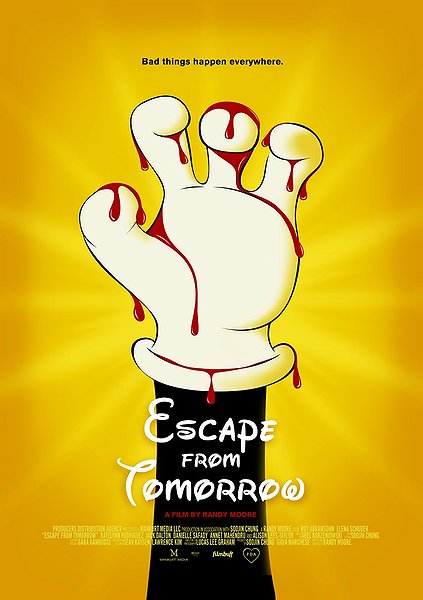 Escape From Tomorrow built a wave of buzz coming out of the Sundance Film Festival, namely because it was a bizarre, psycho-sexual little indie film shot secretly on the premises of Disney World and Disney Land. Writer/director Randy Moore shot his movie in secret, unbeknownst to Disney and the park employees. He was so paranoid about word getting out what they had done that Moore edited the film in another country. There is palpable fear at the reach and power of Disney’s coffers, enough so that a character mentioning the very D-word is silenced, and so I recall early on that people predicted Disney and its armada of lawyers would never allow Escape From Tomorrow to be released. Rather than get litigious, the Mouse House has decided to simply clam up, refusing comment. It’s a smart move, because besides a passing novelty, no one is going to remember the oh so monotonous Escape From Tomorrow in a matter of months.
The wisp of a plot involves a family vacationing at a Disney park. On the final day, the father (Roy Abramsohn) has been told he has lost his job. The rest of the day follows suit as the father loses his grip with reality, interpreting sinister signs throughout the park. He also keeps running into a pair of French teen girls who enjoy holding hands, being flirty, and singing. After the third or fourth time, the father starts to trail the girls, eerily entranced. They warn him that dire things will befall him if he doesn’t go with them.
 Take away the ballsy, surreptitiously recorded angle, the “how did they do that?” factor, and ultimately is there a movie here worth watching? I would definitively say… no. Admittedly it’s interesting to dissect how this guerrilla-style stunt was accomplished, watching scene after scene and figuring out what was shot in the parks unbeknownst to tourists and employees, what was likely shot on a set, where the cuts marry the two, and what techniques the director and his crew utilized to film a movie without blowing their cover. I think many of the scenes had to be improvised, at least the dialogue within the park, because starting and stopping and repeating lines in public, out in the open, would seem suspicious (the cursing would also seem to be courting danger). The Disney theme parks have millions of visitors, so people recording every action would not seem out of the ordinary. Escape From Tomorrow works as a stunt, with the audience picking apart the magic trick simultaneously as it’s performed.
However, a stunt is all that Escape From Tomorrow is because from a thematic, subtext standpoint, this movie is a mess. There just isn’t enough weirdness going on here and whatever small doses of it we get is given precious little connection to any larger theme. It feels like the filmmakers settled on the most facilely subversive idea – Disney Land, the happiest place on Earth, is not. Undercutting all of Disney’s famous family-friendly iconography with the occasional weird thing is not enough. A kid has black eyes. Ten minutes later a stranger makes an offensive comment. Ten minutes later something in a ride that is supposed to be happy looks mean instead. The majority of the movie plays out like you’re watching someone’s boring vacation. You don’t care about the characters. There is no plot to speak of, and that can be acceptable in an atmospheric film that serves as a visual descent into madness. There just isn’t enough madness here. Escape From Tomorrow is far too tedious to be effective. Long stretches are just watching the family traverse the theme park, notably with the father always running into the French teens. There is far too much padding, little connection from scene to scene, and the end is just a confusing muddle groping for a deeper meaning. Midway through, when the father is captured and held underground at Epcot, it looks like the movie is going to take that next step, ramping up the weirdness. Well that conflict is readily solved and then we’re back to the occasional boring out-of-place item. I want to say that Escape From Tomorrow is like David Lynch’s vacation video, but that is giving too much undeserved praise. This is like the deleted scenes of David Lynch’s vacation video.
 My colleague Ben Bailey countered my negative option with the idea that Escape From Tomorrow is meant to be a dark comedy and to view it through that lens; all right then, because as a “comedy” it still is half-baked, meandering, and poorly executed. The incongruous imagery, often sexual or demonic, is rather cheap in the sense that it’s just flipping the staid Disney script on wholesomeness with no more subversive substance than a moody teenager scribbling on his notebook. The Disney princesses double as high-priced courtesans? Okay, now go further rather than just taking a standard Disney character and making it adult in a shallow manner. There’s a scene where the father escapes by squeezing a tube of Neosporin to lubricate his hands out of confines, and oh boy, the white liquid shoots onto hanging pictures of female body parts. What a riot. Taking a cockeyed, perverted look at Disney is not the same as developing comedy, and even that cockeyed view is lame. I think that the father’s lustful pursuit of the French girls is meant to be comedic, but it was only creepy. When he sneaks up to spy on them in their bathing suits, how else should I interpret that? If this is supposed to be a comedy then Escape From Tomorrow is an even larger misfire.
Escape From Tomorrow is a nonsensical, plodding, superficial film, and it adds up to a whole lot of nothing. There isn’t a grander statement or sense of commentary. There is just scene-to-scene weirdness that grows old rapidly. I commend the ingenuity of the filmmakers for being able to secretly record a movie at one of the most heavily trafficked locations in the world. I don’t think the filmmakers had any clear vision of what they wanted to say with their movie, settling on “weird crap at Disney Land,” and then putting all their time and energy into planning how to pull off this coup, never mind the fact that the finished product was not nearly worth the effort. If you’ve ever wanted to be trapped on a bad vacation, then enjoy, movie masochists.
Nate’s Grade: C-
Share this:

We’re the Millers (2013)
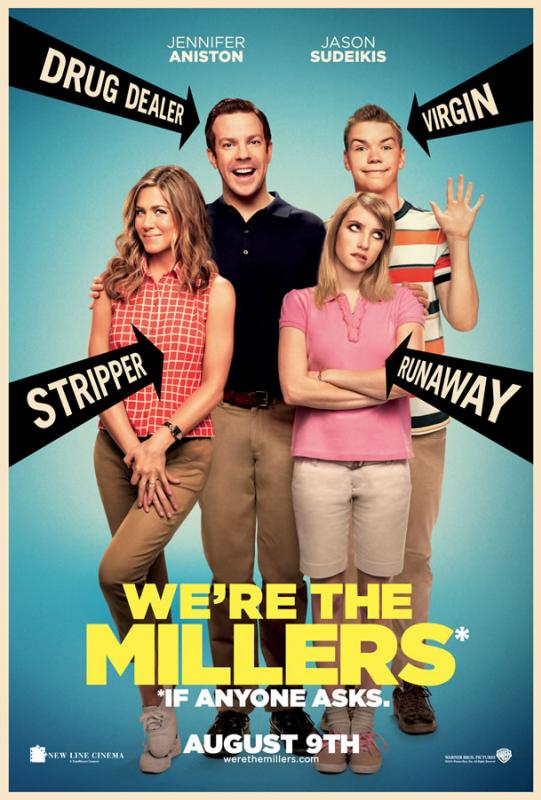 I finally caught one of the biggest surprise hits of the year, the raunchy comedy We’re the Millers, and while fitfully entertaining, mostly in its second half, I have to wonder what made this film the hit it was, despite lack of clear comedy competition. The setup involves four people (Jason Sudeikis, Jennifer Aniston, Emma Roberts, Will Poulter) posing as a model nuclear family to smuggle drugs into the United States. You’d think the difficulty would be getting back into this country, but no, it’s all about keeping their cover, especially when a vacationing DEA agent (Nick Offerman) pals around. The flimsy setup gets much better in the second half as the false family dynamics and roles are skewered, particularly an educational kissing session between siblings and mother. I can also see the markings of why audiences gravitated to this otherwise so-so comedy. It offers each member to contribute meaningfully, it gives each a lesson and a triumph, and they form a likable bond. So while the joke payoffs may whiff, there’s a character payoff to pick up the slack. Plus there’s an Aniston stripping sequence to showcase the fitness of the forty-something actress. The jokes settle for easy vulgarity a bit too often but every now and then the film surprises. Sudeikis is slyly enjoyable channeling a young smarmy smartass Chevy Chase, and Offerman is hilarious, enough to make you wish the movie followed his family. We’re the Millers reminds me of the 90s works of the Farrelly Brothers, a mixture of gross-out gags, slapstick, uninspired villains, and a dash of sentiment. We’re the Millers is an acceptable comedy, not a great one, but after its quarter billion dollar box-office riches, get ready to meet the Millers all over again.
Nate’s Grade: C+
Share this:

The Call (2013)
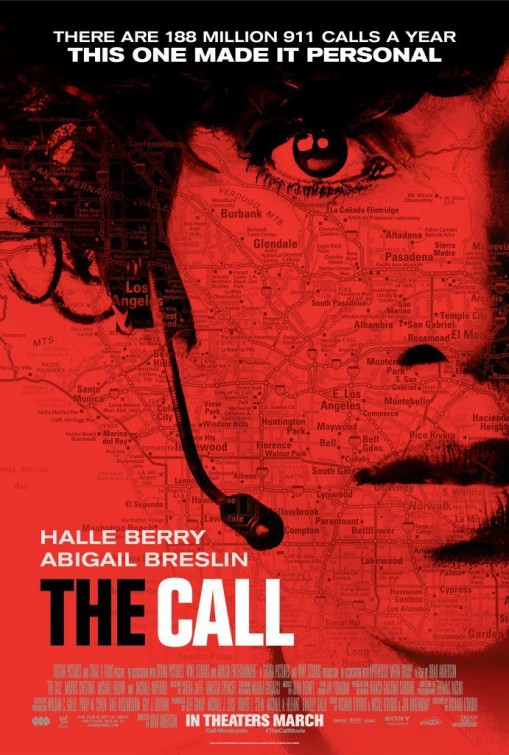 A surprise hit last spring, The Call is a simple but rather effective thriller that wavers a bit in the end but not enough to derail your entertainment. Halle Berry stars as a 911 operator talking through a teen girl (Abigail Breslin, spending far too much time in a bra for my comfort) kidnapped in the trunk of a car. It has the hallmarks of the typical action thriller genre, namely our heroine working through her past trauma of inadvertently getting another young girl abducted by the SAME killer. The Call plays best as we think alongside our two embattled heroines, going step-by-step how to determine where she may be, what car she may be inside, and how to draw attention to her predicament. The writing is economical and fast-paced and mostly smart, having the police act like actual professionals. Director Brad Anderson (Session 9, The Machinist) employs plenty of extreme close-ups that effectively draw upon the claustrophobia and urgency. For a solid two acts, the movie seamlessly transitions form one obstacle to another. Then the third act arrives where Berry decides to leave her post and take matters into her own hands. The film becomes far more predictable, conventional, and veers into the absurdity it had avoided for so long. The creepy killer has a half-hearted creepy back-story/fetish, Berry behaves far too cavalierly when she should be notifying the cops, and the ending defies all sensible logic. It’s meant to be a poetic punishment but, upon minor reflection, it’s entirely possible that this loose end will come back to haunt everyone yet again. In total, The Call is a breezy, suspenseful thriller that is well-acted and directed with style (the pounding electronica score doesn’t fit, though). The downturn at the end is disappointing but The Call is still worth taking.
Nate’s Grade: B
Share this:

Gravity (2013)
 Director Alfonso Cuaron spent over four and a half years developing his latest film, Gravity. The tale of two stranded astronauts had to invent technology to fully realize Cuaron’s zero gravity vision, carefully programming precise camera movements into a room full of LED flat screens to orient the harnessed actors and light them properly. It could have gone stupendously wrong in so many ways. Instead it’s the biggest leap forward in movie technology since 2009’s Avatar and surely one of the best science fiction films since 2006’s Children of Men, Cuaron’s last movie. It is a thrilling, awe-inspiring, astonishing, illuminating, and altogether brilliant film. Films like Gravity are the reason we go to the movies.
High above planet Earth, astronauts Mike Kowalski (George Clooney) and Ryan Stone (Sandra Bullock) are repairing the Hubble telescope when a field of satellite debris crashes into their shuttle. Both of the astronauts are adrift in space and have to maneuver to the safety of a space station. The debris storm circling the Earth is gathering size and force, and these two are running out of oxygen and safe places to hide.
 Gravity is one of those movies that you feel like ordinary English adjectives do it a disservice. I can refer to it and visually resplendent, awe-inspiring, and borderline transcendent, but my words will ultimately prove fruitless, because the experience of Gravity is beyond description. This is the reason we go to the movies, to be amazed, to feel something new, and Cuaron has taken the next great leap forward in technical moviemaking while also retaining the artistic soul of an engaging thriller. You could simply view Gravity as a visual feast and be content, or you could view it as a harrowing survival thriller and be content, or you could view it as Cuaron’s spiritual exploration on the perseverance of life against all odds (more on this later). Any way you shake it, it’s hard to come away from Gravity being disappointed, though I know with every lofty word of praise I inject that the bar is set even higher in audience expectations.
From a visual standpoint, Cuaron has crafted a truly immersive film going experience that puts you in the center of the action. The signature long takes amaze just as much as the visuals, both of which give you the sensation of what it’s like to be in space, weightless, free-floating, and oh so vulnerable at a moment’s notice. It’s been almost 45 years since Stanley Kubrick’s 2001 showed the visual poetry of zero-gravity acrobatics, and the sheer visual still has plenty of potency left. But coupled with Cuaron’s blinkless long takes, the illusion is rarely broken, especially in the first twenty minutes, which establishes the stakes and the reality of survival in space. Ignoring all aspects of the plot and acting, you could sit through the entirety of Gravity and find it a sumptuous, invigorating experience purely from the cutting edge special effects. There is a real sense of majesty to the views from space, overlooking our blue orb, the vastness of it all. It would be overwhelmingly beautiful if it weren’t also simultaneously terrifying. Space, much like nature itself, has an indifferent cruelty to it, and Cuaron does an exceptional job of presenting both the grandeur and the inherent dangers of space.
My nerves were racked throughout those tense 90 minutes of intense orbital activity. As a thriller, Gravity is a very well constructed setup with pristine execution. Each problem is dealt with in the immediacy, the unique particular of space allowing us a new perspective on the survival/disaster thriller model. First she has to stop floating. Then she has to get more oxygen. Then she has to get to a more safe location. Then she has to get back home. It may sound like not enough little plot pit stops but each one is pivotal and a remote respite from jeopardy. The wholeness of space is so complete that it feels like the odds are forever stacked against Stone. I was breathless through many of the suspense sequences, nervously tapping my feet, urging the onscreen characters onward. Cuaron and his son, co-writer Jonas, make it clear early the steps of her journey, and each feel like a natural result of the dire changing circumstances. The accumulative debris is given a 90-minute countdown for return, so we’re always wary that Stone will be caught back in the orbiting mass of projectiles. The sense of peril is kept on high and doesn’t relent, leaving you feeling like every nerve is spent by the conclusion. It’s a top-notch thriller that doesn’t involve the use of a single gun or car chase.
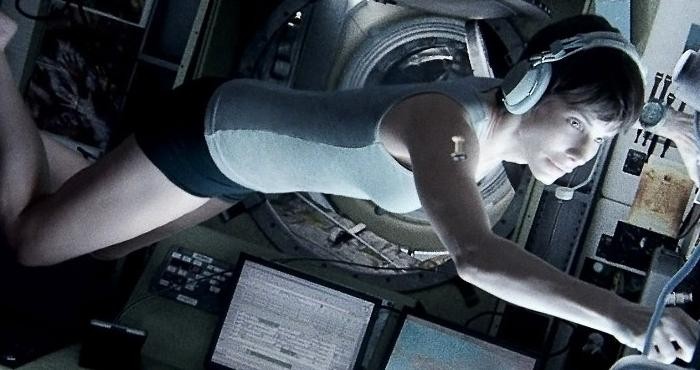 If there is one complaint, I suppose it could be over the somewhat thin back-story and characterization of Stone. I don’t know what a medical officer is exactly doing in space fixing the Hubble telescope but oh well. Cuaron keeps the audience firmly stuck in Stone’s predicament; we do not cut away to any flashbacks of life on Earth, and so it makes fleshing out a central character notable difficult. People don’t usually open up into revealing monologues while they’re trying to fight for immediate survival. She’s got the standard tragic back-story, losing a daughter, but for me this was enough to work with. I don’t necessarily need Stone to be a thriving, complex, emotionally nuanced character because my empathy was already there as soon as the peril began. I wanted her to survive because she was a person; I didn’t have to relate to her on a deeper fundamental level to root for her survival. There are some nice late scenes where Stone reflects on the existential crisis, on knowing her imminent death, on the fog she’s been trapped within since her daughter’s accidental death. Bullock (The Heat), in her best performance to date, is able to pull you in. If faced with your imminent end, how would you attempt to make peace of things, let alone stranded away from all human contact? It’s a strong awards-caliber performance and while her character isn’t given much development, she still has an arc, and I think there’s a greater thematic link with her crossing.
I’m no fan of Terrence Malick (Tree of Life, To the Wonder) but I understand people’s assertion that the man is a film theologian, making the theater a borderline religious experience for his faithful fans. In my eyes, Gravity has an unmistakable spiritual subtext that it can be viewed in different directions. Firstly, it’s hard not to feel an overpowering sense of awe when taking in the sheer magnitude and beauty of the incalculable universe. But then there’s Cuaron’s opening text that prefaces how outrageously impossible life in space is, contemplating all the harsh realities. And yet, here we are. Whether you chalk that up to something religious like God or just the fortune of the cosmos, it’s still a remarkable journey. The evolution of Stone is also reminiscent of that of life on Earth. When she finds refuge in the space station, she removes her suit, curling up in a fetal ball, while the camera centers her and she slowly rotates. The womb imagery is obvious but still effective. There’s also a third act assist that seems like direct divine intervention by most accounts. Then, spoilers, as she lands on a hospitable planet, she emerges from the sea, triumphant, taking her first steps onto land. Triumphant against all odds, against the cruel vacuum of space, life proves to be the winner. Again, whether you ascribe this to a creator God or a wonder of lucky evolutionary forces, it’s hard to escape Cuaron’s spiritual subtext tugging away at you, making the personal survival of Stone a greater analogue for the genesis of mankind and the emergence of humanity.
This is one of the few films I would recommend seeing in 3D. Cuaron has spent four and a half years translating his vision to the big screen and you’ll do yourself a disservice if you don’t see Gravity on the biggest screen possible. It is a film experience to be savored that will not measure up when you are forced to watch such outsized splendor on your puny home TV. This is an expertly made thriller, a visually transcendent, cutting-edge trip to space, and a revitalizing time at the movies. It’s as awe-inspiring as it is terrifying. It’s bursting with stimulation for the senses as well as a reawakened sense of spirituality, of something greater to be thankful for. I am in awe of Curaron as a filmmaker and I am in awe of his finished product. It was worth the wait. Now I hope I never have to wait another seven long years again before I see the words “directed by Alfonso Cuaron” again.
Nate’s Grade: A
Share this:

G.I. Joe: Retaliation (2013)
 Originally intended to be released in the summer of 2012, G.I. Joe: Retaliation was pulled back because, presumably, they wanted to convert it to 3D, but many suspected it was to add more time for star Channing Tatum after his box-office domination that year. Well, wrong on both accounts, because maybe it was merely kicked back because, get this, it’s not terribly good. I had the lowest possible expectations for the 2009 G.I. Joe movie but came away having a fun time; it was the right kind of enjoyably stupid. Well now it’s just stupid. Cobra has kidnapped the president, inserted a doppelganger, and now wants to rule the world that to an evil satellite that drops giant metal rods into space as weapons. Why are these rods not part of the Earth’s orbit after release? There are all sorts of gadgets here that make no sense but somebody thought might sell some toys. The central storyline is almost a knockoff of Mission: Impossible: Ghost Protocol, a small group of Joes having to clear their names. Then because that isn’t enough material to work with, there’s a mini-movie about ninja warriors avenging their fallen master in the mountains, and of all people, the RZA is supplying lengthy exposition. The action sequences are absurd without having enough style to excuse the absurdity. Everyone is a superhuman but also incompetent when the plot demands it (ninjas can shoot flying knives but not a big person jumping off a wall?). Adding The Rock is always a bonus in my book; the man is charisma personified. But the storyline of Retaliation is so sloppy, the villains so lame, and the movie lacks the high-spirited imagination to keep the stupid at bay. I was never a G.I. Joe kid so maybe those with nostalgia will be more charitable than I am, but G.I. Joe: Retaliation is a poorly executed next step for a once-budding franchise.
Nate’s Grade: C
Share this:

Prisoners (2013)
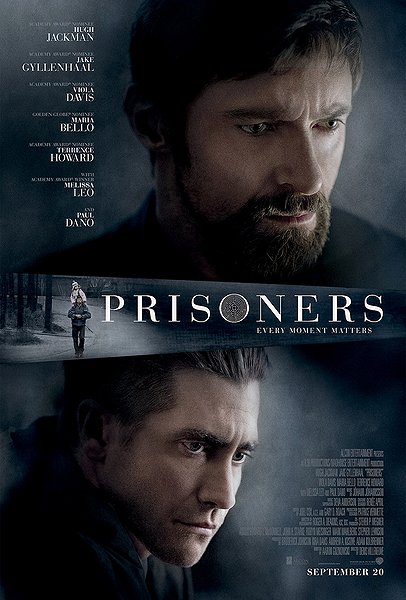 One rainy Thanksgiving day, two little girls go missing. Keller and Grace Dover (Hugh Jackman, Maria Bello) and their neighbors, Franklin and Nancy Birch (Terrence Howard, Viola Davis), discover their two young daughters have gone missing. A manhunt is underway for a suspicious RV, spearheaded by Detective Loki (Jake Gyllenhaal). The RV is found with Alex Jones (Paul Dano) inside. The problem is that there is no physical evidence of the missing girls inside the RV and Alex has the mental capacity of a ten-year-old. He’s being released and Keller is incensed. He’s certain that Alex is guilty and knows where his missing daughter is being held. One night, Keller kidnaps Alex and imprisons him in an abandoned building. He beats him bloody, demanding Alex to tell him the truth, but he only remains silent. Loki has to deal with finding the girls, finding a missing Alex, and trailing Keller, suspicious of foul play.
This is a movie that grabs you early and knows how to keep you squirming in the best ways. The anxiety of a missing child is presented in a steady wave of escalating panic. The moment when you watch the Dover and Birch families slowly realize the reality of their plight, well it’s a moment that puts a knot in your stomach. Prisoners is filled with moments like this, that make you dread what is to come next. The crime procedural elements of the case are generally interesting and well handled to the point that they feel grounded, that these events could transpire, including police mistakes. The central mystery sucks you in right away and writer Aaron Guzikowski (Contraband) lays out clues and suspects with expert pacing, giving an audience something new to think over. At 153 minutes, there is a lot to chew over in terms of plot developments and character complications. It’s a compelling mystery yarn and shows such promise, though the last half hour cannot deliver fully. Fortunately, Prisoners is packed with terrific characters, a real foreboding sense of Fincher-esque chilly atmosphere from director Denis Villeneuve (Incendies) and greatest living cinematographer Roger Deakens (Skyfall). The film’s overall oppressive darkness is also notable for a mainstream release. The darkness doesn’t really let up. It’s hard to walk out feeling upbeat but you’ll be thankful for those punishing predicaments.
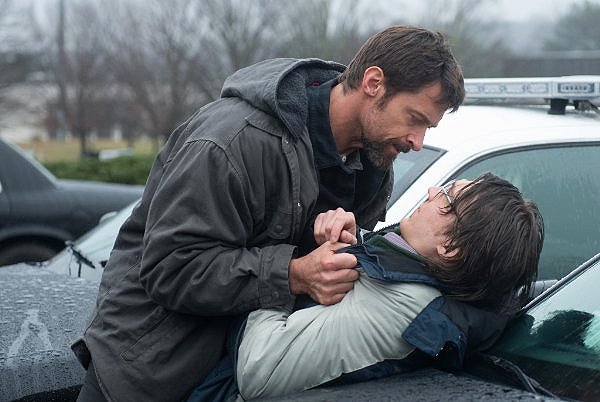 By introducing the vigilante torture angle, Prisoners is given a dual storyline of suspense and intrigue. How far will Keller go? Will he get caught? What will his friends think? Will they be supportive or will they crack? How does this change Keller? That last question is the most interesting one. Others tell us how Keller is a good man, and he’s certainly a devoted family man, but does a good man imprison and torture a mentally challenged man? Does a good man take the law into his own hands? If it meant the difference between your child being dead or alive, how far would you go? These are the questions that bubble up and the movie makes you deal with them. The torture segments are unflinching and challenge your viewer loyalty. You will be placed in an uncomfortable moral position. Then there’s just the what-would-you-do aspect of the proceedings. Could you torture someone, possibly to death? Fortunately most of us will never have to find out. I do wish, however, that the movie had gone further, complicating matters even more severely. It becomes fairly evident halfway through that Alex is innocent. It would have been even more interesting to intensify Keller’s legal troubles. If the police have their man, what does Keller do with Alex? Does he let him live after everything Keller has done? I think it would have worked as a logical escalation and put the audience in an even more uncomfortable position, forcing us to question whether Keller deserves to get away with what he did or pay a price.
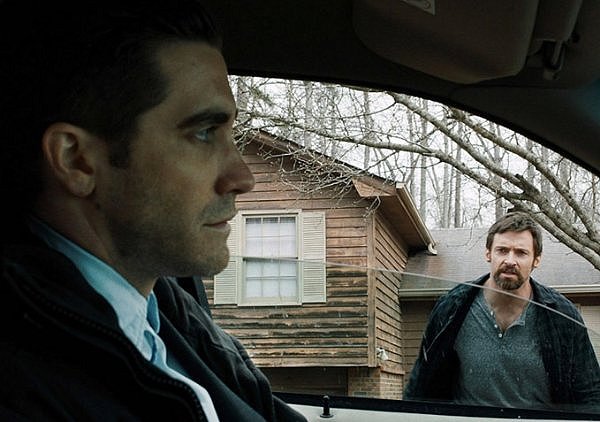
What separates Prisoners from other common thrillers, and what must have appealed to such an all-star cast, is the raised level of characterization on display. Jackman’s (Les Miserables) intensity is searing, as is his character’s sense of pain and futility. By all accounts, this is the best acting work Jackman has done in his career. Keller’s determination is all consuming, pushing away his doubts with his reliable pool of anger. Everyone is failing him so he feels he must take matters into his own hands, and the film does a fine job of relating his frustrations and urgency. But Keller is also in danger of derailing the ongoing investigation, becoming a liability to finding his daughter. This predicament pushes Loki into the tricky role of having to defuse parental intrusion, pushing him into a role he loathes, having to tell a harrowed father to back off. Loki is also consumed with the case, causing plenty of internal tumult and chaffing with the inefficiency and miscommunication of the police force. Gyllenhaal (End of Watch) doesn’t play his character big; he keeps it at a simmer, with hints of rage below the surface. His character is certainly richer than the Driven Cop we’ve often seen. His character is given less moral ambiguity but you feel his frustration working within the system and hitting dead ends. These two performers are both ticking time bombs.
The rest of the supporting cast has a moment or two to shine, though the characters are given less to work with. Bello (Grown Ups 2) is hastily disposed of from a plot standpoint by making her practically comatose with grief. Davis (The Help) knows how to make the most of limited screen time (see her Oscar nominated performance in 2008’s Doubt as evidence), and she’s heartbreaking in her moments of desperate pleading. Howard (Lee Daniels’ The Butler) is meant as the foil to Keller, a voice of moral opposition, but Howard lets the gravity of his involvement in horrible acts hit you hard. Dano (Ruby Sparks) has the toughest part in many ways because of his character’s brokenness and the fact that he’s being tortured so frequently. It’s hard not to sympathize with him even if part of you suspects his guilt. Naturally, Dano is adept at playing weirdos. Melissa Leo (Olympus Has Fallen) is nearly unrecognizable as Alex’s older aunt caring for him. She’s prepared for the worst from the public but has some nice one-on-ones where she opens up about the difficulty of losing a child herself.
 Prisoners is such a good mystery that it works itself into a corner to maintain it, ensuring that no real answer or final reveal will be satisfying, and it isn’t. I’m going to tiptoe around major spoilers but I will be delving into some specifics, so if you wish to remain pure, skip ahead. The culprit behind the child abductions, to put it mildly, is underwhelming and rather obtuse in their wicked motivation. The specified reason is to test people’s faith and turn them into monsters by abducting their children. This comes across as an awfully nebulous philosophical impetus, and it’s a motivating force that I find hard to believe even in the grimy, dark reality the movie presents. It just doesn’t feel grounded, more like a last-ditch conclusion to a TV procedural. However, what makes this ending worse is the false turns and red herrings that Prisoners utilizes. Every mystery requires some red herrings but they need to seem credible, and if executed properly, the characters will learn something useful through the false detour. The issue with Prisoners is that it establishes a secondary suspect that is so OBVIOUSLY the guilty guy, compounded with plenty of incriminating evidence including the missing children’s clothing covered in blood. When this suspect comes undone, his sketchy behavior starts to become a series of contrivances. They introduce a character that is too readily the guilty party, and then they just as easily undo him. And here’s another character of questionable motivation. Plus, there’s the central contrivance of having two characters that remain mute under all torturous circumstances unless the plot requires them to say something that can only be interpreted in an incriminating manner. These mounting plot contrivances, and an ending that wants to be ambiguous but in no way is, rob Prisoners of being the expertly crafted thriller it wants to be. It still hits you in the gut, but you’ll be picking it apart on the car ride home.
Grisly, morally uncomfortable, and genuinely gripping, Prisoners is a grownup thriller that isn’t afraid to go to dark places, with its characters and its plot. It hooks you early and keeps you on the hook, pushing its characters to make desperate decisions and asking you to think how you would perform under similar pressure. It’s a fascinating meta game and one that also adds extra intrigue to a rather intriguing mystery. It may not be revolutionary, but Prisoners is an above-average thriller with strong suspense and characterization. Where Prisoners stumbles is how it brings all this darkness to a close. The ending is rather perfunctory and not terribly satisfying; perhaps no ending would have been truly satisfying given the setup, but I’d at least prefer an alternative to the one I got, especially since it feels less grounded than the 140 minutes or so beforehand. It’s an ending that doesn’t derail the movie, but it certainly blunts the film’s power and fulfillment. Then again perhaps a word like “fulfillment” is the wrong term to use on a movie that trades in vigilante torture and the cyclical nature of abuse. In pursuit of perceived justice, what are we all capable of doing? The answer is likely surprising and disheartening for many, and Prisoners deserves credit for pushing its audience into uncomfortable positions and reflections.
Nate’s Grade: B
Share this:

Don Jon (2013)
 Joseph Gordon-Levitt, one of the most talented and, yeah I’ll say it, dreamy young actors working today is proving to be more than a pretty face. Don Jon is his assured writing and directing debut, and it shows that every man has one more reason to feel insecure compared to Gordon-Levitt. The titular Jon (Gordon-Levitt) is a New Jersey lothario who sleeps with lots of women but the real thing just can’t measure up to his porn. The schism between reality and sexual fantasy is too much. Jon tries to reform his porn-addiction ways when he meets a hot lady (Scarlett Johansson) but old habits are hard to break, especially when he has to wait before sleeping with a woman. The narrative isn’t terribly deep or that developed but remains entertaining throughout, buoyed by feisty performances and stylish direction. The editing, sound design choices, and smooth camerawork made me feel like I was watching a promising Scorsese student. I found Don Jon to be a far more successful look at sex addiction than the recent sex addict drama, Thanks for Sharing. The parallel between porn and Hollywood rom-coms, both an inflated fantasy of relationships, doesn’t really stick, and Jon’s family is a bunch of loud Italian stereotypes, but the lead guy is a self-possessed lunkhead anyway, so it makes sense for his family to follow suit. Don Jon is funny, sexy, and an enjoyable diversion at the movies. What it really does, though, is provide the first notch in what may prove to be an exciting directorial career for its star.
Nate’s Grade: B
Share this:

Short Term 12 (2013)
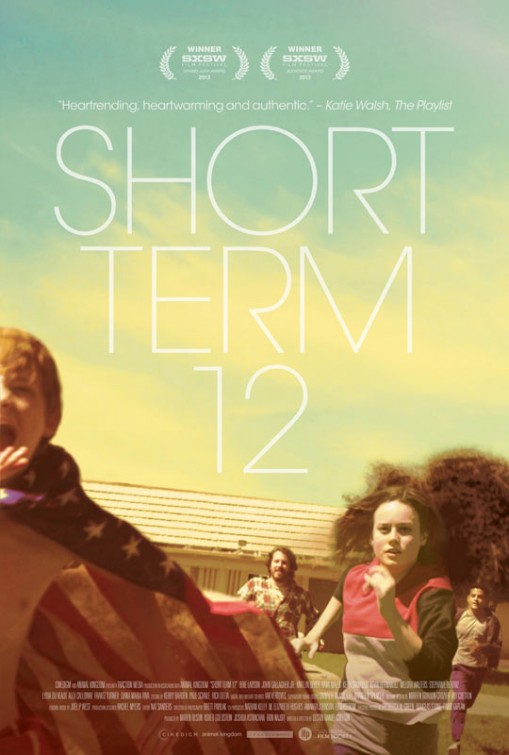 It’s rare for a movie to be emotionally devastating while also being overwhelmingly inspirational and hopeful, but Short Term 12 achieves the nigh impossible.
Short Term 12 follows the inhabitants of a small foster care center in Middle America. Many of the kids have been taken from their biological parents because of abuse, neglect, imprisonment, or death. Many have never known a stable home life. And many will age out of the system at 18 and be trusted to make something on the outside by their lonesome. Grace (Brie Larson) is the lead counselor for the center. She’s dating a co-worker, Mason (The Newsroom’s John Gallagher Jr.) and pregnant, unsure of where to go from here. As the center prepares for Marcus’ (Keith Stanfield) age-out departure, they welcome Jayden (Kaitlyn Dever) to their abode. Jayden’s well-connected father is getting his life in order for full custody, but it also becomes clear that her home life is a danger to her well-being. Grace fights to get Jayden to open up, then she fights to keep her safe, all the while forcing Grace to deal with her own long hidden pain.
 It’s so easy to get engaged in this movie. The very setting calls for plenty of drama and pain to be explored, and it will be, but that doesn’t mean that the film goes overboard with histrionics. The characters are written with such naturalistic ease, allowing an audience to understand them without judgment. These people, be they the foster kids or the counselors, feel refreshingly, exceedingly, magnificently like flesh-and-blood people. The characters feel lived in, their struggles feel real, and their responses are sincere. The foster care system in this country is grueling. A counselor needs a big heart, thick skin, and an immeasurable supply of patience. There are a lot of abused kids in the system, just hoping to find an adult who wishes to love them, to nurture them, to care. The kids don’t want pity; they are perturbed when they’re referred to as “underprivileged youth.” What they really want is respect and sincerity. Highly charged emotions are a given considering the circumstances of the characters, but what makes Short Term 12 exceptional is that they are fully earned. We don’t just feel for these kids because they’ve suffered, we feel for them because they are presented as characters instead of martyrs. I was emotionally moved throughout, tearing up several times, feeling heartbroken at turns and then brimming with buoyant hope at others. It’s a balancing act the movie masters.
Writer/director Destin Cretin (actually remaking his 2008 short film of the same name) explores these characters in gentle waves, allowing the characters to open up in ways that don’t feel forced. You learn about these characters and their history bit by bit, sometimes through creative expression where one must read between the lines. Marcus might seem to be one character, then his rap song he writes reveals an aching degree of personal pain, and then the revelation for why he wants to shave his head, which at first just seems like an average teenage compulsion, will break your heart all over again. You yearn for these kids beyond measure, wanting them to taste delayed happiness in this world, but you also understand why they’re so guarded, why the system grinds together as it does. This is no polemic overburdened with speechifying and soapboxes. It doesn’t really make any larger points about foster reform or the people who run the system. Instead Cretin gives every participant in the film complexity, empathy, and humanity. Even Grace’s supervisor, easily set up for quick blame about decision-making, is allowed empathy. You feel the man’s plight as he tries to make the best out of a bad situation, which is exactly what the counselors are trying to do themselves with their charges. Cretin’s emphasis is on his characters and not necessarily on making overt political attacks. I knew within minutes that I was in for something special. You can feel it with the dialogue, how easily Cretin is shaping character without splurging on exposition. These people come alive under Cretin’s watch, and you’ll be pulled in within mere moments.
This is also fundamentally a star-making performance for Larson. The young actress has had visible roles in Scott Pilgrim vs. the World, 21 Jump Street, and TV’s The United States of Tara, but nothing prepared me for the power of her performance. Larson’s character has plenty of personal pain and secrets and a gnawing sense of futility, but she pushes forward, trying to make a difference somehow in this world. You feel her intensity and determination but you also feel her setbacks and uncertainty. Larson never strays outside the emotional bounds of her character, staying true to her aims. Grace is no saintly and selfless figure. She’s paying a real price keeping her own pain bottled up, focusing completely on others so that she doesn’t have to assess her own damage, but Jayden forces her to examine her own history. Larson serves as the dependable emotional anchor of some very choppy waters. In a just world, Larson’s name would be bandied about come awards season, but the overall small, understated nature of Short Term 12 and its limited release leaves me in doubt. However, there is no doubt that Larson gives a deeply humane, gripping, heartfelt and marvelous performance.
 The character relationships are just as compelling and provide a rich texture to this world. The dynamics within the foster center are interesting, nothing as simplistic as slotting kids into staid high school types. There are divisions within the home, chiefly between Marcus and an antagonistic Luis, but it’s also invigorating when you witness the various kids come together in solidarity and community, when they look out for one another. Jayden is surly at first but won’t let on how truly hurt she is that her father missed her birthday. Marcus leads the other kids and they all make a slew of birthday cards to cheer her up, make her feel that someone out there cares. It’s a small gesture, and yet when it plays out it hits with a wallop. The relationship between Grace and Mason is sweet and frustrating, representing a romantic coupling of two people with an obvious connection but also enough baggage to derail potential long-term success. Gallagher Jr. is a nice fit for the part. I really enjoyed how Mason is developed as the film progresses. Initially he seems like a pseudo-cool authority figure, then a scruffy screw-up, then a sincere and grateful individual worried about Grace and aggravated by his inability to help her.
There are movies that feel true in a broad sense but clumsy with the fine details, and vice versa, but Short Term 12 is that rare movie that feels so authentic that it could have been a documentary. Sure there is convenient plot developments and a tidiness that life just doesn’t want to provide, but the overall impression is remarkably genuine. The characters feel like actual people, their world feels recognizable, and their struggles feel familiar and relatable and raw. Short Term 12 doesn’t glorify the counselors, nor does it demonize or sanctify the kids under their care. Here is an unblinking look at the sheer weight of the work of trying to provide for those in need. The movie is a potent drama with several heartbreaking incidents, but I don’t want to scare people off with the impression that Short Term 12 is all artsy doom and gloom. On the contrary, the film is resolutely hopeful in the face of such dire adversity. The perseverance of the counselors, as well as the kids striving for independent lives, is what I walk away with. Not the abuse, not the systematic neglect, but the indomitable perseverance of the human spirit to transcend damage and to succeed anew. This is the long-lasting impact of this superb movie. It’s not about the pain inflicted, rather the human connections forged and the optimism of recovery. Not everything will get its happy ending, but it is inspiring to watch people put it all on the line, thanklessly. Short Term 12 is the kind of movie you bug your friends until they finally watch it. Ladies and gents, commence bugging.
Nate’s Grade: A
Share this:

Thanks for Sharing (2013)
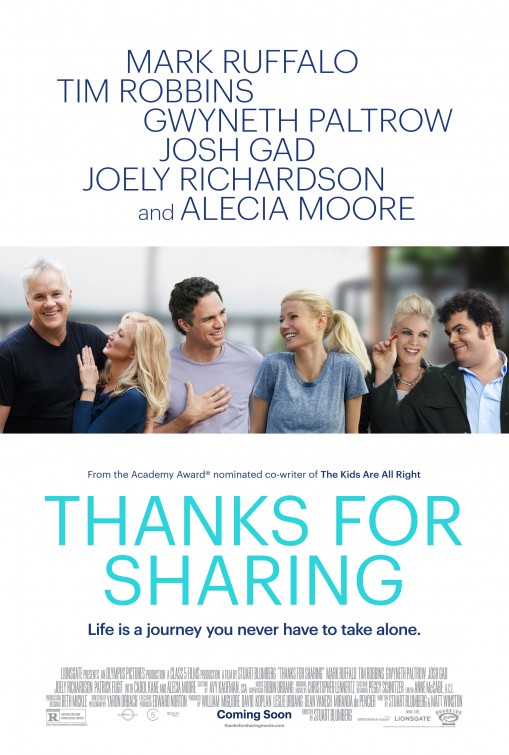 “Isn’t sex addiction one of those things guys make up when they’re caught cheating?” asks a character in Thanks for Sharing. This movie treats the topic of sex addiction very seriously, rattling off plenty of adverse side effects rather than just a wandering eye. Director and co-writer Stuart Blumberg (The Kids Are All Right) is certainly empathetic to his characters on screen. I just wish the movie knew what it wanted to be.
We follow three sex addicts in one therapy group, all at different points of recovery. Mike (Tim Robbins) is the paternal figure of the group. He’s long been married to his high school sweetheart. Adam (Mark Ruffalo) is five years sober and being prodded by Mike to start seriously dating again. He meets Phoebe (Gwyneth Paltrow), a cancer survivor, and hides his addiction from her. Worst of all is Neil (Josh Gad), a doctor who has been mandated to attend sex addict group therapy after “bumping” into people on the subway and recording an upskirt video of his boss. He doesn’t believe he has a problem, but, under the guidance of Adam and Mike, comes to the conclusion that the only person who can fix his impulses is himself.
 Thanks for Sharing is an admittedly entertaining movie, at turns, but it’s a movie with one debilitating identity crises. What kind of movie does it want to be tonally? We get raunchy sex gags, and then the film transitions into rom-com fluff, and then the film transitions into hard-hitting addict drama, and then it’s all back again. All of these elements could have been carefully threaded into one movie, but Blumberg and co-writer Matt Winston cannot nail down a consistent tone. In fact many of the changes can be quite jarring. One minute people are engaged in wacky sex hijinks, and the next they’re lamenting all the horrible life choices they’ve made in tears. When there isn’t a clear tone, or clear transitions, then the comedy undercuts the drama and vice versa. Therefore, certain elements can be appreciated or be found engaging, but the movie cannot become more than the sum of its parts. And let me get into whether sex addiction is really a topic that can work in the realm of romantic comedy. With the right finesse anything can be presented in a comedic light that still maintains the humanity and dignity of its flawed characters. However, is something as easily misunderstood as sex addiction, whose particulars can be quite appalling to many, the right fit for a genre that is predicated on whimsical coupling? I don’t think so. Thanks for Sharing doesn’t change my mind.
About that rom-com part, notably the relationship between Adam and Phoebe, it’s easily the least interesting part of the film. Both of these characters are fairly bland. Adam’s the sober guy trying to keep things going, except that we never really feel like he’s challenged. We don’t feel the threat that he’s going to relapse. And we don’t really get to know much else about the guy. He vaguely works for some sort of environmental firm. As a character, he is defined by Phoebe, herself a collection of quirks that doesn’t coalesce to form a human being. The film weirdly keeps harping on the fact that Phoebe likes her food to not touch, as if this minor peculiarity is some harbinger of a greater OCD complex (she’s into physical fitness!). The fact that other characters have to jump in on this makes it even more transparently reaching. Worse than all this, the couple’s interactions, and much of their budding relationship, feels overwhelmingly artificial. The dialogue should be sparking, charming, but you get no real sense of why either of these people would fall for the other, excluding the obvious physical attributes of each. The rom-com convention of the Big Secret (Adam’s addiction) is left dangling until, surprise, it’s defused early. I’d expect the movie to push further since there is a wealth of drama to be had about the trust levels of dating a sex addict, but instead it just forces them apart all too easy. Then there’s the fact that the movie covers perhaps a month of time and their relationship seems to move ridiculously fast, mostly because Blumberg is impatient for his couple to get to a more physically intimate stage.
Thanks for Sharing works far better as a darker drama, and as a movie, when it focuses on the roles of Mike and Neil. The film smartly connects sex addiction with other impulse control issues; for Mike he’s been sober from booze for 15 years, and for Neill he has weight control issues. These are the characters we see struggle, these are the characters at the more interesting points. Neill especially is a doctor whose hit rock bottom and can’t get away from the felonious things his addiction tempts him to do. Mike has a surrogate family with his support group. Now that his prodigal son (Patrick Fugit) returns, that adds tension to his family dynamic, both at home and in group. I would have preferred Thanks for Sharing to be told chiefly from the perspective of these characters, eliminating Adam and Phoebe altogether. But even these good storylines find themselves wading into all-too familiar plot devices. Mike’s arc involves reconnecting with his son, which will lead to a misunderstanding, a conflict, and ultimately forgiveness, and you see every step coming. Neill’s journey gets an unexpected boost when he takes initiative to help Dede (Pink a.k.a. Alecia Moore), one of the only ladies in group. Of course it takes a pretty girl to push Neill out of his selfishness and self-loathing, but he does progress, and it’s the most emotionally rewarding moment in the film. The problem is that Neill’s storyline is tied up in a platonic head-scratcher. Dede takes Neill to a dance hall where they are just there to… dance, but the kind of dancing that hipsters do. It all seems like something for people on drugs, but whatever reason, Neill shaking his groove thing, and coming to an understanding that he will not be touching Dede, makes his character better. I was surprised that Blumberg was able to end the movie on something of a downbeat, falling back to the central message of one day at a time, vigilance.
 There is one standout scene that really gets to the scariness of sex addiction succinctly. Once Adam falls off the wagon, which shouldn’t be much of a spoiler people, he regroups with Becky (Emily Meade) a gal he had a one-night stand with. Their flirtation is quick, settling into their attraction, and then she engages in behavior that, meant to be alluring, is rather insightful. She has a daddy fixation and wants to be punished as a “bad girl” with Adam pretending to be her stern father. That could be a red flag, but Adam carries on. Then she asks him to slap her. Adam refuses. So she does it herself, beating herself, eventually descending into a mess of tears, screaming. Adam tries to console her, stupidly deciding to try and make contact with her after she keeps screaming, “Don’t touch me!” She locks herself in the bathroom and threatens to harm herself. This one moment in the film gets at the damage of sex addiction like nothing else. It points to possible abuse, but really it all falls apart so rapidly that your head is spinning. The conclusion is pat and anticlimactic, but the lead-up is fantastic. If the rest of the movie had been thematically closer to this scene, Thanks for Sharing would be worth sharing.
From an acting standpoint, the cast does a fine job portraying their characters and his or her respective foibles. Ruffalo (The Avengers) is a bit too even keeled for his character. Gad (Jobs, The Internship) is the film’s comedic spark but also its greatest source of internal drama, which Gad handles well, showcasing the desperation of Neill. The real surprise is actually pop singer Pink in her first real acting performance (Charlie’s Angels: Full Throttle counts under no circumstances). Her introductory monologue, which she nails, makes you take notice that Pink has some genuine acting muscles.
Thanks for Sharing is an uneven mishmash of genres and ideas, rarely settling down into something worthy of the talent at work here. The comedy works against the drama, the drama works against the comedy, the clichéd character developments don’t serve anyone, and the overall artificial nature of the central rom-com coupling drags the enjoyment level further down. There is good work here, good acting and some memorable scenes and offhand laughs, but all Thanks for Sharing can amount to is a series of scant moments, passing encounters of entertainment. I didn’t find many of the characters to be as nearly compelling as the filmmakers did, and some of their hasty resolutions and developments feel far too simple for an addiction this complicated. The potential of the film is never fully realized. While I’m doubtful rom-com is a good fit for a serious exploration on sex addiction (wasn’t Shame hilarious?), it does lend itself to a bevy of juicy setups and possibilities. We get little of these. It’s as if the film wanted to present a case for the legitimacy of sex addiction, front-loaded with stats and horror stories and characters to open our eyes, and the notion of telling a laudable story was secondary to the educational efforts. Congrats. Now give me a story to care about.
Nate’s Grade: C+


 nathanzoebl
You must be logged in to post a comment.