Category Archives: 2021 Movies
Petite Maman (2021)
 There are two things to know about the deeply heartfelt new French movie, Petite Maman. The first is that it’s the follow-up by Celine Sciamma, the writer and director of one of 2019’s absolute best movies, the sumptuously romantic, Portrait of a Lady on Fire. That was reason enough to watch this relatively short movie. The next is a twist that I’ll save for the body of this review but that makes this childhood examination on loss, grief, and the future far more compelling and emotionally striking. It’s further proof to me that Sciamma is one of the best filmmakers out there and that her devotion to story and human emotion is paramount; just as I was enveloped in the romantic swell of Portrait, I was charmed and enchanted by this wholesome movie that’s so winsome that you could watch with the whole family, that is, if you can convince children to watch a 75-minute French drama with you, and if so, congrats.
Nelly (Joséphine Sanz) is mourning the recent loss of her grandmother. She and her mother and father have camped to grandma’s old home to pack it up. Everyone is sad and one day Nelly’s mother leaves without warning. She doesn’t know when mom is coming back. In the meantime, Nelly makes a friend with a neighbor girl, Marion (Gabrielle Sanz). She’s living with her mother and nervous about an upcoming operation to fix a genetic malady. However, in the meantime, these two little girls find solace in playing with one another, building a fort in the woods, and creating role play scenarios that allow each to hone their acting skills. Over the course of a few days, Nelly learns to understand her family more while learning to say goodbye on her own terms.
 I’ll save the spoilers for the next paragraph because I feel like they are unavoidable to truly get at what makes this movie special. One non-spoiler merit of this movie is how persuasively it is told from the perspective of childhood. Our little eight-year-old heroine is the protagonist, and we see the world from her understanding. That doesn’t mean the movie ever leans on narration or a reality-bending imaginative framework; it’s simply told with the understanding of what it’s like to be a child with questions and emotions that you don’t quite know how to handle. There’s a beguiling innocence with the movie that makes it so wholesome and sweet. As an adult, it’s not too difficult to remember your understanding of the world as a child, let alone family relationships, especially in the aftermath of bereavement. Nelly is forlorn because she didn’t know her last exchange with her grandmother would be their final interaction, and that ache is relatable no matter the age. Nobody knows when their last interaction with a loved one could be, so it’s easy to feel that same lament that more wasn’t made to achieve a better sense of closure. There’s a sweet moment between Nelly and her mother where they role play what that final exchange could have been, and all Nelly wishes is to say goodbye one more time but with more forceful feelings behind the words, and it was a moment so pure and innocent. The entire movie is like this moment, a lingering earnest sensation that is universal and expertly delicate.
Here comes the spoilers, so dear reader be aware if you still want to remain as pure as this movie, although I would argue knowing this spoiler ahead of time will improve your movie-going experience by giving you a necessary part of the puzzle. Petite Maman translates to “Little Mother” and it’s more than simply little kids pretending to be adults. It turns out that Marion is actually the eight-year-old version of Nelly’s mother, and her house they retreat to after playing in the woods is an older version of Nelly’s grandmother’s home. There are clues early, like the same distinct wallpaper and interior design of the house, but you might be able to dismiss that as maybe there are just similar houses being built in this neighborhood. After a while, though, you start to realize there’s more going on here, and the movie doesn’t treat you like an idiot. Nelly flat out tells Marion that she is her child from a future. From there, the movie becomes a fully felt inter-generational bonding experience, where daughter gets to talk to her mother on her own level, answer questions for her curious young mother, and they talk about dealing with sadness as they know it. When Marion asks if Nelly was planned, she says yes, and Marion says, “That makes sense. I can’t stop thinking about you already,” and tears come to my eyes even typing the words. This twist brings so much more meaning to everyday activities; instead of Nelly staying one last night to make pancakes with her new friend, now it’s Nelly having only one more opportunity to bond with her mother when they’re both at the same age, saying goodbye while telling her how much she loves her, not knowing if when they part that she may even see her adult mother again. Wow, that is so much going on. Nelly even gets another shot to find that closure with her grandmother.
 The two young actresses are twin sisters, and both are terrific. Given the gentle nature of the movie, neither is given any great moment where they tearfully break down, shout their feelings, or chew the scenery in general. These feel like real kids dealing with real emotions under some unique circumstances. Each of the Sanz sisters is a delight and realistically subdued and not just poor actors incapable of effectively showing emotion. When Nelly and Marion are play acting a scene, with one pretending to be an investigator interrogating the other as a suspect, they both have a twinkle to them as they admire each other’s acting ability, saying they should become an actress. It’s a nice moment for each of the Sanz sisters because they’re living their own dreams in the scene.
Petite Maman is a special movie and one that doesn’t feel like a frame is wasted. Even at only 75 minutes in length, its compassion and sweetness are eminently felt and appreciated. My only regret is that we could have had more time together with these two and to develop even more, but it almost seems like its own commentary on life and our relationships itself. We always are left wanting more, never knowing when one last hug or joke will be the last, and so savor the human experiences we have, the cherished memories earned, the gamut of emotions shared, and enjoy what we have.
Nate’s Grade: A-
Share this:

Belfast (2021)
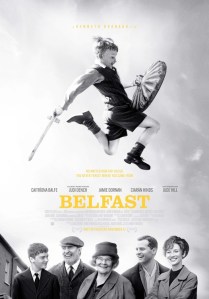
Kenneth Branagh returns to his boyhood home with Belfast, a coming of age story set during the Troubles in 1969 where Protestant mobs were targeting Irish Catholics. The movie is partly autobiographical as we follow young Buddy (newcomer Jude Hill) and his parents (Jamie Dornan, Caitriona Balfe) and grandparents (Cirian Hinds, Judi Dench) dealing with life as their neighborhood block more resembles a war zone. There are dangerous influences and dark intentions on the peripheral, but we’re mostly at kid level, where his days are preoccupied with sitting closer to his crush in school and wanting to impress his older cousin and be accepted. The parental perspective is kept to offhand whsipers and weighty conversations about moving away or staying behind. The black and white photography is gorgeous and exquisitely composed, looking like old family photos come to rich life. The actors are charming and heartfelt, and when called upon deliver emotional fury. The problem with Belfast, and it feels mean to even cite it as such, is that everything is just a little too nice, a little too clean, a little too safe. The childhood perspective doesn’t quite jibe with the political instability at hand. It’s not a Jojo Rabbit where that disconnect is the point for reflection. It’s clearly Branagh’s love letter to his family and native land. It feels like entire scenes have been plucked directly from Branagh’s nostalgic memories. It also feels like the characters are more sweet-smiling composites than real people. It’s all been romanticized with Branagh’s personal nostalgia, reshaping the odd angles and dangling conflicts into something more sentimentally safe, easy, and inoffensively digestible. Belfast is a perfectly enjoyable movie but it feels like a simple TV movie-of-the-week, crowd-pleasing version of a complex story worthy of greater nuance and scrutiny.
Nate’s Grade: B
Share this:

Don’t Look Up (2021)
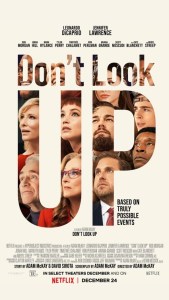 A scorched Earth satire that flirts with a literal scorched Earth, Don’t Look Up is writer/director Adam McKay’s star-studded condemnation of everything stupid and myopic in media, politics, and pop culture. Jennifer Lawrence plays a doctoral student who discovers a comet heading for direct cataclysmic impact with Earth, and she and her astronomy mentor (Leonardo DiCaprio) are trying to sound the alarm but nobody seems to be listening. Not the president (Meryl Streep) and her inept chief of staff/son (Jonah Hill). Not the greedy CEO (Mark Rylance) of a tech company. Not the media where morning TV co-hosts (Cate Blanchett, Tyler Perry) are more compelled by music star breakups than pressing science. It makes a person want to stand up and scream about priorities, and that’s McKay’s point, one that will be bludgeoned again and again. This movie is animated with seething rage about the state of the world and the cowardice about facing obvious problems head-on. It’s fit as a climate change allegory but COVID-19 or any scientific crisis could be applied as well. It’s about choosing ignorance and greed, about deferring to our worst instincts, and those in power who profit from inaction. I laughed at several points, some of it good cackling, and the movie is dark to its bitter end. This is the bleakest movie of McKay’s foray into his more sober, activist movie-making (The Big Short, Vice). It’s less Seeking a Friend for the End of the World, exploring the foibles of humans reconciling their last moments of existence, and more Idiocracy, where there is a lone voice of reason and the rest of the population are aggravating morons that refuse to accept reality even if it literally means just looking up with their own eyes. In some ways, the dark laughter the movie inspires is cathartic after years of COVID denials and mask tirades and horse medicine. The satire is bracingly blunt but also one joke on repeat. If you’re the right audience, that one joke will be sufficient. I don’t think the movie quite achieves the poignancy it’s aiming for by the end of its 138 minutes, but the anger is veritably felt. Don’t Look Up wants us to save the world before it’s too late, though the people that need to see the movie the most will be the ones fastest to dismiss it. Still, congrats to McKay for making a movie this depressing and relevant for the holidays.
Nate’s Grade: B+
Share this:

The Matrix Resurrections (2021)
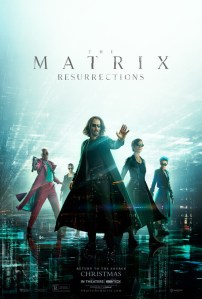 It is hard to overstate how influential The Matrix was upon its release in 1999. It rewrote the science fiction and action genres for Hollywood and introduced American audiences to many of the filmmaking techniques of Eastern cinema. It was exciting, philosophical, challenging, and made an instant brand out of the Wachowskis, the writing/directing siblings who had previously only directed one indie movie. The 2003 sequels were filmed back-to-back and released to great anticipatory fanfare and then, later, derision. The Matrix sequels, Reloaded and Revolutions, became a shorthand joke for bloated artistic miscalculation. They were talky, draggy, and just not what fans were hoping for jacking back into this strange world, and years later I think they’re worth a critical re-evaluation. Flash forward to 2021, and Lana Wachowski has resurrected The Matrix, and with the original actors for Neo and Trinity, both of whom died in Revolutions. Why go back? I think part of this was the declining career of the Wachowskis as directors. I personally loved 2012’s Cloud Atlas but it was an expensive and messy money-loser, the same as 2008’s Speed Racer and 2015’s Jupiter Ascending, a cosmically bad movie. So now it’s back to The Matrix with an older Neo, and older Trinity, and more of the same by design. The Matrix Resurrections just made me sad. It’s a movie that feels resentful for its own inception.
Thomas Anderson/Neo (Reeves) is living out his life as an award-winning game designer. His company and business partner, Smith (Jonathan Groff), are looking for their next big hit, and they’re looking backwards at Anderson’s biggest success… the “Matrix trilogy.” It was a virtual reality program that skewered the difference between reality and fiction. Mr. Anderson might have even based the role of Trinity on Tiffany (Carrie Anne-Moss), a woman he has grown infatuated with over time at a coffee shop. Except Mr. Anderson is having trouble determining what is real and what is only in his head. That’s because a new, younger Morpheus (Yahya Abdul-Mateen II) is telling him that he’s Neo, that he’s destined for greater things, and that he’s been kept in an unorthodox prison to keep him out of the action. Everyone seems interested in reactivating Neo, but for what purpose, and what has happened in the ensuing decades since the end of the war with the machines?
 Part of my struggle with Resurrections is that it too is struggling with its own existence, and not in a meta-textual sort of identity crisis, more like a reason to carry on 18 years later. Fair warning, this movie is far, far more meta than you are anticipating. The entire first hour of the movie features characters justifying rebooting “The Matrix,” the game. It’s a movie where characters glibly talk about parent companies going forward with the IP with or without the involvement of the original creators, so better to be the one trying to staunch the bleeding I suppose. A character literally says Warner Brothers wants a new Matrix and they will not stop until they get one. There are characters that sit around a table and try and break down what made the original Matrix (the game) so cutting-edge, and every person has a different brand slogan. “It was edgy.” “It blew your mind.” “It was a thinking man’s action story.” This prolonged section of Resurrections feels entirely like Wachowski speaking directly to her audience and saying, “Look, I had no reason to be back here. They forced my hand, and I want you to know that I’m not happy about it.” There are literal moments from the 1999 film that are presented as if the characters in the matrix are watching The Matrix to recreate scenes like avid cosplayers. There is one part where a character just starts screaming the word “reboot” with profane intention, promising to get their own spinoff as a threat. The entertainment industry satire about reboots and cash-grab sequels is funny but misplaced and coming from a perspective of defiance. If this was all the movie was then it would have been a fascinating example of an artist burning the bridge to their most successful franchise out of willful spite. However, if we had our own little focus group and asked what made the original Matrix so enjoyable, I doubt anyone would list, “entertainment industry satire and meta humor.”
The Matrix movies are well known for being a smarter, more ambitious viewing experience (“A thinking man’s action story”), blending philosophy and mysticism into anime-style action and kung-fu fights. There’s an intentional repetition here, built upon delivering something familiar and safe to audiences but with a “next gen” feel. We have a new Morpheus and a new Mr. Smith here, but did we require either? When they go through the motions of patterning themselves on characters of old, it feels strained, it feels gassed, and it’s another instance where Wachowski telegraphing to her audience, “Look, the studio demanded I bring back these characters, but I’ll be damned if I know what to do with them.” Morpheus has a little more story leverage as a catalyst for bringing Neo back to his path of enlightenment. Truth be told, I don’t really know half of what was happening in this movie, which lacked the elegant connectivity of the best action movies, linking cause and effect (the Merovingian would be proud of me) and pushing the movie forward to its inevitable conclusion. Even the prior movies felt more like the creators knew what was going on, even if the audience was lagging behind. With Resurrections, it feels like Wachowski and her screenwriters, novelist Dave Mitchell (Cloud Atlas) and Aleksandar Hermon (Sense 8 finale), have just given up trying to make sense of it all.
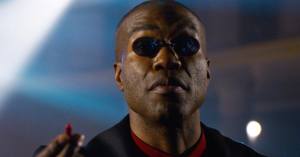 Another disappointment is the lack of any signature or memorable action sequences or, in the words of the Matrix round table, moments that “blew your mind.” The use of phones as transport in and out of the matrix has been replaced with mirror portals and doorways, which initially got my hopes up. There are such playful visual possibilities incorporating portals into action (see: Doctor Strange, even Matrix Reloaded), and I felt that Wachowski was up to the imaginative challenge. It too feels like another element that barely registers. The movie takes the anyone-can-become-an-Agent threat of the original trilogy and says, “What if instead of facing deadly Agents, it was just dumb zombies?” The new machines decide to rely upon a hive-mind system of grabbing whatever humans are in the vicinity and taking control of them into mindless foot soldiers. Let’s explore what a downgrade this is. The Agents were dangerous because they had powers that ordinary humans could not hope for, like the bullet dodging. In this movie, ordinary people are easily foiled and often a pathetic excuse for super-powered adversaries. The final act involves an escalation in numbers of the hive mind, but we’ve already been here with the multiple Agents Smiths of the sequels. There is one disturbing change-up where the machines realize how humans can just serve as canon fodder that is dark but a more effective attack. Even the requisite martial arts battles and gravity-defying wire work are humdrum this round.
If there is one thing that Resurrections does well it’s staking its identity out as a romance. Much of the second half prioritizes the relationship between Neo and Trinity, which was always taken for granted in the sequels. It was a romance of more utilitarian purpose, providing Neo with a love interest to motivate him to be saved in times of great peril. With Resurrections, the movie actually takes time to devote to Neo and Trinity as people with desires and what they would find appealing about the other. He’s not the savior of mankind, and she’s not his gateway to knowledge and empowerment. They’re portrayed as people, somewhat unhappy in their lives, and just hoping they might have another chance meeting at their shared coffee shop for one more electrifying conversation. The evolution of the movie places even more importance on this human connection, so I’m glad time has finally been given to exploring what it is that connects Trinity and Neo, especially if their love story is going to play as prominent a resolution to Resurrections. If you have never cared about Trinity and Neo as a couple, then you’ll likely be in for a disappointing second half.
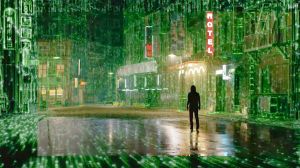 From a technical standpoint, Resurrections is still a feast for the senses. The photography is moody and atmospheric. The musical score is pumping. The special effects are state-of-the-art. There are a lot of talented people working on this sequel. So why then does the movie feel so perfunctory? In some regard each Matrix sequel has felt this way, adding extraneous pieces onto an already perfect standalone film. Having re-watched both Reloaded and Revolutions again, I can affirmatively declare Resurrections to be the weakest Matrix entry yet. We were all a bit too harsh on the prior two Matrix movies, which fall short of capturing the original’s magic alchemy but bring the goods when it comes to memorable set pieces, eye-popping visuals, and narrative zigs instead of zags (It was undercutting audience expectations before it was cool). They are still a bit too stuffy and talk in circles, but there are definite Major Ideas percolating underneath. In contrast, Resurrections feels more powered by resentment, by Wachowski coming back to this world against her better wishes and judgements. Maybe we should have left things alone.
Nate’s Grade: C
Share this:

Mass (2021)
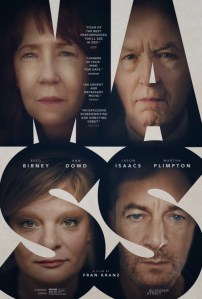 I can completely understand if anyone chooses to ignore the indie movie Mass for its subject matter alone. It’s heavy. I get it. It’s about two sets of parents, one pair (Jason Isaacs, Martha Plimpton) whose child was murdered in a school shooting, and the other pair (Reed Birney, Ann Dowd) whose child was the school shooter. It took me weeks to even work up the courage and proper mood to sit down and watch the movie. I’m glad I eventually watched Mass because it was so emotionally engaging and ultimately cathartic. That’s what I want more people to understand so that they give this hard-hitting indie gem a chance. It’s not all doom and gloom. It’s not all angry finger-pointing and gnashing of teeth. Mass is much more than you expect while being exactly what it sets out to be. It’s a small film brimming with big emotions and an even bigger wealth of empathy, allowing every participant to be a multi-dimensional human being struggling to make sense of the unimaginable that has dominated their life. Mass is one of the best written and acted movies of 2021 and deserves your time and consideration.
As you would expect given this set-up, it’s a lot of powerful conversations and grueling personal details. If you were unfamiliar with the premise, the movie teases out is main scenario like the key info are valuable kernels, and slowly and surely, we get a fuller idea of what has transpired years in the past and what the connection between these two groups of people is. It’s also a terrific setup to build anticipation and dread, so those first few moments face-to-face have the awkward niceties but we’re really waiting for the big subjects to be get their due, and they will, oh boy will they ever. However, if you’re going in looking for blood and easy answers, then this isn’t going to be the witch hunt you crave. I’m reminded of a Ted Talk I watched recently from Sue Klebold, the mother of Dylan Klebold, who was responsible for the Columbine school massacre in 1999. She talks about not recognizing signs, not of homicidal tendencies, but of suicidal tendencies, of depression manifesting as something else. It’s easy to cast blame and formulate our own assessment of parenting failures and ignored warnings, but what if the situation is far more complicated than that? What if the parents of the shooter are just another set of victims, except they never get to be honored as such by the public? They’re often looked at with suspicion, doubt, and culpability, defined by tragedy but transformed to social pariahs (the perspective illustrated so exquisitely and humanely by 2011’s We Need to Talk About Kevin). Where Mass excels is with its mighty empathy. Everyone in this story is a victim. Full stop.
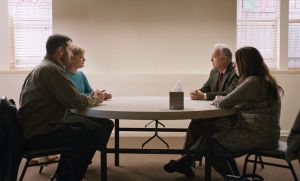 You’d be forgiven thinking Mass is based upon a stage play given its dialogue-driven story and single location setting, but it’s an original screenplay by director Fran Kraz, an actor best known for his comic relief parts in Joss Whedon projects (TV’s Dollhouse, The Cabin in the Woods). I was blown away by the immersive writing and empathy. For the first half of the movie, the parents of the shooter dominate the discussion, as they’re delivering us needed exposition on the day in question but really all the steps beforehand, the red flags that didn’t appear to be so permanent until they were. For every school shooting we read about in the news, the next question is where the parents were or why didn’t they act sooner if they had their suspicions. This is the period of the movie that answers those pertinent questions. The second half is more about the response to this news, culminating in a catharsis of tears and grace, facilitated first through anger. It’s a script structure that feels fully without manipulation, meaning the bend of the conversation occurs in a natural drift and pace. Nobody just blurts out what they want to talk about because the script is in a rush to leap to this next topical area of conflict. Franz is also very generous as a writer, able to make sure each character has their opportunity to shine and making sure we understand each character’s perspective. By the end of it, you should hopefully understand that there are no bad guys here, just victims on different sides of trauma suffering to make sense of tragedy. The monologues in this, beautifully written and performed, broke me each and every time.
Every actor holds their own but Issacs (Star Trek: Discovery) and Plimpton (TV’s Raising Hope) each get their big Oscar moment. It’s always peculiar to watch Isaacs play “normal roles” as we’re so accustomed to seeing him portray snide villains because he’s so damn good at them. Here he’s a grieving father who gets his fiery meltdown moment, and Franz has the great sense to never let his camera off the actor, allowing the full take to just derive from the live-wire emotions of the scene. It leaves the actor shaking and you just might do the same while watching. Isaacs is more the force of anger, while Plimpton is more the force of resolution, seeking an ending for all the heartache that has transformed her marriage. Her plea toward the end of the movie is an attempt at reconciliation that ends a heavy movie on uplift.
 I want to also credit Dowd (Handmaid’s Tale) and Birney (House of Cards) for their performances. They’re the more subdued ones, castigated for their position, afraid to show too much emotion because of the guilt they feel that they should have done more. Both are great, and Dowd’s final monologue, a story about her son she wants to share for better understanding, also had me in tears and especially what it results in. It’s worth it, folks, so stick around through several minutes of dithering discussion over where to find a box.
Mass is a hard movie to watch by design. It’s a delicate subject matter that will prove triggering for some and simply emotionally unpleasant and crushing for most. It’s ultimately a powerful movie about understanding, about shared grief, about empathy and relationships and similarities. It’s brilliantly written, brilliantly acted, and confidently directed. It’s little more than four people in a room hashing out their grief and conflicts, but when the drama is this potent and the characters are this complex, then it’s worth the prolonged discomfort and knots in your stomach.
Nate’s Grade: A-
Share this:

The Lost Daughter (2021)
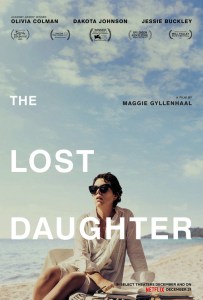 As a film critic part of a credited organization, I’m used to getting goodies in what I call “screener season,” the months of October to December when studios want to court critical favor for year-end consideration of their assorted movies for awards and titles. Netflix has sent me enough heavy coffee table books that I could, in Cosmo Kramer-style, fashion a literal coffee table made from them. For The Lost Daughter, Netflix sent me quite a bundle, including the film’s source material, a 110-page novella written by Italian author Elena Ferrante (My Brilliant Friend), which I read, and an actual bottle of sauvignon blanc wine. This was the first time a movie studio had sent me alcohol (my girlfriend drank a glass and did not like it, so thanks anyway, Netflix, but we dumped the bottle). I found the novella to be well written with plenty of poetic insights and turns of phrase, but I didn’t see the movie there. After sitting down and watching the two-hour feature film, I still don’t quite see the movie in this story.
Leda (Olivia Colman) is 48 years old, a literary professor, and vacationing on a small villa in Greece. Her time away is disrupted by a large, boisterous family sharing her resort. Leda is intrigued by a mother, Nina (Dakota Johnson), and her young daughter, Elena. It makes her reflective of her own time as a mother (played in flashback by Betty Buckley) to her two daughters, now both in their early twenties and having little to do with their mother. One day, Leda picks up Elena’s forgotten doll from the beach with the intention of returning her to the child, and then she simply does not do this. Leda grows closer to Nina, disapproving of her arrogant husband, her boorish relatives, and some of her risky personal choices, and we’re left to question whether she’s relating to this young, besieged mother or judging her from afar.
 This is one of those character study films that will ebb and flow on the level of the performers, and the actors elevate the material beyond what is present on the page. There are several intriguing conversations that shed light on characters and their view of parenthood, like Leda explaining how she feels that she gave the best of herself to her daughters when they were born, and now what she’s left with are the scraps. It’s not breaking new ground to view motherhood in non-glamorous terms. I thought 2018’s Tully did this with great observational detail, unsparing honesty, and great empathy. The Lost Daughter is not exactly Tully, which explored the hardships of motherhood with a put-upon woman who was valiantly struggling to keep her head above water, but it was a woman who wanted to be in the fight. With this movie, you never quite get a clear sense of Leda’s relationship with her two children, who are mostly kept to flashbacks when they are very young. Writer/director Maggie Gyllenhaal (yes, that Maggie Gyllenhaal) employs a non-linear plot to better inform the interior thinking of Leda, so we’ll have past and present juxtaposed for our ongoing evaluation. This is a smart way to follow the imprecise nature of hazy memory. There will be moments that will cause you discomfort, like when one of Leda’s young children is pleading through tears for her mother to kiss her wounded finger, and Leda withholds doing this as a power play, as an act of spite, as a knowing punishment for her wailing child. It’s also potentially relatable for others out there who too have, at the apex of their frustrations and exhaustion, lashed out at children and regretted it later, acknowledging that every parent will fail at some point over the long journey of time and to only attempt to minimize the inherent damage that will be left.
The Lost Daughter becomes an exercise in how long you want to spend with a pleasantly unpleasant woman. Leda is complicated, yes, but she’s also admittedly cruel and selfish, and the movie is trying to make her a case study, to shed our moral judgements and acknowledge that parenthood can be a draining experience. I understand the intention for embarking on empathy for unsympathetic characters; hundreds of movies have invited us into the minds of unlikable and downright psychopathic characters. I’ve always said that I need not like a character, I only need to find them interesting to keep me watching. Leda is an interesting woman because of where she veers from common practice. Most of us would return a missing doll to her rightful owner, especially as that child is grief-stricken and her wave of terror is affecting everyone in her family. Most of us would recognize others suffering and our ability to ease this, to absolve that suffering in an instant, and we would do so. Then the question becomes why isn’t Leda returning this doll to this child? The movie is an elusive attempt to answer, and each person’s interpretation will undoubtedly be different. I don’t know if this doll, perhaps the “lost daughter” of the film’s title, is Leda attempting to hold onto her own daughters, reclaim a version of motherhood that suits her, that doesn’t require of her. Or maybe she views the doll with derision. Whatever the case may be, have at it, dear reader, and enjoy not getting this question resolved.
 I completely understand viewers growing frustrated with watching two hours of a middle-aged woman holding onto a child’s doll and refusing to return it. It’s spiteful, and maybe that’s the point. Maybe Leda wants to impart the same lessons of hardship she endured as a struggling mother at her wits end. Maybe it’s her way of trying to shake Nina to re-examine whether being a mother is a role she is cut out for. Maybe it’s simply the continuation of a sadistic rationalization, “I had to suffer through this, so then you should have to suffer too” that props up whenever sociopolitical reforms and progress are met with generational push-back. By the end of the movie, I don’t know if Leda has seriously changed her outlook or sense of self. I don’t know if anything has really changed, and I don’t know if we’ve gotten to understanding her any better. Again, maybe that’s the point; people are complicated and possibly unknowable. But as a filmmaker showing us a character’s interior life and flashbacks, maybe you should try.
There is a late revelation in the movie that is going to be a deal-breaker for many. I won’t spoil it, though I will say that this reveal is covered in the first chapter of the novella, providing you this key piece of info as a prism for your early assessment. It explains why Leda has a strained relationship with her adult daughters and why thinking back about her perceived parenting failures causes her shivers of grief and guilt. At the same time, there are plenty of feminist stories about women shirking societal demands, so others could perceivablly view this revelation as an act of empowerment or self-determination, and others may just find it as the final straw in giving up in trying to sympathize with an already difficult person.
Fortunately, if you’re going to build a movie around a challenging character, Colman (The Father) and Buckley (I’m Thinking of Ending Things) are two of the most compelling actors for the cause. Much of their performances is naturally guarded, requiring each actress to hold back and utilize more subtle acting muscles. Colman’s middle-aged Leda is more set in her perception of self, more settled though not quite self-assured, so her performance seems more like cracking through a veneer and pushing back, trying to find the real Leda’s feelings about her life and the people she is socializing with. Colman is mesmerizing as always. Buckley’s young Leda is the version that is fraught with being an attentive mother as well as a burgeoning literary academic. Hers is the role of frustration, of shutting down, of desiring an escape hatch from the perils of motherhood. When young Leda is away on an academic retreat, she’s like a completely different person, and Buckley makes it clear that she covets this version of herself. Both women are gifted actresses and provide lifelines for the viewer to better analyze and unpack Leda as a puzzle.
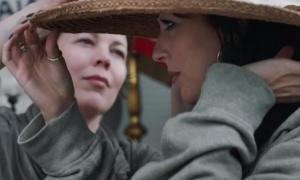 Gyllenhaal makes an impressively natural debut as a director. Her camera is usually very closely tied to her actors, bobbing to catch up and keep them in frame, afraid of leaving their sights. Her attention to detail is solid and her command of the actors is strong across the board. Her adaptation makes smart choices to better visualize the drama. After I read the novella, I genuinely wondered how the movie could even convey the material. It was so insular, so personal, and again, much of the onscreen drama was a woman hiding a doll from a child. I was worried the movie might become a ridiculous thriller of waiting for Leda to be caught, how she had to go to greater lengths to keep her secret, and thankfully that is not the case.
I can easily foresee The Last Daughter becoming a polarizing movie upon its Netflix streaming release at the end of the month. Some will hail it for being challenging and thorny, an indictment on the expectations of motherhood from a society that sets ambitious women up to fail. Some, and I predict the majority of viewers, will find the movie to be an insufferable character study of a misanthropic protagonist. I know the movie wasn’t trying to make an audience like its lead character, but I don’t know if by the end we are better at understanding her and her choices. It leads to a sort of, “That’s all there is?” ending that will frustrate many. The acting is strong to excellent overall and Gyllenhaal has a bright future ahead as a director, but The Lost Daughter might be too lost for too many to care. Just give the kid back her doll already, lady!
Nate’s Grade: B-
Share this:

The Tragedy of Macbeth (2021)
 At this point, William Shakespeare’s tragedy of witchy regicide has been adapted into over 30 movies, most recently in 2015 with Michael Fassbender and Marion Cotilard, so with any new Macbeth the question arises: what will this one offer? The pedigree behind this 2021 film is mesmerizing: Denzel Washington, Frances McDormand, and director Joel Coen. That’s enough reason to see another rendition of the Bard, although the best acting comes from a surprise, theater vet Kathryn Hunter who portrays all the witches as one person (plus more). She’s captivating and haunting and the highlight of the movie. This is the most, for lack of a better term, ordinary film in Coen’s quirky career and his first without brother/collaborator Ethan. It finds a dreamy middle ground between film and theater, utilizing imposing and stark sound stages and striking chiaroscuro black and white photography to feel otherworldly. The eerie, shifting imagery and alien presentation makes the movie feel like a transporting dream oiled by the lugubriousness of Shakespeare’s brilliant words. This version also demonstrates some of the more violent actions typically reserved for offstage implications (poor Macduff son). This Macbeth is also shockingly fast-paced, barely clocking in at 105 minutes, about half of the running time for the unabridged stage play. The acting is uniformly good but I was slightly let down by the leads. I guess I was expecting more indulgence in the sheer thespian feast and was surprised they made more of a tiny meal of things. If you’re familiar with the source material, there should be enough here to appeal to you, though I still hold the Patrick Stewart BBC production as the best film adaptation yet. Go into The Tragedy of Macbeth expecting good, not transcendentally great, and lean back and enjoy the aural pleasures of theater.
Nate’s Grade: B
Share this:

West Side Story (2021)
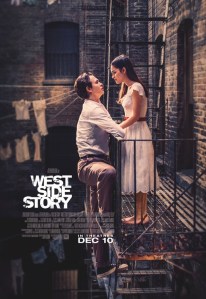 Steven Spielberg, now approaching seventy-five years of age, has experienced such rarefied success as a film director that the man can do whatever he wants. It just so happens he wanted to tackle his first big screen musical, something he’s a little late on considering peers like Martin Scorsese (1977’s New York, New York) and Francis Ford Coppola (1982’s One from the Heart) beat him to the musical punch early. The question isn’t why direct a musical at this stage of his glorious career, it’s why direct a remake of 1961’s Best Picture-winning West Side Story? We already have a perfectly good and revered movie version, and there are other musicals that haven’t even gotten their first big shining moment on the silver screen, so why go back to this particular show a second time?
Once again, we’re following the two New York City street gangs, the Jets, who are made up of Italian and Irish white kids, and the Sharks, made up of Puerto Ricans. Tony (Ansel Elgort) is trying to reform his ways after spending a year in prison for gang violence. The Jets are pleading with him to get back involved, to push back against the Sharks encroaching on their territory. He meets Maria (Rachel Ziegler) at a dance and the two fall instantly in love. The problem is that Maria is Puerto Rican, her brother is the leader of the Sharks, and this relationship would be forbidden and dangerous. Tony and Maria plan to run away together and escape the conflicts of this tragic turf war.
 I’ll risk musical theater heresy and admit outright that Spielberg’s West Side Story actually improves on the much-hallowed 1961 original in several ways. The most immediate and obvious is that we have Hispanic actors playing Hispanic characters. No regrettable brown face including the actual Hispanic actors this time (it’s just humiliating to watch Rita Moreno, in her Oscar-winning role, have to be darkened up to be “more Puerto Rican”). That’s a pretty good improvement already, though it’s not unexpected; 1961 was also the year Breakfast at Tiffany’s was released with its notorious Mickey Rooney performance in jaw-dropping yellow face. Granted, jaw-dropping today, not so back then. 1961 was still only a few years removed from John Wayne taping his eyelids back to portray Genghis Khan. This was the unfortunate norm.
Another immediate improvement is the visual dynamism of 60 years of technical filmmaking advancement. I recently re-watched the 1961 original, a film I haven’t watched since probably the 1990s as a teenager, and it’s a relatively good movie but it’s also a good movie of its time, and by that I mean there are limitations to the presentation. One of the most appealing aspects of movie musicals is how they expand upon our humdrum reality, the splashes of color and synchronicity and bold imagination. I’m not saying the movie musicals of the 1960s were particularly lacking, as there are many classics and favorites, but because of filmmaking practicalities and predilections, movies could only go so far at the time. With 60 years of technological advancements, today’s movie musicals, when under the right guidance, can expand the world of song-and-dance fantasy like few of the past. You need only compare the showstopper “America” in both films, the dancing high-point of either film. The original is on a rooftop for its entire duration. The new version is all over the city block, finally culminating on a crossroads and bringing the denizens of the town out in girl power empowerment. It’s such a high-energy and celebratory sequence and the scale and variance really make it feel so much more joyous and exciting. The choreography is also an improvement. Again, not a slight against the 1961 original, but in the ensuing 60 years we’ve also advanced in the technical precision and creativity of dancers. The 2021 West Side Story is impressive top to bottom with the dancing of all the performers, and with Spielberg as director, he wants you to best appreciate their talents while also making the movie as visually dynamic as he can.
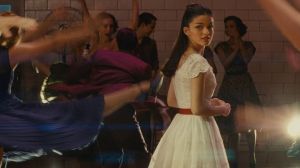
 Spielberg proves an absolute natural at helming a big movie musical. Nothing against Robert Wise, the 1961 director who helmed plenty of influential Hollywood titles like The Sound of Music, The Day the Earth Stood Still, I Want to Live, and Star Trek: The Motion Picture. He was also the editor on Citizen Kane. The man clearly knew how to tell a big screen story across multiple genres. It’s not a shame to say his visual prowess doesn’t quite stack up to a Steven Spielberg, who just happens to be one of the most popular and versatile filmmakers of all time. Spielberg’s camera is much more active than the original movie, and he’s consistently bringing us into the scene, having characters duck in and out of frame, and circling around, always interacting with the world. It makes the movie much more visually immersive and exciting, enlivening an already lively number like the dance hall rivalry between the Jets and the Sharks where each side crowds the edges. The movie operates on a high level of visual pleasure because Spielberg knows exactly how to play to the strengths of the musical genre. Spielberg incorporates the location in each setting and has fun visual flourishes, clearly having given great thought how to visualize every line in each song. The opening of “America” involves women placing clothes on a line, and as the clothes move, it reveals our newest chorus member giving voice to the continuing song. The way the camera moves through the neighborhood to note the encroachment of gentrification. The way he frames the faces of our young lovers. The way he uses shadows as menace. The way he makes every space feel like it’s perfectly utilized for the best shots and edits. Now that Spielberg has proven so adept at handling musicals, somebody please give this man another for our collective benefit.
The top actors are not the leads but two very mesmerizing supporting players. Ariana DeBose, previously seen as one of the ensemble members in 2020’s Hamilton, is pure dynamite as Anita. She explodes with verve and personality and attitude and vibrant life, and the camera loves every second she’s on screen. She gets the bigger emotional arc than Maria. She gets the jubilant song, the aforementioned “America,” and gets her crushing moments of heartache as well. DeBose is phenomenal, and likewise so is Mike Faist (Panic) as the leader of the Jets. Like Anita, this character is brimming with anger and attitude and the movie does a much better job than the 1961 film of presenting him with a point of view that can develop some empathy. Faist is lanky yet so smooth in his movements, and he gets more dancing than just about anyone. He’s balletic in his dancing while still upholding his spiky attitude. Both of these actors are so self-assured in their roles, so vulnerable behind the surface, and so accomplished with their dancing and singing that one wishes the movie would devote more time to both of them.
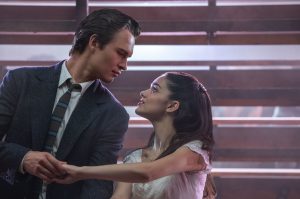 As for our leads, Ziegler and Elgort (Baby Driver) are good but unexceptional as our naifs in love. Ziegler can sing beautifully and definitely has a natural innocence to her appearance. Her eyes are so large and glassy that she reminded me of an animated character at points. Elgort is solid in his singing but I can’t help but feel that he’s been lapped by his co-stars. There is a comic relief musical number, “Gee Officer Krupke,” where the various Jets have fun imitating the nay-saying adults who hastily cast judgement upon these juvenile delinquents. It’s a silly number about guys goofing around and could easily be the first on the chopping block to be cut for time. However, over the course of this fun diversion, I realized that person-to-person in the Jets crew, the same guys that just appeared as background players to fill out a scene previously, how good every person is, and how much more time I wish they had gotten than Elgort. Part of this is that the romance aspect of West Side Story has always been the weakest part of the show. It’s based upon Romeo and Juliet and tied to those tragic plot events, but when both Maria and Tony are ready to run away and marry one another after a single night, and especially after the fateful rumble where Maria is so astonishingly quick to forgiveness (and horniess), the romance plays so incredulously. As a result, the two lovers are essential to the story but also the most boring characters too.
I think the adaptation by Spielberg screenwriting stalwart Tony Kushner (Munich, Lincoln) has smartly updated plenty of political elements, amplifying racial tensions but looking at it over a broader scope. Giving Tony a mentor figure in an older woman who runs her drug store shop, played by Moreno, is a great choice, especially as she represents a medium between the two sides as she is Puerto Rican but her deceased husband was white. It’s smart to have someone from the community and so wise to try and impart lessons to Tony, especially as he wants to change for the better. One update from Kushner didn’t quite jibe for me and felt like token-ism. The youngest member of the Jets, a prepubescent pipsqueak, has been replaced with a trans man fighting for membership. I understand the basic character arc is the same, the outsider trying to be accepted by the group, but the consideration of trans acceptance in the 1960s wasn’t exactly enlightening. The other Jets tease and question the gender identity of the trans man, but this perspective never feels well integrated into the play’s prejudicial world. I suppose more could have been done like having the Sharks harass this character, belittling them over their identity, and then the Jets feeling like one of their own had been attacked and in that they would finally be accepted. Except this inclusion would be around the degradation and potential assault of a trans person, which itself is not the best reason to include a trans character if you’re just setting them up for trauma. I don’t know. This character could have easily been removed if this was all there was.
 One other aspect I found cumbersome was the creative decision to not include English subtitles during the Spanish-speaking portions of the movie. I cannot understand the artistic rationale for this at all. Sure, Spanish-speaking viewers will be fine, and I could piece enough together with context clues and my rudimentary understanding of like 75 Spanish words, but what are we accomplishing here? It just feels alienating, and it inadvertently likens the viewing experience to what the Jets are going through, feeling like they cannot fully understand their new neighbors. I doubt that Spielberg and company wanted to reinforce the perspective of xenophobia, but purposely removing a key portion of your movie from the majority audience in the U.S. seems so strange to me. If it was just scant conversations or moments, I’d excuse it, but the untitled Spanish accounts for like ten percent of the whole movie. Imagine watching any foreign movie without the subtitles on screen. How much meaning are you able to devise on your own?
West Side Story 2021 is a good time for fans of musical theater and a testament that just because something is old and beloved doesn’t mean it can’t even be improved upon with the right people and goals. Both movies are about the same length, 150 minutes, which seems the de facto standard for movies this holiday season, and you’d have a good time with either. I think the updated version adds more visual creativity, impressive choreography, and remodeled racial and political considerations to make it land better for modern audiences. It might not have been needed but I’m glad all the same we now have two West Side Story movie musicals to cheerfully tap along to.
Nate’s Grade: B+
Share this:

Spider-Man: No Way Home (2021)
 This is going to be a difficult review to write. It’s the third Spider-Man movie in the Tom Holland era, though his sixth Marvel Cinematic Universe (MCU) appearance as the character, that much can be said. The MCU has been teasing a universe of parallel universes for a while now, even famously in 2019’s Far From Home, the previous Spider-Man film, and which No Way Home opens seconds later to deal with its immediate aftermath. The scuttlebutt with this new Spider-Man movie is that it is the most Spider-Man in all senses, bringing past iterations from the original Tobey Maguire run (2002-2007) and the maligned Andrew Garfield reboot (2012-2014). We know villains from each non-MCU Spider-Man film are making special appearances, and there are expectations for plenty more special appearances, so by that notion, writing a film review about a movie built upon surprise inclusions and secret revelations can be daunting to even be readable without giving too much away. I’ll do my best, dear reader. Spider-Man: No Way Home is not the best Spider-Man movie, in the MCU or prior, but it’s a rollicking adventure that will play like catnip for fans of the series, all iterations, and has some of the strongest moments of any web-slinging blockbuster.
In the wake of Mysterio framing Spider-Man (Holland) and revealing Peter Parker’s real identity, life has not been kind to your friendly neighborhood Spidey. The public has turned on him and even his best friends are suffering the consequences of their personal relationship. It’s enough that Peter seeks out his old pal, the wizard Doctor Strange (Benedict Cumberbatch), to cast a spell to erase the world’s memory of who Spider-Man really is. The magic spell, naturally, goes wrong, and villains of Spider-Man from other universes begin to appear. These larger-than-life characters are dangerous but also confused; this isn’t their universe, and this isn’t their Peter Parker. Doctor Strange is happy to send them all back to their primary universes, to correct the loose ends of the spell, but Peter doesn’t want to send them all to their fated deaths. He wonders if maybe they can be cured or reformed and if it’s too late to still do the right thing.
 First things first, you need to know that this movie is going to play much, much better if you are familiar with, and especially if you’re a fan of, the previous Spider-Man movies. No Way Home almost feels like it was written by a fan who has been nurturing a desire to do right by all past Spider-Man films. This feels like someone who had assembled a list of unresolved issues from different Spider-Man movies for over twenty years and said, “Hey, could I write these characters another ending that can redeem them and provide better closure in a way that is meaningful?” Because of that, each new character that comes through has a definite jolt of fan excitement like an all-star reunion, especially for characters you never thought you would see again. Certainly, some characters have more meaning than others, but I was pleasantly surprised how well integrated and written so many of the villains come across. Returning screenwriters Erik Sommers and Chris McKenna have ret-conned and redeemed the various Spider-Man missteps of old and have given characters more attention and fitting resolution, which makes this a surprisingly emotionally deep Spider-Man in ways you weren’t expecting. There are character reunions and resolutions that I didn’t know I needed, and I was smiling and even battling back tears of my own at various points. If you’re a fan of the recent Holland run, then the movie will still play well, but if you’ve been with Spider-Man from his cinematic beginning (if you really want to feel old, the original Spider-Man teaser involved the World Trade Center) then this movie will feel like a nostalgic blanket to warm you all over.
I think it’s safe to discuss some of the villains that have been prominent in the advertisement and later trailers, but if you wish to skip any character details, then skip to the next paragraph. It shouldn’t be much of a surprise that the two biggest villains are the ones with the biggest screen time and most allowance at redemption. Willem Dafoe as Norman Osborne (Green Goblin) and Alfred Molina as Doctor Octavius (Doc Ock) are treasures. It’s so good to see them again in these roles and each actor is just as good as you recall from their time 15-plus years ago. I was worried that bringing Doc Ock back could spoil the redemptive turn he has at the end of 2004’s Spider-Man 2, sacrificing himself to save the day from his own dangerous experiment. Little did I know that the entire movie was going to seek redemptive arcs for a veritable Sinister Six-worth of Spider-Man villains. It becomes the backbone of the movie, and I was skeptical at first but the movie found ways to win me over with just about every character’s inclusion. Norman and Octavius are similar in that they are battling other sinister personas in their heads, and when the real versions of each man break through, it’s often in heartbreaking moments of existential confusion and sadness. This is a movie that has time to fit in Spider-Man memes as well as question the moral culpability. It’s fascinating that a huge Marvel movie is so concerned with providing glimpses of humanity and compassion to bad guys from movies that the general public didn’t even generally like.
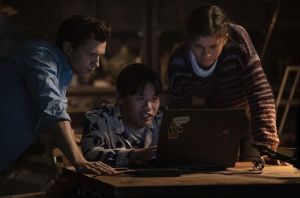 This is the best acting of Holland’s Spider-Man run. He really gets put through the wringer about the consequences of trying to make the moral choice, both good and bad. His most emotional moments got me each time because of the investment in his character growth over six movies as well as the added investment in the supporting characters too. This is the most integrated and important both Ned (Jacob Batalon) and MJ (Zendaya) have been to the plot, and they have a platonic hug at the end that sent me into a tailspin of emotions for what it meant. The humor and natural camaraderie of the actors is still there, a hallmark of the MCU Spider-Man series. I laughed plenty, especially with certain characters deconstructing their parallels and connections (“Gotta watch where you fall,” a villainous understatement). However, this is the most emotional Spider-Man likely ever, and the actors all perform ably. I want to single out Marissa Tomei as Aunt May because she’s been undervalued in these movies until now. This is the biggest role Aunt May has played and she serves as the voice of morality to push Peter to do what he knows is right even in the face of outlandish adversity and personal cost.
No Way Home works better thematically than as a well-constructed plot. The solutions to the villain redemption are laughably convenient, and while it’s not as expressly magic as Doctor Strange’s spells, it’s pretty much the equivalent of technological magic. That’s fine, because it’s less the struggle of invention and more the choice that matters for each character. The mechanics of the ending also feel overly convenient and tidy (you could have just done this the whole time?). When Doctor Strange is chastising characters for hasty decision-making, it’s the movie calling attention to its own cheats. The movie splits so much of its time across multiple villains and drafting off of your old feelings. There are other narrative shortcuts taken and abbreviated, especially Strange’s involvement. He’s left out of much of the movie for the same reason Captain Marvel was left out of much of the final battle with Thanos in 2019’s Avengers: Endgame: he’s too powerful to have on the board. I’m not saying the screenwriters made the wrong choices on what to emphasize. The emotional beats of this movie hit strongly, and if they have to rely on a few cheats and nit-picky hand-waves to get there, then so be it.
 From an action standpoint, I think this might rank last for me in the series. Returning director John Watts has never wowed me as an action director. He’s not bad at staging the big moments but he seems more present in zippy tone than in style on a big stage. The added wow factor of seeing the various characters assembled on screen will compensate for much of the action feeling contained to dank sound stages. I think this was done as a cautionary measure to keep the secrets from being leaked, but it also shortchanges the action possibility. There’s nothing in this movie, from a pure action standpoint, that rivals the Venice or London sequences in Far From Home. The movie utilizes portals, and it got my hopes up for clever action inventions, but it serves as more plot device than action complication. There have been some artistic sacrifices, narratively and visually, to accommodate the Spider-Man Movie All-Stars approach, and while I think the filmmakers have emphasized the correct parts, it does still feel like there are some nagging shortcomings to an overall experience that plays exuberantly.
Finding a comfortable medium between fan service and creative constriction, Spider-Man: No Way Home is not the best Spider-Man movie but at the same time it just might be. It serves as a salve to the rest of the franchise, five iterations across two different runs, and because of that level of attention and compassion, the past movies get a little bit better, with more added resolution, more character moments, and second chances to correct miscues and blunders. Who among us wouldn’t want another opportunity to correct our mistakes? While ostensibly setting up the troubles ahead for the MCU (the trailer for 2022’s Doctor Strange: The Madness of the Multiverse is the final post-credit scene), the movie feels entirely backward-looking, rewarding fans of the character and resolving to do better where other films had gone awry. Maybe (Disney)Fox could do something like this for the bad X-Men movies? I don’t know if the same punitive charges of being slavishly nostalgic will hit No Way Home like they’ve done for the new Ghostbusters and Star Wars. It’s definitely still accessible for newer fans but plays best to the people with the longest investment, but isn’t that every continuing movie series? No Way Home is a rewarding cinematic experience of many highs and fun surprises and cameos as well as a humane redemption for the sins of Spider-Man’s past. It’s not the best superhero movie but it might be the most joyous one yet.
Nate’s Grade: B+
Share this:

C’mon C’mon (2021)

Writer/director Mike Mills’ latest is a gentle and meandering movie, which is coming to be his indie specialty for me. C’mon C’mon features Joaquin Phoenix (in his schlubby every-man phase) as an audio journalist collecting interviews. He suddenly finds himself watching his young nephew (Woody Norman) after his sister (Gabby Hoffman) has to tend to her husband’s deteriorating mental illness. What follows is a lot of small moments that play quite naturalistic and in wry, nice dialogue exchanges. It’s also kind of sweetly boring. It’s a collection of moments of Phoenix struggling with how to relate to children, what we pass down to the next generation as legacy, and how to try and be a responsible parent and role model for an impressionable youth. It’s all messages and themes we’ve seen in dozens of other heartwarming parenting movies. The draw is the relationship between Phoenix and Norman, who proves to be a wonderfully natural performer, enough so that the movie often feels more observed than written. Their relationship is sweet but I felt like the movie was too often circling the same points and character differences for far too long. Perhaps others will get more out of this, find more to personally relate to, especially those finding themselves caring for children in unexpected circumstances. C’mon C’mon is reflective and compassionate and also kind of a snoozer.
Nate’s Grade: B-


 nathanzoebl
You must be logged in to post a comment.