Category Archives: 2020 Movies
Mulan (2020)
 The new Mulan looked like something I’ve been begging for in this surging era of live-action Disney remakes, namely something different. I don’t need inferior live-action versions to shorter animated classics, and as Disney enters into a more modern trove of remakes, the courage to adapt becomes noticeably less. There’s a reason the 2019 Lion King was simply a sludgier, superfluous version that was beat-for-beat the same, and it’s called $1.5 billion dollars worldwide. People want their nostalgia as they remember it, thank you very much. The Mulan remake looked to be taking a different route; it eliminated the songs, the comic relief sidekicks, and overt supernatural characters. It was going to be more serious, more mature, and more action-packed, and I was all for it. The release was pushed back several months due to COVID and finally lands on Disney+ but at an extra cost. I would advise fans to wait. This new Mulan 2020 isn’t worth your time and it’s certainly not worth an additional $30 to be disappointed by.
Mulan (Yifei Liu) is a young maiden in old China who has trouble fitting into how society says a woman should behave. The Emperor (Jet Li) orders all families to supply one male into the royal army to combat Bori Khan (Jason Scott Lee) and his powerful witch, Xianniang (Gong Li). Mulan takes her family armor and poses as a man to take the place of her ailing father. She wants to serve but she’s also hungry for adventure, and over the course of her training, she will come to fully understand her real power.
 I knew within minutes that this movie was in trouble. In a flashback, we watch young Mulan chasing after a chicken, not listening to her father, causing havoc and consternation from neighbors, but then she effortlessly climbs to the roof of her neighborhood and then, as she falls off, is effortlessly able to recapture her balance and land perfectly like she was Spider-Man. From there, the first act tells us that Mulan is not just a super-powered being of high chi (think midi-chlorians and The Force) but also potentially the Chosen One (like Anakin Skywalker) and she must hide her real power to… not bring disgrace to her family? I’m sorry but this makes little sense. I understand the oppressive cultural expectations for women at this time and how women’s real value, as judged by their society, was through marriage and child-rearing. However, we’re now in a world of magic where living super-powered beings walk among us (mutants in X-Men), but rather than valuing this, it’s shunned because she’s a girl? That seems even more preposterous to me. The screenplay followed the Captain Marvel feminist theme and it’s about a woman finally coming into her own power, shunning the restraints, and embracing her full potential against the wishes of frightened men. If after reading all of this that sounds like a good start for a movie, let alone a live-action remake of Mulan, then have at it, dear reader. For me, this began as a thematic and tonal mess that didn’t get better. By making Mulan a super-powered being it eliminates her relatability and the stakes of the movie. She’s no longer an ordinary girl who struggles to do her best. Now she’s essentially a god who just has to turn on her powers and subdue easily outmatched opponents. That’s a significant loss and mistake.
If you were going to be a martial arts epic where characters have super powers, then be that movie and give me epic showdowns between epic warriors. Give me a heavy dose of magic realism and eye-popping imagery. Chinese cinema has plenty of examples of these kinds of movies in recent years. One needs to only start cycling through the filmography of Zhang Yimou for spellbinding supernatural martial arts epics like Hero and House of Flying Daggers and 2018’s Shadow. If you’re going to be a heightened world of extraordinary combat, then build your movie around that tonal decision and start from there. In Mulan 2020, people exist with amazing abilities but nobody treats this with the recognition it deserves. There appears to be a prevalent form of sexism as powerful men are seen as impressive but powerful women are seen as frightening and dangerous, often derided as witches. There was room for exploration of Gong Li’s (2046, Memoirs of a Geisha) character and the parallels with Mulan, both women feared for their powers and apparent threat to a hierarchy that wants to exploit them but not include them. My girlfriend was irate throughout the viewing and pointed specifically at the witch character and declared, “They’re going to give her a lame redemption story where she sacrifices herself at the end to save Mulan, and I will hate it.” And boy oh boy did she hate it.
 Alas, Mulan 2020 cannot sustain itself as a supernatural martial arts epic. As an action spectacle, every moment is shortchanged, which is not good when you have a whopping $200 million budget. The action consists of a handful of characters, at most, and only a short display of activity. There are no strong action set pieces and well-developed sequences that keep your excitement pumping. There is some acceptable fight choreography here and there but little to tickle the imagination or approach the poetry of something like Crouching Tiger, Hidden Dragon. I don’t know if director Niki Caro (Whale Rider, McFarland, USA) feels confident enough as an action director of big visual spectacle, and that uncertainty leaks throughout the finished film. Take for instance camera movements meant to be stylish but instead becomes perplexing. As our big bad villain and his crew ride toward the outer walls of a village, they leap from their horses and ascend the walls, and the camera shifts 90 degrees to follow the movement smoothly. That’s a good stylistic choice. Then mere seconds later, as they reach the top, the camera will abruptly shift again 90 degrees, then back again, but the characters haven’t shifted their stances or perspectives. Caro has taken a stylistic flourish that had meaning and seems to be hitting it again and again, but without the earlier context, it becomes confusing, arbitrary, and annoying, and it happens multiple times. Because the movie doesn’t fully embrace being a martial arts spectacle, when it does employ super human tricks, it runs the risk of being goofy. Mulan has several moments where she kicks flying arrows into her foes as if she was a soccer player setting up a wicked trick shot. I welcomed a martial arts epic version of Mulan but the filmmakers were too timid to commit.
There are several moments that left me scratching my head in the adaptation process. Take for instance Mulan deciding to take her father’s place. In the animated film, it’s a big moment and we watch her slice her hair with her ancestral sword, put on her father’s armor, and it’s treated like the big character-defining moment that the story demands. It’s like watching a superhero transform and suit up for battle. In Mulan 2020, this moment is denied to us and we skip to her turning around already in armor and riding off. Why? Why wouldn’t you want to savor and dwell in a moment of great drama and a turning point for the character? Likewise, late in the movie, once Mulan accepts her destiny and not to compromise her powers, she strips her father’s armor piece by piece and flings it off herself while riding into battle. I understand the symbolism of her stripping away the uniform of entrenched masculinity but two things: wasn’t this her family’s armor that meant something of value, and isn’t wearing armor a good defense in a battle? What’s the point of removing the supernatural ancestral elements from the animated film to simply give Mulan a flying phoenix that mainly serves as a cursor to point her in the right direction?
Let me open up one head-scratcher and how it could have been resolved. Mulan has a younger sister but her inclusion is practically meaningless. Mulan’s parents worry about her capability of being docile and husband-material, but they have the younger sister who will serve their needs. The movie doesn’t present the younger sister’s perspective. She’s just a bonus daughter. It’s a confounding creative decision but I think, with a little more shaping, it would have justified itself. This sister could have been resentful of her big sister, for being selfish and rejecting her eldest responsibilities that would protect their family. These duties now fall onto her with the added pressure of being the only daughter who has a chance of attaining a good marriage. This could and should cause friction between the sisters, a divide that can be healed over the course of the movie. Dearly missing from Mulan 2020 is the ability of its titular heroine to share herself. She doesn’t have her magic companions coaching her, so she has no audience to confide in. As a result, Mulan feels so impassive and inscrutable. My solution: she writes a series of letters to her sister to explain her actions as well as her day-to-day fears and hopes, and in doing so it opens up the Mulan character as well as provides an outlet where her sister can learn and relate to her. That would have worked, and it would have justified the younger sister in the narrative as well as provide Mulan herself with an ongoing opportunity for reflection, expression, and confession.
 Sadly, I also had serious reservations about lead actress Yifei Liu (The Assassins, Forbidden Kingdom) from her first moment onscreen as the adult Mulan. Her line readings were overwhelmingly flat. This may well be a byproduct of her speaking English as opposed to Chinese, and on that front, why couldn’t this movie have been entirely Chinese and subtitled? I understand Disney would view a foreign language version as less profitable but if you’re going for a more serious, more grown-up version of Mulan set in ancient China, how about trusting Americans to read? Regardless, Liu certainly has the right look to anchor a movie but her acting is too stilted. There are many actors who have great martial arts skills (Donnie Yen, Jet Li, Jason Scott Lee) that aren’t called upon. Why hire actors with great fighting capability and then give them precious little to show off? My favorite performer in the movie was Mulan’s father (Tzi Ma, The Farewell).
After watching Mulan 2020, I then re-watched the 1998 animated original, and my opinion of the live-action remake sank even lower. The animated film has it beat in every measure. The mixture of drama and comedy is deft, the emotional core of the character is fierce, and the supporting characters have distinct and discernible personalities, and the songs aren’t too shabby either. The villain is more menacing and has those very necessary moments to establish their villainy. The bad guys in Mulan 2020 have no memorable moments that make you go, “Oh, that’s a baddie.” Plus, the hand-drawn animation is beautiful and allows far more emotional expression for the characters, making it even more transporting but also engaging. If you’re a fan of the original, I cannot see how you will enjoy Mulan 2020, and if you paid $30 for that opportunity, I imagine you’ll be even more incensed. If it was going to be different, the new Mulan needed to fully embrace those differences and develop its new big screen story to be best suited as a martial arts epic for older viewers. If it was going to make Mulan a superhero, it needed to embrace this decision and heighten the world, mixing in fantasy foundations. The moments needed to matter and be a reflection of our heroine’s emotional journey. Mulan 2020 is a frustrating disappointment and another reminder for myself that live-action Disney remakes will rarely, if ever, even come close to recreating the charm and magic of their predecessors.
Nate’s Grade: C
Share this:

I’m Thinking of Ending Things (2020)
 I expect strange from a Charlie Kaufman movie; that goes without saying. I also expect some high concept turned inward and, most importantly, a humane if bewildered anchor. His other movies have dealt with similar themes of depression (Anomalisa), relationship entropy (Eternal Sunshine), identity (Being John Malkovich), and regret from afar (Synecdoche, New York). However, no matter the head-spinning elements, the best Kaufman movies have always been the ones that embrace a human, if flawed, experience with sincerity rather than ironic detachment. There’s a reason that Eternal Sunshine is a masterpiece and that nobody seems to recall 2002’s Human Nature (ironic title for this reference). 2015’s Anomalisa was all about one man trying to break free from the fog of his mind, finding a woman as savior, and then slowly succumbing to the same trap. Even with its wilder aspects, it was all about human connection and disconnection. By contrast, I’m Thinking of Ending Things is all about a puzzle, and once you latch onto its predictable conclusion, it doesn’t provide much else in the way of understanding. It’s more a “so, that’s it?” kind of film, an exercise in trippy moments intended to add up to a whole, except it didn’t add up for me. I held out hope, waiting until the very end to be surprised at some hidden genius that had escaped me, for everything to come together into a more powerful whole, like Synecdoche, New York. It didn’t materialize for me and I was left wondering why I spent two hours with these dull people.
A Young Woman (Jessie Buckley) is traveling with her boyfriend Jake (Jessie Plemons) to meet his parents for the first time. It’s snowy Oklahoma, barren, dreary, and not encouraging. In the opening line we hear our heroine divulge the title in narration, which we think means their relationship but might prove to have multiple interpretations. It only gets more awkward as she meets Jake’s parents (David Thewlis, Toni Collette) and weird things continue happening. The basement door is chained with what look like claw marks. People rapidly age. The snow keeps coming down and the Young Woman is eager to leave for home but she might not be able to ever get home.
 The title is apt because I was thinking of ending things myself after an hour of this movie. Kaufman’s latest is so purposely uncomfortable that it made me cringe throughout, and not in a good squirmy way that Yorgos Lanthimos (The Lobster) has perfected. Kaufman wants to dwell and drag out the discomfort, starting with the relationship between Young Woman and Jake. She’s already questioning whether or not she should be meeting his parents and their inbound conversations in the car are long and punctuated by Jake steering them into proverbial dead ends. He’s a dolt. You clearly already don’t feel a connection between them, and this is then extended into the family meet and dinner, which takes up the first hour of the movie. I’m Thinking of Ending Things tips its hand early about not trusting our senses and that we are in the realm of an unreliable narrator. Characters will suddenly shift placement in the blink of an eye, like we blacked out, and character names, professions, histories, and even ages will constantly alter. The Young Woman is a theoretical physicist, then a gerontologist, then her “meet cute” with Jake borrows liberally from a rom-com directed by Robert Zeemckis in this universe (my one good laugh). Jake’s parents will go from old to young and young to old without comment. All the surreal flourishes keep your attention, at least for the first half, as we await our characters to be affected by their reality, but this never really happens. Our heroine feels less like our protagonist (yes, I know there’s a reason for this) because her responses to the bizarre are like everyone else. The entire movie feels like a collection of incidents that could have taken any order, many of which could also have been left behind considering the portentous 135-minute running time.
There are a lot of weird moments and overall this movie will live on in my memory only for its moments. We have a lengthy choreographed dance with doubles for Jake and the Young Woman, an animated commercial for ice cream, an acceptance speech directly cribbed from A Beautiful Mind that then leads directly into a performance from Oklahoma!, an entire resuscitation of poetry and a film review by Pauline Kael, talking ghosts, and more. It’s a movie of moments because every item is meant to be a reflection of one purpose, but I didn’t feel like that artistic accumulation gave me better clarity. There’s solving the plot puzzle of what is happening, the mixture of the surreal with the everyday, but its insight is limited and redundant. The film’s conclusion wants to reach for tragedy but it doesn’t put in the work to feel tragic. It’s bleak and lonely but I doubt that the characters will resonate any more than, say, an ordinary episode of The Twilight Zone. Everything is a means to an ends to the mysterious revelation, which also means every moment has the nagging feeling of being arbitrary and replaceable. The second half of this movie, once they leave the parents’ home, is a long slog that tested my endurance.
 Buckley (HBO’s Chernobyl) makes for a perfectly matched, disaffected, confused, and plucky protagonist for a Kaufman vehicle. She has a winsome matter of a person trying their best to cover over differences and awkwardness without the need to dominate attention. Her performance is one of sidelong glances and crooked smiles, enough to impart a wariness as she descends on this journey. Buckley has a natural quality to her, so when her character stammers, stumbling over her words and explanations, you feel her vulnerability on display. After Wild Rose and now this, I think big things are ahead for Buckley. The other actors do credible work with their more specifically daft and heightened roles, mostly in low-key deadpan with the exception of Collette (Hereditary), who is uncontrollably sharing and crying. It’s a performance that goes big as a means of creating alarm and discomfort and she succeeds in doing so.
I know there will be people that enjoy I’m Thinking of Ending Things and its surreal, sliding landscape of strange ideas and images. Kaufman is a creative mind like few others in the industry and I hope this is the start of an ongoing relationship with Netflix that affords more of his stories to make their way to our homes. This is only the second movie he’s written to be produced in the last decade, and that’s far too few Kaufman movies to my liking. At the same time, I’m a Kaufman fan and this one left me mystified, alienated, and simply bored. I imagine a second viewing would provide me more help finding parallels and thematic connections, but honestly, I don’t really want to watch this movie again. I recall 2017’s mother!, an unfairly derided movie that was also oft-putting and built around decoding its unsubtle allegory. That movie clicked for me once I attuned myself to its central conceit, and it kept surprising me and horrifying me. It didn’t bore me, and even its indulgences felt like they had purpose and vision. I guess I just don’t personally get that same feeling from I’m Thinking of Ending Things. It’s a movie that left me out cold.
Nate’s Grade: C
Share this:

Bill and Ted Face the Music (2020)
 Bill and Ted might be one of the most inexplicable franchises in Hollywood. It began as a riff on 80s high school movies by writers Ed Solomon and Chris Matheson, taking the California surfer/stoner goofball supporting character staple and saying, “What if people deeply uninformed about history traveled through time?” 1989’s Bill and Ted’s Excellent Adventure movie was a comic delight, and Bill and Ted became unexpected icons, action figures, and even a Saturday morning cartoon. The 1991 sequel could have easily repackaged another escapade through time but instead it went a completely different, darker, and weirder direction. Bill and Ted’s Bogus Journey followed its characters through death, hell, heaven, and back again. It’s been almost thirty years since Bill and Ted left the pop-culture spotlight behind. What more challenges could you present? Bill and Ted Face the Music is a sweet sequel that explores the, dare I even utter the word, legacy of these cheery doofuses, and while it’s not at the same level as its clever predecessors, I was more than happy to take one last trip with these gents. Most excellent.
It’s been decades since Bill S. Preston Esquire (Alex Winter) and Ted Theodore Logan (Keanu Reeves) hit the big time with their band Wyld Stallyns but life hasn’t quite worked out how they imagined. They had been told their music would bring peace to the world, but they’re in their 50s now, fame now behind them, and they have yet to live up to those heavy expectations. Bill and Ted are struggling to still write that perfect, magical song, the one they were destined for, but both men have growing doubts over whether or not they can make it happen. Their adult daughters (Samara Weaving, Brigette Lundy-Paine) want to help and take the ole phone booth time machine for a spin, collecting famous great musicians throughout time to help collaborate with their dear old dude dads before all of reality unravels if that fabled song cannot be written.
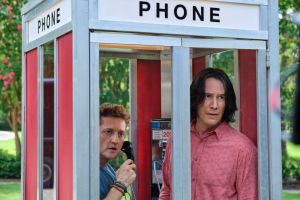 Just as Bogus Journey rejected being a lazy reprise, Face the Music inclines to chart its own path as a sequel rather than replicating the hits of old while also staying reverent to why people loved the originals. This is more a time travel movie, and the daughters even go on their own Excellent Adventure rounding up famous musicians through history as a B-story, but the main story is squarely on Bill and Ted facing off against themselves and their collective insecurities. When challenged, the Bill and Ted of present-day figure that they can skip ahead to the future and simply take the world-saving song from their future selves, who obviously would have written it by then. It’s a move the franchise has used before, relying upon future actions to take care of present problems, so it’s fitting for the characters but this is the first film to explore this as a negative. Bill and Ted are desperate and looking for an easy solution and skipping to the end will do that. However, their future selves are pathetic has-beens who have yet to write the ultimate song, and they resent their past selves for setting them up for failure. There are many face-to-face meetings between present and further future versions of Bill and Ted and their interactions become an adversarial tit-for-tat. I looked forward to each new pit stop with future Bill and Ted to see how their lives were and if they were still trying to set up the past Bill and Ted for a long-simmering retribution. The fact that this storyline has a genuinely sweet and even poignant reconciliation is a joyous addition.
Thankfully, Bill and Ted are still the same lovable, affable, and relentlessly positive dudes we’ve known and loved since the 1980s. I appreciate over three movies how much these guys legitimately appreciate and love each other. That’s one reason why it’s so enjoyable to hang out with these guys regardless of what their adventures entail. It would be easy for Bill and Ted to have become jaded in their old age, cynical from not fulfilling their hallowed destiny. They could have some animosity between the two of them that need to be buried in order to work together, rekindle that old magic, and save the world. But the screenwriters know who these characters are. Even when things aren’t going their way, they stay who they are, hopeful and supportive. I also appreciated how this translates to their relationships with their daughters, who clearly love their fathers and want to follow in their footsteps. They even refer to them as “dads” rather than “dad.” The conclusion rests on the daughters and fathers working together, and the positivity that radiates through their relationships allows the ending to reach a surprisingly emotional high for a family of good-natured goofballs.
 Face the Music is a bit overstuffed with subplots and characters, and I do wish there could have been some careful pruning to allow more room for the daughters. Bill and Ted’s wives, the princesses from Medieval England, have been recast again (Erinn Hayes, Jayma Mayes), and once again they are barely featured. There is an early conflict between the wives and husbands, and the prospect of losing them motivates Bill and Ted to save their marriages, but this conflict is entirely sidelined after the “end of the world” dilemma overtakes the plot. The wives are in their own subplot and also traveling through time or to parallel dimensions, though we never spend any time with them. There must be entirely cut scenes with them. Their perspectives could have been a whole other movie but they’re only an afterthought, as these characters have always been. Kristen Schaal (My Spy) appears as the daughter to Rufus (the late George Carlin), and we’re introduced to her mother, a deadly robot (Barry’s Anthony Carrigan) set to kill Bill and Ted for questionable reasons, the return of the Grim Reaper (William Sadler), plus all the assembled historical figures with the daughters. Also, just about every supporting family character makes an appearance too. It feels like too much, like the movie is constantly racing forward, juggling people and stories, when we didn’t need it all.
The daughters are more reflections of their fathers than independent characters. Each character, Thea and Billie, is a younger impression of their father and little else. They like the same music their dads like. They have the same goals their dads have. They have the same personalities their dads have. Both actresses are fun and Brigette Lundy-Paine (Netflix’s Atypical) does a wicked impression of a young Reeves, including adopting his sway-heavy gait, but I wish they had more to chew over. It seems cliché to make the central conflict of a third Bill and Ted movie an inter-generational one, where the fathers cannot relate to their daughters, and the four of them go on a fantastic journey that helps to bridge their differences and allow each side to better understand and relate. It might sound cliché but it could also have been compelling as well, and it would have elevated the daughters and their relationship into a primal position, rather than using the relationship with the near non-existent wives as the throwaway motivation for their call to action.
 It’s been quite a while since Winter and Reeves have played these parts, and while they both have clear affection for their characters, it’s not quite a seamless relaunch. Reeves (John Wick) has been playing hardass action heroes for so long that it feels like he can’t easily recapture goofball energy. His line deliveries can feel far more stilted and low-energy. Winter hasn’t acted onscreen since 2013 and has transitioned into being a documentary director. He delivers a more spirited performance and hits the comedy notes more effortlessly than Reeves, but the time apart from acting shows. Watching both men imitate their younger selves and going through the same shtick can have a different impact on the viewer. Hearing the same catch-phrases but with deeper, gravely voices isn’t quite the same thing and serves as a warning of the enterprise living in its own shadow. My pal Ben Bailey found an old Bill and Ted to be rather sad. I think that’s part of what Face the Music leans into (including its knowing title). They haven’t succeeded like they wanted. That weighs on them. Neither character is about to contemplate suicide but there is a sense of disappointment about how their careers turned out that they’re barely staying ahead of, which adds a melancholy dimension to these characters still falling back on what they know because it’s all that they know how to do. It’s not overpowering but it’s an acknowledgement of the loss of time.
Bill and Ted Face the Music is a charming, likable, and sweet-natured sequel that wraps up the franchise well, reminding fans why the Bill and Ted characters were so enjoyable from the start. In our COVID times, I’m finding it easier to shrug away some of the movie’s flaws, like its low-budget being noticeable, chintzy CGI special effects, and too many supporting characters on top of not integrating the daughters into the main action in a more significant fashion. It’s 90 minutes of laid back, light-hearted fun with actors and filmmakers who clearly love this franchise, and the screenwriters could have merely coasted and did no such thing. We didn’t need a third Bill and Ted big screen adventure but I’m happy that it still feels, even thirty years later, remarkably like Bill and Ted.
Nate’s Grade: B
Share this:

The One and Only Ivan (2020)
 Disney’s latest talking animal movie is based on a real story. Not the talking animals part, more a gorilla (voiced by Sam Rockwell) who lived in a strip mall as a circus performer and then became a painter and the notoriety of his art built a movement to free him. The One and Only Ivan is a good-natured family film with affirming lessons and a conservationist advocacy. Kids may laugh at some of the silly animals, or they might cry as the maternal elephant (Angelina Jolie) entrusts onto Ivan the promise to break the newest baby elephant free of bondage. Ivan was raised by Mack (Bryan Cranston) who runs the strip mall circus, though times are tough and he may have lost sight of his priorities with his animals. Enter cute kid, cute baby elephant, cute and scrappy dog, and Ivan’s passion for the arts. The one element that makes this movie different, Ivan’s ability to paint his emotions and reflections, is barely included and that’s a real shame. Ivan becomes like the spider from Charlotte’s Web and uses his position to advocate for another animal, using the subsequent attention to spare this small creature. He paints once and the movie zips to its resolution. The thrust of the story is Ivan addressing his own personal tragedy and letting others in, risking his own safety and ego to protect those vulnerable. The CGI special effects are suitable if unremarkable, landing in that middle zone of meeting expectations of semi-reality but not exceeding them. I would have preferred a documentary going into the actual events of the real Ivan, getting interviews from the people who were there and mattered, their own insights and experiences, and really dwelling more on what the idea of artistic expression means for an ape and what it might mean concerning our connections to these creatures. I think there’s a compelling, enlightening, and heartfelt documentary to be had with the subject matter. The live-action talking-animal movie, however, is just more of the same inoffensive family film treacle and clearly not the one and only.
Nate’s Grade: C+
Share this:

Ava (2020)
 The movie Ava was never meant to have this title. The spy thriller was beset with trouble when the original director, Mathew Newton, dropped off the project after domestic abuse accusations resurfaced. Jessica Chastain, serving as star and as producer, reached out to her Help director Tate Taylor to come aboard and helm the project. Even with that upheaval, the movie went through production under the title of Eve, the name of Chastain’s character. Every person refers to her by this name throughout the movie, and it wasn’t until after the film was complete that some studio executive said, “What if her name was Ava instead?” The filmmakers then had to re-record every line of dialogue referencing her name to replace with this new identity. I cannot fathom a reason for doing so unless some exec really had a thing for that name or it was a concerted move to further distance themselves from Newton, who also wrote the screenplay. Just like that, Eve becomes Ava, and suddenly it’s a whole new creative project. Too bad they didn’t go further because whatever you call it, Ava is a fairly lackluster genre exercise for all involved.
Ava (Chastain) is a former soldier who was discharged from the Army and battled an addiction to drugs and alcohol. She’s gotten better and found a job that suits her, namely killing people for hire. Her fatherly handler (John Malkovich) tells her the marks, she dispatches them, and then collects the payouts. She assumes the men on her kill list are specimens of evil but begins to have her doubts, enough so that Simon (Colin Farrell) sends agents to snuff Ava out.
 There’s very little presented in Ava you haven’t seen in any litany of other spy thrillers before except with this pedigree of cast. I kept questioning why all these actors had agreed to be part of this project. The characters aren’t exactly complex or original. The scenarios aren’t exactly intricate or subversive. The action isn’t exactly well choreographed or well shot. The movie isn’t even that long at 95 minutes or so. The screenplay by Newton is unremarkable in every way, no different than any direct-to-DVD genre entry. I could just as readily see, say, Kristanna Loken (BloodRayne) filling the role of Ava than I could an actress as accomplished and in-demand as Chastain. That nagging question of what made a generic spy thriller so appealing will never be answered, because Ava offers little to a viewer already steeped in genre thrillers. It’s more of the same, just with A-list talent voluntarily “slumming it” as underwritten archetypes.
By no means am I against genre movies as a whole. I love genre movies. They can be some of the most entertaining and exciting film experiences, and under the right guidance, they can be thoroughly compelling and rewarding and even enlightening. Plus they’re just fun. Matt Damon resurrected his career as Jason Bourne. If Ava was trying to do something along those lines, re-calibrate the spy movie as a jangly, nerve-wracking thriller grounded in realism, that would have been something. Or if the movie had embraced its genre tropes knowingly, with tongue firmly placed in cheek, it could have been an over-the-top hoot. Instead, Ava just presents the same tropes without any sense of self-awareness. Ava really feels like an imitation of one of the lesser Luc Besson (The Professional, La Femme Nikita) action thrillers, or maybe one of those Besson imitations of a Besson work (3 Days to Kill). It’s going through the motions of motions.
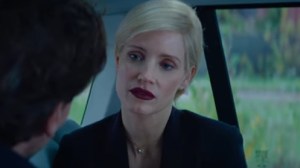 The domestic side of Ava’s life feels like a messy soap opera intruding onto a spy thriller, bordering into farce though without the awareness. Ava’s father died while she was out murdering others, and her sister Judy (Jess Wexler) hasn’t forgotten. Ava’s ex-fiancé, Michael (Common), is also now dating Judy. Michael is also struggling with his own gambling addiction and the debts he owes to local loan shark, Toni (Joan Chen), who has bad blood with Ava. Then there’s Ava’s mother, Bobbi (Geena Davis), who has gone in and out of the hospital for heart problems and wants her family to get along. As you might assess, for a 90-minute movie, there is way too much going on there to keep checking in with. Every time we gain more understanding of the people in Ava’s life, the more ridiculous her life seems to evolve, and remember she also is a recovering addict who is wavering over the possibility of relapse. That’s a lot of capital D drama but the screenplay lacks the follow-through to make it matter. It feels like Newton just keeps piling on the complications rather than developing and twisting them. There’s one genuinely strong moment when Bobbi has a sit-down with her daughter and warns her about the costs of being honest and expresses her content to luxuriate in the lie of Ava’s cover story of a career. As Ava contemplates having an affair with her ex, her sister’s boyfriend, you may start to forget that you’re watching a movie about a trained assassin.
Taylor (The Girl on the Train) shows just as much affinity for directing spy thrillers as directing horror with last year’s Ma. It’s not a good fit, folks. Taylor lacks the innate ability to stage action in a pleasing and exciting manner. The fight choreography is mundane and there is no scenario that develops and transforms with complications. The final confrontation is literally a limping slow-walk foot chase that will draw more unintended laughter than suspense, especially as it keeps going and going and I questioned the character walking speed. There is one standout moment and it’s a knock-out, drag-out fight between Ava and Simon that breaks just about every stick of furniture in a hotel room. Both are left bleeding and bruised and fatigued. It’s nothing exceptional in choreography but the sustained duration is what makes it stand apart. I’ll grant Taylor some leeway considering he was a late hire for a project already moving forward. However, with the results of Ava as a finished film, I wouldn’t advise hiring Taylor for any other action movies.
 Chastain (It Chapter 2) is of course a strong anchor. She taps into some of that ferocious power she had with 2012’s Zero Dark Thirty, and I would have loved to see her kick all sorts of ass in a spy thriller worthy of her talent. Even something like 2012’s Haywire, which was built to showcase the raw fighting skills of MMA-fighter-turned-actress, Gina Carano, or 2017’s Atomic Blonde, which was expanded upon due to the balletic precision and capability of Charlize Theron. We needed something more for Ava. Chastain kicks and punches and stalks the grounds with her cold badass stares, but she could be doing so much more. The soapier plot elements betray her. At one point, she’s crying, laughing, holding a bottle and contemplating putting a gun to her head. It’s just so much that, again, it points to farce but can’t quite tonally commit.
I’m trying to fathom the reason anyone should watch Ava. It’s short. It’s got talented actors. It’s not offensive in any technical or storytelling regard. If you had 95 minutes to waste, you most certainly could do worse. But there’s nothing that separates this spy thriller from any other mundane, mediocre, cliché genre exercise. What about this script excited Chastain to produce and make sure the world could have the opportunity to see this story? Maybe it was her commercial gambit to tell more meaningful indies later, like when Michael Fassbender produced Assassins’ Creed. I’ll never know the full appeal. Maybe it all just sounded a lot better when her name was Eve.
Nate’s Grade: C
Share this:

Project Power (2020)
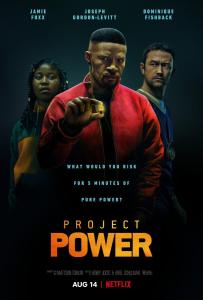 The appeal of Project Power is immediate with its premise, which stirred a bidding war before finally ending up with Netflix. Take a pill and become a super hero for five minutes. Every person has a unique power and won’t know what that entails until they swallow that pill. However, there is also a risk that your body has a negative reaction of the exploding kind. I can see why studios would be all over that, on top of the fact that it plays into established popular cultural tropes, it still gets to be an original property. The finished film, on the other hand, leaves much to be desired, and I’m convinced that this hot commodity script went through a gauntlet of rewrites and producer interference, each new obstacle dimming and diminishing what made Project Power an exciting and compelling idea from inception. Well the concept is still interesting, and its relatively grounded sci-fi world has genuine potential, but the movie falls flat and is far too generic to be special.
Drug dealers are flushing New Orleans with a super pill that activates fantastic powers, though only for five-minute integrals. Frank (Joseph Gordon-Levitt) is a local police officer who secretly keeps a stash of the pills for himself, to juice up to take on the escalating criminals. His supplier is Robin (Dominick Fishback), a teenager looking for a better life, who comes into contact with the mysterious and volatile Art (Jamie Foxx). He’s a man on a mission and working his way across the streets to go from supplier to supplier, working his way up the criminal food chain until he can confront the authority behind the super pill creation and distribution.
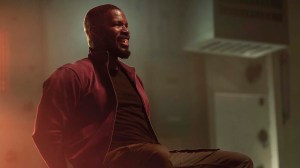 The premise by debut screenwriter Mattson Tomlin (The Batman) is tantalizing and makes every pill its own “what if?” scenario. I’m unsure whether or not the risk of bodily explosion occurs for every person or simply those whom the drug doesn’t agree with. I think it would be more interesting if every person stood some chance of risk. I talked about it with my girlfriend, if there was a pill that granted super powers but it also ran the chance of death, would you take it? We both answered, “Of course.” Who wouldn’t want to be a super hero, even if it’s only for five minutes? Naturally, much like within the X-Men universe, not every super power is on the same level of being useful. There’s a guy who grows extra bones, which serve as spikes attached to his body. I guess that’s something. It reminded me of the unfortunate mutant in X-Men 3 who could grow porcupine quills from his face (he even managed to coax someone near him to kill them). With such a momentous shift in human evolution, and through the angle of drug addiction, you would think Project Power would be the early steps of a complete re-examination of a changing society and the forces falling behind to try and catch up. This should be a big deal, and yet it never feels that way in this world. Super-powered criminals aren’t running rampant. One invisible guy robs a bank naked and it’s comedy. Nobody seems too panicked or bothered. It weirdly feels like everyone has already not only accepted this reality but compartmentalized it. If one city has a new super drug, would it not stand that others in neighboring cities and states and countries would also desire it? Should this not be dominating the news?
The characters are remarkably generic. Our heroes include a beat cop who “doesn’t play by all the rules” and goes on a secret mission to root out this drug conspiracy, a young black woman who wants to be an aspiring rapper while she’s slinging drugs, and a military veteran who was subjected to experiments and is desperate to find and save his kidnapped daughter. We’ve seen each of these archetypes in a thousand other action thrillers, and the fact that Project Power doesn’t give us any more than this is stunning. With some minute personal details, I have laid out everything we know about the three main characters in this movie. That’s it. It’s like each character was checking an archetype box and then was forgotten to be fleshed out. The worst is Art, a character that is coasting on Foxx’s attitude and charisma but is otherwise completely vacant. The kidnapped daughter storyline is maybe the most boring motivation that a protagonist could be saddled with. He might as well be a video game character from 90s-era titles, a military man who was betrayed by his government, experimented upon, given dangerous new powers, and now he’s striking out to save his daughter. It’s so bland and generic and boring. None of the major characters exhibit an interesting personality quirk, flaw, desire, or a point to make them more interesting than if a new nameless character had suddenly taken over from the background.
 This extends to the villains as well. Their evil schemes are too vague and they’re just as generic and bland. The villains are also far too easily defeated, which drains any threat from their machinations. Without memorable or effective villains, Project Power limps to a finish, lacking the needed payoffs of our heroes triumphing over their foes. Does anyone care when Art defeats a secondary antagonist that is introduced far too late in the final twenty minutes? It’s too late to be introducing a Big Bad in the movie that is meant to be savored when vanquished. It’s not satisfying when the bad guys are dumb or nebulous or too easily beaten. I felt more antipathy with a bearded henchman than I did with any of his superiors. This is such an easy thing to do, establish a worthy opposition with personality and menace, a force that an audience will feel a sense of accomplishment and fulfillment over their eventual defeat. Make the villains matter. Regrettably, the villains in Project Power are just as generic and underdeveloped as the heroes.
Directors Henry Joost and Ariel Schulman have dabbled in many genres, first documentary (Catfish), then found footage horror (Paranormal Activity 3 and 4), then youthful thrillers with social media satire (Nerve), and now super hero action cinema. The versatility is to be commended, and they certainly infuse plenty of energetic style into Project Power. The special effects are pretty good when the powers are somewhat visually chaotic, like a drug dealer who becomes the Human Torch, running through ignitable room after room, while the camera zips along, lovingly documenting the rippling flames and embers. The camerawork and lighting can definitely provide jolts of excitement and engagement when the storytelling falters. However, there are moments that should have been avoided, like violent acts presented in unclear ways, perhaps trying to avoid a harsher rating that it ultimately got anyway. Another sequence is from the point of view of a dying woman trapped inside a container, and the action from the other side of the glass is almost completely obscured. The woman’s suffering seemed so overboard that it reminded me of that poor assistant lady who had a more gruesome death in Jurassic World than its actual villain. It’s a misplaced stylistic touch. A villain takes the drug and turns into a giant CGI troll, like something from 2002’s Chamber of Secrets and is goofy and misplaced. For a movie that is trying to be gritty and somewhat grounded, a giant CGI troll is a blunder. Joost and Schulman are currently attached to write and direct a Mega Man movie next, and I imagine this was a trial run for super-powered androids blasting one another to dust.
The Project Power playbook is pretty familiar and underwhelming in its creativity and development. The concept is there but the movie too often feels content to settle for less, trading in stereotypical heroes, vague villains, and muddled action sequences goosed with flashes of style to mask their lack of personal stakes and imagination. The scope of the movie is too frustratingly myopic and under-developed, like a nascent pilot for a TV series that provides impressions with a latent promise of getting back to storylines later. Except later will never arrive. Project Power (even the name is generic) is a super hero movie that feels like everything you’ve already seen before. It’s far less than super.
Nate’s Grade: C
Share this:

An American Pickle (2020)
 Delightfully droll and surprisingly poignant, An American Pickle is a light-hearted fable elevated by a terrific dual performance from Seth Rogen. He plays Herschel Greenbaum (Rogen), an immigrant from Easter Europe seeking a new life with his pregnant wife Sarah (Sarah Snook). Due to an accident at the pickle factory, Herschel is locked in a vat and kept in stasis for 100 years, brined for the future. His only living relative is a great-grandson, Ben (Rogen), a struggling app developer who is equal parts fascinated and annoyed by his long-lost family member. Right away I knew this was a movie with its sense of tone locked firmly in place. The opening few minutes establish the heightened, comically depressing life in the Old Country (“Her parents murdered by Cossacks. My parents murdered by Cossacks!”) and courtship where Sarah dreams of being rich enough to own her own gravestone. Then after Herschel is resurrected and the news media is obviously doubtful, a doctor explains and the narration goes, “A doctor explains. It is good. Everyone accepts,” and the same doubtful reporters now nod in approval. The movie knows its ridiculous but asking you to simply go along. By then I knew this was the movie for me. The first half of this relatively brisk comedy is where it’s at its best. Rogen does an exceptional job portraying Herschel, a man out of time trying to reconcile the life and loved ones lost. There are genuinely emotional moments that affected me, and Rogen doesn’t even try to undercut them with a wink or a nod. Beyond the technical ingenuity of playing identical roles in the same space, Rogen imbues each Greenbaum as a distinct character. Herschel is easily the more compelling character and Ben can be quite annoying, especially in the latter half as he tries to sabotage his great-grandfather through a series of petty recriminations. The last half hour can become a bit too episodic, repeating the escalating family feud without feeling like we’re getting much further narratively. It feels like a series of shorts more than a sustained storyline, like the first half. Yet I laughed repeatedly from writer Simon Rich’s (Miracle Workers) clever and aloof storytelling voice. This is a first-caliber chuckler of a movie, with a few hearty guffaws here and there. Top it off with a surprising veneer of emotional reflection and a fabulous performance from Rogen in comedy and drama, and I would cite An American Pickle as one of the more charming, diverting, and enjoyable comedies of the year. In a pandemic-ravaged year of anxiety, we need a little sweetness with a dash of tart, and that’s what Pickle packs.
Nate’s Grade: B+
Share this:

The Tax Collector (2020)
 If you had told me that The Tax Collector was a parody of writer David Ayer’s hyper masculine, lurid, crime-ridden jaunts into the slums, police stations, and domestic lives of criminals, I would have completely believed you. We’ve been here before, with Ayer’s End of Watch, Street Kings, Harsh Times, Dark Blue, Training Day, even the fantasy-mingled Bright looked like an Ayer battleground of gangs, crooked cops, hypocritical politicians, and godly family men who someone can justify the heinous acts of violence they do. This time Ayer is following a pair of gangsters that make their monthly rounds to collect their dues from the other gangs. Their big boss, The Wizard, is rotting in jail, and a rival gangster, who also is literally a cannibalistic Satanist, takes the opportunity to make a violent power play. First off, this is nothing you haven’t seen before. It’s more bad men barking threats at those they feel are underneath their authority, then lots of driving banter meant to endear us to these bad men, and then professions of how much they love family or God. With the main villain being an avowed occultist, the battle-line takes on a biblical sense or good versus evil. The problem is that I didn’t care about a single character nor did I find them interesting. For a solid hour, we’re watching David (Bobby Sotto) and Creeper (Shia LaBeouf) go about their collections, argue about theology and diet, and reminisce. These guys are not interesting and more place setters for more compelling characters to be developed in later drafts that never took place. There’s a paucity of thrills and action and general tension to be had here. It’s shoddily paced. When things do pick up and The Tax Collector becomes a grisly revenge tale, the villains are so easily toppled, and in such unmemorable ways, that you understand why Ayer was putting all this off. During a bathroom brawl, the action stops for a pointless flashback to see Bobby in his martial arts class, but when he comes back he smashes a guy’s head with a toilet cover. That wasn’t a martial arts move he learned. It’s strange moments like that where The Tax Collector feels more like an old, incomplete screenplay Ayer had locked away in a drawer, a rough collection of his bombastic machismo crime thriller tropes that barely tops 80 minutes. The only passion on display is from LaBeouf, who reportedly got an entire chest tattoo for his character except his exposed chest is never clearly seen once on camera. I don’t even know why he wasn’t the main character. Bobby is boring as the humdrum hoodlum who wants out of the family business (Michael Corleone he is not). A late twist is meant to be revelatory but, beyond being predictable by the economy of characters, signifies little for Bobby. The Tax Collector is awash in the same grimy gangland stereotypes that have populated most of Ayer’s professional work, but rarely has his moral ambiguity, nihilism, and envelope-pushing “rawness” felt more like self-parody. This is a thriller bled dry.
Nate’s Grade: C-
Share this:

She Dies Tomorrow (2020)
 She Dies Tomorrow has unwittingly become a movie of the moment, tapping into the encroaching anxiety and paranoia of our COVID-19 times in a way where the horror of newspaper headlines and existential dread has been transformed into a memetic curse. The new indie thriller is an uncanny and unexpected reflection of our uncertain times and it makes She Dies Tomorrow even more resonant, even if writer/director Amy Seimetz (Upstream Color, 2019 Pet Sematary) doesn’t fully seem to articulate her story. We’ve dealt with curses in films before and we’ve dealt with foreboding omens of impending death, but how would you respond if you knew, with certainty, that you were going to die the next day? How would you respond if you knew that your existence was itself a vector for this mysterious contagion and that by telling others you are dooming them to the same deadly fate, as well as their loved ones, and so on? Sure sounds similar to a certain invisible enemy that relies upon communal consideration to be beaten back but maybe that’s just me.
Amy (Kate Lyn Sheil) is a recovering alcoholic who knows, with complete certainty, that she will die the next day. Her boyfriend killed himself after saying he was cursed to live one last day, and now she’s convinced the same fate awaits her. Her sister Jane (Jane Adams) is worried about her mental state and then becomes obsessed with her warning. Jane then believes she too will meet the same fate, and discusses this to her brother (Chris Messina) and his wife (Katie Aselton) and two of their dinner guests. Each comes to believe that this deadly declaration is true. They must decide how to spend their remaining hours and whether the curse spreads beyond them.
 It seems like with Color Out of Space and The Beach House, 2020 is the year of movies where characters slowly succumb to forces beyond their understanding and that they cannot overcome. Halfway through She Dies Tomorrow, we have a half dozen characters that have been infected, and we watch how each respond to the recognition of their impending doom. One man wants to take care of personal decisions he’s been postponing. Another decides to come clean about wanting to end their relationship. Another debates whether it’s more humane to allow their child to pass in her sleep rather than rouse her to expire aware and conscious. That’s the kind of stuff that is intensely interesting, allowing the viewer to question what their own decisions and thoughts might be under these unique circumstances. I also liked that Seimetz keeps some degree of ambiguity (though perhaps too much for her own good). The curse is never fully confirmed. Could it simply be people going crazy and giving into a mental delusion that their fate is decided beyond their governance? Could they all be hypochondriacs giving into their worst fears and finding paranoid community? Is there a relief is adopting self-defeating fatalism?
The slow, fatalistic approach of the storytelling and the spread of the curse channels the crushing feelings of depression and helplessness, an emotional state many can identify with right now. There’s a heaviness throughout the movie that feels like an oppressive existential weight. As soon as these characters recognize the truth of the “I’ll die tomorrow” creed, they don’t fight. They don’t run. They don’t even rage against the unfair nature of their imminent demise. There isn’t a cure or even a mechanism for delay. The rules of the curse are fairly vague but it seems to follow the specifics of once you’re been exposed to an infected individual, and they mention their own impending death, that this starts the clock for your end. The characters lament how they’ve spent their lives, what they might like to have done differently, and come to terms with some marginal level of acceptance. Amy wants her body to be turned into a leather coat after she’s gone. Another woman opines how much she’ll miss trees, something that she took for granted. Another character marvels at the beauty of the sunset, which will be his last, drinking in the natural splendor with a new appreciation that he never had before. One woman says she regrets spending so much of her days talking about dumb nonsense, and then her firend disagrees, saying he enjoyed her nonsense and it brought him laughter. Taking stock of a life, there will always be regrets that more wasn’t accomplished or appreciated, and many of these same characters are determining how to spend their last hours, whether they prefer a partner or going it alone. In that sense, She Dies Tomorrow reminds me of the mopey indie version of Seeking a Friend for the End of the World or the more palatable, less operatic version of Melancholia.
 At barely 90 minutes, this is also a very slow and meditative movie that will likely trigger frustration in many a viewer. I’ll admit that my mind wandered from time to time with some of the, shall we say, more leisurely paced segments or redundant moments. There is a heavy amount of ennui present throughout here, so watching a woman listen to the same classical record, or laying on the floor in a catatonic daze, or staring off uninterrupted into the middle distance adds up as far as the run time. There isn’t much in the way of story here to fill out those 90 minutes. Amy infects her sister, who infects her brother and his wife, and from there they all deal with their new reality. From a plot standpoint, that’s about all She Dies Tomorrow has to offer. It has flashes of interesting character moments, like the couple who talk about their long-delayed breakup, or the couple discussing the ethics of letting their child die in her sleep, but too often the movie relies on mood over story, letting a numbing futility wash over the characters and conversely the audience. I’m not saying that mood can’t be the priority. It feels like apocalyptic mumblecore but with a screenplay with too much internalization to really take off. It can seem like an overextended short film. I can’t help but feel that Seimetz is just scraping the surface of her story potential and that these characters could have been even more compelling if they were given more than resignation.
Sheil (Equals, House of Cards) gives a suitably withdrawn and shell-shocked performance. She reminded me of a cross between Katherine Waterston and Dakota Johnson. The other actors, including familiar faces like Josh Lucas and Michelle Rodriguez, all adjust their performances to fit the tone and mood of this world, which means much is dialed back. I wish I had more moments like when Aselton (The League) viciously unloads what she really thinks about her aloof sister-in-law. The cast as a whole feel overly anesthetized, a bunch of walking zombies bumbling around the furniture, and while it’s within Seimetz’s intended approach, it does drain some of the appeal from the film.
Given the overwhelming feeling of daily unease we live with during an ongoing pandemic, I can understand if watching a movie like She Dies Tomorrow doesn’t exactly seem desirable. It can prove engaging while also airy, navel-gazing, and adrift. It’s several big ideas spread thin with overextended melancholy and nihilism. In a way it reminds me of 2016’s A Ghost Story, another indie reaching for some big statements about the human condition and grief and our sense of self and legacy. But that movie didn’t quite have enough development to make those ideas hit. Instead, I’ll remember it always as the Rooney Mara Eats a Pie For Five Minutes movie. There’s nothing quite as memorable, good or bad, here with She Dies Tomorrow. It’s mildly affecting and generally interesting, though it can also try your patience and seems to be missing a whole act of development. If you only have one more day to live, I wouldn’t advise using your remaining hours on this movie but you could do worse.
Nate’s Grade: C+
Share this:

Greyhound (2020)
 I’m fairly certain I now know what my father’s favorite movie of 2020 will be. Greyhound is a World War II movie set in the cold, grey waters of the mid Atlantic and follows a cat-and-mouse game between an Allied convoy and a German submarine pack in 1942. Tom Hanks plays the beleaguered U.S. Navy captain of the Greyhound making his first voyage and the long, hard-fought campaign over five days without air cover. I wish I could have seen this in theaters with the added benefit of the immersive screen, the rumbling sound system, and my father as company. While often exciting and well rendered with visual effects, the movie isn’t so much a movie as it is a DLC video game campaign. Ostensibly this is a movie about heroic qualities like leadership and sacrifice and bravery, but it’s really all about tactics and historical realism. It reminds me of those Civil War movies in the 1990s that appealed to battle re-enactors. This feels like it’s made for the same crowd; not moviegoers looking for engaging characters and compelling drama but moviegoers looking for period jargon and historical accuracy, things incidental to storytelling. The climax comes at 75 minutes and the end credits at 81. The battle sequences can be thrilling and feel reverent to a fault, but what emotional engagement is this movie supposed to offer to someone who doesn’t fill their weekends watching streams of WWII documentaries? What characters am I to connect with? It’s not bad by any means but it also feels like it never even tries to be more than a visual manual for naval warfare. I kept thinking my own father would enjoy this movie. He happily watched the many, many hours of those Ted Turner-produced Civil War movies that paid fawning homage to the military tactics and realism (within reason, they were PG-13 after all) at the expense of character and story. The story is the battle, the characters are stuck as interchangeable faces, and the real star is the depth of historical fidelity. It almost feels like it should simply be the epic visual accompaniment to a series of talking heads for a WWII television documentary. Greyhound is an exciting experience, not much of an actual story, but it might be the most “dad movie” of 2020 if your father is anything like mind.
Nate’s Grade: B


 nathanzoebl
You must be logged in to post a comment.