Category Archives: 2018 Movies
Hereditary (2018)

Hereditary has built up a great roaring buzz from film festivals and its oblique marketing. Numerous critics are hailing writer/director Ari Aster’s debut film as one of the scariest movies of a generation. The studio, A24, which has built up a fine reputation for art movies and genre fare, is releasing it. Except A24 has some trouble when it comes to its horror thrillers. Last year’s It Comes at Night was similarly beloved by critics yet audiences generally disliked it, angered by the misleading marketing that framed it as a supernatural horror (there was none, no titular “it” to come at night). I wonder if A24 learned their lesson and that’s why the trailers and ads for Hereditary have been intentionally hard to follow. After watching Hereditary and feeling let down, I wonder if A24 is in for another disparity between critics and audiences. This is a sloppy, unfocused film with little sense of structure, pacing, or payoffs. It’s a movie of moments and from there your mileage will vary.
Annie (Toni Collette) and Steve (Gabriel Byrne) are ordinary middle-class parents living with two teenage children, the older Peter (Alex Wolff) and the younger Charlie (Millie Shapiro), a girl given to peculiar habits. Following a tragic accident, the family is struggling to come to terms with their loss and their new lives. Annie seeks out comfort from a group meeting, and that’s where she meets Joan (the great Ann Dowd) who shows her how to contact the spirits of the dead via a handy incantation. From there, Annie tries to establish a connection to the realm beyond and possibly unleashes a spirit targeting her family.

With the rapturous critical acclaim that Hereditary has garnered, I was expecting something far more engrossing and far less sloppy. Structurally, this movie is a mess. It feels very directionless from a story standpoint, like the movie is wading around and blindly looking for an escape route into the next scene. Rarely will scenes have lasting impact or connect to the following scene; you could literally rearrange the majority of the scenes in this movie and not affect the understanding whatsoever. That’s, simply put, poor screenwriting when your scenes lack a more pertinent purpose other than contributing to an ongoing atmosphere of paranoia (more on that later). I’m struggling to make broader connections or add lasting thematic relevance to much of the plotting, and that’s because it feels so convoluted and repetitious for so long, until Aster decides it’s time to throw the audience the most minimal of lifelines. There is a moment late in the second act where a character finds a convenient exposition dump by looking through a photo album and a book that is literally highlighted. That at least explains the intent of the final act, but even as that plays out, by the end it’s still mostly confounding. The film ends with another exposition dump, this time as voice over, and I got to thinking that if it wasn’t for these two offhand moments you would have no idea why anything is happening. I had a friend whose girlfriend had been bugging him for Hereditary spoilers for months, so I carefully explained the movie to them as precisely as I could. By the end, he told me, “I still don’t get it.” Yeah, I didn’t get it either and I was actively trying.
There is a type of horror fan that will lap up Hereditary, namely the kind that places the creation of dread and atmosphere and memorable moments above all else. If you’re a gushing fan of David Lynch movies or Dario Argento and their sense of strange dream logic, you’ll be more ready to prize the sum rather than the whole of Hereditary. The aesthetics are pleasurable thanks to crafty production designer Grace Yun (First Reformed) and the moody photography from Pawel Pogorzelski (Tragedy Girls) that maximizes the space and draws out the anticipatory dread. There are effective moments where I gasped or squirmed, but there were also moments where I wanted to laugh. The key term is “moments.” Without a structure, sense of development, and attachment to the characters and their lives, Hereditary left me chasing fleeting entertainment.

Now when it comes to horror moments, I’ll again admit that everyone’s mileage will vary. Some people will watch Hereditary and be scared stupid. Others will shrug. That’s a deeply personal response. I can look at a movie like A Quiet Place and point to its intricate structure and execution to explain why its suspense was so affecting and satisfying. With Hereditary, because all it supplies is moments, I can’t explain why something will work or won’t for a person. Maybe you have a thing against headless corpses. Maybe you have a thing for jump scares (there are more than a few). Maybe you have a thing for invisible girls making clicking noises with their tongues. Then again maybe you’d enjoy a narrative that gave you a better reason to care and that organically built meaningful scares through tangible circumstances.
If you can hang onto the final nightmarish act, that’s when Hereditary is at its best, finally picking up a sense of momentum and finality. The first forty-five minutes of this movie more closely resemble something like Manchester by the Sea, a family unit becoming undone through grief and guilt, simmering grievances just under the surface. It’s well acted, especially by Toni Collette (Krampus) as a mother barely escaping the pull of her boiling anger at her son and the universe as a whole. She gets a few quality moments to blow up and it feels like years of painful buildup coming out. The awkward family interaction is chilly but missing greater nuance. It has marked elements that should bring nuance and engagement (Personal Tragedy, Mental Instability, Blame, Guilt, Obsession), but with Aster’s undercooked screenplay those elements never coalesce. This is a movie experience that is never more than the sum of its spooky parts. Byrne (The 33) is essentially just there, and the fact that the 68-year-old actor has two teenage children is a little hard to swallow. Wolff (Jumanji: Welcome to the Jungle) does a fine job of showing his deteriorating mind late in the movie. The problem is that these characters just aren’t that interesting, so when the supernatural acceleration creeps in, there’s already a ceiling as far as how much we, the audience, will care about what befalls them. What are the stakes if you don’t understand what’s happening and don’t genuinely care about the central characters?

My pal Ben Bailey chided me after seeing Hereditary that I was trying to do the movie’s work for it by looking for deeper connections and foreshadowing clues. Is there some greater meaning for the headless women motif? Is there a larger reason why the dollhouse God imagery is prevalent? Is there a reason, after finding out about the haunting, that the family still leaves their beleaguered son alone? Is there a mental illness connection or is it all a manifestation of hysterical grief? The English teacher discusses the Greek tragedy of Iphigenia (see: a better movie following this model, 2017’s Killing of a Sacred Deer) and whether being predestined for sacrifice is more tragic than choosing your own self-destruction, and is that a glimpse at thematic relevance in a way that seems almost half-hearted? The problem with a long, incoherent story built upon a heaping helping of creepy imagery and atmosphere is that it can often fall into the lazy trap where the filmmaker will just throw up their hands as if to say, “Well, it’s up for interpretation.” I don’t mind a challenging movie experience (I was on the side that enjoyed, if that’s the correct term, Darren Aronofsky’s mother!). I can appreciate a movie that’s trying to be ambiguous and ambitious. However, the pieces have to be there to form a larger, more meaningful picture to analyze and discuss, and Hereditary just doesn’t offer those pieces. It’s an eerie horror movie with its moments of intrigue and dread but it’s also poorly developed, too convoluted, and prone to lazy writing and characterization. I’ll highlight it for you, Hereditary-style: if you’re looking for more than atmosphere and tricks, seek another horror movie.
Nate’s Grade: C
Share this:

Adrift (2018)
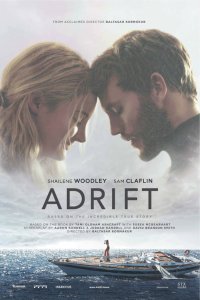 It’s one part survival-at-sea drama, one part relationship drama, and you get an equal slice of both until an unforeseen ending explains why the narrative was so divided. Based on a true story, Adrift tells the journey and survival of a couple (Shailene Woodley, Sam Claflin) lost at sea for 41 days after getting too close to a hurricane. Woodley takes the lead to fix the sailboat, gather supplies, tend to the grievous injuries of her boyfriend, and plot their treacherous path to Hawaii. If they’re off just a few degrees, it will be life and death. The survival half is viscerally entertaining and steady with its details, allowing the audience to get comfortable in following the steps and reasons. The camerawork by director Baltasar Kormakur (Everest) is sweeping and methodical, pulling us into the danger and isolation while creating a sterling sense of verisimilitude. The screenplay vacillates between the present and past, supplying flashbacks to fill out the romantic relationship. It’s a smart move because it allows us to immediately get into the stakes of survival while also finding room to develop the characters in a more normal setting. Plus it also makes more sense by the Tully-esque end. This is pretty much Woodley’s (HBO’s Big Little Lies) show; her secondary co-star might as well be her nipples poking through her character’s swimwear and tops. As readers may know, I’m a big fan of Woodley and the naturalism she brings to her performances, and Adrift is no exception. She can say so much through her smiles. She’s a great anchor for a storyteller. Ultimately, Adrift is a survival drama that takes a while to get going but leaves a favorable impression thanks to the acting and technical merits.
Nate’s Grade: B
Share this:

Revenge (2018)
 Can you tell a rape-revenge movie from a feminist perspective? The lazy storyteller or analyst would say movies like I Spit on Your Grave are feminist because it involves a wronged woman wrecking righteous vengeance on her almost-assuredly male attackers. However, if you’ve seen I Spit on your Grave, or its remake, or any genre thriller where rape is treated as the inciting incident, you’ll know these movies are hardly feminist. The protagonists typically exist to be objectified, then traumatized, then transformed into sadistic killers. It’s not exactly the most nuanced or dignified portraits of sexual violence. French writer/director Coralie Fargeat attempts to give this tired trope a feminist spin with Revenge, a thrilling, grueling, wildly bloody good time. It’s a thriller with real bite.
Jen (Matilda Lutz) is enjoying a vacation with her boyfriend Richard (Kevin Janssens), who also happens to be a married family man. She’s lounging around in a deserted bungalow for Richard’s hunting getaway, a regular vacation he shares with his other pals Stan (Vincent Colombe) and Dimitri (Guillaume Bouchede). Jen makes herself at home and Stan, in particular, lusts over her. While Richard is away, Stan attacks and rapes Jen. Richard offers to set her up with a new life in another country but Jen refuses, demanding to go home. She runs off and is pushed off a cliff by Richard. Miraculously, she survives, and from there the three hunters try to track her down and cover up their misdeeds.
 It’s a simple story but Fargeat has an uncommonly sharp command of her craft, knowing what exploitation elements to double down on and when it’s best to show restraint. This allows Revenge to unfold with a natural sense of pacing and direction while still achieving a high level of thrills and satisfaction. I appreciated that Jen doesn’t suddenly become an expert merchant of death. This isn’t like 2013’s You’re Next (though the final act starts to dip into that film’s black comedy of absurdity) where the damsel ends up secretly being a highly-skilled and highly-trained warrior. In Revenge, the self-entitled creeps think they have the upper hand throughout, constantly underestimating the resourcefulness and will power of Jen. Very early in the second act, the three men are on the hunt for Jen, so the movie becomes a cat-and-mouse thriller with each new set piece being its own engrossing mini-movie, adopting varying degrees of tone. There’s a lovely A-to-B-to-C sense of progression to the plot as Jen confronts a new set of obstacles, all the while being hunted by three cocky sexual predators. There’s great joy in rooting for a worthy underdog and also watching villains robbed of their own joy.
Revenge easily taps into our desire to see justice befall some very bad people, and maximum carnage ensues. This is an outstandingly gory movie and the first I can recall in quite some time that genuinely forced me to avert my sight. Fargeat’s camera gets you up close and personal to gashes and seeping wounds, enough to see layers of tissue and fat, and her camera lingers on the bodily destruction, forcing us to squirm in discomfort. It’s highly effective and yet doesn’t feel gratuitous. When the camera dwells on Jen’s wounds, it’s about her perseverance and strength. When the camera dwells on the wounds of the gents, it’s about the extent of their outlandish punishment. There is a hallucinogenic series of gonzo, gory kills meant to goose the audience for extra fun, and it had me laughing after the third daffy dream sequence-within-a-dream sequence. The final act ramps up the bloodletting to an almost comic degree. Characters are literally slipping and sliding on the floor from the copious amount of blood spilled.
This is a gruesome movie to watch but Fargeat knows what an audience wants to see and squirm over and what they don’t. This is typified in how the rape is portrayed. For the beginning of the first act, the camera seems to adopt the perspective of voyeur, often perfectly framing portions of Lutz’ body, notably her posterior. The men take turns leering at her but so has the audience at this point. It affects us to the male gaze. Then an increasingly agitated Stan harasses Jen. This uncomfortable sit-down is excruciatingly tense because we’re waiting for him to pounce, but it also has an effective power because it illustrates the daily minefield women experience deflecting the unwanted attention and affections of men. She’s desperately looking for safe ways out of the conversation that still save the man’s ego, a tricky navigation so as to not upset one’s toxic masculinity. The ensuring rape happens off screen as the camera leaves the scene with Dimitri who even turns up the TV volume to drown out Jen’s panicked screams. For anyone who’s sat through these kinds of movies, they often glorify the horror of the rape and can readily cross a line into icky intentional titillation. Leaving rape off screen is practically admirable.
 Revenge is a cut above its genre ilk thanks to its strongly developed suspense sequences. Each set piece or confrontation presents itself in a memorable and different manner, requiring our heroine to use a different set of survival skills. Fargeat has a terrific sense of space, allowing the audience to understand the distances between the two participants. This allows the tension to simmer and boil as directed. Take for instance that bloody finale, which has an extended and very tense portion that revolves around two characters literally chasing around a circular hallway trying to get the jump on one another. That sequence doesn’t work without crisp editing and a proper sense of space. The director also knows when to draw out a scene with long takes and a wandering camera that makes you nervous about what’s going on where we don’t see. There are some wonderful moments of anticipatory dread to amplify the suspense. Fargeat’s smooth camerawork and sense of pacing allows the suspense to nicely develop, as she draws out the dangers for Jen and finds organic complications per scenario.
The actors ably perform their parts and Lutz (Rings) is a future star-in-the-making. A lot of physical acting is required from her and she is highly persuasive in every moment. Her happiness early on is infectious, her discomfort is grueling, and her desperate escapes feel frantic and wild, more a realistic human being fighting for their life than as some slick movie character coasting on a divine sense of cool. Her second half onslaught of titular vengeance still manages to keep the character grounded and mortal; she suffers setbacks and grievous injuries during these fights too, yet she endures. The other gentlemen give strong performances displaying different degrees of toxic masculinity, entitlement, and hapless weasel-ness when exposed. Stan, who previously had been enjoying his turn as an unpredictable threat in preparation to raping Jen, becomes a big blubbering weakling. Belgian actor Kevin Janssens reminded me a lot of a younger Aaron Eckhart. The movie is certainly elevated a few notches thanks to the actors giving you strong rooting points.
Revenge is a grisly, gory, and wild genre movie that will appeal to fans of indie thrillers but also extend behind that loyal clientele. Writer/director Coralie Fargeat demonstrates an innate understanding of not just the genre but the mechanics of suspense as well, engineering and executing terrific suspense sequences while keeping her familiar narrative fresh. I loved her attention to details (not just the gory ones) like the fact that Jen has these pink star earrings for the entire run of her vengeance. Fargeat understands this genre and its audience but also brings an empathetic, feminine perspective to our heroine’s awful plight. I was impressed how grounded this movie remained with its characters even as they were losing a blood bank’s worth of inventory. Even if you are more on the squeamish side when it comes to blood and gore, I’d recommend Revenge as an above average thriller that only becomes more satisfying in execution.
Nate’s Grade: B+
Share this:

The 15:17 to Paris (2018)
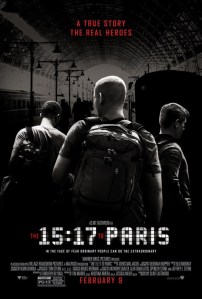
Spencer Stone, Alek Skarlatos, and Anthony Sadler were three ordinary servicemen taking a train ride into Paris when they found themselves in the middle of an armed terrorist attack. The three men rushes into danger, disarmed and subdued the attacker, and treated the injured on the scene. The 15:17 to Paris is a big screen movie directed by Clint Eastwood (American Sniper) that tells their life stories played by the men themselves. It got some of the worst reviews of Eastwood’s storied career (mine won’t be better). There are two gigantic miscalculations when it comes to 15:17 to Paris: 1) having the real-life subjects play the adult versions of themselves, and 2) that there was enough material here to fill out an engaging, enlightening, fulfilling film experience.
I assumed telling this real-life story as a movie was going to be a challenge to produce enough meaningful material to eek out a feature-length running time, and within the first five minutes I knew that I was doomed. We’re sitting down to two single moms discussing their boys with their classroom teacher, and that teacher literally says, “If you don’t medicate them now they’ll just self-medicate later. Statistically, boys of single moms are more likely to have problems.” My response: “What the hell, lady?!” This character was obviously engineered, from her very foundation, to be a walking, talking point of exposition and disagreement. No real teacher would ever utter these words so callously. It was this rude awakening that made me realize what a terribly written slog I was in for. At no point were these supporting characters going to come across as authentic human beings. Instead, it’s a world populated by robots with bad social skills or unshakable faith played by familiar actors (Judy Greer, Jenna Fischer, Thomas Lennon, Tony Hale, Jaleel White of all people). Also, what little kid has a Full Metal Jacket poster in his bedroom? Did he not understand what that movie was about?

These men can rightly serve as an inspiration, rising to the occasion in a true test of courage. No one will challenge the heroism. But what else is there to this story? The attack is presented as the framing device and as it plays out we segue into lengthy flashbacks about their lives leading up to this pivotal point in time. It’s just that these three men lived fairly uneventful, normal lives until finding themselves in a unique situation. We don’t seem to trace any significant, formative moments. Spending time with them as kids, then teens, and finally as adults doesn’t so much provide greater understanding of them as people as it does pad out the running time. We watch them get in trouble twice at school for not having a hall pass. We watch them watch football. We watch them endure training montages. We watch the trio tour the sights of Italy and eat gelato. We watch an Army team retrieve a backpack. We watch Spencer get demoted for not stitching properly. Seriously, this is given time. It’s not even until a full hour-plus into the movie before they confront the attack on the train.
Chronicling the lives of normal, real-life people under extraordinary circumstances is not by itself a fatal flaw, as evidenced by the masterful and mournful United 93. The power of empathy allows us to leap into a multitude of perspectives. However, with United 93 there was an ongoing story that could unfold because of the scope of events. There were developments, deadly complications, and the slow realization of what was happening, what was going to happen, and what needed to be done. With 15:17 to Paris, the attack is uncomplicated and over relatively quickly. There’s a reason Eastwood saves the train attack for the end because it cannot function as a sufficient movie plot on its own. Eastwood had a similar predicament with his previous film chronicling the heroism of the pilot who landed a plane on the Hudson River. The plane crash was thrilling and Tom Hanks added some layers to the portrayal of a man uncomfortable with the spotlight. 15:17 to Paris doesn’t even have that much. It’s a tedious trek to an all-too swift climax.

The other large miscalculation was having the real-life actors portray themselves. These guys just are not actors. I suppose Eastwood felt the real-life figures would best understand the emotions of each scene, in particular the attack, but another approach would be simply teaching actors. The forced verisimilitude feels like a marketing gimmick meant to appeal to a select audience. Making things more difficult is that these guys just aren’t that interesting as subjects. Sure there are broad strokes of characterization applied here and there but it’s with very minimal effort (see above for some of the just-had-to-include plot moments). This is another reason actors would have been preferable, because these guys’ lives don’t have to be interesting for my benefit. Their lives were not destined to one day entertain me on the big screen. They can simply be normal people. On the other hand, watching normal people do normal, boring things without a more enriching sense of introspection, personalities, or depth is like being trapped watching someone else’s home movies on a loop. Spencer Stone performs the best of his buds but none of them should expect a second career as an in-demand thespian.
I feel bad saying this but I really just didn’t care, and that’s because the movie gave me no reason to do so here. Yes, these three men are heroes and their sense of normality might lend itself toward a larger theme about the everyday capabilities of heroism, but there isn’t enough here to make me care beyond the train attack. The screenwriting does not present them as multi-dimensional characters and perhaps that’s because of the guys’ limitations as actors, exacerbating a spiral that only makes 15:17 to Paris less involving as it chases after the idol of authenticity. Eastwood is known for being an economical filmmaker but it feels like he should have been even more judicious here. The adherence to strictly the facts strips the film of some of its larger emotional power. There’s far too much filler and not enough substance to balance out 90-plus minutes. You’ll grow restless. If there’s a lesson to be learned from The 15:17 to Paris, let it be that every story needs a reason to exist and, when in doubt, trust actors to deliver that story.
Nate’s Grade: C-
Share this:

Solo: A Star Wars Story (2018)
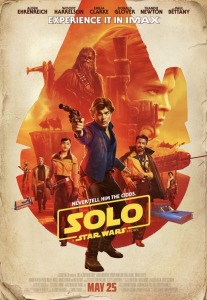 The notorious back-story behind Solo: A Star Wars Story has more than eclipsed whatever else this “young Han Solo” prequel appeared to offer. Directors Phil Lord and Chris Miller were responsible for a string of fast-paced, silly hits like The Lego Movie and the 21 Jump Street films, and when producer Kathleen Kennedy hired them, it felt like an inspired infusion of new blood to make a Star Wars movie different in tone and approach. Five months into shooting and mere weeks away from completing photography, Miller and Lord were fired. The on-set rumors and sources have relayed a badly conceived marriage between the directors, given to improv and irreverence, and Kennedy’s sense of what a Star Wars movie should include. Enter Ron Howard, no stranger to the world of George Lucas, and an extensive battalion of reshoots, and you’re left with Solo, which only lists Howard as director. With that as its genesis, it feels like this movie should be a train wreck. It’s not that. Instead, Solo is fitfully entertaining but underwhelming diversion weighed down by its untapped potential.
Years before that noisy Mos Eisley cantina, Han Solo (Alden Ehrenreich) is a low-level criminal trying to find a better life. He loses his girl, Qi’ra (Emilia Clarke), joins the Imperial Army, and defects, finding a partner in a big hairy wookie named Chewbacca (Joonas Suatamo). The two of them join a crew of thieves run by Beckett (Woody Harrelson), and after a job gone wrong, everyone is in grave danger and deep debt to the crime lord Dryden Vos (Paul Bettany). The crew must even the score and make things right, and they must navigate unreliable allies like Lando Calrissian (Donald Glover), his trusted robotic assistant L3-37 (Phoebe Waller-Bridge), and, most surprisingly, Qui’ra herself, working as one of Vos’ top criminal consultants.
 Solo is hard to justify except as an increasingly tedious appeasement to the greater altar of fan service. The movie reminded me of those young author biopics like Finding Neverland where everything is given the unspoken-though-heavily implied significance of dramatic irony, where the audience knows, “Oh, this will be where that comes from, or that’s the first time that happened, etc.” Solo provides further light on the Star Wars minutia that only a scant few will work up real excitement over. For every interesting revelation, like Han and Chewbacca first meeting and bonding, there are numerous others that could best be characterized as cataloging the story of Who Gives a Crap?: The Movie. Who cares how Han got his dice? On that note, did I just not remember this trinket being as heavily showcased in the original trilogy as these new films emphasize? Also, who cares about how Han gets the Millennium Falcon? Who cares how Han got into the smuggling business? Who cares why Han was on Tatooine to begin with? The film expects audiences to supply the significance for scenes that lack that on their own. Too much of the script by Lawerence and Jonathan Kasdan (In the Land of Women) coasts along on audience good will carried over from the original trilogy.
As far as being a heist movie, Solo doesn’t put much concentrated thought with its heist set pieces. Much of the plot hinges on a “job” to recover a large amount of fuel owed to the scary crime boss, so the job itself should be treated as important. Once topside, the characters stick to their ruse for about five minutes and things immediately go bad and then it’s just one messy, ongoing action sequence. I could understand carefully planning a scheme only for it to unexpectedly go wrong, but the appeal of heists are their intricacy, development, and complications, and Solo sadly snuffs this appeal out. The high-point of the film is an early Act Two heist that’s the sci-fi equivalent of a train robbery. Things start off promising with the space craft being able to rotate around its rail, which tickles the imagination for plenty of dire hangings on. We even get a few preparatory words for the plan, though even those are fairly general. And then things start and they immediately go bad and stay that way without satisfying complication. Part of the appeal of heists is seeing the curve balls, the unexpected complications, and how our team reacts and recovers. It’s a fun sequence with some thrilling visuals but it never rises beyond the sum of its action particulars, and so an important set piece is held back from going for greatness. The action throughout Solo is serviceable but rarely does it feel like what’s onscreen is the best version of what it could have been. Serviceable, sure.
 Which brings about the inevitable analysis over what can be gleaned from the final product that traces back to its original team of directors. There are a handful of comic asides that feel like the lasting touch of Miller and Lord. Beyond that, Solo feels very much like Howard’s movie, though much like Rogue One, the mind conjures the possibilities of the original version. One of the biggest changes is that Howard added Bettany’s gangster character. He’s on screen for really two sequences though his importance stretches over the entire film. Solo feels cohesively like one movie to the degree that if you had never heard about the headline-grabbing production tumult, you wouldn’t suspect anything had happened behind-the-scenes. However, the lasting impact seems deeper, namely that many of these sequences feel, to some degree, interchangeable by design. The execution and development feel lacking. It’s a lingering feeling that what you’ve been watching isn’t fully coming together. It’s not fully engaging the attention and making the most of its beloved characters. It feels less like a seminal moment in the story of Han, Chewie, and Lando and more like an extended episode of a television series. I was too detached and grew restless too often. I started waiting for it to be over rather than waiting to see what happened next.
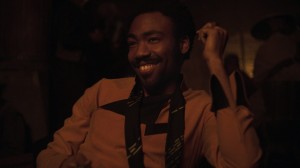
Ehrenreich showed enormous promise with 2016’s Hail, Caesar! both with comedy chops and leading man appeal, so he seemed like a capable choice for a young Han Solo. After rumors of having to hire an emergency acting coach on set, I was expecting a poor performance. He’s decent, grinning through the indignities, stumbling along with a sardonic sensibility that still plays into a confident sense of optimism against the odds. Ehrenreich, much like most of the movie, is perfectly fine, entertaining at times, but far too often a passing blip. The real star of the movie is Glover (TV’s Atlanta) who is brimming with charisma. Plus Lando’s suave, pansexual nature and tendency toward shady scheming lends itself to a more fascinating glimpse at a character we know decidedly less about.
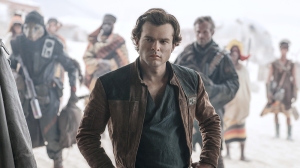 Clarke (HBO’s Game of Thrones) is saddled with a non-starter of a storyline as the old girlfriend who got away. Harrelson (Three Billboards) plays another cranky father figure role. Bettany (Avengers: Infinity War) is generally wasted as a villain lacking a stronger sense of identity or menace. His weapons of choice, two laser-edged knives, seem like where the depth of character creation ended with him. Oh, he also has scars over his face, so that’s about the same as a personality. The lone supporting player that leaves an impression is Waller-Bridge (Fleabag) as the android, L3-37. I could have used an entire movie with her and Lando. She becomes a political revolutionary by accident over the mistreatment of droids, and L3-37 does what the other supporting characters, and even what Ehrenreich to some extent, do not — leave you wanting more.
After its problematic history, it would be easy to look for ways to carve up Solo as a hodgepodge creation of studio interference but that’s too tidy an explanation. I’m not against the idea of a “young Han Solo” film franchise, though it needs to find the right stories to shed new and meaningful light on this classic rogue. Han Solo was, like, mid thirties at the oldest in 1977’s Star Wars and Ehrenreich’s early-to-mid 20s version doesn’t afford a great many differences (he was already a “young” character to start with). If you’ve bought into the Star Wars universe, there should be enough to at least be entertained by, and if you’re a nascent fan, then Solo might be an easily digestible fun adventure. The mitigated or underdeveloped potential nagged at me as I was watching. It’s got aliens and space heists and most of the time I was approaching boredom. I’ll label the movie with its own Scarlet F: it’s… “fine.” It’s the kind of movie you shrug your shoulders at afterwards, not necessarily regretting the experience but moving along. Perhaps we’re just at a natural point in the post-Disney-purchase of Star Wars, and now we’re facing less-than-ideal time-discharged product. I was hoping for more, either good or bad, but had to settle for a relatively lackluster prequel. I don’t know if there will be further escapades with the “young” Han Solo but I wish they choose them more wisely. Even the title feels bland.
Nate’s Grade: C+
Share this:

Deadpool 2 (2018)

It took the leaked release of the Deadpool test footage, and the ensuing enthusiastic fan response, before Fox finally decided to invest in a big screen, R-rated superhero movie. The result was 2016’s Deadpool, a huge smash and proof that a lucrative audience will turn out for more adult-oriented, outrageous, grisly versions of comic book movies. Because of Deadpool, we finally got an R-rated Logan that proved to be an outstanding swan song for Hugh Jackman’s iconic hero. Now Deadpool is getting the spotlight he has earned with a big, splashy summer release, but with success come expectations. Can it live up to the ever-increasing hype? In short: if you were a fan of the original, you’ll be happy enough, because Deadpool 2 isn’t much more than the sum of its zany parts.
Wade Wilson a.k.a. Deadpool (Ryan Reynolds) is killing bad guys for hire and considering starting a family with the love of his life, Vanessa (Morena Baccarin). Trouble emerges when Cable (Josh Brolin) travels from the future to kill a rebellious, troubled young mutant teenager, Russell (Julian Dennison), who will one day grow up to be a monstrous villain. Deadpool reaches out for help and forms an elite squad of determined heroes, notably the luck-assisted Domino (Zazie Beetz). Can Deadpool save the kid, save the day, save the future, and save himself from incessant fourth wall breaks?
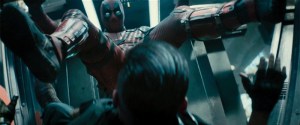
I was worried that a Deadpool sequel would fall into some of the same detractions that a Guardians of the Galaxy sequel did, and this is still applicable. Deadpool, much like the original 2014 Guardians film, was a breath of fresh air and a far looser, weirder, funkier super hero movie with a nose-thumbing, prankish attitude. We didn’t know what to expect from a Deadpool movie and now we do, and with that knowledge comes an anticipated formula of checklists to adhere to, and so any resulting sequel will invariably feel less fresh. It happened with Guardians of the Galaxy vol. 2 so to compensate James Gunn concentrated on fleshing out secondary characters into people you might shed a tear over. Deadpool 2 doesn’t bother because Deadpool 2 doesn’t take anything really seriously. That’s one of the hallmarks of the series and also one of the aspects that holds it back. There can never be a sense of stakes with a gleeful, fourth wall-breaking cartoon of a character who bounces back like Wile E. Coyote. The sequel introduces a sense of stakes with a startling turn in the first ten minutes of the movie, but by the end, even that will be corrected so that the Deadpool universe returns to stasis. The limitation of the Deadpool universe is that nothing feels meaningful or even ambitious. The movie wants to be a cheeky, transgressive good time and it achieves this single goal.
The appeal of Deadpool 2 is still its comedic voice and unpredictability. The laughs will be frequent and there are some subversive and unexpected directions that fully take advantage of the R-rating and the anarchic, nasty comic spirit of the franchise. The formation of the X-Force team and how their first big mission plays out had me howling with laughter. The meta humor commenting on the nature of super hero movies, as well as the film industry in general, begins with the very opening image (a nod to another successful R-rated super hero movie of last year) until the very last moment where Deadpool goes back in time to prevent some stinging cinematic grievances (there is no post-end credit scene, so you can skedaddle early). This is clearly the role Reynolds feels a spiritual kinship with, and his caddish, charming, persistent persona makes the perfect conduit for the film’s vulgar insanity. Whether it’s spitting insults, splashing in over-the-top violence, or making odd observations about the similarities between the songs from Frozen and Yentl, Deadpool 2 is first and foremost a bloody, depraved meta comedy.

Director David Leitch (Atomic Blonde) steps in for the departing original film’s director, Tim Miller, and continues his hot streak of stylish, action thrillers. Leitch has shown a propensity for staging intense action sequences to best showcase intricate choreography. With Deadpool 2, the most exciting moments are when the camera and editing allows the audience to fully appreciate the creativity of the choreography and stunt team. A shot of Cable leaping over the speeding caravan about to smash into him brings on a well-earned wow. Coming from that bruising world, I’m continually impressed with how Leitch approaches his action and finds organic points to develop and complicate matters. The prison caravan attack is the action peak with well-constructed, parallel lines of activity to follow and collaborate upon. It’s our first taste of Deadpool and X-Force versus the might of Cable. The characters enter the fray at different points and get separated from the runaway caravan, which keeps the momentum going. While the comedy is prioritized, Deadpool 2 can still unleash enough exciting, silly, and satisfying action.
The biggest additions to the sequel are an adversary and an ally, and both leave a favorable impression while still making you wish that Deadpool 2 had done more with them. Brolin (Avengers: Infinity War) bulked up considerably to play the gruff cyborg from the future, and his super serious, macho straight man provides a terrific comic foil for Deadpool, much like the stuffy Colossus in the first film. Brolin’s character is a capable fighter with a pretty streamlined back-story (shades of Looper abound) but it’s hard not to feel a little disappointment with how he’s ultimately utilized. He’s a great asset that feels put away for too long. Zazie Beetz (TV’s Atlanta) has a fun introduction especially as it relates to her mutant power, great luck. Deadpool scoffs at this as a power, and “being deeply un-cinematic,” but Domino proves otherwise as she’s able to dodge split-second danger in grand, complicated, Final Destination-like circumstances. Every time she’s onscreen, Domino brings a curiosity quality to the movie, and it’s usually something imaginative and fun. Beetz has an innate spunky energy, which makes it sad when the movie often asks her to be dour and dismissive. It’s taking such a lively character and constricting what makes her amusing and unique.

The biggest thing holding back the film, besides a general sense of “more of the same” or its inherent lack of stakes, is that the entire storyline is built around saving a mutant teen…. and I kind of hated the kid. My first impression was not good and it didn’t get much better from there. Part of it may be that Russell is meant to be an angry, obnoxious teenager, and maybe part of it is the generally grating performance from Dennison (Hunt for the Wilder People), but I could not care about this kid. Unfortunately, a lot of thematic emphasis is placed on saving the soul of this one annoying, wayward teenager. He’s supposed to be a point of redemption for Deadpool and a promise to be fulfilled, but my pal Ben Bailey came up with an instantly better revision. Instead of introducing this new teen character who will one day grow up into a super villain that slaughters Cable’s future family, why not have it be Negasonic Teenage Warhead (Brianna Hildebrand)? We already have an investment in her character and it would provide a better, more personal sense of stakes for the story. Plus, Hildebrand (Tragedy Girls) is actually a good actress.
If you were one of the many fans who enjoyed the irreverent antics of the first Deadpool, then you’ll enjoy Deadpool 2 as it’s more or less the same movie with a slightly limited freshness date. These movies are fun, funny, and ridiculous, but they’re also good for little else than a wicked good time, and that’s okay. There isn’t much ambition to be anything more than an irreverent satire on super heroes with edgy humor and explosive violence. The running theme of the sequel questions what Deadpool has to keep on going, and he’s told it’s one very specific F-word: “family.” I think it’s a different F-word, namely “franchise.” Fox (Disney?) will need the services of the merc with the mouth for an extended engagement as long as audiences do not tire of the same studio brand of naughtiness reheated with a few different ingredients added per revisit.
Nate’s Grade: B
Share this:

Life of the Party (2018)/ Breaking In (2018)
 Just in time for Mother’s Day weekend comes two eminently bland, safe, and unmemorable movies that generally waste their female stars. Melissa McCarthy has proven herself one of the most funny and dynamic performers in comedy, but Life of the Party is a listless and groan-inducing back-to-school comedy that feels tonally off, adopting the persona of its tacky, talky, and awkward middle-aged mother. You would think the premise would lead to plenty of R-rated shenanigans, but instead the film adopts a very sedate PG-13 atmosphere, dulling the wild collegiate experience into something so predictable and safe as to be completely inoffensive. It feels like a caricature reminiscent of a feature-length rendition of a Saved by the Bell: The College Years. McCarthy falls back on tired, corny jokes that don’t attempt to be anything else, and the supporting cast is left to gasp and grasp for anything to spark laughs (special credit Gillian Jacobs for doing everything possible as “coma girl”). McCarthy is best when given room to improvise and discover interesting odd angles for jokes, but she also needs a stronger comedic vision, and that’s not going to come from husband/co-writer/director Ben Falcone (Tammy). It feels like they had a general outline for a comedy and, in grand collegiate tradition, pulled an all-nighter and sloppily finished a serviceable draft. I chuckled about four times, mostly involving an exuberant Maya Rudolph and the one clever structural payoff revolving around a much younger fraternal hookup. Mostly, Life of the Party lacks a sense of stakes, credibility, surprises, development, and laughs, though the middle-aged mothers in my preview screening lapped it up, so take my opinion with a grain of salt if the trailer seemed moderately appealing for you.
 On the other side, Breaking In is a mundane, low-budget home invasion thriller that disappears almost instantly from memory. I’m struggling to even come up with enough to say in this review that isn’t just repetitions of the word “boring.” Gabrielle Union (Bring it On) plays a mom who brings her two children to visit the estate of her recently deceased, estranged father. Also visiting is a trio of stupid robbers searching for a hidden stash of money. They take the kids hostage though keep them locked in a room and in little danger. Union’s determined mother must break in and save her children. It’s a thriller without anything genuinely thrilling to experience, as each chase or near miss hums along ineptly and tediously, finding the least interesting conclusion. There are no well-drawn suspense set pieces to quicken the pulse, no clever escapes or near-misses, no intriguing villains with strong personalities, and no entertainment to be had through its strained 88 minutes. There are glaring plot holes, chief among them why doesn’t she just flag down a car and call the police rather than hack it alone. Depressingly, Breaking In is actually directed by James McTeigue (V for Vendetta) who seems to have exhausted any sense of style and excitement he may have had earlier in his directing career. It feels like nobody really cared about the movie they were making, and that lack of enthusiasm and effort translates into one very boring and very poorly written and executed thriller. Union deserved a better showcase but, then again, the audience deserved a better movie too.
Nate’s Grades:
Life of the Party: C-
Breaking In: D+
Share this:

Tully (2018)
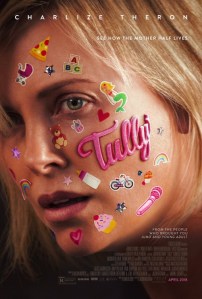 Tully is a Young Adult reunion, bringing back writer Diablo Cody (Juno), director Jason Reitman (Up in the Air), and star Charlize Theron (Atomic Blonde), and for people without kids, it can feel more like a horror movie. Numerous movies have conveyed the challenges of parenthood, the put upon moms and dads struggling to juggle schedules and lunches and homework, all without much time to themselves for self-care. Usually these movies will begin by displaying the hardships of parenthood but ultimately put a cheery bow on things by the end and conclude, “Yeah, but it’s all worth it.” Tully doesn’t provide that easy bow and I appreciated that. Motherhood can be a real bitch.
Marlo (Theron) is a 40-year-old mother who feels overwhelmed with life. She’s about to have baby number three and her “atypical” youngest son requires a lot of intensive supports and is upsetting his school. Her husband, Drew (Ron Livingston), is away for work often and late at night he plays online games and keeps to his side of the bed. Marlo’s rich brother (Mark Duplass) takes it upon himself to hire a “night nanny,” a person who watches the newborn baby during nighttime hours and allows the mother to get some restful sleep. Marlo is adamant about not letting a stranger watch over her child but soon relents and calls for the nanny. Enter Tully (Mackenzie Davis), a mid-twenties godsend who is wise beyond her years, competent, and nonjudgmental. With Tully’s assistance, Marlo is able to make steps toward becoming the person she remembers.
 Through its depiction, it feels like parenthood has a lot in common with incarceration. It feels like a new parent goes away for a multi-year sentence, loses all sense of sleep, is indentured into work often without any compensation, and required at a moment’s notice at all hours. Marlo’s life is certainly unglamorous but it’s also taking its toll. The needs of her children, including one with undiagnosed special needs, are snuffing out her sense of self and taking an unremitting physical and mental toll. The opening of the film has Marlo days away from her third pregnancy and she looks like she’s smuggling a beach ball. Her brother’s wife cheerfully adds, “You look glowing,” that age-old pregnancy praise, and Marlo’s unfazed reaction is more of a, “Really?” She then proceeds to compare herself to the trash barge that floated along the East Coast in the 1980s, a perfectly plucked pop-culture allusion from Cody. At no point do you doubt the love Marlo has for her family, but the servitude is driving her crazy and with no relief in sight with baby number three. There’s a pristine montage of her daily routine of feeding, pumping, changing diapers, and absent sleep, the days just melting into one another, and it’s so horrifying in its mind-numbing execution that it reminded me genuinely of Darren Aronofsky’s Requiem for a Dream montages of drug-abuse and despair.
It’s a third of the way into the film when Tully enters the picture and serves as the long-needed change agent for Marlo. She’s the miracle worker nanny that works at night like a whimsical little elf, and the next morning the house is clean, the baby is taken care of, and Marlo has been allowed a rejuvenating night of sleep. You can chart the change in the quality time with the family, where quickie microwave pizza dinners become more advanced home-cooked meals with multiple ingredients and food groups. You can also chart the change through the magnificent performance of Theron, who appears to be regaining her sense of self and placement in the family. Tully serves as a refreshing, therapeutic conversationalist, able to get Marlo to introspectively reflect upon her life’s goals and setbacks and her sense of what she should be as a woman and not just as a mother. Tully is wise but also winsomely hopeful and optimistic; she recharges the battery for this family and Marlo in particular. These gentle, observational conversations are the best part of the film and Theron and Davis are wonderful together. Each woman seems to be learning from the other and providing a support system.
 Cody’s early screenwriting was dinged for its obsession to be quippy and hip, but it has matured and depended over the years. Young Adult was an incisive character study in kamikaze narcissism, and it was as cold as Tully is warm, even-handed, and honest. Having a talent as surefire as Theron is a great asset, but it’s Cody’s storytelling that gives the movie its sting and its sweetness. This is something of a comfy thematic middle ground between the ironic, quippy yet sentimental Juno and the dark spiral of stunted growth in Young Adult (seriously, rent that movie again if you can, it’s vastly underrated). Tully is a movie that is lifted on wry observations and honest dialogue. It feels very real, so much so that I was convinced the reality show-within-a-show Gigolos (Marlo is a bashful fan) was the real deal for most of the movie [Edit: it has come to my attention this is a real show. Ahh, still a nice detail about Marlo character]. I also loved the drive into Brooklyn being relegated to jump cuts, each new jump playing a different Cyndi Lauper track on an album, which feels very biographical and authentic. The details of Cody’s story feel sharply developed and authentic, and that’s the biggest draw of this movie. It’s an unvarnished look into the realities of motherhood and each little detail helps further contribute to the larger portrait of Marlo’s exhausted life. The supporting characters do get a bit of short shrift here, kept as one-dimensional peripheral portrayals. I was expecting more from her husband Drew since their relationship and the platonic valley they’ve found themselves stuck in is another significant aspect. However, the movie is really about the relationship of Marlo and Tully and how they build up one another. Marlo even sees herself in the younger nanny, and she’s also wistful of a time that her body more closely resembled that of Tully’s flat tummy and compact derriere.
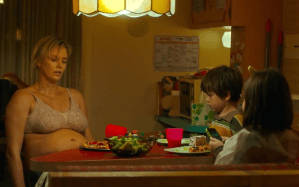
Theron continues to establish with role after role what a phenomenal acting chameleon she can be. I know we gush about Cate Blanchett, Amy Adams, and Kate Winslet as the finest actresses of their generation, but I feel like Theron deserves to be in that same hallowed Pantheon. She gave one of the best performances I’ve ever seen in 2003’s Monster and I think she was deserving of nominations for work as varied as a one-armed post-apocalyptic feminist warrior. Theron gained fifty pounds for this beleaguered role, which is an impressive commitment, but she doesn’t just let the weight gain serve as the focal point of her performance. She uses every exhausted muscle to communicate Marlo’s plight. When she’s slumped over in a chair and just rips her off stained shirt, you feel her utter defeat and desperation (“Mom, what’s wrong with your body?” one child asks). This is a woman who is tired to the bone. She’s taking everything life gives her and soldiering onward, afraid to speak up. This is best voiced when she describes her relentless day and staring into a closet and thinking, “Didn’t I just do this?” Theron’s renewed vitality as mother, wife, and most importantly, person, is a rewarding development to tag along with. Theron’s breadth of tenderness, sadness, and hard-won insight is easily relatable and emotionally engaging.
 The one thing that holds me back from fully embracing Tully is a late story decision that I’m still wrestling over. It feels a bit like tonal whiplash and I immediately felt like it was completely unnecessary and that I was happy with the movie already being told. It left me jarred although I admit this decision helped provide better context for some unexpected turns in the middle between characters. Having deliberated for a couple of days, I can see how this decision plays into a larger sense of theme and character, while also tapping into something primal about motherhood and the emergency lifelines needed and provided. I’m warming to Cody’s decision and can see the rationale behind it. Still, there will be plenty of audience members that will be left questioning the thought process here.
Tully is the third collaboration between Cody and Reitman and they bring out the best in one another. After two duds in a row, I was worried that Reitman had become all too mortal after his 2006-2011 run of amazing films. It’s reassuring to find Reitman back in finer form and to also experience the maturing growth of Cody’s exceptional writing. I wish there was more with the supporting characters but this is a character study of our main momma. The late plot turn will divide audiences (I’ve already identified with both sides) but it serves the film’s larger focus on the well-being and recuperation of Marlo. Tully is a funny, compassionate, and unflinching movie about the perils of motherhood and the steps we all need to take to activate a little necessary self-care.
Nate’s Grade: B+
Share this:

Avengers: Infinity War (2018)
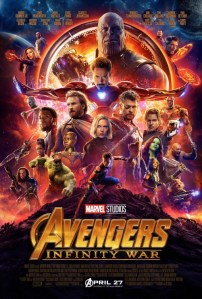 It’s hard to draw comparisons to the major commitment to long-form storytelling that the Marvel Cinematic Universe (MCU) has dabbled with over the course of ten record-shattering years of success. I can think of movie franchises that have been popular over long periods of time, like James Bond, but rarely do they keep to continuity. It’s been 18 movies and ten years since the caddish Robert Downey Jr. first stole our hearts in the original Iron Man, and its stable of heroes and villains has grown exponentially. Looking at the poster for Avengers: Infinity War, it’s hard to believe there’s even enough space just for all of the actors’ names. Infinity War feels like a massive, culminating years-in-the-making film event and it reminded me most of Peter Jackson’s concluding Lord of the Rings chapter, Return of the King. After so long, we’re privy to several separate story threads finally being braided as one and several dispirit characters finally coming together. This is a blockbuster a full decade in the making and it tends to feel overloaded and burdened with the responsibility of being everything to everyone. It’s an epic, entertaining, and enjoyable movie, but Infinity War can also leave you hanging.
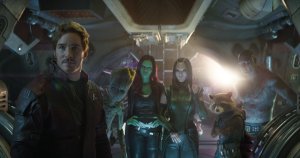
Thanos (Josh Brolin) has finally come to collect the six infinity stones stashed around the universe. With their power, he will be able to achieve his ultimate goal of wiping out half of all life in the universe. Standing in his murderous way is a divided Avengers squad, with Tony Stark (Downey Jr.) still on the outs with a wanted-at-large Captain America (Chris Evans) and Black Widow (Scarlett Johansson). One of the in-demand infinity stones resides in the head of the Vision (Paul Bettany), who is in hiding with his romantic partner, Scarlet Witch (Elizabeth Olsen). They know Thanos will be coming for Vision eventually. On the other side are the Guardians of the Galaxy who have a few personal scores to settle with Thanos, the adopted father of Gomora (Zoe Saldana) and Nebula (Karen Gillan). Elsewhere, Thor (Chris Hemsworth) strikes out looking for the key to defeating the big purple menace. Thanos’ loyal lieutenants attack Earth to gather the remaining infinity stones, drawing the attention and push-back of Doctor Strange (Benedict Cumberbatch) and Peter Parker (Tom Holland). The various heroes of Earth and space unite to eliminate the greatest threat the universe has ever known.
 Avengers: Infinity War serves not as much a series of payoffs as it is climaxes, with climactic event right after another, and this time it’s for keeps (more on that below). There are moments that feel like major payoffs and moments that feel like shrug-worthy Last Jedi-style payoffs. Infinity War is the longest MCU movie yet at 149 minutes but it has no downtime. That’s because it has to find room for dozens of heroes across the cosmos. With the exception of three super heroes, everyone is in this movie, and I mean everyone. This is an overstuffed buffet of comic book spectacle, and whether it feels like overindulgence will be determined by the viewer’s prior investment with this cinematic universe. If this is your first trip to the MCU, I’d advise holding off until later. Any newcomer will be very lost. I’ve deduced the seven MCU movies that are the most essential to see to successfully comprehend the totality of the Infinity War dramatics, and they are Iron Man, The Avengers, Captain America: Winter Soldier, Guardians of the Galaxy, Captain America: Civil War, Doctor Strange, and Thor: Ragnarok. Naturally, being intimately familiar with the previous 18 movies will be best, but if you don’t have thirty hours to spare then please follow my seven-film lineup and you’ll be solid.
As far as the stakes, the MCU has been notoriously reluctant about killing off its characters, but Infinity War is completely different. I won’t spoil circumstances or names, of course, but the march of death happens shockingly early and carries on throughout. There are significant losses that will make fans equally gasp and cry. This is a summer blockbuster that leaves behind an impressive body count across the known universe and ends in a downbeat manner that will naturally trigger reflexive Empire Strikes Back comparisons. It’s hard to feel the full impact of the drastic decisions, and the grief over their losses because I know there is a Part Two coming summer 2019, and with that comes the almost certainty that several important events will be diminished or straight-out reversed. After all, in comics, nobody is ever really dead, though with movies the heroes have the nagging habit of aging. With that said, you better believe I was holding my breath during some standoffs, tearing up at some sudden goodbyes, and reflecting upon journeys shared.
 This is very much Thanos’ movie, which was one of the bigger surprises for me. Beforehand, our exposure to the big purple guy has been relatively minor, a brief moment here or a cameo there during a post-credit scene. Considering Thanos is supposed to be the universe’s biggest bad, it makes sense to finally give him his due, and that is what Infinity War does. Thanos gets the most screen time of any character and is given an honest-to-God character arc. He’s a villain who goes on an actual emotional journey as he follows a path that he feels compelled to even as it tests him personally. He finally opens up as a character rather than some malevolent force that is oft referred to in apocalyptic terms. We get his back-story and motivation, which is less a romantic appeal to Death like in the comics and more a prevention of the apocalypse reminiscent of the Reapers in the Mass Effect series. Thanos sees himself as a necessary corrective force and not as a villain. He’s never portrayed in a maniacal, gleeful sense of wickedness. Instead he seems to carry the heaviness of his mission and looks at the Avengers and other heroes sympathetically. He understands their struggle and defiance. Having an actor the caliber of Brolin (Deadpool 2) is a necessity to make this character work and effectively sell the emotions. Thanos is the most significant addition to the MCU appearing the latest, so there’s a lot of heavy lifting to do, and Infinity War fleshes him out as a worthy foe.
 As an action spectacle, however, Infinity War is good but not great. The action sequences are interesting enough but there’s nothing special and little development. There’s nothing that rivals the delirious nerdgasm of the airport battle in Civil War pitting hero-against-hero to dizzying degree. The characters are separated into units with their own goals leading to a final confrontation that feels more climactic conceptually than in execution. That’s because this is an Avengers film that falls into some of the trappings of the glut of super hero cinema, namely the army of faceless foot soldiers for easy slaughtering, the over exaggerated sense of scale of battle, the apocalyptic stakes that can feel a bit like a bell rung too many times, and even minor things like the lackluster supporting villains. Thanos’ team of lieutenants are all the same kind of sneering heavy with the exception of one, a sort of alien cleric heralding the honor of death from Thanos. Carrie Coon (HBO’s The Leftovers) is generally wasted providing the mo-cap for the Lady Lieutenant That Sounds Like a Band Fronted by Jared Leto, a.k.a. Proxima Midnight. There are far too many scenes where characters reluctantly strike a deal to give up an infinity stone if Thanos will spare the life of a beloved comrade. The film’s greatest point of entertainment isn’t with its action but the character dynamics. The fun is watching years-in-the-making character interactions and seeing the sparks fly. There’s more joy in watching Downey Jr. and Cumberbatch try and out smarm one another than with any CGI collision of a faceless army of monsters. There are so many characters that few are given fully defined arcs. Most are given beginnings and stopping places. Though the eventual sequel will have fewer characters needing to share precious screen time.
The standouts on screen are Hemsworth (12 Strong) carrying a large portion of the movie and not missing a beat of his well-honed comic rhythms from Ragnarok, Bettany (Solo) brings a sad soulfulness to Vision as a man who knows fate is likely unavoidable, and Dave Bautista (Blade Runner 2049) is perfectly deadpan as Drax and has the funniest lines in the movie followed closely by the exuberant Holland (Lost City of Z). To even say which characters deal with more complex emotions might be a spoiler in itself but there are several actors showing an emotive level unseen so far in the bustling MCU.
 Avengers: Infinity War marks a significant concluding chapter for one of cinema’s most popular series, until at least the next movie possibly makes it feel less conclusive. I pity Marvel because expectations are going to be astronomical for this climactic showdown. There are so many characters, so many crossovers, and so much to still establish, like Thanos as a character more than a spooky force of annihilation, that it feels rather breathless even at nearly two-and-a-half hours. You may be feeling a rush of exhilaration on your way out or an equally compelling sense of exhaustion. Infinity War doesn’t have the imaginative highs of a Dcotor Strange, the funky personality and style of a Guardians of the Galaxy, the wonderfully thought-out structure of a Spider-Man: Homecoming, the adroit weirdness of a Thor: Ragnarok, or even the hero-against-hero catharsis of a Civil War (still my favorite). What it does have is a sense of long-gestating finality, of real stakes and dire consequences. It’s not all pervading doom and gloom; this is still a fun movie, buoyed by crackling character team-ups and interactions. While, Infinity War won’t be all things to all people, myself included, it will please many fans, casual and diehard alike.
Nate’s Grade: B
Share this:

Blockers (2018)
 Blockers (nee Cock Blockers, and changed on some posters to appear like Rooster-Shape Blockers) is like getting two fairly funny sex comedies in one. We have the perspective of the panicked parents (Leslie Mann, John Cena, Ike Barinholtz) who are doing whatever they can to thwart their daughters from seeing through their presumed deflowering pact on prom night. We also have the horny teen perspective from the teen girls (Kaitlyn Newton, Geraldine Viswanathan, Gideon Adlon). Each group has their own character arcs and comic set pieces, flunkies and wild supporting characters, and as they criss-cross over the course of one debauched night, lessons will be learned and, more importantly, feel earned. I was steadily impressed with how much Blockers does and does well, chiefly maintaining a sex positive attitude and never supporting the parents in their hysterical, generally sexist alarm. Each parent has to confront their feelings about really letting their daughter grow up, and that relationship leads to a sweet moment for each to acknowledge the error of their ways and grow closer with their child. If this had come out in the 80s or 90s, I’m sure the film would have adopted the parental viewpoint as correct. Hell, if it came out in the 80s, the fact that one of the daughters is gay would have been a source of shock or shame. Today, the father already knows and supports his daughter being a lesbian (he frets she’ll feel pressured to lose her virginity to the wrong sex). Oh, on top of all that, the movie is pretty funny from start to finish thanks to a deep cast of characters. Cena impressed with 2015’s Trainwreck and he shows yet again the promise of his heretofore-untapped comic resources. There is one comic set piece involving blind couple foreplay that feels downright inspired as it develops. Blockers is a raunchy sex comedy with more on its mind than yuks. It’s got a sweet center that allows the characters and their relationships to feel genuine. When you care about the people onscreen, it helps eliminate the sense of downtime.
Nate’s Grade: B


 nathanzoebl
You must be logged in to post a comment.