Category Archives: 2015 Movies
The Hateful Eight (2015)
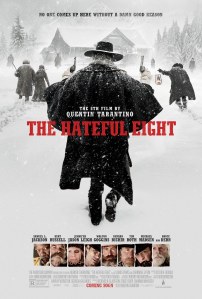 The Hateful Eight almost didn’t happen thanks to our modern-day views on copyright and privacy. Writer/director Quentin Tarantino sent the first draft of his newest script to three trusted actors, and within days it had spread to the outer reaches of the Internet. Tarantino was so incensed that he swore to shelve Hateful Eight and never film it. After a staged reading in L.A. with many of the eventual actors for the film, he changed his mind, to the relief of his sizable fanbase and actors everywhere. The Hateful Eight is a drawing room mystery with plenty of Tarantino’s signature propulsive language and bloody violence, but it’s also the director’s least substantial film to date.
In post-Civil War Wyoming, famous bounty hunter John “The Hangman” Ruth (Kurt Russell) is taking the outlaw Daisy Domergue (Jennifer Jason Leigh) to hang for her crimes. Along the way, he meets up with Major Marquis Warren (Samuel L. Jackson), a bounty hunter who served in the North and carries a letter written to him from none other than Abraham Lincoln. They’re both heading to Red Rock to extract their bounty earnings. Due to an oncoming blizzard, they’re forced to make a stay at Minnie’s haberdashery, except Minnie isn’t anywhere to be found. There’s Bob the Mexican (Demian Bichir) who says Minnie left him in charge, a foppish hangman Oswaldo Moblay (Tim Roth), a quiet cattle driver Joe Gage (Michael Madsen), a Confederate general, Sandy Smithers (Bruce Dern), and Chris Mannix (Walton Goggins), the son of a Confederate rebel who claims to be the newly designated sheriff of Red Rock. Over the course of one long night, everyone’s true identity will be learned, because someone is not who they seem to be and is secretly waiting to free Daisy and kill the rest.
 Even as lesser Tarantino, The Hateful Eight is still an entertaining and talky stage play put to film. The setup is strong and invites the audience to play along, to scrutinize the assorted characters and determine who is telling the truth. There are plenty of twists and turns and some violent surprises to keep things interesting. The conversations of the characters are such a pleasure to listen to; I want to luxuriate in Tarantino’s language. His wordsmith abilities are unparalleled in Hollywood. There’s a reason every star is dying to snag a part in a Tarantino movie, especially now that they’ve caught Oscar fire as of late. That’s somewhat crazy to think about. Cinema’s ultimate indie voice with his encyclopedic knowledge of the medium, high and low art, has become an institution within the system and his violent period films are now looked at as year-end prestige pictures. Tarantino’s M.O. has been to take B-movies and to transform them into A-movie level talent and intelligence. Never has a Tarantino flick felt more B-movie than The Hateful Eight. It was inspired from episodes of TV and it’s easy to see that genesis in its execution. It’s a self-contained mystery that comes to a head. It’s a limited story that’s likely taken as far as it could possible go, pushing three hours. I’m a tad befuddled why this was the movie Tarantino insisted on filming in “glorious Panavision 70 millimeter.” It’s almost entirely set in that one-room interior location. The extra depth that 70 millimeter affords would appear to be wasted, unless you enjoy looking at general store items on shelves in the background. Still, The Hateful Eight is a movie that doesn’t feel like three hours and harbors enough intrigue and payoffs to hook.
I tried to diagnose why this felt like lesser Tarantino, and it’s because over the course of almost three hours we don’t have much at stake because the people inhabiting the movie aren’t really characters but tough-talking facades. Tarantino is often cited for his uniquely florid dialogue, and nobody writes dialogue like Tarantino and his naturally stylized cadences, but another of the man’s skills is how great he can write a coterie of colorful characters that pop from the big screen. You might not be able to remember many lines from Hans Landa or Vincent Vega or Django, but you remember the vivid characters. Tarantino is preternaturally skilled at building characters that feel fully realized with their own viewpoints and flaws and prior experiences. He can make characters stand out but he also has the great ability to make the larger-than-life characters feel real, which is truly genius screenwriting for characters so flamboyant. The older romance in Jackie Brown is perfectly captured and felt. It’s downright mature. This is the first time I would say Tarantino has disappointed when it comes to his characters.
There are broadly drawn folk aplenty onscreen and they still talk in that wonderfully florid language of Tarantino’s that actors must savor like a fine steak, something they can sink themselves in for and enjoy every morsel. However, the characters onscreen have never felt this empty before. They are what they are and the only real change that occurs is that many will be dead before the end credits. They don’t have arcs per se but end points. It’s all about unmasking and identifying the rogues in a room full of rogues. Beyond Warren and Mannix, we’re left with precious little for characterization beyond bravado and nihilism. The effect of how empty they are would be felt less if we weren’t stranded with them for near three hours. Trapped in a room with a group of suspicious characters can only go so far, and ultimately it’s a parlor game that cannot sustain longer staying power. I doubt I’ll ever watch this with the frequency of other Tarantino flicks.
 “You keep talkin’. You’re gonna talk yourself to death,” says one of those hateful numbers to another member. I’d pay to listen to Tarantino rewrite the phone book, that’s how excellent the man is with his dialogue. The man likes to hear his words and I like listening to them too. The problem is that The Hateful Eight has no reason for its gargantuan running time. As stated above, the characters we’re getting are nowhere near as complex or interesting as previous Tarantino escapades, so the talking can grow weary. Tarantino has patented a new formula from 2009’s Inglorious Basterds that involves characters playing a game of I-know-you-know-I-know while they suss out the truth, all the while the tension finely simmers until it blows. It’s a long fuse of suspense that can pay off rich rewards, like the near-perfect tavern scene in Basterds. The dinner table scene with Candie and the skull of his favorite house slave is another good example. Once our titular eight have gathered at Minnie’s, the entire movie is this sort of scene. It may be broken up into chapters and flashbacks but it feels like one long scene.
There’s also far less at stake than there was with Basterds or Django Unchained, even Reservoir Dogs, and that’s because the protagonists had goals and we had built up far more allegiance and time with them. When they were in danger, it mattered. The danger doesn’t feel as immediate because so little else is happening. There are plenty of comparisons to Dogs, which also utilized a hidden identity and a confined location. I think the difference was that, besides it being Tarantino’s first foray as a director, the tension was felt more because the danger was immediate from the start and we cared about character relationships. I cared about Mr. Orange and Mr. White and their bond. I can’t say I cared about any of the characters in Hateful Eight. I found them interesting at points, sure, but they were all a bunch of rotten bastards with little variation short of a burgeoning understanding between Mannix and Warren. The wait at Minnie’s feels like the Basterds tavern scene on steroids, pushed to the breaking point, and yet absent the urgency.
The acting is yet another tasty dish served up by Tarantino, and it feels like the actors are having the time of their lives playing their lively scoundrels. Jackson (Kingsmen: the Secret Service) settles in nicely and always seems to elevate his game when he’s reciting Tarantino’s words. He’s icy cool in scenes where the other characters are trying to do whatever they can to fire him up. He’s less bombastic than we’ve come to expect from Jackson. For bombast, there’s Russell (Furious 7) who cranks his performance to the broad heights of his bellicose lawman. Goggins gives a sly and extra caffeinated performance that answered the question of what it would sound like if you dropped his character from TV’s Justified into a Tarantino movie. Roth (Selma) feels like he’s doing his best manic Christoph Waltz impression. Dern (Nebraska) is a racist codger with a soft spot for his kin. Madsen (Kill Bill vol. 2) seems somewhat wasted as a taciturn “cow puncher.” Bichir (The Heat) gets some laughs as a seemingly aloof caretaker. It’s Leigh (Anomalisa) who steals the show, especially in the film’s second half. Daisy is a character that relishes being bad, and Leigh takes every opportunity to enjoy the fun. Her character plays a bit of possum during the first half but it’s the second half where she lets loose and becomes unhinged, and her exasperated and grotesque responses are often played for great sputtering comic effect. It’s a boys movie but it’s the lone woman who will prove most memorable. Tarantino’s last two movies have won acting awards and Leigh just might make it three-in-a-row.
 There are also some uncomfortable elements that can deter your viewing enjoyment, which isn’t exactly a foreign charge against Tarantino’s career. At this point you can probably repeat the oft-cited accusations: flagrant use of the N-word and exploitative violence. At least the historical background provides a context for the other characters unleashing the N-word, and I’d argue it tells us something about the characters as well. The characters that use the N-word when referring to Warren are the ones with allegiances to the Confederacy and those viewpoints don’t vanish even after you lost a war. They’re dismissive and intolerant and view Warren as sub-human. It also doesn’t approach Django Unchained-levels of excess, so I let it slide (I know my perspective as a white male makes my opinion on this effectively meaningless). It was the violence that got to me, specifically the violence directed at Daisy. Tarantino’s penchant for violence goes all the way back to his ear-slicing debut, so it’s nothing unexpected. He often tells stories about violent men and women fighting their way in a world governed by violence. I accept that these characters are bad to their core. That doesn’t excuse behavior. Violence on screen can be tempered with authorial commentary, but it’s the association that bothered me with Hateful Eight. For the entire movie, Daisy is put through the physical wringer. Our very first image of her is with a black eye. She’s a nasty woman and Ruth often expresses his distaste of her by punching her in the face, which is played as dark comedy. This happens repeatedly. We’re meant to recoil from much of the bloody violence on screen but repeatedly we’re meant to laugh at the violent suffering of Daisy. Tarantino has often used over-the-top violence as dark humor, and I’ve laughed along with it. This was one instance though where I stopped laughing and starting shifting uncomfortably in my seat.
Even lesser Tarantino can still be plenty entertaining and superior to most of what Hollywood usually cranks out as product. The Hateful Eight can be exciting, funny, surprising, and plenty of things, but what it can’t be is more than a lark. Tarantino has taken stories that would seem like larks, particularly the Kill Bill series, and infused them with pathos and meditation and soul to go along with all that snazzy genre stuff. It’s disappointing that Hateful Eight isn’t more than what’s on screen, but what’s on screen is still worth watching, though I don’t know whether it’s worth watching a second time.
Nate’s Grade: B
Share this:

Star Wars: The Force Awakens (2015)
 May 19,1999 is a day that lives in infamy for legions of Star Wars fans. The day hoped died. I remember trying to convince myself that The Phantom Menace was good but a second viewing confirmed my earlier fears. These movies were not going to be the same as the original trilogy, and George Lucas confirmed that with each successive release. I’ve had debates with teenagers who swear that the prequels are better films. They aren’t. This isn’t a matter of opinion; this is fact. After Revenge of the Sith was released in 2005, you could sense that Lucas was burned out and had no desire to further awaken the ire of the fandom. Then in 2012 he surprised everyone by selling the Star Wars empire, along with other properties like Indiana Jones, to Disney for four billion dollars. Immediately Disney let it be known that they wanted to get new Star Wars movies into production ASAP. They tapped J.J. Abrams to spearhead the first steps in a new direction. No other movie has felt the weight of hype and expectation like Episode VII: The Force Awakens. Fans don’t want to be hurt once more by someone they loved. For millions of fans that grew up on the original trilogy, The Force Awakens will be the Star Wars movie they have long been waiting for. It erases the bad feelings of the prequels and re-calibrates the franchise. However, it is also flawed and seems too indebted to nostalgia. It’s certainly good but I cannot put away my nagging reservations (far, far less than what I felt with the prequels).
Thirty years after the events of Return of the Jedi, the First Order has risen in place of the evil Empire. The First Order is lead by General Hux (Domhnall Gleeson) and aspiring sith lord Kylo Ren (Adam Driver). They’re searching for the droid BB-8 and its owner, Resistance pilot Poe Dameron (Oscar Isaac). The droid has a map that leads to the whereabouts of the last known Jedi – Luke Skywalker (Mark Hamil). A Stormtrooper who adopts the name of Finn (John Boyega) runs away from his mission and joins forces with Rey (Daisy Ridley), a scavenger waiting for her family to return to her world. The duo finds BB-8 and seeks to return the droid to the Resistance. They run into Han Solo (Harrison Ford) and Chewbacca (Peter Mayhew) and a few other familiar faces on their journey to the Resistance base and to escape the reach of the First Order.
 Abrams has captured the essential magic of what made the original trilogy so enjoyable and timeless. The prequels carried the burden of setting up characters we had come to love, and so as we watched younger versions of them or characters integral to their development, it was hard to ignore just how little we cared. It didn’t feel like Lucas himself cared that much, more content to direct his green screens than his actors. The special effects had improved but for much of the three prequels it felt like watching disinterested actors recite poorly written lines while they run around fake environments with no semblance of reality. The details that Lucas emphasized were ones that were unnecessary, like treaties and trade tariffs and the notorious midichlorians, which made the force into a blood disorder. The prequels harmed the legacy of the franchise. It takes only seconds for you to feel like you’re in better hands when you read the opening text crawl. No trade disputes. No galactic senate. It sets up its central chase and the important players in three brief paragraphs. And then we’re off and the movie rarely lets up.
We pass the torch to a new generation of characters and it’s here that Force Awakens is able to leave the large shadow of the original trilogy. The characters are great. Finn gives the viewer an entry point into a world we’ve never explored onscreen in any real depth, the life of a Stormtrooper, the cannon fodder of the series. He has moral crises and goes AWOL from the duties he has been raised to do. He doesn’t want to be a mindless killing-machine and forges his own destiny. Watching him embrace a sense of individuality is entertaining. He’s charming and excitable but also fearful of what may catch up to him. Then there’s the hero’s journey with Rey, a plucky heroine who comes of age over the course of the movie’s 135 minutes. Ridley has the presence and poise reminiscent of Keira Knightley, and the screen just adores her. It also helps when her character is easy to root for. Boyega (Attack the Block) and Ridley are terrific and even better paired together. They have a great chemistry and much of the humor is born from the characters rather than lame visual gags like in the prequels. It’s fun to hear characters verbally spar with actual good dialogue. Driver was the first actor hired and it’s easy to see why. If you’ve been watching the man on HBO’s Girls, you’ll know that he has a magnetic presence that separates him from the herd. He plays a villain that so badly wants to follow in Vader’s footsteps but the thing that holds him back is the “temptation of the light.” In one moment, a badass and imposing villain with super force powers had now also become an interesting character wrestling with his influences. Isaac (Ex Machina) is suave and cocksure as an ace pilot. His affection for the other characters is touching, particularly the robot BB-8. This little guy is going to be the toy that every child on Earth demands for the holidays. BB-8 is adorable from its first moment on screen and made me forget about R2D2. The big worry with Force Awakens was that its new characters would be compelling on their own. After one movie I’m looking forward to more adventures with the new kids on the block.
 Abrams has restored the sense of fun and awe that resonated from the original trilogy and the biggest compliment is that Episode VII feels like a Star Wars movie (more on which below). The action sequences are quick and filled with great visuals and shot arrangements. For those worried about Abrams’ penchant for lens flairs in the Star Trek reboots, they are completely absent in Force Awakens (Fun fact: for Star Trek Into Darkness, computer effects had to go in and take out lens flairs because Abrams later admitted he had gone a bit overboard). There are some beautifully orchestrated shots and sequences all around here. The first 40-minutes is the best part of the movie, before the older stars come back for their due. The rest of the film is enjoyable, no doubt, but I was more pleased with the original material. The technical expertise has never been higher. Like Mad Max: Fury Road, there’s a joy with watching characters interact with a real world of practical effects. Watching the characters run around real environments and real sets rather than immense green screens just makes it feel more real and vital. I enjoyed how worn and weathered the technology in this world comes across. The special effects are judiciously utilized and are excellent as anticipated. It’s easy to sense the reverence that Abrams and others have for the series as well as their determination to not repeat the mistakes of the prequels. The first mission for Episode VII is to reset the course, to wash away the bad taste of the prequels that haunt many. Abrams has gone back to what works with these movies and recreated the playbook. It’s a movie that will satisfy the hardcore fans and reawaken their love for the series.
And yet it almost feels like Force Awakens is a swing too far in the other direction, an overcorrection to the prequels that turns a reboot into a loving homage that approaches facsimile. I was amazed at just how closely Episode VII follows the plot beats of A New Hope (mild spoilers to follow – for real, if you don’t want to be spoiled in the slightest, and I’m no monster and won’t dare include anything that would substantially deter your viewing, skip to the spoiler safe area). Here goes: once again we start with an escape from an evil starfleet ship, only to land on a desert planet. The hunt is for a droid with valuable information. Our dispirit band of characters collect on the desert planet and flee, only to be eventually pulled back to the evil base of operations, which once again is a giant floating orb that specializes in planet destruction and this orb seems to have the same pesky design flaw that plagued Death Star 1.0 and 2.0. How does this one design flaw still exist? Are there not backups and redundancies? It would be like Titanic 3.0 going down by hitting another iceberg. There are more parallels involving the characters and personal revelations that mirror Episode IV but I won’t go into detail on those (end of spoilers). Suffice to say, it felt like I was watching a cover act remind me how much I enjoyed the first Star Wars release. Perhaps Abrams felt his rabid audience needed to go backwards before going forward, pay homage to what had been built by practically reliving its plot in a galaxy not so long ago as it once was (it still is likely the same distance: far far away). It’s a movie that cannot escape the nostalgia of its predecessors, and so it indulges it instead. In deferring to fan demands, Force Awakens has moments that waver into the dangerous territory of fan service. This will harm its overall staying power once the glow wears off from audiences overcome with relief.
 Thankfully, the new main characters are compelling and I’ll be happy to follow their continuing adventures with Episodes VIII and IX and who knows. Abrams and company have set up the next generation of fan favorites that have the chance to grow out of the sizable shadow of the original cast. However, not all elements are given that same nurturing care. The Force Awakens is so briskly paced that it rarely has time to establish the new history of its universe. We get character relationships and reunions but I couldn’t help but feel that the larger plot they inhabited felt rushed. The First Order seems rather vague and their rise to power needed at least some explanation. Instead we’re dropped right into a timeline with an Empire knockoff. It’s just easy fascism placeholder. Why are the Republic and the Resistance two separate entities? The villains with the exception of Kylo Ren are pretty one-note and also callbacks to the bad guy types from Episode IV. Captain Phasma (Gwendoline Christie) is in the movie for a lousy three minutes. I’m also not a fan of either of the two motion-capture performances courtesy of Oscar-winner Lupita Nyong’o (12 Years a Slave) and mo-cap pioneer Andy Serkis (Rise of the Planet of the Apes). I hated Nyong’o’s character and her performance. The character design for both of these creatures is rather weak and weirdly unimaginative. There’s also a habit of characters being naturals at things that would ordinarily require expertise. The worlds we visit and the creatures we encounter are all a bit too similar to earlier sources and distinctly unmemorable. We don’t learn much via our locations and geography and so it feels a tad interchangeable and meaningless, which is a shame.
The Force Awakens is a mostly exciting return to the rich world of Star Wars with characters we care about, old and new, lively action that feels substantial and real, and a sense of fun that isn’t at the expense of your full brainpower. Abrams had two missions: 1) eliminate the disappointment over the prequels, and 2) set up new characters and stories for future installments. Both have been accomplished. Abrams may have been the perfect candidate to restart the Star Wars series as he has a history of making films as loving homage to his cinematic influences. Super 8 was Abrams’ homage to Spielberg, and Episode VII is very much homage to Episode IV. The well-trod story allows for the series to reset comfortably while setting up its new characters to take a greater storytelling burden from here on out. I hope future installments give us more development to make the worlds and the history matter just as much as Rey, Finn, Kylo, Poe, and BB-8. This may be an unpopular opinion but I feel that Abrams’ rollicking 2009 Star Trek reboot is a better Star Wars movie than The Force Awakens. Abrams and company prove you can make a new and good Star Wars movie. Now my own new hope is that writer/director Rian Johnson (Looper) will be able to steer the franchise into a fresher direction with Episode VIII. In the meantime, fans can sleep well once again.
Nate’s Grade: B+
Share this:

Anomalisa (2015)
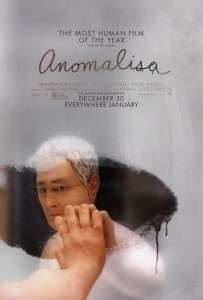 It’s been seven long years since the last Charlie Kaufman movie graced our screens. Cinema needs a voice as wonderfully strange and intelligent as Kaufman’s, and if it wasn’t for a successful Kickstarter campaign in 2012, we might have had to wait even longer. The stop-motion animated film Anomalisa is one of Kaufman’s most accessible movies and it involves felt puppets. Think about that for a second.
Michael Stone (voiced by David Thewlis) is a successful motivational speaker traveling to Cincinnati for a brief conference. He’s supposed to give a keynote speech on the importance of treating the customer like they are special; however, Michael is trapped in a purgatory of redundancy. Every other human being looks the same and sounds the same (all voiced by Tom Noonan), even Michael’s wife and young son. Then he hears a voice that breaks from the conformity of Noonan’s vocal chords. The voice belongs to Lisa (voiced by Jennifer Jason-Leigh), an unassuming and unabashed fan of Stone. She’s bright and lively but guarded due to a facial burn that hampers her self-esteem. She’s eager to spend time with Michael and confused when he insists on spending more time with her. Men usually gravitate to Lisa’s more carefree and forward friend. Not her. Over the course of that night, Michael and Lisa navigate one another. He’s fascinated to hear a new voice and wants to know all he can about her. She’s flattered with the sincere consideration. Michael only wants to be with Lisa from now on, but this decision will have consequences and it feels like there is an invisible force fighting against their union.
 I still can’t shake the fact that there seems little reason for this movie to be animated. Perhaps it’s the fact that it started as an oral play, but the use of the animation medium and everything it can provide so rarely feels utilized. The repeated faces of all the other humdrum human beings in the world, that wider-eyed gnome-like face, is a fine touch but the same could be accomplished through rudimentary computer effects now. Hell, Kaufman’s own Being John Malkovich achieved this in a memorable scene and that was over 16 years ago. I won’t pretend to know the economics of the animation industry but I just assume anything as time-consuming and precise is going to be pricey (reportedly the budget was $8 million). I thought of money during the first thirty minutes. It’s almost like a bet, as if Kaufman and co-director Duke Johnson (TV’s Frankenhole, Community) were trying to animate the banality of a business trip just because nobody has ever done it before. Here are a short list of other things, I assume, have escaped being replicated in animated form: waiting in line at the DMV, looking for a lost TV remote, cleaning one’s ears, watching the Republican presidential debates, changing the toilet paper roll, and filling out the iTunes user agreement. Would any of these banal acts deserve to be animated? Probably not, but I’m sure that’s the point for Kaufman and Johnson. For the longest time we’re meant to live the empty existence of Michael Stone and so we spend thirty minutes making pained small talk, checking into a sterile hotel room, calling loved ones, reconnecting with an ex, and visiting a sex shop in a drunken haze. My friend Ben Bailey asked the same question at five-minute junctions: “Is anything going to happen?”
Once Lisa is introduced, the movie finds its footing and purpose and it is a relief. Maybe that was Kaufman and Johnson’s design so that we, the audience, would also feel the same elation. The rest of the movie is watching a love affair, two people coming into one another’s orbit. The dialogue exchanges are very natural and slowly reveal different layers of the characters, mostly Lisa. Michael is intoxicated and demurs often, instead only wanting to hear the sweet sound of her voice. There’s a delicious irony to Michael working in customer service, an industry that is often listening to people’s angry voices over phone lines, and his inability to distinguish speech. Instantly we get a strong understanding of just how desperate Michael is to form a real connection. It’s his fawning attention that allows Lisa to allow herself to be vulnerable and assertive. In one of the most realistic sex scenes ever captured in movies, Lisa communicates what she wants and what provides her satisfaction, and Michael dutifully abides, determined to hear the sounds of her wonderful voice reach climactic degrees of pleasure. The love scene has garnered plenty of press just for the fact that it’s an animated film and our two characters are fully rendered, though this goes beyond just having recognizable parts. The way the bodies move, the way the lines and creases fold, the way people react to the inherent awkwardness of sexual congress, it’s all faithfully recreated and done so without a hint of comedy. This is by no means the raucous copulation from Team America. It’s a surprisingly touching moment as these two characters simply connect on a few levels.
It’s after the sex scene that everything changes. I’ll forego spoilers and say that there’s a certain buyer’s remorse when it comes to impulsive love affairs, and trying to maintain that same feeling of ecstasy can be like chasing a drug that requires more and more of oneself. There’s a very interesting transition that brilliantly illustrates Michael’s anguish. The conclusion is at once inevitable, hopeful, and also despairing. That’s because it opens up the world in a new way and provides further examination on Michael and the consequences of his crushing depression. The core of the movie is about the need for human connection. I wouldn’t cite Kaufman as a romantic but he does prioritize human connection and believes in the power of those fleeting moments. Aren’t we all looking for our own anomaly, someone whose voice slices through the din? Once those moments run their course, some of us grieve and some of us ascend, made stronger and more complete from the sum total of those magical experiences. The ending provides a new lens to interpret the movie, though most viewers will have already suspected given the mundane prison of the world onscreen. It’s not exactly a twist ending but more a confirmation that Michael Stone is personalizing his misery and unable to escape it. All he can look forward to are those fleeting moments of human connection and hope.
 The stop-motion animation is impressive though it seems intentional to elicit a certain strangeness. Stop-motion used to have that certain stutter-stop movement that made it wonderfully alien. With advances in technology, stop-motion can now look as seamlessly animated as other forms of the medium, as evidenced by the wonderful Laika releases like The Box Trolls and ParaNorman. Johnson and Kaufman decided to use felt dolls which allows the characters to have a certain glow to them, as if they’re emanating some internal lightness of being (apologies to Kundera). The illusion is getting easier to hide. Johnson makes the decision to show the seams of his universe. The facial marks that indicate the interchangeable partitions remain visible, making the Noonan-voiced characters look like they’re all wearing glasses. It’s an animated movie that wants to remind you it’s animated but tell a story that doesn’t need the assistance of animation. That’s one unconventional goal. I’ll admit that it did tickle me to watch the ongoing troubles of getting a room key card to work. Johnson also makes use of long takes to better communicate the reality of this world, from the mundane to the ecstasy. There’s one dream sequence that dips into more identifiable and surreal Kaufman territory, but excluding this moment the movie is mostly the ordinary fixtures of ordinary hotel rooms.
Following the uniqueness of its idiosyncratic creator, Anomalisa is unlike anything else out there and an animated film that is nakedly personable and desperate to grasp for something richer and more meaningful. I can’t say that this was a story that demanded to be told through this style or animation or if it even benefits from this approach, but Kaufman’s ear for human relationships is still sharp and refined. It’s like watching a stage play that just happens to be made with felt puppets that oddly feel very real. It’s a movie that has different layers of what constitutes reality, given an extra sheen of artifice. It’s a movie that conveys the hopes and disappointments of human connection from the awkward to the mundane to the revelatory. The film does an excellent job of communicating the all-encompassing heaviness of depression, how the ordinary can be just as soul crushing and harmful. And yet the film ends not on Michael but on Lisa and on a degree of hope, that the chance encounters that mark our lives are not without consequence and benefits, aiding people to take needed steps outward. It’s a movie about the significance of human connection; something that Michael desperately spends years looking for again, to feel fully human once more, to ignite the synapses. Anomalisa is a thoughtful and touching story. I don’t know if it’s an excellent movie or an unnecessary adaptation of an innately affecting stage play, but it’s Kaufman as romantic and cynic. Who knew puppets could get so deep?
Nate’s Grade: B+
Share this:

In the Heart of the Sea (2015)
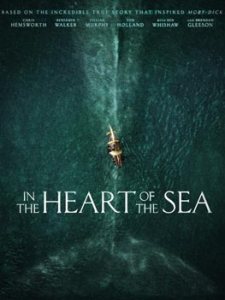 In 1822, the men aboard the Essex, a whaling ship sailing from Nantucket, Massachusetts, encountered a beast unlike any they have ever seen. Captain Pollard (Benjamin Walker) and his first mate, Owen Chase (Chris Hemworth), were at odds throughout the voyage, that is until they encountered a 100-foot long white whale. The creature destroyed the Essex, forcing the crew to drift at sea and hope to find land, but the whale follows them as well. Tom Nickerson (Tom Holland as a young man, Brendan Gleeson as the older version) recounts this traumatic survival tale to author Herman Melville (Ben Whishaw), who is desperate to write this true story.
There’s an old-school throwback vibe to In the Heart of the Sea with its high seas adventure, but there’s just not enough attention to adventure, character, or even plot for this movie to really set sail properly. The first act feels so sluggishly long. It’s trying to set up life on a whaling vessel in the early 19th century but I didn’t feel like we got a coherent sense of life aboard the seas or how the various components worked. I didn’t know that whalers row out from the main ship, so there’s that. The opening act sets up the dull conflict between Chase and Pollard, which can be summarized as blunt upstart vs. unchecked privilege. The conflict doesn’t evolve from this dichotomy. Both men are boring in their unyielding simplicity. Hemsworth (Avengers: Age of Ultron) made a stronger impression in Rush, but a humorless movie role is not in his best interests as an actor. When the action does arrive, it can be genuinely thrilling. Director Ron Howard does a slick job of conveying the danger and destruction of the whale attack. Sadly, it’s over too soon and then the remainder of the movie is 45 minutes of a survival drama adrift in the ocean reminiscent of last year’s Unbroken. This period of isolation forces the characters to make some hard choices, yet we don’t feel the impact of those choices because the narrative, too, feels adrift. Implausibly, the giant whale has followed them for thousands of miles. Are whales really this vindictive? The documentary Blackfish makes me wonder but it still feels unbelievable. What was the whale waiting for? For the men’s spirits to be completely broken before it might attack again? We’re told this whale is a “demon” but who exactly are the bad guys in this story?
 I believe another stopping point for this story is that the culture has moved beyond the acceptance of whaling as an honorable profession, to the point that I, and I assume others, was on Team Whale after witnessing a bloody hunt. It’s pretty gross, especially when they’re harvesting the whale body for the precious oil. Perhaps modern audiences, so far removed from hunting as an essential component of life have become more squeamish, or perhaps modern audiences just recognize something as barbaric when they see it. As a result, it’s hard to root for these guys. When the giant whale attacked it felt like retribution. My sympathies were more for the large mammal than the bipeds on ship. At the end of the film (some spoilers), the white-haired moneyed men of Big Whale Oil are worried what the truth will do to their industry. They want the surviving crewmen of the Essex to deny the existence of this gargantuan whale. This makes little sense to me other than awkwardly forcing a Big Business cover-up for relevancy. First off, whaling seems like a pretty unsafe working environment to begin with, especially considering voyages could last up to three years. Would the reality of one big bad whale destroy an industry? I doubt it since there is such money to be had. If anything it might rejuvenate the timber industry to reinforce the ships to make them more durable against larger whale attacks.
At first I thought a framing device was entirely superfluous; why do we need to watch Melville elicit this tale rather than simply just watching the tale itself? It seemed like a distraction, but as the movie progressed I understood that this framing device was its own sub-story and had its own complexity, namely the older Tom coming clean to the decisions that still haunt his soul. It’s an unburdening for both gentlemen, as Melville admits his deep fear that he is a mediocre writer (he’s no Nathaniel Hawthorne) and that he will be unable to tell this story as well as it truly deserves.
As these two men are allowing themselves to become more vulnerable and sharing their demons and doubts and worst fears, I started to realize that this framing device was weirdly more compelling than all the whale action. That’s because older Tom and Melville are the best drawn characters in the movie, which seems like a screenwriting mistake of sizable proportions. Obviously the nautical survival stuff should be the most compelling, and yet I as more taken with two men sitting by an oil lamp discussing their lives. Older Tom is infinitely more interesting than younger Tom; part of this is because young Tom hasn’t experienced the full effect of the events that shape older Tom, but most of this is from the very clear fact that young Tom is kind of a mute witness in this movie. He rarely speaks and is just kind of there, taking up space. There’s one personal harrowing moment when he’s thrust inside a hollowed out whale carcass to extract more blubber, but that’s the only personal perspective offered through young Tom. A question concerning the framing device: how is older Tom retelling events he had no participation or witness to? Another issue is that the characters on board the Essex are bereft of anything that would allow us to feel for them beyond simple human survival. Chase and Pollard are given one note to play and their eventual understanding and cooperation is fine but it feels like fleeting details in a story, lost to memory or disinterest.
 From a purely technical aspect, this is one of the better Howard films. The cinematography by Anthony Dod Mantle (Slumdog Millionaire) is rich and often breath taking, with plenty of stunning aerial and underwater images. The whale attack sequence is harrowing and thrilling. Howard finds ways to imply the harsher aspects of this life without going overboard, maintaining that PG-13 rating. While the look of the film has an enhanced color palate thanks to the extra boost of CGI filters, I still appreciated the vibrancy of the on screen images. As I said with the similarly boosted Mad Max: Fury Road, I’d rather have vibrant and bright colors than a drab and washed-out color palate. Even as the movie drifts and the characters fail to grab you, at least the visuals are pretty. While sitting through the second half, I started to rethink my own prejudices concerning Howard as a filmmaker, a man who lacks a distinctive style but has a definite feel for how to tell a story. I’m not going to excuse him for The Grinch and other misfires, or his tendency to settle for maudlin in place of subtlety, but the man is a born filmmaker.
In the Heart of the Sea is an old school movie that feels too sluggish, too underdeveloped, and too free of characters for the audience to invest in. When the framing device scores the biggest emotional pull, you better start rethinking your rip-roaring high-seas adventure. Master and Commander this is not. As the inspiration for Moby Dick, I wish I had just watched a remake of Melville’s actual novel (now with extra chapters about rope!). If you ever wanted a movie that ends on a blurb by Nathaniel Hawthorne as a payoff for Melville’s artistic neurosis, then your wait is over. In the Heart of the Sea feels like a whale of a tale that is hard to believe, which ends up inspiring a far greater story, which made me yearn for just watching that superior tale. Sometimes the “truth” behind famous stories is less interesting.
Nate’s Grade: C+
Share this:

Creed (2015)
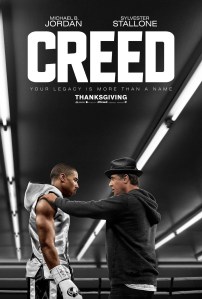 Creed is a crowd-pleaser, an effective character drama, and a rewarding continuation into the Rocky franchise that brings greater relevancy to Sylvester Stallone’s acting muscles. Thanks to the talents of co-writer/director Ryan Coogler (Fruitvale Station) and star Michael B. Jordan, the franchise is given new life by mostly following the same tried-and-true underdog formula that Stallone helped cement long ago. Jordan plays Adonis Creed, the illegitimate son to the deceased boxing legend, and he wants to make his way on his own merits. Adonis tracks Rocky (Stallone) down and convinces him to be his trainer, and the two build a father-son relationship supplying the half the other was sorely missing. From there the plot is fairly predictable as the media discovers Adonis’ identity and he’s fast-tracked for a high-profile bout with the outgoing champ but the movie still hits the right notes to earn its emotional triumph. I was surprised at the careful attention Coogler gave his supporting characters, providing details to round them out and make them feel like legitimate people rather than stock roles. I enjoyed Tessa Thompson (Dear White People) being an actual character rather than an underdeveloped love interest. Coogler’s fluidity with the camera is also striking, and many of the boxing matches are filmed in long tracking shots that amp up the sports verisimilitude. Jordan gives a strongly felt performance that further confirms his star status. The real surprise is Stallone, whose legendary fighter is starting to break down physically. Rocky’s inability to fight an invisible enemy makes for great drama, and Stallone sinks into the meaty dialogue. He has a few genuinely affecting moments, and I didn’t even know Stallone was still capable of that. Easily the best Rocky sequel, Creed is an uplifting underdog tale that doesn’t reinvent the formula but brings added attention, reverence, and sincerity to a whole lot of punching people in the face.
Nate’s Grade: B+
Share this:

Krampus (2015)
 Not quite funny enough and not quite scary enough, Krampus is a holiday antidote that wants to be a modern-day Gremlins but needed to be nastier, darker, or some variant with the suffix of –er. Writer/director Michael Dougherty has been down this holiday road before with Trick ‘r Treat, a superb horror anthology genre gem that was buoyed by a twisted sense of humor and a clever criss-crossing set of storylines that pollinated plenty of payoffs. Krampus begins with a brilliant opening credit sequence that sets a high bar o promise the movie will ultimately be unable to deliver, watching slow-mo stampeding shoppers fighting over Black Friday discounts set to a classic Bing Crosby yuletide tune. From there it’s more a Griswald dysfunctional family gathering until one of the young boys rips up his letter to Santa in disillusionment, calling forth Krampus and his minions. From there the family is terrorized and come closer together in struggle, trying to understand their predicament. There are a few great character designs for the minions, especially a jack-in-the-box whose face unhinges into a sarlac pit of teeth. The PG-13 rating keeps the film from getting too gory or too wicked, which also belies the fact that at heart it’s really an old-fashioned Christmas morality play about loving one another. I was ready to groan with what appeared to be the ending but Dougherty at least subverts the expected and makes sure that there are lasting consequences for bad behavior. This isn’t going to be remembered as a holiday classic but if you’re looking for a fun horror comedy, Krampus at least has something to offer before you feel left wanting.
Nate’s Grade: B-
Share this:

Macbeth (2015)
 It’s a mighty task to boil the Bard’s classics down to a tight yet meaningful running time and maintain a degree of cinematic quality. You don’t just want to film a stage play with the mighty parameters of film, and yet giving in to the visual majesty means less time for Shakespeare’s stirring words and complex characterization. Woe unto thee who attempt an adaptation. It requires more skill than thou would believe. I had hopes for the latest version of Macbeth from its top-shelf cast, Michael Fassbender as the titular ambitious murderer-turned king and Marion Cotillard as his wife and co-conspirator. It didn’t take long for my hopes to be dashed. First, the good: the rolling hills of Scotland are lushly photographed, and the concluding battle is set amid a roaring hellish fire and flying embers that makes for a stunning backdrop. The actors are fairly fine. If you couldn’t tell from this faint praise, there’s not much to credit as an achievement with this Macbeth. It’s strangely narcotized and often listless. It doesn’t help that the actors speak 80% of their dialogue in whispers or mumbles, even when they discover the former king has been murdered. Director Justin Kurzel (the upcoming Assassin’s Creed movie, also with Fassbender) falls back on monotony, whether it’s an overabundance of mist, similar and low-rent locations, and a plodding score that feels like scorpions are in your mind. Some of the changes are also for the worse, especially making Lady Macbeth more “sympathetic” and neutering one of Shakespeare’s great characters. She no longer sleepwalks and instead confesses her unshakable guilt to a cross. Also Macbeth is haunted by the ghost of his dead son with the witches. And there’s some brief inclusion of awkward sex amidst monologues. The final showdown comes at the 90-minute mark and the entire proceedings feel rushed and yet miraculously boring. Even the bloody violence is pretty tame considering its R-rating. If you’re looking for a truly cinematic Macbeth that enlivens Shakespeare, check out the Masterpiece Theater version with Patrick Stewart adapted into a 1930s Stalinist era. Now that was brilliant. Kurzel’s version of the “Scottish play” is one that only signifies disappointment.
Nate’s Grade: C
Share this:

Brooklyn (2015)
 If you’re looking for an Oscar movie this award season that will be perfect for grandparents, I direct you to the perfectly pleasurable Brooklyn. Beyond the throwback to the 1950 setting, it’s a movie that can appeal to multiple generations of audiences. There’s an admirable classical sense of filmmaking with Brooklyn, a delightful and charming movie with a healthy dose of nostalgia and heartfelt sincerity that should find a wide range of appeal to all ages.
Eilis (Saoirse Ronan) is an Irish immigrant who leaves her sister and mother to start a new life in Brooklyn. Thanks to a kindly Irish priest (Jim Broadbent) who had settled from her village, Eilis finds housing and a job. New York takes some getting used to, especially the density. Eilis is attending night classes to become a bookkeeper, but by day she works at a department store counter. It’s at one of the socials in her new Irish neighborhood where she meets Tony (Emory Cohen), a smitten yet confident Italian boy. She agrees to go on a date, actually two upfront, and it’s no time before Tony is walking her home from her night classes and talking about all his dreams. Eilis must return to Ireland for a family emergency. While she’s there, a bookkeeping job opens that needs her help, and a nice boy named Jim Farrell (Domhall Gleeson) grows closer to her with affections that aren’t exactly unwarranted. Eilis must decide which place to call her home and which life she wants to seek.
 While the story is set in the early 1950s, this movie could have been made in any decade of the film industry. It would not be out of place with the films of the 40s and 50s, hopeful and romantic odes about women finding new lives in the land of opportunity. There’s a classical sense to its storytelling that is rather universal about the struggles of self and independence. While this movie is awash in the period details of 50s New York City, it really could be told anywhere. The personal struggles of Eilis are completely relatable, which makes her an instantly engaging heroine. She’s a kind-hearted woman who’s trying to step out and discover who she wants to be, and this promising reality is a pleasure to watch. We’re watching the maturation of a person, watching her find her footing and gain confidence small victory after small victory. There aren’t any large or arch plot events to navigate. It’s the small moments in life, from starting a job, to becoming more sure of one’s self, to knowing whom to open up and trust. The movie is kept at a pleasantly low simmer of intensity, which works just fine. The gentle tone does not imply a lack of urgency but more so the beguiling and romantic spell. Thanks to writer Nick Hornby, who is becoming an ace screenwriter, the movie tells such a heartfelt and emotionally rich and resonate story in 100 carefully paced minutes. There’s a general joyous sensation that washes over you, elongating smiles naturally. The dialogue is often clever without being glib and the characters come across as realistic and humane. There’s only one character that is thinly drawn to approach being stock (well two counting the precocious “tells it like it is” kid). The others are hopeful, yearning, and fundamentally decent people. There’s something quite nourishing about watching decent people try and navigate their desires while maintaining their decency.
I think that’s what makes the love triangle work as well as it can, the fact that both options, not just the gentlemen at the center, are appealing. New York and Ireland both present options that afford Eilis opportunities in a career she wishes to pursue, both have compassionate men who have expressed an interest in her and are supportive of her education and goals, and both locations have a support system of friends. It may sound boring that Eilis can’t really go wrong with where and whom she chooses but I think that makes the ultimate decision that much more engaging. If these options weren’t so appealing then it wouldn’t be so interesting to watch. The mistake is that because the choices are good that there is less at stake when the opposite is true. She could rightfully be happy with either choice but which representation of Eilis will she decide? One life represents the old, the other he new. As I stated above, the characters in Brooklyn have an commendable decency to them, which makes the love triangle more difficult. Tony loves her completely but fears she may not come back, and yet he knows he has to let her go and she has to decide on her own where to call home. Jim is thoughtful and even though he obviously has feelings for her Jim knows that now is not the right time to ask, and so he too waits and hops he presents enough worth staying over. It’s a love triangle where you like all three participants, which happens so rarely in movies.
 Another strength of the film is that Ronan (The Grand Budapest Hotel) delivers a wonderfully felt performance. Much is placed upon her shoulders as our entry point into this world, and Hornby doesn’t resort to his characters explaining everything they’re thinking and feeling. Eilis is a woman who doesn’t speak in paragraphs but in short succinct sentences. She’s guarded but observant, and Ronan’s face is our great tapestry for understanding Eilis and her changing demeanor. We can watch her process the intimidating and invigorating world and read her thinking. It’s the most realistic Ronan has come across on screen as she has a habit of coming across slightly robotic, whether it’s as a pint-sized killer (Hanna), slain teenager (The Lovely Bones), or whatever the hell they were going for with the atrocious Violet & Daisy. With Ronan’s care, Eilis comes across like a resourceful young woman who is growing her sense of self. She’s a deserving lead for our simply story told with excellent care.
The only problem with a simple story told well is that it can also be predictable, which is a minor fault that doesn’t negate the impact of Brooklyn’s conclusion but does make it easy to anticipate. I’ll dance around spoilers but in a way I feel like even discussing the topic is going to be sufficient for you, dear reader, to accurately infer what direction the movie takes and which choice Eilis makes in the end. In short, Eilis makes a decision before leaving back to Ireland that somewhat stacks the deck in the favor of one of the two locations. This kept me from feeling like the choices were evenly considered. In the end, it’s a decision for Eilis about embracing her home and native culture and sense of community or branching out on her own and building something new and exciting. It’s possibility and independence versus comfort and family. It’s what can be versus what she’s known. It’s a decision that is universally relatable. Few of us have had romantic suitors and prosperous situations to vie over but many people have to make the normal decision of what path to embark, whether it’s the risk of something different or the reassurance of what is familiar and what has been earned. These aren’t the life-and-death stakes we see typically in the movies but they’re the decisions that often dictate fates.
Brooklyn is an easy movie to be carried away with. It’s full of honest and earned emotions that resonate from its reletability, tender heart, and gentle observations of watching a woman navigate the choices of her life. It’s an immigrant story and a coming-of-age tale, a romantic triangle with some fish-out-of-water elements. It’s a lot more than the sum of its parts, but with actors this good and with a script this tailored to deliver emotional uplift and satisfaction, those are some mighty impressive parts. If you’re on the hunt for a feel-good movie that won’t make you roll your eyes or overdose on sap, then I advise you and your family take a trip to Brooklyn and enjoy the sights.
Nate’s Grade: A-
Share this:

The Danish Girl (2015)
 While you watch The Danish Girl, you can feel the full weight of everybody’s good intentions. The filmmakers and cast all seem to realize that they are telling a story that will humanize and help others better understand trans issues. It’s the first sexual reassignment surgery and a community that is still fighting for wider acceptance. Nobody wants to screw up this story and do a disservice to representing the stories of the trans community. You feel the earnest good intentions with every frame, and yet I would argue those same good intentions end up paralyzing the movie and its impact.
Lili Erbe (Eddie Redmayne) is living her life as Einar Wegener, a Danish landscape painter of some renown in the 1920s. His wife, Gerda (Alicia Vikander), is a portrait artist trying to be more than the wife of a famous painter. One day, Gerda’s model is absent and she asks Einar to step in. He puts on stockings, holds a gown to his body, and it’s a revelation. Soon after Einar is wearing women’s garments under his clothes and Gerda dresses him up with makeup and a wig. It’s a fun diversion and something of a turn-on for Gerda, and then her husband informs her that Lili isn’t the costume, Einar is. Lili tries to find a sense of explanation with disdainful psychiatrists and doctors but is deemed aberrant. Lili is struggling with this crisis of identity and self-acceptance, and then a new beginning emerges with a helpful doctor who can physically transform Lili from a man into a woman. The surgery is not without risk but Lili is willing to do whatever it takes to feel whole (note: since Lili is the chosen gender identity for the film’s subject, I shall be referring to her as Lili and using feminine pronouns).
 Redmayne (The Theory of Everything) gives a suitably affecting performance that is full of empathy and a halting sense of fragility. He seems like he’s about to crumble at any moment, his nervous smile and pleading and confused eyes communicating Lili’s trepidation and flights of exciting discovery. Redmayne’s delicate androgynous features and long-limbed dancer’s body play to his strengths, as he adjusts his physicality to reflect his mind’s experimentation of what it would be like to be a woman. There’s a rather lovely visual where Lili visits a peep show in Paris. After a few minutes of bashful eye contact, she begins to mimic the peep show model’s physical poses, and the camera’s focus melts between the two. It feels like a dance between the two and in this simple visual much is communicated. Unfortunately, the majority of the movie lacks the impact of this poignant visual. Redmayne too often retreats into his stable of nervous gesticulations and halted speech. It’s a performance that feels too detached and too opaque to make you feel the full turmoil of Lili. There’s an interesting moment when, dressed as Lili, a smitten man kisses her without permission. Lili is upset at the lack of consideration, to which the man replies, “I couldn’t chance you saying no.” That little moment highlights the challenges of women in a society that doesn’t respect their agency. It’s too bad the movie doesn’t present more scenes that explore this new dynamic that Lili will have to adjust to. Instead the move repeatedly falls back on her as Brave and Strong. As presented, Lili is more catalyst than a fleshed-out character, which is remarkable considering the movie is reportedly about her struggles. Rather, the real focus of the story seems to be Gerda, who, incidentally, is the only person on screen referred to as “the Danish girl.”
Gerda is given equal attention in the screen adaptation by Lucinda Coxon (The Crimson Petal and the White), which is generous and will likely leave several viewers confused. First, Gerda is given the most complete character arc and a surprising amount of consideration for her perspective. I suppose she could be the audience’s entry point into this story, the relatable position for many audience members trying to better understand a loved one saying they were born in the wrong body. The movie presents greater empathy for Gerda’s plight than it does Lili, which is definitely unexpected and perhaps misplaced. Surely finding the courage to embrace a controversial identity that precious few will even acknowledge, let alone the bastions of contemporary medical science declaring such thinking to be signs of a degenerative brain, is a bit more of a risk than being a supportive spouse. I don’t want to mitigate Gerda’s own personal struggles dealing with the outward transformation of Einar into Lili. It’s a position that deserves deep empathy and the movie has it in spades, as we watch Gerda try to be supportive while the person she fell in love with erases himself. Vikander (Ex Machina) also kills it. Her performance is full of the breadth of emotions that I found wanting in her screen partner. Vikander’s face registers all the complicated emotions; she’s in a sense saying goodbye to her husband and a specific life they shared, and while for her it can feel like mourning, for Lili it is a rebirth. Viankder’s compassionate and nuanced performance as Gerda is the exclamation on one hell of a year for the Swedish actress.
Director Tom Hooper (Les Miserables, The King’s Speech) gives everything the proper stately appearance with his signature visual indulgences (the man loves his asymmetrical one-shots and generous head room in the camera frame). There are several landscapes or venues that look gorgeous or given a dream-like sense just from Hooper’s framing. His handling of his actors is first-rate, and there’s a comfortable sensuality to scenes between Einar and Gerda, further communicating just how enraptured each is with the other. The musical score by Alexandre Desplat (The Grand Budapest Hotel) is a bit over excited to explain all the many emotions you should be feeling, but other than that the technical aspects of The Danish Girl are pleasing to the senses and enhance the story. I just wish the screenplay gave us so much more to think about when it comes to Lili.
 As a strange aside, I’d like to question what the MPAA is referring to with its disclaimer that The Danish Girl is R-rated for such content as “full nudity.” I understand the concept of partial nudity since you’re only seeing a fraction of the form, but what exactly makes one’s nudity full? Do they mean “complete” as in you see everything, front to back? If so, I thought that content was already covered in the oft-used term of “graphic nudity.” For you ratings aficionados out there, or people who are intrigued with arcane movie trivia like myself, I’ve discovered that “graphic” often means two things: the sight of a penis or pubic hair. If its breasts, bottoms, or female genitals absent the appearance of hair, it’s commonly categorized plainly as “nudity.” There’s likely a larger essay on why male genitals are thought of as “graphic,” and especially why seeing pubic hair on women is somehow a sight in need of more forewarning than simply “nudity,” but I’ll set that bit of cultural soul-searching aside for a later day. If you must know, there’s a brief shot of Redmayne tucking his genitals behind his legs and creating the image of a woman. I double-checked and the MPAA hasn’t revised the rating rationale for 1991’s Silence of the Lambs (also a prominent film tuck display), but I’ll let you know, dear reader, if any more information comes across my news desk on this very weird subject.
Tasteful to a fault, The Danish Girl is a reserved biopic that goes about its story with a sincere and earnest sense of responsibility. It wants to tell its story correctly instead of telling its story in the best-developed and executed fashion, and there is a difference. The performances are strong, though Viankder is the standout as the film’s surprising focus. Redmayne feels too timid and fragile to make Lili’s story resonate beyond common human compassion. The screenplay doesn’t place us insider her mind. Instead, we’re treated more to how Lili’s choices are impacting her supportive but anguished wife. In 1930, a mere four months after the fourth and final surgery, Lili died from complications related to the operation, lending a greater sense of tragedy (this fact is left out of the concluding text). It’s a movie that feels too distant even from itself. Everything is so reserved, so tasteful, so artfully opaque, so afraid of making the wrong step that The Danish Girl ends up being an Oscar-bait biopic that feels too hesitant and bloodless.
Nate’s Grade: B-
Share this:

Mortdecai (2015)
 It’s not going to be called conventionally appealing, or successfully funny, but Mortdecai is not exactly the colossal unwatchable bomb that critics brought out their knives for in the first month of 2015. It’s a curiosity that has some merit in its failure but it’s hard to lambaste this lark too much because it never takes itself too seriously. Johnny Depp plays Mortdecai, a roguish art dealer who also traffics in stolen paintings. Gwyneth Paltrow is his co-conspirator and wife. Paul Bettany is Mortdecai’s long-suffering manservant always getting into dust-ups or occasionally shot by his master. The weird left turns the comedy keeps taking don’t exactly make the movie better but they save it from being completely unmemorable. Your enjoyment factor will weigh heavily upon your tolerance for Depp in full foppish mode, an effete dandy who struggles with his conflating love of his mustache and his wife’s distaste for it. The entire story is a shaggy dog caper about stolen art that involves the Russian mafia, MI 5, and Nazi gold, and nothing matters. The actors look to be having a good deal of fun, playing dress up and trying on silly accents. I can’t say I laughed out loud but I did occasionally smile at the absurd commitment. I mostly sat wondering how something like this gets made, and then I saw that Depp was one of the producers and that answered that question. Mortdecai may not be worth the invective but that doesn’t mean it’s good.
Nate’s Grade: C-


 nathanzoebl
You must be logged in to post a comment.