Category Archives: 2013 Movies
Blue Jasmine (2013)
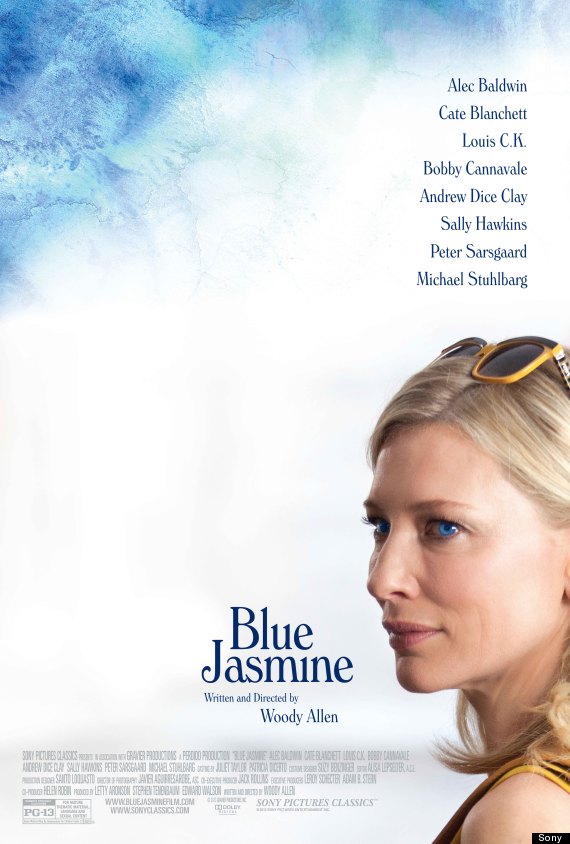 With writer/director Woody Allen’s proliferate output, cranking out a movie every year, it’s all too easy to take the man for granted. Critics will argue his halcyon days are long gone, that the man is coasting on his past laurels. Of course when you’re comparing everything to Manhattan, Annie Hall, or Crimes and Misdemeanors, well sure most movies will be found lacking, even Allen’s. And there’s no real forgiving of 2001’s Curse of the Jade Scorpion. But when Allen hits a rich topic with a capable cast, he can still produce knockout cinema, as is exactly the case with the engrossing Blue Jasmine.
Jasmine (Cate Blanchett) is experiencing a tumultuous change of living. Her wealthy husband Hal (Alec Baldwin) has been indicted for a Ponzi scheme that fleeced millions. Her posh New York lifestyle has vanished, Uncle Sam has frozen the assets that haven’t been repossessed, and she’s forced to move in with her working class sister, Ginger (Sally Hawkins), in San Francisco. Jasmine immediately has her complaints, mostly about the men that Ginger seems to date. She also tries adapting to a life she has been ill prepared for. Much like a domesticated animal, Jasmine’s social skills and pricy tastes do not have real-world transitions into her getting a job and supporting herself. She’s looking for a way to re-enter the shrine of privilege, and that it through a man of means.
 Blue Jasmine is a fascinating character study of a life of self-delusion, denial, greed, and guilt, and it is a marvelous film. Allen hasn’t done something this cutting, this precise in several years and it’s a reminder at just how skilled the man can be at building magnetic, fully realized characters, especially women. This is a rich, complex, and juicy character for an actress of the caliber of Blanchett (Hanna) to go wild with. Jasmine is something of a modern-day Blanch DuBois with a sprinkling of Jay Gatsby; she’s a woman who’s become accustomed to a luxurious fantasy world that she’s still striving to recreate, but she also is a woman who reinvented herself. As we learn in the opening scene, Jasmine left school without finishing her degree when Hal whisked her off her feet, to a world of privilege. She even changed her name from Jeanette to Jasmine at her husband’s whim. She also became particularly adept at looking the other way when it concerned her husband’s shady dealings. Surely she must have known what was happening (in the end, it’s pretty clear) but as long as her illusion of wealth was maintained then it was easy to not ask questions. Why ruin a good thing, even if that good thing is built upon ruining the lives of ordinary people? Two of those people bilked of their money were Ginger and Augie (Andrew Dice Clay), which make Jasmine’s complicity all the more troubling. Every line of dialogue from Jasmine needs to be studied and dissected, analyzing how buried is the real Jasmine.
Jasmine’s declining mental state is also given much attention and curiosity. We are watching in full view a woman go through various stages of a nervous breakdown. She’s medicating herself via booze and a cocktail of prescription drugs, but there are hints that point to something other than substances at play. She hints at undergoing electric chock therapy (does this still exist?) and she may have a touch of mental illness as well, though it’s unclear. Jasmine is given to talking to herself, reciting anecdotes and patter from previous parties with the rich and fabulous. It could be a sign of madness or it could be a desperate attempt by Jasmine to zone out, to return to that former life, to relive her former glory. Personally, I’ve done something similar, recited old conversations out loud to myself, though usually a line or so, not to the degree of recitation that Jasmine engages in. In the opening, it’s revealed that the lady she’s sitting next to on the plane, who we assume she’s talking with, is really just a bystander. She tells her husband she was confused because Jasmine was really just talking to herself. As Jasmine tries to get back on her feet, with delusions of grandeur about reinventing herself again, her world seems to be collapsing around her as she struggles to adapt to the real working world. A receptionist job for a dentist is beneath her as well as far too much for her to handle. She has one real sincere heart-to-heart where she lays out her true feelings, and it’s to her nephews in a pizza shop with no other adult present: “There’s only so many traumas a person can withstand until they take to the streets and start screaming.
An enthralling character study, but Blue Jasmine also benefits from Allen’s precise plotting, folding back into flashbacks to create contrast and revelations. There is an economical finesse to Allen’s writing and directing. Every scene is short and sweet and imparts key knowledge, keeping the plot moving and fresh. It also provides back-story in a manner that feels unobtrusive. Jasmine’s more modest living conditions with her sister are contrasted with apartment shopping in New York City’s Upper West side. The class differences between Jasmine and her sister are put on full display when Ginger and Augie visit New York. However, Allen isn’t only lambasting the out-of-touch rich elite here. Few characters escape analysis. In this story, everyone is pretending to be someone else, putting on fronts, personas, to try and puff themselves up. Once living with her sophisticated sister, Ginger starts seeing her world with new eyes, mainly finding dissatisfaction and a yearning that she could do better. She meets Al (Louis C.K.) at a fancy party and gets smitten, though he’s not what he seems. She dumps her current boyfriend, buying into Jasmine’s theory that she “dates losers because that’s what she thinks she deserves.” She tries to remodel herself into a posh, inaccurate version of herself, a knockoff on Jeanette to Jasmine. It’s a bad fit. The person with the most integrity in the entire film appears to be, surprise, Andrew Dice Clay’s character. Augie is a straightforward blue-collar guy but he has a clear sense of right and wrong, one that comes in handy when he’s able to bust people.
 This is much more a dramatic character study than a typical Allen comedy of neurosis, but I want to add that there are a number of laughs to be had, mostly derisive. There is comedy but it’s of a tragicomedy vibe, one where we laugh at the social absurdities of self-deluded characters and the irony of chance encounters. It’s far less bubbly than Midnight in Paris, Allen’s last hit, but that serves the more serious, critical tone. The class conflicts made me chuckle, as well as Jasmine’s hysterical antics and self-aggrandizing, but I was so thoroughly engaged with the characters and stories to complain about a lack of sufficient yuks. Confession: I generally enjoy Allen’s dramas more than his straight-up comedies.
Naturally, the movie hinges on Blanchett’s performance and the Oscar-winning actress is remarkable. I expect her to be a lock for another Oscar nomination if not the front-runner until later. She fully inhabits the character and lays out every tic, every neurosis, every anxiety, and every glimmer of doubt, of delusion, of humanity. She is a fully developed character given center stage, and it’s a sheer pleasure to watch Blanchett give her such life. You’ll feel a mixture of emotions with the character, from intrigue, to derision, to perhaps some fraying sense of sympathy, especially as the movie comes to an end. Blanchett balances the different faces of Jasmine with startling ease; she can slip into glamorous hostess to self-pitying victim to naiveté like turning a dial. I never tired of the character and I certainly never tired of watching Blanchett on screen.
Woody Allen has been a hit-or-miss filmmaker for over a decade, and you’ll have that when the man has the perseverance to write and direct a movie every freaking year. I had a pet theory that, as of late, every three years was when we really got a great Allen movie: 2005’s Match Point, 2008’s Vicky Cristina Barcelona, 2011’s Midnight in Paris. Well now my theory has been put to rest, thank you very much, all because Allen couldn’t wait one more year to deliver Blue Jasmine, a truly great film. It’s a tragicomedy of entertainment, an exacting character study of a flawed, complex, deeply deluded woman as her carefully calculated world breaks down. Anchored by Blanchett’s supreme performance, the movie glides along with swift acumen, doling out revelations at a steady pace and consistently giving something dishy for the actors and audience to think about. It’s funny, it’s sad, but more than anything Blue Jasmine is compelling as hell. This is one of Allen’s best films and one I’d recommend even to non-fans of the Woodman. Give Blue Jasmine a chance and you may be surprised what you feel, for the film and the woman, both complex, engaging, and memorable.
Nate’s Grade: A
Share this:

The World’s End (2013)
 The third in the Cornetto trilogy, the series of loving homages to genre films that end up transforming into those films, written by star Simon Pegg and director Edgar Wright (Scott Pilgrim vs. the World), is so self-assured, so witty, and so stylish, but it’s also the best film Wright has done. While my heart will always bleed for 2004’s Shaun of the Dead, it’s something of a revelation how everything comes together so magically in The World’s End. Every joke, every sight gag, every offhand reference, it somehow is all tied up together or has some greater narrative connection, like the names of the 12 pubs on a pub crawl reunion that discovers an alien invasion. The dialogue is packed with layered humor, with choice bon mots like, “That’s why I drink out of a crazy straw. Not so crazy now, huh?” and, “Or selective memory like that one guy… who? Oh yeah. Me.” Given the previous films, Shaun and 2007’s Hot Fuzz, I knew this would be a funny movie, but I was unprepared for how emotionally adept it is. The characters are given surprising depth and pain and anger, mostly stemming from Pegg’s screw-up alcoholic character desperately trying to relive the good times. The writing is so textured that the characters come across like actual people, and the twists and turns, while entertaining, are far more emotionally grounded than in any previous Wright movie. There is real pain and atonement for these fallible characters, which makes us root for them even more against the robot invaders. Pegg and Nick Frost are terrific again. The action is frenetic and inventive, the laughs are frequent, and the characters are so fully realized that The World’s End isn’t just the best film in a stellar, pop-culture savvy trilogy, it’s also one of the best movies you’ll see this year.
Nate’s Grade: A
Share this:

The Spectacular Now (2013)
 I say this as a fan but John Hughes was probably the best and worst thing that happened to the modern teen movie. He certainly brought an extra level of pathos and relatability to the genre, but then again he also dealt in stereotypes, often languishing his characters to stock archetype ghettos (the Jock, the Prep, the Nerd, etc.). In the ensuing decades, it’s been hard to break as many teen films, of those aimed at teenagers, have casually dealt in these easy labels. That’s why something like The Spectacular Now is such a welcomed respite. Here is a teen movie that aims to tell a story about people and their problems, not simply a regurgitation of high school cliques and clichés. This isn’t a film where all the pieces magically come together; this is a high school movie that more closely approximates real life. This is more Cameron Crowe than John Hughes material.
Sutter (Miles Teller) is the most popular guy in school, or so he’d tell you. He’s the life of every party, the kind of guy who everyone enjoyed, and the guy who could charm the pants off any girl. He’s recently broken up with his girlfriend Cassidy (Brie Larson), though still harboring serious feelings for her. Of course the best way to get over the old girl is with a new one, and Sutter sets his sights on Aimee (Shailene Woodley). She’s a smart, somewhat quiet gal that immediately takes a shine to the spotlight that is Sutter’s affections and attention. He’s not entirely over his old girlfriend, still angling to get back together, but also Sutter’s whole perspective could be summed up as an extreme case of carpe diem. The kid is partying like there’s no tomorrow because he’s convinced he has no real future, so he’s going to live it up while he can.
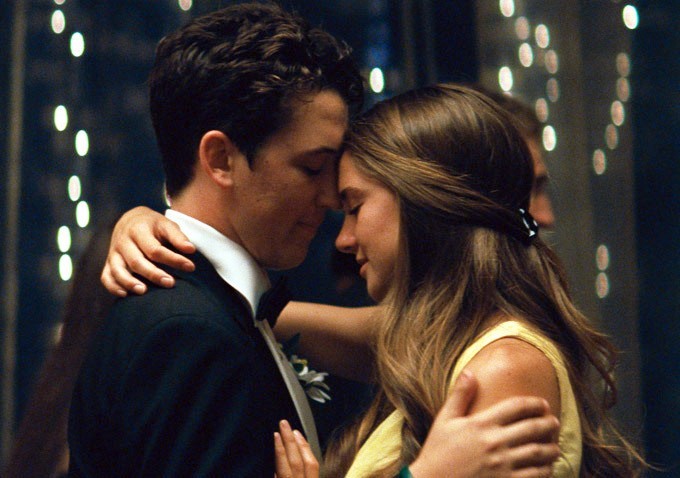
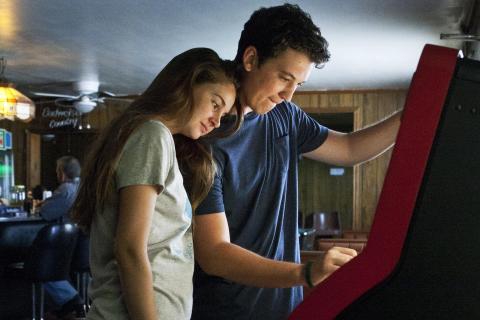 You’ve easily seen this movie before but it’s rare to see it given so much depth, maturity, and care. At heart, this is the story of Sutter learning he’s a screw-up and getting his life back in order, learning some self-control and responsibility, and winning over the good girl. But The Spectacular Now is so much more than that, and it’s especially sadder than you may have expected with its wise-talking, charming protagonist. This is the story of a teen coming to grips with parental abandonment, gaining insight into his own delusional detours to avoid pain, and the horrible realization that he is, in his present reckless condition, a bad influence dragging down the future of the girl he genuinely cares for. That’s a lot of heavy emotional drama and none of it revolves around the clichéd staples of teen movies, like those checkpoints such as prom and the Big Test. This is the story about one damaged man coming to terms with the state of his damage and gaining the courage to change his direction. He’s an alcoholic but the movie doesn’t ever put the narrative on hold for soapbox preaching. If anything, Sutter’s alcoholism is handled so subtlety, with most character silently acknowledging but unsure or indifferent to act, that it may strike a few chords with audience members. Then there’s the fact that none of this is heavy-handed; the filmmakers have done a fabulous job of giving each character credibility. They behave like real human beings. Even the easily slotted antagonists, namely Cassidy and Sutter’s deadbeat dad, are given shades of recognizable humanity and depth. Even though Cassidy waffles in her feelings for her ex, I cannot dislike her because her character portrayal is so honest. She’s struggling with her feelings for a screw-up with redeeming qualities. That’s fairly relatable, even if she’s not our winsome romantic lead. The filmmakers drag a typical teen movie story into our real world setting, adding depth and telling observance. You will recognize many of these characters.
There are few superlatives to describe the cuteness of the blossoming relationship between Sutter and Aimee. It’s so smooth and relaxed yet completely believable, and the two actors have such a warm and natural chemistry with one another, enough that I seriously contemplated if they dated outside the film (rumored but nothing conclusive). You feel their budding affections, the sweet swoon of young love, and the hiccups along the way. Woodley (The Descendants) does an outstanding job with her mannerisms and affectations; her awkwardness around her feelings is adorable, but not in that prefabricated cutesy way often ascribed to the oft-mentioned Manic Pixie Dream Girl roles. She’s a fairly normal teenager on the fringes of high school, keeping her nose down and looking ahead. In movie terms, you couldn’t readily classify a gal like Aimee, and that’s because she’s a real character fully fleshed out by the screenwriters and the actress. Woodley’s performance is near invisible of acting tropes and constraints. She just dissolves into the character as all exceptional actors do.
But this is Sutter’s movie and, in accordance, Teller’s (Rabbit Hole) film. The young man puts on an acting camp in this film, shedding the various layers of armor from his sad clown of a character. As I said, we’ve seen this character before, but Teller and the screenplay are able to give Sutter such extraordinary depth. The carefree life-of-the-party character is turned into an introspective character study, essentially examining the darker side of Ferris Bueller. He’s using alcohol and his blithe attitude to blunt the pain that he fears he’ll end up like his old man, that his life has already peaked and he’s not even out of high school. Teller is such a successful charmer that he already wins you over to his side despite some boorish behavior because we see that the guy has a good heart. In the film’s opening, he’s propping up his friend to finally get the guy a girl, and the ensuing mess ends Sutter’s own relationship. The last act involves Sutter coming to grips with the negative impact of his actions, notably on Aimee. Teller is so effective at giving you glimpses of the sadness eating him whole. His concluding scenes when he finally breaks down feel like a hard-fought victory for the character as he confronts his doomed fate. At every turn, Teller impresses, and compounded with Woodley, they form an unbeatable team of sterling young acting talent.
 Special mention to Kyle Chandler (Super 8) for his pivotal walk-on roll as Sutter’s bad dad. He’s so pathetic and so desperate and so wonderfully realized by Chandler. He doesn’t get a Big Scene, he doesn’t get a Big Speech, he doesn’t even do anything out of the ordinary for a shifty, unreliable, selfish drunk, but those few minutes he’s onscreen, it all becomes so deeply sad and clear where Sutter’s life is headed without intervention.
The only depiction that I had trouble believing was Sutter’s almost consistent drinking and driving. Throughout the film, he has his trusty Styrofoam Big Gulp cup with him, spiked with booze. The man hasn’t graduated high school yet and is already a high-functioning alcoholic. Because of this I can believe that people would not be alarmed seeing him drive after imbibing a few drinks. However, the man is constantly drinking while behind the wheel of an auto and several times he appears completely trashed. I find it alarming as well as a bit far-fetched that not one character, not even Aimee, would raise objection to Sutter’s continued dangerous behavior. We also witness several scenes of Sutter drinking in bars. It’s conceivable he has a fake ID at his disposal, and it’s even more conceivable that he could talk his way into any establishment, but it’s more food for thought. Then again maybe this is just one of those towns where nobody cares about innocent lives being snuffed out by drunk drivers.
The Spectacular Now is an earnest film that doesn’t overdo it, providing challenging life lessons to fully formed, complex, believable characters. It doesn’t sugarcoat the heartache and harsh reality out there for vulnerable teens. It’s a charming romance tied up with an insightful character study of one young man hiding his sadness and anxiety of life’s disappointments with humor and booze. Thanks to the tremendous acting of its onscreen pair, you root for Sutter to turn his life around because you see value in him as a person, even if he doubts it himself. You’re on his side from the start, and you know how nicely he matches up with Aimee. You want this movie to pull off the spectacular, and for long stretches it feels just as if that will happen. The ending aims for ambiguity but is far more hopeful than its source material. I was charmed thoroughly by this film and its lead characters but even more I was thoroughly engaged in their dilemmas, moved by their struggles, and encouraged by their perseverance and growth. The Spectacular Now (extra points for never even having a character spout the title) is a funny, warmhearted, measurable restrained, knowing film that could open eyes. It may not be spectacular to some, but it’s surely a great film.
Nate’s Grade: A-
Share this:

You’re Next (2013)
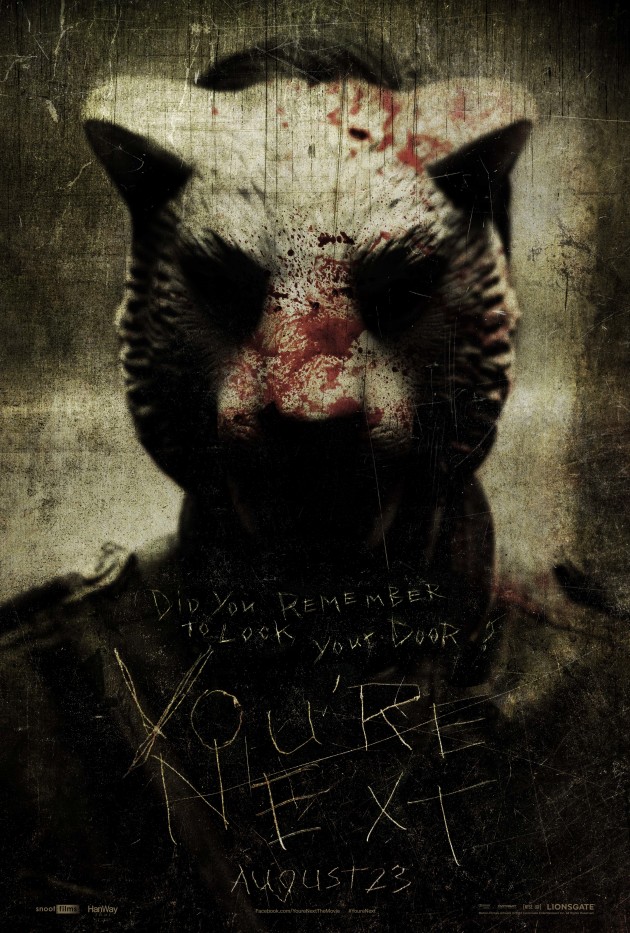 There has been a notable rise in home invasion thrillers in recent years but I am doubtful we’ve hit the crest just yet (this may also be hope speaking since I co-wrote one). Perhaps in an age of real-life anxiety on the news, the invasion of our personal sanctuary strikes an even more horrific chord. Whether you argue the upswing began with Panic Room, or Funny Games, or even the old Audrey Hepburn feature Wait Until Dark, the message is universal: nobody likes having their stuff messed with. This year we’ve already had The Purge make a splash at the box-office, and I’m sure Lionsgate is hopeful that their indie horror flick, You’re Next, which has been reaping great buzz along the festival circuit for years now, will make a similar splash. For me, You’re Next checked every box I would want in an effective horror film: good thrills, good humor, and a good ending. That adds up to one hell of a good time at the movies.
Crispian (AJ Bowen) is traveling all the way upstate for a family reunion at his parent’s palatial mansion in the woods. He’s also going to introduce his new girlfriend, Erin (Charni Vinson), an Australian graduate student that used to work as his teaching assistant at his college. Crispian’s rich family includes his excitable younger sister, his obnoxious older brother, his youngest detached brother, everyone’s boyfriend and girlfriend, and mom and dad. In between a lively family discussion/argument at the dinner table, arrows start flying through their window. Three mean wearing ominous animals masks are stalking outside, armed, and with every intent to kill everyone inside. The masked killers leave ominous messages painted in blood, noting, “You’re next” (I know they’re senseless murderers, but points for using the correct form of “you’re”). Erin snaps into survival mode and assembles a system of defenses but there are more threats than anyone imagined.
 To take nothing away from the artistic merits of You’re Next, the biggest selling point, and its greatest attribute, is that it knows how to properly work over an audience. While nowhere near the genre deconstruction that was last year’s Cabin in the Woods, nor as clever, here is a movie that knows it’s a horror movie, knows you’ve seen these movies before, and knows what you’re looking for as an audience member. And once the killing starts, the movie also gains a delightfully macabre sense of humor, an impish darkness that will leave you chuckling. I heartily recommend seeing this movie in a packed theater because the collective response will add to your enjoyment, or at least it did mine. Never have I experienced a movie where the audience cheered the plugging in of an ordinary kitchen appliance with such reckless enthusiasm. Thanks to director Adam Wingard and screenwriter Simon Barrett, the movie packs great payoffs in its second half, as our prototypical Final Girl outflanks her attackers. There are enough twists and turns to keep things interesting and the pacing swift. Once those arrows pop, this thing just flies by, moving at a speed that keeps you satiated with scares, thrills, and humor. In essence, You’re Next knows how to have fun with an audience, and for whatever reason, with the glut of dank home invasion horror thrillers, this is a surprise. With all the family trauma and killing, watching their loved ones cruelly slip away in horrific fashion, it’s worth praise that Wingard and Barrett find a happy tonal middle-ground that doesn’t blunt the horror or the comedy. The laughs don’t feel out of place with the screams. They make this work. And there are some really sick laughs to be had too.
My only familiarity with Wingard is from his involvement in the horror anthology series V/H/S and The ABCs of Death. It’s also somewhat entertaining to note that all three movies, both V/H/S and its sequel, have been released before You’re Next, a film that was completed two years prior. His anthology segments didn’t point to the same level of promise on full display with You’re Next. Wingard does a great job of orienting his audience to the geography of the play area, so to speak, while juggling different simultaneous threats and maintain a sense of clarity. He knows when to hold back, and he knows when the audience needs a peak of something gruesome. Initially, with the animal masks and the attack on the wealthy, I thought the film was gearing up for a dose of environmental social commentary, as if the killers were extreme defenders of Mother Nature. I’m actually relieved that the film never picks up any ham-handed political subtext.
 As a horror movie, it’s far more effective than most genre deconstructions that will undercut the terror for the chance at a good joke. Even Cabin in the Woods was like this. Again, You’re Next can be riotously funny, especially in the last act, but it can also, and often is, quite suspenseful as well. Once the game get sunder way, you start playing along as well, guessing which of our participants will indeed be next. They place themselves in precarious positions often, especially early, which makes it all the more suspenseful, because you’re suspecting anything can happen at any time. You’re lying in wait, and Wingard does an excellent job of drawing out that tension to a peak level before hitting the horror or gore. There are some gruesomely bloody moments in the film but it doesn’t lovingly linger on the deconstruction of the human body. And just when it seems like the number of housemates fighting for their lives has gotten so low that the thrills would have to be successfully all wrung out, You’re Next supplies a twist that changes gears, introducing a new threat and a new level of dramatic tension. When Erin assembles an ax to smash into the skull of whoever opens the front door, you’re eagerly waiting for that Chekov’s gun to fire (Can we rename it Chekov’s Ax to the Face?). The fact that the movie is almost designed as a Home Alone for demented adults is ingenious.
The acting is a bit hit or miss but the standout, by far, is Vinson (Step Up 3D). She’s our lead heroine, yes, but she takes charge in a way usually reserved for men in these types of movies. She has all sorts of crafty experience with wilderness survival and setting up traps, plus she is able to marshal the family from a bunch of WASPs screaming their guts out into something of a fighting force. And plus, Vinson just has an awesome screen presence to her. It’s a great role for her but credit the actress for knocking it out, giving the audience a strong, extremely capable, and empathetic hero. It’s satisfying to watch the masked killers be outfoxed by their prey. Many of the actors in the film are filmmakers themselves (Joe Swanberg, Ti West, Amy Seimetz), and they’ve collaborated on numerous projects, including other lo-fi horror features, the new Splat Pack if you will.
If you’re looking for a fun horror movie with a dark sense of humor, then You’re Next should be next on your list. It’s savvy, scary, and knows how to goose an audience at just the right moments. Wingard and Barrett know how to give an audience what they want without pandering, and that’s what elevates You’re Next from its peers. This is a horror film that can scare you one minute, make you laugh uncomfortably the next, and then ultimate leave you cheering the vengeful dismemberment of human life with kitchen appliances. It is a more than effectively put together horror thriller from beginning to end.
Nate’s Grade: B+
Share this:

Safe Haven (2013)
 For a solid two acts, I couldn’t hate Safe Haven, the latest in the bland, paint-by-numbers coastal romances based on a novel by Nicholas Sparks. It was chiefly inoffensive but predictable at every step, but I didn’t mind. At this point, Sparks is a brand and you know what you’re getting. Julianne Hough (Rock of Ages) plays a woman on the run from a corrupt Boston cop. She may or may not have killed a man. She hides out in a North Carolina fishing village and comes to love a hunky widower (Josh Duhamel) with a pair of annoying kids. Their coupling is somewhat restrained given the sudsy context; they don’t kiss until close to an hour in. What benefited the film was having a dangerous external threat, the corrupt cop, circling in. This alone raised the stakes of what ordinarily would be a pleasant but mostly mild romance between two pretty people. However, it is that third act, the concluding half hour, where Safe Haven just loses its mind. One twist is a given, though it makes the Boston PD look either incompetent or collusive, but the final twist comes out of nowhere, bringing in a supernatural factor that left me gob smacked. All I kept repeating was, “What?” It’s such a contrived, immediately stupid twist ending, trying to bridge a simple romance with something like The Sixth Sense. I can’t say whether the twist existed in Sparks’ source material, but wherever it originated, I can predict you won’t find a dumber twist ending to a film all year. Safe Haven is two parts of a good-looking albeit mediocre movie with a final dash of half-baked lunacy.
Nate’s Grade: C-
Share this:

Lee Daniels’ The Butler (2013)
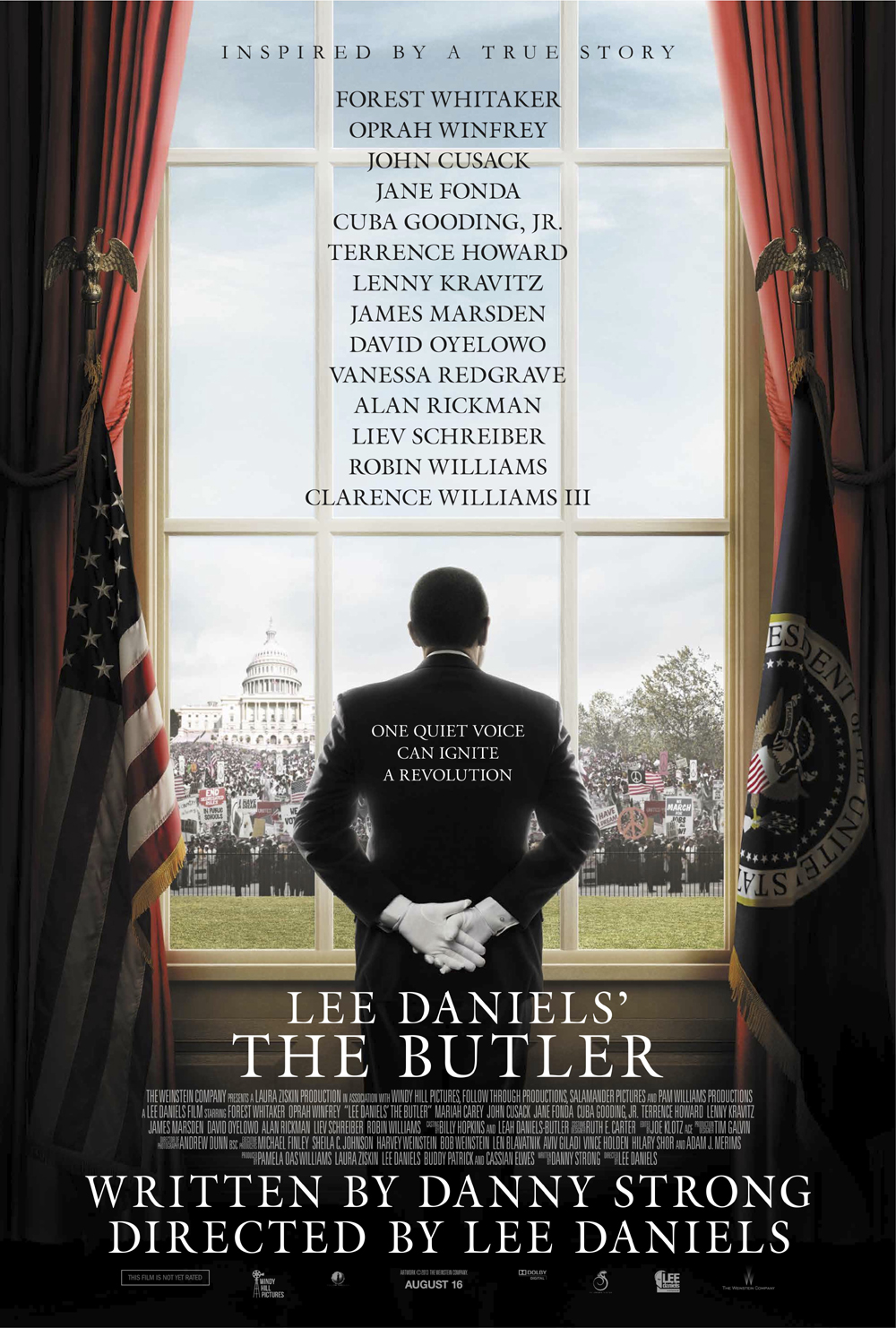 Before I begin my review, I feel the need to come to the defense of Oscar-nominated director Lee Daniels (Precious). Despite what Internet message boards and detractors may have you believe, it was never the man’s intention to insert his name into the title of his latest film, Lee Daniels’ The Butler. Warner Brothers claimed copyright ownership over the title of The Butler. The MPAA mediates title discrepancies in cases where one movie could clearly be confused for another. However, Warner Brothers’ claims a 1915 silent short film in their vault by the same name. Is anyone in the year 2013 really going to pay a ticket for the Butler and reasonably expect a silent short that’s almost 100 years old? Rather than pay a financial settlement, The Weinstein Company decided to alter the original title, adding the director’s name. This isn’t The Butler. Now it’s Lee Daniels’ The Butler. So before I get into the thick of my review, I’d like to absolve Daniels of Tyler Perry-levels of hubris. You’ll excuse me for just referring to it as The Butler throughout the duration of this review, not to be confused with a 1915 short film.
From Harry Truman to Ronald Reagan, one man served them all and his name is Cecil Gaines (Forrest Whitaker). He was a White House butler for over 30 years, even attending a state dinner at the behest of Nancy Reagan. Cecil grew up on a Georgia cotton plantation and moved up the ranks in high-class service. His wife, Gloria (Oprah Winfrey), wishes her husband would worry more about his own home than the White House. Cecil’s two sons, Louis (David Oyelowo) and Charlie (Elijah Kelley), have very different views of their father. Louis feels like dear old dad is too close to the men of power, and Louis is going to do what he can on the frontlines of change.
 I’m sure everyone had good intentions with this movie, but I walked away with the overwhelming impression that The Butler was too heavy-handed, too corny, and too mishandled with its plot construction for it to be the effective drama all desired. I also know that my opinion is of a minority, but that has never bothered me as a critic. Let’s start with the biggest handicap the film has going, and that’s the fact that its central character, the titular butler, is too opaque for a biopic. Early on, Cecil rises through the ranks of black service workers because of his skill, and that skill is none other than “having a room feel empty with [him] inside it.” I’m not downplaying the man’s dedication, or the culture he grew up in that preferred their black workers to be silent, but here is a movie where the man’s claim to fame is that he served eight presidents but he was in the background for all that history. I wasn’t expecting Cecil to lean over and go, “Mr. President, that Voting Rights Act might be a good idea, and I’ll help ya with it.” He is just sort of there. I was expecting him to have some larger significance, especially in his own life, but here’s the kicker: by the end of the movie, you’re left with the impression that all of his years of service were for naught. Cecil comes to the realization that his son, who he has sparred with for decades, was right and he was wrong. Is this the intended point? My colleague Ben Bailey will argue this is Daniels’ subversive intent, to undermine the tenets of typical biopics, to fashion an anti-biopic. I am not as convinced.
The problem is that Cecil is a passive character, which makes him the least interesting character in his own story. He served eight presidents, yes, but what else can you say about him as presented? What greater insights into life, himself, or politics does he have during those years with seven different presidential administrations? I cannot tell. I was thoroughly astounded that Cecil, as a character, was boring. I suspect this is why screenwriter Danny Strong (Recount, Game Change) chose to split Cecil’s story with his son, Louis. Here is a character on the front lines of the Civil Rights movement, getting chased by mobs, beaten, sprayed with firehouses. Here is an active character that wants to make a difference. He also happens to be mostly fictional.
While the film opens with the phrase “inspired by a true story” you should be wary. Upon further inspection, very little is as it happened. I think all true stories, when adapted to the confines of a two-hour film narrative, are going to have to be modified, and pure fidelity to the truth should not get in the way of telling a good story, within reason. I don’t have an issue with Louis being fictional, but it points to the larger problem with the biopic of such an opaque man. The real-life Cecil, Eugene Allen, had one son who went to Vietnam and married a former Black Panther. Strong splits the difference, supplying two sons with different paths. Because of his invention, this means Louis has the benefit of being present at a plethora of famous Civil Rights events, like the Woolworth counter sit-in, the Freedom Rider bus burning, and the assassination of both Malcolm X and Martin Luther King Jr. Seriously, he’s in the same motel room with MLK in Memphis. With the exception of the Woolworth sit-in, the Civil Rights events feel like minor pit stops, barely spending any time to develop. It ends up feeling like a facile Forrest Gump-like trip through the greatest hits of the Civil Rights movement.
This narrative expediency also translates to the supporting characters in The Butler. Beyond Cecil, Louis, and Gloria, there aren’t any characters that last more than one or two scenes. Cecil’s White House co-workers, played by Cuba Gooding Jr. (Red Tails) and Lenny Kravitz (The Hunger Games), provide amiable comic relief but little else to the narrative. Terrence Howard (Dead Man Down) has an affair with Gloria and then is never seen again. That affair, by the way, is also never referenced again nor does it have any further ramifications with the relationship between Cecil and Gloria. So then what was the point? There is a litany of famous faces playing real people, but they’re all in and out before you know it. The actors portraying the presidents are more an entertaining diversion than anything of real substance. Alan Rickman (Harry Potter) as Reagan gets the closest in the physical resemblance game, though I strongly doubt Reagan, as presented in the film, sat down and openly admitted he was wrong to his African-American service workers. John Cusack (The Raven) as Nixon is a hoot. The movie speeds right through the Ford and Carter administrations, so I’ll play my own game of casting (Ford: Dan Akroyd; Carter: Billy Bob Thornton). The presidents, like the clear majority of supporting players, don’t stick around long enough to leave an impression. It’s as if our prior knowledge of these famous faces is meant to serve as characterization. Beyond the immediate Gaines family, you don’t feel like you’re getting to know anyone.
 Then you bring in Daniels as director and the man has not shown much of a penchant for, let’s call, subtlety. This is, after all, the same man who directed Nicole Kidman in the ways of urinating upon Zac Efron. A coherent tone has often been elusive in Daniels’ films, which veer into wild, loud, sometimes clashing melodrama. The most clashing thing in The Butler are the matching 1970s and 80s fashion that will burn your eyes. He tones down his wilder sensibilities but The Butler is an especially earnest movie; but overly earnest without earned drama usually begets a corny movie, and that’s what much of The Butler unfortunately feels like. The significance of the Civil Rights movement and the bravery of the ordinary men and women, and children, fighting for equality cannot be overstated. These were serious heroes combating serious hate. I expect a serious movie, yes, but one that isn’t so transparent about its Staid Seriousness. The Butler is very respectful to history (fictional additions aside) but too often relies on the historical context to do the heavy lifting. It also hurts when the film is so predictable. At one point, I thought to myself, “I bet Cecil’s other son gets shipped to Vietnam and probably dies.” Mere seconds after this thought, young Charlie Gaines says he’s going to Vietnam. I’ll leave it to you to discover his eventual fate.
Daniels’ true power as a director is his skill with actors. The man nurtured Mo’Nique into an Academy Award-winning actress. From top to bottom, no actor in this film delivers a bad performance, which is a real accomplishment considering its stable of speaking roles. Whitaker (Repo Men) is the anchor of the movie and he puts his all into a character that gives him little to work with. He brings a quiet strength and dignity to Cecil, able to draw you in even as he’s presented so passively and ultimately perhaps in the wrong. Winfrey hasn’t been acting onscreen since 1998’s Beloved. Gloria is an underwritten part but she does the most with it and I’d like to see more of Oprah the actress more often. Another highlight is Oyelowo (Jack Reacher) as the defiant son fighting for what he believes is right. I want to also single out former America’s Next Top Model contestant Yaya Alafia as Louis’ girlfriend and eventual Black Power participant, Carol. She’s got real potential as an actress and if she gets the right role she could breakout and surprise people.
Lee Daniels’ The Butler (just one last time for feeling) is an earnest, emotional, but ultimately unsatisfying picture and it’s mostly because of its title figure. The figure of Cecil Gaines is not the kind of man that the entire perspective of the Civil Rights movement can be hung onto as an allegory. He’s treated as background of his own story. If the filmmakers wanted to highlight the life of a man who grew up on a cotton plantation, worked in the White House, and who lived long enough to see an African-American be president, well then tell me that story. But they don’t. I think Daniels and Strong knew the limitations of their central figure, which is why the son’s role was invented to provide a more active perspective outside the hallowed walls of 1600 Pennsylvania Avenue. In the end, I really don’t know what the message is, because the one I’m left with is that Cecil Gaines realizes late in life how wrong he was, not just with his son, but his faith in the office of the presidency. I doubt the majority of filmgoers are going to walk away with this message. While well acted and with a sharp eye for period details, The Butler is earnest without having earned your emotions.
Nate’s Grade: C
Share this:

The Way, Way Back (2013)
 A throwback to the youthful summer movies of the 80s, The Way, Way Back is a delightful coming-of-age film that manages to excel at both comedy and drama. Oscar-winners Jim Rash and Nat Faxon (co-writers of 2011’s The Descendants) graduate to directors, guiding the famous cast with ease yet squeezing enough satisfying emotional truth into the formula of a screwy, Meatballs-style comedy. We follow 13-year-old Duncan (Liam James) as he spends the summer with his mother (Toni Collette) and her bully of a boyfriend (Steve Carell). My one gripe is that the film spends far more time than it needs to establish just how unequivocally awkward Duncan is. You will likely cringe. When Sam Rockwell enters the picture as a charming goofball water park employee who takes Duncan under his wing is when the movie ascends to a new level of comedy. The Way, Way Back hums along with its own sense of charm, presenting familiar characters/scenes but giving them added texture and relatability. You will be surprised at how much you feel for these characters, you may get a bit misty at points, especially when they behave like people and not zany cartoons. Carell as a bad guy is a real eye-opener; he’s a passive aggressive bully rarely seen in movies. James is an authentically awkward teen but you also buy every step of his journey. It’s just such a sweet, enjoyable, and cute movie, exuding charm and sincerity. Here is a movie that just makes you smile. You’ll leave The Way, Way Back feeling warm and fuzzy, and Rash and Faxon have another winner on their hands.
Nate’s Grade: B+
Share this:

Elysium (2013)
 With the subtlety of a sledgehammer to the face, Elysium is a sci-fi action movie with more on its mind than pyrotechnics. It’s writer/director Neill Blomkamp’s follow-up to 2009’s out-of-nowhere hit, District 9, a film so good that the Academy even nominated it for Best Picture that year, a rarity for a sci-fi flick. The apartheid allegory of District 9 was pretty straightforward, but Blomkamp and company found inspiring and fresh ways to tell a rousing story that worked in tandem with its social commentary. Elysium takes the haves and have nots to an admitted extreme.
IIn 2153, the rich have left Earth for a floating space station known as Elysium. It’s a luxurious paradise where technology can miraculously zap people to complete health. Secretary Delacourt (Jodie Foster) is in charge of Homeland Security and protecting Elysium from the less desirables that want to break in. Those “less desirables” would be the inhabitants of Earth. The planet has become an overcrowded, dirty, impoverished slum; Earth as third world. Max (Matt Damon) is an excon working a factory line for a sneering corporate bigwig (William Fichtner) struggling to leave behind a life of crime. His childhood friend, Frey (Alice Braga), works as a nurse at a hospital, but she’s got her own worries, namely a terminally ill daughter. After an accident at work blasts Max with radiation, he has five days to live. If he can just make it to Elysium, he can be cured. The problem is that Delacourt is shooting down spaceships trying to land on Elysium, including ones filled with women and children. To get off planet, Max needs to help in a heist, but it’s prized codes that could lower the defenses of Elysium and make anyone (ANYONE!) a citizen, thus available for medical treatment. To make sure this doesn’t happen, Delacourt relies on a rogue mercenary, Kruger (Sharlto Copley), a crazed madman who leaps at the chance to do dirty work. The hunt is on for Max.
 The socio-political commentary isn’t terribly veiled here, and maybe that’s because now Blomkamp has bigger targets than South Africa’s governmental policy. I didn’t have a problem with the fact that the inhabitants of luxury are portrayed as all white and that the denizens of the impoverished Earth are mostly non-white minorities (if minorities dominate a future Earth, when do they become majorities?). It’s clear that Blomkamp intends for Elysium to represent the United States. The poor who break through into the Promised Land, many to give their children a better life, or a life at all, only to be deported back to a slum, are clear stand-ins for contemporary immigration, notably Latin America. This is all fine by my book, though I can already hear the persecuted cries of some conservative commentators. It’s not as refined a commentary and that’s fine, not every message needs to be subtle, but I want more with my message than a simple rich vs. poor allusion. We never get to see what the people of Elysium are like, nor what most of that world is like beyond wide idyllic imagery. Fichtner’s character does a good job of symbolizing the callousness of an elite, but then he’s just one guy. The difficulty of maintaining a working wage is given the most care in the film, but much of the higher thinking takes a backseat for the third act movie heroics. The shift is acceptable but it makes a thin development of socio-economic commentary that much thinner.
When it comes to action, Blomkamp certainly knows how to stage a scene to get your pulse racing. The only problem is that there isn’t terribly much action to Elysium, or at least methodically sustained action to satisfy. You always feel like you’re getting a taste of something cooler down the road but it never fully materializes, much like the exoskeleton suit. It looks cool, it provides some progression, but it doesn’t lead to much. What does it accomplish? It allows him a port into downloading the Elyisum codes, but so could anything else. If anything, the metal exoskeleton seems like more of a hindrance, dragging Max down with extra weight and bulk. It pains me to say that the cool exoskeleton, such a prominent marketing feature, could have easily been eliminated as well. The best action in the movie is a heist in the middle that manages to juggle a team of good guys, a team of bad guys, a mark, and a deep sense of urgency for the score. It’s terrific and makes fun use of Blomkamp’s inventive future weapons. The rest of the film is mostly a series of chases, many of which are well orchestrated but only flirt with long-lasting action satisfaction.
The third act on Elysium is an entertaining and noisy conclusion, except Blomkamp sets himself up for limitation. Some spoilers to follow so tread carefully, reader. Elysium gets taken over by Kruger and his team as a defacto coup… except, well there are only three of them. We don’t even get to see them train the robot sentries on enemies or the populace of Elysium. I really don’t know how far-reaching their hastily staged coup is going. We want Kruger to be the big baddie that Max has to fight right before the cusp of the climax, but when there are only two other dudes who aren’t making great use of their fancy resources, it feels too boxed in and restrained. The action is fun while it lasts.
 Another niggling concern is the glut of side characters and their side stories that don’t feel organically integrated into the hero’s story. The flashbacks to Max as a kid could have been completely wiped out. They don’t add more information to the story and feel a tad too hokey for the movie. Sister Saintly Nun espouses wisdom and promises Max will be destined for one great thing in the future (could I settle for two “kinda good” things?). The bigger distraction is Frey and her sick kid, a.k.a. the Angelic Sick Child, you know, the type that feels so at peace with things and with no worry. This is a staple of the movies. Her only purpose in the narrative is to goad Max into making a bigger sacrifice, to think of others, not that beforehand the guy was displayed as being particularly selfish. Then there’s Max’s friend Julio (Diego Luna) who serves little purpose other than to carry him out of the occasional scene and to, of course, be sacrificed to drive the hero forward to achieve his goal. There’s a middleman who arranges for people to get identities that will be read on Elysium, if they get on there safely first. The villains are also pretty one-dimensional in their stock villainy: Kruger a sociopathic killing machine and Delacourt a tyrant. None of these characters leave much of an impression to make you want to take time away from the main story arc. Worse, many of them feel vaguely characterized and are clear plot beat generators rather than people. Maybe Max would be better off as a loner.
The acting is also all over the place. The worst offender is Foster (Carnage), who weirdly over enunciates every syllable in an affected future accent. She also seems to bob and swivel her head a lot as she talks, as if the Oscar-winning actress really had to go to the bathroom but was holding it at bay to complete her takes. Damon (Promised Land) is a reliable action hero but realistically, it’s a little curious that the main character would be, by all accounts, white. It makes much more sense for the savior of planet Earth to be like those left behind, but then I don’t really want to wade into deeper racial subtext than necessary. The real treat of the movie is Copley (The A-Team) who is having a ball playing a sword-wielding psycho killer. He provides a notable spark whenever onscreen, bringing a menace that makes you tale notice. Again, I just wish there was more to the character than his vague back-story and bunt motivations.
Despite what has seemed like a fairly negative review from the start, Elysium still a good movie but beware higher expectations forged from District 9’s unique alchemy. There are a lot of familiar plot beats here and everything from the characters, to the action, to the world building feels like it could have been pushed further. It feels like they took the freshness of District 9 and applied it to a more tired-and-true blockbuster formula. Blomkamp drops us into an intriguing world but I wanted more of just about everything. More with the characters, more with the plot, more with the socio-political commentary, more with the ins and outs of this future world and its inhabitants. The ending is also a bit jubilantly naïve given the powers of the Powers That Be. Really, a keystroke sets everything back to scratch. Again, I’m being more critical than I intend to be. Elysium is quite an entertaining movie with great visuals and Blompkamp is certainly a visionary auteur to praise, but it’s hard not to feel a smidge of disappointment with the man when you know what he’s capable of, even with a perfectly fine movie.
Nate’s Grade: B-
Share this:

Only God Forgives (2013)
 Only God Forgives is an apt title for a movie that is replete with such suffering and brutality. Here is a movie that thinks wanton bloodshed and depravity is the same as character depth, and the fact that it’s from Nicolas Winding Refn, the writer/director of Drive might not be as surprising as you’d believe. I enjoyed 2011’s Drive but I wasn’t as taken with it as other critics, my chief complaint being a groping pretentiousness that confused emptiness as contemplation. I see the same issue with Only God Forgives, a grisly morality play that’s simplistic and overwrought at the same time. Once again Ryan Gosling plays a man of few words, so few that I counted he only says eight by the 28-minute mark (at this pace, he’ll dissolve into the background by 2015). Gosling’s brother was killed after the creep raped and murdered a 16-year-old prostitute in Thailand. Gosling’s ferocious mother (Kristin Scott Thomas) demands retribution on the Thai police, but Gosling has his reservations. What ensues is a string of glossy gore, tedious reprisals, and nonsensical plotting, including numerous karaoke sequences with the Thai cops. The movie’s emphasis is almost entirely on a hellish atmosphere, lots of lurid reds and harsh lighting, providing style but minimal substance. The characters are all detestable and unengaging, the story is awash in dreary and ponderous plotting, and the movie just reeks of pretension, every frame oozing with Important Symbolism (catch the emphasis on hands and wombs yet?). Only God Forgives would be forgivable if all of its admirable style and mood had some greater purpose. It’s a grueling movie to endure but the hardest part is getting through all the tedium thanks to the near-mute characters and a script overdosing on torture. At this rate, Refn’s next film will just be 90 minutes of Gosling punching a baby. Silently, of course.
Nate’s Grade: C
Share this:

InAPPropriate Comedy (2013)
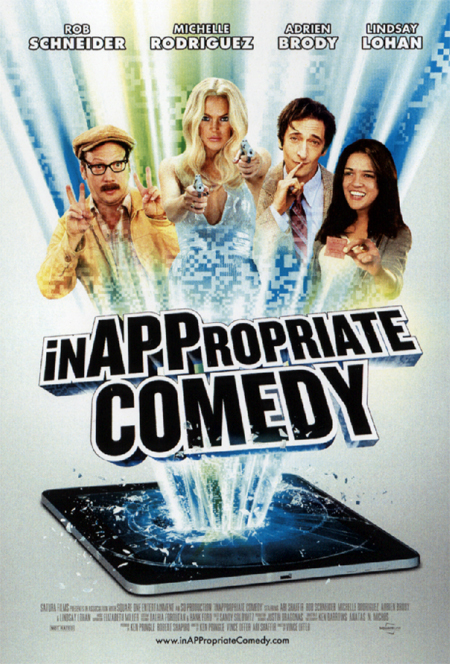 Vince Offer is best known as the successful pitchman for infomercial products like the Sham Wow and the Slap Chop. He’s less known as an amateur comedian. In 1999, he co-wrote and directed The Underground Comedy Movie, pooling all the favors he must have accrued with celebrities and struggling L.A. comics. You’d think after one resounding dud people would know better, but alas Offer and his friends have funded another sketch comedy movie, InAPPropriate Comedy. You see the title refers to the joke delivery system, namely Offer’s finger hitting apps on a tablet to start sketches. And if that inept setup doesn’t seem like a insightful indicator for the misery that is to follow, then allow me to confirm that InAPPropriate Comedy may be the least funny comedy I’ve ever seen.
I’m not saying that ALL people who find some measurable level of enjoyment from InAPPropriate Comedy are racist, homophobic, and sexist, but chances are, if you are all three things, you’ll probably enjoy the comedic abyss that is InAPPropriate Comedy. For the purposes of truly showcasing how comically bankrupt this enterprise is, overdosing on witless shock value and groan-worthy stereotypes, I will quickly dictate exactly what you get in this movie, sketch-wise. It’s really only about four reoccurring segments.
-Before the meat of the comedy begins we’re treated to the lamest, more obvious 127 Hours parody and the sight of tough-guy bikers riding around on bicycles. Does that mental image automatically make you laugh? If so, you’re in luck.
 -A parody of Dirty Harry called “Flirty Harry” where Oscar-winner Adrien Brody is a cop who speaks in nothing but overblown gay-centric double entendres (GAY JOKE #1). Is that half-assed twist on the name worth an entire ongoing series? It’s like you took one of the parody names from MAD magazine and then just called it a day. The second time around, Flirty Harry stops a robber and we see him in pink pants. He’s wearing pink pants. How could that not be hysterical? (GAY JOKE #2) The third segment doesn’t want to waste any time, so now Flirty Harry is getting his nails done at an Asian salon. You better believe these women are portrayed as nattering, horrendous, screeching caricatures (GAY JOKE #3, RACIST JOKE #1, SEXIST JOKE #1). Then Harry shoots a guy in the ass (GAY JOKE #4). Adrien Brody, why?
-The next ongoing sketch is a parody of MTV’s Jackass, and this one, with about as much wit as you’d expect, is called Blackass. It’s about a group of obnoxious, ignorant, lazy, foul-mouthed, angry black males engaging in rude and offensive behavior. These segments may be the most offensive in the whole movie because it is wall-to-wall negative stereotypes; the joke is that black men are not to be trusted and will harass white people, especially white women. The first time we see Blackass it has our characters running from the police. One of them even has a giant boombox over his shoulder because people still do that, right? (RACIST JOKE #2). These guys dress and behave exactly like the harmful misrepresentation your elderly grandmother has about black people. The sad part is that the festering stereotype of the black male up to no good can have serious and tragic consequences, coloring people’s judgments and assumptions.
Stepping down from the soapbox, the first segment involves the Blackass crew falling into a vat of raw sewage. The second segment involves them playing joust in shopping carts with lances made to resemble giant black penises (RACIST JOKE #3). The third involves the Blackass crew as the world’s worst babysitters, threatening a white woman in the process (RACIST JOKE #4). You see black people are terrible fathers, so this movie would argue. They talk about welfare checks and carry around 40s of malt liquor. The fourth segment has one of the Blackass guys and his white girlfriend antagonizing another couple in a hot tub before having anal sex (RACIST JOKE #5, SEXIST JOKE #2). The fifth segment has one of the Blackass guys in an abortion clinic waiting room. He harasses a young couple and offers to abort their pregnancy for cheap with a coat hanger (RACIST JOKE #6). The last segment involves the gang trying to lure a mouse by putting cheese on one of their penises. While it’s the closest in conception to an actual Jackass stunt, it’s still unfunny and much of the humor seems to rest on the enormous size of African-American phalluses (RACIST JOKE #7). Crap, I forgot about another segment where the guys blindfold a dude and have him get run over by a rhino. I don’t even get this one.
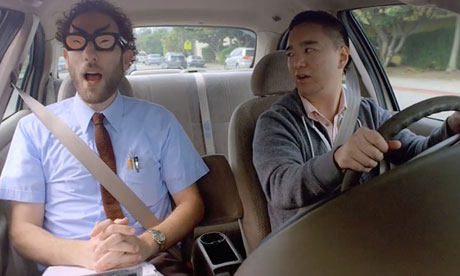
 -The longest and most painful of the reoccurring sketches is a parody of The Amazing Race dubbed The Amazing Racist. You might expect it to have something to do with the popular reality TV competition, perhaps people competing to see who is the bigger racist, racism across color, or even forcing two racists of different ethnicity to team up in competitions. Nope. It’s just co-writer Ari Shaffir and his unending improvisation. The first segment has him rant in front of the U.S.-Mexico border, and then he harangues a gas station owner and assumes any Hispanic present is an illegal alien (RACIST JOKE #8). The next involves him as an insulting driving instructor for Asian drivers (RACIST JOKE #9). The next involves him wandering a predominantly Jewish supermarket trying to gather signatures to apologize for killing Jesus (RACIST JOKE #10). The next segment involves Shaffir entreating black passerbyes on a beach to take a boat ride back to Africa (RACIST JOKE #11). Finally, Shaffir is abandoned in a Middle Eastern territory with armed Arabs. I guess it’s supposed to count as comeuppance but it sure doesn’t feel it. There’s a post-credit sequence where Shaffir is trying to lure Jews into a box to ship to Hitler from the future (RACIST JOKE #12). I later learned that the hidden camera aspect of Shaffir’s bits is another fallacy. The people onscreen are all actors, which makes The Amazing Racist even less amazing. It feels like Offer and Shaffir watched Borat and thought they could replicate what they saw.
-The only other repeating segment is a pair of film critics that specialize in reviewing pornography. The idea on itself actually has the most potential out of everything Offer throws onscreen. It’s got recognizable faces; Michelle Rodriguez and Rob Schneider are the critics. Their reviews, however, are just another excuse to make more racist and gay jokes. A porn they review is called “Sushi Mama” and it features two Asians engaging in over-the-top, badly dubbed sex (RACIST JOKE #13). Another porn they review is weirdly a parody of Swan Lake, with guys dancing around in tutus and eventually humping and ejaculating on a helpless victim (GAY JOKE #5).
There are two other sketches that have the luxury of not being repeat offenders, so to speak. Lord knows what Offer and company saw in the others. One involves Schneider as a sleazy therapist aroused by his client’s vigorous sexual history (SEXIST JOKE #3). Another is called “Things You’ll Never See” and purports that hot ladies would never date someone poor because all good-looking women care about is money (SEXIST JOKE #4). I haven’t even mentioned how all of these sketches are supposed to take place, literally, inside Lindsay Lohan’s vagina (SEXIST JOKE #5). It’s a nonsensical framing device. We zoom out in the end, meaning that Lohan has a treasure trove of unfunny sketches stuffed in her special place. She should probably consult an OBGYN.
And that’s it! That’s the movie, all 75 wretched, horrendous, soul-draining minutes. Did any of that, on the surface, seem funny to you, or, like most people with active senses of humor, did it seem overwhelmingly lazy and poorly thought out? The biggest problem with InAPPropriate Comedy is that it’s trying to be more inappropriate than funny. It’s confused shock value for actual humor. Having a troika of irresponsible black males playing into demoralizing stereotypes and fears isn’t comedy. Having a guy make fun of Asian drivers isn’t a sketch. Having a gay cop make forced double entendres isn’t a sketch. There’s no development here, no escalation, no twisting of the premise, no nothing. All Offer and his motley crew of comedic imbeciles do is take a one-joke premise and pummel it into submission, making the laborious sketches feel even longer. It just so happens that most of their one-joke ideas aren’t even ideas so much as mean slights against minorities, women, and gay people. There is no ironic distance to the joke telling; they are merely just being crushingly racist, sexist, and homophobic.
 I am by no means a comedy prude. I love a terrific vulgar joke as much as the next guy. I think when comedy is concerned that nothing is off limits. You can make anything, no matter how horrific and offensive, funny under the right circumstances, but it takes work and able skill. The problem with Offer’s movie is that there is no consideration to context, setup, developments, let alone surprise. You’ll see every dreadful joke coming before it arrives. That’s because all this movie does is trade in pained, outdated stereotypes. The scenes themselves feel like improv jags that just go on endlessly, like Offer was trying to replicate the process of a Judd Apatow comedy. His faulty reasoning may have been if people just say enough offensive things long enough, then something has to arrive at funny. Comedy doesn’t work like that, and as a comedy writer I find it personally insulting. This is just rampant and pointless vulgarity without any parameters, no point of view, nothing to mask the fact that it’s just cheap shock value. What are the jokes here? Asians are bad drivers? Black men are reckless? Women are superficial? Do these sound like jokes or merely groundless insults? If you removed all the ostensibly offensive elements, there would be nothing to this movie whatsoever.
As a longtime detractor of the duo Friedberg and Seltzer, the men responsible for cinematic crimes against humanity like Epic Movie (my worst film of 2007) and Meet the Spartans (my worst film of 2008), I’m torn. Friedberg/Seltzer don’t so much create jokes as they do lame pop-culture references with built-in expiration dates (go on, try and watch one of their past movies and see if you recall everything). Whatever jokes they do foster are mostly broad slapstick, but it could be classified, no matter how charitably, as a joke. After watching Offer’s InAPPropriate Comedy, I may have second thoughts about the intensity of my screeds against Friedberg and Seltzer. Their movies are still terrible, still the cannibalistic, cinematic watery discharge I dubbed them, but Offer’s comedy may even be worse. There’s no way any of InAPPropriate Comedy could ever be funny. It’s so obvious and desperate that it confuses offense for smashing taboos. This is a black hole of funny, where funny cannot escape and instead gets smashed down to an atomic level. How could anyone making this find it even remotely funny? If I see a worse movie in 2013 than InAPPropriate Comedy, it will make me reevaluate the existence of a loving God.
Nate’s Grade: F


 nathanzoebl
You must be logged in to post a comment.