Category Archives: 2013 Movies
The Place Beyond the Pines (2013)
 Ambitious filmmaking is welcome, but usually ambition leads somewhere, which is the main problem with co-writer and director Derek Cianfrance’s unwieldy 140-minute multi-generational crime drama, The Place Beyond the Pines. First we watch Luke (Ryan Gosling) as a traveling motorcyclist enter a life of crime to support his infant son. Next the focus shifts to Avery (Bradley Cooper) as a cop with a conscience running into corruption on the force. Last, we jump ahead into the future and watch the dramatic irony unfold as the children of Avery and Luke interact, waiting for them to learn their paternal connection. I believe Cianfrance (Blue Valentine) and his team was attempting to tell a meditative, searching drama about children paying for the sins of their fathers, the lingering fallout of bad decisions and moral compromises. Except that’s not this film. By the end of the movie, while some secrets have been laid bare, there really aren’t any significant consequences. The film does an excellent job of maintaining a sense of dread, but it doesn’t come to anything larger or thought provoking. The entire structure of this film is geared toward a tragic accumulation, but it just doesn’t materialize. That’s a shame because it’s got great acting through and through, though I have grown weary of Gosling’s taciturn antihero routine that seems like a rut now. Avery’s portion of the plot was the most interesting and anxiety-inducing, but I found the movie interesting at every turn. The characters are given pockets of nuance and ambiguity as they traverse similar paths of desperation and conciliation. The Place Beyond the Pines is a perfectly good movie, albeit disjointed, that cannot amount to the larger thematic impact it yearns for.
Nate’s Grade: B-
Share this:

Thor: The Dark World (2013)
 Loosely based off the Norse mythology, Marvel’s hammer-wielding hero isn’t exactly the easiest character to relate to even as a superhero. Thor is a god after all. Not to be outdone, the man is also royalty, next in line to be king, so he’s in a special class of privilege. And yet 2011’s Thor was a pleasant surprise, a superhero movie that didn’t take itself too seriously, had modest aims, and embraced its sci-fi fantasy mélange. It was a movie where the sillier it got the better it worked. Now Thor: The Dark World, a.k.a. Thor 2, is ready to dominate the fall box-office and prove that Joe and Jane Popcorn can cheer for a pagan god.
Following the events of The Avengers, Loki (Tom Hiddleston) is taken back to his home world of Asgard and put in prison. Loki’s brother, Thor (Chris Hemsworth), is trying to get back to Earth to reunite with his love, scientist Jane Foster (Natalie Portman). Thor is being groomed for the throne of Asgard by his father, Odin (Anthony Hopkins). Meanwhile, the nine worlds are nearing a convergence and dimensional gateways are opening, including one that infects Jane with an ancient biological weapon, the aether. The aether was used as a weapon by the dark elves, a race of creatures that was long ago defeated but its general, Malekith (Christopher Eccleston), has been dormant and in hiding. Alterted, he assembles his surviving army to attack Asgard, kidnap Jane Foster, retrieve the aether, and destroy all life in the universe.
 Thor is still a second tier character when it comes to Marvel superheroes (the guy just isn’t that interesting) but his franchise has, in only two starring films, become the most interesting. The scope of the Thor movies seems infinite. Whereas the other Marvel heroes are Earthbound and straightforward, Thor transports an audience to all sorts of alien worlds/cultures/conflicts, all of which open up more tantalizing storytelling avenues. Nothing seems out of place in a setting such as this, and so the surprises are more satisfying. I thought the best parts of 2011’s Thor were the Asgard moments, less the strained fish-out-of-water comedy of Thor assimilating on Earth. Thankfully, almost all of Thor 2 takes place off Earth save for a rousing, creative, inter-dimensional hopscotch of a climax. The realm of Asgard is given suitable scope thanks to the screenwriters and first-time feature film director Alan Taylor, who worked in TV for years. Taylor’s notable work on HBO’s Game of Thrones is probably what got him this gig, and his vision with fantasy is given significant breadth here. The Thor universe is an interesting mix of fantasy and sci-fi, reminiscent of Star Wars, and Taylor provides the necessary sweeping visuals, exciting action, and glorious shirtless close-ups we come to expect from our fantasy vistas. I was consistently impressed with Taylor’s command of visuals and shot selection, particularly how the man was able to juggle the various tones and needs of the script while still keeping an exposition-heavy film fun and light.
With rainbow bridges, dark elves, and enchanted hammers, thank goodness that Thor 2 keeps a steady and welcome sense of humor, never getting too serious even with the end of existence on the line. This jovial tone is refreshing when properly executed and contributes to the overall fun of the picture. We’ve had such sturm und drang when it comes to our superhero movies, particularly last summer’s Man of Steel misfire. I appreciate a dark and gloomy superhero tale like Nolan’s Batman films, or a satirical swipe like the original Kick-Ass, but we need stories that fit with their tone. When it comes to Thor, he’s still saving the world, rescuing his damsel, but the attitude, while on its face regal and serious, is anything but. The Thor movies accept the absurdities of its setting and just shrugs, plowing along. And now with Jane on Asgard, the fish-out-of-water comedy gets a different perspective. She gets to meet Thor’s parents (awkward) and an Asgardian who has a thing for the hunky Norseman (double awkward… I’ll stop the 90s catch phrases now). Thor 2 also gives Jane Foster much more to do, placing her front and center as a person integral to the stability of the universe. During the snazzy climax, she gets to run around and contribute in a meaningful manner. The there’s the plucky Kat Dennings (TV’s 2 Broke Girls) who gets to rattle off one-liners like a pro, many of them grounding the elevated levels of silliness. Much of the humor comes from the cocksure characters and their quips, particularly Loki.
And that’s as good as any place to interject my notion that Thor isn’t truly the main character in this film, despite what the title preceding the colon may lead you to believe. That honor goes to Loki, the greatest villain in any modern Marvel movie by far. He’s got the clearest arc in the movie, going through arguably the most personal pain, coming to a crossroads, and his conclusion certainly sets up sizable ramifications down the road for the presumptive Thor 3. Played by Hiddleston (War Horse), the character draws you in, even when he’s throwing his self-aggrandized temper tantrums you want to spend more time with him. He’s far and away the most developed and interesting character onscreen, and Hiddleston has such a gleeful malevolence to him that makes the character all the more electric and unpredictable. Thor 2 is really the story of Loki coming to terms with his life’s choices, the choices his adopted parents made, his sense of self and birthright, and moving forward, becoming his own man again. This is why Thor 2 ascends another entertainment rung by tying Loki into the main story, forcing him and Thor to work together against a common enemy.
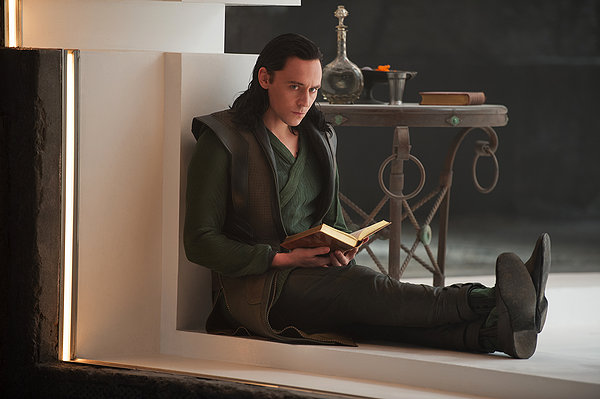 In a film dominated by a charismatic Loki, it’s no wonder that Thor 2’s real bad guy falls woefully short. Malekith is a confusing and altogether lackluster antagonist in every conceivable way. He has no personality to him; he’s simple-minded with the goal of eradicating the universe. I don’t know about you, but my bad guys better have a pretty good reason for destroying the universe since they kinda live there too. This is one of the lazier villain plot devices because it has no nuance, no shading. Apparently before there was a universe there were dark elves. I don’t want to get caught in a chicken-egg paradox here, but was there a universe before the universe, cause I look at the universe like existence’s garage. The cars inside may change but the garage was standing before it all. Anyway, Malekith wants to destroy all life because he wants to, because certainly you’d think there would be enough space in space. He’s not even that threatening or given any particular advantage beyond some firepower. It’s no wonder that Loki runs circles around this chump in the villain department. Eccleston (Unfinished Song) is not at fault. The heavy makeup he’s under smothers the actor’s ability to polish this terrible character.
The rest of the acting fares better. At this point, we know what we’re getting with Hemsworth (Snow White and the Huntsman) as the title character. He’s a sturdy leading man with just enough appeal to satisfy, though part of it is that Thor is just dull as a hero. He was more entertaining when he was cocky and irresponsible. Portman (Black Swan) holds her own though the romance between her and Thor feels more forced. Hopkins (Red 2) strikes the right mix between regal and camp. While their roles aren’t exactly integral, it’s nice having a superhero movie stuffed with great actors like Idris Elba, Ray Stevenson, Adewale Akinnuoye-Agbaje, Clive Russell, and there’s even an amusing appearance by Chris O’Dowd, who effortlessly oozes charm (take note, Thor).
This a superhero movie that separates itself by its sheer sense of fun. Thor: The Dark World takes what worked in the previous movie and provides more of it. The campy, silly Asgard stuff is given even more time, the mischievous sense of humor is renewed, the fantasy worlds given more depth and better action/effects, and fan favorite Loki gets a big starring role this time with extra brotherly bickering. It’s not the best superhero movie, nor is it the best Marvel film of recent years, but Thor 2 knows what kind of movie it wishes to be and how to best achieve this. It’s a loopy, droll, and rather imaginative big-budget superhero film, while still finding ways to be somewhat generic with its overall plotting and character turns. While the action is suitably epic, it’s the character interactions that are the most enjoyable aspect. It seems excessively lazy to say that if you enjoyed the first Thor, you’ll probably enjoy the second one as well, but there it is. Perhaps next time the storyline won’t be as convoluted and we can get even more Loki. Barring that, I’ll accept additional Chris O’Dowd screen time.
Nate’s Grade: B
Share this:

12 Years a Slave (2013)
 In 1841, free black man Solomon Northup (Chiwetel Ejiofor) lives in Saratoga Spring, New York, performing as a trained violinist. Some traveling performers offer him serious money if he’ll play with their circus act in Washington, D.C. Solomon bids goodbye to his family, never knowing he will not see them again for a dozen years. He’s kidnapped, imprisoned, and sold down South to a series of plantation owners. He insists he is a free man, but who will believe him? He’s a black man in chains, and frankly many people just do not care. He learns to adjust to the rules of his new life, finding some companionship with the fiery Patsey (Lupita Nyong’o), and looking for a trusted source to mail a letter to Solomon’s family. It’s a life of daily terror and Solomon could be killed at any moment if word got out that he knew how to read and write.
12 Years a Slave is, as expected, a hard movie to watch at times but it is an essential movie to be seen. A friend of mine literally had this conversation with a movie patron (I wish I was only making this up):
Customer: “Yeah, I don’t think I’ll end up seeing 12 Years.”
Friend: “Oh. Well it is a hard movie to watch.”
Customer: “It’s not that. I’m just waiting for a movie that finally shows all the good slave owners doing nice things. It wasn’t all bad.”
 This brief conversation exemplifies for me why a searing drama like 12 Years of a Slave is still vital in 21st century America. This is a slice of history that cannot be forgotten, but just as sinister is the amelioration of its cruelty. As time passes, and those with direct personal experience are long gone, then the mitigation begins, and you have ignorance consuming people who want to whitewash America’s original sin, like the above movie patron. I’ve even read, simply on message boards for this very film, a dubious prospect I admit, people arguing, “Can’t we just move on already?” and posing false equivalences like, “Well the poor Southerners who worked as indentured servants had it just as bad.” I swear I am not deliberately setting up a straw man argument, these are actual gripes people have. It’s as if acknowledging the totality of the horror of slavery is, in itself, some kind of insult to people today. It’s history and vital history that need not ever be forgotten or mitigated, and we need more films dealing with this subject.
There is zero equivalency to treating people as subhuman property, stripping them of all human rights and dignity, separating them from their families, beating them, raping them, murdering them without consequence, being punished for defending yourself, and kept in a constant state of terror where anything horrible can happen to you at any time without reason. Sorry slavery apologists, but even the notion of a “kindly slaver,” which the movie actually showcases, is erroneous. Whether they don’t beat their slaves as often or addressed them as people, slave owners are still profiting from the institution of slavery, and as such the notion of a “good slave owner” is antithetical to the very insidious nature of plainly owning another human being.
With all that said, 12 Years a Slave is an unflinching look at the cruel reality of slavery but one that demands to be seen. Director Steve McQueen (Shame, Hunger) doesn’t pull his punches when it comes examining the unrelenting misery of slavery. There’s a whipping scene where he are in the safe position of focusing on the faces of those involved, studying their horror, but then McQueen has the camera turn around and you see, in graphic detail, the ravaged back of an innocent woman, the bloody result of every one of those whippings that we watched at a comfortable distance at first. This is a gory example, and the film is rather restrained when it comes to this aspect. This is not simply wallowing in sadism. Hollywood has yet to have a definitive film showcase the traumatic reality of slavery. 1997’s Amistad gave you glimpses, but most of Steven Spielberg’s movie was set in courtrooms arguing the philosophical nature of inherent rights. I wish they would remake the classic miniseries Roots; today’s TV landscape would be more permissible at showing the graphic terror of slavery than 1970s network television. With 12 Years a Slave, there are several uncomfortable moments that will make you gasp, but overall, while retrained on the gore, you feel the overall devastation of a slave’s predicament. Every moment of life was at the whims of another, and a victim could be trapped at every turn. Solomon is beaten soundly, and after he defends himself, he is rounded up to be lynched for his audacity. The aftermath is portrayed with stark tension, as Solomon is left hanging by a noose, his feet barely touching the muddied ground, trying to maintain his stance or else choke to death. And like the long takes in shame, McQueen’s camera just holds us there, trapping the audience in the same strenuous dilemma. The worst goes to Patsey, who is raped by her master and tormented by the master’s jealous wife. Both Solomon and Patsey are damned with every decision. By the end, Solomon is rescued and reunited with his family, but you can’t help but think about all those other unfortunate souls left to mire in slavery. For millions of them, there was no set limit to their desolation.
 From a script standpoint, the movie flows more as a series of scenes rather than a traditional three-act arc. Writer John Ridley (Red Tails, Three Kings) works from Solomon’s own autobiography and does an incisive job of recreating the dimensions of mid-19th century America and the diseased mentality that accepted slavery. No more is this evident than in the frightening character of Edwin Epps, played with chilling absorption by Michael Fassbender, McQueen’s favorite collaborator. Epps is the kind of man who uses selective Scripture to justify his heinous actions. “A man can treat his property how he likes,” he quips with authority. Epps’ plantation is the worst along Solomon’s hellish odyssey. Fassbender (X-Men: First Class, Prometheus) spookily possesses Epps with great ardor, bringing out the snarling dangers of a man and his unsavory convictions. You’ll cringe over all the unwanted lascivious attention he gives to Patsey. He is a weak man through and through, but one who rages against others with his weaknesses. Fassbender is electric and keeps an audience extra alert when onscreen.
The acting is exceptional and infuriating. Ejiofor (Serenity, Salt) is commanding in a performance that stays with you. There is so much the man has to communicate with his eyes, those great orbs of his. Because of his circumstances he must hold back his ire, do what he can to make it another day, and his adjustment to the horrors of slavery are heartbreaking in itself. He must always be cautious, and when he dares to risk trusting a white man, we feel the same tremors of trepidation. There’s a great scene where Solomon, having been betrayed, has to come up with a credible alternative in the moment, with so much riding on his improvisation skills. It’s as suspenseful a moment as most Hollywood thrillers. The most heartbreaking performance, though, belong to Nyong’o, who is making her film debut in a major way. As Patsey, she symbolizes the mounting torment of unremitting victimization, a woman begging for death but too proud to make it happen. She has some intense monologues where not one word feels false. She is a broken woman struggling to find her footing, and watching her get abused in so many different ways is gut wrenching. She’s more than a martyr and Nyong’o shows you that.
Undeniably a good movie, there are still enough filmmaking choices that hold it back for me, and it all comes down to Solomon as the protagonist. The movie’s center was not as strong as it needed to be, and that is chiefly because our focal point, Solomon, is not well developed as a character. I feel pings of something approaching shame just bringing up the subject, but I must profess that Solomon is just not given much to do beyond suffer. As a free man, his adjustment to the absurd cruelty of the institution of slavery is meant to serve as an entry point for a modern audience, to have the safety of our lives suddenly stripped away. But if I had to describe Solomon as a character, I could say that he mostly vacillates between two modes: shock and solemn dignity (“I don’t want to survive. I want to live.”). Strange that Patsey and Epps and even Epps’ wife are shown more dimension than the lead character. I’m not asking for Solomon to suddenly become a more active character and to rise up, Django Unchained-style; the context of slavery limits his opportunities to express himself. I just wanted more to this guy to separate him from the others suffering onscreen. And maybe, ultimately, that’s the point, that Solomon is, at heart, no different than any other slave. I can agree with that in philosophy, however, this approach also nullifies my ultimate investment in the protagonist. I feel for him because he suffers, I feel for him because I want him to find some semblance of justice (an impossible scenario given the circumstances, I know), and I feel for him because he is a good, honorable man. But I do not feel for him because I have an insight into the character of Solomon Northup. Fortunately, Ejiofor does a superb job of communicating as much as he can non-verbally. It just wasn’t enough for me.
 To criticize 12 Years a Slave makes me feel awkward due to the seriousness of its subject matter, but hey, plenty of people make mediocre movies exploring Holocaust atrocities too (does anyone ever dare say, “Get over it,” to Holocaust survivors?). A horrifying historical subject does not give filmmakers cart blanche to slack when it comes to the important elements of storytelling, like story and characterization. 12 Years a Slave, by extension, is an exceptionally made movie with moments to make you wince and cry, gifted with powerful acting and sensitive direction. It is a searing recreation of the many facets of slavery, not just the sheer brutality of the beatings. You will understand on multiple levels the terrorism that was the institution of slavery, a vicious reality that should never be forgotten by a complacent citizenry. I can applaud 12 Years a Slave for its technical excellence, depth of performance, and historical accuracy; however, my personal investment in the protagonist was somewhat limited because Solomon Northup was not developed sufficiently enough. I certainly empathized with the man, but too often I felt like I was watching Solomon as a suffering symbol rather than a character. He’s obviously an interesting figure and I wanted more dimension. While not exactly rising to the level of a Schindler’s List for the institution of slavery (as some have dubbed), 12 Years a Slave is an enthralling movie in so many ways. It’s just a shame that an underdeveloped protagonist would hobble a film so otherwise worthy.
Nate’s Grade: B+
Share this:

Ender’s Game (2013)
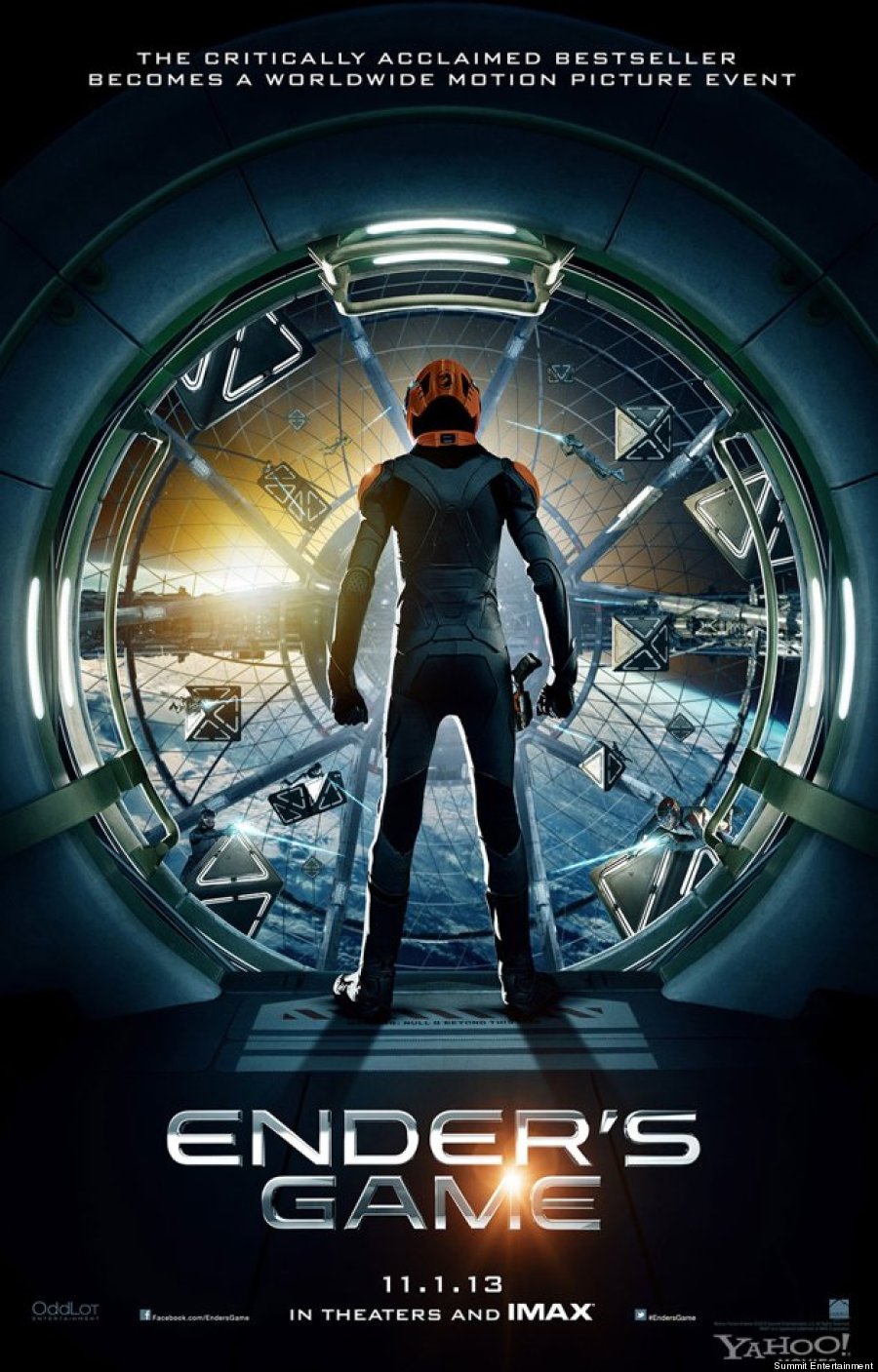 Honestly I know more about Ender’s Game thanks to the swirling rabble about boycotting the film thanks to author Orson Scott Card’s homophobic personal views. I didn’t even know this book existed until I heard about the movie. With my cloud of ignorance, as well as some lingering worries that the director of X-Men Origins: Wolverine was at the helm of this expensive would-be franchise, I was pleasantly surprised at how entertaining I found the movie. It’s set in a future where children are culled and trained to be super soldiers against an alien race that has been in seclusion after a failed invasion of Earth. The emphasis is on strategy and manipulating your opponent, which leads to many military training sequences. At one point I wondered, “Is this whole story going to be training sequences and zero-gravity laser tag?” It’s not, thankfully, but even those sequences are fun. Writer/director Gavin Hood does an excellent job of fleshing out this world while giving enough time in between the games to also flesh out his ragtag group of characters. There’s something inherently satisfying to watching a team come together, and the film has plenty of small payoffs. The visuals are astounding to soak up. The zero gravity fun, backlit by the stars, is dazzling. The acting is strong across the board, with special appreciation that Harrison Ford has a good role that he’s actually well suited for. The pacing does start to slag toward the third act, mostly because the plot feels like an escalating series of games, until it’s not. There’s a measured degree of ethical ambiguity and contemplation to the film that’s admirable. Whether you plan on boycotting Ender’s Game or not, it’s a successful, thrilling, and visually engaging sci-fi flick that deserves to be seen at some point.
Nate’s Grade: B+
Share this:

About Time (2013)
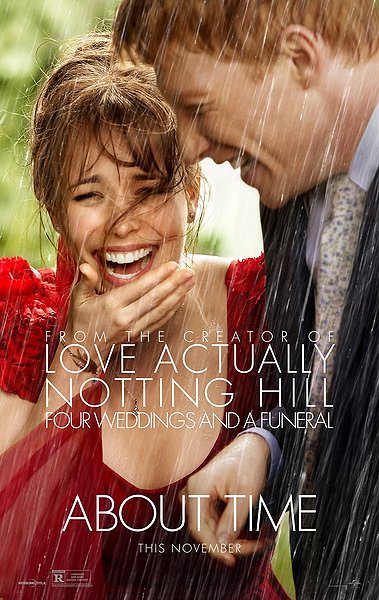 Richard Curtis is something equivalent to royalty in romantic comedy circles. The man wrote Four Weddings and a Funeral, Notting Hill, the screenplay for Bridget Jones’ Diary, and he wrote and directed Love, Actually. If you are a fan of those movies, then About Time is already at the top of your to-do list. Reportedly Curtis’ last movie he will direct (he’s only done three), this time-travel romance looks to be a break from a genre burdened by convention. If you like your British rom-coms to be mildly cheeky, hopelessly dewy-eyed romantic, filled with beautiful people, and loaded with hugs, then About Time with suffice. If you were expecting something grander from the premise you’ll walk away shaking your head at all the squandered potential.
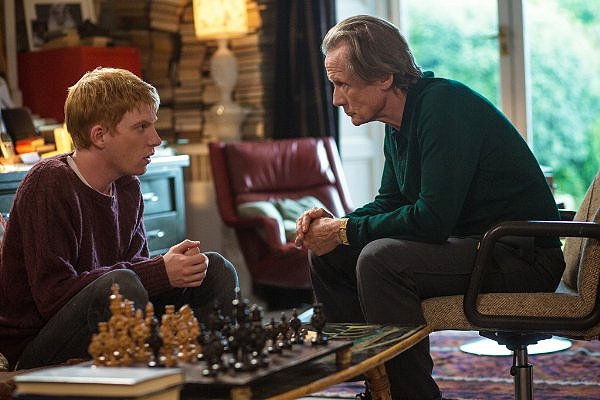
Tim (Domhnall Gleeson, son of Brendan) is a normal upper class British student when his father (Bill Nighy) sits him down to have… The Talk. This one isn’t about birds and bees so much as it is the space-time continuum. It seems that the men in their family have the unique ability to travel through time, though only during their lifetimes. All Tim need do is find a somewhat secluded, dark corner, clench his fists, and think his way back to a particular memory. Tim is able to blink out embarrassing incidents and use his foreknowledge. He meets Mary (Rachel McAdams) and sets his sights on making her fall in love with him. He corrects their courtship until he gets everything “right.”
 While eminently pleasant and suitably funny and emotional, About Time is a tale of wasted potential. I’m unsure why Curtis even brought in such an unconventional element like time travel if he was just going to play it safe. The standard, feel-good rom-com route feels the safe way through, and while it’s well done in that regard, I almost wish the film had pushed further with its concept. To begin with, the time travel restrictions are arbitrarily applied and will later be broken altogether as the film continues. When time travel is used it’s played out like Groundhog Day, with Tim immediately going back to fine-tune his actions, particularly his courting of Mary. That works, as we get used to the inertia of the edits, but that seems to be the lone focus. Once he gets the girl, Tim rarely uses his amazing gift. He’s content and so time travel is an afterthought when, as I suspect for any of us, it would be all we could think about. Tim lacks suitable ambition. I think the film would have been weightier had its lead been less idealistic. He’s a nice guy but imagine a Lothario having the power to travel back in time. He could physically cheat on his wife, go back and make sure it never happened, and live his life, having his cake and eating it too, except for the guilt. Is it cheating if it happened in an alternate timeline? Or what if he was a stockbroker committing insider trading with his past self. In fact, what if he just interacted with his older, more morally wanton self? There’s also the fact that Mary never finds out about any of this. At no point does Tim reveal his family’s incredible ability and have to atone for his actions. I’m fairly certain Mary would feel like her marital bliss could be the end product to manipulation. Alas, we’re stuck with our cute, acceptable, but mostly square rom-com.
While likeable, I didn’t think the characters themselves were sketched out well; I like McAdams and Gleeson, but I couldn’t really say much about them as people. He’s a lawyer. She works as a reader for a publisher. His family is kind of rich. And that’s about it. Even through their interactions we don’t learn much about Tim or Mary. They fall in love, and it’s nice, but the lack of characterization, besides the fact that they are cute together, kept me from fully investing in their love story. I doubt the target audience will have this same issue. I found them cute and their scenes are cute together but I need more about my main characters than a collection of cute scenes. Another nagging aspect of their courtship is that it seems too easy. Tim has the amazing power of time travel so he can fix any problem presented, but that shouldn’t stop the appearance of problems. Tim and Mary are nice people that seem to have no discernible differences, besides Tim’s leftover feelings for a first love. An audience may say they want a couple to be sweet together always. They don’t. It’s boring. We need conflict. With About Time, there just isn’t enough of it and Tim and Mary are too underdeveloped for me to pine for them.
There are loads of dangling storylines that feel like they are leftovers from past drafts. You would think wrapping up a peachy marriage early would lead to some sort of personal crossroads and sacrifice. Everything was coming far too easily for Tim, so I kept waiting for another shoe to drop late in the film, to give him the chance to undo his own personal happiness and marriage to, say, save a beloved family member. I kept waiting for some kind of greater personal stakes, but it never came. Then the movie has all sorts of dangling storylines that do not seem conceptualized. The doddy uncle who seems to be experiencing the ravaged effects of too much time travel? Not much there. They never explain him and so he is just the standard Brit com-com kooky family member to say weird things offhand. Seems like a waste of greater pathos. Tim’s troubled sister? She’s fixed in a pinch and of course it all has to do with the men she’s dating.
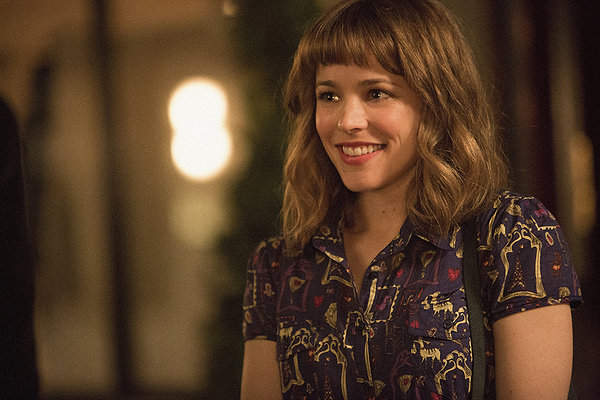 Then there are the rules, which in time travel need to be adhered to closely or else the butterfly effect ripples cascade. We’re told at first that Tim can only go backwards in time. This gives the impression that he has to live out all that extra time. So, say, if Tim traveled back two years, he’d have to live out all two years to get back to the presumed moment he began his journey backwards (writing about time travel does wonderful things with sentence tenses). So every jump back requires reliving your life. But then all of a sudden Tim can jump forward in time as well. No one comments about this. If the men in the family are reliving days and possibly years of time, then shouldn’t they be preternaturally aging, looking 70 at 50 and so on? Then there’s the fact that Tim introduces the ability to travel back in time WITH another person. This is never dealt with again, sadly, and it’s a big deal. You can bring other people with you through time. This is an amazing opportunity but it’s wasted like so many others.
However, with all that said, the movie won me over more as it transitioned into a greater emphasis on the father/son relationship, enough so that it feels like Curtis trying to get the sense of closure we so rarely get in life. I though a late trip backwards, as a young son skipping stones with his dad before he may never see him again, was quite beautiful. It got me wishing the film had given more time to explore the dynamics of father/son time travelers, a rich dramatic possibility that only reminds you how much more interesting About Time could have been.
About Time will be catnip to its target audience, namely female rom-com fans. I found it a fairly pleasant movie and its stars wholly likeable. I laughed at spots and even got teary-eyed a bit toward the end as the film’s emphasis shifted from a guy-gets-girl narrative to more of a father-son examination. The funny Brit characters do their thing, the lovely scenery remains lovely, and the declarations of love get a spit-shine. It is an effective romantic comedy that will charm and please and get its audience to swoon, but I was left feeling that its potential went untapped as it settled on a safer, more conventional story despite all the unconventional possibility. Why introduce time travel if you’re just going to take the safest route possible with your storytelling, never pitting Tim in a difficult decision he has to make, or jeopardizing his carefully manipulated happiness? There are so many possibilities Curtis had with a premise that opens up alternative histories, but it seems like he settled for another dash of more-of-the-same.
Nate’s Grade: B-
Share this:

The Counselor (2013)
 The magnitude of author Cormac McCarthy’s involvement should not go understated in discussions over The Counselor. The acclaimed, Pulitzer Prize-winning author has written modern classics often exploring the darker side of humanity. McCarthy’s first screenplay must have seemed like a hot commodity for all of Hollywood. It attracted director Ridley Scott (Prometheus) and a score of A-list actors. The anticipation was that McCarthy could match the brilliance of his prose. The Counselor, a dreary and lackluster thriller in every conceivable way, proves that McCarthy still has an uphill learning curve when it comes to serviceable screenwriting.
The titular Counselor (Michael Fassbender) seems to have a nice life. He’s just proposed to his girlfriend, Laura (Penelope Cruz), and their sex life is vigorous. Then an old client, Reiner (Javier Bardem), invites the Counselor in on a shady drug transportation deal. The allure of easy money is too much for the Counselor to resist. Naturally, things do not go according to plan. A Mexican cartel intercepts the transport truck, bodies pile up, and the stakes get very personal for the Counselor.
 To be blunt, if McCarthy had submitted this script under a different name, it never would have made its way to the big screen. This is the award-winning author’s first screenplay and it shows. The pacing is shockingly slack, with the film rarely having any sense of life onscreen. I’m not a slave to the standard three-act structure of Hollywood screenwriting, but you need to produce something that keeps pushing the film forward, heading to a finale that seemed inevitable. McCarthy’s script is bogged down with pointless scene after pointless scene, little arias that get away from him, indulging his characters to monologue at length about philosophical nonsense. There are lengthy conversations about diamond shapes, the very nature of existence, and all sorts of Matrix Reloaded-like lingual excesses. These characters talk round and round; it feels like there aren’t even other characters in the room. Their lengthy, pretentious conversations also do little to push the narrative along or reveal essential bits of character. You get to hear one crime kingpin talk about his favorite poet. Great, but what can you say about him beyond the fact that he’s well read? Every character in this movie, from top to bottom, is a vapid space. Some of them have interesting aspects/quirks, like owning cheetahs or masturbating on car windshields, but not one character can be described as interesting. Beyond the terms “ruthless,” “pragmatic,” and “naïve,” I cannot even fathom a way to describe anyone in this film. They don’t even really work as plot devices because that would imply causality. When you couple the void of characterization with ponderous, rambling dialogue, then you’re already sabotaging your entertainment chances.
The plotting is muddled beyond all comprehension. I like to consider myself a pretty sharp moviegoer, but I was left scratching my head far too often. With a paucity of characterization and some idle pacing, I was confused as to what exactly was going on, sometimes even just at a literal level. What was this plan? How do all the players fit in? Why are the betrayers acting as they do? Who works for whom? Why should I be shocked about revealing the identity of a betrayer when it was made all too obvious in a previous scene (note: this is so directly transparent that it cannot count as foreshadowing)? Why does the appearance of a DVD signify finality after a previous phone conversation already did the same thing? And most of all why should I care? Watching this movie is like traveling through a long, impenetrable fog. There are serious, ongoing clarity issues, which make those florid digressions and overall pointless character nattering to be even more maddening. There are well known actors that come in just for single scenes, and then those scenes amount to little to nothing on the overall bearing of the plot. The Counselor doesn’t feel like a fully formed story; it feels like a collection of 30 scenes served as disposable sides for actors during preliminary auditions.
Even worse, for a film about drug deals gone badly, murder, and Cameron Diaz masturbating on a windshield, The Counselor is deathly boring. I grew restless before the halfway mark and just kept hoping beyond all evidence that the film was going to find some direction and pick up the intrigue. It did not. The film’s essential story structure, criminals getting in over their heads and paying a price, is a familiar one. This structure can work to marvelous results both grand (Goodfellas) and small (Things to Do in Denver When You’re Dead). Hell, even McCarthy’s own novel lead to the brilliant, Best Picture winner No Country For Old Men. Look at how the Coen brothers approach the macho, nihilistic material as opposed to its author. They created a sense of all-consuming dread with efficiency, elegance, and their characteristic macabre sense of humor. Watching The Counselor, it’s like the turgid knockoff of a McCarthy novel. When I got home I felt like I had to watch a Quentin Tarantino movie to wash the bad taste out of my mouth. Tarantino is given to long indulgences of elaborate dialogue as well, but he makes his characters interesting, with personalities that grab you and stand out, and listening to his dialogue is a pleasure unto itself.
McCarthy’s brand of ruthless killing has its peculiar intrigue, but again it only functions as morbidly fascinating little asides. The use of tripwire is given high priority by the killers onscreen, decapitating a speeding motorcyclist and cutting into the jugular with another character. It’s a strange, harrowing, and gruesome manner of death, but is it at all practical? I know I’m treading dangerous waters bringing the concept of reality to a murky film, but what killer decides to set up a wire approximately neck high across a road? It seems likely that another car would travel that same road in the hours of buildup. It also seems highly lucky to adjust the wire to the exact height to cut into the neck. I’m no professional killer but it seems like a lot of setup and guesswork. I have to imagine there are far easier ways to kill a speeding cyclist or a man walking along the street. Attention professional hit men of the movies: stop making your job more difficult than it has to be. Nobody is awarding you a ribbon for Most Inventive Kill.
 There are plenty of pretty faces in this movie, genuine acting talent, and to strand them with precious little characterization is an outrage. Fassbender (12 Years a Slave) is a little too sly to play naïve, and his later actions lack a necessary sense of desperation to sell his emotional plummet. Cruz (Pirates of the Caribbean: On Stranger Tides) is so effortlessly sensual but is put on the sidelines early and stuck in the damsel-in-distress box. Brad Pitt (World War Z) is the slick snake charmer we’ve seen plenty of times before. But the worst lot goes to Diaz (Bad Teacher). She’s supposed to be mysterious and threatening as Reiner’s sexually adventurous girlfriend but Diaz plays things so stone-faced serious. This poor woman is given the most unerotic, bizarre sex scene in modern history to enact, and I don’t know whether to applaud or pity her. Sure she gets to uncork some meaty monologues about Malkina’s trenchant world perspective, but this is the movie that will be defined by Diaz humping a windshield. At least the movie plays this out somewhat realistically, with Reiner more horrified than aroused. What did that outrageous scene add up to? Also, Penelope Cruz plays a “Laura” and Cameron Diaz a “Malkina”?
I know it’s a petty thing but it really irritated me how often people refer to Fassbender’s character as “Counselor.” The end credits do reveal this to be his name. If you thought it got irksome hearing Leonardo DiCaprio say “ole sport” after every other sentence in The Great Gatsby, then enjoy the repetitive declaration of Fassbender’s lone job title. “What do you think, Counselor? I don’t know, Counselor. I’d think things over, Counselor.” Do people really refer to somebody by this title as their name, and so frequently? He also doesn’t seem to be a competent lawyer at all.
The Counselor is such an unforgivably boring slog, languid and rudderless when it should be thrilling and complex. The characters are nonexistent, the plotting is muddled and confusing, the dialogue often laborious and roundabout, and the overall film is too meandering to properly engage an audience. Even talented people can produce bad movies, and here is further proof. With this cast, with this crew, there is no excuse for The Counselor to be overwhelmingly stilted and tedious. I cannot fathom what attracted the talent to this film beyond the cache of working on “Cormac McCarthy’s first screenplay.” If the results of The Counselor are any indication, I don’t know if we’ll be seeing too many McCarthy screenplays in the future, or at least McCarthy scripts that haven’t been vetted by other writers who better understand the contours of the medium. His florid arias and abstract, directionless plotting can be forgiven on the page but not on the screen. Scott doesn’t help matters, taking great care to film the luxury of the lifestyles on screen. What we’re left with is a tepid movie about bad people meeting bad ends, with little entry for an audience to care or even find entertainment. The art direction is given more care than the characters. In the weeks leading up to its release, The Counselor adopted a tagline from a quote by Laura: “Have you been bad?” It was turned into the Twitter hashtag promoting the film. Well, Counselor, you’ve been very bad.
Nate’s Grade: C-
Share this:

In a World… (2013)
 Actress Lake Bell’s writing/directing debut, In a World, is a comical look inside the world of voice acting, particular in the field of movie trailers. It’s an interesting world and told with enough comic acumen by Bell (TV’s Children’s Hospital), a serious student of vocal artists. She plays Carol, a woman who breaks into the trailer voice over biz, causing ripples in a field dominated by baritone-voiced men, like her legendary father (a perfectly unctuous Fred Melamed) who holds to sexist dictum. There’s a cute romance involved with Demetri Martin, an effective subplot about Carol’s sister having an affair, and an ongoing commentary about the uncomfortable infantilized voice many young women utilize. The story is threatened by a percolating mistaken identity rom-com convention, but thankfully regroups for a third act pitting father against daughter in vocal performance, as it should be. As a director, Bell has a steady feel for her scenes, following a subdued comic rhythm that also feels eccentric without going overboard. As a writer, she gives her characters space to grow, to make mistakes, and to triumph but not without complications. As an actress, Bell is charming and a terrific lead anchor for a film filled with likeable, quirky characters. In a World is a little movie but it’s effortlessly cute, winning and pleasant in the right places, and filled with a great cast of comic actors. Beware: upon exiting the film, it is unavoidable that you will do your own fake trailer “In a world…” impressions.
Nate’s Grade: B
Share this:

Escape From Tomorrow (2013)
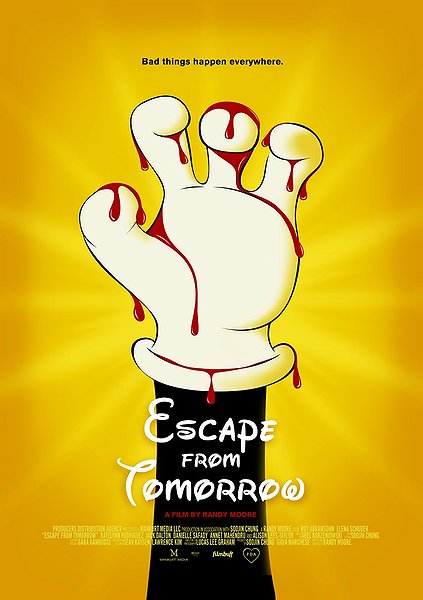 Escape From Tomorrow built a wave of buzz coming out of the Sundance Film Festival, namely because it was a bizarre, psycho-sexual little indie film shot secretly on the premises of Disney World and Disney Land. Writer/director Randy Moore shot his movie in secret, unbeknownst to Disney and the park employees. He was so paranoid about word getting out what they had done that Moore edited the film in another country. There is palpable fear at the reach and power of Disney’s coffers, enough so that a character mentioning the very D-word is silenced, and so I recall early on that people predicted Disney and its armada of lawyers would never allow Escape From Tomorrow to be released. Rather than get litigious, the Mouse House has decided to simply clam up, refusing comment. It’s a smart move, because besides a passing novelty, no one is going to remember the oh so monotonous Escape From Tomorrow in a matter of months.
The wisp of a plot involves a family vacationing at a Disney park. On the final day, the father (Roy Abramsohn) has been told he has lost his job. The rest of the day follows suit as the father loses his grip with reality, interpreting sinister signs throughout the park. He also keeps running into a pair of French teen girls who enjoy holding hands, being flirty, and singing. After the third or fourth time, the father starts to trail the girls, eerily entranced. They warn him that dire things will befall him if he doesn’t go with them.
 Take away the ballsy, surreptitiously recorded angle, the “how did they do that?” factor, and ultimately is there a movie here worth watching? I would definitively say… no. Admittedly it’s interesting to dissect how this guerrilla-style stunt was accomplished, watching scene after scene and figuring out what was shot in the parks unbeknownst to tourists and employees, what was likely shot on a set, where the cuts marry the two, and what techniques the director and his crew utilized to film a movie without blowing their cover. I think many of the scenes had to be improvised, at least the dialogue within the park, because starting and stopping and repeating lines in public, out in the open, would seem suspicious (the cursing would also seem to be courting danger). The Disney theme parks have millions of visitors, so people recording every action would not seem out of the ordinary. Escape From Tomorrow works as a stunt, with the audience picking apart the magic trick simultaneously as it’s performed.
However, a stunt is all that Escape From Tomorrow is because from a thematic, subtext standpoint, this movie is a mess. There just isn’t enough weirdness going on here and whatever small doses of it we get is given precious little connection to any larger theme. It feels like the filmmakers settled on the most facilely subversive idea – Disney Land, the happiest place on Earth, is not. Undercutting all of Disney’s famous family-friendly iconography with the occasional weird thing is not enough. A kid has black eyes. Ten minutes later a stranger makes an offensive comment. Ten minutes later something in a ride that is supposed to be happy looks mean instead. The majority of the movie plays out like you’re watching someone’s boring vacation. You don’t care about the characters. There is no plot to speak of, and that can be acceptable in an atmospheric film that serves as a visual descent into madness. There just isn’t enough madness here. Escape From Tomorrow is far too tedious to be effective. Long stretches are just watching the family traverse the theme park, notably with the father always running into the French teens. There is far too much padding, little connection from scene to scene, and the end is just a confusing muddle groping for a deeper meaning. Midway through, when the father is captured and held underground at Epcot, it looks like the movie is going to take that next step, ramping up the weirdness. Well that conflict is readily solved and then we’re back to the occasional boring out-of-place item. I want to say that Escape From Tomorrow is like David Lynch’s vacation video, but that is giving too much undeserved praise. This is like the deleted scenes of David Lynch’s vacation video.
 My colleague Ben Bailey countered my negative option with the idea that Escape From Tomorrow is meant to be a dark comedy and to view it through that lens; all right then, because as a “comedy” it still is half-baked, meandering, and poorly executed. The incongruous imagery, often sexual or demonic, is rather cheap in the sense that it’s just flipping the staid Disney script on wholesomeness with no more subversive substance than a moody teenager scribbling on his notebook. The Disney princesses double as high-priced courtesans? Okay, now go further rather than just taking a standard Disney character and making it adult in a shallow manner. There’s a scene where the father escapes by squeezing a tube of Neosporin to lubricate his hands out of confines, and oh boy, the white liquid shoots onto hanging pictures of female body parts. What a riot. Taking a cockeyed, perverted look at Disney is not the same as developing comedy, and even that cockeyed view is lame. I think that the father’s lustful pursuit of the French girls is meant to be comedic, but it was only creepy. When he sneaks up to spy on them in their bathing suits, how else should I interpret that? If this is supposed to be a comedy then Escape From Tomorrow is an even larger misfire.
Escape From Tomorrow is a nonsensical, plodding, superficial film, and it adds up to a whole lot of nothing. There isn’t a grander statement or sense of commentary. There is just scene-to-scene weirdness that grows old rapidly. I commend the ingenuity of the filmmakers for being able to secretly record a movie at one of the most heavily trafficked locations in the world. I don’t think the filmmakers had any clear vision of what they wanted to say with their movie, settling on “weird crap at Disney Land,” and then putting all their time and energy into planning how to pull off this coup, never mind the fact that the finished product was not nearly worth the effort. If you’ve ever wanted to be trapped on a bad vacation, then enjoy, movie masochists.
Nate’s Grade: C-
Share this:

We’re the Millers (2013)
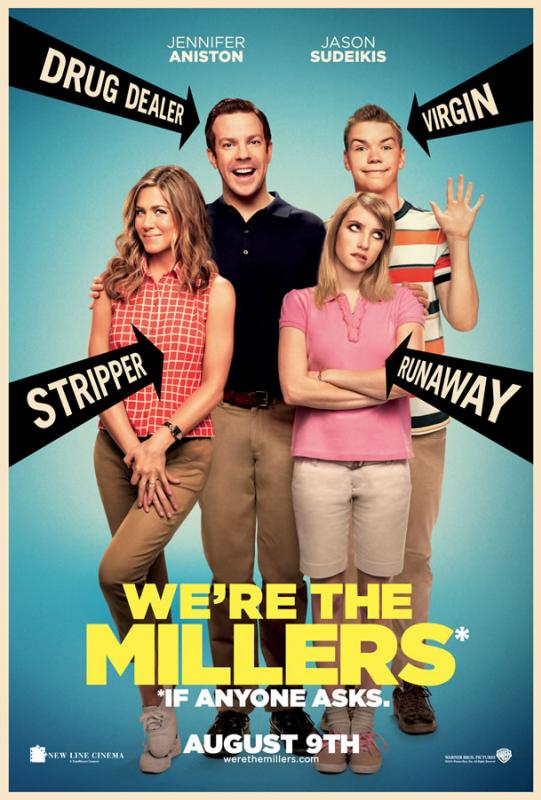 I finally caught one of the biggest surprise hits of the year, the raunchy comedy We’re the Millers, and while fitfully entertaining, mostly in its second half, I have to wonder what made this film the hit it was, despite lack of clear comedy competition. The setup involves four people (Jason Sudeikis, Jennifer Aniston, Emma Roberts, Will Poulter) posing as a model nuclear family to smuggle drugs into the United States. You’d think the difficulty would be getting back into this country, but no, it’s all about keeping their cover, especially when a vacationing DEA agent (Nick Offerman) pals around. The flimsy setup gets much better in the second half as the false family dynamics and roles are skewered, particularly an educational kissing session between siblings and mother. I can also see the markings of why audiences gravitated to this otherwise so-so comedy. It offers each member to contribute meaningfully, it gives each a lesson and a triumph, and they form a likable bond. So while the joke payoffs may whiff, there’s a character payoff to pick up the slack. Plus there’s an Aniston stripping sequence to showcase the fitness of the forty-something actress. The jokes settle for easy vulgarity a bit too often but every now and then the film surprises. Sudeikis is slyly enjoyable channeling a young smarmy smartass Chevy Chase, and Offerman is hilarious, enough to make you wish the movie followed his family. We’re the Millers reminds me of the 90s works of the Farrelly Brothers, a mixture of gross-out gags, slapstick, uninspired villains, and a dash of sentiment. We’re the Millers is an acceptable comedy, not a great one, but after its quarter billion dollar box-office riches, get ready to meet the Millers all over again.
Nate’s Grade: C+
Share this:

The Call (2013)
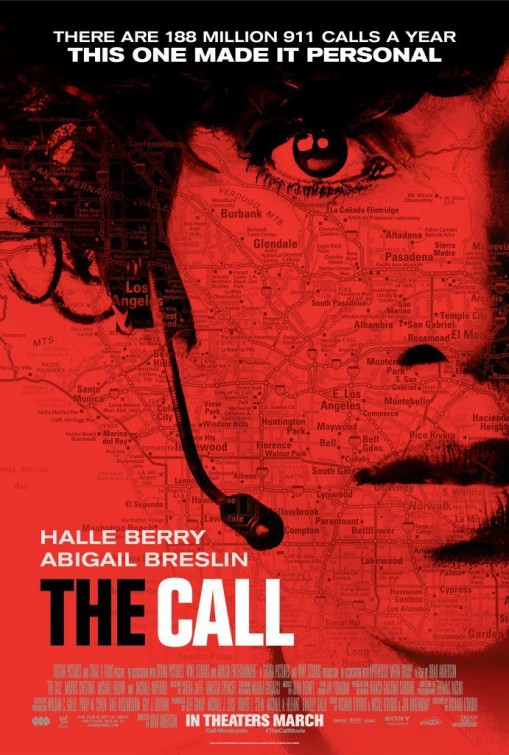 A surprise hit last spring, The Call is a simple but rather effective thriller that wavers a bit in the end but not enough to derail your entertainment. Halle Berry stars as a 911 operator talking through a teen girl (Abigail Breslin, spending far too much time in a bra for my comfort) kidnapped in the trunk of a car. It has the hallmarks of the typical action thriller genre, namely our heroine working through her past trauma of inadvertently getting another young girl abducted by the SAME killer. The Call plays best as we think alongside our two embattled heroines, going step-by-step how to determine where she may be, what car she may be inside, and how to draw attention to her predicament. The writing is economical and fast-paced and mostly smart, having the police act like actual professionals. Director Brad Anderson (Session 9, The Machinist) employs plenty of extreme close-ups that effectively draw upon the claustrophobia and urgency. For a solid two acts, the movie seamlessly transitions form one obstacle to another. Then the third act arrives where Berry decides to leave her post and take matters into her own hands. The film becomes far more predictable, conventional, and veers into the absurdity it had avoided for so long. The creepy killer has a half-hearted creepy back-story/fetish, Berry behaves far too cavalierly when she should be notifying the cops, and the ending defies all sensible logic. It’s meant to be a poetic punishment but, upon minor reflection, it’s entirely possible that this loose end will come back to haunt everyone yet again. In total, The Call is a breezy, suspenseful thriller that is well-acted and directed with style (the pounding electronica score doesn’t fit, though). The downturn at the end is disappointing but The Call is still worth taking.
Nate’s Grade: B


 nathanzoebl
You must be logged in to post a comment.