Category Archives: 2012 Movies
Savages (2012)
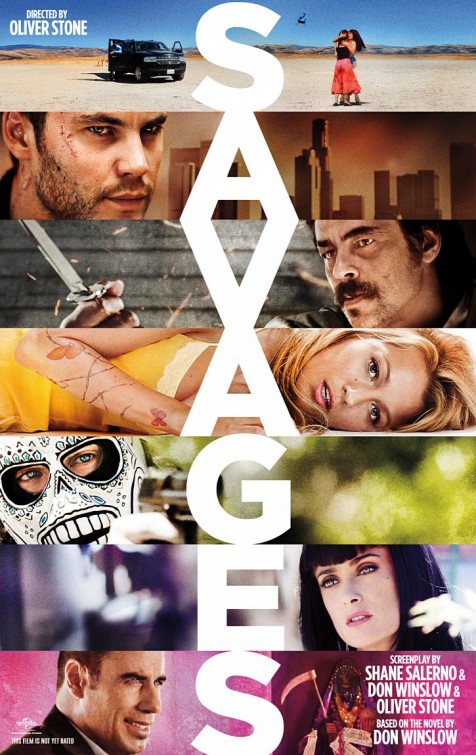 Savages has been described as a “return to form” from prolific director Oliver Stone, who has spent the last decade making straight biopics (W., Alexander) and safe feel-good movies (World Trade Center). The less said about Wall Street: Money Never Sleeps the better. You never thought one of the world’s edgiest filmmakers would follow such a square path. I can’t fault people for getting excited by Savages, hoping this drug-addled crime thriller can revive the gonzo sensibilities of the man. Well, Savages isn’t going to satisfy most people, especially those looking for a cohesive story, characters that grab your interest, and an ending that manages to stay true thematically with the rest of the movie. In short, Savages is a savage mess of a movie but not even an entertaining mess. It’s just a boring mess, and that is the film’s biggest sin.
Best friends Chon (Taylor Kitsch) and Ben (Aaron Johnson) are living the American dream. They began farming their own marijuana plants, using the best seeds form Afghanistan while Chon was on tour with the military. Together, the guys have produced a product high in THC that blows away the competition. They have flourished in California. Now a Mexican cartel, lead by Elena (Salma Hayek), wants in on their business, and they won’t take no for an answer. The cartel kidnaps the boys’ shared girlfriend, O (Blake Lively), and promises to hold her ransom for one year unless the boys agree to their terms. Chon and Ben decide to use their considerable resources to put the squeeze on Elena and her team of scumbags, all the while looking for a way to rescue their shared love of their life.
 It’s a lurid movie all right. Plenty of sex, drugs, and violence, but man oh man is it all just empty diversions because the movie cannot survive its trio of unlikable, uninteresting, and painfully dull characters. O, Chon, and Ben have a dearth of charisma; light cannot escape their black hole of charisma. What sinks Savages is the realization that it’s just a shoddy movie filled with a lot of skuzzy characters but hardly anyone that merits genuine interest. We’ve got skuzzy good guys, skuzzy bad guys, but where are the personalities? Where are the quirks or the hooks to drive our interest? Just having Benicio del Toro (The Wolfman) act weird and mumbly is not enough to cover the shortcomings of his character. I’ve read reviews where critics cite del Toro as “hypnotic.” I have no idea what they’re talking about. He’s just your average skuzzy bad guy you’d find in any mediocre crime picture; he just so happens to be played by Benicio del Toro. The DEA Agent John Travolta (From Paris with Love) plays is your typical skuzzy desk weasel; he just so happens to be played by John Travolta. And that’s where the movie falters. We have all these characters on all sides of the law but we couldn’t give a damn for any of them. O comes across like an annoying, privileged, faux intellectual. Chon is a meathead. Ben is an amorphous do-gooder. I don’t care about their problems and I especially don’t care about them retrieving O so they can return to their vague polyamorous lifestyle. She wasn’t worth all the effort, nor where these men worth dying over. At any point in the film, I wanted these characters to hastily die so that I might, just out of chance, come across a more interesting figure. I received no salvation.
Our trio of bland characters is made flesh by a trio of bad performances. First off, people have got to be realizing that the kind of lived-in, edgy, and compelling performance Lively pulled off in 2010’s The Town is more the exception than the rule. Stop casting her in gritty parts unless they are directed by Ben Affleck. As O, our zombie narrator, she does little to make us sympathize with her dumb plight. Then there’s Kitsch (Battleship) who is just having a record year of high-profile flops. He’s done fine acting work before, but as Chon he’s just another ramped-up hothead with little else on his mind. Johnson (Kick-Ass) has the most “flavor” of the trio, acting granola-y and with philanthropic ambitions, but he’s still just another meathead just in different clothes. All three of these characters are idiots and the young actors don’t find any way to redeem them.
Actually, I found Salma Hayerk’s character the most interesting and would have enjoyed a movie based around her dilemma. Elena’s husband was the head of a drug cartel. He was assassinated, so the duties would have fallen to her son, but in order to protect him she assumed power. She has an estranged relationship with her youngest daughter, Magda (Sandra Echeverria), who is ashamed of her mother. This, Elena tells us, makes her produ; she is proud that her daughter is ashamed. Now just look at all those contradictions and complexities inherent with this character. She’s assumed a duty she did not want, something she knows is morally wrong, but she does so in the interest of protecting her children, even if it means pushing them away and having them despise her. And because she’s a woman, any wrong move and her competitors would be ready to pounce. Plus you add the day-to-day anxieties of a life of crime, the threat of betrayal or some upstart wanting to make a name for himself, and you have the makings of a great character drama. But do we get even a little of this? No. Instead, Elena’s just portrayed as another colorful villain. The supporting cast is peopled with what should be seen as “colorful” characters, but really these people are just as skuzzy and boring and personality-free as our loser ménage a trois.
I suppose there is a certain pleasure seeing Stone return to his blood-soaked, violent, gonzo self. The man has a certain enviable madness when it comes to composing a movie, a mad fever of images and sensations. From that standpoint, Savages is at least watchable even though you would rather see most of the characters get hit by a car. I just wish if Stone was going to go nuts that he committed and went all the way, bathing this movie in his lurid predilections as we tumbled down the rabbit hole of the underground world of organized crime. If you’re going to assault my senses with excess then at least have the gall to be excessive. How can you make a lurid movie but EVERY woman onscreen engaging in sex is clothed? That seems unrealistic even for a movie this stupid. Stone seems to have no problem dragging out uncomfortable rape scenes, so who knows what the further implications of that are. There are several grisly torture scenes and some random brutality, so you’ll at least be kept awake in spurts by people screaming.
 Too much of this supposed crime picture is caught up in the oppressively irritating soap opera between O, Chon, and Ben (a little part of my soul dies every time I have to type “Chon” as a main character name). The script, based upon Dan Winslow’s novel, adapted by Shane Salerno, Stone and Winslow as well, is a mess but not even an enjoyable mess. Some of this dialogue is just laugh-out-loud bad. O opens the movie saying she has orgasms but Chon, you see, has… “wargasms.” Oh ye God, that one hurt. Every time we’re subjected to O’s protracted, monotone narration the movie loses whatever momentum it may have had.
She keeps saying, “Just because I’m telling this story, doesn’t mean I’m alive at the end.” Can you promise me that? Then there’s the very stupid ending, where the movie tries to have it both ways. It gets its bloody, operatic, tragic lovers ending…. and then in the next breath a happy ending as well, a ridiculously inappropriate happy ending. At least bloody and dead would have been satisfying. It’s a cop-out, a cheat, and a mystifying way to end a movie.
I wanted Savages to be a wild thrill ride. I never expected to be bored. Even when things go off the rails, the movie struggles to keep your interest. Blame the inane screenplay that eventually resorts to a cheap, cop-out of an ending, one that barely rises above the “it was all a dream” blunder. Blame the pathetic character and their lack of personality. Blame the strange feeling that Stone is holding back. Blame the bad performances. Blame the lack of fun. Blame the overwrought nature of the title the movie twists into knots trying to give some philosophical meaning. And finally, you might want to blame yourself for thinking that this movie would be any good in the first place. When movies are this mediocre, this lacking in intrigue, you almost wish they had tipped over completely into irredeemable garbage just so you’d at least have something worth watching. Savages is a strange crime thriller that manages to assemble all sorts of exploitation elements and then fumbles them all. If this is Stone in a “return to form,” I weep for what that entails.
Nate’s Grade: C
Share this:

Rampart (2012)
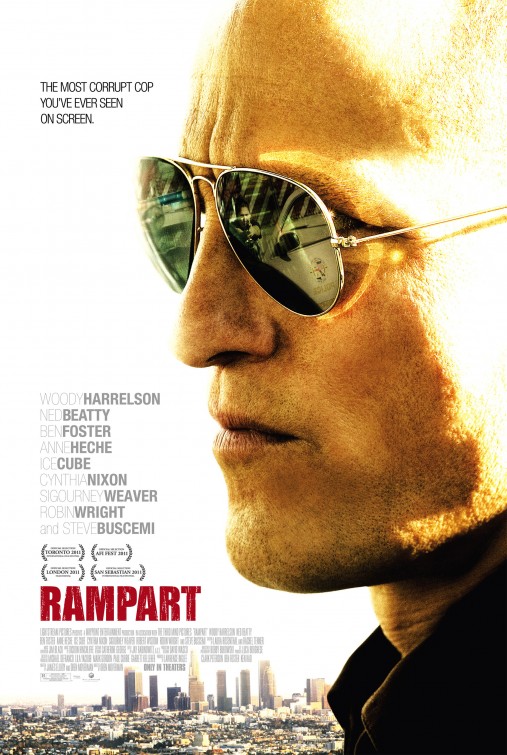 Stop me if you’ve heard this one before. A corrupt L.A. cop (Woody Harrelson) makes bad choices, alienated and frightens his family, and looks to be on the way out as a career of taking the law into his own hands is at long last catching up with him. Yeah, you probably stopped me after the third word in that sentence. This dour character-study showcases Harrelson nicely as a cocksure cop who’s so self-destructive and paranoid that he pushes everyone away. Co-written and directed by Oren Moverman, who made the terrific and searing drama The Messenger, this movie just about turns into high-gloss navel-gazing. The plot is quite loose and there’s very little traction. We get to see scene after scene of Harrelson behaving badly or violent, but what does it all add up to? We already know he’s a bad cop tortured by his own sins and the demands of the job. In a way, there’s an intriguing connection between law enforcement and soldiers who are often called to bear incredible burdens and just deal with it, forgotten by a public complacent with being safe. But really this movie is just one long trip with an angry man who keeps everyone, including the audience, pushed away. He’s complex but I can’t say we ever got to know him better. The film is well acted with plenty of recognizable stars, but why should I care? The central message about the prevailing influence of corruption is a bit heavy-handed as well; at one point Harreslon’s wife says, “You made us dirty.” Rampart is a disappointing venture for Moverman despite Harrelson’s best efforts. In the end, when you’re stuck with a dirty cop he better be worth the time.
Nate’s Grade: C
Share this:

Ted (2012)
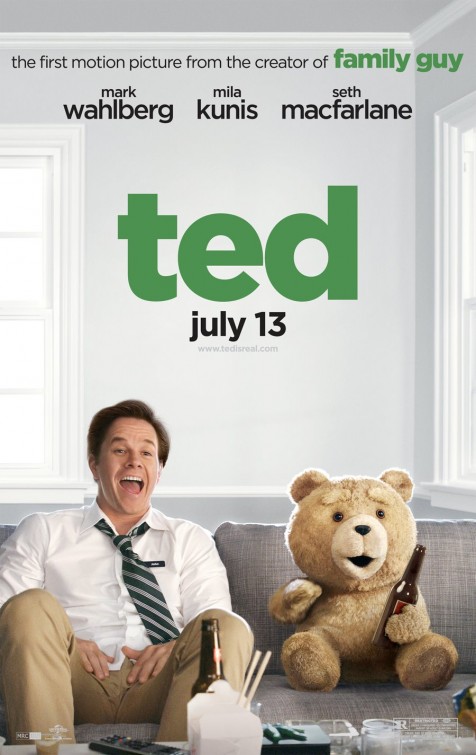 Seth MacFarlane has become an industry powerhouse. The man has three animated TV shows on air (Family Guy, American Dad, The Cleveland Show) and essentially carved an entire niche of modern comedy. His brand of irreverent, offensive, tangential humor has turned the man into a demigod among young audiences and helped him rake in millions. A journey to the movies seemed inevitable, and so comes Ted, which MacFarlane directed and co-wrote with two of his Family Guy scribes. The best assessment I can give is that if you enjoy MacFarlane’s brand of humor on TV, you’ll probably enjoy Ted. If not, then you’re in for a prolonged, obnoxious two hours.
One day when young John Bennett was a young boy, he wished his teddy bear would come alive so he’d always have a best friend. And as a narrator tells us, nothing is stronger than a young boy’s wish (curious gender is specified and then never touched upon for some kind of joke). The next morning Ted (voiced by Seth MacFarlane) comes alive. Flash forward 30 years and Jon (Mark Wahlberg) works at a rental car company, has a stunning girlfriend in Lori (Mila Kunis), and regularly gets stoned with his best pal, Ted. The two guys are inseparable, which causes friction between John and Lori. After another notorious incident of Ted behaving badly, Lori insists that he move out. John has to start acting more responsible and treating Lori like she deserves, but Ted’s influence usually leads to trouble. Both Ted and John are in desperate need of growing up.
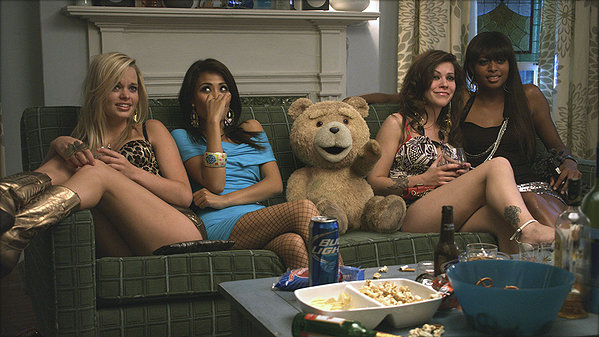 It was no surprise for me that Ted was exactly what I expected from Seth MacFarlane. It’s just a bigger, raunchier version of the style of humor he’s patented on television: tangential non-sequitors, scenes that go on far too long, obscure pop culture references, pointless shock material, and the basic premise that the jokes hinge around some creature merely doing things. Like Brian the Dog, or Roger the alien, Ted is a creature that shouldn’t necessarily exist, and thus so much humor is built around just seeing Ted exist. Is it supposed to be hilarious watching him drive? How about hit on women? Do bong hits? Far too often the only joke the movie seems to offer is that Ted is a teddy bear doing stuff. If you replaced him with, say, a normal human being, would any of those jokes work? Would it be funny watching a normal person drive, hit on women, and do bong hits? Maybe but probably not. It’s all one joke: look at something unnatural doing natural things. And that’s my issue with MacFarlane’s brand of humor. These jokes are not given proper attention, setup, and development. The film rarely subverts your expectations with how every joke will play out, and if you already know the jokes before the movie delivers them then what’s the point? The one joke I did laugh at, and a good guffaw at that, was Ted’s boss who kept responding to Ted’s screw-ups with good words and promotions. That was a surprise. But here’s the thing: once it’s established, you know what will happen the next time. So the second time it’s still funny but not as much. By the third time, his nonplussed reaction is completely expected and thus all traces of funny have been squeezed dry. In comedy, it’s all about surprise, and I find with MacFarlane that he rarely strays from his routine.
As far as jokes going on too long, let’s talk about a myriad of subplots that seemed to go on forever. There’s an entire storyline where an obsessed fan played by Giovanni Ribisi (Contraband) kidnaps Ted. This storyline makes up almost the entire third act and occurs after the reconciliation between John and Lori, so the movie already feels like it should be over. And then it keeps going. And it keeps going longer. And then there’s a car chase and a foot race through Fenway Park, which serves no purpose other than to probably fulfill a childhood wish of MacFarlane’s to film on said hallowed grounds. And it’s during this final act where the crass movie tries to become… sentimental? It just doesn’t work. You can’t have 100 minutes of rude, offensive, vulgar humor and then try and then try and go all gooey and soft and make people feel something akin to emotion. The reason that the Judd Apatow films can work with emotion is because from the get-go they make you care about the characters and their relatable conflicts. But there’s a difference between emotion and cheap sentiment, and Ted hasn’t earned genuine emotion. I didn’t like any of these characters. They all seemed like louts and jerks and dolts, none of them charming. Thus the end and its wish-upon-a-star conclusion are cheap sentiment and the kind of conclusion that you believe without a doubt that the characters in Ted would mercilessly mock.
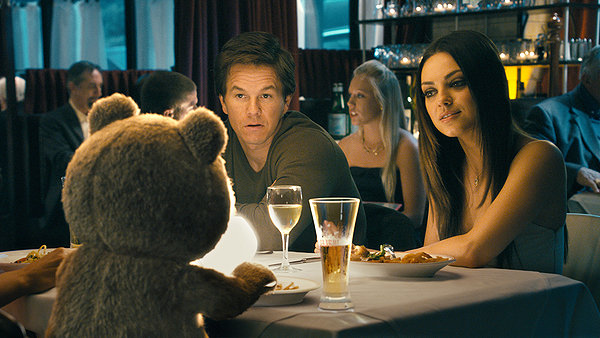 Let me specify for the moment that there is a distinct difference between gross-out gags and gags that are just gross. There is also a difference between jokes that are shocking but funny and jokes that are just desperate to offend. In my experience with MacFarlane’s brand of humor, as well as McFarlane’s fratty devotees (if I was rushing a fraternity, I have no doubt Ted would be my favorite movie, bro), that difference is not understood. Watching an over-the-top racist Asian stereotype is merely offensive without proper context to draw out humor beyond the odious and obvious. Just punching a child in the face isn’t funny. Just having someone defecate on the floor isn’t funny, though the panicked removal of said feces was humorous in flashback. I may have chuckled and giggled from time to time with Ted, but most of the time I was just saddened by how desperate McFarlane and his writers were to shock rather than to entertain.
Thank God Wahlberg (The Fighter) was in this movie. While Ted is best left in small doses, the boorish best friend archetype, Wahlberg has been sharpening his comedic muscles (the only muscle in need of work it seems) and has become a terrific straight man. Anyone who remembered 2010’s The Other Guys knows that Wahlberg can be flat-out funny when given great madness to play off of. With Ted, Wahlberg’s commitment to the innate absurdity of the movie goes a long way. His breathless rendition of an exhaustive list of white trash girl names had me laughing harder than anything else in the movie, and I admit I was also impressed by Wahlberg’s speedy delivery. The character of John is a pretty standard role at this point in American comedy, one of arrested development. However, it seems to take so long, blown chance after blown chance, for John to finally find some sense of responsibility. Just like everyone else, he is at the mercy of Ted’s corrosive influence.
I probably wasn’t the ideal specimen for MacFarlane’s first foray into movies. I’ve never been more than a mild fan of his TV work and its hit-or-miss-but-mostly-miss brand of tangential humor, though I admit American Dad has grown on me (the only MacFarlane show where the jokes seem related to the story situations). MacFarlane unleashes the vulgar material he’s been holding back from TV, which makes for some laughs. The obviously stoned guys sitting in front of me thought the movie was hilarious, even during quiet moments where nothing was going on. I’m disappointed that a MacFarlane movie is pretty much exactly as I would have suspected, essentially a MacFarlane TV show blown up to a bigger screen. The jokes here are so limited, mostly deriving from Ted the teddy bear just doing things a teddy bear normally doesn’t. I wish the comedy were more developed, more nuanced, more concerned with doing something other than shock. The most shocking aspect of Ted is how utterly forgettable the whole enterprise is even with a magical talking teddy bear.
Nate’s Grade: C
Share this:

The Amazing Spider-Man (2012)
 It’s only been a mere ten years since Marvel’s signature web-shooting, wall-crawling super hero leaped onto the big screen and smashed box-office records, and yet he’s already getting the reboot treatment. Usually we reserve reboots for movie franchises that ended in colossal artistic failure. I don’t know anyone that will ardently defend director Sam Raimi’s Spider-Man 3, but I know of no one that puts its in the same vicinity as the atrocious, franchise-slaying Batman and Robin. Spider-Man 3 suffered in comparison to its predecessors, which formed the gold standard of super hero films (even in my review I called out for some new blood if this was any indication what we had left to expect). But then in 2010, Sony decided that it would rather start all over with its billion-dollar franchise, so Raimi was out, so too were stars Tobey Maguire and Kirsten Dunst, and 500 Days of Summer director Marc Webb was tapped to direct. The (rebooted) Amazing Spider-Man swings into theaters with a serious case of déjà vu attached. Are we far enough out to forget about Raimi’s accomplishments? My spider sense is telling me we’ve been here before and better.
Peter Parker (Andrew Garfield) is a geeky high school student living with his Uncle Ben (Martin Sheen) and Aunt May (Sally Field) ever since his parents had to vanish mysteriously one night. Peter is picked on at school and crushes on cutie-pie Gwen Stacy (Emma Stone) but all that changes when he’s bitten by a genetically engineered spider. He gains super spider-like abilities including improved dexterity and the ability to stick onto surfaces. He designs his own webbing devices that allow him to shoot long tendrils of super-strong spider webbing he can swing around with. Peter is trying to unravel the mystery of what happened to his parents and he seeks out Doctor Connors (Rhys Ifans), a notable genetics scientist who worked with Peter’s long lost dad. Peter supplies his father’s secret math formula and gives Connors the breakthrough he was hoping for in genetic replication. When injected with a serum, creature should be able to regrow lost appendages. Connors turns himself into a human guinea pig because he’s desperate to grow back his amputated right arm. But the serum causes Connors to transform into a hideous lizard creature for periods of night and only Spider-Man can stop him.

Simply put, I liked Spider-Man when it was made the first time and called Spider-Man. I understand the desire to reboot after the disappointing mess that was 2007’s Spider-Man 3, but did we need to start completely from scratch? Could we not have just eased into a Spider-Man 4 and replaced the original actors? Though I personally had no problem with Bryce Dallas Howard as Gwen Stacy (yum). I don’t need to see another version of the Spider-Man origin tale because it was already covered just ten years ago. The worldwide public is familiar enough with Spidey’s back-story that I don’t understand why we couldn’t just start with our hero already doing his business. I don’t need another hour of setup for the guy to become Spider-Man. This “sameness” seems to sap much of the energy out of Amazing Spider-Man, a competent and occasionally thrilling superhero flick. It does plenty of things well enough but you just can’t shake the feeling that the movie, at its core, is unnecessary or at least tripping over redundancy. Do we really need to see Peter Parker discover his powers again? I understand that we want to experience part of his joy at discovering his fantastic new abilities, but it just feels like all too familiar. I don’t think we would have missed anything by simply condensing all the back-story and doling it out as a series of concise flashbacks.
Despite some serious déjà vu, The Amazing Spider-Man has some other serious issues. Firstly, the tone just seems like a bad fit. This is a much darker, somber, and angsty tone for a character that was never intended to be as brooding as, say, Batman. Just because the dark tone worked for Christopher Nolan’s Batman films doesn’t mean it’s the right fit for every comic character. I’m not saying that Peter Parker doesn’t have his issues and plenty of guilt to struggle with (more on that in a moment), but this movie feels like the fun has been squeezed out. It’s a kid who was abounded by his parents, bullied at school, and he teems with repressed frustration. Peter Parker is not meant to be a brooding antihero. He’s supposed to be the high-flying jokester. Regardless, you can interpret the character however you’d like, I just don’t think this darker, gloomier incarnation works despite the best efforts from Garfield. The spirit of the movie feels like it’s being suffocated at times. Raimi’s films had their dramatic material but they never lost a sense of fun. It’s hard to tell if anyone is enjoying himself or herself for much of Amazing Spider-Man.
Now let’s talk about one of those areas of Parker’s guilt, namely his guilt over the murder of dearly beloved Uncle Ben. Peter chooses not to get involved and from that action Ben is murdered by the same criminal Peter could have thwarted earlier. In Amazing Spider-Man, it’s transformed into an inane example of being at the wrong place at the wrong time. Ben just so happens to run into the same guy and he stupidly wrestles for the man’s gun. It’s hard to make any real connection for Peter to blame himself. Spider-Man 3 did something similar by rewriting the back-story so that the Sandman was responsible for Uncle Ben’s death. I wrote: “By introducing a new killer it means that Peter has no responsibility for his uncle’s death. This completely strips away the character’s guilt and rationale for what compels him to swing from building to building to fight crime.” Now, this new Spider-Man, since he’s so edgy and dark, is only hunting for bad guys who bear a likeness to the robber who killed Uncle Ben. Yes, Peter Parker has become a vigilante defined by his all-consuming sense of vengeance. And guess what? He never finds the guy. Get used to all sorts of storylines being dropped or forgotten throughout the film (I guess we’ll have to wait for future films to explain what happened to his parents).

While I think a darker interpretation of Spider-Man is mislead, I wish the movie would see it through rather than keep having moments to break the reality of this more grounded approach. I’ll buy that Dr. Connors turns into a giant lizard creature from the magic DNA serum whatever. I’ll even buy that he goes mad with power because of it. However, what I won’t buy is that this guy, all of a sudden, decides to relocate his lab into the sewers. What? The guy has everything he needs in a giant scientific tower, and he says he “gave the staff the week off.” Well then do your crazy mad scientist science stuff in your lab. Why the sewers? Do you know how many trips this guy would have to make to haul all that equipment down into the sewers, and remember he’s only got one friggin’ arm! The entire character of the Lizard feels so poorly developed and adds no greater thematic message to the movie. And then there’s the case of Peter Parker being a world-class dweeb mocked in high school. As presented, he’s a pretty hunky, smart, athletic kid who has fabulous hair. It makes no sense that he has absolutely zero friends and that there wouldn’t be girls crawling all over this guy. Are there no alternative-style girls in this school besides the one girl with glasses we keep cutting back to for reaction shots? And how many times is Aunt May going to watch her nephew come home at odd hours and covered in bruises before she says anything?
Then there’s just the forehead-smacking number of coincidences in the movie. With most movies you accept that the characters exist in a small universe where they will regularly continue to run into one another, but in Amazing Spider-Man it’s absurd. As my pal Mike Galusick noted, you have Peter who just happens to have the last steps needed in a formula who just happens to go to Oscorp and poses as another student with shocking ease who just happens to wander off a tour and much up with lab stuff because security cameras do not exist in this universe and who just happens to meet the same scientist who is responsible for his parents missing and the guy also happens to have a head intern who just happens to be Peter’s crush and she just happens to be the daughter of the police captain (Denis Leary) trying to hunt down Spider-Man. Phew. I haven’t even mentioned the construction worker dad (C. Thomas Howell, for real) whose kid was saved by Spider-Man so he makes sure to rally all his fellow construction workers to synchronize their beams for Spidey. It is moments like this that undermine the filmmakers’ grounded approach.
It sounds like I really disliked this film, and I didn’t. Amazing Spider-Man is a completely serviceable superhero tale and the cast does a great job of covering up for many of the narrative shortcomings. The action, what there is, seems a little too rushed and missing that spark that Raimi had in abundance. There is one nifty sequence that Webb deserves credit for: in the foreground a librarian listens to classical music, which drowns out the background action as the Lizard and Spider-Man smash through shelf after shelf of books. This was the only moment in the movie where it felt fresh and exciting and I wanted to see where it would go. It’s just that the movie cannot capitalize on its potential. Take for instance a late incident where the Lizard unleashes his mutant gas and transforms a cadre of police officers into giant lizard creatures. You’d naturally expect that if you were introducing a lizard army that we’re upping the stakes and that the movie would do something with this new team of antagonists. Wrong. No ramifications. Webb’s film does benefit from advances in computer wizardry as the CGI is far more advanced and Spider-Man doesn’t resemble the cartoon character he often did in Raimi’s trilogy. The brief moments swinging through the city, feeling the rush of exhilaration with the character, are the movie’s visual highpoint. I found the Lizard’s face eerily similar to the goombahs in the reviled Super Mario Brothers movie.

Garfield (The Social Network) and Stone (The Help) certainly feel like a step up from before. Even though Garfield seems a bit old for high school, he does a more than credible job of being a super smart kid who slowly grows in confidence and demeanor. He can do it all, handle the comedy, the emotional angst, the formation of courage. Garfield is a great addition and he gets along wonderfully with Stone; the actors have great chemistry, which may explain why they started dating after the production ended. Stone brings a comedic zeal to the part and seems far more approachable and les standoffish than Dunst’s Mary Jane ever did. While the movie seems to indicate a fully formed romance for its stars, what we see on the screen plays out more like a nervous flirtation. The actors are cute when they seem to be stammering in awkwardness and mutual attraction. I wish the movie gave us more development rather than skipping ahead, but hey, these kids are great together.
The Amazing Spider-Man, when you get down to it, is less than amazing. It’s a capable super hero movie with some fancy effects and stunt work, but the mounting plot holes, incongruities, tonal conflicts, and overwhelming sense of sameness prove to be a foe even Spider-Man cannot topple. This aims to be a leaner, more emotionally engaging, realistically grounded Spider-Man, but it just can’t pull it off. Garfield and Stone are great but it’s impossible to erase Raimi’s original trilogy from your memory. His films weren’t perfect, though Spider-Man 2 came closest, but they were loving odes to the character and knew how best to link action with character for maximum impact. I can’t think of any real memorable moments in this movie, which is troublesome given its hefty budget and its hefty mission of supplanting the Raimi films. I didn’t have a bad time while watching The Amazing Spider-Man but my involvement and enjoyment was very limited. Even with a glossy reboot, I guess The Amazing Spider-Man is proof enough that sometimes it’s better to go forward rather than reliving the past.
Nate’s Grade: B-
Share this:

Safety Not Guaranteed (2012)
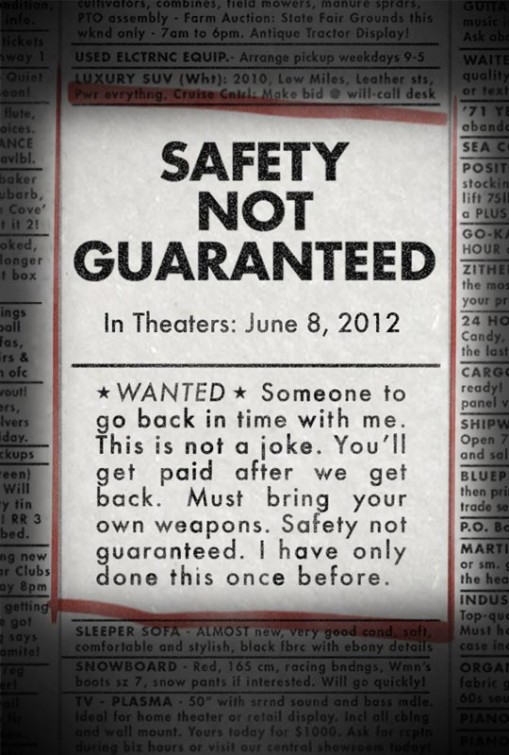 A man puts a classified ad in the newspaper asking for an unusual companion. No, it’s not some weird sex thing. Kenneth (Mark Duplass) intends to travel back in time to correct a few regrets. He’s looking for a partner, though he specifies his traveling companion must bring his or her own weapons and that safety is not guaranteed. This quirky ad grabs the attention of Jeff (New Girl‘s Jake Johnson), an egotistical writer for a Seattle magazine. He takes along a pair of interns, the surly Darius (Aubrey Plaza) and the nerdy Arnau (Karan Soni). Together, the gang heads out of town to seek out Kenneth and determine whether or not he is for real. However, Jeff’s real intention for this “work vacation” was to travel back to his hometown and try and score with Liz (Jenica Bergere), an old high school flame he is horrified to discover has… aged. Darius is the only one who can get close to Kenneth, but what starts as an opportune assignment into investigating a weirdo becomes something more. The guy, sweet if a little off, may be on to something… big, and Darius may be falling for him despite her own misgivings.
Safety Not Guaranteed is a modest film but does it ever sneak up on you and deliver an emotional wallop. I’m a romantic at heart, and so I’m generally affected by seeing two lonely people find their special something in the world reserved for them, and it’s even more affecting when these people are oddballs, and thus it’s even more resonant and meaningful for them to find that connection so elusive before. At its heart, Safety Not Guaranteed is a quirky yet naturally developing love story, and those are my favorite kind. I found my heart melting every time Darius couldn’t help herself and smiled. Perhaps it’s because Darius is our outside heroine or that Plaza is best known for her stone-faced deadpans on TV’s Parks and Recreation, but every one of those smiles felt so richly earned and rewarding. These aren’t the typical rom-com characters that are going to lapse into great speeches about love at key clichéd moments; while dabbling in some fantastical elements, Safety Not Guaranteed exists in our own recognizable world. And with that established, the unguarded moments of genuine happiness for characters we care about translates into a surprisingly touching experience. My heart felt so full at different points, melting and swelling and doing other non-medically accurate things. I honestly had tears in my eyes at different points. By the perfect end, I was so hopeful and overjoyed and left the theater soaring on my good vibes. I can’t guarantee everyone will find the same level of engagement in the romantic relationship, but I believe that the movie is inspired, clever, and authentic enough to deliver a crowd-pleasing finish. It’s earnest without being hokey.
 I’m trying to tiptoe around spoilers, though for those critical readers out there I’m sure you can infer a thing or two about the end of the film given my positive, beaming response. I’m sure my reaction would have been quite different if, say, Darius and Kenneth died in a horrible fireball because he was criminally insane from the start. All I’ll say is pay attention to certain discrepancies and see if they might prove to be a conversation-starter when you leave the theater.
Have I mentioned how truly funny this movie is? I’ve been talking all about the “rom” portion of the equation, but Safety not Guaranteed is a consistently funny movie, with a few big laughs. The movie’s sharp sense of comedy is more than everyone simply derisively laughing at the nutball. To be sure, Kenneth provides plenty of comedy in his super serious demeanor, and the movie doesn’t overplay the idea that he may be mentally unbalanced. The jokes come from the character interaction more than any contrived set piece, and the pleasure is in watching conflicting personalities bounce off one another. Every character contributes nicely to the comedic rhythms of this picture, adding a line here, a reaction there, to assemble one very funny movie. In movies where one character enters a relationship under initial false pretenses, usually you just keep waiting for that particular shoe to drop. You wait for the truth to come out and then deception reconciliation dominates the third act. Thankfully, the movie speeds over this narrative trap and gets us to the good stuff. We don’t need an entire act for people to be contrite and prove their love when what we see onscreen is obvious enough.
What elevated Safety Not Guaranteed for me was that beyond the oddball romance, there’s careful and compassionate attention paid to a slew of supporting characters. Now with a scant 80-minute running time, and the attention-grabber of a guy who thinks he can travel through time, naturally the supporting characters have minimized roles, but what I enjoyed was that they were not just relegated as stock players. The film has two stock roles, Nerd and Jerk, and fleshes them out further (though, to be assured, those are still defining characteristics). Arnau is a guy who is convinced any interaction with girls will ultimately lead to personal embarrassment. He’s only focused on the future and what he needs to get there, barely living in the present. It’s nice to watch him grow some confidence, albeit a small amount, and find some degree of enjoyment. And then there’s self-described asshole Jeff, who only submitted the story so he could come back and bang his old high school girlfriend. Some will find Jeff’s minimal personal growth to be disappointing and stagnate, but I thought anything substantial for this character over a three-day period of time would be unrealistic. Jeff is chasing his past memories, a faded time that had so much possibility when he was a stud in high school. The movie explores this notion of returning to a period of innocence as well. Going back to a time before overwrought cynicism, before settling, before compromising, before life became work, it’s something of a wish that the characters seem to be chasing. Jeff realizes how truly empty his life is, yet he’s probably too set in his ways to alter his path, which is a shame because Liz certainly seems like a lovely, caring, and capable romantic opportunity. Hey, she bakes, too (Bergere is great and easy to fall for). The unlikely friendship that emerges between Jeff and Arnau is also quite enjoyable and disarmingly sweet.
 I also need to single out the score from first time composer Ryan Miller, the lead singer and guitarist for one of my favorite alternative rock bands, Guster. The music has a lilting, dreamy quality to it but then follows a steady melodic rock path, reminiscent of the melancholic score for Little Miss Sunshine. The strumming guitars, plinging pianos, and swelling violins come together in harmony with little sci-fi touches. The score gives the film another sense of enchantment. I’ve been listening to “Big Machine,” the song Kenneth plays for Darius, on a loop for over an hour, if that gives you any indication on how much I enjoyed the original tune. The fact that “Big Machine” plays over the end credits when the movie meets its perfect end has got to account for some of my positive association. I think Miller has a bright future in crafting film scores.
Plaza (Funny People) deserves to break out in a big way after this film. She’s the heart of the movie and deeply vulnerable, covering it up with nonchalant cynicism. Darius is well within her surly comfort range so it’s no surprise that she excels with the hipster character, but the moments of dramatic weight are not given flippant treatment. Duplass (TV’s The League), just about everywhere in 2012, delivers a committed performance, though it seems mostly committed to the goofiness of his character. Yet when Duplass is able to show you some of the edge to his character, that’s when the performance walks a line between dangerous and exciting. The movie hinges on the two actors working together and they have good chemistry; the goofball and the cynic.
It’s so nice to discover a movie that lifts your spirits, that touches your heart without reaching for the treacle, and delivers a funny experience without compromising its modest aims and modest tone. Safety Not Guaranteed obviously plays a deliberate dance with the audience, vacillating between moments that make Kenneth seem crazy and moments that make you question whether he’s legit. The movie reminded me in a lot of ways of the underrated 2000 flick Happy Accidents, which featured Vincent D’Onofrio as a romantic suitor who also might be a time traveler or just plain nuts. Safety Not Guaranteed is a charming movie that seems to work a spell on you while watching; you get so invested in watching lonely people find meaningful human connections that you are compelling the movie to end under some happy scenario. Director Colin Trevorrow and writer Derek Connolly deserve to make waves in Hollywood with what they’re able to accomplish with a tidy budget and some clever yet earnest writing. This beguiling love story is all about stretching out of your comfort zone and taking a plunge into the unknown. Just like Kenneth, we’re all looking for a partner worthy of that plunge (not necessarily a romantic partner, mind you). Take the plunge and go see Safety Not Guaranteed, one of the best movies of the year. Not bad for a movie potentially based upon an Internet meme, huh?
Nate’s Grade: A
Share this:

Moonrise Kingdom (2012)
 It feels good to be a Wes Anderson fan once again. The indie auteur has a very distinctive style that he seems to have little regard in altering. I’ve been critical of Anderson’s idiosyncratic style, comparing it to crafting wonderfully composed, intricate dollhouses minus compelling or relatable characters to inhabit these artfully constructed mini-worlds. Without that necessary element, it’s all just fancy window dressing. Finally, Anderson, with Moonrise Kingdom, has concocted another movie where the characters grab more of your attention than the backgrounds.
Set in 1965 on a small island just off the New England coast, the movie follows the adventures of Sam (Jared Gilman) and Suzy (Kara Hayward), both twelve years old. Sam has run away from his summer camp, the Khaki Scouts, led by Scout Master Ward (Ed Norton). Suzy has run away from her parents (Bill Murray, Frances McDormand). The small island’s one police officer, Captain Sharp (Bruce Willis), enlists the help of several Khaki Scouts he deputizes to find the missing duo. It’s revealed through a serried of letters, and flashbacks, that Sam and Suzy have been plotting their escape for over a year. They’re in love, and they’re going to make sure nobody interferes.
 What more relatable than young love? Sam and Suzy just want to be together and the rest of the adult world seems intent on keeping them apart. Right away you’re pulling for these kids, rooting for their triumph, and the movie does a fantastic job of replicating the innocence of young love without overly romanticizing a very nervous, awkward time in life. When Sam and Suzy practice kissing, for what is obviously the first time, I defy anyone sitting in the audience not to feel a recognizable pang of insecurity. The experimentation is a tad more realistic than you might expect with the PG-13 rating but still nothing to shatter the youthful innocence of the picture. There is not a tawdry moment in Moonrise Kingdom. It’s a time in life when the knowledge of sex existed without a keen understanding of sensuality, like in Miranda July’s Me, and You, and Everyone We Know. It’s more like fumbling around with what you think is appropriate activity. Still, the fact that the movie features twelve-year-olds in their underwear dancing and mildly experimenting means Moonrise Kingdom might draw a swath of ticket-buyers for the wrong reasons (beware the patron in a raincoat).
The scrupulous attention to detail is the same obsessive quality you come to expect from a Wes Anderson movie. He builds living worlds and his color schemes and shot arrangements add much texture to this idiosyncratic landscape. Unlike Life Aquatic and Darjeeling Limited, these artistic elements work in harmony rather than conflict; Anderson actually seems to care about the people here. Chances are if you’re not a Wes Anderson fan, Moonrise Kingdom will probably not be the movie to win you over. The whimsical, storybook nature of the film actually accentuates the broader themes; bright-eyed exploration, the magic of possibility with love, and an unyielding hope. The movie feels like one of Suzy’s storied adventures come to life but without compromising the relatable character conflicts. The movie does build a nice head of steam thanks to the pursuit of our runaway romantics. There’s also a palpable sense of danger lurking, as the kids risk life and limb and even experience death, albeit a dog (Suzy: “Was he a good dog?” Sam: “Who’s to say?”). It’s a poignant tale of childhood but it doesn’t feel childish, a family film meant for people probably too young for families.
Moonrise Kingdom walks a fine line between whimsical and overly precious. Less skilled filmmakers haven fallen suit to making insufferably twee film productions consumed by their own indulgent sense of preciousness. Moonrise Kingdom is full of the typical Anderson quirk but it doesn’t overpower the narrative or define the characters in such limited personal scopes. There’s plenty of laughs to be had with the film, most in the wry chuckle variety; I was laughing throughout, finding those staple peculiar touches to be the most amusing, from the Scout Master reading a magazine titled “Indian Corn,” to Bob Balaban’s questionably omniscient narrator, to some improvised natural earrings.
The movie is consistently funny but also far sweeter than I would have imagined given the detached, arch nature of Life Aquatic and The Darjeeling Limited. Again, the kids are precocious and the adults act more like children, but everyone is really hurting and lonely and looking for a means of coping or persevering, with the biggest source of pain being love; the longing, the ache, the uncertainty of when and if it will return. Usually Anderson’s films involve dysfunctional families mending some degree of their brokenness by film’s end and formulating a connection. With Moonrise Kingdom, the plot is on two kids falling in love and their will to endure. I appreciate that Anderson and co-writer Roman Coppola (Darjeeling Limited) do not trivialize or look down upon the relationship between Sam and Suzy (“Oh, it’s just puppy love you silly, naïve, waifs.”). To them it feels like everything. The tender approach to young love opens the film up to a broader audience without compromising the director’s unique vision. I’d hardly say the film approaches overt sentimentality. What’s there feels earned and more reserved than what we might expect from burgeoning romance. When the expressions of affection occur, they have greater weight and make a greater impact charming the audience.
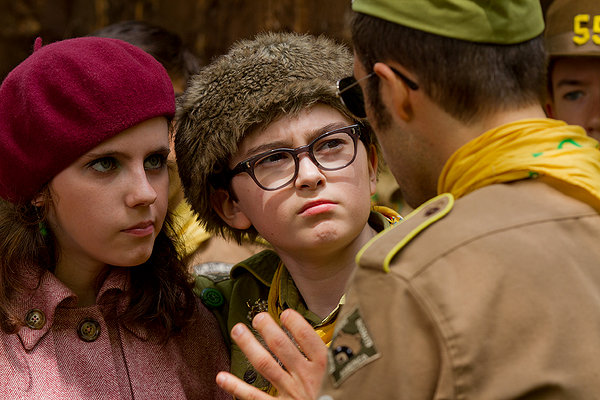 The first-time child actors do a credible job with carrying the film. Hayward and Gilman are charming and easy to like, though I wish Anderson had pushed his young actors a tad harder. They seem stiff at times and a little above-it-all in attitude. I applaud the kids for acting somewhat reserved rather than going crazy with their budding hormones. Both characters are also characterized as “emotionally disturbed,” though this seems like another of the film’s damning details about the out-of-touch adults dictating their lives. I just wished we sensed a greater degree of urgency from them about this whole adventure and the possibility of losing one another. They feel a tad blasé, all things considered.
The bigger celebrity names in the cast assume smaller roles, and many of the supporting characters are thinly sketched with personal conflicts mostly kept at a simmer. These are grownups that, at their heart, don’t know what to do with their feelings. Sam and Suzy feel liberated by their feelings. I found Murray’s blustery sense of anger amusing, and Willis does some subtle work to give you a sense how truly lonely his character is to the core, but it’s Jason Schwartzman (Scott Pilgrim vs. the World) who steals the show in my book as the fast-talking, mercurial, scheming Cousin Ben who seems to have whatever somebody needs. When he agrees to marry Sam and Suzy and acknowledges that their marriage will not be deemed official under any court whatsoever, you get a sense that Moonrise Kingdom has been missing a propulsive and delightful character like Cousin Ben. I wish he had been inserted earlier, but this is Sam and Suzy’s movie, after all.
It’s not on the same level as Rushmore of The Royal Tenenbaums (my favorite Anderson films), but it’s a film that feels a lot more alive and emotionally resonant. It feels like a return to form for Anderson, remembering that the characters and their drama need to be as engaging as the set design. The turbulent young love of Sam and Suzy is sweet and leads to some tender yet poignant moments that warm the heart without making you overdose on cheap sentiment. The idiosyncratic touches are all there, the ironic humor, and the stellar soundtrack selection (Benjamin Britten’s deconstructive orchestral marches stand out as a thematic core), everything you’d expect from a Wes Anderson movie, except this time you’ll find the characters recognizable, their struggle compelling, and the end rewarding. Moonrise Kingdom isn’t the most substantive film playing in theaters but damned if it isn’t the most alluring, amusing, and affectionate, yet all on its own terms. Who would have guessed that a pair of twelve-year-olds would help us show what real love is in 2012?
Nate’s Grade: A-
Share this:

Brave (2012)
 Perhaps after a series of ambitious, mature, celebrated animated works, we just hold Pixar to unrealistic expectations. Their latest film Brave isn’t bad by any means, but it’s certainly second-tier Pixar among their cherished catalog of hits (somewhere along with Monsters Inc. and A Bug’s Life, I’d say). The movie is an eye-popping beauty to watch; the Scottish highlands look gorgeous and teaming with life, and our heroine, Princess Merida (voiced by Kelly Macdonald), has a signature mess of red tresses that look incredibly real. The hair practically blazes onscreen. Even though the independent-minded young heroine has been a staple of stories, and particularly animation, since the 1990s, Merida is still a feisty, engaging, and relatable lead. Her friction with her mother (Emma Thompson), who wants Merida to accept royal responsibilities and marry a suitor, creates some nice sparks, and the mother-daughter dynamic is an exciting new avenue for Pixar to explore. Without spoiling too much, Merida, in a moment of anger, has a spell cast with disastrous results. It’s here, at about the 30-40 minute mark, where the movie goes in a completely different, and unwelcome, direction. The rest of the film becomes a series of chases and comical close calls and lots and lots of slapstick humor. The timeframe of the movie, about 36 hours as near as I can tell, is too short for substantial character growth. And so, by the film’s end, the character development feels facile and forced and just unbelievable. Rather than keep its focus on Merida making her own way against a patriarchy, the film devolves into a supernatural buddy comedy and then concludes in a clumsy, dues ex machina fashion. The tone is uneven, and some points are a bit scary for young children, and I kept thinking that this was more a Dreamworks release. I may sound overly critical but that’s because we’ve come to expect the best from Pixar. Brave is an entertaining, funny, and often visually astounding movie, and while it’s second-tier Pixar, that’s certainly better than most.
Nate’s Grade: B
Share this:

Abraham Lincoln: Vampire Hunter (2012)
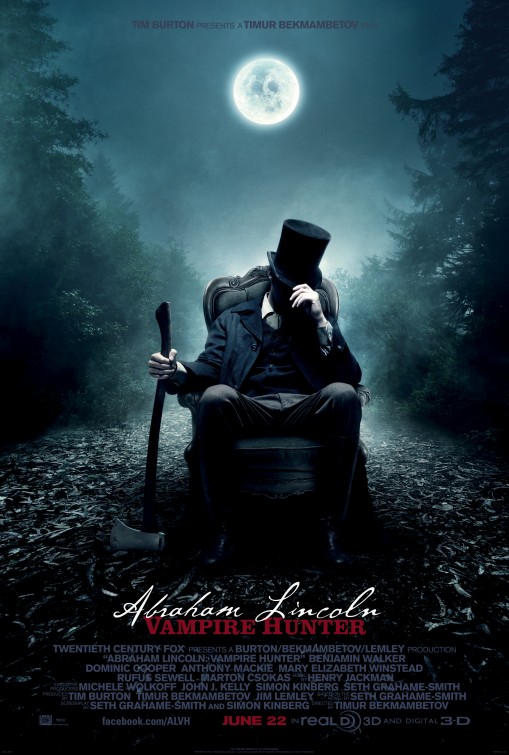 Did you know that our sixteenth president had a rather unorthodox hobby, and it was really the purpose that drove him into politics and later the White House? That’s what the gonzo best-selling book Abraham Lincoln: Vampire Hunter purports. When he was talking about a house divided not being able to stand, he was secretly talking about vampires, you see. The film version, under the tutelage of producer Tim Burton, looks like it’d be an axe-swinging good time. I realize the absurdity of wishing the filmmakers had hewn closer to the source material, a radical reinterpretation of American history, but there it is. I cannot tell a lie.
Abraham Lincoln (Benjamin Walker) is a man determined to rid this new country of the scourge of vampires. His mother was murdered by a vampire landlord, Jack Barts (Marton Csokas), when Lincoln was only a little boy. As an adult, Lincoln tries to avenge his mother’s death but Barts is too strong. Henry (Dominic Cooper) saves Lincoln and teaches him all about vampires and, more importantly, how to hunt and kill them. They strike up a partnership: Henry will provide names of vampire targets and Lincoln will dispatch them with extreme prejudice. Lincoln tries to live a solitary life but keeps building attachments; to his co-worker Joshua Speed (Jimmi Simpson), to his childhood friend Will (Anthony Mackie), who needs Lincoln’s help to forge some slave papers, and the enchanting Mary Todd (Mary Elizabeth Winstead). Abe realizes the limitations of killing vampires one by one. The vampires are exploiting Southern slavery as an all-you-can-eat buffet. Lincoln realizes the only way to foil the vampires is to eliminate slavery, and to do so he must be in a high government position, and so Lincoln retires his axe to turn to abolitionist politics.
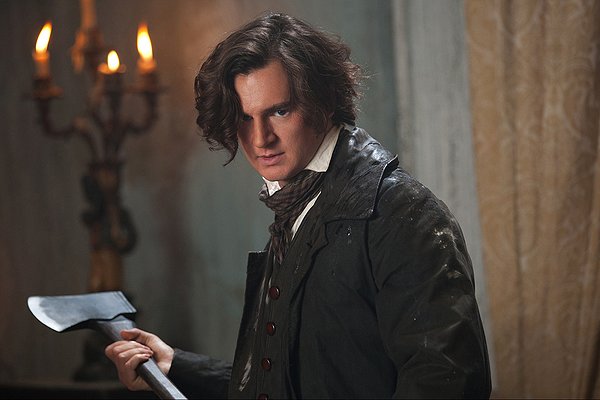 It feels that rather than embrace the courage of its convictions, the movie is trying to please as many mass markets as possible. So many characters and storylines are inserted wholesale without any connection to the book. The film is almost unrecognizable from the book. Now, I’ll quit my bemoaning for the time being because a movie has to exist on its own merits, but Abraham Lincoln: Vampire Hunter is just a mess. As far as new characters included only to appeal to broad audiences, there’s the Black Best Friend, long a staple in movies meant to say, “Hey, our lead character is hip and has no problems with race,” but really it’s always been a depressing act of pander and I always feel sympathy for the thousands of black actors who have to compete over the limited best friend parts. Giving Lincoln a black best friend seems to remind the audience that Lincoln was against slavery, you know, in case anyone didn’t know anything about the man nicknamed the Great Emancipator. Then there’s the ascension of Mary Todd Lincoln into a feisty, strong-willed, formidable ally rather than the insular, clinically depressed woman she was in real life and in the book. Mary even gets some grand hero moments taking out a vampire in slow-mo coolness. The transformation of Mary feels just as big a pander as the character of Will. Then there’s the idea that Lincoln and his small inner circle of pals are placed in the center of action, like they alone and their heroic escapades single-handedly turn the tide of war. It’s handled so ham-handedly that it all plays out like they’re the Scooby Doo gang solving the Case of the Vampire Insurrection.
Lincoln’s history is given such shrift attention, just enough to fill out the standard tortured hero’s backstory for the aims of the story. We see Lincoln as a child but just enough to establish his tragedy and hunger for revenge. Then we cut to him as an adult and going to kill Barts. That’s quite a big leap in time with little careful setup. The time before Lincoln’s presidency is just enough to supply him with a stock character posse and a plucky love interest, and then it’s right to the Civil War. So much time in between the main events just gets squeezed out, and so Abraham Lincoln: Vampire Hunter feels like it’s always one scene away from a clumsy montage.
The vampire threat, as presented, also feels too insurmountable. Not only can these vampires walk in the daylight, they’re super strong, super fast, and can make themselves invisible, a neat new trick. When they ally with the South they seem nigh unbeatable. The movie makes the mistake of making the adversary seem too powerful, so the eventual thwarting of the vampire Confederacy feels too easy and far-fetched given the magnitude of the threat. Adam (Rufus Sewell) is hinted at being like the first vampire, but then this idea is never picked up again. Why even hint at something significant if you have no intention of pursuing it? There’s another new wrinkle where vampires are incapable of killing their own kind. If this is the case then why aren’t the vampires turning every single person they can find into vampires? It shores up their side and guarantees less potential people that could kill them. I’m curious how certain swaths of southerners are going to react to seeing their beloved Confederacy teeming with devilish creatures. Then again, I think the romanticism of the Confederacy is hogwash. When insurrections win we call them revolutions of independence, and when they lose we call them treason. Guess what? The South lost.
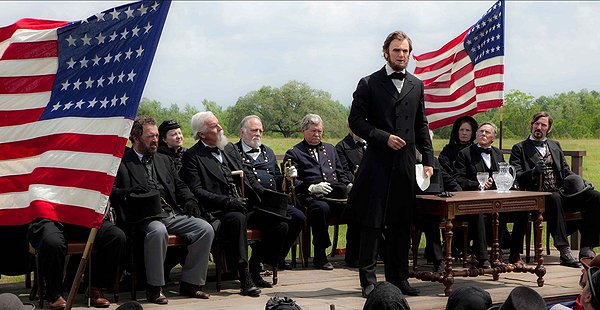 As much as I enjoyed his book, I have to lay the blame at the hands of Seth Grahame-Smith, who adapted his book into the screenplay (he’s 0-2 this summer after his disastrous screenplay for the other vampire movie this summer, Burton’s Dark Shadows). Granted, I’m sure he got intensive notes on how to alter his story for the big screen; the whole projects reeks like it had too many cooks in the kitchen. The interconnection from the book, finding clever ways to marry history and alternative history together, have been ground down to stream line Lincoln into an American super hero. Not only is he handy with an axe, this Honest Abe can leap from racing horse back to racing horse back, and even get clobbered by a horse and keep on going. The coda at the end feels like a missed opportunity to carry on the Lincoln tradition into our modern age. With the clever reworking replaced by blockbuster superficiality, the film merely takes history and has it perform the outrageous rather than finding smart ways to connect all the outrageousness to the established facts.
What the movie has to the credit of director Timur Bekmambetov is a strong visual pulse. Bekmambetov directed 2008’s testosterone-soaked Wanted, so you know you’re going to get some crazy and eye-catching images on display. The action sequences do pack a punch and I’ll admit that seeing an axe utilized as an inventive martial arts weapon is considerably cool. There are two standout set pieces. The first is a fistfight between Abe and Barts in the middle of stampeding horses. You feel right in the thick of the action, horses stampeding all around, the sun setting to offer an eerie yet beautiful glow to the ordeal. It’s one of the more reality-stretching moments, as I noted above, but man if it isn’t thrilling and lovely to watch. The other standout sequence is a climax aboard a speeding locomotive itself atop a large wooden bridge engulfed in flames. Abe and Will stand back to back, swapping the axe to kill vampires, and then hey have to outrun the collapsing train. In these moments, the movie is joltingly alive, bursting with excitement and that rare yet glorious feeling of watching something beautifully different. I just wish this sensation wasn’t so fleeting in the movie.
Abraham Lincoln: Vampire Hunter is a violent historical reworking that isn’t good enough to be properly entertaining and it isn’t bad enough to be considered camp. The film is mostly disappointing because it should feel far more engaging given its whacked-out premise the very cheeky promise of its title, and strong source material, a pulpy, ripsnorter of a read. The movie has some stellar standout moments but I think what ultimately hinders the entertainment value is how dumb everything comes across. This is not dumb in the winking, self-aware, satiric sense, but dumb in more of the blockheaded, Michael Bay, formulaic blockbuster sense. I wouldn’t even classify this movie as an enjoyably dumb, a silly summer slice of escapism like Battleship, which is looking better every week after new, disappointing summer releases (and it’s not even July yet!). The spirit of this movie is missing, the cleverness of the conceit drained, and the fun is bottled up. What this movie reminds me of is the stupid 2003 film The League of Extraordinary Gentlemen, which took classic literary characters and threw them into a genre movie. Both movies figure the exercise alone, seeing classic literary or historical figures in absurd contexts, was enough to justify entertainment. I say that you have to work harder.
Nate’s Grade: C+
Share this:

The Devil Inside (2012)
 I heard all about The Devil Inside earlier this year, when supposedly midnight screening audiences were so incensed that they practically became a riotous mob, throwing items at the screen, loudly booing, some even destroying theater equipment. If that doesn’t sell this movie, then I don’t know what will. I wasn’t expecting much from this faux documentary about one pretty girl’s (Fernanda Andrade) search for her crazy mom who may or may not be possessed by demons. She enlists the help of two exorcists and a camera crew and goes searching for answers. Never mind that the movie is absent any scares outside the sudden jump variety, ignore the empty characters and nonsensical plotting and poor pacing and choppy editing, as well as some bad Italian accents, and let’s get down to what makes this movie so notorious – the ending. Just when it appears that The Devil Inside is gearing up for a climactic showdown between good and evil, just when it seems like the movie is finally getting somewhere, it ends in the most abrupt, ludicrous fashion (note to self: when transporting possessed people, stow them away in the trunk). You’re left dumbstruck, shocked that the filmmakers cheated you out of an ending. It’s a nonsensical and cheap thing to do, and I can understand why it inflamed audiences (it still made over $50 million, so I think the filmmakers are feeling fine). Only those easily spooked by demonic possession would find this movie scary. Everyone else will just find it upsetting, not because of its content, but because of its lack of a workable conclusion.
Nate’s Grade: D+
Share this:

Hysteria (2012)
 The birth of the vibrator doesn’t seem like a tale that demands telling until you realize that the most prolific sex toy of all time started during one of the most sexually repressive cultures, Victorian England. In 1880, the plague of the era was a malady known as “hysteria.” Half the women in London seemed to suffer from this condition where, as the doctors of the times believed, a woman’s uterus had become unaligned and needed to be properly readjusted; the readjustment produced a “paroxysm” of relief. To treat hysteria, these trained professionals would oil their hands, insert them inside a woman’s vaginal canal, and apply alternating pressure. They were getting these women off. Hysteria presents a charming document about the invention of the vibrator, a miracle of modern science. However, I wish the movie had taken a more mature approach to the material.
The alignment process was an arduous one, and Dr. Robert Dalrymple (Jonathan Pryce) needs a new set of hands. Enter Mortimer Granville (Hugh Dancy), a crusading young doctor who butts heads with the medical establishment over things like washing hands and germs. Under Dr. Dalrymple’s tutelage, the practice is never busier, relieving upper class women of hysteria. It’s going so well that Dr. Dalrymple would like to eventually pass the practice on to his young protégé, as well as his proper young daughter, Emily (Felicity Jones). Then there’s the doctor’s other daughter, Charlotte (Maggie Gyllenhaal), who clashes with authority, is outspoken about women’s suffrage, is critical of the limited role women play in society, and devotes her time to a lower-class shelter to provide refuge and education to those in need. She represents a brand-new kind of woman in time, and Mortimer cannot get a handle on her. Mort is suffering some pretty serious hand cramps from his line of work when he gets a splendid idea from his childhood friend and amateur inventor, Edmund St. John-Smythe (Rupert Everett). It seems with a quick fix, the electric feather duster may have other more scandalous uses.
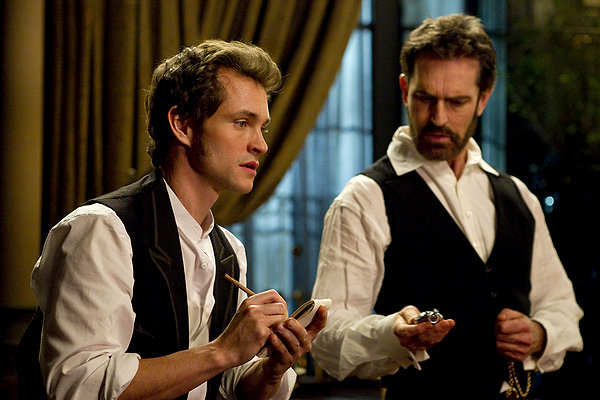 Hysteria is short of being hysterical but it’s certainly charming and provides an interesting history lesson with a light touch. The very nature of women’s hysteria is a fascinating moment in history where men were bending over backwards to find medical assessments for what is, in essence, horniness. The fact that these women’s doctors were getting carpal tunnel from all the manually stimulation of their clients has got to be one of the strangest workplace hazards. In certain regards, the invention of the vibrator has saved lives, or at least the hands of medial practitioners. It’s probably also made a whole lot of women a whole lot happier. Feminine sexuality was just an obtuse concept to the well-educated men in charge. One character says, with absolute certainty, that women cannot achieve sexual pleasure unless through insertion. As another fun historical note of male ignorance when it comes to female anatomy, when Deep Throat was being banned in the U.S., the federal judge who deemed it obscene cited, in his writing, that one of the many dangers of the provocative flesh film was that it mistakenly exposed women to the idea of an orgasm without insertion. This is almost 100 years later and yet men in high places of power are still carrying on complete ignorance of something they very literally know very little about. In that regard, Hysteria is jolly fun as we watch women get their jollies. There’s always something fun about watching uptight characters cut loose, especially when they find pleasure that has been denied them.
Having a talented cast is also a benefit when you’re working in comedy. Dancy (Adam) plays our straight man with fine properness. He has a few moments where he gets to delightfully squirm thanks to bold women and bold topics. He’s got some solid chemistry with Gyllenhaal (Crazy Heart), who is the feisty spitfire we expect in this sort of movie. Gyllenhaal is charming without being obnoxious, and her English accent is impeccable. Pryce (G.I. Joe: Rise of Cobra) and Jones (Like Crazy) are funny in their understated, stuffy British formal way, while Everett (Stardust) provides a great comedic jolt as the self-possessed, blithe technophile, ready at a moment’s notice for a good wisecrack. Sheridan Smith (How to Stop Being a Loser) also deserves special mention as a maid who was formerly employed as a prostitute. Her randiness is a nice counterpoint to all that Victorian repression and she pushes the movie further into sex farce.
While amusing, I wish the filmmakers would have taken a, dare I say it, more mature approach to a very interesting subject of history. The structure and very aim of the movie is that of a typical romantic comedy, which is a shame given the atypical subject matter. It’s pretty much a romantic comedy transplanted to merry old England. Much of the humor of the movie is divided into two camps: 1) watching the uptight Victorian-era Brits cut loose with decorum, or, 2) self-aware humor about the ignorance of the age. The first is always fun since we’re watching people sneak their true feelings through the wall of social repression. Director Tanya Wexler makes sue of a lot of sight gags and heartily enjoys cutaway reaction shots of ladies going orgasmic. It’s enjoyable but the fact that Wexler has to keep going back to the reaction shots for jokes, it loses its effect. Then there’s the self-aware humor built entirely upon dramatic irony, where the writers tweak the knowledge of a bygone era with all of our clever foresight: “Oh those stupid Victorians, not believing in things like germs and female orgasms.” After a while, the self-aware humor becomes tiresome. We get it; these silly Brits did not understand female health and proceeded to rule in their ignorance. I wish the movie left behind the easy jokes for some stronger social commentary. To this very day, we have men legislating women’s bodies and their reproductive rights (see: Oklahoma saying life begins weeks before conception, or Virginia demands medically-unnecessary vaginal probes for no other purpose than to shame women, and so so much more…). Ignorance knows no end, and one imagines the rom-com that makes fun of our current social mores and understanding.
 It’s during the last act where Hysteria really starts to come apart at the seams. Beforehand, it’s been a fairly light comedy with some punctuations of commentary from Charlotte and her idealistic desire for equality. But then, and spoilers will follow, the movie suddenly transforms into a courtroom drama with Charlotte on trial. Her very mental health is on trial and if she’s found to be a hopeless case of incurable hysteria, then she’ll be shipped to a sanitarium and have her uterus forcibly removed. Wow. That is some heavy stuff for a movie that spent an hour making sex jokes. The courtroom setting leads to some pretty transparent speechifying; any subtlety goes out the window and we listen to messages about women’s suffrage, equality, and empathy. This conclusion feels like it was ripped from another movie. It’s tonally jarring. Then, after our lead takes his moral stand and confesses to his belief that there is no such thing as hysteria, that women are just stuck in sexually unfulfilling relationships in a sexually repressed age, everyone goes home to think about life. Then, thirty days later when Charlotte gets out of prison, she’s met by Mortimer where he, I kid you not, proposes to her on the spot. For a movie about breaking misconceptions about women, tying things up with a marriage proposal seems almost hypocritical. It also marks a pretty big leap in the burgeoning romantic relationship between Charlotte and Mort. It seems rushed and a strange way to end a movie about female empowerment. The rom-com elements have won out over any higher messages.
Hysteria starts strong but goes limp. Hysteria runs out of juice. Hysteria is a pleasant experience but doesn’t deliver a proper climax. Hysteria is not the feel-good movie of the year. The very nature of the movie lends itself to all sorts of innuenduous critical blurbs. It’s a rom-com transplanted to Victorian England and I wish that it tried a little harder with the material rather than settling for easy jokes relying upon the ignorance of the age. The cast is superb and the movie is certainly fun, but it falls apart in the end when the messages overtake the narrative. So what is the best Hysteria blurb? I’ve had better.
Nate’s Grade: B-


 nathanzoebl
You must be logged in to post a comment.