Category Archives: 2012 Movies
Red Tails (2012)
 You’d think a big name like George Lucas would not have a problem getting a movie made. Lucas has been trying to get a movie about the Tuskegee Airmen made since the 1980s, but he says no studio would bite, concerned that American audiences would not be interested in a movie with an all-black cast. So Lucas just paid for the movie himself, forking over $50 million of his own money a.k.a. July’s paycheck from Star Wars toys, a.k.a. what Lucas just had in his pockets at the time. Even though only credited as an executive producer, it’s hard not to feel the Lucas imprint all over Red Tails. The emphasis is on the high-flying aerial combat, ladled heavily with CGI special effects work, rather than on a credible story and characters that we care about. Simply out, the Tuskegee Airmen deserve a better movie than this.
In 1944, the Tuskegee Airmen have been kept on the ground for most of the war. However, the bomber pilots need more protection. It seems that white pilots meant to provide protection of the bombers will easily get distracted, chasing after German fighter planes for a taste of glory. Colonel Bullard (Terrence Howard) and Major Stance (Cuba Gooding Jr.) have been notified that their unit of black pilots will finally get their shot. Marty “Easy” Julian (Nate Parker) leads the squad, followed by Joe “Lightening” Little (David Oyelowo) and Ray “Junior” Gannon (Tristan Wilds). They are to escort the bombers and stick to the bombers; the mission is paramount. The unit paints the tails of their planes a bright crimson to stand out from the pack. The Tuskegee Airmen keep to their creed, ensuring the bombers carry out their missions, and proving themselves every bit as courageous as capable as white servicemen.
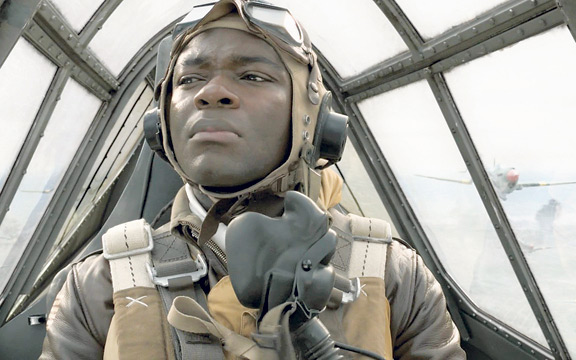 It’s like somebody transplanted a 1950s war film to present day but left every single hoary cliché imaginable. Just because African-American actors get to play the clichés doesn’t mean we’ve made progress. The Tuskegee Airmen are a historical account with enough real-life intrigue; Lucas and company didn’t need to create a fictional tale to illustrate their heroic deeds. The characters are all resoundingly one-note; the troubled leader with a drinking problem, the hotshot who doesn’t follow orders, the wisecracking pilot with a firm religious belief in “black Jesus,” the young guy trying to prove himself, and the guy who gets married and just wants to get back to his girl (guess what happens to him?). Let’s stop and analyze that plot point. Lightening first discovers his Italian beauty (NCIS: LA’s Daniela Ruah) waving while he’s zooming by in an airplane. Naturally he can find her home. After a series of strolls, Lightening asks her to be his wife, and eventually she accepts after some deliberation. Neither of them seems to find this interracial marriage concept a big deal, but in the 1940s, when the Army was still segregated and miscegenation was still illegal in certain states until 1967, you better believe it would be a big deal. Italy was no prejudice-free haven of tolerance, especially under Mussolini’s rule. And by the way, the portrayal of Italy in this movie looks like the war hasn’t even touched the land, physically and mentally. All those happy Italians just walking around smiling. And then there’s the white officers club where one of the black pilots visits and punches a guy after he calls him the N-word. In reality, this guy would have been beaten to an inch of his life. It’s even more bizarre then that, just after a month of flying missions, this say officer’s club greets the black pilots with open arms, fighting to by the guys rounds of drinks. Red Tails, at times, seems to exist in a different universe.
This has got to be the most boring part of a story you could tell about the Tuskegee Airmen. We watch the pilots escort the bombers and stick with the mission. While an interesting historical footnote, that’s about it. The story before the missions and after the missions is infinitely more interesting. I’d much rather see these brave heroes have to go back to a bitterly racist country, be declared honored men of valor by the government and then told they don’t deserve equal rights in the same breath. There’s so much more inherent drama in the conflict of going home to a segregationist country. Likewise, the Army was only integrated late into the war, meaning that African-American soldiers could not enter combat until 1944. Surely the journey these men took to enter the armed services is more compelling, and their experiences must have been even harder, battling the prejudices of their fellow brothers in arms. The early scenes in the film where Col. Bullard is fighting for respect and to get his men an actual mission, butting heads with brass who feel African-American soldiers are inferior, is far more gripping than anything that goes on in the air. The actual war part of this story is the least interesting part. If Lucas and company were so hell-bent on framing their story this way, they should have taken a cue from 1990’s Memphis Belle and stuck to a single mission being the majority of the plot. That would have kept the realism of the situation, ratcheted up suspense, and been a more natural way to get to know our characters.
While only thoroughly mediocre, Red Tails can have some pretty awful moments. The white bomber pilots provide, for lack of a better phrase, color commentary on the plot. Their dialogue is so on-the-nose and transparent, meant to lead an audience into some stilted realization that African-Americans are, gosh, not that different. The dialogue starts off with stuff like, “What? A colored man?! We’re done for,” then goes to, “Hey, these boys might actually be okay. I hope them Red Tails fly with us next time,” and then the movie might as well end on, “Wow, my altogether uninformed prejudices have been completely upended. I’m sorry I ever relied on such outdated notions of race that were completely ignorant. My paradigm has shifted and I’m going to look at people not as black or white anymore, but as people.” It’s so annoying and artificial. The dialogue is mostly cornball but the line that takes the cornball cake is after Lightening attacks a German munitions train, he shouts, “How you like that, Mr. Hitler?!” Really? “Mr. Hitler?” You’d think two African-American screenwriters (John Ridley and Boondocks creator Aaron McGruder) would have eschewed any phrases that could be racially loaded. Speaking of Germans, the movie has one German ace that keep reappearing again and again. Just so we understand that all those cockpit shots of ONE GERMAN are the same guy, the movie gives him a hideous scar along the side of his face. Being a scary scarred German fighter isn’t enough to convince us this man is a villain, so the movie also has him spout some pretty ludicrous racist dialogue, even for someone who may have believed wholeheartedly in the principles of an Aryan race. “Die you foolish, African,” he shouts at one point. Maybe he’s still steamed over that whole Jesse Owens thing.
 But the dumbest moment in a movie that will tax a minimal amount of brain cells is what happens to Junior after his plane goes down. He’s caught behind enemy lines and is thrown into a prisoner of war camp. But what luck, because it just so happens that these prisoners are planning an escape that very night (“At least they won’t see you at night,” one of the guys tells Junior). They’ve dug a tunnel beneath their barracks and Junior agrees to go first to be the lookout. He climbs out of the exit hole right in front of a forest clearing. When the next one in line pops out, however, a German guard has spotted them and turned his weapon on the American. Junior hops from behind a tree, waves his arms wildly to distract, and then runs off into the woods. Inexplicably, this is where the storyline concludes. You’re telling me that a German soldier with a gun isn’t going to give chase into the woods? These guys have the upper hand, plenty of armed men and dogs to track escaped prisoners. The rest of the American prisoners make it out to alive miraculously and one of the guys gives Junior’s dog tags to his unit. How did these prisoners, all escaping after the jig was up, get past everyone? And yet Junior does indeed live too and shows up just in time, in literally the last thirty seconds of the movie, to cut short everyone feeling sad about fallen soldiers. It’s like an angel just dropped him out of the sky. Junior’s escape and perilous journey back to American forces seems like a pretty good story worth telling. It has to be fraught with danger and thrills, but to just hastily end his storyline and magically zap him back to base isn’t just criminally lazy, it’s insulting.
The saving grace of Red Tails is its coterie of talented actors, doing the best they can with the wobbly material. This is a movie designed for the most mainstream of audiences, not for anybody who knows a whiff of history. The characters are one-note, the story is driven by every cliché imaginable, and the reality of the time period feels oddly glossed over at too many points, settling for safe rah-rah movie heroics. The aerial combat sequences can be exciting but they come across as weightless, with all the emotional investment of watching a video game. Credit Lucas giving this movie a decent-sized budget to pull off the special effects and involved combat sequences, but that money would have been better spent on a good script, not one just dusted off from the World War II era and the race of the characters altered. I find this kind of pandering mush to be insulting, especially the fact that the audience is supposed to feel grateful that black soldiers are finally getting the spotlight no matter the quality of film. The choice of “pandering mush” or nothing is a false choice. If giving black characters the chance to run through all the tired, hoary war clichés that went out of style decades ago is progress, then I shed a tear for this country.
Nate’s Grade: C
Share this:

Contraband (2012)
 January at the movies has long been a time for two kinds of releases: 1) award-worthy films expanding into wider release, and, 2) crap. That’s about it. I’ll let you figure out which category the action thriller Contraband belongs in.
Paul (Mark Wahlberg) was once the best smuggler in the business. He’s since gone legit, starting a family and his own private security business. His brother-in-law (Caleb Landry Jones) gets into trouble with some bad men. He tosses a load of smuggled drugs to elude Customs ships, but now Briggs (Giovanni Ribisi) wants the value of the drugs or else. Paul knows he has no choice but to put together one last job to save Kate’s (Kate Beckinsale) brother. Paul leaves his family in the hands of Sebastian (Ben Foster), a trusted accomplish on many missions. John puts together a team and plans to board a ship headed for Panama City. While there, the team will load large sums of confederate money. The sale of the fake currency should square things between John and Briggs. However, little goes according to plan.
 Contraband is a lousy heist picture that feels like it’s making it up as it goes. First off, the premise of John having to go back into his art of smuggling to settle a debt has been overdone, and the fact that John’s idiotic brother-in-law is as fault makes it hard to care that something might happen to the idiot. But why God do they bring this screw-up, the brother-in-law, along with them? He’s already proven to be a poor decision maker and a moron, and, surprise surprise, when in Panama the guy gets them into more danger. So irritating is this character, always foolishly making things worse for John, that you wish they had thrown this dolt overboard. This is a movie structured with a small beginning, a small end, and a great big fat middle, and it’s that middle that involves our destination to Panama. With heist movies, as well as most thrillers, we don’t want things to go according to plan. We want to see organic complications and watch our team of characters adjust. With Contraband, the complications don’t feel natural so much as like careening plot elements from other movies. John’s quick visit goes out of control, with the team losing their payment money for the confederate loot (guess who’s responsible for that? Guess?), and they have to go find a budding crime lord, Gonzalo (Milk’s Diego Luna), and then this crime lord just happens to be plotting a heist at THAT EXACT MOMENT and John and his team should come along and then the heist goes bad, as always, and the team ahs to get away, but Gonzalo demands to be taken to a hospital by gunpoint, and then the cargo ship is going to leave port, and, and, and, and, etc. There are so many breakneck plot turns thrown in that it feels like a broken blender spewing half-formed plot residue everywhere. It’s the film equivalent of the If You Give a Mouse a Cookie story (“If you give a smuggler a deadline, he’ll need a contact. If you give him a contact, he’ll need to do the contact a favor. If he does the contact a favor, he’ll have to do this one job for him. If he does this one job for him, he’ll need a crew. If he needs a crew, he’ll need… etc.).
Let’s take a moment to analyze the peculiar masks Gonzalo and his team choose to utilize. They literally wrap duct tape around their faces. That’s got to be the dumbest mask in the history of cinema, and there have been some stinkers. They couldn’t afford pantyhose? Anything? They had to use tape? First off, you can’t conceal key features, like your eyes and mouth, and lastly, isn’t it going to be something of a bitch to rip those things off? The only person who could properly wear a duct tape mask would be someone suffering from alopecia (condition that leaves a person hairless). Otherwise you’re sacrificing your eyebrows. Maybe this is just how things are done in Panama.
So much of this movie feels like it’s on autopilot, just drifting like that cargo ship. At this point, I don’t even think Wahlberg is trying to hide his indifference to the material. He’s a man with a shady past who went legit and has a family now, but in order to protect that family he is drawn back to his shady past. How many times has this plot device just been used in the last few years? The rest of the characters fill out the crime thriller cheat sheet: young screw-up who serves as plot catalyst, parent in prison to provide cautionary tale, best trusted pal that ultimately proves to be untrustworthy, and the harried, often victimized wife. Poor Beckinsale (Underworld) who gets beaten, threatened with a gun in her face, and victimized to a degree that it feels like exploitation. This woman can never catch a break. She gets few moments in the film where she is free from being terrorized with violence. I have no idea what would attract an actress like Beckinsale to this part other than the allure of a paycheck. Contraband stalls when it comes to thrills, and part of this is because the villains seem so lame. Briggs just comes across as an inept criminal, like somebody’s own screw-up brother-in-law that tagged along to play with the big boys. He’s routinely beaten and bossed around. It’s hard to take his threats seriously, so the movie cuts its losses and just has him threaten Kate some more. It becomes old quick. The only thing that keeps Contraband going is the great distance between Paula and his family, a divide that keeps Paul vulnerable. Too bad that the movie can’t think of anything thrilling to do with this scenario and settles, all too frequently, on scaring the wife. Wouldn’t the film have been more engrossing if Paul’s wife had been kidnapped this whole time? Would that not cause a better sense of urgency than the vague threat that a character we don’t care about might get offed for being stupid?
 From an action standpoint, the thrills rarely materialize, relying on a contingent of blunders and coincidences to provide the thrills. There wasn’t a moment where I worried for a character on screen. This may be because I didn’t care for a person on screen, thanks to workmanlike characterization, but it’s also got to fall on the feet of Icelandic director Baltasar Kormakur (who starred in Wahlberg’s role in the original Icleandic version of this flick) and his nascent camerawork. There will be moments where his camera does stutter-step zooms, mimicking the docu-drama camerawork that’s been en vogue with action cinema. And then he’ll never repeat it. There’s a shot of Gonzalo blowing the armored car up and it’s filmed in a high-speed, stylized shot to distill the strange beauty of the force, and then this never happens again. It’s like Kormakur is sampling all 31 flavors of action movie styles and can’t decide on a visual tone. The action is too dependent on arbitrary coincidences for it to be satisfying of thrilling; we’re just waiting for the next out-of-nowhere plot turn to move things along. The ending attempts to tie up things nicely but feels asinine and laughable in how John can take out three villains in one well-orchestrated, tidy swoop. Don’t even get me started on the impracticalities of John hearing a lone cell phone ringing to be able to trace his wife in an entire construction site. The resolution feels ludicrous and a stroke of dumb luck.
Contraband is a convoluted, knuckleheaded thriller that drags because of arbitrary maneuverings, poor characterization, a fat middle section plot-wise, and pedestrian action. The movie feels like it’s being made up on the spot. As a result of all this tiresome lateral plotting, Contraband feels like it’s going nowhere and spinning into oblivion. I found myself nodding off at various points, my brain bored by all the generic goings-on. The constant victimization of Paul’s wife is a rather ugly development for a movie that confuses salty language and furrowed brows for toughness. The movie is devoid of any sense of fun. It just becomes an empty enterprise of actors going through the motions to work of genre pap. Even by the dirt-low standards of January cinematic offerings, Contraband isn’t worth a cent of your hard-earned money.
Nate’s Grade: C-


You must be logged in to post a comment.