Category Archives: 2010 Movies
The Last Airbender (2010)
 Let The Last Airbender be a shining example of how NOT to adapt a children’s fantasy series into a standalone 90-minute movie. M. Night Shyamalan was hired to write and direct the popular Nickelodeon cartoon into a major movie with a major budget. It’s astounding how poorly made on every front this movie is. Seriously, people should be taking notes because Shyamalan has given a blueprint of blunders to avoid. The first blunder, and perhaps the source of all the others: hiring Shyamalan to begin with.
The film takes place in a fantasy realm where human beings are divided into four different nations based on the natural elements: earth, fire, wind, and water. Each nation has a special select group of people that can control that element. These people are known as benders. The one figure who can control all four elements is referred to as the Avatar, and this figure is reincarnated into a different nation each generation. In the absence of the last Avatar, the fie nation has invaded the other nations. Prince Zuko (Dev Patel) has dishonored his father, leader of the fire nation, and been banished. He seeks redemption by attacking the water nation, where siblings Katara (Nicola Peltz) and Sokka (Jackson Rathbone) live. They discover hidden among the ice a small bald child named Aang (Noah Ringer). This kid is the last of the airbenders and is believed to be the last reincarnation of the Avatar. For obvious reasons, Prince Zuko is after the Avatar to regain his father’s acceptance.
 At one point christened with the moniker of “the next Spielberg,” the writer/director has been slipping and sliding down into the pits of his self-deluded grandeur and stubbornness. After Lady in the Water and The Happening, who in their right minds would give this guy $150 million to direct a special effects-driven summer action movie AND let him adapt the show too? Even if you somehow managed to convince yourself that Shyamalan sitting in the director’s chair was a feasible solution, why on Earth would you let this man near the screenplay? I must repeat: did people see Lady in the Water and The Happening (this is a rhetorical question, because nobody wants to remember seeing them)? The Airbender series is a very well regarded television show that has appealed to audiences of all ages, including those old enough to buy their own beer, thank you very much. What purpose does it serve to ditch the show’s creators and longtime show runners in place of giving the responsibilities for coming up with plot, characterization, and God help us, dialogue, to the man that last gave the world The Happening? The Happening, people! What did you think was going to happen? Even with the lowest of expectations, The Last Airbender will still confound with its dead-on-arrival acting, zero character development, and overly serious spiritual mumbo jumbo. Who at the studio read Shyamaln’s adaptation and thought it was ready to move forward?
The Last Airbender begins with an opening scrawl informing the audience of the four different nations and the significance of the Avatar. Then it sprints forward without ever establishing context. Spending time to explain the rule and makeup of a new world is essential to the fantasy genre; we need to be able to know the rules of this universe and the dramatic stakes. Shyamalan establishes his villains via a lame text crawl. How hard would it have been to open the movie by showcasing the Fire Nation being big and bad? Most films open by establishing the bad guys in true villainous form. This movie would have started out so much better by establishing the villains, their mission, why they’re so bad, and introducing the general audience to the family of bad guys. That way our first introduction to them isn’t so perfunctory. In the film as it is, Shyamalan just sort of slides his characters into the plot in the most bumbling, awkward fashion. We don’t even learn about Prince Zuko’s banishment firsthand. In grand Shyamalan style, characters explain to the audience at every opportunity. Because why would you rather watch Zuko try to impress his father, fail and become scared, and have his father banish him from his nationality, promising to return and win back his father’s approval… when you could just listen to a character recite what took place? Isn’t that way better than watching something in a visual medium? There are a terrible amount of moments that feel clumsily strung together, like several important scenes were taken out at the last minute.
 This is emblematic of the entire movie because unless you’re well versed in the Airbender story, you will be as clueless as I was. I had no idea what was going on for most of the movie. Suddenly characters appear. Suddenly they can do some magical ability. Suddenly they can’t. Suddenly they’re gone. Suddenly we’re somewhere new. Suddenly this character’s dead/ Suddenly the Earthbenders are all kept together in a prison that lies atop plenty of bendable earth. Where’s the correctional planning on that one? I couldn’t explain why anything was all of a sudden happening, or what the exact rules were that helped or hindered characters, and I was left grasping for any sort of workable motivation among all the ridiculous and reflexive New Age spiritualism. Shyamalan and the film’s producers do not set up a damn thing. The film operates on a false assumption that the audience is already familiar with the source material, so it never stoops to setup plot or explain characters and events. That would be a waste of time when they have more substandard water effects to show. Because why would you want to spend $150 million on a movie that appeals to people outside a narrow margin of fans? And when you try and try and cannot understand what’s happening on screen, it’s only natural to lose interest. When the film is as dopey as The Last Airbender it only speeds up the process. I was deeply apathetic all the way through this ungainly mess.
I don’t think there’s anything that irritates me more in a fantasy film than when characters treat everything with such general indifference: “Ho hum, we just found a bald kid and his flying buffalo in a block of ice. Ho hum, he can master all the elements. Whatever. What’s on TV?” If the characters can’t be bothered to care then why should I?
I don’t know what this movie spent on special effects but whatever it was it clearly wasn’t enough. Last Airbender has some of the worst special effects I’ve ever seen in a major Hollywood summer release. Did the ILM gurus pass along their effects work to their interns? The green screen work, featured early with Katara and Sokka in some Icelandic realm, is ridiculously shoddy. People look like they have halos as they stand out against the all-too fake backdrops. The special effects in general are missing a polish and resonance that helps to disguise the illusion. I have to admit that it gets pretty boring watching one character hurl blue water orbs while another hurls red fire orbs. You would hope that a movie where people can control natural elements for combat they could do something more imaginative than fling different colored blobby orbs at each other. You have the power to control fire, the power to command the oceans or the wind, why must you low-ball it? I saw infinitely better choreographed elemental fighting on old episodes of Captain Planet and the Planeteers.
 Once again Shyamalan completely betrays the trust of his actors (don’t think Zooey Deschanel can give an awful performance? See The Happening). He gets lost in the whirlwind of special effects and fantasy worlds, so his actors get short shrift when it comes to direction. Ringer look the part and can perform the tricky martial arts moves with ease, but is that the best reason to hire an actor? Can’t makeup take care of perfecting a look? Can’t a stunt double fill in for the more challenging physical stunts? I’d rather have somebody who can act rather than just look like the human form of an animated character. Ringer is an annoying messianic figure to have at the center of your franchise. His counterparts don’t fare much better. Peltz (Deck the Halls) is impassive and routinely hits the wrong note for a scene, and Rathbone (Eclipse, New Moon) is fairly wooden and plays too many scenes like he was given one note (“bigger eyes”). Patel (Slumdog Millionaire) gets to glower and his voice kicks up in volume at weird intervals. It’s another example of unmoored actors struggling for direction. But the worst offender in the film is Aasif Mandvi, though through no real fault of his own. He is dreadfully miscast as the movie’s chief villain, and wickedness is not in Mandvi’s repertoire. He’s a cutup on TV’s The Daily Show but here Mandvi couldn’t seriously menace anyone. His tone, demeanor, and even very look lack intimidation. He has a glint of mischief that you can’t take seriously. I’m usually not one to point and shout “racism,” but the fact that Shyamlan and the producers have whitewashed the film’s casting is troublesome. Caucasian actors have filled in for the series’ predominantly Asian characters, and all the villains happen to be transformed into dark-skinned figures played by Indian actors.
I can’t explain most of M. Night Shyamalan’s thinking when it comes to the finished product. The Last Airbender seems intended solely for fans given how forgetful it is when it comes to plot setup and explanations and back-stories. Why should an audience be able to follow along? Comprehension is overrated (David Lynch being a lone exception). At the same time, Shyamalan gives nothing back to those fans who have looked forward to a big-budget realization of the popular TV fantasy series. Shyamalan even seems downright disdainful, again falling victim to his own ever-swelling hubris. Why shouldn’t he write the script? Why would the creators have any clue about how to condense their mythological dense show into a satisfying two-hour taste? If you’ve never watched the TV show, you’ll leave the theater wondering why the hell anybody would give a crap about all this junk. The movie presumptuously sets itself up for a series of sequels that I doubt we’ll ever see, certainly not with Shyamalan’s involvement at the least. Shyamlan once again defies his critics and lives on to make yet another artistic disaster. If three straight duds couldn’t detract somebody from throwing $150 million and artistic license his way, then I don’t know if this man and his ego will ever be humbled or tamed.
Nate’s Grade: D
Share this:

Buried (2010)
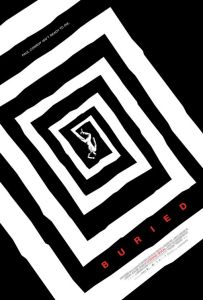 Spending 90 minutes trapped in a cramped space with a sweaty Ryan Reynolds? Doesn’t sound like a bad start for large swaths of the population. Buried is a small indie experiment that places Reynolds in exceedingly tight quarters. Paul is an American contractor driving trucks over in Iraq. Insurgents ambushed his convoy. He awakens to find himself trapped in a coffin and buried under the earth. Packed away inside with him are a lighter, a pen, and most importantly, a cell phone. Can your carrier get you coverage buried under the Iraqi desert? Time to switch, my friends.
For those left curious, yes, it really does take place entirely within a coffin. The entire 95 minutes are spent inside the small space. There is nary a flashback or even a visual insert to be had. You are trapped in that box just like Paul. The film is effectively claustrophobic. Director Rodrigo Cortes (The Contestant) gets terrific mileage out of his ultra confined space. The creative combination of angles, lighting, and nimble camerawork ensure that audiences do not grow tired of seeing the same 6 x 3″ of set. You can practically taste the sweat and dank air on screen. Buried has the most inspired camerawork I’ve seen in a film since 2006’s Children of Men. Cortes has only so much space to room to work and yet he does a magnificent job of manipulating the space to accentuate Paul’s fears and isolation. There are a few shots where the camera seems to keep zooming out, further and further, much further than the ceiling of that box would allow, like Paul is sinking below the sand.
 The script by Chris Sparling is agile and resourceful and keeps finding news ways to keep your eyes glued to the screen. The movie is consumed by that nerve-wracking sense of urgency. The first minute and a half of the film is in darkness, and we awaken to the terror of the situation just as Paul does. Including a cell phone seems like a necessary screenwriting plot device. If Paul awoke by his lonesome, the movie would turn into 90 minutes of watching a guy screaming himself hoarse and clawing away at the wooden walls. A cell phone opens up the narrative. Now Paul has something of a fighting chance to survive. It gives him the motivation to survive and adapt to his surroundings during his limited last moments. The cell phone also allows the bad guys to terrorize Paul over and over. They can make increasingly hostile demands even with their hostage lodged six feet under ground. The demands for money get more and more aggressive, leading to one-sided negotiations, like Paul filming a plea for help that terrorists can exploit and upload to the Internet. The people that Paul does get through to offer little in assistance. To them, it’s just another day going through the same motions, taking down the same messages. Cries for help may not rise above the fray.
The political commentary is, in a word, indelicate. The Iraq War commentary can feel a tad ham-fisted at times in how it wants to boil down and extrapolate Paul as a symbol of the war’s untold hidden human costs. Paul is a contractor paid to ferry supply along the dangerous roads of Iraq. He’s supposed to be seen as “just any guy,” that is, any American Joe. He symbolizes the lost lives that don’t manage to make the news because they don’t have stars and stripes on their uniforms. The Iraq War made use of hundreds of thousands of privet industry contractors, supposedly easing the burden of the U.S. military. Paul is intended to represent the forgotten casualties of war, the people who were merely punching a clock in a foreign land to help their families. The officials that Paul does get through seem more concerned with personal agendas then retrieving an entombed man. The military is concerned, sure, but more interested in locating and killing the terrorists/insurgents that ambushed Paul’s convoy. The State Department is more concerned about containing Paul’s story and ensuring media outlets don’t find out. They’re really worried that any ransom video Paul records will become an Internet sensation, particularly in the dry, dusty part of the world, and become a recruitment tool. Paul’s company is more worried about weaseling out of paying his insurance policy. The movie aims to ask what is the price of one life. Is it just a numbers game? Is losing an American contractor every few weeks worth the price of freedom? What is the definition of an acceptable loss?
 The movie is really a one-man show, so it’s fortunate to have an actor of Reynolds capabilities. He’s used to playing charming, self-effacing, fast-talking rascals; he has an innate ability to command your attention and interest. Reynolds gives a deeply empathetic performance. He goes through different stages of emotions, from shock and horror to anger and frustration, to impotence and self-pity, and all the way back again. You will think step-by-step with him as he tries to assess his situation. It’s a performance rooted in manufactured seclusion, something akin to the one-man show that Tom Hanks shared with a scene-stealing volleyball. Except Reynolds’ commitment seems even greater than what Hanks endured; Reynolds face is in every frame of this film. It would have been very easy for an actor to use the situation as an excuse to bounce off the walls, chewing scenery as an effective means of escape. But Reynolds dials down the histrionics. His character feels awkwardly real under the extreme circumstances.
I really enjoyed the concept, execution (the ending is note perfect), but I also found many of Buried‘s smaller moments to be more than worthwhile. When Paul begins to doubt he’ll ever be found in time, he mentally prepares himself for the inevitable. He films a last will and testament to be found with his corpse, whenever he is eventually unearthed. He leaves messages trying to reach out to love ones one last time. And perhaps most heartbreaking of all, Paul tries to reach his elderly mother, an Alzheimer’s patient in a rest home. He desperately wants to hear one last “I love you” from his mother’s voice, but the woman’s brain is a mental carousel and she is unable to comply. I thought about my own acceptance process if I was in Paul’s exact situation, and I know how much significance I would place on achieving some form of saying goodbye. In order to let go I would need to speak to the people closest to me and tell them how important they were, how much they meant to me. To be denied something so vital to acceptance is cruel. And Paul is denied his one last meaningful goodbye, and I found it to be aching and emotionally terrifying.
If you have any minute fear of tiny spaces or being trapped and helpless, then Buried will get under your skin big time. Add the general race-against-time nature of the script and the flick hums with nervous tension. This film is taut like a drum. It’s ridiculously tense. You may start to feel your feet moving, as if you’re trying to push away the space and dig your way out. It’s hard to believe but a movie that takes place entirely inside a box is one of the most inventive, visually appealing, and enjoyable films of the year.
Nate’s Grade: A
Share this:

Paranormal Activity 2 (2010)
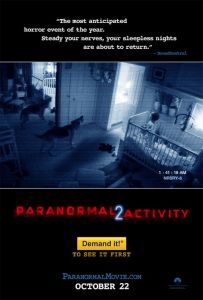 The real draw for the first Paranormal Activity was that it was a word-of-mouth secret that became a sensation. You just had to see what all the fuss was about. It was the super cheap little indie that could and took the nation by storm. Of course, with any product that makes money a sequel must come. But it’s hard to repeat a phenomenon, just ask the makers behind Book of Shadows: Blair Witch 2 (an odd, fascinating failure). Paranormal Activity 2 is a decent slow burn horror movie but it can’t escape the long shadow of its predecessor. There isn’t enough new or interesting to justify this redundant exercise in standard low-wattage terror.
The first film involved the haunted bedroom of a couple, Katie (Katie Featherston) and Micah (Micah Strout). They filmed their nightly haunted shenanigans and it all didn’t end so well. Now we have Katie’s sister and her husband. They’re welcoming home a brand-new baby boy, Hunter, when they find their home has been trashed. Rooms have been upended but no valuables are missing. The family gets a home security system installed with multiple surveillance videos to spy for intruders. Of course these cameras also begin catching strange occurrences in the house. It seems a sinister presence is after the baby. Apparently demons love children, did you know this? Hell has a really fantastic T-ball team.
 Like most other gimmick movies, duplicating the same effect leads to diminishing returns. Part of what made the first film work was its relative freshness and creative ingenuity. For a measly $11,000, director Oren Peli was able to fashion and sustain a mood of mounting dread that also stayed within the confines of the “found footage” concept. He built up suspense gradually and lead to some terrific “boo” moments. I’m still amazed how Peli was able to pull off some of his tricks sight unseen with such a minuscule budget. Part of the appreciation of Paranormal Activity was the level of skill for the craft. Now along comes a sequel with a $3 million budget, which is still chump change by Hollywood’s standards. However, it’s a large enough figure that I never once questioned how they were ale to pull anything off. I expected more from the sequel given the budget and the general nature of sequels to inevitably up the ante. You’ll still be scanning the frame of those surveillance camera angles, looking for any sign of something amiss or strange. The whole process can be maddening in both a good and bad way. Much of whatever tension does build is in these moments of uncertainty waiting with baited breath. It can seem like an interactive group game of Where’s Waldo. You’re sort of relieved when something actually does happen to break the nothingness.
As a whole, Paranormal Activity 2 doesn’t work as well when it comes to the construction of their scares. The first film primarily took place in one location, the bedroom, the sanctity of the modern man’s domicile. Whenever we got to beddy time we knew what waited. A visual vocabulary had been built to get the audience sweating as soon as the characters sleep. And isn’t disrupting our sleep the ultimate home invasion? With the sequel, there are multiple cameras to work through, always opening with the same shot of the pool cleaner busy at work. We start with pool cam, then after a while we add one more, kitchen came, then stair cam, etc., but we always cycle back to the original before moving forward. It can become an especially tiring pattern, especially when early camera angles prove to have nothing going on within. The pool-cleaning robot emerges as the breakout star of the film (evidently the first sign of a haunting is a dirty pool). There are some effective scares but it’s all in the jump scare/gotcha variety. The film toys with the possibility of a night vision mode for the ever-present camcorder tossed around the home. This possibility is woefully underutilized and only saved for a mad dash through the house at the conclusion.
 Repeating the same haunting elements may work in a narrative sense but it also mitigates the impact. You know what to expect. Hearing loud noises or watching doors slam shut does not offer the same jolt the second time around, especially on a larger budget. It’s unavoidable that Paranormal Activity 2 will become a victim of the first film’s success. Unless it raises the stakes, the movie is just going through the same paces with different faces. This time there’s a baby that’s being sought after by a malicious spirit. If all you’re doing is raising the “innocent quotient” of the victims then the film might as well be set in a impoverished Bangladesh orphanage where the kids all have terminal diseases as well. Paranormal Activity 2 tries to repeat the same tricks to mixed results. The scares are too few and far between and none have the same power as in the first film. The climax is lazily similar as well.
Unlike the first film, much of the movie feels like it’s just filling time to space out its scares. You won’t feel any true sense of attachment to these people nor will you get excited when they parcel out morsels of back-story (the first mom died and… what?). Instead of a young couple we now have a young couple… with a baby! And a teen daughter too but really it’s all about the baby. The family members sit and talk at length rationalizing the weird phenomenon. They even perform research on the Internet and make sure to record themselves with a camera they set down. Who does that? Who records simple conversations? The family’s main dilemma is that dad is unreasonably skeptical despite strong video evidence. Why do these people still let the baby sleep alone? Why haven’t they brought the baby’s crib into their own bedroom? The family pet, a trusted German shepherd, is good protection. The dog growls and barks because animals, just like Hispanic housekeepers the film asserts, innately know when evil spirits are afoot. Why do Hispanic women all have fine-tuned demon radar in the movies? Is this a feature that a Caucasian male can upgrade to? Apparently, the best protection you can afford your home is multiple dogs and multiple Hispanic housekeepers to stand guard.
Paranormal Activity 2 attempts to deepen the mythology of the franchise. It takes place both before and after the events of the first movie, providing some explanation as to what the demon is really after and how it came to terrorize Katie. It’s nice to watch how the two movies fold on top of each other and guess what areas will next connect. Katie makes numerous appearances and ironically offers the sage advice to her sister to just ignore those bumps in the night. When Micah makes an appearance he is accompanied by onscreen text that informs us that this is 3 weeks before his dead body is found. Why? We already know thanks to Katie’s early presence that the film is a prequel, so we already know the doomed fate of Katie and Micah. What does spelling it out have to offer the audience?
 Paranormal Activity 2 runs into problems when it imitates what worked previously but doesn’t add any new flavor, escalation, or variety. The freshness of the concept is quickly turning stale. What was new and exciting is now being written into rote rules for the franchise. I can only surmise that the Paranormal Activity franchise will follow the same downward slide as befell the Final Destination franchise once the audience became hip to all the rules. Surprise goes out the window when films are made to meet genre expectations. You’re still relying overall on your imagination for much of the scares in Paranormal Activity 2, which will vary depending upon the individual. I just think it’s harder to trick you the second time around. My brain kept saying, “I’ve already seen this movie. Been there, done that.” I had no actual rebuttal for my brain, so I ate some popcorn and scanned the screen looking for more weird stuff.
Nate’s Grade: C+
Share this:

Due Date (2010)
 Due Date feels less a wholesale rip-off of 1987’s Planes, Trains, and Automobiles and more of a full-blown film inspired by the one sequence where Steve Martin unleashes a profane tirade at an airport clerk. It has two talented actors (Robert Downey Jr., Zack Galifiankas) in situations that should come across as funny, but the movie only gets so many laughs. The road trip angle has been done to death but the mismatched pairing of Downey, acerbic anger, and Galifianakas, continued goofball man-child, should have compensated for any stale genre formula leftovers. I think Due Date, under the direction of Todd Phillips (The Hangover, Old School), really just doesn’t know what to do with all its misplaced mean-spirited rage. So we end up with kids getting punched, people being beaten by disabled veterans, multiple cars crashing in spectacular fashion, public masturbation with dogs, people enduring great injury, and somehow the characters bond through all the adversity, even though neither changes at all. The comedy setups are all fairly transparent and can only deliver medium-sized payoffs; when a man’s ashes are kept in a coffee can, you know it’s only a matter of time before the inevitable occurs. For better or worse, this is a two-man operation; the supporting actors are all wasted, particularly Downey’s Kiss Kiss Bang Bang co-star Michelle Monaghan (Eagle Eye) as Downey’s pregnant wife. She isn’t even given one funny thing to say or do the whole movie. Due Date is a comedy that will make you laugh sporadically but it should have performed better. It’s a mid-level comedy with medium-level payoffs that ultimately prove to be underwhelming given the upper-level talent involved.
Nate’s Grade: C+
Share this:

Casino Jack and the United States of Money (2010)
 Alex Gibney is a masterful documentary filmmaker, having crafted Enron: The Smartest Guys in the Room and the Oscar-winning Taxi to the Dark Side. His latest doc chronicling the rise and fall of corrupt lobbyist Jack Abramoff is insightful, clear-eyed, and entertaining like his other work, but something’s missing here and it’s hard to put my finger on it. Gibney’s doc lacks the fire and outrage of his previous exposes, so Casino Jack doesn’t hold your attention as strong. It focuses closely on Abramoff’s scandals and his influence peddling and gives shrift coverage to bigger issues about our government being for sale to the highest bidder. The lack of attention to a bigger picture hurts the movie’s power. But ultimately I think what makes Casino Jack lacking is that it is missing one very key participant — Abramoff. Gibney interviewed the man several times in prison but Abramoff declined to be involved after pressure from federal prosecutors. By all accounts, Abramoff is a charismatic, larger-than-life figure, whose Reagan era College Republican idealism transforms into greed and out-of-control hubris (Abramoff foolishly wrote every single thought down in e-mail). His absence is noticeable and blunts the storytelling angles the film can take. With Abramoff’s side, there could be much more insight and dirt. Casino Jack is a solid viewing but not up to snuff for Gibney. Wait for the Kevin Spacey film later this year.
Nate’s Grade: B
Share this:

Never Let Me Go (2010)
 You’ll be excused for mistaking Never Let Me Go as one of those austere boardinghouse dramas the English are fond of cranking out. I mean it even has Keira Knightley in the thing for goodness sakes. Pretty lily-white British actors trying to find their place in a reserved society spanning the 1970s to the mid 1990s. You’d be forgiven for stifling a yawn. But then Never Let Me Go takes a sudden left turn into a realm of science fiction morality play. It becomes something much deeper and menacing. I am about to go into some major spoilers concerning the sinister premise of the movie, so if you’d prefer to stay pure then politely excuse yourself from the remainder of this review and come back at a later time. I won’t think less of you but only if you promise to come back.
Kathy (Carey Mulligan) and her pals Tommy (Andrew Garfield) and Ruth (Knightley) all grew up in the remote countryside school of Hailsham. It’s like any other school in most regards, except at Hailsham the children all wear monitoring bracelets, are afraid to leave the boundaries of school for fear of being murdered by outside forces, and are told that her physical fitness and internal health are of “paramount importance.” Figured it out yet? My then-partner leaned over and whispered, “Are these kids organ slaves?” Kathy and her friends find out their true identity when an outside third-grade teacher (Sally Hawkins) takes pity on them. She reveals that the students of Hailsham are clones whose sole purpose is to be raised into healthy adults who will then give “donations” to the ailing public at large. Most clones will go through one to four “donations” before “completing,” unless they so desire. You see Never Let Me Go exists in a realm where medical science has made momentous breakthroughs and now people can live to 100 years of age on average. Kathy and her friends are the dirty details.
 The rest of the movie flashes through our trio’s teen years. Kathy has always been kind and affectionate to Tommy, but before she could seal the deal Ruth swooped in and took Tommy for her own. Kathy has waited in vain for the two to break up, but that day just never comes. The trio ventures out to a small farmhouse in their teens to do some work and see the outside world. They’re living with a few other Hailsham alums that show them the knack for social interaction with outsiders. There are two rumors at play. One is that the Hailsham alums think they’ve found Ruth’s “original,” the person she’s been cloned from. The second rumor has greater significance: if two Hailsham students can prove that they’re in love, deep, honest love, then they can defer their donations for a few years. This idea takes hold of Tommy and consumes him. Except, we don’t really know whether Ruth or Kathy will be his partner in love.
So why don’t these people run away, or fight back, or do anything of defiance once they discover the horrible truth that will befall them? I have read several critics taking the film to task for being so painfully prosaic and passive, and Never Let Me Go can admittedly fall prey to those detractions at times. However, this is not the Hollywood version where the abused (clones) fight back for their survival and regain independence in a hostile world. That movie was called The Island, plus the several other films that Michael Bay sort of ripped off and then added extra loud explosions. Never Let Me Go has nary an explosion or moment of triumphant revolution. There is no revolt coming because the film doesn’t want to let anyone off the hook; these people are society’s collective collateral damage. They have been bred to be walking, talking, mostly demure, fleshy warehouses for spare parts. It’s only a matter of time before they leave everything on the operating room table, and these people benignly accept their doomed fate (“We all complete”). They march forward, trying to find some level of dignity and beauty before they get the call for “donations.” These people don’t know what it means to rebel; they have no real concept of liberty. They’ve been conditioned since childhood to obey, and that’s the whole point of the film. They have no self-preservation instincts. Likely any cloned child that was expressing strong feelings of boldness was removed, and destroyed, so as not to taint the rest of group. These people are like gown-up versions of veal. They’ve been cultivated since birth for the purpose of destruction, and their knowledge of the world is limited and cruelly self-serving. Watching innocent characters march off to a merciless fate can be very emotionally draining. It should also make you angry.
 These people are hopeless so that the movie’s full impact is absorbed. This isn’t some far off nightmarish scenario, because we as a society are already reaping the rewards of a lifestyle, a lifestyle that we’re loath to think about the mechanics of how we got so fat and happy. I can go to a Walmart and buy a T-shirt for a dollar. I am a happy consumer, but what did it take for me to get that product at such a discounted rate? Sure there are variables up the wazoo, but there are many negative factors that go into why that price stays low, invisible hand of the market be damned. Workers clock long hours in unsafe conditions in order to meet supply, earning a penance just enough to keep them alive and moving product. Environmental concerns are overlooked because that would mess with production. Long-term generational poverty can develop. The worker has ceased to be a person and is merely a dispenser of product, much like our clones in the film. This is not a definitive example of what goes on in the world, mind you. Never Let Me Go isn’t some far off scenario; we’re already there, albeit less explicitly. If the price of gas rose a dollar a gallon but it meant that people in other countries could have safe, uncontaminated water and enough food to stay healthy, what do you think would happen?
With all of that said, Never Let Me Go can’t fully fight the trappings of inert drama. For two hours we are watching somewhat nice, somewhat bland British kids gawk and smile their way toward the inevitable. The conceit calls for the breeding of rather milquetoast personalities. It simultaneously makes the characters more innocent and less emotionally involving. The screenplay relies on our sense of outrage and injustice to fill in the gaps of emotional connection. There are little molehills of characterization at best. You’re supposed to be choked up on indignation and sadness so as to not notice that the threesome of character are all rather good-natured but boring. That even may be an aim of the screenplay to accentuate the terrible fate that awaits, or maybe I’m just being overly analytical. Never Let Me Go reveals its awful truth fairly early at about the 40-minute mark, making sure that the audience is fully aware that we are definitely not headed for a happy ending. As it is, the actors are all lovely and talented but there’s only so much silent emoting and teary eyes can conjure.
 It’s credit to the talents of the actors that you do feel a storm of emotions from such otherwise frail characters. Mulligan (An Education) showcases her great gifts for communicating sadness. Her face just crinkles up, her eyes get glassy, and you want to hug her. She’s our dramatic linchpin. Her looks of conflict and yearning do well to communicate the inner struggle of her character’s abbreviated life. There’s a lot left to the imagination and Mulligan once again crushes it. Garfield (The Social Network) is stuck playing a wishy-washy character, which makes him seem a bit thick at times. He’s the most naïve and hopeful of the three, so when those hopes get crushed again and again his breakdowns have the most emotional heft. Knightley (Pride and Prejudice) has been in six period films since 2005, so she’s got this thing down pat. Ruth is a bit more assertive and angry than her friends, and it’s a pleasure seeing a more calculating side from the actress. It seems like the filmmakers had a troublesome time trying to downplay the attractive features of their cast. So it seems that they relied on the actors eating less. Knightley, and particularly Garfield, look rather gaunt and puckish, even before they begin “donations.”
I’ve gone this far without even mentioning director Mark Romanek’s (One Hour Photo) contributions, or the fact that the film is based off the 2005 novel by author Kazuo Ishiguru (Remains of the Day) and is adapted by Alex Garland (28 Days Later). Great artists that shaped the vision of this film. It’s a shame then that the impact of Never Let Me Go is blunted. It’s an intelligent, poetic, haunting, and emotionally wrenching film experience, and yet it could have been far more penetrating and devastating. The passive nature of the characters accentuates their doom and our sense of outrage. But that same passive nature makes them less than engaging characters. It’s been days since I saw the film and it still lingers in my memory, a testament to the moral quandaries and acting prowess. The existential drama of the film is better suited for the page where the questions of identity and morality can be given more careful and rewarding examination. The movie has an oddly detached feel to so much suffering. Never Let Me Go is a hard film to let go but also a hard film to truly embrace.
Nate’s Grade: B
Share this:

Babies (2010)
 This tiny documentary might easily win the award for cutest movie of the year, but at best it’s only perfectly suited to have on in the background of your home. Nearly wordless, this French documentary chronicles four newborn babies on four different countries growing up in vastly different cultures, from San Francisco to Namibia to Tokyo and Mongolia. The babies are adorable and the sequences rarely last more than a minute with each baby, making this perhaps the fastest paced home movie you’ll ever likely see. At the same time, just because the different babies are juxtaposed does not mean that a greater sense of meaning arises from the film. We watch them walk, talk, and discover the various stimuli of their environment in beautiful photography. Babies may be the best looking documentary that conveys the least substance. This may be the cutest waste of time you’ll have all year at the movies.
Nate’s Grade: C+
Share this:

The Social Network (2010)
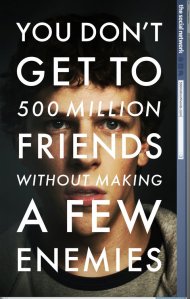 Dismissively branded as “the Facebook movie,” the whip smart and hypnotic, yet poorly titled, The Social Network is much more than a rote TV-movie on the start of a popular website (coming out next year: Twitter: The Musical in 144 Characters). Yes, the film chronicles the people responsible for the Internet’s most ubiquitous time waster and their very varying accounts of who was responsible and who was unscrupulous. But the backdrop could be just as much any start-up business. Truth be told, the “Facebook movie” bares a striking resemblance to Citizen Kane. It is the story of one man who may be a genius in some regards but can?t help but push everybody he cares about away. It’s about powerful men who don’t know what to do with power. It’s about ambitious men who dedicate their lives to that ambition. It’s not about terabytes and html coding, this is a movie about people, betrayal, ego, greed, jealousy, and the great irony that Mark Zuckerberg created the world’s most dominant social network and yet he himself cannot hold onto a single legitimate friend.
In 2003, Zuckerberg (Jesse Eisenberg) is a Harvard student obsessed with getting into the prestigious clubs and fraternities on campus. But he’s not well connected or athletic or close to being rich. So after being dumped on night, he goes home and hacks into various Harvard sorority websites and steals pictures of coeds. He then creates the crude website Facemash (while also drunk, mind you) where Harvard undergrads rank their fellow classmates side-by-side two at a time. It’s an immediate hit and crashes the Harvard server. Zuckerberg is then approached by Cameron and Tyler Winklevoss (Armie Hammer and Josh Pence), handsome blue-blooded WASP twins who have an idea. They want to create their own social website just for Harvard students to communicate with each other. They are impressed with Zuckerberg’s tech skills and want to hire him to build the site. Zuckerberg takes the idea to his roommate and best friend Eduardo Saverin (Andrew Garfield), proposing to make their own site with Saverin’s limited means.
From there is where the different parties diverge on their versions of truth. Zuckerberg secretly works on his own side project while stalling and dodging the Winklevoss twins. He offers to have Saverin be CFO of the company and split the stakes. Then as success mounts, the Facebook website gets the attention of Sean Parker (Justin Timberlake), notorious for co-founding Napster at age 19. Parker immediately has the ear of Zuckerberg, and it isn’t long before Saverin starts feeling on the outskirts of his own company, and then eventually shut out completely. The Winklevoss twins and Saverin each file multi-million dollar lawsuits accusing Zuckerberg of intellectual theft and underhanded business tactics.
 Watching The Social Network feels like you?re downloading an entire semester?s worth of information directly to your brain. Adapted by uber wordsmith Aaron Sorkin (TV’s West Wing, Charlie Wilson’s War), this is a story that gallops at full speed and leaves you spinning. The dialogue flies by so blazingly quick that it?s easy to get left behind. I would not advise eating any concession snack with this movie or else you might miss reams of dialogue. Sorkin smartly weaves together a murky and litigious tale of alternate truths, showing different sides when it comes to the creation of Facebook. Was it really stealing or did the Winklevoss twins merely inspire Zuckerberg? Is he truly indebted to them? “Does a guy who makes a chair have to pay a fee to every person who ever made a chair before in history,” Zuckerberg snaps. How deep did Saverin?s involvement go, and was he naïve or just thinking too small in scope? How much is a friendship worth in dollars and cents? Sorkin gives a definite impression to these answers, and it should surprise nobody that Saverin comes across as angelic and the obviously wronged party here. But the script as a whole is meticulous with detail, characters, and dates. It almost feels like the content of a miniseries has been squeezed into a brisk two-hour time frame. The characters are just as layered as the plot. The opening scene where Mark is dumped by his girlfriend (Rooney Mara, soon to be Lisbeth Salander in Fincher’s remake of The Girl with the Dragon Tattoo) sets the tone of the movie. The dialogue feels like an assault and it is unrelenting. You openly wonder how Eisenberg can breathe reciting his verbose lines with such lightning speed. Mara is aghast at her hyper-literate yet bitter boyfriend spewing bile at the elite and yet unashamedly pining for that life. He’s brilliant and cutting but socially awkward and unable to understand the feelings he’s hurting. Mara has had enough and dumps him right there, spurring Zuckerberg into a drunken night of revenge that will set the stage for Facebook. Sorkin can pretty much start clearing shelf space for his Best Adapted Screenplay Oscar right now.
Many will find Zuckerberg to be unlikable from the get-go, but I never could bring myself to actively dislike or loathe the man. He’s really more of a figure of Greek tragedy. Zuckerberg is a blissful conundrum of a character, a walking contradiction. He can be sullen and wounded one minute and the next casually cruel. He seethes at deposition hearings; unable to control the contempt he has for others. Zuckerberg’s anger boils over, and his beady-eyed glares communicate an incredulous, “You are worlds below me.” He can?t stand people who have easy breaks, the select and privileged, and yet he nakedly longs to be apart of that group and meet their approval. He can be childish and narcissistic, insular and insecure, and then he can be charitable. Zuckerberg created a music application that Microsoft was willing to purchase. “Why didn’t you sell?” asks one of the Winklevoss twins. Zuckerberg just shrugs his shoulders. He doesn’t want to sell ad space on Facebook and get rich quick because it would ruin the site experience. He is a champion of the democracy of the World Wide Web; a modern-day Thomas Paine? Probably not, but Zuckerberg’s hard-driven ambition and crooked tactics make him a modern-day robber baron, a titan of industry. Rockefeller and Carnegie and J.P. Morgan are all men that don’t seem any different in practice than Zuckerberg, though they probably had more family money as a starting point. That’s not an excuse for Zuckerberg’s behavior, but I want to add some perspective before the world tars and feathers the guy. Zuckerberg is the Internet’s first self-made billionaire, but what are the costs? By sacrificing all, and burning personal relationships, Zuckerberg may have advanced Facebook to unparalleled heights. But whom does he get to share his success with? It’s a little simplistic to boil such a complex film to the greeting card-esque moral “It’s people that matter most?” but the film always circles back to the question of cost. It’s also rather simplistic to chalk up the creation of Facebook as a means of impressing a girl, but then operas have been written, art has been sculpted, and wars have been fought over the need to impress a woman. Zuckerberg is a fascinating creature and brilliantly played by Eisenberg. This is a character Ayn Rand would love.
 It seems that Zuckerberg’s instincts about human obsession with being apart of something exclusive were right on the mark. What separated Zuckerberg’s site from the likes of MySpace and Friendster is that you needed a college-based web address to get inside. It was a closed community, which made it cool and desirable. It started as a restricted club that all the cool kids wanted to belong to, then everyone joined, and now it’s damn near impossible to resist. First it was college kids, then college kids from other countries, then high school kids, then adults, now everybody on the planet has a Facebook page making sure the world doesn’t miss a single detail about their personal lives. I resisted as long as I could but broke down and got a Facebook account earlier this year. The Social Network is not concerned with the business angle of success unless it related directly to how it impacts the characters. You’re not going to find many insights into why Facebook took off or became entrenched in our navel-gazing society, which is a pity. The film also doesn’t concern itself with outright social commentary. Sure by exploring the micro personal struggles and betrayals of Mark and Eduardo the film marginally comments on the macro idea of generational self-absorption and ego, but so much more could be said about society as a whole. The film’s one clear moment of social satire is when Eduardo’s girlfriend berates him about his Facebook relationship status remaining single. She’s incensed and wants to know what he truly means by this outrageous declaration. He says he’s embarrassed but he doesn’t know how to change it, plus he’s hardly ever on the site. She responds to this by setting his gift on fire. Ah, petulant and jealous and self-absorbed concerning what a few scraps of digital bits say rather than direct, personal, face-to-face communication. It’s a brief, albeit nice slam on the myopic self-absorption of millennials, who came out of the womb with something electronic attached to their fingertips. The film doesn’t even touch the idea of millennials’ free sense of privacy and over sharing. This is not a generation -defining movie, folks.
This is all strange ground for director David Fincher (Seven, Zodiac), a visual stylist with few peers. Nerds creating a website doesn’t exactly strike anybody as fertile ground for a visually exciting drama, and yet Fincher proves once again that he is a masterful artist. The film looks beautifully sleek from beginning to end with Fincher’s typical green tinted, deep focus cinematography. Fincher also makes the best use of special effects I’ve seen this year. The Winklevoss twins were not played by actual twins. Hammer had his face digitally placed onto a stand-in’s (Pence) body. The digital cut-and-paste was remarkable in Fincher’s Benjamin Button but it also called attention to itself. Nobody would walk in believing Brad Pitt’s face somehow was on the body of a three-foot tall old man. However, in The Social Network, you would never once doubt that there are two twin actors on screen the whole time. Hammer manages to make each twin distinct and frustrated without coming across as jerky or entitled. The rest of the actors do fantastic work as well, and special notice to Timberlake who plays his mercurial role with glee.
 So what does the real Mark Zuckerberg think about all this attention? Well, in a surprise to people who do not have a firm understanding of the word, Facebook has declined all advertising for The Social Network and is staying mum on the film, hoping to ride out the critical storm. I don’t think anyone is going to be using Facebook less now that they have learned the ethically murky beginnings of the website. But Zuckerberg and his Facebook crew might want to think of formulating some response strategy because this movie, and talk of this movie, isn’t going away any time soon (Zuckerberg recently donated $100 million to Newark city schools on Oprah coincidentally the same week Social Network was opening). It’s rare to find a studio film that is as polished across the bard as this film. The writing is sharp, the direction is sleek, the acting is top-notch, the film rollicks with intrigue and suspense and juicy drama, and the film can’t help but be relevant in our modern society. You do not have to know a lick about coding and websites and whatever to get absorbed in this high-stakes drama. It may not be the generation defining experience some critics are wetting themselves over in hype, but The Social Network is easily one of the best films of 2010. Perhaps the Academy will give it the ultimate “friend request” come this winter. In the meantime, log off and get yourself into a theater to see this great American movie.
Nate’s Grade: A
Share this:

Shutter Island (2010)
 This was a pulpy B-movie put together with A-movie artistry. In a year that had some artistically polished genre movies, Shutter Island was Martin Scorsese’s return to genre filmmaking and he brought with him an entire team of experts and professionals. The movie is playful and intriguing, engaging the mind enough for a crime thriller that appears to be a straight-forward mystery but then shows flashes of being about something more, something darker. And when you’re dealing with a movie with Holocaust flashbacks, dead kids, Nazi doctors, mental asylums, well you know you’re not going to be reaching subtlety even with a stick. But the way Scorsese orchestrates all these foreboding elements, tying together various plotlines, and working at different levels to satisfy the informed and uninformed, right before delivering a dynamite twist that calls for further investigation and rewatching, well it’s nothing short of masterful. Shutter Island may not be anything more than a souped-up B-movie, but with this level of artistry, it’s also one of the most entertaining films of the year.
Nate’s Grade: A-
Share this:

Easy A (2010)
 Usually when I think “teen comedy” I think lowest common denominator and a pitch straight down the middle of the plate. Will there be fart jokes? Probably. Will the climax taken place at the prom? Absolutely. Does Easy A do either? Not a chance. This is the sort of teen comedy that would have greatly appealed to me back in my own days of high school institutional education.
Olive (Emma Stone) is a high school senior that gets good grades, behaves well, and spends her weekends hopping around her bedroom and singing a song she can’t get out of her brain. She’s not into parties or idiots or anything remotely dangerous. Then her world turns upside down when she fibs about losing her virginity. Suddenly Olive is branded as the school’s hussy. Inspired by Nathaniel Hawthorne’s famous character, Olive decides to embrace the rumors, accessorizing her wardrobe with plenty of scarlet “A”s along the corseted bust line. Olive’s gay friend asks her for a huge favor: he wants to use her fake notoriety to lose his virginity. The two will attend a party, find a room, and dramatically interpret animated sex. It works like a charm. Her pal is given a free pass, some extra popularity, and it isn’t long before other downtrodden high school rejects seek a similar deal. Outraged at Olive’s lack of shame is Marianne (Amanda Bynes), the school?s busybody and leader of a vocal Christian abstinence program. She doesn’t know whether she wants to save Olive or banish her.
 All hail the coming of Emma Stone, comedy goddess and future heartbreaker. Easy A is a fantastic showcase of the many strengths of this irresistible actress. After several supporting roles in films like Superbad and The House Bunny, this is the first opportunity for Stone to have a film where she gets to be the lead, and trust me folks, this won?t be the last one. Stone has a great way of becoming instantly empathetic and, much like the film, being brainy and playfully risqué at the same time. Watching the success of Stone is like watching the road not taken by Lindsay Lohan (be careful whose advice you take, Emma). Stone makes her good times seem effortless, like she really is having a blast playing up her bad girl image. Her facial expressions and sarcastic, know-it-all line readings help push her comedic range even further, and yet she remains completely empathetic the entire time. Stone is the kind of girl that other girls would want to hang out with and guys would crush on. It is impossible to not love this actress, and she makes Easy A easily enjoyable and downright effervescent at times.
The rest of the cast is having just as much fun with the material as Stone. Chief among them are Stanley Tucci and Patricia Clarkson as Olive’s hyper-literate parents. They may seem like they stepped off the train from a Diablo Cody movie at first, but you will quickly get used to their glib rapid-fire repartee. Some might dismiss them as kooks. Thomas Haden Church (Sideways) tries to make the glamorous movie idea of the Hip Teacher into a droll square and succeeds admirably. There’s even Lisa Kudrow (TV’s Friends) as a guidance counselor and Malcolm McDowell (Halloween) as a blasé principal (“This is public school. If I can keep the girls off the pole and the boys off the pipe, I get a bonus”). Then there’s Bynes (Hairspray, She’s the Man) in what was billed as her final film performance before hastily retiring from acting, and then following in the footsteps of other famous retirees like Michael Jordan, Stephen King, Jay-Z, and Brett Farve, and hastily un-retired. She has her cutesy, dimple-faced shtick she cling to, but what happened to her? Her face looks very swollen, like she had an allergic reaction on every day of shooting. It looks like someone inflated her head with the plot to turn her into a Macy’s Day balloon. I started to get concerned for Bynes by the end.
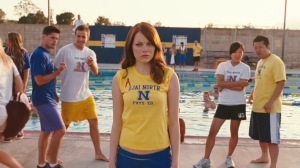 While Stone is the number one, two, and three reasons for seeing this movie, Easy A doesn’t let down her efforts. This is a teen comedy that might just be light years ahead of the pack. There are jokes guaranteed to go over the heads of a majority of audience members, from wisecracks about Sylvia Plath to French wordplay to the Kinsey scale. You’re not going to find any of that stuff in your typically brain-dead Freddie Prinze Jr. vehicle (is it just pathetic to keep holding onto a 10-year-old anti-FPJ grudge? The answer is, “No!”). Though I died a little inside when the movie resorts to explaining the plot of The Scarlet Letter to Joe Public; however, this intellectual Cliff Notes salve was saved by Stone bemoaning the idiotic 1995 Demi Moore film that takes some of the sharpest deviations I’ve ever seen from a classic literary adaptation (“If I have to grade one more paper talking about Hester Prynne taking baths all the time?”). The dialogue is routinely snappy and occasionally barbed, which is a bit of a surprise. It’s witty, a little cheeky, but it doesn’t go over the line or play for the easy gross-out gag. It?s a well-constructed, well-executed teen comedy that has a playful zing, a facetious tone that celebrates literature and makes being smart sexy.
While sex is at the forefront of the plot, the film does not treat the serious subject matter with flippancy. There’s some heavy stuff about what it means to sell out your ideals, prostituting yourself in more ways than the obvious. Olive begins her crusade as a means of taking ownership of her reputation and as an amusing character to play. But then as she dives ahead, accepting gift cards for her imaginary yet cred-boosting favors, the bloom of idealism dims and the meaning of her crusade become murky. What point is she trying to prove, exactly? In the end, is there a sharp difference between being a prostitute and being a “prostitute”? How big of a distance can irony give you? Easy A may have its fun when it comes time to doing the deed (I was howling with laughter about Olive chastising her first “client” about his comment on the aroma of sexual intercourse), but this is a teen movie ready to accept the consequences of its actions with a clear and level head.
 Not everything hums with precision. Easy A can be faulted for being too reverential and referential to 1980s teen comedies. Its ambition to be a modern-day member of this group is a bit too in-your-face. The abstinent Christian opposition feels too broadly drawn and setups for cheap shots and some downright mean punchlines. This movie is better than stooping to tin-eared caricature. The relationship between Olive and her best friend (Alyson Michalka) is vastly underdeveloped. The emergence of a Herpes outbreak also seems a little tacky, especially given its salacious carrier (trying hard not to spoil plot reveals). Then there are simply questions of believability. I?m not expecting a journalistic document of the American educational system, but since when was a high school student losing their virginity scandalous gossip? Why would Olive become the talk of the town by doing something that, according to the CDC, 80% of men and 75% of women have accomplished by age 19? Now, later in the film, the whiff of prostitution would definitely create a stir in the social gossip machine, and with technology, a rumor can spread at the speed of texting.
The film follows a well-worn path and owes a serious debt to the teen films of the 1980s, but Easy A is a winning teen comedy thanks to a snappy script, a playful sense of the taboo, and the courage to shoot for a higher level joke, also Stone’s charismatic comedic performance makes the grade. The entire movie has this bustling, quirky energy to it that feels un-labored. They make it all look so easy. Despite being a thorough genre flick, it is lifted thanks to its zesty writing and acting. In the most simplistically crass terms, Easy A scores.
Nate’s Grade: B


 nathanzoebl
You must be logged in to post a comment.