Category Archives: 2010 Movies
Dear John (2010)
 Best-selling author Nicholas Sparks is probably a perfectly reasonable human being. I’m sure he’s great at parties and that people love him. He may even have a dynamite recipe for sugar cookies. But I don’t know what happened to Sparks to turn him into the romance genre’s angel of death. His novels have followed a familiar practice of big Third Act deaths that usually deny readers their cherished happy endings. Is the motive to push people to make the most of our preciously little time spent on Earth? Is Sparks just sadistic and has found the secret to eternal life — the tears of millions of housewives and teenager girls. Whatever his rationale, another commonality for Sparks is that the film adaptations of his books are pretty corny and dreadful. A Walk to Remember, Nights in Rodanthe, Message in a Bottle; all about romance ultimately denied, none coming close to watchable. Dear John can at least be called watchable; however, watching should be limited to the confines of your living room TV when there’s nothing else on.
It’s the spring of 2001, and John Tyree (Channing Tatum) is enjoying his two-week leave from the military. He’s out surfing the fine North Carolina beaches when he rescues the handbag of Savannah (Amanda Seyfried) from being washed away. They two of them casually chat and soon those chats lead to barbecue invitations, parental visits, and kisses in the rain (a romantic movie tradition). Savannah takes an interest in John’s eccentric father (Richard Jenkins) because she recognizes his condition as autism. She’s been helping to watch her neighbor’s autistic child. Savannah would like to start her own horse camp for the autistic (sounds like an insurance nightmare). Life seems so full of promise and John promises to be back as soon as his military commitment expires in six months. Then 9/11 happens. John re-enlists and extends his tour another two years. This places great strain on his relationship with Savannah, but they write each other countless letters that manage to find John no matter what far-flung village he’s stationed at. Can their love exists on a series of hand-written letters? Well, look no further than the classic implications from the film’s title.
 Dear John goes through all the traditional Nicholas Sparks waterworks trademarks: young love leads to yearning, which leads to heartbreak, which leads to more yearning, which then inevitably leads toward one of the leads dying and everyone learning some sort of shallow profound meaning about life, blah blah blah. There are plenty of heightened melodramatic elements thrown into a fairly traditional, unspectacular love story, but all potent potential moments of drama feel underwhelming pretty much because the audience doesn’t care. John and Savannah are perfectly nice people and their love has that hopeful bloom, but their relationship is no more involving than watching a pretend couple in a commercial for greeting cards or life insurance. These people are vanilla. It makes it astounding, then, that such highly charged elements like cancer autism, and 9/11 fail to leave any impact. Dear John confuses listing dramatic events as drama itself. The dramatic stakes feel entirely too mellow and the film generally has a detached feeling, like it’s purposely distanced from the material for fear of getting too involved. This is a relationship movie that has its own commitment issues.
The military angle is respectfully explored, though not in much depth. John is torn apart by the pull of returning to his beloved but also of serving his country and, more personally, keeping his band of brothers in arms together. It’s a complicated scenario but the military commitment is another item in a list that should grab your interest but fail to do so. 9/11 isn’t given any deeper consideration other than the fact that it serves as a roadblock between our two lovebirds. If you want to see a more nuanced, complicated, and empathetic view of today’s overburdened military, check out the movie Stop-Loss, which also stars Tatum.
 The film drops any facade of being a romantic drama about midway through when Seyfried gets completely sidelined. She’s less a character and more an agreeable plot device; she’s self-aware and kind and knowing and receptive yet also naive. This makes her sudden character shift rather jarring, which seemingly paints Savannah as extremely co-dependant. Dear John then transforms into a serviceable father/son drama. There are some nice and moving moments between John and his father; this should have been the real focal point of the movie. Jenkins acts circles around everybody in this movie. It’s wonderful seeing a grown-up in these kind of movies show the kids ho this acting thing is done. Tatum actually might become a pretty good actor. He convincingly plays the more emotional moments well. He may very well prove to be the Patrick Swayze of his generation. Tatum can dance (Step Up), make the girls cry, and also handle some rock-socking action (G.I. Joe, Fighting, most of Tatum’s other movies). I think there’s an actor buried beneath that daunting physique waiting to blossom. Don’t disappoint me, Channing.
Dear John is a formulaic romance trained to seek pre-programmed audience responses (“Now you will laugh. Now you will cry. Now you will cry again. Now you will once again continue to cry…”). Lasse Halstrom (What’s Eating Gilbert Grape, Cassanova) directed this movie but you’d never be able to notice. I don’t want to be too harsh on the film because the acting is pleasant the story isn’t repulsive and does have some good moments, but mostly the movie comes across as bland and remote. The romance seems absent a beating heart to keep things moving. It’s all too lifeless. The character of Savannah best summarizes Dear John as a whole: mild pretense of wisdom, pretty to look at, genial, but fairly bland and difficult to convince is worth your valuable time.
Nate’s Grade: C
Share this:

The Wolfman (2010)
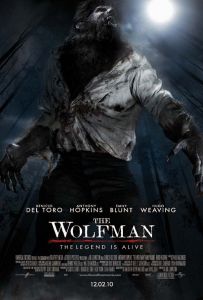 After re-shoots, reedits, a second director late in the process, and delayed release dates, it’s no surprise that The Wolfman is a bit of a shaggy mess.
In 1880, Lawrence Talbot (Benicio Del Toro) is an actor who returns home to England when he learns that his brother has been killed. Gwen (Emily Blunt), the fiancé to Talbot’s dead bro, writes that the departed brother was mauled, which points toward some kind of vicious creature roaming the woods. Inspector Aberline (Hugo Weaving) has been called in to clear the matter. Talbot’s father, Sir John (Anthony Hopkins), welcomes his prodigal son back but warns him of the dangers lurking in the countryside. The villagers are ready to blame the gypsy caravan and their chained bear when the feral creature strikes again, thus exonerating the bear. Talbot is bitten by the beast but survives only to transform into the cursed werewolf once every full moon.
Structurally, this movie feels like it’s all Act 1 and Act 3 with about ten minutes in between. By that I mean it’s all protracted setup and climax and little to connect the two. The beginning takes so long, with characters walking around like zombies who have no sense of wonder or fear given the extravagant circumstances. This is a movie that confuses set changes with plot advancement. Dour characters enter half-lit rooms and say little that isn’t cryptic or terse about the unusual happenings. This is what you have to look forward to for about an hour. The central mystery of who is the initial Wolfman is pretty easy to figure out when you play the economy of characters, which only compounds the movie’s sluggish pacing problems. You’re going to have definite pacing issues when your monster can only appear once a month, so say hello to massive time-lapse montages with the moon. It makes it hard to keep track of how much time is actually elapsing.
 There is little cogent explanation for why anything happens and the movie does an extremely poor job of maintaining a credible suspension of disbelief. What exactly are the rules here? What are the limitations for the Wolfmen? How far back does this whole thing go? The movie traces it back to an Indian kid, who looks like Gollum, in a cave, but where did he get it from? What is the history of this lycanthropy illness? When you turn into the monster, do you have any control? Are you a slave to your animal impulses? Are you culpable for what happens? Is it more like having multiple personalities except one of them is harrier? Nothing is really made clear and the movie just plows along while the unanswered questions continue to pile up, never to be addressed.
The Wolfman does a fine job of establishing an ambiance that feels ripped right from the old Hammer horror films, but fog and shadows and art direction can only take you so far. Every room looks like it’d be a prize-winning example of how to build a haunted house, though the lighting tends to be overly murky. Danny Elfman also provides a darkly lush score that mingles well with the onscreen atmosphere. But the refined sets only tease a better movie. An attack at the gypsy camp can get interesting. The beast flaring up at an insane asylum calls for something wickedly entertaining and scary, but everything is over before it really gets going, and we’ve moved on to the next scene of character sitting glumly in the dark. There’s nothing to startle beyond some overused jump scares. The movie lacks good scares because the film fundamentally can’t sustain a mood because the plot is never elaborated.
The character work is exceedingly shallow. Talbot is the main character but what do we learn about him? He’s an actor, he left town, he gets bit by a wolf, he skips stone’s with his dead brother’s girl, and that’s about it, folks. There’s an entire back story about Talbot spending time in a mental ward, which could prove to be fascinating but it’s just another set piece and nothing more. Talbot is pretty much a placeholder for a character; he’s the dude that has to get bit for there to be a story. He’s more catalyst than character, and you can feel that painful realization in how Del Toro (Traffic, Che) plays his non-character. Del Toro is a truly capable actor but he sleepwalks through the entire movie and mumbles most of his lines. Despite being a dead ringer for Lon Chaney Jr., he brings no energy to his role, nor does he ever seem truly concerned with his beastly transformation. You got more reaction and contemplation from Michael J. Fox in Teen Wolf.
The rest of the actors try and make good with the parts they’ve been tossed. Blunt (Sunshine Cleaning) can be a very good actress but she’s playing the thankless task of the underwritten love-interest-to-monster part. She’s no more fleshed out than the blonde damsel that screams and faints in the old classic monster movies. Blunt has the annoying habit of her voice turning into this simpering whine when she’s distressed. Hopkins (Fracture) pretty much gives the plot away with his maniacal cackling and incessant ear-to-ear grinning. You can pretty much faithfully assume where his character is going from the first malevolent twinkle in his eye. The screenplay exerts no effort to disguise its easily telegraphed character reveals. The person who comes out best is Weaving as the inspector, but that may be directly linked to the fact that he has the least amount of screen time of any of the main characters.
The special effects are fairly good and the practical makeup effects by screen legend Rick Baker are even better. The actual Wolfman is a snarling, spooky creature, but I wonder why we don’t get more shots allowing us to fully view the makeup work. Director Joe Johnston (Jurassic Park 3, Jumanji) seems to be more of a proponent of CGI, which means that we get scenes of Wolfie jumping from ye olde rooftop to rooftop like he’s any sort of wily creature. There’s nothing in the movie that really makes use of the specifics of being a Wolfman. We get a few POV shots of the Wolfman running extremely fast, but little else takes advantage of what makes the Wolfman a creature to be reckoned with. We only get a slew of decapitations and sliced innards that display the ferociousness of those wolf claws. Johnston isn’t afraid of gore but he doesn’t help his case when he fails to create any feeling of dread. It’s hard to dread what you can barely understand and with people you don’t really care about. Consider me stubborn, but when I got to a movie called The Wolfman I want some attention paid to the title animal.
 As I was watching The Wolfman I began to disassemble it in my head and piece together my own version of the film, an infinitely better version. For the sake or argument, I’ll explain my version and you can tell me which seems like the superior product. In my imaginary version, I completely eliminated Blunt, Hopkins, and most of the other side characters. I focused on Talbot and the Inspector and their relationship. Talbot has known about his lycanthropy for some time but he’s been able to control it for the most part, until recently. It haunts him, his inability to stop the sinister urges inside him that take over. The inspector is called in after the mysterious murders have picked up and they resemble some equally gruesome murders from 20 years prior (when Talbot first grappled with his hairy alter ego). The bent of the plot would then be on the relationship forged between the two men, how it turns into mutual affection and admiration all the while Talbot is trying to stay one step ahead of the investigation. Then my Act 2 break would be the Inspector finally realizing who is responsible for the murders (his friend!) and struggling with his own moral obligation to meet justice. Maybe this sounds too much like a crime thriller, but to me that sounds like a better film than watching two CGI werewolves claw at each other and spit.
The Wolfman is yet another misguided remake in a genre being gutted by horror remakes. The old monster movies of old were more than creature features and deserve better treatment than this bloody mess. I suppose few films can survive given the retooling process this one went through. This super serious monster movie has terrific production design, some alluring atmosphere, and a whopping void where a story should be. Characters will bumble about and the plot hums along with no explanation or elaboration given, meaning that setup often immediately crashes into climax. That’s not a satisfying recipe for a moviegoer. The Wolfman is mostly suspense-free and the actors are phoning it in; Hopkins is a kook, Blunt trembles her lower lip, and Del Toro seems to be drugged. This is mostly a costume drama with a little gore splashes in for good measure. It’s boring and half-baked and the best attribute is the scenery. If I wanted to watch scenery I’d flip through a Home and Gardens magazine. I was expecting entertainment here but instead it’s just another reminder to stick with the original.
Nate’s Grade: C
Share this:

Jennifer’s Body (2009)
 Something of an unholy mess, Jennifer’s Body doesn’t have enough comedy to be funny and doesn’t have enough scares to be frightening. And yet the movie might have worked (heavy emphasis on the “might”) had someone completely rewritten the dialogue. Diablo Cody’s hallmark hyper-verbal, hipster dialogue runs at odds with the horror elements, undermining the finished product. Curses like “cheese and crackers” and calling each other names like “Monostat” and “Vagisil” are actually the high-point. This is just a big, swinging whiff for Cody’s wordsmith abilities. There are just some painful, wince-inducing lines that land with a thud. The film follows a strange story structure, placing the reveal of how Jennifer became what she is in the middle of the movie. By this point, we’ve seen her devour too many boys to see her as anything other than a monster. If the scene played out in a linear fashion, we may have actually felt sympathy for her as a scared, relatable girl, and her appetites might come across as some kind of cosmic justice. But it doesn’t work that way thanks to the scene order. Somewhere inside the body of this movie is a quasi-feminist reworking of the horror genre, but really the movie just seems like another genre fantasy byproduct that treats the ladies as walking meat. What does two girls kissing for an extended period of time have to do with female empowerment? The biggest surprise is that Megan Fox is actually kind of good as the demonic object of desire. Who would have thought that Fox would be the best thing in a movie written by an Oscar winner and directed by a Sundance Award winner?
Nate’s Grade: C
Share this:

Edge of Darkness (2010)
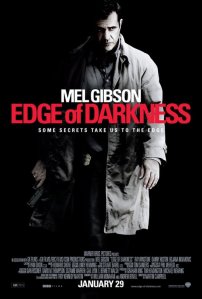 While I was watching Edge of Darkness, a conspiracy thriller that hearkens the return to acting for Mel Gibson, one thing kept sticking out to me, and no, it wasn?t the protracted ear-splitting “Bahstun” accents. One character makes comment about the current lowly state of affairs and says, “Everything’s illegal in Massachusetts.” That perked my ears, and then a second character says the exact same thing later in the movie, like it’s this flick’s summary, “It’s Chinatown.” What exactly does that mean specifically about Massachusetts? That the Bay State is somehow a nanny state, dictating behavior? Or is this a resigned admittance toward the futility of competing against the long arm of the law? I’ll tell you something that isn’t illegal in Massachusetts — gay marriage. They got a leg up on that one. This is the kind of internal conversation I had with myself while Gibson unraveled a fairly ho-hum conspiracy-of-the-week plot.
Detective Thomas Craven (Gibson) is a decorated Boston lawman. His grown daughter, Emma (Bojana Novakovic), is visiting from her job when she starts throwing up blood. She needs to tell her father some important secrets about her workplace. But as the two are about to leave for the hospital, a man cries out “Craven,” and follows it with a thunderous shotgun blast. Emma gets the full force and dies in her father?s arms. The media assumes Thomas was the target and the gunman had an old score to settle. However, the more Craven investigates the more convinced he is that his daughter was the real target. He looks into Emma’s connection to some dead environmental activists caught breaking into her place of work. The head of the company (Danny Huston) has plenty of important defense contracts and suspicious behavior. As Craven tracks down the truth he is assisted by the mystifying Mr. Jedburgh (Ray Winstone), a man normally hired to cover up any messy loose ends of governmental business. Jedburgh decides to work with Craven instead of against him, and the two men must fight for their lives.
 The real reason to see this fairly pedestrian police thriller is because of Gibson. It’s been a long eight years since his last onscreen role, and I must say I’ve forgotten about what a great actor the man can be. When this guy gets mad, you can practically feel the intensity. Gibson is terrific at playing a man with simmering emotions that often get the better of him. The lines and wrinkles give him a new canvas to play with, letting his age help tell the story of his character. Gibson seems to have this inner insanity to him, an admirable bent of crazy manic anarchic energy (I highly suggest checking out some of the Jimmy Kimmel Show shorts he’s been apart of). It makes him hard to ignore. He peppers in what he can with his character, a long-standing member of the law thirsting for answers and vengeance. What’s enjoyable is that he doesn’t go about knocking down every door to make people pay. Craven plays each interrogation differently depending upon his prey; sometimes he uses a soft touch and sometimes he opts for the tried-and-true punch to the nose. It’s little touches like this that bring out details in the character, and Gibson knows how to exploit them for maximum drama. Does anyone play instantly bereaved better than this man? He has a real knack for nailing scenes where a character is confronted with the sudden death of a loved one. His face is full of tics, his eyes glass over, it’s like he has lost all control and given over to the amassing and conflicting emotions. This clearly isn’t one of Gibson’s best performances, but after eight yeas of absence I’m more than willing to give the man a little latitude. An angry and bereaved Gibson is a Gibson I can enjoy watching on the big screen no matter how rudimentary the caper.
Edge of Darkness belongs to Gibson, but Winstone pretty much comes out of nowhere and hijacks the movie. Every time his character leaves the scene you’re anxiously awaiting his return. He’s an intriguing character, which makes me wonder why he’s gotten such a languished subplot. He could have been better involved in the story but the script keeps him to the narrative’s edges until the climax. Though a bit hard to understand thanks to a severe case of the mumbles, Winstone is by far the most interesting character in the movie. He’s an expert on fixing problems who tires of the long hours of shadowy, dastardly work. This is surely a character worthy of his own tale, or at least equal placement in the narrative, but instead Jedburgh functions as a sly informant when he should be running the show.
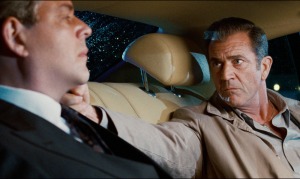 The script pretty much treads water. It’s not anything that’s particularly bad, but this story is pretty much content to stick with the basics. This isn’t a dumb movie per se, thanks to screenwriters William Monahan (The Departed) and Andrew Bovell (Lantana) adapting from the acclaimed BBC mini-series. Those guys know something about a crackling crime thriller, which this is not. The lizardly Huston couldn’t be any more obvious of a villain, but he’s not alone. The burly henchmen drive around in dark, tinted SUVs that seem to say that somebody got their nefarious goon driver’s license. This is the kind of movie that plays its hand early, telegraphing future revelations and double-crosses. When we’re introduced to a character right after Emma’s death, and the camera takes a deliberate amount of time hanging on that character’s pained expression, obviously we’ve been informed that this person is somehow connected. No prolonged reaction shot is ever meaningless in an action thriller. Every time Craven ties to gain information from a person of interest, they say, “I can’t talk. They’ll kill me,” and then that person is promptly killed as prophesied. You basically expect something “shocking” to happen every time a person leaves Craven’s presence (FYI: check both ways before crossing the street).
There’s a really engaging and politically active whistler blower story somewhere in here that could have used better attention. It seems the line between whistle-blower and activist is a thin one, and Craven must assemble enough evidence to make sure that his case cannot be dismissed as a kook. It’s an interesting dilemma, trying to assemble a compelling case that will hold up on objective scrutiny, that can’t be tossed out. That’s an interesting predicament considering the many eyes and ears of a large, legally autonomous corporate entity. Alas, that movie is not Edge of Darkness.
Gibson’s return to movie acting is definitely welcomed, even if it’s something as disposable as this. Edge of Darkness is a by-the-book conspiracy thriller that offers glimpses of something superior that could have been worked out. More attention could have been given to Winstone’s character. The whistleblower aspect could have been heightened and clarified. There could have been a bit more action and a little less blood. The bad guy could have been less obvious from the get-go. But in the end, there’s Gibson tapping into his mad Mel streak of appealing intensity. Not everybody can offer what Gibson does. It’s too bad then that Edge of Darkness fails to realize this virtue.
Nate’s Grade: B-
Share this:

Legion (2010)
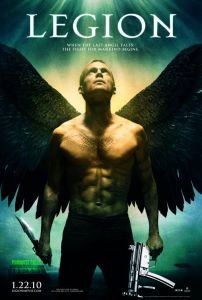 Just to be upfront, I am a big fan of action movies making use of Christian mythology (sorry if the use of the word “mythology” offends some). You tell me a tale about angels, demons, in a contemporary setting no less, and I’m hooked. You give those two sides weapons and have them fight over the fate of mankind, and I’m already revving my engines. So please know that no matter what the artistic achievements of Legion may be, I was predisposed to enjoying a movie that features the angel Michael (Paul Bettany) on the poster with a sword in one hand and an automatic weapon in the other. The premise of Legion is that God has finally had it with mankind and is making good on his threat to “turn this thing around right now.” He’s sending a host of heavenly angels to … eliminate humanity. Michael rebelled, believing man was still capable of making good on its promise. So he fights alongside a handful of characters shacked up in Dennis Quaid’s greasy spoon diner in the middle of nowhere. The action isn’t really involving but the movies does have some cool moments, like when Michael goes mano-a-seraphim with Gabriel (a marble-mouthed Kevin Durand). Legion deals with an antagonist (God) that is so powerful that there have got to be arbitrary limits placed on that power. So the attacking angels don’t overwhelm the tiny diner with their superior numbers, nor does the Almighty just blink the troublemakers out of existence. The end doesn’t really give much in the way of clarity but I got what I wanted from a movie like Legion. Though, in retrospect, I really didn’t want sizzling acid popping from boils.
Nate’s Grade: C+
Share this:

The Book of Eli (2010)
 Where did the Hughes brothers go? Albert and Allen Hughes have four movies to their names, one of them a documentary about pimps, and their last flick was 2001’s From Hell. I know that Jack the Ripper thriller underperformed at the box office, starring a pre-Pirates Johnny Depp, but was it enough to throw these guys in movie jail for nine years? The Hughes brothers are talented filmmakers, first evidenced by their debut feature Menace II Society, which they wrote and directed when they were only twenty years old. I actually really liked From Hell. I get that it isn’t anywhere as complex as the source material from famous comics scribe Alan Moore, but the movie was slick, stylish, twisty and twisted and satisfying (although, Heather Graham has the worst accent in the history of movies). Where have these brothers been all this time? Nine years later, the Hughes brothers take a whack at the popular genre of the moment –Apocalyptic Cinema. The Book of Eli kind of comes across like a Hollywood version of The Road. It’s all about duplicating the look, without getting too bleak, and failing to replicate the sense of humanity in desperation. Why worry about that when you can have explosions?
It’s been 30 years since the sun scorched the Earth. Food is scarce. Gangs roam the highways. The law is a forgotten concept. Eli (Denzel Washington) is a loner heading westerly and trying to make out a meager existence. He takes the boots off a dead man, hunts emaciated cats for food, and looks for a safe shelter from the blistering sun. He struts into a dusty town looking for clean water. The town is under the rule of Carnegie (Gary Oldman), a man in search of a very specific book for his own purposes. It just so happens that Eli is in possession of this book. Eli refuses to hand over his property, speaking about his mission to transport the book to where it belongs. Carnegie sends his thugs out to kill Eli and retrieve the book. Helping Eli is Solara (Mila Kunis), a teenage prostitute who feels Eli has answers that nobody else has.
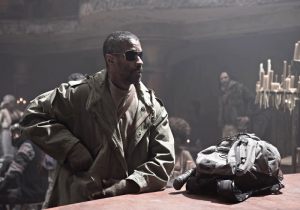 What we have here is a post-apocalyptic Western. Denzel is the lone drifter that comes into a town besieged by lawlessness or a corrupt agency of power. He even has a fight in a saloon that doubles as a whorehouse. He takes on an unlikely younger apprentice and enforces his own moral code through a series of shootouts. It just so happens that in Eli, he also has a giant machete and knows kung-fu. This is pretty strict genre stuff, mixing in apocalyptic elements for some extra flavor. The Hughes brothers give everything an ashy grimy gloss, making the most of desolate locations they shot in New Mexico (“When you need some place that looks like the end of the world, film New Mexico!”). The sparse locations and desaturated cinematography do well in establishing an unforgiving reality of the landscape.
The Hughes brothers certainly have a sense of style when it comes to the camera lens, yet they don’t approach being too self-conscious with their visuals. There’s an extended fight sequence that plays entirely in silhouette. There isn’t an overabundance of special effects in the film to clutter up the bangs and booms. There is one shootout outside a home (with Michael Gambon no less) that mimics some of the unblinking camerawork of Children of Men, swinging from side to side throughout the escalating firefight. It’s a fun visual motif that thrusts the viewer in the middle of the action. Otherwise, the action is all fairly standard stuff. It?s entertaining to watch Denzel take out a bushel of bad guys time and again, but what does that add up to with such a worn out story and half-hearted characterization? The script by Gary Whitta is heavy on apocalyptic mood and light on details. Cue more ass kicking.
Washington is stoic, almost Eastwood-like in his grit. He’s an easy antihero to root for, the reluctant avenger that manages to slice and dice his way through trouble. I won?t say this movie forces Washington to stretch his reserve of acting muscles, but it is undeniably pleasing to watch him perform his own fighting stunts. Oldman hasn’t gotten an opportunity to play a scenery-chewing villain in quite a while. Let’s face it; Evil Oldman will always overrule Good Oldman. This man was created to play sociopaths that have no ability to control the volume of their voice. This man needs a chance to bellow once every movie. Kunis proved she was a capable actress in Forgetting Sarah Marshall, but her role is fairly limited here to sidekick. She stares with her dark eyes and gets to hold a gun. That’s about it. The Hughes brothers have populated their post-apocalyptic world with familiar faces. Tom Waits is a merchant, Ray Stevenson (HBO’s Rome) as the Number One Henchman, Jennifer Beals as the blind mother to Solaris, and Gambon as a well-armed homeowner with an appetite for human flesh. That?s a good stable of actors to fill out a bunch of stock roles. It certainly makes The Book of Eli more entertaining.
The religious element doesn’t dominate the film but it does serve as food for thought. You see the book of Eli’s in high demand is actually he King James Bible. But you see, this isn’t any bible wrapped in leather with a metallic locked binding (all this for a Bible?); this is the LAST BIBLE ON EARTH. That is why Carnegie craves it. In the 30 years since the vague apocalyptic event, apparently mankind rounded up all the Bibles and burnt them, perhaps to express their displeasure with God. Eli operates on the premise that Denzel has the only Bible in the known world, which just seems downright silly. Did people search through every habitable dwelling, every library, and every hotel drawer? There have to be hidden Bibles out there. Even in this extreme setting, it seems to strain credibility to think that mankind is left with one copy of the most widely published book in the history of the world.
 Ignoring this fact, the religious element remains nebulous even though the film chronicles the journey of the Christian text. God is referred briefly but mostly the talk steers around the ideas of “faith” and “fate” and “the right path.” Eli feels he has been chosen for a special mission, and so he trudges west with his eyes on the prize. Carnegie wants to use the Bible as a “weapon” to pervert people’s faith into giving him more power. He wants to abuse religion as a motivational force to expand the reach of his control. Here’s the thing though, Carnegie has control over a town already and rules by fear. This seems to be working fine for him. So he wants to rule by love instead, using the Bible to spread the Gospel of discipleship? It’s somewhat unclear what exactly Carnegie plans to use the text for especially considering that most of the remaining population is illiterate anyway. He could just as easily hold up any book (The Da Vinci Code is shown, why not that one? It even has “code” in the title) and proclaim it the Word of God. It’s not like these people, struggling just to eat and find water, are going to question the power structure.
Not content with being a competent genre film, The Book of Eli ends on one of those ghastly twist endings that forces you to rethink everything that came before it. It doesn’t ruin the movie, but this twist certainly leads a charge toward building a counterargument toward disproving it. I won?t get into particulars but it seems unlikely that Denzel would be as good a shot as he was if the twist holds up.
The Book of Eli has its share of thrills and some interesting visual style, but there isn’t anything here you haven?t seen in hundreds of other post-apocalyptic movies. The dusty landscapes, the biker gangs, the aviator goggles, the cryptic threats, the necessity for leather as a fashion statement. This isn’t a bad movie by any means; it’s just another entry in a cluttered genre that, with our renewed fascination of the end times, is only getting more cluttered. Washington and the assortment of actors put in fine work but it’s ultimately the story that lets them down. This is a by-the-books genre flick with a touch more style courtesy of the Hughes brothers and a touch more gravitas courtesy of Mr. Washington. My advice to the human race: stock up on Bibles. Apparently, in the post-apocalyptic future, they will be more valuable than gold. Invest now while you still can. I got 15 of them and will entertain all offers.
Nate’s Grade: C+
Share this:

Daybreakers (2010)
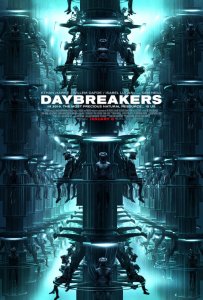 Taking a cue from zombie cinema, Daybreakers takes the idea of vampire-as-virus to an apocalyptic crescendo. The world is populated almost exclusively by vampires now. Human beings are farmed for blood but they are in such limited supplies. You see there is an extreme blood shortage because the vampires have lived beyond their means. That’s right, it’s a consumer consumption/environmental metaphor. The limited resources are dire because if vampires go without human blood they begin to devolve into senseless, winged mutating monsters known as “subsiders.” The poor cannot afford the skyrocketing blood prices so they are most fated to doom, while the rich argue that the blood supplies need to go to families first and not be wasted on the lesser dregs. The U.S. vampiric military, when not hunting humans, shackles the subsiders and marches them into the sunlight to be executed. Daybreakers has a lot more on its mind than most vampire movies, and it’s plainly fascinating to explore the realities of a world run by vampires (cars that drive during the day, the Subwalk, blood in your coffee). For most of its running length, Daybreakers is an intriguing setup that makes room for cool visceral action and social commentary. Then in the final act it sort of devolves itself into one big, dumb action movie. Ethan Hawke is a blood scientist trying to work on a synthetic substitute for a super vampire corporation that, of course, is evil. He stumbles upon an outlandish “cure” for vampirism and wants to resurrect humanity. This leads to a climax where Hawke and his human warriors wage battle inside the corporate HQ. For a promising concept, it’s depressing that Daybreakers had to end in such a typical manner. At least the vampires explode in the sun instead of sparkling.
Nate’s Grade: B-


 nathanzoebl
You must be logged in to post a comment.