Category Archives: 2006 Movies
Flags of Our Fathers (2006)
 Clint Eastwood’s WWII epic is all about scaling down legend, deconstructing myths, and illustrating how truth can become hazy in the name of the greater good. It’s very well made, noble, reverent, intelligently written but somewhat empty at its center, feeling far too mechanical to become one of the great war movies of modern times. The structure is needlessly scattered into three interconnected storylines: 1) the ongoing battle of Iwo Jima between Japan and the United States, 2) the stateside bond tour by three of the six men responsible for raising the flag in the iconic photograph, and 3) a son in present day writing a book about his father’s war experiences in the Pacific. I really don’t feel that splintering the narrative added anything to the story; in fact, there’s a late segment that’s a barrage of character deaths that would have been far more powerful had it not been assembled into an afterthought of a montage. The battle moments are tense and bloody, with just a tinge of Saving Private Ryan familiarity (shaky cam POV, washed out colors, chaotic editing, graphic gore). I would have actually preferred more battle action but oh well.
Most of the film focuses on our three soldiers (Ryan Phillippe, Jesse Bradford, Adam Beach) dealing with the pressure of a spotlight they feel is undeserved. You see, the raising-the-flag picture, perhaps the most famous war photograph of all time, was a group of men replacing a flag. There were no bullets buzzing over heads, no bombs blasting; it isn’t even the first flag. The men wince at being called heroes. They’re made to become U.S. military shills, encouraging the nation to keep buying those war bonds. This segment provides lots of moments of interest by illuminating a chapter few know — the story behind the story. These moments of insider info have some juice to them, led by a suave SOB performance by John Slattery as the man in charge of drumming up dollar signs.
Phillippe is an actor I’ve been keeping tabs on ever since 2000’s Way of the Gun, and he is the moral center of the movie, showing grit and humility. It’s mostly a performance of stoic silence, but he has a very strong scene when he confronts a war widow wanting the truth and he lies between his teeth to comfort her. Beach (Wind Talkers) gets the best role as a solider of Native American blood that is still seen as a second citizen in his own nation. There are plenty of revealing moments of casual racism (people call him “chief” more than his actual name) that explain why he took to the bottle with such ferocity. Beach is an emotional wreck and deeply haunted by the disturbing memories of war. He has to be practically pried off of a widow he is clinging to and crying uncontrollably. The cast is full of young Hollywood actors and it might due some good to become acquainted with their faces before stepping into a theater. It can get confusing. Yet another reason a disjointed narrative is a bad idea.
Where Flags of our Fathers cannot make the leap from good to great is in the area of character. After two hours, you don’t really feel like you know anyone better. There’s a distance that stops the audience from fully investing. I think Eastwood and the film have such noble aims that the movie becomes more of a statement than entertainment. There isn’t any conclusive climax; the film seems to directly go right into a voice-over heavy resolution. On a technical front, Flags is very impressive and Eastwood has created his most visually lush film to date. From a human standpoint, it falters and flags. It’s admirable and attractive but I doubt come Oscar time that this war-weary ode to heroism will have many followers.
Nate’s Grade: B
Share this:

Stranger than Fiction (2006)
 Ever think your life would make for a good story? Be careful what you wish for. Harold Crick (Will Ferrell) is hearing voices. They aren’t telling him to kill or do anything subversive. In fact it’s just one voice, an English woman, and she isn’t instructing Crick to do anything. No, she’s more so just… narrating. She comes in and out and expresses the doldrums of Crick?s life. He’s an IRS agent whose life revolves around order, repetition, and numbers. We can even see his inner tabulations thanks to some snazzy onscreen visual effects. Crick is sent to audit Anna (Maggie Gyllenhaal), a baker with a disdain for civil servants and authority. Crick is stricken by this shrewd beauty and finds himself wanting her, something the Narrator affirms for him. Crick’s life takes a dour turn when the Narrator lets on that Harold Crick had set in motion his “imminent death.” Crick is confused and seeks advice from Professor Hilbert (Dustin Hoffman) an expert on literature. Then they figure out the Narrator is Kay Eiffel (Emma Thompson), a famous writer who has the unfortunate habit of bumping off every one of her main characters.
Make no mistake, Stranger than Fiction is funny, but it’s a different kind of funny than most people are accustomed to with Ferrell. In my theater, I kept an eye on a gaggle of teenagers sitting several rows in front of me. I just wanted to observe their body language and what I saw was a lot of fidgeting, getting up for trips to bathrooms and popcorn, and lots of whispery talk. I can only imagine the disappointment of those teenagers expecting Ferrell to rip his clothes off and run around like a buffoon. They were likely busily thumbing away at their ever-present cell phones, text messaging their friends. People that are looking for a wild, sidesplitting, slapstick comedy are going to shaking their head. Stranger than Fiction is funny, but it’s in a very dry, witty way, much like British humor; it’s a humor you can admire for being clever but might not make you roll in any aisle.
 The biggest fans of Stranger than Fiction will be bookworms. This is a very literate movie that works better for those with an appreciation or outright love of literature and storytelling. Professor Hilbert doesn’t initially believe Crick until he learns that Crick’s narrator said, “Little did he know.” That, ladies and gents, is all a professor of literature needs. He has to rule out what kind of story Crick may be apart of, so he subjects Crick to a series of hilarious questions along the lines of treasure-inheriting, nemesis-making, and magical-creature befriending. Crick keeps a notebook to tally examples in his life that may point to whether he is part of a Comedy or a Tragedy. Professor Hilton even explains the difference: in grand Shakespearean tradition, a comedy ends with people getting hitched and a tragedy ends with people getting snuffed. This is all fabulously witty and extremely fun, but I can think you’ll see why hard-core fans of Old School and Talladega Nights might be heading for the exits.
Writer Zach Helm has created a wonderfully whimsical tale that’s trippy but manages to still have warmth and a firm heart. It’s far more embraceable a movie than, say, Adaptation, and less smug. He has a smart sense of humor and loves deconstructing literature, like the Jasper Fforde (The Thursday Next books) of screenwriting. We are really sucked into the movie from the moment we can hear Thompson. The story has an innocence to it and this existential comedy feels out there but still grounded; it’s surprisingly poignant and full of dramatic revelations. Even better, Helm has done something that few have achieved: he wrote a story-within-a-story that works. Kay’s narrative voice is highly droll in her observations on Harold Crick’s life. It sounds like a genuine novel, and on top of that, a novel I would enjoy reading. Stranger than Fiction is all the proof I need that Helm is a talent to keep track of.
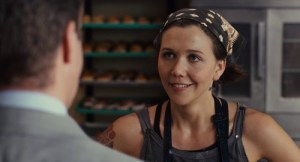 The performers all seem to have the same affection for the material. Ferrell is making that leap from funnyman into leading man, the same dramatic territory Robin Williams first tiptoed in Good Morning Vietnam and, likewise, Jim Carrey approached in The Truman Show. Ferrell won’t turn any heads but he underplays his performance maturely, playing a sad but sweet drone of a human being finally taking charge of his life under very insane circumstances. There’s a quiet moment toward the end where Ferrell is told he must accept his fate and he sits, shell-shocked, tearing up, his voice getting softer with every word. It’s only a moment but it piques my interest in what Ferrell may have in the tank. The comedy he can do in spades, including a desperate moment when he tries narrating his own life to coax his Narrator out of hiding.
Who will turn heads, however, is Gyllenhaal. I can already see a nation of teen boys falling in love with her tattooed, punky baker. To them I say, get in line pals, Gyllenhaal has made me dot my I’s with hearts ever since her star-making performance in 2002’s kinky romantic comedy, Secretary. She’s easy to fall in love with and expresses a fragile compassion to her role. The romance between Anna and Crick is unexpected but these two people need each other, and you feel that need as you watch their eyes light up as their relationship blossoms. Late moments between them add to the tenderness of the film and you will be on your knees pleading Crick is spared so he can return to loving Anna. I think Wreckless Eric’s “Whole Wide World” will become a potential staple on romantic teenage mix CDs sent to their sweethearts from now on.
Thompson and Hoffman have appealing supporting performances. Thompson has marvelous fun thinking of different grisly outcomes in store for Crick. Her interaction with the hospital staff to see the “not gonna make it people” is a howl. But Thompson is too good of an actress to play it straight. Once she discovers the life-altering implications of her writing she is crushed by guilt, obsessed over killing good people cruelly. Frankly, if I had anyone narrating my life, Thompson’s voice would definitely rank high. Hoffman plays a dedicated literary professor like a straight man, and everything seems on the level for him, even the fantastic. It’s a nice touch for a film that doesn’t require broad strokes.
 The movie doesn’t have the depth of feeling or dark turnarounds that I know Charlie Kaufman would have done. Stranger than Fiction has a lot of fun with a very ripe premise, and is very intellectually stimulating, but you do feel like it could have gone further, exploring the reaches and implications of its metaphysical setup. What if someone who read Kay’s manuscript thought it was such a masterpiece, a shining light of literature that could move mountains, that they knew Crick must die, and that they must kill him to make certain of it. Or what about the relationship between author and character, and the role each has over the other and perhaps a battle over the future, a typewriter, and a happy ending at the end of a tunnel. However, while all of these options would further explore the novel premise, it would betray the movie’s whimsical tone. This isn’t a very dark movie. It has an authentic sweetness to it, and Crick is a gentle and kind man, and to do anything too heavy would work against the film’s tone. The movie explores existential queries and the topics can be grim, but ultimately Stranger than Fiction is life affirming.
Stranger than fiction also has a buoyant, unexpectedly pleasing romance to it. Again, it doesn’t show the depth of love and human feeling that Kaufman’s Eternal Sunshine could, but this is an unfair comparison. This romance is more a subplot that carries increasing weight thanks to heartwarming performances and the winsomely adorable Gyllenhaal. The romance in Eternal Sunshine was the story, and everything else was outside variable coming into contact. It might sound dismissive to call Stranger than Fiction as decaf Charlie Kaufman, but it really is a compliment. Kaufman is the most exciting, brilliant, creative, insightful, and whacked out screenwriter working today. I would give one of my kidneys to write even one story that could be described as decaf Kaufman. Stranger than Fiction may not examine as many themes, conflicts, or relationships as Kaufman might with the material, but this movie is a sweet fable that floats by like a fluffy cloud on a sunny day. It’s just so damn pleasant you sort of soak it in and fall in love, not wanting to leave.
Stranger than Fiction is strange, all right, but gloriously so. Scribe Zach Helm has concocted an existential fairy tale aimed for bookworms and outsiders. The premise is clever but the film doesn’t stop there, and Helm explores the implications of his premise with whimsy, charm, and a sweetness that is hard to rebuke. The wacky story seems reminiscent of Kaufman’s works, but it has a more heartwarming and embraceable appeal. Great performances from a game cast help to push the material even further into excellence. It has a small handful of flaws, perhaps a too limited scope, but that doesn’t stop Stranger than Fiction from being one of the best stories of 2006 and one of the best movies too.
Nate?s Grade: A-
Share this:

Running with Scissors (2006)
 Ever since author James Frey imploded into a million little pieces, the memoir has come under intense scrutiny. At issue is the validity of the written word, whether these people are being honest as they recount their tortured yet inevitably redemptive lives. What is the difference between nonfiction and memoir, and does it implicitly imply personal bias? Running with Scissors is the 2002 best-selling book detailing the bizarre childhood of Augusten Burroughs. It’s a book with lots of out-there claims but they’re all held in check by Burroughs’ tart observation and witty writing. When translated to the silver screen, Running with Scissors loses credibility without the author’s voice. I doubt many people going in cold will even believe what they’re seeing.
In the 1970s, Augusten (Joseph Cross) is a gay teen growing up in the care of his alcoholic father (Alec Baldwin) and his deeply delusional, bipolar, wannabe poet mother (Annette Benning). When their marriage hits one of its many slags they seek out a therapist, Dr. Finch (Bryan Cox). He has a room he dubs his “masturbatorium,” a resemblance to Santa Claus, and a family just as whacked as he is. His oldest daughter, Hope (Gwyneth Paltrow), helps him in his practice and thinks that pets talk to her, even from beyond the grave. Natalie (Evan Rachel Wood) is the rebellious daughter who likes to play doctor via electric shock therapy. Agnes Finch (Jill Clayburgh) is the matriarch of this cracked family that also enjoys eating some dog kibble here and there. When Augusten’s mother signs over adoption papers he becomes the reluctant newest member of this dysfunctional family.
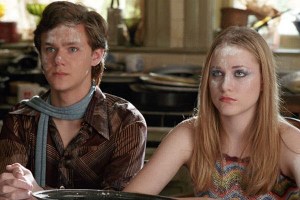 The trouble with translating a book is that you lose the author’s voice and commentary. Running with Scissors maintains the horrifying living conditions for Augusten and the stable of oddballs, but lost is the author’s snappy humor that carried him through this tumultuous time. It’s definitely weird but it’s far from engaging. Without the wit and dark humor from Augusten’s voice we’re left with a series of loosely bandaged scenes about crazy characters and crazy anecdotes, little of which contains further importance. This is a fan of the book talking here, and I’m afraid that the film adaptation has heightened some of the weaknesses of the book, namely the loose storyline. When pieced together as a film, Running with Scissors can become slightly tiresome and overly reliant on background details. The film treats its wild, kitschy production design and 70s nostalgia as a character on par with anyone. It makes for great production design, true to the spirit of the book, but also serves as a narrative distraction. Too much attention seems to be put on getting things to look right than getting the screenplay to feel right.
Without the author’s voice the results lose credibility. It’s funny to see a Christmas tree up year round, and it’s funny when Dr. Finch is convinced God is communicating to him through his bowel movements, but it all just comes off as another joke like the art direction and nothing more. When fully added together without any sense of pathos, it all seems like a joke. The subplot involving Augusten’s sexual relationship with a much older schizophrenic patient (Joseph Fiennes) seems mishandled without much insight. Running with Scissors presents all examples of dangerous, sometimes illegal, behavior and doesn’t bat an eye, nor does it pass judgment. While this may irk some and seem irresponsible it’s just another case of little mattering. Running with Scissors, as an adaptation, presents little of consequence.
Director Ryan Murphy also adapted the screenplay and knows a thing or two about dysfunction and trashiness, having created the risky TV show Nip/Tuck. His adaptation has a blunted feel, but it also seems too broad. Then again, maybe only fans of the book would notice. He has a good feel for his actors and can stage some nice shot selections, but man, someone needs to slap his hand away from the AM radio. Running with Scissors is crammed with so many popular 70s tunes that it becomes a crutch, with Murphy hitting the soundtrack button whenever he needs some kind of character catharsis. It doesn’t work and comes across as indulgent and simplistic. There are so many zippy classic pop songs you may think Elton John is owed a writing credit.
 The acting is one of the elements that help give life to this adaptation. Benning has been generating Oscar buzz for her deeply self-involved portrayal of a mom held hostage by her illness. Benning digs deep and displays a comic range of absurd behavior and wild paranoia. She’s all over the place and you can’t help but loathe her, that is, if you ever take her seriously. But then, once overly medicated, she gives an entirely secondary performance as an emotionless zombie, and we feel a sliver of sympathy, a true surprise. It’s a good, meaty role, however, I actually think Clayburgh gives the more Oscar-worthy performance. In a lot of ways she’s resigned to her fate and yet manages to be the gauzy heart of the picture. She tells me more with her wrinkles than Benning does in her gesticulating outbursts.
The rest of the cast work admirably. Cross is our focal point of the story and does a fine job of, essentially, gawking and looking perplexed. He’s like a blank, gangly canvas, and I wonder what else Cross is capable of than a performance built around indignant reactions. Wood is developing into a lovely adult actress and has some of the best foul-mouthed lines. It’s just nice to see Paltrow in a movie again. Baldwin has transformed from leading man into incredibly versatile supporting actor that excels as comedic lunkheads. Cox remains one of my favorite character actors of all time. There’s nothing this man cannot do. The actors all do a good job of filling out their zany characters while leaving their own imprint.
The issue with Running with Scissors is that when you strip away the author’s caustic voice, then the movie strains credibility, even with the knowledge that it?s based on a personal memoir. The movie gets all the wackiness but misses out on some of the finer points and humor that helped save Augusten from his unorthodox housing. The story feels dulled and stretched too broad, and yet it still manages to be intermittently entertaining despite these flaws. The actors range from good to great and the art direction is fantastic, even if Murphy expects it to do more work than his screenplay. Running with Scissors isn’t as nervy, engaging, or provocative as its source material. Then again little else is. Consider the film Running with Safety Scissors.
Nate’s Grade: B-
Share this:

Death of a President (2006)
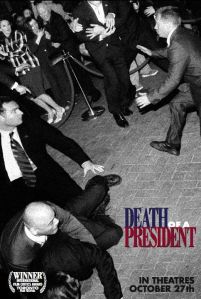 It’s been called morally reprehensible and obscene. Theater chains have refused to even touch it. The White House is concerned it will spawn a deadly array of copycats. The controversial movie in question is a little independently produced mock documentary about the assassination of George W. Bush in the year 2007. It’s kind of funny that this small talking-heads piece has so many people talking, because without its central gimmick, no one would be utterly a word about Death of a President. No readers, they would all be fast asleep.
We’re introduced to various people involved in the fateful event. In October 2007, Bush is appearing in Chicago and the city is overrun with protestors armed with angry signs and angrier words. A handful of protestors even break police lines and come within a hair of the president’s motorcade (to his credit, Bush doesn’t take it personally). Then as he’s leaving a speech, shaking hands along a roped line, shots are heard and the president goes down. In the aftermath many are suspected, including disenfranchised Iraq war vets, protestors, and a Muslim man who may have a connection to al-Quaida.
 Death of a President has the potential to be little more than extreme left-wing wish fulfillment. No matter your thoughts on Bush as a president and a person, I hope the majority of people would not wish death upon him. I think the appeal of this mock-doc is the ghoulish rubbernecking of watching the president die right before your eyes. The moment is quick and mostly just Bush bending over in pain. The lead-up to the kill manages to quicken the pulse. Is it offensive to flirt with the idea of killing our elected leaders while they are still in office? Is it more repugnant when filmmakers use advanced computer effects and archival footage to make the moment as real as possible? It seems that the movie is coming at the peak of an unpopular president and an unpopular war, so some moviegoers will buy their tickets just to vicariously watch Bush die. Those same folks will be surprised how sympathetic and likeable Bush comes across in passing.
Questionable ethics aside, the movie is a whodunit built around a fortuitous gimmick, but once the title death takes place the movie utterly collapses. The ensuing hour turns into an investigation into who had their finger on the trigger. Death of a President has a baffling lack of political insight. The government centers their investigation on a Middle Eastern man of Syrian descent, fudges evidence out of pressure, and tries to build support for a unilateral military response, civil liberties get trampled upon in the name of security, and yet it’s all so sadly predictable. Death of a President is merely repeating the news of our tumultuous times, and it feels so stiltedly scripted. You can?t help but think that the current political scandals are far more weird and fascinating than this ho-hum what-if political science scenario. It’s just recycling current events and changing corresponding details. There?s nothing new or interesting here. As soon as Bush gets shot down so too does the film?s chances of exploring anything meaningful.
 The second half of this film is downright narcoleptic. The investigation is deep in procedural gobbledy gook and the film feels impersonal. I mean, a sitting president has been assassinated in the age of cable TV, global economy, and the war on terror, and all the film can muster is trying to piece together the minutia of how to prosecute a case? I’m sorry, presidential assassination ranks a bit above your standard Law & Order output. There are so many interesting doomsday outcomes that could come about (especially with the scary thought of a President Cheney) and yet the film finds the most boring, insignificant, tedious path. This is inexcusable. It all feels so pathetically small for an act that would be immeasurably monumental. The film is shocking in how little it has to say about anything. It is devoid of commentary and complexity.
Director/co-writer Gabriel Range stages the entire film exactly like a prime time TV news report. It’s slick and packaged well, and the cut-and-paste magic creates an eerie realism. Range uses a mix of archival footage and CGI to illustrate Bush’s assassination. Cheney’s eulogy is actually extensively culled from the speech he gave at Ronald Reagan’s funeral. Don’t know if that?s respectful or not. The technical credentials are worthwhile; the heavy-handed message is not. This is not satire. This is shallow and secondary and pointless. I think Range has treated Death of a President more like an audition film, hoping for bigger and better things. At least, I hope whatever comes next for this man is better.
Death of a President isn’t a terrible movie but it’s way too simplistic, ham-fisted, myopic, and freakin’ dull. The controversy attached to this tiny movie may mislead you into thinking it’s something worth seeing. It’s not. The visual trickery and talking-head structure makes it seem like something you’d see on TV, and you should take that to heart. Wait for TV with this one. Its direct-to-TV ticket is booked as soon as audiences find out what the movie really is. That is, if you can manage to rouse them awake.
Nate’s Grade: C-
Share this:

Saw III (2006)
 Horror works in cycles and seems to ebb and flow every three years or so. The popular horror cycle right now is all about torture and realism. I guess people have had it with masked men with large pointy things. Pasty Asian children don’t seem as gloomy as they once did; in fact, in today’s world-on-the-go, who wouldn’t want an extra hand in the shower? In a world bombarded with carnage leading the six o’clock news, I guess American audiences desire something more universal than ghosts and boogeymen. The Saw franchise has exploded and seems destined to place a new entry every Halloween until the public looks to a new en vogue horror cycle. After seeing the loss of luster that is Saw III, I am already looking.
Jigsaw (Tobin Bell) is back with a fresh new batch of his twisted games. Unfortunately, he’s bedridden and dying. His serial killer apprentice, Amanda (Shawnee Smith), has to do the grunt work. She kidnaps a depressed doctor, Lynn (Bahar Soomekh), and orders her to keep Jigsaw alive as long as she can. Around Lynn’s neck is a crude explosive device that will detonate if Jigsaw’s heart flatlines. He has to stay alive just long enough to witness one final game. Jeff (Angus Macfadyen) is trapped in a typical Jigsaw-engineered series of traps. He has to pass through three tests of resolve and forgiveness, each involving someone related to his young son’s unexpected death.
 The Saw franchise seems to be losing momentum with each additional thrown-together sequel. I found the first film to be mostly entertaining and very inventive, but this was because of a smart narrative device: we wake up in the same dingy bathroom as our figures and must learn with them about what is happening. It plied some neat tricks and twists and was an altogether enjoyable horror movie that didn’t mind mucking around. But with all invention, if it sells then it becomes repeated in mass-market form, dulling the edges and losing the bite it once had. What once startled and amused is now the expectation. Just like the collapse of the Final Destination franchise, these movies started big but then bottomed out when their audiences had the rules memorized. At that point the only thing left is curiosity in what fiendishly outlandish ways people will get horribly killed. The Saw films still have more smarts to them than your typical man-chases-teens-with-axe slasher flick, but the franchise definitely seems, like Jigsaw, to be dying a slow death.
Saw III spends far too much of its time and energy trying to be a compendium to the franchise, filling in the blanks and the resolutions for Saw and Saw II. The film bends over backwards trying to tie up loose ends that didn’t really need tying up (Finally, now I know what happened to that foot that was cut off!). I don’t need to know how the incidents of the previous movies were set up, or who kidnapped who; the minute details are pointless in a horror film, especially one with such flights of frightful fancy. This movie spends too much time feeding the audience needless back-story. The film’s two major storylines are uneven in interest. There’s a real lack of danger and development for Lynn playing nursemaid to Jigsaw. We know the only time he may die is late in the movie, so her storyline becomes prime thumb-twirling time. We see some nifty medical procedures but I?d rather get back to Jeff’s descent into the funhouse of doom.
Saw III seems too concerned with how it fits within the framework of a trilogy when it should be worrying how it works as a movie. Saw III, for stretches, feels like it was cobbled together from the dull deleted scenes of previous films. And true to form, this Saw sequel ends with a familiar rush of twists, deaths, and a very nihilistic close. Let’s just say the inevitable Halloween 2007-bound Saw IV is going to have to go back to the ridiculous plot device drawing board. I truly wonder how many little tape recorders Jigsaw has stashed around and for what occasion (“Note to self: clean gutters.”).
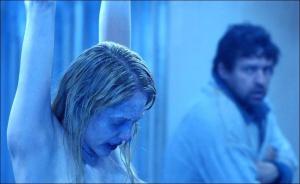 Some of the ingenuity is downright admirable; Jigsaw sure puts a lot of thought and care into his skin-crawling craft. Some notably gruesome torture tests include a naked woman being frozen to death by routine sprays of water, a man having his limbs twisted all the way around, and a man drowning in the slimy goo of ground up pig carcasses. Now that takes discipline just to plan, let alone fully stage. I’d like to see Michael Myers or Freddy Kruger try something like that. Part of the macabre fun of the Saw franchise was playing along, wondering what you would do in the situation and how far you?d go to save your own life. But in Saw III the deck is stacked for about half of the twisted games. There’s no way to win. A character goes through great lengths to free herself from a death trap but, alas, there is no escape and she gets her rib cage ripped out for the bloody hell of it. This … lack of sportsmanship, let?s say, does play a crucial part to the Saw III storyline, but it still knocks the film’s fun level down when you’re just waiting for the moment the person becomes a corpse instead of waiting to see what they do next.
It seems like the Saw movies become less engaging the gorier they get, and Saw III may be the goriest yet. These films have never been afraid to get messy, and Saw III has some squirmy moments, particularly a very protracted scene that involves the peeling, drilling, and scraping of the human skull. Horror fans should be happy with the results but there’s nothing that will make the squeamish cover their eyes (a bone snapping through a leg comes closest). Worst yet, despite the yucky credentials I’ve mentioned above, there really isn’t anything too memorable about the death traps this go-round, though the pureed pig entrails is certainly praise-worthy.
After three movies in three years, it feels time for a breather. The Saw movies are losing their sheen as their audiences become hungrier for blood and harder to fool. 2004’s Saw was clever and different, but like the demise of the Final Destination franchise, the sequels are victims of expectation. When the unexpected becomes the expected, then you may need to rework your scare formula. For whatever reason, Saw III feels compelled to be a refresher on the other films, devoting serious chunks of wasted time to clarifying loose ends that never mattered. I’d rather get to more sticky, icky death traps than examine the father-daughter-mentor relationship between Jigsaw and Amanda. Yawn. Saw III feels uneven, distracted, less fun, and a middling close to a franchise that began with wicked promise. This kind of movie just isn’t cutting it like before.
Nate’s Grade: C
Share this:

Marie Antoinette (2006)
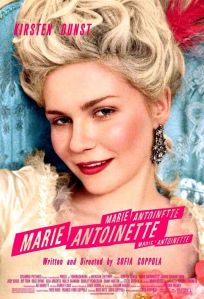 From its opening 80s New Wave soundtrack, you know Sophia Coppola’s Marie Antoinette is a period piece like none other. The famous daughter of Francis Ford Coppola has long been planning a movie around the famous queen that lost her head during the French Revolution. She premiered it at the Cannes film festival where it was booed by the homeland critics. This cast a shadow of doubt over Coppola’s dreamy pop confection of a biopic. Maybe the French don’t like having one of their most iconic historical individuals turned into a bouncing, troubled teenager. Too bad because this is the most interesting and, later, the most frustrating accomplishment Coppola achieves.
Marie (Kirsten Dunst) is a young Austrian girl married away by her family with the hopes of strengthening an alliance between France and Austria. She’s intended to wed Louie August (Jason Schwatzman, Coppola’s cousin), a rather goofy young man more comfortable with hunting than women. Their marriage is arranged by Louis XV (Rip Torn) with the intent on keeping the family line with a male heir. Trouble is, Marie’s husband is more interested in locks than her in a nightie. She’s warned in letters by her family at home, and by a caring ambassador (Steve Coogan), that her only leverage is a child. Without a child her marriage could be annulled. Life at the Versailles palace is a vortex of gossip and attention, and the idea that the queen cannot interest the king is most stressing.
 Marie Antoinette is a feast for the eyes, and that’s saying nothing about Dunst. The costumes are gorgeous, the multitudes of food look delectable, and the sets are the real deal, filmed at the actual Versailles palace for that extra oomph. I’d let them eat cake too if I got the stuff she had. Expect Marie Antoinette to at least get several Oscar nominations for its lavish technical merits; it very well might win too. There’s a really neat sequence that informs the audience through a series of family portraits about a death in the family.
Anyone looking for a strict biography on the famous queen will be left scratching their head. Coppola has thrown historical accuracy to the wind and produced a movie less about plot and character and more about an impression. She really nails the insular palace life, from its ridiculous and rigid traditions to the importance placed on blind formality. There’s a very amusing scene where Marie has to be dressed by handlers, and her clothes must keep getting swapped to the current highest-ranking person in the room. Coppola also smoothly handles this extravagant, opulent world from the point of view of her young teenage girl, betrothed by the age of 14. The world of royals and Versailles was one of constant gossip where everyone’s eyes were glued to the new girl. In many ways, Coppola’s world mirrors high school existence, just with far better clothes. When Marie is ignored yet again by her clammy husband, she goes on a wild shopping spree with fabulous shoes and fabrics in bright, sticky colors. She stays up late with a close circle of friends to watch the sun rise over the palace. Coppola firmly reminds us that Marie Antoinette was still a teenage girl and perhaps was still fighting to be one. The movie is good at stripping away the context of history and showing us the awkward lives of two kids selected to be leaders of their country. Better yet, the film is good at exploring what it?s like for teenagers to have the world at their fingertips and have no clue what to do with it. Besides shoe shopping, that is. The film is an excellent mosaic that reiterates the breezy sensation of being young and trapped in the world that never seemed big enough.
But, alas, the trouble with establishing an impression is that we get the idea pretty quickly, and yet the movie keeps going on and on without anything else to interest us. You can watch Marie lay in the field, host a tea party in her garden, marvel at sumptuous food, try on different clothes, play with her puppies, and, hell, the woman even sings an opera in one moment. I don’t know if Coppola intended to establish the tedium of life in Versailles but the audience will definitely start to feel suffocated by it. At least she never steers into a Terrence Mallick danger zone (the man would have sat in a forest with a camera in his lap and called the results a “movie”). That’s the issue with the movie. Like her 2003 Oscar-winner Lost in Translation, Coppola is more interested in mood and silence than character and plot. This approach worked splendidly in the sparely beautiful and moving Translation, but it cannot fully save this film. After a while it just all gets too repetitious and feels slight, like Lizzie McGuire’s Fabulous Versailles Vacation.
The figure of Marie Antoinette is too big to just be dressed up and put in a room. Coppola doesn’t seem to care about the politics or historical anxieties of the time. That’s a shame since France was going through one of the most amazing turnarounds in all of history. There’s no social commentary and the last quarter of the film seems to go off track. When the peasant mob does appear at the very end it feels like a misplaced subplot instead of a world-changing event. Likewise, the affair Marie Antoinette embarks on feels all too shrift and meaningless, like a high school crush of the week (might she doodle his name on her diamond-encrusted notebook?). Marie Antoinette is an interesting, ambitious period drama trying to be a youthful fantasy turned nightmare. It just doesn’t have enough going on to justify a prolonged experience.
Dunst is an actress I’ve been really hot and cold with. Sometimes she dazzles me but more often she bores me. As the title monarch, Dunst totally comes across like a vibrant teen girl still feeling out the world. She seems impetuous, sensual, and naive, all hallmarks of a growing girl that just so happens to be the queen of France. She does a lot of communication with her face. Sometimes she comes across like a silly, vapid little girl playing dress-up, but then that seems within the scope of Coppola’s aim.
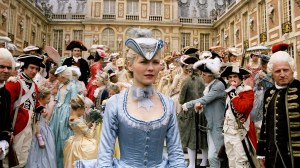 Schwartzman’s portrayal makes the king look like an aloof adolescent, but he make me laugh very easily at his pained awkwardness. Judy Davis is a hoot as the palace’s liaison of policy and manners, tsk-tsk-ing whenever etiquette is broken. The rest of the cast mostly have moments but it’s surprising to me that I’d see Marianne Faithfull, Rip Torn, Molly Shannon (!), and Asia Argento in a period piece movie. Like I said, Marie Antoinette is a costume drama like none other.
Much was made about the anachronistic soundtrack of 1980s tunes set amongst the pomp and circumstance of 18th century France. I like it because it works in engineering the breezy, bubbly youthful impression Coppola wants. It shouldn’t be that big of a deal because the music is not incorporated into the story unlike 2001’s tandem Moulin Rouge and A Knight’s Tale. It provides some of the more fun moments in the movie, though at times the lyrics become all too transparent; “I Want Candy” during a spending spree, “Fools Rush In” when Marie goes to her affair, The Strokes screaming “I want to be forgotten,” as Marie runs off.
Coppola’s luscious period piece feels more like a dreamscape in a daze. Her focus relies less on linear storytelling and character than on creating an impression of youthful decadence and emptiness. Marie Antoinette manages to simultaneously be fluffy and vague. After a while it all just gets repetitious and a bit dull watching scene after scene of Marie being indulged and bored. Perhaps some of that boredom will translate over to the audience. Coppola reminds us that Marie Antoinette was still a teenage girl beneath her powdered wig and bustle, but after two hours you might wish Coppola had more on her agenda.
Nate’s Grade: C+
Share this:

The Notorious Bettie Page (2006)
 A somewhat shallow biopic, The Notorious Bettie Page is kept afloat by an incandescent performance from Gretchen Mol, at one time the appointed future Hollywood It Girl. Mol imbues the same transcendent mix of girl-next-door sweetness and sex-kitten-in-training vivaciousness that Page was famous for; she was, in the same moment, both angel and temptress, and yet never understood the impact. We get your standard assembly of biopic moments but some intriguing past elements barely get touched on, like the potential sexual abuse Page may have experienced from her father. There’s a ripe conflict of sex vs. sin waiting to be explored that also seems to get the most cursory of exposure. Director Mary Haron (American Psycho) cleverly stages the movie as if it was a product of Page’s own time, but it also places the film in an artistic limbo because of its strident, possibly anachronistic forward thinking. Bettie Page is such an interesting person and had such a lasting impact, not just on the debate over what constitutes pornography, but the movies fails to tell us why she should still even be relevant. It feels somewhat of a shame that such a person, simultaneously a devout Christian and bondage pin-up queen, doesn’t get a better character showcase. Still, the movie is well made and Mol is luminous, imitating Page’s cheesecake poses and faces to perfection. The Notorious Bettie Page would have worked better looking harder at what made its title heroine notorious and memorable still to this day.
Nate’s Grade: B-
Share this:

The Departed (2006)
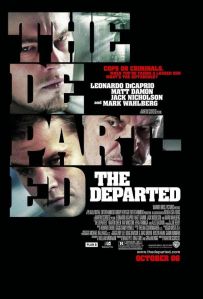 “I don’t want to be a product of my environment,” growls Frank Costello (Jack Nicholson) in the opening seconds of The Departed. “I want my environment to be a product of me.” Without question, the filmmaker that has shaped the environment of movies more than any other in the last 30 years is Martin Scorsese. No one does the cops-and-robbers territory better than Scorsese, and it’s great to have him back on familiar turf. It’s not that Gangs of New York and The Aviator were lacking in directorial skill, it’s just that they felt so labored and reeking of classy awards envy. With The Departed, it all feels so artistically effortless, like Scorsese settled in a zone of brilliant filmmaking. I just hope Marty bangs out more of these excellent gangster flicks before trying again to woo Oscar. In fact, his return to his violent stomping grounds might finally be his long-overdue ticket to the winner’s circle.
The premise is appealingly simple. The Boston State Police Department is desperate to nail local crime lord Costello. They pluck a young recruit, William Costigan (Leonardo DiCaprio), who has a shady family history of small-time crooks. He agrees to infiltrate Costello’s mob and report back to the Boston PD. To make is situation credible, Costigan is expelled from the force and sent to prison to earn a rep. Only two other people know Cosigan’s real identity, the police chief (Martin Sheen) and the head of undercover work (Mark Wahlberg). On the other side of the law, Costello has a mole all his own working inside the Boston State police force. Colin Sullivan (Matt Damon) has quickly risen through the ranks and has a prime position working with the state?s FBI crack force. He’s also an acolyte of Costello’s ever since he was a young Southie kid seeing the draw of power. Now full grown, Sullivan tips Costello and tries to redirect the ongoing investigation to bring the man to justice.
 The real sparks come when both moles try to discover the identity of the other, without compromising their own precarious identities.
The Departed is a bruising, bristling return to form for Martin Scorsese and his most entertaining film since his last Great Movie, 1990’s gangster-rific Goodfellas. This is a movie that crams multiple characters, storylines, and histories into one tight, focused setting, but then the flick glides smoothly on electric storytelling and intense performances. The movie’s twists and turns are, at times, of a knockout variety, and there’s a stretch of late surprises that each feels like a shot to the gut. I was possibly winded from gasping so hard. This is a film so fantastically alive with feeling and vigor that you cannot help but get ensnared. It sets up all the players and back-story before we even get the opening titles set to the blaring wails of the Dropkick Murphies. The thrills are real because we feel the danger, and the onslaught of brutal violence is another rhythmic piece in Scorsese’s masterful conduction. Adding to the feeling is the sure-handed, quick-fire editing of longtime Scorsese collaborator Thelma Schoonmaker and the ominous cinematography of Michael Ballhaus. Even though this film is based on a 2002 Hong Kong film, Scorsese has firmly made The Departed a movie all its own in spirit and personality. No one so easily brings us into the sordid lives of criminals better than this man, who, when in that creative zone of his, brings such palpable energy to his melding of image, song, and consequence, that the results are simply intoxicating. The Departed reminds you why Scorsese is still our greatest living director, no matter what Oscar thinks.
What elevates The Departed from the clutter of other macho men-with-guns crime capers is its studious attention to character. This is a film that works beyond a concept. The movie’s central moral theme is the price of identity. Frank opens the film asking what does it matter who’s holding the gun to your head, cop or crook. Costigan is tormented from wearing too many faces. He’s having trouble justifying his deeds and actions and is scared he may lose his own soul at the price of his lost identity. Sullivan, on the other hand, has gladly sold his own soul for a pittance. He’s a class conscience yuppie that craves power and will cut any throat if it gets him ahead. The movie steamrolls ahead with intrigue but it’s our connections to these characters that elevate the life-and-death stakes. You have a real emotional investment in this story, therefore when things get murky you really feel the danger. My heart was racing with excitement and dread. There may still be impressions from where I was squeezing the movie chair.
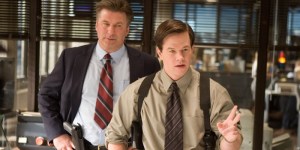 Complimenting these complex characters are brilliant performances. DiCaprio may have been nominated for a Best Actor Oscar for his second Scorsese collaboration, The Aviator, but he turns in his strongest work here. DiCaprio expertly bares a gnawing moral conflict with equal parts desperation and the hunger to do good. He’s trying to finally do right and step out of his family’s criminal past, and DiCaprio brings sharp intensity to this plight. You really feel every stomach churn this guy goes through to do what he does and stay alive. I knocked the boy for being too boyish a gangster in Gangs of New York, and let me say I take back my words. On the flip side, Damon utilizes his angelic, choirboy good looks and masterfully downplays his character’s pragmatic villainy. The character has to hide so much from the outside world, be it the police, his true bosses, his girlfriend, and even himself. Damon goes about his deceitful business with slickly sick ease, tapping a killer’s instinct for self-preservation. You may shudder from how methodically cold and manipulative he comes across. He’s a mesmerizing rat bastard of a human being and yet Damon presents an almost seductive portrait of evil.
Nicholson is equally good though at times can be a distraction to the storytelling. There are a handful of moments where Nicholson seems to go too far off the page, indulging his crazier tendencies. Costello is supposed to be a scary, unpredictable, potentially unhinged man, and Scorsese has plenty of moments that bring home this point. It just feels inappropriate then for Nicholson to, in a few small moments, transform into a goofy cartoon. With that said, it’s great to see Nicholson cracking some heads for Scorsese. He has devilish fun and is insanely watchable while definitely going for broke. After some nice guy roles it’s nice to have back an unrestrained Nicholson to play the film’s abyss of evil.
 The collected supporting players all leave some mark. Baldwin and Wahlerg are perfectly profane hardass characters that you warm up to. Sheen, free from the Oval Office, displays nice touches of weariness and, in one moment, practically breaks my heart with his brave resignation. Breaking up this boy’s club is Vera Farmiga (Running Scared) as a somewhat contrived plot point to connect Costigan and Sullivan as the police shrink to one and the girlfriend to the other. There’s a perceived sadness to her willowy eyes and slender face that she plays to great effect. She?s a captivating new face and gives an extra ladling of emotion to the tale.
It’s been over a week since I’ve seen the movie and I still can’t get it out of my head. There are only a handful of flaws that separates The Departed from Scorsese’s rich pantheon of mythically Great Movies. This is a complex, gritty, amazing crime thriller stuffed to the gills with entertainment. Making the bloody body count resonate are the incredibly intense performances, particularly Damon and DiCaprio. This is a gripping gangster thriller pumping with the blood of a sterling character piece. The unexpected twists and turns will shake you, and the movie goes well beyond a snappy premise. The Departed is a moviegoing experience that will thrill you, stir you, sadden you, exhilarate you, and firmly plant itself in your memory banks. Welcome back Marty.
Nate’s Grade: A
Share this:

The Guardian (2006)
 Ever since 9/11 we’ve been redefining who exactly qualifies as a hero. We’re stepping away from the old line of thinking, money and fame, and reexamining those selfless few that protect us, like firefighters, policemen, doctors, and military personnel. But when the culture defines a new hero, then the Hollywood tribute canonizing that role is sure to follow. We’ve had plenty of recent films looking at those who put their lives on the line, but are we, as a friend asked, scraping the bottom of the hero barrel when we devote an entire movie to the U.S. Coast Guard? And does it help your film in this day and age to feature Kevin Costner in a leading role?
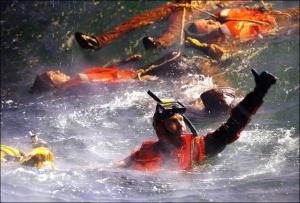
Ben Randall (Costner) is a senior officer in the Coast Guard’s team of rescue swimmers, men and women first on the scene no matter what the situation is like. He’s the lone survivor of a rescue attempt gone awry and it’s badly shaken his confidence and ability to perform. He’s reassigned to a teaching position to mold the next generation of rescue swimmers. Enter Jake “Fischbowl” Fischer (Ashton Kutcher), a champion swimmer with an oversized ego. He takes every abuse Ben can dish, and slowly but surely he learns what it takes to devote your life to a job whose motto consists of, “So that others may live.”
 To enjoy this movie you must come to grips with the fact that it is born atop a mountain of clichés. I mean a whole slew of clichés, so many that you may feel genre fatigue by the end of its 140-minutes. It’s like every other military training film. The old buck readjusting to his new position as teacher. The young hotshot he butts heads with but eventually forms a father-son relationship. The tragic pasts both have that still haunt them. Old buck’s job demands cause marital discord. The many many training montages. The requisite bar fight as team building activity. The local girl who starts off as a fling but develops into something more. The lessons about teamwork over individual gain. There’s a sassy bar owner that dispenses life advice. The old buck being pulled back into the game one more time to save his pupil and consequently overcoming his guilt/fear/apprehension from losing his team. And even the heroic ending. Like I said, you will accurately be able to guess where every storyline and every character is heading because you’ve seen them all long before. You might even call the film Top Gun with fins or Kevin Costner Returns to the Water (and just when you thought it was safe to go back in).
And yet the film works. It’s a sturdy, no-frills genre movie that goes about its business in a respectable manner. I may have known every turn but it didn’t stop me from enjoying the movie. The characters are a bit rote, but the harrowing situations they thrust themselves into and their sense of heroism was very affecting. The story is familiar but the demands of the genre almost require a familiarity for success. The Guardian isn’t going to change the world (it will definitely increase Coast Guard recruit numbers), but it’s more than suitable entertainment for a weary moviegoer let down by bigger, louder Hollywood fare and looking for something more adult.
When it comes to genre movies, great acting and great writing can elevate the material. I found the details about how exactly the Coast Guard goes about rescues to be interesting, and the movie is effective at filling in the minutia of this life. I learned a lot of things about the Coast Guard and was impressed with what they go through, despite the misconceptions and dismissals. There is intelligence to the illustration of this world, and the dialogue often has a certain snap to it. Director Andrew Davis (The Fugitive) stages high excitement on the seas with great editing and seamless use of CGI.
Make no mistake about it; The Guardian is definitely tilted to an older audience. It’s a bit of a familiar, old-fashioned story and it doesn’t come close to rocking any boat, but it’s also a durable movie that plugs in the needs of this formula effectively and satisfying. This is a movie that will appeal to dads and granddads and, who knows, may get them to tear up. It’s hard to dislike a film that wears its heart on its sleeve and has such affection and reverence for those in harm’s way. It’s harder when the story, mountain of clichés and all, still resonates with semi-palpable emotion.
There is one very big misstep at the conclusion of the movie. I won’t go into great spoiler detail, but the film leaves you in two positions: 1) the ludicrous notion that something we saw minutes ago did not happen, or 2) a somewhat sappy but too-detailed-to-come-across-as-coincidence puzzler. All The Guardian had to do is trim a few words or made its final lines of dialogue a little more vague, then none of this would matter.
Costner seems to be settling into a nice second life as a middle age supporting actor. Here is an actor that’s had his share of setbacks and creative wounding (The Postman?), and yet he’s still immensely likeable when he turns on the grit and aw-shucks determination. He’s the film’s mentor and father figure and infuses a lot of personality into what could have come across as an idol of worship rather than a human being. After a sublimely laid back performance in The Upside of Anger, and now this, it looks like Costner is back on track and well over dud territory.
 Kutcher is a mystery to me. I’ve mostly found this kid to be grating and overdoing his one-note joke of a dimwit persona. The Guardian is the first film where I’ve begrudgingly found myself enjoying a Kutcher performance. He’s got the physique for hard duty but he finally gets a chance to flex some acting muscle as well. While I won’t say he opened my eyes to the talent behind one half of Dude, Where’s My Car?, I will concede he’s worthy of taking a chance on in upcoming dramas. Don’t let me down Kutcher now that I’ve gone out on a limb for you, boy. Don’t punk me.
The Guardian is in a lot of ways very similar to Ladder 49, another fawning tribute to brave first responders. Whereas Ladder 49 idolized firefighters to the point of worship, The Guardian does a better job of molding penetrating characters. I think firefighters and rescue swimmers are heroes, obviously, but I find their courage and selflessness more admirable when we don’t place them on a pedestal. When we don’t make our heroes into something super-human that makes their decisions and acts that much greater.
I’ve been to few movies where the audience broke out in applause at the end credits. This was one of them. I could understand why. The Guardian is a familiar formula aimed at older adults and reminds them of the sacrifice and heroism of those who keep us safe. This flick is an adoring testament but also succeeds as a respectable, mostly engaging genre piece that manages to be emotionally involving without getting too sappy. It’s a meat-and-potatoes male weepie. Costner and Kutcher create a solid father-son bond and both actors reveal a bit more about themselves. This isn’t a movie that dares to reinvent the wheel, but it is worth a spin if you’re a fan of this genre and don’t mind reworking old clichés into something new.
Nate?s Grade: B-
Share this:

An Inconvenient Truth (2006)
 Al Gore is possibly the least likely movie star in the history of movies. The former Vice President and 2000 presidential candidate has been making the scene with An Inconvenient Truth, a potent documentary warning about the impending perils of global warming. Gore has traveled all over the globe giving a well-honed Power Point presentation on the topic. An Inconvenient Truth is a 90-minute big screen version of this presentation. Consider it more concert film than documentary. An Inconvenient Truth is equal parts spellbinding and terrifying. Best of all, it’s that rare film that could quite honestly change the world for the better.
This is like sitting through an impassioned lecture by your favorite college professor. Gore smartly turns the issue of global warming from a political issue to a moral issue and asks how can we let this happen to our planet. He delivers a highly persuasive science show that should shake everyday Americans out of complacency and galvanize them to action. But what’s best about An Inconvenient Truth is that it doesn’t crush you to death with data. Gore explains the perils of climate change in general, easily graspable terms and uses choice pictures to service his message. It’s downright startling to see photos of glaciers and lakes that have gone dry in such a short span of time. As the film continues, Gore gains momentum and the facts, graphs, and charts multiply, and you’ll be hungry for even more. An Inconvenient Truth is a great learning tool because it really whets your appetite for knowledge and follows through on its convictions. Gore climbs an elevated lift to illustrate on a chart where carbon dioxide emissions will be heading. The moment is both grand theater and a stupendously straightforward visual demonstration that there will be far, far, faaaaaar greater carbon dioxide emissions in the near future than there has even been in 650,000 years.
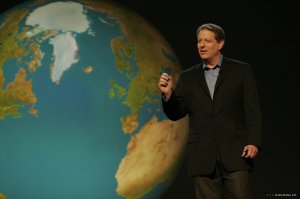 Gone is the hectoring, emotionless Al Gore that people seem to recall from his political days. An Inconvenient Truth displays a Gore rich with humor, command, and most surprising of all, guile and charm. Old Gore might have harrumphed at his critics and come across like a walking stiff, stick firmly entrenched in rear. The Gore on display here seems candid, spirited, and easily engaging, plus he never comes across as preachy. It helps when he’s presenting on a topic he’s devoted much of his life to being a cheerleader for. Nevertheless, he’s a disarming speaker and it’s easier to swallow his spoonfuls of science when he’s turning on the charm.
Gore presents an overwhelming case for the existence of steady global climate change. But why then is there still much hand wringing about whether scientists can even agree? An Inconvenient Truth seems to have the answer. We see a ten percent sample, around 900 peer-edited scientific reports, concerning the topic of global warming. Not one of the 900 reports concluded that the proof of global warming was inconclusive. However, we then see that over 50 percent of all media reports mentioning global warming cite scientific wavering, saying the jury’s still out in the scientific community when it is anything but. Perhaps this is why people still see global warming as inauthentic hippie alarmism. Gore tackles his critics and presents very levelheaded reasoning. You can tell this man believes strongly and genuinely in the topic.
Let me put aside my film critic hat, if I may for one moment. I am getting fed up with how flippantly people dismiss science when it conflicts with their own belief system or agenda. There was a time when people looked at scientific findings and accepted them, saw their extensive testing and recalculating, and chalked it up to truth. Nowadays we have people trying to define their own versions of science, whether it be a new opening to slip religion into a classroom (Intelligent Design), a new way to control behavior (suppressing FDA-approved birth control studies), or simply a way of turning back time and civil rights (erroneous abstinence only sex ed). This stuff really irritates me. Let’s trust the science to the scientists, not Pat Robertson when he says he knows condoms are unreliable. When I get a cold I don’t consult my pastor, do you? That’s why I too am frustrated by what Al Gore sees. There’s a cabal of special interests trying to turn the issue of global warming from fact to theory, and in the process delaying serious response because it affects their cash flow. Okay, rant completed.
The science side of the equation is open and shut. Global warming is taking place but what can we do about it? We learn in the movie that the United States is the biggest polluter in the world. Thankfully, An Inconvenient Truth actually suggests ways of cutting down on energy that the average American can do. The end credits are full of helpful do-good aphorisms and suggestions to combat climate change. One of those suggestions just happens to be telling your friends to see An Inconvenient Truth. Surely the makers of this film get nothing out of that option.
 Less effective are the minor asides the film takes to look into Al Gore’s personal and political past. The point I suppose is to show how we can turn personal tragedy or setbacks into a rallying point to save the planet. I don’t really know. These segments clog up the engrossing horror story Gore is dictating. I don’t want to learn about Gore’s tobacco farming family or how he handled losing the 2000 presidential election, I want to get back to the doom, the gloom, the graphs, and the pictures! It’s the equivalent of listening to a grand ghost story by camp light and having the storyteller occasionally stopping to mention they once caught an eight-pound bass. Get back to the good stuff already.
You don’t have to agree with Gore’s politics or even like him to be strongly affected by An Inconvenient Truth. As a film, it’s little more than a bigger stage for Gore’s patented, visually friendly slideshow, but as a message movie its aim is true and striking. Gore lets the science speak for itself and to that end the case seems closed. Global warming is happening, despite what media reports, skeptical business big wigs, and energy polluters might say. It’s saying something about the reach and importance of a documentary when actual oil companies are releasing smear commercials to discredit its message. Gore’s impassioned science lecture is fascinating, incredibly informative, and easy on the eyes with lots of stark pictorial examples. Al Gore is right; global warming is too big to be deemed a matter of political right and wrong. It demands attention and action, and An Inconvenient Truth demands to be seen; it’s not the best movie of 2006 but it’s certainly the most important.
Nate?s Grade: B+


 nathanzoebl
You must be logged in to post a comment.