Category Archives: 2004 Movies
Kill Bill Vol. 2 (2004)
 When last we left The Bride (Uma Thurman), she had reawakened from years of coma, traveled to Japan to acquire the finest sword ever created, and crossed off two names from her list of those marked for death in the name of bittersweet vengeance. O-Ren Ishii (Lucy Lui) and Vernita Green (Vivica A. Fox) fell under the hand of The Bride in Kill Bill, Vol. 1. Now, the only members left of the Deadly Viper Assassination Squad (DiVAS), the group our heroine was once a part of, are the one-eyed Elle Driver (Daryl Hannah), Budd (Michael Madsen), and the titular ringleader, Bill (David Carradine).
Kill Bill, Vol. 2 takes a very sharp tonal shift from the previous film. Kill Bill, Vol. 1 was a head-spinning orgy of blood and stylized carnage, and it could be argued that its actual plot was wafer-thin. But it seems with Kill Bill, Vol. 2 that Tarantino had answered every critical concern about the first film before they were even brought to his attention as the two films were shot and cut in one grand effort. This film has a much more genial sense of pacing and numerous moments of drawn-out monologues, a far cry from the breakneck pace and terse dialogue of its forerunner. Fans of the relentless hack-and-slash of Kill Bill, Vol. 1 may be disappointed that this film lacks the chopped limbs, geysers of blood, and senseless, yet immeasurably thrilling, slaughter. In fact, whereas the body count for a lone sequence of Kill Bill, Vol. 1 may be in the fifties, Kill Bill, Vol. 2 has three total murders. It is the quieter, more adult half of this revenge opus. Kill Bill, Vol. 1 was an homage to chop-socky grindhouse Japanese films. Kill Bill, Vol. 2 is Tarantinos homage to spaghetti Westerns and their languid pacing and showdowns.
 The acting is superior to what you would expect from a revenge movie.
Thurman has always been as good as her director, and under the hands of a master like Tarantino she excels. In Kill Bill, Vol. 1 she was a hurricane of rage and an unstoppable warrior. Here we see the human being inside the warrior’s armor, and she performs with amazing assurance and a ragged, raw delivery. When she’s crying on the floor, face and body red and strained, aching, you believe everything this woman does and is capable of doing.
Carradine, with his gaunt features and face like leather, gives the standout performance of the film. Whereas Bill was an unseen menace in Kill Bill, Vol. 1, with the final installment he becomes fully realized as both a figure of terror but also one of great tenderness. He has a lengthy speech about Superman, masks, and the mythology of comic books that is spellbinding. Madsen gives a fine performance steeped with surprising pathos. He’s the only former DiVAS member who feels remorse for his actions at the Two Pines Wedding Chapel that triggered The Bride’s rampage. A large subplot displays Budd’s current life slumming it as a bouncer at a sleazy strip club and getting verbally berated by people he could easily kill. You come away with the idea that its Budds version of penance.Madsen mixes his remorse with sadistic grit, like when he gives The Bride a choice between a flashlight or a can of mace, and this is before he buries her alive.
Hannah seems to relish every moment as the one-eyed right hand to Bill. There’s a scene where a character is suffering from venomous snakebites thanks to her and she sits down and reads a list of Discovery Channel-esque information she looked up on the Internet about the snake and painstakingly copied onto a notepad. She performs with such gleeful insincerity that it is hard not to start to like her for being so good at being so bad.
 Perhaps the person that steals the movie though is Gordon Lui, who plays the cruel master Pai Mei that teaches Thurman all her moves. He has eyebrows like cotton balls and a long, whispery beard he loves to flick around. Its a shame that this hilarious character is not in the film longer. Kill Bill, Vol. 2 also boasts one of the greatest child performances I have ever seen. The actress that plays the daughter of Bill and The Bride has such a natural quality to her acting that it is amazing she isn’t coming up with her lines, reactions, and movements on the spot.
So does a longer, slower, talkier concluding half mean that Kill Bill, Vol. 2 plays it too safe or loses any of its steam? Hell no. Tarantino fills in all the rough spots and unanswered questions from the first film, and the result is drawing the audience further into the story.
We open the film with another perspective of the events that took place at the Two Pines Wedding Chapel that left a wedding party dead, and a bloodied, pregnant Bride shot in the head. We also discover how The Bride became the deadly warrior she is, why she chose to leave the business of hired killing, why Bill reacted in the extreme manner he did, and we even learn to our delight how Elle Driver lost her eye. The result of knowing the full story are characters, which in Kill Bill, Vol. 1 were more archetypal than living and breathing, that have become fully fleshed out, rounded, and incredibly complex figures full of remorse and vulnerability. The Bride and Bill transcend their descriptions as adversaries, and their relationship becomes more intensely complicated when mommy returns home to find her daughter still alive.
Despite all this fancy talk about character building, Kill Bill, Vol. 2 does not disappoint in action and thrills. A fight between The Bride and Elle inside a cramped trailer may be the most brutal, bone-crushing fight sequence I have ever seen between two women. Every strike that connects breaks something, be it furniture or bones. The final showdown between Bill and The Bride is a fitting and satisfying end for both warriors.
Tarantino’s concluding half of this story long in gestation is a highly entertaining, stylish, thrilling, engrossing, eye-plucking good time. There is so much to talk about. This is the first film since, perhaps, Gladiator that I have seen at the full-price theaters three times. In total, I have seen the Kill Bill saga five times in theaters, and I find something new and rewarding every time. Tarantino has given the masses a masterpiece and everyone should take the opportunity to see it.
Nate’s Grade: A
Share this:

Man on Fire (2004)
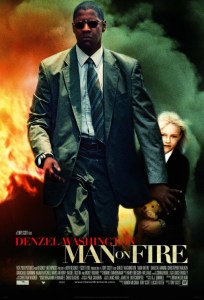 By far, the most entertaining moment of Man on Fire occurs shortly after the movie ends. A message comes on screen more or less saying, Mexico City is a very special place and we thank them. Now, after having watched a lengthy 2 hour and 25 minute film that shows Mexico City as a chaotic equal to the Middle East, a city that experiences four kidnappings a day we are told, these ending sentiments feel like a mea culpa. To say a place is great after showing it to be a corrupt war-zone is hilarious. I doubt Mexico City will be using Man on Fire to lure tourism, just like I doubt Germany uses Hogan’s Heroes for its tourism.
The man on fire is Creasy (Denzel Washington), a former soldier with a drinking problem. Hes hired dirt cheap to be the bodyguard for Pita (Dakota Fanning), the daughter of a wealthy Mexican politician (Marc Anthony). Creasy is pragmatic about his job and shirks Pitas attempts at friendship. Eventually, the precocious tyke gets the better of him and Creasy forgoes his self-loathing for coaching Pita on how to swim better. Creasy has found his recovery in the form of Pita’s love, but his world is ripped apart when Pita is kidnapped and Creasy is left for dead. When he recovers, he vows merciless vengeance on anyone involved in Pita’s kidnapping.
 Denzel Washington is competent in his role, but there aren’t many films that wouldn’t be better by having a Denzel Washington performance in it. Fanning has a robotic nature to her delivery. The wacky Christopher Walken is in this movie somewhere, but you would be hard-pressed to find him in the last hour or so. It’s kind of nutty that Walken of all people plays the voice of reason in a revenge movie.
Director Tony Scott (Crimson Tide, Top Gun) has flat-out forgotten or lost interest in telling stories. His direction of Man on Fire is erratic and heavy on stop-the-action-dead visual flourishes. Scott is a slave to visuals, but so many of them are jarringly miscalculated that the audience can never fully immerse themselves in the film. It’s like a kid fiddling with a new camcorder and wanting to try all the super cool special features (Whoa, I can make things slower … now grittier stock … now sepia … now I can make a mirror of things … etc.).
It takes over an hour to get to the key kidnapping plot point. Until then the audience is relegated to watching scenes of Creasy find redemption through the eyes of a child. Denzel and Fanning have a nice mentor camaraderie, but after an hour the audience is impatiently waiting for the inevitable kidnapping that the movies foreshadowing has been tripping all over.
 When Man on Fire does hit the kidnapping, the ensuing movie gets very messy, and boy does it get ugly. Creasy goes on a grisly killing spree that turns him from a sympathetic loner into a one-man wrecking crew. Vengeance is an easy emotion for an audience to get behind a character, but Man on Fire goes way beyond audience empathy. Are we to cheer when Creasy goes about ruthlessly killing unarmed people and threatening families, pregnant women, and kids? I didn’t cheer. I was somewhat appalled that the filmmakers expected us to revel in this violence as if it was more than justified. It’s just ugly, plain and simple. It is also sickeningly sadistic.
The most bizarre thing about Man on Fire is the subtitles. When I think back on this film in the future, that is the one thing that will stand out for me. These arent your ordinary stay-at-the-bottom-and-do-as-you’re-told subtitles. Oh no. These subtitles dance, jump around, float, fade, expand and shrink in size, and do about everything but make balloon animals (or, I should say, subtitle animals). It’s like a living comic book; however, this is yet another visual trick that draws the audience out of the film. The unusual subtitles call too much attention to themselves, especially when they just pop up for a single word, spoken in English, as if to clue in the audience that this point of information will be vital somehow.
Man on Fire is a sadistic action film that is too full of itself for amusement. By the time that mea culpa comes onscreen its almost a relief to laugh again. The hard-driving ugliness of Man on Fire might make you forget how to. Fans of revenge films may find some redeemable qualities, but Man on Fire is one gruesome 145 minutes to squirm through.
Nate’s Grade: C-
Share this:

The Alamo (2004)
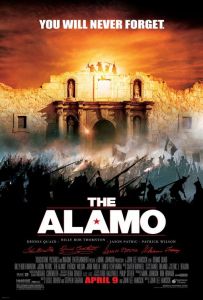 The Alamo was originally going to be the jewel in Disney’s 2003 Oscar crown. It began with a star-studded pedigree: Ron Howard directing, a screenplay by John Sayles and Stephen Gaghan, and Russell Crowe starring. Things got dicey when budget figures were debated, and Howard insisted on an R-rated cut for authenticity. After some creative wrangling, Howard left to get his gore fix on with another flick (The Missing), Crowe went off to sea (Master and Commander), and Disney tapped Johnny Lee Hancock to direct in the wake. Trouble is, Hancock had only directed one previous film, 2002’s The Rookie. The 90 million dollar movie was supposed to be released during December 2003, just in time for Oscar season. However, the editing needed more time, so Disney’s supposed award-grabber was delayed until April 2004. Now, given the final PG-13 product, were the wait and creative compromises worth all the trouble?
In The Alamo we follow the men of Texas, including surly drunk Jim Bowie (Jason Patric), idealistic Sam Houston (Dennis Quaid), girly aristocrat William Travis (Patrick Wilson), and legendary Davey Crockett (Billy Bob Thornton). They want to make Texas their home, but Mexican General, Santa Anna, has different plans and wants to reclaim the land for the glory of Mexico and, more importantly, for the glory of himself. As Santa Anna storms into Texas, a meager number of men take refuge in the Alamo, an old Spanish mission, and arm themselves for an eventual battle between the merciless General and his thousands of soldiers.
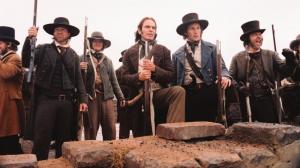 The pacing of this movie is about as fast as a tumbleweed. An entire act of this movie involves Texans and Santa Annas men exchanging a shot here, a volley there, back and forth and back and forth for no reason. It certainly doesn’t build tension. It just squanders time, and this thing is 2 hours and 20 minutes long! If it weren’t for my free bag of popcorn I would have fallen asleep countless times during viewing.
The acting of The Alamo may make you want to throw up a white flag yourself. Jason Patric spends the majority of his time on his back with teeth clenched, and when that’s not the case hes lookin’ to get his famous blade a cameo. Quaid seems to have a frog permanently lodged in his throat. The only performer who walks away unscathed is Thornton. He gives a humanistic touch to the familiar character of Davey Crockett and shows the wear of living up to legend.
Perhaps the most shocking thing about The Alamo is how poorly directed it is. I know Johnny Lee Hancock has only one previous movie under his saddle, but my jaw hit the floor when I saw how flat his direction was. Scenes and angles are very awkwardly framed, everything is too flat or too rigid, his cinematography is an underwhelming mixture of silhouette shots and dusty hues, his sets look like a high school production, and his action scenes are staged without any sense of excitement or tension. Excluding one shot that shows the battle on all four sides of the Alamo, seen prominently in the trailers and TV spots, there isn’t a single shot in this entire film that looks great. This is one of the worst looking $90 million film I have ever seen.
The script is another factor in driving down the entertainment. The makers strive for historical accuracy and to show both sides of the conflict without bias. So we get what all modern historical films feature now, namely the Famous People with Flaws. Bowie drinks a lot. Travis is unsure of himself and leaves his family. Boone doesn’t live up to hyperbolic legend. This information is fine, but The Alamo tries so hard to get the characters accurate that it fails in getting the characters right. I’m not calling for the return of myths, but The Alamo is so focused on the details that that’s all these characters become: historical details instead of living, breathing people.
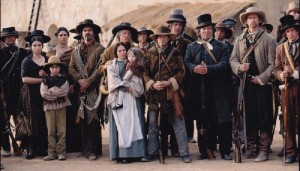 The script also shirks any kind of detailed look at the role of minorities involved during the siege. Black people hardly mention slavery (and Texas would go on to become the largest slave state), women are designated as caregivers, either tending to the wounded or becoming floaty fantasies. The Alamo feels more like a eulogy than a film. And how many eulogies do people pay 5-10 bucks to go see?
I think what ultimately sinks this movie for me is my roots. I’m not from Texas, I dont know anyone from Texas, I dont know if everything is bigger in Texas, and I dont know if I’ve ever messed with Texas, but the lone star state clings to the martyrdom of the Alamo like the crucifixion of Jesus. When I was watching The Alamo I kept having one reoccurring thought: is this accomplishing anything? In my assessment, no it did not. A bunch of Texans banded up in an old mission and fought Santa Anna but there was no reason for it and nothing was really gained. Someone will argue that they held up Santa Anna and allowed Sam Houston to collect his army and eventually take down Santa Anna. I would counter that with, ”You know what else could delay Santa Anna? Anything.”
The Alamo is an overlong, overly serious, flat, uninteresting bore. It feels more like a textbook and less like a story. Sure its not the jingoistic flag-waver that John Wayne’s 1960 version was, and I can appreciate trying to get history right, but The Alamo is so insanely by-the-book serious that its as fun as a funeral march. It seems like the director and the producers were so afraid of telling the story of the Alamo wrong that they lost the ability to tell a good story. Only ardent history buffs, and maybe ardent Texans, will find anything appealing about this boring history lesson.
Nate’s Grade: C
Share this:

Hellboy (2004)
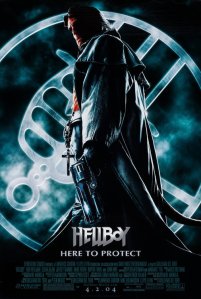 Guillermo del Toro loves things that go bump in the night. The Mexican born writer/director has shown prowess at slimy, spooky creatures with Cronos and 1997’s Mimic. He helmed the 2002 sequel to Blade, which had super vampires whose mouths would open up into four sections with rows of chattering teeth. The man sure loves his movie monsters. del Toro also loved Mike Mignola’s cult comic book Hellboy enough to turn down directing Harry Potter 3 and Blade 3 to ensure he could bring Hellboy to the big screen. Was it worth the sacrifice?
Let me just explain to you the villains of this movie as an example of how ridiculously stupid Hellboy is. The villains are Nazis. Yes, the tried and true villains everyone can hate Nazis. But these ain’t yo daddy’s Nazis; they’re immortal and led by zombie Rasputin (yes, the Rasputin). They all wish to puncture a hole into another dimension. What’s in this alternate dimension? Why nothing except for a giant floating spaceship that houses, I kid you not, the Seven Gods of Chaos, which all happen to be gigantic space squids. Why would anyone create a universe that has nothing but the imprisoned gods of evil? That seems awfully precarious. How exactly are giant squids going to take over the industrialized, nuclear-age world? Shoot ink at everyone? Sorry, space ink?
 Let me not forget a Nazi assassin and his handy dandy arm-length blades. This assassin is also 100 years old and his body is filled entirely with sand. He winds himself up like a big clock. But if his body is filled completely with sand how can the clock gears work inside? You see what the normal audience member has to deal with? Plus these are just the villains, there’s a whole plot left to toil over as well.
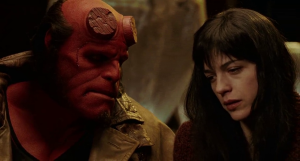
The story revolves around a hulking, red demon named Hellboy (veteran character actor Ron Perlman). Hellboy escaped the space squid dimension in the 1940s when the Nazis unsuccessfully tried to open a dimensional hole large enough for your everyday on-the-go space squid. Now, Hellboy is an elite soldier for the governments Bureau of Paranormal Research. He fights the creepy crawlies. He has to deal with a wide-eyed rookie, the watch of his father (John Hurt) and an attempt to rekindle a romance with a mentally troubled fire starter (Selma Blair). Oh yeah, and all the Nazi/Rasputin/space squid stuff mentioned before.
Perlman is really the only redeeming thing about this movie. The makeup is impressive, and he gives an enjoyably droll performance as a man who fights monsters with the same ho-hum-ness as a plumber reacts to clogged sinks. The rest of the acting runs the gambit of either being too serious (Im looking at you Blair) or just too over-the-top silly (Im looking at you, league of villains).
Hellboy is strung together with bizarre inanities, flat one-liners, heavy Catholic imagery, conflicting logic and contradictions, ridiculous villains, painful comic relief, half-baked romance and frustratingly ever-changing plot devices.
Watching Hellboy is like playing tag with a kid that keeps making up new rules as he goes (“You cant tag me; I have an invisibility shield!”), and after awhile you lose any interest. Late in the film, the Nazis will all of a sudden decide not to be immortal, and at a very inopportune time. Why? How? I don’t know. Hellboy also gets sudden new powers for some reason. Like he can bring people back to life by whispering otherworldly threats in their ears. For some reason nobody’s clothes burn when theyre set on fire.
 Not only does Hellboy frustrate by changing the rules of its world arbitrarily, it will also frustrate out of sheer uninhibited stupidity. How come characters cant hear or see a pendulum the size of the Chrysler building? How come during a vision of the apocalypse we see a newspaper that actually had the time and staff, during the Apocalypse, to print an issue that reads, “APPOCALYPSE”? Why doesn’t Blair use her pyro superpowers immediately to vanquish all the H.P. Lovecraft creatures instead of letting Hellboy foolishly wrestle with them all? The gaping holes in Hellboy are large enough to squeeze a gigantic space squid through.
All this frustration and insanity might have been moot if the action sequences were somewhat thrilling. Sadly, they are not. Del Toro’s action sequences seldom matter. There’s such little consequence of what’s going on that the action becomes stiff and lifeless. The first time we see Hellboy chase a creature through city streets it’s a fun experience, but soon the novelty wears off. The overuse of CGI wears down the audience, and after the third or forth time we watch Hellboy battle the same monster, the audience is ready to go to sleep. There’s little entertainment in the film’s action sequences, but just as much frustration and stupidity.
I have never watched a film that induced more eye rolls, shoulder shrugs, raised eyebrows, pained and confused glances and mutters of, What the hell (boy)? By the time the resurrected torso of a Russian skeleton appears to make cheesy puns and wisecracks, you should have left the theater, demanded full compensation, and maybe, if you’re into it, destroyed whatever Hellboy display was within burning distance. Comic book aficionados may enjoy the fruits of Hellboy but general audiences will simply shrug. I’m amazed that the majority of film critics seem to think positively about this movie. Maybe I’m the last sane person in an insane world but Hellboy is one of the worst films of the year and one of the craziest films you could ever hope to see in a lifetime.
Nate’s Grade: D+
Share this:

Jersey Girl (2004)
 Writer/director Kevin Smith (Dogma) takes a stab at family friendly territory with the story of Ollie Trinke (Ben Affleck), a music publicist who must give up the glamour of the big city to realize the realities of single fatherhood. Despite brief J. Lo involvement, Jersey Girl is by no means Gigli 2: Electric Boogaloo. Alternating between edgy humor and sweet family melodrama, Smith shows a growing sense of maturity. Liv Tyler stars as Maya, a liberated video store clerk and Ollie’s real love interest. Tyler and Affleck have terrific chemistry and their scenes together are a playful highlight. The real star of Jersey Girl is nine-year-old Raquel Castro, who plays Ollie’s daughter. Castro is delightful and her cherubic smile can light up the screen. Smith deals heavily with familiar clichés (how many films recently end with some parent rushing to their child’s theatrical production?), but at least they seem to be clichés and elements that Smith feels are worth something. Much cute kiddie stuff can be expected, but the strength of Jersey Girl is the earnest appeal of the characters. Some sequences are laugh-out-loud funny (like Affleck discovering his daughter and a neighbor boy engaging in the time-honored game of “doctor”), but there are just as many small character beats that could have you feeling some emotion. A late exchange between Ollie and his father (George Carlin) is heartwarming, as is the final image of the movie, a father and daughter embracing and swaying to music. Jersey Girl proves to be a sweetly enjoyable date movie from one of the most unlikely sources.
Nates Grade: B
Share this:

Dawn of the Dead (2004)
 For many, any notion of a remake of George Romero’s 1978 zombie classic Dawn of the Dead would be heresy. There are only two things this remake has in common with its predecessor: 1) The characters are holed up in a mall for survival, and 2) There are zombies. Thats it. The social commentary of Romero’s Dawn is stripped away, and in its place is a slick, lean action film with lots of very effective and suspenseful set pieces. Instead of thoughtless and lumbering zombies of Romero’s film, these zombies have taken a cue from Danny Boyle’s 28 Days Later brood and run, dont walk, to nibble their meat. First time director Zack Snyder creates a movie rich in gruesome thrills and dark comedy but overloaded with characters, some of which you dont even remember until they are eventually picked off. Indie stalwarts Sarah Polley and Ving Rhames nicely anchor the cast. Dawn of the Dead is light on characters (except in numbers) and plot, but it starts with a cataclysmic bang and doesn’t let up until the lights go back on. If you want the film to end optimistically leave immediately upon the end credits, and if not, then stick around for some more goodies.
Nate’s Grade: B+
Share this:

Eternal Sunshine of the Spotless Mind (2004)
 No other movie this year captured the possibility of film like Michel Gondry and Charlie Kaufman’s enigmatic collaboration. Eternal Sunshine was a mind-bending philosophical excursion that also ended up being one of the most nakedly realistic romances of all time. Joel (Jim Carrey restrained) embarks on having his memories erased involving the painful breakup of Clemintine (Kate Winslet, wonderful), an impulsive woman whose vibrant hair changes as much as her moods. As Joel revisits his memories, they fade and die. He starts to fall in love with her all over again and tries to have the process stop. This labyrinth of a movie gets so many details right, from the weird physics of dreams to the small, tender moments of love and relationships. I see something new and marvelous every time I watch Eternal Sunshine, and the fact that it’s caught on with audiences (it was nominated for Favorite Movie by the People’s friggin’ Choice Awards) reaffirms its insights into memory and love. I never would have thought we’d get the perfect romance for the new millennium from Kaufman. This is a beautiful, dizzingly complex, elegant romance caked in visual grandeur, and it will be just as special in 5 years as it will be in 50, that is if monkeys don’t evolve and take over by then (it will happen).
Nate’s Grade: A
Share this:

Taking Lives (2004)
 While viewing Taking Lives my mind wandered quite a bit. There was one point where I actually gave credence to a theory that Taking Lives was so intensely bland that is was parodying the glut of serial killer films. Then I just concluded that the movie was dumb. Angelina Jolie plays one of those hard-as-nails criminal investigators who just happen to be drop dead gorgeous. She’s on the hunt for a Canadian serial killer who murders then assumes the lives of his victims. He’s been doing this for over 20 years. My main question is … how? Taking someones identity has so many variables to it. What if any family member found you? Theyd know for sure you wouldn’t be their loved one. Oh yes, and the killer masks the identity of his victims by cutting off their hands and smashing their faces in. Would that even work? All you have to do is draw some blood and do a DNA test. Taking Lives is so by-the-book that it even dares to have a scene where the serial killer calls Jolie and claims that he and her are exactly alike. The ending veers so far off track into the land of implausibility that its almost entertaining. Almost. The only reason to even poke your head in a theater to see this is for a gratuitous nude scene involving Jolie, and even that you’ve seen before in better movies.
Nate’s Grade: C-
Share this:

Starsky & Hutch (2004)
 The big screen adaptation of yet another 1970s television show has about one joke in it that the 70s were funny. So after scene after scene of people with funny hair, in funny clothes, and talking funny, Starsky and Hutch doesn’t so much coast as it skids to a flat, lifeless halt. Ben Stiller and Owen Wilson are an amiable duo and Vince Vaughn makes a credible cocaine creep, but director Todd Phillips (Road Trip) is left to unsuccessfully hammer his film with sight gags. Scenes and jokes will stretch on much longer than their recommended shelf life. Will Ferrell makes a welcomed cameo to give the film its only moment of juice. Snoop is wasted. You may laugh at all this but the Beastie Boys did it better with their “Sabotage” video and that was ten friggin’ years ago.
Nate’s Grade: C
Share this:

Hidalgo (2004)
 It is important to talk about Hidalgo being marketed as a “true story.” As a general rule, it’s good to be wary of movies that are heavily pushed as being “true stories” or “based on true events.” You have to pay close attention to the wording. Last fall, The Texas Chainsaw Massacre remake was heavily marketed as a film “inspired by true events.” Which means it’s about as real as your dreams are. With this said, Hidalgo is based on the real Frank Hopkins and his stories about his life. Oh yeah, it just so happens that Hopkins is also a pathological liar and none of this is real. So, what the marketing of Hidalgo should really say is something like “based on the true story of what we heard from a pathological liar.” Something like that.
In fact, if you do some minor research, you’ll discover that the only thing true is that there was a guy named Frank Hopkins. He wasn’t part Native American, a Pony Express employee, a member of Wild Bill’s Circus, and he never had a horse named Hidalgo AND there has never been any 3,000-mile race in the Arabian desert. Yet Disneys marketing department still goes with “based on a true story.” I’ll remember that next time I have a dream involving little people and ice cream.
 Hidalgo is the “story” of Frank Hopkins (Viggo Mortensen), a former Pony Express employee who’s turned to the bottle to try to forget the slaughtering of Native Americans (exactly like Tom Cruise in Last Samurai). Hopkins enters a legendary 3,000-mile race across the Arabian desert to regain his spirit. The race, across the “Ocean of Fire,” is dangerous, the elements are brutal, and the other riders will stop at nothing to win. Can the American cowboy who no one believes in triumph in the end?
Taking a hard look at Hidalgo, roughly 50 percent of the finished movie is watching Hopkins travel from Point A (usually on the left) to Point B (usually on the right). So, yes, half of this movie is watching someone walk one direction. I can’t imagine what the editing process was like. How do you know exactly where one shot of Hopkins walking should go? Sure, Lawrence of Arabia had a lot of walking in the desert from left to right, but it was also 4 hours long! Both films do star Omar Sharif, though.
25 percent of what is left involves people sitting around talking about all kinds of clichés, like pining for acceptance, independence, equality, etc. These sequences tend to bog down Hidalgo‘s narrative and bring the action to a halt. I realize that these “sit down” scenes are meant to be breathers and expand the characters. However, the characters don’t deepen because they are amidst a patchwork of clichés instead of a story. The actors are also saddled with some laughably awful dialogue, like, “There is a tempest in my tent,” or the greatest groaner of them all, “Even a blind man could see you’re beautiful.”
So, continuing numbers crunching, an audience is left with 25 percent of a movie, and what is that 25 percent? In short, the rest. Hidalgo does have some lively action sequences and exciting horse races but these bursts of fun are much too far apart. When getting down to it, Hidalgo is 25 percent an interesting movie. Now, whether 25 percent of entertainment is enough for someone depends on how hard-fought they are for amusement.
The thing Hidalgo has going for it is Viggo’s star power. He is a handsome guy and has a smoldering presence but he whispers more lines than any actor I know. Maybe he threw out his voice after three of years of yelling with The Lord of the Rings.
 There are just some wondrously odd moments in Hidalgo. When Hopkins gets to the Arabian desert he notices a group of chained black people walking beside him. “Never seen slaves before?” a rider asks Hopkins. Then we cut away. What was that? The movie gives a shoulder shrug to slavery and then moves on. Later the slave kid becomes part of Hopkins’ pit crew, which also includes a wily old goat farmer. What? I have no idea how this kid became like Hopkins’ servant, and I have no idea why he’d be so happy about it. This part of the movie leaves me stumped, especially for a film where a character is so forward thinking about tolerating other races (as the protagonists always are in movies now). By the time you get to a laugh-out-loud sequence where Hopkins is on his knees chanting Native American chants, and the wavy ghosts of his brethren encircle him, you may have already checked out of the building.
Some of the blame must be heaped upon director Joe Johnston (Jumanji). His pacing is quite slack (136 minutes) and yet he stuffs more subplots and minor characters than the narrative seems able to handle. A very long subplot involving a kidnapped princess is a nice diversion, but entirely inorganic and almost to a distracting level of fantasy. Johnston also employs some hatchet CGI work that seems like it was left over from The Mummy movies. It does not speak well to the quality of a film when it’s been on the shelf for close to a year. The surprise antagonist who kidnaps, kills, and does whatever to win the race has no repercussions at the end. They lose. That’s it. Hopkins doesn’t even find out the person is a villain. What’s up with that? There’s no comeuppance
Hidalgo is not a bad film, but it’s not exactly a good film either. It’s cliché-ridden, clumsily plotted, and full of bad dialogue and stiff characters. The movie looks good, and the horses are beautiful, but this is one tale to put out to pasture. Those hungry for a grand adventure with a hunky lead may be partially pleased, but that’s only if they can put up with 25 percent of an entertaining movie.
Nate’s Grade: C+


 nathanzoebl
You must be logged in to post a comment.