Author Archives: natezoebl
The Accountant 2 (2025)
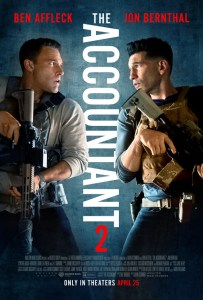 I’m going to start this review by doing what everyone loves to read, the author patting themself on the back. Back in 2016, I found The Accountant to be an enjoyable thriller with a compelling main character that answered the question, “What if Jason Bourne was actually interesting as a character?” I concluded my original review with this observation: “It’s rare that a movie leaves me wanting more, and it’s even more rare when a movie leaves me wanting to watch a weekly variation of Christian Wolff living as whiz kid accountant by day and enforcer of justice by night.” Over the years, The Accountant became one of the most popular streaming movies, a real word-of-mouth sensation that gave it life long after its theatrical release. It was enough that another studio, Amazon MGM, wanted to buy the rights to pay Ben Affleck to produce a sequel that hit theaters and now is available on streaming, thus ready to be the next great movie that dads fall asleep to. It took longer than expected but The Accountant 2 does fulfill my request, showcasing what a regular series could be, for better and worse.
Christian (Affleck) is like Batman if Batman had Autism and did his own taxes. He has a multi-million-dollar foundation that looks for wrongs to right, and this time he’s called back into the action by the sudden death of Ray King (J.K.Simmons), the retired agency head who was tracking the elusive accountant for years. Ray was obsessed with a family lost to human trafficking and hoped to find the missing child. Christian takes up the case and invites his once-again estranged brother Braxton (Jon Bernthal) to help.
 The positives from the original Accountant still shine through, namely the entertainment value of Christian as an outsider character trying to fit into the larger world. He’s an unexpected and often funny person but also a man with his own code of justice, and it’s a treat to watch him bomb through a marathon of speed dating one moment and punch guys in the throat the next moment. Affleck is still enjoyably dry as the lead, and the movie is at its best in the moments where Christian and Braxton are butting heads. It takes a longer than it should to reintroduce Braxton and bring him back into Christian’s orbit, but once the brothers are together, the movie coasts on a chummy buddy comedy dynamic that can reliably work no matter the setting. That’s one of the features that led me to apply the movie into a TV adaptation; the characters are what make ordinary encounters that much more entertaining, and TV is the premiere realm for characters. We tune in on a weekly basis because we want to discover what the characters we love will do next. While The Accountant 2 is certainly a few steps behind its predecessor, the core dynamic that made it enjoyable for so many should still prove appealing to those same legions of fans.
The movie also demonstrates some creaky choices and execution that manages to make it feel less like a full and vital sequel and more like an iffy showcase for turning the franchise into that weekly TV series. The central mystery feels lifted from any generic crime procedural about discovering a human trafficking network. The particulars aren’t that interesting or complicated or even that surprising given the general public’s understanding of human trafficking nowadays. I was waiting for this storyline to give us a little insight into the people most affected, the vulnerable families being exploited as they risk everything to search for a better life or more stable employment. I was waiting for something extra that felt like this storyline would be anything more than a ripped-from-the-headlines rescue mission, and it just doesn’t materialize. Much like 2023’s Sound of Freedom, the complex issue of human trafficking gets boiled down to whether or not our characters can save one unfortunate child. Hilariously, during the climax, the movie keeps cross-cutting between the brothers riding to liberate the kids from their imprisonment and an excavator digging a hole intended to be the kids’ mass grave. One inclusion is enough for us to understand the stakes, but the movie keeps cutting back repeatedly, as if anxiously asking, “Oh no, will the bad guys get the grave completely finished in time for the kids to be dumped inside?”
Already it feels like we’re sanding things down in order to fit a formula. Another indication is the relationship between the brothers. Apparently the brothers have not seen nor spoken with one another since the events from the first movie eight years ago. This is odd considering much of that movie’s story was divided with the Braxton character in parallel and finally recognizing his long-lost brother. After all their years apart it feels more likely that they would have stayed in touch or better. By not going that route, the sequel gets redundant reuniting the brothers again, but this time they’ll actually stick it out because they’ve gone line dancing together and killed even more dudes, the two most brotherly-bonding activities possible. It feels like setting up the team for more fun adventures.
 Although redundancy is part of what holds back the movie. Take for instance back-to-back introduction scenes for Braxton. Our first scene is him trying to psych himself up, and we may think it’s for a date or to talk to a woman he likes, but it’s actually to ask whether or not he can adopt his selected puppy even earlier. Funny, sure, and gets to his loneliness. The next scene he’s trying to have a conversation with a woman who is clearly not as interested and this perturbs him, and upon him leaving we see the trail of bodies he has left behind in the aftermath of some job. Both of these scenes are accomplishing the same thing: Braxton has difficulty connecting with others and is lonely. Why did we need the first scene when the second conveys the same information plus his formidable nature? Braxton even brings up his desire to get a dog later and Christian considers his brother more a “cat person” because he lacks the stable job and responsibility to care for a canine. This moment could have been the first time the film introduced Braxton’s desire for a pet. We don’t gain much from knowing this already. This may seem slight but it’s indicative of a movie that is filling time (hence the mass grave cutaways). For a movie over two hours, there is a surprising amount of fat that could’ve been reduced for narrative redundancy and pacing.
The most obvious sequel idea for a special-skilled accountant would be to meet his match, and The Accountant 2 does and doesn’t do this (some spoilers to follow in this paragraph). Much of the movie is about locating two people, the child stuck in human trafficking and a mysterious woman (Danielle Pineda) who the bad guys are after. She is linked to the missing child but she’s also a highly-skilled killer who is seeking vengeance of her own. It turns out this woman, who I won’t identify, had a traumatic experience and has now become a savant action superhero. This revelation is meant to explain how an ordinary woman could become this badass killing machine, but it awkwardly feels like a ret-con to try and apply Christian’s condition to anyone under unique circumstances (you too could transform, kids). Except the first Accountant made it abundantly clear that Christian was as skilled and methodical as he is because of being on the Autism spectrum, allowing him a unique dedication and attention to detail. Obviously, Autism is not some shortcut to super powers. If it were, RFK Jr. would actually try and read something relevant about medicine. But it was established that the same skills that Christian uses to be such an exacting accountant are the ones he taps into to become a crushing crusader. As someone who has worked with many on the Autism spectrum, I didn’t see this portrayal as insulting or insensitive, especially since much of the movie is about humanizing people with differences and showing how their capabilities can rise above the preconceived perception of others. It wasn’t saying Christian was like all people with Autism, but this is, again, only my nuer typical perspective. I don’t know if in the ensuing eight years that returning screenwriter Bill Dubuque (Ozark) decided that it was less problematic to have the secret formula be the brain’s response to trauma rather than being on the spectrum. It opens up the movie to other highly-powered super spy assassins, but it also takes away something from the premise.
 The actual bad guys are a rather uninspired gathering of goons and shadowy business types. At no point will you feel like our characters are genuinely under threat, and at no point will you remember anything about these villains except for their rote application in the plot. The main trafficker is an evil Boston crime boss (Robert Morgan) that could have been ported over from any other generic crime thriller. His one quirk is that he whistles “Pop Goes the Weasel,” even when he’s murdering migrants in the desert. So there’s that. His main muscle is just… some guy. Literally there is no even cursory attempt to provide any point of characterization for this guy, and he’s supposed to be one of our biggest threats? They could have given this guy, bare minimum, like an eye-patch or an affinity for pop songs, anything. As a result, we have two sets of antagonists, one of which is revealed as an avenging antihero while the others are so disposable to be laughable. At least the first Accountant film gave us a real opponent who, granted, ended up being the younger brother to our main character, but there was a real question what could happen when their paths crossed. Would they use their skills to eliminate the other?
The Accountant 2 might not add up to the same degree of entertainment and thrills that its first outing offered, and there are several missteps and redundancies that take away the edge and uniqueness of that original, but as long as Christian is still determined to help others, I’ll always find this possible franchise worth watching. Now look out for that eventual Amazon TV series to be scheduled right after Reacher.
Nate’s Grade: C+
Share this:

The Fountain of Youth (2025)
 Ever since Indiana Jones famously swashbuckeled his way onscreen in 1981, studios have been chasing after recreating that dashing action-adventure treasure hunting caper that can win over mass audiences. The tough love is that there are very few that actually succeed. The closest might be the 1999 Mummy movie or perhaps the popular Uncharted video games. For some the National Treasure movies might apply. Unfortunately, most of these Indiana Jones hopefuls end up being proven unworthy of one’s time and especially in comparison to the great Dr. Jones, and so The Fountain of Youth also fails to recapture that excitement. The reportedly $180-million Apple TV original is directed by Guy Ritchie (Aladdin, The Gentlemen) and stars John Krasinski and Natalie Portman as the Purdue siblings who are racing to discover the famed Fountain of Youth before another team of shady corporate archeologists (booo!), that feature’s an ex-girlfriend (Eiza Gonzalez) of our lead, gets there first. He’s a wild adventurer trying to clear his disgraced father’s name, and she’s a professor who’s settled down with a family and needs a reminder of her adventurer roots. These kinds of movies live and breathe by their set pieces and charm. The problem with The Fountain of Youth is how forced everything feels. Krasinski can be a very charming actor, as evidenced to any fan of the American Office, but he’s the wrong kind of energy for this role. His carefree attitude comes across as smarmy and detached. Portman is also completely wrong for her role, never finding a degree of fun for her character, only becoming the nagging tag-along. There are some intriguing set pieces, especially aboard the literal Lusitania as it’s dredged back to the surface and then begins sinking again. That’s the highlight of the movie and it happens before the hour mark of a two-hour experience. Ritchie feels restrained in his application of his signature style, once more feeling like a journeyman for hire. The final setting whereupon our characters do find the Fountain of Youth is anticlimactic and builds up its magic hokum with late rule-changing as well as the most telegraphed villain turn. The movie’s tone is aiming for frivolity but because everything feels so forced and empty it instead comes across as obnoxious and tiresome. The drought continues.
Nate’s Grade: C
Share this:

Heart Eyes (2025)/ Fear Street: Prom Queen (2025)
Slasher movies have been a popu;ar staple of horror, enough so to go through different phases of resurgence and ironic reinterpretation. They rose to prominence in the 1980s but are still wildly popular today, perhaps proving that there’s something timeless about a masked maniac chasing after dumb teenagers with his or her weapon of choice. Mix in heavy amounts of blood and gratuitous nudity, and it’s easy to see why this cost-effective entertainment strategy continues to endure. Two new 2025 slasher movies show the highs and middling lows of this horror genre known for its graphic kills and little else.
 Heart Eyes is ostensibly about a romance-hating masked killer who stalks happy couples on Valentine’s Day and gets all stabby with their insides. However, it’s really a pretty charming romantic comedy that just so happens to also have a healthy amount of gore. The clever screenplay follows many of the same tropes we come to expect from the rom-com genre but now with a twist. It’s Boy Meets Girl, as Jay (Mason Gooding) and Ally (Olivia Holt) are forced to work together to save a romantic ad campaign gone wrong. It’s Girl getting over the pain of her recent breakup with the emergence of a handsome new man in town. It’s Guy and Girl butting heads before creating sparks. And then they’re chased repeatedly by the masked killer. They yell, “We’re not even a couple,” but it makes no difference; their chemistry is just that undeniable. In that regard, this murder menace is actively driving these two would-be lovebirds together, forcing them to rely upon one another for survival, and revealing parts of themselves. If you cut out all the horror parts, it would still work as a romance, but it’s even more entertaining to watch how the two genres, both beholden to their formulas, mash so bloody well. The banter is witty, the silly are over-the-top gory, and this is a rare movie that could be loved by gorehounds and foolish romantics. It’s an elevation that is self-aware but not obnoxiously, more silly tongue-firmly-in-cheek. You can tell there is a love for both of these genres from the filmmakers. Heart Eyes is a fun and refreshing spin on the old.
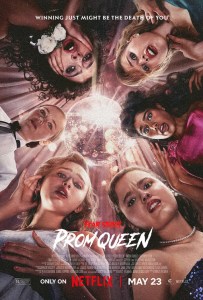 The newest Fear Street movie, based on the scream teen novels by R.L.Stein, is by far the weakest in the Netflix horror anthology series. Prom Queen is a pretty straightforward rehash of your 1980s high school movie staples of horny teens, bitchy popular girls, the less popular girl striving for Prom Queen and having to reconcile the changes she’s willing to make to be a winner, and a knife-wielding killer. Ah, the nostalgia. The issue is that there’s nothing separating this movie from, say, Prom Night, either the 1980 original or the PG-13 remake in 2008. The most thought put into this movie is the gruesome kills with some decent gore, but the whole movie doesn’t even play like a cartoon. It plays like a TV special you’ve watched before, something not just outdated but that’s been iterated upon iterations, a bland copy of a copy of a copy. The mystery of who might be the killer has some slight fun but the culprit should be easy enough to suss out when you take into account what actors have names that you remember. There’s nothing wrong with emphasizing the more gruesome exploitation elements of the genre, but the kills aren’t that memorable or clever, nor are the characters that interesting even as generic stock roles. I found myself confusing many of the multiple Prom Queen candidates (why are there so many pale brunettes?). The previous Fear Street movies released in 2022 had an interesting gimmick connecting them with the history of the town going back centuries to explain its crushed nature. Prom Queen just exists in this space without doing anything to connect to the larger Shadyside mythos and cross-generational storytelling. It feels so dreary and perfunctory and rather boring, shuffling along like a zombie wearing the husk of Fear Street. It’s just not fun. It’s not outlandish enough to be silly and too dumb to be self-aware. It’s mostly unimaginative cliches warmed over and unrelated to a far more stylish and ambitious horror series. This is a Prom Queen that deserves a bucket of blood and social ostracism instead of any accolades.
Nate’s Grades:
Heart Eyes: B+
Fear Street: Prom Queen: C-
Share this:

Until Dawn (2025)

I’m going to do something I don’t know if I’ve ever really done before in my twenty-five-plus years of toil as a film critic. I’m going to devote almost the entirety of this review to try and make sense of the ending and its cascading choices that confound and astound me. I’ll present some spoiler-free analysis beforehand but, dear reader, this is going to be a spoiler-heavy review because, quite simply, it’s all I want to talk about as it concerns Until Dawn. The horror movie is an adaptation of a 2014 PlayStation video game that itself was fashioned like a ten-hour horror movie. It was a love letter to the horror genre and your goal was to keep as many of the characters alive as you could through quick-time events and choices that could have lingering and unexpected consequences later in the game. It was, above all else, fun, and news that Hollywood was going to turn it into a movie made a degree of sense. After all, it was practically an interactive movie to begin with. Then news matriculated that they weren’t really adapting the game and instead were making something new and different, so why call it Until Dawn? Beyond the cash-grab from the use of a familiar name, if you’re going to be Until Dawn in name only, why not just be that original horror idea and let someone else actually adapt Until Dawn as it was? You’re not going to get another crack at this title, so why is the first attempt one that could be done without the game existing? Regardless, the movie is a bad adaptation of the game and a bad use of dwindling brain cells.
Five teenagers make a trip to search of Clover’s (Ella Rubin) missing older sister. They trace her last recording to a gas station just outside the mining town of Gore County. The gas station attendant (Peter Stormare) lets these curious kids know that weird things happen in town, and sure enough the weird stranger is right. The teens take refuge in a visitor center with a guestbook and a peculiar hourglass time piece on the wall. Soon enough they’re beset with masked killers and monsters and each of the five friends is slaughtered. Then they wake up back in the visitor center with the hourglass starting over. They have to learn about this mysterious location to try and stay alive all the way… until dawn!

Before the heavy spoilers begin, I’ll provide a few accolades to what the movie does well. Director David F. Sandberg (Shazam!, Lights Out) has a clear affinity for the horror genre and can summon some pretty effective and skin-crawling imagery. I actually like the premise of a horror time loop, though this was also covered with the tongue-in-cheek genre tweak that was 2017’s Happy Death Day. However, that movie primarily dealt with a slasher scenario whereas Until Dawn can mix and match different genres, which makes each new iteration feel like a blank slate to explore. I loved the shortest loop, where the characters hold up in a bathroom and gruesomely discover what happens if you drink the local water. It’s the best development in the movie and one I’m glad the script revisits from time to time. With most time loop movies, once the characters adjust to the reality that death is not final, they get a little more loose with their physical well-being. I enjoyed some of the turns the characters make with the understanding that they’ll come back again. The visual nods and connections to the game are there without feeling too gimmicky. Plus, having Stormare come back to play a variation on his nattering psychiatric weirdo from the game is exactly what the movie adaptation needs. Stormare is on his own unique wavelength.
Now, the madness. Abandon all hope ye who enter the spoiler section of this review.
I don’t understand this movie. At all. I read over its Wikipedia summary and watched a few of those YouTube explanation videos to see if it was just me and I missed important pieces of information that would connect the various elements together. It’s not me, folks. These story elements don’t connect. They don’t form a coherent whole. I don’t need a reason why time loop scenarios happen; they never explained it with the genre grandaddy Groundhog Day, and if it’s good enough for Groundhog Day, it’s good enough for your movie. The problem is when they try to explain and it actively makes things worse, because now you begin to question everything. I liken it to 2019’s Us, a movie with plenty of outlandish story elements including the existence of a same-age evil twin for every person but living in a subterranean mimicry of surface life. I would have happily accepted that as-is, but then the movie tries to find a real explanation for where these people came from and why, and now the illusion of ignorance is shattered. Now all those pesky questions start flooding the mind that could have before been kept at bay.

Let’s examine the explanations for the two primary mysteries: 1) why there are monsters, and 2) why there is a time loop trap. Again, both of which didn’t even need explanations but here we go.
The mythology of the game gets ported over in starts and stops, but the movie keeps the setting of a mining town that had a tragic collapse that devastated the town. In this version, the majority of the town fell into a sinkhole below the earth. Do we get to explore these exciting and creepy locations? Nope. One of the town’s psychiatrists (Stormare) is still alive and continuing his mad experiments for… reasons. Like the game, there is a curse wherein if you resort to cannibalism you will become a spooky wendigo monster, so the creatures are a result of the former townspeople and other past residents from the previous time loops. Fine. I can accept that. However, late in the movie, our creepy psych doc clarifies for Clover that things aren’t just all in her head, a nod to the original game. Except that ending would have made more sense. The new ending says that Clover’s fears are responsible for manifesting the different antagonistic monsters and killers. Okay, so we’re externalizing the internal, fine, but why her? Why not any of the other friends? Does this mean every previous group was also responsible for manifesting their own tormentors based upon personal psychological fears? Why are we including this roulette wheel of terrors on top of the constant of the wendigo creatures? How is this even happening because the movie gives no scant indication? Do the deadly rules get reset with each new group? In our story, the characters can’t drink the water, but what about other groups? If every group is manifesting the same avatars of fear then why not just adopt them as stable rules? Why is this one man staying behind to catalogue the results? He’s mortal so he just lives in the sinkhole or works at the gas station, waiting for wayward teens to stumble into his next experimental group? Who is keeping the lights on in this visitor center? What does this guy do during the “off season” when there are no looky-loos? Does he have to feed the existing wendigos like some kind of demented zoo? What is to be gained from all these experiments? Is he planning on publishing his research later? What is this guy’s regular life like?

Then there’s the time loop explanation which is -wait for it- nothing. Absolutely nothing. Why are characters getting second and third and thirteenth chances to survive until dawn? Why is it thirteen? The movie doesn’t even have the time to demonstrate thirteen loops, instead jumping from like the fourth straight to the last one through the annoying use of, “Oh, let’s watch these film clips we took that we don’t remember.” If you didn’t have the interest or time for thirteen loops, why even make it thirteen? Why does the number matter if they inevitably turn into wendigos from desperate cannibalism? You would think the loops should be infinite to guarantee this result. Why would the other victims bother writing their name in the guestbook every loop? It establishes a timeline of sorts, but if writing can last in this guestbook, why doesn’t anyone write anything other than their name over and over? Detailing your experiences and lessons learned as a living record might be helpful to future loopers. Also, what obligations do these people feel about signing their names in the guestbook? Who accepts getting murdered over ten times but is still being a stickler for signing their name, and for what? Are they getting some little feeling of superiority that they were able to scribble their name thirteen times? Where did the hourglass come from? It definitely looks like it was installed with purpose, so did these just materialize? Why do the timeloops even consider having a mechanism for letting participants win and escape? What about the other quirks like how the weather is affected by the bad vibes of this place? Even the rain knows better.
So, in summation, the time loops and manifesting monsters are unrelated to one another and there is no added context provided for like some ancient curse or witchy magic or anything to cause this mess. There is one nefarious wacko doctor who just hangs around for kicks, though why he is immune from the loops or the larger effects of the manifested monsters is beyond me. Is he recruiting the monsters like some sort of work foreman, telling this gnarly creature, “Need ya to pull a double today, Fangy.” It just all feels like scary elements working in parallel and occasionally drifting into one another’s orbit, but there’s no fitting or acceptable explanation, so why does the movie even try to present one in the first place? I’m stunned at how Until Dawn just completely unravels into incoherent madness by the conclusion, which sets up that there might be a larger universe of these doctors overseeing experiments. At that point, you might as well be watching The Cabin in the Woods. If you have no allegiance or familiarity with the video game, you might find enough to amuse you, at least for fleeting moments. I was open-minded to what an Until Dawn-in-name-only adaptation could do with a time loop gimmick, but the final results feel like an uneven grab-bag of imagery and ideas and directions that go nowhere.
Nate’s Grade: C-
Share this:

Another Simple Favor (2025)
 The sly 2018 original was a tart breath of fresh air, chronicling a friendship between two moms, one of means and one of lesser means, that unraveled a conspiracy of death, lies, secret twins, ransom, and murder. It was an enjoyable diversion that was elevated by snappy banter, a combustible chemistry between Anna Kendrick and Blake Lively, and some dishy twists. I wasn’t expecting a sequel, but with the same director and principal cast returning, I was at least a little intrigued as to what they would cook up. Instead Another Simple Favor is a warmed-over retread of the original. This time we travel to scenic Italy where Emily (Lively) has been released from prison and is now marrying a wealthy Mafia scion and wants Stephanie (Kendrick), her old frenemy, to be her maid of honor. At its best, the sequel has glimmers of the spiky fun of its predecessor thanks to the serviceably witty banter and ongoing fun between its lead actresses. Mostly, it’s a tangled mess chasing after what made the original entertaining and adult. I can pretend I fully understood the plot with its assault of soapy revelations, character intersections, and convoluted machinations, but that would be a lie. There are times where the movie feels like an overburdened runaway “yes and…” improv game, where anything and anything is accepted and absorbed into the script. I wonder if every additional movie is just going to add more versions of a certain character. If you’re a fan of the 2018 original there might be enough here to prove fleetingly engaging, like the fabulous villas and extravagant costumes, but mostly Another Simple Favor doesn’t feel like it’s doing anyone a real favor.
Nate’s Grade: C+
Share this:

Black Bag (2025)
 It’s Steven Soderbergh’s second movie of 2025, also with screenwriting vet David Koepp, and this time they’re tackling the spy thriller, centering on a marriage between two spies. Michael Fassbender and Cate Blanchett play a couple who both have clandestine lives, and when either one ventures into sharing sensitive details, they utter the code “black bag” as a conversation-ender. There’s a mole in the agency and Fassbender is tasked with uncovering the identity of the culprit, but he worries this investigation might ultimately point toward his own wife and then what’s a man to do? Black Bag is one of those more realistic, exacting spy thrillers, which means it’s churning at a very slow pace with minimal stakes before things ratchet up late. The parallels between trust in a marriage and trust in a spy agency are there but never explicitly explored for thematic richness. You know where the ultimate goal is, finding the mole, but every scene plays out more like a couples drama of squabbling, unhappy upper class winos with secrets and grudges. I had to occasionally remind myself, “Oh yeah, these are spies.” I never fully got on board the wavelength of this movie, finding its detached sexy vibe to be more glossy and meandering. The characters just weren’t that interesting to me. I kept waiting for things to pick up, and even when characters are murdered the tension level still feels unchanged. It’s all a little too heavily submerged under the icy tranquil surface for me. Black Bag is a sedate spy thriller presented as sophisticated but comes across a tad too detached and ultimately tedious.
Nate’s Grade: C+
Share this:

Havoc (2025)/ Novocaine (2025)

Action cinema has long been one of the most satisfying experiences for the always-insatiable moviegoer, being presented with the thrum of kinetic editing, expert choreography, and visceral photography to produce a sensory thrill. Watching a well-developed action sequence is akin to watching a stupendously choreographed dance, where the movement and struggle are part of the storytelling momentum. Two recent action movies show what can be achieved, one through intensity of the familiar and the other through elevating its concept. Both are fairly enjoyable escapes and reminders that, with the right hook or sense of passion, action cinema can be some of the most gleefully transporting sensory experiences.
One of the best genre filmmakers is Gareth Evans, a man who blew the industry away with his intense Indonesian martial arts epics, The Raid and its even better sequel. After watching those movies, and taking time to catch your breath, you have to wonder why Evans isn’t directing every Hollywood action movie, or at least been tapped to try his hand at juicing some studio franchise with his visionary feel for action. It’s still a mystery to me that Evans has only helmed two movies since 2014. Both of them happen to be from Netflix, and while I don’t pretend to understand the creative machinations behind this streaming giant, if I were them I would give Evans a $20-million budget every three years and tell him to do whatever he wants as long as it involves people getting hurt. At first glance, Havoc looks fairly conventional, a crime drama about corrupt cops and hoodlums fighting over who can get to a target first. You have to keep reminding yourself that Havoc is not The Raid and not aspiring to be, so the fact that it cannot rise to that extreme level of action excellence does not mean it is a failure. It’s not in that upper echelon of action cinema, like your John Wicks, but Havoc is most definitely a step above many of Netflix’s junky action-thrillers with A-listers that inevitably disappoint in their flailing execution.

Tom Hardy plays Walker, a veteran cop who works as an enforcer when the money’s right. He’s tired of being a tool to the rich and powerful and looking to get out and be a better family man. You know, the stuff of formulaic action boilerplate. He gets involved in a job gone wrong that leads to a gang war spreading and plenty of hired guns looking to find the son of the mayor (Forest Whitaker). That’s about it as far as the plot. It’s about different groups racing to get what they want first at whatever bloody cost.
Whereas The Raid was a martial arts action extravaganza with professionals at the top of their game getting the platform and material to showcase their amazing skills, Havoc is not that kind of movie; in fact there’s very few moments where the action consists of fisticuffs. This is an action movie built on car chases and mainly gunfights. It’s a cops and robbers kind of action movie, which puts less emphasis on hand-to-hand and more on room clearing. While the accumulated thrills might not be as gratifying as watching professional athletes launch exciting routines, there is still plenty to enjoy when watching finely developed gunfight sequences. The boring approach is simply to convey a shot-reverse shot dynamic: Character A fires a gun, then cuts to Character B being shot or dodging, repeat. Good directors will think about how to better stage a sequence so that each one has its own purpose, its own set of mini-goals, a set of organic complications that keep the conflict roiling, and ways to connect to character. Action sequences should not just be excuses to blow something up. With Havoc, it takes quite a bit to get going, but there are two standout action sequences that make it worthwhile and will satisfy most action aficionados.

The first sequence is a fight in a club that kicks off the movie’s shift to constant scrambling action. It’s about 50 minutes into the movie and all the respective characters have been slotted into their conflicting positions. We know who the good guys are, the bad guys, the goals in opposition, and what the stakes are, and from there the movie just takes off in a sprint until its final blast. The club involves different levels and different factions fighting and mixing, providing a series of changing complications that makes the sequence feel more lively and engaging. There are several inventive moves to avoid gunfire or reach guns, and the cinematography keeps the action centered and easy to comprehend. The best action sequences are planned like moving puzzles, and the more work that is put into the preparation, the more enjoyable the action can become. This club shootout scene finds numerous ways to keep the stakes upended and to place the characters in new forms of danger they have to quickly adapt to survive.
The second sequence is a climactic confrontation at a cabin in the middle of a snowy forest. It’s a prolonged siege sequence where the bad guys are attempting to break through into this secure location and take out our heroes. From this claustrophobic setting, Evans presents the antagonistic intrusions as unrelenting and coming from all four walls and even below as well. The characters have to constantly be moving and reacting to an assembly of threats while their protective walls begin to literally crumble. It is a literal onslaught. I’m shocked the cabin is still standing by the end. It’s an immensely engaging sequence that communicates the frenzy and anxiety of being under constant attack. The gunplay can be brutal and there are satisfying kills and battles between side characters throughout this sequence to avoid the sequence from feeling too repetitive. It feels in many ways like the whole movie has been leading up to this sequence, not just in a traditional linear-plotting fashion but also the viewer has been waiting for the director to fully go off with a celebration of action mayhem. This is Evans unleashing his best, and he’s adapted his creativity to the setting and the action sub-genre, so there’s different moments meant to present immediate gunfire problems and fast-paced responses. In this world, people aren’t all gifted as expert fighters, and thus even our heroes can falter under the harried circumstances.

Short of these sequences, the rest of Havoc has difficulty breaking free from the gravitational pull of its own genre cliches. Evans wrote the screenplay by himself and I’m surprised how flimsy so much of the story and characters come across. With 2011’s Raid, there wasn’t much of a story once the action stopped, but with 2014’s Raid 2, Evans was able to compose an undercover cop story that was just as compelling even when people weren’t getting kicked in the face. He can write colorful side characters that feel like they stepped out of a Tarantino-favorite grindhouse movie. He can write tense sequences that don’t have to rely upon action. He can do so much more than what Havoc provides, so it’s hard not to feel like this wasn’t exactly a passion project. It feels more like a serviceable vehicle to achieve the kind of action that Evans was looking to achieve. Now, if you’ve underwritten a genre movie because your real interest is staging the action, then you would expect there to be more action, correct? Strangely, Evans spends most of those first fifty minutes setting up his story, the same story that is awash in genre stock roles and cliches without much intrigue beyond a one-sentence description. Simply put, if you’re going to stick us with underdeveloped characters, don’t keep us waiting for the action. There’s so many characters in this movie that I think Evans gets overwhelmed trying to set them all up and involve them in the larger story. If they’re only going to be stock roles, why do we need 30 when 10 can do? I think Evans keeps his cast so big so he can unceremoniously bump off so many of them, which can be surprising, but I would have preferred doing more with the space their absence might have provided the narrative. There’s also an odd stylistic choice where any exterior shots are much more stylized, looking more like video game cut-scenes or something out of the realm of Sin City. It’s at odds with the rest of the film’s stripped-down look.
Havoc is a gritty and bloody action movie that can overwhelm at moments and underwhelm at others. The genre grist is pretty familiar, from our troubled antihero lead trying to atone for his past sins, to the dumb kids in the middle of a gang war they don’t understand, to the good-natured partner who has to grow up, so to speak, by getting their hands dirty. You’ve seen variations of these stories before, but the real draw is once Evans works up enough space to really unleash his invigorating action best. It’s a movie I wish was better but it’s functional enough for Evans to do his extraordinary thing. I just want more of his specialty.
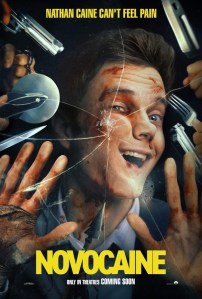
In comparison, Novocaine isn’t going to be defined by stylish choreography or exceptional style. It’s a high-concept action comedy driven by flipping the genre script. Instead of our hero inflicting great pain on his foes, this movie is about a hero enduring amazing amounts of pain. It’s an underdog story where a novice is thrust into an unfamiliar situation and has to utilize his unique disorder, a blessing and a curse, in order to rescue the girl and save the day. It’s a great premise that lends itself to plenty of fun scenarios to fully capitalize on its bizarre potential, and that’s where Novocaine hits a sweet spot of entertainment.
Nate (Jack Quaid) is a shy assistant manager at a small bank in San Diego. He suffers from a unique medical condition where he doesn’t feel the burdens of physical pain. You might think this a luxury but it’s actually a great worry for Nate. Without his body’s alarm system he can stumble into grave danger without even knowing it, so he’s been living an overly cautious life as a result. That all changes when he meets Sherry (Amber Midthunder), a new coworker who takes an interest in him. They go out on a date and really hit it off. Things are looking up for Nate until bank robbers storm his work, kill his boss, and take Sherry hostage. Nate hijacks a cop car and goes chasing after the bandits to rescue Sherry. He’ll undergo lots of trials of pain to win back the girl who makes him feel things.

How do you make a person invulnerable to pain an exciting character? It’s the lingering Superman question, except nobody is going to confuse the character of Nate with Krypton’s orphaned son; if a character cannot feel pain how can we worry over their well-being? Now there’s a reason writers have been able to tell Superman stories for decades, even if the movies often struggle with representing the figure, and that’s because it just forces you to have to think harder. It can be done. With Novocaine, Nate is a hapless naif thrown into an action movie and trying his best to fit in. He lacks physical prowess, weapons training, and tactical planning. However, the only thing he has going for him is his inability to feel physical pain, and the filmmakers routinely find funny and entertaining methods to test how far one could go with this pain threshold. While his body isn’t registering pain he is still taking all the punishment. Nate is nowhere near indestructible, and a running gag becomes how utterly mangled and deformed his hand becomes from event after event (I thought it was just going to be a stump by the end). He takes quite a beating but because of the whole “mind over matter” matter, he’s surprisingly able to persevere where others could not. This allows Nate to become an unexpected hero where the rest of us would pass out from shock. The appeal of the movie isn’t so much the action itself but the ongoing response to all of said action.
The set pieces are what makes this movie so much fun, pushing Naate into action hero mode when he’s clearly awkward and not ready for the promotion. I loved his dry responses to every new injury, from mild annoyance to feigned surprise. There’s a scene where one of the villains is torturing Nate and he has to go along with the charade in order to appease his tormentor and get valuable information out of him. It’s a reverse interrogation where the target is actually trying to manipulate the guy with the pliers. I loved how quickly he could bounce back from whatever trauma, from catching a knife blade first and quickly yanking it out of his hand, to casually writing an address on his hand with a tattoo gun. There is a crafty ingenuity to how the filmmakers can make the best use of this superpower. There are some impressive kills that also made me wince in response, like reaching for a gun at the bottom of a deep fryer, or literally stabbing a person in the face with an exposed arm bone. Novocaine has a delightfully demented sense of humor that keeps everything grounded with mordant laughs even when it’s dishing out the punishment.

Even more surprising, there’s a buoyant love story that genuinely feels sweet that could have benefited from a little more development and attention. Sherry is the one who activates our protagonist and pushes him outside of his comfort zone. He lacks confidence in himself and has been living an overly cautious existence from fear of not being able to respond to his body’s emergencies. The man has been eating his food as liquefied goop out of a fear of choking. She introduces him to the simple joys of eating one’s food before it’s been vigorously blended, like the wonders of pie. Their first date was genuinely charming and I liked the chemistry between both actors. Midthunder has been a favorite of mine since Prey and I want to see her in more varied roles. When the bank robbery commences, I actually had an emotional response to these two being in danger and watching the other being put in danger. Once she becomes a hostage, Sherry is placed as the damsel to be saved, which is disappointing because I liked her contributions to the story and especially what she brought out of Nate. There is a revelation with her later that reorients our understanding of her but I don’t think it was fully necessary. Their budding romance is quite enjoyable and so I wish the story could also continue to develop this connection over its wild series of mishaps.
Novocaine is a great example of a movie that maximizes its unique premise to stand out. It’s structured like a traditional action-thriller but it never takes itself seriously, pushing forward a stumbling protagonist whose real gift is that he’s the human equivalent of a punching bag. This dynamic is ingeniously developed and showcased, and just when I was worrying the premise might get old or become repetitive, the filmmakers find new ways to twist their story into even better twisted results. I wish the female supporting role was more tied into the action and fun, and the villains are a bland blend of overly confident paramilitary goons. Still, the fun comes from Quaid and his light-footed screwball performance anchoring the bloody hi-jinks and demented humor. Novocaine is a fresh reworking of action movie tropes with a twist that allows the audience to heartily laugh at our hero’s pain and pratfalls. It’s the kind of humor and energy that reminds me of the Crank filmmakers. If you’re looking for a winning dark comedy bouncing against the formulas of action movies of old, settle in for some Novocaine and enjoy the pain.
Nate’s Grades:
Havoc: B-
Novocaine: B+
Share this:

Freaky Tales (2025)
 Watching Freaky Tales, an ode to 1980s Oakland California, punk, rap music, and grindhouse cinema, is like washing in someone else’s nostalgia. It’s a fun throwback experience but it doesn’t amount to much more than transitional diversions that won’t have the same appeal. This is an anthology movie following the events of a few nights in 1987 Oakland with criss-crossing characters told out of order. Given the abbreviated nature of the stories, you either have to make a strong impression with the characters, have memorable and surprising adventures, or have an intricate connection to the different stories that allows the narrative to keep reforming. Otherwise it’s a collection of shorts that don’t really add up to much else. While entertaining in spurts, there isn’t much more to Freaky Tales. The first story involves a punk rock club defending themselves against neo-Nazi bullies. It centers on a budding romance and works well with an exuberant, youthful energy and the theme of a vulnerable community standing together against hate is easy to root for especially when it results in bloody and maimed Nazis. The second story is the weakest and follows a female rap act trying to make the most of a stage show. The third story involves a mob enforcer (Pedro Pascal) trying to make a clean break and coming to terms with his past after a tragedy. It’s a story more memorable for some unexpected cameos and turns rather than supplying an antihero worthy of Pascal. The final story involves a professional basketball player seeking vengeance against the men who killed his family in a burglary-gone-wrong. It’s the most entertaining and ridiculous segment, especially as the pro player reveals the extent of his martial arts and mind powers. While each segment doesn’t quite overstay its welcome, none of the segments feel essential or cleverly integrated with the rest of the tales. As a result, Freaky Tales feels like gonzo campfire stories that don’t exactly go anywhere; pleasantly silly but missing out on greater fun.
Nate’s Grade: B-
Share this:

Companion (2025)

Confession: several years ago, my good friend and I co-wrote a movie for the Chinese film market that had several similarities with Companion. It was about a robot designed to be everything her owner desires turning on her owner. I’ll freely admit: Companion is better. While the movie doesn’t reveal that its robotic companion, Iris (Sophie Thatcher), is indeed made of circuits and screws until twenty minutes in, there are so many better twists and turns that come later. It begins with something relatively standard, a girlfriend nervous to meet the friends of her boyfriend Josh (Jack Quaid) during a lake house retreat. The film takes a dark turn that forces the characters to question how far they would be willing to go to cover up a crime as well as their own culpability. The second half of the movie becomes a very engaging and twisty cat-and-mouse game with Iris trying to escape from pursuers. Writer/director Drew Hancock (My Dead Ex) had put plenty of thought into the story mechanics of his thriller set pieces, connecting them to character decisions and the desperation of trying to outwit one another. The entire movie is elevated and then some by the terrific lead performance from Thatcher (Heretic, Yellowjackets) who becomes our emotional anchor and Final Girl worthy of rooting for. Thatcher can be heartbreaking one minute, hilariously deadpan the next, like when she’s stuck speaking German, and a tremendous source of empathy as she fights for her survival. Upon my first watch, I felt there might be too many twists and turns right up to the very end, but having re-watched Companion, I appreciate how much Hancock really thinks about move-countermove plotting, making sure that we experience many avenues from this premise. It’s a vicious take-down of viciously exploitative control freaks, with some strong satirical dark humor elbowing you in the ribs. It very much reminded me of 2019’s Ready or Not and would pair well as a double-feature of feminine empowerment amidst horror manhunts. While it might not have much on its mind as far as larger social commentary, there’s enough cooking here to keep me entertained, laughing, wincing, with my eyes glued to the screen to see where exactly it could go next. That’s a rarity. Companion is built different.
Nate’s Grade: A-
Share this:

Wolf Man (2025)
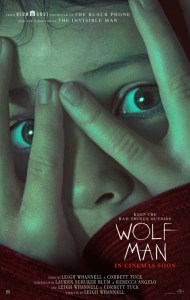 I had high hopes for writer/director Leigh Whannell’s second take on the classic monsters after how thrilling and satisfying his take on the Invisible Man was in the early months of 2020. Werewolves have served as a fertile metaphorical ground for genre storytelling to cover such varied topics like coming of age, self-actualization, and addiction. Considering Whannell was able to use an invisible man to explore toxic masculinity and gaslighting, without losing sight of a monstrously entertaining movie, I was hoping for repeated success. Wolf Man is ostensibly about inherited curses and the relationships between fathers and children, but it’s really about dealing with flaring tempers and whether or not our shortcomings are a result of our genetic inheritance. It’s also about a family trapped in a cabin helplessly watching their father/husband transform into a dangerous beast. I suppose there’s something here about the cycles of trauma and abuse, anger as a sickness, but the problem with Whannell’s Wolf Man is that it all feels like an incomplete beginning. There are definite identifiable themes here, and a scenario that would lend to slow-building dread amid losing control over one’s sanity to become a monster against their loved ones. I just kept waiting for something more. The movie runs out of steam shockingly once it strands its family in the cabin. We’re treated to many scenes of Christopher Abbott, as the beleaguered father, blankly staring and then seeing his vision where people are highlighted with neon outlines. It’s a neat visual but what does it mean? I was waiting for more development, more character work, more culminating of themes, more… anything. It’s a lot of sitting around, like this promising genre movie had been hijacked by, like, some self-sabotaging arty Godard-obsessed filmmaker trying to Say Something with all the protracted scenes, pained silences, and repetition without revelation. It’s a surprisingly boring movie and, I repeat, it’s a werewolf movie. The makeup effects also make our titular monster look more like a shaved wolf, or a goblin rather than a lupine-centric creature of the night. I don’t even think there was a single shot of a full moon in the whole movie. Regardless, Wolf Man is a disappointing a d dull monster movie that’s too shaggy for its own good.
Nate’s Grade: C


 nathanzoebl
You must be logged in to post a comment.