Author Archives: natezoebl
The League of Extraordinary Gentlemen (2003)
 This movie is certifiably insane. While a very literary X-Men seems like a great idea, what exactly does Tom Sawyer bring to the table? What, is he going to convince the bad guys to white wash a fence? And yet, this highly operatic bombast almost succeeds on its sheer level of lunacy, like when you realize you’re watching Sawyer get a crush on a vampire on a giant underwater submarine that’s so big it has end tables and vases in its hallways. Still, the handling of Jekyll/Hyde here is what Hulk should have been like. League of Extraordinary Gentlemen almost works, but its falls apart amidst shabby special effects, outlandish plotting, and very wooden dialogue. The director doesn’t make it any easier to follow, trumping his action sequences with rapid fire edits. Ah well, my bafflement was more entertaining.
Nate’s Grade: C
Share this:

Terminator 3: Rise of the Machines (2003)
 Arnold is indeed back and it appears that the 55-year-old action star and seven-time Mr. Olympia has saved our summer with the refreshingly retro retread, Terminator 3: Rise of the Machines. Twelve years have passed since the ending of Terminator 2. John Conner (Nick Stahl, replacing Edward Furlong) battles paranoia that at any second the machines of the future could send yet another android assassin back in time (And hes right, because if I was a machine and interested in proficiency, I would just keep doing this every year and eventually one would get it right). So because of these fears, the future hero of the human race is living his life right now like a drifter. He has no phones, no paper trails, and works from place to place never getting too comfortable.
John acting like a bum actually works. The machines cannot find him so they send a slinky new model, the T-X (Kristanna Loken), back in time to off his eventual lieutenants. This new version of the Terminator has the same silvery shape-shifting finish of Robert Patricks T-1000 (as well as the vacant emotionless staring) but now can turn her limbs into an arsenal of weapons at no extra cost. T-X, or Terminatirx, even appears in the window display of a posh clothing store. She appears alongside other manikins and struts her naked stuff along the night streets. So the killing machine of T3 is a blonde woman in red leather so tight it could have been painted on. She looks to be 115 lbs. soaking wet and made of metal. Nevertheless, the T-X is a suitable villain.
 One of the names on the T-X list is Kate Brewster (Claire Danes), a vet with a dad in very secretive military projects. Which projects? Well only the creation and operation of sentient computer program SKYNET. Kate meets up with John at her vet office. They also meet the T-X, though why this killing machine would check the vet office and not Kates home is an oddity. But wait, another Terminator (Schwarzenegger) is sent back in time to protect the Conner clan for the third time (It’s becoming so familiar that the Conner family might as well have a T-100 stocking on their fireplace for Christmas). And like that Arnold rescues Kate and John from the evil robotic runway model and the chase is on. Meanwhile a computer virus is crippling the nations electronics and the military is pushing Kates father into making SKYNET operational. But to do so would give full control over the nation’s nuclear instruments to a machine. Can you see some things brewing on the horizon?
T3 is basically a retread of the story of T2 with Arnold’s obsolete model trying to save John on the run from a faster and deadlier Terminator. And you know what? So what I say. T2 was an incredible film brimming with great action sequences beautifully captured. So what better action film to emulate than quite possibly the best action film ever? And T3 fills in quite well. It is so marvelously refreshing to see an action film that doesn’t involve wires, kung-fu, and extensively obvious CGI. CGI should be used to enhance an action sequence, but when it becomes the sole reason an action sequence exists its harder to be drawn in. So when I see Arnold and the T-X rumble in a bathroom, knocking heads through doors and broken porcelain, it’s a total blast because of the sense of realism.
I think part of me would have had a slightly different reaction to T3 if I had not seen the humorless pretension of The Matrix: Reloaded and Hulk. And unlike the earlier summer fare, T3 is an action movie that -are you listening Ang Lee?- ENTERTAINS the audience without boring them. Since when did we enter some parallel realm where our action films were trying to deconstruct the works of Nietzsche and use words like “concordantly” and “ergo”? Where was the turning point when the action fell out of the action film? These statements are not to say that action films would be better brainless (see The Mummy films, go on) but they would certainly be better if they had some humor and a lack of heady posturing. And for all of these reasons, and more, T3 is a solid action film, the kind we need to remind us what action films are and the fun they can bring. Did anyone, and I mean ANYONE have any fun with Hulk? I think a trip to the dentist would have been more exhilarating. Especially if he gassed you and touched your nipples like mine did. This is pure speculation though.
 The Terminator franchise took a hit with departing director, and all around King of the World, James Cameron (the only director this franchise has ever known) and stars Linda Hamilton and Furlong opting out. Stahl and Danes are great choices and provide credible weight to their roles and suitable heroics. It’s personally wonderful to see Danes growing up into a confidant and lovely adult actress. I swear she looks older and more mature in this than The Hours even though that art crap was filmed later. Stahl seems to have a habit of getting killed in his films (In the Bedroom, Bully), so that might keep a few more film savvy people on their guard.
The biggest addition is from director Jonathon Mostow (Breakdown, U-571). One of the things Mostow does so effectively is play up humor like no previous Terminator film. The naked entrance of Arnold is a great example of Mostow acknowledging the iconic nature of the films. Mostow also stages incredible action scenes. Thats good too.
What does it say that Arnold is at his best when acting like a machine? I didn’t realize until seeing T3 how welcome it is to watch Arnold strut around in his familiar leather jacket and sunglasses. We might not have known we could use another Terminator flick but while you’ll watching you may think, ”Man it’s been too long, welcome back.” T3 isn’t going to be the benchmark of action like its predecessor is, but the film is a good time.
Nate’s Grade: B-
Share this:

Pirates of the Caribbean: The Curse of the Black Pearl (2003)
 Johnny Depp is THE MAN. But then, we already knew this. Can’t wait to see more.
Nate’s Grade: A
Share this:

28 Days Later (2003)

Zombies have generally seemed one of the little brothers of the horror genre. Certainly not as complicated or Freudian as Frankenstein or Jekyll and Hyde, and no where near as seductive as vampires and werewolves. Zombies are stumbling, bumbling cement-shoe wearing monsters. They’re usually conduits for some kind of social message, like George Romero’s classic Night of the Living Dead and Dawn of the Dead. The scary part of zombies is the methodical eventuality they exhibit. They may be stupid, they may be slow, and they may be really stupid, but they’ll keep coming. They’re dead and they got no where to be. And there’s the pull –– that they will eventually get you. You’ll give in, something will happen, and they’ll seize upon that unfortunate misstep (I did an extensive paper on the symbolism of zombies in Romero’s films and the connections between religion and horror. I think I deleted it though, so this is the best analysis you’re gonna get). Now there’s director Danny Boyle’s indie horror flick, 28 Days Later, which gives the zombie genre a few good shocks to the system.
We open up with stark television clips of violence, genocide, and all around mayhem around the world. It’s basically what the cable news stations are now, except in this case, the viewership of these broadcasts are monkeys. Yes, it seems that the British government is experimenting on the nature of rage by strapping monkeys onto slabs and forcing them, A Clockwork Orange style, to watch all kinds of icky video. Animal rights activists break into the facility and plan on freeing the primate prisoners. A lab assistant tries to deter the monkey theft. He says alarmingly that the animals are infected with rage (as are most drivers it seems), and that this infection is highly contagious. The animal rights activists scoff at his concern and open the cages to the primates. For their altruistic virtues the activists are instantly attacked, bitten, mauled (can one be mauled by monkeys? It just seems like bears and lions have a monopoly on this verb) and infected with this deadly rage disease. This is likely the worst PR set-back for the animal rights activists since PETA clubbed baby seals. Look it up.

Flash to the titular 28 days later. Jim (Cillian Murphy) comes to in a hospital bed, and like previous films, Boyle finds an outlet to shoehorn in some full-frontal male nudity. It’s almost like a director’s trademark. Jim’s a bike messenger and has been in a coma for about, oh, let’s just say for the sake of it, 28 days. Jim wanders through the vacant hospital calling out for anyone. He hits the streets of London to find them startlingly empty, like some Twilight Zone episode. City kiosks are papered with numerous pictures for missing relatives or good-bye letters. A scattered newspaper says London has been evacuated. Jim meets two other survivors, Mark (Noah Huntley) and Selena (Naomie Harris). They wax chunky exposition to tell us what we already know: the virus got out, spread rapidly, is transmitted through the blood. Selena does have more unsettling news about the nature of the disease. It turns out that once infected a person has about 10-20 seconds of rational thought left before they fully turn into the rabid, crazed not-dead zombies. Jim demands to see his parents and the two agree to lead him to his home in the morning.
The next morning the surviving trio trek through the empty streets and residential areas. Jim enters his home calling out for his parents. He immediately has to cover his nose with his shirt sleeve. He walks into his parents’ bedroom to find both curled up next to each other long dead. On the nightstand are a bottle of wine and a slew of pills. His mother holds a picture of Jim as a child. On the back Jim reads: “We left you sleeping. Now we’’ll be with you again.” At the bottom it says, “Don’’t wake up.” Jim is devastated.
They find refuge in the apartment building of a Frank (Brendan Gleeson) and his daughter Hannah (Megan Burns). The two have been surviving since the outbreak. Frank is delighted to find other survivors. He shares a radio message he picked up. The message, though slightly garbled, is from a military base a way’s away. They say they have discovered the answer for infection and will provide shelter for any survivors. The foursome pack up their belongings in Frank’s car and head for the military base with a new sense of hope.
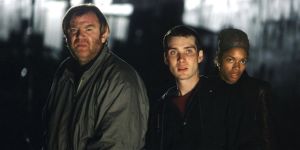
The cinematography of 28 Days Later is wonderful. It’s the best I’ve ever seen digital video. The choice of shooting on that medium also amplifies the horror and creates a more immediate sense of danger. The musical score could have been written by one of those popular Brit-rock bands. It’s propulsive, effectively building, and wonderfully sonic.
Harris is the star of the film, whether the makers know this or not. She’s one tough cookie but also reflects great moments of vulnerability as she opens up to the group and starts kindling some feelings for Jim. Gleeson is one of the best character actors out there, as evidence by a great turn in Scorsese’s Gangs of New York. Acting is never the strongest suit for horror flicks but 28 Days Later has some nice exceptions to this norm.
28 Days Later has a resonating sense of truth to it, if that can be said about apocalyptic cinema. When one character regrettably becomes infected they order their fellows to stand back, but before succumbing they say, “Just know that I love you.” This felt so genuine to me. Like if a comet was hurtling to decimate the planet within seconds, and your loved ones were around you, would you not act the same way? How does one compress all their feelings and appreciation and love in closing seconds? Something tells me it’s something like what is displayed in 28 Days Later.
Boyle, as has been ingrained into me from the blurb-heavy ads, has indeed reinvented zombie horror. However, what you may not know is that zombie horror doesn’’t exactly have many titles to it. I think I’ve already mentioned most of them. Boyle’s zombies aren’t dead, just infected human beings. They don’t move at that lumbering drag-your-feet speed of classic zombie lore, no these not-so-undead move with great velocity and ferocity, like rabid junkyard dogs. The new touches here and there provide some interesting dynamics to the genre.
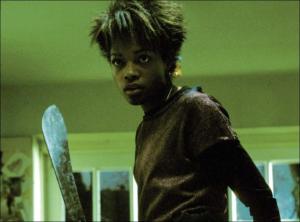
Perhaps what is different than most zombie films is that the audience grows to like the characters and root for their survival. In most horror films the characters are either too stupid or sketchy that it allows the audience to wait in amusement for their eventual horrific deaths. It’s simple: we want to see these people die because it’s titillating (Maybe I was wrong about all the zombie analysis I still had in my head).
Boyle does service a slight message in his zombie film when the group gets to the military base. Perhaps, he muses, our military and trusted leaders are no better than those rabidly wandering the streets. The idea of a thriller set against a biological pandemic also feels very timely and relevant. The film kind of drags in the middle during the stretch between London and the military base. And the end was a bit too much Die Hard for my taste, but is suitably climactic.
Boyle has crafted a creepy, smart, and engrossing piece of entertainment. I hope people don’t confuse this film with that Sandra Bullock clunker, 28 Days. They may be spending the entire time wondering where shirtless Viggo is and when Bullock will start her endless pratfalls (You knew I was going to talk about that movie somewhere).
Nate’s Grade: B
Share this:

Charlie’s Angels: Full Throttle (2003)
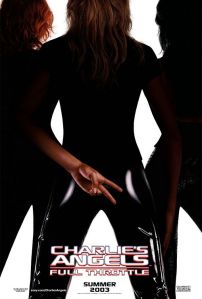 More of the same, except this time all the verve and invention seems stale and reheated. This sequel subscribes to the bigger-better train of thought, so as it continues to get more and more outlandish and the girls become invincible super heroes on par with Neo, the movie tanks hard. Much has been made about Demi Moore’s “comeback” but apparently she wasn’t sharpening her acting muscles during her hiatus. No one said the first Charlie’s Angels movie was within the realm of reality, but in the sequel apparently the Witness Protection Agency has decided to store all their valuable information not in a computer mainframe, a system of files, no, on two magic decoder rings. What the hell? McG returns as director and cranks the style into overkill, set to a radio-friendly soundtrack, but it all seems so ho-hum and excessive at the same time. Quite an accomplishment. No more please.
Nate’s Grade: C
Share this:

Hulk (2003)
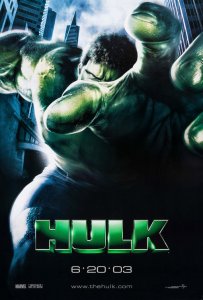 Comic book movies are all the rage these days. The X-Men films, Spider-Man, even Daredevil all managed some level of success because they were, at their heart, entertaining pulp and treated the source material with some sense of reverence. Now Ang Lee’s monstrous film Hulk lumbers into theaters and one could best describe it as being too serious for its own good.
Bruce Banner (Eric Bana) is the quiet guy, the one who bottles everything inside. His lab partner Betty Ross (Jennifer Connelly) has recently broken off their relationship due to his emotionally shut-off demeanor. Well Bruce gets hit with a lethal dose of gamma rays and it kicks up something inside him. You see, Bruces long-absent father (Nick Nolte, looking frightfully like his drunken mug shot photo) experimented some kind of regeneration serum on himself. When he fathered Bruce he passed on whatever genetic alteration. So now when Bruce gets mad he turns into a 15-foot raging Jolly Green Giant (the CGI in this movie is not good). He starts enjoying the freedom letting go can bring. Nothing gets him more mad than some yuppie (Josh Lucas, badly miscast) trying to buy out his lab and then kill him to sell his DNA to the military. Along the way, Betty’s father (Sam Elliott) tries to hunt Bruce and his greener-on-the-other-side alter ego for the good of us all.
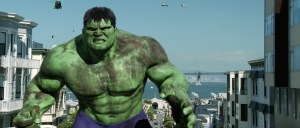 Director Ang Lee has injected most of his films with a sense of depression and repression, from the biting and darkly astute The Ice Storm to the stoic Gary Cooper-like silence of the aerobatic samurai in Crouching Tiger, Hidden Dragon. He’s a master filmmaker without question. Lee bites off more than he can chew with Hulk much like the gifted Cameron Crowe did with the sci-fi Vanilla Sky. Lee is so damn ambitious that Hulk tries to be everything and it ends up fulfilling nothing. His film is the most ambitious and the most tedious super hero/comic book movie of all time. What does it say when the super green Hulk has more personality than the bland Bruce Banner?
The acting is a non-issue here. Connelly remains one of the most beautiful women in all of movies and has incredibly expressive eyes and brows. She has this strand of hair thats always in the right side of her face. It’s so awkward. Bana gets the least fun part as the mentally scarred kid afraid of his own anger. He doesn’t do much but then he isn’t given much. Elliott overacts with impressive gusto whereas Nolte overacts like every line was his last breath.
After about an hour or so of beleaguered talking and flat characters, I started to become restless. I wanted to see Hulk smash, Hulk smash good. Instead what you get is endless scenes of cheesy speeches, sci-fi babble speech, phony philosophy, and mind-numbingly awful pacing. Seriously, Hulk has worse pacing than glaciers. You’ll see the Mona Lisa yellow faster than this movie will be over. And in some weird paradox, I think it will never be over.
 Lee attempts to make the film a living comic book. You’ve never seen this many wipes short of a Brady Bunch marathon on TV Land. Lee splits his screen into multiple panels and slides them around much like the layout of a comic book. However, this visual cue is overused and calls attention to itself in a how arty are we kind of pretentious way. If Hulk was attempting to be a comic book movie, then where the hell did all the action go? This movie could have been subtitled The Hulk Goes to Therapy because everything excluding an over-the-top final act revolves around people working out childhood issues. Man, there’s nothing I like to see more during the summer than a $150 million dollar movie about people working out childhood issues. Oh yeah!
Hulk is an overlong and ambitiously meandering film thats incredibly serious, incredibly labored, and incredibly boring. Someone needs to tell the creators of this film to lighten up. The big-screen adaptation of the big green id may have heavy doses of Freudian psychoanalysis (try and tie THAT with the merchandizing onslaught) but the film is barren when it comes to fun. Even comic book fans should be disappointed. I heard a story of a kid who saw Hulk and asked his mom when the movie was going to start, and she replied, “90 minutes ago.” Should you see Hulk in the theater at full price? No. Instead, give your money to me. It will have more resonance and action than anything this bloated, joyless, self-important vacuum of entertainment could offer.
Hulk mad? Audience mad! Audience leave theater. See other better movies instead. Hulk sad. No Hulk 2. Audience happy.
Nate’s Grade: D+
Share this:

The Italian Job (2003)
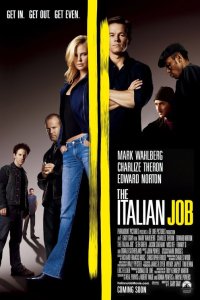 The Italian Job is equal parts dumb and equal parts entertaining, which makes for fine breezy summertainment. The cast is agreeable, the heist is interesting, the action is full of sexy cars and explosions; I call into question how in the world Jerry Bruckheimer’s name is absent from this. Maybe he’s too busy with his TV work.
The film opens up on a nifty heist in, of all places, Venice. Grizzled old-timer John Bridger (Donald Sutherland) leads his crew for, say it with me now everyone, one last heist. Charlie (Mark Wahlberg) is his second in command and the heir to the thievery throne. The crew steals a safe full of gold bars by applying explosive paint to specific levels of ceilings, causing the safe to drop two floors into the awaiting arms of our scoundrels. The Venice police believe the safe to be riding off in a boat, driven by the crew’s getaway man Handsome Rob (the always good to have Jason Statham). But no the real safe has fallen into the canal and Charlie and John are scuba-safe-crackin’. The crew gets away with their misdeed and toast about their thievery atop a mountainside.
 Everything is good. But wait, Steve (Edward Norton) double-crosses his peers and hijacks the gold and kills John. Heres what I dont get. Everyone in the crew is shocked, especially an overactive and whiny Wahlberg (and there’s no worse kind than a whiny Wahlberg). “How could you do this?” whines Whiney Wahlberg. Let me think here. Maybe its because … YOU’RE ALL THIEVES, JACKASS! What was that old saying, no honor among thieves or something. To paraphrase Go, you guys aren’t exactly in a highly ethical industry. There aren’t good thieves and bad thieves; this ain’t no Errol Flynn pic. I would also like to note that everyone in the crew should have known of Steves predestined treachery just by the fact that Norton has a mustache. C’mon, do you need any bigger a sign? Anyway, the van the crew is in drives off a bridge into subzero water. Steve fires some round into the water and believes hes killed his former crew. They of course are not dead and instead are using the scuba gear to breathe. Of course, it’s still subzero temperatures but what does that matter?
We then flash to one year later. Dead John’s not-so-dead daughter, Stella (Theron), conveniently works as a professional safe-cracker to tests security systems. Hmm, I wonder if that will come in handy later. Charlie approaches her with a plan to re-re-re-steal the gold from Steve, the man who, dramatic pause, killed her father. She agrees to help because she wants to see the look on Steve’s face when he finds his money gone. Its probably something very similar to many people over 40 I see now that the stock market is full of price-inflated charlatans.
 What follows is Charlie reassembling his crew; Seth Green as the geeky tech dude, Handsome Rob, and Mos Def as the demolitions expert. Together they work out a plan that is part elaborate and part ludicrous, but still entertaining. This is where The Italian Job gets the rules of heist cinema right: 1) Efficient amount of time must be made to plan the heist so the audience knows the steps and every role of importance. 2) The heist must go off for an extended period of time for the audience to enjoy the payoff of watching all the rehearsal proceedings. 3) The heist has got to be done in an interesting way. 4) Not everything has to go according to plan. The only real action sequences in The Italian Job bookend the film, with the opening Venice heists and the later and extended Steve steal. With this said, the end still carries a good sense of payoff for the audience, and watching all of the different elements of the team work together with their own responsibilities builds a sense of attachment to these otherwise undeveloped characters.
I am convinced Mark Wahlberg is a black hole of acting. Sure, he can do Affable Lug fine and dandy as evidenced by Boogie Nights, but when Wahlberg attempts (and that is the operative word) to emote he looks like his leg is caught in a bear trap. His whole bland handsome understatedness isn’t fooling me. Theron is a pretty face but I still havent seen anything shes done to convince me shes anything more. Green is very funny in his geeky role, complaining that he had the original idea for Napster and it was stolen from him by his roommate. Statham and Mos Def round out a likable if slightly one-note crew.
Director F. Gary Gray (The Negotiator) has graduated from the world of music videos but still knows how to stage some exciting scenes. The slick ending heist, with the L.A. gridlock, three trucks to chase after, and fleet of patriotic Minis is a great popcorn action set piece all the more appreciated because of the patient setup the movie has given.
In the days of summer, where some people wrongly consider a bloated and pretentious action film to be entertaining, even if they dont get a lick of it, it’s especially nice to have something like The Italian Job remind us the escapist fun summer flicks can offer. Just don’t worry if Wahlberg looks to be in pain.
Nate’s Grade: B-
Share this:

The Matrix Reloaded (2003)
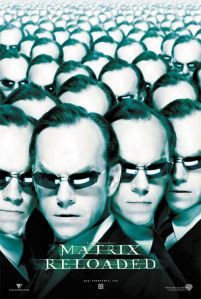 Imagine my disappointment as I viewed the highly anticipated sequel to 1999s sci-fi smash The Matrix and learned that the writing and directing team of the Wachowski brothers had taken a page from good ole George Lucas on how to make sequels: the bigger is better and more is more approach. Like the first two Star Wars prequels, the second Matrix movie is overstuffed and unfocused. Unlike the Star Wars prequels, it’s also extremely talky when it comes to psycho-babble that would only impress the bong-carrying peanut gallery.
Reloaded picks up sometime after the first. Morpheus (Lawrence Fishburne), Neo (Keanu Reeves), and Trinity (Carrie-Anne Moss) are late for a pow-wow with other leaders including Morpheus former flame, Niobe (Jada Pinkett Smith). In this meeting, which is within the Matrix, we learn that the humans have discovered that the machines are drilling at an incredible speed and will reach Zion, the last human city far beneath the Earth, in a matter of days. Add this to the bad dreams Neo keeps having where Trinity falls out of a building and gets shot by an Agent, and things are not looking good for our heroes from the first film.
At Zion, Morpheus stokes up the crowd who already believe that Neo is The One in the prophecy of the Oracle (Gloria Foster). They believe he is the one who will lead them to topple the machines. Morpheus informs the many citizens of Zion (okay, the last battalion of the human race lives in caves under the surface and people are STILL wearing sunglasses all the time? Watch your heads.) that the machines are digging to a town near you, and they have 250,000 Sentinels to wipe out what remains of humanity.
 So what do people do next; what would your standard response be? Apparently, in Zion, it involves a massive spontaneous, sex-charged rave. The multitudes of Zion start grinding and sweatily dancing to electronic beats. And curiously, as youll notice with the slow camera movement in the scene, NO ONE in the future wears a bra. Perhaps the machines got those too. So after a tremendously long span of raving with nipples, intercut with Neo and Trinity knockin boots (though could you imagine zero-gravity sex in the Matrix?), the heroes set off to find the Oracle once more. Zion is preparing to mount a counterstrike against the burrowing machines and is hopeful that it will buy them some time. They plan on sending the entire fleet out, save Morpheus ship and one or two to aid him in his quest.
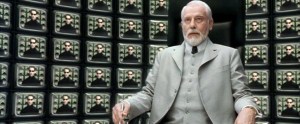
Neo finally regroups with the Oracle along a park bench inside the Matrix. She puts forth more psychological babble about choice and how choices are already made before you make them. You may start zoning out and wondering when people are gonna start punching people again, because it takes a good 45-50 minutes to get into this movie. The Oracle does have an interesting tidbit of information however. She reveals that the Matrix if just chock full of rogue programs living out their days in the confines of this virtual reality. Included in this group are werewolves, vampires, ghosts, angels which are all programming errors that walk among the Matrix. So, wouldn’t it be kind of neat to see Neo fight the monsters from Universal Studios (Hey Frankenstein monster … I know kung-fu Fire baaaaaaaaaad!)?
The supreme drawback of Reloaded is that it introduces us to a plethora of new characters, all with minimal screen time and even more minimal plot impact, and then fails to advance the story. Niobe is pointless except for the old action picture adage of being at the right place at the right time to rescue our seemingly doomed heroes. A rogue program that calls himself The Merovingian (Lambert Wilson), who decides on being a European playboy with an accent that renders all speech useless, snoots and huffs his way around. Monica Bellucci plays his wife. This Italian actress can be enthralling, and not just on the eyes, but she also serves minimal purpose other than some heaving chest shots. Then theres the Keymaker, who will somehow lead Neo to his destiny or whatever. Theres about fifteen or so new characters and hardly any of them matter. The coolest additions are the twins, a pair of pasty dreadlocked fighters who can go through walls and parry any enemy assault. More time is needed for these two before they turn into another wasted villain, like Star Wars‘ Darth Maul.
 All of this criticism is moot, of course, because the center of The Matrix is on inventive and pulse-pounding action, right? Well I’d say that is so with the 1999 film but its sequel suffers when its action sequences drone on and become repetitious and dull. Neo fighting twenty or so replicates of Agent Smith (Hugo Weaving) is interesting and fun, but when ninety more show up and its painfully and slightly embarrassing when the people fighting are CGI, then the fun level drops with the film. Neo ends the big brawl by flying away. My friend next to me whispered in my ear once this scene concluded, If he could fly, why didn’t he fly away at the beginning? My response: That would be using your brain. Seriously, this action sequence is nifty and all but it serves no purpose, just like much of the first half of the film.
The freeway chase scene seems to already be famous and with due cause. Trinity and Morpheus zooming through traffic, fighting Agents and the twins, is a fantastic set piece that is reminiscent of the inventive action the first Matrix gave us. When Trinity zooms through oncoming traffic on her motorcycle the film comes alive and my attention was certainly front and center. The scene does fizzle a bit as it segues into Morpheus fighting an Agent atop a speeding semi. Again, the CGI rotoscoping of the landscape and the people is painfully obvious and detracts from the enjoyment.
What ultimately kills The Matrix sequel is that no one had the heart to question if maybe more wasn’t better. Sure the Wachowski brothers had all the riches unto Caesar to make this movie, but what perplexes me is that once we do get much more it only feels like more of the same, and disappointment sets in. Agent Smith is shoved to the side of the film and pops up here and there to glare. He’s more or less just repackaged with nothing new and no personality, like much of the film. The purposely perplexing psycho-babble does not help. Im sure hundreds of websites will dissect the exact philosophical links the movie presents, but man, all this talking about stuff thats shutting down my brain is getting in the way of ass-kicking. I felt bloodlust the more I heard people, usually some old fruitcake, endlessly blab about causality and choice. When it comes to action-packed sequels from 2003, I’ll take X2 any day over Reloaded.
 This is not to say that Reloaded is a bad film because it does have some nice special effects, cinematography, and some cool action sequences. These points of interest do not, however, justify its bloated running time. Some things were better left to the imagination, like the city of Zion, which looks about as dreary and dull as you might expect the last bastion of human civilization to look like in a ruined world, but this is science-fiction. Where’s the fun in dreary and dull? Again, whereas the first Matrix took place mainly in the false virtual reality where we could watch fantastic feats defying the laws of physics, Reloaded spends half its time running around the dank real world.
Some moments did have me giggling, like the Merovingian’s joyous creation — an orgasm cake. A woman has a piece of cake and her temperature rises. Finally the camera zooms into her vagina (its in computer-code so its all columns of sexy green numbers) and we see an explosion of light. Very interesting indeed. Essentially, this is a key metaphor for the film itself: an attempt to have its cake and eat it too.
The Matrix: Reloaded is an occasionally entertaining and often mind-numbingly talky summer entry. Youll get some thrills, maybe the philosophy will connect more for some (even though to me, at the heart, they say very little very eloquently), but because The Matrix is a colossal franchise that will make a gazillion dollars and then some, the power of editing has been kicked to the curb. If that power had been present perhaps someone could have trimmed a few of the many peripheral characters, kicked the pace up a few notches, reworked the fight scenes to advance the plot and stopped events from being so repetitive, and while they were at it maybe they could have done away with all the philosophy and stilted love dialogue. As it stands, The Matrix sequel has lost a lot of edge and this is because of the initial success of the first film. Sure, you might have an intermittently good time, but you should have had a great time. The Wachowski brothers had every tool at their fingertips but they became so enamored with fame and fortune that their work of creativity and genius has morphed into a self-indulgent, adolescent (with its hormone driven sexual events and its stoner philosophy), cash cow.
Nate’s Grade: C+
Share this:

The Man on the Train (2003)
 A dark stranger gets off a train in France. He has piercing blue eyes and a weathered face with a machine-like expression. This man is Milan (Johnny Hallyday) and he’s stopping by this small French town for a new job. Oh, Milan’s business is robbing banks. In this small village he befriends a garrulous retired poetry teacher, Monsieur Manesquie (Jean Rochefort). The two men spend their time wishing they had the life of the other. Milan openly seeks a comfortable life surrounded by books. Manesquie is a huge fan of Clint Eastwood movies and longs for some action in his life. He secretly dreams of one day robbing a bank just for the fun of it.
So, an interesting start for a film, right? Sure. But this IS the movie. The Man on the Train is a middling character experiment. The two men rub off each other, with Milan teaching a young boy the wonders of poetry, and Monsieur Manesquie learning how to properly fire a gun. The scenes are nice and both actors are splendid (especially French rocker Hallyday) but the film is one long muddled and meandering trip until our inevitable climax. The ending feels needlessly open-ended and a tad clumsy. There’s also a subplot featuring a young mistress for Monsieur Manesquie that sticks out like a sore thumb.
The Man on the Train is well shot and well acted but it only feels like the first half of a movie. I’m sure plenty of people out there will appreciate the character nuances and small moments, but this is a film completely driven by small moments that never adds up to anything larger. Maybe The Man on the Train just isn’t for me. Or maybe I need to just wait for the second half, if it ever gets made.
Nate’s Grade: C+
Share this:

X2: X-Men United (2003)
 Rollicking entertainment until they reach the dam and things get really bogged down. However, still the action film to beat this year. I heart Bryan Cox. X-Men 2 shows the promise of the X-Men world after the somewhat dull first film. Thank God we got the jumping point out of the way because now we can have fun with these characters and their world. And X-Men 2 is great fun. This is how sequels should be.
Nate’s Grade: B+


You must be logged in to post a comment.