Author Archives: natezoebl
Inception (2010)
 Without a doubt, no movie has piqued curiosity like Christopher Nolan’s Inception. After breaking all sorts of box-office records with The Dark Knight, Nolan earned some capital. He wanted to make an expensive, intellectually demanding, high-concept movie that takes place mostly in the realm of dreams. The studio said yes, anything to keep their golden goose happy before a third Batman can roll out. Nolan has been tinkering with the script for Inception for almost ten years, trying to scale it down but never being content. This is a story that called for the biggest stage, which required a heavy price tag, and could only be fulfilled once Nolan was an established hit-maker. Early images of shifting gravity and folding cityscapes got people buzzing but then the concern was whether Inception would be too smart for audiences to embrace. You know, the same public that made two Alvin and the Chipmunks films blockbusters. Two weeks running, Inception has made a sizeable portion of money and become the “must-see” movie of the summer. Score one for the public.
Dom Cobb (Leonardo DiCaprio) is an expert extractor. He can sneak into your dreams and discover whatever secret you’re hiding from your self, your wife, even your shrink. All for a tidy sum, of course. He’s on the run from U.S. authorities because they believe he killed his wife Mal (Marion Cotillard). A rich businessman, Seito (Ken Watanabe), promises to clear away the pending charges if Cobb can perform one important job. Instead of stealing an idea, Cobb will have to plant an idea, known as inception. A young upstart (Cillian Murphy) will inherit his dying father?s empire, and Seito wants the guy to break up that empire and sell it off. Cobb enlists the help of a skilled team to pull off what is believed to be impossible; Arthur (Joseph Gordon-Levitt) as the point man, Ariadne (Ellen Page), as the architect of the dream world, Eames (Tom Hardy), a forger who can convince the mark he?s other identities, and Yusuf (Dileep Rao), a chemist that creates a compound to put the team under a deep sleep. They’ll need it because Cobb plans to go three levels deep, a dream within a dream within a dream in order for inception to take root. The only way out is a “kick,” the sensation of falling that will awaken the dreamer. The team is under great risk not just from the dream world, but also from Cobb. He?s been secretly keeping memories of his dead wife alive and she keeps intruding into shared dreaming, causing havoc, relying on the same info that Cobb knows. The deeper they go into the dream the deeper they also go into Cobb’s memories.
 Inception can be many things to many people, as is the nature of dreams. I found the movie to be a master class mousetrap. Watching Nolan and his origami-like script fold and bend and connect is a true pleasure. However, the movie is not a great character piece. Cobb is the only person on the entire team allowed any sort of back-story or inner lives or even personality traits. What do we know about Arthur, Ariadne, Eames? Nothing. They are all members of the team, but it is Cobb who is the only one allowed to have supporting details. Despite Cobb’s tragic past with his wife, emotionally the movie can best be described as a bit distant (not cold, distant). Nor does Inception deal with the psychology of dreams or the interpretation of the subconscious and its links to our own reality; this movie does not have Freudian psychoanalysis in mind. What Inception does deliver is a brilliantly staged heist that takes place in the realm of dreams, and if that doesn’t sound like a fun concept then I don?t know what does. To get to that heist, the audience must slosh through about 90 minutes of solid set-up and exposition (Pages character is essentially an exposition device). There are a lot of rules to digest in order for the final hour to have the impact that it does. If you nod off for a portion of that time, like my father, you will be lost as to why anything is exactly happening. Having seen the film a second time, I can say that once the hyperactive “Oh my gosh, this is awesome!” haze of newness wears off you do realize that the pre-heist portion of the movie can be a bit slow. I think that for future DVD-viewings I will skip to the start of the heist and sit back and relax (much like skipping the first hour of King Kong).
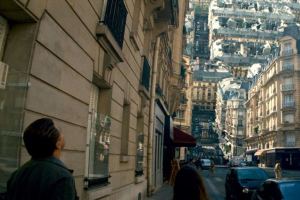
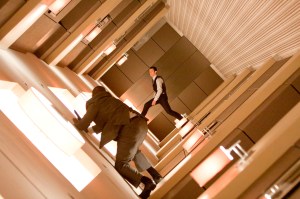
After talking about what Inception is not, let’s focus on what Inception is. It is a massively entertaining, brain-tickling thriller with eye-popping visuals that verge toward the iconic. Nolan isn’t the greatest orchestrator of action (a foot chase in Mombassa is pretty lackluster short of a narrow alleyway) but the man knows how to put together tremendously memorable set pieces. From Paris folding upon itself to a fistfight in a revolving hallway, Inception is packed with stimuli to ignite the senses. It’s the first movie in years that I walked out and thought, “How did they do that?” It renewed my sense of mystery and wonder with the movies. And the last hour is ridiculously fraught with tension as the movie descends level after level of subconscious, juggling four separate action set pieces with mounting climaxes. The revolving hallway fight is perhaps my favorite action scene in years. I still got goose bumps the second time. Gordon-Levitt hops from ceiling to floor like he’s Spiderman, or Gene Kelly, all while the camera remains fixed. Gordon-Levitt gets a lot of zero gravity experience in this movie. He might have qualified for a free ride on the space shuttle.
Like the alternate reality of The Matrix, people can manipulate the world of dreams, which allows for some imaginative visuals. Aside from the dreams-within-dreams impacting one another, there aren’t really playful distortions of reality. There?s a few M. C. Escher-inspired staircases but nothing too out of bounds. Nolan devises a reason for this since the dreamers do not want to call attention to altering the dream. They want to hide among the subconscious projections; get in and get out without being noticed. You do wish that Nolan played to the potential of his flexible reality, but on the other hand, it’s still fairly mind-bending to reach inside a magician?s hat into another magician?s hat and so on. I wonder if there was another story that could have succeeded in this setting, namely competing thieves that have to race against time within the world of dreams. Think about it next time, Nolan. That one?s on me.
 But the most exciting aspect of the movie is how intellectually stimulating it is. The movie is jam-packed with ideas like Nolan’s other works, so much that it’s hard to fully process everything the film offers in one sitting. The pieces do fit together and the movie follows its own internal logic, so if you didn’t skip out on any bathroom breaks, you should be able to follow along reasonably. On first viewing, Inception is bristling with intelligence and narrative complexity, and it rarely stops to pander to an audience. It expects you to keep up for the rewards that will follow, and they are indeed rewarding. The movie isn’t as complicated to follow but it can definitely get complicated when you try and explain action beyond a literal level. Nolan laces all sorts of narrative stops and peculiarities that can be targeted for an alternative thesis statement on the ending. The very ending shot is ambiguous perfection. It keeps the mystery of what constitutes reality while providing an out for people that want to formulate a happy ending. There’s plenty of room for interpretation and analysis but it doesn’t get in the way of telling a good story. Hollywood is pretty risk averse when it comes to anything that makes people think, let along anything expensive that requires active synapses. Nolan has long been a filmmaker of intellectual heft and non-linear narratives. His narratives are complex puzzles that snap together with airtight precision. The joy of a Nolan film is surrendering yourself to his narrative origami and waiting to see the Big Picture. There are new insights to discover with every viewing. Nolan may not be the second-coming of God, as those frothing at the mouth on Internet message boards proclaim, but I can think of no other director working today who harnesses Big Ideas on such a big stage.
Inception is a $160-million dollar studio film with substance, but it also looks like money well spent. The film looks amazing. The cinematography by Wall Pfister (Dark Knight) is gorgeous without being self-consciously arty, pleasing the senses without drawing too much attention away from the story. But with a screenplay that makes all kinds of leaps, you need the help of a good editor to guide the proceedings. Lee Smith (Truman Show, Master and Commander) is that man. While the repeated cutbacks to the van falling in slow motion can be giggle-inducing, Smith gamely holds everything together thanks to his skill in juggling all the parallel storylines/dreamscapes. Finally, the score by Hans Zimmer (The Lion King, Gladiator) is full of ominous, blaring horns that send shivers and get your blood pumping. Johnny Marr (The Smiths, Modest Mouse) even added an assist by strumming the guitar licks on the score. Apparently Zimmer’s key score themes are actually the tune “Non, Je Ne Regrette Rien,” the Edith Piaf signature song used to signal “kicks,” played at a slowed speed. At the risk of sounding like one of those frothing from the mouth on the Internet, that’s insanely cool.
 The acting is uniformly good with a few bumps. DiCaprio (Shutter Island) might need to do something light after continuous roles where he inhabits mean weighed down by guilt and dead wives (three in a row for those counting). He’s a good emotional anchor. Watching the star of 500 Days of Summer and Brick as a suave, cool-as-can-be action star is improbably awesome. Hardy (Bronson) is a scene-stealer mostly because he?s the only member of the team that has a sense of humor. Cotillard (Nine, Public Enemies) who won an Oscar playing Edith Piaf in 2007’s La vie en Rose, gets her best part since then. She gets to do many things as Mal, a projection of a character. This means that she must be limited in how she fills out the character because she is defined by Cobb’s fading memory. Yet she can be malicious, playful, spiteful, loving, vulnerable, and more. Cotillard and her big, glassy eyes do a great service in selling a romance we only see after the fact. Page (Juno) just feels out of place. She seems like the kid among a group of adults. And while the elfin actress will always look youthful until she applies for an AARP card, Page just seems in over her head. Her performance is fine if a bit mealy-mouthed but she still feels miscast.
Inception. Expect it to become a fanboy religion in a matter of weeks. It wears its influences on its sleeve, from The Matrix to Abre Los Ojos (or the American remake, Vanilla Sky). Thrilling, stimulating on different levels, and supremely engrossing, Inception is just about everything you could wish for in a summer blockbuster, except when it can also feel mechanical, distant, and free of emotion and character development save DiCaprio (perhaps this is further evidence that it was all a dream?). Regardless, Inception is easily the brainiest movie of the year, and usually those don?t get packaged as big-budget Hollywood spectacle. Just make sure to bring your totem the second time you watch the movie.
Nate’s Grade: A
Share this:

The Bounty Hunter (2010)
When a woman runs out of a trunk and is chased down by a man who then tackles her and drags her back to said trunk, how would you react? Horror, right? This scenario is the opening minute of The Bounty Hunter, an abhorrent romantic comedy that fails in every regard. The opening scene is supposed to be funny because it’s two stars and we learn, via onscreen text, that the guy and gal are formerly married. Somehow this knowledge makes the scene… funny? Because in real life no spurned ex-spouses inflict punishment on their former halves. This disastrous and bizarre opening clued me in that The Bounty Hunter was going to be one hell of a slog to sit through. It made me want to put a bounty on the filmmakers who made this mess possible.
Milo (Gerard Butler) is an ex-cop who currently pays the bills as a bounty hunter. Nicole (Jennifer Aniston) is an investigative reporter looking into a series of suicides that might not be what they seem. She’s also due in court for hitting a police horse with her car (the reveal of her actual crime is intended to be a payoff; you?re welcome for having it spoiled). Nicole gets too close to a crime conspiracy that has connections inside the New York City police force, so goons chase her down to kill her. Naturally, she misses her court date and becomes a wanted fugitive, which brings her ex back into the picture. Milo is elated that he gets to drag his ex-wife to jail and get paid for doing so. Along the way, the couple improbably rekindles their old romance while being chased by hordes of goons with guns.
First off, The Bounty Hunter is one of the more unpleasant, tone-deaf comedies I’ve seen in years. It assumes if two people, with obviously zero chemistry, will bicker long enough in shrill voices, eventually comedy will emerge. This is the comedic equivalent of the faulty scientific theory of Spontaneous Generation. The comedy just isn’t coming. I never laughed once during the entire painful 115 minutes. I failed to crack even a smile. I sat dumbfounded, looking back and forth between the screen and my then-partner’s reaction, to gauge if I was truly missing something, mainly the “comedy” part. These people are unlikable and not once do you ever believe that they are capable of even expressing a realistic human emotion. These are people that shouldn’t even exist in a crummy romantic comedy. These are the background players in a crummy romantic comedy, given starring roles and proving with every exhalation why they should have remained Angry Dinner Couple #2. Milo is a jackass who’s full of himself and Nicole is whiny and annoying and they both have massive egos. Butler and Aniston have various acting abilities, though both seem to be in rapid decline, but their hammy acting is trying to overcompensate for the film’s numerous shortcomings. They’re playing broadly, but now they’re just broad, unlikable idiots rather than unlikable idiots. The only way anybody could like these characters is imagining that they’re completely different people.
 The premise itself routinely destroys any plausible sense of believability. Milo chases down his ex-wife in scene after scene, taunting her, spitefully laughing at her misfortune, harassing and threatening her. At NO POINT WHATSOEVER in the entire movie does a single person look at this ongoing relationship and cry foul. Nobody calls the police, nobody intervenes, nobody notices what explicitly looks like a woman being stalked and kidnapped by a creep. At no point does Milo flash a badge to at least provide some context or explain his actions, so scene after scene looks like a blatant kidnapping with the female captive kicking and screaming. There is nothing wacky or amusing in watching a world of apathetic rom-com extras ignoring what is obviously somebody in trouble. The fact that Milo can get away with this behavior in a gala of public venues only makes the movie, and every living being within it, infinitely dumber.
The very nature of the comedy oddly results in plenty of cruel slapstick. Nicole has an officemate, Stewart (Jason Sudeikis), who is smitten with her after a drunken bout of making out. He follows her to Atlantic City and eventually gets hijacked by the goons after Milo. There are several astonishing scenes that just involve the goons torturing Stewart. They hit him in the leg with a golf club, they inject a horse tranquilizer into his neck, and all of this is somehow supposed to be funny. It’s really just mean and rather distasteful. The fact that The Bounty Hunter thinks that this situation is a comedy goldmine speaks volumes to me. Watching a dweeby character repeatedly get injured is not funny on its face, and it’s even less funny when the film just lets it keep happening without comment. Stewart doesn’t deserve his pain and neither does the unfortunate audience watching this garbage.
Director Andy Tennant (Hitch, Fool’s Gold) and screenwriter Sarah Thorp (Twisted) wouldn’t know comedy if it chained them to a car door. Tennant’s idea of comedy is to stretch the comedy, play things as big and as long as possible. There are plenty of moments that have a rather slipshod comedic setup (oh look, they’re chasing a guy on a golf course in a golf cart! This has to end well right?), and then the movie just keeps going and going, long after what was designed to be funny crashed, burned, and had its ashes scattered at sea. His visual style also leans on bright pastel colors that heighten the cartoonish atmosphere. The comic set-ups are along the lines of? Milo chains Nicole to bed. She crawls over him to reach for gun. Sexual dialogue about a “gun.” Milo chases a guy on stilts. Stilts! How could you resist that? And then at one point Nicole tries to make a break for it in a rickshaw. I’m already not laughing. And then the movie wants to be an action caper and lo does it fail miserably at this as well. Nicole is being chased by a bevy of goons because she knows too much. Milo is also being chased by his own bevy of goons that want to collect on his gambling debts. Then there’s a mutual friend/cop who may be dirty or might not be, but it’s just way too many extraneous characters chasing after the likes of Milo and Nicole.
 Thorp lacks an ear for dialogue. She seems to have some basic grasp on the ingredients of funny, but she can’t make them come together and work. Every line alternates between being clumsy, obvious, or clumsily obvious. We’re supposed to be amused by Milo and Nicole’s banter. It’s grating, like you’re stuck in someone else’s miserable family vacation. There’s a moment in the end where Milo has distracted the bad guys and come to save his ex-wife, and then instead of bolting they sit and glumly talk about the failed state of their relationship. Could that not have waited until you were safe? The tone is decidedly uneven and the second half of the film feels like an eternity. The comedy completely gets smothered in the last half because now the movie wants to be taken seriously and we’re supposed to care about the characters getting back together, as if their reconciliation was ever in doubt. Thorp’s screenplay feels like a pastiche of 1000 different movies. There isn’t an original thought anywhere inside this movie. Even worse, there isn’t anything funny. This is the kind of movie that you say, “Well, it had its moments,” except The Bounty Hunter doesn’t even have those “moments.”
The Bounty Hunter is a colossal miscalculation on the part of everyone involved. It is neither funny nor romantic in any sense, it’s weirdly cruel and very casual about it, and the entire movie exists in some contrived, sketchy realm of reality that only exists in the furthest reaches of the rom-com universe. I find it funny (much funnier than anything in this movie) that Butler and Aniston were rumored to be dating after filming this movie. They have no screen chemistry whatsoever, though they can argue in annoying tones effectively. As the film neared its merciful end, I thought about calling somebody to round up those responsible for such an egregious waste of time and money. It’s not just that The Bounty Hunter is a bad movie; it’s a woefully clumsy and excruciating movie even considering the depths of romantic comedies. And if anybody sat through The Ugly Truth, or Over Her Dead Body, or anything with Freddie Prinze Jr. in it, then you know exactly how alarming that statement is.
Nate’s Grade: D
Share this:

She’s Out of My League (2010)
 This is a fairly lackluster, flaccid, infantile comedy that aims to follow the same Judd Apatow formula of equal parts heart and raunch. Where this movie utterly fails is its choice of lead. Jay Baruchel (Tropic Thunder) is not a good leading man (his voice is very nasally and hard to listen to at times), but worse, his character, Kirk, is a callow, simpering, snot-nosed dolt. He has a dearth of a personality; he’s constantly berating himself or groveling for support by his oblivious family and mean ex-girlfriend. You simply don’t care. Kirk is not a guy worth watching. There’s empathy and then there’s pity. The movie wants to be a “nice guy gets the girl” story, but instead She’s Out of My League is a “guy with zero self-esteem and charisma gets the magazine cover model” story. At least in Apatow productions, the schlubby leads had personalities and redeeming qualities. I started enjoying the respites away from Kirk, time spent with his callous family members or his annoyingly juvenile friends. Anything to escape. The jokes have a pretty low ratio of hits to misses (an early ejaculation actually almost becomes an act break that keeps the couple apart), becoming subservient to a clichéd romantic comedy that wants to teach us that looks don’t matter. It’s what’s on the inside that counts. Have you heard that one before this week? If what’s on the inside is what matters, then She’s Out of My League has little to offer.
Nate’s Grade: C
Share this:

The Girl Who Played with Fire (2010)
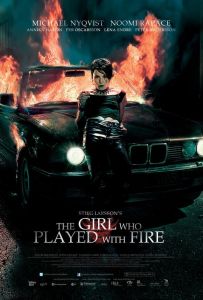 So in the few short months since The Girl with the Dragon Tattoo opened in the spring, the book series has catapulted to even new reaches of fame. It even appeared on the cover of Entertainment Weekly under the headline, “The hottest books on the planet.” I’ll take their word on that one. The Girl Who Kicked the Hornet’s Nest, the third book in late Swedish author Stieg Larsson’s series was finally released stateside, and depending upon when you read this, is probably still on the best-seller list. Larsson’s trilogy of novels is a global publishing phenomenon. The first film in the series made over $10 million dollars in the United States and was the top-grossing film in Europe last year. That says something about a 150-minute Swedish thriller with no-names attached. The Girl Who Played with Fire is the second film in the series and naturally couldn’t live up to expectations after the first smash movie. The second film is good, not great, but really whets the appetite for the concluding movie to come.
It’s been one year since the events of Girl with the Dragon Tattoo. The titular tattooed-girl, Lisbeth Salander (Noomi Rapace), has been living abroad. Her ally and one-time lover, Mikael Blomkvist (Michael Nyqvist), has been trying to get in contact with her but to no avail. Blomvist is about to publish a damning report about sex trafficking with some pretty high-profile names attached as members. The authors of the article are then executed and Lisbeth’s fingerprints are found on the gun left at the crime scene. Salander’s court-appointed guardian, the one who viciously raped her in the previous film, is also found murdered. Blomkvist is certain his companion is innocent and goes about investigating who is truly responsible. Salander comes out of hiding and back to Sweden where she tries to clear her name the best way she knows how. All roads seem to lead to a figure known as “Zala,” a Soviet spy who defected to Sweden ages ago but who has been carrying on in the shadows ever since.
 The focus with Fire in on Lisbeth Salander, which is exactly the character the audience wants to spend the most time with. Salander split duty with Blomkvist in the first film. They were equals, but a crusading journalist just isn’t as interesting as a five-foot Gothic ass-kicking computer hacker. As I wrote: “Mikael isn’t a blah character by any means but he seems to serve as an expository device, the guy who uncovers the secrets and gets to be the helpless foil to Lisbeth. I suppose for maximum narrative effect a straight man would be required to be paired with Lisbeth.” She is the star of the series so it’s a great pleasure to watch her receive oodles of screen time. The second film is significantly devoted to the history of Salander, her back-story, her father, what she did to get locked away in a mental ward (which was hinted at before). The sex trafficking murders are merely a narrative smokescreen. Being framed for the murders puts Lisbeth on defense, but the sex trafficking stuff and the high-profile johns quickly dissolve in the wake of a standard investigation into the mysterious “Zala.” The mystery of this film is really the mystery of Salander’s back-story and family tree. However, being focused primarily on Lisbeth Salander also means that everybody else gets sidelined. She’s on the run and trying to clear her name, but that doesn’t give much room for other people to contribute to the narrative. Blomkvist gets to pensively look at his computer screen a lot and always show up one step behind our heroine. The two are kept apart for nearly the entire movie.
Rapace is still the best reason to see the series. She inhabits the character with tremendous intensity and skill. If you stripped away all the aesthetics, the Goth trinkets, you would still have a vital character. As I wrote before: “There’s much more to this girl than a dragon tattoo and a spiked collar. Rapace doesn’t let the outfits overwhelm her. There’s a certain joyful recklessness to her character hidden beneath a veneer of steely coolness.” Because of her mysterious nature and painful past, Rapace must play all emotions through a prism of emotional reserve. Even though we get a lot more of Salander’s past explained, I felt like we got to know her as a character better in the first flick where she could breathe and behave “normally.” Thanks to being on the run for murder, it’s hard to argue that Lisbeth ever gets a chance to simply be her complicated self, which robs the audience of an appealing character. We project the interest we felt for her from the first film to the Salander stand-in represented in the second film. She’s still a resourceful, loyal, and cavalier presence, but the plot corners her into being a creature of action. She becomes the fantasy bisexual ass-kicking protagonist that was merely hinted at previously. That sounds like a good thing, but trust me, it does the audience a disservice to box in such a fascinating character.
 Girl Who Played with Fire is nowhere near the complete film experience that the first film offered. This movie feels like one half and the continuing half, The Girl Who Kicked the Hornet’s Nest, won’t be out until later in the fall. As such, it’s hard to fully analyze certain storylines at play. I imagine that the sex trafficking storyline will carry on with the third film because of the tease that high-profile figures in government and police offices were involved. It already establishes a conflict and a set of antagonists ready for the third film. Then again, I may be too hopeful and the storylines of interest in Part Two may be completely dropped or mishandled by Part Three (see: Matrix sequels, Pirates of the Caribbean sequels). Girl Who Played with Fire does a decent job of setting up a narrative base and establishing a one-shot villain, somebody to be dispatched by episode’s end. But the movie feels far from complete, and sadly I won’t know until later whether that incomplete feeling is from breaking up a continuing storyline or from deficits of filmmaking. There are too many loose ends with Girl Who Played with Fire for it to feel complete, and thus it cannot help but suffer in comparison to its predecessor.
Where the movie goes haywire is in its adoption of action tropes. The Girl with the Dragon Tattoo was more of a slow-burning thriller with some nasty flashes of violence. The second in the trilogy seems to take place more in the realm of action cinema, which means that things get a little preposterous. There are a lot more car chases, henchmen, fistfights, shootouts, and it almost unravels at the end. Slanader seems to transform into the Bride, sharing two key abilities from Uma Thurman?s character in the Kill Bill series (that’s about as spoilery as I want to get). Salander just becomes like a pint-sized Terminator; she’s indestructible and capable of amazing feats. It’s like the Swedes took the Hollywood edict that every sequel had to be bigger and better than the original. There’s even a lesbian love scene before the 20-minute mark, in case the audience was already getting bored (presented like something out of Cinemax late-night TV). I appreciated that the original film respected the intelligence of the audience, giving a deluge of information and characters to sort and trusting that in time we could follow along. The Girl Who Played with Fire is far less complicated in scope. In fact, it’s a fairly rote detective story that only dishes out clues when the characters need to progress. The first film actually utilized good detective work; the second film just has everything fall into people’s laps at predetermined points of need. The tension doesn’t manifest as ferociously as it did in Dragon Tattoo. For goodness sake, the chief antagonist has a hired goon that is actually a rip-off of a James Bond villain from The World is Not Enough, which was an awful Bond movie! The end focuses too much on the bloody confrontation between Lisbeth and a chief antagonist and an axe that apparently fails to mortally wound people when swung at their craniums.
 I think the switch in directors, from Niels Arden Oplev to Daniel Alfredson, has something to do with the slip in quality. To American audiences, this might not ever register, but the films have completely different tones. The turnover feels less abrupt thanks to the cast reappearing. The direction feels less focused, more casual and pedestrian, relying on that grimy green/orange cinematography that Dominic Sena (Gone in 60 Seconds) always favored so much. Here’s another thing I learned. When it’s not a snowy winter, Sweden looks pretty much like Canada. Seriously, the landscapes do nothing in this movie to distinguish it.
Now that sounds like a lot of quibbles, like I’m quibbling Girl Who Played with Fire to death. In short, it’s not as good as the first one, and the final 20 minutes proves it, but it is still a finely entertaining movie. Even with a less complicated plot, the movie manages to be smarter than most of its Hollywood brethren. It’s more an action movie than a dark, lurid thriller like its predecessor, which means there will be certain limitations on the use of your brain. But the movie plays off our residual good will from the last one, it’s interesting enough, and Lisbeth Salander is rightly the star, so it’s enough to forgive. We’ll see in the fall whether The Girl Who Kicked the Hornet’s Nest can provide a satisfying close to the popular series. As proven, never count Salander out.
Nate’s Grade: B
Share this:

After Last Season (2009)
 After Last Season is a little movie that most people wrongly mistook for a joke. Writer/director Mark Region pulled off something rarely witnessed in modern movies: he put together a low budget movie all on his own and got it released nationally. The movie even has a Quicktime trailer on Apple’s website. It was released last summer in only four cities for a limited trial run, which explains why nobody has every heard of Region’s creative opus. It also might have to do with the fact that After Last Season is so appallingly terrible that the distributor reportedly called the theaters to advise burning the film prints rather than returning them. Naturally, given my cinematic tastes for the finest trash and my keen knowledge of the baddest of bads, I instantly had to see this film for myself. The website After Last Season boasts an Amazon.com customer review (nary a good sign of accomplishment) saying that the movie is unlike any you have ever seen. There’s a good reason for that. After Last Season approaches a near Manos level of ineptitude. That should speak volumes.
The plot, as can best be described, involves a university conducting scientific experiments. Sarah (Peggy McClellen) and Matthew (Jason Kulas) are interns conducting their own investigation into a recent string of murders. They have access to a device that allows the connection of minds, and so Sarah and Matthew link brains and get caught in the wavelengths of the campus killer, who now begins to target them. This plot synopsis is actually too kind and might mislead some into thinking the movie has drama or action or suspense. What really happens are characters who you don’t know doing things that aren’t fully explained followed by unexplained location changes where the whole process repeats itself. You haven’t lived until you’ve listened to Sarah’s roommates engage in senseless conversations about going to the North Market.
 When I say that this movie is awful, I really mean it with all sincerity. This movie is so awful, so off-the-charts painful to watch that there is not an ounce of derisive fun to be had. After Last Season does not fall into that coveted category of “so bad it’s good,” no, this movie is simply disastrously, regrettably, incomprehensibly bad. I would not recommend it to my friends or enemies. From a plot standpoint, there’s about 15 minutes of stuff stretched out to a short but far too long length of 93 minutes. The opening 10 minutes concern characters explaining how an MRI machine operates. It’s like Region once wrote a paper on an MRI machine and wanted everybody to know the work put into it. The characters just keep rehashing the ins and outs of this machine, and the machine is clearly made of cardboard and in the middle of somebody’s living room (is it unusual for a metallic ceiling fan to be placed directly above a Magnetic Resonating Imaging machine?). Then there’s a 30-minute stretch in the middle that is nothing more than two people sitting across a table and dreaming about geometric shapes. 30 minutes! I doubt that I even have the ability to adequately explain the amount of mind-numbing torture that this sequence was. My friend Eric and I just kept looking at one another with hopeful expressions, silently pleading, “Will our pain and suffering soon be over?” 30 freaking minutes! One third of the entire movie is like watching somebody’s annoying screensaver from 1987. I can’t wait for the sequel where it looks like a bunch of windows are flying.
The rest of the script isn’t filled with intriguing character dynamics or challenging drama. It’s almost completely built from non-related scenes with non-identified characters having frivolous conversations about nothing. Most of the dialogue is driven by linked non-sequitors, which prompted me to repeatedly yell at the screen, “Why the hell was that important?” Characters will drone on in useless babble, never once circling a subject that seems to be related to the plot at hand. The small group of actors (you will be amazed that the end credits lists over 15 characters) feels like people awaiting an execution. True, the pitiful direction leaves them unmoored, fighting to find meaning in anything they say, but these people just suck at acting. The general range of acting goes from impassive monotone to somewhat less impassive monotone. It’s the acting equivalent of rounding up random people at the bus station and hoping for a miracle.
 I have seen low budget productions before but this movie looks like it was made for the cost of a lottery ticket. For whatever reason, the current info has the budget at five million but there’s no way in hell that can be true (some producer must have ran off with like the whole sum minus twenty bucks). Reportedly the movie cost $40,000, which I can believe barely, and the special effects cost 4.95 million dollars, which I find baffling. The sets are all overly lit basements disguised by the clever decorative abilities of pegboards and sheets of paper. There are scenes where actual paper is taped to the walls like it was shingles, just like what a child might devise as a means of decoration. There’s even a supposed college class that takes place in this same low-rent location, which means that this particular university is really struggling for endowment funds. This utilitarian approach to locations is what I’d expect from a public access show or a student’s video project. These locations make it seem like every person is one moment away from being gutted by a serial killer just off screen. Did Region have only one abandoned office basement to work with? The visitations by the ghost/mind spirit/whatever are just as bad. We have the embarrassment of watching plastic tubs being pulled across the floor with fishing line. Having a low budget should force Region to be more creative with his use of resources, to work around his limitations. Instead, he just continually shines a bright light illuminating every possible limitation in the movie.
From a technical standpoint, After Last Season is an abysmal entry. It fails not just because of its lack of funds but it fails because Region lacks any filmmaking ability whatsoever. Sure, apparently the man was able to pose actors, have them recite lines, and keep the cameras running, but I expect more from my movies than the same criteria I have for family vacation videos. Region’s directorial style is, ostensibly, to have no discernible visual sensibility at all. Actors will routinely be cut out from the camera frame or the spatial relations will be completely out of whack, allowing for tremendous space above heads or showing the actor’s complete body except the upper half of the face. Characters will be bunched in one tiny section of the screen, or Region will suddenly cut back and forth between two different shots that conflict from a geographic standpoint; they don’t visually match up. There isn’t a single shot anywhere in After Last Season that couldn’t have been credited to a tripod for complete creative inspiration.
Here’s a terrific example of how creatively bankrupt this movie is, and no, I will restrain from making reference to the sheets of paper as decoration. The website for After Last Season actually touts its use of special effects. What special effects, you may very reasonably be asking yourself. Evidently, several scenes had less background coverage, so the special effects gurus took a sample background object and copied it to cover the space (like taking one sheet and making a wall out of them). Okay, fine, except that this special effects wizardry doesn’t always work. The website itself even showcases a scene where Sarah goes in for her job interview and on the right hand side we can see the special effect trick of covering up the empty space. However, the left side is completely untouched, leaving exposed all the set shortcomings and extension cords. Why cover one side but not the other? Too expensive? Here’s the best question of all. Why spend any money whatsoever on lame special effects when you could have simply zoomed in so that the two characters filled the screen? That’s a much more cost-effective option and wouldn’t break the perilous illusion of the movie. It is examples like this that condemn Region as an artist with zero creative ingenuity.
 Now it’s at this point where I have to call into question the integrity of After Last Season. Was this entire project created on purpose to be terrible, and if so, does it even make a difference? Is a bad movie more acceptable if it’s intentional or unintentional? From my perspective, you cannot intentionally make a campy movie. The derisive pleasure must come from the fact that the filmmakers thought they were making compelling cinema at some point. If After Last Season is fake (I hesitate to use that word given its connotation) then it’s an even bigger waste of time (Update: I just read online interviews with Region, and the movie is for real). As it stands, the movie is technically inept on every level of filmmaking with a bad script, bad actors, bad pacing, bad direction, bad sets, bad sound coverage, bad “special effects,” and really bad editing. If Region was dreaming of creating a midnight-movie sensation like The Room then he missed the mark. This movie isn’t any fun whatsoever to watch because there’s not enough going on to make laugh at. With The Room, every scene had like eight things wrong with it; that film was a 1000 brushstrokes of bad. With After Last Season, it’s the same forehead-smacking flaws repeated ad nauseam. There’s no derisive joy to be had here, folks.
I’m not shocked that something as unrepentantly bad as After Last Season exists. There is plenty of crap on the Internet and in this modern age of user media, there’s no shortage of poorly executed ideas finding a wider audience. It’s the same with the infamous 1979 blotch on cinema, Caligula. I’m not surprised that something so debased and wildly salacious exists, what shocks me is that a movie with incest, bestiality, necrophilia, hard-core sex scenes, and gallons of blood would star such a celebrated cast of thespians like John Gielgud, Peter O’Toole, Malcolm McDowell, and Helen Mirren (though if you’ve seen Zardoz you know that Mirren wasn’t too picky in those days). What shocks me is not that Caligula exists but the level of involvement and exposure. What truly shocks me is that After Last Season got a theatrical release over the likes of thousands of other movies fighting for a release. Yes, this only played on four screens in four different cities, but how does anybody justify After Last Season even being in the same consideration of cinematic art? I am faint to even refer to this as a movie. It almost seems like a social experiment with disturbing psychological implications. After Last Season isn’t a movie so much as an endurance test of how much pointless garbage a person can consume before they relentlessly cry, “Enough! You have officially destroyed my soul!” I never thought I’d say these words, but After Last Season makes The Room look competent. Your apology letter is in the mail, Tommy Wiseau.
Nate’s Grade: F
Share this:

Knight & Day (2010)
 Imagine a James Bond movie from the point of view of the Bond girl. That’s the premise for the curiously titled Knight and Day, a mostly breezy action movie that really resembles a romantic comedy with guns. It works thanks to the chemistry between Cameron Diaz (Bond girl) and Tom Cruise (super agent). She’s engulfed in a sketchy international spy caper that is replete with typical stock characters (sleazy agents, kooky scientists, angry authority figures). The movie, under the direction of James Mangold (3:10 to Yuma), tried too hard to be lighthearted and can veer from confidant to indifferent. The film is told from Diaz’s point of view, which means there are chunks of the movie where the action occurs off screen, which will naturally disappoint people. There’s one montage where Diaz has been drugged and she keeps going in and out, waking up to a different dangerous situation. It’s meant to be satiric but it might also frustrate. The action sequences, on whole, are well paced and make use of their exotic locales. Knight and Day doesn’t fully work due to its leaps in tone from satire to sincere romance, the on/off switch for the law of physics, and introducing a secondary antagonist far too late in the film. Cruise lays out a full-on charm offensive. You’re reminded that this man is a movie star, and Cruise has fun tweaking that image as well as the public perception over his mental state. His character may be crazy after all, but Cruise is having serious fun and you might too watching the man with the million-dollar smile.
Nate’s Grade: B
Share this:

When in Rome (2010)
 When in Rome, do not do as this banal movie does. Know what kind of movie you’re in for? There’s an audio record scratch/slowdown effect twice in the first ten minutes. Kirsten Bell (Forgetting Sarah Marshall) is an unlucky in love workaholic who, when in Rome, pilfers coins from the Fountain of Love. This makes the subjects who tossed the coins (Jon Heder, Dax Shepard, Danny DeVito, Will Arnett) magically fall in love with Bell. They chase her back to New York and act like obsessive stalkers. Essentially, this is a rip-off of Love Potion Number Nine, except this rom-com is neither romantic nor comedic. The comedy is mostly brain-dead slapstick and the payoffs never materialize. In one scene, Bell and a date go out for a “night dinner” where they eat completely in the dark. There’s plenty of potential there but it’s like a minute until her posse of stalkers interrupt and the date’s over. There’s stuff like people running into trees, people squeezing into a tiny Italian car, a vase that’s supposed to break as a wedding celebration and refuses to break, and Bell and her lead, Josh Duhamel, have zero chemistry and like a three feet height differential. The movie is so joyless and bereft of energy. The scripts seems to be missing many scenes that fill in details about the various characters, or at least help give setup and context. The movie exists squarely in the absurd realm of romantic comedies and it’s thoroughly mediocre. I would expect nothing less from the writers of Old Dogs. I enjoy Bell but it’s not hard to resist the spell of this junk.
Nate’s Grade: C-
Share this:

Micmacs (2010)
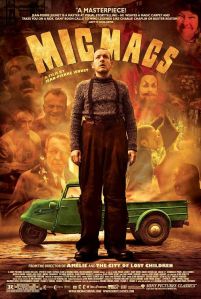 So what exactly does Micmacs even mean? A cursory search online brings me a few definitions: 1) a Native American Algonquian group living in Canada and upper New England, 2) the Algonquian language of the Micmac. That doesn’t exactly clear things up, especially considering that Mimacs is a French movie by the famed filmmaker Jean-Pierre Jeunet. An interview with the director has him explaining that the title is French slang for a mixture. That seems appropriate since the film is a mélange of the director’s other works, high on inventiveness and visual whimsy. Except the one thing Jeunet strangely left out this time was a reason to care amidst the high-powered shenanigans.
Bazil (Danny Boon) is a bit down on his luck. A landmine killed his father when Bazil was a child. He drifted through life, got a job at a video store, and then got a bullet in his brain thanks to a drive-by shootout. The doctors decided to leave the stray bullet inside or else Bazil will become catatonic. Bazil eventually is adopted by a batch of homeless misfits living in a junkyard. They accept Bazil and encourage him to seek vengeance against the warring arms dealers responsible for the land mind and stray bullet. Bazil and his colorful new family plot to antagonize the arms company CEOs. They come up with crazy schemes to then frame on the rival CEOs to escalate tensions. Bazil and crew intend to expose these men and their corporate crimes to the world.
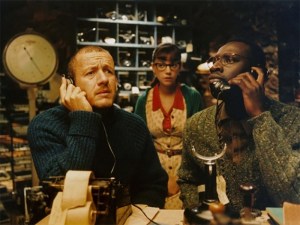 Micmacs succeeds where Rian Johnson’s Brother’s Bloom dangerously came close, and by that I mean that Micmacs overdoses on whimsy and I pronounced it clinically dead about an hour in. It’s too much; it’s just too much. Jeunet has always created movies that existed in rich, idiosyncratic worlds but those worlds always felt lush and lively and bursting with wonder. What saves a movie from whimsy is an emotional connection to the proceedings. 2001’s Amelie is a perfect example of cinematic “magic realism” but it’s also a moving and emotionally rewarding love story that transcends the plucky heroine. 2004’s A Very Long Engagement was a rapturous, old-fashioned love story with flights of fancy. Now, after a long six-year absence, Jeunet seems to have lost touch with the heart. There is no real emotional entry point for Micmacs. The protagonist is pretty much a blank. Yeah, you want him to get justice and you pull for the underdogs, but at no point did I care whatsoever for any character. Most of the junkyard characters are just ideas, walking-talking heist components (the human cannonball, the girl whose brain is good at math, the toy maker). Several characters barely exist except for their specific roles in Bazil’s schemes. There’s a romantic angle with the female contortionist (Julie Ferrier) and Bazil, but that comes off as less a function of the narrative and more of a desperate “Well, who else is gonna get together?” necessity. Jeunet has put together a movie that is all surface and no polish. Sure, the movie is intermittently entertaining and has plenty of imagination, but Micmacs is without a doubt the least involving and least accomplished film from a man responsible for a fantastic output.
The tone of the film seems to hew to something like a silent movie, which might explain why all the older members in my audience were constantly giggling while I just occasionally snickered under my breath. The comedy never rises above the chuckle level. There’s plenty of controlled wackiness, nothing gets too out of hand or edgy despite the fact that the plot revolves around getting vengeance on arms dealers. I was expecting something a little darker than the cutesy oddballs that I got. The best and darkest moment in the film is when we see that one of the arms dealers collects body parts of dead celebrities (Marilyn Monroe’s molar, Mussolini’s eyeball). It’s an interesting quirk that actually reveals something about the dark heart of the antagonist. There should be more moments like this. The bullet in Bazil’s brain is barely referenced. I have no issues with whimsy when it doesn’t overwhelm the narrative, and that’s the problem with Micmacs. The story is merely the vehicle for the inventive hijinks. The story is suffocated by whimsy and visual energy, therefore there’s no room for character development. All that inventiveness takes center stage. If playfulness is all you seek in a movie, then Micmacs will likely satisfy. Jeunet still makes movies that nobody else does, but he’s fallen fall short of his own lofty standards.
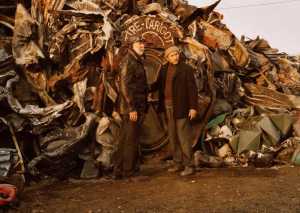 The movie moves along so quickly that it seems like every character just naturally intuits what must be done next, like they all have the screenplay in hand just off camera. Bazil is so quickly adopted by the junkyard gang. He so quickly discovers who is responsible for his life’s troubles. The schemes are so quickly thrown together. They aren’t even that complicated, mostly distracting and framing. The movie just feels like a spinning plate that has to keep moving or else everything will just break. I suppose Jeunet and his longtime co-writing collaborator Guillaume Laurant are trying to keep things busy so people won’t notice that they don’t genuinely care what happens.
This being a Jeunet film, of course it’s spectacular from a technical standpoint. Every frame of a Jeunet film can be used as a mural. His compositions delight the eye and the colorful cinematography by Tetsuo Negata (Splice) makes Paris seem like a dream city. The production design looks like it was taken directly from the Steampunk Architectural Digest magazine. You’ll never have to worry about the visual aesthetics or ingenuity of a Jeunet film. But there are plenty of artists that can master technical craft (you can find them in the world of commercials) but it takes something much more to marry technical precision in the service story and character. Micmacs is a strange film not because of plot, character, tone, or energy, but because Jeunet spent six years in absence and returned with a film that’s got plenty of style but no heart inside all that artifice.
Nate’s Grade: B-
Share this:

The Final Storm (2009)

Famously detested film director Uwe Boll finally tackles a subject that many film fans, and video game aficionados, felt he could possibly be the harbinger for – the apocalypse. Yes, in our apocalypse-drenched times with the bottoms falling out of economic markets and civil unrest, it was only a matter of time before Boll decided to put his unique German stamp on the end of the world. Usually we associate a feeling of dread with the apocalypse, akin to the feeling of dread whenever somebody turns on a Boll movie. Except Boll’s apocalyptic entry, The Final Storm, is a direct-to-DVD oddity that actually works for a while but ultimately fails like other Boll movies. But here’s the funny thing – it’s not Boll’s fault.
Tom (Steve Bacic) and Gillian Grady (Lauren Holly) ditched their big city lives to raise live on a farm out in the country. The TV is filled with apocalyptic flair: riots, fires, strange weather, radiation leaks, power outages, etc. Over the night, a ferocious storm knocks out the family’s power. Their dog runs off into the night and a mysterious stranger collapses on their doorstep. Silas (Luke Perry) says his family used to live on the Grady farm, but he can’t remember much else. Tom is convinced (somehow) that Silas is no good, whereas Tom’s wife is happy to accept a guest that will agree to do housework. When the Grady clan, plus Silas, enters into town they find it deserted. People seemed to have vanished overnight, except for the violent gang roaming the town. Silas, a man of faith, is pretty confidant that God’s Rapture is upon mankind, but Tom goes back into town once more to seek answers about the world and about Silas’ family past.
 For a while there, The Final Storm actually presents a pair of intriguing mysteries that keep the mind occupied: 1) Who is Silas, and 2) What has happened to the outside world? The world has pretty much disappeared; neighbors are gone, the police station has half-drunk cups of coffee and half-eaten donuts. Tom keeps trying to find a rational explanation for what is happening, arguing that the empty town was evacuated as a precaution. But a precaution against what exactly? Something major is underway or has already taken place. Ever since the heavy storm, there have been no birds singing or circkets chirping, no real noises of any kind. Silas is pretty confidant that it’s the end of the world and says that all they have to do is “stack up the chairs and turn out the lights.” Boll places us in the family’s camp; we only know as much as the beleaguered family trying to make sense out of the unexplainable. Canadian screenwriter Tim McGregor (Bitten) is telling a worldly event from a small perspective, trying to personalize the apocalypse. There are no big special effects sequences a la 2012 where the earth swallows cities whole. There is only uncertainty and an overall dread that something is coming but must be waited for. It’s an unsettling thought and played out with enough Twilight Zone –level ambiguity to keep the audience guessing and sticking around for answers.
A general complaint is that nobody seems to react about, you know, the End of Days. Animals and people disappeared over night. Certain townspeople are left behind. Why? Why were others taken and others not? How exactly does that one get explained (in the Left Behind movies, they comically tried to explain the Rapture as “radiation”)? The only one who shows any sign of concern is Gillian, probably because she’s slotted into the thriller female role and thus needs to express concern and eventually need saving. Tom is too preoccupied with his paranoia over Silas, and Silas is supposed to be mysterious so he reacts like he always knew the apocalypse was right around the corner. Even Graham (Cole Heppell), the Grady’s son, seems to be more concerned with his missing dog than the end of all existence. If only everybody was this blasé about the End of Days.
But then there’s that other mystery. Silas shows up at the Grady family home the night of the intense thunderstorm. He says he can’t recall how he got there, per se, and his body is covered in Biblical tattoos. Silas also appears to have some sort of insight into what’s happening in the world. He even tells Graham that his dog, which ran away during the storm, is dead. He’s so certain and preoccupied with making a nice grave marker for the dog that I almost started guessing that Silas was the dead dog incarnate. Seriously, the movie really tries hard to present the illusion that Silas has some sort of ephemeral connection to what is happening, some sort of understanding that goes beyond knowledge of Scripture.
And then the last 20 minutes of the movie reveal that Silas is … (spoiler alert) just some dude who killed his dad and escaped from prison. The Grady home is Silas’ old family home. So the guy who Tom kept saying was dangerous, who showed no real signs of being unbalanced or anything other than courtly and helpful, is revealed to be your standard killer on the loose. This is where The Final Storm utterly falls apart. These characters should be reacting with more alarm about the end of the world. Perhaps McGregor was trying to illustrate how extreme situations affect us, and how jealousy and paranoia can take hold as a means of comfort and survival. But I don’t buy that. First off, it rewards Tom for his unchecked paranoia that had no basis in reality. Silas fixes the roof, helps fend off attackers in town, and chops wood, but it all just makes Tom angry. The last 20 minutes is Silas fully embracing his villainy, the stuff that didn’t show any previous signs of existing. Silas is one big red herring and the movie shifts gears so quickly and absurdly to fit in “super able killer terrorizes family clan” mode. Silas gets frisky with Gillian, asking her to bring in hot water for his bath while he’s in the tub (it’s like an Amish Body Heat). Then he goes full crazy and tries to hang Tom in a tree. Eventually, Silas is set on fire and stabbed with a pitchfork. Then the family stares into the sky and watches as stars get blotted out and the universe collapses. Where is the connection to the apocalypse? The two storylines don’t seem to mix when there is no greater connection. It feels like an ordinary “dangerous drifter” story weirdly set against the backdrop of the apocalypse. Why connect these stories if there is no relevancy, McGregor? It seems like an awfully big waste of time.
Luke Perry (TV’s first Beverly Hills 90210) and Lauren Holly (Dumb and Dumber) don’t seem too shocking to star in a Boll movie when you remind yourself that this isn’t 1996 and neither star has exactly been in high demand since their zeniths. That’s the Boll casting way: catch a falling star. Perry is actually pretty good. He has this serene nature to him that regrettably makes him seem knowledgeable, until you realize that his secret he’s hiding is mundane. He has a slight creepiness brought out through his serenity, but then he gives in fully to malice when his character indulges the dark side. Holly’s character is mostly the worried mother figure, the concerned type who widens her eyes and dribbles her lips to denote said worry. There’s little else to her character, though McGregor tries to come up with some weak back-story. Holly goes in and out of a Southern accent but is generally decent at being wary. What is perhaps the most perplexing is that Holly agrees to get naked for a Uwe Boll movie. Anyway, it’s a point of excitement for any NCIS fans out there that can still feel something below the waist.
 As for Boll, this is one movie that I can honestly say is not his fault. His direction doesn’t exactly elevate the material but at the same time he doesn’t get in the way of the mysteries. I was genuinely interested in discovering what has happened. I figured a religious explanation was going to be the climax, especially after we witness a blood-red moon. But it’s not Boll’s fault that the movie collapses at the end when it feels the need to endanger the family by cribbing from slasher movie rules. Boll’s direction is fairly invisible, though a few shots seem to go on much longer than necessary. The entire production feels like a TV-movie just with a few more naughty words. I feel like Boll is getting a better command of how to direct actors because Holly, Perry, and Bacic (TV’s Big Love), who actually is the best actor of the bunch, all give decent if underwhelming performances. But it wouldn’t be a Boll movie without some form of imitation. I think McGregor and Boll were trying to create their own version of Cormac McCarthy’s widely revered, The Road. There’s an unidentifiable apocalypse, a father and son, roaming bands of desperate gangs, and the general unease of futility creeping up. Too bad that Boll’s movie
The Final Storm isn’t necessarily a good movie by most standards but by Boll’s standards it rises to the top of the junk heap. The supernatural apocalyptic mystery is clearly the most interesting aspect, far more interesting than Silas becoming your standard movie maniac terrorizing a family. Has he no consideration? It’s the end of the world, man. Leave land squabbles for the day after the apocalypse. This unrelated side story pretty much derails the movie during the last act, jettisoning the apocalypse for lousy thriller fare. Boll’s direction lets the story play out to its potential and we feel the pull of the mystery, the longing for discovery and answers, and then the answers end up being far less than satisfying. The Final Storm is probably a little too slow for its own good, which furthers my hypothesis that McGregor had half a story about a crazy drifter and thought, “Well, I can’t finish this. I’ll throw together some end of the world stuff and call it a day.” Boll seems to be advancing as a director; the last few movies have become more capable. This is the first of his thirteen movies (and counting) that I’ve reviewed that I can say, without a hint of seething irony, that this movie sucks and it’s not Boll’s fault. Of course, you’re still left with a movie that sucks.
Nate’s Grade: C
Share this:

Eclipse (2010)
 This may be an obvious statement but I will never be a teenage girl. Shocking news to anybody who never knew of the existence of my Y chromosome. Regardless, it’s hard for me to empathize with the madness that surrounds the cultural juggernaut that is the Twilight series. I cannot work myself into a frenzy. I cannot get madly passionate about the merits of Team Jacob vs. Team Edward (though full disclosure: I lean more toward Jacob). I cannot even understand the appeal of the main character and why she’s worth every human, vampire, and werewolf fighting over her. I just can’t walk in the same shoes of the Twilight faithful and their devotion to author Stephenie Meyer’s series. I get the appeal because its adolescent wish fulfillment with the flashes of danger muted by the overall security of traditional values (the vampire wants to wait until marriage before they have sex). I fully acknowledge my divorce from this conjured reality of the Twilight series. But that doesn’t mean I can’t judge the films on their merits. The first film worked for what it was, the second one was resoundingly bad, and now the third film, Eclipse, manages to reheat the same love triangle squabbles and call it something fresh.
Bella Swan (Kristen Stewart) is about to graduate high school and, presumably, graduate from the human race. Her vampire boyfriend, Edward Cullen (Robert Pattinson), has pledged to grant her wish and make her a vampire so they can truly be together forever. Bella’s friend/werewolf/ab model Jacob (Taylor Lautner) is vehemently against this plan. He wants Bella to be with him instead. He’s the safer choice and she doesn’t have to become dead for a happily ever after. Bella is torn between her two romantic options, again. However, Victoria (Bryce Dallas Howard) is out their plotting vengeance against Bella and the Cullen clan of “vegetarian” vampires. She’s creating an army of newborn vampires in Seattle. The army is so powerful that the Cullens reach out to the werewolves for an alliance. Mortal enemies comes together, including feuding paramours Edward and Jacob, to protect Bella and vanquish Victoria once and for all.
 For starters, stuff actually happens in the third Twilight movie. I know that’s a fairly damning comment in itself that one must wait until the third movie for action. But here’s the thing: the plot fails to advance more than an inch. At the end of New Moon, Bella pretty much made her choice when she decided to whisk to the other side of the earth at the very utterance of Edward’s name, leaving poor Jacob high and dry. In Eclipse, she solidifies her choice. In New Moon, Bella implores Edward to turn her into a vampire, which he agrees to do after she graduates from high school (what a bizarre academic motivation strategy). In Eclipse, Bella further implores Edward to turn her into a vampire, which he is reluctant to do, but eventually he agrees. In New Moon, the werewolves and vampires don’t like each other. In Eclipse, that’s about the same, but they form an uneasy alliance to protect Bella, the most important girl in the whole wide world. The third film feels like a student’s paper revision; characters now add supporting evidence to explain their decision-making. Bella now gets to expound in further detail why she should be turned into a vampire (hint: she doesn’t feel like she fits in), Jacob adds to a budding Master’s thesis on why he is the better romantic option for Bella, and Edward gets plenty of opportunity to be the wet blanket, whether he’s turning down a horny Bella (no action there) or warning her about the dire lifestyle of today’s modern vampiric American. Much of Eclipse is people sitting around and chatting about their decision-making, verbalizing stuff that Meyer has no ability to place as subtext. By the end of the movie, at least you feel satisfied that everybody has weighed their options, even if they keep making the same dumb mistakes.
Speaking of action, Eclipse greatly benefits from having an external threat throughout the movie. The first two films felt prosaic and self-involved partially due to the fact that an antagonist was never introduced until the final act of each movie. The first two movies were two hours of brooding and making cow-eyes at each other, followed by a requisite climactic fight that felt anything but climactic.
 With Eclipse, we have Victoria building her army of newborn vampires, and we see that army form, wreck havoc on the streets of Seattle, and for once the Twilight series feels like it has a real threat. That’s because Victoria has never ever felt like a threat. I don’t know how she’s represented in Meyer’s books, but in three movies, this curly-haired vampire has always come across as woefully unintimidating. She feels like a Kate Hudson romantic comedy character with fangs. It just doesn’t work no matter how fast the filmmakers show she can run through forests. The Cullen clan will occasionally chase after her, that is, when they’re not lining up like they’re making superhero posse poses. Victoria has never cut it as a villain, so it’s a good move for her to amass an army of super vampires that will do her bidding. The audience is repeatedly told, rather than shown, how serious the newborn vampires are because, you see, newborns still have some human blood in them. Never mind that the Twilight movies have never made mention of this power before. What’s puzzling is that Victoria has been building up her base of bloodsuckers for over a year, so why aren’t there like a ton more? The army of newborns consists of like twelve vampires. I understand the logistics of having to feed and house multiple vampires, but if I was planning for a brutal assault I’d want as many of these super vampires as I could sire.
Let me rephrase some of what I just said. New Moon did have an antagonist and her name was Bella Swan. She was sullen, whiny, self-involved, casually hurtful, and she led around Jacob on a leash. The dude is obviously in love with her, and even tells her face-to-face in Eclipse. Bella toyed around with her self-described “best friend” for whatever she needed and then she screwed him over for her sparkly vampire. In Eclipse, she starts to repeat this same pattern of behavior. Every movie makes it emphatically clear that Bella and Edward are destined to be together, and yet every movie has Bella engage in this annoying, wishy-washy “Maybe I’ll be with you, maybe I won’t” dance to make the boys fight over her one more time and thus validate her existence. I’ve seen this type of behavior before; it’s loathsome. She’s less unlikable and callous in Eclipse. Bella is absent any defining characteristic so that the millions of Twilight readers can insert themselves into the story as the girl everybody wants to fight over. Edward practically hounds her at every turn to marry him, which also seems like another case of wish fulfillment. Bella seems defined by whatever man she has at the current time. I’m surprised more of Meyer’s readers don’t find this fact insulting. Well, in Eclipse Bella doesn’t magically sprout a personality so you’re stuck yet again with the Bella bores.
 Director David Slade (Hard Candy, 30 Days of Night) was an interesting choice to handle all this teenage melodrama. The visual aesthetic is much more refined and accomplished, and the pacing is infinitely better. New Moon was 130 minutes but felt eight times that long because of all the repetitious plotting and brooding, not to mention the gratuitous beefcake shots. Eclipse is only six minutes shorter than its predecessor and yet it moves along at a steady jaunt thanks to the immediate external threat. It still has to fit in all those beefcake shots to make the soccer moms swoon, but at least the movie maintains that pulpy teenage synergy from the first Twilight movie. The special effects have greatly improved as well, which makes the wolves vs. vampire fight scenes more entertaining to witness for the right reasons.
The screenplay for Eclipse includes all sorts of extras to round out the Twilight universe, though they are tangential to the plot at best. Jasper (Jackson Rathbone) and Rosalie (Nikki Reed) get their back-stories revealed, which means flashbacks with costumes! While each is momentarily diverting, why am I getting time taken out from the movie to flesh out the lives of what are, essentially, background characters? At least Slade doesn’t just let the actors jaw away with exposition; he shows the audience their pre-vampire lives. Screenwriter Melissa Rosenberg has adapted every movie so far and she seems well aware of what her audience expects. Eclipse has the exasperating habit of not leaving anything implied. When Rosalie warns Bella about choosing to become a vampire, Bella promises she’ll never want anything more than Edward. “There’s one thing more you’ll want,” Rosalie says. And then, because the audience is perhaps too thick to pick up that subtlety, she adds, “Blood.”
Our threesome of young actors all seem to have their parts well memorized at this point. One part pouting, one part glowering, and two parts yearning. This is the meatiest film yet for the actors as they all get to assemble heir cases. Jacob argues that he’s best for Bella and tries to convince Edward that if he truly loves her, he won’t let her become a vampire. Edward knows the heartache that comes with transforming into a monster and watching as everybody you love dies while you seem to be standing still. Oh, and there’s that whole insatiable desire to drink blood thing, which is just gross. Bella realizes she’s in love with two guys at the same time. She also realizes that in order for her relationship with Edward to last, she will inevitable have to be turned into a vampire. It’s the fork in the road every “girl who dates vampire” story must ultimately lead.
 Stewart and Pattinson give serviceable performances, though Stewart seems like she’s doing you the favor of acting, like she’d rather be elsewhere. Once again, Lautner, who seems to have the most fun with his role, upstages them. There’s a sequence where the threesome share a tent in the mountains, and Bella is freezing and the ice-cold Edward cannot warm her. A plan is hatched: Jacob will crawl into the sleeping bag with Bella and warm her with his body heat. The ridiculousness of the scene is pierced by Lautner deadpanning, “Well, I am hotter than you” (which left my packed theater screaming in approval). Even though he’s saddled with quasi-stalker dialogue like “You love me, you just don’t know it yet,” Lautner makes the most of his wolf-boy licking his wounds.
Here’s another revelation thanks to Eclipse: vampires are apparently made of porcelain. When a vampire is destroyed in the Twilight world, they literally can have limbs snapped off like it’s nothing. They look like dolls getting ripped apart. Occasionally someone will have their head beaten and the vampire cranium will just shatter into thick pieces, much like a porcelain doll. Weirdest of all, whenever a vampire gets hit they are accompanied by this rattling sound effect, like inside the vampires are filled with rolls of nickels and dimes. It’s bizarre and distracting. I don’t ever remember this happening to vampires in the previous two installments. Why not go the Buffy route and just have dead vampires turn into ash? It doesn’t have to be as violent and nauseating as vampires getting staked on HBO’s superior True Blood, but I expect more than vampires just breaking. These are the creatures of the night. They should not be fragile little porcelain dolls. I know Slade and the producers went this route so that they could ramp up their bloodless action and get away with more onscreen.
The fact that something other than two-hours of lovey-dovey romantic declarations and intense, self-indulgent brooding happens means this is by far the most action-packed film in the Twilight series yet. It’s still not that good but it is a vast improvement over the dour suckfest that was New Moon. In fact, since Eclipse repeats many of the same plot points there really is no reason to ever watch New Moon. Skip it altogether. Once again, little of consequence happens in the film but at least Bella isn’t insufferable and we get some nice supernatural fight scenes out of it. The appeal of the series has failed to be translated on the big screen. It’s all about the swoon, and Eclipse will keep the Twi-hards swooning as they take in their male sex objects brought to visual life. Once again, I will state that the Twilight series comes across like a tedious teenage soap opera scrubbed clean of teenage hormones. Eclipse is probably the most guy-friendly of all the films so far, but even that isn’t enough to keep old material interesting the third time it’s reheated.
Nate’s Grade: C+


 nathanzoebl
You must be logged in to post a comment.