Monthly Archives: February 2026
Oh, Hi! (2025)
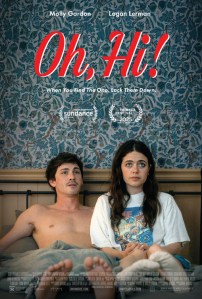 This feels like a charming rom-com by way of a 2010s no-budget mumblecore character-centric dramedy. Oh, Hi! follows a couple (Logan Lerman, Molly Hopkins) on a small vacation to the country to stay at an Air B&B farmhouse. They discover a closet full of bondage gear and get silly with it, strapping Lerman to the bed post. After their fun, it becomes clear there’s a dramatic misunderstanding between the couple. She thought they were an official exclusive couple. He thought they were non-exclusive and he says he’s not ready for any commitment. She leaves him in cuffs attached to the bed and promises that, in 24 hours, she can convince him to agree to be official boyfriend and girlfriend. I thought Oh, Hi! was going to be one kind of movie, maybe a kinky sex comedy (the comedic version of Gerald’s Game?), but it’s really more of a quirky relationship drama by way of kidnapping. The tone is balanced so you never feel the characters are at great risk, but it’s also hard to fathom how this turn of events will be an unorthodox relationship-builder (definitely a scenario that would play very differently if the genders were reversed). Oh, Hi! becomes more of a vehicle to reveal whether this couple should stay together or not, with Hopkins unleashing all of her romantic neuroses as a cathartic deluge. There is an organic escalation as more characters get drawn into this anxious scenario, but the movie loses its comic momentum in the last 20-30 minutes. There really is only so far you can go with this scenario, and when characters are reaching out to witchy spells to instill memory loss, we’re probably tapped out of ideas. Hopkins, who also co-wrote the script with director Sophie Brooks (The Boy Downstairs), is a charismatic find who elevates the comedy while still finding room to ground it in emotional vulnerability. Lerman can only do so much tied to a bed for most of the movie. It’s a fun little movie that finds some natural and effective comedy from its absurd kidnap-for-the-sake-of-the-relationship premise but it ultimately stalls out. Still, Oh, Hi! is full of small pleasures for a good while, from its ensemble, to its surprises, to the ever-shifting dynamic between the couple, and may prove worthwhile even for the commitment-phobic.
Nate’s Grade: B-
Share this:

Die My Love (2025)
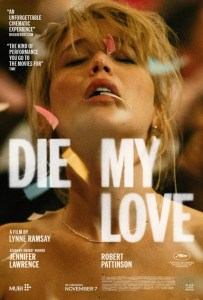 A new Lynne Ramsay (We Need to Talk About Kevin) movie should be a cause of celebration. She’s only directed three movies since 2002 and each is worth every ounce of your consideration. They’re typically genre-defying triptych character studies of people with deep reservoirs of pain and isolation, and so her latest, Die My Love, is a natural fit as it explores one woman’s headfirst descent into post-partum depression. Jennifer Lawrence plays our lead character Grace, a vaguely defined “writer” transplanted to rural Montana, living in her husband’s (Robert Pattinson) family’s old home, but in reality confined is the better term. Ever since her child’s birth, Grace has felt disconnected; from her body, from her feelings, from her husband, from her sense of self. This is a showcase for Lawrence to unravel in a stylistic manner that could feel deeply authentic to millions of women post-birth. She’s struggling to feel something as strongly as she used to, to lift her head above the stormy waters of depression that has engulfed her, and this can lead to some dangerous and impulsive outbursts, like throwing herself through a glass door just to feel something. Her husband is no help, who leaves for long stretches of time on business and tries to act like nothing’s wrong (example of reading the situation entirely wrong: thinking this woman needs a puppy – note, it will not end well for the dog). He also may or may not be having affairs with other women, it’s hard to say what exactly is literal reality here. Ramsay and her co-screenwriters have elected to make a movie more about evoking the feeling of our lead’s alienation and confusion. It’s less about plotting, which unfortunately also hampers the characterization, keeping Grace more of a symbol for accessibility. What she’s going through feels vivid and authentic but she rarely feels like a fleshed-out character rather than an archetype to examine. The same with the supporting roles, including Lakeith Stanfield as her neighbor who she may be fantasizing about or more, it’s hard to say. There’s plenty of unspoken commentary on mental illness and the unfair expectations thrust upon women, especially new mothers, but much of Die My Love feels like winding up Lawrence and setting her loose to make a scene. Make no mistake, she is very very good at being disconnected and angry and raw. There are some bold artistic choices throughout but ultimately, because I didn’t feel connected to the characters, by the end I felt more exhausted by the emotional tumult rather than gaining better awareness of her plight.
Nate’s Grade: C+
Share this:

Blue Moon (2025)
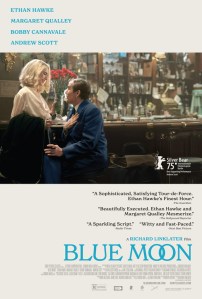 Ethan Hawke is transcendent in Richard Linklater’s Blue Moon, a glorified play set on the opening night of Rodgers and Hammerstein’s Oklahoma! on Broadway, except our star is Lorenz Hart (Hawke), the former lyricist and creative partner of twenty-five years for Rodgers (Andrew Scott). He’s nursing his gripes and hard-won insights at Sardi’s, commiserating with whomever might listen. This is a man who would talk himself hoarse. It’s a great showcase for Hart to expound upon his life, perspective, and desperation, whether it’s re-teaming with his former partner, hoping to get ahead of his alcoholism, the reason for Rodgers’ split, or the hope for love from a college girl (Maragret Qualley) who he’s so clearly projecting confused infatuation upon. Hawke is sensational as the troubled, egotistical, catty, funny, and clearly flailing musical genius who has accomplished so much but is so restless. There is so much to this performance, and each new conversation with someone at this bar feels like it’s unveiling a new dimension to our understanding of Hart, who can be convivial one moment and lacerating the next. I could listen to him prattle for hours. The subplot with the college girl infatuation has some obvious Lolita overtures, though it’s less lecherous middle-aged lust than an over-the-hill artist trying to feel important and wanted by somebody, even if he’s abusing his teacher-student relationship to achieve this (Hart was dealing with his repressed sexuality on top of everything). I found it illuminating in how someone as creative and cutting and incisive as Hart could be taken by his own self-delusions. Linklater lets the story take center stage and gives his stars the needed room to shine. This is that rare character study that finds its perfect lead and the best creative team to bring it to life. Blue Moon is one of the best movies of 2025 and I feel that Hawke’s career-best turn is the best male acting of the year.
Nate’s Grade: A-
Share this:

Nuremberg (2025)
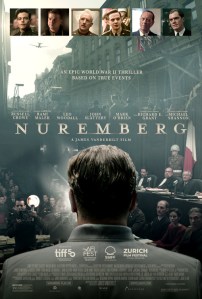 Taking an Oscar-winning courtroom classic and eliminating 40 minutes sounds like a surefire gamble, and while Nuremberg has its heart in the right place, bringing Nazis to justice, it cannot help but feel like a more shallow and rushed version of 1961’s Judgement at Nuremberg. That’s not to say different movies cannot exist from the same source material or true story, even in the shadow of famous stories. However, this version feels strangely perfunctory, condensing the worldwide judicial response to the horrors of the Holocaust into a simplified buddy movie about a psychologist (Rami Malek) who has to learn the hard way that maybe, just maybe, Hermann Goring (Russell Crowe) might not be trustworthy. It’s frustrating that the depth of this story and the plight of so many is reduced to one guy getting too close to his subject as well as having to learn the most obvious lessons about applied evil. Also, the culminating courtroom showdown, where so much hangs in the balance and Goring has been hyped as the most of challenging of cross-examination opponents, and it all resolves so easily, with a different prosecutor essentially using a cheat code to undo Goring’s pseudo-intellectual front. It’s quite a lot of buildup for a, “Wait, that’s it?” response, and much of the movie follows this same disappointing route. The acting is relatively good all around, with Crowe especially good as a chummy narcissist, and the production quality is sufficient to recreate its post-war period, but I couldn’t help but feel that I was missing out on a richer story. It’s so flattened out and self-important with its limited details to actually satisfy. The ending tries to draw a direct line to Trump today and I don’t quite know if it’s done the work. Nuremberg is one of those Important Movies that garners early Oscar buzz on paper, and then when people actually see it, falls away as an also-ran, mostly because it was missing a few too many important elements to resonate. It takes 130 minutes for Malik to learn that Nazis might not make good friends. You’ll probably know that already.
Nate’s Grade: C+
Share this:

Mercy (2026)
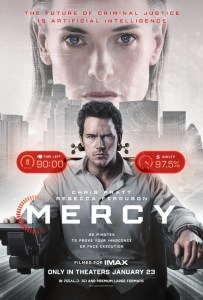 Detective Chris Raven (Chris Pratt) wakes up strapped to a chair. An A.I. judge (Rebecca Ferguson) informs him that he has been changed with the murder of his wife, and thanks to the new Mercy program instituted by the Los Angeles justice system, he will have 90 minutes to prove his innocence to a “reasonable doubt” level of 91% guilty (is that all a “reasonable doubt” is going for these days?). If he fails to convince the A.I. judge, then he will be terminated at the end of those 90 minutes. Start the clock.
Mercy is essentially a screen life movie with a high-concept twist, but at no time was I captivated with the mystery or intellectually satisfied by the application of its storytelling angle. We’ve seen similar movies recently, notably 2018’s Searching and far far less notably the 2025 War of the Worlds, where the movie screen is an extension of a computer screen that holds the borders and tools of our storytelling. In a way it reminds me of the found footage boom of the early 2010s, a hot gimmick that could get studio execs to say yes to projects that they would otherwise have passed on. However, there still needs to be careful ingenuity about how to incorporate these elements and, even more importantly, how to work within the limitations of your gimmick. With Mercy, our main character is basically trying to prove his innocence in real time with an A.I. judge who really functions more like an A.I. assistant, granting him access to people and databases even his police position would not have immediate access to. The recreation of the crime scene with the clues and evidence has a very Detroit Become Human feel (that’s a sci-fi video game that plays more like a movie). The A.I. judge is willing to help out this convicted man as long as he doesn’t admit guilt, because then it’s straight to execution time. For ninety minutes, Chris Raven has to crack his own murder case. The real-time element is meant to provide a sense of urgency, a literal ticking clock, but it’s also quite the misstep when your movie isn’t very good. This allows the audience to mentally count down how much time is left before your movie is finally over. The screen life aspects are pretty superficial and visually dull even if the graphics as being pulled around like interactive three-dimensional objects. The fact that this movie was shot for IMAX is astounding.
 The problem is that the plot is too predictable at every turn. We have a future criminal justice system made for automation and expediency, so it’s not going to be too much of a leap to suspect it might not be operating at the level of success its proponents profess. There’s a long history of stories presenting a new technological leap that is meant to be fool-proof that, shocker, is proven to be anything but. Right away, the audience is already going to be suspecting that the Mercy system is compromised or at least prone to errors like our present criminal justice system. We can safely assume that our protagonist is innocent, and if that’s the case then the implicit question is how many others who were tried and convicted were also ultimately innocent? Some might call it a death row metaphor but it’s literally the same thing just with a high-tech A.I. spin. The next question becomes is the potential error a sign of the limitations of assigning such power to seemingly infallible computers, or is it being deliberately compromised and manipulated? Are certain powers-that-be using this as an excuse to eliminate undesirable peoples and populations? The case of Chris Raven is meant to unveil a larger, systemic problem of justice not being served. And yet, the movie doesn’t exactly explore this obvious implication.
I’m going to dive into spoilers with this next paragraph because I think it’s worthwhile and also I don’t think you’re missing anything with Mercy. If you already assume that Chris is innocent or set up, there’s only so many other places you can go as a story. So with that warning addressed, the Mercy system is really easy to trick, as evidenced by our eventual culprit who has the know-how to digitally erase and alter security footage. Didn’t know this guy had those kinds of skills but, hey, people can surprise you or, more accurately, when the screenplay calls upon enough coincidences. However, there’s another layer of conspiracy afoot. This one guy is responsible for setting Chris Raven up because his own brother was accused and executed by Mercy even after he gave the police an alibi that was ignored. He wants vengeance for the injustice done to his family. This means there’s also the unraveling of who was responsible for this other guy’s wrongful arrest and execution, and wouldn’t you know it happens to be Chris Raven’s own partner, who needed the Mercy program to be seen as trustworthy. The movie never deals with the implications of this. It doesn’t really confront the moral turpitude of killing an innocent man, and it doesn’t think big picture to ask how many other innocent people have been sacrificed as cover. Amazingly, the last line of the movie involves Chris Raven saying, “Humans and A.I., we all make mistakes. And we learn.” What? Technology shouldn’t make mistakes. Alexander Pope didn’t say, “To err is human, and also these new contraptions. Have you seen these textile factories? Wild.” We don’t expect technology to fail us, especially if we are putting judgement over life and death as one of its tasks. This sounds like dubious excuse-making for a system literally killing innocents in the name of the law, and yet our hero treats the whole revelation like, “Well, you gotta break some eggs for an omelette.” It’s such a callous, incompetent response to an immediate problem that his own police force is exploiting. Yet the movie doesn’t blame the faulty A.I. system, which I repeat even some random guy was able to hack and manipulate, and instead looks at it as a tool, like when people try to separate guns from gun violence. However, in this case, the gun is making its own calculations on who deserves to die, and, again, being manipulated by randos. This gets a little more unseemly when you realize that the movie studio’s release is from Amazon, which would very much like you, dear citizen, to stop villainizing A.I. and accept its omnipresence in your new digital life.
 Mercifully, Mercy holds to its countdown, though there’s an extra period of “stoppage time” with an action sequence outside of the chair as climax. The mystery is dull, the plot is predictable (if you don’t suspect who the real killer is after 30 minutes, this might be your first movie, so I’ll tell you now – they get better), the world building is underwritten (who needs an exploration of the large-ranging moral implications of this system when we get police on drone cycles!), and the fun of its creative ingenuity is gasping. It’s forever going to be the Chris-Pratt-stuck-in-a-death-chair movie. This concept could have worked but there needed to be significant revisions, especially unpacking the larger implications for this new system of justice outsourcing justice to all-knowing machines. That’s not this movie. Mercy isn’t even overtly critical of artificial intelligence, instead excusing its faults as “user error” from bad actors. It’s a film too afraid to have any strong sentiments, which makes for a pretty lifeless time at the movies. The machines have won.
Nate’s Grade: D+
Share this:

Hurry Up Tomorrow (2025)
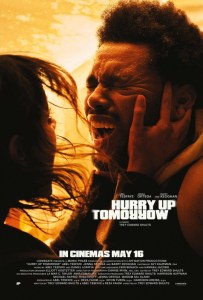
The pop star vanity project is a dubious film enterprise, though it’s been quite a while since we had a theatrically released bauble from one of the most popular singers in the world. Typically, if musicians want to get experimental and “arty” with a visual medium, they turn to longer-form music videos for even the entirety of a new album release, like what Beyonce and Halsey have done. That wasn’t good enough for The Weeknd, a.k.a. Abel Tesfaye, as he co-wrote a starring vehicle for himself that could be filmed alongside his world tour where he essentially plays an enigmatic version of himself that Jenna Ortega is obsessed with. At this rate, I’m surprised he didn’t write a scene where a bunch of women congratulate him on being the world’s best lover. Hurry Up Tomorrow is a glorified longer-form music video collection of extended musical performances and some more trippy experimental videos in the second half. It’s also a low-rent Misery with Ortega being a crazy fan who eventually takes her target of obsession hostage. She thinks she can help the troubled singer confront his past through her extreme therapy. If this was the whole dynamic, this could have been the movie rather than the final twenty minutes of it. It’s gob-smacking that Tesfaye is able to spare his life through the unquestioned power of song and his talent (“You had it in you all along, most talented superstar”). By the end, I don’t think anyone has learned anything after all the kidnapping and murders and arson except that Tesfaye has a pretty high opinion of himself. Unless you’re the biggest Weeknd fan, you’ll be left blinded by the meandering artistic hubris of Hurry Up Tomorrow. There’s just nothing here to grapple with besides the self-serious self-indulgence. What to expect from two of the three credited creators of HBO’s abysmal and cringe-inducing canceled-after-one-season show, The Idol?
Nate’s Grade: D
Share this:

Send Help (2026)

I am grateful for Sam Raimi and I’m even more grateful for Sam Raimi movies. The director began in low-budget gore-fests with a dash of goofy slapstick to balance the gross-out gratuity, and these sensibilities have never left the man. He enlivens any genre he works in, from Western (The Quick and the Dead), to superhero (original Spider-Man trilogy, Dr. Strange and the Multiverse of Madness), and the occasional awards-drama crime tragedy (A Simple Plan). But the man is at his best on his home turf of horror/thrillers with his gonzo style and devilish sense of humor. Send Help is the most unabashedly “Sam Raimi movie” since 2009’s Drag Me to Hell, which already makes it worth your time. It’s basically the schlockier, more condensed and focused version of Triangle of Sadness, even borrowing a similar premise of a put-upon corporate subordinate (Rachel McAdams) and her fussy, misogynist, blowhard of a boss (Dylan O’Brien) stranded on a deserted island and the power dynamics flip. Now she’s the one in charge because she has leaned survivalist skills thanks to her aspirations to being a contestant on the reality TV show Survivor. As the movie progresses, what I really appreciated was the level of nuance given to both of these stranded characters. It would be all-too easy to make her character impossibly noble, and the screenplay adds some intriguing dimensions that make you question some of her motives. It would be all-too easy to make his character irredeemably evil, and while you’re never going to be in danger of switching loyalties, the screenplay provides shades of empathy to him too. I also appreciated how nasty the movie gets, both in lurches of horror comedy zaniness, but also in how nasty the characters get to one another. McAdams is wonderful, though the concerted effort to “ugly up” a Hollywood starlet amounts to frumpy sweaters and a dash of tuna fish at the corner of her mouth. There was no point I wasn’t entertained, especially from the shifting dynamic between the two leads. I may be in a minority here but Send Help is a better developed and more satisfying version of Best Picture-nominee Triangle of Sadness. It made me laugh and cower. May we never be without new Sam Raimi movies.
Nate’s Grade: B+


 nathanzoebl
You must be logged in to post a comment.